
An electric dipole of dipole moment vec p is placed in a uniform electric field vec E. Find the maximum torque experienced by the dipole.

Collegedunia Team logo

Collegedunia Team Content Curator

Content Curator

When an electric dipole of dipole moment vector p is placed in a uniform electric field vector E, it experiences a torque given by the formula:

τ = p × E

where τ is the torque vector, p is the dipole moment vector, and E is the electric field vector.

The magnitude of the torque is given by:

|τ| = p E sin θ

where θ is the angle between the dipole moment vector and the electric field vector.

The maximum torque occurs when the dipole moment vector is perpendicular to the electric field vector, i.e., when θ = 90 degrees. In this case, sin θ = 1, and the magnitude of the torque is:

|τ|max = p E

Therefore, the maximum torque experienced by the dipole is equal to the product of the dipole moment and the electric field strength.
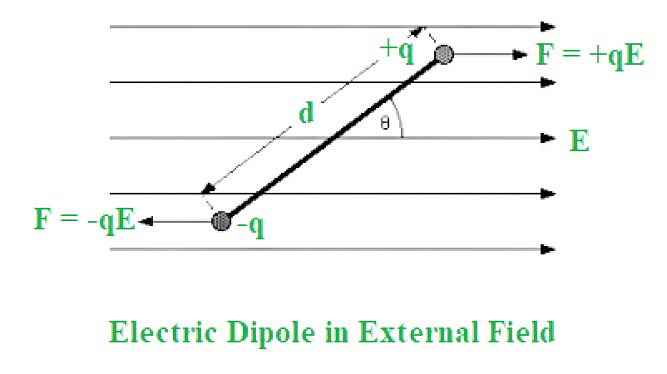
Electric Dipole in External Field

Electric Dipole in External Field

Also check:

CBSE CLASS XII Related Questions

  • 1.
    A rectangular glass slab ABCD (refractive index 1.5) is surrounded by a transparent liquid (refractive index 1.25) as shown in the figure. A ray of light is incident on face AB at an angle \(i\) such that it is refracted out grazing the face AD. Find the value of angle \(i\).
    A rectangular glass slab ABCD (refractive index 1.5)


      • 2.
        In a compound microscope, an object is placed at a distance of 1.5 cm from the objective of focal length 1.25 cm. The eyepiece has a focal length of 5 cm. The final image is formed at infinity. Calculate the distance between the objective and the eyepiece.


          • 3.
            In a Young’s double-slit experiment, two light waves, each of intensity \( I_0 \), interfere at a point, having a path difference \( \frac{\lambda}{8} \) on the screen. Find the intensity at this point.


              • 4.
                A particle of charge \( q \) is moving with a velocity \( \vec{v} \) at a distance \( d \) from a long straight wire carrying a current \( I \) as shown in the figure. At this instant, it is subjected to a uniform electric field \( \vec{E} \) such that the particle keeps moving undeviated. In terms of unit vectors \( \hat{i}, \hat{j}, \) and \( \hat{k} \), find:
                the magnetic field \( \vec{B} \),
                the magnetic force \( \vec{F}_m \), and
                the electric field \( \vec{E} \) acting on the charge.
                A particle of charge  q q is moving with a velocity  v v   at a distance  d d


                  • 5.
                    An alternating current is given by \( I = I_0 \cos (100\pi t) \). The least time the current takes to decrease from its maximum value to zero will be:

                      • \(\left( \frac{1}{200} \right) \text{s}\)
                      • \(\left( \frac{1}{150} \right) \text{s}\)
                      • \(\left( \frac{1}{100} \right) \text{s}\)
                      • \(\left( \frac{1}{50} \right) \text{s}\)

                    • 6.
                      A wire of resistance \( R \), connected to an ideal battery, consumes a power \( P \). If the wire is gradually stretched to double its initial length, and connected across the same battery, the power consumed will be:

                        • \( \frac{P}{4} \)
                        • \( \frac{P}{2} \)
                        • \( P \)
                        • \( 2P \)
                      CBSE CLASS XII Previous Year Papers

                      Comments


                      No Comments To Show

