




CBSE Class 12 Mathematics Set 1- (65/5/1) Question Paper 2026 is available for download here. CBSE conducted Class 12 Mathematics exam on March 9, 2026 from 10:30 AM to 1:30 PM. The Mathematics theory paper is of 80 marks, and the internal assessment is of 20 marks.
Mathematics question paper includes MCQs (1 mark each), short-answer type questions (2 & 3 marks each), and long-answer type questions (4 & 6 marks each) which makes up the total of 80 marks.
Download CBSE Class 12 Mathematics Set 1- (65/5/1) Question Paper 2026 with detailed solutions from the links provided below.
CBSE Class 12 Mathematics Set 1- (65/5/1) Question Paper 2026 with Solution PDF
| CBSE Official PDF | CD PDF | CD PDF with Solutions |
|---|---|---|
| Download official PDF 0.73 MB | Download Collegedunia PDF 0.40 MB | Download solutions PDF 0.47 MB |
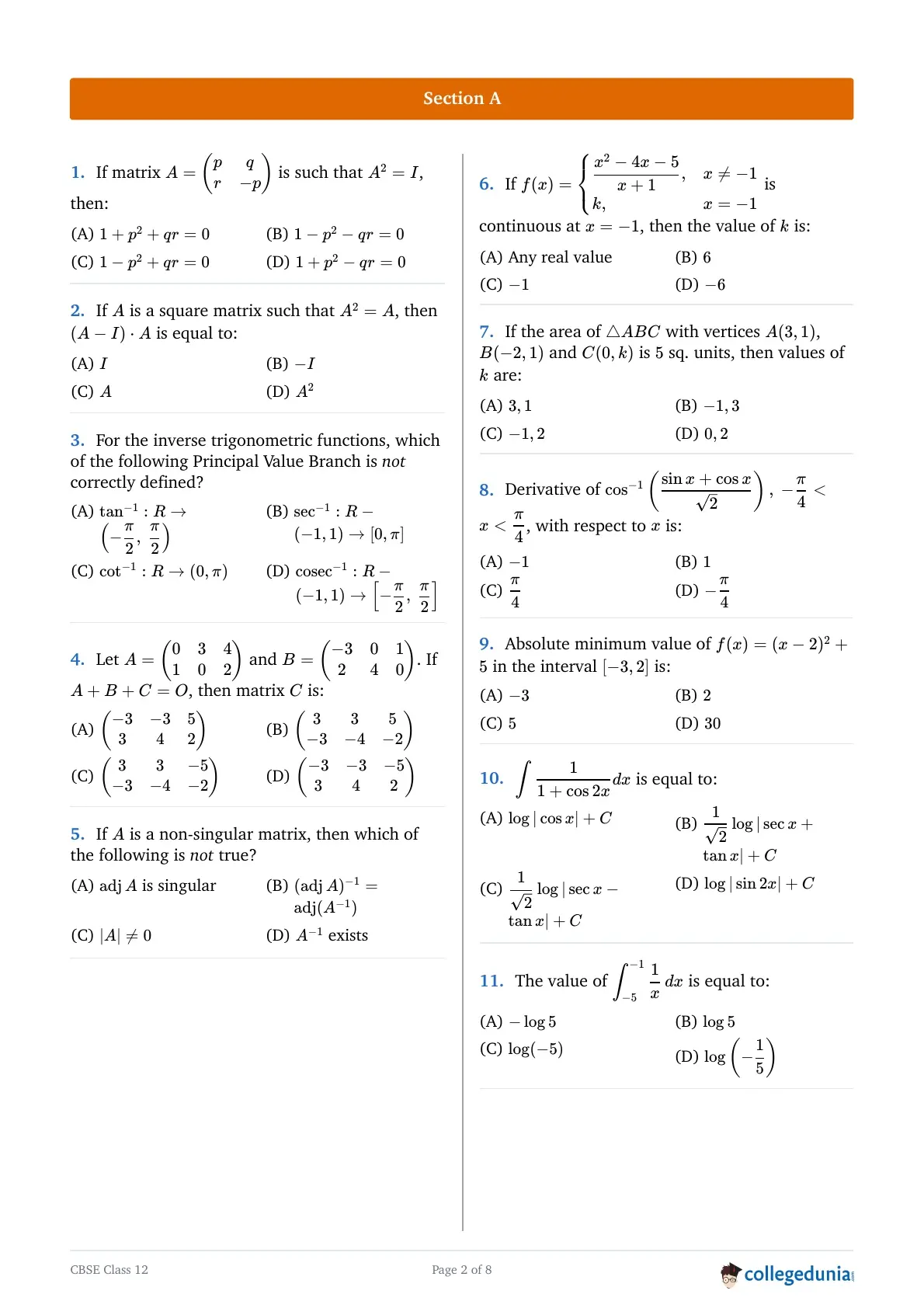
If matrix \( A = \begin{bmatrix} -p & q \\ r & p \end{bmatrix} \) is such that \( A^2 = I \), then :
Detailed Solution
Concept:
Matrix multiplication is defined as the dot product of rows of the first matrix and columns of the second.
The Identity matrix \( I \) for a \( 2 \times 2 \) system is \( \begin{bmatrix} 1 & 0 \\ 0 & 1 \end{bmatrix} \).
Two matrices are equal if and only if their corresponding entries are identical.
Step 1: Calculate the square of the given matrix \( A \)
We are given \( A = \begin{bmatrix} -p & q
r & p \end{bmatrix} \). \[ \begin{aligned} A^2 &= \begin{bmatrix} -p & q \\ r & p \end{bmatrix} \begin{bmatrix} -p & q \\ r & p \end{bmatrix}
[2ex] &= \begin{bmatrix} (-p)(-p) + (q)(r) & (-p)(q) + (q)(p)
(r)(-p) + (p)(r) & (r)(q) + (p)(p) \end{bmatrix}
[2ex] &= \begin{bmatrix} p^2 + qr & -pq + pq \\ -rp + pr & qr + p^2 \end{bmatrix}
[2ex] &= \begin{bmatrix} p^2 + qr & 0 \\ 0 & p^2 + qr \end{bmatrix} \end{aligned} \]
Step 2: Apply the condition \( A^2 = I \) to form an equation
Equating the result from Step 1 to the identity matrix: \[ \begin{bmatrix} p^2 + qr & 0 \\ 0 & p^2 + qr \end{bmatrix} = \begin{bmatrix} 1 & 0 \\ 0 & 1 \end{bmatrix} \]
Comparing the element in the first row and first column: \[ p^2 + qr = 1 \]
Step 3: Rearrange terms to match the required format
From the equation \( p^2 + qr = 1 \), we shift all terms to one side: \[ 1 - p^2 - qr = 0 \]
This result matches the expression given in option (B). Quick Tip: Always double-check signs during matrix multiplication, especially when dealing with variables like \(-p\).
For a \( 2 \times 2 \) matrix with trace zero, \( A^2 \) will always be a scalar multiple of the identity matrix.
If \( A \) is a square matrix such that \( A^2 = A \), then \( (A - I)^3 - A \) is equal to :
Detailed Solution
Concept:
A matrix \( A \) is idempotent if \( A^2 = A \). This also implies \( A^3 = A^2 \cdot A = A \cdot A = A \).
The Identity matrix \( I \) commutes with any square matrix: \( AI = IA = A \).
Standard binomial expansion \( (A - B)^3 = A^3 - 3A^2B + 3AB^2 - B^3 \) is valid only if \( AB = BA \).
Step 1: Expand the cubic expression \( (A - I)^3 \)
Since \( A \) and \( I \) commute, we expand as: \[ (A - I)^3 = A^3 - 3A^2I + 3AI^2 - I^3 \]
Simplifying using \( I^n = I \) and \( MI = M \): \[ (A - I)^3 = A^3 - 3A^2 + 3A - I \]
Step 2: Substitute the idempotent property \( A^2 = A \) into the expansion
Given \( A^2 = A \), it follows that \( A^3 = A^2 \cdot A = A \cdot A = A \).
Substituting these into the expression: \[ (A - I)^3 = A - 3(A) + 3A - I \] \[ (A - I)^3 = A - I \]
Step 3: Evaluate the final expression \( (A - I)^3 - A \)
Substitute the result from Step 2: \[ \begin{aligned} ((A - I)^3) - A &= (A - I) - A
[2ex] &= A - I - A
[2ex] &= -I \end{aligned} \] Quick Tip: For an idempotent matrix, any power \( A^n = A \).
Remember that \( (I - A)^2 = I - 2A + A^2 = I - 2A + A = I - A \), which is a useful shortcut in similar problems.
For the inverse trigonometric functions, which of the following Principal Value Branch is not correctly defined ?
Detailed Solution
Concept:
Principal value branches are the specific ranges defined to make trigonometric functions bijective so their inverses can exist.
We must identify which range correctly excludes points where the original function is undefined (division by zero).
Step 1: Evaluate the standard branches for options (A), (B), and (C)
\( \tan^{-1} x \): The range is the open interval \( (-\pi/2, \pi/2) \). Correct.
\( \sec^{-1} x \): Since \( \sec \theta = 1/\cos \theta \), the value \( \pi/2 \) (where \( \cos \theta = 0 \)) must be excluded from \( [0, \pi] \). Correct.
\( \cot^{-1} x \): The range is the open interval \( (0, \pi) \). Correct.
Step 2: Analyze the definition of \( cosec^{-1} x \) in option (D)
The function \( cosec \theta = 1/\sin \theta \).
The function is undefined when \( \sin \theta = 0 \), which occurs at \( \theta = 0 \) within the interval \( [-\pi/2, \pi/2] \).
Therefore, the principal value branch must be \( [-\pi/2, \pi/2] - \{0\} \).
Step 3: Identify the error
Option (D) provides the range as \( [-\pi/2, \pi/2] \) but fails to exclude the singular point \( \{0\} \).
Thus, it is not a correctly defined principal value branch. Quick Tip: Always remember the "holes" in reciprocal trig functions: sec excludes \( \pi/2 \), cosec excludes \( 0 \).
Think of the graphs: wherever the original trig function has a vertical asymptote, that point is excluded from the range of the inverse.
Let \( A = \begin{bmatrix} 0 & -3 & 4 \\ 1 & 0 & 2 \end{bmatrix} \) and \( B = \begin{bmatrix} -3 & 0 & 1 \\ 2 & 4 & 0 \end{bmatrix} \). If \( A + B + C = O \), then matrix \( C \) is :
Detailed Solution
Concept:
Matrix addition is performed element-wise.
The Zero matrix \( O \) is a matrix of the same order where all elements are \( 0 \).
If \( A + B + C = O \), then \( C = -(A + B) \).
Step 1: Compute the sum of matrices \( A \) and \( B \)
Given \( A = \begin{bmatrix} 0 & -3 & 4 \\ 1 & 0 & 2 \end{bmatrix} \) and \( B = \begin{bmatrix} -3 & 0 & 1 \\ 2 & 4 & 0 \end{bmatrix} \). \[ \begin{aligned} A + B &= \begin{bmatrix} 0+(-3) & -3+0 & 4+1 \\ 1+2 & 0+4 & 2+0 \end{bmatrix}
[2ex] &= \begin{bmatrix} -3 & -3 & 5 \\ 3 & 4 & 2 \end{bmatrix} \end{aligned} \]
Step 2: Find the matrix \( C \) using the equation \( A + B + C = O \)
Rearranging the equation: \( C = - (A + B) \). \[ \begin{aligned} C &= - \begin{bmatrix} -3 & -3 & 5 \\ 3 & 4 & 2 \end{bmatrix}
[2ex] &= \begin{bmatrix} -(-3) & -(-3) & -5 \\ -3 & -4 & -2 \end{bmatrix}
[2ex] &= \begin{bmatrix} 3 & 3 & -5 \\ -3 & -4 & -2 \end{bmatrix} \end{aligned} \]
Step 3: Compare the resulting matrix with the given options
The calculated matrix \( C = \begin{bmatrix} 3 & 3 & -5 \\ -3 & -4 & -2 \end{bmatrix} \) corresponds exactly to option (C). Quick Tip: To solve \( A+B+C=0 \) quickly, sum the elements and then flip their signs.
Matrix dimensions must match for addition; both \( A \) and \( B \) are \( 2 \times 3 \), so the operation is valid.
If \( A \) is a non-singular matrix, then which of the following is \textit{not true ?
Detailed Solution
Concept:
A non-singular matrix \( A \) is a square matrix whose determinant \( |A| \) is not equal to zero.
The inverse \( A^{-1} \) exists if and only if \( |A| \neq 0 \).
Property of Adjoint: \( |adj A| = |A|^{n-1} \), where \( n \) is the order of the matrix.
Step 1: Verify options (C) and (D) based on the definition of non-singularity
Since \( A \) is non-singular:
By definition, \( |A| \neq 0 \). So, (C) is true.
Since \( |A| \neq 0 \), the inverse \( A^{-1} = \frac{adj A}{|A|} \) is defined. So, (D) is true.
Step 2: Analyze the singularity of the adjoint matrix in option (A)
We use the determinant property: \( |adj A| = |A|^{n-1} \).
Given \( A \) is non-singular, \( |A| \neq 0 \).
Consequently, \( |A|^{n-1} \) will also be non-zero (for any order \( n \geq 1 \)).
Since \( |adj A| \neq 0 \), \( adj A \) is a non-singular matrix.
Therefore, the statement "\( adj A \) is singular" is false.
Step 3: Check option (B) for completeness
Using the property \( adj A = |A| A^{-1} \): \[ (adj A)^{-1} = (|A| A^{-1})^{-1} = \frac{1}{|A|} (A^{-1})^{-1} = \frac{1}{|A|} A \]
Also, \( adj (A^{-1}) = |A^{-1}| (A^{-1})^{-1} = \frac{1}{|A|} A \).
Since both sides equal \( \frac{1}{|A|} A \), (B) is a true statement. Quick Tip: A non-singular matrix preserves its non-singularity through common transformations like finding its adjoint or its inverse.
If \( |A| \neq 0 \), then every property involving \( |A| \) in the denominator or as a product factor will remain non-zero.
If \( f(x) = \begin{cases} \frac{x^2 - 4x - 5}{x + 1}, & x \neq -1
k, & x = -1 \end{cases} \) is continuous at \( x = -1 \), then the value of \( k \) is :
Detailed Solution
Concept:
A function \( f(x) \) is continuous at a point \( x = a \) if \( \lim_{x \to a} f(x) = f(a) \).
For the limit to exist, the indeterminate form \( \frac{0}{0} \) must be resolved by factoring or other algebraic methods.
Step 1: Evaluate the limit of \( f(x) \) as \( x \to -1 \)
Since \( f(x) \) is continuous at \( x = -1 \), we must have: \[ \lim_{x \to -1} f(x) = f(-1) \]
Given \( f(-1) = k \), let's calculate the limit: \[ \lim_{x \to -1} \frac{x^2 - 4x - 5}{x + 1} \]
Substituting \( x = -1 \) gives the indeterminate form \( \frac{1 + 4 - 5}{-1 + 1} = \frac{0}{0} \).
Step 2: Simplify the expression by factoring the numerator
\[ x^2 - 4x - 5 = x^2 - 5x + x - 5 = x(x - 5) + 1(x - 5) = (x - 5)(x + 1) \]
Now, rewrite the limit: \[ \begin{aligned} \lim_{x \to -1} \frac{(x - 5)(x + 1)}{x + 1} &= \lim_{x \to -1} (x - 5)
[2ex] &= -1 - 5
[2ex] &= -6 \end{aligned} \]
Step 3: Equate the limit to the functional value
For continuity: \[ \lim_{x \to -1} f(x) = f(-1) \] \[ -6 = k \]
Thus, the value of \( k \) is \( -6 \), which matches option (D). Quick Tip: Whenever a function is defined piecewise with a "not equal to" condition, the limit usually involves removing a common factor.
You can also use L'Hôpital's Rule for \( 0/0 \) forms: \( \lim \frac{2x - 4}{1} = 2(-1) - 4 = -6 \).
If the area of \( \Delta ABC \) with vertices \( A(3, 1), B(-2, 1) \) and \( C(0, k) \) is \( 5 \) sq. units, then values of \( k \) are :
Detailed Solution
Concept:
The area of a triangle with vertices \( (x_1, y_1), (x_2, y_2), (x_3, y_3) \) is given by:
\[ Area = \frac{1}{2} |x_1(y_2 - y_3) + x_2(y_3 - y_1) + x_3(y_1 - y_2)| \]
Since area is always positive, the absolute value is essential, leading to two possible cases for the variable.
Step 1: Substitute the given coordinates into the area formula
Let \( (x_1, y_1) = (3, 1) \), \( (x_2, y_2) = (-2, 1) \), and \( (x_3, y_3) = (0, k) \). \[ \begin{aligned} 5 &= \frac{1}{2} |3(1 - k) + (-2)(k - 1) + 0(1 - 1)|
[2ex] 10 &= |3 - 3k - 2k + 2|
[2ex] 10 &= |5 - 5k| \end{aligned} \]
Step 2: Solve the absolute value equation
Case 1: \( 5 - 5k = 10 \) \[ \begin{aligned} -5k &= 10 - 5
[2ex] -5k &= 5
[2ex] k &= -1 \end{aligned} \]
Step 3: Solve the second case
Case 2: \( 5 - 5k = -10 \) \[ \begin{aligned} -5k &= -10 - 5
[2ex] -5k &= -15
[2ex] k &= 3 \end{aligned} \]
The values of \( k \) are \( -1 \) and \( 3 \), which matches option (B). Quick Tip: Never forget the "absolute value" in the area formula; area problems with a given value usually result in two possible answers.
You can also use a determinant to calculate the area for higher accuracy in complex problems.
Derivative of \( \cos^{-1} \left( \frac{\sin x + \cos x}{\sqrt{2}} \right), -\frac{\pi}{4} < x < \frac{\pi}{4} \) with respect to \( x \) is :
Detailed Solution
Concept:
Simplify the trigonometric expression inside the inverse function using compound angle formulas.
\( \cos(A - B) = \cos A \cos B + \sin A \sin B \).
Property: \( \cos^{-1}(\cos \theta) = \theta \) if \( \theta \in [0, \pi] \).
Step 1: Simplify the internal trigonometric expression
Let \( y = \cos^{-1} \left( \frac{\sin x + \cos x}{\sqrt{2}} \right) \).
Rewrite the term: \[ \frac{\sin x + \cos x}{\sqrt{2}} = \frac{1}{\sqrt{2}} \cos x + \frac{1}{\sqrt{2}} \sin x \]
We know \( \cos(\pi/4) = \sin(\pi/4) = 1/\sqrt{2} \). \[ \frac{\sin x + \cos x}{\sqrt{2}} = \cos x \cos \left( \frac{\pi}{4} \right) + \sin x \sin \left( \frac{\pi}{4} \right) = \cos \left( x - \frac{\pi}{4} \right) \]
Step 2: Apply the range constraint to simplify the inverse cosine function
Now, \( y = \cos^{-1} \left( \cos \left( x - \frac{\pi}{4} \right) \right) \).
Given \( -\frac{\pi}{4} < x < \frac{\pi}{4} \).
Subtracting \( \pi/4 \): \[ -\frac{\pi}{2} < x - \frac{\pi}{4} < 0 \]
Since \( \cos(-\theta) = \cos \theta \), we can write \( \cos(x - \pi/4) = \cos(\pi/4 - x) \).
If \( -\frac{\pi}{2} < x - \frac{\pi}{4} < 0 \), then \( 0 < \frac{\pi}{4} - x < \frac{\pi}{2} \).
This value is in the principal branch \( [0, \pi] \).
So, \( y = \frac{\pi}{4} - x \).
Step 3: Differentiate with respect to \( x \)
\[ \frac{dy}{dx} = \frac{d}{dx} \left( \frac{\pi}{4} - x \right) \] \[ \frac{dy}{dx} = 0 - 1 = -1 \]
This matches option (A). Quick Tip: Always simplify inverse trig functions before differentiating to avoid using the chain rule on complex radicals.
Check the range carefully to ensure the simplified variable form is valid within the principal branch.
Absolute minimum value of \( f(x) = (x - 2)^2 + 5 \) in the interval \( [-3, 2] \) is :
Detailed Solution
Concept:
To find the absolute minimum in a closed interval, we must check the functional values at the critical points and the endpoints.
Critical points are where \( f'(x) = 0 \).
Step 1: Find the critical points by differentiating \( f(x) \)
\[ f(x) = (x - 2)^2 + 5 \] \[ f'(x) = 2(x - 2) \]
Setting \( f'(x) = 0 \): \[ 2(x - 2) = 0 \Rightarrow x = 2 \]
The critical point \( x = 2 \) is within the given interval \( [-3, 2] \).
Step 2: Calculate the functional values at critical points and endpoints
The endpoints are \( x = -3 \) and \( x = 2 \).
At \( x = -3 \): \[ f(-3) = (-3 - 2)^2 + 5 = (-5)^2 + 5 = 25 + 5 = 30 \]
At \( x = 2 \) (which is both a critical point and an endpoint): \[ f(2) = (2 - 2)^2 + 5 = 0^2 + 5 = 5 \]
Step 3: Identify the absolute minimum value
Comparing the values:
Values are \( \{30, 5\} \).
The smallest value is \( 5 \).
So, the absolute minimum value is \( 5 \), matching option (C). Quick Tip: For a parabola of the form \( (x - h)^2 + k \), the vertex \( (h, k) \) is the absolute minimum point if the parabola opens upward.
Since \( (x - 2)^2 \) is always \( \geq 0 \), the expression is minimum when the squared term is zero.
\( \int \frac{1}{\sqrt{1 + \cos 2x}} \, dx \) is equal to :
Detailed Solution
Concept:
Use trigonometric identity: \( 1 + \cos 2x = 2\cos^2 x \).
Standard Integral: \( \int \sec x \, dx = \log |\sec x + \tan x| + C \).
Step 1: Simplify the integrand using trig identities
Let \( I = \int \frac{1}{\sqrt{1 + \cos 2x}} \, dx \).
Substitute \( 1 + \cos 2x = 2\cos^2 x \): \[ I = \int \frac{1}{\sqrt{2\cos^2 x}} \, dx \] \[ I = \int \frac{1}{\sqrt{2} \cos x} \, dx \]
Step 2: Transform the integral into a standard form
Factor out the constant \( 1/\sqrt{2} \): \[ I = \frac{1}{\sqrt{2}} \int \frac{1}{\cos x} \, dx \] \[ I = \frac{1}{\sqrt{2}} \int \sec x \, dx \]
Step 3: Integrate and add the constant of integration
Applying the standard formula for \( \int \sec x \, dx \): \[ I = \frac{1}{\sqrt{2}} \log |\sec x + \tan x| + C \]
This result matches option (B). Quick Tip: Always look for ways to eliminate square roots in denominators using double angle identities (\( \cos 2x \)).
Remember: \( 1 - \cos 2x = 2\sin^2 x \) and \( 1 + \cos 2x = 2\cos^2 x \).
The value of \( \int_{-5}^{-1} \frac{1}{x} \, dx \) is equal to :
Detailed Solution
Concept:
The integral of \( \frac{1}{x} \) is \( \log |x| \).
The Fundamental Theorem of Calculus states \( \int_a^b f(x) \, dx = F(b) - F(a) \).
Always use the absolute value inside the logarithm for real-valued integrals of \( 1/x \).
Step 1: Apply the integration rule for \( 1/x \)
Let the integral be \( I = \int_{-5}^{-1} \frac{1}{x} \, dx \).
The antiderivative of \( \frac{1}{x} \) is \( \log |x| \). \[ I = [\log |x|]_{-5}^{-1} \]
Step 2: Substitute the upper and lower limits
\[ I = \log |-1| - \log |-5| \]
Since \( |-1| = 1 \) and \( |-5| = 5 \): \[ I = \log 1 - \log 5 \]
Step 3: Simplify the final value
We know that \( \log 1 = 0 \) for any base. \[ I = 0 - \log 5 \] \[ I = -\log 5 \]
This matches option (A). Quick Tip: Always remember the absolute value: \( \int \frac{1}{x} dx = \log|x| \). Without it, you might incorrectly try to evaluate \( \log(-1) \).
Property: \( \log(1/a) = -\log a \).
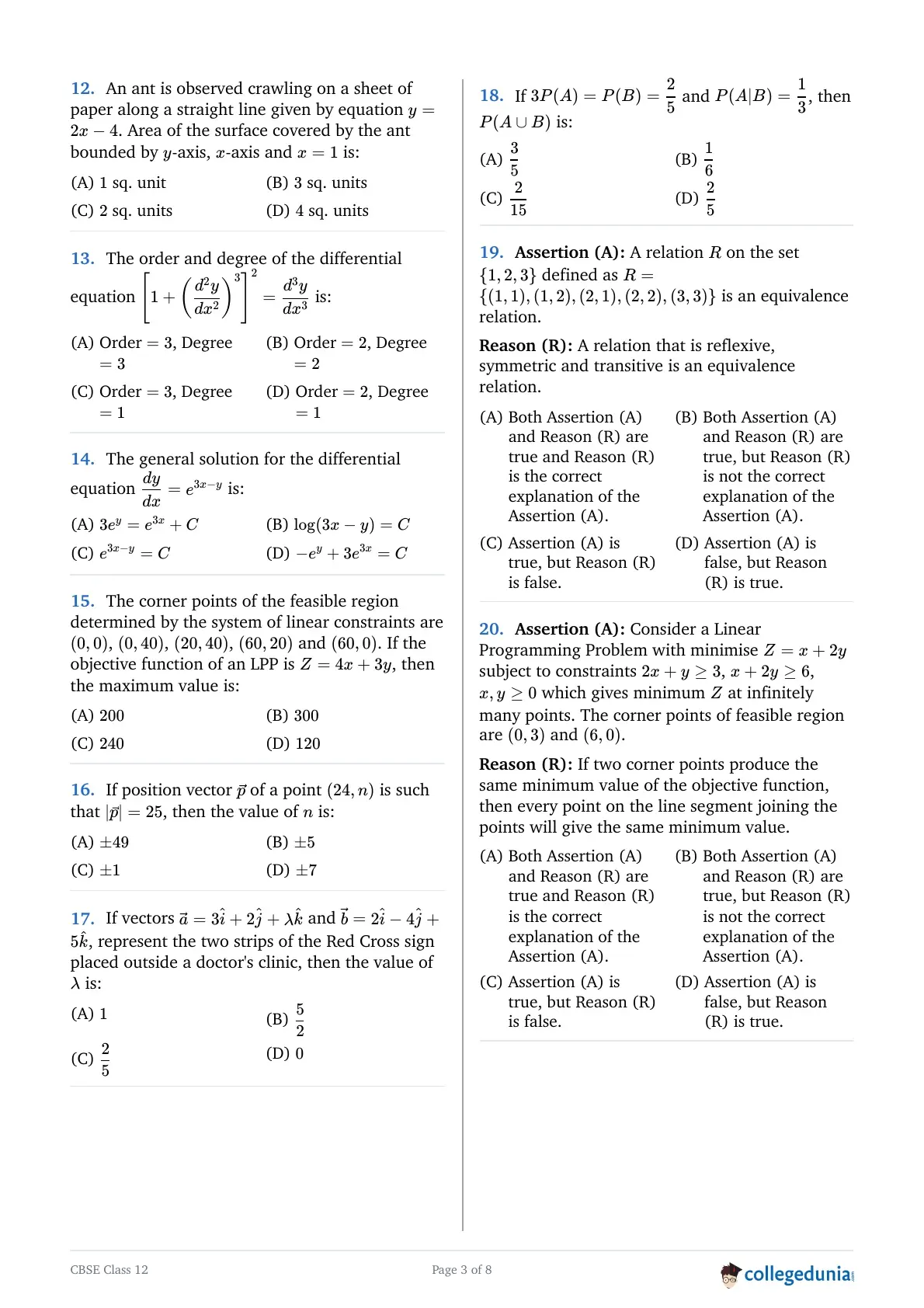
An ant is observed crawling on a sheet of paper along a straight line given by equation \( y = 2x - 4 \). Area of the surface covered by the ant bounded by y-axis, x-axis and \( x = 1 \) is :
Detailed Solution
Concept:
The area bounded by a curve \( y = f(x) \), the x-axis, and lines \( x = a, x = b \) is \( \int_a^b |f(x)| \, dx \).
For a region below the x-axis, the integral of \( f(x) \) is negative, so we take the absolute value or negate the integral.
Step 1: Determine the boundaries of the region
The region is bounded by:
The line \( y = 2x - 4 \)
The y-axis (\( x = 0 \))
The x-axis (\( y = 0 \))
The vertical line \( x = 1 \)
In the interval \( [0, 1] \), let's check the sign of \( y \):
For \( x=0, y=-4 \); for \( x=1, y=-2 \).
The entire segment of the line lies below the x-axis.
Step 2: Set up the definite integral for area
Since the graph is below the x-axis, Area \( A = \int_0^1 (0 - y) \, dx \): \[ A = \int_0^1 -(2x - 4) \, dx \] \[ A = \int_0^1 (4 - 2x) \, dx \]
Step 3: Evaluate the integral
\[ \begin{aligned} A &= [4x - x^2]_0^1
[2ex] &= (4(1) - (1)^2) - (4(0) - 0^2)
[2ex] &= (4 - 1) - 0
[2ex] &= 3 sq. units \end{aligned} \]
This matches option (B). Quick Tip: Sketching the region helps identify if it's a simple geometric shape. This region is a trapezoid with height 1 and parallel sides of lengths 4 and 2.
Area of Trapezoid = \( \frac{1}{2}(4 + 2) \times 1 = 3 \).
The order and degree of the differential equation \( 1 + \left( \frac{d^3y}{dx^3} \right)^3 = \lambda \frac{d^2y}{dx^2} \) is :
Detailed Solution
Concept:
Order: The highest order derivative present in the differential equation.
Degree: The power of the highest order derivative when the equation is a polynomial in derivatives (free from radicals and fractions).
Step 1: Identify the highest order derivative
The derivatives present are:
Third order: \( \frac{d^3y}{dx^3} \)
Second order: \( \frac{d^2y}{dx^2} \)
The highest order is \( 3 \). Thus, Order = \( 3 \).
Step 2: Check for polynomial form and find the degree
The equation is already in polynomial form with respect to its derivatives.
The highest order derivative term is \( \left( \frac{d^3y}{dx^3} \right)^3 \).
The exponent (power) of this highest order derivative is \( 3 \).
Thus, Degree = \( 3 \).
Step 3: Conclusion
Order = \( 3 \) and Degree = \( 3 \). This matches option (A). Quick Tip: Always look for the 'boss' derivative first to find the order. The degree is just the power that 'boss' derivative is raised to.
Ensure the equation is free of fractional powers of derivatives before determining the degree.
The general solution for the differential equation \( \frac{dy}{dx} = e^{3x-y} \) is :
Detailed Solution
Concept:
Variable Separable Method: Group all \( y \) terms with \( dy \) and \( x \) terms with \( dx \).
Use exponent laws: \( e^{a-b} = \frac{e^a}{e^b} \).
Step 1: Separate the variables
Given: \( \frac{dy}{dx} = e^{3x} \cdot e^{-y} \) \[ \frac{dy}{dx} = \frac{e^{3x}}{e^y} \]
Multiplying both sides by \( e^y \, dx \): \[ e^y \, dy = e^{3x} \, dx \]
Step 2: Integrate both sides
\[ \int e^y \, dy = \int e^{3x} \, dx \]
Applying standard integration formulas: \[ e^y = \frac{e^{3x}}{3} + C_1 \]
where \( C_1 \) is the constant of integration.
Step 3: Simplify the expression to match options
Multiply the entire equation by \( 3 \): \[ 3e^y = e^{3x} + 3C_1 \]
Let \( 3C_1 = C \) (a new constant): \[ 3e^y = e^{3x} + C \]
This matches option (A). Quick Tip: When variables are in the exponent, separating them usually transforms the problem into simple exponential integrals.
Constants can be absorbed into a single \( C \) at the end.
The corner points of the feasible region determined by the system of linear constraints are \( (0, 0), (0, 40), (20, 40), (60, 20) \) and \( (60, 0) \). If the objective function of an LPP is \( Z = 4x + 3y \), then the maximum value is :
Detailed Solution
Concept:
Corner Point Method: For a bounded feasible region, the optimal (maximum or minimum) value of the objective function occurs at one of the corner points.
Evaluate \( Z \) at every given corner point and choose the largest value.
Step 1: Calculate \( Z \) at each corner point
Objective function: \( Z = 4x + 3y \).
At \( (0, 0) \): \( Z = 4(0) + 3(0) = 0 \)
At \( (0, 40) \): \( Z = 4(0) + 3(40) = 120 \)
At \( (20, 40) \): \( Z = 4(20) + 3(40) = 80 + 120 = 200 \)
At \( (60, 20) \): \( Z = 4(60) + 3(20) = 240 + 60 = 300 \)
At \( (60, 0) \): \( Z = 4(60) + 3(0) = 240 \)
Step 2: Compare the values and identify the maximum
The values calculated are \( \{0, 120, 200, 300, 240\} \).
The highest value among these is \( 300 \).
Step 3: Conclusion
The maximum value of \( Z \) is \( 300 \), which occurs at the point \( (60, 20) \).
This matches option (B). Quick Tip: In LPP problems, usually, points with a mix of high values for both variables (like \( 60, 20 \)) are likely candidates for the maximum if coefficients are positive.
Always organize your evaluations in a table to avoid simple calculation errors.
If position vector \( \vec{p} \) of a point \( (24, n) \) is such that \( |\vec{p}| = 25 \), then the value of \( n \) is :
Detailed Solution
Concept:
The position vector of a point \( (x, y) \) in a 2D plane is given by \( \vec{p} = x\hat{i} + y\hat{j} \).
The magnitude (length) of a vector \( \vec{v} = a\hat{i} + b\hat{j} \) is calculated using the formula \( |\vec{v}| = \sqrt{a^2 + b^2} \).
Step 1: Express the position vector in component form
Given the point is \( (24, n) \).
The position vector \( \vec{p} \) can be written as: \[ \vec{p} = 24\hat{i} + n\hat{j} \]
Step 2: Set up the equation for the magnitude of the vector
We are given that the magnitude \( |\vec{p}| = 25 \).
Using the magnitude formula: \[ \sqrt{(24)^2 + (n)^2} = 25 \]
Step 3: Solve for \( n \) by squaring both sides
\[ \begin{aligned} (\sqrt{24^2 + n^2})^2 &= (25)^2
[2ex] 576 + n^2 &= 625
[2ex] n^2 &= 625 - 576
[2ex] n^2 &= 49 \end{aligned} \]
Taking the square root of both sides: \[ n = \pm \sqrt{49} \] \[ n = \pm 7 \]
This corresponds to option (D). Quick Tip: Remember that \( \sqrt{x^2} = |x| \), which always leads to both positive and negative solutions for the variable.
Pythagorean triplets can speed up calculations: \( 7, 24, 25 \) is a common triplet.
If vectors \( \vec{a} = 3\hat{i} + 2\hat{j} + \lambda\hat{k} \) and \( \vec{b} = 2\hat{i} - 4\hat{j} + 5\hat{k} \), represent the two strips of the Red Cross sign placed outside a doctor's clinic, then the value of \( \lambda \) is :
Detailed Solution
Concept:
The Red Cross symbol consists of two identical rectangular strips that are perpendicular to each other.
Two non-zero vectors \( \vec{u} \) and \( \vec{v} \) are perpendicular (orthogonal) if and only if their dot product is zero: \( \vec{u} \cdot \vec{v} = 0 \).
Step 1: Apply the condition of perpendicularity
Since the vectors represent the strips of a Red Cross sign, they must be perpendicular. \[ \vec{a} \cdot \vec{b} = 0 \]
Step 2: Calculate the dot product of the given vectors
\[ \begin{aligned} (3\hat{i} + 2\hat{j} + \lambda\hat{k}) \cdot (2\hat{i} - 4\hat{j} + 5\hat{k}) &= 0
[2ex] (3)(2) + (2)(-4) + (\lambda)(5) &= 0
[2ex] 6 - 8 + 5\lambda &= 0 \end{aligned} \]
Step 3: Solve the linear equation for \( \lambda \)
\[ \begin{aligned} -2 + 5\lambda &= 0
[2ex] 5\lambda &= 2
[2ex] \lambda &= \frac{2}{5} \end{aligned} \]
This matches option (C). Quick Tip: In competitive exams, symbols like "Red Cross" or "Square" imply perpendicularity of adjacent sides or strips.
The dot product is a scalar value; ensure you sum the products of the components correctly.
If \( 3P(A) = P(B) = \frac{3}{5} \) and \( P(A|B) = \frac{2}{3} \), then \( P(A \cup B) \) is :
Detailed Solution
Concept:
Conditional Probability: \( P(A|B) = \frac{P(A \cap B)}{P(B)} \).
Addition Theorem of Probability: \( P(A \cup B) = P(A) + P(B) - P(A \cap B) \).
Step 1: Determine the values of \( P(A) \) and \( P(B) \)
Given: \( 3P(A) = \frac{3}{5} \Rightarrow P(A) = \frac{1}{3} \times \frac{3}{5} = \frac{1}{5} \).
Given: \( P(B) = \frac{3}{5} \).
Step 2: Find the probability of the intersection \( P(A \cap B) \)
Using the definition of conditional probability: \[ P(A \cap B) = P(A|B) \times P(B) \] \[ \begin{aligned} P(A \cap B) &= \frac{2}{3} \times \frac{3}{5}
[2ex] P(A \cap B) &= \frac{2}{5} \end{aligned} \]
Step 3: Calculate \( P(A \cup B) \) using the addition theorem
\[ \begin{aligned} P(A \cup B) &= P(A) + P(B) - P(A \cap B)
[2ex] &= \frac{1}{5} + \frac{3}{5} - \frac{2}{5}
[2ex] &= \frac{1 + 3 - 2}{5}
[2ex] &= \frac{2}{5} \end{aligned} \]
This matches option (D). Quick Tip: Always identify the relationship between the intersection, union, and conditional probability first.
Double check fractional additions by using a common denominator.
Assertion (A) : A relation R on the set {1, 2, 3} defined as R = {(1, 1), (1, 2), (2, 1), (2, 2), (3, 3)} is an equivalence relation.
Reason (R) : A relation that is reflexive, symmetric and transitive is an equivalence relation.
Detailed Solution
Concept:
Reflexive: \( (a, a) \in R \) for every \( a \in A \).
Symmetric: \( (a, b) \in R \Rightarrow (b, a) \in R \).
Transitive: \( (a, b) \in R \) and \( (b, c) \in R \Rightarrow (a, c) \in R \).
Equivalence: A relation is equivalence if it satisfies all three properties.
Step 1: Evaluate the Assertion (A) for reflexivity
Set \( A = \{1, 2, 3\} \).
For \( R \) to be reflexive, it must contain \( (1, 1), (2, 2), (3, 3) \).
Check \( R \): \( (1, 1) \in R, (2, 2) \in R, (3, 3) \in R \).
Thus, \( R \) is reflexive.
Step 2: Evaluate for symmetry and transitivity
Symmetry: \( (1, 2) \in R \) and its flip \( (2, 1) \in R \). All other pairs are self-symmetric. So, \( R \) is symmetric.
Transitivity: We have \( (1, 2) \) and \( (2, 1) \). Their combination \( (1, 1) \) is in \( R \). Also \( (2, 1) \) and \( (1, 2) \) gives \( (2, 2) \), which is in \( R \). No other non-trivial chains exist. So, \( R \) is transitive.
Since it satisfies all three, Assertion (A) is true.
Step 3: Evaluate the Reason (R) and its relationship to (A)
Reason (R) states the standard definition of an equivalence relation. This is a true statement.
Furthermore, the assertion is categorized as an equivalence relation precisely because it fulfills the conditions of being reflexive, symmetric, and transitive.
Thus, Reason (R) correctly explains Assertion (A). Quick Tip: To verify an equivalence relation on a small set, check the diagonal elements \((a,a)\) first for reflexivity.
In Assertion-Reason questions, ask "Is A true?", "Is R true?", then "Is A true BECAUSE of R?".
Assertion (A) : Consider a Linear Programming Problem with minimise Z = x + 2y subject to constraints 2x + y \( \geq \) 3, x + 2y \( \geq \) 6, x, y \( \geq \) 0 which gives minimum Z at infinitely many points. The corner points of feasible region are (0, 3) and (6, 0).
Reason (R) : If two corner points produce the same minimum value of the objective function, then every point on the line segment joining the points will give the same minimum value.
Detailed Solution
Concept:
Feasible region corner points are vertices of the polygon formed by constraints.
Optimal solutions occur at corner points.
If the objective function line is parallel to one of the active constraint boundaries, there can be infinite optimal solutions.
Step 1: Verify the corner points of the feasible region
Constraint 1: \( 2x + y = 3 \) (Intercepts: (1.5, 0), (0, 3)).
Constraint 2: \( x + 2y = 6 \) (Intercepts: (6, 0), (0, 3)).
For the "greater than or equal to" region, the boundary vertices are \( (0, \infty), (0, 3) \) and \( (6, 0), (\infty, 0) \).
The corner points on the boundary are indeed \( (0, 3) \) and \( (6, 0) \).
Step 2: Evaluate the objective function at corner points
\( Z = x + 2y \)
At \( (0, 3) \): \( Z = 0 + 2(3) = 6 \)
At \( (6, 0) \): \( Z = 6 + 2(0) = 6 \)
Since both corner points yield the same minimum value of \( 6 \), every point on the segment joining \( (0, 3) \) and \( (6, 0) \) will also yield \( Z = 6 \). This gives infinitely many points. Assertion (A) is true.
Step 3: Check Reason (R) and its logical connection
Reason (R) is a fundamental theorem in Linear Programming regarding multiple optimal solutions. It is true.
The reason Assertion (A) concludes there are "infinitely many points" is exactly the theorem stated in Reason (R).
Thus, Reason (R) is the correct explanation. Quick Tip: An objective function \( Z = ax + by \) results in infinite solutions if its slope \( -a/b \) matches the slope of an active constraint boundary.
Infinite solutions only occur on a bounded or boundary segment of the feasible region.
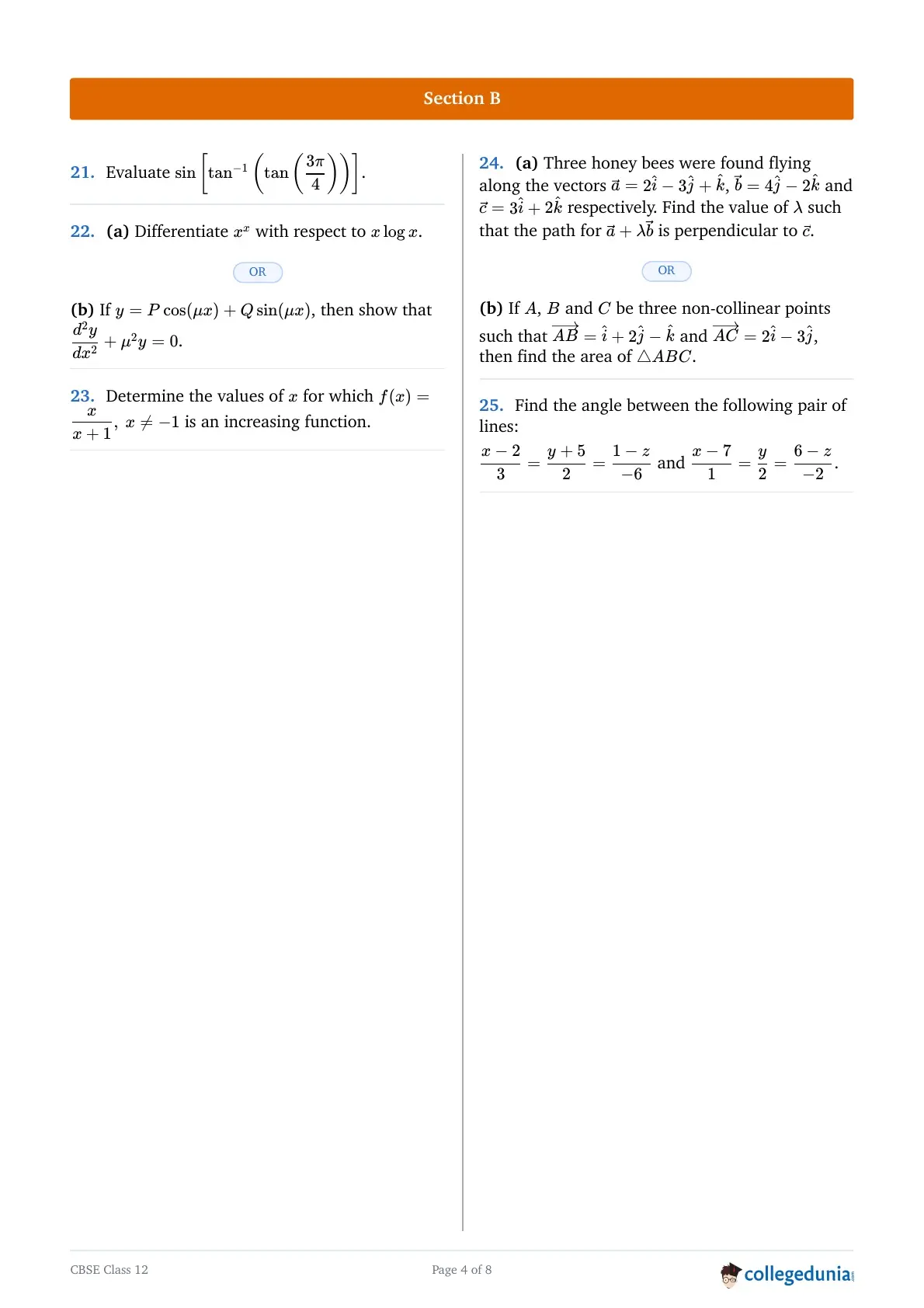
Evaluate \(\sin \left[\tan^{-1} \tan\left(\frac{3\pi}{4}\right)\right]\).
Detailed Solution
Concept:
Principal Value Branch of \(\tan^{-1}x\) is \(\left( -\frac{\pi}{2}, \frac{\pi}{2} \right)\).
Relation: \(\tan^{-1}(\tan \theta) = \theta\) only if \(\theta\) belongs to the principal value range.
Symmetry: \(\tan(\pi - \theta) = -\tan \theta\).
Step 1: Evaluate the inner tangent function value
The angle given is \(\frac{3\pi}{4}\).
Since \(\frac{3\pi}{4}\) does not lie in the principal value branch \(\left( -\frac{\pi}{2}, \frac{\pi}{2} \right)\), we simplify it: \[ \tan\left(\frac{3\pi}{4}\right) = \tan\left(\pi - \frac{\pi}{4}\right) \]
Using the identity \(\tan(\pi - \theta) = -\tan \theta\): \[ \tan\left(\frac{3\pi}{4}\right) = -\tan\left(\frac{\pi}{4}\right) = -1 \]
Step 2: Find the value of the inverse tangent function
Now we find \(\tan^{-1}(-1)\).
We look for an angle \(\theta \in \left( -\frac{\pi}{2}, \frac{\pi}{2} \right)\) such that \(\tan \theta = -1\). \[ \tan^{-1}(-1) = -\frac{\pi}{4} \]
Step 3: Calculate the final sine value
The expression becomes: \[ \sin\left[ -\frac{\pi}{4} \right] \]
Using the property \(\sin(-\theta) = -\sin \theta\): \[ \sin\left( -\frac{\pi}{4} \right) = -\sin\left( \frac{\pi}{4} \right) \] \[ = -\frac{1}{\sqrt{2}} \] Quick Tip: Always reduce the angle to its principal value branch before applying inverse operations.
For sine and tangent, remember the negative sign 'comes out' of the function.
Differentiate \(x^x\) with respect to \(x \log x\).
Detailed Solution
Concept:
Differentiation of a function with respect to another function: \(\frac{du}{dv} = \frac{du/dx}{dv/dx}\).
Logarithmic differentiation is used when the base and exponent both contain the variable.
Step 1: Differentiate \(u = x^x\) with respect to \(x\)
Let \(u = x^x\).
Taking natural log on both sides: \[ \log u = x \log x \]
Differentiating with respect to \(x\): \[ \frac{1}{u} \cdot \frac{du}{dx} = \frac{d}{dx}(x \log x) \]
Using product rule: \[ \frac{1}{u} \cdot \frac{du}{dx} = x \cdot \frac{1}{x} + \log x \cdot 1 \] \[ \frac{du}{dx} = u(1 + \log x) = x^x(1 + \log x) \]
Step 2: Differentiate \(v = x \log x\) with respect to \(x\)
Let \(v = x \log x\).
Differentiating with respect to \(x\) using product rule: \[ \frac{dv}{dx} = x \cdot \frac{1}{x} + \log x \cdot 1 \] \[ \frac{dv}{dx} = 1 + \log x \]
Step 3: Find the final derivative \(du/dv\)
Using the chain rule in functional form: \[ \frac{du}{dv} = \frac{du/dx}{dv/dx} \] \[ \frac{du}{dv} = \frac{x^x(1 + \log x)}{1 + \log x} \]
Cancelling the common term \((1 + \log x)\): \[ \frac{du}{dv} = x^x \] Quick Tip: Note that \(x \log x\) is actually the natural logarithm of \(x^x\).
Hence, you are essentially differentiating \(e^v\) with respect to \(v\), which is why the result is simply the original function.
If \(y = P \cos ux + Q \sin ux\), show that \(\frac{d^2y}{dx^2} + u^2y = 0\).
Detailed Solution
Concept:
Second-order differentiation.
Chain rule of differentiation: \(\frac{d}{dx}[\cos(ax)] = -a \sin(ax)\).
Direct substitution into a differential equation.
Step 1: Find the first derivative of \(y\)
Given: \(y = P \cos ux + Q \sin ux\).
Differentiating with respect to \(x\): \[ \frac{dy}{dx} = P(-u \sin ux) + Q(u \cos ux) \] \[ \frac{dy}{dx} = -Pu \sin ux + Qu \cos ux \]
Step 2: Find the second derivative of \(y\)
Differentiating again with respect to \(x\): \[ \frac{d^2y}{dx^2} = -Pu(u \cos ux) + Qu(-u \sin ux) \] \[ \frac{d^2y}{dx^2} = -Pu^2 \cos ux - Qu^2 \sin ux \]
Step 3: Substitute into the differential expression and prove
Factor out \(-u^2\) from the expression: \[ \frac{d^2y}{dx^2} = -u^2(P \cos ux + Q \sin ux) \]
Since \(P \cos ux + Q \sin ux = y\): \[ \frac{d^2y}{dx^2} = -u^2y \]
Rearranging terms: \[ \frac{d^2y}{dx^2} + u^2y = 0 \]
Hence proved. Quick Tip: This is a standard differential equation form for simple harmonic motion.
Differentiating trig functions with constants always brings the constant outside the function as a multiplier.
Determine the values of \(x\) for which \(f(x) = \frac{x - 3}{x + 1}, x \neq -1\) is an increasing function.
Detailed Solution
Concept:
A function \(f(x)\) is increasing in an interval if its first derivative \(f'(x) > 0\).
Quotent Rule: \(\frac{d}{dx}\left(\frac{u}{v}\right) = \frac{v u' - u v'}{v^2}\).
Step 1: Differentiate \(f(x)\) with respect to \(x\)
Using the quotient rule where \(u = x - 3\) and \(v = x + 1\): \[ f'(x) = \frac{(x + 1) \cdot \frac{d}{dx}(x - 3) - (x - 3) \cdot \frac{d}{dx}(x + 1)}{(x + 1)^2} \] \[ f'(x) = \frac{(x + 1)(1) - (x - 3)(1)}{(x + 1)^2} \]
Step 2: Simplify the derivative expression
\[ f'(x) = \frac{x + 1 - x + 3}{(x + 1)^2} \] \[ f'(x) = \frac{4}{(x + 1)^2} \]
Step 3: Analyze the sign of the derivative
For \(f(x)\) to be increasing, we need \(f'(x) > 0\).
The numerator is \(4\), which is always positive.
The denominator is \((x + 1)^2\), which is a perfect square and is always positive for all \(x \neq -1\).
Since both numerator and denominator are positive, \(f'(x) > 0\) for all \(x \in \mathbb{R}\) except \(x = -1\).
Step 4: State the final interval
The function is increasing for: \[ x \in (-\infty, -1) \cup (-1, \infty) \]
Or simply, \(x \in \mathbb{R} - \{-1\}\). Quick Tip: If the derivative of a rational function simplifies to a positive constant divided by a squared term, it is strictly increasing in its entire domain.
Always state excluded domain points from the original function.
Three honey bees were found flying along the vectors \(\vec{a} = 2\hat{i} - 3\hat{j} + \hat{k}\), \(\vec{b} = 4\hat{j} - 2\hat{k}\) and \(\vec{c} = 3\hat{i} + 2\hat{k}\) respectively.
Find the value of \(\lambda\) such that the path for \(\vec{a} + \lambda\vec{b}\) is perpendicular to \(\vec{c}\).
Detailed Solution
Concept:
Vector addition: \((a_1\hat{i} + b_1\hat{j}) + (a_2\hat{i} + b_2\hat{j}) = (a_1+a_2)\hat{i} + (b_1+b_2)\hat{j}\).
Perpendicularity: Two non-zero vectors are perpendicular if their dot product is zero.
Step 1: Find the combined vector \(\vec{a} + \lambda\vec{b}\)
\[ \vec{a} + \lambda\vec{b} = (2\hat{i} - 3\hat{j} + \hat{k}) + \lambda(0\hat{i} + 4\hat{j} - 2\hat{k}) \] \[ \vec{a} + \lambda\vec{b} = 2\hat{i} + (-3 + 4\lambda)\hat{j} + (1 - 2\lambda)\hat{k} \]
Step 2: Apply the condition of perpendicularity with \(\vec{c}\)
\[ (\vec{a} + \lambda\vec{b}) \cdot \vec{c} = 0 \]
Substituting the components: \[ [2\hat{i} + (-3 + 4\lambda)\hat{j} + (1 - 2\lambda)\hat{k}] \cdot [3\hat{i} + 0\hat{j} + 2\hat{k}] = 0 \]
Step 3: Solve the resulting dot product equation
\[ (2)(3) + (-3 + 4\lambda)(0) + (1 - 2\lambda)(2) = 0 \] \[ 6 + 0 + 2 - 4\lambda = 0 \] \[ 8 - 4\lambda = 0 \] \[ 4\lambda = 8 \] \[ \lambda = 2 \] Quick Tip: Carefully watch the missing components (like \(\hat{i}\) in \(\vec{b}\) or \(\hat{j}\) in \(\vec{c}\)) and treat them as zero during calculations.
The dot product simplifies a vector equation into a simple linear scalar equation.
If \(A, B\) and \(C\) be three non-collinear points such that \(\vec{AB} = \hat{i} + 2\hat{j} - \hat{k}\) and \(\vec{AC} = 2\hat{i} - 3\hat{j}\), then find the area of \(\Delta ABC\).
Detailed Solution
Concept:
Area of a triangle with adjacent sides \(\vec{AB}\) and \(\vec{AC}\) is \(\frac{1}{2} |\vec{AB} \times \vec{AC}|\).
Cross product is calculated using a determinant.
Step 1: Compute the cross product \(\vec{AB} \times \vec{AC}\)
\[ \vec{AB} \times \vec{AC} = \begin{vmatrix} \hat{i} & \hat{j} & \hat{k} \\ 1 & 2 & -1 \\ 2 & -3 & 0 \end{vmatrix} \] \[ = \hat{i}(2 \cdot 0 - (-1) \cdot (-3)) - \hat{j}(1 \cdot 0 - (-1) \cdot 2) + \hat{k}(1 \cdot (-3) - 2 \cdot 2) \] \[ = \hat{i}(0 - 3) - \hat{j}(0 + 2) + \hat{k}(-3 - 4) \] \[ = -3\hat{i} - 2\hat{j} - 7\hat{k} \]
Step 2: Find the magnitude of the cross product vector
\[ |\vec{AB} \times \vec{AC}| = \sqrt{(-3)^2 + (-2)^2 + (-7)^2} \] \[ = \sqrt{9 + 4 + 49} \] \[ = \sqrt{62} \]
Step 3: Calculate the area of the triangle
Area of \(\Delta ABC = \frac{1}{2} |\vec{AB} \times \vec{AC}|\) \[ = \frac{1}{2} \sqrt{62} sq. units \] Quick Tip: Always check the order of components in the determinant.
The cross product method is significantly faster for triangles in 3D space compared to coordinates-based formulas.
Find the angle between the following pair of lines :
\(\frac{x - 2}{3} = \frac{y + 5}{2} = \frac{1 - z}{-6}\) and \(\frac{x - 7}{1} = \frac{y}{2} = \frac{6 - z}{-2}\).
Detailed Solution
Concept:
Direction ratios (DRs) of a line are the denominators when the equation is in standard form \(\frac{x-x_1}{a} = \frac{y-y_1}{b} = \frac{z-z_1}{c}\).
Angle \(\theta\) between two lines with DRs \((a_1, b_1, c_1)\) and \((a_2, b_2, c_2)\) is \(\cos \theta = \frac{|a_1a_2 + b_1b_2 + c_1c_2|}{\sqrt{a_1^2+b_1^2+c_1^2}\sqrt{a_2^2+b_2^2+c_2^2}}\).
Step 1: Convert equations to standard form and find DRs
Line 1: \(\frac{x - 2}{3} = \frac{y + 5}{2} = \frac{z - 1}{6}\).
Direction Ratios \(\vec{b_1} = (3, 2, 6)\).
Line 2: \(\frac{x - 7}{1} = \frac{y}{2} = \frac{z - 6}{2}\).
Direction Ratios \(\vec{b_2} = (1, 2, 2)\).
Step 2: Evaluate the numerator for the cosine formula
The dot product of direction vectors: \[ \vec{b_1} \cdot \vec{b_2} = (3)(1) + (2)(2) + (6)(2) \] \[ = 3 + 4 + 12 = 19 \]
Step 3: Evaluate the magnitudes of the direction vectors
\[ |\vec{b_1}| = \sqrt{3^2 + 2^2 + 6^2} = \sqrt{9 + 4 + 36} = \sqrt{49} = 7 \] \[ |\vec{b_2}| = \sqrt{1^2 + 2^2 + 2^2} = \sqrt{1 + 4 + 4} = \sqrt{9} = 3 \]
Step 4: Calculate the angle \(\theta\)
\[ \cos \theta = \frac{19}{7 \times 3} = \frac{19}{21} \] \[ \theta = \cos^{-1}\left( \frac{19}{21} \right) \] Quick Tip: Be extremely careful with terms like \(1 - z\). You must rewrite them as \(z - 1\) and adjust the denominator's sign to extract correct DRs.
If the dot product is zero, the lines are perpendicular (angle is \(90^\circ\)).
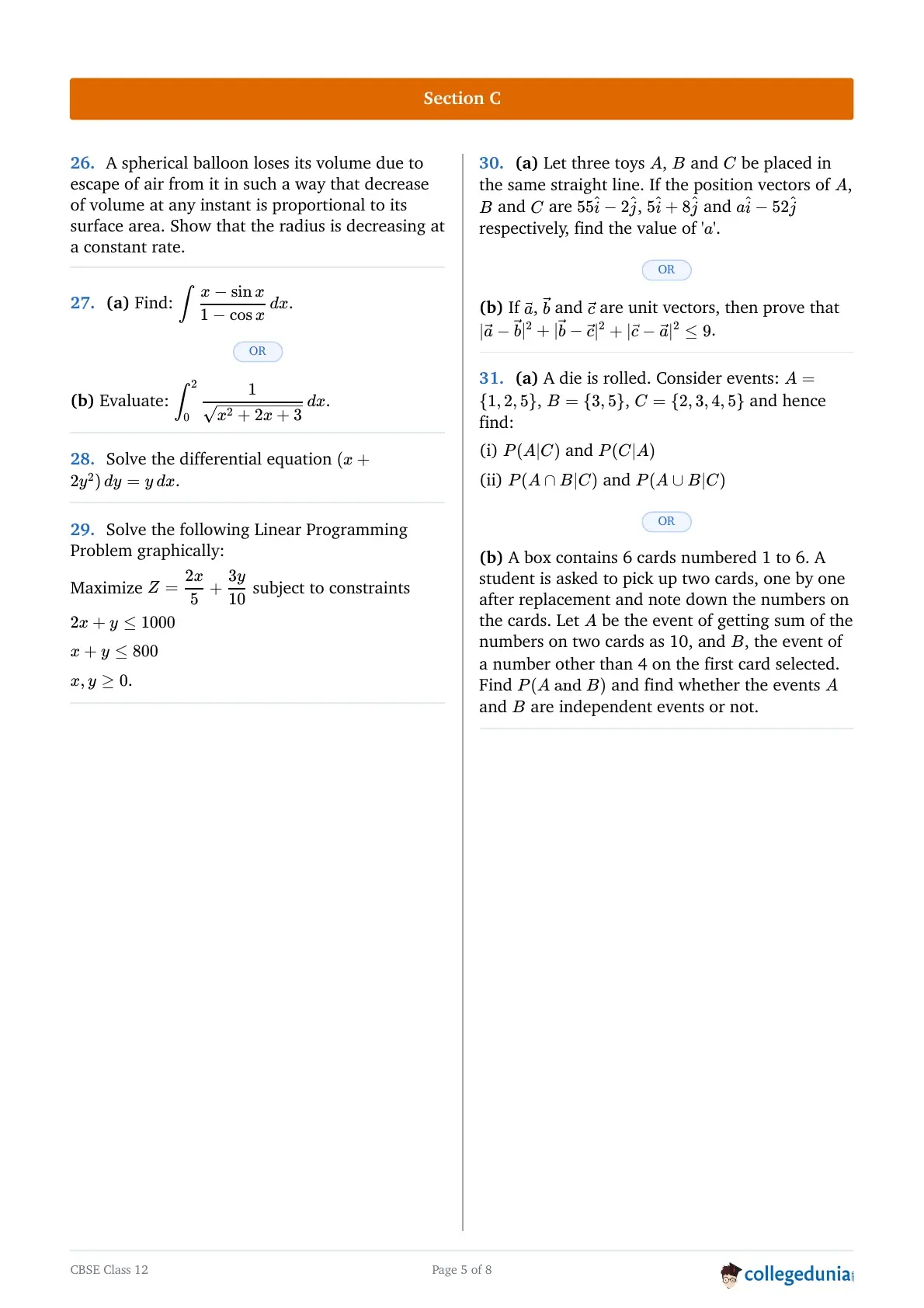
A spherical balloon loses its volume due to escape of air from it in such a way that decrease of volume at any instant is proportional to its surface area. Show that the radius is decreasing at a constant rate.
Detailed Solution
Concept:
Volume of a sphere: \( V = \frac{4}{3}\pi r^3 \).
Surface area of a sphere: \( S = 4\pi r^2 \).
Rate of change: The derivative with respect to time \( t \).
Proportionality: \( y \propto x \Rightarrow y = kx \), where \( k \) is a constant.
Step 1: Relate the rate of change of volume to surface area
Let \( V \) be the volume and \( S \) be the surface area of the spherical balloon at time \( t \).
According to the problem, the rate of decrease of volume is proportional to the surface area: \[ -\frac{dV}{dt} \propto S \] \[ -\frac{dV}{dt} = kS \]
where \( k \) is a positive constant of proportionality.
Step 2: Differentiate the volume formula with respect to time
We know that \( V = \frac{4}{3}\pi r^3 \).
Differentiating both sides with respect to time \( t \) using the chain rule: \[ \frac{dV}{dt} = \frac{d}{dt} \left( \frac{4}{3}\pi r^3 \right) \] \[ \frac{dV}{dt} = \frac{4}{3}\pi \cdot 3r^2 \cdot \frac{dr}{dt} \] \[ \frac{dV}{dt} = 4\pi r^2 \frac{dr}{dt} \]
Step 3: Substitute expressions for surface area and volume rate into the proportionality equation
Substituting \( \frac{dV}{dt} = 4\pi r^2 \frac{dr}{dt} \) and \( S = 4\pi r^2 \) into the equation from Step 1: \[ -(4\pi r^2 \frac{dr}{dt}) = k(4\pi r^2) \]
Dividing both sides by \( 4\pi r^2 \) (since \( r \neq 0 \)): \[ -\frac{dr}{dt} = k \] \[ \frac{dr}{dt} = -k \]
Step 4: Conclusion
The rate of change of the radius \( \frac{dr}{dt} \) is a constant (\(-k\)).
The negative sign indicates that the radius is decreasing.
Since \( k \) is a constant, the radius is decreasing at a constant rate. Quick Tip: In rate of change problems involving spheres, notice that the derivative of volume with respect to radius (\(dV/dr\)) is exactly the surface area.
Always distinguish between "rate of change" (derivative) and "rate of decrease" (negative of the derivative).
Find : \( \int \frac{x - \sin x}{1 - \cos x} \, dx \)
Detailed Solution
Concept:
Half-angle identities: \( 1 - \cos x = 2\sin^2(x/2) \) and \( \sin x = 2\sin(x/2)\cos(x/2) \).
Integration by parts: \( \int u \, dv = uv - \int v \, du \).
Basic integral: \( \int cosec^2(ax) \, dx = -\frac{1}{a}\cot(ax) \).
Step 1: Simplify the integrand using trigonometric identities
Let \( I = \int \frac{x - \sin x}{1 - \cos x} \, dx \).
Substitute \( 1 - \cos x = 2\sin^2(x/2) \) and \( \sin x = 2\sin(x/2)\cos(x/2) \): \[ I = \int \left( \frac{x}{2\sin^2(x/2)} - \frac{2\sin(x/2)\cos(x/2)}{2\sin^2(x/2)} \right) \, dx \] \[ I = \int \left( \frac{x}{2}cosec^2(x/2) - \cot(x/2) \right) \, dx \]
Step 2: Split the integral and apply integration by parts to the first term
\[ I = \int \frac{x}{2}cosec^2(x/2) \, dx - \int \cot(x/2) \, dx \]
For the first integral \( I_1 = \int \frac{x}{2}cosec^2(x/2) \, dx \), let \( u = x \) and \( dv = \frac{1}{2}cosec^2(x/2) \, dx \).
Then \( du = dx \) and \( v = \int \frac{1}{2}cosec^2(x/2) \, dx = -\cot(x/2) \).
Applying integration by parts: \[ I_1 = x(-\cot(x/2)) - \int (-\cot(x/2)) \, dx \] \[ I_1 = -x\cot(x/2) + \int \cot(x/2) \, dx \]
Step 3: Combine the results
Substituting the value of \( I_1 \) back into the expression for \( I \): \[ I = \left( -x\cot(x/2) + \int \cot(x/2) \, dx \right) - \int \cot(x/2) \, dx \]
The integral terms cancel out: \[ I = -x\cot(x/2) + C \] Quick Tip: Splitting complex fractions involving \(1 \pm \cos x\) into simpler parts often leads to integrals that cancel out using integration by parts.
Look for the pattern \( \int [f(x) + xf'(x)] dx = xf(x) + C \). Here, if \( f(x) = -\cot(x/2) \), then \( f'(x) = \frac{1}{2}cosec^2(x/2) \).
Evaluate : \( \int_0^2 \frac{1}{\sqrt{x^2 + 2x + 3}} \, dx \)
Detailed Solution
Concept:
Completing the square: \( ax^2 + bx + c = a(x + \frac{b}{2a})^2 + (c - \frac{b^2}{4a}) \).
Standard integral: \( \int \frac{dx}{\sqrt{x^2 + a^2}} = \log |x + \sqrt{x^2 + a^2}| + C \).
Step 1: Complete the square for the quadratic expression in the denominator
The quadratic is \( x^2 + 2x + 3 \). \[ x^2 + 2x + 3 = (x^2 + 2x + 1) + 2 = (x + 1)^2 + (\sqrt{2})^2 \]
Step 2: Rewrite the integral and apply the standard formula
Let \( I = \int_0^2 \frac{dx}{\sqrt{(x + 1)^2 + (\sqrt{2})^2}} \).
Using the formula \( \int \frac{dx}{\sqrt{X^2 + A^2}} = \log |X + \sqrt{X^2 + A^2}| \), where \( X = x + 1 \) and \( A = \sqrt{2} \): \[ I = \left[ \log |(x + 1) + \sqrt{(x + 1)^2 + (\sqrt{2})^2}| \right]_0^2 \]
Simplifying the term inside the square root back to the original quadratic: \[ I = \left[ \log |x + 1 + \sqrt{x^2 + 2x + 3}| \right]_0^2 \]
Step 3: Evaluate the limits
Upper limit (\( x = 2 \)): \[ \log |2 + 1 + \sqrt{2^2 + 2(2) + 3}| = \log |3 + \sqrt{4 + 4 + 3}| = \log(3 + \sqrt{11}) \]
Lower limit (\( x = 0 \)): \[ \log |0 + 1 + \sqrt{0^2 + 2(0) + 3}| = \log |1 + \sqrt{3}| = \log(1 + \sqrt{3}) \]
Subtracting the results: \[ I = \log(3 + \sqrt{11}) - \log(1 + \sqrt{3}) \]
Using the property \( \log a - \log b = \log(a/b) \): \[ I = \log \left( \frac{3 + \sqrt{11}}{1 + \sqrt{3}} \right) \] Quick Tip: Always complete the square when you see a quadratic under a square root in the denominator.
Check your standard integral formulas; confusing \( \sqrt{x^2 + a^2} \) with \( \sqrt{a^2 - x^2} \) is a very common error.
Solve the differential equation \( (x + 2y^3) \frac{dy}{dx} = y \).
Detailed Solution
Concept:
Linear Differential Equation of the form \( \frac{dx}{dy} + Px = Q \), where \( P \) and \( Q \) are functions of \( y \).
Integrating Factor (I.F.) = \( e^{\int P \, dy} \).
General Solution: \( x \cdot (I.F.) = \int Q \cdot (I.F.) \, dy + C \).
Step 1: Rearrange the equation to a standard linear form
The given equation is \( (x + 2y^3) \frac{dy}{dx} = y \).
Since it is not linear in \( y \), let's check for linearity in \( x \) by taking the reciprocal: \[ \frac{dx}{dy} = \frac{x + 2y^3}{y} \] \[ \frac{dx}{dy} = \frac{x}{y} + 2y^2 \] \[ \frac{dx}{dy} - \frac{1}{y}x = 2y^2 \]
This is a linear differential equation in \( x \) with \( P = -\frac{1}{y} \) and \( Q = 2y^2 \).
Step 2: Calculate the Integrating Factor (I.F.)
\[ I.F. = e^{\int P \, dy} = e^{\int -\frac{1}{y} \, dy} \] \[ I.F. = e^{-\log |y|} = e^{\log |y^{-1}|} \] \[ I.F. = \frac{1}{y} \]
Step 3: Find the general solution
The solution is given by: \[ x \cdot \frac{1}{y} = \int (2y^2) \cdot \frac{1}{y} \, dy \] \[ \frac{x}{y} = \int 2y \, dy \] \[ \frac{x}{y} = y^2 + C \]
Multiplying through by \( y \): \[ x = y^3 + Cy \] Quick Tip: If a differential equation isn't linear in \( y \), try flipping it to see if it's linear in \( x \) (\(dx/dy\) form).
Always remember that \( e^{\log f(y)} = f(y) \), but handle coefficients like the minus sign in \( -\log y \) by moving them inside the log as exponents first.
Solve the following Linear Programming Problem graphically :
Maximize \( Z = \frac{2x}{5} + \frac{3y}{10} \)
subject to constraints
\( 2x + y \leq 1000 \)
\( x + y \leq 800 \)
\( x, y \geq 0 \).
Detailed Solution
Concept:
Graphing inequalities to find the feasible region (common intersection).
Identifying corner points of the bounded feasible region.
Corner Point Theorem: Optimal solution occurs at a corner point.
Step 1: Find the boundary points for each constraint
Line 1 (\( 2x + y = 1000 \)):
If \( x = 0 \), \( y = 1000 \). Point: \( (0, 1000) \)
If \( y = 0 \), \( 2x = 1000 \Rightarrow x = 500 \). Point: \( (500, 0) \)
Line 2 (\( x + y = 800 \)):
If \( x = 0 \), \( y = 800 \). Point: \( (0, 800) \)
If \( y = 0 \), \( x = 800 \). Point: \( (800, 0) \)
Step 2: Identify the intersection point of the two lines
Solve \( 2x + y = 1000 \) and \( x + y = 800 \) simultaneously.
Subtracting the second equation from the first: \[ (2x + y) - (x + y) = 1000 - 800 \] \[ x = 200 \]
Substitute \( x = 200 \) into \( x + y = 800 \): \[ 200 + y = 800 \Rightarrow y = 600 \]
Intersection point is \( (200, 600) \).
Step 3: Identify the feasible region corner points
The feasible region is bounded by the axes and the innermost constraints (since all are \( \leq \)).
The corner points are: \( O(0, 0) \), \( A(500, 0) \), \( B(200, 600) \), and \( C(0, 800) \).
Step 4: Evaluate \( Z \) at each corner point
Objective Function: \( Z = 0.4x + 0.3y \).
At \( O(0, 0) \): \( Z = 0.4(0) + 0.3(0) = 0 \)
At \( A(500, 0) \): \( Z = 0.4(500) + 0.3(0) = 200 \)
At \( C(0, 800) \): \( Z = 0.4(0) + 0.3(800) = 240 \)
At \( B(200, 600) \): \( Z = 0.4(200) + 0.3(600) = 80 + 180 = 260 \)
Step 5: Conclusion

The maximum value of \( Z \) is \( 260 \), which occurs at the point \( (200, 600) \). Quick Tip: Always shade the feasible region towards the origin for \( \leq \) constraints when intercepts are positive.
Evaluation of corner points is best presented in a table for clarity.
Let three toys A, B and C be placed in the same straight line. If the position vectors of A, B and C are \( 55\hat{i} - 2\hat{j} \), \( 5\hat{i} + 8\hat{j} \) and \( a\hat{i} - 52\hat{j} \) respectively, find the value of 'a'.
Detailed Solution
Concept:
Collinearity of points: Three points A, B, and C are collinear if the vectors \( \vec{AB} \) and \( \vec{BC} \) are parallel.
Parallel vectors: \( \vec{u} \parallel \vec{v} \Rightarrow \vec{u} = k\vec{v} \), which implies the components are proportional.
Step 1: Calculate the displacement vectors \( \vec{AB} \) and \( \vec{BC} \)
Let \( \vec{OA} = 55\hat{i} - 2\hat{j} \), \( \vec{OB} = 5\hat{i} + 8\hat{j} \), and \( \vec{OC} = a\hat{i} - 52\hat{j} \). \[ \vec{AB} = \vec{OB} - \vec{OA} = (5 - 55)\hat{i} + (8 - (-2))\hat{j} = -50\hat{i} + 10\hat{j} \] \[ \vec{BC} = \vec{OC} - \vec{OB} = (a - 5)\hat{i} + (-52 - 8)\hat{j} = (a - 5)\hat{i} - 60\hat{j} \]
Step 2: Apply the condition of collinearity
Since the toys are on the same straight line, \( \vec{AB} \) and \( \vec{BC} \) must be parallel.
The ratio of their \( \hat{j} \)-components is: \[ \frac{-60}{10} = -6 \]
For them to be parallel, the ratio of the \( \hat{i} \)-components must be the same: \[ \frac{a - 5}{-50} = -6 \]
Step 3: Solve for 'a'
\[ a - 5 = (-6) \times (-50) \] \[ a - 5 = 300 \] \[ a = 305 \] Quick Tip: For 2D vectors, you can also use the slope formula \( m = (y_2 - y_1)/(x_2 - x_1) \). Slopes of AB and BC must be equal.
Slope of AB = \( (8 - (-2))/(5 - 55) = 10/-50 = -1/5 \).
Slope of BC = \( (-52 - 8)/(a - 5) = -60/(a - 5) \).
\( -1/5 = -60/(a - 5) \Rightarrow a - 5 = 300 \Rightarrow a = 305 \).
If \( \vec{a}, \vec{b} \) and \( \vec{c} \) are unit vectors, then prove that \( |\vec{a} - \vec{b}|^2 + |\vec{b} - \vec{c}|^2 + |\vec{c} - \vec{a}|^2 \leq 9 \).
Detailed Solution
Concept:
Unit vectors: \( |\vec{a}| = |\vec{b}| = |\vec{c}| = 1 \).
Expansion property: \( |\vec{u} - \vec{v}|^2 = |\vec{u}|^2 + |\vec{v}|^2 - 2\vec{u}\cdot\vec{v} \).
Sum squared property: \( |\vec{a} + \vec{b} + \vec{c}|^2 = |\vec{a}|^2 + |\vec{b}|^2 + |\vec{c}|^2 + 2(\vec{a}\cdot\vec{b} + \vec{b}\cdot\vec{c} + \vec{c}\cdot\vec{a}) \).
Magnitudes are non-negative: \( |\vec{v}|^2 \geq 0 \).
Step 1: Expand the given expression using the dot product property
Let \( S = |\vec{a} - \vec{b}|^2 + |\vec{b} - \vec{c}|^2 + |\vec{c} - \vec{a}|^2 \).
Using the property \( |\vec{u} - \vec{v}|^2 = |\vec{u}|^2 + |\vec{v}|^2 - 2\vec{u}\cdot\vec{v} \): \[ S = (|\vec{a}|^2 + |\vec{b}|^2 - 2\vec{a}\cdot\vec{b}) + (|\vec{b}|^2 + |\vec{c}|^2 - 2\vec{b}\cdot\vec{c}) + (|\vec{c}|^2 + |\vec{a}|^2 - 2\vec{c}\cdot\vec{a}) \]
Since they are unit vectors, \( |\vec{a}|^2 = |\vec{b}|^2 = |\vec{c}|^2 = 1 \): \[ S = (1 + 1 - 2\vec{a}\cdot\vec{b}) + (1 + 1 - 2\vec{b}\cdot\vec{c}) + (1 + 1 - 2\vec{c}\cdot\vec{a}) \] \[ S = 6 - 2(\vec{a}\cdot\vec{b} + \vec{b}\cdot\vec{c} + \vec{c}\cdot\vec{a}) \]
Step 2: Find an inequality for the dot product sum
Consider the square of the sum of the three unit vectors: \[ |\vec{a} + \vec{b} + \vec{c}|^2 = |\vec{a}|^2 + |\vec{b}|^2 + |\vec{c}|^2 + 2(\vec{a}\cdot\vec{b} + \vec{b}\cdot\vec{c} + \vec{c}\cdot\vec{a}) \]
Since \( |\vec{a} + \vec{b} + \vec{c}|^2 \geq 0 \): \[ 1 + 1 + 1 + 2(\vec{a}\cdot\vec{b} + \vec{b}\cdot\vec{c} + \vec{c}\cdot\vec{a}) \geq 0 \] \[ 2(\vec{a}\cdot\vec{b} + \vec{b}\cdot\vec{c} + \vec{c}\cdot\vec{a}) \geq -3 \]
Multiplying by \(-1\) (reverses the inequality): \[ -2(\vec{a}\cdot\vec{b} + \vec{b}\cdot\vec{c} + \vec{c}\cdot\vec{a}) \leq 3 \]
Step 3: Substitute back into the expression for \( S \)
From Step 1, \( S = 6 - 2(\vec{a}\cdot\vec{b} + \vec{b}\cdot\vec{c} + \vec{c}\cdot\vec{a}) \).
Using the result from Step 2: \[ S \leq 6 + 3 \] \[ S \leq 9 \]
Hence proved. Quick Tip: Problems involving sums of vector differences squared often rely on the expansion of \( |\Sigma \vec{v}|^2 \geq 0 \).
Remember that for unit vectors, the dot product \( \vec{u}\cdot\vec{v} = \cos \theta \), which ranges from -1 to 1.
A die is rolled. Consider events : \( A = \{1, 2, 5\}, B = \{3, 5\}, C = \{2, 3, 4, 5\} \)
and hence find :
(i) \( P(A|C) \) and \( P(C|A) \)
(ii) \( P(A \cap B | C) \) and \( P(A \cup B | C) \)
Detailed Solution
Concept:
Sample space for a single die roll: \( S = \{1, 2, 3, 4, 5, 6\} \).
Classical definition of probability: \( P(E) = \frac{n(E)}{n(S)} \).
Conditional Probability: \( P(E|F) = \frac{P(E \cap F)}{P(F)} = \frac{n(E \cap F)}{n(F)} \).
Sets: \( A \cap B \) is the intersection (common elements) and \( A \cup B \) is the union (all elements from both).
Step 1: Evaluate the basic probabilities of the events
From the sample space \( S \), \( n(S) = 6 \).
The given events are: \( A = \{1, 2, 5\} \Rightarrow n(A) = 3 \) \( B = \{3, 5\} \Rightarrow n(B) = 2 \) \( C = \{2, 3, 4, 5\} \Rightarrow n(C) = 4 \)
Step 2: Solve part (i): Find \( P(A|C) \) and \( P(C|A) \)
First, find the intersection \( A \cap C \): \( A \cap C = \{1, 2, 5\} \cap \{2, 3, 4, 5\} = \{2, 5\} \Rightarrow n(A \cap C) = 2 \). \[ P(A|C) = \frac{n(A \cap C)}{n(C)} = \frac{2}{4} = \frac{1}{2} \] \[ P(C|A) = \frac{n(C \cap A)}{n(A)} = \frac{2}{3} \]
Step 3: Solve part (ii): Find \( P(A \cap B | C) \)
First, find \( A \cap B \): \( A \cap B = \{1, 2, 5\} \cap \{3, 5\} = \{5\} \).
Now, find the intersection with \( C \): \( (A \cap B) \cap C = \{5\} \cap \{2, 3, 4, 5\} = \{5\} \Rightarrow n((A \cap B) \cap C) = 1 \). \[ P(A \cap B | C) = \frac{n((A \cap B) \cap C)}{n(C)} = \frac{1}{4} \]
Step 4: Solve part (ii): Find \( P(A \cup B | C) \)
First, find \( A \cup B \): \( A \cup B = \{1, 2, 5, 3\} = \{1, 2, 3, 5\} \).
Now, find the intersection with \( C \): \( (A \cup B) \cap C = \{1, 2, 3, 5\} \cap \{2, 3, 4, 5\} = \{2, 3, 5\} \Rightarrow n((A \cup B) \cap C) = 3 \). \[ P(A \cup B | C) = \frac{n((A \cup B) \cap C)}{n(C)} = \frac{3}{4} \] Quick Tip: Conditional probability effectively restricts your sample space to the 'given' event.
To find \( P(X|C) \), simply look at set \( C \) and count how many elements of \( X \) it contains, then divide by \( n(C) \).
A box contains 6 cards numbered 1 to 6. A student is asked to pick up two cards, one by one after replacement and note down the numbers on the cards. Let A be the event of getting sum of the numbers on two cards as 10, and B, the event of a number other than 4 on the first card selected.
Find P(A and B) and find whether the events A and B are independent events or not.
Detailed Solution
Concept:
Sample space with replacement: Since 2 cards are picked from 6 with replacement, \( n(S) = 6 \times 6 = 36 \).
Probability of intersection: \( P(A \cap B) = \frac{n(A \cap B)}{n(S)} \).
Independent Events: A and B are independent if and only if \( P(A \cap B) = P(A) \cdot P(B) \).
Step 1: List the outcomes for event A (Sum = 10)
Possible pairs \( (x, y) \) where \( x+y = 10 \) and \( x, y \in \{1, 2, 3, 4, 5, 6\} \): \( A = \{(4, 6), (5, 5), (6, 4)\} \). \( n(A) = 3 \). \[ P(A) = \frac{3}{36} = \frac{1}{12} \]
Step 2: Analyze event B (First card \( \neq 4 \)) and find \( P(B) \)
The first card can be any of \( \{1, 2, 3, 5, 6\} \) (5 choices).
The second card can be any of \( \{1, 2, 3, 4, 5, 6\} \) (6 choices). \( n(B) = 5 \times 6 = 30 \). \[ P(B) = \frac{30}{36} = \frac{5}{6} \]
Step 3: Find \( P(A \cap B) \)
\( A \cap B \) means the sum is 10 AND the first card is not 4.
From the set \( A \):
- \( (4, 6) \): First card is 4 (Discard)
- \( (5, 5) \): First card is not 4 (Keep)
- \( (6, 4) \): First card is not 4 (Keep)
So, \( A \cap B = \{(5, 5), (6, 4)\} \Rightarrow n(A \cap B) = 2 \). \[ P(A \cap B) = \frac{2}{36} = \frac{1}{18} \]
Step 4: Check for independence
Check if \( P(A \cap B) = P(A) \cdot P(B) \): \[ P(A) \cdot P(B) = \frac{1}{12} \times \frac{5}{6} = \frac{5}{72} \]
Since \( \frac{1}{18} = \frac{4}{72} \) and \( \frac{4}{72} \neq \frac{5}{72} \), we have: \[ P(A \cap B) \neq P(A) \cdot P(B) \]
Thus, events A and B are not independent (they are dependent). Quick Tip: In 'with replacement' problems, the denominator remains constant for each draw.
Always verify independence numerically; do not rely on intuition as events can sometimes be independent in non-obvious ways.
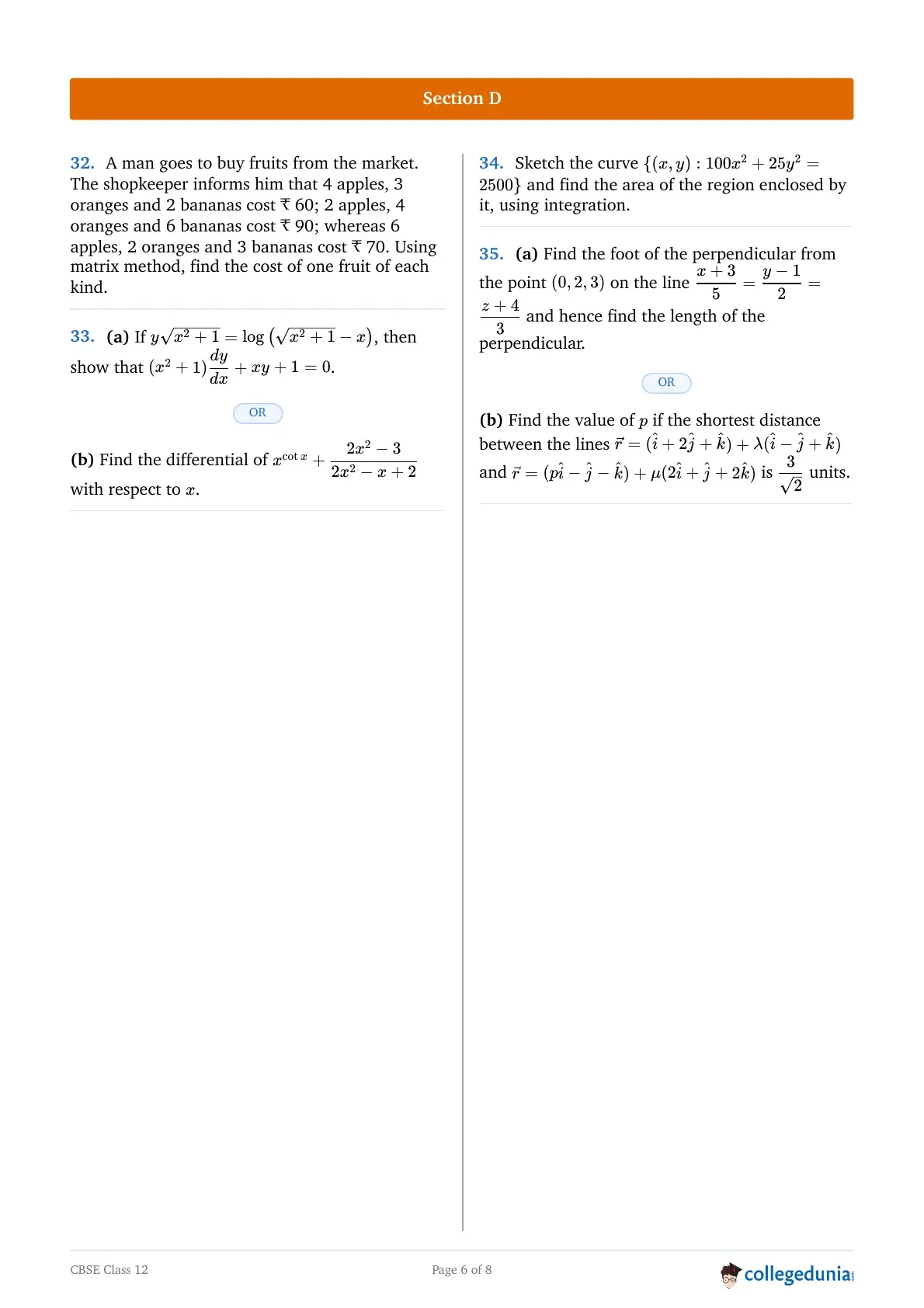
A man goes to buy fruits from the market. The shopkeeper informs him that 4 apples, 3 oranges and 2 bananas cost Rs.60; 2 apples, 4 oranges and 6 bananas cost Rs.90; whereas 6 apples, 2 oranges and 3 bananas cost Rs.70. Using matrix method, find the cost of one fruit of each kind.
Detailed Solution
Concept:
System of Linear Equations: Represent the problem as \( AX = B \).
Matrix Method: The solution is given by \( X = A^{-1}B \).
Inverse Formula: \( A^{-1} = \frac{1}{|A|} adj A \).
Step 1: Formulate the linear equations
Let the cost of 1 apple be \( x \), 1 orange be \( y \), and 1 banana be \( z \).
The equations are: \[ 4x + 3y + 2z = 60 \] \[ 2x + 4y + 6z = 90 \Rightarrow x + 2y + 3z = 45 \] \[ 6x + 2y + 3z = 70 \]
Step 2: Set up the matrix equation \( AX = B \)
\[ \begin{bmatrix} 4 & 3 & 2 \\ 1 & 2 & 3 \\ 6 & 2 & 3 \end{bmatrix} \begin{bmatrix} x \\ y \\ z \end{bmatrix} = \begin{bmatrix} 60 \\ 45 \\ 70 \end{bmatrix} \]
Determinant of \( A \): \[ |A| = 4(6-6) - 3(3-18) + 2(2-12) \] \[ |A| = 4(0) - 3(-15) + 2(-10) = 45 - 20 = 25 \]
Since \( |A| \neq 0 \), a unique solution exists.
Step 3: Calculate the adjoint matrix \( adj A \)
Cofactor matrix \( C \): \[ C_{11}=0, C_{12}=15, C_{13}=-10 \] \[ C_{21}=-(9-4)=-5, C_{22}=(12-12)=0, C_{23}=-(8-18)=10 \] \[ C_{31}=(9-4)=5, C_{32}=-(12-2)=-10, C_{33}=(8-3)=5 \] \[ adj A = C^T = \begin{bmatrix} 0 & -5 & 5
15 & 0 & -10
-10 & 10 & 5 \end{bmatrix} \]
Step 4: Calculate \( X = A^{-1}B \)
\[ \begin{bmatrix} x \\ y \\ z \end{bmatrix} = \frac{1}{25} \begin{bmatrix} 0 & -5 & 5 \\ 15 & 0 & -10 \\ -10 & 10 & 5 \end{bmatrix} \begin{bmatrix} 60 \\ 45 \\ 70 \end{bmatrix} \] \[ \begin{bmatrix} x \\ y \\ z \end{bmatrix} = \frac{1}{25} \begin{bmatrix} 0 - 225 + 350 \\ 900 + 0 - 700 \\ -600 + 450 + 350 \end{bmatrix} = \frac{1}{25} \begin{bmatrix} 125 \\ 200 \\ 200 \end{bmatrix} \] \[ x = \frac{125}{25} = 5, y = \frac{200}{25} = 8, z = \frac{200}{25} = 8 \]
Step 5: Conclusion
Cost of one apple = Rs. 5, one orange = Rs. 8, and one banana = Rs. 8. Quick Tip: Simplify equations first (like dividing the second row by 2) to reduce arithmetic errors.
Always substitute the final values back into one original equation to verify the result.
If \( y\sqrt{x^2+1} = \log(\sqrt{x^2+1} - x) \), show that \( (x^2+1)\frac{dy}{dx} + xy + 1 = 0 \).
Detailed Solution
Concept:
Implicit differentiation using the product rule: \( \frac{d}{dx}(uv) = u\frac{dv}{dx} + v\frac{du}{dx} \).
Derivative of \(\log(f(x))\): \( \frac{f'(x)}{f(x)} \).
Derivative of \(\sqrt{x^2+1}\): \( \frac{x}{\sqrt{x^2+1}} \).
Step 1: Differentiate both sides with respect to \( x \)
Using the product rule on the left-hand side: \[ y \cdot \frac{d}{dx}(\sqrt{x^2+1}) + \sqrt{x^2+1} \cdot \frac{dy}{dx} = \frac{d}{dx}[\log(\sqrt{x^2+1} - x)] \] \[ y \cdot \frac{2x}{2\sqrt{x^2+1}} + \sqrt{x^2+1} \frac{dy}{dx} = \frac{1}{\sqrt{x^2+1} - x} \cdot \left( \frac{x}{\sqrt{x^2+1}} - 1 \right) \]
Step 2: Simplify the right-hand side derivative
\[ \frac{xy}{\sqrt{x^2+1}} + \sqrt{x^2+1} \frac{dy}{dx} = \frac{1}{\sqrt{x^2+1} - x} \cdot \left( \frac{x - \sqrt{x^2+1}}{\sqrt{x^2+1}} \right) \] \[ \frac{xy}{\sqrt{x^2+1}} + \sqrt{x^2+1} \frac{dy}{dx} = \frac{-( \sqrt{x^2+1} - x)}{\sqrt{x^2+1}( \sqrt{x^2+1} - x)} \] \[ \frac{xy}{\sqrt{x^2+1}} + \sqrt{x^2+1} \frac{dy}{dx} = -\frac{1}{\sqrt{x^2+1}} \]
Step 3: Clear the denominator and rearrange
Multiply the entire equation by \( \sqrt{x^2+1} \): \[ xy + (\sqrt{x^2+1})^2 \frac{dy}{dx} = -1 \] \[ xy + (x^2+1) \frac{dy}{dx} = -1 \] \[ (x^2+1)\frac{dy}{dx} + xy + 1 = 0 \]
Hence proved. Quick Tip: Don't be intimidated by complex logs; the derivative of \(\log(\sqrt{x^2+1} \pm x)\) often simplifies to \( \pm 1/\sqrt{x^2+1} \).
Clearing radicals from the denominator as early as possible simplifies the subsequent algebra.
Find the differential of \( x^{\cot x} + \frac{2x^2-3}{2x^2-x+2} \) with respect to \( x \).
Detailed Solution
Concept:
Sum rule for differentiation.
Logarithmic differentiation for \( u(x)^{v(x)} \).
Quotient rule: \( \frac{d}{dx}(\frac{u}{v}) = \frac{vu' - uv'}{v^2} \).
Step 1: Differentiate the first term \( u = x^{\cot x} \)
Let \( u = x^{\cot x} \). Taking natural log: \[ \log u = \cot x \log x \]
Differentiating wrt \( x \): \[ \frac{1}{u}\frac{du}{dx} = -cosec^2 x \cdot \log x + \cot x \cdot \frac{1}{x} \] \[ \frac{du}{dx} = x^{\cot x} \left( \frac{\cot x}{x} - \log x \cdot cosec^2 x \right) \]
Step 2: Differentiate the second term \( v = \frac{2x^2-3}{2x^2-x+2} \)
Using quotient rule: \[ \frac{dv}{dx} = \frac{(2x^2-x+2)(4x) - (2x^2-3)(4x-1)}{(2x^2-x+2)^2} \]
Numerator: \[ (8x^3 - 4x^2 + 8x) - (8x^3 - 2x^2 - 12x + 3) \] \[ 8x^3 - 4x^2 + 8x - 8x^3 + 2x^2 + 12x - 3 = -2x^2 + 20x - 3 \] \[ \frac{dv}{dx} = \frac{-2x^2 + 20x - 3}{(2x^2-x+2)^2} \]
Step 3: Combine the derivatives
The total derivative \( \frac{dy}{dx} = \frac{du}{dx} + \frac{dv}{dx} \): \[ \frac{dy}{dx} = x^{\cot x} \left( \frac{\cot x}{x} - cosec^2 x \log x \right) + \frac{20x - 2x^2 - 3}{(2x^2-x+2)^2} \] Quick Tip: Break down functions with different rules (power vs fraction) into separate variables \( u \) and \( v \) to keep work organized.
Simplify numerator algebra step-by-step to avoid missing negative signs.
Sketch the curve \( \{(x, y) : 100x^2 + 25y^2 = 2500\} \) and find the area of the region enclosed by it, using integration.
Detailed Solution
Concept:
Ellipse equation in standard form: \( \frac{x^2}{a^2} + \frac{y^2}{b^2} = 1 \).
Area of a region using integration: \( Area = 4 \int_{0}^{a} y \, dx \) for an ellipse.
Integration formula: \( \int \sqrt{a^2 - x^2} \, dx = \frac{x}{2}\sqrt{a^2 - x^2} + \frac{a^2}{2}\sin^{-1}(\frac{x}{a}) \).
Step 1: Identify the curve and its key parameters
Given: \( 100x^2 + 25y^2 = 2500 \). Divide by 2500: \[ \frac{x^2}{25} + \frac{y^2}{100} = 1 \Rightarrow \frac{x^2}{5^2} + \frac{y^2}{10^2} = 1 \]
This is an ellipse centered at \( (0, 0) \) with vertical major axis length 20 and horizontal minor axis length 10.
Vertices are \( (\pm 5, 0) \) and \( (0, \pm 10) \).
Step 2: Set up the integral for the area
Express \( y \) in terms of \( x \): \[ y^2 = 100(1 - x^2/25) = 4(25 - x^2) \Rightarrow y = 2\sqrt{25 - x^2} \]
Total Area \( A = 4 \times Area in 1st Quadrant \): \[ A = 4 \int_{0}^{5} 2\sqrt{25 - x^2} \, dx = 8 \int_{0}^{5} \sqrt{5^2 - x^2} \, dx \]
Step 3: Evaluate the integral
\[ A = 8 \left[ \frac{x}{2}\sqrt{25 - x^2} + \frac{25}{2}\sin^{-1}\left(\frac{x}{5}\right) \right]_{0}^{5} \]
Upper limit \( (x=5) \): \( 0 + \frac{25}{2}\sin^{-1}(1) = \frac{25}{2} \cdot \frac{\pi}{2} = \frac{25\pi}{4} \).
Lower limit \( (x=0) \): \( 0 + 0 = 0 \). \[ A = 8 \left( \frac{25\pi}{4} \right) = 50\pi sq. units \] Quick Tip: The area of an ellipse \( \frac{x^2}{a^2} + \frac{y^2}{b^2} = 1 \) is \( \pi ab \). You can use this to verify your final answer: \( \pi \times 5 \times 10 = 50\pi \).
Always remember to multiply the single quadrant integral by 4 to get the total enclosed area.
Find the foot of the perpendicular from the point \( (0, 2, 3) \) on the line \( \frac{x+3}{5} = \frac{y-1}{2} = \frac{z+4}{3} \) and hence find the length of the perpendicular.
Detailed Solution
Concept:
Any point on the line can be represented as a function of parameter \( \lambda \).
The vector from the given point to the foot of the perpendicular is orthogonal to the line's direction vector.
Orthogonality condition: Dot product of vectors is zero.
Step 1: Find a general point on the line
Let the foot of the perpendicular be \( Q \).
Setting the line equation to \( \lambda \): \[ x = 5\lambda - 3, y = 2\lambda + 1, z = 3\lambda - 4 \]
Coordinates of \( Q = (5\lambda-3, 2\lambda+1, 3\lambda-4) \).
Step 2: Find the direction vector \( \vec{PQ} \) and use orthogonality
Given point \( P(0, 2, 3) \). \( \vec{PQ} = (5\lambda-3 - 0)\hat{i} + (2\lambda+1 - 2)\hat{j} + (3\lambda-4 - 3)\hat{k} \) \( \vec{PQ} = (5\lambda-3)\hat{i} + (2\lambda-1)\hat{j} + (3\lambda-7)\hat{k} \).
The direction vector of the line is \( \vec{b} = 5\hat{i} + 2\hat{j} + 3\hat{k} \).
Since \( \vec{PQ} \perp \vec{b} \), their dot product is zero: \[ 5(5\lambda-3) + 2(2\lambda-1) + 3(3\lambda-7) = 0 \] \[ 25\lambda - 15 + 4\lambda - 2 + 9\lambda - 21 = 0 \Rightarrow 38\lambda - 38 = 0 \Rightarrow \lambda = 1 \]
Step 3: Determine the foot \( Q \) and the length \( PQ \)
Substituting \( \lambda = 1 \) into \( Q \):
Foot \( Q = (5(1)-3, 2(1)+1, 3(1)-4) = (2, 3, -1) \).
Length of perpendicular \( PQ \): \[ PQ = \sqrt{(2-0)^2 + (3-2)^2 + (-1-3)^2} = \sqrt{4 + 1 + 16} = \sqrt{21} units \] Quick Tip: Drawing a small sketch of the point and line helps visualize the vector \(\vec{PQ}\) correctly.
This method is more direct and less error-prone than using projection formulas for general lines.
Find the value of \( p \) if the shortest distance between the lines \( \vec{r} = (\hat{i} + 2\hat{j} + \hat{k}) + \lambda(\hat{i} - \hat{j} + \hat{k}) \) and \( \vec{r} = (p\hat{i} - \hat{j} - \hat{k}) + \mu(2\hat{i} + \hat{j} + 2\hat{k}) \) is \( \frac{3}{\sqrt{2}} \) units.
Detailed Solution
Concept:
Shortest distance (SD) between two skew lines \( \vec{r} = \vec{a_1} + \lambda\vec{b_1} \) and \( \vec{r} = \vec{a_2} + \mu\vec{b_2} \):
\[ SD = \frac{|(\vec{a_2} - \vec{a_1}) \cdot (\vec{b_1} \times \vec{b_2})|}{|\vec{b_1} \times \vec{b_2}|} \]
Step 1: Identify vectors and calculate \( \vec{a_2} - \vec{a_1} \) and \( \vec{b_1} \times \vec{b_2} \)
\( \vec{a_1} = (1, 2, 1), \vec{b_1} = (1, -1, 1) \). \( \vec{a_2} = (p, -1, -1), \vec{b_2} = (2, 1, 2) \). \( \vec{a_2} - \vec{a_1} = (p-1)\hat{i} - 3\hat{j} - 2\hat{k} \). \[ \vec{b_1} \times \vec{b_2} = \begin{vmatrix} \hat{i} & \hat{j} & \hat{k} \\ 1 & -1 & 1 \\ 2 & 1 & 2 \end{vmatrix} = \hat{i}(-2-1) - \hat{j}(2-2) + \hat{k}(1+2) = -3\hat{i} + 0\hat{j} + 3\hat{k} \]
Magnitude \( |\vec{b_1} \times \vec{b_2}| = \sqrt{(-3)^2 + 3^2} = \sqrt{18} = 3\sqrt{2} \).
Step 2: Evaluate the numerator and substitute into the distance formula
\[ (\vec{a_2} - \vec{a_1}) \cdot (\vec{b_1} \times \vec{b_2}) = (p-1)(-3) + (-3)(0) + (-2)(3) = -3p + 3 - 6 = -3p - 3 \]
Given \( SD = 3/\sqrt{2} \): \[ \frac{|-3p - 3|}{3\sqrt{2}} = \frac{3}{\sqrt{2}} \] \[ \frac{3|p + 1|}{3\sqrt{2}} = \frac{3}{\sqrt{2}} \Rightarrow |p + 1| = 3 \]
Step 3: Solve the final equation for \( p \)
Case 1: \( p + 1 = 3 \Rightarrow p = 2 \).
Case 2: \( p + 1 = -3 \Rightarrow p = -4 \).
The values of \( p \) are 2 and -4. Quick Tip: If \( \vec{b_1} \times \vec{b_2} \) results in a zero vector, the lines are parallel, and you must use a different distance formula.
Always use the absolute value around the dot product to ensure a positive distance.
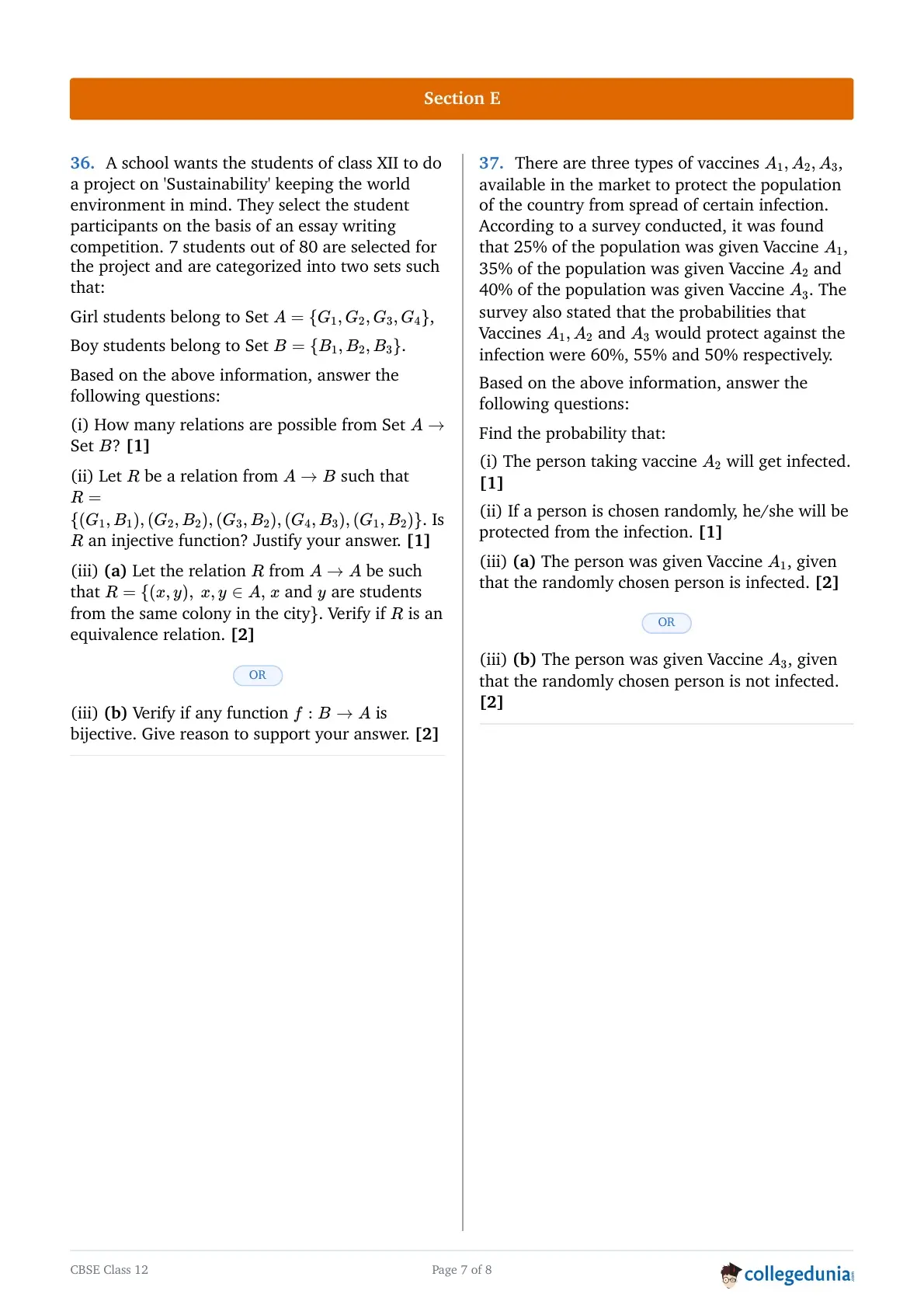
A school wants the students of class XII to do a project on ‘Sustainability’ keeping the world environment in mind. They select the student participants on the basis of an essay writing competition.
7 students out of 80 are selected for the project and are categorized into
two sets such that :
Girl students belong to Set A = \( A = \{G_1, G_2, G_3, G_4\} \) and
Boy students belong to Set B = \( B = \{B_1, B_2, B_3\} \) .
How many relations are possible from Set \( A \to \) Set \( B \)?
Detailed Solution
Concept:
A relation from set \( A \) to set \( B \) is any subset of the Cartesian product \( A \times B \).
If \( n(A) = p \) and \( n(B) = q \), then the number of elements in \( A \times B \) is \( p \times q \).
The total number of subsets of a set with \( m \) elements is \( 2^m \).
Step 1: Find the number of elements in each set
Set \( A \) contains 4 elements: \( n(A) = 4 \).
Set \( B \) contains 3 elements: \( n(B) = 3 \).
Step 2: Calculate the number of elements in the Cartesian product \( A \times B \)
\[ n(A \times B) = n(A) \times n(B) \] \[ n(A \times B) = 4 \times 3 = 12 \]
Step 3: Determine the total number of relations
The total number of possible relations is the total number of subsets of \( A \times B \). \[ Total Relations = 2^{n(A \times B)} \] \[ Total Relations = 2^{12} \] \[ Total Relations = 4096 \] Quick Tip: A relation is simply a set of ordered pairs; it doesn't have the "one output per input" restriction of a function.
Remember: The number of relations from \( A \to B \) is the same as from \( B \to A \).
Let \( R \) be a relation from \( A \to B \) such that \( R = \{(G_1, B_1), (G_2, B_2), (G_3, B_2), (G_4, B_3), (G_1, B_2)\} \). Is \( R \) an injective function? Justify your answer.
Detailed Solution
Concept:
A relation is a function if every element in the domain has exactly one image in the codomain.
A function is injective (one-to-one) if distinct elements in the domain have distinct images in the codomain.
Step 1: Check if the relation \( R \) qualifies as a function
In the given relation \( R \):
The element \( G_1 \in A \) is associated with two different elements in \( B \), namely \( B_1 \) and \( B_2 \). \[ (G_1, B_1) \in R \quad and \quad (G_1, B_2) \in R \]
By the definition of a function, an element in the domain cannot have more than one image.
Therefore, \( R \) is not a function.
Step 2: Check the condition for injectivity
Even if we ignore the first step, let's examine the mapping of other elements:
We see that \( (G_2, B_2) \in R \) and \( (G_3, B_2) \in R \).
Two distinct elements \( G_2 \) and \( G_3 \) have the same image \( B_2 \).
This violates the condition for a function to be injective.
Step 3: Conclusion and Justification
\( R \) is not an injective function because:
It is not a function (since \( G_1 \) has multiple images).
It is not one-to-one (since \( G_2 \) and \( G_3 \) share the same image \( B_2 \)). Quick Tip: To be a function, check if any first element in the pairs is repeated with a different second element.
Injectivity is about the 'uniqueness' of the second elements in the pairs.
Let the relation \(R\) from \(A \to A\) be such that \[ R = \{(x,y) : x,y \in A,\ x and y are students from the same colony in the city\}. \]
Verify if \(R\) is an equivalence relation.
Detailed Solution
Concept:
Reflexive: \((x, x) \in R\) for all \(x \in A\).
Symmetric: If \((x, y) \in R\), then \((y, x) \in R\).
Transitive: If \((x, y) \in R\) and \((y, z) \in R\), then \((x, z) \in R\).
A relation is an equivalence relation if it is reflexive, symmetric, and transitive.
Step 1: Verify Reflexivity
For any student \( x \in A \), \( x \) and \( x \) are obviously from the same colony.
So, \( (x, x) \in R \) for all \( x \in A \).
Therefore, \( R \) is reflexive.
Step 2: Verify Symmetry
Let \( (x, y) \in R \). This means student \( x \) and student \( y \) are from the same colony.
If \( x \) and \( y \) are in the same colony, then \( y \) and \( x \) are also in the same colony.
So, \( (y, x) \in R \).
Therefore, \( R \) is symmetric.
Step 3: Verify Transitivity
Let \( (x, y) \in R \) and \( (y, z) \in R \).
This means \( x \) and \( y \) are in the same colony, and \( y \) and \( z \) are in the same colony.
This logically implies that \( x \) and \( z \) must also be in the same colony.
So, \( (x, z) \in R \).
Therefore, \( R \) is transitive.
Step 4: Conclusion
Since the relation \( R \) is reflexive, symmetric, and transitive, it is verified that \( R \) is an equivalence relation. Quick Tip: Any relation defined by the property of "belonging to the same category" (colony, school, age, etc.) is always an equivalence relation.
Use clear logical statements for symmetry and transitivity to earn full marks.
Verify if any function \( f : B \to A \) is bijective. Give reason to support your answer.
Detailed Solution
Concept:
A function is bijective if it is both injective (one-to-one) and surjective (onto).
For a function \( f : X \to Y \) to be bijective, the number of elements in the domain and codomain must be equal: \( n(X) = n(Y) \).
Step 1: Compare the number of elements in both sets
Set \( B \) (Domain) contains 3 elements: \( n(B) = 3 \).
Set \( A \) (Codomain) contains 4 elements: \( n(A) = 4 \).
Step 2: Analyze the condition for Surjectivity (Onto)
For a function to be surjective, every element in the codomain \( A \) must have at least one pre-image in the domain \( B \).
Since there are only 3 elements in the domain \( B \), they can map to at most 3 distinct elements in the codomain \( A \).
Because the codomain \( A \) has 4 elements, at least one element in \( A \) will always be left without a pre-image.
Thus, no function from \( B \) to \( A \) can be surjective.
Step 3: Conclusion
A function must be both injective and surjective to be bijective.
Since no function from \( B \) to \( A \) can be surjective (due to \( n(B) < n(A) \)), it follows that no such function can be bijective. Quick Tip: If \( n(Domain) \neq n(Codomain) \), a bijection is impossible.
If \( n(D) < n(C) \), it cannot be onto. If \( n(D) > n(C) \), it cannot be one-to-one.
There are three types of vaccines \( A_1, A_2, A_3 \), available in the market to protect the population of the country from spread of certain infection. According to a survey conducted, it was found that 25% of the population was given Vaccine \( A_1 \), 35% of the population was given Vaccine \( A_2 \) and 40% of the population was given Vaccine \( A_3 \). The survey also stated that the probabilities that Vaccines \( A_1, A_2 \) and \( A_3 \) would protect against the infection were 60%, 55% and 50% respectively. Based on the above information, find the probability that:
The person taking vaccine \( A_2 \) will get infected.
Detailed Solution
Concept:
Probability of an event and its complement: \( P(E') = 1 - P(E) \).
Given a conditional probability of success (protection), the probability of failure (infection) is its complement.
Step 1: Identify the given probabilities for Vaccine \( A_2 \)
From the case study, for a person taking Vaccine \( A_2 \):
Probability of being protected, \( P(Protected | A_2) = 55% = 0.55 \).
Step 2: Calculate the probability of being infected
Getting infected is the complementary event of being protected. \[ P(Infected | A_2) = 1 - P(Protected | A_2) \] \[ P(Infected | A_2) = 1 - 0.55 \] \[ P(Infected | A_2) = 0.45 \]
Step 3: Final Result
The probability that a person taking Vaccine \( A_2 \) will get infected is \( 0.45 \) or \( 45% \). Quick Tip: Conditional probability for a single branch is simply the complement.
Always convert percentages to decimals for easier calculation in probability problems.
If a person is chosen randomly, he/she will be protected from the
infection.
Detailed Solution
Concept:
Theorem of Total Probability: For mutually exclusive events \( E_1, E_2, E_3 \), the total probability of an event \( A \) is \( P(A) = \sum P(E_i)P(A|E_i) \).
Step 1: Define the events and their probabilities
Let \( E_1, E_2, E_3 \) be the events that a person takes Vaccine \( A_1, A_2, A_3 \) respectively. \[ P(E_1) = 25% = 0.25 \] \[ P(E_2) = 35% = 0.35 \] \[ P(E_3) = 40% = 0.40 \]
Let \( A \) be the event that the person is protected. \[ P(A|E_1) = 0.60 \] \[ P(A|E_2) = 0.55 \] \[ P(A|E_3) = 0.50 \]
Step 2: Apply the Total Probability Formula
\[ P(A) = P(E_1)P(A|E_1) + P(E_2)P(A|E_2) + P(E_3)P(A|E_3) \] \[ P(A) = (0.25 \times 0.60) + (0.35 \times 0.55) + (0.40 \times 0.50) \]
Step 3: Calculate the final numerical value
\[ P(A) = 0.1500 + 0.1925 + 0.2000 \] \[ P(A) = 0.5425 \]
The probability that a randomly chosen person is protected is \( 0.5425 \). Quick Tip: Total probability sums the 'weighted' probabilities of each vaccine branch.
Multiply carefully and keep as many decimal places as needed until the final step.
The person was given Vaccine \(A_1\), given that the randomly chosen person is infected.
Detailed Solution
Concept:
Bayes' Theorem: \( P(E_k|I) = \frac{P(E_k)P(I|E_k)}{P(I)} \).
\( P(I) = 1 - P(Protected) \).
Step 1: Calculate the total probability of being infected
From question 37(ii), total probability of protection \( P(A) = 0.5425 \).
Total probability of infection \( P(I) = 1 - 0.5425 = 0.4575 \).
Step 2: Calculate the numerator for Bayes' Theorem
We need the probability of being infected given Vaccine \( A_1 \). \[ P(I|E_1) = 1 - 0.60 = 0.40 \]
Numerator: \( P(E_1)P(I|E_1) = 0.25 \times 0.40 = 0.10 \).
Step 3: Apply Bayes' Theorem
\[ P(E_1|I) = \frac{P(E_1)P(I|E_1)}{P(I)} \] \[ P(E_1|I) = \frac{0.10}{0.4575} \]
Converting to fraction: \[ P(E_1|I) = \frac{1000}{4575} = \frac{40}{183} \] Quick Tip: Always simplify your final fraction if possible.
Bayes' Theorem answers "given the result, what was the cause?".
The person was given Vaccine \(A_3\), given that the randomly chosen person is not infected.
Detailed Solution
Concept:
Bayes' Theorem for protected individuals (not infected): \( P(E_3|A) = \frac{P(E_3)P(A|E_3)}{P(A)} \).
Step 1: Identify the required values from previous steps
\( P(A) = 0.5425 \) (Total Probability of protection).
\( P(E_3) = 0.40 \).
\( P(A|E_3) = 0.50 \).
Step 2: Calculate the numerator
\[ P(E_3)P(A|E_3) = 0.40 \times 0.50 = 0.20 \]
Step 3: Apply Bayes' Theorem
\[ P(E_3|A) = \frac{0.20}{0.5425} \]
Converting to fraction:
\[ P(E_3|A) = \frac{2000}{5425} = \frac{80}{217} \] Quick Tip: "Not infected" is the same as "Protected" in this context.
Double check your division when converting decimals to fractions.
A company produces cylindrical tumblers, open from the top. Since they want uniformity in the product, they fix the surface area of the tumblers produced. If for a tumbler, \( V \) is its volume, \( h \) the height and \( r \) the radius of the circular base, then:

Differentiate its volume with respect to radius of the base, where
the surface area is constant.
Detailed Solution
Concept:
Volume of cylinder: \( V = \pi r^2 h \).
Surface area of an open cylinder: \( S = \pi r^2 + 2\pi r h \).
To differentiate \( V \) wrt \( r \), express \( V \) as a function of \( r \) alone by eliminating \( h \).
Step 1: Express \( h \) in terms of \( S \) and \( r \)
From the surface area formula (where \( S \) is constant): \[ 2\pi r h = S - \pi r^2 \] \[ h = \frac{S - \pi r^2}{2\pi r} \]
Step 2: Substitute \( h \) into the volume formula
\[ V = \pi r^2 \left( \frac{S - \pi r^2}{2\pi r} \right) \] \[ V = \frac{r(S - \pi r^2)}{2} \] \[ V = \frac{Sr}{2} - \frac{\pi r^3}{2} \]
Step 3: Differentiate \( V \) with respect to \( r \)
Treating \( S \) and \( \pi \) as constants: \[ \frac{dV}{dr} = \frac{d}{dr} \left( \frac{Sr}{2} - \frac{\pi r^3}{2} \right) \] \[ \frac{dV}{dr} = \frac{S}{2} - \frac{3\pi r^2}{2} \] Quick Tip: For an open cylinder, only one base (\( \pi r^2 \)) is included in the surface area.
Ensure you simplify the volume expression before differentiating to avoid the product rule.
If the company wants to maximize the volume of each tumbler,
then establish a relation between its height and the radius of the
base.
Detailed Solution
Concept:
For maximum volume, the derivative \( dV/dr \) must be zero.
Use the result from the previous part to find the optimal dimensions.
Step 1: Set the derivative to zero
From part (i): \( \frac{dV}{dr} = \frac{S}{2} - \frac{3\pi r^2}{2} \).
For maximum volume: \[ \frac{S}{2} - \frac{3\pi r^2}{2} = 0 \] \[ S = 3\pi r^2 \]
Step 2: Substitute the original formula for \( S \)
We know \( S = \pi r^2 + 2\pi r h \).
Substituting this into our optimality condition: \[ \pi r^2 + 2\pi r h = 3\pi r^2 \]
Step 3: Simplify the relation
\[ 2\pi r h = 3\pi r^2 - \pi r^2 \] \[ 2\pi r h = 2\pi r^2 \]
Dividing by \( 2\pi r \) (since \( r \neq 0 \)): \[ h = r \]
Step 4: Conclusion
To maximize the volume of an open cylindrical tumbler for a fixed surface area, the height must be equal to the radius of the base. Quick Tip: In many optimization problems involving shapes, the dimensions often turn out to be equal or proportional to each other.
Always verify with the second derivative test if required; here \( d^2V/dr^2 = -3\pi r < 0 \), confirming a maximum.
CBSE Class 12 Mathematics Chapter-Wise Weightage
| S.No | Units | Marks |
|---|---|---|
| I | Relations and Functions | 08 |
| II | Algebra | 10 |
| III | Calculus | 35 |
| IV | Vectors and Three-Dimensional Geometry | 14 |
| V | Linear Programming | 05 |
| VI | Probability | 08 |
| Total (Theory) | 80 | |
| Internal Assessment | 20 |



Comments