CBSE Class 12 Mathematics Set 1- (65/4/1) Question Paper 2026 is available for download here. CBSE conducted Class 12 Mathematics exam on March 9, 2026 from 10:30 AM to 1:30 PM. The Mathematics theory paper is of 80 marks, and the internal assessment is of 20 marks.

Mathematics question paper includes MCQs (1 mark each), short-answer type questions (2 & 3 marks each), and long-answer type questions (4 & 6 marks each) which makes up the total of 80 marks.

Download CBSE Class 12 Mathematics Set 1- (65/4/1) Question Paper 2026 with detailed solutions from the links provided below.

CBSE Class 12 Mathematics Set 1- (65/4/1) Question Paper 2026 with Solution PDF

CBSE Class 12 Mathematics Question Paper 2026 Set 1- (65/4/1) Download PDF Detailed Solutions

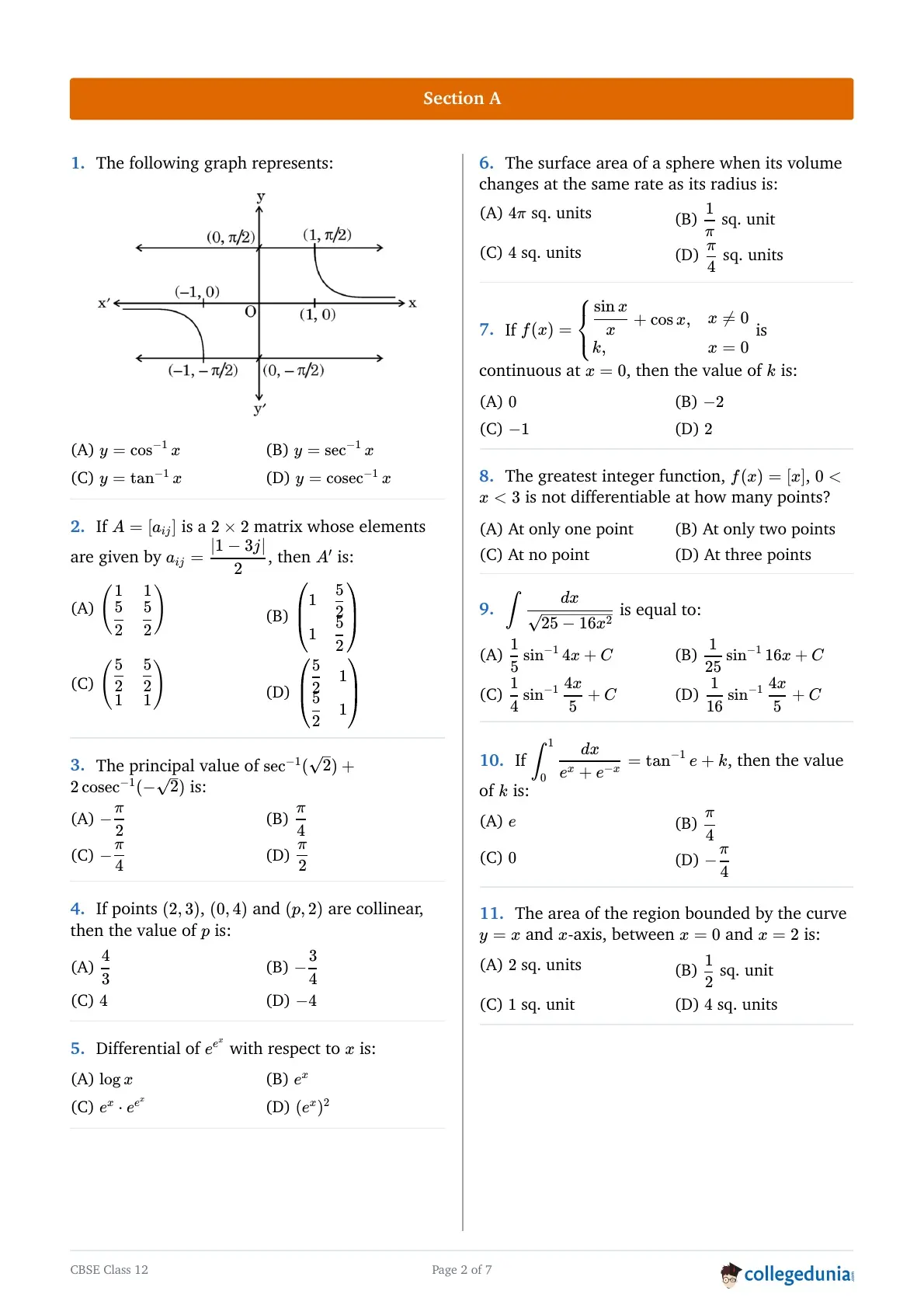
Question 1:

The following graph represents :


  • (A) \(y = \cos^{-1} x\)
  • (B) \(y = \sec^{-1} x\)
  • (C) \(y = \tan^{-1} x\)
  • (D) \(y = cosec^{-1} x\)
Correct Answer: (B) \(y = \sec^{-1} x\)
View Solution


Concept:

The domain of \(\sec^{-1} x\) is \((-\infty, -1] \cup [1, \infty)\).
The principal value range of \(\sec^{-1} x\) is \([0, \pi] \setminus \{\frac{\pi}{2}\}\), but in some modified conventions, it is defined as \([-\pi, -\frac{\pi}{2}) \cup [0, \frac{\pi}{2})\).
At \(x = 1\), \(y = \sec^{-1}(1) = 0\).
At \(x = -1\), \(y = \sec^{-1}(-1) = \pi\) (Standard) or \(-\pi\) (Modified).


Step 1: Analyze the domain shown in the graph

The graph consists of two branches.

One branch exists for \(x \ge 1\) starting from the point \((1, 0)\).

The other branch exists for \(x \le -1\) starting from the point \((-1, 0)\).

This confirms the domain is \((-\infty, -1] \cup [1, \infty)\). This eliminates \(\tan^{-1} x\) (which has domain \(\mathbb{R}\)) and \(\cos^{-1} x\) (which has domain \([-1, 1]\)).

Step 2: Evaluate specific points to distinguish between \(\sec^{-1} x\) and \(cosec^{-1} x\)

The graph clearly passes through the point \((1, 0)\).

We check the values for \(\sec^{-1} x\) and \(cosec^{-1} x\):

For \(\sec^{-1} x\): \(\sec^{-1}(1) = 0\) because \(\sec(0) = 1\).

For \(cosec^{-1} x\): \(cosec^{-1}(1) = \frac{\pi}{2}\) because \(cosec(\frac{\pi}{2}) = 1\).

Since the graph includes \((1, 0)\), it represents a form of the \(\sec^{-1} x\) function.

Step 3: Examine the asymptotic behavior

The graph shows a horizontal asymptote at \(y = \frac{\pi}{2}\) as \(x \to \infty\).

It shows another horizontal asymptote at \(y = -\frac{\pi}{2}\) as \(x \to -\infty\).

This corresponds to the definition of \(\sec^{-1} x\) often used in calculus where the range is split to make the function's derivative always positive.

Thus, the graph represents \(y = \sec^{-1} x\). Quick Tip: To identify inverse trig graphs, look at the intercepts: \((1, 0)\) is the signature of \(\sec^{-1} x\).
Check the domain: If the graph is missing between \(-1\) and \(1\), it must be \(\sec^{-1}\) or \(cosec^{-1}\).
Horizontal asymptotes indicate the bounds of the range.


Question 2:

If \(A = [a_{ij}]\) is a \(2 \times 2\) matrix whose elements are given by \(a_{ij} = \frac{|i - 3j|}{2}\), then \(A'\) is :

  • (A) \(\begin{bmatrix} 1 & \frac{5}{2} \\ \frac{1}{2} & 2 \end{bmatrix}\)
  • (B) \(\begin{bmatrix} 1 & \frac{1}{2} \\ \frac{5}{2} & 2 \end{bmatrix}\)
  • (C) \(\begin{bmatrix} 2 & \frac{5}{2} \\ \frac{1}{2} & 1 \end{bmatrix}\)
  • (D) \(\begin{bmatrix} 1 & \frac{1}{2} \\ \frac{5}{2} & 1 \end{bmatrix}\)
Correct Answer: (B) \(\begin{bmatrix} 1 & \frac{1}{2} \\ \frac{5}{2} & 2 \end{bmatrix}\)
View Solution


Concept:

A \(2 \times 2\) matrix \(A\) is represented as \(\begin{bmatrix} a_{11} & a_{12}
a_{21} & a_{22} \end{bmatrix}\).
The index \(i\) denotes the row number, and \(j\) denotes the column number.
The transpose of a matrix \(A\), denoted by \(A'\), is found by swapping rows with columns: \(A'_{ij} = A_{ji}\).


Step 1: Calculate the element \(a_{11}\)

Here \(i = 1\) and \(j = 1\).

Substituting into the formula \(a_{ij} = \frac{|i - 3j|}{2}\):
\[ a_{11} = \frac{|1 - 3(1)|}{2} = \frac{|1 - 3|}{2} = \frac{|-2|}{2} = \frac{2}{2} = 1 \]

Step 2: Calculate the element \(a_{12}\)

Here \(i = 1\) and \(j = 2\).
\[ a_{12} = \frac{|1 - 3(2)|}{2} = \frac{|1 - 6|}{2} = \frac{|-5|}{2} = \frac{5}{2} \]

Step 3: Calculate the element \(a_{21}\)

Here \(i = 2\) and \(j = 1\).
\[ a_{21} = \frac{|2 - 3(1)|}{2} = \frac{|2 - 3|}{2} = \frac{|-1|}{2} = \frac{1}{2} \]

Step 4: Calculate the element \(a_{22}\)

Here \(i = 2\) and \(j = 2\).
\[ a_{22} = \frac{|2 - 3(2)|}{2} = \frac{|2 - 6|}{2} = \frac{|-4|}{2} = \frac{4}{2} = 2 \]

Step 5: Construct matrix \(A\) and find its transpose \(A'\)

The matrix \(A\) is:
\[ A = \begin{bmatrix} 1 & \frac{5}{2} \\ \frac{1}{2} & 2 \end{bmatrix} \]
To find the transpose \(A'\), interchange rows and columns:
\[ A' = \begin{bmatrix} a_{11} & a_{21} \\ a_{12} & a_{22} \end{bmatrix} = \begin{bmatrix} 1 & \frac{1}{2} \\ \frac{5}{2} & 2 \end{bmatrix} \]
Comparing this with the given options, it matches option (B). Quick Tip: Always double-check if the question asks for matrix \(A\) or its transpose \(A'\).
Transpose operation: Row 1 becomes Column 1, and Row 2 becomes Column 2.


Question 3:

The principal value of \(\sec^{-1}(\sqrt{2}) + 2 cosec^{-1}(-\sqrt{2})\) is :

  • (A) \(-\frac{\pi}{2}\)
  • (B) \(-\frac{\pi}{4}\)
  • (C) \(\frac{\pi}{4}\)
  • (D) \(\frac{\pi}{2}\)
Correct Answer: (B) \(-\frac{\pi}{4}\)
View Solution


Concept:

Principal value range of \(\sec^{-1} x\) is \([0, \pi] \setminus \{\frac{\pi}{2}\}\).
Principal value range of \(cosec^{-1} x\) is \([-\frac{\pi}{2}, \frac{\pi}{2}] \setminus \{0\}\).
For \(cosec^{-1} x\), we use the identity \(cosec^{-1}(-x) = -cosec^{-1}(x)\).


Step 1: Evaluate \(\sec^{-1}(\sqrt{2})\)

Let \(\sec^{-1}(\sqrt{2}) = y\).

Then \(\sec y = \sqrt{2}\).

Since \(\sec \frac{\pi}{4} = \sqrt{2}\) and \(\frac{\pi}{4}\) is in the principal range \([0, \pi] \setminus \{\frac{\pi}{2}\}\),
\[ \sec^{-1}(\sqrt{2}) = \frac{\pi}{4} \]

Step 2: Evaluate \(cosec^{-1}(-\sqrt{2})\)

Using the identity \(cosec^{-1}(-x) = -cosec^{-1}(x)\):
\[ cosec^{-1}(-\sqrt{2}) = -cosec^{-1}(\sqrt{2}) \]
We know \(cosec \frac{\pi}{4} = \sqrt{2}\) because \(\sin \frac{\pi}{4} = \frac{1}{\sqrt{2}}\).

So, \(cosec^{-1}(\sqrt{2}) = \frac{\pi}{4}\).

Thus, \(cosec^{-1}(-\sqrt{2}) = -\frac{\pi}{4}\).

Step 3: Compute the final expression value

Substitute the evaluated values into the expression:
\[ \sec^{-1}(\sqrt{2}) + 2 cosec^{-1}(-\sqrt{2}) = \frac{\pi}{4} + 2\left(-\frac{\pi}{4}\right) \] \[ = \frac{\pi}{4} - \frac{2\pi}{4} \] \[ = \frac{\pi - 2\pi}{4} = -\frac{\pi}{4} \]
This matches option (B). Quick Tip: Memorize the principal value ranges for all six inverse trigonometric functions.
Remember \(cosec^{-1}(-x) = -cosec^{-1}(x)\) but \(\sec^{-1}(-x) = \pi - \sec^{-1}(x)\).


Question 4:

If points (2, 3), (0, 4) and (p, 2) are collinear, then the value of p is :

  • (A) \(\frac{4}{7}\)
  • (B) \(-\frac{3}{7}\)
  • (C) \(4\)
  • (D) \(-4\)
Correct Answer: (C) 4
View Solution


Concept:

Three points \(A(x_1, y_1), B(x_2, y_2)\) and \(C(x_3, y_3)\) are collinear if they lie on the same straight line.
This condition is met if the slope of line segment \(AB\) is equal to the slope of line segment \(BC\).
Slope formula: \(m = \frac{y_2 - y_1}{x_2 - x_1}\).


Step 1: Calculate the slope of the segment joining (2, 3) and (0, 4)

Let \(A = (2, 3)\) and \(B = (0, 4)\).

Slope of \(AB\) (\(m_1\)) is:
\[ m_1 = \frac{4 - 3}{0 - 2} = \frac{1}{-2} = -\frac{1}{2} \]

Step 2: Calculate the slope of the segment joining (0, 4) and (p, 2)

Let \(B = (0, 4)\) and \(C = (p, 2)\).

Slope of \(BC\) (\(m_2\)) is:
\[ m_2 = \frac{2 - 4}{p - 0} = \frac{-2}{p} \]

Step 3: Equate the slopes to find p

Since the points are collinear, \(m_1 = m_2\):
\[ -\frac{1}{2} = -\frac{2}{p} \]
Cancel the negative signs from both sides:
\[ \frac{1}{2} = \frac{2}{p} \]
Cross-multiplying:
\[ p \times 1 = 2 \times 2 \] \[ p = 4 \]
Alternatively, using the area of triangle method, set \(\frac{1}{2}|x_1(y_2-y_3) + x_2(y_3-y_1) + x_3(y_1-y_2)| = 0\):
\[ |2(4-2) + 0(2-3) + p(3-4)| = 0 \] \[ |2(2) + 0 + p(-1)| = 0 \] \[ |4 - p| = 0 \implies p = 4 \]
This matches option (C). Quick Tip: For checking collinearity of three points, the slope method is usually the fastest.
If one x-coordinate is zero (like in this question), calculations become significantly simpler.


Question 5:

Differential of \(e^{e^x}\) with respect to x is :

  • (A) \(\log x\)
  • (B) \(e^{e^x}\)
  • (C) \(e^x e^{e^x}\)
  • (D) \((e^x)^2\)
Correct Answer: (C) \(e^x e^{e^x}\)
View Solution


Concept:

The derivative of \(e^x\) with respect to \(x\) is \(e^x\).
Chain Rule: \(\frac{d}{dx}[f(g(x))] = f'(g(x)) \cdot g'(x)\).
For a function in the form \(e^{u(x)}\), the derivative is \(e^{u(x)} \cdot \frac{du}{dx}\).


Step 1: Identify the components for the chain rule

Let \(y = e^{e^x}\).

Let the exponent be \(u\), so \(u = e^x\).

Then the original function becomes \(y = e^u\).

Step 2: Differentiate the individual components

Differentiate \(y\) with respect to \(u\):
\[ \frac{dy}{du} = \frac{d}{du}(e^u) = e^u \]
Differentiate \(u\) with respect to \(x\):
\[ \frac{du}{dx} = \frac{d}{dx}(e^x) = e^x \]

Step 3: Apply the chain rule formula
\[ \frac{dy}{dx} = \frac{dy}{du} \cdot \frac{du}{dx} \]
Substitute the results from Step 2:
\[ \frac{dy}{dx} = e^u \cdot e^x \]
Now, replace \(u\) with the original expression \(e^x\):
\[ \frac{dy}{dx} = e^{e^x} \cdot e^x \]
Rearranging for standard notation:
\[ \frac{dy}{dx} = e^x e^{e^x} \]
This matches option (C). Quick Tip: For functions of the form \(e^{something}\), the derivative always starts with the original function itself, followed by the derivative of the 'something'.
Chain rule: differentiate from 'outside-in'.


Question 6:

The surface area of a sphere when its volume changes at the same rate as its radius is :

  • (A) \(4\pi sq. units\)
  • (B) \(1 sq. unit\)
  • (C) \(4 sq. units\)
  • (D) \(\pi sq. units\)
Correct Answer: (B) \(1 \text{ sq. unit}\)
View Solution


Concept:

Volume of a sphere of radius \(r\) is given by \(V = \frac{4}{3}\pi r^3\).
Surface area of a sphere of radius \(r\) is given by \(S = 4\pi r^2\).
Rate of change of volume with respect to time is \(\frac{dV}{dt}\).
Rate of change of radius with respect to time is \(\frac{dr}{dt}\).


Step 1: Find the derivative of volume with respect to time

Using the chain rule for \(V = \frac{4}{3}\pi r^3\):
\[ \frac{dV}{dt} = \frac{d}{dr}\left(\frac{4}{3}\pi r^3\right) \cdot \frac{dr}{dt} \] \[ \frac{dV}{dt} = \left(\frac{4}{3}\pi \cdot 3r^2\right) \cdot \frac{dr}{dt} \] \[ \frac{dV}{dt} = 4\pi r^2 \frac{dr}{dt} \]

Step 2: Use the given condition to find a relationship

The question states that the volume changes at the same rate as its radius.
\[ \frac{dV}{dt} = \frac{dr}{dt} \]
Substituting the expression from Step 1:
\[ 4\pi r^2 \frac{dr}{dt} = \frac{dr}{dt} \]
Assuming the radius is changing (\(\frac{dr}{dt} \neq 0\)), we can divide both sides by \(\frac{dr}{dt}\):
\[ 4\pi r^2 = 1 \]

Step 3: Identify the surface area

We know that the formula for the surface area \(S\) is \(4\pi r^2\).

From Step 2, we found that \(4\pi r^2 = 1\).

Therefore, \(S = 1\).

The surface area is \(1 sq. unit\). Quick Tip: Always write down the basic formulas for volume and surface area first.
The rate of change of volume \(\frac{dV}{dt}\) is always equal to the surface area \(S\) times \(\frac{dr}{dt}\).
Pay close attention to units in the final answer.


Question 7:

If \(f(x) = \begin{cases} \frac{\sin x}{x} + \cos x, & x \neq 0
k, & x = 0 \end{cases}\) is continuous at \(x = 0\), then the value of \(k\) is :

  • (A) \(0\)
  • (B) \(-2\)
  • (C) \(-1\)
  • (D) \(2\)
Correct Answer: (D) \(2\)
View Solution


Concept:

A function \(f(x)\) is continuous at \(x = a\) if \(\lim_{x \to a} f(x) = f(a)\).
Standard limit: \(\lim_{x \to 0} \frac{\sin x}{x} = 1\).
Standard limit: \(\lim_{x \to 0} \cos x = 1\).


Step 1: Calculate the limit of the function as \(x\) approaches 0

To find \(\lim_{x \to 0} f(x)\), we use the expression for \(x \neq 0\):
\[ L = \lim_{x \to 0} \left( \frac{\sin x}{x} + \cos x \right) \]

Step 2: Apply the sum rule of limits

The limit of a sum is the sum of the limits:
\[ L = \lim_{x \to 0} \frac{\sin x}{x} + \lim_{x \to 0} \cos x \]
Substituting the standard limits:
\[ L = 1 + 1 = 2 \]

Step 3: Equate the limit to the functional value at \(x = 0\)

For continuity at \(x = 0\), we must have:
\[ \lim_{x \to 0} f(x) = f(0) \]
From the function definition, \(f(0) = k\).

From our calculation, \(\lim_{x \to 0} f(x) = 2\).

Therefore, \(k = 2\). Quick Tip: Continuity at a point means "Limit = Value".
The limit \(\lim_{x \to 0} \frac{\sin x}{x}\) is a fundamental result in calculus; ensure it is memorized.
Check individual limits of terms if the overall expression looks complex.


Question 8:

The greatest integer function, \(f(x) = [x]\), \(0 < x < 3\) is not differentiable at how many points ?

  • (A) At only one point
  • (B) At only two points
  • (C) At no point
  • (D) At three points
Correct Answer: (B) At only two points
View Solution


Concept:

The greatest integer function \(f(x) = [x]\) is discontinuous at every integer value of \(x\).
Differentiability implies continuity. Therefore, if a function is discontinuous at a point, it cannot be differentiable at that point.
In an interval \((a, b)\), we count the number of integers contained within the interval.


Step 1: Identify the points of discontinuity in the given interval

The function is defined for \(x \in (0, 3)\).

The integers within this open interval are \(x = 1\) and \(x = 2\).

Step 2: Analyze differentiability at integer points

At \(x = 1\):

Left Hand Limit (LHL) \(= \lim_{x \to 1^-} [x] = 0\).

Right Hand Limit (RHL) \(= \lim_{x \to 1^+} [x] = 1\).

Since LHL \(\neq\) RHL, the function is discontinuous at \(x = 1\).

At \(x = 2\):

LHL \(= \lim_{x \to 2^-} [x] = 1\).

RHL \(= \lim_{x \to 2^+} [x] = 2\).

Since LHL \(\neq\) RHL, the function is discontinuous at \(x = 2\).

Step 3: Determine the total number of points of non-differentiability

As shown above, the function is discontinuous at \(x = 1\) and \(x = 2\).

Since a function is not differentiable where it is discontinuous, it is not differentiable at \(x = 1\) and \(x = 2\).

The total number of such points in the given interval is 2. Quick Tip: The greatest integer function "jumps" at every integer.
If the interval is closed, check the endpoints carefully, but for open intervals, just count the integers inside.
Non-differentiability also occurs at sharp corners, but for \([x]\), the primary cause is discontinuity.


Question 9:

\(\int \frac{dx}{\sqrt{25 - 16x^2}}\) is equal to :

  • (A) \(\frac{1}{5} \sin^{-1} 4x + C\)
  • (B) \(\frac{1}{25} \sin^{-1} 16x + C\)
  • (C) \(\frac{1}{4} \sin^{-1} \frac{4x}{5} + C\)
  • (D) \(\frac{1}{16} \sin^{-1} \frac{4x}{5} + C\)
Correct Answer: (C) \(\frac{1}{4} \sin^{-1} \frac{4x}{5} + C\)
View Solution


Concept:

Use the standard integral formula: \(\int \frac{dx}{\sqrt{a^2 - x^2}} = \sin^{-1}\left(\frac{x}{a}\right) + C\).
If there is a coefficient with \(x^2\), use substitution or factor out the coefficient.


Step 1: Rewrite the integrand in standard form

The integral is \(I = \int \frac{dx}{\sqrt{25 - 16x^2}}\).

We can express the terms as squares:
\[ I = \int \frac{dx}{\sqrt{5^2 - (4x)^2}} \]

Step 2: Apply substitution

Let \(4x = t\).

Then, differentiating both sides: \(4 dx = dt \implies dx = \frac{dt}{4}\).

Substitute these into the integral:
\[ I = \int \frac{\frac{dt}{4}}{\sqrt{5^2 - t^2}} = \frac{1}{4} \int \frac{dt}{\sqrt{5^2 - t^2}} \]

Step 3: Integrate using the standard formula

Using \(\int \frac{dt}{\sqrt{a^2 - t^2}} = \sin^{-1}\left(\frac{t}{a}\right) + C\) with \(a = 5\):
\[ I = \frac{1}{4} \left[ \sin^{-1}\left(\frac{t}{5}\right) \right] + C \]
Substitute back \(t = 4x\):
\[ I = \frac{1}{4} \sin^{-1}\left(\frac{4x}{5}\right) + C \]
This matches option (C). Quick Tip: Alternatively, you can factor out 16 from the square root: \(\sqrt{16(\frac{25}{16} - x^2)} = 4\sqrt{(\frac{5}{4})^2 - x^2}\).
Remember that the derivative of \(\sin^{-1}(kx)\) includes a factor of \(k\) due to the chain rule, which is why we need \(1/k\) in the integral.
Always include the constant of integration \(C\) for indefinite integrals.


Question 10:

If \(\int_{0}^{1} \frac{dx}{e^x + e^{-x}} = \tan^{-1} e + k\), then the value of \(k\) is :

  • (A) \(e\)
  • (B) \(\frac{\pi}{4}\)
  • (C) \(0\)
  • (D) \(-\frac{\pi}{4}\)
Correct Answer: (D) \(-\frac{\pi}{4}\)
View Solution


Concept:

Definite integral evaluation involves finding the antiderivative and applying limits.
Simplify expressions with \(e^x\) and \(e^{-x}\) by multiplying the numerator and denominator by \(e^x\).
Substitution method: Let \(e^x = t\).


Step 1: Simplify the integrand

Multiply the numerator and denominator by \(e^x\):
\[ I = \int_{0}^{1} \frac{e^x}{e^x(e^x + e^{-x})} dx = \int_{0}^{1} \frac{e^x}{e^{2x} + 1} dx \]

Step 2: Apply substitution and change limits

Let \(e^x = t \implies e^x dx = dt\).

Changing the limits of integration:

When \(x = 0\), \(t = e^0 = 1\).

When \(x = 1\), \(t = e^1 = e\).

The integral becomes:
\[ I = \int_{1}^{e} \frac{dt}{t^2 + 1} \]

Step 3: Integrate and evaluate the definite integral

We know that \(\int \frac{dt}{1 + t^2} = \tan^{-1} t\).
\[ I = [\tan^{-1} t]_{1}^{e} \] \[ I = \tan^{-1} e - \tan^{-1} 1 \]
We know \(\tan^{-1} 1 = \frac{\pi}{4}\):
\[ I = \tan^{-1} e - \frac{\pi}{4} \]

Step 4: Compare with the given expression to find \(k\)

The question states \(I = \tan^{-1} e + k\).

Comparing our result with this:
\[ \tan^{-1} e - \frac{\pi}{4} = \tan^{-1} e + k \]
Subtracting \(\tan^{-1} e\) from both sides:
\[ k = -\frac{\pi}{4} \] Quick Tip: Whenever you see \(e^x\) and \(e^{-x}\) in a denominator, multiplying by \(e^x\) is almost always the correct first step.
Don't forget to change the limits of integration when using substitution in definite integrals.
Familiarize yourself with the values of inverse trigonometric functions for standard values like 1, 0, and \(\sqrt{3}\).


Question 11:

The area of the region bounded by the curve \(y = x\) and x-axis, between \(x = 0\) and \(x = 2\) is :

  • (A) \(2 sq. units\)
  • (B) \(\frac{1}{2} sq. unit\)
  • (C) \(1 sq. unit\)
  • (D) \(4 sq. units\)
Correct Answer: (A) 2 sq. units
View Solution


Concept:

The area bounded by a curve \(y = f(x)\), the x-axis, and the vertical lines \(x = a\) and \(x = b\) is given by the definite integral \(\int_{a}^{b} |f(x)| \, dx\).
If the curve lies above the x-axis in the interval \([a, b]\), the area is simply \(\int_{a}^{b} f(x) \, dx\).
The power rule for integration states: \(\int x^n \, dx = \frac{x^{n+1}}{n+1} + C\) for \(n \neq -1\).


Step 1: Identify the boundaries and the function

The given curve is \(y = x\).

The region is bounded by the x-axis (\(y = 0\)).

The vertical boundaries are \(x = 0\) and \(x = 2\).

In the interval \([0, 2]\), the value of \(y = x\) is non-negative, so the curve lies on or above the x-axis.

Step 2: Set up the definite integral for the area

The area \(A\) is represented by:
\[ A = \int_{0}^{2} y \, dx \]
Substituting \(y = x\):
\[ A = \int_{0}^{2} x \, dx \]

Step 3: Integrate and evaluate at the limits

Apply the power rule of integration:
\[ A = \left[ \frac{x^2}{2} \right]_{0}^{2} \]
Now, substitute the upper and lower limits:
\[ A = \left( \frac{2^2}{2} \right) - \left( \frac{0^2}{2} \right) \] \[ A = \frac{4}{2} - 0 \] \[ A = 2 \]
The area of the region is \(2 sq. units\), which matches option (A). Quick Tip: For linear functions like \(y = x\), the area often forms a geometric shape (like a triangle).
Here, the region is a triangle with base 2 and height 2. Area \(= \frac{1}{2} \times base \times height = \frac{1}{2} \times 2 \times 2 = 2\).
Always check if the function crosses the x-axis within the given limits to handle negative areas correctly.


Question 12:

Product of the order and degree of differential equation \(1 + \left(\frac{dy}{dx}\right)^3 = \lambda \left(\frac{d^3y}{dx^3}\right)^2\) is :

  • (A) \(5\)
  • (B) \(6\)
  • (C) \(2\)
  • (D) \(3\)
Correct Answer: (B) 6
View Solution


Concept:

The order of a differential equation is the order of the highest-order derivative appearing in the equation.
The degree of a differential equation is the highest power (positive integer exponent) of the highest-order derivative, provided the equation can be expressed as a polynomial in derivatives.
The given equation is already in a polynomial form with respect to its derivatives.


Step 1: Determine the order of the differential equation

Examine the derivatives present in the equation:

Term 1: \(\frac{dy}{dx}\) is a first-order derivative.

Term 2: \(\frac{d^3y}{dx^3}\) is a third-order derivative.

The highest derivative present is the third-order derivative.

Therefore, Order \(= 3\).

Step 2: Determine the degree of the differential equation

Identify the highest-order derivative, which is \(\frac{d^3y}{dx^3}\).

Look at the power to which this highest-order derivative is raised.

In the term \(\left(\frac{d^3y}{dx^3}\right)^2\), the power is 2.

Therefore, Degree \(= 2\).

Step 3: Calculate the product of order and degree

Product \(= Order \times Degree\)

Product \(= 3 \times 2 = 6\).

This matches option (B). Quick Tip: Order is always defined, but degree exists only if the DE is a polynomial in derivatives (no \(\sin(y')\), \(e^{y''}\), etc.).
Before finding the degree, ensure all derivatives are free from radicals and fractional powers.
In this specific problem, ignore the power 3 on \(\frac{dy}{dx}\) because it is not the highest-order derivative.


Question 13:

Which of the following is not a Linear Differential Equation ?

  • (A) \((1 + x^2) dy + 2xy dx = \cot x dx\)
  • (B) \(y + \frac{d}{dx}(xy) = x (\sin x + \log x)\)
  • (C) \(x (1 + y^2) dx - y (1 + x^2) dy = 0\)
  • (D) \(y dx - (x + 3y^2) dy = 0\)
Correct Answer: (C) \(x (1 + y^2) dx - y (1 + x^2) dy = 0\)
View Solution


Concept:

A differential equation is linear if the dependent variable (\(y\)) and its derivatives (e.g., \(\frac{dy}{dx}\)) appear only in the first degree and are not multiplied together.
General linear form (in \(y\)): \(\frac{dy}{dx} + P(x)y = Q(x)\).
General linear form (in \(x\)): \(\frac{dx}{dy} + P(y)x = Q(y)\).


Step 1: Analyze Option (A)
\((1 + x^2) dy + 2xy dx = \cot x dx\)

Divide by \(dx\): \((1 + x^2) \frac{dy}{dx} + 2xy = \cot x\)

Divide by \((1+x^2)\): \(\frac{dy}{dx} + \left(\frac{2x}{1+x^2}\right)y = \frac{\cot x}{1+x^2}\)

This is in the form \(\frac{dy}{dx} + P(x)y = Q(x)\). It is linear.

Step 2: Analyze Option (B)
\(y + \frac{d}{dx}(xy) = x (\sin x + \log x)\)

Expand using product rule: \(y + (x \frac{dy}{dx} + y) = x (\sin x + \log x)\)
\(x \frac{dy}{dx} + 2y = x (\sin x + \log x)\)

Divide by \(x\): \(\frac{dy}{dx} + \frac{2}{x}y = (\sin x + \log x)\)

This is in the form \(\frac{dy}{dx} + P(x)y = Q(x)\). It is linear.

Step 3: Analyze Option (C)
\(x (1 + y^2) dx - y (1 + x^2) dy = 0\)

Divide by \(dx\) and rearrange:
\(y(1 + x^2) \frac{dy}{dx} = x(1 + y^2)\)
\(\frac{dy}{dx} = \frac{x(1 + y^2)}{y(1 + x^2)}\)

Here, the dependent variable \(y\) appears as \(y^2\). A linear equation must have \(y\) only in the first degree.

Thus, this equation is not linear.

Step 4: Analyze Option (D)
\(y dx - (x + 3y^2) dy = 0\)

Rearrange: \(y \frac{dx}{dy} - x = 3y^2\)

Divide by \(y\): \(\frac{dx}{dy} - \frac{1}{y}x = 3y\)

This is in the form \(\frac{dx}{dy} + P(y)x = Q(y)\), which is linear in \(x\). Quick Tip: To check linearity, look for terms like \(y^2, (y')^2, y \cdot y', \sin(y), \log(y)\). If any of these exist, the equation is non-linear.
Always check if an equation is linear in \(x\) (where \(x\) is the dependent variable) if it fails the linearity test for \(y\).


Question 14:

The region represented by the system of inequations \(3x + y \ge 3, 2x - y \ge - 5, x, y \ge 0\) is :

  • (A) unbounded in \(1^{st}\) quadrant
  • (B) bounded in \(1^{st}\) quadrant
  • (C) unbounded in \(2^{nd}\) quadrant
  • (D) bounded in \(2^{nd}\) quadrant
Correct Answer: (A) unbounded in 1st quadrant
View Solution


Concept:

The constraints \(x \ge 0, y \ge 0\) restrict the feasible region to the first quadrant.
For each inequation, plot the corresponding line and determine which side represents the inequality by testing a point (usually the origin \((0,0)\)).
An unbounded region extends infinitely in at least one direction.


Step 1: Analyze the first inequality \(3x + y \ge 3\)

Plot the line \(3x + y = 3\).

Intercepts: \(x\)-intercept \(= (1, 0)\), \(y\)-intercept \(= (0, 3)\).

Test \((0,0)\): \(3(0) + 0 \ge 3 \implies 0 \ge 3\) (False).

The region is on the side away from the origin.

Step 2: Analyze the second inequality \(2x - y \ge -5\)

Plot the line \(2x - y = -5\).

Intercepts: \(x\)-intercept \(= (-2.5, 0)\), \(y\)-intercept \(= (0, 5)\).

Test \((0,0)\): \(2(0) - 0 \ge -5 \implies 0 \ge -5\) (True).

The region is on the side towards the origin.

Step 3: Determine if the intersection is bounded

In the first quadrant (\(x, y \ge 0\)):

The region is bounded below by the line \(y = 3 - 3x\).

The region is bounded on the other side by the line \(y = 2x + 5\).

Note that as \(x\) increases towards infinity, both \(3x+y \ge 3\) and \(2x-y \ge -5\) can be satisfied simultaneously for large values of \(y\) (specifically, \(y\) can range between \(0\) and \(2x+5\)).

For example, the point \((100, 100)\) satisfies both:
\(3(100) + 100 = 400 \ge 3\)
\(2(100) - 100 = 100 \ge -5\)

Since there is no upper limit on how large \(x\) or \(y\) can be while staying in the first quadrant and satisfying these constraints, the region is unbounded. Quick Tip: To quickly see if a region is unbounded, check if a very large point like \((1000, 1000)\) satisfies the inequalities.
In LPP, if the constraints are mostly of the "\(\ge\)" type with positive coefficients, the region is likely unbounded in the positive direction.


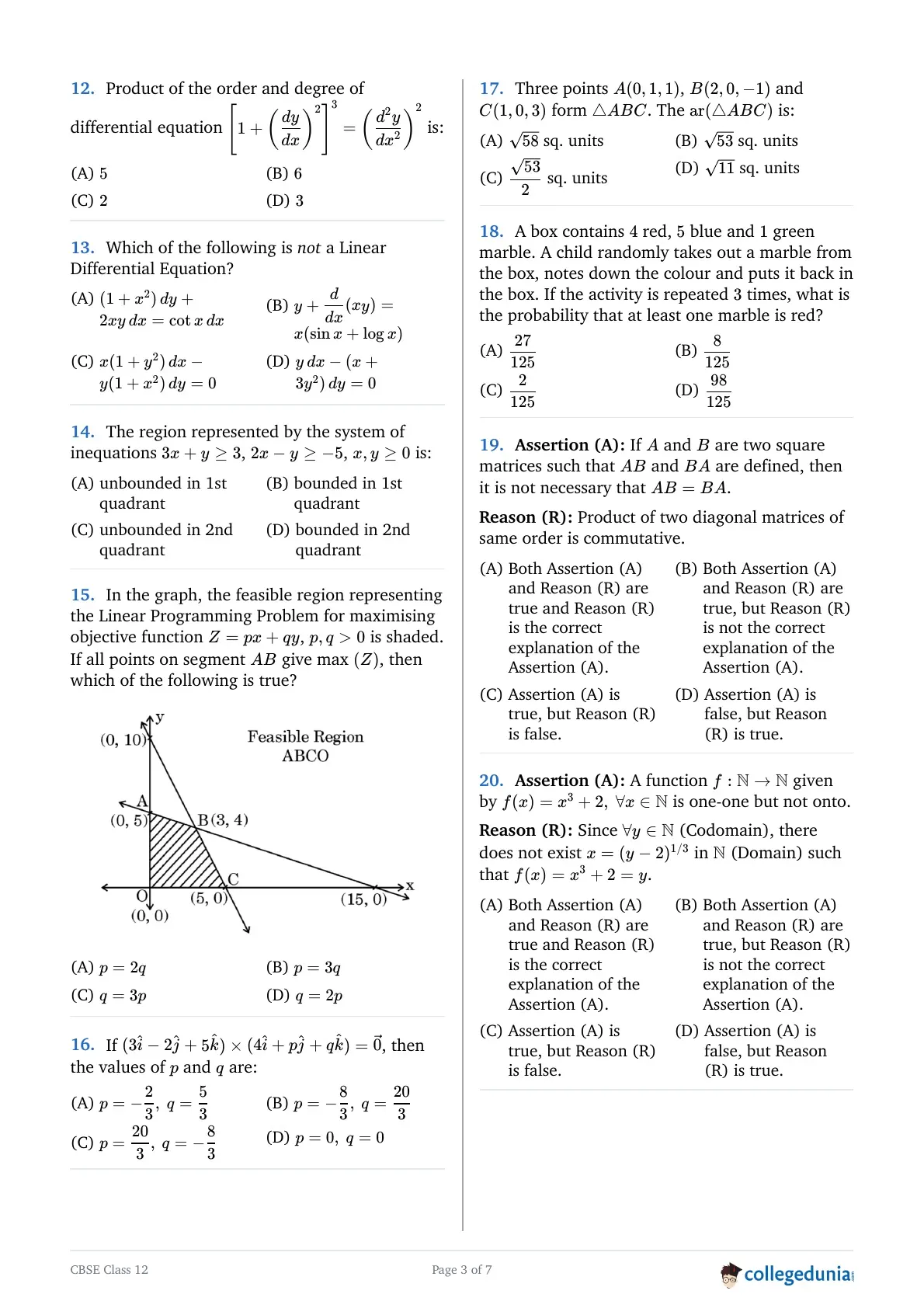
Question 15:

In the graph, the feasible region representing the Linear Programming Problem for maximising objective function \(Z = px + qy, p, q > 0\) is shaded. If all points on segment \(AB\) give max (Z), then which of the following is true ?


  • (A) \(p = 2q\)
  • (B) \(p = 3q\)
  • (C) \(q = 3p\)
  • (D) \(q = 2p\)
Correct Answer: (C) q = 3p
View Solution


Concept:

If an objective function \(Z = px + qy\) achieves its maximum value at every point on a line segment, then the objective function must be parallel to that line segment.
Parallel lines have equal slopes.
The slope of the objective function \(Z = px + qy\) is \(-\frac{p}{q}\).


Step 1: Identify the coordinates of points A and B from the graph

From the provided graph:

Point \(A\) is the y-intercept of the top boundary line: \(A = (0, 5)\).

Point \(B\) is the intersection of two lines: \(B = (3, 4)\).

Step 2: Calculate the slope of the line segment \(AB\)

The slope \(m\) of the segment joining \((x_1, y_1)\) and \((x_2, y_2)\) is given by:
\[ m = \frac{y_2 - y_1}{x_2 - x_1} \]
Substituting coordinates of \(A(0, 5)\) and \(B(3, 4)\):
\[ m_{AB} = \frac{4 - 5}{3 - 0} = \frac{-1}{3} = -\frac{1}{3} \]

Step 3: Find the slope of the objective function

The objective function is \(Z = px + qy\).

To find the slope, rewrite it in \(y = mx + c\) form:
\[ qy = -px + Z \] \[ y = \left(-\frac{p}{q}\right)x + \frac{Z}{q} \]
The slope of the objective function is \(-\frac{p}{q}\).

Step 4: Equate the slopes to find the relationship between p and q

Since all points on \(AB\) give the same maximum \(Z\), the slopes must be equal:
\[ -\frac{p}{q} = -\frac{1}{3} \]
Cross-multiplying:
\[ 3p = q \]
Or \(q = 3p\).

This matches option (C). Quick Tip: When multiple optimal solutions exist on a line segment, the objective function is always parallel to that constraint line.
Check your signs carefully: slopes of lines going "downhill" from left to right must be negative.
If the equation is \(3p = q\), then \(q\) is three times larger than \(p\).


Question 16:

If \((3\hat{i} - 2\hat{j} + 5\hat{k}) \times (4\hat{i} + p\hat{j} + q\hat{k}) = \vec{0}\), then the values of \(p\) and \(q\) are :

  • (A) \(p = -\frac{2}{3}, q = \frac{5}{3}\)
  • (B) \(p = -\frac{8}{3}, q = \frac{20}{3}\)
  • (C) \(p = \frac{20}{3}, q = -\frac{8}{3}\)
  • (D) \(p = 0, q = 0\)
Correct Answer: (B) \(p = -\frac{8}{3}, q = \frac{20}{3}\)
View Solution


Concept:

The cross product of two non-zero vectors is the zero vector (\(\vec{0}\)) if and only if the vectors are parallel or collinear.
If two vectors \(\vec{a} = a_1\hat{i} + a_2\hat{j} + a_3\hat{k}\) and \(\vec{b} = b_1\hat{i} + b_2\hat{j} + b_3\hat{k}\) are parallel, their corresponding components are proportional: \(\frac{a_1}{b_1} = \frac{a_2}{b_2} = \frac{a_3}{b_3}\).


Step 1: Apply the condition for parallel vectors

Given \(\vec{a} = 3\hat{i} - 2\hat{j} + 5\hat{k}\) and \(\vec{b} = 4\hat{i} + p\hat{j} + q\hat{k}\).

Since \(\vec{a} \times \vec{b} = \vec{0}\), the vectors are parallel.

Therefore, the ratios of their components must be equal:
\[ \frac{3}{4} = \frac{-2}{p} = \frac{5}{q} \]

Step 2: Solve for p

Equate the first and second ratios:
\[ \frac{3}{4} = \frac{-2}{p} \] \[ 3p = -8 \] \[ p = -\frac{8}{3} \]

Step 3: Solve for q

Equate the first and third ratios:
\[ \frac{3}{4} = \frac{5}{q} \] \[ 3q = 20 \] \[ q = \frac{20}{3} \]
Thus, the values are \(p = -\frac{8}{3}\) and \(q = \frac{20}{3}\). Quick Tip: Avoid calculating the full determinant for the cross product if it equals zero; the proportionality rule is much faster.
Always keep track of negative signs in component ratios.


Question 17:

Three points \(A(0, 1, 1)\), \(B(2, 0, -1)\) and \(C(1, 0, 3)\) form \(\Delta ABC\). The \(ar (\Delta ABC)\) is :

  • (A) \(\frac{\sqrt{53}}{2} sq. units\)
  • (B) \(\sqrt{53} sq. units\)
  • (C) \(\frac{\sqrt{11}}{2} sq. units\)
  • (D) \(\sqrt{11} sq. units\)
Correct Answer: (A) \(\frac{\sqrt{53}}{2}\) sq. units
View Solution


Concept:

The area of a triangle with vertices \(A, B,\) and \(C\) is given by \(Area = \frac{1}{2} |\vec{AB} \times \vec{AC}|\).
A position vector \(\vec{AB}\) is calculated as \(\vec{B} - \vec{A}\).
Cross product magnitude represents the area of the parallelogram formed by the two vectors; the triangle is half of that.


Step 1: Find the vectors \(\vec{AB}\) and \(\vec{AC}\)
\[ \vec{AB} = (2-0)\hat{i} + (0-1)\hat{j} + (-1-1)\hat{k} = 2\hat{i} - \hat{j} - 2\hat{k} \] \[ \vec{AC} = (1-0)\hat{i} + (0-1)\hat{j} + (3-1)\hat{k} = \hat{i} - \hat{j} + 2\hat{k} \]

Step 2: Calculate the cross product \(\vec{AB} \times \vec{AC}\)
\[ \vec{AB} \times \vec{AC} = \begin{vmatrix} \hat{i} & \hat{j} & \hat{k} \\ 2 & -1 & -2 \\ 1 & -1 & 2 \end{vmatrix} \] \[ = \hat{i}[(-1)(2) - (-2)(-1)] - \hat{j}[(2)(2) - (-2)(1)] + \hat{k}[(2)(-1) - (-1)(1)] \] \[ = \hat{i}[-2 - 2] - \hat{j}[4 + 2] + \hat{k}[-2 + 1] \] \[ = -4\hat{i} - 6\hat{j} - \hat{k} \]

Step 3: Calculate the magnitude of the cross product and the area

Magnitude \(|\vec{AB} \times \vec{AC}| = \sqrt{(-4)^2 + (-6)^2 + (-1)^2} = \sqrt{16 + 36 + 1} = \sqrt{53}\).

The area of the triangle is \(\frac{1}{2} \times Magnitude\):
\[ Area = \frac{\sqrt{53}}{2} sq. units \] Quick Tip: You can use any two vectors starting from the same vertex (e.g., \(\vec{BA}\) and \(\vec{BC}\)) to get the same result.
Double-check determinant expansion signs: \(+ \hat{i}, - \hat{j}, + \hat{k}\).


Question 18:

A box contains 4 red, 5 blue and 1 green marble. A child randomly takes out a marble from the box, notes down the colour and puts it back in the box. If the activity is repeated 3 times, what is the probability that at least one marble is red ?

  • (A) \(\frac{27}{125}\)
  • (B) \(\frac{8}{125}\)
  • (C) \(\frac{2}{125}\)
  • (D) \(\frac{98}{125}\)
Correct Answer: (D) \(\frac{98}{125}\)
View Solution


Concept:

This is a case of sampling with replacement, making each draw an independent Bernoulli trial.
Total number of marbles \(= 4 (red) + 5 (blue) + 1 (green) = 10\).
Complementary probability: \(P(at least one red) = 1 - P(no red marbles)\).


Step 1: Find the probability of drawing a red marble in a single trial
\[ P(Red) = \frac{Number of red marbles}{Total marbles} = \frac{4}{10} = \frac{2}{5} \]

Step 2: Find the probability of NOT drawing a red marble in a single trial
\[ P(Not Red) = 1 - P(Red) = 1 - \frac{2}{5} = \frac{3}{5} \]

Step 3: Calculate the probability of drawing no red marbles in 3 independent trials

Since the events are independent (due to replacement):
\[ P(No red in 3 trials) = (P(Not Red))^3 = \left(\frac{3}{5}\right)^3 = \frac{27}{125} \]

Step 4: Calculate the final probability of at least one red marble

Using the complementary principle:
\[ P(At least one red) = 1 - P(No red in 3 trials) \] \[ = 1 - \frac{27}{125} = \frac{125 - 27}{125} = \frac{98}{125} \] Quick Tip: "At least one" problems are almost always solved faster using the complement (1 - none).
Replacement means the denominator stays constant for every draw.


Question 19:

Assertion (A) : If A and B are two square matrices such that AB and BA are defined, then it is not necessary that AB = BA.

Reason (R) : Product of two diagonal matrices of same order is commutative.

  • (A) Both Assertion (A) and Reason (R) are true and Reason (R) is the correct explanation of the Assertion (A).
  • (B) Both Assertion (A) and Reason (R) are true, but Reason (R) is not the correct explanation of the Assertion (A).
  • (C) Assertion (A) is true, but Reason (R) is false.
  • (D) Assertion (A) is false, but Reason (R) is true.
Correct Answer: (B) Both Assertion (A) and Reason (R) are true, but Reason (R) is not the correct explanation of the Assertion (A).
View Solution


Concept:

Matrix multiplication is generally non-commutative, i.e., \(AB \neq BA\) for most square matrices \(A\) and \(B\).
There are specific classes of matrices, such as diagonal matrices of the same order, for which multiplication is commutative.


Step 1: Evaluate the truth of Assertion (A)

Matrix multiplication lacks commutativity as a general property. For example:

Let \(A = \begin{bmatrix} 0 & 1 \\ 0 & 0 \end{bmatrix}\) and \(B = \begin{bmatrix} 0 & 0 \\ 1 & 0 \end{bmatrix}\).
\(AB = \begin{bmatrix} 1 & 0 \\ 0 & 0 \end{bmatrix}\) while \(BA = \begin{bmatrix} 0 & 0 \\ 0 & 1 \end{bmatrix}\).

So \(AB \neq BA\). Thus, Assertion (A) is true.

Step 2: Evaluate the truth of Reason (R)

If \(D_1\) and \(D_2\) are diagonal matrices, their product is obtained by multiplying corresponding diagonal elements. Since scalar multiplication is commutative, \(D_1 D_2 = D_2 D_1\).

Thus, Reason (R) is true.

Step 3: Check the relationship between A and R

The fact that a specific subtype of matrices (diagonal) commutes does not explain why general matrices do not. In fact, diagonal matrices are an exception to the general rule stated in the assertion. Therefore, R is not the explanation for A. Quick Tip: Matrix multiplication is commutative only in special cases: powers of the same matrix, a matrix and its inverse, or diagonal matrices of the same order.
For A and R questions, always check if R is a specific example or a general underlying cause.


Question 20:

Assertion (A) : A function \(f : \mathbb{N} \to \mathbb{N}\) given by \(f(x) = x^3 + 2, \forall x \in \mathbb{N}\) is one-one but not onto.

Reason (R) : Since \(\forall y \in \mathbb{N}\) (Codomain), there does not exist \(x = (y - 2)^{1/3}\) in \(\mathbb{N}\) (Domain) such that \(f(x) = x^3 + 2 = y\).

  • (A) Both Assertion (A) and Reason (R) are true and Reason (R) is the correct explanation of the Assertion (A).
  • (B) Both Assertion (A) and Reason (R) are true, but Reason (R) is not the correct explanation of the Assertion (A).
  • (C) Assertion (A) is true, but Reason (R) is false.
  • (D) Assertion (A) is false, but Reason (R) is true.
Correct Answer: (C) Assertion (A) is true, but Reason (R) is false.
View Solution


Concept:


A function is one-one if \(f(x_1) = f(x_2) \implies x_1 = x_2\).
A function is onto if the range equals the codomain.
For \(f: \mathbb{N} \to \mathbb{N}\), all inputs and outputs must be natural numbers \(\{1, 2, 3, \dots\}\).


Step 1: Test Assertion (A) for the one-one property


Let \(f(x_1) = f(x_2)\).

\(x_1^3 + 2 = x_2^3 + 2 \implies x_1^3 = x_2^3 \implies x_1 = x_2\).

Thus, the function is one-one.

Step 2: Test Assertion (A) for the onto property


The codomain is \(\mathbb{N}\).


The range of \(f(x) = x^3 + 2\) for \(x \in \{1, 2, 3, \dots\}\) is \(\{3, 10, 29, \dots\}\).

Numbers like \(1, 2, 4, 5, \dots\) in the codomain have no pre-image in the domain.

Thus, the function is not onto. Assertion (A) is true.

Step 3: Evaluate Reason (R)


The reason states: "\(\forall y \in \mathbb{N}\) ... there does not exist \(x\)".

The universal quantifier "\(\forall y\)" (for all \(y\)) makes this statement false.

If \(y = 3\), then \(x = (3-2)^{1/3} = 1 \in \mathbb{N}\). So for \(y = 3\), an \(x\) does exist.

The reason would be true if it said "there exists some \(y\)" for which no pre-image exists, but as a universal statement, it is mathematically incorrect. Quick Tip: In Assertion-Reason questions involving functions, pay extremely close attention to the domain/codomain sets (\(\mathbb{N}, \mathbb{Z}, \mathbb{R}\)).
Watch out for quantifiers like "all" or "every"; a single counter-example makes such a statement false.


Question 21:

Evaluate : \( \tan^{-1}\left(-\frac{1}{\sqrt{3}}\right) + \cot^{-1}\left(\frac{1}{\sqrt{3}}\right) + \tan^{-1}\left(\sin\left(-\frac{\pi}{2}\right)\right) + \tan^{-1}\left(\tan\frac{2\pi}{3}\right) \)

Correct Answer:
View Solution


Concept:

The principal value range of \( \tan^{-1}x \) is \( \left(-\frac{\pi}{2}, \frac{\pi}{2}\right) \).
The principal value range of \( \cot^{-1}x \) is \( (0, \pi) \).
For \( \tan^{-1}(\tan \theta) = \theta \), \( \theta \) must lie in \( \left(-\frac{\pi}{2}, \frac{\pi}{2}\right) \). If it does not, we use trigonometric identities to find an equivalent angle within the range.


Step 1: Evaluate each inverse trigonometric term individually

Term 1: \( \tan^{-1}\left(-\frac{1}{\sqrt{3}}\right) \)

We know that \( \tan \frac{\pi}{6} = \frac{1}{\sqrt{3}} \). Since the range is \( \left(-\frac{\pi}{2}, \frac{\pi}{2}\right) \):
\( \tan^{-1}\left(-\frac{1}{\sqrt{3}}\right) = -\frac{\pi}{6} \)

Term 2: \( \cot^{-1}\left(\frac{1}{\sqrt{3}}\right) \)

We know that \( \cot \frac{\pi}{3} = \frac{1}{\sqrt{3}} \). Since the range is \( (0, \pi) \):
\( \cot^{-1}\left(\frac{1}{\sqrt{3}}\right) = \frac{\pi}{3} \)

Term 3: \( \tan^{-1}\left(\sin\left(-\frac{\pi}{2}\right)\right) \)

First, evaluate the inner term: \( \sin\left(-\frac{\pi}{2}\right) = -1 \).

Then, \( \tan^{-1}(-1) = -\frac{\pi}{4} \).

Term 4: \( \tan^{-1}\left(\tan\frac{2\pi}{3}\right) \)

The angle \( \frac{2\pi}{3} \) is outside the principal range \( \left(-\frac{\pi}{2}, \frac{\pi}{2}\right) \).

Using \( \tan(\pi - \theta) = -\tan \theta \):
\( \tan\left(\frac{2\pi}{3}\right) = \tan\left(\pi - \frac{\pi}{3}\right) = -\tan\frac{\pi}{3} = -\sqrt{3} \).

So, \( \tan^{-1}(-\sqrt{3}) = -\frac{\pi}{3} \).

Step 2: Sum all the evaluated values

Substitute the values back into the original expression:
\[ Expression = \left(-\frac{\pi}{6}\right) + \left(\frac{\pi}{3}\right) + \left(-\frac{\pi}{4}\right) + \left(-\frac{\pi}{3}\right) \]
Cancel the \( \frac{\pi}{3} \) and \( -\frac{\pi}{3} \) terms:
\[ Expression = -\frac{\pi}{6} - \frac{\pi}{4} \]

Step 3: Find a common denominator and simplify

The least common multiple of 6 and 4 is 12:
\[ Expression = \frac{-2\pi - 3\pi}{12} = -\frac{5\pi}{12} \] Quick Tip: Always verify if the angle inside \( \tan^{-1}(\tan \theta) \) is within the principal range before simplifying.
Remember: \( \tan^{-1}(-x) = -\tan^{-1}x \).


Question 22:

Show that the function \( f(x) = \begin{cases} \frac{\cos x}{\frac{\pi}{2}-x}, & x \neq \frac{\pi}{2}
1, & x = \frac{\pi}{2} \end{cases} \) is continuous at \( x = \frac{\pi}{2} \).

Correct Answer:
View Solution


Concept:

A function \( f(x) \) is continuous at a point \( x = a \) if \( \lim_{x \to a} f(x) = f(a) \).
This requires the limit to exist and be equal to the functional value at that point.
We can use the substitution method or L'Hôpital's rule to evaluate indeterminate forms like \( 0/0 \).


Step 1: Determine the functional value at the point

From the definition of the function given in the problem:
\( f\left(\frac{\pi}{2}\right) = 1 \).

Step 2: Evaluate the limit as \( x \) approaches \( \frac{\pi}{2} \)

The limit to evaluate is:
\[ L = \lim_{x \to \frac{\pi}{2}} \frac{\cos x}{\frac{\pi}{2} - x} \]
As \( x \to \frac{\pi}{2} \), the expression is in the indeterminate form \( \frac{\cos(\pi/2)}{\pi/2 - \pi/2} = \frac{0}{0} \).

Step 3: Apply substitution to simplify the limit

Let \( \frac{\pi}{2} - x = h \). As \( x \to \frac{\pi}{2} \), \( h \to 0 \).

Also, \( x = \frac{\pi}{2} - h \).

Substituting these into the limit expression:
\[ L = \lim_{h \to 0} \frac{\cos\left(\frac{\pi}{2} - h\right)}{h} \]
Using the trigonometric identity \( \cos\left(\frac{\pi}{2} - \theta\right) = \sin \theta \):
\[ L = \lim_{h \to 0} \frac{\sin h}{h} \]

Step 4: Compare the limit with the functional value

We know the standard limit \( \lim_{h \to 0} \frac{\sin h}{h} = 1 \).

So, \( \lim_{x \to \frac{\pi}{2}} f(x) = 1 \).

Since \( \lim_{x \to \frac{\pi}{2}} f(x) = f\left(\frac{\pi}{2}\right) = 1 \), the function is continuous at \( x = \frac{\pi}{2} \). Quick Tip: For limits involving \( \frac{\pi}{2} - x \), substituting \( h = \frac{\pi}{2} - x \) often converts the problem into a standard limit involving \( \sin h / h \).
Always state the condition for continuity explicitly in descriptive answers.


Question 23:

Find whether the function \( f(x) = \begin{cases} x - 1, & x < 2
2x - 3, & x \ge 2 \end{cases} \) at \( x = 2 \) is differentiable or not.

Correct Answer:
View Solution


Concept:

A function is differentiable at \( x = a \) if its Left Hand Derivative (LHD) and Right Hand Derivative (RHD) at that point exist and are equal.
LHD at \( a = \lim_{h \to 0^-} \frac{f(a+h) - f(a)}{h} \).
RHD at \( a = \lim_{h \to 0^+} \frac{f(a+h) - f(a)}{h} \).
First, check continuity; if a function is discontinuous, it is automatically non-differentiable.


Step 1: Check continuity at \( x = 2 \)

Functional value: \( f(2) = 2(2) - 3 = 1 \).

Left Hand Limit (LHL): \( \lim_{x \to 2^-} (x - 1) = 2 - 1 = 1 \).

Right Hand Limit (RHL): \( \lim_{x \to 2^+} (2x - 3) = 2(2) - 3 = 1 \).

Since \( LHL = RHL = f(2) \), the function is continuous.

Step 2: Calculate the Left Hand Derivative (LHD)

For \( x < 2 \), \( f(x) = x - 1 \).
\[ LHD = \lim_{h \to 0^-} \frac{f(2+h) - f(2)}{h} \]
Since \( 2+h < 2 \) for \( h < 0 \):
\[ LHD = \lim_{h \to 0} \frac{(2 + h - 1) - 1}{h} = \lim_{h \to 0} \frac{h}{h} = 1 \]

Step 3: Calculate the Right Hand Derivative (RHD)

For \( x \ge 2 \), \( f(x) = 2x - 3 \).
\[ RHD = \lim_{h \to 0^+} \frac{f(2+h) - f(2)}{h} \]
Since \( 2+h > 2 \) for \( h > 0 \):
\[ RHD = \lim_{h \to 0} \frac{[2(2 + h) - 3] - 1}{h} = \lim_{h \to 0} \frac{4 + 2h - 3 - 1}{h} = \lim_{h \to 0} \frac{2h}{h} = 2 \]

Step 4: Compare LHD and RHD

We found \( LHD = 1 \) and \( RHD = 2 \).

Since \( LHD \neq RHD \), the function is not differentiable at \( x = 2 \). Quick Tip: For piecewise linear functions, the LHD and RHD are simply the slopes of the line segments on either side of the point.
Slope for \( x < 2 \) is 1; slope for \( x \ge 2 \) is 2. Since they differ, non-differentiability is confirmed.


Question 24:

Find the values of \( x \) for which \( f(x) = x^x, x > 0 \) is increasing.

Correct Answer:
View Solution


Concept:

A function \( f(x) \) is increasing if its first derivative \( f'(x) > 0 \).
To differentiate \( x^x \), we use logarithmic differentiation.
Recall the domain constraint \( x > 0 \) given in the question.


Step 1: Differentiate the function \( f(x) = x^x \)

Let \( y = x^x \).

Taking natural logarithm on both sides:
\( \ln y = \ln(x^x) = x \ln x \)

Differentiating with respect to \( x \) using the product rule:
\[ \frac{1}{y} \frac{dy}{dx} = \frac{d}{dx}(x) \cdot \ln x + x \cdot \frac{d}{dx}(\ln x) \] \[ \frac{1}{y} f'(x) = 1 \cdot \ln x + x \cdot \frac{1}{x} = \ln x + 1 \]
Substituting \( y = x^x \):
\[ f'(x) = x^x(1 + \ln x) \]

Step 2: Set the condition for the function to be increasing

For \( f(x) \) to be increasing, we require \( f'(x) > 0 \):
\[ x^x(1 + \ln x) > 0 \]
Since \( x > 0 \), \( x^x \) is always a positive value. Thus, the inequality depends only on the second factor:
\[ 1 + \ln x > 0 \]

Step 3: Solve the inequality for \( x \)
\[ \ln x > -1 \]
Applying the exponential function (base \( e \)) to both sides:
\[ e^{\ln x} > e^{-1} \] \[ x > \frac{1}{e} \]

Step 4: State the final interval

Considering the domain \( x > 0 \), the function is increasing for all \( x \in \left(\frac{1}{e}, \infty\right) \). Quick Tip: Remember that \( \ln x \) is only defined for positive values.
The critical point for \( x^x \) is at \( x = 1/e \approx 0.368 \). Below this value, the function decreases; above it, it increases.


Question 25:

If the position vectors of three points A, B and C are \( 3\hat{i} + \hat{j} \), \( 5\hat{i} + 6\hat{j} - 3\hat{k} \) and \( 4\hat{j} \) respectively, then show that they form an isosceles triangle.

Correct Answer:
View Solution


Concept:

A triangle is isosceles if any two of its sides are equal in length.
The length of a side is the magnitude of the vector representing that side.
Vector \( \vec{AB} = P.V. of B - P.V. of A \).
Magnitude of \( \vec{v} = x\hat{i} + y\hat{j} + z\hat{k} \) is \( |\vec{v}| = \sqrt{x^2 + y^2 + z^2} \).


Step 1: Find the vector representation for each side

Given: \( \vec{A} = 3\hat{i} + \hat{j} \), \( \vec{B} = 5\hat{i} + 6\hat{j} - 3\hat{k} \), \( \vec{C} = 4\hat{j} \).
\[ \vec{AB} = (5-3)\hat{i} + (6-1)\hat{j} + (-3-0)\hat{k} = 2\hat{i} + 5\hat{j} - 3\hat{k} \] \[ \vec{BC} = (0-5)\hat{i} + (4-6)\hat{j} + (0 - (-3))\hat{k} = -5\hat{i} - 2\hat{j} + 3\hat{k} \] \[ \vec{AC} = (0-3)\hat{i} + (4-1)\hat{j} + (0-0)\hat{k} = -3\hat{i} + 3\hat{j} + 0\hat{k} \]

Step 2: Calculate the length (magnitude) of each side

Length of \( AB = |\vec{AB}| = \sqrt{2^2 + 5^2 + (-3)^2} = \sqrt{4 + 25 + 9} = \sqrt{38} \) units.

Length of \( BC = |\vec{BC}| = \sqrt{(-5)^2 + (-2)^2 + 3^2} = \sqrt{25 + 4 + 9} = \sqrt{38} \) units.

Length of \( AC = |\vec{AC}| = \sqrt{(-3)^2 + 3^2 + 0^2} = \sqrt{9 + 9} = \sqrt{18} \) units.

Step 3: Draw a conclusion

Comparing the lengths calculated in Step 2, we see that:
\( AB = BC = \sqrt{38} \) units.

Since two sides of the triangle are equal in length, \( \Delta ABC \) is an isosceles triangle. Quick Tip: Always simplify magnitudes under the square root, but don't feel pressured to convert to decimals; radical form is preferred.
The vector \( \vec{AC} \) can also be found using the triangle law: \( \vec{AC} = \vec{AB} + \vec{BC} \).


Question 26:

Let two rods placed on the ground be represented by vectors \( 4\hat{i} - \hat{j} + 3\hat{k} \) and \( -2\hat{i} + \hat{j} - 2\hat{k} \). Find a vector representing a flag-post of height 5 m that has to be erected perpendicular to both the rods.

Correct Answer:
View Solution


Concept:

The cross product of two vectors \( \vec{a} \) and \( \vec{b} \) gives a third vector \( \vec{c} \) that is perpendicular to both.
A vector of a specific magnitude \( \lambda \) in the direction of \( \vec{n} \) is given by \( \vec{v} = \lambda \hat{n} \), where \( \hat{n} \) is the unit vector.


Step 1: Find a vector perpendicular to both rods using the cross product

Let \( \vec{a} = 4\hat{i} - \hat{j} + 3\hat{k} \) and \( \vec{b} = -2\hat{i} + \hat{j} - 2\hat{k} \).
\[ \vec{n} = \vec{a} \times \vec{b} = \begin{vmatrix} \hat{i} & \hat{j} & \hat{k} \\ 4 & -1 & 3 \\ -2 & 1 & -2 \end{vmatrix} \] \[ = \hat{i}[(-1)(-2) - (3)(1)] - \hat{j}[(4)(-2) - (3)(-2)] + \hat{k}[(4)(1) - (-1)(-2)] \] \[ = \hat{i}[2 - 3] - \hat{j}[-8 + 6] + \hat{k}[4 - 2] \] \[ = -\hat{i} + 2\hat{j} + 2\hat{k} \]

Step 2: Find the unit vector in the direction of \( \vec{n} \)

Magnitude \( |\vec{n}| = \sqrt{(-1)^2 + 2^2 + 2^2} = \sqrt{1 + 4 + 4} = \sqrt{9} = 3 \).

Unit vector \( \hat{n} = \frac{\vec{n}}{|\vec{n}|} = \frac{-\hat{i} + 2\hat{j} + 2\hat{k}}{3} \).

Step 3: Determine the final vector for the flag-post

The flag-post has a height (magnitude) of 5 m.

Vector \( \vec{F} = 5 \hat{n} = 5 \left( \frac{-\hat{i} + 2\hat{j} + 2\hat{k}}{3} \right) \)
\[ \vec{F} = -\frac{5}{3}\hat{i} + \frac{10}{3}\hat{j} + \frac{10}{3}\hat{k} \]
(Note: The vector \( \frac{5}{3}\hat{i} - \frac{10}{3}\hat{j} - \frac{10}{3}\hat{k} \) is also valid as it represents the opposite direction). Quick Tip: To ensure the cross product is correct, check if the dot product of the result and the original vectors is zero.
\((-\hat{i} + 2\hat{j} + 2\hat{k}) \cdot (4\hat{i} - \hat{j} + 3\hat{k}) = -4 - 2 + 6 = 0\). Correct!


Question 27:

A unit vector \( \vec{a} \) is such that it makes an angle \( \frac{\pi}{4} \) with x-axis, \( \frac{\pi}{3} \) with y-axis and an acute angle \( \theta \) with z-axis. Find \( \theta \) and the components of \( \vec{a} \).

Correct Answer:
View Solution


Concept:

Let \( \alpha, \beta, \gamma \) be the angles made by a vector with the x, y, and z axes respectively.
The direction cosines are \( l = \cos \alpha, m = \cos \beta, n = \cos \gamma \).
Fundamental property: \( l^2 + m^2 + n^2 = 1 \).
For a unit vector \( \vec{a} \), its components are simply \( (l, m, n) \).


Step 1: Calculate the direction cosines \( l \) and \( m \)

Given \( \alpha = \frac{\pi}{4} \) and \( \beta = \frac{\pi}{3} \).
\( l = \cos\left(\frac{\pi}{4}\right) = \frac{1}{\sqrt{2}} \)
\( m = \cos\left(\frac{\pi}{3}\right) = \frac{1}{2} \)

Step 2: Solve for \( n \) and the angle \( \theta \)

Using \( l^2 + m^2 + n^2 = 1 \):
\[ \left(\frac{1}{\sqrt{2}}\right)^2 + \left(\frac{1}{2}\right)^2 + n^2 = 1 \] \[ \frac{1}{2} + \frac{1}{4} + n^2 = 1 \] \[ \frac{3}{4} + n^2 = 1 \implies n^2 = 1 - \frac{3}{4} = \frac{1}{4} \]
Since \( \theta \) (which is \( \gamma \)) is acute, \( n = \cos \theta \) must be positive:
\[ n = \frac{1}{2} \implies \cos \theta = \frac{1}{2} \implies \theta = \frac{\pi}{3} \]

Step 3: State the components of the unit vector \( \vec{a} \)

The components of the unit vector are \( (l, m, n) \):
\[ \vec{a} = l\hat{i} + m\hat{j} + n\hat{k} = \frac{1}{\sqrt{2}}\hat{i} + \frac{1}{2}\hat{j} + \frac{1}{2}\hat{k} \] Quick Tip: "Acute angle" means \( 0 \le \theta < \pi/2 \), so the cosine is positive. "Obtuse" would mean the cosine is negative.
For a unit vector, the sum of the squares of its components must always be 1.


Question 28:

Let \(A = \mathbb{R} - \{3\}\) and \(B = \mathbb{R} - \{1\}\). A function \(f : A \to B\) is defined by \(f(x) = \frac{x - 2}{x - 3}\). Find whether \(f\) is one-one and onto.

Correct Answer:
View Solution


Concept:

A function is one-one (injective) if \(f(x_1) = f(x_2) \implies x_1 = x_2\) for all \(x_1, x_2\) in the domain.
A function is onto (surjective) if for every element \(y\) in the codomain, there exists an \(x\) in the domain such that \(f(x) = y\).


Step 1: Check for one-one property

Let \(x_1, x_2 \in A\) such that \(f(x_1) = f(x_2)\):
\[ \frac{x_1 - 2}{x_1 - 3} = \frac{x_2 - 2}{x_2 - 3} \]
Cross-multiplying:
\[ (x_1 - 2)(x_2 - 3) = (x_2 - 2)(x_1 - 3) \] \[ x_1x_2 - 3x_1 - 2x_2 + 6 = x_1x_2 - 3x_2 - 2x_1 + 6 \]
Subtracting common terms from both sides:
\[ -3x_1 - 2x_2 = -3x_2 - 2x_1 \] \[ 3x_2 - 2x_2 = 3x_1 - 2x_1 \] \[ x_2 = x_1 \]
Since \(f(x_1) = f(x_2)\) implies \(x_1 = x_2\), the function is one-one.

Step 2: Check for onto property

Let \(y \in B\). We check if there exists \(x \in A\) such that \(f(x) = y\):
\[ y = \frac{x - 2}{x - 3} \] \[ y(x - 3) = x - 2 \] \[ xy - 3y = x - 2 \] \[ xy - x = 3y - 2 \] \[ x(y - 1) = 3y - 2 \] \[ x = \frac{3y - 2}{y - 1} \]
Since \(y \in B = \mathbb{R} - \{1\}\), \(y \neq 1\), so \(x\) is always defined.

Now check if \(x = 3\) is possible:

If \(\frac{3y - 2}{y - 1} = 3 \implies 3y - 2 = 3y - 3 \implies -2 = -3\) (Impossible).

Thus, for every \(y \in B\), there is a corresponding \(x \in A\). The function is onto. Quick Tip: To test for 'onto', express \(x\) in terms of \(y\). If the resulting expression is defined for all \(y\) in the codomain and lies within the domain, the function is surjective.
For rational functions, the one-one check always involves a cross-multiplication step.


Question 29:

Let \(n\) be a fixed positive integer. A relation \(R\) is defined in set \(\mathbb{Z}\) such that \(R = \{(x, y) : (x - y) is divisible by n, x, y \in \mathbb{Z}\}\). Determine if \(R\) is an equivalence relation.

Correct Answer:
View Solution


Concept:

A relation is an equivalence relation if it is reflexive, symmetric, and transitive.
Reflexive: \(aRa\) for all \(a\).
Symmetric: \(aRb \implies bRa\).
Transitive: \(aRb\) and \(bRc \implies aRc\).


Step 1: Check for Reflexivity

For any \(x \in \mathbb{Z}\), we have \(x - x = 0\).

Since 0 is divisible by any positive integer \(n\), \(x - x\) is divisible by \(n\).

Thus, \((x, x) \in R\) for all \(x \in \mathbb{Z}\). \(R\) is reflexive.

Step 2: Check for Symmetry

Let \((x, y) \in R\). Then \((x - y)\) is divisible by \(n\).

So, \(x - y = kn\) for some integer \(k\).

Then, \(y - x = -(x - y) = -kn = (-k)n\).

Since \(-k\) is also an integer, \((y - x)\) is divisible by \(n\).

Thus, \((y, x) \in R\). \(R\) is symmetric.

Step 3: Check for Transitivity

Let \((x, y) \in R\) and \((y, z) \in R\).

Then \((x - y) = k_1n\) and \((y - z) = k_2n\) for some integers \(k_1, k_2\).

Adding these two equations:
\[ (x - y) + (y - z) = k_1n + k_2n \] \[ x - z = (k_1 + k_2)n \]
Since \((k_1 + k_2)\) is an integer, \((x - z)\) is divisible by \(n\).

Thus, \((x, z) \in R\). \(R\) is transitive.

Step 4: Conclusion

Since the relation is reflexive, symmetric, and transitive, \(R\) is an equivalence relation. Quick Tip: This specific relation is known as "congruence modulo n".
Divisibility properties of integers (like 0 being divisible by everything) are key to proving equivalence relations on \(\mathbb{Z}\).


Question 30:

If \(A = \begin{bmatrix} 3 & 2 & 0 \\ 1 & 4 & 0 \\ 0 & 0 & 5 \end{bmatrix}\), then compute \(A^2 - 7A + 10 I\).

Correct Answer:
View Solution


Concept:

Matrix multiplication \(A^2 = A \times A\).
Scalar multiplication \(kA\) involves multiplying every element by \(k\).
\(I\) is the identity matrix of the same order as \(A\).


Step 1: Calculate \(A^2\)
\[ A^2 = \begin{bmatrix} 3 & 2 & 0 \\ 1 & 4 & 0 \\ 0 & 0 & 5 \end{bmatrix} \begin{bmatrix} 3 & 2 & 0 \\ 1 & 4 & 0 \\ 0 & 0 & 5 \end{bmatrix} \] \[ = \begin{bmatrix} 3(3)+2(1)+0(0) & 3(2)+2(4)+0(0) & 3(0)+2(0)+0(5) \\ 1(3)+4(1)+0(0) & 1(2)+4(4)+0(0) & 1(0)+4(0)+0(5) \\ 0(3)+0(1)+5(0) & 0(2)+0(4)+5(0) & 0(0)+0(0)+5(5) \end{bmatrix} \] \[ A^2 = \begin{bmatrix} 11 & 14 & 0 \\ 7 & 18 & 0 \\ 0 & 0 & 25 \end{bmatrix} \]

Step 2: Calculate \(7A\) and \(10I\)
\[ 7A = 7 \begin{bmatrix} 3 & 2 & 0 \\ 1 & 4 & 0 \\ 0 & 0 & 5 \end{bmatrix} = \begin{bmatrix} 21 & 14 & 0 \\ 7 & 28 & 0 \\ 0 & 0 & 35 \end{bmatrix} \] \[ 10I = 10 \begin{bmatrix} 1 & 0 & 0 \\ 0 & 1 & 0 \\ 0 & 0 & 1 \end{bmatrix} = \begin{bmatrix} 10 & 0 & 0 \\ 0 & 10 & 0 \\ 0 & 0 & 10 \end{bmatrix} \]

Step 3: Compute \(A^2 - 7A + 10I\)
\[ = \begin{bmatrix} 11 & 14 & 0 \\ 7 & 18 & 0 \\ 0 & 0 & 25 \end{bmatrix} - \begin{bmatrix} 21 & 14 & 0 \\ 7 & 28 & 0 \\ 0 & 0 & 35 \end{bmatrix} + \begin{bmatrix} 10 & 0 & 0 \\ 0 & 10 & 0 \\ 0 & 0 & 10 \end{bmatrix} \] \[ = \begin{bmatrix} 11 - 21 + 10 & 14 - 14 + 0 & 0 - 0 + 0 \\ 7 - 7 + 0 & 18 - 28 + 10 & 0 - 0 + 0 \\ 0 - 0 + 0 & 0 - 0 + 0 & 25 - 35 + 10 \end{bmatrix} = \begin{bmatrix} 0 & 0 & 0 \\ 0 & 0 & 0 \\ 0 & 0 & 0 \end{bmatrix} \]
The result is the Zero Matrix \(O\). Quick Tip: Always double-check matrix multiplication row-by-column calculations, as one small error propagates.
For block diagonal matrices like this, the multiplication often stays within the blocks, making it easier to track.


Question 31:

If \(xy = e^{x-y}\), then find \(\frac{dy}{dx}\).

Correct Answer:
View Solution


Concept:

Implicit differentiation is used when \(y\) is not explicitly isolated.
Taking natural logarithms on both sides can simplify expressions with variables in the exponent.


Step 1: Take natural logarithm on both sides
\[ \ln(xy) = \ln(e^{x-y}) \]
Using log properties \(\ln(ab) = \ln a + \ln b\) and \(\ln(e^u) = u\):
\[ \ln x + \ln y = x - y \]

Step 2: Differentiate both sides with respect to \(x\)
\[ \frac{d}{dx}(\ln x) + \frac{d}{dx}(\ln y) = \frac{d}{dx}(x) - \frac{d}{dx}(y) \] \[ \frac{1}{x} + \frac{1}{y} \frac{dy}{dx} = 1 - \frac{dy}{dx} \]

Step 3: Isolate \(\frac{dy}{dx}\)

Move all terms with \(\frac{dy}{dx}\) to the left side:
\[ \frac{1}{y} \frac{dy}{dx} + \frac{dy}{dx} = 1 - \frac{1}{x} \]
Factor out \(\frac{dy}{dx}\):
\[ \frac{dy}{dx} \left(\frac{1}{y} + 1\right) = \frac{x - 1}{x} \] \[ \frac{dy}{dx} \left(\frac{1 + y}{y}\right) = \frac{x - 1}{x} \]
Multiply both sides by \(\frac{y}{1 + y}\):
\[ \frac{dy}{dx} = \frac{y(x - 1)}{x(1 + y)} \] Quick Tip: When differentiating terms with \(y\), don't forget to multiply by \(dy/dx\) (chain rule).
Using logarithms early on avoids dealing with complicated derivatives of product terms equal to exponential towers.


Question 32:

Differentiate \(\tan^{-1}\left(\frac{\sqrt{1+x^2} - \sqrt{1-x^2}}{\sqrt{1+x^2} + \sqrt{1-x^2}}\right)\) with respect to \(\cos^{-1} x^2\).

Correct Answer:
View Solution


Concept:

Differentiation of one function \(u\) with respect to another \(v\) is given by \(\frac{du}{dv} = \frac{du/dx}{dv/dx}\).
Trigonometric substitutions help simplify complex inverse trig functions.


Step 1: Simplify the function \(u = \tan^{-1}\left(\dots\right)\)

Let \(x^2 = \cos 2\theta\). Then \(\theta = \frac{1}{2} \cos^{-1} x^2\).

Recall: \(1 + \cos 2\theta = 2\cos^2\theta\) and \(1 - \cos 2\theta = 2\sin^2\theta\).

So, \(\sqrt{1+x^2} = \sqrt{2}\cos\theta\) and \(\sqrt{1-x^2} = \sqrt{2}\sin\theta\).

Substituting into \(u\):
\[ u = \tan^{-1}\left(\frac{\sqrt{2}\cos\theta - \sqrt{2}\sin\theta}{\sqrt{2}\cos\theta + \sqrt{2}\sin\theta}\right) = \tan^{-1}\left(\frac{\cos\theta - \sin\theta}{\cos\theta + \sin\theta}\right) \]
Divide numerator and denominator by \(\cos\theta\):
\[ u = \tan^{-1}\left(\frac{1 - \tan\theta}{1 + \tan\theta}\right) = \tan^{-1}\left[\tan\left(\frac{\pi}{4} - \theta\right)\right] = \frac{\pi}{4} - \theta \]

Step 2: Simplify the function \(v = \cos^{-1} x^2\)

Since \(x^2 = \cos 2\theta\), we have:
\[ v = \cos^{-1}(\cos 2\theta) = 2\theta \]

Step 3: Calculate \(\frac{du}{dv}\)

We have \(u = \frac{\pi}{4} - \theta\) and \(v = 2\theta\).

Expressing \(\theta\) in terms of \(v\): \(\theta = \frac{v}{2}\).

Then, \(u = \frac{\pi}{4} - \frac{v}{2}\).

Differentiating \(u\) with respect to \(v\):
\[ \frac{du}{dv} = \frac{d}{dv}\left(\frac{\pi}{4} - \frac{v}{2}\right) = 0 - \frac{1}{2} = -\frac{1}{2} \] Quick Tip: Choosing the right substitution (\(x^2 = \cos 2\theta\)) is the most important step for radical expressions involving \(1+x^2\) and \(1-x^2\).
Always simplify both functions in terms of the same parameter (\(\theta\)) to make the final division trivial.


Question 33:

Solve the following Linear Programming Problem graphically :

Maximise \(Z = 200x + 120y\)

subject to the constraints
\(x + y \le 300\)
\(3x + y \le 600\)
\(x - y \ge -100\)
\(x, y \ge 0\)

Correct Answer:
View Solution


Concept:

Graph the boundary lines for each constraint.
Shade the feasible region (common region satisfying all inequalities).
Corner Point Method: Maximum value must occur at one of the vertices of the feasible region.


Step 1: Determine intercepts and plot constraint lines
\(L_1: x + y = 300\). Intercepts: \((300, 0)\) and \((0, 300)\).
\(L_2: 3x + y = 600\). Intercepts: \((200, 0)\) and \((0, 600)\).
\(L_3: x - y = -100\). Intercepts: \((-100, 0)\) (outside 1st quad) and \((0, 100)\).

For \(L_3\), another point in the 1st quadrant: when \(x = 100, y = 200\).

Step 2: Identify the feasible region and corner points


The feasible region is bounded by corner points found by intersecting lines:
\(O: (0, 0)\)
\(A: (200, 0)\) (from \(L_2\) and x-axis)
\(B: (150, 150)\) (intersecting \(L_1\) and \(L_2\))
\(C: (100, 200)\) (intersecting \(L_1\) and \(L_3\))
\(D: (0, 100)\) (from \(L_3\) and y-axis)

Step 3: Evaluate \(Z = 200x + 120y\) at each corner point

At \(O(0, 0): Z = 0\)

At \(A(200, 0): Z = 200(200) + 0 = 40,000\)

At \(B(150, 150): Z = 200(150) + 120(150) = 30,000 + 18,000 = 48,000\)

At \(C(100, 200): Z = 200(100) + 120(200) = 20,000 + 24,000 = 44,000\)

At \(D(0, 100): Z = 200(0) + 120(100) = 12,000\)

The maximum value of \(Z\) is \(48,000\) at point \((150, 150)\). Quick Tip: To find intersection points like (150, 150), solve the pair of linear equations simultaneously.
The constraint \(x - y \ge -100\) can be written as \(y - x \le 100\). Always test \((0,0)\) to confirm the shading direction.


Question 34:

Find a point on the line \(\frac{x - 2}{3} = \frac{1 - y}{2} = \frac{z - 3}{2}\) at a distance of \(\sqrt{2}\) units from the point \((1, 2, 3)\).

Correct Answer:
View Solution


Concept:

Express the general point on a line in terms of a parameter \(\lambda\).
Use the distance formula between the general point and the given point.


Step 1: Rewrite the line equation in standard form

The given equation is \(\frac{x - 2}{3} = \frac{1 - y}{2} = \frac{z - 3}{2}\).

To standardise, multiply the second term by -1 in both numerator and denominator:
\[ \frac{x - 2}{3} = \frac{y - 1}{-2} = \frac{z - 3}{2} = \lambda \]

Step 2: Write the general point on the line

Any point \(P\) on the line is given by:
\(x = 3\lambda + 2\)
\(y = -2\lambda + 1\)
\(z = 2\lambda + 3\)

Step 3: Apply the distance formula

The distance from \(P(3\lambda + 2, -2\lambda + 1, 2\lambda + 3)\) to \(Q(1, 2, 3)\) is \(\sqrt{2}\):
\[ \sqrt{(3\lambda + 2 - 1)^2 + (-2\lambda + 1 - 2)^2 + (2\lambda + 3 - 3)^2} = \sqrt{2} \]
Squaring both sides:
\[ (3\lambda + 1)^2 + (-2\lambda - 1)^2 + (2\lambda)^2 = 2 \] \[ (9\lambda^2 + 6\lambda + 1) + (4\lambda^2 + 4\lambda + 1) + 4\lambda^2 = 2 \] \[ 17\lambda^2 + 10\lambda + 2 = 2 \] \[ 17\lambda^2 + 10\lambda = 0 \] \[ \lambda(17\lambda + 10) = 0 \]
This gives \(\lambda = 0\) or \(\lambda = -10/17\).

Step 4: Find the point

For \(\lambda = 0\):
\(x = 3(0) + 2 = 2, y = -2(0) + 1 = 1, z = 2(0) + 3 = 3\).

One such point is \((2, 1, 3)\). Quick Tip: Always ensure your line equation has coefficients of x, y, and z as +1 before parametrizing.
Distance formula in 3D: \(d = \sqrt{(x_2-x_1)^2 + (y_2-y_1)^2 + (z_2-z_1)^2}\).


Question 35:

Find the shortest distance between the lines
\(\vec{r} = (4 + \lambda)\hat{i} + (2\lambda - 1)\hat{j} - 3\lambda\hat{k}\)
\(\vec{r} = (1 + 2\mu)\hat{i} + (4\mu - 1)\hat{j} + (2 - 5\mu)\hat{k}\)

Correct Answer:
View Solution


Concept:


Shortest distance between lines \(\vec{r} = \vec{a_1} + \lambda\vec{b_1}\) and \(\vec{r} = \vec{a_2} + \mu\vec{b_2}\) is:
\[ d = \frac{|(\vec{a_2} - \vec{a_1}) \cdot (\vec{b_1} \times \vec{b_2})|}{|\vec{b_1} \times \vec{b_2}|} \]


Step 1: Identify \(\vec{a_1}, \vec{b_1}, \vec{a_2}, \vec{b_2}\)


From Line 1: \(\vec{r} = (4\hat{i} - \hat{j}) + \lambda(\hat{i} + 2\hat{j} - 3\hat{k})\)

\(\vec{a_1} = 4\hat{i} - \hat{j}\) and \(\vec{b_1} = \hat{i} + 2\hat{j} - 3\hat{k}\).

From Line 2: \(\vec{r} = (\hat{i} - \hat{j} + 2\hat{k}) + \mu(2\hat{i} + 4\hat{j} - 5\hat{k})\)
\(\vec{a_2} = \hat{i} - \hat{j} + 2\hat{k}\) and \(\vec{b_2} = 2\hat{i} + 4\hat{j} - 5\hat{k}\).

Step 2: Calculate \(\vec{a_2} - \vec{a_1}\) and \(\vec{b_1} \times \vec{b_2}\)

\(\vec{a_2} - \vec{a_1} = (1 - 4)\hat{i} + (-1 - (-1))\hat{j} + (2 - 0)\hat{k} = -3\hat{i} + 2\hat{k}\).

\[ \vec{b_1} \times \vec{b_2} = \begin{vmatrix} \hat{i} & \hat{j} & \hat{k} \\ 1 & 2 & -3 \\ 2 & 4 & -5 \end{vmatrix} \] \[ = \hat{i}[(-10) - (-12)] - \hat{j}[(-5) - (-6)] + \hat{k}[(4) - (4)] \] \[ = 2\hat{i} - \hat{j} + 0\hat{k} \]

Step 3: Apply the distance formula


Numerator: \(|(-3\hat{i} + 2\hat{k}) \cdot (2\hat{i} - \hat{j})| = |(-3)(2) + (0)(-1) + (2)(0)| = |-6| = 6\).

Denominator: \(|\vec{b_1} \times \vec{b_2}| = \sqrt{2^2 + (-1)^2 + 0^2} = \sqrt{5}\).

Shortest Distance \(d = \frac{6}{\sqrt{5}}\) units. Quick Tip: If \(\vec{b_1} \times \vec{b_2} = \vec{0}\), the lines are parallel and a different formula is used.
In Line 2, be careful to collect terms for \(\hat{i}, \hat{j}, and \hat{k}\) correctly from the combined form.


Question 36:

In a school, the probability of holding a debate competition is \( \frac{1}{3} \) and that of a quiz competition is \( \frac{2}{3} \). In the two participating teams, A has 4 girls and 6 boys and B has 7 girls and 3 boys. If a debate competition is held, the students are selected from team A and for the quiz competition they are selected from team B. If only two students are to be chosen from the teams, then find the probability that one will be a girl and the other a boy.

Correct Answer:
View Solution


Concept:

Law of Total Probability: \( P(E) = P(A_1)P(E|A_1) + P(A_2)P(E|A_2) \).
Combination formula for selection: \( ^nC_r = \frac{n!}{r!(n-r)!} \).


Step 1: Define the events and their probabilities

Let \( D \) be the event that a debate competition is held, and \( Q \) be the event that a quiz competition is held.
\( P(D) = \frac{1}{3} \)
\( P(Q) = \frac{2}{3} \)

Let \( E \) be the event that one girl and one boy are selected.

Step 2: Calculate conditional probabilities for each competition

For Debate (Team A: 4G, 6B, Total 10):

The number of ways to select 1 girl and 1 boy out of 2 students is:
\( P(E|D) = \frac{^4C_1 \times ^6C_1}{^{10}C_2} = \frac{4 \times 6}{45} = \frac{24}{45} \)

For Quiz (Team B: 7G, 3B, Total 10):

The number of ways to select 1 girl and 1 boy out of 2 students is:
\( P(E|Q) = \frac{^7C_1 \times ^3C_1}{^{10}C_2} = \frac{7 \times 3}{45} = \frac{21}{45} \)

Step 3: Apply the Law of Total Probability
\( P(E) = P(D)P(E|D) + P(Q)P(E|Q) \)
\( P(E) = \left( \frac{1}{3} \times \frac{24}{45} \right) + \left( \frac{2}{3} \times \frac{21}{45} \right) \)
\( P(E) = \frac{24}{135} + \frac{42}{135} = \frac{66}{135} \)

Simplifying the fraction by dividing by 3:
\( P(E) = \frac{22}{45} \) Quick Tip: Always ensure the sum of probabilities of the mutually exclusive events (Debate and Quiz) is 1. For selection of two items of different types, use the product of individual combinations divided by the total combination.


Question 37:

Find : \[ \int \frac{x}{(x - 1)(x^2 + 4)} dx \]

Correct Answer:
View Solution


Concept:


Method of Partial Fractions for rational functions.
Standard integrals: \( \int \frac{1}{x} dx = \log|x| \), \( \int \frac{f'(x)}{f(x)} dx = \log|f(x)| \), and \( \int \frac{1}{x^2+a^2} dx = \frac{1}{a} \tan^{-1}\frac{x}{a} \).


Step 1: Decompose the integrand into partial fractions


Let \( \frac{x}{(x-1)(x^2+4)} = \frac{A}{x-1} + \frac{Bx + C}{x^2+4} \)


Multiplying by the denominator: \( x = A(x^2+4) + (Bx+C)(x-1) \)


Put \( x = 1 \): \( 1 = A(1+4) \implies A = \frac{1}{5} \)


Comparing coefficients of \( x^2 \): \( 0 = A + B \implies B = -A = -\frac{1}{5} \)


Comparing constant terms: \( 0 = 4A - C \implies C = 4A = \frac{4}{5} \)

Step 2: Set up the integral with substituted partial fractions

\( \int \frac{x}{(x-1)(x^2+4)} dx = \int \left[ \frac{1}{5(x-1)} + \frac{-\frac{1}{5}x + \frac{4}{5}}{x^2+4} \right] dx \)
\( = \frac{1}{5} \int \frac{1}{x-1} dx - \frac{1}{5} \int \frac{x}{x^2+4} dx + \frac{4}{5} \int \frac{1}{x^2+4} dx \)


Step 3: Integrate each term

\( I_1 = \frac{1}{5} \log|x-1| \)
\( I_2 = -\frac{1}{5} \times \frac{1}{2} \int \frac{2x}{x^2+4} dx = -\frac{1}{10} \log(x^2+4) \)
\( I_3 = \frac{4}{5} \times \frac{1}{2} \tan^{-1}\frac{x}{2} = \frac{2}{5} \tan^{-1}\frac{x}{2} \)

Final answer: \( \frac{1}{5} \log|x-1| - \frac{1}{10} \log(x^2+4) + \frac{2}{5} \tan^{-1}\frac{x}{2} + C \) Quick Tip: When dealing with a quadratic factor \( ax^2+b \), the numerator in partial fractions should be \( Bx+C \). To integrate \( \frac{x}{x^2+a^2} \), always create the derivative of the denominator in the numerator by multiplying/dividing by 2.


Question 38:

Evaluate : \[ \int_{0}^{1} \frac{x \tan^{-1} x}{(1 + x^2)^{3/2}} dx \]

Correct Answer:
View Solution


Concept:


Integration by substitution: \( x = \tan \theta \).
Integration by parts: \( \int u v dx = u \int v dx - \int (u' \int v dx) dx \).


Step 1: Apply trigonometric substitution


Let \( x = \tan \theta \implies dx = \sec^2 \theta d\theta \)

When \( x = 0, \theta = 0 \). When \( x = 1, \theta = \frac{\pi}{4} \).

The integral becomes:
\( I = \int_{0}^{\pi/4} \frac{\tan \theta \cdot \theta}{(\sec^2 \theta)^{3/2}} \sec^2 \theta d\theta \)
\( I = \int_{0}^{\pi/4} \frac{\tan \theta \cdot \theta}{\sec^3 \theta} \sec^2 \theta d\theta = \int_{0}^{\pi/4} \theta \cdot \frac{\tan \theta}{\sec \theta} d\theta \)
\( I = \int_{0}^{\pi/4} \theta \sin \theta d\theta \)


Step 2: Integrate by parts


Using \( u = \theta, dv = \sin \theta d\theta \):
\( I = [ \theta (-\cos \theta) ]_0^{\pi/4} - \int_{0}^{\pi/4} 1 \cdot (-\cos \theta) d\theta \)
\( I = [ -\theta \cos \theta + \sin \theta ]_0^{\pi/4} \)


Step 3: Evaluate the definite integral

\( I = \left( -\frac{\pi}{4} \cos\frac{\pi}{4} + \sin\frac{\pi}{4} \right) - (0 + 0) \)
\( I = -\frac{\pi}{4} \cdot \frac{1}{\sqrt{2}} + \frac{1}{\sqrt{2}} = \frac{1}{\sqrt{2}} \left( 1 - \frac{\pi}{4} \right) \)
\( I = \frac{4 - \pi}{4\sqrt{2}} \) Quick Tip: Substitution \( x = \tan \theta \) is standard for expressions involving \( \sqrt{1+x^2} \). After substitution, simplify trigonometric expressions as much as possible before integrating by parts.


Question 39:

Using integration, find the area of the region enclosed by the curve \( y = |x - 6| \), the x-axis, and between \( x = 4 \) and \( x = 8 \).

Correct Answer:
View Solution


Concept:


Definition of absolute value: \( |x-6| = \begin{cases} 6-x, & x < 6
x-6, & x \ge 6 \end{cases} \).
Area under curve: \( A = \int_a^b |f(x)| dx \).


Step 1: Split the integral at the turning point


The function \( y = |x-6| \) changes definition at \( x = 6 \). The limits are from 4 to 8.

\( Area = \int_4^6 (6 - x) dx + \int_6^8 (x - 6) dx \)


Step 2: Evaluate the first integral

\( \int_4^6 (6 - x) dx = [ 6x - \frac{x^2}{2} ]_4^6 \)

\( = (36 - 18) - (24 - 8) = 18 - 16 = 2 \)


Step 3: Evaluate the second integral

\( \int_6^8 (x - 6) dx = [ \frac{x^2}{2} - 6x ]_6^8 \)

\( = (32 - 48) - (18 - 36) = -16 - (-18) = 2 \)


Step 4: Sum the areas

\( Total Area = 2 + 2 = 4 sq. units \). Quick Tip: The graph of \( y = |x-6| \) is V-shaped. You can verify the area geometrically as two triangles of base 2 and height 2: \( 2 \times (\frac{1}{2} \times 2 \times 2) = 4 \). Always split integrals at points where modulus functions change sign.


Question 40:

Solve the differential equation \( y e^y dx = (y^3 + 2x e^y) dy \), when \( y(0) = 1 \).

Correct Answer:
View Solution


Concept:


Linear differential equation of form \( \frac{dx}{dy} + P(y)x = Q(y) \).
Integrating Factor \( IF = e^{\int P(y) dy} \).


Step 1: Rewrite the equation in linear form in \( x \)


Divide by \( y e^y dy \):
\( \frac{dx}{dy} = \frac{y^3 + 2x e^y}{y e^y} \)
\( \frac{dx}{dy} = \frac{y^2}{e^y} + \frac{2x}{y} \)
\( \frac{dx}{dy} - \frac{2}{y} x = y^2 e^{-y} \)


Step 2: Find the Integrating Factor


Here \( P(y) = -\frac{2}{y} \).
\( IF = e^{\int -\frac{2}{y} dy} = e^{-2 \ln y} = e^{\ln y^{-2}} = \frac{1}{y^2} \)


Step 3: Find the general solution

\( x \cdot IF = \int Q(y) \cdot IF dy \)
\( x \cdot \frac{1}{y^2} = \int y^2 e^{-y} \cdot \frac{1}{y^2} dy \)
\( \frac{x}{y^2} = \int e^{-y} dy = -e^{-y} + C \)


Step 4: Apply initial conditions


Given \( y(0) = 1 \), so at \( x = 0, y = 1 \):
\( \frac{0}{1} = -e^{-1} + C \implies C = \frac{1}{e} \)

Final solution: \( \frac{x}{y^2} = \frac{1}{e} - e^{-y} \implies x = y^2 \left( \frac{1}{e} - e^{-y} \right) \) Quick Tip: If a differential equation is not linear in \( y \), check if it is linear in \( x \) by treating \( \frac{dx}{dy} \) as the primary derivative. Properties of logarithms in exponents are crucial for simplifying Integrating Factors.


Question 41:

Find the general solution of the differential equation \( (x^3 - 3xy^2) dx = (y^3 - 3x^2y) dy \).

Correct Answer:
View Solution


Concept:

Homogeneous differential equation of degree 3.
Substitution: \( y = vx, \frac{dy}{dx} = v + x \frac{dv}{dx} \).


Step 1: Express the equation in \( \frac{dy}{dx} \) form
\( \frac{dy}{dx} = \frac{x^3 - 3xy^2}{y^3 - 3x^2y} \)

Step 2: Substitute \( y = vx \)
\( v + x \frac{dv}{dx} = \frac{x^3 - 3x(vx)^2}{(vx)^3 - 3x^2(vx)} = \frac{x^3(1 - 3v^2)}{x^3(v^3 - 3v)} = \frac{1 - 3v^2}{v^3 - 3v} \)
\( x \frac{dv}{dx} = \frac{1 - 3v^2}{v^3 - 3v} - v = \frac{1 - 3v^2 - v^4 + 3v^2}{v^3 - 3v} = \frac{1 - v^4}{v^3 - 3v} \)

Step 3: Separate variables and integrate
\( \int \frac{v^3 - 3v}{1 - v^4} dv = \int \frac{1}{x} dx \)

Let \( v^2 = t \implies 2v dv = dt \):
\( \frac{1}{2} \int \frac{t - 3}{1 - t^2} dt = \int \frac{1}{x} dx \)

Using partial fractions on \( \frac{t-3}{(1-t)(1+t)} \):
\( \frac{1}{2} \int \left( \frac{-1}{1-t} - \frac{2}{1+t} \right) dt = \ln|x| + C' \)
\( \frac{1}{2} [ \ln|1-t| - 2 \ln|1+t| ] = \ln|x| + C' \)
\( \ln \left( \frac{\sqrt{1-v^2}}{1+v^2} \right) = \ln|kx| \)

Step 4: Substitute back \( v = y/x \)

Simplifying leads to the relation:
\( x^2 - y^2 = C(x^2 + y^2)^2 \). Quick Tip: Homogeneous equations are identified by having the same total degree for every term. Always substitute \( y=vx \) and then look for separation of variables.


Question 42:

Find the equation of a line (in vector and cartesian form) that passes through the point of intersection of lines \( \frac{x - 1}{2} = \frac{y - 2}{3} = \frac{z - 3}{4} \) and \( \frac{x - 4}{5} = \frac{y - 1}{2} = z \) and is parallel to the vector \( 3\hat{i} + 2\hat{j} - 8\hat{k} \).

Correct Answer:
View Solution


Concept:

To find the intersection of two lines, express general points in terms of parameters \( r \) and \( s \).
A line passing through \( \vec{a} \) parallel to \( \vec{b} \) is \( \vec{r} = \vec{a} + \lambda \vec{b} \).


Step 1: Find the point of intersection

Line 1: \( x = 2r+1, y = 3r+2, z = 4r+3 \)

Line 2: \( x = 5s+4, y = 2s+1, z = s \)

Equating \( z \): \( s = 4r + 3 \)

Equating \( y \): \( 3r + 2 = 2s + 1 \implies 3r + 2 = 2(4r + 3) + 1 \implies 3r + 2 = 8r + 7 \)
\( -5 = 5r \implies r = -1 \)

Then \( s = 4(-1) + 3 = -1 \).

Check \( x \): \( 2(-1)+1 = -1 \) and \( 5(-1)+4 = -1 \). (Matches)

Intersection point \( P(-1, -1, -1) \).

Step 2: Write the equation in Vector form

Point \( \vec{a} = -\hat{i} - \hat{j} - \hat{k} \), Direction \( \vec{b} = 3\hat{i} + 2\hat{j} - 8\hat{k} \).
\( \vec{r} = (-\hat{i} - \hat{j} - \hat{k}) + \lambda(3\hat{i} + 2\hat{j} - 8\hat{k}) \)

Step 3: Write the equation in Cartesian form

Passing through \( (-1, -1, -1) \) with DRs \( (3, 2, -8) \):
\( \frac{x + 1}{3} = \frac{y + 1}{2} = \frac{z + 1}{-8} \) Quick Tip: Always check the intersection point against all three coordinates to ensure the lines actually intersect. "Parallel to a vector" means the line takes that vector as its direction ratios.


Question 43:

At a birthday party, children are being served orange juice in conical cups. Each cup is 15 cm deep and has a radius 5 cm. The juice is being poured into this cup at a rate of 0.1 cm\(^3\)/s.


Establish a relation between the height \(h\) of the juice in the cup and radius \(r\) of the surface of the juice in the cup, if the semi-vertical angle of the cone is \(\alpha\).

Correct Answer:
View Solution


Concept:

In a cone, the semi-vertical angle \(\alpha\) is the angle between the axis of the cone and its generators.
At any point in time, the volume of liquid in a cone forms a smaller similar cone.
The ratio of the radius to the height in these similar triangles remains constant and is equal to \(\tan \alpha\).


Step 1: Identify the geometry of the cone

The cup is a right circular cone with height \(H = 15 cm\) and base radius \(R = 5 cm\).

Let \(\alpha\) be the semi-vertical angle of the cup.

From the right-angled triangle formed by the radius and height of the cup:
\[ \tan \alpha = \frac{Radius}{Height} = \frac{R}{H} = \frac{5}{15} = \frac{1}{3} \]

Step 2: Relate height \(h\) and radius \(r\) of the juice

At any instant, let the juice in the cup have a height \(h\) and a surface radius \(r\).

The juice forms a smaller cone inside the cup, which is similar to the cup itself.

The semi-vertical angle for the juice cone is also \(\alpha\).

From the geometry of the smaller cone:
\[ \tan \alpha = \frac{r}{h} \]

Step 3: Establish the final relation

From the results above, we can write:
\[ \frac{r}{h} = \tan \alpha \] \[ r = h \tan \alpha \]
Using the numerical value \(\tan \alpha = \frac{1}{3}\):
\[ \frac{r}{h} = \frac{1}{3} \implies h = 3r \]
This is the required relationship between the radius and the height of the juice. Quick Tip: In problems involving conical containers, the ratio \(r/h\) is always a constant determined by the dimensions of the container. Identifying similar triangles is the fastest way to reduce the number of variables from two (\(r, h\)) to one in volume calculations.


Question 44:

At what rate is the juice level in the cup rising when the juice is 6 cm deep ?

Correct Answer:
View Solution


Concept:

Volume of a cone is \(V = \frac{1}{3}\pi r^2 h\).
Rate of change of volume is given by \(\frac{dV}{dt}\).
We use the chain rule to relate \(\frac{dV}{dt}\) and \(\frac{dh}{dt}\).
From sub-part (i), we know \(r = \frac{h}{3}\).


Step 1: Express volume as a function of height only

Given the relation \(r = \frac{h}{3}\), substitute this into the volume formula:
\[ V = \frac{1}{3}\pi \left(\frac{h}{3}\right)^2 h \] \[ V = \frac{1}{3}\pi \left(\frac{h^2}{9}\right) h = \frac{\pi h^3}{27} \]

Step 2: Differentiate the volume with respect to time

Using the chain rule:
\[ \frac{dV}{dt} = \frac{d}{dh}\left(\frac{\pi h^3}{27}\right) \cdot \frac{dh}{dt} \] \[ \frac{dV}{dt} = \frac{\pi}{27} \cdot 3h^2 \cdot \frac{dh}{dt} \] \[ \frac{dV}{dt} = \frac{\pi h^2}{9} \frac{dh}{dt} \]

Step 3: Substitute given values to find \(\frac{dh}{dt}\)

We are given \(\frac{dV}{dt} = 0.1 cm^3/s\) and we need to find \(\frac{dh}{dt}\) when \(h = 6 cm\):
\[ 0.1 = \frac{\pi (6)^2}{9} \frac{dh}{dt} \] \[ 0.1 = \frac{36\pi}{9} \frac{dh}{dt} \] \[ 0.1 = 4\pi \frac{dh}{dt} \] \[ \frac{dh}{dt} = \frac{0.1}{4\pi} = \frac{1}{40\pi} cm/s \]
Thus, the juice level is rising at a rate of \(\frac{1}{40\pi} cm/s\). Quick Tip: For rate of change problems, always eliminate one variable (\(r\) or \(h\)) before differentiating to simplify the math. Keep units consistent throughout the calculation.


Question 45:

When the juice is 6 cm deep, then find at what rate is the upper surface area of juice increasing ?

Correct Answer:
View Solution


Concept:

Upper surface area of juice in a conical cup is a circle: \(A = \pi r^2\).
We know \(r = \frac{h}{3}\) from the cone's geometry.
We use the rate \(\frac{dh}{dt} = \frac{1}{40\pi} cm/s\) calculated in the previous step.


Step 1: Express surface area as a function of height

Substitute \(r = \frac{h}{3}\) into the area formula:
\[ A = \pi \left(\frac{h}{3}\right)^2 = \frac{\pi h^2}{9} \]

Step 2: Differentiate surface area with respect to time

Using the chain rule:
\[ \frac{dA}{dt} = \frac{d}{dh}\left(\frac{\pi h^2}{9}\right) \cdot \frac{dh}{dt} \] \[ \frac{dA}{dt} = \frac{2\pi h}{9} \cdot \frac{dh}{dt} \]

Step 3: Calculate the rate of change at \(h = 6 cm\)

Substitute \(h = 6\) and \(\frac{dh}{dt} = \frac{1}{40\pi}\):
\[ \frac{dA}{dt} = \frac{2\pi (6)}{9} \cdot \frac{1}{40\pi} \] \[ \frac{dA}{dt} = \frac{12\pi}{9} \cdot \frac{1}{40\pi} \] \[ \frac{dA}{dt} = \frac{4}{3} \cdot \frac{1}{40} = \frac{1}{30} cm^2/s \]
Thus, the upper surface area is increasing at a rate of \(\frac{1}{30} cm^2/s\). Quick Tip: Area rates depend on the current dimensions (like \(h\) and \(r\)), so the rate changes as the cup fills. Remember to square the factor in substitutions involving squared terms (e.g., \(r^2 = (h/3)^2 = h^2/9\)).


Question 46:

When the juice is 6 cm deep, then find the rate at which the wetted surface area of the cup is increasing.

Correct Answer:
View Solution


Concept:

Wetted surface area of a cone is its curved surface area: \(S = \pi r l\).
Slant height \(l\) is related to radius \(r\) and height \(h\) by \(l = \sqrt{r^2 + h^2}\).
From sub-part (i), we use \(r = \frac{h}{3}\) and from (ii), \(\frac{dh}{dt} = \frac{1}{40\pi}\).


Step 1: Express slant height \(l\) in terms of height \(h\)

Substitute \(r = \frac{h}{3}\) into the slant height formula:
\[ l = \sqrt{\left(\frac{h}{3}\right)^2 + h^2} = \sqrt{\frac{h^2}{9} + h^2} \] \[ l = \sqrt{\frac{10h^2}{9}} = \frac{\sqrt{10}}{3} h \]

Step 2: Express wetted surface area \(S\) in terms of \(h\)

Substitute \(r = \frac{h}{3}\) and \(l = \frac{\sqrt{10}}{3} h\) into \(S = \pi r l\):
\[ S = \pi \left(\frac{h}{3}\right) \left(\frac{\sqrt{10}}{3} h\right) \] \[ S = \frac{\pi \sqrt{10}}{9} h^2 \]

Step 3: Differentiate \(S\) and calculate the rate

Differentiate with respect to time using the chain rule:
\[ \frac{dS}{dt} = \frac{d}{dh}\left(\frac{\pi \sqrt{10}}{9} h^2\right) \cdot \frac{dh}{dt} = \frac{2\pi \sqrt{10} h}{9} \cdot \frac{dh}{dt} \]
Substitute \(h = 6\) and \(\frac{dh}{dt} = \frac{1}{40\pi}\):
\[ \frac{dS}{dt} = \frac{2\pi \sqrt{10} (6)}{9} \cdot \frac{1}{40\pi} \] \[ \frac{dS}{dt} = \frac{12\pi \sqrt{10}}{9 \cdot 40\pi} = \frac{4 \sqrt{10}}{3 \cdot 40} = \frac{\sqrt{10}}{30} cm^2/s \]
Thus, the wetted surface area is increasing at a rate of \(\frac{\sqrt{10}}{30} cm^2/s\). Quick Tip: Wetted area refers to the Curved Surface Area (CSA) of the cone that is in contact with the liquid. Ensure slant height \(l\) is also expressed in terms of the variable you are using for differentiation.


Question 47:

A carpenter needs to design a wooden box in the shape of a cuboid such that the sum of its length and breadth is 3 cm more than its height. Twice of its length, thrice of its breadth and its height add up to 10 cm. Its breadth added to 7 times its height is 1 cm less than 3 times its length.


Write the equations representing the various dimensions and express them as the matrix equation \(AX = B\).

Correct Answer:
View Solution


Concept:

Let the dimensions of the cuboid be \(x\) (length), \(y\) (breadth), and \(z\) (height) in cm.
Linear systems can be expressed as \(AX = B\), where \(A\) is the coefficient matrix, \(X\) is the variable column vector, and \(B\) is the constant column vector.


Step 1: Translate the word problems into algebraic equations

1. "The sum of its length and breadth is 3 cm more than its height": \[ x + y = z + 3 \implies x + y - z = 3 \quad ---(Eq. 1) \]
2. "Twice of its length, thrice of its breadth and its height add up to 10 cm": \[ 2x + 3y + z = 10 \quad ---(Eq. 2) \]
3. "Its breadth added to 7 times its height is 1 cm less than 3 times its length": \[ y + 7z = 3x - 1 \implies 3x - y - 7z = 1 \quad ---(Eq. 3) \]

Step 2: Construct the matrix equation \(AX = B\)

From the coefficients of \(x, y, z\) in the three equations, we form matrix \(A\): \[ A = \begin{bmatrix} 1 & 1 & -1 \\ 2 & 3 & 1 \\ 3 & -1 & -7 \end{bmatrix} \]
The variable vector \(X\) and constant vector \(B\) are: \[ X = \begin{bmatrix} x \\ y \\ z \end{bmatrix}, \quad B = \begin{bmatrix} 3 \\ 10 \\ 1 \end{bmatrix} \]
Thus, the matrix equation is: \[ \begin{bmatrix} 1 & 1 & -1 \\ 2 & 3 & 1 \\ 3 & -1 & -7 \end{bmatrix} \begin{bmatrix} x \\ y \\ z \end{bmatrix} = \begin{bmatrix} 3 \\ 10 \\ 1 \end{bmatrix} \] Quick Tip: Ensure all equations are arranged in the standard form \(ax + by + cz = d\) before extracting coefficients. Double-check the signs, especially when moving terms across the equality sign.


Question 48:

Find if \(A^{-1}\) exists. Justify your answer.

Correct Answer:
View Solution


Concept:

A square matrix \(A\) is invertible (i.e., \(A^{-1}\) exists) if and only if it is non-singular.
A matrix is non-singular if its determinant \(|A| \neq 0\).


Step 1: State the matrix \(A\) obtained from the equations

From the previous part, the coefficient matrix is: \[ A = \begin{bmatrix} 1 & 1 & -1 \\ 2 & 3 & 1 \\ 3 & -1 & -7 \end{bmatrix} \]

Step 2: Calculate the determinant of matrix \(A\)

Expanding along the first row: \[ |A| = 1 \cdot \begin{vmatrix} 3 & 1 \\ -1 & -7 \end{vmatrix} - 1 \cdot \begin{vmatrix} 2 & 1 \\ 3 & -7 \end{vmatrix} + (-1) \cdot \begin{vmatrix} 2 & 3 \\ 3 & -1 \end{vmatrix} \] \[ |A| = 1[3(-7) - 1(-1)] - 1[2(-7) - 1(3)] - 1[2(-1) - 3(3)] \] \[ |A| = 1[-21 + 1] - 1[-14 - 3] - 1[-2 - 9] \] \[ |A| = 1(-20) - 1(-17) - 1(-11) \] \[ |A| = -20 + 17 + 11 = 8 \]

Step 3: Justify the existence of \(A^{-1}\)

Since the determinant \(|A| = 8\), which is not equal to zero (\(|A| \neq 0\)), the matrix \(A\) is non-singular.
Therefore, the inverse matrix \(A^{-1}\) exists. Quick Tip: Determinant expansion can be done along any row or column; choose the one with zeros to simplify calculation. If \(|A| = 0\), the system might have infinitely many solutions or no solution.


Question 49:

Find \(A^{-1}\).

Correct Answer:
View Solution


Concept:

The inverse of a matrix is given by \(A^{-1} = \frac{1}{|A|} adj A\).
\(adj A\) is the transpose of the cofactor matrix.


Step 1: Calculate the cofactors of all elements of matrix \(A\)
\(C_{11} = +(-21 - (-1)) = -20\)
\(C_{12} = -(-14 - 3) = 17\)
\(C_{13} = +(-2 - 9) = -11\)
\(C_{21} = -(-7 - 1) = 8\)
\(C_{22} = +(-7 - (-3)) = -4\)
\(C_{23} = -(-1 - 3) = 4\)
\(C_{31} = +(1 - (-3)) = 4\)
\(C_{32} = -(1 - (-2)) = -3\)
\(C_{33} = +(3 - 2) = 1\)

Step 2: Construct the Adjoint of \(A\)

The cofactor matrix is \(\begin{bmatrix} -20 & 17 & -11 \\ 8 & -4 & 4 \\ 4 & -3 & 1 \end{bmatrix}\).

Taking its transpose to find \(adj A\): \[ adj A = \begin{bmatrix} -20 & 8 & 4 \\ 17 & -4 & -3 \\ -11 & 4 & 1 \end{bmatrix} \]

Step 3: Calculate \(A^{-1}\)

Using the formula \(A^{-1} = \frac{1}{|A|} adj A\) with \(|A| = 8\): \[ A^{-1} = \frac{1}{8} \begin{bmatrix} -20 & 8 & 4 \\ 17 & -4 & -3 \\ -11 & 4 & 1 \end{bmatrix} \] Quick Tip: Remember the checkerboard pattern of signs for cofactors: \(+ - +\) on the first row, \(- + -\) on the second, etc. Transposing the cofactor matrix is a step often forgotten; ensure row 1 of cofactors becomes column 1 of the adjoint.


Question 50:

Find \(A^2 + 7 I\).

Correct Answer:
View Solution


Concept:

\(A^2\) is the product \(A \cdot A\).
\(I\) is the \(3 \times 3\) identity matrix: \(\begin{bmatrix} 1 & 0 & 0
0 & 1 & 0
0 & 0 & 1 \end{bmatrix}\).


Step 1: Calculate \(A^2\)
\[ A^2 = \begin{bmatrix} 1 & 1 & -1 \\ 2 & 3 & 1 \\ 3 & -1 & -7 \end{bmatrix} \begin{bmatrix} 1 & 1 & -1 \\ 2 & 3 & 1 \\ 3 & -1 & -7 \end{bmatrix} \]
Row 1: \([1(1)+1(2)-1(3), \quad 1(1)+1(3)-1(-1), \quad 1(-1)+1(1)-1(-7)] = [0, 5, 7]\)

Row 2: \([2(1)+3(2)+1(3), \quad 2(1)+3(3)+1(-1), \quad 2(-1)+3(1)+1(-7)] = [11, 10, -6]\)

Row 3: \([3(1)-1(2)-7(3), \quad 3(1)-1(3)-7(-1), \quad 3(-1)-1(1)-7(-7)] = [-20, 7, 45]\)
\[ A^2 = \begin{bmatrix} 0 & 5 & 7 \\ 11 & 10 & -6 \\ -20 & 7 & 45 \end{bmatrix} \]

Step 2: Add \(7I\) to \(A^2\)
\[ A^2 + 7I = \begin{bmatrix} 0 & 5 & 7 \\ 11 & 10 & -6 \\ -20 & 7 & 45 \end{bmatrix} + \begin{bmatrix} 7 & 0 & 0 \\ 0 & 7 & 0 \\ 0 & 0 & 7 \end{bmatrix} \] \[ A^2 + 7I = \begin{bmatrix} 7 & 5 & 7 \\ 11 & 17 & -6 \\ -20 & 7 & 52 \end{bmatrix} \] Quick Tip: Matrix multiplication is row-by-column. Take your time with the signs. \(7I\) only adds 7 to the diagonal elements of \(A^2\). All other elements remain unchanged.


Question 51:

An NGO organises a charity event in which they decide to distribute woollen caps to protect children from winter. The caps to be distributed are in three separate boxes, Box I has 30 red caps, Box II has 20 red and 10 green caps, and Box III has 30 green caps. The probability that a Box \(i\) is selected and a cap picked out is \(i/6\), where \(i = 1, 2, 3\).


What is the probability that he selects a red cap ?

Correct Answer:
View Solution


Concept:

Let \(B_1, B_2, B_3\) be the events of selecting Box I, II, and III respectively.
Based on the problem description, the probability of choosing Box \(i\) is \(P(B_i) = i/6\).
Let \(R\) be the event of selecting a red cap.
The Law of Total Probability states: \(P(R) = \sum P(B_i) \cdot P(R|B_i)\).


Step 1: Identify probabilities for each box

Box I (\(B_1\)): 30 Red, 0 Green. Total = 30. \[ P(B_1) = 1/6, \quad P(R|B_1) = 30/30 = 1 \]
Box II (\(B_2\)): 20 Red, 10 Green. Total = 30. \[ P(B_2) = 2/6 = 1/3, \quad P(R|B_2) = 20/30 = 2/3 \]
Box III (\(B_3\)): 0 Red, 30 Green. Total = 30. \[ P(B_3) = 3/6 = 1/2, \quad P(R|B_3) = 0/30 = 0 \]

Step 2: Apply the Law of Total Probability
\[ P(R) = P(B_1)P(R|B_1) + P(B_2)P(R|B_2) + P(B_3)P(R|B_3) \] \[ P(R) = \left( \frac{1}{6} \times 1 \right) + \left( \frac{1}{3} \times \frac{2}{3} \right) + \left( \frac{1}{2} \times 0 \right) \] \[ P(R) = \frac{1}{6} + \frac{2}{9} + 0 \]

Step 3: Calculate the final sum

Find the common denominator (18): \[ P(R) = \frac{3}{18} + \frac{4}{18} = \frac{7}{18} \] Quick Tip: Check that the sum of box probabilities is 1: \(1/6 + 2/6 + 3/6 = 1\). Total probability problems involve "branching" calculations—multiply along paths and add the final results.


Question 52:

If he selects a green cap, what is the probability that the cap has come from Box II ?

Correct Answer:
View Solution


Concept:

This is a problem of reverse probability, solved using Bayes' Theorem.
Let \(G\) be the event of selecting a green cap.
Bayes' Theorem: \(P(B_2|G) = \frac{P(B_2) \cdot P(G|B_2)}{P(G)}\).


Step 1: Calculate the total probability of selecting a green cap \(P(G)\)

We can find this using \(P(G) = 1 - P(R)\) from the previous part: \[ P(G) = 1 - \frac{7}{18} = \frac{11}{18} \]
Alternatively, using Law of Total Probability: \[ P(G) = P(B_1)P(G|B_1) + P(B_2)P(G|B_2) + P(B_3)P(G|B_3) \] \[ P(G) = \left(\frac{1}{6} \times 0\right) + \left(\frac{1}{3} \times \frac{10}{30}\right) + \left(\frac{1}{2} \times 1\right) = \frac{1}{9} + \frac{1}{2} = \frac{11}{18} \]

Step 2: Identify the components for the numerator

For Box II (\(B_2\)): \[ P(B_2) = 1/3, \quad P(G|B_2) = 10/30 = 1/3 \]
The joint probability \(P(B_2 \cap G) = P(B_2) \cdot P(G|B_2) = \frac{1}{3} \times \frac{1}{3} = \frac{1}{9} \).

Step 3: Apply Bayes' Theorem
\[ P(B_2|G) = \frac{1/9}{11/18} \] \[ P(B_2|G) = \frac{1}{9} \times \frac{18}{11} = \frac{2}{11} \]
The probability that the green cap came from Box II is \(2/11\). Quick Tip: If you've already found the probability of the complement (Red), subtraction is much faster for finding \(P(G)\). Bayes' Theorem essentially finds the ratio of "success in one specific way" over "total successful ways".

CBSE Class 12 Mathematics Chapter-Wise Weightage

S.No Units Marks
I Relations and Functions 08
II Algebra 10
III Calculus 35
IV Vectors and Three-Dimensional Geometry 14
V Linear Programming 05
VI Probability 08
Total (Theory) 80
Internal Assessment 20

CBSE Class 12 Mathematics Paper Analysis 2026