




CBSE Class 12 Chemistry Question Paper 2026 (Set 1 - 56/4/1) with Solutions is now available here for download. CBSE conducted the Class 12 Chemistry examination on February 28, 2026, from 10:30 AM to 1:30 PM.
CBSE Class 12 Chemistry paper is of total 100 marks out of which 70 marks are allocated to the theory paper and 30 marks are for practical examination.
The theory paper consists of 33 questions divided into five sections:
- Section A contains Multiple Choice Questions (MCQs),
- Section B contains Very Short Answer Type (VSA) Questions,
- Section C contains Short Answer Type (SA) Questions,
- Section D contains Case-Study based Questions,
- Section E contains Long Answer (LA) Type Questions.
All sections are compulsory.
CBSE Class 12 Chemistry Question Paper 2026 (Set 1 - 56/4/1) with Solution PDF
| CBSE Official PDF | CD PDF | CD PDF with Solutions |
|---|---|---|
| Download official PDF 0.69 MB | Download Collegedunia PDF 0.49 MB | Download solutions PDF 0.53 MB |

Oxidation of chloroform by air in the presence of sunlight produces a poisonous gas known as :
View Solution
Concept:
Chloroform (\( CHCl_{3} \)) is a volatile liquid that is highly sensitive to atmospheric oxygen and light exposure.
When exposed to sunlight, it undergoes a slow chemical reaction known as atmospheric oxidation or photo-oxidation.
The reaction leads to the formation of a carbonyl halide, which is an extremely toxic substance.
This toxicity makes the storage of chloroform a critical safety concern in laboratories and industrial settings.
Step 1: Analyze the atmospheric oxidation process
In the presence of light (ultraviolet radiation), chloroform reacts with oxygen (\( O_{2} \)) from the air.
This reaction is facilitated by a free radical mechanism.
The presence of sunlight acts as a catalyst to initiate the cleavage of chemical bonds in chloroform.
Step 2: Determine the balanced chemical equation
The oxidation of chloroform follows the equation shown below:
\[ 2CHCl_{3} + O_{2} \xrightarrow{light} 2COCl_{2} + 2HCl \]
[0.3cm]
In this reaction:
\( CHCl_{3} \) represents Chloroform.
\( COCl_{2} \) represents Carbonyl chloride (the poisonous gas).
\( HCl \) represents Hydrogen chloride gas.
Step 3: Identify the common name of the product
The chemical compound \( COCl_{2} \) is systematically named as carbonyl chloride.
However, it is more famously known by its common name, Phosgene.
Phosgene is a colorless gas that was notoriously used as a chemical weapon during World War I due to its high toxicity.
Step 4: Explain prevention and stabilization methods
To prevent the formation of phosgene, chloroform is stored in dark, amber-colored bottles.
The bottles are filled completely to the brim to ensure no air (oxygen) is trapped inside.
Additionally, a small amount (\( 1% \)) of ethyl alcohol (\( C_{2}H_{5}OH \)) is often added.
Ethanol reacts with any phosgene formed to create non-toxic diethyl carbonate:
\[ COCl_{2} + 2C_{2}H_{5}OH \rightarrow (C_{2}H_{5})_{2}CO_{3} + 2HCl \] Quick Tip: Always check for the presence of \( HCl \) (using silver nitrate test) before using old samples of chloroform to ensure no phosgene is present.
Remember: Phosgene = Carbonyl Chloride = \( COCl_{2} \).
Lucas reagent produces cloudiness immediately with :
View Solution
Concept:
Lucas reagent consists of a mixture of concentrated Hydrochloric acid (\( HCl \)) and anhydrous Zinc chloride (\( ZnCl_{2} \)).
It is a classic laboratory reagent used to differentiate between primary (\( 1^\circ \)), secondary (\( 2^\circ \)), and tertiary (\( 3^\circ \)) alcohols.
The test is based on the difference in the rate of formation of alkyl chlorides from alcohols.
Alkyl chlorides are insoluble in the Lucas reagent, leading to the appearance of turbidity or "cloudiness" in the solution.
Step 1: Identify the structure and degree of each option
We must classify each alcohol based on the carbon atom attached to the hydroxyl (\( -OH \)) group:
[0.2cm]
(A) 2-methyl-1-propanol: The \( -OH \) is attached to a carbon bonded to only one other carbon (\( 1^\circ \) alcohol).
(B) Butan-2-ol: The \( -OH \) is attached to a carbon bonded to two other carbons (\( 2^\circ \) alcohol).
(C) 2-methyl-2-propanol: The \( -OH \) is attached to a carbon bonded to three other carbons (\( 3^\circ \) alcohol).
(D) Butan-1-ol: The \( -OH \) is attached to a carbon bonded to only one other carbon (\( 1^\circ \) alcohol).
Step 2: Analyze the reaction mechanism and stability
The reaction proceeds via an \( S_{N}1 \) mechanism involving a carbocation intermediate.
The rate of the reaction depends on the stability of the carbocation formed:
\[ Tertiary carbocation > Secondary carbocation > Primary carbocation \]
[0.2cm]
Tertiary alcohols form highly stable tertiary carbocations, making the reaction extremely fast.
Step 3: Correlate observations with alcohol types
1. Tertiary (\( 3^\circ \)) alcohols: Produce cloudiness immediately upon mixing.
2. Secondary (\( 2^\circ \)) alcohols: Produce cloudiness within 5 to 10 minutes at room temperature.
3. Primary (\( 1^\circ \)) alcohols: Do not produce cloudiness at room temperature; reaction only occurs upon heating.
Step 4: Final selection
Since 2-methyl-2-propanol is a tertiary alcohol, it will react with the Lucas reagent to produce cloudiness instantly.
The reaction is:
\[ (CH_{3})_{3}COH + HCl \xrightarrow{ZnCl_{2}} (CH_{3})_{3}CCl \downarrow (cloudy) + H_{2}O \] Quick Tip: Reactivity order for Lucas Test: \( 3^\circ > 2^\circ > 1^\circ \).
Anhydrous \( ZnCl_{2} \) acts as a Lewis acid catalyst, helping to break the \( C-O \) bond in the alcohol.
Which of the following d-orbitals experience more repulsion in the crystal field splitting of octahedral complex ?
View Solution
Concept:
Crystal Field Theory (CFT) describes the splitting of degenerate d-orbitals of a metal ion in the presence of a ligand field.
In an octahedral complex, the central metal ion is surrounded by six ligands located at the corners of a regular octahedron.
These ligands approach the metal ion along the Cartesian axes (\( x, y, \) and \( z \) axes).
Electrostatic repulsion occurs between the lone pairs of the ligands and the electrons in the metal's d-orbitals.
Step 1: Classify the geometry of d-orbitals
The five d-orbitals are oriented differently in 3D space:
[0.2cm]
1. \( d_{xy}, d_{yz}, d_{xz} \): These are called non-axial orbitals because their lobes lie between the axes at \( 45^\circ \) angles.
2. \( d_{x^2-y^2}, d_{z^2} \): These are called axial orbitals because their lobes point directly along the \( x, y, \) and \( z \) axes.
Step 2: Analyze the direction of ligand approach
In an octahedral geometry, the six ligands approach specifically along the \( \pm x, \pm y, \) and \( \pm z \) directions.
This means the ligands head directly toward any orbital that is oriented along these axes.
Step 3: Evaluate the magnitude of repulsion
Orbitals pointing directly at the ligands (\( d_{x^2-y^2} \) and \( d_{z^2} \)) experience strong electrostatic repulsion.
Orbitals pointing between the ligands (\( d_{xy}, d_{yz}, d_{xz} \)) experience relatively less repulsion.
Step 4: Conclusion on splitting
Due to higher repulsion, the energy of the axial orbitals (\( e_{g} \) set) increases more than the energy of the non-axial orbitals (\( t_{2g} \) set).
Therefore, \( d_{x^2-y^2} \) and \( d_{z^2} \) experience more repulsion. Quick Tip: In Octahedral splitting: \( e_{g} \) (axial) is high energy, \( t_{2g} \) (non-axial) is low energy.
In Tetrahedral splitting, the order is reversed because ligands approach between the axes.
The chelating ligand used for the treatment of lead poisoning is :
View Solution
Concept:
Chelation therapy is a medical procedure used to remove heavy metals like lead (\( Pb \)), mercury, or arsenic from the bloodstream.
It involves the administration of chelating agents (ligands) that bind to metal ions to form stable, cyclic coordination complexes.
These complexes are water-soluble and can be easily excreted by the kidneys through urine.
The effectiveness of a chelator depends on its denticity and the stability constant of the resulting complex.
Step 1: Analyze the characteristics of the options
(A) Ethane-1,2-diamine (en): A bidentate ligand with 2 nitrogen donor atoms.
(B) Oxalate ion (\( ox \)): A bidentate ligand with 2 oxygen donor atoms.
(C) Dimethylglyoxime (DMG): A bidentate ligand often used specifically for Nickel (\( Ni^{2+} \)) detection.
(D) EDTA (Ethylenediaminetetraacetate): A hexadentate ligand with 6 donor atoms (2 Nitrogen and 4 Oxygen).
Step 2: Evaluate EDTA's structure and binding
EDTA is a powerful chelating agent because it can "envelop" a metal ion by binding at six different sites simultaneously.
This creates a very stable cage-like structure around the toxic metal ion.
Step 3: Explain the clinical treatment mechanism
For lead poisoning, a specific salt called Calcium disodium EDTA (\( CaNa_{2}EDTA \)) is used.
In the body, the lead ion (\( Pb^{2+} \)) has a much higher affinity for EDTA than the calcium ion (\( Ca^{2+} \)).
The lead ions displace the calcium ions from the EDTA complex:
\[ [Ca(EDTA)]^{2-} + Pb^{2+} \rightarrow [Pb(EDTA)]^{2-} + Ca^{2+} \]
Step 4: Conclusion
The resulting \( [Pb(EDTA)]^{2-} \) complex is extremely stable and non-toxic, which is then safely excreted from the patient's body.
Thus, EDTA is the preferred ligand for treating lead poisoning. Quick Tip: EDTA stands for Ethylenediaminetetraacetate.
It is a hexadentate ligand, and its high stability is attributed to the "Chelate Effect," where multidentate ligands form more stable complexes than monodentate ones.
Manganate ion is paramagnetic due to the presence of :
View Solution
Concept:
Paramagnetism is a property of substances that are weakly attracted by a magnetic field, occurring due to the presence of unpaired electrons.
To determine the magnetic nature of an ion, we must identify the oxidation state of the central metal and write its electronic configuration.
Manganate ion is represented by the chemical formula \( MnO_{4}^{2-} \).
Step 1: Calculate the oxidation state of Manganese (\( Mn \))
In the \( MnO_{4}^{2-} \) ion, let the oxidation state of \( Mn \) be \( x \).
Oxygen generally has an oxidation state of \( -2 \).
The sum of oxidation states must equal the net charge of the ion (\( -2 \)):
\[ x + 4(-2) = -2 \] \[ x - 8 = -2 \] \[ x = +6 \]
Thus, Manganese is in the \( +6 \) oxidation state.
Step 2: Determine the electronic configuration of \( Mn^{6+} \)
The atomic number of Manganese (\( Mn \)) is 25.
The ground state electronic configuration of neutral \( Mn \) is:
\[ Mn: [Ar] 3d^{5} 4s^{2} \]
[0.2cm]
To form the \( Mn^{6+} \) ion, we must remove 6 electrons (starting from the outermost shell):
- Remove 2 electrons from the \( 4s \) orbital.
- Remove 4 electrons from the \( 3d \) orbital.
[0.2cm]
The configuration of \( Mn^{6+} \) is:
\[ Mn^{6+}: [Ar] 3d^{1} 4s^{0} \]
Step 3: Analyze the unpaired electrons
The \( 3d^{1} \) configuration indicates that there is exactly one electron in the d-subshell.
Since this single electron occupies one of the five d-orbitals alone, it is an unpaired electron.
The presence of this single unpaired electron causes the manganate ion to be paramagnetic.
Step 4: Calculate the magnetic moment (Extra detail)
The spin-only magnetic moment (\( \mu \)) can be calculated using:
\[ \mu = \sqrt{n(n+2)} B.M. \]
Where \( n = 1 \):
\[ \mu = \sqrt{1(1+2)} = \sqrt{3} = 1.73 B.M. \] Quick Tip: Manganate (\( MnO_{4}^{2-} \)) is Green and Paramagnetic (\( d^{1} \)).
Permanganate (\( MnO_{4}^{-} \)) is Purple and Diamagnetic (\( d^{0} \)).
Always distinguish carefully between these two closely related ions.
The correct order of decreasing basicities of \( C_{2}H_{5}NH_{2} \), \( (C_{2}H_{5})_{2}NH \) and \( (C_{2}H_{5})_{3}N \) in aqueous solution is :
View Solution
Concept:
The basicity of amines in aqueous solution is determined by the stability of the substituted ammonium cation formed after accepting a proton.
Three major factors influence this stability: The inductive effect (+I effect of alkyl groups), the solvation effect (hydration through hydrogen bonding), and steric hindrance.
In the gas phase, basicity follows the simple order: \( 3^\circ > 2^\circ > 1^\circ \) due to the +I effect.
In aqueous solution, the interplay between these three factors leads to an anomalous order depending on the size of the alkyl group.
Step 1: Evaluate the effect of alkyl groups (Inductive Effect)
Alkyl groups like ethyl (\( -C_{2}H_{5} \)) are electron-releasing groups.
They increase electron density on the Nitrogen atom, making the lone pair more available for donation.
Based solely on this, the tertiary amine \( (C_{2}H_{5})_{3}N \) should be the strongest base.
Step 2: Analyze the Solvation Effect
When an amine accepts a proton, it forms a conjugate acid (cation).
This cation is stabilized by water molecules via hydrogen bonding.
The more Hydrogens attached to the Nitrogen in the cation, the better it is solvated.
Order of stability via solvation: \( 1^\circ > 2^\circ > 3^\circ \).
Step 3: Consider Steric Hindrance
Bulky ethyl groups hinder the approach of water molecules for solvation and the approach of a proton (\( H^+ \)).
This is particularly high in the tertiary amine \( (C_{2}H_{5})_{3}N \), which reduces its stability significantly compared to the secondary amine.
Step 4: Determine the combined final order
For Ethyl-substituted amines, the secondary amine is the most stable because it balances +I effect and solvation perfectly.
The tertiary amine follows, as the +I effect of three ethyl groups compensates for the steric hindrance more effectively than in methyl amines.
Final Order: Secondary (\( 2^\circ \)) \( > \) Tertiary (\( 3^\circ \)) \( > \) Primary (\( 1^\circ \)).
\[ (C_{2}H_{5})_{2}NH > (C_{2}H_{5})_{3}N > C_{2}H_{5}NH_{2} \] Quick Tip: Memory Rule for basicity in water:
Methyl amines: \( 2^\circ > 1^\circ > 3^\circ \) (213 rule)
Ethyl amines: \( 2^\circ > 3^\circ > 1^\circ \) (231 rule)
Secondary is always the strongest!
The boiling point of one molal \( NaCl \) solution, assuming \( NaCl \) to be completely dissociated in water is : (\( K_{b} \) for water = \( 0.52 \, K \, kg \, mol^{-1} \))
View Solution
Concept:
Boiling point elevation is a colligative property that depends on the number of solute particles in the solution.
For electrolytic solutes that dissociate, we must account for the van't Hoff factor (\( i \)).
The elevation in boiling point (\( \Delta T_{b} \)) is given by the formula:
\[ \Delta T_{b} = i \times K_{b} \times m \]
The final boiling point of the solution (\( T_{b} \)) is:
\[ T_{b} = T_{b}^\circ + \Delta T_{b} \]
where \( T_{b}^\circ \) is the boiling point of pure water (\( 100^\circ C \)).
Step 1: Determine the van't Hoff factor (\( i \))
The problem states that \( NaCl \) is completely dissociated.
\( NaCl \) dissociates as: \[ NaCl \rightarrow Na^{+} + Cl^{-} \]
Since 1 mole of \( NaCl \) produces 2 moles of particles, \( i = 2 \).
Step 2: Identify the given values
Molality (\( m \)) = \( 1 \, molal \)
Ebullioscopic constant (\( K_{b} \)) = \( 0.52 \, K \, kg \, mol^{-1} \)
Boiling point of pure water (\( T_{b}^\circ \)) = \( 100^\circ C \) (or \( 373.15 \, K \))
Step 3: Calculate the elevation in boiling point (\( \Delta T_{b} \))
Using the formula: \[ \Delta T_{b} = 2 \times 0.52 \times 1 \] \[ \Delta T_{b} = 1.04 \, K \]
(Note: A change of \( 1.04 \, K \) is identical to a change of \( 1.04^\circ C \)).
Step 4: Calculate the boiling point of the solution
\[ T_{b} = 100^\circ C + 1.04^\circ C \] \[ T_{b} = 101.04^\circ C \] Quick Tip: Always check if the solute is an electrolyte. If it is, never forget to multiply by \( i \).
Common values: \( NaCl \) (\( i=2 \)), \( MgCl_2 \) (\( i=3 \)), Glucose (\( i=1 \)).
For boiling point, the answer must be greater than \( 100^\circ C \).
When a liquid and its vapour are at equilibrium and the pressure is suddenly decreased :
View Solution
Concept:
At equilibrium, the rate of evaporation equals the rate of condensation.
According to Le Chatelier's Principle, if a system at equilibrium is disturbed, the system will shift in a direction that counteracts the disturbance.
Decreasing the pressure favors the phase that occupies more volume, which is the gaseous (vapour) phase.
Evaporation is an endothermic process, meaning it absorbs heat from the surroundings.
Step 1: Determine the shift in equilibrium
When pressure is suddenly decreased, the system tries to increase the pressure back.
It does this by producing more gas molecules.
Therefore, the equilibrium shifts in favor of vaporization: \[ Liquid \rightarrow Vapour \]
Step 2: Evaluate the energy change
Vaporization requires energy to overcome the intermolecular forces in the liquid.
This energy (Latent Heat of Vaporization) is taken from the internal energy of the liquid itself or the immediate surroundings.
\[ \Delta H_{vap} > 0 \, (Endothermic) \]
Step 3: Analyze the temperature effect
Because the process is endothermic and happens "suddenly" (often adiabatic or near-adiabatic), the liquid loses its thermal energy to power the evaporation.
The loss of kinetic energy of the remaining molecules results in a drop in temperature.
Therefore, cooling occurs. Quick Tip: This is the same principle behind why we feel cold when sweat evaporates or when using a "cooling spray."
Decrease in pressure \( \rightarrow \) More evaporation \( \rightarrow \) Absorption of heat \( \rightarrow \) Cooling.
Consider the following cell at \( 298 \, K \): \( Mg (s) \mid Mg^{2+} (1.0 \, M) \parallel Cu^{2+} (1.0 \, M) \mid Cu (s) \). How can we increase the emf of the cell using the same substances ?
View Solution
Concept:
The emf of a cell under non-standard conditions is determined by the Nernst Equation.
For the cell reaction: \( Mg(s) + Cu^{2+}(aq) \rightarrow Mg^{2+}(aq) + Cu(s) \), the number of electrons transferred (\( n \)) is 2.
The Nernst equation is:
\[ E_{cell} = E_{cell}^\circ - \frac{0.0591}{n} \log \frac{[Mg^{2+}]}{[Cu^{2+}]} \]
To increase \( E_{cell} \), we must decrease the value of the term being subtracted.
Step 1: Analyze the logarithmic term
The expression \( \log \frac{[Mg^{2+}]}{[Cu^{2+}]} \) must be made smaller (or more negative) to increase the total cell potential.
This can be achieved by:
1. Decreasing the concentration of products (Anode compartment ions, \( [Mg^{2+}] \)).
2. Increasing the concentration of reactants (Cathode compartment ions, \( [Cu^{2+}] \)).
Step 2: Test Option (A)
Decrease \( [Mg^{2+}] \) from \( 1.0 \, M \) to \( 0.1 \, M \):
\[ E = E^\circ - \frac{0.059}{2} \log \frac{0.1}{1.0} \] \[ E = E^\circ - \frac{0.059}{2} (-1) = E^\circ + 0.0295 \, V \]
The emf increases.
Step 3: Test Option (B)
Decrease \( [Cu^{2+}] \) from \( 1.0 \, M \) to \( 0.1 \, M \):
\[ E = E^\circ - \frac{0.059}{2} \log \frac{1.0}{0.1} \] \[ E = E^\circ - \frac{0.059}{2} (1) = E^\circ - 0.0295 \, V \]
The emf decreases.
Step 4: Conclusion
Decreasing the concentration of the oxidation product (\( Mg^{2+} \)) reduces the "back-pressure" on the reaction, shifting the equilibrium to the right and increasing the potential. Quick Tip: Emf increases if:
1. Reactant (\( Cathode ion \)) concentration increases.
2. Product (\( Anode ion \)) concentration decreases.
Think of it as pushing the reaction forward!
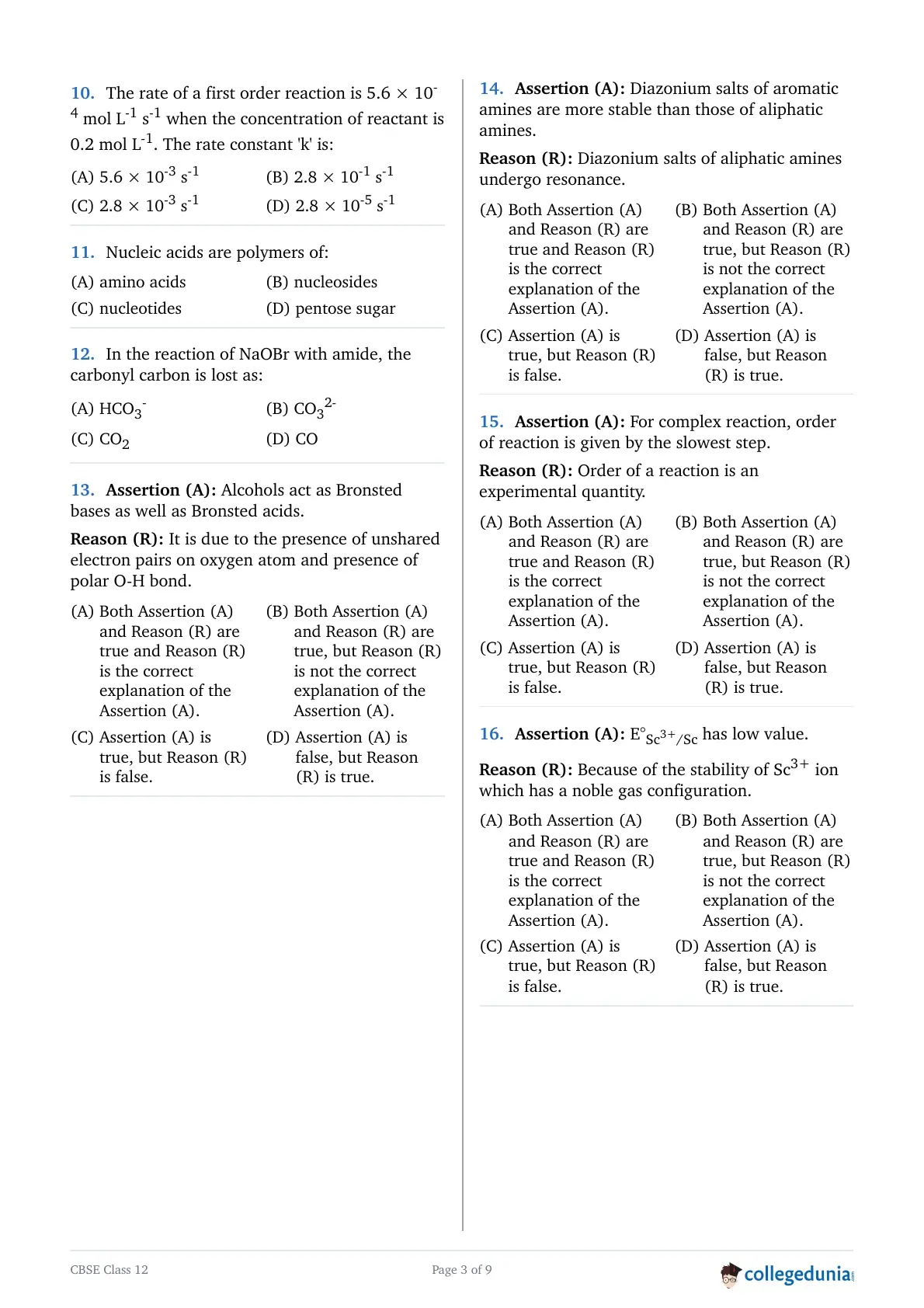
The rate of a first order reaction is \( 5.6 \times 10^{-4} \, mol \, L^{-1} \, s^{-1} \), when the concentration of reactant is \( 0.2 \, mol \, L^{-1} \). The rate constant \( 'k' \) is :
View Solution
Concept:
For a first-order reaction, the rate of the reaction is directly proportional to the concentration of the reactant raised to the power of one.
The rate law expression is:
\[ Rate = k[A] \]
where \( k \) is the rate constant and \( [A] \) is the molar concentration of the reactant.
The units of \( k \) for a first-order reaction are always \( time^{-1} \).
Step 1: Identify the given data
Rate of reaction (\( R \)) = \( 5.6 \times 10^{-4} \, mol \, L^{-1} \, s^{-1} \)
Concentration of reactant (\( [A] \)) = \( 0.2 \, mol \, L^{-1} \)
Step 2: Set up the equation for \( k \)
From the rate law: \[ k = \frac{Rate}{[A]} \]
Step 3: Perform the calculation
\[ k = \frac{5.6 \times 10^{-4}}{0.2} \]
To simplify, rewrite \( 0.2 \) as \( 2 \times 10^{-1} \): \[ k = \frac{5.6 \times 10^{-4}}{2 \times 10^{-1}} \] \[ k = 2.8 \times 10^{-4 - (-1)} \] \[ k = 2.8 \times 10^{-3} \, s^{-1} \]
Step 4: Verify units
The units of rate are \( M \cdot s^{-1} \) and concentration is \( M \).
\[ k = \frac{M \cdot s^{-1}}{M} = s^{-1} \]
The calculation and units are consistent with a first-order reaction. Quick Tip: For first-order reactions, the rate constant \( k \) is independent of the initial concentration.
Always be careful with powers of 10 during division in competitive exams.
Nucleic acids are polymers of :
View Solution
Concept:
Nucleic acids, such as DNA (Deoxyribonucleic acid) and RNA (Ribonucleic acid), are the biological macromolecules essential for all forms of life.
These are long-chain polymers called polynucleotides.
A polymer is built from repeating structural units known as monomers.
In the case of nucleic acids, these monomeric units consist of three distinct chemical components: a nitrogenous base, a pentose sugar, and a phosphate group.
Step 1: Identify the monomeric unit
The fundamental building block of a nucleic acid is the nucleotide.
A nucleotide is formed when a phosphate group is attached to the \( 5' \)-position of the sugar moiety of a nucleoside.
Step 2: Analyze the polymer structure
Nucleotides are joined together by phosphodiester linkages between the \( 5' \) and \( 3' \) carbon atoms of the pentose sugar residues.
This repeating sequence of sugar-phosphate-sugar-phosphate forms the backbone of the nucleic acid chain.
Step 3: Distinguish between options
(A) Amino acids are the monomers for proteins.
(B) Nucleosides consist of only a sugar and a base (lacking the phosphate needed for polymerization).
(D) Pentose sugar is just one component of the nucleotide.
Step 4: Conclusion
Since nucleic acids are made of repeating nucleotide units linked together, they are defined as polymers of nucleotides.
The final answer is nucleotides. Quick Tip: Remember the hierarchy: Sugar + Base = Nucleoside; Nucleoside + Phosphate = Nucleotide; Nucleotide \(\times\) n = Polynucleotide (Nucleic Acid).
In the reaction of \( NaOBr \) with amide, the carbonyl carbon is lost as :
View Solution
Concept:
This question refers to the Hoffmann Bromamide Degradation reaction.
In this reaction, an amide (\( R-CONH_{2} \)) is treated with bromine (\( Br_{2} \)) and an alkali (like \( NaOH \) or \( KOH \)).
The combination of \( Br_{2} \) and \( NaOH \) in situ forms sodium hypobromite (\( NaOBr \)).
The reaction results in the formation of a primary amine containing one carbon atom less than the parent amide.
Step 1: Observe the overall reaction equation
The balanced chemical equation for the Hoffmann Bromamide reaction is: \[ R-CONH_{2} + Br_{2} + 4NaOH \rightarrow R-NH_{2} + Na_{2}CO_{3} + 2NaBr + 2H_{2}O \]
Alternatively, using \( NaOBr \): \[ R-CONH_{2} + NaOBr + 2NaOH \rightarrow R-NH_{2} + Na_{2}CO_{3} + NaBr + H_{2}O \]
Step 2: Track the fate of the Carbonyl Carbon
The amide group (\( -CONH_{2} \)) contains a carbonyl carbon (\( C=O \)).
During the rearrangement mechanism (involving an isocyanate intermediate, \( R-N=C=O \)), this carbonyl carbon is expelled from the organic molecule.
Step 3: Identify the inorganic byproduct
The expelled carbon reacts with the excess hydroxide ions (\( OH^{-} \)) present in the alkaline medium to form sodium carbonate (\( Na_{2}CO_{3} \)).
In an aqueous ionic solution, sodium carbonate exists as sodium ions (\( Na^{+} \)) and carbonate ions (\( CO_{3}^{2-} \)).
Step 4: Conclusion
Therefore, the carbonyl carbon is formally lost from the organic chain in the form of the carbonate ion.
The final answer is \( CO_{3}^{2-} \). Quick Tip: Hoffmann "Degradation" literally means stepping down the carbon chain.
If you start with propanamide (\( C_{3} \)), you get ethanamine (\( C_{2} \)). The "lost" carbon is always in the carbonate byproduct.
Assertion (A) : Alcohols act as Bronsted bases as well as Bronsted acids.
Reason (R) : It is due to the presence of unshared electron pairs on oxygen atom and presence of polar \( O - H \) bond.
View Solution
Concept:
A Bronsted acid is a species that can donate a proton (\( H^{+} \)).
A Bronsted base is a species that can accept a proton (\( H^{+} \)).
Substances that can behave as both acids and bases are termed amphoteric.
The reactivity of alcohols (\( R-OH \)) is centered around the Oxygen atom and the \( O-H \) bond.
Step 1: Evaluate the acidic behavior of alcohols
Alcohols have a polar \( O-H \) bond due to the high electronegativity of oxygen.
This polarity allows the hydrogen to be released as a proton (\( H^{+} \)) when reacting with a strong base.
\[ R-O-H + B: \rightarrow R-O^{-} + BH^{+} \]
Thus, they act as Bronsted acids.
Step 2: Evaluate the basic behavior of alcohols
The oxygen atom in alcohols has two lone pairs (unshared electron pairs).
These lone pairs can be donated to a proton from a strong mineral acid to form an oxonium ion.
\[ R-O-H + H^{+} \rightarrow R-OH_{2}^{+} \]
Thus, they act as Bronsted bases.
Step 3: Verify the link between Assertion and Reason
The Assertion states they are amphoteric (acting as both acid and base), which is true.
The Reason explains that the acidity is due to the polar \( O-H \) bond and basicity is due to the lone pairs on Oxygen, which is also true.
Since these chemical features directly enable the two types of Bronsted behavior, the Reason is the correct explanation for the Assertion.
The final answer is (A). Quick Tip: Alcohols are actually weaker acids than water but stronger bases than water in many contexts.
The lone pairs on Oxygen also make alcohols good nucleophiles in organic reactions.
Assertion (A) : Diazonium salts of aromatic amines are more stable than those of aliphatic amines.
Reason (R) : Diazonium salts of aliphatic amines undergo resonance.
View Solution
Concept:
Diazonium salts have the general formula \( R-N_{2}^{+} X^{-} \).
The stability of these salts depends on whether \( R \) is an alkyl (aliphatic) or aryl (aromatic) group.
Stability in organic chemistry is often provided by the delocalization of charge through resonance.
Step 1: Analyze Aromatic Diazonium Salts
In benzenediazonium chloride, the positive charge on the nitrogen atom is dispersed over the benzene ring through resonance.
The \( \pi \)-electrons of the ring interact with the diazonium group, providing temporary stability at low temperatures (\( 0-5^\circ C \)).
Thus, Assertion (A) is true.
Step 2: Analyze Aliphatic Diazonium Salts
Aliphatic diazonium salts (\( R-N_{2}^{+} X^{-} \)) where \( R \) is an alkyl group (like methyl or ethyl) do not have a \( \pi \)-system to allow resonance.
The alkyl group only has a +I effect, which cannot stabilize the positive charge effectively.
As a result, they are extremely unstable and decompose instantly, even at very low temperatures, to release Nitrogen gas (\( N_{2} \)) and form carbocations.
Step 3: Evaluate the Reason
The Reason states that aliphatic diazonium salts undergo resonance.
As established in Step 2, alkyl groups lack the necessary conjugated system for resonance.
Therefore, Reason (R) is false.
Step 4: Final Verdict
Since the Assertion is a correct factual statement and the Reason is scientifically incorrect, the code is (C).
The final answer is (C). Quick Tip: Aromatic diazonium salts are stable enough to be used as intermediates in synthesis (Dye test).
Aliphatic diazonium salts are so unstable they are never isolated; they just bubble off \( N_{2} \) gas.
Assertion (A) : For complex reaction, order of reaction is given by the slowest step.
Reason (R) : Order of a reaction is an experimental quantity.
View Solution
Concept:
A complex reaction is one that proceeds through a sequence of elementary steps (a mechanism).
The Rate Determining Step (RDS) is the slowest step in the mechanism, which controls the overall rate of the reaction.
The order of a reaction is the sum of exponents of the concentration terms in the rate law expression.
Step 1: Evaluate the Assertion
In any multi-step process, the overall speed is limited by the slowest component.
For a chemical reaction, the rate law (and thus the order) is derived from the stoichiometry of the slowest elementary step.
Therefore, Assertion (A) is true.
Step 2: Evaluate the Reason
Unlike molecularity (which is theoretical), the order of a reaction cannot be determined simply by looking at the balanced equation of a complex reaction.
It must be determined through experimental observations of how the rate changes with concentration.
Therefore, Reason (R) is also true.
Step 3: Check for the logical connection
Does the fact that "Order is experimental" explain why the slowest step determines the order?
No. The reason the slowest step determines the order is because it acts as a kinetic bottleneck.
The experimental nature of order is a separate characteristic of chemical kinetics.
Step 4: Conclusion
Both statements are true, but there is no "because" relationship between the Reason and the Assertion.
The final answer is (B). Quick Tip: Molecularity applies only to elementary steps. Order applies to the whole reaction.
If a reaction is elementary, its order and molecularity are usually the same.
Assertion (A) : \( E^{\circ}_{Sc^{3+}/Sc^{2+}} \) has low value.
Reason (R) : Because of the stability of \( Sc^{3+} \) ion which has a noble gas configuration.
View Solution
Concept:
Scandium (\( Sc \)) is the first element of the 3d transition series with atomic number 21.
The electronic configuration of neutral \( Sc \) is \( [Ar] 3d^{1} 4s^{2} \).
Stability in transition metal ions is often governed by the achievement of a noble gas configuration (\( d^0, d^5, or d^{10} \)).
Standard reduction potential (\( E^{\circ} \)) values indicate the tendency of a species to be reduced; a low (highly negative) value indicates high stability of the oxidized state.
Step 1: Determine the electronic configurations of the ions
For \( Sc^{3+} \): The ion is formed by losing all three valence electrons (two from \( 4s \) and one from \( 3d \)).
Configuration: \( [Ar] \) (equivalent to the noble gas Argon).
For \( Sc^{2+} \): The ion is formed by losing two electrons from the \( 4s \) orbital.
Configuration: \( [Ar] 3d^{1} \).
Step 2: Evaluate the stability of the states
The \( Sc^{3+} \) ion is exceptionally stable because it has a completely filled shell (noble gas configuration).
The \( Sc^{2+} \) ion is much less stable as it has one lone electron in the \( 3d \) orbital.
Therefore, \( Sc^{3+} \) has very little tendency to accept an electron to become \( Sc^{2+} \).
Step 3: Relate stability to \( E^{\circ} \) value
The reduction potential \( E^{\circ}_{Sc^{3+}/Sc^{2+}} \) refers to the process: \( Sc^{3+} + e^{-} \rightarrow Sc^{2+} \).
Because \( Sc^{3+} \) is so stable, this reduction is energetically unfavorable, resulting in a very low (highly negative) reduction potential.
The final answer is (A). Quick Tip: Scandium essentially only exists in the \( +3 \) oxidation state in its compounds due to this extreme stability of the \( d^0 \) configuration.
It is technically a transition element, but its chemistry is quite different from other transition metals because it doesn't show variable valency easily.
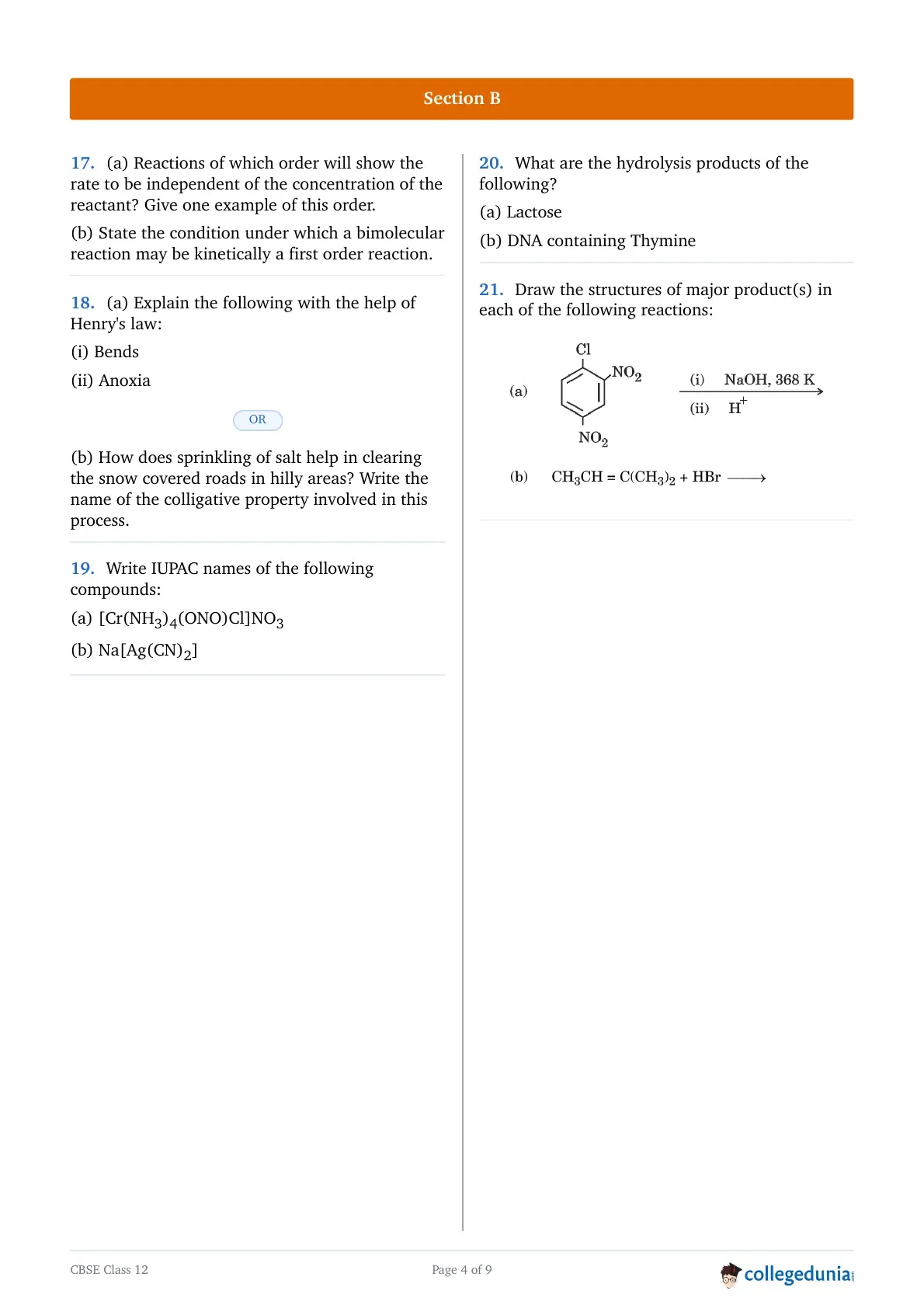
Reactions of which order will show the rate to be independent of the concentration of the reactant ? Give one example of this order.
View Solution
Concept:
The order of a reaction is defined as the sum of the powers of the concentration terms of the reactants in the rate law expression.
In certain specific chemical processes, the rate of the reaction does not change regardless of how much reactant is added or removed.
These reactions are classified as zero-order reactions because the concentration term in the rate law is raised to the power of zero.
Zero-order reactions typically occur when the reaction is limited by the availability of a catalyst surface or light intensity.
Step 1: Derive the mathematical dependency
Consider a general reaction: \( A \rightarrow Products \).
[0.3cm]
For a zero-order reaction, the rate law is written as: \[ Rate = k[A]^{0} \]
[0.3cm]
Since any number raised to the power of zero is 1, we get: \[ Rate = k \]
[0.3cm]
This shows that the rate of reaction is equal to the rate constant (\( k \)) and is independent of the molar concentration of reactant \( A \).
Step 2: Describe a practical example and the underlying reason
A standard example is the decomposition of ammonia gas on a hot platinum surface: \[ 2NH_{3}(g) \xrightarrow{Pt, \Delta} N_{2}(g) + 3H_{2}(g) \]
[0.3cm]
In this heterogeneous catalysis, the ammonia molecules are adsorbed on the surface of the platinum. At high pressures, the entire surface of the catalyst becomes completely covered (saturated) with ammonia molecules.
[0.3cm]
Once the surface is saturated, any further increase in the concentration (or pressure) of ammonia cannot increase the number of molecules reacting per unit time because there are no more free sites on the catalyst. Consequently, the rate remains constant.
The final answer is Zero order reaction; example is decomposition of \( NH_{3} \) on Pt. Quick Tip: In a zero-order reaction, a graph of concentration versus time is a straight line with a negative slope equal to \( -k \).
The units for a zero-order rate constant are \( mol \, L^{-1} \, s^{-1} \).
State the condition under which a bimolecular reaction may be kinetically a first order reaction.
View Solution
Concept:
Molecularity is the number of reacting species taking part in an elementary step, whereas the order is determined experimentally.
A bimolecular reaction involves the collision of two molecules.
If a bimolecular reaction follows first-order kinetics, it is called a pseudo-first-order reaction.
This usually happens when the concentration of one reactant remains practically unchanged during the reaction.
Step 1: Analyze the rate law for a bimolecular system
Consider a reaction between two species \( A \) and \( B \): \[ A + B \rightarrow Products \]
[0.3cm]
The general experimental rate law is: \[ Rate = k'[A][B] \]
[0.3cm]
This is a second-order reaction (1st order with respect to \( A \) and 1st order with respect to \( B \)).
Step 2: Apply the condition of large excess
If the reactant \( B \) is present in a very large excess (for example, if \( B \) is the solvent), its concentration will not change significantly as the reaction proceeds.
[0.3cm]
Therefore, \( [B] \) can be treated as a constant. The rate law is modified to: \[ Rate = (k'[B]) [A] \] \[ Rate = k[A] \]
[0.3cm]
where \( k = k'[B] \). The reaction now behaves as a first-order reaction kinetically.
Step 3: Illustrate with a chemical example
The inversion of cane sugar is a bimolecular reaction: \[ C_{12}H_{22}O_{11} + H_{2}O \xrightarrow{H^{+}} C_{6}H_{12}O_{6} + C_{6}H_{12}O_{6} \]
[0.3cm]
Because water is present in such a massive excess, its concentration remains nearly constant at \( 55.5 \, M \). The rate depends only on the concentration of the sugar, making it a pseudo-first-order reaction.
The final answer is one reactant must be in large excess. Quick Tip: "Pseudo" means false. These reactions are not "true" first-order reactions because they require two different molecules to collide, but they appear first-order in experiments.
Explain the following with the help of Henry’s law : (i) Bends (ii) Anoxia
View Solution
Concept:
Henry’s Law states that at a constant temperature, the solubility of a gas in a liquid is directly proportional to the partial pressure of the gas above the liquid.
Mathematically: \( P = K_{H} \cdot \chi \), where \( P \) is the partial pressure and \( \chi \) is the mole fraction of the gas in the solution.
Pressure changes significantly affect how much gas our blood can hold.
Step 1: Explain the physiology of "Bends"
Scuba divers breathe air at high pressure while deep underwater. According to Henry's Law, this high pressure increases the solubility of atmospheric gases, particularly Nitrogen (\( N_{2} \)), in the blood and tissues.
[0.4cm]
When the diver ascends rapidly to the surface, the external pressure decreases. This causes the dissolved Nitrogen to quickly lose its solubility and come out of the blood in the form of bubbles. These bubbles block capillaries and pinch nerve endings, causing a painful and life-threatening condition called "the bends."
Step 2: Explain the physiology of "Anoxia"
At high altitudes, such as on mountain peaks, the partial pressure of oxygen is much lower than at sea level.
[0.4cm]
By Henry's Law, lower partial pressure leads to a decrease in the solubility of oxygen in the blood of climbers. This results in low concentrations of oxygen in the blood and tissues, causing climbers to feel weak and have difficulty thinking clearly. This condition is medically termed Anoxia.
The final answer is (i) Bends: Nitrogen bubble formation; (ii) Anoxia: Low oxygen solubility. Quick Tip: To prevent bends, modern scuba tanks use air diluted with Helium. Helium is used because it has very low solubility in blood even at high pressures.
How does sprinkling of salt help in clearing the snow covered roads in hilly areas ? Write the name of the colligative property involved in this process.
View Solution
Concept:
The freezing point of a substance is the temperature at which its liquid and solid phases are in equilibrium.
Adding a non-volatile solute (like salt) to a solvent (like water) lowers the vapor pressure of the solvent.
This results in a lower freezing point for the solution compared to the pure solvent.
This effect is known as the Depression in Freezing Point (\( \Delta T_{f} \)).
Step 1: Identify the role of the salt
When salt (\( NaCl \) or \( CaCl_{2} \)) is sprinkled onto snow, it dissolves into the thin layer of liquid water always present on the surface of ice. This forms a concentrated salt solution.
[0.3cm]
The salt acts as a non-volatile solute in the water.
Step 2: Explain the melting process
Pure water freezes at \( 0^{\circ}C \). However, a salt solution has a much lower freezing point (e.g., \( -10^{\circ}C \) or lower depending on concentration).
[0.3cm]
If the ambient temperature is \( -5^{\circ}C \), the snow (pure ice) would normally remain solid. But once the salt is added, the freezing point of the mixture drops below \( -5^{\circ}C \). Because the environment is now "warmer" than the new freezing point, the ice melts into a liquid brine, clearing the road.
Step 3: State the specific property
The colligative property utilized in this industrial application is the Depression in Freezing Point.
The final answer is Depression in Freezing Point. Quick Tip: One mole of \( CaCl_{2} \) is more effective than one mole of \( NaCl \) because it produces three particles (\( i=3 \)) instead of two, causing a greater depression in freezing point.
Write IUPAC name of the following compound : \( [Cr(NH_{3})_{4} (ONO)Cl] NO_{3} \)
View Solution
Concept:
IUPAC rules for coordination compounds require naming ligands in alphabetical order, followed by the metal.
The oxidation state of the central metal must be indicated in Roman numerals in parentheses.
If the complex is a cation, the metal's standard name is used.
Ambidentate ligands like \( ONO^{-} \) must specify the donor atom.
Step 1: Determine the oxidation state of Chromium
Let the oxidation state of \( Cr \) be \( x \).
[0.3cm]
The charges on the components are:
- Ammine (\( NH_{3} \)) = \( 0 \)
- Nitrito (\( ONO^{-} \)) = \( -1 \)
- Chloro (\( Cl^{-} \)) = \( -1 \)
- Nitrate (\( NO_{3}^{-} \)) (counter ion) = \( -1 \)
[0.3cm]
Summing for the neutral molecule: \( x + 4(0) + (-1) + (-1) + (-1) = 0 \) \( x - 3 = 0 \Rightarrow x = +3 \).
Step 2: Alphabetize the ligands
- \( NH_{3} \): ammine
- \( Cl \): chloro
- \( ONO \): nitrito-O
[0.3cm]
Alphabetical order: ammine \( > \) chloro \( > \) nitrito-O.
Step 3: Construct the full name
Combine the ligands (with prefixes), the metal, its oxidation state, and the counter ion:
Tetraamminechloronitrito-O-chromium(III) nitrate.
The final answer is Tetraamminechloronitrito-O-chromium(III) nitrate. Quick Tip: Always double-check the donor atom for \( NO_{2} \). If it's written \( ONO \), the oxygen is the donor, so the name is nitrito-O. If it's \( NO_{2} \), the nitrogen is the donor, so it's nitrito-N.
Write IUPAC name of the following compound : \( Na[Ag(CN)_{2}] \)
View Solution
Concept:
For compounds with a complex anion, the cation is named first.
The name of the central metal in an anionic complex must end with the suffix "-ate."
For silver, the Latin name "Argentum" is used to form the suffix.
Step 1: Calculate the oxidation state of Silver
Let the oxidation state of \( Ag \) be \( x \).
[0.3cm]
The charges are:
- Sodium (\( Na^{+} \)) = \( +1 \)
- Cyano (\( CN^{-} \)) = \( -1 \)
[0.3cm]
Equation: \( (+1) + [x + 2(-1)] = 0 \) \( 1 + x - 2 = 0 \Rightarrow x = +1 \).
Step 2: Identify the components for the name
1. Cation: Sodium
2. Ligands: Two cyano groups = dicyano
3. Metal: Silver in an anionic complex = argentate
4. Oxidation state: (I)
Step 3: Assemble the final name
The name is Sodium dicyanoargentate(I).
The final answer is Sodium dicyanoargentate(I). Quick Tip: Metals that use Latin roots in anionic complexes: Iron (Ferrate), Copper (Cuprate), Silver (Argentate), Gold (Aurate), Tin (Stannate), and Lead (Plumbate).
What are the hydrolysis products of the following ? Lactose
View Solution
Concept:
Lactose is a disaccharide commonly found in milk, consisting of two monosaccharide units.
Hydrolysis involves the breaking of the glycosidic linkage by the addition of a water molecule.
This reaction is usually catalyzed by dilute acids or the enzyme lactase.
Step 1: Determine the structural units of Lactose
Lactose is composed of one molecule of D-galactose and one molecule of D-glucose.
[0.3cm]
Specifically, these units are linked by a \(\beta\)-1,4-glycosidic bond (between C1 of galactose and C4 of glucose).
Step 2: Describe the chemical hydrolysis
When lactose reacts with water in the presence of the enzyme lactase or an acid catalyst: \[ C_{12}H_{22}O_{11} + H_{2}O \rightarrow C_{6}H_{12}O_{6} + C_{6}H_{12}O_{6} \]
[0.3cm]
The glycosidic bond is cleaved, yielding an equimolar mixture of \(\beta\)-D-galactose and \(\beta\)-D-glucose.
The final answer is Galactose and Glucose. Quick Tip: Lactose is a reducing sugar. Even though it is a disaccharide, one of its glucose units has a potential free aldehyde group at the C1 position.
What are the hydrolysis products of the following ? DNA containing Thymine
View Solution
Concept:
DNA (Deoxyribonucleic acid) is a polymer made of nucleotide monomers.
Each nucleotide consists of a phosphate group, a pentose sugar, and a nitrogenous base.
Complete hydrolysis breaks all the phosphodiester and N-glycosidic bonds.
Step 1: Identify the sugar component
DNA contains a specific five-carbon sugar known as 2-deoxy-D-ribose. Unlike RNA, it lacks a hydroxyl group at the second carbon position.
Step 2: Identify the acidic component
The backbone of DNA consists of phosphate groups that link the sugars. Complete hydrolysis of these linkages yields phosphoric acid (\( H_{3}PO_{4} \)).
Step 3: Identify the nitrogenous bases
DNA contains four heterocyclic bases. For the specific case mentioned:
- Purines: Adenine (A) and Guanine (G)
- Pyrimidines: Cytosine (C) and Thymine (T)
[0.3cm]
Thymine is the base characteristic of DNA; in RNA, it is replaced by Uracil.
The final answer is Deoxyribose, Phosphoric acid, and nitrogenous bases (A, G, C, T). Quick Tip: If you are asked for the hydrolysis of RNA instead, the products would be D-ribose, phosphoric acid, and the bases A, G, C, and Uracil.
Draw the structure of the major product in the following reaction:

View Solution
Concept:
Haloarenes are generally less reactive towards nucleophilic substitution reactions due to resonance and partial double bond character of the \( C-X \) bond.
However, the presence of electron-withdrawing groups (EWG) like \( -NO_{2} \) at ortho and para positions significantly increases the reactivity of haloarenes towards nucleophilic aromatic substitution (\( S_{N}Ar \)).
These groups stabilize the intermediate carbanion (Meisenheimer complex) by delocalizing the negative charge through resonance.
Step 1: Analyze the substrate and reagents
The substrate is 1-chloro-2,4-dinitrobenzene. It has two strong electron-withdrawing nitro groups at the ortho and para positions relative to the chlorine atom.
[0.3cm]
The reagent is sodium hydroxide (\( NaOH \)), which provides the nucleophile \( OH^{-} \). The temperature of \( 368 \, K \) is sufficient to drive the substitution.
Step 2: Describe the reaction mechanism
The \( OH^{-} \) nucleophile attacks the carbon atom bearing the chlorine. This forms a resonance-stabilized carbanion intermediate where the negative charge is delocalized onto the oxygens of the nitro groups.
[0.3cm]
Subsequently, the chloride ion (\( Cl^{-} \)) is eliminated to restore aromaticity, resulting in 2,4-dinitrophenoxide.
Step 3: Final acidification
The second step involves treatment with \( H^{+} \). This protonates the phenoxide ion to yield the final neutral product: 2,4-dinitrophenol.
Step 4: Draw the structure
The final answer is 2,4-dinitrophenol. Quick Tip: The more \( -NO_{2} \) groups at ortho/para positions, the milder the conditions required.
Picryl chloride (2,4,6-trinitrochlorobenzene) reacts with just warm water!
Draw the structure of the major product in the following reaction: \( CH_{3}CH = C(CH_{3})_{2} + HBr \rightarrow \)
View Solution
Concept:
The addition of hydrogen halides (\( HX \)) to unsymmetrical alkenes follows Markovnikov's Rule.
According to this rule, the "rich get richer": the hydrogen atom attaches to the doubly bonded carbon that already has the greater number of hydrogen atoms.
Mechanistically, the reaction proceeds via the formation of the most stable carbocation intermediate.
Step 1: Identify the structure of the alkene
The alkene is 2-methylbut-2-ene: \( CH_{3}-CH=C(CH_{3})_{2} \).
[0.3cm]
Carbon-2 is bonded to two methyl groups (zero hydrogens).
Carbon-3 is bonded to one methyl group and one hydrogen atom.
Step 2: Determine carbocation stability
When \( H^{+} \) from \( HBr \) adds to Carbon-3, a carbocation forms at Carbon-2. This is a tertiary (\( 3^\circ \)) carbocation, which is highly stable due to inductive effects and hyperconjugation from three alkyl groups.
[0.3cm]
If \( H^{+} \) added to Carbon-2, a secondary (\( 2^\circ \)) carbocation would form at Carbon-3, which is less stable.
Step 3: Attack of the nucleophile
The bromide ion (\( Br^{-} \)) attacks the more stable tertiary carbocation at Carbon-2.
Step 4: Final Product Structure
The product is 2-bromo-2-methylbutane: \[ CH_{3}-CH_{2}-C(Br)(CH_{3})_{2} \]
The final answer is 2-bromo-2-methylbutane. Quick Tip: Markovnikov addition is used unless peroxides are present.
With peroxides, \( HBr \) adds via an Anti-Markovnikov mechanism (Kharasch effect), but this only works for \( HBr \).
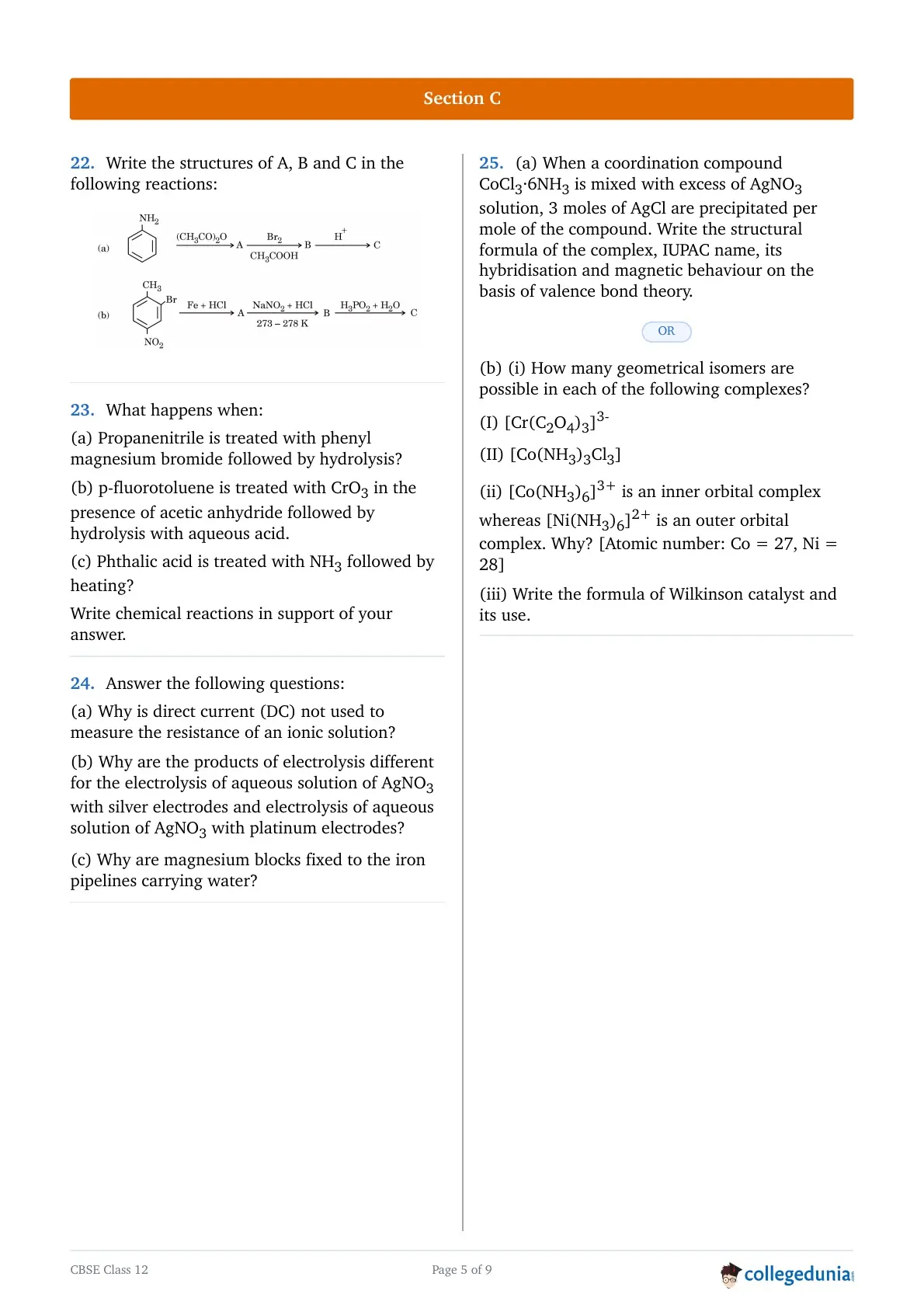
Write the structures of A, B and C in the following reaction:

View Solution
Concept:
Direct bromination of aniline is difficult to control because the \( -NH_{2} \) group is extremely activating, leading to 2,4,6-tribromoaniline.
To obtain a mono-substituted product, the activating power of the amino group must be reduced by acetylation (protection).
The acetyl group is electron-withdrawing, which reduces the electron density on Nitrogen and thus on the ring.
Step 1: Formation of A (Acetylation)
Aniline reacts with acetic anhydride \( (CH_{3}CO)_{2}O \) to form acetanilide.
Structure A: \( C_{6}H_{5}NHCOCH_{3} \)
Step 2: Formation of B (Bromination)
Acetanilide reacts with \( Br_{2} \) in acetic acid. The \( -NHCOCH_{3} \) group is ortho/para directing. Due to steric hindrance of the bulky acetyl group, the para product is the major one.
Structure B: \( p-Br-C_{6}H_{4}NHCOCH_{3} \) (4-bromoacetanilide)
Step 3: Formation of C (Hydrolysis)
Acidic hydrolysis (\( H^{+} \)) removes the acetyl protecting group to restore the primary amine.
Structure C: \( p-Br-C_{6}H_{4}NH_{2} \) (4-bromoaniline or p-bromoaniline)
The final answer is A: Acetanilide, B: 4-bromoacetanilide, C: 4-bromoaniline. Quick Tip: Acetylation is the standard "protection" strategy in aromatic synthesis to prevent over-substitution and oxidation of the sensitive \( -NH_{2} \) group.
Write the structures of A, B and C in the following reaction:

View Solution
Concept:
Nitro groups are reduced to amino groups using active metals in acid (\( Fe/HCl \)).
Primary aromatic amines undergo diazotization to form stable diazonium salts at low temperatures.
Diazonium groups can be replaced by hydrogen (deamination) using mild reducing agents like phosphinic acid (\( H_{3}PO_{2} \)).
Step 1: Formation of A (Reduction)
The nitro group in 2-bromo-4-nitrotoluene is reduced to an amino group.
Structure A: 3-bromo-4-methylaniline (or 2-bromo-4-aminotoluene).
Step 2: Formation of B (Diazotization)
Reaction with \( NaNO_{2} + HCl \) at \( 0-5^{\circ}C \) converts the \( -NH_{2} \) group into a diazonium chloride group (\( -N_{2}^{+}Cl^{-} \)).
Structure B: 3-bromo-4-methylbenzenediazonium chloride.
Step 3: Formation of C (Deamination)
Treatment with hypophosphorous acid (\( H_{3}PO_{2} \)) and water replaces the \( -N_{2}^{+}Cl^{-} \) group with a Hydrogen atom. The byproduct is phosphorous acid (\( H_{3}PO_{3} \)).
Structure C: 2-bromotoluene.
The final answer is A: 3-bromo-4-methylaniline, B: 3-bromo-4-methylbenzenediazonium chloride, C: 2-bromotoluene. Quick Tip: \( H_{3}PO_{2} \) or \( CH_{3}CH_{2}OH \) are the standard reagents used to remove the diazonium group entirely from a ring.
What happens when: Propanenitrile is treated with phenyl magnesium bromide followed by hydrolysis?
View Solution
Concept:
Grignard reagents (\( RMgX \)) act as nucleophiles and attack the electrophilic carbon of the nitrile group (\( -C\equiv N \)).
The initial addition product is an imine salt.
Acidic hydrolysis of this imine salt yields a ketone.
Step 1: Nucleophilic attack
Phenyl magnesium bromide (\( C_{6}H_{5}MgBr \)) attacks the carbon of propanenitrile (\( CH_{3}CH_{2}CN \)). The phenyl group attaches to the carbon, and the \( MgBr \) attaches to the nitrogen. \[ CH_{3}CH_{2}C\equiv N + C_{6}H_{5}MgBr \rightarrow CH_{3}CH_{2}C(C_{6}H_{5})=NMgBr \]
Step 2: Hydrolysis
The addition of water/acid breaks the carbon-nitrogen double bond. The Nitrogen is lost as an ammonium salt, and the Carbon becomes a carbonyl group. \[ CH_{3}CH_{2}C(C_{6}H_{5})=NMgBr + H_{2}O/H^{+} \rightarrow CH_{3}CH_{2}C(=O)C_{6}H_{5} \]
Step 3: Identify the product
The resulting product is 1-phenylpropan-1-one, also commonly known as propiophenone.
The final answer is Propiophenone (1-phenylpropan-1-one). Quick Tip: Nitriles + Grignard \( \rightarrow \) Ketones.
Nitriles + Grignard followed by excessive hydrolysis is one of the best ways to prepare aryl alkyl ketones.
What happens when: p-fluorotoluene is treated with \( CrO_{3} \) in the presence of acetic anhydride followed by hydrolysis with aqueous acid?
View Solution
Concept:
Chromic anhydride (\( CrO_{3} \)) in acetic anhydride is used to partially oxidize the methyl group of an aromatic ring to an aldehyde.
To prevent over-oxidation to a carboxylic acid, the intermediate is trapped as a gem-diacetate.
Subsequent hydrolysis of the diacetate yields the aldehyde.
Step 1: Formation of the intermediate
p-fluorotoluene reacts with \( CrO_{3} \) and acetic anhydride to form p-fluorobenzylidene diacetate. \[ p-F-C_{6}H_{4}-CH_{3} \xrightarrow{CrO_{3}, (CH_{3}CO)_{2}O} p-F-C_{6}H_{4}-CH(OCOCH_{3})_{2} \]
Step 2: Hydrolysis
Acidic hydrolysis of the benzylidene diacetate replaces the two acetate groups with one oxygen atom, forming the aldehyde. \[ p-F-C_{6}H_{4}-CH(OCOCH_{3})_{2} \xrightarrow{H_{3}O^{+}} p-F-C_{6}H_{4}-CHO \]
Step 3: Identify the product
The resulting product is 4-fluorobenzaldehyde (or p-fluorobenzaldehyde).
The final answer is 4-fluorobenzaldehyde. Quick Tip: This is a variation of the Etard reaction. Using acetic anhydride is key to stopping the oxidation at the aldehyde stage.
What happens when: Phthalic acid is treated with \( NH_{3} \) followed by heating?
View Solution
Concept:
Carboxylic acids react with ammonia to form ammonium salts.
Heating the ammonium salt leads to dehydration, forming an amide.
Strong heating of a dicarboxylic acid derivative like phthalamide leads to further loss of ammonia to form a cyclic imide.
Step 1: Salt formation
Phthalic acid reacts with ammonia to form ammonium phthalate. \[ C_{6}H_{4}(COOH)_{2} + 2NH_{3} \rightarrow C_{6}H_{4}(COONH_{4})_{2} \]
Step 2: Amide formation
Mild heating of ammonium phthalate causes the loss of two water molecules to form phthalamide. \[ C_{6}H_{4}(COONH_{4})_{2} \xrightarrow{\Delta} C_{6}H_{4}(CONH_{2})_{2} \]
Step 3: Imide formation
Strong heating of phthalamide leads to the elimination of one molecule of ammonia, resulting in the formation of a cyclic product. \[ C_{6}H_{4}(CONH_{2})_{2} \xrightarrow{strong \Delta} Phthalimide + NH_{3} \]
Step 4: Identify the product
The final product is Phthalimide, a cyclic imide used extensively in the Gabriel Phthalimide Synthesis.
The final answer is Phthalimide. Quick Tip: Phthalimide is the starting material for synthesizing primary amines without any secondary or tertiary amine contamination.
Why is direct current (DC) not used to measure the resistance of an ionic solution?
View Solution
Concept:
Resistance measurement of solutions involves passing a current through the liquid between two electrodes.
Ionic solutions contain mobile ions that participate in electrochemical processes.
Using the wrong type of current can lead to chemical and physical changes in the sample.
Step 1: Effect of electrolysis
Direct current (DC) flows in one direction. This causes prolonged electrolysis of the solution. Ions migrate to the electrodes and undergo redox reactions, which changes the chemical composition of the solution.
Step 2: Change in concentration
Because of the chemical reactions at the electrodes, the concentration of the ions in the bulk solution changes. Since resistance depends directly on ion concentration, the measured value becomes inaccurate and non-reproducible.
Step 3: Polarization effects
DC current leads to the accumulation of products (gases or solids) at the electrode surfaces. This creates a "polarization" potential that opposes the applied voltage, leading to a false increase in the measured resistance.
Step 4: The solution
To avoid these issues, Alternating Current (AC) with a frequency in the audio range is used. AC reverses direction periodically, preventing net chemical change and polarization.
The final answer is because DC causes electrolysis and changes the solution composition. Quick Tip: In a Wheatstone bridge circuit for conductivity, an AC source and a "conductivity cell" with platinum-coated electrodes are used to ensure precision.
Why are the products of electrolysis different for the electrolysis of aqueous solution of \( AgNO_{3} \) with silver electrodes and electrolysis of aqueous solution of \( AgNO_{3} \) with platinum electrodes?
View Solution
Concept:
The products of electrolysis depend on the nature of the electrodes.
Inert electrodes (like Pt or Au) do not participate in the chemical reaction; they only provide a surface for electron transfer.
Active electrodes (like Ag, Cu, or Ni) participate in the redox reactions themselves.
Step 1: Analyze with Platinum (Inert) Electrodes
At the Cathode: \( Ag^{+} \) ions are reduced to silver metal because silver has a higher reduction potential than water. \[ Ag^{+}(aq) + e^{-} \rightarrow Ag(s) \]
At the Anode: Water is oxidized to Oxygen gas because the Pt electrode is inert and does not react. \[ 2H_{2}O(l) \rightarrow O_{2}(g) + 4H^{+}(aq) + 4e^{-} \]
Step 2: Analyze with Silver (Active) Electrodes
At the Cathode: \( Ag^{+} \) ions are still reduced to silver metal. \[ Ag^{+}(aq) + e^{-} \rightarrow Ag(s) \]
At the Anode: The silver electrode itself is oxidized to \( Ag^{+} \) ions because the oxidation of Ag metal requires less energy than the oxidation of water. \[ Ag(s) \rightarrow Ag^{+}(aq) + e^{-} \]
Step 3: Compare the results
With Pt electrodes, Oxygen gas is produced at the anode. With Ag electrodes, the anode dissolves, and no gas is produced.
The final answer is because silver electrodes are active and participate in the reaction, unlike inert platinum. Quick Tip: Using active electrodes is the basis for electroplating and electrolytic refining of metals.
Why are magnesium blocks fixed to the iron pipelines carrying water?
View Solution
Concept:
Corrosion (rusting) of iron is an electrochemical process where iron is oxidized.
This can be prevented by a technique called Cathodic Protection.
A more reactive metal is used to protect a less reactive metal.
Step 1: Compare reactivity
Magnesium is much more electropositive (reactive) than iron. In the electrochemical series, Magnesium has a much lower standard reduction potential than Iron.
Step 2: Identify the sacrificial anode
When Magnesium is connected to the Iron pipeline, it acts as the anode in the local electrochemical cell. Magnesium undergoes oxidation preferentially over Iron. \[ Mg(s) \rightarrow Mg^{2+}(aq) + 2e^{-} \]
Step 3: Effect on Iron
The electrons released by the Magnesium flow to the Iron pipeline, making it the cathode. Since reduction happens at the cathode, the Iron is protected from being oxidized (rusting).
Step 4: Conclusion
Magnesium is called a sacrificial anode because it is "sacrificed" (corroded) to save the iron pipeline. These blocks must be replaced periodically.
The final answer is for sacrificial protection of iron against corrosion. Quick Tip: This same principle is used in galvanization, where iron is coated with zinc to prevent rust.
When a coordination compound \( CoCl_{3} \cdot 6NH_{3} \) is mixed with excess of \( AgNO_{3} \) solution, 3 moles of \( AgCl \) are precipitated per mole of the compound. Write the structural formula of the complex, IUPAC name, its hybridisation and magnetic behaviour on the basis of valence bond theory.
View Solution
Concept:
Werner's Theory states that ions outside the coordination sphere are ionizable and react with reagents like \( AgNO_{3} \).
Since 3 moles of \( AgCl \) are formed, there must be 3 chloride ions outside the brackets.
Valence Bond Theory (VBT) uses orbital hybridization to explain geometry and magnetism.
Step 1: Determine the structural formula
Total components: 1 Co, 3 Cl, 6 \( NH_{3} \).
If 3 Cl are outside, the 6 \( NH_{3} \) must be inside as ligands.
Formula: \( [Co(NH_{3})_{6}]Cl_{3} \)
Step 2: Determine the IUPAC name
Metal: Cobalt. Ligand: Ammine (6). Counter ion: Chloride.
Oxidation state of Co: \( x + 6(0) + 3(-1) = 0 \Rightarrow x = +3 \).
Name: Hexaamminecobalt(III) chloride
Step 3: Determine hybridisation and geometry
\( Co^{3+} \) configuration: \( [Ar] 3d^{6} 4s^{0} 4p^{0} \).
\( NH_{3} \) is a strong field ligand, causing the 6 electrons in \( 3d \) to pair up. This leaves two \( 3d \) orbitals empty.
Hybridization: \( d^{2}sp^{3} \) (Inner orbital complex).
Geometry: Octahedral.
Step 4: Determine magnetic behaviour
Since all 6 electrons in the \( 3d \) subshell are paired due to the strong field ligand, there are zero unpaired electrons.
Behaviour: Diamagnetic.
The final answer is [Co(NH3)6]Cl3, Hexaamminecobalt(III) chloride, d2sp3, diamagnetic. Quick Tip: Strong field ligands (\( CN^{-}, CO, NH_{3}, en \)) often cause pairing in d6 systems, leading to diamagnetic complexes.
How many geometrical isomers are possible in each of the following complexes?
\[ (I) [Cr(C_{2}O_{4})_{3}]^{3-} \qquad (II) [Co(NH_{3})_{3}Cl_{3}] \]
View Solution
Concept:
Geometrical isomerism arises due to different spatial arrangements of ligands around the central metal atom.
Octahedral complexes containing three identical bidentate ligands generally do not exhibit geometrical isomerism.
Octahedral complexes of the type \(MA_{3}B_{3}\) exhibit two geometrical isomers: Facial (fac) and Meridional (mer).
Step 1: Complex (I): \( [Cr(C_{2}O_{4})_{3}]^{3-} \)
Here, all three ligands are identical bidentate oxalate ligands.
Since every ligand occupies two adjacent coordination positions, only one geometrical arrangement is possible.
Therefore,
\[ \boxed{Number of geometrical isomers=0} \]
(Note: This complex shows optical isomerism but not geometrical isomerism.)
Step 2: Complex (II): \( [Co(NH_{3})_{3}Cl_{3}] \)
This complex is of the type \(MA_{3}B_{3}\).
Hence, two geometrical arrangements are possible:
Facial (fac)
Meridional (mer)
Therefore,
\[ \boxed{Number of geometrical isomers=2} \] Quick Tip: Remember: \[ MA_{3}B_{3}\rightarrow fac and mer isomers \] while complexes containing three identical bidentate ligands generally do not show geometrical isomerism.
\( [Co(NH_{3})_{6}]^{3+} \) is an inner orbital complex whereas \( [Ni(NH_{3})_{6}]^{2+} \) is an outer orbital complex. Why?
View Solution
Concept:
Whether a complex is inner orbital or outer orbital depends upon the electronic configuration of the metal ion and the pairing of electrons in the \(d\)-orbitals.
Inner orbital complexes use \((n-1)d\) orbitals.
Outer orbital complexes use \(nd\) orbitals.
Step 1: Electronic configuration of \(Co^{3+}\).
Cobalt (\(Z=27\))
\[ Co=[Ar]\,3d^{7}4s^{2} \]
For \(Co^{3+}\),
\[ Co^{3+}=[Ar]\,3d^{6} \]
Since the oxidation state is +3, electron pairing occurs in the \(3d\)-orbitals.
Thus, two vacant \(3d\)-orbitals become available for hybridisation.
Hybridisation:
\[ d^{2}sp^{3} \]
Hence,
\[ \boxed{[Co(NH_{3})_{6}]^{3+} is an inner orbital complex.} \]
Step 2: Electronic configuration of \(Ni^{2+}\).
Nickel (\(Z=28\))
\[ Ni=[Ar]\,3d^{8}4s^{2} \]
For \(Ni^{2+}\),
\[ Ni^{2+}=[Ar]\,3d^{8} \]
The \(3d\)-electrons cannot pair sufficiently to create two vacant \(3d\)-orbitals.
Therefore hybridisation involves outer \(4d\)-orbitals.
Hybridisation:
\[ sp^{3}d^{2} \]
Hence,
\[ \boxed{[Ni(NH_{3})_{6}]^{2+} is an outer orbital complex.} \] Quick Tip: \(Co^{3+}(3d^{6})\) forms an inner orbital complex because electron pairing is possible, whereas \(Ni^{2+}(3d^{8})\) generally forms an outer orbital complex since sufficient pairing does not occur.
Write the formula of Wilkinson catalyst and its use.
View Solution
Concept:
Wilkinson catalyst is a homogeneous transition metal catalyst widely used in organic synthesis.
It contains rhodium as the central metal coordinated with triphenylphosphine ligands.
Metal: Rhodium (Rh)
Ligands: Three triphenylphosphine (\(PPh_{3}\))
One chloride ion
Step 1: Write the formula.
The molecular formula of Wilkinson catalyst is
\[ \boxed{RhCl(PPh_{3})_{3}} \]
where
\[ PPh_{3}=Triphenylphosphine. \]
Step 2: Write its use.
Wilkinson catalyst is mainly used for the catalytic hydrogenation of alkenes.
It adds hydrogen across the carbon-carbon double bond to produce alkanes.
Example:
\[ CH_{2}=CH_{2}+H_{2} \xrightarrow{RhCl(PPh_{3})_{3}} CH_{3}-CH_{3} \]
Therefore,
\[ \boxed{Wilkinson catalyst is used for hydrogenation of alkenes.} \] Quick Tip: Remember: \[ \boxed{RhCl(PPh_{3})_{3}} \] is Wilkinson catalyst and is extensively used in homogeneous catalytic hydrogenation reactions.
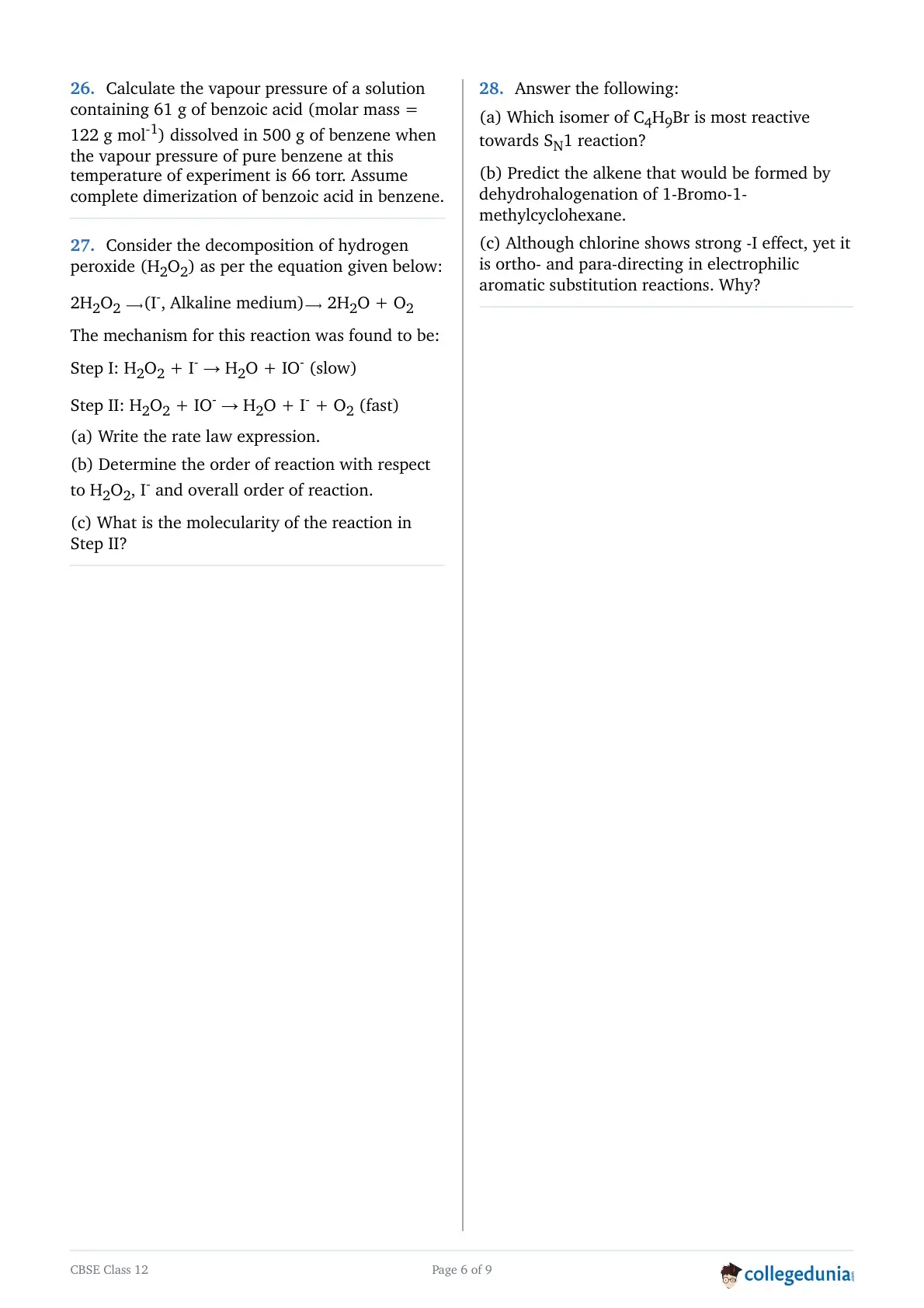
Calculate the vapour pressure of a solution containing \( 61 \, g \) of benzoic acid (molar mass \( = 122 \, g \, mol^{-1} \)) dissolved in \( 500 \, g \) of benzene when the vapour pressure of pure benzene at this temperature of experiment is \( 66 \, torr \). Assume complete dimerization of benzoic acid in benzene.
View Solution
Concept:
Vapor pressure lowering is a colligative property. According to Raoult's Law for a non-volatile solute:
\[ \frac{P^\circ - P_s}{P^\circ} = \frac{i \cdot n_B}{n_A + i \cdot n_B} \approx \frac{i \cdot n_B}{n_A} (for dilute solutions) \]
When a solute undergoes association (like dimerization), the number of effective particles decreases.
The van't Hoff factor (\( i \)) for dimerization is calculated as \( i = 1 + (\frac{1}{n} - 1)\alpha \). For complete dimerization, \( \alpha = 1 \) and \( n = 2 \).
Step 1: Calculate the number of moles of solute and solvent
Mass of benzoic acid (\( W_B \)) \( = 61 \, g \)
Molar mass of benzoic acid (\( M_B \)) \( = 122 \, g \, mol^{-1} \)
Moles of benzoic acid (\( n_B \)) \( = \frac{61}{122} = 0.5 \, mol \)
[0.2cm]
Mass of benzene (\( W_A \)) \( = 500 \, g \)
Molar mass of benzene (\( C_6H_6 \), \( M_A \)) \( = 78 \, g \, mol^{-1} \)
Moles of benzene (\( n_A \)) \( = \frac{500}{78} \approx 6.41 \, mol \)
Step 2: Determine the van't Hoff factor (\( i \))
Benzoic acid dimersize in benzene as: \( 2C_6H_5COOH \rightarrow (C_6H_5COOH)_2 \)
For complete dimerization (\( \alpha = 1 \)): \[ i = 1 + \left(\frac{1}{2} - 1\right)(1) = 1 - 0.5 = 0.5 \]
Step 3: Apply Raoult's Law formula
Let the vapor pressure of the solution be \( P_s \).
Pure vapor pressure (\( P^\circ \)) \( = 66 \, torr \)
\[ \frac{66 - P_s}{66} = \frac{0.5 \times 0.5}{6.41 + (0.5 \times 0.5)} \] \[ \frac{66 - P_s}{66} = \frac{0.25}{6.41 + 0.25} = \frac{0.25}{6.66} \approx 0.03753 \]
Step 4: Calculate the final vapor pressure
\[ 66 - P_s = 66 \times 0.03753 \approx 2.477 \, torr \] \[ P_s = 66 - 2.477 = 63.523 \, torr \]
The final answer is \( 63.52 \, torr \). Quick Tip: Benzoic acid dimerizes in non-polar solvents like benzene due to intermolecular hydrogen bonding.
The van't Hoff factor for dimerization is always \( 0.5 \) if association is complete.
Consider the decomposition of hydrogen peroxide \((H_{2}O_{2})\) as per the equation given below:
\[ 2H_{2}O_{2} \overset{I^-}{\longrightarrow} 2H_{2}O + O_{2} \]
The mechanism for this reaction was found to be:
\[ \textbf{Step I:}\qquad H_{2}O_{2}+I^- \longrightarrow H_{2}O+IO^- \qquad (slow) \]
\[ \textbf{Step II:}\qquad H_{2}O_{2}+IO^- \longrightarrow H_{2}O+I^-+O_{2} \qquad (fast) \]
Write the rate law expression.
View Solution
Concept:
For a multi-step (complex) reaction, the rate law is determined by the slowest step, known as the Rate Determining Step (RDS).
The mechanism provided is:
Step I: \( H_2O_2 + I^- \rightarrow H_2O + IO^- \) (slow)
Step II: \( H_2O_2 + IO^- \rightarrow H_2O + I^- + O_2 \) (fast)
Step 1: Identify the Rate Determining Step
Step I is specified as the "slow" step. The kinetics of the overall reaction will follow the stoichiometry of this specific elementary step.
Step 2: Write the rate law based on Step I
The reactants in Step I are one molecule of \( H_2O_2 \) and one ion of \( I^- \).
[0.3cm]
Therefore, the rate law expression is: \[ Rate = k [H_2O_2] [I^-] \]
The final answer is \( Rate = k [H_2O_2] [I^-] \). Quick Tip: Even though the overall equation involves 2 moles of \( H_2O_2 \), the rate law only depends on the species in the slowest step.
Determine the order of reaction with respect to \( H_2O_2 \), \( I^- \) and overall order of reaction.
View Solution
Concept:
The order of reaction with respect to a specific reactant is the exponent to which its concentration is raised in the rate law.
The overall order is the sum of the individual orders of all reactants in the rate law.
Step 1: Extract individual orders from the rate law
From the rate law \( Rate = k [H_2O_2]^1 [I^-]^1 \):
The exponent for \( [H_2O_2] \) is 1.
The exponent for \( [I^-] \) is 1.
Step 2: Calculate the overall order
Overall order \( = Order wrt H_2O_2 + Order wrt I^- \)
Overall order \( = 1 + 1 = 2 \).
The final answer is Order wrt \( H_2O_2 = 1 \), \( I^- = 1 \), Overall order \( = 2 \). Quick Tip: Note that \( I^- \) acts as a catalyst because it appears in the rate law but is regenerated in Step II.
What is the molecularity of the reaction in Step II?
View Solution
Concept:
Molecularity is defined as the number of reacting species (atoms, ions, or molecules) taking part in an elementary reaction which must collide simultaneously in order to bring about a chemical reaction.
Molecularity is only applicable to individual elementary steps.
Step 1: Analyze the species in Step II
The equation for Step II is: \[ H_2O_2 + IO^- \rightarrow H_2O + I^- + O_2 \]
[0.2cm]
The reacting species are:
1. One molecule of \( H_2O_2 \)
2. One ion of \( IO^- \)
Step 2: Sum the species
Total number of reacting species \( = 1 + 1 = 2 \).
[0.2cm]
Therefore, the molecularity of this specific step is 2 (bimolecular).
The final answer is 2. Quick Tip: Molecularity is always a whole number and cannot be zero or fractional, unlike the order of reaction.
Which isomer of \( C_4H_9Br \) is most reactive towards \( S_N1 \) reaction?
View Solution
Concept:
The \( S_N1 \) (Substitution Nucleophilic Unimolecular) reaction proceeds via the formation of a carbocation intermediate.
The rate of an \( S_N1 \) reaction depends directly on the stability of the carbocation formed in the rate-determining step.
Carbocation stability follows the order: \( 3^\circ > 2^\circ > 1^\circ > Methyl \).
Step 1: List the isomers of \( C_4H_9Br \)
The four isomers are:
1. n-butyl bromide (1-bromobutane): Primary (\( 1^\circ \))
2. isobutyl bromide (1-bromo-2-methylpropane): Primary (\( 1^\circ \))
3. sec-butyl bromide (2-bromobutane): Secondary (\( 2^\circ \))
4. tert-butyl bromide (2-bromo-2-methylpropane): Tertiary (\( 3^\circ \))
Step 2: Compare carbocation stability
Tert-butyl bromide forms a tertiary (\( 3^\circ \)) carbocation: \( (CH_3)_3C^+ \).
This carbocation is highly stabilized by nine hyperconjugative structures and the +I effect of three methyl groups.
Step 3: Conclusion
Since the tertiary carbocation is the most stable among all isomers, tert-butyl bromide reacts the fastest in an \( S_N1 \) mechanism.
The final answer is tert-butyl bromide (2-bromo-2-methylpropane). Quick Tip: For \( S_N1 \), stability of carbocation is key. For \( S_N2 \), lack of steric hindrance is key.
Predict the alkene that would be formed by dehydrohalogenation of 1-Bromo-1-methylcyclohexane.
View Solution
Concept:
Dehydrohalogenation follows Zaitsev's (Saytzeff's) rule.
The rule states that during elimination, the preferred product is the alkene that has the greater number of alkyl groups attached to the doubly bonded carbon atoms (the more substituted alkene).
Step 1: Analyze the substrate structure
1-Bromo-1-methylcyclohexane has a bromine atom and a methyl group on the same carbon (C1) of the cyclohexane ring.
[0.2cm]
There are two types of beta-hydrogens available for elimination:
1. Hydrogens on the methyl group (\( CH_3 \)).
2. Hydrogens on the C2/C6 positions of the ring (\( CH_2 \)).
Step 2: Evaluate potential products
Path 1: Elimination using methyl hydrogens forms methylenecyclohexane (exocyclic double bond).
Path 2: Elimination using ring hydrogens forms 1-methylcyclohexene (endocyclic double bond).
Step 3: Apply Zaitsev's Rule
1-methylcyclohexene has a trisubstituted double bond. Methylenecyclohexane has a disubstituted double bond.
[0.2cm]
Therefore, 1-methylcyclohexene is the more stable, major product.
The final answer is 1-methylcyclohexene. Quick Tip: Internal double bonds are generally more stable than terminal/exocyclic ones due to more hyperconjugative stabilization.
Although chlorine shows strong \( -I \) effect, yet it is ortho- and para-directing in electrophilic aromatic substitution reactions. Why?
View Solution
Concept:
Substituents on a benzene ring affect reactivity and orientation via two competing effects: Inductive (\( I \)) effect and Resonance (\( R \) or \( M \)) effect.
Inductive effect works through sigma bonds; Resonance works through pi systems.
Step 1: Explain the deactivating nature (\( -I \))
Chlorine is highly electronegative. It withdraws electron density from the benzene ring through the sigma bond (\( -I \) effect). This reduces the overall electron density on the ring, making it less reactive (deactivated) compared to benzene.
Step 2: Explain the directing nature (\( +R \))
Chlorine has lone pairs of electrons. These lone pairs can be delocalized into the benzene ring through resonance (\( +R \) effect).
[0.2cm]
Resonance structures show that the electron density increases specifically at the ortho and para positions.
Step 3: Reconcile the effects
While the \( -I \) effect is stronger and controls the reactivity (deactivation), the \( +R \) effect stabilizes the intermediate carbocation formed during attack at ortho/para positions.
[0.2cm]
Therefore, the incoming electrophile is directed to the ortho and para positions despite the ring being deactivated.
The final answer is due to the \( +R \) effect which stabilizes ortho and para attack intermediates. Quick Tip: Halogens are the only substituents that are deactivating but ortho/para directing.
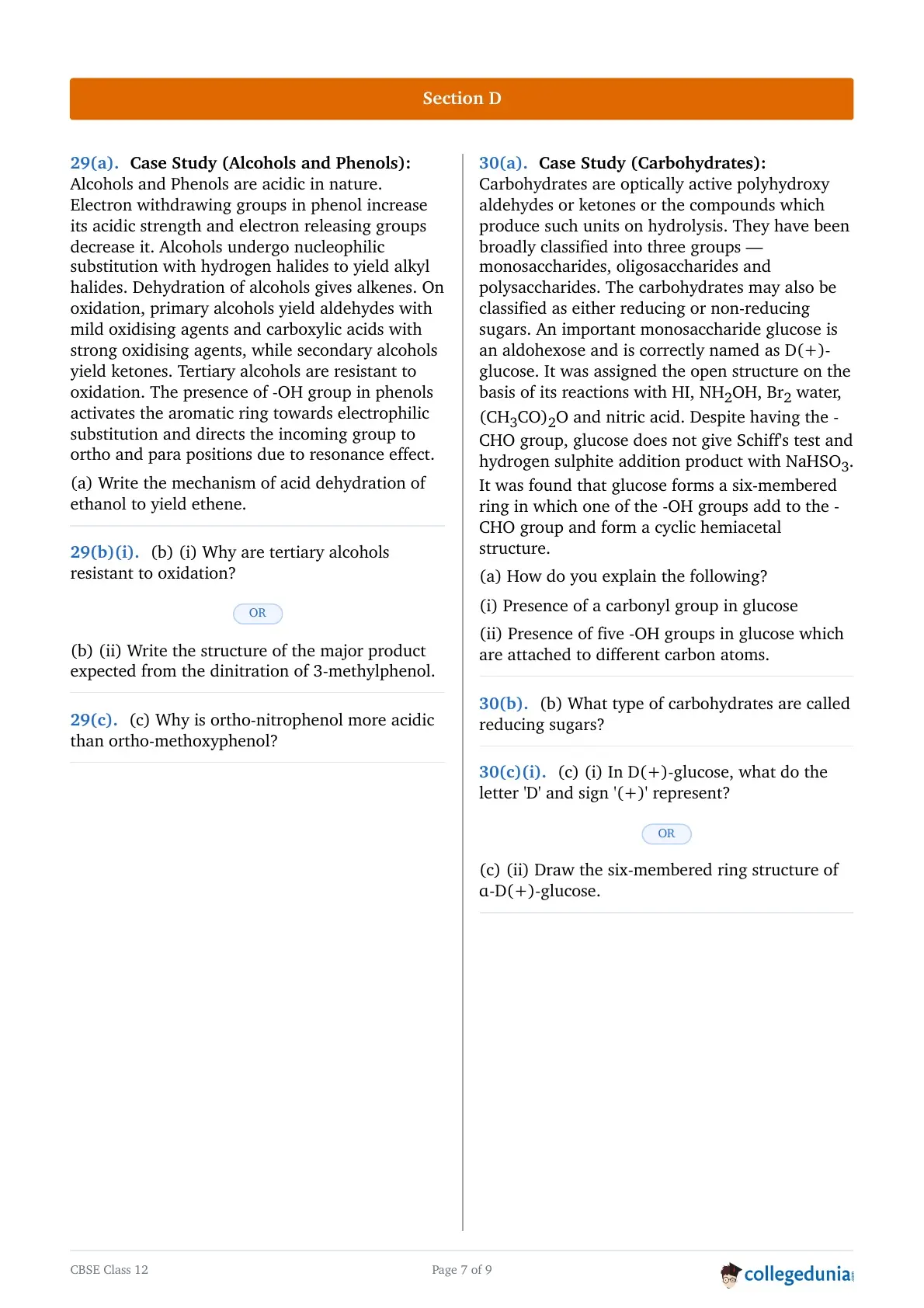
Alcohols and Phenols are acidic in nature. Electron withdrawing groups
in phenol increase its acidic strength and electron releasing groups
decrease it. Alcohols undergo nucleophilic substitution with hydrogen
halides to yield alkyl halides. Dehydration of alcohols gives alkenes. On
oxidation, primary alcohols yield aldehydes with mild oxidising agents
and carboxylic acids with strong oxidising agents, while secondary
alcohols yield ketones. Tertiary alcohols are resistant to oxidation. The
presence of – OH group in phenols activates the aromatic ring towards
electrophilic substitution and directs the incoming group to ortho and
para positions due to resonance effect.
Write the mechanism of acid dehydration of ethanol to yield ethene.
View Solution
Concept:
Dehydration of ethanol to ethene occurs in the presence of concentrated \( H_2SO_4 \) at \( 443 \, K \).
It is an elimination reaction proceeding through a carbocation intermediate (\( E1 \) mechanism).
Step 1: Protonation of alcohol
The ethanol molecule acts as a base and accepts a proton from the acid to form an oxonium ion. \[ CH_3CH_2OH + H^+ \rightleftharpoons CH_3CH_2OH_2^+ \]
Step 2: Formation of carbocation
This is the slowest step (RDS). The \( C-O \) bond breaks, and a water molecule is eliminated, leaving behind an ethyl carbocation. \[ CH_3CH_2OH_2^+ \xrightarrow{slow} CH_3CH_2^+ + H_2O \]
Step 3: Elimination of a proton
A proton is removed from the beta-carbon (the methyl group) by a base (like \( HSO_4^- \) or \( H_2O \)) to form the carbon-carbon double bond. \[ CH_3CH_2^+ \rightarrow CH_2=CH_2 + H^+ \]
The acid catalyst is regenerated.
The final answer is the three-step \( E1 \) mechanism. Quick Tip: At a lower temperature (\( 413 \, K \)), the same reaction yields ethoxyethane (ether) instead of ethene.
Why are tertiary alcohols resistant to oxidation?
View Solution
Concept:
Oxidation of alcohols involves the removal of a hydrogen atom from the hydroxyl group (\( -OH \)) and another hydrogen from the alpha-carbon (the carbon attached to the \( -OH \)).
This results in the formation of a \( C=O \) double bond.
Step 1: Examine the structure of tertiary alcohols
In a tertiary alcohol (\( R_3COH \)), the alpha-carbon is bonded to three other alkyl groups.
[0.2cm]
Critically, there are no hydrogen atoms attached to the alpha-carbon atom.
Step 2: Explain the chemical consequence
Since the alpha-hydrogen is missing, the usual mechanism for forming a carbonyl group cannot proceed without breaking strong carbon-carbon (\( C-C \)) bonds.
[0.2cm]
Under mild oxidation conditions, no reaction occurs. Under very drastic conditions (strong acid + heat), they undergo dehydration followed by cleavage of the double bond.
The final answer is due to the absence of alpha-hydrogen atoms. Quick Tip: Primary alcohols oxidize to aldehydes/acids; Secondary to ketones; Tertiary resist oxidation.
Write the structure of the major product expected from the dinitration of 3-methylphenol.
View Solution
Concept:
In a disubstituted benzene ring, the directing power of the substituents determines the position of the incoming group.
The phenolic \( -OH \) group is a much stronger activating group (\( +R \)) than the methyl \( -CH_3 \) group (\( +I \)).
Both groups are ortho/para directing.
Step 1: Locate activating positions
In 3-methylphenol (\( m \)-cresol), the \( -OH \) is at C1 and \( -CH_3 \) is at C3.
[0.2cm]
Positions activated by \( -OH \) (relative to C1): 2, 4, and 6.
[0.2cm]
Positions activated by \( -CH_3 \) (relative to C3): 2, 4, and 6 (which corresponds to C2, C4, and C6 of the original ring).
Step 2: Evaluate steric hindrance
Position 2 is between two substituents and is highly sterically hindered. Substitution is preferred at positions 4 and 6.
Step 3: Final Product
Dinitration will place nitro groups at the 4 and 6 positions.
[0.2cm]
Structure: 3-methyl-4,6-dinitrophenol.
The final answer is 3-methyl-4,6-dinitrophenol. Quick Tip: The stronger activating group (\( -OH \)) always wins the directing battle.
Why is ortho-nitrophenol more acidic than ortho-methoxyphenol?
View Solution
Concept:
Acidity depends on the stability of the phenoxide ion formed after losing a proton.
Electron-withdrawing groups (EWG) stabilize the negative charge and increase acidity.
Electron-donating groups (EDG) destabilize the negative charge and decrease acidity.
Step 1: Analyze the nitro group (\( -NO_2 \))
The nitro group is a strong EWG via both \( -I \) and \( -R \) effects. It pulls electron density away from the ring and the phenoxide oxygen, significantly stabilizing the anion.
Step 2: Analyze the methoxy group (\( -OCH_3 \))
The methoxy group is an EDG via the \( +R \) effect (resonance). It pushes electron density into the ring, increasing the negative charge density on the phenoxide oxygen and destabilizing the anion.
Step 3: Conclusion
Since nitrophenoxide is much more stable than methoxyphenoxide, ortho-nitrophenol releases its proton much more easily.
The final answer is due to the electron-withdrawing nature of the nitro group. Quick Tip: Acidity: \( Nitrophenol > Phenol > Methoxyphenol \).
Carbohydrates are optically active polyhydroxy aldehydes or ketones or
the compounds which produce such units on hydrolysis. They have been
broadly classified into three groups — monosaccharides, oligosaccharides
and polysaccharides. The carbohydrates may also be classified as either
reducing or non-reducing sugars. An important monosaccharide glucose
is an aldohexose and is correctly named as D(+)–glucose. It was assigned
the open structure on the basis of its reactions with HI, NH2OH, Br2
water, (CH3CO)2O and nitric acid.
Despite having the – CHO group, glucose does not give Schiff’s test and
hydrogen sulphite addition product with NaHSO3
. It was found that
glucose forms a six-membered ring in which one of the – OH groups add
to the – CHO group and form a cyclic hemiacetal structure.
How do you explain the presence of a carbonyl group in glucose?
View Solution
Concept:
Glucose is an aldohexose. In its open-chain structure, it contains an aldehyde (\(-CHO\)) functional group, which is a carbonyl group. The presence of this group can be confirmed by characteristic reactions of aldehydes.
Carbonyl compounds react with hydroxylamine to form oximes.
Aldehydes also react with hydrogen cyanide to form cyanohydrins.
These reactions confirm the presence of a carbonyl group.
Step 1: Reaction with hydroxylamine.
Glucose reacts with hydroxylamine (\(NH_{2}OH\)) to form glucose oxime.
\[ Glucose + NH_{2}OH \longrightarrow Glucose oxime + H_{2}O \]
Formation of an oxime is a characteristic reaction of aldehydes and ketones.
Step 2: Inference.
Since glucose forms an oxime, it must contain a carbonyl (\(C=O\)) group. In glucose, this carbonyl group is present as an aldehyde (\(-CHO\)) group in the open-chain form.
\[ \boxed{Hence, the presence of a carbonyl group in glucose is confirmed.} \] Quick Tip: Formation of oxime or cyanohydrin is a characteristic test for the presence of a carbonyl group in aldehydes and ketones.
How do you explain the presence of five \(-OH\) groups in glucose which are attached to different carbon atoms?
View Solution
Concept:
Glucose is a polyhydroxy aldehyde. The number of hydroxyl (\(-OH\)) groups present in glucose can be determined by studying its reaction with acetic anhydride.
Alcoholic hydroxyl groups react with acetic anhydride to form acetate esters.
The number of acetate groups formed indicates the number of hydroxyl groups present.
Step 1: Reaction of glucose with acetic anhydride.
When glucose is treated with excess acetic anhydride \((CH_{3}CO)_{2}O\), it forms glucose pentaacetate.
\[ Glucose \xrightarrow{(CH_{3}CO)_{2}O} Glucose pentaacetate \]
Step 2: Interpret the product formed.
Since one acetate group is formed from each hydroxyl group, the formation of glucose pentaacetate indicates that glucose contains five alcoholic hydroxyl (\(-OH\)) groups.
These hydroxyl groups are attached to five different carbon atoms.
\[ \boxed{Glucose contains five -OH groups attached to different carbon atoms.} \] Quick Tip: Remember: Formation of glucose pentaacetate is the experimental evidence for the presence of five alcoholic hydroxyl groups in glucose.
What type of carbohydrates are called reducing sugars?
View Solution
Concept:
Reducing sugars are carbohydrates that possess a free aldehyde group or a free ketonic group capable of converting into an aldehyde group in solution.
They act as reducing agents.
They reduce Tollens' reagent and Fehling's solution.
All monosaccharides and some disaccharides are reducing sugars.
Step 1: Define reducing sugars.
Reducing sugars are those carbohydrates which contain a free aldehyde (\(-CHO\)) group or a free ketonic group that can tautomerise to an aldehyde group under alkaline conditions.
Step 2: State their characteristic property.
These sugars reduce mild oxidising agents such as Tollens' reagent and Fehling's solution because of the presence of a free reducing group.
Examples include glucose, fructose, maltose and lactose.
\[ \boxed{Carbohydrates capable of reducing Tollens' and Fehling's reagents are called reducing sugars.} \] Quick Tip: All monosaccharides are reducing sugars, whereas sucrose is a non-reducing sugar because it has no free aldehyde or ketonic group.
In D(+)-glucose, what do the letter 'D' and sign '(+)' represent?
View Solution
Concept:
The notation D(+) in carbohydrates provides information about both the stereochemical configuration and the optical activity of the molecule.
The letter \(D\) denotes the relative configuration of glucose with respect to D-glyceraldehyde.
The sign \((+)\) indicates the direction in which the compound rotates plane-polarised light.
Step 1: Meaning of the letter \(D\).
The letter \(D\) indicates that the hydroxyl (\(-OH\)) group on the chiral carbon farthest from the aldehyde group is present on the right-hand side in the Fischer projection.
Thus, glucose has the same relative configuration as D-glyceraldehyde.
Step 2: Meaning of the sign \((+)\).
The symbol \((+)\) indicates that glucose rotates the plane of plane-polarised light towards the right (clockwise direction).
Therefore, glucose is dextrorotatory.
\[ \boxed{\begin{aligned} D &\rightarrow Relative configuration
(+) &\rightarrow Dextrorotation of plane-polarised light \end{aligned}} \] Quick Tip: Remember: The symbols \(D/L\) indicate configuration, whereas the symbols \((+)\) and \((-)\) indicate optical rotation. These two notations are independent of each other.
Draw the six-membered ring structure of \(\alpha\)--D(+)--glucose.
View Solution
Concept:
\(\alpha\)--D(+)-glucose exists predominantly in the cyclic pyranose (six-membered ring) form in aqueous solution.
The six-membered ring is formed by the reaction between the aldehyde group at C-1 and the hydroxyl group at C-5, forming a hemiacetal.
Step 1: Formation of the ring
The aldehyde group present at carbon-1 reacts with the hydroxyl group attached to carbon-5. This intramolecular reaction forms a six-membered cyclic hemiacetal known as the pyranose ring.
Step 2: Identify the \(\alpha\)-anomer
In \(\alpha\)--D(+)-glucose, the hydroxyl group attached to the anomeric carbon (C-1) lies below the plane of the ring, while the \(\mathrm{CH_2OH}\) group at C-5 lies above the plane of the ring.
Step 3: Draw the labelled structure

\(\alpha\)--D(+)-Glucose (Six-membered Pyranose Ring) Quick Tip: The six-membered ring of glucose is called the pyranose form. In \(\alpha\)--D(+)-glucose, the OH group at C-1 is directed downward. In \(\beta\)--D(+)-glucose, the OH group at C-1 is directed upward.
Account for the following: \( MnO \) is basic while \( Mn_{2}O_{7} \) is acidic.
View Solution
Concept:
The nature of an oxide of a transition metal depends significantly on the oxidation state of the metal.
As the oxidation state of the central metal increases, its electronegativity and polarizing power also increase.
High oxidation states lead to a greater covalent character in the metal-oxygen bond, making the oxide more acidic.
Conversely, low oxidation states favor ionic character, which results in basic behavior.
Step 1: Determine the oxidation states
In \( MnO \): Oxygen is \( -2 \), so Manganese (\( Mn \)) is in the \( +2 \) oxidation state.
[0.4cm]
In \( Mn_{2}O_{7} \): Oxygen is \( -2 \). For seven oxygens, the total negative charge is \( -14 \). Thus, two manganese atoms must have a total charge of \( +14 \), meaning each \( Mn \) is in the \( +7 \) oxidation state.
Step 2: Analyze the chemical nature based on oxidation states
In the lower oxidation state (\( +2 \)), the manganese-oxygen bond has a high degree of ionic character. In aqueous medium, it releases hydroxide ions or reacts as a base to neutralize acids.
[0.4cm]
In the highest oxidation state (\( +7 \)), the manganese ion has a very high charge density. It pulls the electron cloud of the oxygen atoms strongly, making the bond covalent. This high positive center attracts water or hydroxide ions to release protons (\( H^{+} \)), which is characteristic of an acid.
The final answer is that acidity increases with an increase in the oxidation state of the metal. Quick Tip: General Rule for Transition Metal Oxides:
Lower Oxidation State = Basic
Intermediate Oxidation State = Amphoteric
Higher Oxidation State = Acidic
Account for the following: Iron has higher enthalpy of atomization than that of copper.
View Solution
Concept:
Enthalpy of atomization (\( \Delta_{a}H \)) is the energy required to break the metallic lattice into individual atoms.
The magnitude of the enthalpy of atomization depends on the strength of the metallic bonds.
Metallic bond strength is directly proportional to the number of unpaired electrons in the (n-1)d and ns subshells that are available for metallic bonding.
Step 1: Compare electronic configurations
Iron (\( Fe \), \( Z=26 \)): \( [Ar] 3d^{6} 4s^{2} \). In the \( 3d \) subshell, there are four unpaired electrons.
[0.4cm]
Copper (\( Cu \), \( Z=29 \)): \( [Ar] 3d^{10} 4s^{1} \). In the \( 3d \) subshell, all electrons are paired (zero unpaired d-electrons).
Step 2: Relate configuration to bond strength
Iron has a significantly larger number of unpaired electrons (\( 4 \)) in its d-orbitals compared to Copper. These unpaired electrons participate more effectively in interatomic metallic bonding (covalent-like interactions within the lattice).
[0.4cm]
Stronger interatomic forces in Iron mean that much more energy is required to separate its atoms into the gaseous state compared to Copper.
The final answer is that Iron has more unpaired d-electrons leading to stronger metallic bonding. Quick Tip: The enthalpy of atomization usually peaks in the middle of a transition series where the number of unpaired electrons is maximum (e.g., V, Cr, Mo, W).
Account for the following: \( Mn^{3+} \) is a stronger oxidising agent than \( Cr^{3+} \).
View Solution
Concept:
An oxidizing agent is a species that tends to gain electrons and reduce its own oxidation state.
The relative strength of an oxidizing agent depends on the stability of the state it transforms into.
Transition metal ions are most stable with half-filled (\( d^{5} \)) or completely filled (\( d^{10} \)) subshells, or a half-filled \( t_{2g} \) set in octahedral fields.
Step 1: Analyze the stability of the products
When \( Mn^{3+} \) acts as an oxidizing agent, it gains one electron to become \( Mn^{2+} \). \[ Mn^{3+} (d^{4}) + e^{-} \rightarrow Mn^{2+} (d^{5}) \]
The \( d^{5} \) configuration is exceptionally stable because it is a exactly half-filled d-subshell. This high stability provides a strong driving force for \( Mn^{3+} \) to gain an electron.
Step 2: Compare with Chromium
In the case of \( Cr^{3+} \), the configuration is \( 3d^{3} \). In an aqueous (octahedral) environment, this corresponds to a half-filled \( t_{2g} \) level (\( t_{2g}^{3} \)), which is very stable. \[ Cr^{3+} (d^{3}) + e^{-} \rightarrow Cr^{2+} (d^{4}) \]
Transitioning from a stable \( d^{3} \) state to a less stable \( d^{4} \) state is energetically unfavorable.
Step 3: Conclusion
Thus, \( Mn^{3+} \) is very eager to gain an electron to reach stability, while \( Cr^{3+} \) is already in a stable state. This makes \( Mn^{3+} \) a much stronger oxidizing agent.
The final answer is because the reduction of \( Mn^{3+} \) leads to the very stable \( d^{5} \) configuration. Quick Tip: Stability follows: \( d^{10} > d^{5} > t_{2g}^{3} > others \).
Always look at the product's electronic configuration to determine redox strength.
How do you prepare potassium dichromate from sodium chromate ? Write balanced chemical equation for each step.
View Solution
Concept:
Potassium dichromate is produced from chromite ore in multiple steps.
The conversion from sodium chromate to potassium dichromate involves acidification followed by a metathesis (exchange) reaction.
Step 1: Conversion of Chromate to Dichromate
Yellow sodium chromate is converted into orange sodium dichromate by reacting it with concentrated sulfuric acid. \[ 2Na_{2}CrO_{4} + H_{2}SO_{4} \rightarrow Na_{2}Cr_{2}O_{7} + Na_{2}SO_{4} + H_{2}O \]
Step 2: Metathesis reaction with Potassium Chloride
Sodium dichromate is more soluble than potassium dichromate. When potassium chloride (\( KCl \)) is added to a hot concentrated solution of sodium dichromate, potassium dichromate precipitates out as orange crystals upon cooling. \[ Na_{2}Cr_{2}O_{7} + 2KCl \rightarrow K_{2}Cr_{2}O_{7} + 2NaCl \]
The final answer is provided by the two-step chemical process shown above. Quick Tip: Remember: Chromate (\( CrO_{4}^{2-} \), yellow) exists in alkaline medium, and Dichromate (\( Cr_{2}O_{7}^{2-} \), orange) exists in acidic medium. They are interconvertible based on pH.
Why is chemistry of actinoids more complicated as compared to lanthanoids?
View Solution
Concept:
Both lanthanoids and actinoids are f-block elements, but the spatial distribution and energy of their f-orbitals vary significantly.
Lanthanoids involve the filling of \( 4f \) orbitals, while actinoids involve the filling of \( 5f \) orbitals.
The complexity of actinoid chemistry arises from the close energy levels of their outermost shells and their radioactive nature.
Step 1: Analyze orbital energy levels
In actinoids, the energy levels of the \( 5f \), \( 6d \), and \( 7s \) subshells are very close to one another.
[0.3cm]
This is quite different from lanthanoids, where there is a substantial energy gap between the \( 4f \) and \( 5d \) orbitals. Because the energies are so close in actinoids, electrons from all three subshells can participate in chemical bonding.
Step 2: Evaluate oxidation states
Due to the participation of multiple subshells, actinoids exhibit a much wider range of oxidation states (varying from \( +3 \) up to \( +7 \), especially in elements like Neptunium and Plutonium).
[0.3cm]
Lanthanoids, by contrast, are dominated by the very stable \( +3 \) oxidation state, with only a few elements showing \( +2 \) or \( +4 \). This variability in actinoids makes their reaction patterns much harder to predict.
Step 3: Consider shielding and radioactivity
The \( 5f \) electrons of actinoids provide poorer shielding for the nuclear charge compared to the \( 4f \) electrons of lanthanoids. This leads to stronger complex-forming tendencies.
[0.3cm]
Furthermore, most actinoids are radioactive and have short half-lives, which makes experimental handling and characterization extremely difficult compared to the stable lanthanoids.
The final answer is due to the close energy levels of the \( 5f, 6d, \) and \( 7s \) orbitals and the resulting wide range of oxidation states. Quick Tip: Lanthanoid chemistry is largely about the \( +3 \) state and ionic size.
Actinoid chemistry is complicated by multiple oxidation states and radioactive decay.
\( E^{\circ}_{M^{2+}/M} \) values are not regular for first row transition elements (3d series). Why?
View Solution
Concept:
The standard electrode potential (\( E^{\circ} \)) of a metal describes the total energy change involved in converting a solid metal atom into a hydrated ion in an aqueous solution.
This total energy is the net result of three distinct processes: Sublimation, Ionization, and Hydration.
Step 1: Deconstruct the energy components
The transformation \( M(s) \rightarrow M^{2+}(aq) + 2e^{-} \) consists of the following thermodynamic steps:
Enthalpy of Sublimation (\( \Delta_{sub}H \)): Converting the solid metal into gaseous atoms.
Ionization Enthalpy (\( \Delta_{i}H \)): The sum of the first and second ionization energies to remove two electrons.
Enthalpy of Hydration (\( \Delta_{hyd}H \)): The energy released when the gaseous ion is surrounded by water molecules.
Step 2: Explain the irregularity of these terms
In the 3d transition series, none of these three values vary smoothly from Scandium to Zinc.
[0.3cm]
For instance, the ionization enthalpy shows a sudden drop for Manganese due to its stable half-filled \( d^{5} \) configuration. Sublimation enthalpies vary based on the number of unpaired electrons participating in metallic bonding. Hydration energies vary with ionic radius.
Step 3: Conclusion
Since the standard electrode potential is the sum of these three non-regularly changing energy terms, the resulting \( E^{\circ} \) values do not follow a predictable or regular trend across the series.
The final answer is because of the irregular variation in sublimation enthalpies, ionization enthalpies, and hydration enthalpies across the series. Quick Tip: Remember that Mn and Zn have more negative \( E^{\circ} \) values than expected due to the extra stability of \( d^{5} \) and \( d^{10} \) shells respectively.
Identify the oxoanion of chromium which is stable in acidic medium.
View Solution
Concept:
Chromium in the \( +6 \) oxidation state forms two related oxoanions: Chromate (\( CrO_{4}^{2-} \)) and Dichromate (\( Cr_{2}O_{7}^{2-} \)).
These two species exist in a dynamic equilibrium that is highly sensitive to the pH of the solution.
Step 1: Understand the pH equilibrium
The chemical equilibrium between these two ions can be represented as: \[ 2CrO_{4}^{2-} + 2H^{+} \rightleftharpoons Cr_{2}O_{7}^{2-} + H_{2}O \]
Step 2: Predict the shift in acidic medium
In an acidic medium, the concentration of \( H^{+} \) ions is high. According to Le Chatelier’s Principle, adding \( H^{+} \) shifts the equilibrium to the right (the product side).
[0.3cm]
This results in the conversion of the yellow chromate ion into the orange dichromate ion (\( Cr_{2}O_{7}^{2-} \)). Therefore, the dichromate ion is the form that is stable under acidic conditions.
The final answer is Dichromate ion (\( Cr_{2}O_{7}^{2-} \)). Quick Tip: Easy way to remember: Orange (Dichromate) is for Acid (like citric acid in oranges). Yellow (Chromate) is for Base.
Identify the lanthanoid element that exhibits +4 oxidation state.
View Solution
Concept:
The most common and stable oxidation state for all lanthanoids is \( +3 \).
Some elements can exhibit other oxidation states if it allows them to reach a stable electronic configuration, such as a noble gas configuration (\( f^{0} \)), a half-filled (\( f^{7} \)), or a fully filled (\( f^{14} \)) subshell.
Step 1: Examine the configuration of Cerium
Cerium (\( Ce \)) has the atomic number 58. Its ground state electronic configuration is \( [Xe] 4f^{1} 5d^{1} 6s^{2} \).
[0.3cm]
When Cerium loses four electrons to reach the \( +4 \) oxidation state (\( Ce^{4+} \)), it attains the configuration of the noble gas Xenon (\( [Xe] 4f^{0} \)).
Step 2: Identify the element
Because the \( 4f^{0} \) state (empty f-orbital) provides significant extra stability, Cerium is well-known for exhibiting a stable \( +4 \) oxidation state in its compounds (like \( CeO_{2} \)).
The final answer is Cerium (\( Ce \)). Quick Tip: Cerium(IV) is widely used in analytical chemistry as an oxidizing agent because it eventually wants to return to the most stable \( +3 \) state.
Write the products obtained on heating \( KMnO_{4} \).
View Solution
Concept:
Potassium permanganate (\( KMnO_{4} \)) is a dark purple crystalline solid.
It is thermally unstable and decomposes when heated above \( 240^{\circ}C \) (\( 513 \, K \)).
The decomposition involves a reduction of Manganese from the \( +7 \) state to lower oxidation states.
Step 1: Write the balanced chemical equation
When solid \( KMnO_{4} \) is heated, it undergoes the following decomposition reaction: \[ 2KMnO_{4} (s) \xrightarrow{\Delta} K_{2}MnO_{4} (s) + MnO_{2} (s) + O_{2} (g) \]
Step 2: Identify and name the products
The chemical products formed are:
Potassium manganate (\( K_{2}MnO_{4} \)): A green-colored solid where \( Mn \) is in the \( +6 \) state.
Manganese dioxide (\( MnO_{2} \)): A black/brown solid where \( Mn \) is in the \( +4 \) state.
Oxygen gas (\( O_{2} \)): A colorless, odorless gas.
The final answer is Potassium manganate (\( K_{2}MnO_{4} \)), Manganese dioxide (\( MnO_{2} \)), and Oxygen (\( O_{2} \)). Quick Tip: This reaction is a standard laboratory preparation for oxygen gas. Notice the color change from purple to green and black.
Predict which of the following ions will be coloured in aqueous solution: \( Cu^{+} \), \( Sc^{3+} \), \( Fe^{2+} \), \( Ti^{3+} \), \( Zn^{2+} \).
View Solution
Concept:
The color of transition metal ions is primarily due to d-d transitions.
For such a transition to occur, there must be at least one unpaired electron in the d-orbitals (\( d^{1} \) to \( d^{9} \) configurations).
Ions with completely empty (\( d^{0} \)) or completely filled (\( d^{10} \)) d-subshells cannot undergo these transitions and are thus colorless.
Step 1: Determine electronic configurations
\( Cu^{+} \): \( [Ar] 3d^{10} \) (Full d-subshell, no unpaired electrons) \( \rightarrow \) Colorless
\( Sc^{3+} \): \( [Ar] 3d^{0} \) (Empty d-subshell, no d-electrons) \( \rightarrow \) Colorless
\( Fe^{2+} \): \( [Ar] 3d^{6} \) (Incomplete d-subshell, contains unpaired electrons) \( \rightarrow \) Coloured
\( Ti^{3+} \): \( [Ar] 3d^{1} \) (Incomplete d-subshell, contains one unpaired electron) \( \rightarrow \) Coloured
\( Zn^{2+} \): \( [Ar] 3d^{10} \) (Full d-subshell, no unpaired electrons) \( \rightarrow \) Colorless
Step 2: Identify the coloured ions
Based on the configurations above, only \( Fe^{2+} \) and \( Ti^{3+} \) have electrons in the d-orbitals that can jump between split d-energy levels by absorbing visible light.
The final answer is \( Fe^{2+} \) and \( Ti^{3+} \). Quick Tip: \( Fe^{2+} \) ions usually appear pale green in water, while \( Ti^{3+} \) ions are famous for their characteristic purple/violet color.
How will you bring about the following conversion: Bromobenzene to 1-phenylethanol
View Solution
Concept:
Grignard reagents (\( RMgX \)) are versatile organometallic compounds used to synthesize various classes of alcohols.
Phenyl halides can be converted into Grignard reagents by reacting with Magnesium in dry ether.
Reaction of a Grignard reagent with an aldehyde (other than formaldehyde) followed by hydrolysis yields a secondary alcohol.
Step 1: Formation of the Grignard reagent
Bromobenzene is reacted with magnesium metal turnings in the presence of anhydrous (dry) ether.
[0.3cm]
This results in the formation of phenylmagnesium bromide: \[ C_{6}H_{5}Br + Mg \xrightarrow{dry ether} C_{6}H_{5}MgBr \]
Step 2: Nucleophilic addition to acetaldehyde
Phenylmagnesium bromide acts as a nucleophile. The phenyl group (\( C_{6}H_{5}^{-} \)) attacks the electrophilic carbonyl carbon of acetaldehyde (\( CH_{3}CHO \)).
[0.3cm]
This forms an intermediate magnesium alkoxide complex. \[ C_{6}H_{5}MgBr + CH_{3}CHO \rightarrow CH_{3}CH(OMgBr)C_{6}H_{5} \]
Step 3: Acidic hydrolysis
The addition of dilute acid or water breaks the magnesium-oxygen bond to yield the secondary alcohol, 1-phenylethanol. \[ CH_{3}CH(OMgBr)C_{6}H_{5} + H_{2}O/H^{+} \rightarrow C_{6}H_{5}CH(OH)CH_{3} + Mg(OH)Br \]
The final answer is 1-phenylethanol. Quick Tip: Grignard reactions must be carried out in strictly anhydrous conditions because the reagent reacts instantly with even traces of moisture to form benzene.
How will you bring about the following conversion: Benzene to m-nitroacetophenone
View Solution
Concept:
Acetylation of benzene is an electrophilic aromatic substitution (Friedel-Crafts Acylation).
The acetyl group (\( -COCH_{3} \)) is a deactivating group and is meta-directing for further substitutions.
Nitration of acetophenone will place the nitro group at the meta position due to the electron-withdrawing nature of the carbonyl group.
Step 1: Friedel-Crafts Acylation of benzene
Benzene is reacted with acetyl chloride (\( CH_{3}COCl \)) in the presence of anhydrous aluminium chloride (\( AlCl_{3} \)) which acts as a Lewis acid catalyst.
[0.3cm]
This produces acetophenone. \[ C_{6}H_{6} + CH_{3}COCl \xrightarrow{anh. AlCl_{3}} C_{6}H_{5}COCH_{3} + HCl \]
Step 2: Nitration of acetophenone
Acetophenone is treated with a nitrating mixture (concentrated \( HNO_{3} \) and concentrated \( H_{2}SO_{4} \)).
[0.3cm]
Because the \( -COCH_{3} \) group withdraws electron density from the ortho and para positions via resonance, the electrophile (\( NO_{2}^{+} \)) attacks the meta position. \[ C_{6}H_{5}COCH_{3} \xrightarrow{conc. HNO_{3} / conc. H_{2}SO_{4}} m-NO_{2}-C_{6}H_{4}COCH_{3} \]
The final answer is m-nitroacetophenone. Quick Tip: Always perform the meta-directing substitution first if you need a meta-disubstituted product. If you nitrate benzene first, you cannot perform Friedel-Crafts acylation because the nitro group is too strongly deactivating.
An organic compound with the molecular formula \( C_{8}H_{8}O \) forms 2,4-DNP derivative, reduces Tollens’ reagent and undergoes Cannizzaro reaction. On vigorous oxidation with acidic or alkaline \( KMnO_{4} \), it gives Benzene-1,2-dicarboxylic acid. Identify the compound and write the products when it undergoes Cannizzaro reaction.
View Solution
Concept:
2,4-DNP test is positive for aldehydes and ketones.
Tollens' reagent reduction is specific for aldehydes.
Cannizzaro reaction is given by aldehydes that lack an alpha-hydrogen atom.
Oxidation of alkyl-substituted benzenes with \( KMnO_{4} \) yields benzoic acid derivatives regardless of chain length.
Step 1: Functional group identification
1. \( C_{8}H_{8}O \) forms 2,4-DNP derivative \( \rightarrow \) contains a carbonyl group (\( C=O \)).
[0.2cm]
2. Reduces Tollens' reagent \( \rightarrow \) it is an aldehyde (\( -CHO \)).
[0.2cm]
3. Undergoes Cannizzaro reaction \( \rightarrow \) the aldehyde group is directly attached to the benzene ring and has no alpha-hydrogens.
Step 2: Structure determination from oxidation
Vigorous oxidation with \( KMnO_{4} \) yields Benzene-1,2-dicarboxylic acid (Phthalic acid). This confirms that there are two substituents on the benzene ring located at the ortho (1,2) positions.
[0.3cm]
Since one substituent is the aldehyde group (\( -CHO \), 1 carbon) and the total carbons are 8 (6 in ring + 1 in aldehyde + 1 extra), the other substituent must be a methyl group (\( -CH_{3} \)).
[0.3cm]
Compound: 2-methylbenzaldehyde (also called o-tolualdehyde).
Step 3: Write the Cannizzaro reaction
When 2-methylbenzaldehyde reacts with concentrated \( KOH \), it undergoes disproportionation (one molecule reduces, another oxidizes).
[0.3cm] \[ 2(o-CH_{3}C_{6}H_{4}CHO) \xrightarrow{conc. KOH} o-CH_{3}C_{6}H_{4}CH_{2}OH + o-CH_{3}C_{6}H_{4}COOK \]
[0.3cm]
Products: 2-methylbenzyl alcohol and Potassium 2-methylbenzoate.
The final answer is 2-methylbenzaldehyde; products are 2-methylbenzyl alcohol and potassium 2-methylbenzoate. Quick Tip: Formation of Phthalic acid on oxidation is the biggest hint for an ortho-disubstituted benzene ring.
Arrange the following compounds in increasing order of their acid strength: \( C_{6}H_{5}COOH \), \( O_{2}N - CH_{2} - COOH \), \( CF_{3} - COOH \), \( HCOOH \)
View Solution
Concept:
Acidity of carboxylic acids is enhanced by electron-withdrawing groups (EWG) through the \( -I \) (inductive) and \( -R \) (resonance) effects.
EWGs stabilize the carboxylate anion by dispersing the negative charge.
Electron-donating groups (EDG) destabilize the anion and decrease acidity.
Step 1: Analyze individual substituents
1. \( CF_{3} \): Contains three highly electronegative fluorine atoms. It exerts a very strong \( -I \) effect.
[0.2cm]
2. \( NO_{2} \): A very strong electron-withdrawing group (\( -I \) effect).
[0.2cm]
3. \( H \): Reference atom with no significant inductive effect.
[0.2cm]
4. \( C_{6}H_{5} \): The phenyl group has a complex effect, but generally, benzoic acid is a weaker acid than formic acid because of the resonance stabilization of the ring which can slightly push electrons toward the carboxyl group.
Step 2: Compare Inductive strengths
The \( -I \) effect strength follows: \( -CF_{3} > -NO_{2} \).
[0.3cm]
Therefore, \( CF_{3}COOH \) is the strongest acid, followed by \( O_{2}NCH_{2}COOH \).
Step 3: Compare Formic and Benzoic acids
Formic acid (\( HCOOH \)) is more acidic than Benzoic acid (\( C_{6}H_{5}COOH \)) due to the electronic effects of the bulky phenyl ring.
[0.3cm]
Order: \( C_{6}H_{5}COOH < HCOOH < O_{2}NCH_{2}COOH < CF_{3}COOH \).
The final answer is \( C_{6}H_{5}COOH < HCOOH < O_{2}NCH_{2}COOH < CF_{3}COOH \). Quick Tip: Remember: \( -I \) effect order is \( F > Cl > Br > I \). For multiple atoms, \( -CF_{3} \) is significantly more powerful than even \( -NO_{2} \) in terms of inductive pull.
Write the product formed when benzaldehyde reacts with 2,4-Dinitrophenylhydrazine.
View Solution
Concept:
Aldehydes react with ammonia derivatives (like 2,4-DNP) through a nucleophilic addition followed by the elimination of a water molecule.
This reaction is catalyzed by a small amount of acid.
The product is generally a crystalline solid with a characteristic color (yellow, orange, or red).
Step 1: Write the chemical reaction
Benzaldehyde (\( C_{6}H_{5}CHO \)) reacts with 2,4-dinitrophenylhydrazine in an acidic medium.
[0.3cm]
The oxygen from the aldehyde and the two hydrogens from the \( -NH_{2} \) group of the reagent combine to form water. \[ C_{6}H_{5}CHO + H_{2}NNHC_{6}H_{3}(NO_{2})_{2} \xrightarrow{H^{+}} C_{6}H_{5}CH=NNHC_{6}H_{3}(NO_{2})_{2} + H_{2}O \]
Step 2: Identify the product
The product is Benzaldehyde 2,4-dinitrophenylhydrazone.
[0.3cm]
This compound is an orange-red crystalline solid, often used to characterize the presence of the benzaldehyde group in organic analysis.
The final answer is Benzaldehyde 2,4-dinitrophenylhydrazone. Quick Tip: This is a standard "condensation" reaction. The formation of a double bond between Carbon and Nitrogen (\( C=N \)) is the key feature.
Write the product formed when benzaldehyde reacts with acetophenone in the presence of dilute \( NaOH \) followed by heating.
View Solution
Concept:
This is a Cross-Aldol Condensation, specifically known as the Claisen-Schmidt reaction.
Benzaldehyde has no alpha-hydrogens, while acetophenone has three alpha-hydrogens on the methyl group.
Acetophenone forms an enolate ion which attacks the carbonyl carbon of benzaldehyde.
Step 1: Enolate formation and addition
The base (\( OH^{-} \)) removes a proton from the methyl group of acetophenone (\( C_{6}H_{5}COCH_{3} \)) to form an enolate ion.
[0.3cm]
This enolate ion attacks the carbonyl carbon of benzaldehyde (\( C_{6}H_{5}CHO \)) to form a \( \beta \)-hydroxyketone intermediate (ketol).
Step 2: Dehydration on heating
Upon heating, the intermediate undergoes dehydration (loss of water) to form an \( \alpha,\beta \)-unsaturated ketone. \[ C_{6}H_{5}CHO + CH_{3}COC_{6}H_{5} \xrightarrow{dil. NaOH, \Delta} C_{6}H_{5}CH=CHCOC_{6}H_{5} + H_{2}O \]
Step 3: Identify the product
The final product is 1,3-diphenylprop-2-en-1-one, commonly known as benzalacetophenone or chalcone.
The final answer is 1,3-diphenylprop-2-en-1-one. Quick Tip: In cross-aldol between an aldehyde without alpha-H and a ketone with alpha-H, the ketone always provides the alpha-carbon for the new bond.
Give reasons for the following: Benzoic acid does not undergo Friedel-Crafts reaction.
View Solution
Concept:
Friedel-Crafts reactions require an active or moderately deactivated benzene ring.
The reaction involves a carbocation electrophile generated by a Lewis acid catalyst like \( AlCl_{3} \).
Step 1: Deactivation of the ring
The carboxyl group (\( -COOH \)) is a strongly deactivating group. It withdraws electron density from the benzene ring through both inductive (\( -I \)) and resonance (\( -R \)) effects.
[0.3cm]
This makes the ring so electron-deficient that it cannot attack the electrophile generated during the Friedel-Crafts reaction.
Step 2: Catalyst poisoning
The carboxyl group contains lone pairs of electrons on the oxygen atoms. These act as a Lewis base and react with the Lewis acid catalyst (\( AlCl_{3} \)).
[0.3cm]
This formation of a complex further deactivates the ring and "poisons" the catalyst, making it unavailable to generate the required electrophile from the alkyl or acyl halide.
The final answer is because the \( -COOH \) group is strongly deactivating and also complexes with the \( AlCl_{3} \) catalyst. Quick Tip: Similar to benzoic acid, nitrobenzene and aniline also do not undergo Friedel-Crafts reactions for similar reasons (deactivation or complexation).
Give reasons for the following: Carboxylic acids have higher boiling point than alcohols of comparable molecular mass.
View Solution
Concept:
Boiling point depends on the strength of intermolecular forces.
Both alcohols and carboxylic acids exhibit intermolecular hydrogen bonding.
Step 1: Nature of Hydrogen bonding
In alcohols, each molecule forms hydrogen bonds with other molecules, but these bonds are generally linear.
[0.3cm]
In carboxylic acids, the presence of both a carbonyl group (\( C=O \)) and a hydroxyl group (\( -OH \)) allows for the formation of cyclic dimers through two hydrogen bonds between a pair of molecules.
Step 2: Effect of dimerization
These cyclic dimers are so stable that they often persist even in the vapor phase.
[0.3cm]
Because carboxylic acids exist as these associated dimers, the effective molecular mass is doubled, and much more energy is required to break these extensive and strong hydrogen bonds compared to the simpler hydrogen bonding in alcohols.
The final answer is due to the formation of more extensive intermolecular hydrogen bonding resulting in cyclic dimers. Quick Tip: Carboxylic acids are the most highly associated simple organic molecules. Their boiling points are even higher than those of corresponding aldehydes, ketones, and alcohols.
Write simple chemical test to distinguish between propanal and propanone.
View Solution
Concept:
Propanal is an aldehyde (\( CH_{3}CH_{2}CHO \)).
Propanone is a ketone (\( CH_{3}COCH_{3} \)).
Aldehydes are easily oxidized, while ketones are not, which allows for several distinguishing chemical tests.
Step 1: Tollens' Test (Silver Mirror Test)
Add Tollens' reagent (ammoniacal silver nitrate) to both samples and warm gently.
[0.3cm]
Propanal: Reduces Tollens' reagent to metallic silver, forming a bright silver mirror on the inner walls of the test tube. \[ CH_{3}CH_{2}CHO + 2[Ag(NH_{3})_{2}]^{+} + 3OH^{-} \rightarrow CH_{3}CH_{2}COO^{-} + 2Ag \downarrow + 4NH_{3} + 2H_{2}O \]
Propanone: Does not react with Tollens' reagent.
Step 2: Fehling's Test
Add Fehling's solution (mixture of Fehling A and B) to both and heat.
[0.3cm]
Propanal: Reduces the deep blue copper(II) ions to a red precipitate of copper(I) oxide (\( Cu_{2}O \)). \[ CH_{3}CH_{2}CHO + 2Cu^{2+} + 5OH^{-} \rightarrow CH_{3}CH_{2}COO^{-} + Cu_{2}O \downarrow + 3H_{2}O \]
Propanone: Does not react with Fehling's solution.
The final answer is Tollens' test or Fehling's test. Quick Tip: Note that the Iodoform test cannot distinguish them because both Propanone (a methyl ketone) and Propanal (which has a \( CH_{3}CH_{2}- \) group but not a methyl ketone group) behave differently. Actually, propanal does not give the iodoform test, but propanone does. So, Iodoform test is also valid!
Calculate \( E^{\circ}_{cell} \) for the following reaction which is at equilibrium: \( Cu (s) + 2Ag^{+} (aq) \rightleftharpoons Cu^{2+} (aq) + 2Ag (s) \). Equilibrium constant (\( K_{c} \)) for the cell is \( 10^{15} \). [Given : \( \log 10 = 1 \)]
View Solution
Concept:
The relationship between the standard cell potential (\( E^{\circ}_{cell} \)) and the equilibrium constant (\( K_{c} \)) is derived from the Nernst Equation.
At equilibrium, the cell potential (\( E_{cell} \)) is zero because the reaction has no further net tendency to proceed in either direction.
The equation used is:
\[ E^{\circ}_{cell} = \frac{0.0591}{n} \log K_{c} (at 298 K) \]
where \( n \) represents the number of moles of electrons transferred in the balanced redox equation.
Step 1: Identify the number of electrons (\( n \)) transferred
To find \( n \), we look at the half-reactions:
[0.3cm]
Oxidation: \( Cu(s) \rightarrow Cu^{2+}(aq) + 2e^{-} \)
[0.2cm]
Reduction: \( 2Ag^{+}(aq) + 2e^{-} \rightarrow 2Ag(s) \)
[0.3cm]
The total number of electrons exchanged in the balanced overall reaction is \( n = 2 \).
Step 2: Set up the logarithmic calculation
The given equilibrium constant is \( K_{c} = 10^{15} \).
[0.3cm]
We need to find \( \log K_{c} \): \[ \log K_{c} = \log(10^{15}) = 15 \log(10) \]
Since \( \log 10 = 1 \): \[ \log K_{c} = 15 \times 1 = 15 \]
Step 3: Perform the final calculation for \( E^{\circ}_{cell} \)
Substitute the values into the formula: \[ E^{\circ}_{cell} = \frac{0.0591}{2} \times 15 \]
[0.3cm] \[ E^{\circ}_{cell} = 0.02955 \times 15 \]
[0.3cm] \[ E^{\circ}_{cell} = 0.44325 \, V \]
The final answer is \( 0.443 \, V \). Quick Tip: At equilibrium, \( \Delta G = 0 \) and \( E_{cell} = 0 \).
Always remember that \( E^{\circ}_{cell} \) remains a positive value for a spontaneous reaction, even if the system has reached equilibrium.
Write anode, cathode and overall reaction of lead storage battery when it is in use.
View Solution
Concept:
A lead storage battery is a secondary cell, meaning it can be recharged.
When "in use" (discharging), it acts as a galvanic cell, converting chemical energy into electrical energy.
It consists of a lead anode and a grid of lead packed with lead dioxide (\( PbO_{2} \)) as the cathode.
The electrolyte is an aqueous solution of sulfuric acid (\( 38% \, H_{2}SO_{4} \)).
Step 1: Write the reaction at the Anode (Oxidation)
At the anode, lead metal is oxidized to lead(II) ions, which immediately react with sulfate ions from the electrolyte to form insoluble lead sulfate. \[ Pb(s) + SO_{4}^{2-}(aq) \rightarrow PbSO_{4}(s) + 2e^{-} \]
Step 2: Write the reaction at the Cathode (Reduction)
At the cathode, lead dioxide is reduced to lead(II) ions in the presence of acid, which also results in the formation of lead sulfate and water. \[ PbO_{2}(s) + SO_{4}^{2-}(aq) + 4H^{+}(aq) + 2e^{-} \rightarrow PbSO_{4}(s) + 2H_{2}O(l) \]
Step 3: Combine to find the Overall Cell Reaction
Summing the anode and cathode reactions: \[ Pb(s) + PbO_{2}(s) + 2SO_{4}^{2-}(aq) + 4H^{+}(aq) \rightarrow 2PbSO_{4}(s) + 2H_{2}O(l) \]
[0.3cm]
This can be more simply written using the sulfuric acid formula: \[ Pb(s) + PbO_{2}(s) + 2H_{2}SO_{4}(aq) \rightarrow 2PbSO_{4}(s) + 2H_{2}O(l) \]
The final answer consists of the Anode, Cathode, and Overall reactions provided above. Quick Tip: During discharge, sulfuric acid is consumed and water is produced, which decreases the density of the electrolyte.
Monitoring the density of \( H_{2}SO_{4} \) is a common way to check the battery's charge level.
How much electricity is required in coulombs for the oxidation of 1 mol of \( FeO \) to \( Fe_{2}O_{3} \)?
View Solution
Concept:
According to Faraday's First Law of Electrolysis, the amount of electricity (\( Q \)) required for a redox process is related to the moles of electrons transferred.
\( Q = n \times F \), where \( n \) is the number of moles of electrons and \( F \) is Faraday's constant (\( \approx 96487 \, C/mol \)).
Step 1: Determine the change in oxidation state
In \( FeO \), the oxidation state of Iron (\( Fe \)) is \( +2 \).
[0.2cm]
In \( Fe_{2}O_{3} \), the oxidation state of Iron (\( Fe \)) is \( +3 \).
[0.2cm]
The oxidation reaction for 1 mole of iron atoms is: \[ Fe^{2+} \rightarrow Fe^{3+} + 1e^{-} \]
Step 2: Identify the moles of electrons
For the oxidation of 1 mole of \( FeO \), exactly 1 mole of electrons is lost. \[ n = 1 \]
Step 3: Calculate the charge in Coulombs
Using Faraday's constant: \[ Q = 1 \times 96487 \, C \] \[ Q = 96487 \, C \]
[0.2cm]
(Using the approximate value \( 96500 \, C \) is also standard for most calculations).
The final answer is \( 96487 \, C \). Quick Tip: Always identify the change in oxidation state per mole of the substance to find the value of \( n \).
1 Faraday (96500 C) is the charge carried by one mole of electrons.
Conductivity of \( 0.0024 \, M \) acetic acid is \( 7.2 \times 10^{-5} \, S \, cm^{-1} \). If \( \Lambda_{m}^{\circ} \) for acetic acid is \( 390.5 \, S \, cm^{2} \, mol^{-1} \), then calculate the degree of dissociation (\( \alpha \)) of acetic acid.
View Solution
Concept:
The degree of dissociation (\( \alpha \)) of a weak electrolyte is the ratio of its molar conductivity at a given concentration (\( \Lambda_{m} \)) to its molar conductivity at infinite dilution (\( \Lambda_{m}^{\circ} \)).
Formula: \( \alpha = \frac{\Lambda_{m}}{\Lambda_{m}^{\circ}} \)
Molar conductivity is calculated using the formula: \( \Lambda_{m} = \frac{\kappa \times 1000}{C} \)
Step 1: Calculate the Molar Conductivity (\( \Lambda_{m} \))
Given:
Conductivity (\( \kappa \)) = \( 7.2 \times 10^{-5} \, S \, cm^{-1} \)
Concentration (\( C \)) = \( 0.0024 \, M \)
[0.3cm] \[ \Lambda_{m} = \frac{7.2 \times 10^{-5} \times 1000}{0.0024} \]
[0.2cm] \[ \Lambda_{m} = \frac{0.072}{0.0024} \]
[0.2cm] \[ \Lambda_{m} = 30 \, S \, cm^{2} \, mol^{-1} \]
Step 2: Calculate the degree of dissociation (\( \alpha \))
Given: \( \Lambda_{m}^{\circ} = 390.5 \, S \, cm^{2} \, mol^{-1} \)
[0.3cm] \[ \alpha = \frac{30}{390.5} \]
[0.2cm] \[ \alpha \approx 0.07682 \]
The final answer is \( 0.0768 \). Quick Tip: The value of \( \alpha \) should always be between 0 and 1.
To express this as a percentage, multiply by 100 (e.g., \( 7.68% \)).
Calculate the cell potential for the following half cell reaction at \( 25^{\circ}C \): \( Ag^{+}(aq) + 1 e^{-} \rightarrow Ag(s) \). Given that: \( [Ag^{+}] = 0.01 \, M \) and \( E^{\circ}_{Ag^{+}/Ag} = + 0.80 \, V \). [\( \log 10 = 1 \)]
View Solution
Concept:
The potential of a half-cell under non-standard conditions is given by the Nernst Equation.
For a reduction half-reaction: \( M^{n+} + ne^{-} \rightarrow M(s) \)
\[ E = E^{\circ} - \frac{0.0591}{n} \log \frac{1}{[M^{n+}]} \]
Step 1: Identify the parameters
Standard potential (\( E^{\circ} \)) = \( +0.80 \, V \)
Concentration (\( [Ag^{+}] \)) = \( 0.01 \, M \) (or \( 10^{-2} \, M \))
Number of electrons (\( n \)) = \( 1 \)
Step 2: Set up the equation
\[ E = 0.80 - \frac{0.0591}{1} \log \frac{1}{0.01} \]
[0.2cm] \[ E = 0.80 - 0.0591 \log(100) \]
Step 3: Solve the logarithm and calculate potential
Since \( 100 = 10^{2} \), we have \( \log(100) = 2 \log(10) = 2 \).
[0.3cm] \[ E = 0.80 - (0.0591 \times 2) \]
[0.2cm] \[ E = 0.80 - 0.1182 \]
[0.2cm] \[ E = 0.6818 \, V \]
The final answer is \( 0.682 \, V \). Quick Tip: Decreasing the concentration of the reactant ion (\( Ag^{+} \)) always results in a decrease in the reduction potential of the electrode.
Write the name of the electrolyte used in: (I) Dry cell (II) Fuel cell (\( H_{2} - O_{2} \))
View Solution
Concept:
The electrolyte is the substance that contains free ions and makes the substance electrically conductive within a cell.
Different cells use different physical states (paste or liquid) and chemical compositions for their electrolytes based on their application.
Step 1: Electrolyte in a Dry Cell (Leclanché Cell)
In a typical dry cell, the electrolyte is not actually "dry" but is a moist paste.
[0.2cm]
It consists of a mixture of Ammonium chloride (\( NH_{4}Cl \)) and Zinc chloride (\( ZnCl_{2} \)), often mixed with starch to form a thick paste.
Step 2: Electrolyte in an \( H_{2} - O_{2} \) Fuel Cell
Fuel cells use a concentrated aqueous solution of a strong base as the electrolyte.
[0.2cm]
The most commonly used electrolyte is Potassium hydroxide (\( KOH \)) or Sodium hydroxide (\( NaOH \)). This solution provides the hydroxide ions (\( OH^{-} \)) needed for the reactions at the porous carbon electrodes.
The final answer is (I) Ammonium chloride and Zinc chloride; (II) Potassium hydroxide. Quick Tip: In a dry cell, \( ZnCl_{2} \) is added to react with the ammonia produced at the cathode to prevent gas pressure buildup.
In fuel cells, \( KOH \) is preferred because of its high conductivity.
CBSE Class 12 Chemistry Paper Structure
| Question Type | Description |
|---|---|
| Very Short Answer | 1–2 line answers, definitions, or simple equations |
| Short Answer | Explanations, derivations, or numerical problems |
| Long Answer | Detailed answers, reaction mechanisms, or calculations |
| Case-based / Integrated | Questions based on a given situation may include calculations or reasoning |



Comments