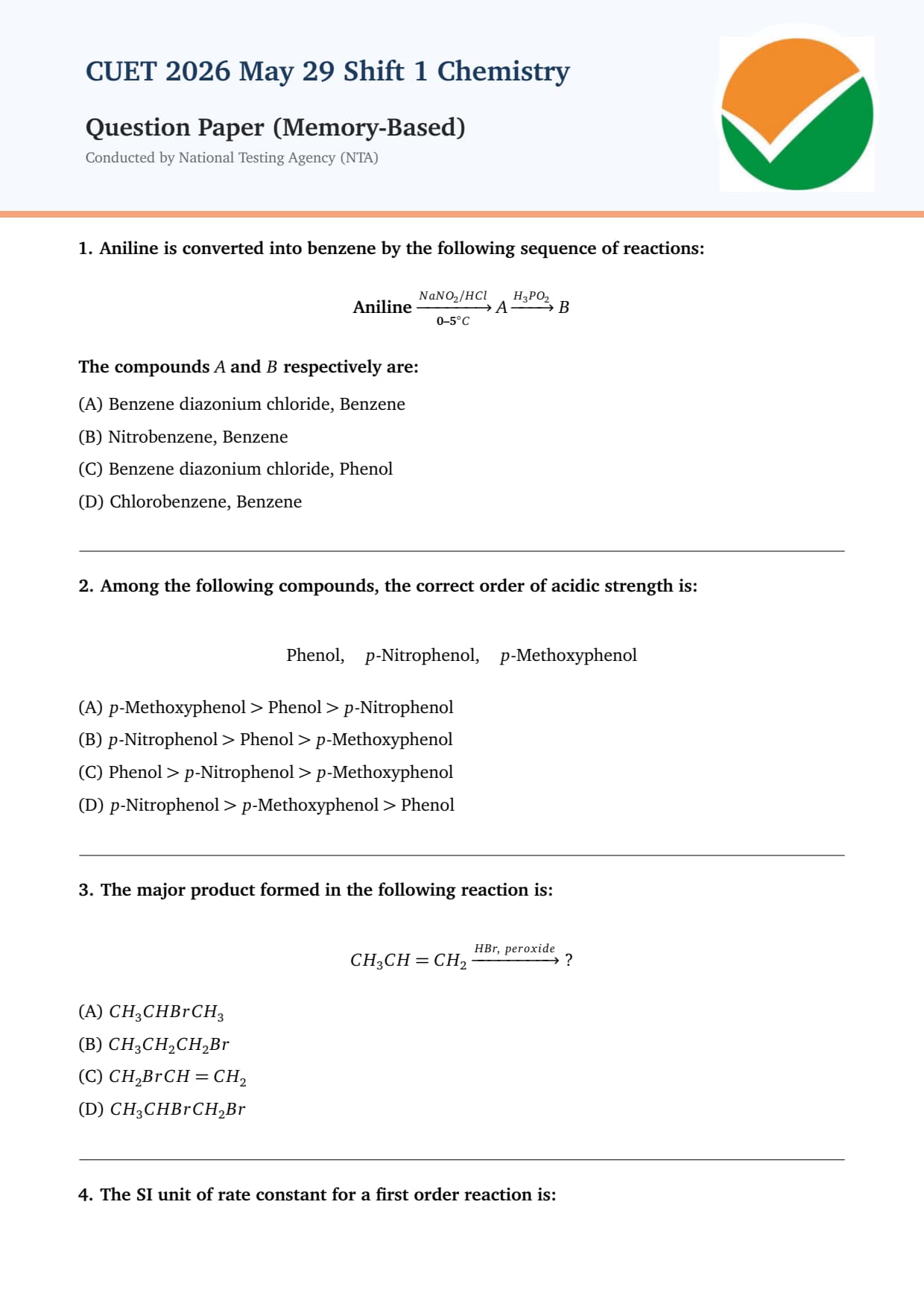
CUET 2026 May 29 Shift 1 Chemistry Question Paper is available for download here. NTA is conducting the CUET 2026 exam from 11th May to 31st May.

  • CUET 2026 Chemistry exam consists of 50 questions for 250 marks to be attempted in 60 minutes.
  • As per the marking scheme, 5 marks are awarded for each correct answer, and 1 mark is deducted for incorrect answer.

Candidates can download CUET 2026 May 29 Shift 1 Chemistry Question Paper with Answer Key and Solution PDF from links provided below.

Related Links:

CUET 2026 Chemistry May 29 Shift 1 Question Paper with Solution PDF

CUET May 29 Shift 1 Chemistry Question Paper 2026 Download PDF Check Solutions


Question 1:

Aniline is converted into benzene by the following sequence of reactions: \[ Aniline \xrightarrow[0--5^\circ C]{NaNO_2/HCl} A \xrightarrow{H_3PO_2} B \]
The compounds \(A\) and \(B\) respectively are:

  • (A) Benzene diazonium chloride, Benzene
  • (B) Nitrobenzene, Benzene
  • (C) Benzene diazonium chloride, Phenol
  • (D) Chlorobenzene, Benzene
Correct Answer: (1) Benzene diazonium chloride, Benzene
View Solution


Concept:

This question is based on:

Diazotisation reaction
Reduction of diazonium salts
Important NCERT named reactions


Primary aromatic amines react with nitrous acid at low temperature to form diazonium salts.

Further reduction using hypophosphorous acid replaces diazonium group by hydrogen.


Step 1: Formation of diazonium salt.

Aniline: \[ C_6H_5NH_2 \]

reacts with: \[ NaNO_2 + HCl \]
at: \[ 0-5^\circ C \]

to form benzene diazonium chloride: \[ C_6H_5N_2^+Cl^- \]

Thus: \[ A = Benzene diazonium chloride \]

Reaction: \[ C_6H_5NH_2 \rightarrow C_6H_5N_2^+Cl^- \]


Step 2: Reduction of diazonium salt.

Hypophosphorous acid: \[ H_3PO_2 \]
reduces diazonium group into hydrogen.

Thus: \[ C_6H_5N_2^+Cl^- \rightarrow C_6H_6 \]

Hence: \[ B = Benzene \]


Step 3: Identify the correct option.

Therefore: \[ A = Benzene diazonium chloride \]
and \[ B = Benzene \]

Hence correct option is: \[ \boxed{(A)} \] Quick Tip: Remember: \[ ArN_2^+Cl^- \xrightarrow{H_3PO_2} ArH \] Hypophosphorous acid replaces diazonium group by hydrogen.


Question 2:

Among the following compounds, the correct order of acidic strength is:
\[ Phenol,\quad p-Nitrophenol,\quad p-Methoxyphenol \]

  • (A) \(p-Methoxyphenol > Phenol > p-Nitrophenol\)
  • (B) \(p-Nitrophenol > Phenol > p-Methoxyphenol\)
  • (C) \(Phenol > p-Nitrophenol > p-Methoxyphenol\)
  • (D) \(p-Nitrophenol > p-Methoxyphenol > Phenol\)
Correct Answer: (2) \(p\text{-Nitrophenol} > \text{Phenol} > p\text{-Methoxyphenol}\)
View Solution


Concept:

Acidic strength depends upon stability of conjugate base.


Electron withdrawing groups increase acidity
Electron donating groups decrease acidity


Greater stabilization of phenoxide ion means stronger acid.


Step 1: Analyse \(p\)-nitrophenol.

Nitro group: \[ (-NO_2) \]
is strongly electron withdrawing.

It stabilizes phenoxide ion by:

\(-I\) effect
\(-R\) effect


Thus acidity increases significantly.

Therefore: \[ p-Nitrophenol is most acidic \]


Step 2: Analyse phenol.

Phenol has no strong substituent.

Hence its acidity is intermediate.


Step 3: Analyse \(p\)-methoxyphenol.

Methoxy group: \[ (-OCH_3) \]
is electron donating through resonance.

It destabilizes phenoxide ion.

Thus acidity decreases.

Therefore: \[ p-Methoxyphenol is least acidic \]


Step 4: Write the correct order.

Hence: \[ p-Nitrophenol > Phenol > p-Methoxyphenol \]

Thus the correct option is: \[ \boxed{(B)} \] Quick Tip: Electron withdrawing groups increase acidity by stabilizing conjugate base, while electron donating groups decrease acidity by destabilizing the conjugate base.


Question 3:

The major product formed in the following reaction is:
\[ CH_3CH=CH_2 \xrightarrow{HBr,\ peroxide} \ ? \]

  • (A) \(CH_3CHBrCH_3\)
  • (B) \(CH_3CH_2CH_2Br\)
  • (C) \(CH_2BrCH=CH_2\)
  • (D) \(CH_3CHBrCH_2Br\)
Correct Answer: (2) \(CH_3CH_2CH_2Br\)
View Solution


Concept:

Addition of HBr in presence of peroxide follows: \[ Anti-Markovnikov rule \]

This reaction is known as: \[ Peroxide effect or Kharasch effect \]

Free radical mechanism causes bromine to attach to less substituted carbon atom.


Step 1: Identify the alkene.

Given alkene: \[ CH_3CH=CH_2 \]

This is propene.


Step 2: Understand peroxide effect.

In presence of peroxide: \[ HBr \]
adds through free radical mechanism.

Bromine attaches to terminal carbon.

Thus: \[ CH_3CH=CH_2 \rightarrow CH_3CH_2CH_2Br \]


Step 3: Identify the product.

The product formed is: \[ 1-Bromopropane \]

Structure: \[ CH_3CH_2CH_2Br \]

Hence correct option is: \[ \boxed{(B)} \] Quick Tip: Peroxide effect is shown only by HBr and not by HCl or HI. \[ HBr + Peroxide \Rightarrow Anti-Markovnikov addition \]


Question 4:

The SI unit of rate constant for a first order reaction is:

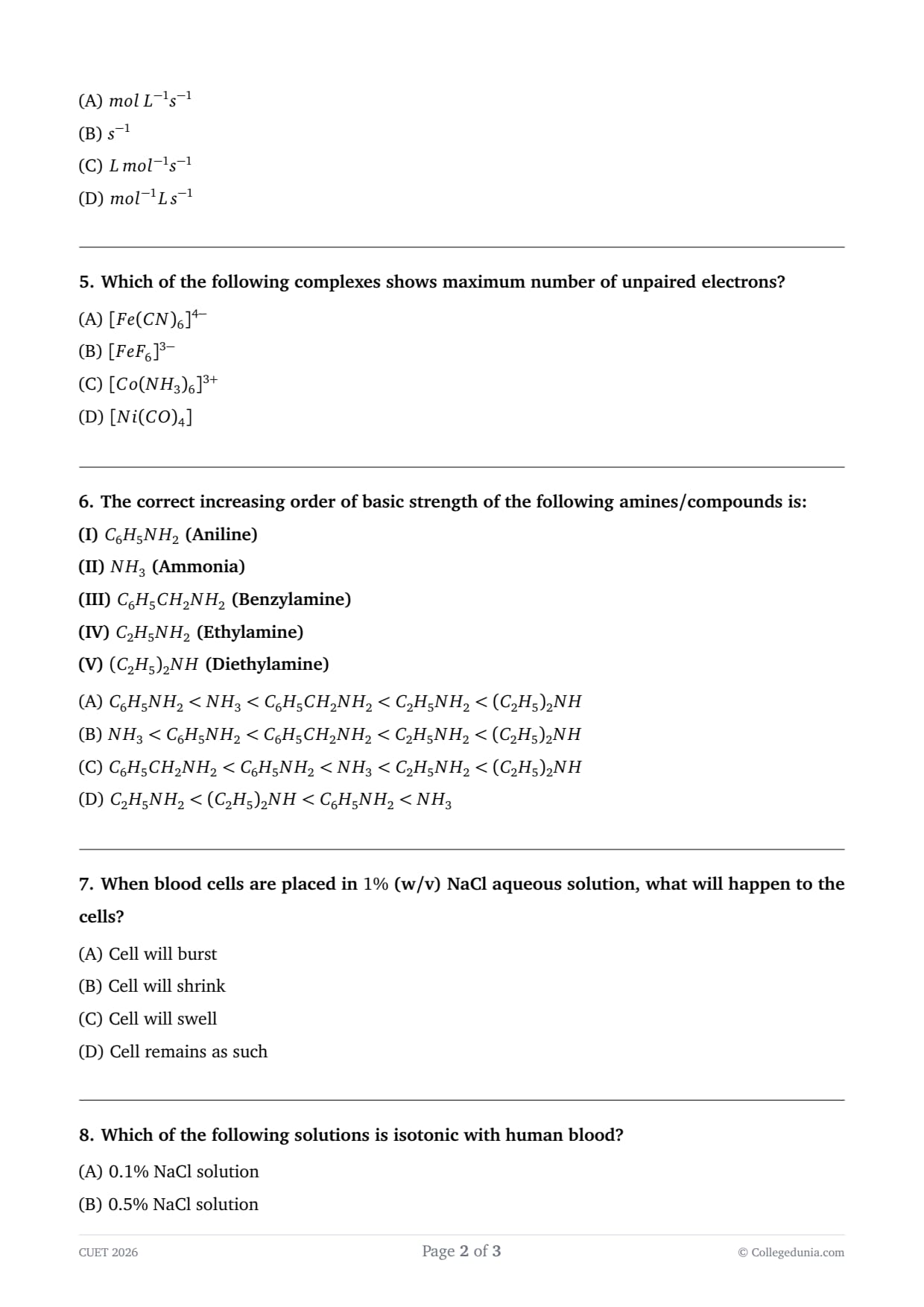
  • (A) \(mol\,L^{-1}s^{-1}\)
  • (B) \(s^{-1}\)
  • (C) \(L\,mol^{-1}s^{-1}\)
  • (D) \(mol^{-1}L\,s^{-1}\)
Correct Answer: (2) \(s^{-1}\)
View Solution


Concept:

For a first order reaction: \[ Rate = k[A] \]

The unit of rate constant depends on reaction order.


Step 1: Write units of rate and concentration.

Units of rate: \[ mol\,L^{-1}s^{-1} \]

Units of concentration: \[ mol\,L^{-1} \]


Step 2: Substitute into rate law.

For first order: \[ k = \frac{Rate}{[A]} \]

Thus: \[ k = \frac{mol\,L^{-1}s^{-1}} {mol\,L^{-1}} \]

Cancelling concentration units: \[ k = s^{-1} \]


Step 3: Write final answer.

Hence SI unit of first order rate constant is: \[ \boxed{s^{-1}} \]

Therefore correct option is: \[ \boxed{(B)} \] Quick Tip: For a first order reaction: \[ k = s^{-1} \] The unit depends only on reaction order, not on reaction mechanism.


Question 5:

Which of the following complexes shows maximum number of unpaired electrons?

  • (A) \([Fe(CN)_6]^{4-}\)
  • (B) \([FeF_6]^{3-}\)
  • (C) \([Co(NH_3)_6]^{3+}\)
  • (D) \([Ni(CO)_4]\)
Correct Answer: (2) \([FeF_6]^{3-}\)
View Solution


Concept:

Number of unpaired electrons depends on:

Oxidation state of metal
Nature of ligand
Crystal field splitting
Weak field or strong field ligands


Weak field ligands produce high spin complexes with more unpaired electrons.


Step 1: Analyse \([Fe(CN)_6]^{4-}\).

Oxidation state of Fe: \[ x+6(-1)=-4 \]
\[ x=+2 \]

Electronic configuration: \[ Fe^{2+}=3d^6 \]
\(CN^-\) is strong field ligand.

Thus low spin complex forms.

Number of unpaired electrons: \[ 0 \]


Step 2: Analyse \([FeF_6]^{3-}\).

Oxidation state: \[ x+6(-1)=-3 \]
\[ x=+3 \]

Thus: \[ Fe^{3+}=3d^5 \]
\(F^-\) is weak field ligand.

Hence high spin complex forms.

Electronic arrangement gives: \[ 5 unpaired electrons \]


Step 3: Analyse \([Co(NH_3)_6]^{3+}\).
\[ Co^{3+}=3d^6 \]
\(NH_3\) acts as strong field ligand for \(Co^{3+}\).

Low spin complex forms.

Number of unpaired electrons: \[ 0 \]


Step 4: Analyse \([Ni(CO)_4]\).

Nickel oxidation state: \[ 0 \]

CO is strong field ligand.

All electrons become paired.

Thus: \[ 0 unpaired electrons \]


Step 5: Identify the complex with maximum unpaired electrons.

Maximum unpaired electrons: \[ 5 \]

present in: \[ \boxed{[FeF_6]^{3-}} \]

Therefore, the correct option is: \[ \boxed{(B)} \] Quick Tip: Weak field ligands such as: \[ F^-,\ Cl^-,\ Br^- \] usually form high spin complexes with maximum unpaired electrons.


Question 6:

The correct increasing order of basic strength of the following amines/compounds is:

(I) \(C_6H_5NH_2\) (Aniline)

(II) \(NH_3\) (Ammonia)

(III) \(C_6H_5CH_2NH_2\) (Benzylamine)

(IV) \(C_2H_5NH_2\) (Ethylamine)

(V) \((C_2H_5)_2NH\) (Diethylamine)

  • (A) \(C_6H_5NH_2 < NH_3 < C_6H_5CH_2NH_2 < C_2H_5NH_2 < (C_2H_5)_2NH\)
  • (B) \(NH_3 < C_6H_5NH_2 < C_6H_5CH_2NH_2 < C_2H_5NH_2 < (C_2H_5)_2NH\)
  • (C) \(C_6H_5CH_2NH_2 < C_6H_5NH_2 < NH_3 < C_2H_5NH_2 < (C_2H_5)_2NH\)
  • (D) \(C_2H_5NH_2 < (C_2H_5)_2NH < C_6H_5NH_2 < NH_3\)
Correct Answer: (A) \(C_6H_5NH_2 < NH_3 < C_6H_5CH_2NH_2 < C_2H_5NH_2 < (C_2H_5)_2NH\)
View Solution


Concept:

The basic strength of amines depends upon the availability of the lone pair of electrons on the nitrogen atom for donation to a proton (\(H^+\)). Greater the availability of the lone pair, greater will be the basic strength.

The important factors affecting basicity are:

Inductive Effect (\(+I\) effect): Alkyl groups donate electron density toward nitrogen, increasing basicity.
Resonance Effect: Delocalization of lone pair decreases its availability and decreases basicity.
Solvation Effect: Stabilization of protonated species in aqueous medium affects basicity.
Steric Hindrance: Bulky groups can reduce protonation efficiency.


Step 1: Analyzing Aniline \((C_6H_5NH_2)\).


In aniline, the lone pair on nitrogen is directly involved in resonance with the benzene ring.
\[ C_6H_5NH_2 \longleftrightarrow Resonance structures \]

Due to resonance:

Lone pair becomes delocalized.
Electron density on nitrogen decreases.
Availability of lone pair for protonation decreases.


Hence, Aniline is the weakest base among all the given compounds.
\[ C_6H_5NH_2 < NH_3 \]

Step 2: Analyzing Ammonia \((NH_3)\).


Ammonia contains a localized lone pair on nitrogen.

There is:

No resonance effect.
No electron donating alkyl group.


Thus, Ammonia is more basic than Aniline but weaker than aliphatic amines.

Step 3: Analyzing Benzylamine \((C_6H_5CH_2NH_2)\).


In Benzylamine:

The \(-NH_2\) group is attached to \(sp^3\) hybridized carbon.
Lone pair cannot participate in resonance with benzene ring.


Therefore:

Lone pair remains available.
Basicity increases compared to ammonia.


Thus: \[ NH_3 < C_6H_5CH_2NH_2 \]

Step 4: Analyzing Ethylamine and Diethylamine.


Ethyl groups show strong \(+I\) effect.


Ethylamine has one ethyl group.
Diethylamine has two ethyl groups.


More alkyl groups increase electron density on nitrogen.

Thus: \[ C_2H_5NH_2 < (C_2H_5)_2NH \]

Also both are stronger bases than ammonia and benzylamine.

Step 5: Combining all observations.


Final increasing order of basic strength becomes:
\[ C_6H_5NH_2 < NH_3 < C_6H_5CH_2NH_2 < C_2H_5NH_2 < (C_2H_5)_2NH \]

Hence, the correct option is:
\[ \boxed{(A)} \] Quick Tip: Aromatic amines are weaker bases because resonance delocalizes the lone pair on nitrogen. Aliphatic amines are stronger due to the \(+I\) effect of alkyl groups.


Question 7:

When blood cells are placed in \(1%\) (w/v) NaCl aqueous solution, what will happen to the cells?

  • (A) Cell will burst
  • (B) Cell will shrink
  • (C) Cell will swell
  • (D) Cell remains as such
Correct Answer: (B) Cell will shrink
View Solution


Concept:

This question is based on:

Osmosis
Hypertonic and hypotonic solutions
Osmotic pressure


Osmosis is the movement of solvent molecules through a semipermeable membrane from lower solute concentration to higher solute concentration.

For human blood cells: \[ 0.9% NaCl solution \]
is approximately isotonic.

Step 1: Identify the nature of the external solution.


Given external solution: \[ 1% NaCl \]

Normal isotonic concentration: \[ 0.9% NaCl \]

Since: \[ 1% > 0.9% \]

the external solution is hypertonic.

Step 2: Determine direction of osmosis.


In a hypertonic solution:

Solute concentration outside cell is greater.
Water moves out of the cell.


This outward movement of water is called: \[ Exosmosis \]

Step 3: Determine the effect on blood cell.


As water leaves the blood cell:

Cell volume decreases.
Cell membrane contracts inward.


Therefore, the blood cell shrinks.

This shrinking is known as: \[ Crenation \]

Step 4: Write the final answer.


Hence: \[ \boxed{Cell will shrink} \]

Therefore, the correct option is:
\[ \boxed{(B)} \] Quick Tip: Remember: Hypertonic solution \(\rightarrow\) Cell shrinks Hypotonic solution \(\rightarrow\) Cell swells/bursts Isotonic solution \(\rightarrow\) No change


Question 8:

Which of the following solutions is isotonic with human blood?

  • (A) \(0.1%\) NaCl solution
  • (B) \(0.5%\) NaCl solution
  • (C) \(0.9%\) NaCl solution
  • (D) \(2%\) NaCl solution
Correct Answer: (C) \(0.9%\) NaCl solution
View Solution


Concept:

An isotonic solution is a solution having the same osmotic pressure as the fluid inside human blood cells.

In isotonic conditions:

No net movement of water occurs.
Blood cells neither shrink nor swell.


Human blood plasma is isotonic with approximately: \[ 0.9% NaCl solution \]

Step 1: Understand isotonicity.


If external solution concentration equals internal cell concentration: \[ Water entering = Water leaving \]

Thus:

Cell size remains unchanged.
Osmotic equilibrium is maintained.


Step 2: Compare all options.


\(0.1%\) NaCl: Hypotonic
\(0.5%\) NaCl: Hypotonic
\(0.9%\) NaCl: Isotonic
\(2%\) NaCl: Hypertonic


Thus only: \[ 0.9% NaCl \]
matches blood osmotic pressure.

Step 3: Write the final answer.


Hence, isotonic solution is: \[ \boxed{0.9% NaCl solution} \]

Therefore, the correct option is:
\[ \boxed{(C)} \] Quick Tip: Physiological saline or normal saline used in hospitals is: \[ 0.9% NaCl \] because it is isotonic with human blood.


Question 9:

Which of the following compounds will not undergo an Azo coupling reaction?

  • (A) Aniline
  • (B) Phenol
  • (C) Anisole
  • (D) Nitrobenzene
Correct Answer: (D) Nitrobenzene
View Solution


Concept:

Azo coupling reaction is an important electrophilic aromatic substitution reaction involving diazonium salts.

In this reaction: \[ ArN_2^+ \]
acts as a weak electrophile.

Therefore, azo coupling occurs only with highly activated aromatic rings containing strong electron donating groups.

Important points:

Electron donating groups activate the ring.
Electron withdrawing groups deactivate the ring.
Activated rings undergo azo coupling easily.


Examples of activating groups: \[ -OH,\ -NH_2,\ -OR \]

Examples of deactivating groups: \[ -NO_2,\ -COOH,\ -CN \]

Step 1: Analyzing Aniline \((C_6H_5NH_2)\).


Aniline contains: \[ -NH_2 \]
group.

The lone pair on nitrogen participates in resonance and increases electron density in the benzene ring.

Thus:

Ring becomes highly activated.
Electrophilic substitution becomes easier.


Hence, Aniline undergoes azo coupling reaction.

Step 2: Analyzing Phenol \((C_6H_5OH)\).


Phenol contains: \[ -OH \]
group.

Oxygen donates electron density through resonance effect.

Therefore:

Ring becomes activated.
Phenol reacts readily with diazonium salts.


Hence, Phenol undergoes azo coupling reaction.

Step 3: Analyzing Anisole \((C_6H_5OCH_3)\).


Anisole contains: \[ -OCH_3 \]
group.

Methoxy group donates electrons through resonance.

Thus:

Aromatic ring becomes electron rich.
Electrophilic substitution occurs easily.


Hence, Anisole also undergoes azo coupling reaction.

Step 4: Analyzing Nitrobenzene \((C_6H_5NO_2)\).


Nitro group: \[ -NO_2 \]
is a strong electron withdrawing group.

It withdraws electron density by:

\(-I\) effect
\(-M\) effect


As a result:

Benzene ring becomes strongly deactivated.
Weak diazonium electrophile cannot attack the ring.


Therefore, Nitrobenzene does not undergo azo coupling reaction.

Step 5: Write the final answer.


Hence: \[ \boxed{Nitrobenzene} \]

Therefore, the correct option is:
\[ \boxed{(D)} \] Quick Tip: Azo coupling occurs easily with activated aromatic compounds such as phenols and aromatic amines. Strong electron withdrawing groups like \(-NO_2\) prevent azo coupling.


Question 10:

Which of the following are fat soluble vitamins?

(A) Vitamin A

(B) Vitamin B

(C) Vitamin D

(D) Vitamin E

(E) Vitamin K

Choose the correct answer from the options given below:

  • (A) (A), (B), (D) and (E) only
  • (B) (A), (B), (C) and (D) only
  • (C) (A), (C), (D) and (E) only
  • (D) (B), (C), (D) and (E) only
Correct Answer: (C) (A), (C), (D) and (E) only
View Solution


Concept:

Vitamins are essential organic compounds required in small quantities for proper growth, metabolism and maintenance of body functions.

Based on solubility, vitamins are classified into:

Fat-soluble vitamins
Water-soluble vitamins


Fat-soluble vitamins: \[ A,\ D,\ E,\ K \]

Water-soluble vitamins: \[ B -complex and Vitamin C \]

Fat-soluble vitamins:

Dissolve in fats and oils
Are stored in liver and adipose tissues
Can accumulate in body


Step 1: Identify Vitamin A.


Vitamin A: \[ Retinol \]
is fat soluble.

It is important for:

Vision
Healthy epithelial tissues


Thus: \[ (A) is correct \]

Step 2: Identify Vitamin B.


Vitamin B belongs to: \[ Vitamin B-complex \]

These vitamins are water soluble.

Therefore: \[ (B) is not fat soluble \]

Step 3: Identify Vitamins D, E and K.


Vitamin D helps calcium absorption.
Vitamin E acts as antioxidant.
Vitamin K is essential for blood clotting.


All three are fat soluble vitamins.

Thus: \[ (C),\ (D),\ (E) \]
are correct.

Step 4: Select the correct combination.


Fat-soluble vitamins are: \[ A,\ D,\ E,\ K \]

Hence correct combination is: \[ (A),\ (C),\ (D),\ (E) \]

Therefore, the correct option is:
\[ \boxed{(C)} \] Quick Tip: Remember the mnemonic: \[ \boxed{ADEK} \] These are the four fat-soluble vitamins. Vitamins B and C are water soluble.

CUET UG 2026 Exam Pattern

Parameter Details
Exam Name Common University Entrance Test (CUET UG) 2026
Conducting Body National Testing Agency (NTA)
Exam Mode Computer-Based Test (CBT)
Exam Duration 60 minutes per test
Total Sections 3 (Languages, Domain Subjects, General Test)
Question Type Multiple Choice Questions (MCQs)
Questions per Test 50 questions (all compulsory)
Marking Scheme +5 for correct, -1 for incorrect
Maximum Marks 250 marks per test
Maximum Subject Choices 5 subjects in total
Syllabus Base Class 12 NCERT (mainly for Domain Subjects)

CUET UG 2026 Paper Analysis