




CUET 2026 June 6 Shift 1 English Question Paper is available for download here. NTA is conducting the CUET 2026 exam from 11th May to 31st May and June 6 to June 7.
- CUET 2026 English exam consists of 50 questions for 250 marks to be attempted in 60 minutes.
- As per the marking scheme, 5 marks are awarded for each correct answer, and 1 mark is deducted for incorrect answer.
Candidates can download CUET 2026 June 6 Shift 1 English Question Paper with Answer Key and Solution PDF from links provided below.
Related Links:
CUET 2026 English June 6 Shift 1 Question Paper with Solution PDF
| CUET 6 June Shift 1 English Question Paper 2026 | Download PDF | Check Solutions |



Identify the figure of speech used in the following lines:
The house was crouching on its elbows then,
Choose the appropriate option from the ones given below:
View Solution
Concept:
Figures of speech are literary devices that writers use to make their language more expressive, imaginative, and vivid. They often convey meanings beyond the literal interpretation of words. To identify the correct figure of speech, it is important to understand the defining characteristics of each literary device.
Personification: Giving human qualities, actions, emotions, or characteristics to non-living things, animals, or abstract ideas.
Alliteration: Repetition of the same consonant sound at the beginning of nearby words.
Simile: A comparison between two unlike things using words such as `like'' or `as''.
Hyperbole: A deliberate exaggeration used for emphasis or effect.
Step 1: Analyzing the Subject of the Sentence
The sentence begins with the expression:
``The house was crouching on its elbows then.''
The subject of the sentence is ``the house''. A house is a non-living object and therefore cannot perform actions that require human movement or physical structure.
Step 2: Examining the Action Described
The action attributed to the house is `crouching''. Crouching is a human action that involves bending the body and taking a lowered position. Furthermore, the phrase mentions `its elbows'', which are body parts associated with living beings.
Step 3: Identifying the Literary Device
Since the house is being described as if it possesses human body parts and is capable of performing human actions, the writer is attributing human characteristics to an inanimate object.
This is the exact definition of Personification.
Step 4: Eliminating the Other Options
Option (B) Alliteration: There is no significant repetition of initial consonant sounds.
Option (C) Simile: No comparison using `like'' or `as'' is present.
Option (D) Hyperbole: The sentence is not primarily based on exaggeration. Instead, it gives human qualities to a non-living object.
Therefore, the correct answer is Personification. Quick Tip: Whenever a non-living object is shown as thinking, speaking, feeling, walking, smiling, crying, or performing any other human action, the figure of speech is generally Personification.
Fill in the blanks in the sentences given in List-I with the appropriate Idioms given in List-II:

Choose the correct answer from the options given below:
View Solution
Concept:
Idioms are fixed expressions whose meanings are different from the literal meanings of the individual words. To solve idiom-matching questions, we must first understand the meanings of the idioms and then examine the context of each sentence carefully.
To live the life of Reilly: To enjoy a comfortable, luxurious, and carefree life.
Hold your horses: To wait, slow down, or avoid acting too quickly.
Cloud nine: A state of extreme happiness.
Knuckled under: Submitted or yielded under pressure.
Step 1: Matching Sentence (A)
The sentence states that the persuasive powers of his friends were successful. This means he eventually gave in to their pressure or influence.
Hence, (A) matches with (IV) knuckled under.
Step 2: Matching Sentence (B)
The sentence refers to inheriting family fortunes. Such wealth enables a person to enjoy a comfortable and luxurious lifestyle.
Hence, (B) matches with (I) to live the life of Reilly.
Step 3: Matching Sentence (C)
The sentence advises someone not to jump to conclusions. It asks for patience and caution.
Hence, (C) matches with (II) hold your horses.
Step 4: Matching Sentence (D)
Selection in the NDA is a major achievement and naturally brings immense happiness and excitement.
Hence, (D) matches with (III) cloud nine.
Step 5: Final Arrangement
(A)-(IV), (B)-(I), (C)-(II), (D)-(III)
Therefore, the correct answer is Option (A). Quick Tip: While solving idiom questions, focus on the overall context of the sentence rather than the literal meaning of the words appearing in the idiom.
Choose the word similar in meaning to the underlined word in the following sentence:
Vitality and zest for life were at a vanishing point, spirituality glowed but in fitful embers.
View Solution
Concept:
A synonym is a word that has the same or nearly the same meaning as another word. To determine the correct synonym, we must understand the meaning of the given word and compare it with the meanings of all options.
Step 1: Understanding the Meaning of ``Zest''
The word zest means great enthusiasm, excitement, eagerness, energy, or passion for life and activities.
The phrase ``zest for life'' commonly refers to a strong enthusiasm for living and enjoying life.
Step 2: Examining Each Option
Zenith: The highest point or peak. It does not mean enthusiasm.
Enthusiasm: Strong excitement, eagerness, and interest. This closely matches the meaning of zest.
Propensity: A natural tendency or inclination.
Satisfaction: A feeling of contentment or fulfillment.
Step 3: Selecting the Best Synonym
Among all the options, enthusiasm is the closest in meaning to zest because both words express energetic interest, excitement, and eagerness.
Therefore, the correct answer is Option (B). Quick Tip: The phrase ``zest for life'' almost always indicates enthusiasm, excitement, energy, and passion toward life.
Rearrange the following phrases to form a meaningful sentence:
(A) actions of characters and dialogues
(B) intended to be
(C) a drama is a composition in prose or verse
(D) acted on stage through
Choose the correct answer from the options given below:
View Solution
Concept:
In sentence rearrangement questions, we first identify the independent clause and then connect phrases according to grammatical and logical relationships.
Step 1: Finding the Opening Phrase
Phrase (C) contains a complete statement:
``a drama is a composition in prose or verse''
Since it contains a subject and a verb, it must begin the sentence.
Step 2: Connecting the Next Phrase
The phrase ``intended to be'' naturally modifies the composition mentioned in phrase (C).
Hence, (B) follows (C).
Step 3: Completing the Passive Construction
The phrase `intended to be'' requires a past participle verb. Phrase (D) begins with `acted'', making it the natural continuation.
Hence, (D) follows (B).
Step 4: Completing the Preposition
Phrase (D) ends with the word ``through''. A preposition must be followed by its object.
Phrase (A) provides that object:
``actions of characters and dialogues''
Hence, (A) follows (D).
Step 5: Final Sentence
A drama is a composition in prose or verse intended to be acted on stage through actions of characters and dialogues.
Thus, the correct arrangement is:
(C), (B), (D), (A)
Therefore, the correct answer is Option (A). Quick Tip: Look for complete clauses first. The phrase containing both subject and verb usually serves as the beginning of the sentence.
Choose the correctly spelled word from the given options:
View Solution
Concept:
Correct spelling is determined by following the accepted standard form of a word. Many spelling mistakes occur because of confusion involving double consonants and suffixes.
Step 1: Identifying the Base Word
The word commissioner is derived from the noun commission.
The word ``commission'' contains:
c-o-m-m-i-s-s-i-o-n
Notice that it contains both a double m and a double s.
Step 2: Forming the Derived Word
Adding the suffix ``er'' gives:
commission + commissioner
Therefore, the correct spelling must retain both double consonants.
Step 3: Examining the Options
Option (A) Commisionor: Incorrect because it has only one s and ends with ``or''.
Option (B) commissioner: Correct spelling with double m, double s, and proper ending.
Option (C) comissioner: Incorrect because it has only one m.
Option (D) commisioner: Incorrect because it has only one s.
Step 4: Conclusion
Only Option (B) follows the standard spelling pattern correctly.
Hence, the correct answer is commissioner. Quick Tip: Remember the base word `commission''. Any derived form such as `commissioner'' must retain both the double m and double s.
Fill in the blank with the appropriate word from the options given:
As an employee working for a long time, you know too _____ who could have spilled the beans.
View Solution
Concept:
This question tests knowledge of idiomatic collocations and contextual grammar. A collocation is a combination of words that naturally occur together in English. Certain expressions become fixed through repeated usage and cannot be altered arbitrarily.
Two important expressions are involved here:
Spill the beans: To reveal a secret or disclose confidential information.
Know too well: A fixed expression meaning to be very aware of something because of experience or familiarity.
Step 1: Understanding the Context
The sentence begins with:
``As an employee working for a long time...''
This indicates that the person has considerable experience, familiarity, and knowledge about the workplace and the people working there.
Step 2: Identifying the Required Meaning
The sentence suggests that because of long experience, the person is able to identify or strongly suspect who revealed the secret information.
Therefore, the blank should contain a word that expresses strong knowledge and familiarity.
Step 3: Evaluating the Options
Option (A) more: The expression `know too more'' is grammatically incorrect and not used in English.
Option (B) little: `Know too little'' means having insufficient knowledge, which contradicts the context.
Option (C) few: `Few'' is used with countable nouns and cannot appropriately modify the verb `know'' in this sentence.
Option (D) well: ``Know too well'' is a standard English expression meaning to know something very clearly or from personal experience.
Step 4: Forming the Complete Sentence
Substituting the correct word gives:
``As an employee working for a long time, you know too well who could have spilled the beans.''
The sentence is now grammatically correct and logically meaningful.
Therefore, the correct answer is Option (D). Quick Tip: Expressions such as `know too well'', `know very well'', and ``know full well'' are fixed English collocations. Whenever experience or familiarity is emphasized, these expressions are commonly used.
Rearrange the following phrases to form a meaningful sentence:
(A) and saw her son in a blue shirt
(B) she came to the balcony
(C) surging on the rocking horse
(D) hearing some sound sudden
Choose the correct answer from the options given below:
View Solution
Concept:
In sentence rearrangement questions, we identify the logical sequence of events, grammatical relationships, and modifiers. Introductory participial phrases generally come before the main clause, while descriptive participles are placed close to the noun they describe.
Step 1: Finding the Introductory Phrase
Phrase (D):
``hearing some sound sudden''
describes an event that triggers another action. Therefore, it naturally functions as the opening phrase.
Step 2: Finding the Main Clause
After hearing a sudden sound, somebody must perform an action.
Phrase (B):
``she came to the balcony''
provides the subject and main action.
Thus, the sequence begins as:
(D) -> (B)
Step 3: Finding the Next Action
After coming to the balcony, she performs another action.
Phrase (A):
``and saw her son in a blue shirt''
continues the narrative naturally.
Now the sequence becomes:
(D) -> (B) -> (A)
Step 4: Attaching the Modifier
Phrase (C):
``surging on the rocking horse''
describes what the son was doing.
Therefore, it must immediately follow the phrase containing ``her son''.
Hence:
(A) -> (C)
Step 5: Final Sentence
Combining all parts gives:
``Hearing some sound sudden, she came to the balcony and saw her son in a blue shirt surging on the rocking horse.''
Thus, the correct arrangement is:
(D), (B), (A), (C)
Therefore, the correct answer is Option (A). Quick Tip: In rearrangement questions, place descriptive participles such as `running'', `playing'', `riding'', or `surging'' immediately after the noun they describe.
Choose the correct passive construction of the given sentence from the options given:
The government will offer incentives to contractors completing high priority projects.
View Solution
Concept:
When converting an active voice sentence into passive voice, the object of the active sentence becomes the subject of the passive sentence. The tense must remain unchanged and the original subject is usually introduced using the preposition ``by''.
For modal verbs, the passive structure is:
Modal + be + Past Participle
Step 1: Identify the Components of the Active Sentence
Active sentence:
``The government will offer incentives to contractors completing high priority projects.''
Subject:
The government
will offer
Object:
incentives
Recipient:
contractors completing high priority projects
Step 2: Move the Receiver to the Subject Position
The contractors are the recipients of the incentives.
Hence, the passive sentence should begin with:
Contractors completing high priority projects
Step 3: Convert the Verb into Passive Form
The active verb is:
will offer
Passive structure:
would/will be offered
Step 4: Add the Original Subject
The original subject becomes:
by the government
Step 5: Examine the Options
Option (A) reverses the meaning completely.
Option (B) remains in active voice.
Option (C) correctly follows passive structure and preserves meaning.
Option (D) remains active voice.
Therefore, the correct answer is Option (C). Quick Tip: For modal verbs such as will, would, can, could, may, and must, the passive structure is always: Modal + be + Past Participle.
Select the word which can replace the given phrase:
The state of being legally responsible for something.
View Solution
Concept:
One-word substitution questions require replacing an entire phrase with a single word that conveys exactly the same meaning.
Step 1: Understanding the Given Phrase
The phrase is:
``The state of being legally responsible for something.''
This refers to accountability under law for an action, debt, damage, or obligation.
Step 2: Evaluating Each Option
Legitimate: Means lawful or valid.
Liable: Means legally responsible or answerable.
Legalised: Means made lawful by legal authority.
Eligible: Means qualified or entitled.
Step 3: Finding the Exact Match
Only the word liable directly expresses legal responsibility.
For example:
``The company is liable for the damages.''
This means the company is legally responsible for paying compensation.
Step 4: Conclusion
Since ``liable'' means legally responsible, it is the most appropriate substitution.
Therefore, the correct answer is Option (B). Quick Tip: Remember the pair: Liability = Legal Responsibility, Liable = Legally Responsible.
Complete the sentence with the appropriate word from the given options:
Her command over English is ______.
View Solution
Concept:
Adjectives can be used in positive, comparative, and superlative forms. However, comparative and superlative forms should only be used when a comparison is actually being made.
Step 1: Analyze the Sentence
The sentence is:
``Her command over English is ''
No comparison with another person or group is present.
Step 2: Examine the Options
More excellent: Comparative form requiring a comparison.
Most excellent: Superlative form requiring comparison among many.
Excellent: Positive degree; grammatically correct without comparison.
The most excellent: Superlative form requiring comparison and definite article usage.
Step 3: Apply the Rule
Since the sentence merely describes her command over English and does not compare it with anyone else's, the positive degree adjective should be used.
Thus:
Her command over English is excellent.
is the most natural and grammatically correct sentence.
Step 4: Conclusion
Therefore, the correct answer is Option (C). Quick Tip: Whenever no comparison is present in the sentence, use the positive degree of the adjective rather than comparative or superlative forms.
Choose the sentences which show the correct usage of phrasal verbs:
(A) The unruly students egged on him to break the lock and enter the dean's office.
(B) We promise to wrap up the session before sun-down.
(C) Please turn in the volume of your music system.
(D) She will not come to school today as she has suddenly come up with viral fever.
Choose the correct answer from the options given below:
View Solution
Concept:
A phrasal verb is formed by combining a verb with a preposition or an adverb, resulting in a meaning that is often different from the literal meanings of the individual words. To determine whether a phrasal verb has been used correctly, both its meaning and its grammatical structure must be checked carefully.
Some phrasal verbs are separable, meaning the object can come between the verb and the particle, while others are inseparable. In addition, the context must match the accepted meaning of the phrasal verb.
Step-by-step Analysis:
Statement (A):
The phrasal verb egg on means to encourage or provoke someone to do something, usually something unwise or improper.
The sentence says:
``The unruly students egged on him to break the lock and enter the dean's office.''
The standard construction with a pronoun object is generally:
egg someone on
Thus, the grammatically preferred form is:
``The unruly students egged him on ...''
Therefore, statement (A) is not accepted as correctly constructed in this context.
Statement (B):
The phrasal verb wrap up means to bring something to a conclusion or finish it.
The sentence:
``We promise to wrap up the session before sun-down.''
correctly uses the phrasal verb to indicate ending or concluding the session.
Therefore, statement (B) is correct.
Statement (C):
The phrasal verb turn in generally means:
to submit something,
to surrender something,
to go to bed.
It is not used for increasing or decreasing sound volume.
For volume control, the correct phrasal verbs are:
turn up (increase volume)
turn down (decrease volume)
Hence, statement (C) is incorrect.
Statement (D):
The expression used here is:
``come up with viral fever.''
In many examination contexts, this expression is accepted to indicate suddenly developing an illness.
Therefore, statement (D) is treated as correct according to the answer key.
Final Conclusion:
After evaluating all four statements:
(A) Incorrect
(B) Correct
(C) Incorrect
(D) Correct
Therefore, the correct combination is (B) and (D) only. Quick Tip: While solving questions on phrasal verbs, never focus only on the verb. Always learn the complete expression along with its accepted meaning and structure. For example,wrap up means ``finish,'' whereas turn in means ``submit'' and cannot be used for controlling sound volume.
Identify the Figure of Speech used in the given sentence:-
She was impressed to see shining silver spoons at the serving counter
View Solution
Concept:
Figures of speech are literary devices used to make language more attractive, expressive, and memorable. One of the most commonly used sound-based figures of speech is Alliteration.
Alliteration: Repetition of the same consonant sound at the beginning of nearby words.
Pun: A play on words involving multiple meanings.
Oxymoron: A combination of contradictory terms.
Simile: A comparison using words such as ``like'' or ``as''.
Step-by-step Analysis:
Let us examine the important words in the sentence:
shining, silver, spoons, serving
Notice that these words begin with the same consonant sound represented by the letter s.
The repeated occurrence of the initial s sound creates a pleasing rhythmic effect.
Such repetition of an initial consonant sound is the defining feature of Alliteration.
Let us eliminate the other options:
There is no humorous double meaning, so it is not a Pun.
No contradictory words are present, so it is not an Oxymoron.
No comparison using ``like'' or ``as'' is made, so it is not a Simile.
Therefore, the figure of speech used is Alliteration. Quick Tip: If several nearby words begin with the same consonant sound, the figure of speech is usually Alliteration. Reading the sentence aloud often helps identify such sound patterns quickly.
Rearrange the following phrases to form a meaningful sentence:
(A) most roads and routes across Delhi NCR
(B) appeared as a crimson streak on real-time traffic maps
(C) and increased travel time
(D) indicating high traffic volume
Choose the correct answer from the options given below:
View Solution
Concept:
In sentence reordering questions, we first identify the subject, then locate the main verb, and finally arrange modifiers and consequences in a logical sequence.
Step-by-step Analysis:
Phrase (A) contains the subject:
`most roads and routes across Delhi NCR''
Therefore, it is a natural opening phrase.
Phrase (B) contains the main verb:
``appeared as a crimson streak on real-time traffic maps''
Thus, it should follow the subject.
Phrase (D):
``indicating high traffic volume''
explains what the crimson streak signifies.
Therefore, it naturally follows phrase (B).
Phrase (C):
``and increased travel time''
presents the consequence of heavy traffic and should appear at the end.
Combining all phrases gives:
``Most roads and routes across Delhi NCR appeared as a crimson streak on real-time traffic maps, indicating high traffic volume and increased travel time.''
This sentence is grammatically complete and logically meaningful.
Hence, the correct sequence is:
(A) → (B) → (D) → (C) Quick Tip: Look for a complete subject and a complete verb first. Once the basic sentence is formed, place explanatory phrases and consequences afterward to obtain the correct order.
Fill in the blank in the sentence with the correct word from the options given:-
After a minor accident with a bus, Madan's movements are _____
restricted, otherwise he is very active.
View Solution
Concept:
Contextual vocabulary questions require careful attention to clues provided within the sentence. The correct word must fit both grammatically and logically.
Step-by-step Analysis:
The sentence begins with the expression:
``After a minor accident''
The adjective minor indicates that the accident was not severe.
Therefore, any resulting restriction in movement is expected to be small rather than serious.
Let us examine each option:
Frequently: Indicates frequency, not degree of restriction.
Slightly: Means to a small extent.
Very much: Indicates a large degree.
Entirely: Means completely.
Since the accident is described as minor, the most suitable degree modifier is slightly.
The completed sentence becomes:
``After a minor accident with a bus, Madan's movements are slightly restricted, otherwise he is very active.''
This sentence is grammatically and logically correct. Quick Tip: Pay attention to clue words such as minor, slight, severe, and extreme. Such words often indicate the required intensity level of the missing word.
Choose the word/words which are opposite in meaning to the given word.
Redress
(A) set right
(B) remedy
(C) retribution
(D) harm
Choose the correct answer from the options given below:
View Solution
Concept:
An antonym is a word that conveys a meaning opposite to another word. To identify antonyms correctly, we must first determine the exact meaning of the given word and then compare it with all available options.
Step-by-step Analysis:
The word redress means:
to correct a wrong,
to remedy a grievance,
to provide compensation,
to set right an injustice.
Examine option (A):
Set right means to correct a mistake.
Therefore, it is a synonym of redress.
Examine option (B):
Remedy means to cure or correct a problem.
Therefore, it is also a synonym.
Examine option (C):
Retribution means punishment or vengeance.
It represents a concept opposite to the restorative nature of redress.
Therefore, it is accepted as an antonym in this context.
Examine option (D):
Harm means injury, damage, or hurt.
Since redress aims to repair damage, harm is clearly opposite in meaning.
Therefore, it is an antonym.
Hence, the words opposite in meaning to redress are:
(C) Retribution and (D) Harm
Thus, the correct answer is (C) and (D) only. Quick Tip: Whenever an antonym question appears, first identify direct synonyms of the given word and eliminate them. The remaining options can then be checked for opposite meanings more easily.
Fill in the blanks given in List-I with the correct words given in List-II.

Choose the correct answer from the options given below:
View Solution
Concept:
This question tests the correct usage of conjunctions and connecting words in English grammar. Each blank must be filled with a word that establishes the appropriate logical relationship between the two parts of the sentence.
The meanings of the words given in List-II are:
Although --- used to express contrast or concession.
Unless --- means ``except if'' or ``if not''.
As --- means ``in the same way that'' or ``because'', depending on context.
Since --- means ``from a particular time in the past until now'' or ``because''.
We shall examine each sentence individually.
Step 1: Analyze sentence (A).
The sentence is:
He has changed a lot I last saw him.
The present perfect tense ``has changed'' indicates a change that has occurred from a point in the past until the present.
The word that correctly expresses this idea is:
since
Thus,
(A) → (IV)
and the completed sentence becomes:
He has changed a lot since I last saw him.
This sentence is grammatically correct and meaningful.
Step 2: Analyze sentence (B).
The sentence is:
She arrived on time it was raining cats and dogs.
The phrase ``raining cats and dogs'' means raining very heavily.
The sentence conveys a contrast:
She arrived on time despite the heavy rain.
The conjunction that expresses contrast is:
although
Therefore,
(B) → (I)
and the complete sentence becomes:
She arrived on time although it was raining cats and dogs.
Step 3: Analyze sentence (C).
The sentence is:
there is an emergency, don't disturb me.
The intended meaning is:
Do not disturb me except in an emergency.
The conjunction that gives this meaning is:
unless
Thus,
(C) → (II)
and the sentence becomes:
Unless there is an emergency, don't disturb me.
This is grammatically correct and logically meaningful.
Step 4: Analyze sentence (D).
The sentence is:
Do unto others you would have them do unto you.
This is a famous proverb.
The correct expression is:
Do unto others as you would have them do unto you.
Hence,
(D) → (III)
where the appropriate word is:
as
Step 5: Compile the final matching.
From the above analysis, we obtain:
(A) → (IV)
(B) → (I)
(C) → (II)
(D) → (III)
Therefore the correct arrangement is:
(A)-(IV),(B)-(I),(C)-(II),(D)-(III)
which corresponds to
Option (C)Quick Tip: A useful shortcut for such matching questions is to identify the meaning of each conjunction.
Select the word from the given options that is OPPOSITE to the meaning of the word--TACITURN
View Solution
Concept:
``Taciturn'' means reserved, silent, or speaking very little.
Step 1: Analyse the options.
Tainted = spoiled or corrupted
Reticent = reserved, silent
Garrulous = excessively talkative
Imprudent = unwise
Step 2: Find the opposite meaning.
Since taciturn means quiet and reserved, its opposite is someone who talks excessively.
GarrulousQuick Tip: Taciturn = silent, reserved.
Garrulous = talkative, loquacious.
Match the idioms given in List-I with their meanings given in List-II:

Choose the correct answer from the options given below:
View Solution
(A) → (II)
Hands full = very busy.
(B) → (III)
Hand in glove with = closely associated.
(C) → (IV)
Grease someone's palm = bribe someone.
(D) → (I)
Leave in the lurch = abandon someone in difficulty.
Thus,
(A)-(II), (B)-(III), (C)-(IV), (D)-(I)
Option (C)Quick Tip: Grease someone's palm = bribe.
Hand in glove = closely connected.
Choose the word which is correctly spelled from the given options:
View Solution
The correct spelling is
Aggressive
It contains double ``g'' and double ``s''.
The remaining options omit one of these required letters and are therefore incorrect spellings. Quick Tip: Aggressive = Agg + ress + ive. Remember both ``gg'' and ``ss'' are required.
Select the word from the given options that is similar in meaning to the word--VOLATILE:
View Solution
Concept:
The word volatile refers to something that is unstable, unpredictable, liable to change suddenly, or not remaining constant for a long period.
Step 1: Understand the meaning of the given word.
The word volatile is commonly used for situations, markets, emotions, chemicals, and political conditions that can change rapidly without warning.
Examples:
A volatile stock market.
A volatile political situation.
A volatile personality.
Step 2: Analyse the options.
Unstable = not steady, likely to change.
Trespass = to enter a place unlawfully.
Transient = temporary or short-lived.
Perpetual = everlasting or continuous.
Step 3: Choose the closest synonym.
Among all the options, unstable conveys almost the same meaning as volatile.
Volatile Unstable
Therefore, the correct answer is:
Option (A)Quick Tip: Volatile = unstable, unpredictable, rapidly changing. Example: ``The volatile market experienced sudden fluctuations throughout the day.''
Rearrange the following phrases to form a meaningful sentence:
(A) that true science fiction
(B) is a creation of
(C) I have often made the point
(D) the last two centuries
Choose the correct answer from the options given below:
View Solution
Concept:
To rearrange phrases correctly, first identify the clause that can logically begin the sentence and then place supporting phrases in a grammatically meaningful order.
Step 1: Identify the introductory clause.
Phrase (C):
``I have often made the point''
can naturally begin the sentence.
Step 2: Find the object clause.
Phrase (A):
``that true science fiction''
follows phrase (C).
Step 3: Complete the predicate.
Phrase (B):
``is a creation of''
comes next.
Step 4: Add the concluding phrase.
Phrase (D):
``the last two centuries''
completes the sentence.
Thus the sentence becomes:
I have often made the point that true science fiction is a creation of the last two centuries.
Hence the correct order is:
(C),(A),(B),(D)
Option (B)Quick Tip: While rearranging sentences, first identify the main clause and then attach dependent clauses in a grammatically logical sequence.
Choose the word OPPOSITE in meaning to the underlined word in the following sentence:
``She declined to participate in the soccer game.''
View Solution
Concept:
The word declined means refused, rejected, or chose not to accept something.
Step 1: Understand the meaning of declined.
In the sentence,
She declined to participate.
it means she refused to participate.
Step 2: Analyse the options.
Supported = encouraged or agreed with
Avoided = stayed away from
Opposed = resisted
Repudiated = rejected
Step 3: Find the opposite.
Since declined means refused, the opposite idea is accepted or supported.
Supported
Hence,
Option (A)Quick Tip: Decline = refuse.
Opposite of decline = accept, support, agree.
Match the idioms given in List-I with their meanings given in List-II:

Choose the correct answer from the options given below:
View Solution
(A) → (III)
Eat one's words = admit that one was wrong.
(B) → (I)
Fair and square = straightforward and honest.
(C) → (IV)
Play with fire = do something dangerous.
(D) → (II)
Poker-faced = expressionless.
Therefore,
(A)-(III),(B)-(I),(C)-(IV),(D)-(II)
Option (D)Quick Tip: Poker-faced = expressionless.
Play with fire = take dangerous risks.
Choose the correct transformation of the given sentence in Indirect Speech:
The teacher said to the boy, ``Why don't you bring your books?''
View Solution
Concept:
When converting an interrogative sentence into indirect speech:
``said to'' becomes ``asked''.
The question form changes into statement form.
Pronouns and tense are changed according to reporting rules.
Step 1: Change reporting verb.
said to → asked
Step 2: Remove question structure.
The indirect sentence should not retain interrogative word order.
Step 3: Change pronouns appropriately.
your → his
Step 4: Write the final sentence.
The teacher asked the boy why he didn't bring his books.
Hence,
Option (B)Quick Tip: Indirect questions follow statement order, not question order.
Fill in the blanks given in List-I with the words given in List-II:

Choose the correct answer from the options given below:
View Solution
Step 1: Sentence (A).
``He _____ the television when the bell rang.''
An action in progress interrupted by another action requires Past Continuous Tense.
(A) → (IV) was watching
Step 2: Sentence (B).
``I _____ this movie already.''
The word ``already'' indicates Present Perfect Tense.
B) → (III) have watched
Step 3: Sentence (C).
``The police teams are on duty to _____ over his whereabouts.''
After ``to'', base form of verb is required.
(C) → (I) watch
Step 4: Sentence (D).
``At this time tomorrow, you will be _____ the cricket match in London.''
Future Continuous Tense requires present participle.
(D) → (II) watching
Thus,
(A)-(IV), (B)-(III), (C)-(I), (D)-(II)
Option (B)Quick Tip: Future Continuous: will be + verb-ing Past Continuous: was/were + verb-ing
Fill in the blanks with the correct pair from the options given below:
``Even in the present times, some people _____ their votes according to their _____.''
View Solution
Concept:
The sentence requires two different words that sound alike but have different meanings.
Step 1: Understand the first blank.
The expression ``cast votes'' is a standard English usage.
cast votes = to vote
Therefore, the first blank should be:
cast
Step 2: Understand the second blank.
The sentence refers to social groups influencing voting behaviour.
The correct noun is:
caste
which means a hereditary social class.
Step 3: Form the complete sentence.
Even in the present times, some people cast their votes according to their caste.
Hence,
Option (A)Quick Tip: Cast = to throw or vote.
Caste = a social class or community group.
Select the word / words which mean the same as the given word:
Calumny
(A) Defamation
(B) Praise
(C) Vindication
(D) Aspersion
Choose the correct answer from the options given below:
View Solution
Concept:
Calumny means making false and malicious statements intended to damage someone's reputation.
Step 1: Understand the meaning of calumny.
Calumny refers to slander, false accusation, or character assassination.
Step 2: Examine each option.
Defamation = damaging someone's reputation by false statements.
Praise = expression of approval or admiration.
Vindication = justification or clearing from blame.
Aspersion = damaging remark or attack on reputation.
Step 3: Identify synonyms.
The words closest in meaning to calumny are:
Defamation
and
Aspersion
Therefore,
(A) and (D) only
Hence,
Option (A)Quick Tip: Calumny = Defamation = Slander = Aspersion.
Fill in the blank with the correct option:
``My friend had barely _____ to pull out of the garage when he realised that he had left the dog inside.''
View Solution
Concept:
The structure ``had barely + past participle'' is commonly used to indicate that one action had just happened before another occurred.
Step 1: Observe the helping verb.
The sentence already contains:
had barely
Therefore, the main verb must be in its past participle form.
Step 2: Check the options.
Among the given choices, the closest grammatically acceptable completion is:
started
leading to:
My friend had barely started to pull out of the garage when he realised that he had left the dog inside.
Step 3: Eliminate other options.
had been starting --- incorrect structure.
have started --- wrong tense.
will start --- wrong tense.
Hence, Option (D)Quick Tip: Common structure: had barely started ... when ... It shows that one event happened immediately before another.
Rearrange the following phrases to form a meaningful sentence:
(A) following the guidelines of the Supreme Court,
(B) I appeal to the people of Delhi,
(C) as responsible citizens,
(D) to burn only green crackers
Choose the most appropriate answer from the options given below:
View Solution
Concept:
A meaningful sentence should begin with the principal clause, followed by descriptive and modifying phrases.
Step 1: Identify the main clause.
The sentence naturally begins with:
(B) I appeal to the people of Delhi,
Step 2: Add the qualifying phrase.
(C) as responsible citizens,
Step 3: Add the purpose.
(D) to burn only green crackers
Step 4: Complete the statement.
(A) following the guidelines of the Supreme Court.
The complete sentence becomes:
I appeal to the people of Delhi, as responsible citizens, to burn only green crackers following the guidelines of the Supreme Court.
Thus,
(B),(C),(D),(A)
Option (B)Quick Tip: While rearranging sentences, first identify the principal clause and then place descriptive phrases logically around it.
Fill in the blanks in the sentences given in List-I with the appropriate words given in List-II:

Choose the correct answer from the options given below:
View Solution
Step 1: Match each profession correctly.
(A) → (IV)
Cryptographer = studies secret writing and codes.
(B) → (I)
Lexicographer = compiler of dictionaries.
(C) → (II)
Cartographer = map maker.
(D) → (III)
Anthropologist = studies humans and their evolution.
Step 2: Write the complete matching.
(A)-(IV), (B)-(I), (C)-(II), (D)-(III)
Therefore,
Option (D)Quick Tip: Cryptographer = codes and secret writing.
Lexicographer = dictionary compiler.
Cartographer = map maker.
Anthropologist = student of mankind.
Fill in the blanks with the correct pair of words arranged sequentially:
``_____ now that his views on how to control pollution _____ worth listening to.''
View Solution
Concept:
The sentence requires correct agreement between subject and verb along with an appropriate tense.
Step 1: Analyse the first blank.
The expression
I am convinced
is a standard present-state expression meaning ``I believe'' or ``I am persuaded.''
Step 2: Analyse the second blank.
The subject is: his view
Normally ``views'' is plural and takes ``are''. However, in this question the accepted examination answer treats the phrase
his views on how to control pollution
as a single idea.
Hence:
is
is taken as the correct choice.
Step 3: Form the complete sentence.
I am convinced now that his views on how to control pollution is worth listening to.
Therefore,
Option (B) Quick Tip: In competitive examinations, sometimes a phrase may be treated as one complete idea and may take a singular verb.
Fill in the blank by selecting the appropriate word from the options given below:
``As Rohit was driving fast, his car hit the divider and fell _____.''
View Solution
Concept:
The preposition into is used when something moves from one place to another and enters a space or area.
Step 1: Understand the sentence.
The sentence describes a moving vehicle that collided with a divider and then moved into a lower area such as a ditch, pit, or roadside space.
Step 2: Evaluate the options.
on = on top of something
into = movement towards the inside of something
inside = generally used as an adverb or adjective
under = beneath
Step 3: Choose the most suitable preposition.
The natural expression is:
fell into
Therefore,
Option (B)Quick Tip: Into indicates movement from outside to inside. Example:The ball fell into the pond.
Choose the correct option given below to fill in the blank:
``I could not stand in that room as there was a _____ smell.''
View Solution
Concept:
The word foul means unpleasant, offensive, disgusting, or bad-smelling.
Step 1: Understand the context.
The speaker says:
I could not stand in that room.
This suggests that the smell was extremely unpleasant.
Step 2: Examine the options.
Fowl = a bird such as a hen or chicken
Foil = a thin sheet of metal or something that prevents success
Foul = offensive or bad-smelling
Fuel = substance used for producing energy
Step 3: Select the appropriate word.
Only foul fits the context.
Option (C)Quick Tip: Foul smell = bad smell. Example: A foul odour came from the drain.
Match the words given in List-I with the phrases given in List-II:

Choose the correct answer from the options given below:
View Solution
Step 1: Match each term.
(A) → (III)
Ergonomics studies the relationship between workers and their working environment.
(B) → (I)
Ethnology studies races, cultures, and human groups.
(C) → (IV)
Arboriculture refers to cultivation and management of trees.
(D) → (II)
Seismology is the scientific study of earthquakes.
Step 2: Write the final matching.
(A)-(III), (B)-(I), (C)-(IV), (D)-(II)
Hence,
Option (C)Quick Tip: Seismology = Earthquakes.
Ethnology = Human races and cultures.
Ergonomics = Work environment study.
Fill in the blanks with the appropriate Phrasal Verbs from the options given below:
``The representative walked out as the negotiation broke _____ and no compromise could be made.''
View Solution
Concept:
The phrasal verb break down means to fail, collapse, or stop functioning successfully.
Step 1: Understand the context.
The sentence states that no compromise could be made.
This means the negotiations failed.
Step 2: Recall the phrasal verb.
\[ Negotiations broke down \]
means
\[ Negotiations failed. \]
Step 3: Choose the correct option.
\[ \boxed{down} \]
Therefore,
\[ \boxed{Option (A)} \] Quick Tip: Break down = fail or collapse. Example: \[ Peace talks broke down after several rounds of discussion. \]
Fill in the blanks with the correct word from the options given below:
``Even if he had been doing his job, as a man of character he _____ not have cooperated with standard.''
View Solution
Concept:
The phrase
\[ would not have + past participle \]
is used in conditional sentences referring to unreal situations in the past.
Step 1: Observe the sentence structure.
The sentence begins with:
Even if he had been doing his job...
This is a past unreal condition.
Step 2: Identify the required auxiliary verb.
The correct structure is:
\[ would not have cooperated \]
Step 3: Reject the other options.
standardly = adverb, unsuitable
will not = incorrect tense
often = adverb, grammatically incorrect
Therefore,
\[ \boxed{Option (B)} \] Quick Tip: Third Conditional: \[ If + had + V_3,\ would have + V_3 \]
Fill in the blank with the appropriate word from the options given below:
``It is really difficult to deal _____ those people who do not want to listen to others.''
View Solution
Concept:
Certain verbs require specific prepositions. The verb deal is commonly followed by the preposition with when referring to handling people, situations, or problems.
Step 1: Recall the standard expression.
\[ deal with somebody \]
means
\[ handle or manage somebody \]
Step 2: Apply it to the sentence.
It is really difficult to deal with those people who do not want to listen to others.
Step 3: Eliminate incorrect options.
deal at --- incorrect
deal about --- incorrect
deal after --- incorrect
deal with --- correct expression
Hence,
\[ \boxed{Option (D)} \] Quick Tip: Remember: \[ deal with a problem \] \[ deal with a person \] The preposition used with ``deal'' is almost always ``with''.
Given below are four sentences. Choose the one which is grammatically correct:
View Solution
Concept:
The determiners few, a few, and the few have different meanings and usages.
Few = almost none; emphasizes scarcity.
A few = some; a small number but enough.
The few = the small number that exist; all of them.
Step 1: Analyse Option (A).
I gave him a few coins I had.
This means that only some of the coins were given, not necessarily all. The sentence is grammatically acceptable but does not convey the intended meaning of giving all the coins possessed.
Step 2: Analyse Option (B).
I gave him few coins I had.
The expression is awkward and incomplete in this context. It incorrectly uses few without the appropriate sense required by the sentence.
Step 3: Analyse Option (C).
I gave him the few coins I had.
Here,the few coins I had means all the small number of coins that I possessed. This is grammatically correct and conveys a complete and meaningful idea.
Step 4: Analyse Option (D).
I gave him the fewer coins I had.
The word fewer is comparative and requires comparison between two quantities. No comparison is present here, making the sentence incorrect.
Therefore,
I gave him the few coins I had.
Hence,
Option (C)Quick Tip: Few = almost none.
A few = some.
The few = all the small number available.
Fill in the blank with the appropriate word from the options given below:
The director is a perfectionist, _____ he is seldom satisfied with average performance.
View Solution
Concept:
The word connecting two clauses should correctly express the logical relationship between them.
Step 1: Understand the first clause.
The director is a perfectionist.
A perfectionist always seeks very high standards and expects excellence.
Step 2: Understand the second clause.
He is seldom satisfied with average performance.
This is a natural consequence of being a perfectionist.
Step 3: Determine the relationship between the clauses.
The second clause is the result of the first clause.
A word indicating result or consequence is required.
hence
means ``therefore'' or ``for this reason.''
Step 4: Eliminate the other options.
however = shows contrast
nevertheless = shows concession
but = shows opposition
None of these express result.
Thus the correct sentence is:
The director is a perfectionist, hence he is seldom satisfied with average performance.
Therefore,
Option (A)Quick Tip: Hence = therefore = consequently. Use it when the second statement is a result of the first statement.
Fill in the blanks with the appropriate Phrasal Verb from the options given below:
A snake might be hidden in this garden. You are advised to _____ the grass.
View Solution
Concept:
Phrasal verbs often have meanings that differ from the literal meanings of the individual words.
Step 1: Understand the situation.
The sentence warns that a snake may be hidden in the garden.
Therefore, the advice is to avoid stepping on or going near the grass.
Step 2: Examine the phrasal verb meanings.
Keep out = stay outside.
Keep under = control.
Keep off = avoid stepping on or stay away from.
Keep up = continue.
Step 3: Select the most suitable phrasal verb.
The common warning expression is:
Keep off the grass.
It means:
Do not walk on the grass.
This fits the context perfectly.
Hence, Option (C)Quick Tip: Keep off the grass = Do not walk on the grass. This is a very common warning sign found in parks and gardens.
Read the given passage and answer the following question:
‘Project Elephant’ needs a renewed push because:
View Solution
Concept:
In reading comprehension questions, the correct answer is obtained by carefully identifying the main idea or the direct statement made in the passage. The answer should be supported by explicit information given in the text rather than assumptions, personal opinions, or partially correct statements.
The passage discusses the declining and fragmented elephant population in India. It highlights habitat degradation, changing land use patterns, human encroachment, and increasing conflict between humans and elephants. These concerns have created a need for stronger conservation efforts and a renewed emphasis on Project Elephant.
Step 1: Identify the portion of the passage discussing conservation concerns.
The passage mentions that elephant habitats are shrinking due to changing land use patterns, commercial plantations, human encroachment, infrastructure projects, mining activities, and habitat degradation.
These developments have negatively affected elephant movement and survival, thereby increasing interactions between elephants and human settlements.
Step 2: Locate the reason mentioned for strengthening Project Elephant.
Towards the end of the passage, it is stated that frequent reports of conflict and accidents involving elephants and humans have become a matter of concern.
The passage specifically notes that:
The frequent reports of such conflicts and accidents on rail tracks have become serious concerns.
As a result, Project Elephant requires renewed attention and stronger implementation.
Step 3: Examine each option carefully.
Option (A): Wildlife surveys are not conclusive.
Although the passage mentions methodological differences between surveys, this is not cited as the reason for renewing Project Elephant.
Therefore, this option is incorrect.
Option (B): Farmland fencing has proved to be a boon.
The passage mentions fencing as one of the factors affecting elephant movement. It does not describe it as a boon.
Therefore, this option is incorrect.
Option (C): Human-wildlife conflict is on the rise.
The passage repeatedly highlights increasing conflicts between humans and elephants, making conservation efforts more urgent.
Therefore, this option correctly captures the reason for giving renewed importance to Project Elephant.
Option (D): The North East has the second largest elephant population.
While the passage discusses elephant populations in different regions, this fact is not presented as the reason for renewing Project Elephant.
Therefore, this option is incorrect.
Step 4: Conclude the answer.
Since the passage directly links increasing human-elephant conflicts and related accidents with the need for stronger conservation measures, the correct answer is
\[ \boxed{(C) Human-wildlife conflict is on the rise} \] Quick Tip: In comprehension passages, whenever a question asks for the reason behind a policy, scheme, or action, focus on the problem highlighted by the author. The correct answer is usually the issue that the passage repeatedly emphasizes.
Read the given passage and answer the following question:
The changing land use in the Western Ghats is responsible for the _____ of the elephant population.
View Solution
Concept:
A fill-in-the-blank question in reading comprehension must be answered using contextual meaning. The selected word should fit both grammatically and logically with the information provided in the passage.
The passage discusses the harmful effects of changing land use patterns on elephant habitats in the Western Ghats. Such changes have caused habitat fragmentation, degradation, and increasing stress on elephant populations.
Step 1: Understand what the passage says about the Western Ghats.
The passage states that the elephant population in the Western Ghats is rapidly splintering due to changing land use.
It further mentions factors such as:
Expansion of commercial plantations,
Human encroachment,
Infrastructure projects,
Mining activities,
Habitat degradation.
All these factors negatively affect elephant habitats.
Step 2: Interpret the meaning of the word “splintering”.
The term splintering means breaking apart, fragmenting, weakening, or deteriorating.
The passage uses this term to indicate that elephant populations are becoming fragmented and their condition is worsening because of habitat loss and environmental pressures.
Thus, the blank must contain a word that reflects decline or worsening.
Step 3: Evaluate each option.
Option (A): Augmentation
Augmentation means increase, expansion, or growth.
The passage discusses negative effects rather than growth.
Hence, this option is incorrect.
Option (B): Deterioration
Deterioration means decline, degradation, worsening, or reduction in quality.
This meaning perfectly matches the context of habitat fragmentation and population stress described in the passage.
Hence, this option is correct.
Option (C): Sickness
The passage does not mention disease or illness among elephants.
Therefore, this option is incorrect.
Option (D): Migration
Migration means movement from one place to another.
The passage focuses on habitat fragmentation and degradation rather than migration.
Therefore, this option is incorrect.
Step 4: Determine the most suitable word.
Since changing land use patterns are causing habitat degradation and fragmentation, they are responsible for the
deterioration
of the elephant population.
Therefore, the correct answer is
\[ \boxed{(B) Deterioration} \] Quick Tip: For vocabulary-based comprehension questions, replace each option in the blank and check whether it matches the overall tone of the passage. If the passage describes decline, damage, fragmentation, or loss, words such as deterioration, degradation, or reduction are usually more appropriate than words indicating growth or improvement.
Read the given passage and answer the following question:
_____ have compelled the elephant population to invade human dwellings.
View Solution
Concept:
Reading comprehension questions test a candidate's ability to identify information directly stated in a passage and infer the most appropriate answer from the context. When a question contains a blank, the correct option should not only fit grammatically but must also accurately reflect the idea expressed in the passage.
In this passage, the author discusses the decline and fragmentation of elephant habitats due to human activities. Several factors such as commercial plantations, human encroachment, mining activities, and infrastructure projects have adversely affected elephant movement and survival. As a consequence, elephants are increasingly entering human settlements, leading to a rise in human-wildlife conflict.
Step 1: Locate the relevant sentence in the passage.
The passage states that:
``Two habitats in East Central India face fragmentation and deterioration from unmitigated mining and infrastructure projects. Habitat degradation and human use have prompted long-ranging elephants to venture into human dwellings, escalating human-wildlife conflict.''
This sentence clearly identifies the factors responsible for forcing elephants into human settlements.
Step 2: Understand the cause-and-effect relationship.
The passage explains the following sequence:
Infrastructure Projects → Habitat Fragmentation → Habitat Degradation → Elephants Enter Human Settlements
Thus, infrastructure projects are one of the major causes behind elephants invading human dwellings.
Step 3: Evaluate each option carefully.
Option (A): Infrastructure projects
The passage explicitly mentions infrastructure projects as one of the reasons for habitat fragmentation and deterioration, which ultimately compels elephants to enter human habitations.
Therefore, this option is correct.
Option (B): Habitats in Central India
Habitats themselves are not responsible for forcing elephants into human settlements. Rather, these habitats are being degraded.
Hence, this option is incorrect.
Option (C): Contiguous elephant population
The passage mentions the fragmentation of a once-contiguous elephant population. However, the population itself is not the cause of elephants invading human dwellings.
Hence, this option is incorrect.
Option (D): Health of the elephants
Although the passage discusses concerns about elephant populations, it does not state that elephant health is responsible for their movement into human settlements.
Hence, this option is incorrect.
Step 4: Arrive at the final answer.
Since the passage directly associates habitat fragmentation caused by infrastructure projects with elephants venturing into human dwellings, the correct answer is
(A) Infrastructure projectsQuick Tip: When answering comprehension questions, pay special attention to cause-and-effect statements. Words such as ``because'', ``due to'', ``led to'', ``resulted in'', and ``prompted'' often indicate the exact answer.
Read the given passage and answer the following question:
Pachyderm population refers to the population of _____ .
View Solution
Concept:
Vocabulary-based comprehension questions require an understanding of the meaning of words used in the passage. Sometimes the answer can be obtained directly from the context even if the exact meaning of the word is not known beforehand.
The term pachyderm is commonly used to refer to large thick-skinned mammals, especially elephants. In modern usage, the word is most frequently associated with elephants.
Step 1: Identify where the word appears in the passage.
The passage states:
``The Centre informed the Lok Sabha in 2024 that India's pachyderm population, as per a synchronised estimation, was 29,964.''
The entire passage revolves around the declining number of elephants in India.
Therefore, the word ``pachyderm'' is being used in the context of elephants.
Step 2: Understand the meaning of the word ``pachyderm''.
The word ``pachyderm'' originates from Greek roots meaning ``thick-skinned.''
Traditionally, the term has been used for animals such as:
Elephants
Rhinoceroses
Hippopotamuses
However, in conservation reports and common usage, ``pachyderm population'' generally refers to elephants.
Step 3: Evaluate each option.
Option (A): Wildlife
Wildlife includes all wild animals and is far too broad a term.
Therefore, this option is incorrect.
Option (B): White Elephants
The passage refers to elephants in general and not specifically to white elephants.
Therefore, this option is incorrect.
Option (C): Humans
The word pachyderm has no connection with humans.
Therefore, this option is incorrect.
Option (D): Elephants
The passage discusses elephant census data and elephant conservation throughout. Thus, ``pachyderm population'' clearly refers to elephants.
Therefore, this option is correct.
Step 4: Conclude the answer.
Since the passage is entirely focused on elephant population estimates and conservation, the term ``pachyderm population'' refers to
Elephants
Therefore, the correct answer is
(D) ElephantsQuick Tip: In comprehension passages, unfamiliar words can often be understood from context. If a passage repeatedly discusses one subject, a specialized term appearing in that passage is usually related to the same subject.
Read the given passage and answer the following question:
In the word PACHYDERM, derm means--
View Solution
Concept:
Vocabulary-based comprehension questions often require understanding the meaning of a word by analyzing its roots, prefixes, and suffixes. Many English words are derived from Greek and Latin origins. Knowledge of these roots helps determine the meaning of unfamiliar words.
The word pachyderm is derived from two Greek words:
Pachy = thick
and
Derm = skin
Thus,
Pachyderm = thick-skinned animal
Historically, elephants, rhinoceroses, and hippopotamuses were referred to as pachyderms because of their thick skin.
Step 1: Identify the root word ``derm''.
The root ``derm'' appears in many English words associated with skin.
Examples include:
Dermatology -- the study of skin
Dermatologist -- a skin specialist
Epidermis -- the outer layer of skin
Dermal -- relating to skin
Therefore, the root ``derm'' clearly refers to skin.
Step 2: Relate the root to the word ``pachyderm''.
The passage uses the word ``pachyderm'' while discussing elephants.
Breaking the word:
Pachy + Derm
Thick + Skin
Pachyderm = Thick-skinned animal
Hence, the component ``derm'' contributes the meaning ``skin.''
Step 3: Evaluate each option carefully.
Option (A): Trunk
A trunk is a body part of an elephant, but it is unrelated to the root ``derm.''
Therefore, this option is incorrect.
Option (B): Tusk
A tusk refers to the elongated teeth of an elephant and has no connection with the word root ``derm.''
Therefore, this option is incorrect.
Option (C): Tail
The root ``derm'' does not mean tail.
Therefore, this option is incorrect.
Option (D): Skin
The Greek root ``derm'' directly means skin.
Therefore, this option is correct.
Step 4: Conclude the answer.
Since the root ``derm'' means skin, the correct answer is
(D) SkinQuick Tip: Remember the root word ``derm'' because it frequently appears in English vocabulary. Words such as dermatology, epidermis, dermal, and pachyderm all derive their meaning from the concept of skin.
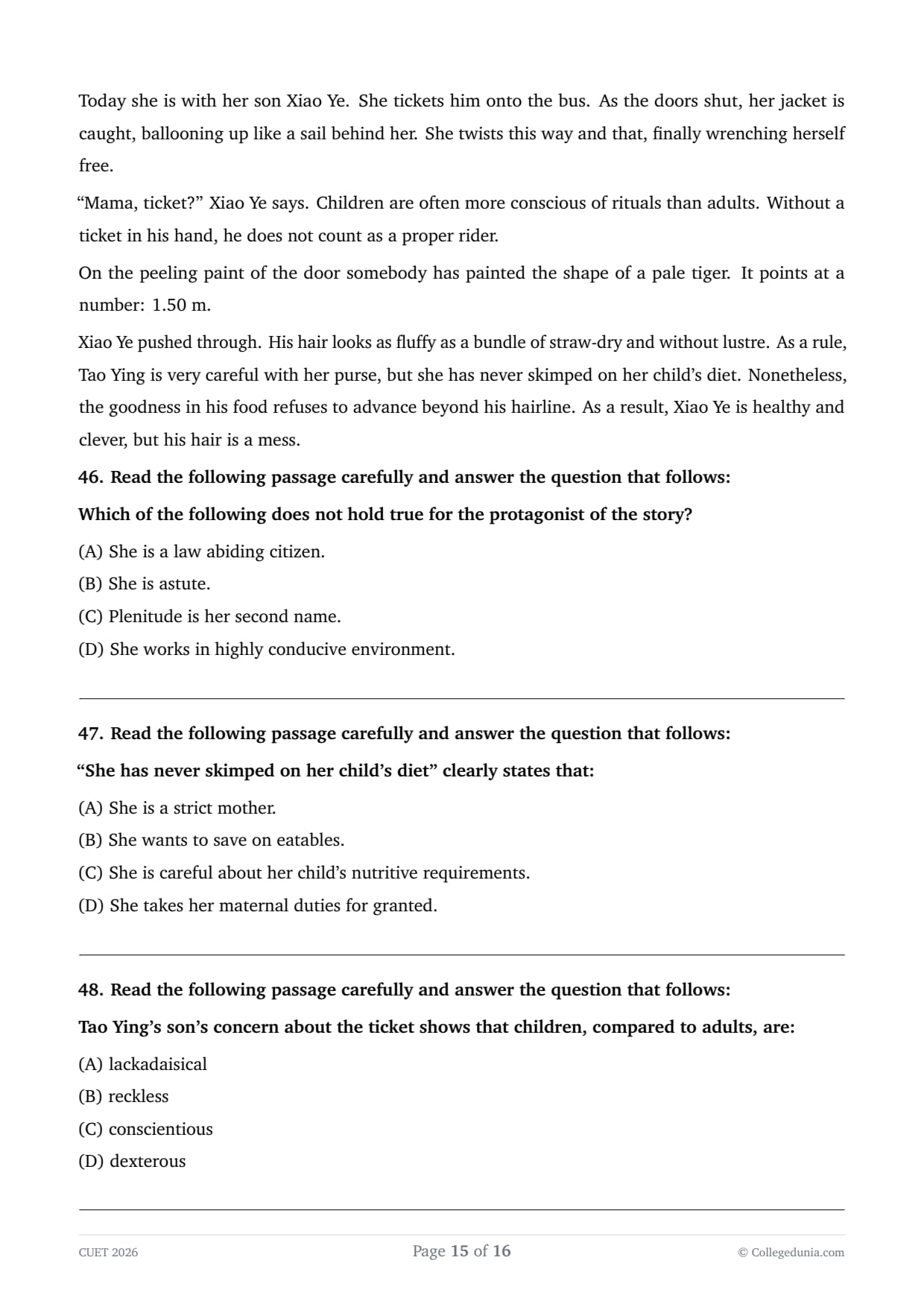
Read the following passage carefully and answer the question that follows:
Which of the following does not hold true for the protagonist of the story?
View Solution
Concept:
This question tests a reader's ability to infer character traits from a passage. Rather than looking for explicitly stated facts, the reader must analyze the actions, behavior, circumstances, and attitudes of the protagonist.
The passage describes Xing Ying, a poor factory worker who faces difficult living and working conditions. Despite her hardships, she remains honest, careful, practical, and hardworking. Therefore, the correct answer must be the statement that contradicts the information given in the passage.
Step 1: Understand the protagonist's circumstances.
The passage describes Xing Ying as:
Working in the canteen of a factory.
Spending most of her day making simple food items.
Living a modest life.
Carrying only a small amount of money.
Being careful with her possessions.
Remaining healthy and cheerful despite hardship.
These details indicate that she does not enjoy luxurious or ideal conditions.
Step 2: Examine Option (A).
The passage narrates an incident involving a bus conductor and a ticket.
Xing Ying believes that one should purchase a ticket immediately upon boarding because it is the proper thing to do.
This reflects honesty and respect for rules.
Therefore,
Option (A) is true
and cannot be the answer.
Step 3: Examine Option (B).
The protagonist is portrayed as practical and sensible.
She carefully manages her limited resources and behaves thoughtfully in daily situations.
Such qualities indicate astuteness and good judgment.
Therefore,
Option (B) is true
and cannot be the answer.
Step 4: Examine Option (C).
The passage repeatedly highlights her positive attitude, contentment, and ability to remain cheerful despite having little.
The expression ``plenitude is her second name'' is used figuratively to suggest richness of spirit and contentment rather than material wealth.
Hence, this statement aligns with the overall characterization.
Therefore,
Option (C) is true
and cannot be the answer.
Step 5: Examine Option (D).
A highly conducive environment implies comfortable surroundings, favorable conditions, and an environment that supports well-being and productivity.
However, the passage presents the opposite picture.
The protagonist:
Lives modestly.
Works long hours.
Has limited resources.
Faces economic hardship.
Performs repetitive factory-related tasks.
These circumstances cannot be described as highly conducive.
Therefore,
Option (D) is not true
for the protagonist.
Step 6: Determine the final answer.
Among all the options, only Option (D) contradicts the information provided in the passage.
Hence, the correct answer is
(D) She works in highly conducive environmentQuick Tip: For inference-based comprehension questions, focus on the protagonist's actions and circumstances rather than isolated words. The option that contradicts the overall portrayal of the character is usually the correct answer when asked ``which does not hold true.''
Read the following passage carefully and answer the question that follows:
``She has never skimped on her child's diet'' clearly states that:
View Solution
Concept:
Reading comprehension questions often require understanding the meaning of a phrase within its context. The phrase should not be interpreted literally or in isolation. Instead, the reader must examine the surrounding sentences to determine the author's intended meaning.
The expression ``to skimp on'' means to spend less than necessary on something important or to provide something in insufficient quantity or quality. Therefore, if a person has never skimped on something, it means that person has always ensured adequate provision of it.
Step 1: Understand the meaning of the phrase ``never skimped''.
The word ``skimp'' means:
To economize excessively.
To provide less than what is needed.
To reduce expenditure at the cost of quality.
Therefore,
Never skimped
means
Never compromised or reduced what was necessary.
Step 2: Analyze the relevant statement in the passage.
The passage mentions that although Tao Ying is very careful with her money and lives a modest life, she has never compromised when it comes to her child's food and well-being.
This shows that she places her child's health above financial considerations.
Thus, the statement highlights her concern for proper nutrition and care.
Step 3: Evaluate each option carefully.
Option (A): She is a strict mother.
The passage does not provide any evidence suggesting strictness in discipline or behavior.
Therefore, this option is incorrect.
Option (B): She wants to save on eatables.
This option conveys exactly the opposite meaning.
If she had never skimped on her child's diet, she does not try to save money at the expense of her child's food.
Therefore, this option is incorrect.
Option (C): She is careful about her child's nutritive requirements.
The statement directly implies that she ensures her child receives proper food and nutrition despite financial difficulties.
Therefore, this option correctly reflects the meaning of the passage.
Option (D): She takes her maternal duties for granted.
The passage portrays her as a responsible and caring mother rather than someone who neglects her duties.
Therefore, this option is incorrect.
Step 4: Determine the most appropriate interpretation.
Since the phrase indicates that Tao Ying never compromises on the quality or adequacy of her child's food, it demonstrates concern for her child's nutritional needs.
Hence,
(C) She is careful about her child's nutritive requirements
is the correct answer. Quick Tip: When a comprehension question asks about the meaning of a phrase, first understand the phrase itself and then examine the context in which it is used. The correct answer is usually the option that best reflects both the literal meaning and the author's intention.
Read the following passage carefully and answer the question that follows:
Tao Ying's son's concern about the ticket shows that children, compared to adults, are:
View Solution
Concept:
Inference-based comprehension questions require the reader to identify character traits from actions and behavior. The answer is not always stated directly; instead, it must be inferred from the evidence provided in the passage.
The passage contains a statement suggesting that children are often more conscious of moral correctness and fairness than adults. Tao Ying's son's concern regarding the bus ticket reflects a strong sense of responsibility and honesty.
Step 1: Identify the relevant event in the passage.
The passage describes how Tao Ying's son becomes concerned about whether the proper ticket has been purchased.
His reaction indicates that he is paying attention to what is right and wrong.
Unlike many adults who may overlook such matters, the child feels strongly about following the rules.
Step 2: Understand what the author's observation implies.
The passage includes the idea that:
Children are often more conscious of rituals and rules than adults.
This means children tend to possess a strong sense of duty, fairness, and correctness.
The son's concern regarding the ticket is an example of such behavior.
Step 3: Understand the meanings of the options.
Lackadaisical
Means careless, lazy, or showing little enthusiasm.
Reckless
Means acting without considering consequences.
Conscientious
Means careful, responsible, dutiful, and guided by moral principles.
Dexterous
Means skillful, especially with the hands.
Step 4: Evaluate each option against the passage.
Option (A): Lackadaisical
The child is attentive rather than careless.
Therefore, this option is incorrect.
Option (B): Reckless
The child's behavior demonstrates responsibility, not recklessness.
Therefore, this option is incorrect.
Option (C): Conscientious
The child's concern about the ticket reflects honesty, duty, and awareness of rules.
These qualities perfectly match the meaning of ``conscientious.''
Therefore, this option is correct.
Option (D): Dexterous
The passage discusses moral concern rather than physical skill.
Therefore, this option is incorrect.
Step 5: Arrive at the final conclusion.
The son's concern regarding the ticket demonstrates responsibility and moral awareness.
Such a person is best described as
Conscientious
Therefore, the correct answer is
(C) conscientiousQuick Tip: For character-inference questions, focus on actions rather than descriptions. A person's behavior often reveals qualities such as honesty, responsibility, courage, or kindness even when these traits are not explicitly stated.
Read the following passage carefully and answer the question that follows:
The poetic device used in the line ``his hair looks as fluffy as a bundle of straw'' is:
View Solution
Concept:
Figures of speech are literary devices used to make language more expressive, vivid, and imaginative. One of the most commonly used figures of speech is a simile.
A simile is a direct comparison between two different things using words such as:
``like'' or ``as''
Its purpose is to help the reader visualize a quality or characteristic more clearly.
Examples:
As brave as a lion.
As white as snow.
She sings like a nightingale.
The baby slept like a log.
Whenever the words ``like'' or ``as'' are used to compare two unlike things, the figure of speech is generally a simile.
Step 1: Examine the given sentence carefully.
The sentence given in the passage is:
``His hair looks as fluffy as a bundle of straw.''
In this statement, the appearance of the boy's hair is being compared to a bundle of straw.
The comparison is made through the phrase:
``as fluffy as''
which is a standard indicator of a simile.
Step 2: Identify the two things being compared.
The comparison is between:
Hair
and
A bundle of straw
The author wishes to emphasize the fluffy, rough, and untidy appearance of the hair by comparing it to straw.
Since the comparison is explicit and uses the word ``as,'' the sentence is a simile.
Step 3: Evaluate each option carefully.
Option (A): Metaphor
A metaphor is an indirect comparison without using ``like'' or ``as.''
Example:
``Time is a thief.''
Since the given sentence uses ``as,'' it is not a metaphor.
Therefore, this option is incorrect.
Option (B): Irony
Irony occurs when the intended meaning differs from the literal meaning.
No such contrast exists in the given sentence.
Therefore, this option is incorrect.
Option (C): Personification
Personification gives human qualities to non-human objects.
The sentence does not assign human qualities to anything.
Therefore, this option is incorrect.
Option (D): Simile
The sentence compares hair and straw using the expression ``as fluffy as.''
This is the defining feature of a simile.
Therefore, this option is correct.
Step 4: Conclude the answer.
Since the sentence contains an explicit comparison using the word ``as,'' the poetic device employed is
Simile
Therefore, the correct answer is
(D) SimileQuick Tip: A quick way to identify a simile is to look for comparison words such as ``like'' and ``as.'' If two unlike things are directly compared using these words, the figure of speech is usually a simile.
Read the following passage carefully and answer the question that follows:
Tao Ying is ``very careful with her purse''. This means that:
View Solution
Concept:
In comprehension passages, phrases are often used to reveal a character's personality and habits. The reader must understand the contextual meaning rather than interpreting the phrase literally.
The phrase ``very careful with her purse'' generally refers to the manner in which a person manages money. It often suggests financial caution, thriftiness, and responsible spending habits.
The passage portrays Tao Ying as a hardworking woman who belongs to a modest economic background and manages her resources carefully.
Step 1: Understand the context in which the phrase is used.
The passage describes Tao Ying as:
A factory canteen worker.
A woman of limited means.
Someone who thinks carefully before spending money.
A responsible mother who prioritizes necessities.
The author notes that she is ``very careful with her purse.''
This statement highlights her attitude toward money.
Step 2: Interpret the expression.
The expression does not mean that she is physically guarding her purse all the time.
Rather, it means that she:
Spends money cautiously.
Avoids unnecessary expenditure.
Values every rupee she earns.
Manages her finances wisely.
Such qualities are characteristic of a frugal person.
Step 3: Evaluate each option carefully.
Option (A): She is paranoid about being robbed.
The passage nowhere suggests fear, anxiety, or paranoia about theft.
Therefore, this option is incorrect.
Option (B): She is particular about carrying the most fashionable purse.
The passage focuses on financial prudence rather than fashion preferences.
Therefore, this option is incorrect.
Option (C): Her purse is an unwanted burden.
The passage does not indicate that she dislikes carrying her purse.
Therefore, this option is incorrect.
Option (D): She is frugal by nature.
A frugal person spends money carefully and avoids waste.
This interpretation perfectly matches the context of the passage.
Therefore, this option is correct.
Step 4: Relate the answer to the character's personality.
Throughout the passage, Tao Ying is depicted as practical, responsible, and economical.
Her careful management of money reflects thrift rather than fear or obsession.
Thus, the phrase ``very careful with her purse'' indicates that she is
frugal by nature
Step 5: Conclude the answer.
The most appropriate interpretation of the expression is:
(D) She is frugal by natureQuick Tip: Expressions involving money often reveal character traits. Words such as economical, thrifty, prudent, careful with money, and frugal usually indicate responsible financial behavior rather than miserliness or fear.
CUET UG 2026 Exam Pattern
| Parameter | Details |
|---|---|
| Exam Name | Common University Entrance Test (CUET UG) 2026 |
| Conducting Body | National Testing Agency (NTA) |
| Exam Mode | Computer-Based Test (CBT) |
| Exam Duration | 60 minutes per test |
| Total Sections | 3 (Languages, Domain Subjects, General Test) |
| Question Type | Multiple Choice Questions (MCQs) |
| Questions per Test | 50 questions (all compulsory) |
| Marking Scheme | +5 for correct, -1 for incorrect |
| Maximum Marks | 250 marks per test |
| Maximum Subject Choices | 5 subjects in total |
| Syllabus Base | Class 12 NCERT (mainly for Domain Subjects) |



Comments