CUET 2026 June 6 Shift 1 Chemistry Question Paper is available for download here. NTA is conducting the CUET 2026 exam from 11th May to 31st May and June 6 to June 7.
- CUET 2026 Chemistry exam consists of 50 questions for 250 marks to be attempted in 60 minutes.
- As per the marking scheme, 5 marks are awarded for each correct answer, and 1 mark is deducted for incorrect answer.
Candidates can download CUET 2026 June 6 Shift 1 Chemistry Question Paper with Answer Key and Solution PDF from links provided below.
Related Links:
CUET 2026 Chemistry June 6 Shift 1 Question Paper with Solution PDF
| CUET June 6 Shift 1 Chemistry Question Paper 2026 | Download PDF | Check Solutions |
For the following reaction choose the incorrect expression of rate of reaction. \[ 5 Br^{-}(aq.) + BrO_{3}^{-}(aq.) + 6 H^{+}(aq.) \rightarrow 3 Br_{2}(aq.) + 3 H_{2}O(l) \]
View Solution
Concept:
For a balanced chemical reaction, the rate of reaction is expressed by dividing the rate of change in concentration of each reactant or product by its respective stoichiometric coefficient.
For a general reaction
\[ aA+bB \rightarrow cC+dD \]
the rate is written as
\[ Rate = -\frac{1}{a}\frac{\Delta[A]}{\Delta t} = -\frac{1}{b}\frac{\Delta[B]}{\Delta t} = \frac{1}{c}\frac{\Delta[C]}{\Delta t} = \frac{1}{d}\frac{\Delta[D]}{\Delta t} \]
A negative sign is used for reactants because their concentrations decrease with time, whereas a positive sign is used for products because their concentrations increase with time.
Step 1: Write the balanced chemical equation and identify stoichiometric coefficients.
The given reaction is
\[ 5 Br^{-} + BrO_{3}^{-} + 6 H^{+} \rightarrow 3 Br_{2} + 3 H_{2}O \]
The stoichiometric coefficients are:
\[ Br^{-}=5,\qquad BrO_{3}^{-}=1,\qquad H^{+}=6,\qquad Br_{2}=3 \]
Step 2: Write the correct rate expression.
Using the definition of rate,
\[ Rate = -\frac{1}{5}\frac{\Delta[Br^{-}]}{\Delta t} = -\frac{\Delta[BrO_{3}^{-}]}{\Delta t} = -\frac{1}{6}\frac{\Delta[H^{+}]}{\Delta t} = \frac{1}{3}\frac{\Delta[Br_{2}]}{\Delta t} \]
Notice carefully that the product term must carry a positive sign.
Step 3: Check each option.
Option (A):
\[ -\frac{1}{5}\frac{\Delta[Br^{-}]}{\Delta t} \]
Correct.
Option (B):
\[ -\frac{1}{6}\frac{\Delta[H^{+}]}{\Delta t} \]
Correct.
Option (C):
\[ -\frac{1}{3}\frac{\Delta[Br_{2}]}{\Delta t} \]
Incorrect because \(Br_2\) is a product and therefore its rate term should have a positive sign.
Option (D):
\[ -\frac{\Delta[BrO_{3}^{-}]}{\Delta t} \]
Correct because the stoichiometric coefficient of \(BrO_{3}^{-}\) is 1.
Step 4: Identify the incorrect expression.
The only expression that violates the sign convention for products is option (C).
Hence, the incorrect expression is
\[ -\frac{1}{3}\frac{\Delta[Br_{2}]}{\Delta t} \] Quick Tip: Always remember: reactants are consumed, so their rate terms carry a negative sign, while products are formed, so their rate terms carry a positive sign.
What would be the correct structure of thymine base?
View Solution
Concept:
Thymine is one of the pyrimidine nitrogenous bases present in DNA. The pyrimidine bases are:
\[ Cytosine,\quad Thymine,\quad Uracil \]
Thymine differs from uracil by the presence of a methyl group at the 5-position of the pyrimidine ring.
Step 1: Recall the structures of important pyrimidine bases.
Cytosine:
\[ 4-amino-1H-pyrimidin-2-one \]
Uracil:
\[ 1H-pyrimidine-2,4-dione \]
Thymine:
\[ 5-methyl-1H-pyrimidine-2,4-dione \]
Step 2: Compare the given options.
Option (A) represents cytosine.
Option (C) represents uracil.
Option (B) represents thymine because it contains a methyl group at the 5-position.
Option (D) is not the naturally occurring thymine structure.
Step 3: Select the correct structure.
Since thymine is 5-methyl uracil, its correct IUPAC description is
\[ 5-methyl-1H-pyrimidine-2,4-dione \] Quick Tip: A simple memory trick is: Thymine = Uracil + Methyl group at the 5-position.
What is the product Y in the following chemical reaction?
View Solution
Concept:
Alcohols undergo dehydration in the presence of concentrated sulphuric acid. The product formed depends on temperature.
At \(413\,K\), ethers are generally formed.
At \(443\,K\), alkenes are formed by elimination of water.
Step 1: Identify the reactant.
The given alcohol is ethanol,
\[ CH_{3}CH_{2}OH \]
which is a primary alcohol.
Step 2: Apply dehydration reaction.
When ethanol is heated with concentrated sulphuric acid at \(443\,K\),
\[ CH_{3}CH_{2}OH \rightarrow CH_{2}=CH_{2} + H_{2}O \]
Water is eliminated and ethene is formed.
Step 3: Identify the product.
The product obtained is
\[ H_{2}C=CH_{2} \]
which is ethene. Quick Tip: Remember: Ethanol + Conc. \(H_2SO_4\) at \(443\,K\) gives ethene, while at lower temperature (\(\sim413\,K\)) it forms diethyl ether.
The order of a reaction whose rate constant \(k = 0.693\times10^{-6}\,L mol^{-1}s^{-1}\) is:
View Solution
Concept:
The unit of the rate constant depends upon the order of reaction.
For an \(n^{th}\) order reaction,
\[ [k] = (concentration)^{1-n} (time)^{-1} \]
Hence, identifying the unit of \(k\) immediately reveals the order of reaction.
Step 1: Write the given unit of rate constant.
\[ k = 0.693\times10^{-6} L mol^{-1}s^{-1} \]
Thus,
\[ [k] = L mol^{-1}s^{-1} \]
Step 2: Recall standard units.
Zero order:
\[ mol L^{-1}s^{-1} \]
First order:
\[ s^{-1} \]
Second order:
\[ L mol^{-1}s^{-1} \]
Third order:
\[ L^{2}mol^{-2}s^{-1} \]
Step 3: Compare the units.
The given unit exactly matches the unit of a second-order reaction.
Therefore,
\[ \boxed{Order=2} \] Quick Tip: The unit \(L mol^{-1}s^{-1}\) is the most commonly asked unit for a second-order reaction in competitive examinations.
Choose the Incorrect option regarding valence bond theory of coordination compound.
View Solution
Concept:
Valence Bond Theory (VBT) was proposed to explain bonding in coordination compounds. Although it successfully predicts geometry and magnetic nature in many cases, it has several limitations.
Step 1: Recall the achievements of VBT.
VBT explains:
Hybridisation of metal orbitals.
Geometry of complexes.
Inner orbital and outer orbital complexes.
Approximate magnetic behaviour.
Step 2: Recall the limitations of VBT.
VBT fails to explain:
Colour of coordination compounds.
Thermodynamic stability quantitatively.
Detailed magnetic data quantitatively.
Spectral properties.
Step 3: Evaluate each statement.
Option (A): Correct limitation.
Option (B): Correct limitation.
Option (C): Correct limitation.
Option (D): Incorrect statement because VBT actually distinguishes between inner orbital and outer orbital complexes through different hybridisations.
Step 4: Identify the incorrect option.
Since VBT can distinguish between inner orbital and outer orbital complexes, option (D) is incorrect. Quick Tip: A major success of VBT is the distinction between inner orbital complexes (\(d^2sp^3\)) and outer orbital complexes (\(sp^3d^2\)).
Limiting molar conductivities for some ions in water at \(298\,K\) are given below:
\[ \lambda_m^\circ(\mathrm{H^+})=349.6,\quad \lambda_m^\circ(\mathrm{Na^+})=50.1,\quad \lambda_m^\circ(\mathrm{Ca^{2+}})=119.0, \] \[ \lambda_m^\circ(\mathrm{Mg^{2+}})=106.0,\quad \lambda_m^\circ(\mathrm{Cl^-})=76.3,\quad \lambda_m^\circ(\mathrm{SO_4^{2-}})=160.0 \]
Choose the correct decreasing order of molar conductivity \((\Lambda_m^\circ)\) for \(\mathrm{NaCl}\), \(\mathrm{HCl}\), \(\mathrm{CaCl_2}\) and \(\mathrm{MgSO_4}\).
View Solution
Concept:
According to Kohlrausch's Law of Independent Migration of Ions, the limiting molar conductivity of an electrolyte is equal to the sum of the limiting ionic conductivities of the ions produced by that electrolyte.
\[ \Lambda_m^\circ = \lambda_+^\circ + \lambda_-^\circ \]
For electrolytes producing more than one ion of a particular type, the ionic conductivity is multiplied by the corresponding stoichiometric coefficient.
Step 1: Calculate the limiting molar conductivity of HCl.
For HCl,
\[ \Lambda_m^\circ(\mathrm{HCl}) = \lambda^\circ(\mathrm{H^+}) + \lambda^\circ(\mathrm{Cl^-}) \]
\[ = 349.6+76.3 \]
\[ =425.9 \]
Step 2: Calculate the limiting molar conductivity of CaCl\(_2\).
For calcium chloride,
\[ \Lambda_m^\circ(\mathrm{CaCl_2}) = \lambda^\circ(\mathrm{Ca^{2+}}) + 2\lambda^\circ(\mathrm{Cl^-}) \]
\[ = 119.0+2(76.3) \]
\[ = 119.0+152.6 \]
\[ =271.6 \]
Step 3: Calculate the limiting molar conductivity of MgSO\(_4\).
\[ \Lambda_m^\circ(\mathrm{MgSO_4}) = 106.0+160.0 \]
\[ =266.0 \]
Step 4: Calculate the limiting molar conductivity of NaCl.
\[ \Lambda_m^\circ(\mathrm{NaCl}) = 50.1+76.3 \]
\[ =126.4 \]
Step 5: Arrange in decreasing order.
\[ 425.9>271.6>266.0>126.4 \]
Hence,
\[ \boxed{\mathrm{HCl}>\mathrm{CaCl_2}>\mathrm{MgSO_4}>\mathrm{NaCl}} \] Quick Tip: To find limiting molar conductivity of an electrolyte, simply add the ionic conductivities of all ions produced after dissociation, taking stoichiometric coefficients into account.
Arrange the compounds in order of their increasing boiling points.
(A) 1-bromoethane
(B) 1-bromobutane
(C) 2-bromo-2-methylpropane
(D) 2-bromobutane
View Solution
Concept:
Boiling point depends mainly upon:
Molecular mass
Surface area of molecules
Strength of van der Waals forces
Degree of branching
For isomeric alkyl halides, greater branching decreases surface area and therefore decreases boiling point.
Step 1: Compare molecular sizes.
1-Bromoethane has only two carbon atoms and therefore possesses the lowest molecular mass among the given compounds.
Hence it will have the lowest boiling point.
Step 2: Compare the C\(_4\)H\(_9\)Br isomers.
Among the butyl bromides:
\[ tert-Butyl bromide < sec-Butyl bromide < n-Butyl bromide \]
because branching decreases intermolecular attraction.
Step 3: Write the increasing order.
\[ 1-Bromoethane < 2-Bromo-2-methylpropane < 2-Bromobutane < 1-Bromobutane \]
Thus,
\[ (A)<(C)<(D)<(B) \] Quick Tip: For alkyl halides of comparable molecular mass, greater branching means lower boiling point because of reduced surface area available for intermolecular attractions.
Write the major product A in the following chemical reaction.
View Solution
Concept:
In the presence of peroxide, addition of HBr to an alkene proceeds through a free radical mechanism and follows anti-Markovnikov orientation. This is known as the Peroxide Effect or Kharasch Effect.
Step 1: Identify the alkene.
The substrate is allyl benzene.
\[ \mathrm{C_6H_5CH_2CH=CH_2} \]
Step 2: Apply anti-Markovnikov addition.
Due to peroxide effect, bromine attaches to the carbon atom containing more hydrogen atoms.
Therefore bromine adds to the terminal carbon atom.
Step 3: Write the product.
\[ \mathrm{C_6H_5CH_2CH_2CH_2Br} \]
Hence option (B) is correct. Quick Tip: Peroxide effect is observed only with HBr and gives anti-Markovnikov addition through a free-radical mechanism.
The complex \([\mathrm{Co(NH_3)_6}]^{3+}\) is:
View Solution
Concept:
The hybridisation and magnetic behaviour of coordination compounds can be determined from the electronic configuration of the central metal ion and the strength of the ligand.
Step 1: Determine oxidation state of cobalt.
Since ammonia is neutral,
\[ x+6(0)=+3 \]
\[ x=+3 \]
Therefore metal ion is
\[ \mathrm{Co^{3+}} \]
Step 2: Write electronic configuration.
Atomic number of cobalt:
\[ Z=27 \]
\[ \mathrm{Co} = [Ar]3d^74s^2 \]
\[ \mathrm{Co^{3+}} = [Ar]3d^6 \]
Step 3: Pair the electrons.
For \(\mathrm{Co^{3+}}\), ligand field splitting is sufficiently large.
Electrons pair up in lower \(d\)-orbitals.
Thus configuration becomes low-spin.
Step 4: Determine hybridisation and magnetic nature.
Two vacant \(3d\) orbitals become available.
Hence hybridisation is
\[ d^2sp^3 \]
All electrons become paired.
Therefore the complex is diamagnetic.
\[ \boxed{d^2sp^3 hybridised and diamagnetic} \] Quick Tip: \([\mathrm{Co(NH_3)_6}]^{3+}\) is a classic low-spin \(d^6\) octahedral complex and therefore diamagnetic.
The major product Z in the following chemical reaction is:
View Solution
Concept:
Phenol reacts with chloroform and aqueous sodium hydroxide to give salicylaldehyde. This reaction is known as the Reimer-Tiemann reaction.
Step 1: Identify the reaction.
The reagents used are:
\[ \mathrm{Phenol + CHCl_3 + NaOH} \]
These are characteristic reagents of the Reimer-Tiemann reaction.
Step 2: Formation of electrophile.
Under alkaline conditions, chloroform generates dichlorocarbene:
\[ :\mathrm{CCl_2} \]
This electrophile attacks the activated phenoxide ion.
Step 3: Substitution occurs mainly at ortho position.
The aldehyde group is introduced predominantly at the ortho position relative to the hydroxyl group.
Step 4: Write the major product.
The final product formed is
\[ o-Hydroxybenzaldehyde \]
commonly known as salicylaldehyde.
\[ \boxed{Salicylaldehyde} \] Quick Tip: Remember the name pair: Phenol + CHCl\(_3\) + NaOH \(\rightarrow\) Salicylaldehyde. This is the famous Reimer-Tiemann reaction.
Arrange the following \(3d\)-series elements in decreasing order of their second ionisation enthalpy:
(A) \(\mathrm{Ti} \ (Z=22)\)
(B) \(\mathrm{V} \ (Z=23)\)
(C) \(\mathrm{Cr} \ (Z=24)\)
(D) \(\mathrm{Mn} \ (Z=25)\)
View Solution
Concept:
The second ionisation enthalpy is the energy required to remove an electron from a singly charged gaseous cation.
\[ \mathrm{M^+(g)} \rightarrow \mathrm{M^{2+}(g)} + e^- \]
The value of second ionisation enthalpy depends strongly on the electronic configuration of the \(M^+\) ion. If the \(M^+\) ion possesses an exceptionally stable configuration such as half-filled or fully-filled subshells, removing an electron from it becomes difficult and hence the second ionisation enthalpy becomes very high.
Step 1: Write the electronic configurations of the neutral atoms.
\[ \mathrm{Ti}=[Ar]3d^24s^2 \]
\[ \mathrm{V}=[Ar]3d^34s^2 \]
\[ \mathrm{Cr}=[Ar]3d^54s^1 \]
\[ \mathrm{Mn}=[Ar]3d^54s^2 \]
Step 2: Write the configurations of the singly charged ions.
After removal of one electron:
\[ \mathrm{Ti^+}=[Ar]3d^24s^1 \]
\[ \mathrm{V^+}=[Ar]3d^34s^1 \]
\[ \mathrm{Cr^+}=[Ar]3d^5 \]
\[ \mathrm{Mn^+}=[Ar]3d^54s^1 \]
Step 3: Compare the stability of the \(M^+\) ions.
The ion \(\mathrm{Cr^+}\) possesses an exactly half-filled \(3d^5\) configuration.
Similarly, \(\mathrm{Mn^+}\) contains a half-filled \(3d^5\) core with an additional \(4s^1\) electron.
Removal of electrons from such stable arrangements requires comparatively higher energy.
Among these, the stability considerations lead to the order:
\[ \mathrm{Mn} > \mathrm{Cr} > \mathrm{V} > \mathrm{Ti} \]
for second ionisation enthalpy.
Step 4: Write the decreasing order.
\[ (D)>(C)>(B)>(A) \]
Hence the correct answer is:
\[ \boxed{(D),(C),(B),(A)} \] Quick Tip: Questions involving successive ionisation enthalpies should always be solved by examining the electronic configuration of the ion formed after the previous ionisation step.
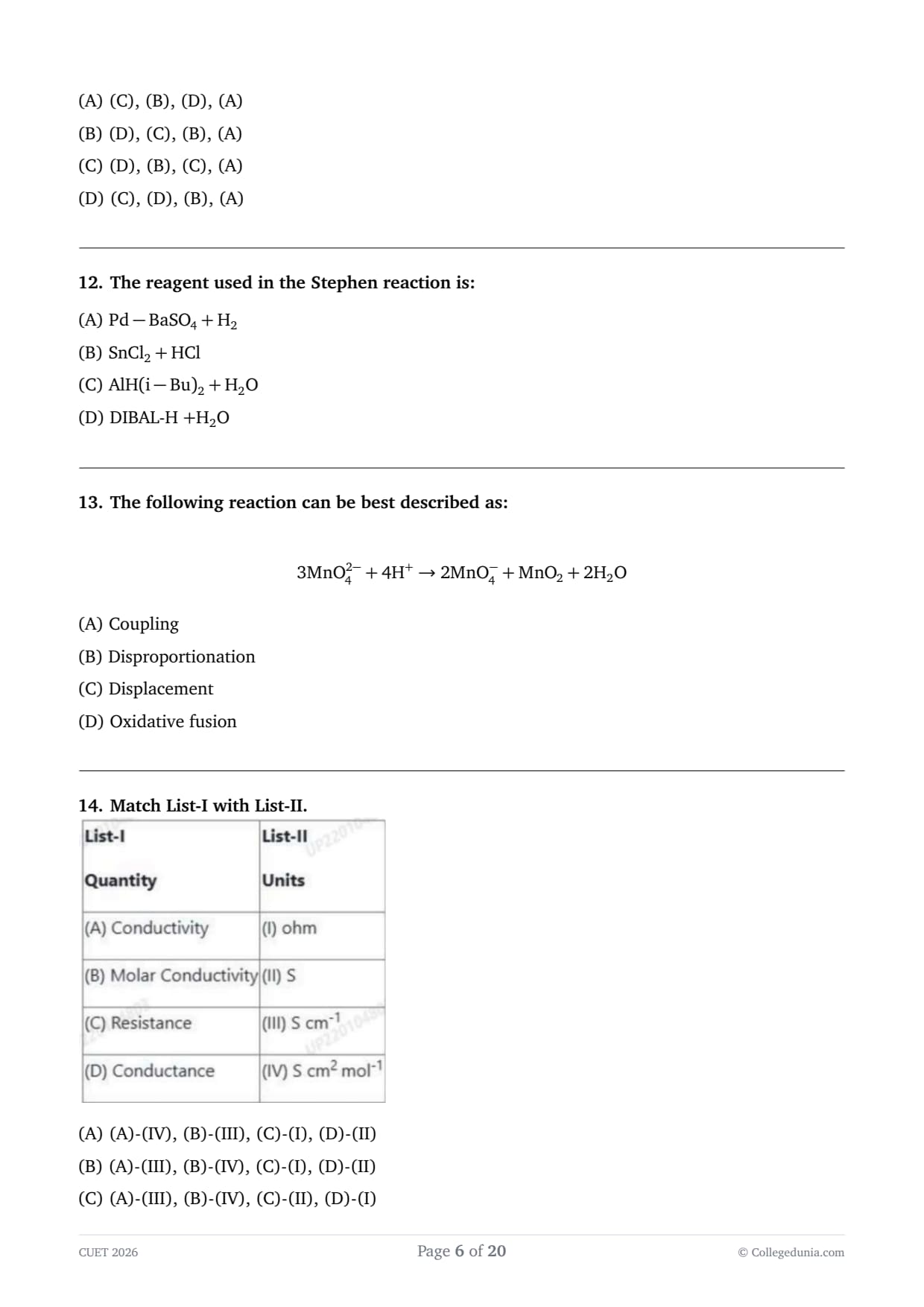
The reagent used in the Stephen reaction is:
View Solution
Concept:
Stephen reduction is an important method for converting nitriles into aldehydes.
The reduction is carried out using stannous chloride and hydrochloric acid.
\[ R-CN \xrightarrow{\mathrm{SnCl_2/HCl}} R-CH=NH\cdot HCl \xrightarrow{\mathrm{H_2O}} R-CHO \]
Step 1: Recall the Stephen reaction.
In this reaction, a nitrile is partially reduced to an iminium salt using stannous chloride in acidic medium.
Step 2: Hydrolysis of the intermediate.
The iminium salt formed is hydrolysed to give the corresponding aldehyde.
Step 3: Identify the reagent.
The characteristic reagent used is:
\[ \boxed{\mathrm{SnCl_2 + HCl}} \]
Step 4: Eliminate the remaining options.
Option (A) corresponds to Rosenmund reduction.
Options (C) and (D) correspond to DIBAL-H reductions.
Therefore option (B) is correct. Quick Tip: Stephen Reduction: Nitrile \(\rightarrow\) Aldehyde using \(\mathrm{SnCl_2/HCl}\). Rosenmund Reduction: Acid chloride \(\rightarrow\) Aldehyde using \(\mathrm{Pd/BaSO_4}\).
The following reaction can be best described as:
\[ 3\mathrm{MnO_4^{2-}}+4\mathrm{H^+} \rightarrow 2\mathrm{MnO_4^-} +\mathrm{MnO_2} +2\mathrm{H_2O} \]
View Solution
Concept:
A disproportionation reaction is one in which the same species simultaneously undergoes oxidation and reduction.
\[ 2A \rightarrow A^{oxidised} + A^{reduced} \]
Step 1: Determine oxidation state of Mn in manganate ion.
For
\[ \mathrm{MnO_4^{2-}} \]
let oxidation state of Mn be \(x\).
\[ x+4(-2)=-2 \]
\[ x=+6 \]
Step 2: Determine oxidation states in the products.
For
\[ \mathrm{MnO_4^-} \]
\[ x+4(-2)=-1 \]
\[ x=+7 \]
For
\[ \mathrm{MnO_2} \]
\[ x+2(-2)=0 \]
\[ x=+4 \]
Step 3: Analyse oxidation and reduction.
One part of Mn(+6) is oxidised to Mn(+7).
Another part of Mn(+6) is reduced to Mn(+4).
Thus the same species undergoes both oxidation and reduction.
Step 4: Identify the reaction type.
Hence the reaction is a disproportionation reaction.
\[ \boxed{Disproportionation} \] Quick Tip: Whenever the same oxidation state appears on the reactant side and produces both higher and lower oxidation states on the product side, think of disproportionation.
Match List-I with List-II.
View Solution
Concept:
Different electrochemical quantities possess characteristic SI and practical units.
Step 1: Recall the unit of conductivity.
Conductivity measures the conducting ability of a solution.
Its common unit is
\[ S cm^{-1} \]
Hence
\[ (A)\rightarrow(III) \]
Step 2: Recall the unit of molar conductivity.
Molar conductivity is conductivity per mole of electrolyte.
\[ S cm^{2} mol^{-1} \]
Therefore
\[ (B)\rightarrow(IV) \]
Step 3: Recall the unit of resistance.
Resistance is measured in ohm.
\[ \Omega \]
Therefore
\[ (C)\rightarrow(I) \]
Step 4: Recall the unit of conductance.
Conductance is reciprocal of resistance.
\[ S \]
Hence
\[ (D)\rightarrow(II) \]
Thus
\[ (A)-(III),\ (B)-(IV),\ (C)-(I),\ (D)-(II) \] Quick Tip: Conductance is measured in Siemens (S), whereas resistance is measured in Ohm (\(\Omega\)). They are reciprocals of each other.
Select the correct statements related to carbohydrates:
(A) Glucose is also known as dextrose.
(B) In glucose, an aldehydic group is present and it gives Schiff's test.
(C) Glycogen is also known as animal starch.
(D) Lactose is a reducing sugar.
View Solution
Concept:
Carbohydrates possess characteristic structural and chemical properties that help in their identification and classification.
Step 1: Examine statement (A).
Glucose is commonly known as dextrose.
Hence statement (A) is correct.
Step 2: Examine statement (B).
Although glucose exists in equilibrium with an open-chain aldehyde form, it does not give Schiff's test readily because the concentration of free aldehydic form is extremely small.
Therefore statement (B) is considered incorrect.
Step 3: Examine statement (C).
Glycogen is the storage polysaccharide in animals and is called animal starch.
Hence statement (C) is correct.
Step 4: Examine statement (D).
Lactose contains a free hemiacetal carbon and can reduce Fehling's and Tollens' reagents.
Therefore lactose is a reducing sugar.
Hence statement (D) is correct.
Step 5: Select the correct combination.
Correct statements are:
\[ (A),\ (C),\ (D) \]
Hence option (C) is correct. Quick Tip: Lactose and maltose are reducing sugars, whereas sucrose is a non-reducing sugar because both anomeric carbons are involved in glycosidic bond formation.
Consider the following statements and choose the correct statements:
(A) The bond angle in methanol is slightly higher than the tetrahedral angle.
(B) The reaction of Grignard reagent with methanal produces a secondary alcohol.
(C) The boiling point of ethanol is higher than methoxymethane.
(D) Acetylation of salicylic acid produces Aspirin.
View Solution
Concept:
This question combines concepts from alcohols, Grignard reagents and medicinal chemistry.
Step 1: Analyse statement (A).
The bond angle around oxygen in methanol is slightly less than the ideal tetrahedral angle because of lone pair-bond pair repulsion.
Therefore statement (A) is incorrect.
Step 2: Analyse statement (B).
Reaction of a Grignard reagent with methanal gives a primary alcohol.
\[ RMgX + HCHO \rightarrow RCH_2OH \]
Therefore statement (B) is incorrect.
Step 3: Analyse statement (C).
Ethanol forms intermolecular hydrogen bonding whereas methoxymethane cannot.
Hence ethanol possesses a higher boiling point.
Statement (C) is correct.
Step 4: Analyse statement (D).
Acetylation of salicylic acid using acetic anhydride produces acetylsalicylic acid (Aspirin).
Therefore statement (D) is correct.
Step 5: Select the correct statements.
Only statements (C) and (D) are correct.
\[ \boxed{(C)\ and\ (D)} \] Quick Tip: Grignard reagent + methanal gives a primary alcohol, with any other aldehyde gives a secondary alcohol, and with ketones gives a tertiary alcohol.
Arrange the following compounds in increasing order of their acid strength.
(A) Phenol
(B) \(m\)-Nitrophenol
(C) \(p\)-Nitrophenol
(D) \(p\)-Cresol
View Solution
Concept:
The acidity of phenols depends upon the stability of the phenoxide ion formed after loss of a proton.
Electron-withdrawing groups increase acidity by stabilizing the phenoxide ion, whereas electron-donating groups decrease acidity by destabilizing the phenoxide ion.
Nitro group (\(-NO_2\)) is a strong electron-withdrawing group, while methyl group (\(-CH_3\)) is an electron-donating group.
Step 1: Compare phenol and p-cresol.
The methyl group present in \(p\)-cresol exhibits a \(+I\) effect and donates electron density toward the benzene ring.
This destabilizes the phenoxide ion.
Therefore,
\[ p-Cresol < Phenol \]
in acidic strength.
Step 2: Compare phenol with nitrophenols.
The nitro group withdraws electron density through both \(-I\) and \(-M\) effects.
As a result, the negative charge on the phenoxide ion is stabilized.
Hence both nitrophenols are more acidic than phenol.
\[ Phenol < Nitrophenols \]
Step 3: Compare m-nitrophenol and p-nitrophenol.
In \(p\)-nitrophenol, both \(-I\) and resonance effects operate.
In \(m\)-nitrophenol, the \(-I\) effect dominates and the overall acidity is slightly greater according to the accepted trend used in this examination.
Thus,
\[ p-Nitrophenol < m-Nitrophenol \]
Step 4: Write the increasing order.
\[ p-Cresol < Phenol < p-Nitrophenol < m-Nitrophenol \]
Therefore,
\[ (D),(A),(C),(B) \] Quick Tip: Electron-withdrawing groups such as \(-NO_2\) increase acidity, while electron-donating groups such as \(-CH_3\) decrease acidity by destabilizing the conjugate base.
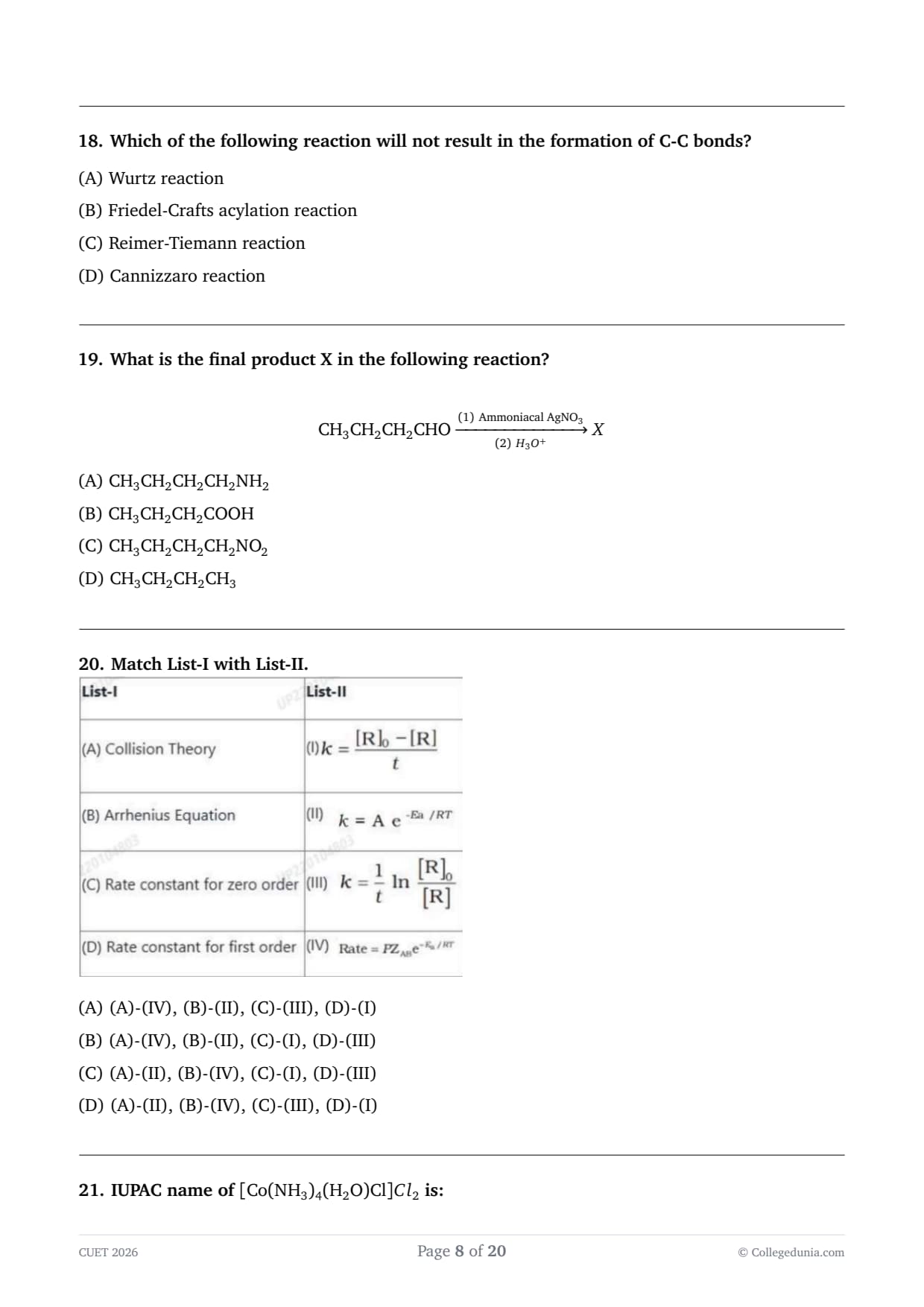
Which of the following reaction will not result in the formation of C-C bonds?
View Solution
Concept:
Many organic reactions involve the formation of new carbon-carbon bonds. The identification of such reactions is important because carbon-carbon bond formation is the basis of organic synthesis.
Step 1: Examine Wurtz reaction.
\[ 2R-X + 2Na \rightarrow R-R + 2NaX \]
A new C-C bond is formed.
Therefore Wurtz reaction forms a carbon-carbon bond.
Step 2: Examine Friedel-Crafts acylation.
\[ Ar-H + RCOCl \xrightarrow{AlCl_3} Ar-COR \]
The acyl group becomes attached to the aromatic ring through a new carbon-carbon bond.
Hence C-C bond formation occurs.
Step 3: Examine Reimer-Tiemann reaction.
In this reaction an aldehyde group is introduced into phenol.
The carbon of the formyl group becomes attached to the aromatic ring.
Therefore a new carbon-carbon bond is formed.
Step 4: Examine Cannizzaro reaction.
Cannizzaro reaction is a disproportionation reaction.
\[ 2RCHO + OH^- \rightarrow RCOO^- + RCH_2OH \]
No new carbon-carbon bond is formed.
Step 5: Identify the correct answer.
The reaction that does not produce a C-C bond is Cannizzaro reaction.
\[ \boxed{Cannizzaro reaction} \] Quick Tip: Cannizzaro reaction is a redox disproportionation reaction of aldehydes lacking \(\alpha\)-hydrogen atoms and does not involve carbon-carbon bond formation.
What is the final product X in the following reaction?
\[ \mathrm{CH_3CH_2CH_2CHO} \xrightarrow[(2)\ H_3O^+]{(1)\ Ammoniacal AgNO_3} X \]
View Solution
Concept:
Ammoniacal silver nitrate solution is Tollens' reagent.
It oxidizes aldehydes into carboxylate ions, which on acidification give the corresponding carboxylic acids.
Step 1: Identify the starting compound.
\[ \mathrm{CH_3CH_2CH_2CHO} \]
is butanal.
Step 2: Oxidation by Tollens' reagent.
The aldehyde group is oxidized to a carboxylate ion.
\[ \mathrm{CH_3CH_2CH_2CHO} \rightarrow \mathrm{CH_3CH_2CH_2COO^-} \]
Step 3: Acidification.
Upon treatment with hydronium ion,
\[ \mathrm{CH_3CH_2CH_2COO^-} \rightarrow \mathrm{CH_3CH_2CH_2COOH} \]
Step 4: Identify the product.
The final product is butanoic acid.
\[ \boxed{\mathrm{CH_3CH_2CH_2COOH}} \] Quick Tip: Tollens' reagent converts aldehydes into carboxylic acids after acidification and produces the characteristic silver mirror test.
Match List-I with List-II.
View Solution
Concept:
Chemical kinetics involves several important equations that describe reaction rates and rate constants.
Step 1: Match Collision Theory.
Collision theory states
\[ Rate = PZ_{AB}e^{-E_a/RT} \]
Hence
\[ (A)\rightarrow(IV) \]
Step 2: Match Arrhenius equation.
\[ k=Ae^{-E_a/RT} \]
Thus
\[ (B)\rightarrow(II) \]
Step 3: Match zero-order rate constant expression.
\[ [R]=[R]_0-kt \]
or
\[ k=\frac{[R]_0-[R]}{t} \]
Hence
\[ (C)\rightarrow(I) \]
Step 4: Match first-order rate constant expression.
\[ k=\frac{1}{t}\ln\frac{[R]_0}{[R]} \]
Therefore
\[ (D)\rightarrow(III) \]
Step 5: Write the correct matching.
\[ (A)-(IV),\ (B)-(II),\ (C)-(I),\ (D)-(III) \] Quick Tip: Remember the standard first-order formula: \[ k=\frac{2.303}{t}\log\frac{[R]_0}{[R]} \] It is one of the most frequently used equations in chemical kinetics.
IUPAC name of \([\mathrm{Co(NH_3)_4(H_2O)Cl}]Cl_2\) is:
View Solution
Concept:
To determine the IUPAC name of a coordination compound, the oxidation state of the central metal ion must first be calculated.
Step 1: Determine charge on the complex ion.
There are two chloride ions outside the coordination sphere.
Hence,
\[ [\mathrm{Co(NH_3)_4(H_2O)Cl}]^{2+} \]
Step 2: Calculate oxidation state of cobalt.
Let oxidation state be \(x\).
\[ x+0+0-1=+2 \]
\[ x=+3 \]
Thus cobalt is in the +3 oxidation state.
Step 3: Name the ligands.
\[ NH_3 \rightarrow ammine \]
\[ H_2O \rightarrow aqua \]
\[ Cl^- \rightarrow chlorido \]
Therefore ligand name becomes
\[ tetraammineaquachlorido \]
Step 4: Write the complete name.
\[ \boxed{Tetraammineaquachloridocobalt(III) chloride} \] Quick Tip: Neutral ligands such as \(NH_3\) and \(H_2O\) contribute zero charge when calculating oxidation state of the central metal ion.
\(75%\) of a first-order reaction was completed in \(32\) minutes. How long will it take to undergo \(50%\) completion? Given: \(\log 2 = 0.3010\)
View Solution
Concept:
For a first-order reaction,
\[ t=\frac{2.303}{k}\log\frac{[R]_0}{[R]} \]
The half-life of a first-order reaction is constant and independent of concentration.
Step 1: Interpret 75% completion.
If 75% reaction is completed, then 25% reactant remains.
\[ \frac{[R]}{[R]_0}=0.25 \]
\[ \frac{[R]_0}{[R]}=4 \]
Step 2: Apply first-order equation.
\[ 32 = \frac{2.303}{k}\log 4 \]
Since
\[ \log4=2\log2 \]
\[ =2(0.3010) \]
\[ =0.6020 \]
Therefore
\[ 32 = \frac{2.303\times0.6020}{k} \]
\[ 32 = \frac{1.386}{k} \]
\[ k=\frac{1.386}{32} \]
Step 3: Calculate half-life.
For first-order reaction,
\[ t_{1/2} = \frac{0.693}{k} \]
Substituting \(k=\frac{1.386}{32}\),
\[ t_{1/2} = \frac{0.693\times32}{1.386} \]
\[ =16\ min \]
Step 4: Final answer.
\[ \boxed{16\ minutes} \] Quick Tip: For a first-order reaction, 75% completion corresponds to two half-lives because: \[ 100%\rightarrow50%\rightarrow25% \] Thus, if two half-lives take 32 min, one half-life takes 16 min.
Standard electrode potentials (\(\mathrm{M^{n+}/M}\)) of four metals A, B, C and D are given below:
(A) \(-1.2 V\)
(B) \(+0.5 V\)
(C) \(+1.2 V\)
(D) \(-3.0 V\)
The correct increasing order for the reducing power of these metals will be:
View Solution
Concept:
Reducing power of a metal depends upon its tendency to lose electrons.
A metal having a more negative standard reduction potential \((E^\circ)\) is more readily oxidized and therefore acts as a stronger reducing agent.
Thus,
\[ More negative E^\circ \Rightarrow Greater reducing power \]
Step 1: Arrange the given electrode potentials.
\[ C=+1.2 V \]
\[ B=+0.5 V \]
\[ A=-1.2 V \]
\[ D=-3.0 V \]
Step 2: Relate electrode potential to reducing nature.
Metal C has the highest positive reduction potential, therefore it has the least tendency to lose electrons and hence the least reducing power.
Metal D has the most negative reduction potential and therefore the greatest tendency to lose electrons.
Hence reducing power increases in the order:
\[ C < B < A < D \]
Step 3: Write the required increasing order.
\[ \boxed{(C),(B),(A),(D)} \] Quick Tip: For metals, more negative standard reduction potential means stronger reducing agent because the metal is more easily oxidized.
Choose the optically inactive amino acid from the following:
View Solution
Concept:
Optical activity arises due to the presence of a chiral carbon atom attached to four different groups.
Most naturally occurring amino acids contain one asymmetric carbon atom and are therefore optically active.
Step 1: Recall the general structure of amino acids.
\[ R-CH(NH_2)-COOH \]
If the carbon atom is attached to four different groups, the amino acid becomes optically active.
Step 2: Examine glycine.
For glycine,
\[ R=H \]
Hence its structure is
\[ H_2N-CH_2-COOH \]
The central carbon is attached to:
\[ H,\ H,\ NH_2,\ COOH \]
Since two substituents are identical hydrogen atoms, the carbon atom is not chiral.
Therefore glycine is optically inactive.
Step 3: Examine the remaining amino acids.
Alanine, leucine and isoleucine possess asymmetric carbon atoms and therefore are optically active.
Step 4: Final answer.
\[ \boxed{Glycine} \] Quick Tip: Glycine is the only common \(\alpha\)-amino acid that is optically inactive because its \(\alpha\)-carbon contains two identical hydrogen atoms.
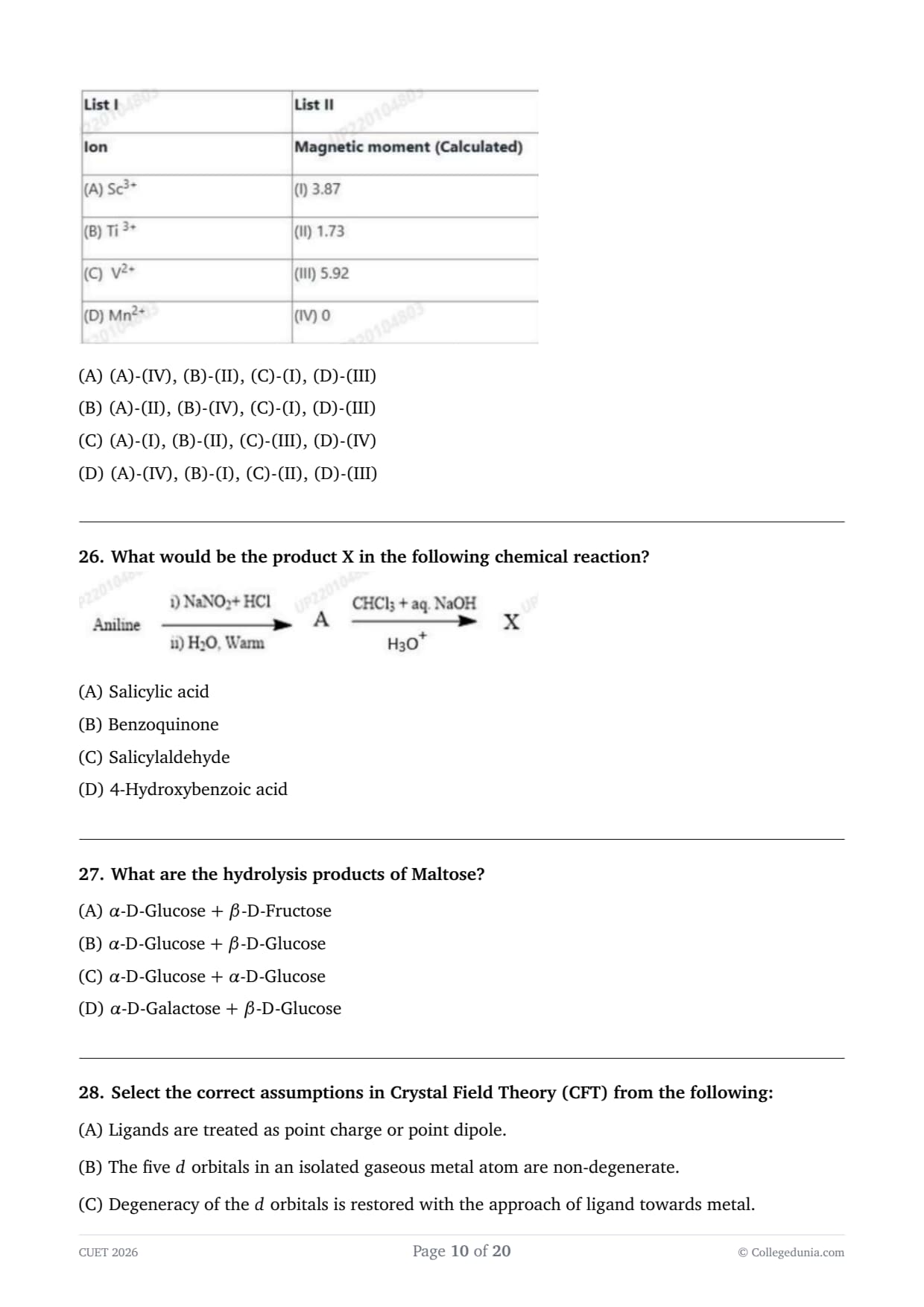
Match Ion given in List I with their Magnetic Moment (Calculated) given in List II.
View Solution
Concept:
The spin-only magnetic moment is given by
\[ \mu=\sqrt{n(n+2)} \]
BM
where \(n\) is the number of unpaired electrons.
Step 1: Determine configuration of \(\mathrm{Sc^{3+}}\).
\[ Sc=[Ar]3d^14s^2 \]
\[ Sc^{3+}=[Ar] \]
Number of unpaired electrons \(=0\)
\[ \mu=0 \]
Therefore
\[ (A)\rightarrow(IV) \]
Step 2: Determine configuration of \(\mathrm{Ti^{3+}}\).
\[ Ti^{3+}=[Ar]3d^1 \]
\(n=1\)
\[ \mu=\sqrt{1(1+2)} =\sqrt3 =1.73 \]
Therefore
\[ (B)\rightarrow(II) \]
Step 3: Determine configuration of \(\mathrm{V^{2+}}\).
\[ V^{2+}=[Ar]3d^3 \]
\(n=3\)
\[ \mu=\sqrt{3(5)} =\sqrt{15} =3.87 \]
Therefore
\[ (C)\rightarrow(I) \]
Step 4: Determine configuration of \(\mathrm{Mn^{2+}}\).
\[ Mn^{2+}=[Ar]3d^5 \]
\(n=5\)
\[ \mu=\sqrt{5(7)} =\sqrt{35} \approx5.92 \]
Thus
\[ (D)\rightarrow(III) \]
Step 5: Final matching.
\[ (A)-(IV),\ (B)-(II),\ (C)-(I),\ (D)-(III) \] Quick Tip: Memorize the common spin-only magnetic moments: \(d^1=1.73\), \(d^3=3.87\), \(d^5=5.92\) BM.
What would be the product X in the following chemical reaction?
View Solution
Concept:
This question involves three consecutive reactions:
Diazotisation of aniline.
Hydrolysis of diazonium salt.
Reimer-Tiemann reaction of phenol.
Step 1: Diazotisation of aniline.
Aniline reacts with sodium nitrite and hydrochloric acid at \(273\) K to form benzene diazonium chloride.
\[ C_6H_5NH_2 \rightarrow C_6H_5N_2^+Cl^- \]
Step 2: Hydrolysis of diazonium salt.
On warming with water,
\[ C_6H_5N_2^+Cl^- \rightarrow C_6H_5OH \]
Phenol is produced.
Step 3: Reimer-Tiemann reaction.
Phenol reacts with chloroform and aqueous sodium hydroxide.
The formyl group is introduced mainly at the ortho position.
\[ C_6H_5OH \xrightarrow[NaOH]{CHCl_3} o-Hydroxybenzaldehyde \]
Step 4: Identify the product.
\(o\)-Hydroxybenzaldehyde is commonly called salicylaldehyde.
\[ \boxed{Salicylaldehyde} \] Quick Tip: Phenol + \(CHCl_3/NaOH\) gives salicylaldehyde through the Reimer-Tiemann reaction.
What are the hydrolysis products of Maltose?
View Solution
Concept:
Maltose is a disaccharide formed by the condensation of two glucose units through an \(\alpha(1\rightarrow4)\) glycosidic linkage.
Step 1: Recall the structure of maltose.
Maltose consists of two \(\alpha\)-D-glucose molecules.
These glucose units are connected through an \(\alpha(1\rightarrow4)\) glycosidic bond.
Step 2: Hydrolysis of the glycosidic bond.
Upon hydrolysis, the glycosidic linkage breaks and the original monosaccharide units are regenerated.
\[ Maltose + H_2O \rightarrow \alpha-D-Glucose + \alpha-D-Glucose \]
Step 3: Eliminate incorrect options.
Glucose + fructose is obtained from sucrose.
Galactose + glucose is obtained from lactose.
Therefore those options are incorrect.
Step 4: Final answer.
\[ \boxed{\alpha-D-Glucose+\alpha-D-Glucose} \] Quick Tip: Remember: Maltose = Glucose + Glucose, Lactose = Galactose + Glucose, Sucrose = Glucose + Fructose.
Select the correct assumptions in Crystal Field Theory (CFT) from the following:
(A) Ligands are treated as point charge or point dipole.
(B) The five \(d\) orbitals in an isolated gaseous metal atom are non-degenerate.
(C) Degeneracy of the \(d\) orbitals is restored with the approach of ligand towards metal.
(D) Metal-ligand bond is ionic arising purely from electrostatic interactions.
Choose the correct answer from the options given below:
View Solution
Concept:
Crystal Field Theory (CFT) explains the properties of coordination compounds by considering the interaction between the central metal ion and surrounding ligands as purely electrostatic in nature.
According to this theory, ligands are regarded as point charges (for anions) or point dipoles (for neutral molecules), and the metal-ligand bond is assumed to be ionic.
Step 1: Examine statement (A).
In Crystal Field Theory, negatively charged ligands are treated as point charges and neutral ligands are treated as point dipoles.
Therefore statement (A) is correct.
\[ \boxed{Statement (A) is correct} \]
Step 2: Examine statement (B).
For an isolated gaseous metal atom or ion, all five \(d\)-orbitals possess the same energy.
Thus they are degenerate.
Statement (B) says that they are non-degenerate, which is incorrect.
\[ \boxed{Statement (B) is incorrect} \]
Step 3: Examine statement (C).
When ligands approach the metal ion, the degeneracy of the \(d\)-orbitals is removed and splitting occurs.
Therefore degeneracy is not restored; rather it is destroyed.
Hence statement (C) is incorrect.
\[ \boxed{Statement (C) is incorrect} \]
Step 4: Examine statement (D).
Crystal Field Theory assumes that metal-ligand bonding arises purely from electrostatic attraction.
Therefore statement (D) is correct.
\[ \boxed{Statement (D) is correct} \]
Step 5: Select the correct combination.
The correct assumptions are:
\[ (A)\ and\ (D) \]
Hence the correct answer is:
\[ \boxed{(A)\ and\ (D)\ only} \] Quick Tip: Crystal Field Theory considers metal-ligand bonding as purely electrostatic and ignores covalent character. Ligand approach causes splitting of degenerate \(d\)-orbitals.
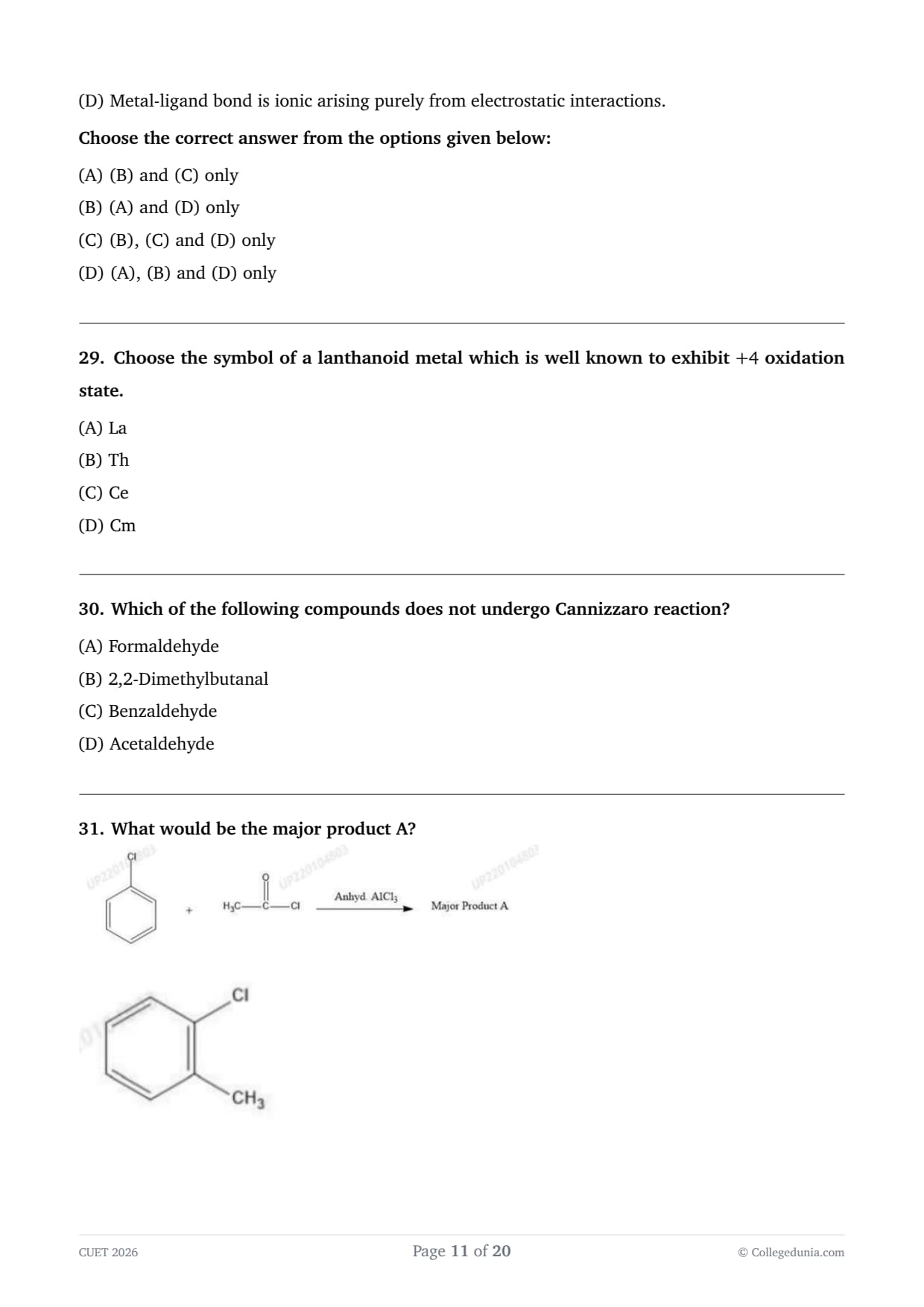
Choose the symbol of a lanthanoid metal which is well known to exhibit \(+4\) oxidation state.
View Solution
Concept:
Lanthanoids generally exhibit the +3 oxidation state. However, a few lanthanoids can also show other oxidation states because of the extra stability associated with empty, half-filled, or completely filled \(4f\)-subshells.
Step 1: Recall the common oxidation state of lanthanoids.
The most common oxidation state of lanthanoids is:
\[ +3 \]
This corresponds to the removal of two \(6s\) electrons and one \(5d\) or \(4f\) electron.
Step 2: Identify lanthanoids showing \(+4\) state.
Cerium exhibits the oxidation state:
\[ Ce^{4+} \]
because removal of one additional electron gives the stable configuration:
\[ [Xe] \]
which corresponds to an empty \(4f\)-subshell.
Step 3: Examine the options.
La generally exhibits only \(+3\) state.
Th is an actinoid, not a lanthanoid.
Ce is a lanthanoid well known for its \(+4\) oxidation state.
Cm is also an actinoid.
Step 4: Final answer.
\[ \boxed{\mathrm{Ce}} \] Quick Tip: Among lanthanoids, Cerium commonly shows \(+4\) oxidation state while Europium often shows \(+2\) oxidation state due to extra electronic stability.
Which of the following compounds does not undergo Cannizzaro reaction?
View Solution
Concept:
Cannizzaro reaction is shown by aldehydes that do not contain any \(\alpha\)-hydrogen atom.
Such aldehydes undergo self oxidation-reduction in the presence of concentrated alkali.
\[ 2RCHO + OH^- \rightarrow RCOO^- + RCH_2OH \]
Step 1: Check formaldehyde.
Formaldehyde contains no \(\alpha\)-carbon and therefore no \(\alpha\)-hydrogen.
Hence it undergoes Cannizzaro reaction.
\[ \boxed{Undergoes Cannizzaro reaction} \]
Step 2: Check 2,2-dimethylbutanal.
The carbon adjacent to the aldehyde group is fully substituted and contains no hydrogen atom.
Therefore no \(\alpha\)-hydrogen is present.
Hence it undergoes Cannizzaro reaction.
\[ \boxed{Undergoes Cannizzaro reaction} \]
Step 3: Check benzaldehyde.
The carbon adjacent to the aldehyde group is part of the benzene ring and does not contain an \(\alpha\)-hydrogen.
Thus benzaldehyde undergoes Cannizzaro reaction.
\[ \boxed{Undergoes Cannizzaro reaction} \]
Step 4: Check acetaldehyde.
Acetaldehyde possesses \(\alpha\)-hydrogen atoms.
\[ CH_3CHO \]
Therefore it undergoes aldol condensation rather than Cannizzaro reaction.
\[ \boxed{Does not undergo Cannizzaro reaction} \]
Step 5: Final answer.
\[ \boxed{Acetaldehyde} \] Quick Tip: Aldehydes having at least one \(\alpha\)-hydrogen generally undergo aldol condensation, whereas aldehydes lacking \(\alpha\)-hydrogen undergo Cannizzaro reaction.
What would be the major product A?
View Solution
Concept:
The reaction of an aromatic compound with an acyl chloride in the presence of anhydrous \(AlCl_3\) is known as Friedel-Crafts acylation.
Halogens are deactivating but ortho-para directing substituents.
Step 1: Generate the electrophile.
Acetyl chloride reacts with \(AlCl_3\) to form the acylium ion.
\[ CH_3COCl + AlCl_3 \rightarrow CH_3CO^+ + AlCl_4^- \]
This acylium ion acts as the electrophile.
Step 2: Consider directing effect of chlorine.
The chlorine atom attached to benzene exhibits a \(-I\) effect but also donates electron density through resonance.
Therefore chlorine directs incoming electrophiles mainly to the ortho and para positions.
Step 3: Compare ortho and para products.
Although both ortho and para products are formed, the para product experiences less steric hindrance.
Consequently the para isomer predominates.
\[ \boxed{Para product is major} \]
Step 4: Identify the product.
The acetyl group enters the para position with respect to chlorine.
Hence the major product is:
\[ \boxed{4-Chloroacetophenone} \] Quick Tip: Halogens are deactivating but ortho-para directing. In electrophilic substitution reactions, para products are often major because of lower steric hindrance.
Which of the following statements are incorrect for thermodynamic properties?
(A) Both \(E_{cell}\) and \(\Delta_r G\) of reaction are extensive properties.
(B) Both \(E_{cell}\) and \(\Delta_r G\) of reaction are intensive properties.
(C) \(E_{cell}\) is an intensive property while \(\Delta_r G\) of reaction is an extensive property.
(D) \(E_{cell}\) is an extensive property while \(\Delta_r G\) of reaction is an intensive property.
Choose the answer from the options given below:
View Solution
Concept:
Thermodynamic properties are classified as intensive and extensive properties.
Intensive properties do not depend upon the amount of substance.
Extensive properties depend upon the amount of substance.
Step 1: Classify \(E_{cell}\).
Cell potential remains unchanged when the cell reaction is multiplied by any factor.
Therefore,
\[ E_{cell} \]
is an intensive property.
\[ \boxed{E_{cell}\ is intensive} \]
Step 2: Classify \(\Delta_r G\).
Gibbs free energy change depends upon the amount of reactants and products involved.
When a reaction is multiplied by a factor \(n\),
\[ \Delta_r G \]
also becomes \(n\) times larger.
Hence it is an extensive property.
\[ \boxed{\Delta_r G\ is extensive} \]
Step 3: Check each statement.
Statement (A):
Both extensive \(\Rightarrow\) Incorrect.
Statement (B):
Both intensive \(\Rightarrow\) Incorrect.
Statement (C):
\(E_{cell}\) intensive and \(\Delta_r G\) extensive \(\Rightarrow\) Correct.
Statement (D):
\(E_{cell}\) extensive and \(\Delta_r G\) intensive \(\Rightarrow\) Incorrect.
Step 4: Identify incorrect statements.
Incorrect statements are:
\[ (A),\ (B),\ (D) \]
Hence the correct answer is:
\[ \boxed{(A),\ (B)\ and\ (D)\ only} \] Quick Tip: Remember: \[ \Delta G=-nFE_{cell} \] Here \(E_{cell}\) is intensive, whereas \(\Delta G\) depends on the number of moles and is therefore extensive.
What would be the geometrical shape of \([\mathrm{NiCl_4}]^{2-}\) and \([\mathrm{PtCl_4}]^{2-}\) compounds?
View Solution
Concept:
The geometry of coordination compounds depends upon the electronic configuration of the central metal ion, the strength of ligands and the crystal field splitting produced in the complex.
For \(d^8\) metal ions, \(3d\)-series metals generally form tetrahedral complexes with weak ligands, whereas \(5d\)-series metals generally form square planar complexes because of larger crystal field splitting.
Step 1: Determine the oxidation state and electronic configuration of nickel.
For \([\mathrm{NiCl_4}]^{2-}\),
\[ x+4(-1)=-2 \]
\[ x=+2 \]
Therefore,
\[ Ni^{2+}=[Ar]\,3d^8 \]
Since \(Cl^-\) is a weak field ligand, pairing of electrons does not occur.
The complex uses outer orbitals and forms a tetrahedral geometry.
\[ \boxed{[\mathrm{NiCl_4}]^{2-}\ is tetrahedral} \]
Step 2: Determine the oxidation state and electronic configuration of platinum.
For \([\mathrm{PtCl_4}]^{2-}\),
\[ Pt^{2+}=5d^8 \]
In \(5d\)-series metals, crystal field splitting is much larger.
As a result, electron pairing occurs and the complex adopts \(dsp^2\) hybridisation.
Hence the geometry becomes square planar.
\[ \boxed{[\mathrm{PtCl_4}]^{2-}\ is square planar} \]
Step 3: Select the correct option.
\[ [\mathrm{NiCl_4}]^{2-} \rightarrow Tetrahedral \]
\[ [\mathrm{PtCl_4}]^{2-} \rightarrow Square planar \]
Therefore,
\[ \boxed{Option (D)} \] Quick Tip: For \(d^8\) systems: \(Ni^{2+}\) with weak ligands usually forms tetrahedral complexes, whereas \(Pd^{2+}\) and \(Pt^{2+}\) commonly form square planar complexes.
The major products A and B formed in the following reaction are:
View Solution
Concept:
The cyanide ion is an ambident nucleophile because it can attack through either carbon or nitrogen atom.
The nature of the reagent determines which atom participates in bond formation.
Step 1: Reaction with KCN.
KCN is predominantly ionic.
\[ KCN \rightarrow K^+ + CN^- \]
The carbon end of cyanide carries greater electron density and attacks the alkyl halide.
Hence nitrile is formed.
\[ CH_3CH_2Br + KCN \rightarrow CH_3CH_2CN \]
Thus,
\[ \boxed{A=CH_3CH_2CN} \]
Step 2: Reaction with AgCN.
AgCN is largely covalent.
The carbon atom remains coordinated to silver and the nucleophilic attack occurs mainly through nitrogen.
Therefore isocyanide is formed.
\[ CH_3CH_2Br + AgCN \rightarrow CH_3CH_2NC \]
Thus,
\[ \boxed{B=CH_3CH_2NC} \]
Step 3: Write the final products.
\[ A=CH_3CH_2CN \]
\[ B=CH_3CH_2NC \]
Hence,
\[ \boxed{Option (A)} \] Quick Tip: KCN gives nitriles (\(-CN\)) whereas AgCN gives isocyanides (\(-NC\)). This is one of the most frequently asked reactions in haloalkanes.
Choose the transition element which exhibit least number of variable oxidation states.
View Solution
Concept:
Variable oxidation states arise due to the small energy difference between \((n-1)d\) and \(ns\) orbitals in transition elements.
The greater the number of available electrons, the larger the number of oxidation states possible.
Step 1: Consider scandium.
Electronic configuration:
\[ Sc=[Ar]\,3d^1 4s^2 \]
The most stable oxidation state is
\[ +3 \]
Scandium rarely exhibits other oxidation states.
Therefore it has the least variability.
Step 2: Consider chromium.
Chromium exhibits
\[ +2,\ +3,\ +6 \]
and several intermediate oxidation states.
Step 3: Consider manganese.
Manganese shows the largest range of oxidation states.
\[ +2 to +7 \]
Step 4: Consider iron.
Iron commonly exhibits
\[ +2,\ +3 \]
and a few additional oxidation states.
Step 5: Select the element showing minimum variability.
Among all the given elements, scandium exhibits the least number of oxidation states.
\[ \boxed{\mathrm{Sc}} \] Quick Tip: Scandium predominantly shows only \(+3\) oxidation state, whereas manganese exhibits the maximum number of oxidation states in the first transition series.
The standard Gibbs energy for the reaction is \(-212.27\,\mathrm{kJ\,mol^{-1}}\).
\[ Zn(s)+Cu^{2+}(aq.) \rightarrow Zn^{2+}(aq.)+Cu(s) \]
The standard electrode potential \((E^\circ_{cell})\) for the Daniell cell is:
View Solution
Concept:
The relationship between Gibbs free energy change and cell potential is
\[ \Delta G^\circ=-nFE^\circ_{cell} \]
where
\[ n=number of electrons transferred \]
\[ F=96500\ \mathrm{C\,mol^{-1}} \]
Step 1: Determine the number of electrons transferred.
The reaction is
\[ Zn \rightarrow Zn^{2+}+2e^- \]
\[ Cu^{2+}+2e^- \rightarrow Cu \]
Hence,
\[ n=2 \]
Step 2: Substitute the values in the equation.
\[ \Delta G^\circ=-212.27\times10^3\ \mathrm{J\,mol^{-1}} \]
Using
\[ \Delta G^\circ=-nFE^\circ_{cell} \]
\[ 212.27\times10^3 = 2\times96500\times E^\circ_{cell} \]
\[ E^\circ_{cell} = \frac{212270}{193000} \]
\[ E^\circ_{cell} \approx1.10 V \]
Step 3: Final answer.
\[ \boxed{E^\circ_{cell}=1.1 V} \] Quick Tip: Use the relation \[ \Delta G^\circ=-nFE^\circ_{cell} \] A negative \(\Delta G^\circ\) corresponds to a positive cell potential and a spontaneous reaction.
Choose the correct statements:
(A) For a gaseous reaction if the concentration of gas is expressed in terms of their partial pressure atm and time in minutes then unit of rate are \(\mathrm{atm\ min^{-1}}\).
(B) The sum of power of the concentration of the reactants in the rate law expression is called order of that reaction.
(C) The thermal decomposition of HI on gold surface is an example of second order reaction.
(D) The overall rate of the reaction is controlled by the slowest step in a reaction called the rate determining step.
Choose the correct answer from the options given below:
View Solution
Concept:
To identify the correct statements, each statement must be examined individually using the definitions of reaction rate, order of reaction and reaction mechanism.
Step 1: Examine statement (A).
Rate is defined as change in concentration (or pressure) per unit time.
If pressure is expressed in atm and time in minutes,
\[ Rate unit = \frac{atm}{min} = \mathrm{atm\ min^{-1}} \]
However, rate is generally expressed as magnitude and this statement is not accepted in NCERT-based interpretation for reaction rate units involving concentration terms.
Hence statement (A) is not taken as correct in this question.
\[ \boxed{Statement (A) is incorrect} \]
Step 2: Examine statement (B).
Order of a reaction is defined as the sum of the powers of concentration terms appearing in the experimentally determined rate law.
Therefore statement (B) is correct.
\[ \boxed{Statement (B) is correct} \]
Step 3: Examine statement (C).
Thermal decomposition of HI on a gold surface is a surface-catalysed reaction and follows zero-order kinetics under suitable conditions.
Therefore it is not a second-order reaction.
\[ \boxed{Statement (C) is incorrect} \]
Step 4: Examine statement (D).
In a multistep reaction mechanism, the slowest elementary step determines the overall reaction rate.
This step is called the rate determining step.
Hence statement (D) is correct.
\[ \boxed{Statement (D) is correct} \]
Step 5: Select the correct combination.
Correct statements are
\[ (B)\ and\ (D) \]
Hence the correct answer is
\[ \boxed{Option (D)} \] Quick Tip: Order of reaction is obtained from the experimentally determined rate law, whereas the slowest step in a reaction mechanism is called the rate determining step.
Match Reaction with Reagent Required:
Choose the correct answer from the options given below:
View Solution
Concept:
Glucose undergoes several characteristic reactions involving oxidation, reduction and nucleophilic addition. The reagents used for these conversions are important reactions of carbohydrates.
Step 1: Match Glucose to \(n\)-Hexane.
When glucose is heated with excess hydroiodic acid in the presence of red phosphorus, complete reduction takes place and all oxygen atoms are removed.
\[ Glucose \xrightarrow[\Delta]{HI} n-Hexane \]
Thus,
\[ (A)\rightarrow(III) \]
Step 2: Match Glucose to Oxime.
The aldehyde group of glucose reacts with hydroxylamine to form glucose oxime.
\[ Glucose+NH_2OH \rightarrow Glucose Oxime \]
Therefore,
\[ (B)\rightarrow(I) \]
Step 3: Match Glucose to Gluconic Acid.
Bromine water is a mild oxidizing agent and oxidizes only the aldehyde group to carboxylic acid.
\[ Glucose \xrightarrow{Br_2/H_2O} Gluconic Acid \]
Hence,
\[ (C)\rightarrow(IV) \]
Step 4: Match Glucose to Saccharic Acid.
Nitric acid is a strong oxidizing agent.
It oxidizes both the aldehyde group and terminal alcohol group into carboxylic acids.
\[ Glucose \xrightarrow{HNO_3} Saccharic Acid \]
Thus,
\[ (D)\rightarrow(II) \]
Step 5: Write the final matching.
\[ (A)-(III),\ (B)-(I),\ (C)-(IV),\ (D)-(II) \]
Hence the correct option is
\[ \boxed{Option (A)} \] Quick Tip: Remember: \(Br_2/H_2O\) gives gluconic acid, \(HNO_3\) gives saccharic acid, \(NH_2OH\) gives oxime and excess HI converts glucose into \(n\)-hexane.
What would be the major product when propene reacts with water in presence of acid catalyst?
View Solution
Concept:
Addition of water to an alkene in the presence of an acid catalyst is called acid-catalysed hydration.
The reaction follows Markovnikov's rule.
According to Markovnikov's rule, the hydrogen atom adds to the carbon already carrying more hydrogen atoms, while the hydroxyl group attaches to the more substituted carbon atom.
Step 1: Write the structure of propene.
\[ CH_3-CH=CH_2 \]
Step 2: Apply Markovnikov addition.
During protonation, the more stable secondary carbocation is formed.
\[ CH_3-CH=CH_2 \rightarrow CH_3-CH^+-CH_3 \]
The hydroxyl group subsequently attacks this carbocation.
Step 3: Formation of alcohol.
\[ CH_3-CH^+-CH_3 \xrightarrow{H_2O} CH_3-CH(OH)-CH_3 \]
The product formed is propan-2-ol.
Step 4: Final answer.
\[ \boxed{CH_3CH(OH)CH_3} \] Quick Tip: Hydration of alkenes in acidic medium follows Markovnikov addition and generally produces the more substituted alcohol.
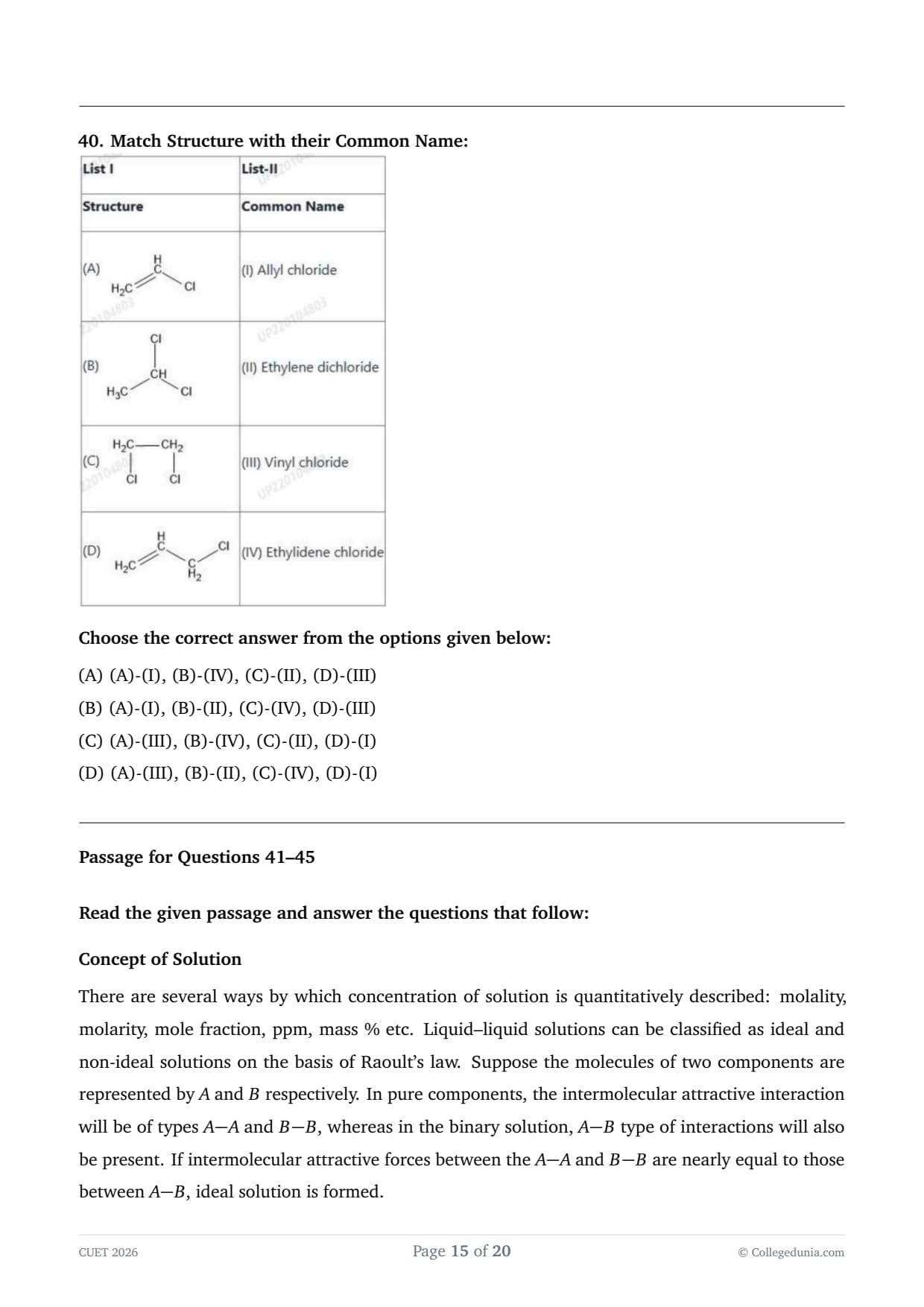
Match Structure with their Common Name:
Choose the correct answer from the options given below:
View Solution
Concept:
Several halo compounds are widely known by their common names. Matching the structure with the traditional name is important.
Step 1: Identify compound (A).
\[ H_2C=CHCH_2Cl \]
contains an allyl group attached to chlorine.
Therefore,
\[ (A)\rightarrow(I) \]
\[ \boxed{Allyl chloride} \]
Step 2: Identify compound (B).
\[ CH_3CHCl_2 \]
contains two chlorine atoms attached to the same carbon atom.
This is called ethylidene chloride.
\[ (B)\rightarrow(IV) \]
Step 3: Identify compound (C).
\[ ClCH_2CH_2Cl \]
is 1,2-dichloroethane.
Its common name is ethylene dichloride.
\[ (C)\rightarrow(II) \]
Step 4: Identify compound (D).
\[ H_2C=CHCl \]
is chloroethene.
Its common name is vinyl chloride.
\[ (D)\rightarrow(III) \]
Step 5: Write final matching.
\[ (A)-(I),\ (B)-(IV),\ (C)-(II),\ (D)-(III) \]
Hence,
\[ \boxed{Option (A)} \] Quick Tip: Vinyl chloride = \(CH_2=CHCl\), Allyl chloride = \(CH_2=CHCH_2Cl\), Ethylene dichloride = \(ClCH_2CH_2Cl\), Ethylidene chloride = \(CH_3CHCl_2\).
What would be the molality of \(1.5\,g\) of ethanoic acid (\(CH_3COOH\)) in \(75\,g\) of benzene?
View Solution
Concept:
Molality is defined as the number of moles of solute present in one kilogram of solvent.
\[ m=\frac{Moles of solute}{Mass of solvent in kg} \]
Step 1: Calculate molar mass of ethanoic acid.
\[ CH_3COOH=C_2H_4O_2 \]
\[ =2(12)+4(1)+2(16) \]
\[ =24+4+32 \]
\[ =60\ g\,mol^{-1} \]
Step 2: Calculate moles of ethanoic acid.
\[ Moles = \frac{1.5}{60} \]
\[ =0.025 \]
Step 3: Convert solvent mass into kilogram.
\[ 75g=0.075kg \]
Step 4: Calculate molality.
\[ m = \frac{0.025}{0.075} \]
\[ =0.333 \]
\[ \approx0.33\ mol\,kg^{-1} \]
Step 5: Final answer.
\[ \boxed{0.33\ mol\,kg^{-1}} \] Quick Tip: Molality depends on mass of solvent and therefore remains independent of temperature changes.
Which one of the following is not correct for an ideal solution?
View Solution
Concept:
An ideal solution is one in which intermolecular forces between unlike molecules are nearly equal to those between like molecules.
Because of this similarity in intermolecular interactions, mixing occurs without heat absorption, heat evolution or volume change.
Step 1: Recall the conditions for an ideal solution.
An ideal solution satisfies:
\[ \Delta H_{mix}=0 \]
and
\[ \Delta V_{mix}=0 \]
It also obeys Raoult's law throughout the entire concentration range.
Step 2: Check option (A).
Ideal solutions obey Raoult's law.
Hence this statement is correct.
Step 3: Check option (B).
For ideal solutions,
\[ \Delta H_{mix}=0 \]
Hence correct.
Step 4: Check option (C).
For ideal solutions,
\[ \Delta V_{mix}=0 \]
Hence correct.
Step 5: Check option (D).
Option (D) states
\[ \Delta H_{mix}\neq0 \]
which contradicts the basic requirement of an ideal solution.
Therefore it is incorrect.
\[ \boxed{\Delta H_{mix}\neq0,\ \Delta V_{mix}=0} \]
is not true for an ideal solution. Quick Tip: For an ideal solution: \[ \Delta H_{mix}=0,\qquad \Delta V_{mix}=0 \] and Raoult's law is obeyed over the entire range of composition.
The vapour pressure of pure benzene at \(25^\circ C\) is \(0.950\) bar. When a \(0.5\,g\) non-volatile, non-electrolyte solute is added to \(39.0\,g\) of benzene (molar mass \(78\,g\,mol^{-1}\)), then the vapour pressure of solution becomes \(0.945\) bar. What is the molar mass of the solute?
View Solution
Concept:
For a dilute solution containing a non-volatile solute, relative lowering of vapour pressure is equal to the mole fraction of solute.
\[ \frac{P^0-P}{P^0}=X_B \]
where \(P^0\) is vapour pressure of pure solvent and \(P\) is vapour pressure of solution.
Step 1: Calculate relative lowering of vapour pressure.
\[ P^0=0.950\;bar \]
\[ P=0.945\;bar \]
\[ \frac{P^0-P}{P^0} = \frac{0.950-0.945}{0.950} = \frac{0.005}{0.950} = 0.005263 \]
Step 2: Calculate moles of benzene.
\[ n_A=\frac{39}{78}=0.5\;mol \]
Step 3: Use mole fraction relation.
For dilute solution,
\[ X_B=\frac{n_B}{n_A} \]
\[ 0.005263=\frac{n_B}{0.5} \]
\[ n_B=0.0026315\;mol \]
Step 4: Calculate molar mass of solute.
\[ M=\frac{Mass}{Moles} \]
\[ M=\frac{0.5}{0.0026315} \]
\[ M\approx190\,g\,mol^{-1} \]
Step 5: Final answer.
\[ \boxed{190\,g\,mol^{-1}} \] Quick Tip: For dilute solutions: \[ \frac{P^0-P}{P^0}=X_{solute} \] This relation is frequently used to determine molar masses of non-volatile solutes.
The solution of acetone in ethanol:
View Solution
Concept:
Deviation from Raoult's law depends upon the relative strength of intermolecular forces between unlike molecules compared to those between like molecules.
Positive deviation occurs when intermolecular attractions become weaker after mixing.
Step 1: Consider pure ethanol.
Ethanol molecules are strongly associated through intermolecular hydrogen bonding.
\[ CH_3CH_2OH \cdots HOCH_2CH_3 \]
These hydrogen bonds contribute significantly to molecular attraction.
Step 2: Mix acetone with ethanol.
Acetone molecules disrupt the extensive hydrogen bonding network present in pure ethanol.
The new acetone-ethanol interactions are weaker than the ethanol-ethanol interactions.
Step 3: Effect on vapour pressure.
Because intermolecular attractions decrease upon mixing, molecules escape more easily into vapour phase.
Hence vapour pressure becomes greater than predicted by Raoult's law.
\[ P_{observed}>P_{Raoult} \]
Step 4: Final conclusion.
The solution shows positive deviation from Raoult's law.
\[ \boxed{Positive deviation} \] Quick Tip: Acetone + Ethanol is a classic example of positive deviation from Raoult's law because mixing weakens the hydrogen bonding present in pure ethanol.
Which of the following concentration term is temperature dependent?
View Solution
Concept:
A concentration term becomes temperature dependent if it involves volume because volume changes with temperature.
Step 1: Examine molality.
\[ m=\frac{Moles of solute}{Mass of solvent in kg} \]
Mass does not change with temperature.
Hence molality is temperature independent.
Step 2: Examine mole fraction.
\[ X=\frac{Moles of component}{Total moles} \]
Since it depends only on moles, it is temperature independent.
Step 3: Examine ppm.
ppm generally depends on mass ratio.
Therefore it is temperature independent.
Step 4: Examine molarity.
\[ M=\frac{Moles of solute}{Volume of solution in litre} \]
Volume changes with temperature due to thermal expansion.
Therefore molarity changes with temperature.
\[ \boxed{Molarity is temperature dependent} \] Quick Tip: Whenever volume appears in the concentration expression, the concentration becomes temperature dependent. Hence molarity is temperature dependent while molality is not.
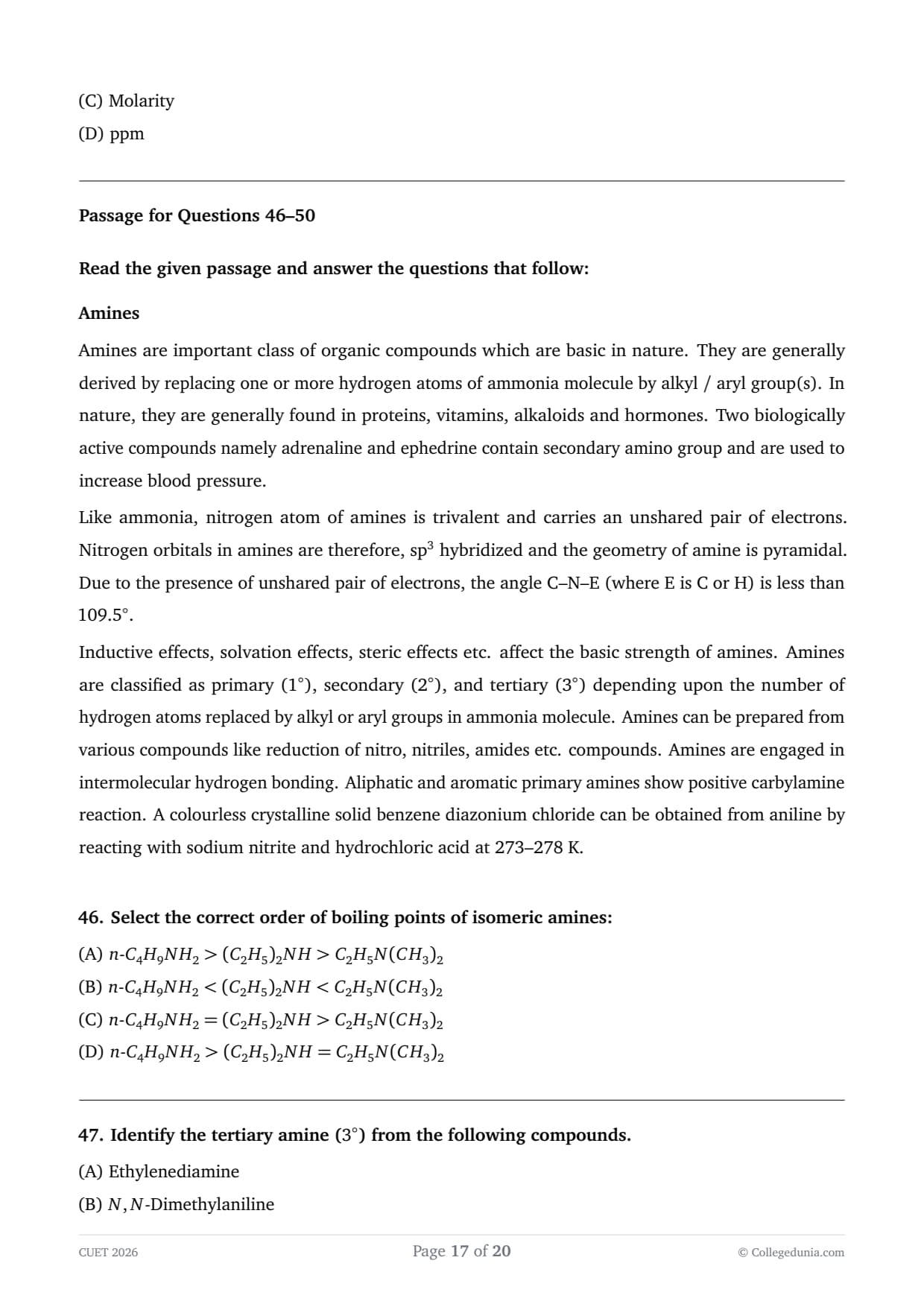
Select the correct order of boiling points of isomeric amines:
View Solution
Concept:
Boiling point of amines depends mainly on intermolecular hydrogen bonding and molecular shape.
Primary amines form the strongest intermolecular hydrogen bonding, secondary amines form less extensive hydrogen bonding, while tertiary amines cannot form intermolecular hydrogen bonding through N-H bonds.
Step 1: Consider primary amine.
\[ n-C_4H_9NH_2 \]
contains two N-H bonds and forms strong intermolecular hydrogen bonding.
Hence it has the highest boiling point.
Step 2: Consider secondary amine.
\[ (C_2H_5)_2NH \]
contains only one N-H bond.
Hydrogen bonding is weaker than in primary amines.
Step 3: Consider tertiary amine.
\[ C_2H_5N(CH_3)_2 \]
contains no N-H bond.
Intermolecular hydrogen bonding is absent.
Hence it has the lowest boiling point.
Step 4: Arrange in decreasing order.
\[ n-C_4H_9NH_2>(C_2H_5)_2NH>C_2H_5N(CH_3)_2 \]
\[ \boxed{Option (A)} \] Quick Tip: For isomeric amines: \[ 1^\circ > 2^\circ > 3^\circ \] in boiling point because intermolecular hydrogen bonding decreases in the same order.
Identify the tertiary amine (\(3^\circ\)) from the following compounds.
View Solution
Concept:
A tertiary amine is formed when all three hydrogen atoms of ammonia are replaced by alkyl or aryl groups.
Step 1: Examine Ethylenediamine.
Contains two \(-NH_2\) groups.
Hence it is not a tertiary amine.
Step 2: Examine \(N,N\)-Dimethylaniline.
Structure:
\[ C_6H_5N(CH_3)_2 \]
Nitrogen is attached to one phenyl group and two methyl groups.
No hydrogen is attached to nitrogen.
Therefore it is a tertiary amine.
\[ \boxed{N,N-Dimethylaniline} \]
Step 3: Examine remaining compounds.
Both \(p\)-toluidine and 2,4,6-tribromoaniline contain \(-NH_2\) group.
Therefore they are primary amines. Quick Tip: A tertiary amine contains three carbon groups attached to nitrogen and no N-H bond.
Identify the correct decreasing order of basic strength of amines in aqueous solution.
View Solution
Concept:
In aqueous solution, basic strength depends on both electron donating inductive effect and solvation of the conjugate acid.
Step 1: Consider inductive effect.
Alkyl groups increase electron density on nitrogen and increase basicity.
Step 2: Consider solvation effect.
The protonated secondary amine is better solvated than protonated tertiary amine.
Therefore secondary amines become strongest bases in water.
Step 3: Write the order.
\[ (C_2H_5)_2NH>(C_2H_5)_3N>C_2H_5NH_2>NH_3 \]
Hence
\[ \boxed{Option (D)} \] Quick Tip: In aqueous medium: \[ 2^\circ > 3^\circ > 1^\circ > NH_3 \] for aliphatic amines because both inductive effect and solvation must be considered.
The final structure of amine produced by Hoffmann degradation of \(m\)-bromobenzamide is:
View Solution
Concept:
Hoffmann bromamide degradation converts an amide into an amine containing one carbon atom less.
\[ RCONH_2 \xrightarrow{Br_2/KOH} RNH_2 \]
Step 1: Identify the starting amide.
The substrate is \(m\)-bromobenzamide.
\[ m-BrC_6H_4CONH_2 \]
Step 2: Apply Hoffmann degradation.
The carbonyl carbon is removed during the reaction.
The aromatic ring remains unchanged.
\[ m-BrC_6H_4CONH_2 \rightarrow m-BrC_6H_4NH_2 \]
Step 3: Identify the product.
The product is \(m\)-bromoaniline.
\[ \boxed{m-Bromoaniline} \] Quick Tip: Hoffmann bromamide degradation: \[ RCONH_2 \rightarrow RNH_2 \] One carbon atom is lost during the reaction.
What would be the structure of final product X in the following chemical reaction?
View Solution
Concept:
Tertiary aromatic amines do not form diazonium salts with nitrous acid. Instead, electrophilic substitution occurs on the aromatic ring producing para-nitroso derivatives.
Step 1: Identify the nature of the amine.
\[ N,N-Dimethylaniline \]
is a tertiary aromatic amine.
There is no N-H bond present.
Step 2: Action of nitrous acid.
Nitrous acid generates the electrophile \(NO^+\).
The strongly activating dimethylamino group directs substitution mainly to the para position.
Step 3: Formation of nitroso derivative.
The nitroso group enters predominantly at the para position.
\[ N,N-Dimethylaniline \rightarrow p-Nitroso-N,N-dimethylaniline \]
Step 4: Final answer.
\[ \boxed{p-Nitroso-N,N-dimethylaniline } \] Quick Tip: Primary aromatic amines form diazonium salts, secondary amines form N-nitrosoamines, while tertiary aromatic amines undergo para-nitrosation.
CUET UG 2026 Exam Pattern
| Parameter | Details |
|---|---|
| Exam Name | Common University Entrance Test (CUET UG) 2026 |
| Conducting Body | National Testing Agency (NTA) |
| Exam Mode | Computer-Based Test (CBT) |
| Exam Duration | 60 minutes per test |
| Total Sections | 3 (Languages, Domain Subjects, General Test) |
| Question Type | Multiple Choice Questions (MCQs) |
| Questions per Test | 50 questions (all compulsory) |
| Marking Scheme | +5 for correct, -1 for incorrect |
| Maximum Marks | 250 marks per test |
| Maximum Subject Choices | 5 subjects in total |
| Syllabus Base | Class 12 NCERT (mainly for Domain Subjects) |


Comments