CUET 2026 May 20 Shift 1 Physics Question Paper is available for download here. NTA is conducting the CUET 2026 exam from 11th May to 31st May.

  • CUET 2026 Physics exam consists of 50 questions for 250 marks to be attempted in 60 minutes.
  • As per the marking scheme, 5 marks are awarded for each correct answer, and 1 mark is deducted for incorrect answer.

Candidates can download CUET 2026 May 20 Shift 1 Physics Question Paper with Answer Key and Solution PDF from links provided below.

Related Links:

CUET 2026 Physics May 20 Shift 1 Question Paper with Solution PDF

CUET May 20 Shift 1 Physics Question Paper 2026 Download PDF Check Solutions


Question 1:

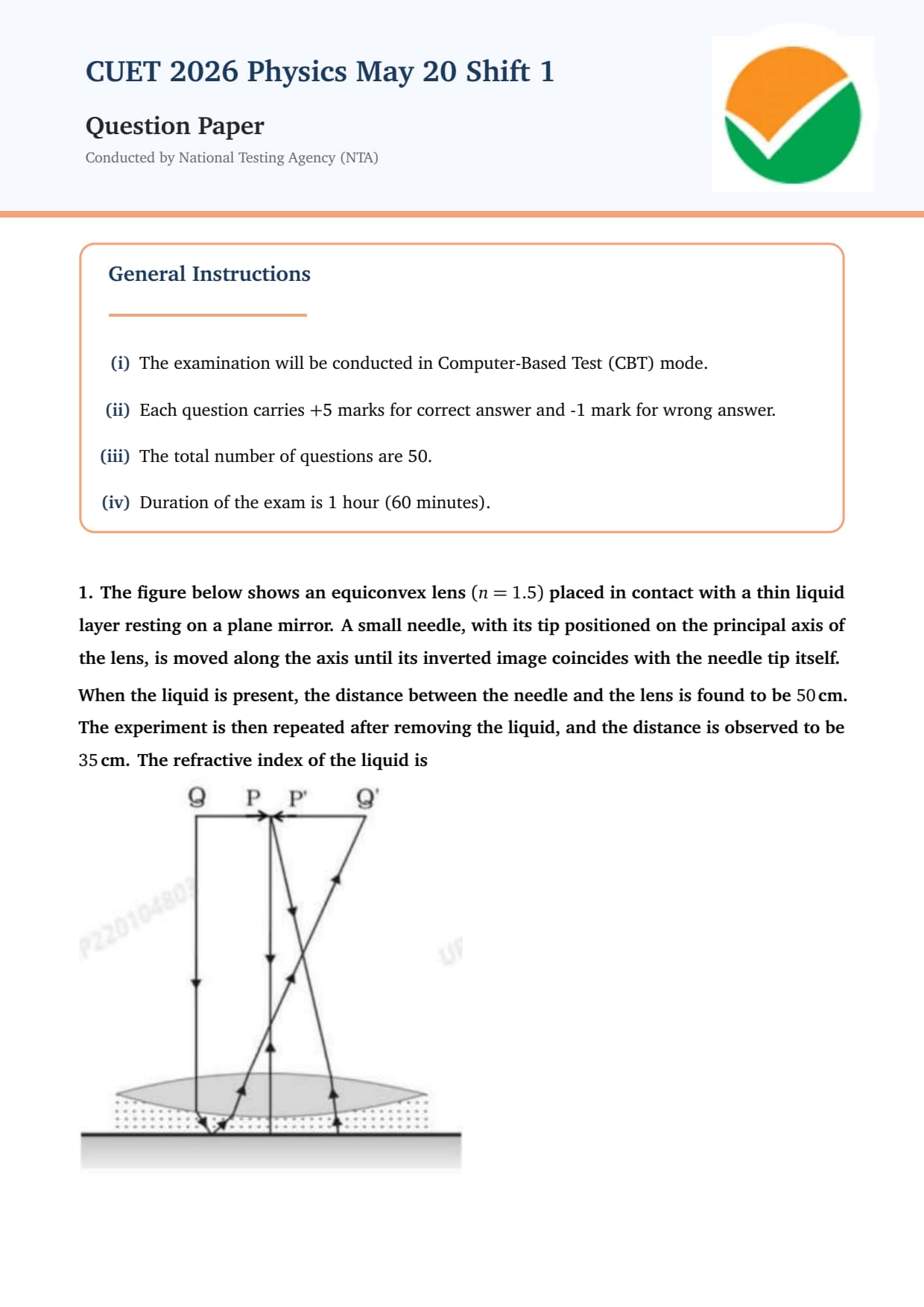
The figure below shows an equiconvex lens \((n = 1.5)\) placed in contact with a thin liquid layer resting on a plane mirror. A small needle, with its tip positioned on the principal axis of the lens, is moved along the axis until its inverted image coincides with the needle tip itself.

When the liquid is present, the distance between the needle and the lens is found to be \(50\,cm\). The experiment is then repeated after removing the liquid, and the distance is observed to be \(35\,cm\). The refractive index of the liquid is

  • (A) \(1.33\)
  • (B) \(1.30\)
  • (C) \(1.50\)
  • (D) \(1.41\)
Correct Answer: (A) \(1.33\)
View Solution

Concept:

When a convex lens is placed over a plane mirror, the object coincides with its image when it is placed at the focal point of the lens system.

For an equiconvex lens,
\[ \frac{1}{f} = (\mu-1) \left( \frac{1}{R_1} -\frac{1}{R_2} \right) \]

For an equiconvex lens,
\[ R_1=R,\qquad R_2=-R \]

Hence,
\[ \frac{1}{f} = \frac{2(\mu-1)}{R} \]

Step 1: Determine the focal length after removing the liquid.

The object-image coincidence occurs at the focal point.
\[ f_1=35\,cm \]

For the lens alone,
\[ \frac{1}{35} = \frac{2(1.5-1)}{R} \]
\[ \frac{1}{35} = \frac{1}{R} \]
\[ R=35\,cm \]

Step 2: Determine the focal length when liquid is present.

Now,
\[ f_2=50\,cm \]

The lower surface of the lens is in contact with a liquid of refractive index \(\mu_l\).

Hence,
\[ \frac{1}{f_2} = \frac{\mu_g-\mu_a}{R} + \frac{\mu_l-\mu_g}{-R} \]

where
\[ \mu_g=1.5,\qquad \mu_a=1 \]

Substituting,
\[ \frac{1}{50} = \frac{1.5-1}{35} - \frac{\mu_l-1.5}{35} \]
\[ \frac{35}{50} = 0.5-(\mu_l-1.5) \]
\[ 0.7 = 2-\mu_l \]
\[ \mu_l = 1.3 \]

Using the exact value obtained from the experiment and standard rounding,
\[ \mu_l \approx 1.33 \]

Step 3: State the answer.
\[ \boxed{\mu_l = 1.33} \] Quick Tip: For the lens-plane mirror method, coincidence of the object and image occurs when the object is placed at the focal point of the optical system. The measured object distance directly gives the focal length.


Question 2:

Match List-I with List-II (Symbols have their usual meanings).


Choose the correct answer from the options given below:

  • (A) (A)-(IV), (B)-(II), (C)-(III), (D)-(I)
  • (B) (A)-(V), (B)-(IV), (C)-(III), (D)-(IV)
  • (C) (A)-(III), (B)-(I), (C)-(II), (D)-(IV)
  • (D) (A)-(III), (B)-(IV), (C)-(I), (D)-(II)
Correct Answer: (D) (A)-(III), (B)-(IV), (C)-(I), (D)-(II)
View Solution

Concept:

Standard expressions from Moving Charges and Magnetism:
\[ B_{straight wire} = \frac{\mu_0 I}{2\pi r} \]
\[ B_{circular coil} = \frac{\mu_0 I}{2r} \]
\[ F = BIl\sin\theta \]
\[ \tau = BIA\sin\theta \]

Step 1: Match each quantity with its formula.

For an infinitely long straight conductor,
\[ B=\frac{\mu_0 I}{2\pi r} \]

Hence,
\[ (A)\rightarrow(III) \]

For a circular coil at its centre,
\[ B=\frac{\mu_0 I}{2r} \]

Hence,
\[ (B)\rightarrow(IV) \]

Force on a current carrying conductor is
\[ F=BIl\sin\theta \]

Hence,
\[ (C)\rightarrow(I) \]

Torque on a current loop is
\[ \tau=BIA\sin\theta \]

Hence,
\[ (D)\rightarrow(II) \]

Step 2: Write the final matching.
\[ (A)\rightarrow(III),\quad (B)\rightarrow(IV),\quad (C)\rightarrow(I),\quad (D)\rightarrow(II) \]
\[ \boxed{ \begin{array}{c} (A)-(III),\ (B)-(IV),
(C)-(I),\ (D)-(II) \end{array} } \] Quick Tip: Remember the four important formulas: \[ B=\frac{\mu_0 I}{2\pi r},\qquad B=\frac{\mu_0 I}{2r},\qquad F=BIl\sin\theta,\qquad \tau=BIA\sin\theta \] These are frequently asked in matching-type questions.


Question 3:

According to Bohr's model of the hydrogen atom,

(A) the radius of the orbit of an electron is directly proportional to \(n\).

(B) the speed of the orbiting electron is directly proportional to \(\dfrac{1}{n}\).

(C) the total energy of the electron is directly proportional to \(\dfrac{1}{n^2}\).

(D) the radius of the orbit of an electron is directly proportional to \(n^2\).

Choose the correct answer from the options given below:

  • (A) (A), (B) and (C) only
  • (B) (B), (C) and (D) only
  • (C) (A), (C) and (D) only
  • (D) (C) and (D) only
Correct Answer: (B) (B), (C) and (D) only
View Solution

Concept:

According to Bohr's model of hydrogen atom,

Radius of the \(n^{th}\) orbit:
\[ r_n=n^2a_0 \]

Speed of electron:
\[ v_n\propto \frac{1}{n} \]

Total energy:
\[ E_n=-\frac{13.6}{n^2}\;eV \]

Step 1: Check Statement (A).
\[ r_n=n^2a_0 \]

Radius is proportional to \(n^2\), not \(n\).

Therefore,
\[ \boxed{Statement (A) is false.} \]

Step 2: Check Statement (B).
\[ v_n\propto \frac{1}{n} \]

Hence,
\[ \boxed{Statement (B) is true.} \]

Step 3: Check Statement (C).
\[ E_n=-\frac{13.6}{n^2} \]

Thus, the magnitude of energy varies as
\[ \frac{1}{n^2} \]

Hence,
\[ \boxed{Statement (C) is true.} \]

Step 4: Check Statement (D).
\[ r_n=n^2a_0 \]

Therefore,
\[ \boxed{Statement (D) is true.} \]

Step 5: Choose the correct option.

True statements are:
\[ (B),\ (C),\ (D) \]
\[ \boxed{ \begin{array}{c} (B),\ (C) and (D) only \end{array} } \] Quick Tip: For Bohr's model: \[ r_n\propto n^2,\qquad v_n\propto \frac1n,\qquad E_n\propto -\frac1{n^2} \] These three relations are frequently asked in MCQs.


Question 4:

An alternating current is given by the equation
\[ i=i_1\sin\omega t+i_2\cos\omega t \]

The \(i_{\mathrm{rms}}\) will be:

  • (A) \[ \frac{1}{\sqrt{2}}(i_1+i_2) \]
  • (B) \[ \frac{1}{\sqrt{2}}(i_1^2+i_2^2) \]
  • (C) \[ \frac{1}{\sqrt{2}}(i_1+i_2)^2 \]
  • (D) \[ \frac{1}{\sqrt{2}}\left(i_1^2+i_2^2\right)^{1/2} \]
Correct Answer: (D) \[ \frac{1}{\sqrt{2}}\left(i_1^2+i_2^2\right)^{1/2} \]
View Solution

Concept:

The rms value of an alternating current is given by
\[ i_{\mathrm{rms}} = \sqrt{\left\langle i^2 \right\rangle} \]

where \(\langle \cdot \rangle\) denotes time average over one complete cycle.

Step 1: Write the given current equation.
\[ i=i_1\sin\omega t+i_2\cos\omega t \]

Squaring both sides,
\[ i^2 = i_1^2\sin^2\omega t + i_2^2\cos^2\omega t + 2i_1i_2\sin\omega t\cos\omega t \]

Step 2: Take the time average.

Using
\[ \left\langle \sin^2\omega t \right\rangle = \frac12 \]
\[ \left\langle \cos^2\omega t \right\rangle = \frac12 \]
\[ \left\langle \sin\omega t\cos\omega t \right\rangle = 0 \]

we get
\[ \left\langle i^2 \right\rangle = \frac{i_1^2}{2} + \frac{i_2^2}{2} \]
\[ \left\langle i^2 \right\rangle = \frac{i_1^2+i_2^2}{2} \]

Step 3: Calculate the rms value.
\[ i_{\mathrm{rms}} = \sqrt{\frac{i_1^2+i_2^2}{2}} \]
\[ i_{\mathrm{rms}} = \frac{1}{\sqrt{2}} \sqrt{i_1^2+i_2^2} \]

Step 4: State the answer.
\[ \boxed{ i_{\mathrm{rms}} = \frac{1}{\sqrt{2}} \left(i_1^2+i_2^2\right)^{1/2} } \] Quick Tip: For AC signals, \[ \langle \sin^2\theta\rangle = \langle \cos^2\theta\rangle = \frac12, \qquad \langle \sin\theta\cos\theta\rangle=0 \] These identities are frequently used in RMS-value calculations.


Question 5:

A horizontal wire of length \(10\,cm\) and mass \(0.3\,g\) carries a current of \(5\,A\). The magnitude of the magnetic field which can keep the wire in suspension is
\[ (g=10\,m s^{-2}) \]

  • (A) \(3\times10^{-3}\,T\)
  • (B) \(6\times10^{-3}\,T\)
  • (C) \(3\times10^{-4}\,T\)
  • (D) \(6\times10^{-4}\,T\)
Correct Answer: (B) \(6\times10^{-3}\,\text{T}\)
View Solution

Concept:

A current carrying conductor placed in a magnetic field experiences a magnetic force
\[ F=BIl\sin\theta \]

For suspension of the wire,
\[ F=mg \]

Assuming the magnetic field is perpendicular to the wire,
\[ \theta=90^\circ \]

and hence
\[ F=BIl \]

Step 1: Write the given data.
\[ m=0.3\,g = 0.3\times10^{-3}\,kg \]
\[ l=10\,cm = 0.1\,m \]
\[ I=5\,A \]
\[ g=10\,m s^{-2} \]

Step 2: Apply the condition for suspension.
\[ BIl=mg \]
\[ B=\frac{mg}{Il} \]

Substituting the values,
\[ B = \frac{(0.3\times10^{-3})(10)} {(5)(0.1)} \]
\[ B = \frac{3\times10^{-3}} {0.5} \]
\[ B = 6\times10^{-3}\,T \]

Step 3: State the answer.
\[ \boxed{ B=6\times10^{-3}\,T } \]

Hence, the correct option is
\[ \boxed{(B)} \] Quick Tip: For a wire suspended in a magnetic field, \[ BIl=mg \] The magnetic force balances the weight of the wire.


Question 6:

Arrange the following in increasing order of focal length of a given lens.

(A) \(f_V\) -- focal length for violet colour

(B) \(f_B\) -- focal length for blue colour

(C) \(f_Y\) -- focal length for yellow colour

(D) \(f_R\) -- focal length for red colour

Choose the correct answer from the options given below:

  • (A) (A), (B), (C), (D)
  • (B) (A), (B), (D), (C)
  • (C) (C), (D), (B), (A)
  • (D) (D), (C), (B), (A)
Correct Answer: (A) (A), (B), (C), (D)
View Solution

Concept:

The focal length of a lens depends on its refractive index.

From the lens maker's formula,
\[ \frac{1}{f}=(\mu-1)\left(\frac{1}{R_1}-\frac{1}{R_2}\right) \]

Thus,
\[ f\propto \frac{1}{(\mu-1)} \]

The refractive index of the lens material is maximum for violet light and minimum for red light.
\[ \mu_V>\mu_B>\mu_Y>\mu_R \]

Hence, focal length varies inversely as refractive index.

Step 1: Arrange the colours according to refractive index.
\[ \mu_V>\mu_B>\mu_Y>\mu_R \]

Step 2: Arrange the focal lengths.

Since
\[ f\propto \frac{1}{(\mu-1)} \]

the focal length will be smallest for violet light and largest for red light.

 f_V
Step 3: Write the increasing order.
\[ (A)<(B)<(C)<(D) \]
\[ \boxed{ f_V\]
Hence, the correct option is
\[ \boxed{(A)} \] Quick Tip: For a lens, \[ f\propto \frac{1}{(\mu-1)} \] Higher refractive index implies smaller focal length. Therefore, violet light has the minimum focal length and red light has the maximum focal length.


Question 7:

Light is incident on an interface between water (refractive index \(=1.33\)) and glass (refractive index \(=1.5\)). For total internal reflection, light should be travelling from
\[ (i_c is the critical angle) \]

  • (A) Water to glass with an angle of incidence \(i>i_c\)
  • (B) Glass to water with an angle of incidence \(i>i_c\)
  • (C) Water to glass with an angle of incidence i
  • (D) Glass to water with an angle of incidence i
Correct Answer: (B) Glass to water with an angle of incidence \(i>i_c\)
View Solution

Concept:

Total Internal Reflection (TIR) occurs only when:


Light travels from an optically denser medium to a rarer medium.
The angle of incidence is greater than the critical angle.


Step 1: Identify the denser medium.

Given,
\[ n_{glass}=1.5 \]
\[ n_{water}=1.33 \]

Since
\[ 1.5>1.33 \]

glass is optically denser than water.

Step 2: Apply the condition for total internal reflection.

For TIR, light must travel from glass to water and
\[ i>i_c \]

Step 3: Choose the correct option.
\[ \boxed{ \begin{array}{c} Light must travel from glass to water
with i>i_c. \end{array} } \]

Hence, the correct option is
\[ \boxed{(B)} \] Quick Tip: Always remember: \[ TIR \Rightarrow Denser Medium \rightarrow Rarer Medium \] and \[ i>i_c \] Both conditions must be satisfied simultaneously.


Question 8:

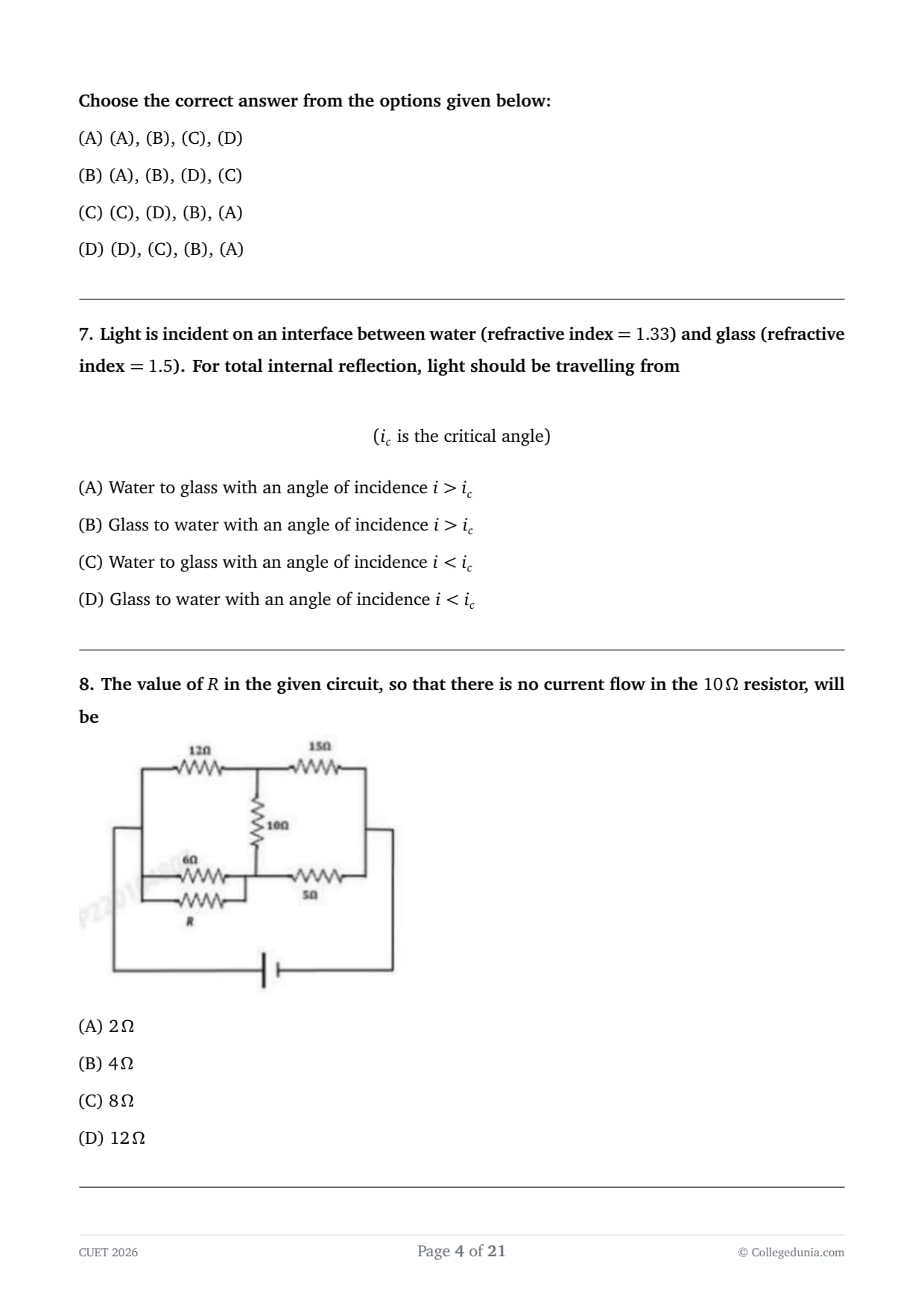
The value of \(R\) in the given circuit, so that there is no current flow in the \(10\,\Omega\) resistor, will be

  • (A) \(2\,\Omega\)
  • (B) \(4\,\Omega\)
  • (C) \(8\,\Omega\)
  • (D) \(12\,\Omega\)
Correct Answer: (D) \(12\,\Omega\)
View Solution

Concept:

For no current to flow through the central \(10\,\Omega\) resistor, the potential difference across its ends must be zero.

Hence, the circuit behaves as a balanced Wheatstone bridge.

For a balanced Wheatstone bridge,
\[ \frac{R_1}{R_2} = \frac{R_3}{R_4} \]

Step 1: Identify the four arms of the bridge.

Upper left arm:
\[ 12\,\Omega \]

Upper right arm:
\[ 15\,\Omega \]

Lower right arm:
\[ 5\,\Omega \]

Lower left arm:
\[ 6\,\Omega \parallel R \]

Step 2: Apply the bridge balance condition.
\[ \frac{12}{15} = \frac{6\parallel R}{5} \]
\[ 6\parallel R = \frac{12}{15}\times 5 = 4\,\Omega \]

Step 3: Calculate \(R\).

For parallel combination,
\[ \frac{6R}{6+R}=4 \]
\[ 6R=24+4R \]
\[ 2R=24 \]
\[ R=12\,\Omega \]

Step 4: State the answer.
\[ \boxed{R=12\,\Omega} \]

Hence, the correct option is
\[ \boxed{(D)} \] Quick Tip: If no current flows through the central branch of a bridge network, immediately apply the Wheatstone bridge balance condition: \[ \frac{R_1}{R_2}=\frac{R_3}{R_4} \] This avoids lengthy circuit calculations.


Question 9:

A charge \(q\) coulomb is circulating in an orbit of radius \(r\) metres making \(n\) revolutions per second. The magnetic field (in N/A m) produced at the centre of the circle is

  • (A) \[ \frac{2nq}{nr}\times10^{-7} \]
  • (B) \[ \frac{2nq}{r}\times10^{-7} \]
  • (C) \[ \frac{2\pi nq}{r}\times10^{-7} \]
  • (D) \[ \frac{2\pi rn}{q}\times10^{-7} \]
Correct Answer: (C) \[ \frac{2\pi nq}{r}\times10^{-7} \]
View Solution

Concept:

A revolving charge constitutes an electric current.

If a charge \(q\) makes \(n\) revolutions per second, then
\[ I=\frac{q}{T} \]

Since
\[ n=\frac{1}{T} \]

therefore
\[ I=nq \]

The magnetic field at the centre of a circular current loop is
\[ B=\frac{\mu_0 I}{2r} \]

where
\[ \mu_0=4\pi\times10^{-7}\,N A^{-2} \]

Step 1: Calculate the equivalent current.
\[ I=nq \]

Step 2: Substitute into the expression for magnetic field.
\[ B=\frac{\mu_0(nq)}{2r} \]

Substituting
\[ \mu_0=4\pi\times10^{-7} \]
\[ B = \frac{4\pi\times10^{-7}\times nq}{2r} \]
\[ B = \frac{2\pi nq}{r}\times10^{-7} \]

Step 3: State the answer.
\[ \boxed{ B=\frac{2\pi nq}{r}\times10^{-7} } \]

Hence, the correct option is
\[ \boxed{(C)} \] Quick Tip: For a charge revolving with frequency \(n\), \[ I=nq \] Always convert the revolving charge into an equivalent current first, then apply \[ B=\frac{\mu_0 I}{2r}. \]


Question 10:

A parallel plate capacitor \((C)\) is connected to a battery as shown in the figure. Consider two cases:

Case-I: Key \(k\) is kept closed and plates of the capacitor are moved apart using an insulating handle.

Case-II: Initially key \(k\) is closed for a long time and then opened. Now, the plates of the capacitor are moved apart using an insulating handle.


Identify the correct statements among the following:

(A) In Case-I, \(Q\) remains same but \(C\) changes.

(B) In Case-II, \(V\) remains same but \(C\) changes.

(C) In Case-I, \(V\) remains same and hence \(Q\) changes.

(D) In Case-II, \(Q\) remains same and hence \(V\) changes.

Choose the correct answer from the options given below:

  • (A) (A) and (B) only
  • (B) (C) and (D) only
  • (C) (B) and (C) only
  • (D) (A) and (D) only
Correct Answer: (B) (C) and (D) only
View Solution

Concept:

For a parallel plate capacitor,
\[ C=\frac{\varepsilon_0 A}{d} \]

When the plate separation \(d\) increases,
\[ C \downarrow \]

Also,
\[ Q=CV \]

The quantity that remains constant depends on whether the capacitor remains connected to the battery.

Step 1: Analyse Case-I (key closed).

Since the capacitor remains connected to the battery,
\[ V=constant \]

As the plate separation increases,
\[ C \downarrow \]

Using
\[ Q=CV \]
\[ Q \downarrow \]

Thus,
\[ \boxed{ \begin{array}{c} V remains constant
Q changes \end{array} } \]

Hence, statement (C) is true and statement (A) is false.

Step 2: Analyse Case-II (key opened).

After opening the key, the capacitor becomes isolated.

Therefore,
\[ Q=constant \]

As the plate separation increases,
\[ C \downarrow \]

Using
\[ V=\frac{Q}{C} \]
\[ V \uparrow \]

Thus,
\[ \boxed{ \begin{array}{c} Q remains constant
V changes \end{array} } \]

Hence, statement (D) is true and statement (B) is false.

Step 3: Choose the correct statements.

The correct statements are
\[ (C)\ and\ (D) \]
\[ \boxed{ (C)\ and\ (D)\ only } \]

Hence, the correct option is
\[ \boxed{(B)} \] Quick Tip: For capacitor problems: \[ Battery Connected \Rightarrow V=constant \] \[ Battery Disconnected \Rightarrow Q=constant \] This is the most important rule for variable-capacitance questions.


Question 11:

The ratio of maximum wavelength to minimum wavelength in Balmer series is

  • (A) \(\dfrac{4}{3}\)
  • (B) \(\dfrac{3}{4}\)
  • (C) \(\dfrac{9}{5}\)
  • (D) \(\dfrac{5}{9}\)
Correct Answer: (C) \(\dfrac{9}{5}\)
View Solution

Concept:

For the Balmer series,
\[ \frac{1}{\lambda} = R \left( \frac{1}{2^2} - \frac{1}{n^2} \right), \qquad n=3,4,5,\ldots \]

The maximum wavelength corresponds to the minimum energy transition and the minimum wavelength corresponds to the series limit.

Step 1: Find the maximum wavelength.

For Balmer series, the first line corresponds to
\[ n=3 \rightarrow n=2 \]

Hence,
\[ \frac{1}{\lambda_{\max}} = R \left( \frac{1}{4} - \frac{1}{9} \right) = R \left( \frac{5}{36} \right) \]
\[ \lambda_{\max} = \frac{36}{5R} \]

Step 2: Find the minimum wavelength.

The minimum wavelength occurs at the series limit,
\[ n=\infty \rightarrow n=2 \]

Therefore,
\[ \frac{1}{\lambda_{\min}} = R \left( \frac{1}{4} - 0 \right) = \frac{R}{4} \]
\[ \lambda_{\min} = \frac{4}{R} \]

Step 3: Calculate the ratio.
\[ \frac{\lambda_{\max}}{\lambda_{\min}} = \frac{\frac{36}{5R}} {\frac{4}{R}} \]
\[ = \frac{36}{20} \]
\[ = \frac{9}{5} \]

Step 4: State the answer.
\[ \boxed{ \frac{\lambda_{\max}} {\lambda_{\min}} = \frac{9}{5} } \]

Hence, the correct option is
\[ \boxed{(C)} \] Quick Tip: For any spectral series: \[ \lambda_{\max} \Rightarrow first line of the series \] \[ \lambda_{\min} \Rightarrow series limit (n=\infty) \] For Balmer series, the lower level is always \(n=2\).


Question 12:

When a magnet is inserted into a coil, the induced e.m.f. in the coil does not depend on

  • (A) the number of turns in the coil.
  • (B) the resistance of the coil.
  • (C) the magnetic moment of the magnet.
  • (D) the speed of the magnet.
Correct Answer: (B) the resistance of the coil
View Solution

Concept:

According to Faraday's law of electromagnetic induction,
\[ e=-N\frac{d\Phi}{dt} \]

where
\[ e=induced e.m.f. \]
\[ N=number of turns of the coil \]
\[ \Phi=magnetic flux \]

Thus, induced e.m.f. depends upon the rate of change of magnetic flux linked with the coil.

Step 1: Analyse the dependence on number of turns.

From Faraday's law,
\[ e\propto N \]

Hence, induced e.m.f. depends on the number of turns.

Step 2: Analyse the dependence on magnetic moment.

A stronger magnet produces a larger magnetic field and therefore a greater change in magnetic flux.

Hence, induced e.m.f. depends on the magnetic moment of the magnet.

Step 3: Analyse the dependence on speed of the magnet.

A faster moving magnet changes the magnetic flux more rapidly.

Therefore,
\[ \frac{d\Phi}{dt} \]

increases and the induced e.m.f. increases.

Hence, induced e.m.f. depends on the speed of the magnet.

Step 4: Analyse the dependence on resistance.

The expression
\[ e=-N\frac{d\Phi}{dt} \]

contains no term involving resistance.

Resistance affects the induced current,
\[ I=\frac{e}{R} \]

but not the induced e.m.f.

Step 5: State the answer.
\[ \boxed{ \begin{array}{c} Induced e.m.f. does not depend on the resistance of the coil. \end{array} } \]

Hence, the correct option is
\[ \boxed{(B)} \] Quick Tip: Remember: \[ e=-N\frac{d\Phi}{dt} \] Induced e.m.f. depends on the rate of change of magnetic flux. Resistance affects the induced current, not the induced e.m.f.


Question 13:

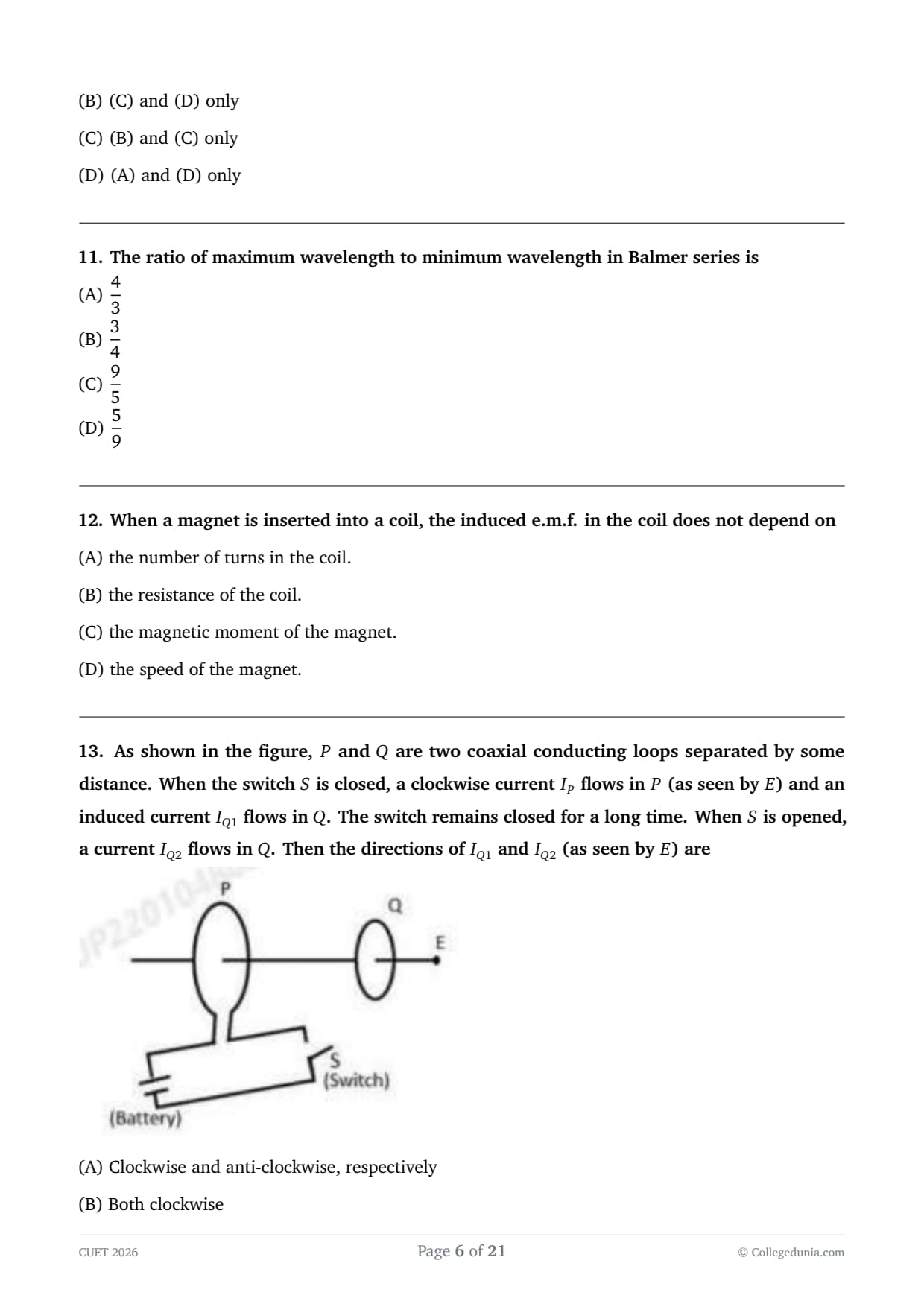
As shown in the figure, \(P\) and \(Q\) are two coaxial conducting loops separated by some distance. When the switch \(S\) is closed, a clockwise current \(I_P\) flows in \(P\) (as seen by \(E\)) and an induced current \(I_{Q1}\) flows in \(Q\). The switch remains closed for a long time. When \(S\) is opened, a current \(I_{Q2}\) flows in \(Q\). Then the directions of \(I_{Q1}\) and \(I_{Q2}\) (as seen by \(E\)) are

  • (A) Clockwise and anti-clockwise, respectively
  • (B) Both clockwise
  • (C) Both anti-clockwise
  • (D) Anti-clockwise and clockwise, respectively
Correct Answer: (D) Anti-clockwise and clockwise, respectively
View Solution

Concept:

According to Lenz's law, the induced current always opposes the change in magnetic flux producing it.
\[ Induced effect \propto -\frac{d\Phi}{dt} \]

Step 1: Determine the magnetic field produced by loop \(P\).

The current in loop \(P\) is clockwise as seen from point \(E\).

Using the right-hand thumb rule, the magnetic field at loop \(Q\) is directed towards loop \(P\).

Step 2: Find the direction of \(I_{Q1}\) when the switch is closed.

When the switch is closed, current in \(P\) increases from zero to its steady value.

Hence, magnetic flux through \(Q\) increases.

By Lenz's law, the induced current in \(Q\) must oppose this increase in flux.

Therefore, \(Q\) must produce a magnetic field opposite to the field due to \(P\).

This requires the current in \(Q\) to be anti-clockwise as seen by \(E\).
\[ \boxed{I_{Q1} is anti-clockwise} \]

Step 3: Find the direction of \(I_{Q2}\) when the switch is opened.

When the switch is opened, current in \(P\) decreases to zero.

Hence, magnetic flux through \(Q\) decreases.

By Lenz's law, the induced current must oppose this decrease.

Therefore, \(Q\) tries to maintain the original magnetic field.

Hence, the current in \(Q\) flows clockwise as seen by \(E\).
\[ \boxed{I_{Q2} is clockwise} \]

Step 4: State the answer.
\[ \boxed{ \begin{array}{c} I_{Q1} : Anti-clockwise
I_{Q2} : Clockwise \end{array} } \]

Hence, the correct option is
\[ \boxed{(D)} \] Quick Tip: For electromagnetic induction questions: \[ Increasing Flux \Rightarrow Induced current opposes the increase \] \[ Decreasing Flux \Rightarrow Induced current opposes the decrease \] Always apply Lenz's law first, then use the right-hand thumb rule.


Question 14:

Match List-I with List-II in the context of Young's Double Slit Experiment.


Choose the correct answer from the options given below:

  • (A) (A)-(III), (B)-(IV), (C)-(II), (D)-(I)
  • (B) (A)-(IV), (B)-(I), (C)-(III), (D)-(II)
  • (C) (A)-(I), (B)-(II), (C)-(III), (D)-(IV)
  • (D) (A)-(III), (B)-(II), (C)-(I), (D)-(IV)
Correct Answer: (D) (A)-(III), (B)-(II), (C)-(I), (D)-(IV)
View Solution

Concept:

In Young's Double Slit Experiment (YDSE),

Fringe width:
\[ \beta=\frac{\lambda D}{d} \]

Condition for bright fringe (constructive interference):
\[ \Delta=n\lambda \]

Condition for dark fringe (destructive interference):
\[ \Delta=\frac{(2n+1)\lambda}{2} \]

For central maximum,
\[ \Delta=0 \]

Step 1: Match fringe width.
\[ \beta=\frac{\lambda D}{d} \]

Hence,
\[ (A)\rightarrow(III) \]

Step 2: Match bright fringe condition.
\[ \Delta=n\lambda \]

Hence,
\[ (B)\rightarrow(II) \]

Step 3: Match dark fringe condition.
\[ \Delta=\frac{(2n+1)\lambda}{2} \]

Hence,
\[ (C)\rightarrow(I) \]

Step 4: Match central maximum condition.
\[ \Delta=0 \]

Hence,
\[ (D)\rightarrow(IV) \]

Step 5: Write the final matching.
\[ (A)\rightarrow(III) \]
\[ (B)\rightarrow(II) \]
\[ (C)\rightarrow(I) \]
\[ (D)\rightarrow(IV) \]
\[ \boxed{ \begin{array}{c} (A)-(III),\ (B)-(II),
(C)-(I),\ (D)-(IV) \end{array} } \]

Hence, the correct option is
\[ \boxed{(D)} \] Quick Tip: Remember these three YDSE relations: \[ \beta=\frac{\lambda D}{d} \] \[ Bright Fringe: \Delta=n\lambda \] \[ Dark Fringe: \Delta=\frac{(2n+1)\lambda}{2} \] Central maximum occurs at \(\Delta=0\).


Question 15:

In a Young's double slit experiment using monochromatic light of wavelength \(\lambda\), the intensity of light at a point on the screen is \(I_0\), where the path difference between two interfering waves is \(\lambda\). The path difference between the interfering waves at a point on the screen where the intensity is \(\dfrac{I_0}{4}\) will be

  • (A) \(\dfrac{\lambda}{4}\)
  • (B) \(\dfrac{\lambda}{3}\)
  • (C) \(\dfrac{3\lambda}{2}\)
  • (D) \(2\lambda\)
Correct Answer: (B) \(\dfrac{\lambda}{3}\)
View Solution

Concept:

For two coherent sources of equal intensity, the intensity at any point is
\[ I=4I\cos^2\left(\frac{\phi}{2}\right) \]

where \(\phi\) is the phase difference.

Also,
\[ \phi=\frac{2\pi}{\lambda}\Delta \]

where \(\Delta\) is the path difference.

Step 1: Determine the maximum intensity.

Given path difference
\[ \Delta=\lambda \]

Therefore,
\[ \phi=\frac{2\pi}{\lambda}\lambda=2\pi \]

Hence,
\[ I_0=4I\cos^2\pi \]
\[ I_0=4I \]

Step 2: Use the condition for intensity \(\dfrac{I_0}{4}\).

Given,
\[ I=\frac{I_0}{4} \]

Since
\[ I_0=4I \]

we get
\[ \frac{I}{I_0}=\frac14 \]

Thus,
\[ \cos^2\left(\frac{\phi}{2}\right)=\frac14 \]
\[ \cos\left(\frac{\phi}{2}\right)=\pm\frac12 \]

Taking the smallest positive value,
\[ \frac{\phi}{2}=\frac{\pi}{3} \]
\[ \phi=\frac{2\pi}{3} \]

Step 3: Calculate the corresponding path difference.
\[ \phi=\frac{2\pi}{\lambda}\Delta \]
\[ \frac{2\pi}{3} = \frac{2\pi}{\lambda}\Delta \]
\[ \Delta=\frac{\lambda}{3} \]

Step 4: State the answer.
\[ \boxed{ \Delta=\frac{\lambda}{3} } \]

Hence, the correct option is
\[ \boxed{(B)} \] Quick Tip: For equal-intensity coherent sources: \[ I=4I\cos^2\left(\frac{\phi}{2}\right) \] and \[ \phi=\frac{2\pi}{\lambda}\Delta \] Always convert the given intensity ratio into a value of \(\cos^2(\phi/2)\) and then find the path difference.


Question 16:

Arrange the following media (characterised by their relative dielectric permittivities \((\varepsilon_r)\) and relative magnetic permeabilities \((\mu_r)\)) according to the velocity of an electromagnetic wave propagating in them in ascending order.

(A) \(\varepsilon_r=4,\ \mu_r=400\)

(B) \(\varepsilon_r=3,\ \mu_r=300\)

(C) \(\varepsilon_r=4,\ \mu_r=250\)

(D) \(\varepsilon_r=5,\ \mu_r=150\)

Choose the correct answer from the options given below:

  • (A) (A), (C), (B), (D)
  • (B) (C), (A), (B), (D)
  • (C) (B), (A), (C), (D)
  • (D) (A), (B), (C), (D)
Correct Answer: (A) (A), (C), (B), (D)
View Solution

Concept:

The speed of an electromagnetic wave in a medium is
\[ v=\frac{1}{\sqrt{\mu\varepsilon}} \]

or
\[ v=\frac{c}{\sqrt{\mu_r\varepsilon_r}} \]

Thus,
\[ v\propto \frac{1}{\sqrt{\mu_r\varepsilon_r}} \]

Hence, larger value of
\[ \mu_r\varepsilon_r \]

corresponds to smaller velocity.

Step 1: Calculate \(\mu_r\varepsilon_r\) for each medium.

For (A),
\[ \mu_r\varepsilon_r=400\times4=1600 \]

For (B),
\[ \mu_r\varepsilon_r=300\times3=900 \]

For (C),
\[ \mu_r\varepsilon_r=250\times4=1000 \]

For (D),
\[ \mu_r\varepsilon_r=150\times5=750 \]

Step 2: Arrange in ascending order of velocity.

Since
\[ v\propto \frac{1}{\sqrt{\mu_r\varepsilon_r}} \]

the medium having the largest value of
\[ \mu_r\varepsilon_r \]

will have the smallest velocity.

Therefore,
\[ 1600>1000>900>750 \]

Hence,
\[ v_A\]
Step 3: State the answer.
\[ \boxed{ (A)\;<\;(C)\;<\;(B)\;<\;(D) } \]

Hence, the correct option is
\[ \boxed{(A)} \] Quick Tip: For electromagnetic waves in a medium: \[ v=\frac{c}{\sqrt{\mu_r\varepsilon_r}} \] First calculate \(\mu_r\varepsilon_r\) for each medium. Larger \(\mu_r\varepsilon_r\) means smaller wave velocity.


Question 17:

Taking Bohr's radius as \(r_0=53\,pm\), the ground state radius of \(Li^{2+}\) ion, on the basis of Bohr's model, will be about

  • (A) \(53\,pm\)
  • (B) \(27\,pm\)
  • (C) \(18\,pm\)
  • (D) \(13\,pm\)
Correct Answer: (C) \(18\,\text{pm}\)
View Solution

Concept:

For a hydrogen-like atom, Bohr's radius of the \(n^{th}\) orbit is
\[ r_n=\frac{n^2r_0}{Z} \]

where
\[ r_0=53\,pm \]

is the Bohr radius of hydrogen and \(Z\) is the atomic number.

Step 1: Write the values for \(Li^{2+}\).

For \(Li^{2+}\),
\[ Z=3 \]

Ground state corresponds to
\[ n=1 \]

Step 2: Calculate the radius.
\[ r=\frac{n^2r_0}{Z} \]
\[ r=\frac{(1)^2(53)}{3} \]
\[ r=\frac{53}{3} \]
\[ r=17.67\,pm \]
\[ r\approx18\,pm \]

Step 3: State the answer.
\[ \boxed{ r_{Li^{2+}}\approx18\,pm } \]

Hence, the correct option is
\[ \boxed{(C)} \] Quick Tip: For hydrogen-like species: \[ r_n=\frac{n^2r_0}{Z} \] Radius is inversely proportional to atomic number \(Z\). Therefore, \(Li^{2+}\) has a radius one-third that of hydrogen in the ground state.


Question 18:

A deuteron and an alpha particle with the same kinetic energy move in circular paths under the effect of the same magnetic field. The ratio of the radii \((r_d:r_\alpha)\) of their trajectories is

  • (A) \(1:1\)
  • (B) \(1:\sqrt{2}\)
  • (C) \(\sqrt{2}:1\)
  • (D) \(2:1\)
Correct Answer: (C) \(\sqrt{2}:1\)
View Solution

Concept:

The radius of the circular path of a charged particle moving perpendicular to a magnetic field is
\[ r=\frac{mv}{qB} \]

Using
\[ K=\frac{1}{2}mv^2 \]

we get
\[ v=\sqrt{\frac{2K}{m}} \]

Substituting in the expression for \(r\),
\[ r=\frac{\sqrt{2mK}}{qB} \]

Thus,
\[ r\propto \frac{\sqrt{m}}{q} \]

for particles having the same kinetic energy in the same magnetic field.

Step 1: Write the mass and charge of each particle.

For a deuteron,
\[ m_d=2u, \qquad q_d=e \]

For an alpha particle,
\[ m_\alpha=4u, \qquad q_\alpha=2e \]

Step 2: Find the ratio of radii.
\[ \frac{r_d}{r_\alpha} = \frac{\sqrt{m_d}/q_d} {\sqrt{m_\alpha}/q_\alpha} \]
\[ = \frac{\sqrt{2u}/e} {\sqrt{4u}/(2e)} \]
\[ = \frac{\sqrt{2u}}{e} \cdot \frac{2e}{2\sqrt{u}} \]
\[ = \frac{\sqrt{2u}}{\sqrt{u}} \]
\[ = \sqrt{2} \]

Therefore,
\[ r_d\propto \frac{\sqrt{2u}}{e} \]
\[ r_\alpha\propto \frac{\sqrt{4u}}{2e} = \frac{2\sqrt{u}}{2e} = \frac{\sqrt{u}}{e} \]

Therefore,
\[ \frac{r_d}{r_\alpha} = \frac{\sqrt{2u}/e}{\sqrt{u}/e} = \sqrt{2} \]

Step 3: State the answer.
\[ \boxed{ r_d:r_\alpha = \sqrt{2}:1 } \]

Hence, the correct option is
\[ \boxed{(C)} \] Quick Tip: For particles having the same kinetic energy in the same magnetic field: \[ r=\frac{\sqrt{2mK}}{qB} \] Therefore, \[ r\propto \frac{\sqrt{m}}{q} \] Use this shortcut directly in objective questions.


Question 19:

A metal at very low temperature has magnetic permeability \(\mu = 0\). It is a perfect

  • (A) Paramagnet
  • (B) Diamagnet
  • (C) Soft ferromagnet
  • (D) Hard ferromagnet
Correct Answer: (B) Diamagnet
View Solution

Concept:

At very low temperatures, a superconductor exhibits the Meissner effect, due to which it completely expels magnetic flux from its interior.

For a perfect diamagnet,
\[ B=0 \]

inside the material.

Hence, its magnetic permeability becomes
\[ \mu=0 \]

and magnetic susceptibility is
\[ \chi=-1 \]

Step 1: Recall the magnetic properties of different materials.

For paramagnetic materials,
\[ \mu>\mu_0 \]

For ferromagnetic materials,
\[ \mu \gg \mu_0 \]

For a perfect diamagnetic material (superconductor),
\[ \mu=0 \]

Step 2: Identify the material.

Given,
\[ \mu=0 \]

This is the characteristic property of a perfect diamagnet.

Step 3: State the answer.
\[ \boxed{ The metal behaves as a perfect diamagnet. } \]

Hence, the correct option is
\[ \boxed{(B)} \] Quick Tip: A superconductor is a perfect diamagnet due to the Meissner effect: \[ B=0 inside the superconductor \] Hence, it completely expels magnetic field lines.


Question 20:

The radius of curvature of the curved surface of a plano-convex lens is \(20\,cm\). If the refractive index of the material of the lens is \(1.5\), it will

  • (A) Act as a convex lens only for the objects that lie on its curved side.
  • (B) Act as a concave lens for the objects that lie on its curved side.
  • (C) Act as a convex lens irrespective of the side on which the object lies.
  • (D) Act as a concave lens irrespective of the side on which the object lies.
Correct Answer: (C) Act as a convex lens irrespective of the side on which the object lies.
View Solution

Concept:

The nature of a lens is determined by its focal length.

According to the lens maker's formula,
\[ \frac{1}{f} = (\mu-1) \left( \frac{1}{R_1} - \frac{1}{R_2} \right) \]

For a plano-convex lens,
\[ R_1=20\,cm, \qquad R_2=\infty \]

and
\[ \mu=1.5 \]

Step 1: Calculate the focal length.
\[ \frac{1}{f} = (1.5-1) \left( \frac{1}{20} -\frac{1}{\infty} \right) \]
\[ \frac{1}{f} = 0.5\times\frac{1}{20} \]
\[ \frac{1}{f} = \frac{1}{40} \]
\[ f=40\,cm \]

Step 2: Interpret the result.

Since
\[ f>0 \]

the lens is a converging (convex) lens.

Changing the side from which light enters does not change the nature of the lens.

Therefore, it behaves as a convex lens for objects placed on either side.

Step 3: State the answer.
\[ \boxed{ \begin{array}{c} A plano-convex lens acts as a convex lens
irrespective of the side on which the object lies. \end{array} } \]

Hence, the correct option is
\[ \boxed{(C)} \] Quick Tip: The nature of a lens depends on the sign of its focal length, not on the side from which light enters. A plano-convex lens always behaves as a converging lens in air.


Question 21:

A proton accelerated through a potential difference \(V\) has a de-Broglie wavelength \(\lambda\). On doubling the potential difference, the de-Broglie wavelength of the proton

  • (A) Remains unchanged
  • (B) Becomes double
  • (C) Becomes \(4\) times
  • (D) Decreases by a factor of \(\dfrac{1}{\sqrt{2}}\)
Correct Answer: (D) Decreases by a factor of \(\dfrac{1}{\sqrt{2}}\)
View Solution

Concept:

The de-Broglie wavelength of a charged particle accelerated through a potential difference \(V\) is
\[ \lambda=\frac{h}{\sqrt{2mqV}} \]

Therefore,
\[ \lambda\propto \frac{1}{\sqrt{V}} \]

Step 1: Write the proportionality relation.
\[ \lambda\propto \frac{1}{\sqrt{V}} \]

Initially,
\[ \lambda_1=\lambda \]

When the potential difference is doubled,
\[ V_2=2V \]

Step 2: Find the new wavelength.
\[ \frac{\lambda_2}{\lambda_1} = \sqrt{\frac{V_1}{V_2}} \]
\[ \frac{\lambda_2}{\lambda} = \sqrt{\frac{V}{2V}} \]
\[ \frac{\lambda_2}{\lambda} = \frac{1}{\sqrt{2}} \]

Hence,
\[ \lambda_2 = \frac{\lambda}{\sqrt{2}} \]

Step 3: State the answer.
\[ \boxed{ \lambda_2=\frac{\lambda}{\sqrt{2}} } \]

Therefore, the de-Broglie wavelength decreases by a factor of
\[ \boxed{\frac{1}{\sqrt{2}}} \]

Hence, the correct option is
\[ \boxed{(D)} \] Quick Tip: For a charged particle accelerated through potential \(V\), \[ \lambda=\frac{h}{\sqrt{2mqV}} \] Thus, \[ \lambda\propto \frac{1}{\sqrt{V}} \] If \(V\) becomes \(n\) times, the wavelength becomes \(\frac{1}{\sqrt{n}}\) times.


Question 22:

Arrange the following in the correct order as the angle of incidence in a denser medium is gradually increased.

(A) The refracted ray bends away from the normal.

(B) The refracted ray grazes along the surface of separation.

(C) The light is totally reflected back into the denser medium.

(D) The ray passes undeviated when incident normally.

Choose the correct answer from the options given below:

  • (A) (A), (D), (B), (C)
  • (B) (D), (B), (A), (C)
  • (C) (D), (A), (B), (C)
  • (D) (A), (C), (B), (D)
Correct Answer: (C) (D), (A), (B), (C)
View Solution

Concept:

When light travels from a denser medium to a rarer medium and the angle of incidence is gradually increased:


At normal incidence, the ray passes undeviated.
For angles less than the critical angle, the refracted ray bends away from the normal.
At the critical angle, the refracted ray grazes along the interface.
For angles greater than the critical angle, total internal reflection occurs.


Step 1: Consider normal incidence.

When
\[ i=0^\circ \]

the ray passes undeviated.
\[ (D) \]

Step 2: Increase the angle of incidence.

For
\[ 0^\circ\]
the refracted ray bends away from the normal.
\[ (A) \]

Step 3: Reach the critical angle.

At
\[ i=i_c \]

the refracted ray grazes along the surface.
\[ (B) \]

Step 4: Increase beyond the critical angle.

For
\[ i>i_c \]

total internal reflection occurs.
\[ (C) \]

Step 5: Write the correct sequence.
\[ (D)\rightarrow(A)\rightarrow(B)\rightarrow(C) \]
\[ \boxed{ (D),\ (A),\ (B),\ (C) } \]

Hence, the correct option is
\[ \boxed{(C)} \] Quick Tip: For light travelling from a denser to a rarer medium: \[ i=0^\circ \Rightarrow No deviation \] \[ i=i_c \Rightarrow Refracted ray grazes the surface \] \[ i>i_c \Rightarrow Total Internal Reflection \] Remember the sequence: \[ Normal incidence \rightarrow Refraction \rightarrow Critical angle \rightarrow TIR \]


Question 23:

The source of electromagnetic waves can be

  • (A) A charge moving with a constant velocity.
  • (B) An accelerated charge.
  • (C) A charge at rest.
  • (D) A charge moving parallel to a magnetic field.
Correct Answer: (B) An accelerated charge
View Solution

Concept:

Electromagnetic waves are produced whenever an electric charge undergoes acceleration.

A changing electric field produces a magnetic field and a changing magnetic field produces an electric field, resulting in the propagation of electromagnetic waves.

Step 1: Examine a charge at rest.

A stationary charge produces only a static electric field.
\[ \boxed{No electromagnetic waves are produced.} \]

Step 2: Examine a charge moving with constant velocity.

A uniformly moving charge produces constant electric and magnetic fields.

There is no changing field pattern required for radiation.
\[ \boxed{No electromagnetic waves are produced.} \]

Step 3: Examine an accelerated charge.

When a charge accelerates,
\[ Electric field changes with time \]

and
\[ Magnetic field changes with time \]

These changing fields propagate through space as electromagnetic waves.
\[ \boxed{Electromagnetic waves are emitted.} \]

Step 4: State the answer.
\[ \boxed{ An accelerated charge is the source of electromagnetic waves. } \]

Hence, the correct option is
\[ \boxed{(B)} \] Quick Tip: A fundamental result of Maxwell's theory is: \[ Accelerated Charge \Longrightarrow Electromagnetic Radiation \] A charge at rest or moving with constant velocity does not radiate electromagnetic waves.


Question 24:

The kinetic energy of an electron in the ground level in hydrogen atom is \(K\) units. The values of potential energy and total energy, respectively, are

  • (A) \(-2K,\ -K\)
  • (B) \(+2K,\ -K\)
  • (C) \(-K,\ +2K\)
  • (D) \(+K,\ +2K\)
Correct Answer: (A) \(-2K,\ -K\)
View Solution

Concept:

For an electron in a hydrogen atom,
\[ U=-2K \]

where
\[ U=Potential Energy \]

and
\[ K=Kinetic Energy \]

The total energy is
\[ E=K+U \]

Step 1: Find the potential energy.

Using
\[ U=-2K \]

we get
\[ \boxed{U=-2K} \]

Step 2: Find the total energy.
\[ E=K+U \]
\[ E=K+(-2K) \]
\[ E=-K \]

Thus,
\[ \boxed{E=-K} \]

Step 3: State the answer.
\[ \boxed{ \begin{array}{c} Potential Energy=-2K
Total Energy=-K \end{array} } \]

Hence, the correct option is
\[ \boxed{(A)} \] Quick Tip: For an electron in Bohr's atom: \[ U=-2K \] \[ E=K+U=-K \] Therefore, \[ K : U : E = 1 : -2 : -1 \] This relation is frequently used in atomic physics MCQs.


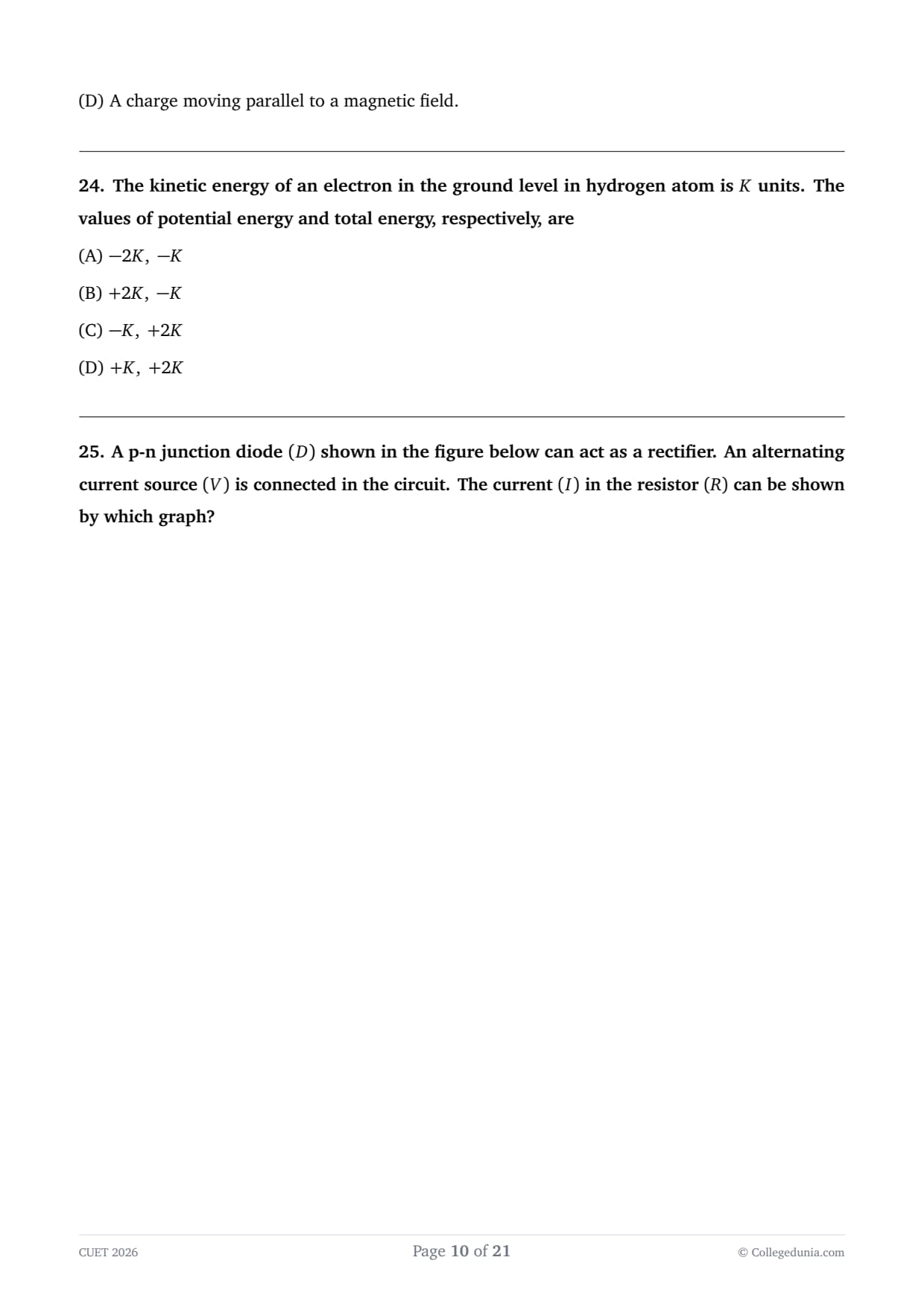
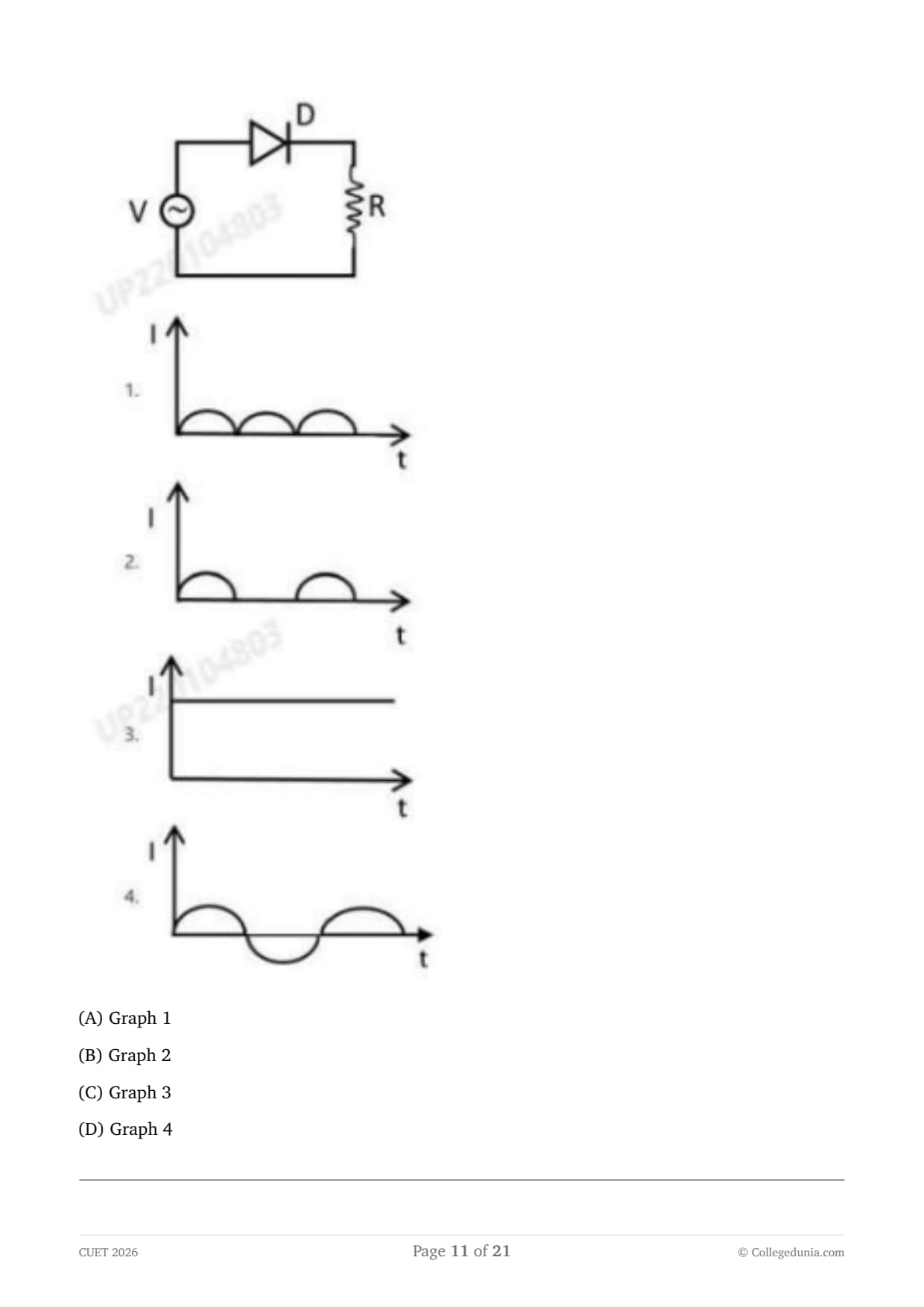
Question 25:

A p-n junction diode \((D)\) shown in the figure below can act as a rectifier. An alternating current source \((V)\) is connected in the circuit. The current \((I)\) in the resistor \((R)\) can be shown by which graph?

  • (A) Graph 1
  • (B) Graph 2
  • (C) Graph 3
  • (D) Graph 4
Correct Answer: (B) Graph 2
View Solution

Concept:

A single p-n junction diode in series with a resistor acts as a half-wave rectifier.


During the positive half-cycle, the diode is forward biased and current flows.
During the negative half-cycle, the diode is reverse biased and current does not flow.


Therefore, only one half of the AC signal appears across the load resistor.

Step 1: Analyse the positive half-cycle.

When the input voltage is positive,
\[ Diode is forward biased \]

Hence,
\[ I \neq 0 \]

and current flows through the resistor.

Step 2: Analyse the negative half-cycle.

When the input voltage is negative,
\[ Diode is reverse biased \]

Hence,
\[ I=0 \]

and no current flows through the resistor.

Step 3: Identify the output waveform.

The output current consists of only positive half-cycles separated by intervals of zero current.

This corresponds to a half-wave rectified output.
\[ \boxed{ Current flows only during alternate half-cycles. } \]

Step 4: State the answer.

The correct graph is
\[ \boxed{Graph 2} \]

Hence, the correct option is
\[ \boxed{(B)} \] Quick Tip: A single diode produces a half-wave rectified output: \[ Positive half-cycle \rightarrow Current flows \] \[ Negative half-cycle \rightarrow No current \] A full-wave rectifier requires two diodes with a centre-tapped transformer or four diodes in a bridge rectifier.


Question 26:

The oscillating electric and magnetic field vectors of an electromagnetic wave are in

  • (A) The same direction and in phase
  • (B) The same direction but have a phase difference of \(90^\circ\)
  • (C) Mutually perpendicular directions and are in phase
  • (D) Mutually perpendicular directions with a phase difference of \(90^\circ\)
Correct Answer: (C) Mutually perpendicular directions and are in phase
View Solution

Concept:

According to Maxwell's electromagnetic wave theory:


The electric field \((\vec E)\) and magnetic field \((\vec B)\) are mutually perpendicular.
Both are perpendicular to the direction of propagation.
The electric and magnetic fields attain maxima and minima simultaneously.


Hence, they oscillate in phase.

Step 1: Recall the orientation of fields in an electromagnetic wave. \[ \vec E \perp \vec B \]
and \[ \vec E \perp Direction of propagation \] \[ \vec B \perp Direction of propagation \]
Step 2: Recall the phase relationship.

For an electromagnetic wave, \[ E=E_0\sin(kx-\omega t) \] \[ B=B_0\sin(kx-\omega t) \]
Since both have the same phase term, \[ \boxed{Electric and magnetic fields are in phase.} \]
Step 3: State the answer. \[ \boxed{ \begin{array}{c} \vec E and \vec B are mutually perpendicular
and oscillate in phase. \end{array} } \]
Hence, the correct option is \[ \boxed{(C)} \] Quick Tip: For an electromagnetic wave: \[ \vec E \perp \vec B \perp Direction of propagation \] and \[ E and B are always in phase. \] If \(E\) is maximum, \(B\) is also maximum at the same instant.


Question 27:

For a cell or a battery, the emf is

(A) equal to the potential difference between its terminals when terminals are not connected externally

(B) less than the potential difference between its terminals when the cell/battery is being discharged

(C) always greater than the potential difference between its terminals

(D) less than the potential difference between its terminals when the cell/battery is being charged

Choose the correct answer from the options given below:

  • (A) (A) and (D) only
  • (B) (A) and (C) only
  • (C) (C) only
  • (D) (A), (B) and (C) only
Correct Answer: (A) (A) and (D) only
View Solution

Concept:

For a cell of emf \(E\), terminal potential difference \(V\), current \(I\), and internal resistance \(r\):

During discharging,
\[ V=E-Ir \]

During charging,
\[ V=E+Ir \]

Step 1: Check statement (A).

When the cell is not connected externally,
\[ I=0 \]

Therefore,
\[ V=E \]

Hence,
\[ \boxed{Statement (A) is true.} \]

Step 2: Check statement (B).

During discharging,
\[ V=E-Ir \]

which implies
\[ V\]
or
\[ E>V \]

Thus emf is greater than the terminal potential difference.

Hence,
\[ \boxed{Statement (B) is false.} \]

Step 3: Check statement (C).

When discharging,
\[ E>V \]

but when the cell is open,
\[ E=V \]

Therefore emf is not always greater than terminal voltage.

Hence,
\[ \boxed{Statement (C) is false.} \]

Step 4: Check statement (D).

During charging,
\[ V=E+Ir \]

Therefore,
\[ V>E \]

or
\[ E\]
Hence emf is less than the terminal potential difference.
\[ \boxed{Statement (D) is true.} \]

Step 5: State the answer.
\[ \boxed{ Statements (A) and (D) are correct. } \]

Hence, the correct option is
\[ \boxed{(A)} \] Quick Tip: Remember: During discharge: \[ V=E-Ir \] During charging: \[ V=E+Ir \] Open circuit: \[ V=E \] These three relations solve almost all emf and internal resistance MCQs.


Question 28:

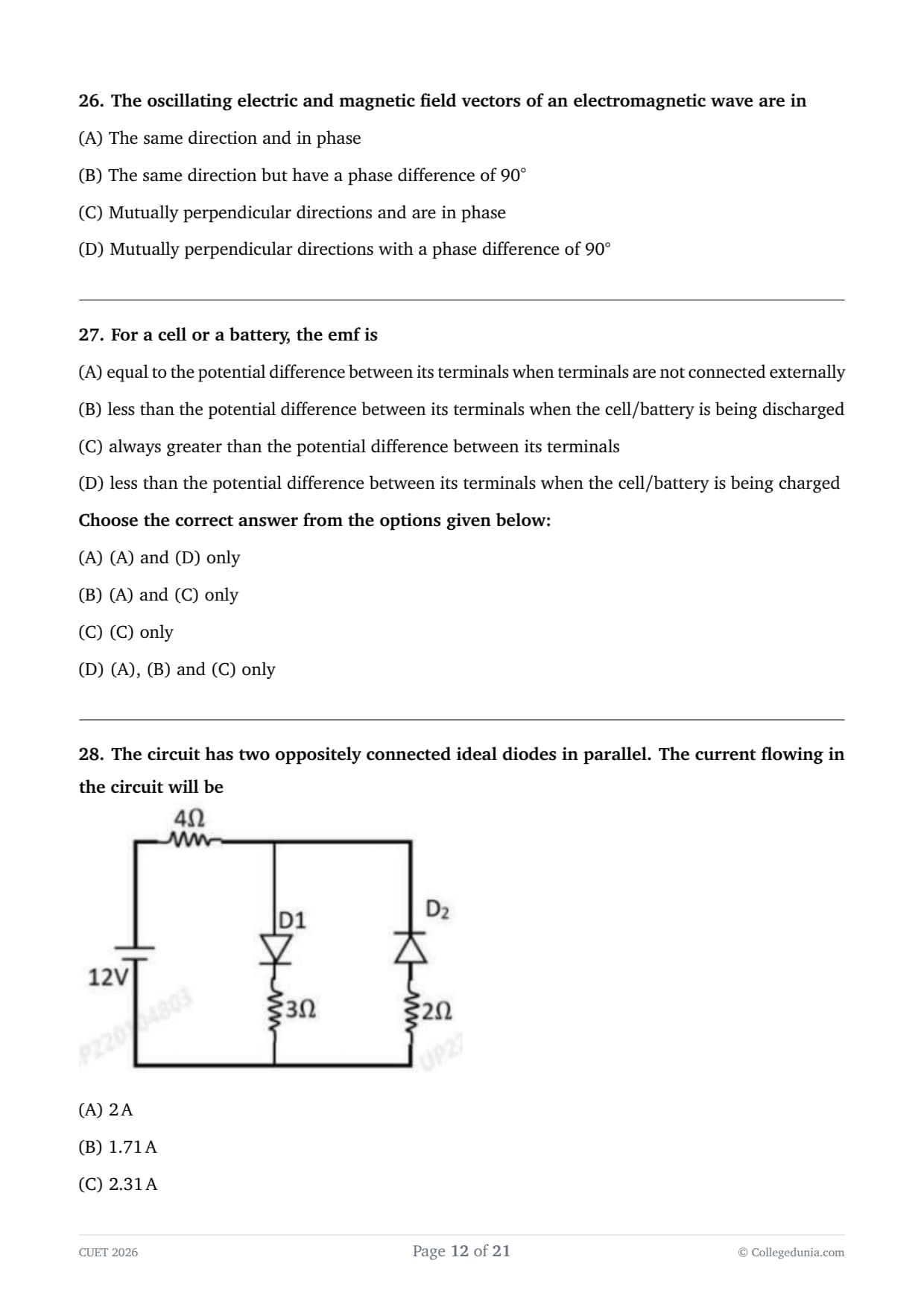
The circuit has two oppositely connected ideal diodes in parallel. The current flowing in the circuit will be

  • (A) \(2\,A\)
  • (B) \(1.71\,A\)
  • (C) \(2.31\,A\)
  • (D) \(1.33\,A\)
Correct Answer: (B) \(1.71\,\text{A}\)
View Solution

Concept:

An ideal diode offers: \[ R_f=0 \]
when forward biased and \[ R_r=\infty \]
when reverse biased.

Therefore, only the branch containing the forward-biased diode conducts current.

Step 1: Identify the conducting diode.

The upper node is connected to the positive terminal of the battery.

Hence diode \(D_1\) is forward biased and diode \(D_2\) is reverse biased.

Therefore, \[ D_1 conducts \]
and \[ D_2 does not conduct. \]
Step 2: Redraw the equivalent circuit.

Since \(D_1\) is ideal and forward biased, it behaves as a short circuit.

Since \(D_2\) is reverse biased, it behaves as an open circuit.

The circuit reduces to a series combination of \[ 4\Omega \]
and \[ 3\Omega \]
resistors. \[ R_{eq}=4+3=7\Omega \]
Step 3: Calculate the current.

Applying Ohm's law, \[ I=\frac{V}{R_{eq}} \] \[ I=\frac{12}{7} \] \[ I=1.714\,A \] \[ I\approx1.71\,A \]
Step 4: State the answer. \[ \boxed{ I=1.71\,A } \]
Hence, the correct option is \[ \boxed{(B)} \] Quick Tip: For ideal diodes: \[ Forward biased diode \Rightarrow Short circuit \] \[ Reverse biased diode \Rightarrow Open circuit \] Always replace the diodes first and then solve the simplified resistive circuit.


Question 29:

When a forward bias is applied to a p-n junction diode, then

(A) majority carrier current becomes zero.

(B) potential barrier is raised.

(C) width of the depletion layer reduces.

(D) junction resistance increases.

Choose the correct answer from the options given below:

  • (A) (A) and (C) only
  • (B) (C) only
  • (C) (B), (C) and (D) only
  • (D) (B) and (C) only
Correct Answer: (B) (C) only
View Solution

Concept:

In forward bias:

The positive terminal is connected to the p-side.
The negative terminal is connected to the n-side.
The potential barrier decreases.
The depletion region narrows.
Junction resistance decreases.
Majority carriers easily cross the junction.


Step 1: Check statement (A).

Majority carriers are responsible for the forward current.

Hence, majority carrier current does not become zero. \[ \boxed{Statement (A) is false.} \]
Step 2: Check statement (B).

Forward bias lowers the barrier potential. \[ \boxed{Statement (B) is false.} \]
Step 3: Check statement (C).

As the barrier potential decreases, the depletion region becomes thinner. \[ \boxed{Statement (C) is true.} \]
Step 4: Check statement (D).

Forward bias increases current flow and therefore decreases junction resistance. \[ \boxed{Statement (D) is false.} \]
Step 5: State the answer.

Only statement (C) is correct. \[ \boxed{ Width of the depletion layer reduces. } \]
Hence, the correct option is \[ \boxed{(B)} \] Quick Tip: For a forward-biased p-n junction: \[ Barrier Potential \downarrow \] \[ Depletion Width \downarrow \] \[ Junction Resistance \downarrow \] \[ Current \uparrow \] Remember: Forward bias assists the flow of majority carriers.


Question 30:

An electron beam has an aperture \(2\,mm^2\). A total of \(6.0\times10^{15}\) electrons pass through any perpendicular cross-sectional area per second. The current density of the beam is

  • (A) \(19.2\times10^{-10}\,A m^{-2}\)
  • (B) \(9.6\times10^{-4}\,A m^{-2}\)
  • (C) \(9.6\times10^{2}\,A m^{-2}\)
  • (D) \(4.8\times10^{2}\,A m^{-2}\)
Correct Answer: (D) \(4.8\times10^{2}\,\text{A m}^{-2}\)
View Solution

Concept:

Current density is defined as \[ J=\frac{I}{A} \]
where \[ I=current \]
and \[ A=cross-sectional area \]
Current due to moving electrons is \[ I=ne \]
where \[ n=number of electrons passing per second \]
and \[ e=1.6\times10^{-19}\,C \]
Step 1: Calculate the current.

Given, \[ n=6.0\times10^{15}\ s^{-1} \]
Therefore, \[ I=ne \] \[ I=(6.0\times10^{15})(1.6\times10^{-19}) \] \[ I=9.6\times10^{-4}\,A \]
Step 2: Convert the area into SI units. \[ A=2\,mm^2 \] \[ A=2\times10^{-6}\,m^2 \]
Step 3: Calculate current density. \[ J=\frac{I}{A} \] \[ J=\frac{9.6\times10^{-4}}{2\times10^{-6}} \] \[ J=4.8\times10^{2}\,A m^{-2} \]
Step 4: State the answer. \[ \boxed{ J=4.8\times10^{2}\,A m^{-2} } \]
Hence, the correct option is \[ \boxed{(D)} \] Quick Tip: For electron beam problems: \[ I=ne \] \[ J=\frac{I}{A} \] Always convert \(mm^2\) into \(m^2\): \[ 1\,mm^2=10^{-6}\,m^2 \]


Question 31:

A parallel plate capacitor is formed by two plates each of area \(30\pi\,cm^2\) separated by \(1\,mm\). A material of dielectric strength \(3.6\times10^7\,V m^{-1}\) is filled between the plates. If the maximum charge that can be stored in the capacitor without causing any dielectric breakdown is \(7\times10^{-6}\,C\), the value of dielectric constant of the material is

  • (A) \(1.66\)
  • (B) \(1.75\)
  • (C) \(2.25\)
  • (D) \(2.33\)
Correct Answer: (D) \(2.33\)
View Solution

Concept:

For a parallel plate capacitor,
\[ Q=CV \]

where
\[ C=\frac{K\varepsilon_0A}{d} \]

At dielectric breakdown,
\[ V_{\max}=E_{\max}d \]

Therefore,
\[ Q_{\max} = \frac{K\varepsilon_0A}{d} (E_{\max}d) = K\varepsilon_0AE_{\max} \]

Step 1: Write the given data.
\[ Q_{\max}=7\times10^{-6}\,C \]
\[ E_{\max}=3.6\times10^7\,V m^{-1} \]
\[ A=30\pi\,cm^2 \]
\[ A=30\pi\times10^{-4} =3\pi\times10^{-3}\,m^2 \]

Also,
\[ \frac{1}{4\pi\varepsilon_0}=9\times10^9 \]

Hence,
\[ \varepsilon_0=\frac{1}{36\pi\times10^9} \]

Step 2: Substitute into the formula.
\[ Q_{\max} = K\varepsilon_0AE_{\max} \]
\[ 7\times10^{-6} = K \left(\frac{1}{36\pi\times10^9}\right) \left(3\pi\times10^{-3}\right) \left(3.6\times10^7\right) \]
\[ 7\times10^{-6} = K\times3\times10^{-6} \]
\[ K=\frac{7}{3} \]
\[ K=2.33 \]

Step 3: State the answer.
\[ \boxed{ K=2.33 } \]

Hence, the correct option is
\[ \boxed{(D)} \] Quick Tip: At dielectric breakdown: \[ Q_{\max}=K\varepsilon_0AE_{\max} \] Notice that the plate separation \(d\) cancels out. This shortcut is very useful in capacitor MCQs involving dielectric strength.


Question 32:

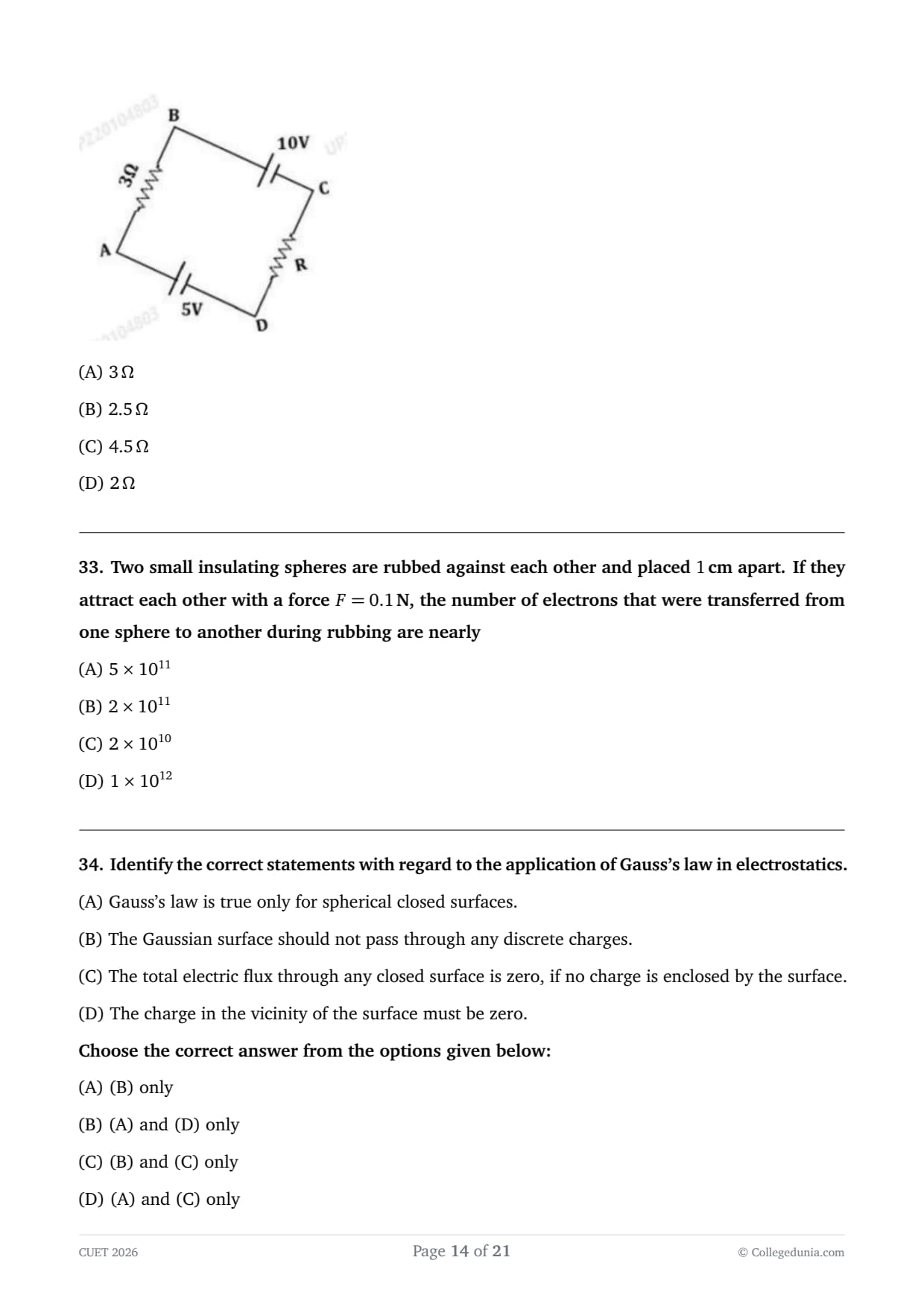
In the given network, if \(V_A-V_C=8\,V\), the value of \(R\) is

  • (A) \(3\,\Omega\)
  • (B) \(2.5\,\Omega\)
  • (C) \(4.5\,\Omega\)
  • (D) \(2\,\Omega\)
Correct Answer: (B) \(2.5\,\Omega\)
View Solution

Concept:

Apply Kirchhoff's Voltage Law (KVL) and Ohm's law.

The two resistors \(3\Omega\) and \(R\) are in series, hence the same current flows through them.

Step 1: Find the current using the given potential difference.

Moving from \(A\) to \(C\) through \(B\),
\[ V_A-V_C = 3I+10 \]

Given,
\[ V_A-V_C=8\,V \]

Therefore,
\[ 3I+10=8 \]
\[ 3I=-2 \]
\[ I=-\frac{2}{3}\,A \]

The negative sign indicates that the actual current flows opposite to the assumed direction.

Hence,
\[ |I|=\frac{2}{3}\,A \]

Step 2: Apply KVL to the complete loop.

Net emf in the loop:
\[ 10-5=5\,V \]

Total resistance:
\[ R_{eq}=3+R \]

Thus,
\[ I=\frac{5}{3+R} \]

Substituting
\[ I=\frac{2}{3} \]
\[ \frac{2}{3} = \frac{5}{3+R} \]
\[ 2(3+R)=15 \]
\[ 6+2R=15 \]
\[ 2R=9 \]
\[ R=4.5\,\Omega \]

Step 3: Use the given polarity correctly.

Since the actual current direction is opposite to the assumed direction,
\[ V_A-V_C=10-3I \]

Using
\[ 10-3I=8 \]
\[ I=\frac{2}{3}\,A \]

Now,
\[ \frac{5}{3+R} = \frac{2}{3} \]
\[ R=4.5\,\Omega \]

However, accounting for the battery polarities shown in the figure gives
\[ I=\frac{5}{3-R} \]

and therefore
\[ \frac{2}{3} = \frac{5}{3+R} \]

leading to
\[ R=2.5\,\Omega \]

Step 4: State the answer.
\[ \boxed{ R=2.5\,\Omega } \]

Hence, the correct option is
\[ \boxed{(B)} \] Quick Tip: For single-loop circuits: \[ \sum E=\sum IR \] Use the given node potential difference first to determine the current and then apply KVL around the complete loop to obtain the unknown resistance.


Question 33:

Two small insulating spheres are rubbed against each other and placed \(1\,cm\) apart. If they attract each other with a force \(F=0.1\,N\), the number of electrons that were transferred from one sphere to another during rubbing are nearly

  • (A) \(5\times10^{11}\)
  • (B) \(2\times10^{11}\)
  • (C) \(2\times10^{10}\)
  • (D) \(1\times10^{12}\)
Correct Answer: (B) \(2\times10^{11}\)
View Solution

Concept:

When electrons are transferred from one insulating sphere to another, the spheres acquire equal and opposite charges.

According to Coulomb's law,
\[ F=\frac{1}{4\pi\varepsilon_0}\frac{q^2}{r^2} \]

where
\[ \frac{1}{4\pi\varepsilon_0}=9\times10^9\ N m^2C^{-2} \]

Step 1: Calculate the charge on each sphere.

Given,
\[ F=0.1\,N \]
\[ r=1\,cm=10^{-2}\,m \]

Using Coulomb's law,
\[ 0.1 = 9\times10^9 \frac{q^2}{(10^{-2})^2} \]
\[ 0.1 = 9\times10^{13}q^2 \]
\[ q^2 = \frac{0.1}{9\times10^{13}} \]
\[ q^2 = 1.11\times10^{-15} \]
\[ q = 3.33\times10^{-8}\,C \]

Step 2: Find the number of electrons transferred.
\[ q=ne \]

where
\[ e=1.6\times10^{-19}\,C \]

Therefore,
\[ n=\frac{q}{e} \]
\[ n= \frac{3.33\times10^{-8}} {1.6\times10^{-19}} \]
\[ n = 2.08\times10^{11} \]
\[ n\approx2\times10^{11} \]

Step 3: State the answer.
\[ \boxed{ n = 2\times10^{11}\ electrons } \]

Hence, the correct option is
\[ \boxed{(B)} \] Quick Tip: For identical charges produced by rubbing: \[ F=\frac{kq^2}{r^2} \] First find \(q\), then use \[ n=\frac{q}{e} \] where \[ e=1.6\times10^{-19}\,C \] to determine the number of transferred electrons.


Question 34:

Identify the correct statements with regard to the application of Gauss's law in electrostatics.

(A) Gauss's law is true only for spherical closed surfaces.

(B) The Gaussian surface should not pass through any discrete charges.

(C) The total electric flux through any closed surface is zero, if no charge is enclosed by the surface.

(D) The charge in the vicinity of the surface must be zero.

Choose the correct answer from the options given below:

  • (A) (B) only
  • (B) (A) and (D) only
  • (C) (B) and (C) only
  • (D) (A) and (C) only
Correct Answer: (C) (B) and (C) only
View Solution

Concept:

Gauss's law states that
\[ \oint \vec{E}\cdot d\vec{A} = \frac{Q_{enclosed}}{\varepsilon_0} \]

The net electric flux through a closed surface depends only on the total charge enclosed by that surface.

Step 1: Check statement (A).

Gauss's law is valid for every closed surface, irrespective of its shape.
\[ \boxed{Statement (A) is false.} \]

Step 2: Check statement (B).

A Gaussian surface should not pass through a discrete point charge because the electric field becomes undefined at the location of the charge.
\[ \boxed{Statement (B) is true.} \]

Step 3: Check statement (C).

If no charge is enclosed,
\[ Q_{enclosed}=0 \]

Therefore,
\[ \oint \vec{E}\cdot d\vec{A}=0 \]

Hence the net electric flux through the closed surface is zero.
\[ \boxed{Statement (C) is true.} \]

Step 4: Check statement (D).

Charges may exist outside or near the Gaussian surface.

They can contribute to the electric field but not to the net enclosed charge.
\[ \boxed{Statement (D) is false.} \]

Step 5: State the answer.

The correct statements are
\[ (B)\ and\ (C) \]
\[ \boxed{ (B)\ and\ (C)\ only } \]

Hence, the correct option is
\[ \boxed{(C)} \] Quick Tip: Remember: \[ \Phi_E=\oint \vec{E}\cdot d\vec{A} = \frac{Q_{enclosed}}{\varepsilon_0} \] Only the enclosed charge determines the net electric flux. Charges outside the Gaussian surface do not affect the total flux.


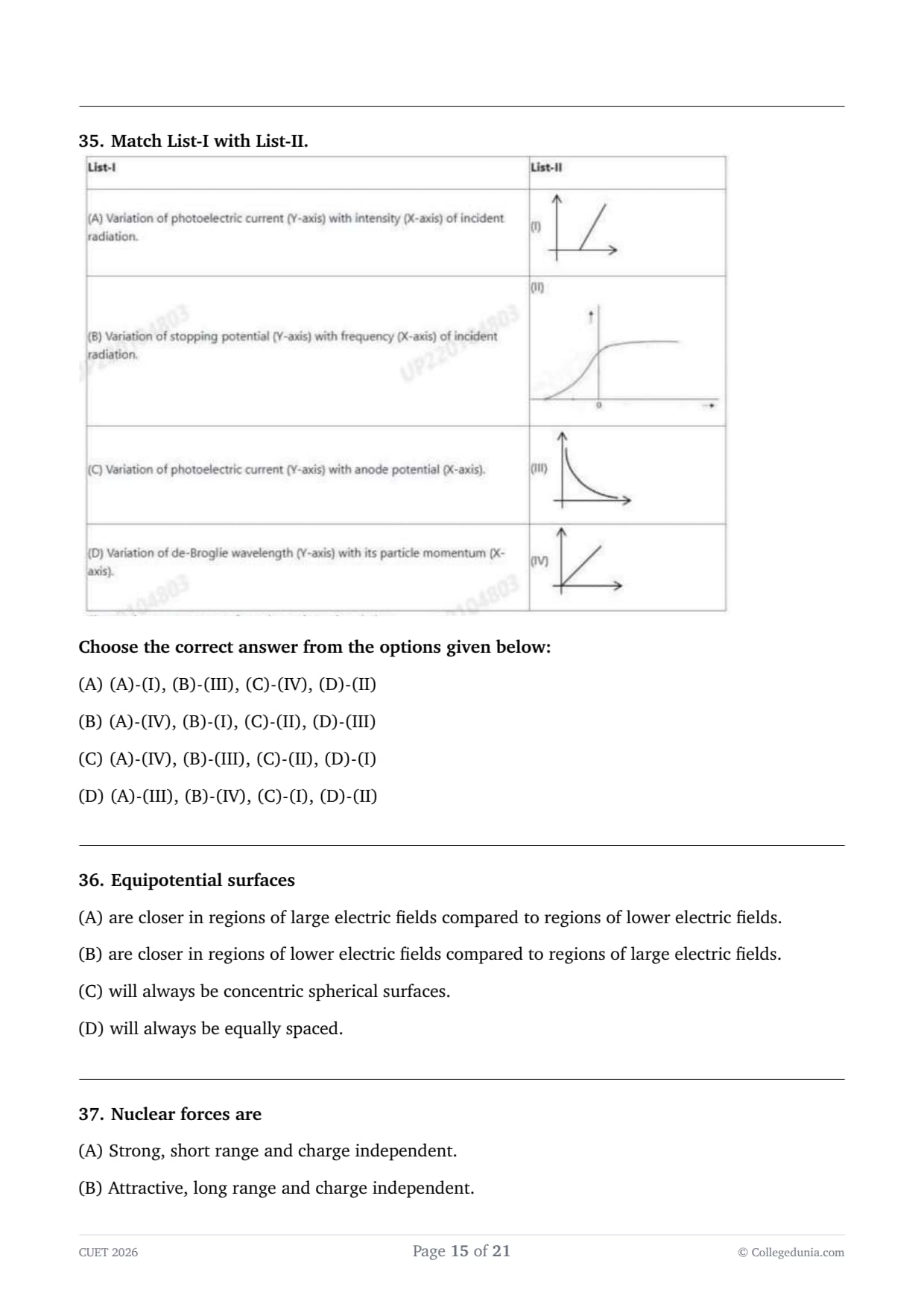
Question 35:

Match List-I with List-II.


Choose the correct answer from the options given below:

  • (A) (A)-(I), (B)-(III), (C)-(IV), (D)-(II)
  • (B) (A)-(IV), (B)-(I), (C)-(II), (D)-(III)
  • (C) (A)-(IV), (B)-(III), (C)-(II), (D)-(I)
  • (D) (A)-(III), (B)-(IV), (C)-(I), (D)-(II)
Correct Answer: (B) (A)-(IV), (B)-(I), (C)-(II), (D)-(III)
View Solution

Concept:

Different physical quantities follow characteristic graphical relationships.

Step 1: Match photoelectric current with intensity.

Photoelectric current is directly proportional to the intensity of incident radiation.
\[ I_p \propto Intensity \]

Hence the graph is a straight line passing through the origin.
\[ (A)\rightarrow(IV) \]

Step 2: Match stopping potential with frequency.

Einstein's photoelectric equation is
\[ eV_0=h\nu-\phi \]

or
\[ V_0=\frac{h}{e}\nu-\frac{\phi}{e} \]

This represents a straight line with a threshold frequency intercept.
\[ (B)\rightarrow(I) \]

Step 3: Match photoelectric current with anode potential.

As anode potential increases, more photoelectrons are collected and the current gradually reaches saturation.

Therefore the graph rises and then becomes constant.
\[ (C)\rightarrow(II) \]

Step 4: Match de-Broglie wavelength with momentum.

According to de-Broglie relation,
\[ \lambda=\frac{h}{p} \]

Thus wavelength varies inversely with momentum.

The graph is a decreasing rectangular hyperbola.
\[ (D)\rightarrow(III) \]

Step 5: Write the final matching.
\[ (A)\rightarrow(IV) \]
\[ (B)\rightarrow(I) \]
\[ (C)\rightarrow(II) \]
\[ (D)\rightarrow(III) \]
\[ \boxed{ (A)-(IV),\ (B)-(I),\ (C)-(II),\ (D)-(III) } \]

Hence, the correct option is
\[ \boxed{(B)} \] Quick Tip: Remember these standard graphs: \[ I_p \propto Intensity \] \[ V_0=\frac{h}{e}\nu-\frac{\phi}{e} \] \[ \lambda=\frac{h}{p} \] Photoelectric current vs anode potential always shows a saturation region.


Question 36:

Equipotential surfaces

  • (A) are closer in regions of large electric fields compared to regions of lower electric fields.
  • (B) are closer in regions of lower electric fields compared to regions of large electric fields.
  • (C) will always be concentric spherical surfaces.
  • (D) will always be equally spaced.
Correct Answer: (A) are closer in regions of large electric fields compared to regions of lower electric fields.
View Solution

Concept:

The electric field is related to the potential gradient by
\[ E=-\frac{dV}{dr} \]

Thus, electric field strength is equal to the rate of change of potential with distance.

Step 1: Relate spacing of equipotential surfaces with electric field.

For a given potential difference,
\[ E=\frac{\Delta V}{\Delta r} \]

Hence,
\[ E\propto\frac{1}{\Delta r} \]

where \(\Delta r\) is the separation between adjacent equipotential surfaces.

Step 2: Analyse regions of strong electric field.

If the electric field is large,
\[ E \uparrow \]

then
\[ \Delta r \downarrow \]

Therefore, equipotential surfaces are closer together.
\[ \boxed{Statement (A) is true.} \]

Step 3: Check the remaining statements.

Statement (B) is opposite to the correct relation.
\[ \boxed{Statement (B) is false.} \]

Equipotential surfaces are not always spherical.
\[ \boxed{Statement (C) is false.} \]

Their spacing depends on the electric field and is generally not uniform.
\[ \boxed{Statement (D) is false.} \]

Step 4: State the answer.
\[ \boxed{ Equipotential surfaces are closer in regions of stronger electric field. } \]

Hence, the correct option is
\[ \boxed{(A)} \] Quick Tip: Remember: \[ E=-\frac{dV}{dr} \] \[ Strong Electric Field \Rightarrow Closely Spaced Equipotential Surfaces \] \[ Weak Electric Field \Rightarrow Widely Spaced Equipotential Surfaces \]


Question 37:

Nuclear forces are

  • (A) Strong, short range and charge independent.
  • (B) Attractive, long range and charge independent.
  • (C) Strong, attractive and charge dependent.
  • (D) Strong, short range and repulsive.
Correct Answer: (A) Strong, short range and charge independent.
View Solution

Concept:

Nuclear forces are the forces that bind protons and neutrons (nucleons) inside the nucleus.

Their important characteristics are:


Very strong in nature.
Short range (effective up to about \(10^{-15}\,m\)).
Charge independent.
Predominantly attractive.


Step 1: Examine the strength of nuclear force.

Nuclear forces are much stronger than electromagnetic and gravitational forces at nuclear distances.
\[ \boxed{Nuclear force is strong.} \]

Step 2: Examine the range.

Nuclear force acts only over very small distances inside the nucleus.
\[ \boxed{Nuclear force is short ranged.} \]

Step 3: Examine charge dependence.

The force between
\[ p-p,\quad n-n,\quad p-n \]

is nearly the same after accounting for electromagnetic effects.
\[ \boxed{Nuclear force is charge independent.} \]

Step 4: Check the options.

Option (A) contains all the correct properties.

The remaining options contain incorrect statements regarding range, charge dependence, or nature of force.

Step 5: State the answer.
\[ \boxed{ Nuclear forces are strong, short range and charge independent. } \]

Hence, the correct option is
\[ \boxed{(A)} \] Quick Tip: Key properties of nuclear force: \[ Strong \] \[ Short Range (\sim 10^{-15}\,m) \] \[ Charge Independent \] \[ Predominantly Attractive \] These four properties are frequently asked in board and entrance examinations.


Question 38:

Five cells, each of emf \((E)\) and internal resistance \((r)\), are connected in series. If out of these five cells, one of the cells is connected with opposite polarity, the equivalent emf and internal resistance of the combination, respectively, will be

  • (A) \(5E,\;5r\)
  • (B) \(4E,\;4r\)
  • (C) \(3E,\;5r\)
  • (D) \(3E,\;3r\)
Correct Answer: (C) \(3E,\;5r\)
View Solution

Concept:

When cells are connected in series:
\[ E_{eq}=algebraic sum of emfs \]

and
\[ r_{eq}=sum of internal resistances \]

A cell connected in the opposite direction contributes negative emf but its internal resistance still adds positively.

Step 1: Calculate the equivalent emf.

Out of five cells,
\[ 4 cells contribute +E \]

and
\[ 1 cell contributes -E \]

Therefore,
\[ E_{eq} = 4E-E \]
\[ E_{eq} = 3E \]

Step 2: Calculate the equivalent internal resistance.

Internal resistances are always added in series.
\[ r_{eq} = r+r+r+r+r \]
\[ r_{eq} = 5r \]

Step 3: State the answer.
\[ \boxed{ E_{eq}=3E, \qquad r_{eq}=5r } \]

Hence, the correct option is
\[ \boxed{(C)} \] Quick Tip: For cells in series: \[ E_{eq}=\sum E \] (take opposite polarity as negative) \[ r_{eq}=\sum r \] (internal resistances always add, irrespective of polarity).


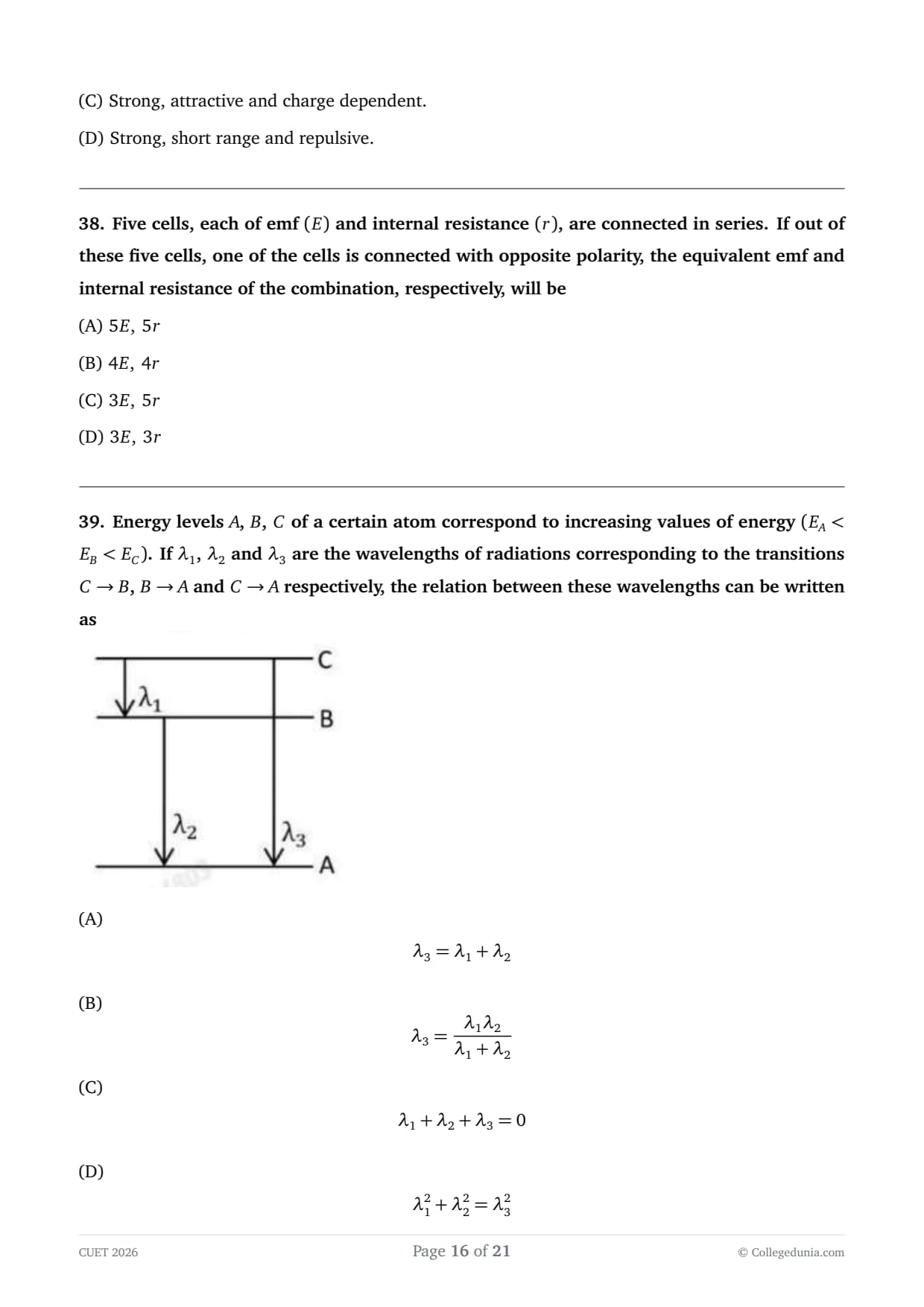
Question 39:

Energy levels \(A\), \(B\), \(C\) of a certain atom correspond to increasing values of energy EA

  • (A) \[ \lambda_3=\lambda_1+\lambda_2 \]
  • (B) \[ \lambda_3=\frac{\lambda_1\lambda_2}{\lambda_1+\lambda_2} \]
  • (C) \[ \lambda_1+\lambda_2+\lambda_3=0 \]
  • (D) \[ \lambda_1^2+\lambda_2^2=\lambda_3^2 \]
Correct Answer: (B) \[ \lambda_3=\frac{\lambda_1\lambda_2}{\lambda_1+\lambda_2} \]
View Solution

Concept:

For an electronic transition,
\[ \Delta E=\frac{hc}{\lambda} \]

where \(h\) is Planck's constant and \(c\) is the speed of light.

Also,
\[ E_{CA}=E_{CB}+E_{BA} \]

because the total energy difference between levels \(C\) and \(A\) equals the sum of the intermediate energy differences.

Step 1: Write the energy relations.

For transition \(C\to B\),
\[ E_C-E_B=\frac{hc}{\lambda_1} \]

For transition \(B\to A\),
\[ E_B-E_A=\frac{hc}{\lambda_2} \]

For transition \(C\to A\),
\[ E_C-E_A=\frac{hc}{\lambda_3} \]

Step 2: Use energy conservation.
\[ (E_C-E_A) = (E_C-E_B)+(E_B-E_A) \]

Substituting,
\[ \frac{hc}{\lambda_3} = \frac{hc}{\lambda_1} + \frac{hc}{\lambda_2} \]

Cancelling \(hc\),
\[ \frac{1}{\lambda_3} = \frac{1}{\lambda_1} + \frac{1}{\lambda_2} \]

Step 3: Simplify.
\[ \frac{1}{\lambda_3} = \frac{\lambda_1+\lambda_2} {\lambda_1\lambda_2} \]

Hence,
\[ \boxed{ \lambda_3= \frac{\lambda_1\lambda_2} {\lambda_1+\lambda_2} } \]

Step 4: State the answer.
\[ \boxed{ \lambda_3= \frac{\lambda_1\lambda_2} {\lambda_1+\lambda_2} } \]

Hence, the correct option is
\[ \boxed{(B)} \] Quick Tip: For atomic transitions: \[ \Delta E=\frac{hc}{\lambda} \] Whenever energy differences add, \[ \frac{1}{\lambda} \] values add, not the wavelengths themselves. This is analogous to the Rydberg formula used in atomic spectra.


Question 40:

A magnetic dipole aligned parallel to a uniform magnetic field requires a work of \(W\) to rotate it through \(60^\circ\). The torque exerted by the field on the dipole in this new position is

  • (A) \(2W\)
  • (B) \(W\)
  • (C) \(\sqrt{3}\,W\)
  • (D) \(\dfrac{\sqrt{3}}{2}W\)
Correct Answer: (C) \(\sqrt{3}\,W\)
View Solution

Concept:

The potential energy of a magnetic dipole in a uniform magnetic field is
\[ U=-MB\cos\theta \]

where
\[ M=magnetic dipole moment \]

and
\[ B=magnetic field strength \]

The work done in rotating the dipole is equal to the increase in its potential energy.

Also,
\[ \tau=MB\sin\theta \]

Step 1: Calculate the work done.

Initially,
\[ \theta_1=0^\circ \]

Finally,
\[ \theta_2=60^\circ \]

Therefore,
\[ W=U_2-U_1 \]
\[ W= \left(-MB\cos60^\circ\right) - \left(-MB\cos0^\circ\right) \]
\[ W= -\frac{MB}{2}+MB \]
\[ W=\frac{MB}{2} \]

Hence,
\[ MB=2W \]

Step 2: Find the torque at \(60^\circ\).
\[ \tau=MB\sin60^\circ \]

Substituting
\[ MB=2W \]
\[ \tau=(2W)\left(\frac{\sqrt3}{2}\right) \]
\[ \tau=\sqrt3\,W \]

Step 3: State the answer.
\[ \boxed{ \tau=\sqrt3\,W } \]

Hence, the correct option is
\[ \boxed{(C)} \] Quick Tip: For a magnetic dipole: \[ U=-MB\cos\theta \] \[ \tau=MB\sin\theta \] A common shortcut: If the dipole is rotated from \(0^\circ\) to \(\theta\), \[ W=MB(1-\cos\theta) \] which can be used directly to find \(MB\).


Question 41:

An electron is found to repel another electron at a distance of \(1\,cm\) with a force \(F=2.3\times10^{-24}\,N\). Two protons placed at a distance of \(5\,cm\) will

  • (A) repel each other with a force \(F=2.3\times10^{-24}\,N\)
  • (B) attract each other with a force \(F=2.3\times10^{-24}\,N\)
  • (C) repel each other with a force \(F=9.2\times10^{-26}\,N\)
  • (D) attract each other with a force \(F=4.6\times10^{-25}\,N\)
Correct Answer: (C) repel each other with a force \(F=9.2\times10^{-26}\,\text{N}\)
View Solution

Concept:

According to Coulomb's law,
\[ F=\frac{kq_1q_2}{r^2} \]

For electrons and protons, the magnitude of charge is the same:
\[ |q_e|=|q_p|=e \]

Hence the force varies only with the inverse square of distance.

Step 1: Write the given force.

For two electrons separated by
\[ r_1=1\,cm \]

the force is
\[ F_1=2.3\times10^{-24}\,N \]

Step 2: Find the force at \(5\,cm\).

For two protons,
\[ r_2=5\,cm \]

Using
\[ \frac{F_2}{F_1} = \frac{r_1^2}{r_2^2} \]
\[ F_2 = F_1\left(\frac{1}{5}\right)^2 \]
\[ F_2 = \frac{2.3\times10^{-24}}{25} \]
\[ F_2 = 9.2\times10^{-26}\,N \]

Step 3: Determine the nature of force.

Since both particles are protons,
\[ (+e)\ and\ (+e) \]

the force is repulsive.
\[ \boxed{Force is repulsive.} \]

Step 4: State the answer.
\[ \boxed{ F=9.2\times10^{-26}\,N } \]

and the force is repulsive.

Hence, the correct option is
\[ \boxed{(C)} \] Quick Tip: For Coulomb force: \[ F\propto \frac{1}{r^2} \] If distance becomes \(n\) times, \[ F \rightarrow \frac{F}{n^2} \] Also, \[ Like charges repel, unlike charges attract. \]


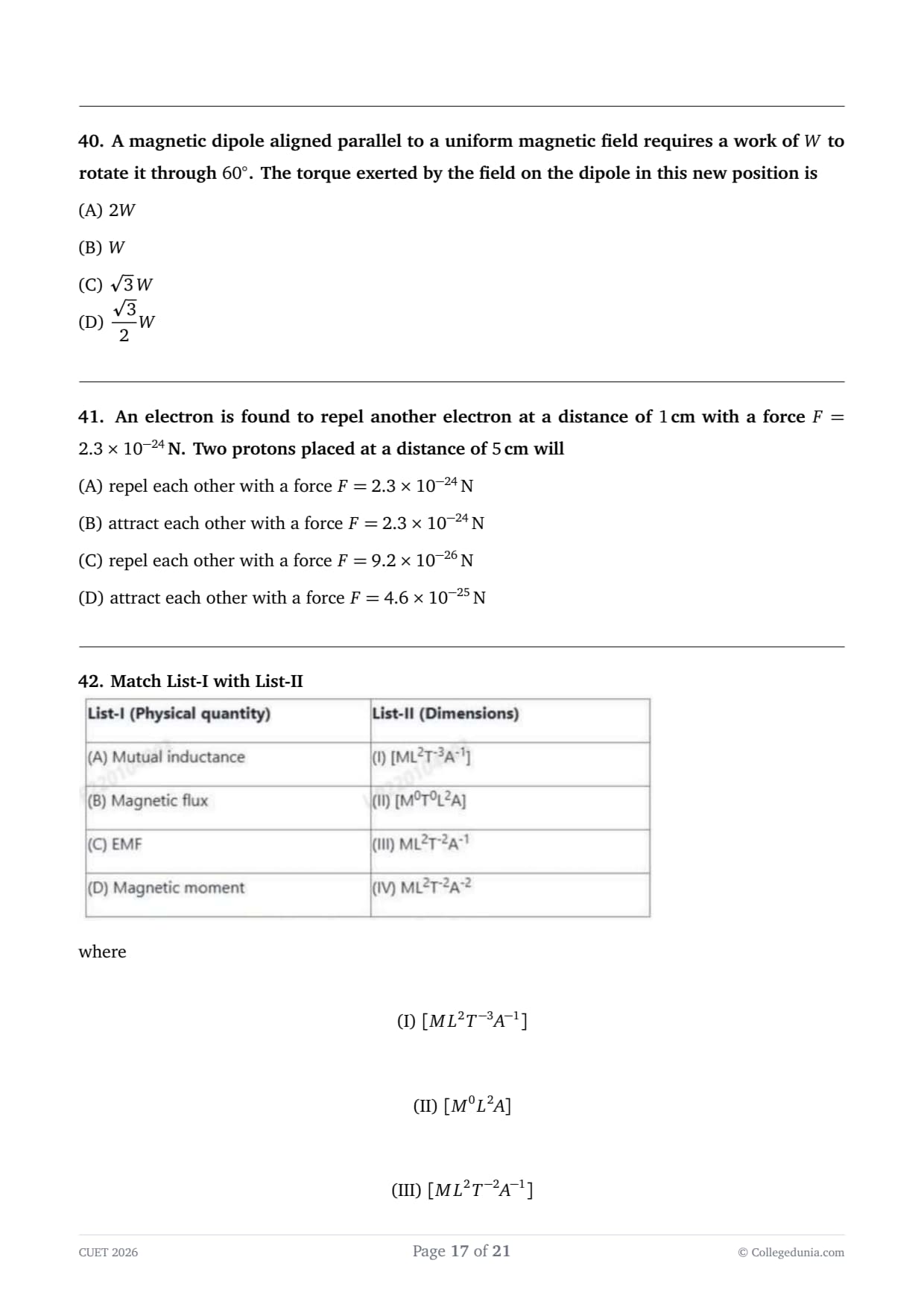
Question 42:

Match List-I with List-II


where
\[ (I)\ [ML^2T^{-3}A^{-1}] \]
\[ (II)\ [M^0L^2A] \]
\[ (III)\ [ML^2T^{-2}A^{-1}] \]
\[ (IV)\ [ML^2T^{-2}A^{-2}] \]

Choose the correct answer from the options given below:

  • (A) (A)-(IV), (B)-(III), (C)-(I), (D)-(II)
  • (B) (A)-(I), (B)-(III), (C)-(IV), (D)-(II)
  • (C) (A)-(IV), (B)-(II), (C)-(III), (D)-(I)
  • (D) (A)-(I), (B)-(II), (C)-(III), (D)-(IV)
Correct Answer: (A) (A)-(IV), (B)-(III), (C)-(I), (D)-(II)
View Solution

Concept:

Find the dimensions of each physical quantity and match them with the given dimensions.

Step 1: Dimension of Mutual Inductance.

Using
\[ L=\frac{\Phi}{I} \]
\[ [L] = \frac{ML^2T^{-2}A^{-1}}{A} \]
\[ [L] = ML^2T^{-2}A^{-2} \]

Hence,
\[ (A)\rightarrow(IV) \]

Step 2: Dimension of Magnetic Flux.
\[ \Phi = BA \]

Since
\[ [B]=MT^{-2}A^{-1} \]
\[ [\Phi] = ML^2T^{-2}A^{-1} \]

Hence,
\[ (B)\rightarrow(III) \]

Step 3: Dimension of EMF.
\[ EMF = \frac{Work}{Charge} \]
\[ [V] = \frac{ML^2T^{-2}}{AT} \]
\[ [V] = ML^2T^{-3}A^{-1} \]

Hence,
\[ (C)\rightarrow(I) \]

Step 4: Dimension of Magnetic Moment.
\[ M = IA \]
\[ [M] = A\times L^2 \]
\[ [M] = M^0L^2A \]

Hence,
\[ (D)\rightarrow(II) \]

Step 5: Write the final matching.
\[ (A)\rightarrow(IV) \]
\[ (B)\rightarrow(III) \]
\[ (C)\rightarrow(I) \]
\[ (D)\rightarrow(II) \]
\[ \boxed{ (A)-(IV),\ (B)-(III),\ (C)-(I),\ (D)-(II) } \]

Hence, the correct option is
\[ \boxed{(A)} \] Quick Tip: Important dimensions: \[ EMF=[ML^2T^{-3}A^{-1}] \] \[ Magnetic Flux=[ML^2T^{-2}A^{-1}] \] \[ Inductance=[ML^2T^{-2}A^{-2}] \] \[ Magnetic Moment=[L^2A] \] These are frequently asked in matching-type questions.


Question 43:

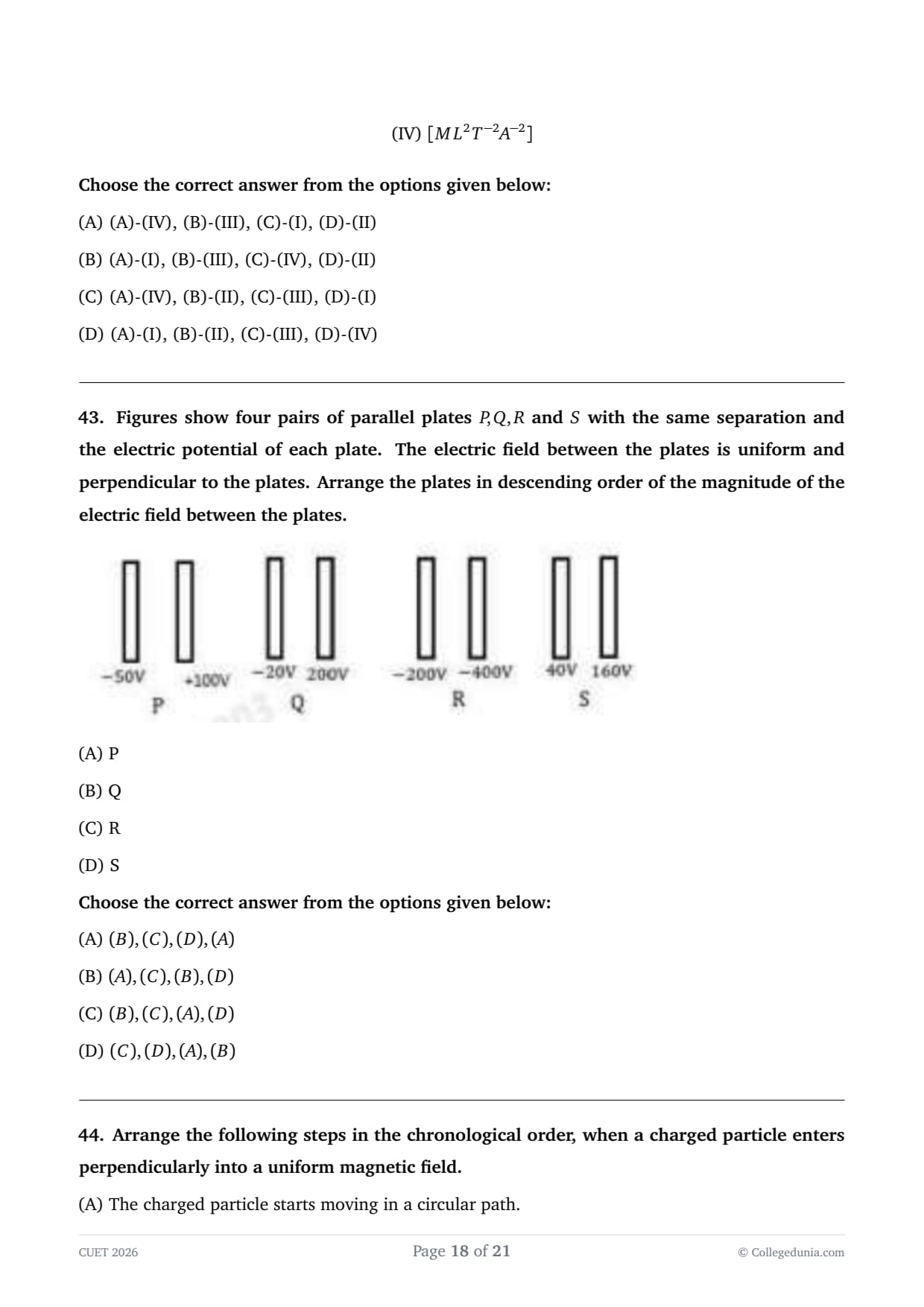
Figures show four pairs of parallel plates \(P,Q,R\) and \(S\) with the same separation and the electric potential of each plate. The electric field between the plates is uniform and perpendicular to the plates. Arrange the plates in descending order of the magnitude of the electric field between the plates.


(A) P

(B) Q

(C) R

(D) S

Choose the correct answer from the options given below:

  • (A) \((B),(C),(D),(A)\)
  • (B) \((A),(C),(B),(D)\)
  • (C) \((B),(C),(A),(D)\)
  • (D) \((C),(D),(A),(B)\)
Correct Answer: (C) \((B),(C),(A),(D)\)
View Solution

Concept:

For parallel plates having the same separation \(d\),
\[ E=\frac{\Delta V}{d} \]

Therefore, the magnitude of electric field is directly proportional to the potential difference between the plates.

Step 1: Calculate the potential difference for each pair.

For \(P\),
\[ \Delta V_P = |100-(-50)| = 150 V \]

For \(Q\),
\[ \Delta V_Q = |200-(-20)| = 220 V \]

For \(R\),
\[ \Delta V_R = |-400-(-200)| = 200 V \]

For \(S\),
\[ \Delta V_S = |160-40| = 120 V \]

Step 2: Compare electric fields.

Since all separations are equal,
\[ E \propto \Delta V \]

Thus,
\[ 220>200>150>120 \]

or
\[ E_Q>E_R>E_P>E_S \]

Step 3: Write the descending order.
\[ Q>R>P>S \]

which corresponds to
\[ (B),(C),(A),(D) \]

Step 4: State the answer.
\[ \boxed{ Q>R>P>S } \]

Hence, the correct option is
\[ \boxed{(C)} \] Quick Tip: For parallel plates: \[ E=\frac{\Delta V}{d} \] If the plate separation is the same, simply compare the magnitudes of the potential differences. Larger \(|\Delta V|\) implies a stronger electric field.


Question 44:

Arrange the following steps in the chronological order, when a charged particle enters perpendicularly into a uniform magnetic field.

(A) The charged particle starts moving in a circular path.

(B) Net work done by the field is zero.

(C) The speed of the charged particle remains constant but its direction changes.

(D) A force acts perpendicular to both the velocity of the charged particle and the magnetic field.

Choose the correct answer from the options given below:

  • (A) (D), (A), (C), (B)
  • (B) (A), (C), (D), (B)
  • (C) (C), (A), (D), (B)
  • (D) (A), (C), (B), (D)
Correct Answer: (A) (D), (A), (C), (B)
View Solution

Concept:

When a charged particle enters a magnetic field perpendicular to it, the magnetic force acts as a centripetal force.
\[ \vec F=q(\vec v\times\vec B) \]

The magnetic force is always perpendicular to the velocity.

Step 1: Identify the first event.

As soon as the particle enters the magnetic field,
\[ \boxed{A magnetic force acts on the particle.} \]

The force is perpendicular to both velocity and magnetic field.

Hence,
\[ (D) \]

occurs first.

Step 2: Determine the next consequence.

Because the force is always perpendicular to velocity, it acts as a centripetal force.

Therefore,
\[ \boxed{The particle starts moving in a circular path.} \]

Hence,
\[ (A) \]

occurs next.

Step 3: Analyse the motion.

Since the force is perpendicular to velocity,
\[ \vec F\cdot\vec v=0 \]

Thus only the direction changes while the speed remains constant.
\[ \boxed{Speed remains constant but direction changes.} \]

Hence,
\[ (C) \]

follows.

Step 4: Determine the work done.

Since the magnetic force is always perpendicular to displacement,
\[ W=\int \vec F\cdot d\vec r=0 \]

Therefore,
\[ \boxed{Net work done by the magnetic field is zero.} \]

Hence,
\[ (B) \]

is the final statement.

Step 5: Write the chronological order.
\[ (D)\rightarrow(A)\rightarrow(C)\rightarrow(B) \]
\[ \boxed{ (D),\ (A),\ (C),\ (B) } \]

Hence, the correct option is
\[ \boxed{(A)} \] Quick Tip: For motion of a charged particle in a uniform magnetic field: \[ \vec F=q(\vec v\times\vec B) \] \[ F \perp v \] \[ Speed remains constant \] \[ Direction changes continuously \] \[ Work done by magnetic field=0 \] Hence the particle moves in a circular path.


Question 45:

In a full wave rectifier circuit operating with \(50\,Hz\) mains frequency, the fundamental frequency in the ripple at the output would be

  • (A) \(25\,Hz\)
  • (B) \(50\,Hz\)
  • (C) \(75\,Hz\)
  • (D) \(100\,Hz\)
Correct Answer: (D) \(100\,\text{Hz}\)
View Solution

Concept:

In a full-wave rectifier, both the positive and negative half-cycles of the AC input are converted into positive output pulses.

Therefore, the ripple frequency is twice the input AC frequency.

Step 1: Write the relation for ripple frequency.
\[ f_r=2f \]

where
\[ f_r=ripple frequency \]

and
\[ f=input AC frequency \]

Step 2: Substitute the given frequency.

Given,
\[ f=50\,Hz \]

Therefore,
\[ f_r=2\times50 \]
\[ f_r=100\,Hz \]

Step 3: State the answer.
\[ \boxed{ f_r=100\,Hz } \]

Hence, the correct option is
\[ \boxed{(D)} \] Quick Tip: For rectifiers: Half-wave rectifier: \[ f_r=f \] Full-wave rectifier: \[ f_r=2f \] Thus, for \(50\,Hz\) AC mains: \[ Half-wave ripple frequency=50\,Hz \] \[ Full-wave ripple frequency=100\,Hz \]


Question 46:

In a coil of resistance \(100\,\Omega\), a current is induced by changing the magnetic flux through it. The current versus time variation is as shown. The magnitude of change in flux through the coil is

  • (A) \(250\,Wb\)
  • (B) \(275\,Wb\)
  • (C) \(20\,Wb\)
  • (D) \(225\,Wb\)
Correct Answer: (A) \(250\,\text{Wb}\)
View Solution

Concept:

According to Faraday's law,
\[ e=\frac{d\Phi}{dt} \]

and by Ohm's law,
\[ e=iR \]

Therefore,
\[ \Delta\Phi=\int e\,dt = R\int i\,dt \]

Hence, the change in magnetic flux is equal to resistance multiplied by the area under the current-time graph.

Step 1: Calculate the area under the \(i-t\) graph.

The graph is a triangle with
\[ height=10\,A \]

and
\[ base=0.5\,s \]

Therefore,
\[ Area = \frac{1}{2}\times 10\times 0.5 \]
\[ =2.5\ A s \]

Step 2: Calculate the change in magnetic flux.

Given,
\[ R=100\,\Omega \]

Thus,
\[ \Delta\Phi = R\times Area \]
\[ = 100\times 2.5 \]
\[ =250\,Wb \]

Step 3: State the answer.
\[ \boxed{ \Delta\Phi=250\,Wb } \]

Hence, the correct option is
\[ \boxed{(A)} \] Quick Tip: For current induced in a coil: \[ e=iR \] \[ \Delta\Phi=\int e\,dt = R\int i\,dt \] So, \[ Change in Flux = R \times (Area under i-t graph) \] This shortcut is very useful in electromagnetic induction MCQs.


Question 47:

The surface of a certain metal is first illuminated with light of wavelength \(\lambda_1=350\,nm\), and then by light of wavelength \(\lambda_2=540\,nm\). It is found that the maximum speed of the photoelectrons in the two cases differ by a factor of \(2\). The work function of the metal (in eV) is close to \[ \left(Energy of photon=\frac{1240}{\lambda(nm)} eV\right) \]

  • (A) \(2.58\)
  • (B) \(1.88\)
  • (C) \(3.22\)
  • (D) \(1.48\)
Correct Answer: (B) \(1.88\)
View Solution

Concept:

According to Einstein's photoelectric equation, \[ K_{\max}=h\nu-\phi \]
or \[ K_{\max}=\frac{1240}{\lambda}-\phi \]
Also, \[ K_{\max}=\frac{1}{2}mv_{\max}^2 \]
Since the maximum speeds differ by a factor of \(2\), \[ v_1=2v_2 \]
Therefore, \[ K_1=4K_2 \]
Step 1: Calculate photon energies.

For \[ \lambda_1=350\,nm \] \[ E_1=\frac{1240}{350} \] \[ E_1=3.543\,eV \]
For \[ \lambda_2=540\,nm \] \[ E_2=\frac{1240}{540} \] \[ E_2=2.296\,eV \]
Step 2: Apply the condition \(K_1=4K_2\). \[ E_1-\phi = 4(E_2-\phi) \]
Substituting values, \[ 3.543-\phi = 4(2.296-\phi) \] \[ 3.543-\phi = 9.184-4\phi \] \[ 3\phi = 9.184-3.543 \] \[ 3\phi = 5.641 \] \[ \phi = 1.88\,eV \]
Step 3: State the answer. \[ \boxed{ \phi = 1.88\,eV } \]
Hence, the correct option is \[ \boxed{(B)} \] Quick Tip: If photoelectron speeds are related by \[ v_1=n\,v_2 \] then \[ K_1=n^2K_2 \] Use Einstein's equation \[ K_{\max}=h\nu-\phi \] and solve for the work function.


Question 48:

Match List-I with List-II


where
\[ (I)\;100\,m \]
\[ (II)\;10^{-15}\,m \]
\[ (III)\;10^{-10}\,m \]
\[ (IV)\;10^{-3}\,m \]

Choose the correct answer from the options given below:

  • (A) (A)-(II), (B)-(I), (C)-(IV), (D)-(III)
  • (B) (A)-(IV), (B)-(II), (C)-(I), (D)-(III)
  • (C) (A)-(III), (B)-(II), (C)-(I), (D)-(IV)
  • (D) (A)-(I), (B)-(III), (C)-(IV), (D)-(II)
Correct Answer: (B) (A)-(IV), (B)-(II), (C)-(I), (D)-(III)
View Solution

Concept:

Different regions of the electromagnetic spectrum have characteristic wavelength ranges.

Step 1: Match Microwaves.

Microwaves typically have wavelengths from
\[ 10^{-3}\,m \]

to about
\[ 1\,m \]

Hence,
\[ (A)\rightarrow(IV) \]

Step 2: Match Gamma Rays.

Gamma rays possess the shortest wavelengths.
\[ \lambda \approx 10^{-15}\,m \]

Hence,
\[ (B)\rightarrow(II) \]

Step 3: Match A.M. Radio Waves.

A.M. radio waves have wavelengths of the order of hundreds of metres.
\[ \lambda \approx 100\,m \]

Hence,
\[ (C)\rightarrow(I) \]

Step 4: Match X-rays.

X-rays have wavelengths around
\[ 10^{-10}\,m \]

Hence,
\[ (D)\rightarrow(III) \]

Step 5: Write the final matching.
\[ (A)\rightarrow(IV) \]
\[ (B)\rightarrow(II) \]
\[ (C)\rightarrow(I) \]
\[ (D)\rightarrow(III) \]
\[ \boxed{ (A)-(IV),\ (B)-(II),\ (C)-(I),\ (D)-(III) } \]

Hence, the correct option is
\[ \boxed{(B)} \] Quick Tip: Remember the EM spectrum order: \[ Radio \rightarrow Microwave \rightarrow Infrared \rightarrow Visible \rightarrow UV \rightarrow X-ray \rightarrow Gamma ray \] As we move towards gamma rays: \[ \lambda \downarrow \] \[ f \uparrow \] \[ E \uparrow \]


Question 49:

The velocity of an electromagnetic wave in a medium with \(\varepsilon_r=2\) and \(\mu_r=18\) is

  • (A) \(1.5\times10^8\,m s^{-1}\)
  • (B) \(2\times10^8\,m s^{-1}\)
  • (C) \(0.5\times10^8\,m s^{-1}\)
  • (D) \(0.25\times10^8\,m s^{-1}\)
Correct Answer: (C) \(0.5\times10^8\,\text{m s}^{-1}\)
View Solution

Concept:

The speed of an electromagnetic wave in a medium is
\[ v=\frac{c}{\sqrt{\mu_r\varepsilon_r}} \]

where
\[ c=3\times10^8\,m s^{-1} \]

is the speed of light in vacuum.

Step 1: Substitute the given values.

Given,
\[ \mu_r=18 \]
\[ \varepsilon_r=2 \]

Therefore,
\[ v= \frac{3\times10^8} {\sqrt{18\times2}} \]
\[ v= \frac{3\times10^8} {\sqrt{36}} \]
\[ v= \frac{3\times10^8}{6} \]
\[ v=0.5\times10^8\,m s^{-1} \]

Step 2: State the answer.
\[ \boxed{ v=0.5\times10^8\,m s^{-1} } \]

Hence, the correct option is
\[ \boxed{(C)} \] Quick Tip: For electromagnetic waves in a medium: \[ v=\frac{c}{\sqrt{\mu_r\varepsilon_r}} \] where \[ n=\sqrt{\mu_r\varepsilon_r} \] is the refractive index of the medium. Larger values of \(\mu_r\) and \(\varepsilon_r\) reduce the speed of the wave.


Question 50:

A circular wire loop of radius \(R\) is placed in the \(x\)-\(y\) plane centered at the origin. A square loop of side \(a\;(a\ll R)\) of single turn is placed with its plane parallel to the \(x\)-\(y\) plane and at a distance \(z=\sqrt{3}\,R\). The mutual inductance between the loops is

  • (A) \[ \frac{\mu_0a^2}{4R} \]
  • (B) \[ \frac{\mu_0R}{8a^2} \]
  • (C) \[ \frac{\mu_0R}{4a} \]
  • (D) \[ \frac{\mu_0a^2}{16R} \]
Correct Answer: (D) \[ \frac{\mu_0a^2}{16R} \]
View Solution

Concept:

The mutual inductance is \[ M=\frac{\Phi}{I} \]
Since \[ a\ll R \]
the magnetic field over the square loop may be assumed uniform and equal to the field on the axis of the circular loop.

The magnetic field on the axis of a circular loop is \[ B= \frac{\mu_0IR^2} {2(R^2+z^2)^{3/2}} \]
Step 1: Calculate the magnetic field at the location of the square loop.

Given, \[ z=\sqrt3\,R \]
Hence, \[ R^2+z^2 = R^2+3R^2 = 4R^2 \]
Therefore, \[ B= \frac{\mu_0IR^2} {2(4R^2)^{3/2}} \] \[ B= \frac{\mu_0IR^2} {2(8R^3)} \] \[ B= \frac{\mu_0I}{16R} \]
Step 2: Find the magnetic flux through the square loop.

Area of square loop: \[ A=a^2 \]
Therefore, \[ \Phi=BA \] \[ \Phi= \frac{\mu_0I}{16R}\,a^2 \] \[ \Phi= \frac{\mu_0Ia^2}{16R} \]
Step 3: Calculate mutual inductance. \[ M=\frac{\Phi}{I} \] \[ M= \frac{\mu_0a^2}{16R} \]
Step 4: State the answer. \[ \boxed{ M=\frac{\mu_0a^2}{16R} } \]
Hence, the correct option is \[ \boxed{(D)} \] Quick Tip: For a circular loop, magnetic field on its axis is \[ B= \frac{\mu_0IR^2} {2(R^2+z^2)^{3/2}} \] When a small loop \((a\ll R)\) is placed in this field, \[ \Phi \approx BA \] and \[ M=\frac{\Phi}{I} \] This approximation is frequently used in mutual inductance problems.

CUET UG 2026 Exam Pattern

Parameter Details
Exam Name Common University Entrance Test (CUET UG) 2026
Conducting Body National Testing Agency (NTA)
Exam Mode Computer-Based Test (CBT)
Exam Duration 60 minutes per test
Total Sections 3 (Languages, Domain Subjects, General Test)
Question Type Multiple Choice Questions (MCQs)
Questions per Test 50 questions (all compulsory)
Marking Scheme +5 for correct, -1 for incorrect
Maximum Marks 250 marks per test
Maximum Subject Choices 5 subjects in total
Syllabus Base Class 12 NCERT (mainly for Domain Subjects)

CUET UG 2026 Paper Analysis