




The Central Board of Secondary Education (CBSE) successfully conducted the Class 12 Hindustani Music (Vocal) Exam 2026 on March 17, 2026. The CBSE Class 12 Hindustani Music (Vocal) Question Paper with Solution PDF is now available for download.
The CBSE Class 12 Hindustani Music (Vocal) paper covered key topics from ragas, talas, music theory, and practical performance. Students should focus on understanding different ragas, their time and mood, the structure of talas, and practicing vocal renditions. The exam is marked out of 100, with 30 marks for theory paper and 70 marks for internal assessments and practical.
CBSE Class 12 2026 Hindustani Music (Vocal) Question Paper with Solution PDF
| CBSE Class 12 Hindustani Music (Vocal) Question Paper 2026 | Download PDF | Check Solution |
What is the ascending-descending order of Seven Swaras called?
View Solution
The ascending-descending order of the Seven Swaras (Sa, Re, Ga, Ma, Pa, Dha, Ni) in classical music is referred to as Jaati. Jaati plays a crucial role in shaping the raga by defining the pattern in which the swaras are used during their ascent and descent.
Step 1: Understanding Jaati
In classical Indian music, every raga has a specific set of rules for its structure, which includes the way the swaras are used. Jaati refers to the pattern or the arrangement of these swaras in both the ascending and descending order. The order and combination of these swaras give the raga its unique identity.
Step 2: Importance of Jaati
The order of swaras is essential for establishing the tonal framework of the raga. Jaati is particularly important because it dictates how the notes will be presented in the raga’s performance. Without this structure, the raga would lose its characteristic sound. For example, the combination of specific swaras in their ascending and descending forms helps in distinguishing one raga from another.
Step 3: Comparison with Other Options
Let's compare the other options:
(A) Gram: Incorrect. Gram refers to a series of notes in the octave and does not specifically describe the ascending-descending order.
(B) Murchana: Incorrect. Murchana refers to a melodic phrase or the use of specific notes in a particular pattern, but it is not related to the specific ascending-descending order of swaras.
(D) That: Incorrect. That refers to a system of classifying ragas based on their structure and mood, but it does not define the ascending-descending order of swaras.
Final Answer: Jaati. This is the correct term that defines the ascending and descending order of the Seven Swaras. Quick Tip: Jaati is an important concept in classical music for understanding the structure and identity of ragas. The ascending and descending order of swaras is a fundamental characteristic of raga classification.
How many Gamaks are there according to Sangeet Ratnakar?
View Solution
According to Sangeet Ratnakar, a famous classical music treatise, there are 40 Gamaks. Gamaks are embellishments or ornamental movements that give emotional depth to the raga. These movements are used to enhance the beauty and expression of the notes.
Step 1: Understanding Gamaks
In classical music, Gamaks are crucial for adding expressiveness and ornamentation to a raga. They are a type of vibrato or variation applied to the notes to give them more feeling. Gamaks can be as simple as a small oscillation of the note or can be complex patterns. They contribute to the emotional weight of the raga.
Step 2: Role in Indian Classical Music
Gamaks help in expressing the mood and the rasa (emotional essence) of a raga. They are used in both the ascent and descent of a raga, but their frequency and style may vary according to the raga's characteristics. Sangeet Ratnakar’s classification of 40 Gamaks includes various methods of applying these movements to different notes and ragas.
Step 3: Comparison with Other Options
Let's analyze the other options:
(A) 5: Incorrect. While there are some basic forms of Gamaks, Sangeet Ratnakar describes 40 different types of Gamaks.
(B) 38: Incorrect. This number is not consistent with the traditional classification found in Sangeet Ratnakar.
(D) 15: Incorrect. Although there are several ways to categorize Gamaks, 15 is not the number given by Sangeet Ratnakar.
Final Answer: 40. Quick Tip: Gamaks are essential for adding nuance and emotional depth to ragas. They are an integral part of classical Indian music.
Which of the following is Jaanti of Raga Malkouns?
View Solution
The Jaanti of Raga Malkouns is Audav - Shadav. "Audav" means a raga or scale that uses five notes in the ascending order, while "Shadav" means six notes in the descending order. This is the specific structure of Raga Malkouns.
Step 1: Understanding Jaanti
Jaanti refers to the number of notes used in the ascending and descending portions of a raga. The Jaanti can vary depending on whether the raga uses five or six notes in ascent, or if it uses the complete set of seven notes.
Step 2: Raga Structure
Raga Malkouns follows the pattern Audav - Shadav, meaning it uses five notes in the ascent and six notes in the descent. This Jaanti helps define the raga’s overall sound and mood.
Step 3: Comparison with Other Options
(A) Audav - Shadav: Correct. Raga Malkouns follows the structure of Audav in ascent and Shadav in descent.
(B) Shadav - Shadav: Incorrect. This option indicates a raga that uses six notes in both ascent and descent, which is not the structure of Malkouns.
(C) Audav - Audav: Incorrect. Audav in both ascent and descent is not the correct Jaanti for Malkouns.
(D) Audav - Sampurn: Incorrect. Sampurn means the full set of seven notes in the descent, but Malkouns does not follow this pattern.
Final Answer: Audav - Shadav. Quick Tip: Jaanti classification is important for identifying ragas. The number of notes in ascent and descent defines the raga’s Jaanti.
Choose the correct statements:
View Solution
Step 1: Understanding the Statements
Let's analyze each statement:
(A) Dasvidha Raga Vargikaran is given by Sharangdev: Correct. Dasvidha Raga Vargikaran is a system introduced by Sharangdev in his treatise, Sangeet Ratnakar. It classifies ragas into ten categories.
(B) In Shadja Gram Pa is on 16th Shruti: Correct. In the Shadja Gram, the Pa (Pancham) is located at the 16th Shruti in the 22 Shruti scale, which divides the octave into 22 parts.
(C) Shankar Rao Shankar Pandit belongs to Gwalior Gharana: Correct. Shankar Rao Shankar Pandit was a renowned classical musician from the Gwalior Gharana, known for his contribution to Hindustani music.
(D) Abhol established Swaras on the length of wire of Veena: Incorrect. Abhol is credited with several contributions, but the concept of Swaras based on the wire length of the Veena is not attributed to him.
Final Answer: (A) Dasvidha Raga Vargikaran is given by Sharangdev. Quick Tip: Remember, Gharanas and their contributions are key to understanding classical music. The Gwalior Gharana is one of the oldest and most respected.
Choose the correct statements:
View Solution
Step 1: Analyzing the Statements
Let's break down the statements:
(A) Bade Gulam Ali Khan also Sang Thumri: Correct. Bade Gulam Ali Khan, a renowned Hindustani classical vocalist, was known for his Khayal performances, but he also performed Thumris, which are a lighter, more romantic genre in classical music.
(B) First String of Tanpura is tuned in Shadja: Incorrect. While the first string of the Tanpura is indeed important, it is typically tuned to the tonic note (Sa) of the raga being performed, not always in Shadja specifically.
(C) Rupak has Khali on first beat: Correct. In Rupak Tala, Khali (the empty beat) occurs on the first beat of the cycle, which is a key feature of this rhythm pattern.
(D) Jhapala has three Vibhagas: Incorrect. Jhapala Tala typically has five Vibhagas, not three.
Final Answer: (C) Rupak has Khali on first beat. Quick Tip: In Indian classical music, knowing the structure of Taal and the use of Khali and Vibhaga is crucial for rhythmic understanding.
Match List-I with List-II:
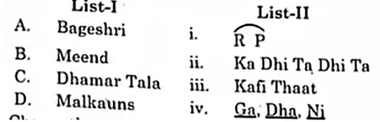
View Solution
Step 1: Understanding the Match
We are matching Raga names with their corresponding characteristics and properties.
(A) Bageshri: The correct match for Bageshri is (iii) Kafi Thaat. Bageshri is a raga associated with the Kafi Thaat, which has a specific melodic structure.
(B) Meend: The correct match for Meend is (ii) Ka Dhi Tq Dhi Ta. Meend is a sliding technique in classical music that connects two notes, and this rhythmic pattern is used to express its nuances.
(C) Dhamar Tala: The correct match for Dhamar Tala is (iv) Ga, Dha, Ni. This tala is often associated with specific syllables or the use of particular notes during its performance.
(D) Malkouns: The correct match for Malkouns is (i) R P swaras are omitted in Raga Bhairav. Malkouns is a raga that omits certain swaras like R and P, specifically in the Raga Bhairav context.
Final Answer: (C) A - iii, B - ii, C - iv, D - i. Quick Tip: Matching ragas with their corresponding thaats and rhythms is crucial in classical music for identifying the emotional and tonal structure of the performance.
Statement-I: R P swaras are omitted in Raga Bhairav.
Statement-II: Bhairav is a morning Sandhi Prakash Raga.
Choose the correct option:
View Solution
Step 1: Analyzing Statement-I
In Raga Bhairav, the R and P swaras are indeed omitted. This is a common feature of the raga, contributing to its distinct tonal quality.
Step 2: Analyzing Statement-II
Raga Bhairav is indeed a morning raga and is classified as a Sandhi Prakash Raga. It is typically performed during the early hours of the day, often in the morning, when it brings out the serenity and devotion of the raga.
Final Answer: (A) Statement I and II both are true. Quick Tip: Understanding the time of day and the tonal qualities of a raga is essential in classical music. Ragas like Bhairav have a specific emotional expression when performed at the right time.
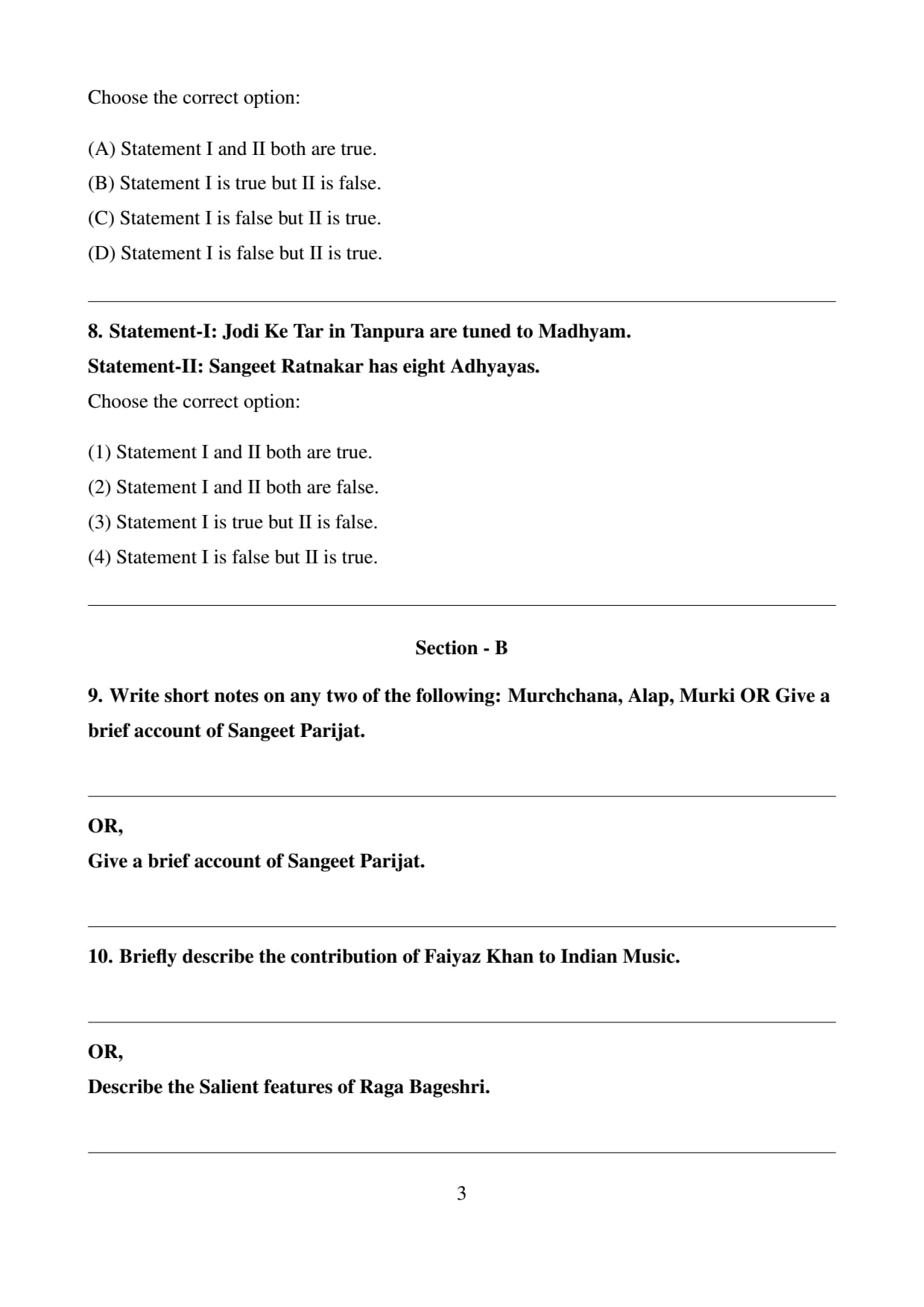
Statement-I: Jodi Ke Tar in Tanpura are tuned to Madhyam.
Statement-II: Sangeet Ratnakar has eight Adhyayas.
Choose the correct option:
View Solution
Step 1: Analyzing Statement-I
In Statement-I, the Jodi Ke Tar (pair of strings) in the Tanpura are indeed tuned to Madhyam (the fourth note of the scale). This is correct. The tuning of the Tanpura’s strings follows the raga's structure, and the Jodi Ke Tar is typically tuned to Madhyam for a fuller sound.
Step 2: Analyzing Statement-II
In Statement-II, Sangeet Ratnakar does not have eight Adhyayas. It contains seven Adhyayas. Therefore, this statement is false.
Final Answer: (3) Statement I is true but II is false. Quick Tip: In classical music, the Tanpura's string tuning plays an important role in supporting the raga's tonal foundation. Be sure to study the correct number of Adhyayas in Sangeet Ratnakar for accurate knowledge.
Write short notes on any two of the following: Murchchana, Alap, Murki OR Give a brief account of Sangeet Parijat.
View Solution
Step 1: Define each term.
- Murchchana: Murchchana refers to a modulation technique used in Indian classical music, which involves changing the tonal center or pitch of the raga to create a new mood or effect.
Step 2: Explanation of Murchchana.
This technique involves shifting the focus of the raga to a different note or a different scale, giving the performance a different emotional or tonal color.
Step 3: Define Alap.
- Alap: Alap is the introductory section of a raga performance in classical music. It is a slow, unmetered exploration of the raga, where the artist presents the ragas' notes (swaras) and mood (rasa).
Step 4: Explanation of Alap.
In this phase, the performer improvises without rhythm (tala) to explore the emotional nuances of the raga. It is a meditative and free-flowing presentation of the ragas' characteristics.
Step 5: Define Murki.
- Murki: Murki is a musical ornamentation in Indian classical music. It refers to the rapid, delicate movements or embellishments applied to a note, often adding expressiveness to the performance.
Step 6: Explanation of Murki.
Murki involves adding grace notes to a single tone or a melody, creating a sense of ornamentation and increasing the expressiveness of the performance. Quick Tip: Remember: In classical music, Murchchana changes tonal centers, Alap is a meditative introduction without rhythm, and Murki adds ornamentation to melodies.
Give a brief account of Sangeet Parijat.
View Solution
Step 1: Introduction to Sangeet Parijat.
Sangeet Parijat is an ancient text on Indian classical music, which was written by the eminent scholar and musician, Maheshwar Pandit. It is one of the most significant treatises in the history of classical music and is regarded as an essential guide for musicians.
Step 2: Significance of Sangeet Parijat.
This work covers a wide range of topics, including the theory of ragas, the concept of rhythm (tala), the structure of compositions, and the significance of different musical instruments. It also introduces the concept of the classification of ragas, the relationship between different ragas, and their use in specific times and seasons.
Step 3: Influence on Indian Classical Music.
Sangeet Parijat's contribution lies in its comprehensive presentation of Indian classical music and its structure. It served as an important source of reference for musicologists, artists, and students of music for generations, ensuring the preservation and propagation of classical traditions. Quick Tip: Sangeet Parijat is a classical text that covers the theory, history, and structure of Indian music, including the classification of ragas and their significance.
Briefly describe the contribution of Faiyaz Khan to Indian Music.
View Solution
Step 1: Faiyaz Khan's contribution to Indian music.
Faiyaz Khan, a prominent classical singer, made significant contributions to Indian music, particularly in the field of Hindustani classical music. He is known for his mastery of both Khayal and Dhrupad forms and was a renowned member of the Gwalior gharana.
Step 2: Innovating vocal techniques.
Faiyaz Khan is credited with bringing innovation in vocal techniques, emphasizing the importance of Raag-based performance and introducing improvisational elements that enhanced the emotional depth of his renditions.
Step 3: Popularizing his style.
His unique style, which combined emotional depth and intricate ornamentations (meend, gamak), has inspired countless disciples and has continued to be influential in contemporary Indian classical music.
Step 4: Mentoring students.
Faiyaz Khan also contributed to the music community by training many students, thereby preserving and passing on his musical legacy to the future generations. Quick Tip: Faiyaz Khan's innovations in classical music, especially his deep emotional approach and vocal techniques, have left a lasting impact on the Hindustani music tradition.
Describe the Salient features of Raga Bageshri.
View Solution
Step 1: Introduction to Raga Bageshri.
Raga Bageshri is a Hindustani classical raga associated with the evening time. It is known for its mood of devotion and romance, evoking feelings of longing and devotion. The raga is typically performed after sunset, as it is considered to be the night-time raga.
Step 2: Structure of the raga.
Raga Bageshri is structured with a characteristic phrase that focuses on the use of both the Komal (flat) Nishad and Komal Gandhar notes. The ascending scale (Arohana) of Bageshri is: S R G M P D N S, and the descending scale (Avarohana) is: S N D P M G R S.
Step 3: Emotional impact.
The raga is often used to express deep emotional states like yearning and devotion. Its slow tempo and deliberate phrasing evoke a sense of tranquility and reverence, making it one of the most revered ragas in classical Indian music.
Step 4: Performance aspects.
The rendition of Raga Bageshri is marked by extensive use of meend (glides), gamak (oscillations), and intricate ornamentations to bring out its emotional depth. It is usually performed by vocalists and instrumentalists alike, with its slow pace allowing for elaborate improvisation. Quick Tip: Raga Bageshri is ideal for expressing devotion and longing, characterized by its emotional depth and slow tempo.
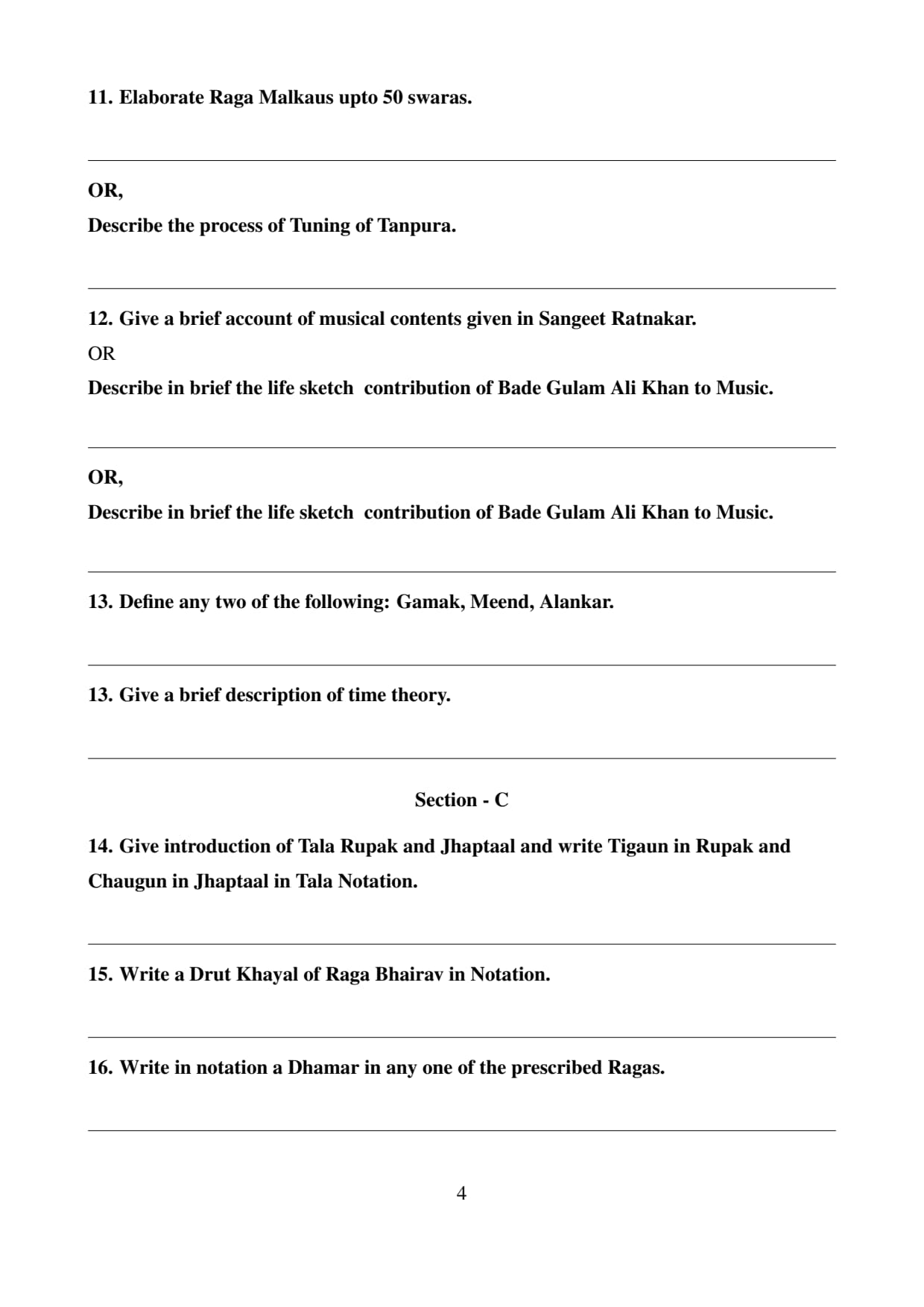
Elaborate Raga Malkaus upto 50 swaras.
View Solution
Step 1: Introduction to Raga Malkaus.
Raga Malkaus is a serious and meditative raga in Indian classical music, typically performed during the late night hours. It is known for its emotional depth and is often associated with the mood of devotion and longing.
Step 2: The Swaras of Raga Malkaus.
Raga Malkaus is composed of a pentatonic scale (known as audav) and uses the following swaras:
- Arohana (ascending order): S R M P D S'
- Avarohana (descending order): S' D P M R S
It is important to note that Raga Malkaus avoids certain swaras in its structure, contributing to its unique flavor.
Step 3: Performance of Raga Malkaus.
In a performance of Raga Malkaus, the artist explores the emotional intensity of the raga. The performer may elaborate on the raga up to 50 swaras, emphasizing the key notes and their relationships to one another, creating a mood of contemplation and devotion. Quick Tip: Remember: Raga Malkaus is a pentatonic raga performed at night, with a mood of devotion and longing.
Describe the process of Tuning of Tanpura.
View Solution
Step 1: Tuning the Tanpura Strings.
The process of tuning a Tanpura involves adjusting the four strings to specific pitches, which are:
- Sa (the tonic): The first string is tuned to the tonic note (Sa), which is the key note of the raga.
- Pa (the fifth): The second string is tuned to the fifth note (Pa), creating the drone harmony.
- Sa (octave): The third string is tuned to the octave of Sa (Sa').
- Pa (octave): The fourth string is tuned to the octave of Pa (Pa').
Step 2: Tuning Process.
The Tanpura is then played to provide a constant, resonating drone that supports the raga performance. The tension on the strings must be adjusted for a harmonious and clear sound. Quick Tip: Remember: The Tanpura is tuned to the tonic (Sa) and fifth (Pa) notes, creating a continuous drone for the raga.
Give a brief account of musical contents given in Sangeet Ratnakar.
View Solution
Step 1: Musical contents of Sangeet Ratnakar.
Sangeet Ratnakar is a comprehensive treatise on music written by the great Indian musicologist Sharangdeva. It is one of the most important works in the history of classical music. The text covers various aspects of music, including ragas, talas, and the theoretical foundations of Indian classical music.
Step 2: Sections of the Sangeet Ratnakar.
The Sangeet Ratnakar is divided into several chapters, which discuss the origin of music, the classification of ragas and talas, the characteristics of vocal and instrumental music, and the importance of improvisation. The work also emphasizes the role of melody, rhythm, and voice culture in classical music.
Step 3: Contribution to the music tradition.
Sharangdeva's Sangeet Ratnakar has contributed immensely to the understanding and preservation of the traditional music system. It laid down the foundations for the later developments in the field of Indian classical music. Quick Tip: Sangeet Ratnakar is a foundational text in Indian classical music, providing insights into ragas, talas, and music theory.
Describe in brief the life sketch & contribution of Bade Gulam Ali Khan to Music.
View Solution
Step 1: Life sketch of Bade Gulam Ali Khan.
Bade Gulam Ali Khan, born in 1902, was one of the most celebrated classical vocalists of India. He was a master of the Kirana Gharana and is remembered for his impeccable renditions of Khayal and Thumri. His early training in music began under the guidance of his father, and later, his uncle and other renowned musicians.
Step 2: Musical contributions.
Bade Gulam Ali Khan made a significant contribution to the classical music world by popularizing the Kirana Gharana style. His unique style of singing, characterized by elaborate meends, taans, and slow rendering of ragas, earned him a devoted following. He also introduced several new ragas and contributed to the development of classical music in the 20th century.
Step 3: Influence on future generations.
His performances and compositions continue to inspire contemporary musicians. He trained several disciples, thereby ensuring that his legacy would live on through the generations. His ability to express deep emotion through music remains unmatched. Quick Tip: Bade Gulam Ali Khan was a key figure in Hindustani classical music, contributing to the development and spread of the Kirana Gharana style.
Define any two of the following: Gamak, Meend, Alankar.
View Solution
Step 1: Definition of Gamak.
Gamak is a technique used in Indian classical music to ornament a note or to emphasize a note by oscillating between two pitches. It is often used to enhance the emotional appeal of a raga and is executed with intricate variations of the sound on a particular note.
Step 2: Definition of Meend.
Meend refers to the glide between two notes, smoothly transitioning from one pitch to another without any distinct break. It is an essential ornamentation in classical music, allowing for a fluid and expressive rendition of a raga.
Step 3: Definition of Alankar.
Alankar means musical ornamentation or embellishment. In Indian classical music, it refers to the use of various techniques like gamak, meend, and taan to enhance the melody and expressiveness of a raga. Quick Tip: Gamak, Meend, and Alankar are key concepts in Indian classical music that add depth, emotion, and complexity to the performance of ragas.
Give a brief description of time theory.
View Solution
Step 1: Introduction to Time Theory.
Time theory in Indian classical music refers to the classification of ragas based on the time of day or night when they are traditionally performed. The theory connects specific ragas to specific time periods, based on the mood and the emotion that the raga is meant to evoke.
Step 2: Role of Time in Raga Performance.
According to time theory, the performance of a raga at a particular time enhances its emotional effect. The raga, being tied to a specific mood, evokes feelings that align with the natural cycle of the day or night, adding a layer of connection between music and the listener's environment.
Step 3: Importance of Time in Classical Music.
In this system, early morning ragas are expected to evoke serenity, while evening ragas are designed to bring out romantic or devotional moods. Time theory is essential for performers to evoke the desired emotional responses from the audience. Quick Tip: Time theory is vital for understanding the mood and emotional intent behind a raga's performance, making it central to the art of Indian classical music.
Give introduction of Tala Rupak and Jhaptaal and write Tigaun in Rupak and Chaugun in Jhaptaal in Tala Notation.
View Solution
Step 1: Introduction to Tala Rupak.
Rupak is a 7-beat rhythmic cycle in Indian classical music, divided as 3+2+2 beats. It is often used in both Hindustani classical and devotional music. It is usually performed in slow to medium tempo and is known for its balanced structure.
Step 2: Introduction to Tala Jhaptaal.
Jhaptaal is a 10-beat rhythmic cycle in Indian classical music, typically divided as 2+3+2+3 beats. It has a characteristic rhythmic pattern and is commonly used in Hindustani classical music for compositions in slow to medium tempo.
Step 3: Tigaun in Rupak.
In Tala Rupak, Tigaun (triplets) can be notated as:
\[ 1st beat: \textbf{Ta-ka, 2nd beat: \textbf{Ta-ka}, 3rd beat: \textbf{Ta-ka}.} \]
Step 4: Chaugun in Jhaptaal.
In Tala Jhaptaal, Chaugun (quadruplets) can be notated as:
\[ 1st beat: \textbf{Ta-ka-di-mi, 2nd beat: \textbf{Ta-ka-di-mi}, 3rd beat: \textbf{Ta-ka-di-mi}, 4th beat: \textbf{Ta-ka-di-mi.}} \] Quick Tip: Rupak and Jhaptaal are two common talas used in Hindustani classical music. Tigaun and Chaugun refer to rhythmic subdivisions that help in performing compositions at different tempos.
Write a Drut Khayal of Raga Bhairav in Notation.
View Solution
Step 1: Introduction to Raga Bhairav.
Raga Bhairav is a morning raga in Hindustani classical music, characterized by its serious, devotional mood. It is one of the oldest ragas, known for evoking feelings of awe and reverence.
Step 2: Characteristics of Drut Khayal.
Drut Khayal is a fast-tempo composition typically performed in the second half of a raga performance. It is known for its intricate and rapid taans, emphasizing the melodic aspects of the raga.
Step 3: Notation of Drut Khayal in Raga Bhairav.
The Drut Khayal in Raga Bhairav can be notated as follows: \[ Sthayi: \textbf{S R G M P D N S} \quad (Main theme of the raga)
Antara: \textbf{S N D P M G R S} \quad (Second section with emphasis on higher notes) \] Quick Tip: Drut Khayal in Raga Bhairav is usually performed at a fast tempo, showcasing the raga's regal and grand nature.
Write in notation a Dhamar in any one of the prescribed Ragas.
View Solution
Step 1: Introduction to Dhamar.
Dhamar is a rhythmic cycle of 14 beats, commonly used in the performance of compositions in classical music, particularly in Raga-based compositions. It is one of the key talas (rhythmic cycles) used in Hindustani classical music, associated with the expression of devotion and grandeur.
Step 2: Characteristics of Dhamar.
Dhamar tala is typically divided as 5+2+3+4 beats. It is a medium-paced tala that is often used in the performance of compositions such as Thumri, Dhrupad, and Khayal.
Step 3: Dhamar in Raga.
When Dhamar is performed in Ragas, it is known for its grandeur and devotional appeal. It is frequently performed in the evening or late night and is ideal for compositions that express a sense of reverence and solemnity.
Step 4: Notation of Dhamar in a Prescribed Raga.
The following is an example of a Dhamar notation in Raga Bageshri: \[ Sthayi: \textbf{S R G M P D N S} \quad (Main theme of the raga)
Antara: \textbf{S N D P M G R S} \quad (Second section with emphasis on higher notes) \] Quick Tip: Dhamar tala is a unique rhythmic cycle that provides a solemn and expressive backdrop to compositions in various ragas.
CBSE Class 12 2026 Hindustani Music (Vocal) | Complete Syllabus in one Shot



Comments