



Education Journalist | Study Abroad Lead
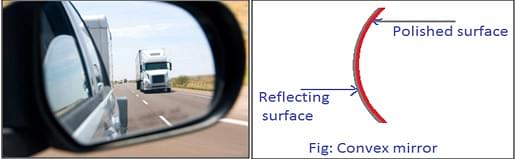
A convex mirror is a type of curved mirror that bulges outward, like a rounded fishbowl. The surface of a convex mirror is curved outward so that the reflection appears smaller and farther away than the actual object. This type of mirror is commonly used in many practical applications, such as in vehicles, security systems, and retail stores, because of its ability to provide a wider field of view than a flat mirror. The five most common uses of convex mirrors are as follows:
-
Traffic Safety: Convex mirrors are commonly used on roadways and highways to provide drivers with a wider view of their surroundings. These mirrors are placed at intersections, exits, and entrances to help drivers see around corners and obstacles, reducing the risk of accidents. The curved surface of the mirror provides a panoramic view, giving drivers an early warning of any potential danger.
-
Parking Lots: Convex mirrors are frequently used in parking lots to help drivers see around corners and obstacles, reducing the risk of accidents. These mirrors are typically placed at blind spots, such as the corners of buildings, to help drivers see approaching vehicles and pedestrians.
-
Retail Stores: Convex mirrors are commonly used in retail stores to provide store managers and employees with a clear overview of the entire store. By using convex mirrors, store personnel can keep an eye on customers, reducing the risk of theft and making it easier to identify any suspicious behavior.
-
Security: Convex mirrors are often used in security systems to monitor large areas in real-time. The curved surface of the mirror provides a panoramic view, making it easier for security personnel to detect potential threats and respond promptly. Convex mirrors are typically used in settings such as banks, prisons, and government buildings to increase security and ensure the safety of personnel and visitors.
-
Warehouse Management: Convex mirrors are used in warehouses to improve visibility and monitor the movement of goods. By using these mirrors, warehouse managers can keep an eye on workers, reducing the risk of accidents and increasing productivity and efficiency. Convex mirrors are also useful for monitoring the flow of goods and ensuring that storage areas are being used effectively.
In conclusion, convex mirrors are a versatile and useful tool with a wide range of applications.
Read More:



Comments