



Exams Prep Master
Blood plasma is a light amber liquid component of blood that is separated from the blood cells. However, it holds proteins as well as other constituents of whole blood in suspension and it forms about 55% of the body’s total blood volume. Blood plasma is considered as the intravascular part of extracellular fluid. Let’s have a closer look at the topic with some important questions.
| Table of Content |
Keyterms: Blood, Blood Cells, tissue, RBC, WBC, blood platelets, serum, osmotic pressure, enzymes, hormones, fibrinogen, plasma, connective tissue
What is Blood Plasma?
[Click Here for Sample Questions]
Before starting out with the topic, let us first understand what blood is. Blood is a type of connective tissue made up of a fluid matrix, plasma, and formed components. To transport food, oxygen, etc., sophisticated organisms require unique fluids throughout their bodies. Most higher species, including humans, use blood as their primary bodily fluid for this purpose. RBC (red blood cells), WBC (white blood cells), blood platelets, plasma, and serum are the main components of blood. The major component of blood is plasma, which is one of these components.
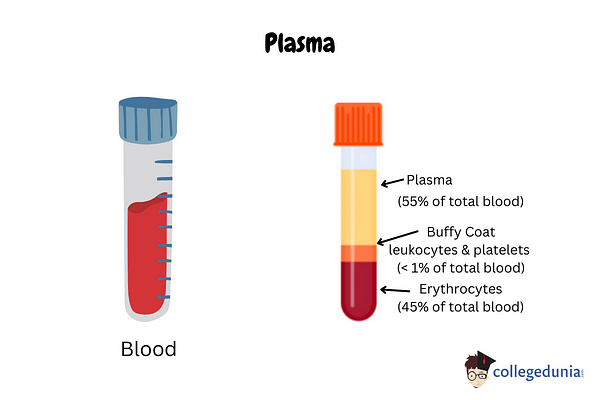
Plasma is referred to as the blood matrix. Plasma is an extracellular and liquid component of blood that is clear and pale yellow or straw-colored. Clotting factors and other protein molecules make up the majority of it. Plasma accounts for 50 to 55 percent of total blood volume. The plasma in the blood is mostly water, with the remaining 10% made up of salts, fats, nutrients, enzymes, and hormones.
Plasma in blood cells has a high concentration of proteins, immunoglobulins, clotting factors, and fibrinogen. This protein aids in the production of coagulation factors as well as the maintenance of serum osmotic pressure. Factors for blood coagulation or clotting are also present in plasma in an inactive state. The serum is plasma devoid of clotting factors.
Components of Blood Plasma
[Click Here for Previous Year Questions]
Plasma is 90% water, with the remaining 10% made up of ions, proteins, dissolved gases, nutritional molecules, and wastes. Antibody proteins, coagulation factors, and the proteins albumin and fibrinogen, which regulate serum osmotic pressure, are all found in plasma. Each of them may be isolated using various ways to create distinct blood products that are used to treat various diseases. Clotting factors, for example, are used to treat coagulation diseases such as hemophilia and disseminated intravascular coagulation.

Also check:
Specific Components and Their Functions
Plasma particles, proteins, and different substances keep blood's pH and osmotic strain stable.
Proteins in Plasma: Plasma proteins are the most widely recognized parts in plasma and are ordered into three sorts: albumin, globulins, and fibrinogen. They play the accompanying explicit parts:
Albumin: Albumin helps in the conservation of the blood's colloid osmotic strain. It is the littlest of the plasma proteins yet represents the most noteworthy rate. The blood's colloid osmotic tension is basic for keeping harmony between the water inside the blood and the water in the tissue liquid encompassing the cells. At the point when plasma proteins are inadequate, water in the plasma spills into the space around the veins, causing interstitial edema, which is an indication of liver illnesses, renal ailment, and hunger, in addition to other things. albumin likewise supports the exchange of an assortment of atoms, including medications, chemicals, and unsaturated fats.
Globulins: Staying the course — a clever protein found in red platelets has been identified with easing back intellectual weakening.
For people with rheumatoid joint pain, a straightforward blood test may recognize the best drug and portion. Globulins are grouped into three sorts: alpha, beta, and gamma, with the littlest being alpha and the greatest being gamma. Antibodies are gamma-globulins.

The alpha globulins contain high-thickness lipoproteins (HDL), which are essential in shipping lipids to cells for the development of various mixtures just as energy digestion. The broadly well-known component of HDL is its capacity in halting plaque development by keeping up with cholesterol withinside the circulatory system. Low-thickness lipoproteins (LDL) are beta globulins that carry fats to cells for the assembling of steroid and molecular films. It additionally expands the creation of cholesterol plaques, which is a danger factor for blood vessels and coronary illness. They are produced by B lymphocytes, a sort of insusceptible cell. Antibodies are accountable for the body's humoral insusceptible reaction, recognizing microbes through specific receptors and killing them through an assortment of ways.
Fibrinogen: Fibrinogen is a crumbling plasma coagulation component forerunner that, while it comes into contact with a tacky surface, converts to fibrin, a threadlike protein. The fibrin strings delivered trap platelets, framing the underlying platelet cluster whereupon a steady blood clump is made by the coagulation cycle.

Functions of Blood Plasma
[Click Here for Sample Questions]
The purpose of blood plasma are as follows:
- Plasma is collected from the liquid component of the blood and is frequently utilized in blood group research investigations to determine the patient's blood group.
- Blood plasma also contains important proteins and other necessary components for good health. As a result, patients with liver failure and potentially fatal injuries are given blood plasma infusions.
- Plasma is a fluid particle in the blood that contains the clotting component fibrinogen, which acts by stopping excessive blood flow following injury.
- Blood plasma aids in the regulation of body temperature and is in charge of blood pressure regulation.
- In addition to blood clotting, the fluid matrix aids in the circulation of blood platelets, red and white blood cells (RBC), hormones, and digested food particles.
As previously stated, plasma is the principal way of transferring excretory products by carrying waste materials from cells to excretory organs. Waste products are pushed out of the body via these organs.
Uses of Blood Plasma
[Click Here for Sample Questions]
Plasma is typically provided to patients who are suffering from trauma, burns, or shock, as well as those suffering from severe liver disease or clotting factor deficiencies. This increases the patient's blood flow, which reduces shock and aids in blood clotting. Pharmaceutical companies utilize plasma to provide therapies for diseases such as immunological deficiencies and bleeding problems.

Also check:
Plasma Donation
[Click Here for Previous Year Questions]
A plasma-only donation is the separation of the donor's blood's liquid component from the cells. Blood is drawn from one arm and placed in a high-tech plasma-gathering device. The donor's red blood cells and platelets are subsequently returned to him or her, along with some saline. The technique is safe and just takes a few minutes longer than donating whole blood.
Donated plasma is frozen within 24 hours after being donated in order to maintain the important clotting factors. It can be stored for up to a year and frozen for transfusion to a patient if necessary.
Things to Remember
- Plasma is a viscous fluid that is a straw-colored and fluid component of blood.
- Plasma is 90% water, with the remaining 10% made up of ions, proteins, dissolved gases, nutritional molecules, and wastes.
- Plasma in blood cells has a high concentration of proteins, immunoglobulins, clotting factors, and fibrinogen. This protein aids in the production of coagulation factors as well as the maintenance of serum osmotic pressure.
- Blood plasma aids in the regulation of body temperature and is in charge of blood pressure regulation.
- Pharmaceutical companies utilize plasma to provide therapies for diseases such as immunological deficiencies and bleeding problems.
Previous Year Questions
- The vitamin which is essential for blood clotting is…
- The condition of erythroblastosis foetalis occurs only when… [JKCET 2007]
- The thickening of walls of arteries is called...[BHU UET 2012]
- Renal portal system carries blood...[BHU UET 2009]
- Cardiac output is determined by…..[BHU UET 2008]
- Rh factor is present in….[BHU UET 2006]
- 'Heart of heart' is:...[BHU UET 2005]
- Splenic artery arises from… [NEET 1991]
- The life span of human WBC is approximately… [NEET 1997]
- The most active phagocytic white blood cells are… [NEET 2008]
- RA - Right Auricle RV - Right Ventricle LA - Left Auricle LV - Left Ventricle in the… [KCET 2007]
- Study the diagram given below and identify the cells labeled as A, B, C, and D… [KCET 2012]
- The largest RBC's have been seen in… [KCET 2007]
- Heparin is secreted by…
- RBCs are nucleated in…
- The cardiac pacemaker in a patient fails to function normally. The doctors find that an artificial pacemaker is to be grafted in him. It is likely that it will be grafted at the site of...[NEET 1980]
- In the ABO system of blood groups, if both antigens are present but no antibody, the blood group of the individual would be...[NEET 1980]
- Erythropoiesis starts in...[NEET 2015]
- Globulins contained in human blood plasma are primarily involved in...[NEET 2009]
- If due to some injury the chordae tendinae of the tricuspid valve of the human heart is partially non-functional, what will be the immediate effect ?..[NEET 2010]
Sample Questions
Ques: What is plasma in blood? (2 marks)
Ans: Before starting out with the topic, let us first understand what blood is. Blood is a type of connective tissue made up of a fluid matrix, plasma, and formed components. To transport food, oxygen, etc., sophisticated organisms require unique fluids throughout their bodies. Most higher species, including humans, use blood as their primary bodily fluid for this purpose. RBC (red blood cells), WBC (white blood cells), blood platelets, plasma, and serum are the main components of blood. The major component of blood is plasma, which is one of these components.
Ques: State the components of blood plasma. (2 marks)
Ans: Plasma is 90% water, with the remaining 10% made up of ions, proteins, dissolved gases, nutritional molecules, and wastes. Antibody proteins, coagulation factors, and the proteins albumin and fibrinogen, which regulate serum osmotic pressure, are all found in plasma. Each of them may be isolated using various ways to create distinct blood products that are used to treat various diseases. Clotting factors, for example, are used to treat coagulation diseases such as hemophilia and disseminated intravascular coagulation.
Ques: Write the functions of blood plasma. (5 marks)
Ans: Plasma is essentially made out of water (roughly 92%), proteins (6-8%) like albumins, globulins, fibrinogens. It additionally contains limited quantities of minerals like sodium particles, potassium particles, glucose, amino acids, and so on. Blood proteins are otherwise called plasma proteins. They serve a wide range of capacities like transportation of supplements and working of the resistant framework.
Blood plasma goes about as a separator of the body, a portion of its significant capacities are recorded beneath:
- One of the fundamental elements of blood plasma is the expulsion of waste from cell works that assist with creating energy. Thereafter plasma acknowledges and moves this loss to different spaces of the body, for example, the kidneys and liver for discharge.
- It manages the internal heat level by retaining and delivering heat as required.
- It likewise helps in the maintenance of liquids in the blood.
- Fibrinogens present in the plasma is required for the thickening or coagulation of blood.
- Albumin is imperative for keeping an equilibrium of liquid called oncotic tension in the blood.
- Globulins are associated with the protection system of the body and the albumins help in keeping up with the sufficient osmotic strain in the body.
Ques: What is the Fluid medium of blood called? (2 marks)
Ans: Plasma is a viscous fluid that is a straw-colored and fluid component of blood. It accounts for about 55% of the blood. As a result, the right answer to the question is plasma.
Ques: What is the difference between plasma and serum? (4 marks)
Ans:
| Serum | Plasma |
|---|---|
| It is the liquid part of the blood after the coagulation. | It is a clear and yellowish fluid part of the blood |
| It contains proteins, electrolytes, antibodies, antigens, and hormones. | RBCs, WBC, and other components of blood are suspended. |
| Fibrinogen is absent | Fibrinogen is present |
| It is used in checking blood groups. | It is delivered to patients who lack blood cells. |
| Difficult to separate and is time-consuming | Comparatively easier and less time consuming |
Ques: Blood plasma contains (2 marks)
(a) 60% of water
(b) 80%of water
(c) 90%of water
(d) 98% of water
Ans: Blood cells are suspended in blood plasma. It accounts for approximately 55 percent of blood fluid, which is primarily water (90 percent by volume) and contains protein (including the major protein albumin), glucose, mineral ions, hormones, carbon dioxide, immunoglobulins, clotting factors, and fibrinogen. Hence, the answer to the question is option C.
Ques: Name the various components of blood. (2 marks)
Ans: Blood is primarily broken down into the following components:
- Plasma
- RBC
- WBC
- Platelets
Ques: What are the specific components of blood plasma and state their functions. (5 marks)
Ans: Proteins in Plasma: Plasma proteins are the most widely recognized parts in plasma and are ordered into three sorts: albumin, globulins, and fibrinogen. They play the accompanying explicit parts:
Albumin: Albumin helps in the conservation of the blood's colloid osmotic strain. It is the littlest of the plasma proteins yet represents the most noteworthy rate. The blood's colloid osmotic tension is basic for keeping harmony between the water inside the blood and the water in the tissue liquid encompassing the cells. At the point when plasma proteins are inadequate, water in the plasma spills into the space around the veins, causing interstitial edema, which is an indication of liver illnesses, renal ailment, and hunger, in addition to other things. albumin likewise supports the exchange of an assortment of atoms, including medications, chemicals, and unsaturated fats.
Globulins: Staying the course — a clever protein found in red platelets has been identified with easing back intellectual weakening.
For people with rheumatoid joint pain, a straightforward blood test may recognize the best drug and portion. Globulins are grouped into three sorts: alpha, beta, and gamma, with the littlest being alpha and the greatest being gamma. Antibodies are gamma-globulins.
Fibrinogen: Fibrinogen is a crumbling plasma coagulation component forerunner that, while it comes into contact with a tacky surface, converts to fibrin, a threadlike protein. The fibrin strings delivered trap platelets, framing the underlying platelet cluster whereupon a steady blood clump is made by the coagulation cycle.
Ques: What is meant by plasma donation? (4 marks)
Ans: A plasma-only donation is the separation of the donor's blood's liquid component from the cells. Blood is drawn from one arm and placed in a high-tech plasma-gathering device. The donor's red blood cells and platelets are subsequently returned to him or her, along with some saline. The technique is safe and just takes a few minutes longer than donating whole blood. Donated plasma is frozen within 24 hours after being donated in order to maintain the important clotting factors. It can be stored for up to a year and frozen for transfusion to a patient if necessary.
Ques: What are the features of blood plasma? (4 marks)
Ans: The features of blood plasma are:
- Blood plasma contains fibrinogen, immunoglobulin, electrolytes, and proteins.
- It is the main medium for excretory product transportation.
- Blood plasma possesses a density of approximately 1025 kg/m3 or 1.025 g/ml.
- It is the medium of the blood, in which different types of blood cells exist.
- Blood plasma has a long shelf life because of which it can be preserved for more than a year and can be used.
For Latest Updates on Upcoming Board Exams, Click Here:https://t.me/class_10_12_board_updates
Do Check Out:



Comments