




NEET Physics Exam Pattern 2027 is expected to follow the same subject-wise structure, with 45 compulsory questions carrying 180 marks. The paper will assess students through objective MCQs, with +4 marks for correct answers and −1 mark for incorrect answers.
| Direct Link to NEET Physics Exam Pattern 2027 (Expected Soon) |
- The paper is expected to test students through numerical, conceptual, statement-based, and other MCQ formats, making strong conceptual understanding and calculation speed important.
- The exam covers the NEET Physics syllabus with a near-equal balance between Class 11 (~46%) and Class 12 (~54%) NCERT topics, testing core conceptual foundations across all major units.
- Current Electricity (3–5 questions), Ray & Wave Optics (5–6 questions), and Semiconductor Electronics (3 questions) are the high-weightage units in the Class 12 syllabus.
- From the Class 11 Physics Syllabus, Mechanics covers over 15–20% of the paper, while Thermodynamics & KTG combined contribute ~7–8% (3–4 questions).
Related Links:
- NEET Chapter-Wise Weightage 2027: Marks Distribution, Important Topics & Preparation Tips
- NEET Physics Syllabus 2027: Subject-Wise Topics, Deleted Chapters and PDF Download
- NEET Reduced Syllabus 2027: Latest Updates, Syllabus PDF, & Reduced Subject-Wise Syllabus
Key Summary
- NEET Physics 2027 is expected to have 45 compulsory MCQs carrying 180 marks, with +4 marks for correct and −1 for incorrect answers.
- The NEET Physics syllabus covers Class 11 and Class 12 Physics, with chapters such as Mechanics, Electrodynamics, Optics and Modern Physics.
- NEET Physics chapter-wise weightage shows higher importance for areas such as Current Electricity, Electrostatics, Rotational Motion, Magnetism and Semiconductor Electronics.
- Students should combine NEET PYQ Physics chapter-wise practice with Physics notes for NEET and NEET Physics questions with solutions to improve accuracy and speed.
NEET Physics Exam Pattern 2027: Overview
NEET Physics consists of 45 compulsory MCQs carrying 180 marks, with +4 for correct and −1 for incorrect answers.
- The paper covers the NEET Physics syllabus from Class 11 and 12 NCERT.
- Candidates can strengthen their preparation with NEET Physics questions with solutions, chapter-wise PYQs, and Physics notes for NEET.
| Particulars | Details |
|---|---|
| Total Questions | 45 questions (All compulsory) |
| Total Marks | 180 Marks |
| Exam Duration | 3 Hours (180 minutes) |
| Question Type | Objective MCQs (4 options, 1 correct choice) |
| Marking Scheme | +4 for every correct answer; −1 for every incorrect answer |
| Unattempted Questions | 0 marks |
| Syllabus Level | Class 11 and Class 12 NCERT Physics |
Ques. How many questions are asked in NEET Physics?
Ans. There are 45 compulsory questions
Ques. How many marks is Physics worth in NEET?
Ans. The Physics section is worth a total of 180 marks out of the overall 720 marks.
Also Check:
NEET Physics Marking Scheme 2027
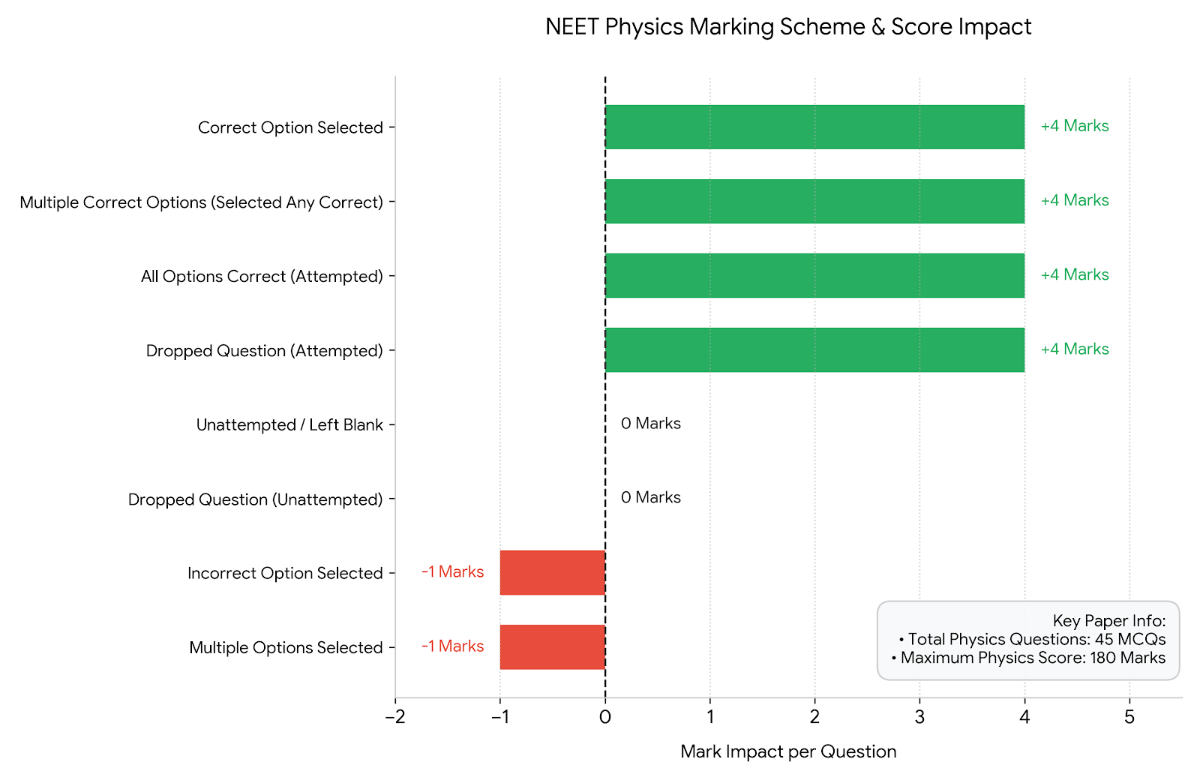
NEET Physics Marking scheme follows the pattern below:
- The NEET Physics marking scheme awards +4 marks for correct responses and −1 for incorrect ones, so careful question selection is important to avoid losing marks through negative marking.
| Candidate Response | Impact on Score |
|---|---|
| Correct Option Selected | +4 Marks |
| Incorrect Option Selected | −1 Mark |
| Unattempted / Left Blank | 0 Marks |
| Multiple Options Selected | −1 Mark (Treated as incorrect) |
| Multiple Correct Options | +4 Marks if any one of the officially correct options is selected |
| All Options Correct | +4 Marks for every candidate who attempted the question |
| Dropped / Invalid Question | +4 Marks for candidates who attempted it; 0 for those who left it blank |
| Total Physics Questions | 45 MCQs |
| Maximum Physics Score | 180 Marks |
Ques. How many marks are awarded for a correct answer in NEET Physics?
Ans. Candidates receive +4 marks for every correct response in NEET Physics.
Ques. How many marks are deducted for an incorrect answer in NEET Physics?
Ans. Exactly 1 mark is deducted (-1) for every incorrect answer. Unattempted questions get 0 marks.
Also Check:
NEET Physics Sample Paper 2027 PDF with Solutions
| NEET Sample Paper | Direct Link |
|---|---|
| NEET 2027 Physics Sample Paper 1 | Download PDF |
| NEET 2027 Physics Sample Paper 2 | Download PDF |
| NEET 2027 Physics Sample Paper 3 | Download PDF |
| NEET 2027 Physics Sample Paper 4 | Download PDF |
| NEET 2027 Physics Sample Paper 5 | Download PDF |
| NEET 2027 Physics Sample Paper 6 | Download PDF |
| NEET 2027 Physics Sample Paper 7 | Download PDF |
| NEET 2027 Physics Sample Paper 8 | Download PDF |
| NEET 2027 Physics Sample Paper 9 | Download PDF |
| NEET 2027 Physics Sample Paper 10 | Download PDF |
| NEET 2027 Physics Sample Paper 11 | Download PDF |
| NEET 2027 Physics Sample Paper 12 | Download PDF |
| NEET 2027 Physics Sample Paper 13 | Download PDF |
| NEET 2027 Physics Sample Paper 14 | Download PDF |
| NEET 2027 Physics Sample Paper 15 | Download PDF |
NEET Physics Chapter-Wise Weightage 2027
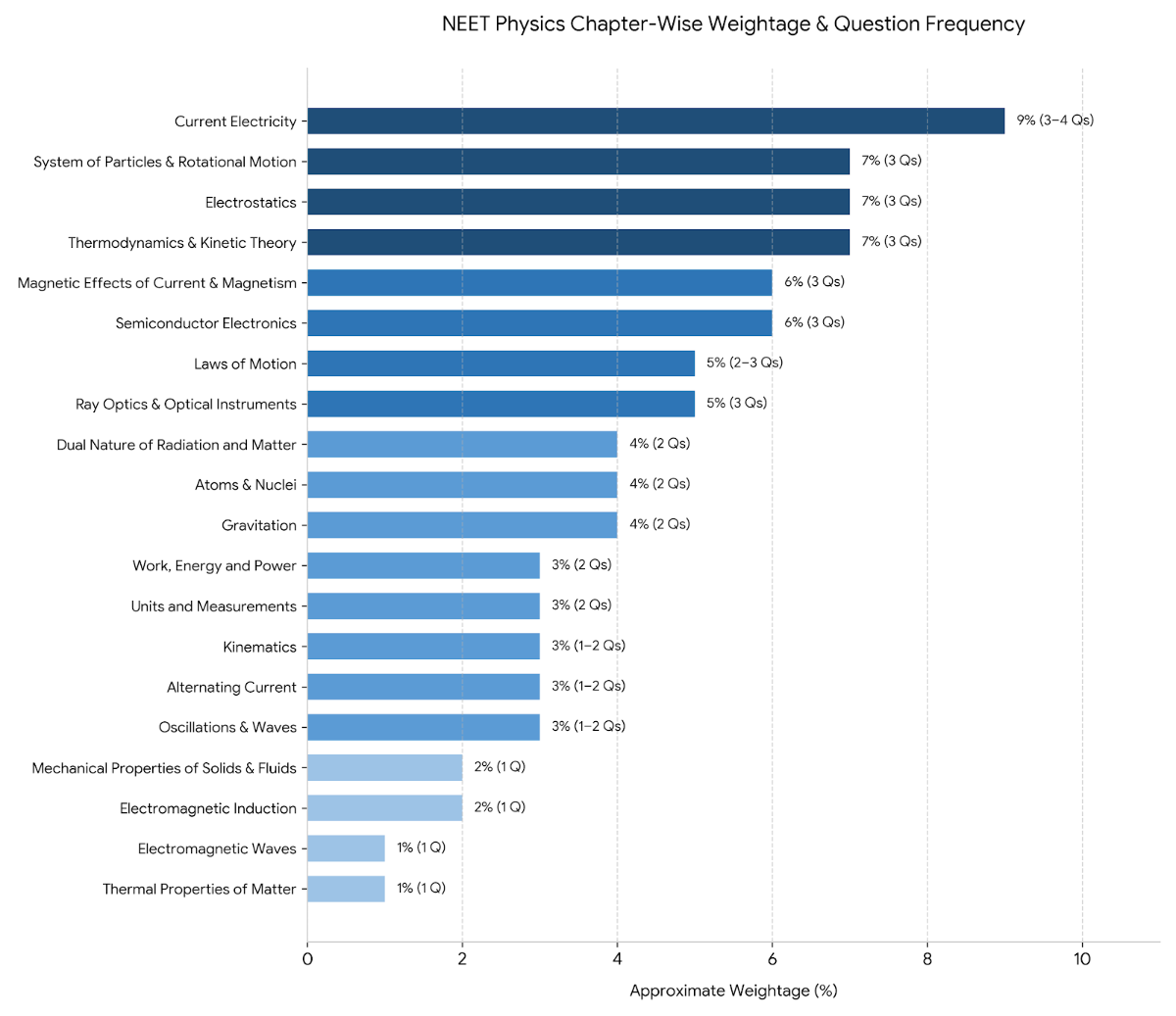
Below is the NEET Physics chapter-wise weightage for each chapter to streamline your preparation:
- Current Electricity, Electrostatics, Rotational Motion, Magnetism, and Semiconductor Electronics are among the high-weightage areas, making them important parts of the NEET Physics syllabus and preparation strategy.
| NEET Physics Chapter | Average Questions | Approx. Weightage | Important / High-Yield Topics |
|---|---|---|---|
| Current Electricity | 3–4 | 9% | Ohm's Law, Kirchhoff's Rules, Meter Bridge, Potentiometer, Series/Parallel Resistors, Drift Velocity |
| System of Particles & Rotational Motion | 3 | 7% | Moment of Inertia of regular bodies, Torque, Angular Momentum Conservation, Rolling Motion |
| Electrostatics | 3 | 7% | Coulomb's Law, Electric Dipole, Gauss's Law, Capacitance, Dielectrics, Energy Stored |
| Thermodynamics & Kinetic Theory | 3 | 7% | First Law of Thermodynamics, Carnot Engine, Efficiency, Specific Heat, Ideal Gas Laws, Mean Free Path |
| Magnetic Effects of Current & Magnetism | 3 | 6% | Biot-Savart Law, Ampere's Law, Moving Coil Galvanometer, Magnetic Dipole, Earth's Magnetism |
| Semiconductor Electronics | 3 | 6% | p-n Junction Diode, Half/Full Wave Rectifiers, Logic Gates |
| Laws of Motion | 2–3 | 5% | Newton's Laws, Free Body Diagrams, Friction, Circular Motion |
| Ray Optics & Optical Instruments | 3 | 5% | Lens Maker's Formula, Prism, Dispersion, TIR, Microscope, Telescope |
| Dual Nature of Radiation and Matter | 2 | 4% | Photoelectric Effect, de Broglie Wavelength, Davisson-Germer Experiment |
| Atoms & Nuclei | 2 | 4% | Bohr Model, Hydrogen Spectrum, Radioactive Decay, Mass Defect, Binding Energy |
| Gravitation | 2 | 4% | Universal Law, Variation of g, Escape Velocity, Orbital Velocity |
| Work, Energy and Power | 2 | 3% | Work-Energy Theorem, Conservative Forces, Spring Energy, Collisions |
| Units and Measurements | 2 | 3% | Dimensional Analysis, Significant Figures, Error Propagation, Least Count |
| Kinematics | 1–2 | 3% | Motion Under Gravity, Relative Velocity, Projectile Motion |
| Alternating Current | 1–2 | 3% | RMS/Peak Values, LCR Resonance, Power Factor, Q-Factor, Transformers |
| Oscillations & Waves | 1–2 | 3% | SHM, Simple Pendulum, Wave Speed, Beats, Doppler Effect |
| Mechanical Properties of Solids & Fluids | 1 | 2% | Hooke's Law, Young's Modulus, Pascal's Law, Bernoulli's Principle, Surface Tension, Viscosity |
| Electromagnetic Induction | 1 | 2% | Faraday's Law, Lenz's Law, Motional EMF, Self/Mutual Inductance, Eddy Currents |
| Electromagnetic Waves | 1 | 1% | Displacement Current, Maxwell's Equations, EM Spectrum, Properties and Uses |
| Thermal Properties of Matter | 1 | 1% | Thermal Expansion, Calorimetry, Latent Heat, Newton's Law of Cooling |
Ques. What are the important chapters in the NEET Physics syllabus?
Ans. The high-priority chapters are Current Electricity, Electrostatics, Magnetic Effects, Rotational Motion, Semiconductors, and Ray Optics
Check Out:
NEET Physics Question Papers with Solutions: Download PDF
| Paper Code | Question Paper PDF | Solutions PDF |
|---|---|---|
| NEET 2026 Physics Question Paper | Download PDF | Check Solutions |
| NEET 2025 Physics Question Paper | Download PDF and Check Solutions | |
| NEET 2024 Physics Question Paper | Download PDF and Check Solutions | |
| NEET 2023 Physics Question Paper | Download PDF and Check Solutions | |
| NEET 2022 Physics Question Paper | Download PDF and Check Solutions | |
| NEET 2021 Physics Question Paper | Download PDF and Check Solutions | |
What are the types of Questions Asked in the NEET Physics Exam?
Based on NEET Physics previous years' papers, below are the 5 types of MCQ questions asked in the NEET exam:
- Numerical and conceptual MCQs form the core of NEET Physics, testing calculation speed alongside direct understanding of NCERT-based laws, formulas, and concepts.
- Assertion-Reason, statement-based, and match-the-column questions require closer reading, making conceptual clarity especially important when practising NEET Physics questions from different chapters.
| Question Type | What It Tests | Typical Approach |
|---|---|---|
| Direct Numerical MCQs | Formula application and calculation speed | Substitute values and solve |
| Conceptual & Theoretical MCQs | Understanding of concepts, laws, definitions, and graphs | Recall and apply concepts |
| Assertion-Reason MCQs | Logical understanding of two related statements | Evaluate Assertion and Reason separately |
| Statement-Based MCQs | Accuracy in identifying correct/incorrect statements | Analyse each statement carefully |
| Match the Columns MCQs | Conceptual connections, SI units and dimensional formulas | Match Column I with Column II |
Ques. Which chapters have the highest weightage in NEET Physics?
Ans. Current Electricity (9%), followed closely by Rotational Motion (7%), Electrostatics (7%), and Thermodynamics (7%) have the highest weightage in NEET Physics.
Ques. Is Rolling Motion included in the NEET Physics syllabus?
Ans. Yes, the core qualitative and kinematic principles of Rolling Motion are a key part of the System of Particles and Rotational Motion unit.
Also Check:
| Handwritten Notes for CBSE Class 12 Physics | |
|---|---|
| Laws of Motion | Thermodynamics |
| Gravitation | Atoms |
| Thermal Properties of Matter | Kinetic Theory of Gases |
What is the Difficulty Level of NEET Physics?
Below is the analysis of difficulty level of Re-NEET Physics 2026:
- Moderate questions dominated the Physics section, making up 44.4% of NEET Physics, out of which 33.3% questions were easy, offering scoring opportunities with strong concepts and NEET Physics notes.
- 22.2% were difficult, with Mechanics having the highest difficult-question share. Lengthy question language increased time pressure.
- Class 11 contributed 46.7% and Class 12 53.3% of Physics questions, showing the importance of the complete NEET Physics syllabus.
| Re-NEET 2026 Physics Section | Total Questions | Easy | Moderate | Difficult |
|---|---|---|---|---|
| Mechanics (Class 11) | 13 | 4 | 3 | 6 |
| Heat & Thermodynamics (Class 11) | 5 | 3 | 2 | 0 |
| SHM, Waves & Sound (Class 11) | 3 | 0 | 2 | 1 |
| Electrodynamics (Class 12) | 13 | 4 | 7 | 2 |
| Optics / Light (Class 12) | 3 | 0 | 2 | 1 |
| Modern Physics, Nuclear Physics & Electronics | 8 | 4 | 4 | 0 |
| Total | 45 | 15 | 20 | 10 |
Ques. What types of questions are asked in NEET Physics?
Ans. The NEET Physics exam features only Multiple-Choice Questions (MCQs), presented as Direct Numericals, Conceptual questions, Assertion-Reason, Statement-based, and Match-the-Column tasks.
Ques. How many easy, moderate and difficult questions are asked in NEET Physics?
Ans. Typically, the 45 questions are split into roughly 22–25 Easy questions, 15–17 Moderate questions and 3-4 difficult questions in NEET Physics.
Also Check:
- NEET Self Preparation Tips 2025: Effective Study Schedule, Revision Strategies, & How to Score 700+
- Books for NEET 2027: Best Books for Beginners, NCERT PDFs, Online Platforms and Mock Tests
Check Out the following Youtube Video By Dr. Anand Mani for more details
NEET Physics 2027 Preparation Tips
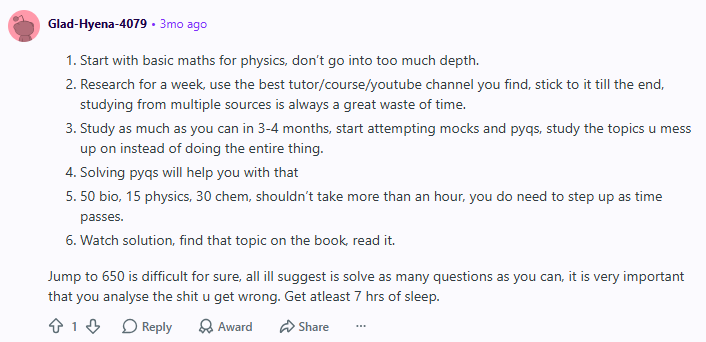
Based on Reddit discussions, below are some effective tips for NEET Physics preparation:
- Balance practice with analysis: Solving PYQs and mocks is essential, but the real progress comes from carefully reviewing mistakes and revisiting weak topics.
- Consistency over cramming: Stick to one reliable resource, revise formulas weekly, and maintain steady effort with proper rest to avoid burnout.
| Day | Focus Area | Tasks | Time Allocation |
|---|---|---|---|
| Mon | Basics & Foundation | Revise core maths needed for physics (formulas, units, conversions). Make formula sheets for 1–2 chapters. | 2–3 hrs |
| Tue | Concept Learning | Pick one reliable source (book/course/YouTube). Study 2 chapters deeply; avoid switching resources. | 3–4 hrs |
| Wed | Practice PYQs | Solve past year questions (PYQs) for physics. Mark tough ones for weekly re‑attempt. | 3 hrs |
| Thu | Mock Test | Attempt a short mock (bio 50 Qs, physics 15 Qs, chem 30 Qs). Analyze mistakes in detail. | 2 hrs test + 2 hrs analysis |
| Fri | Weak Topics | Re‑study topics you got wrong in mocks. Watch solutions, revisit book sections. | 3 hrs |
| Sat | Mixed Revision | Re‑solve marked tough questions from earlier in the week. Teach/explain concepts aloud (to a friend or even yourself). | 3–4 hrs |
| Sun | Full Mock & Rest | Attempt a full NEET mock test. Spend 2–3 hrs analyzing errors (concept gaps vs silly mistakes). Ensure 7 hrs sleep. | 3 hrs test + 3 hrs analysis |

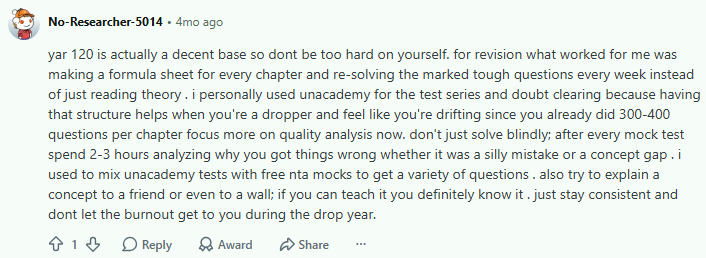
Source: Reddit
Related Links:
NEET Physics Exam Pattern FAQs
Ques. What is the marking scheme for NEET Physics?
Ans. The exam awards +4 marks for a correct answer and deducts -1 mark for an incorrect answer.
Ques. What is the duration of the NEET exam?
Ans. The total duration for the entire NEET exam is 3 hours and 20 minutes (200 minutes).
Ques. What is the NEET Physics syllabus for 2027?
Ans. It is based strictly on the NCERT Physics curriculum, which includes fundamental theories, numerical applications, and core experimental/practical skills at the Class 11 and 12 level.
Ques. Is the NEET Physics syllabus based on Class 11 and Class 12?
Ans. Yes, it is directly mapped to the Class 11 and Class 12 NCERT textbooks.
Ques. What is the NEET Physics chapter-wise weightage?
Ans. Electrodynamics (~25%) and Mechanics (~20%) dominate nearly half of the entire section. Modern Physics and Optics make up another ~25% combined.
Ques. How can I prepare using NEET PYQ Physics chapter-wise?
Ans. To study using NEET PYQ Physics chapter-wise, isolate one chapter at a time, solve its past 10–15 years of questions, identify your conceptual errors, and strictly time yourself to complete each question in under 1 minute.
Ques. Which Physics notes for NEET and question banks are best for preparation?
Ans. The best resources include your self-made NCERT-based core notes, the NCERT Exemplar, and standard practice volumes like DC Pandey (Objective Physics for NEET) or MTG Champion.



Comments