




The NEET UG 2026 re-exam is now over. NTA has successfully concluded NEET 2026 retest for 22 lakh+ students. Now that the exam is over, the NEET 2026 June 21 analysis, students' reactions, and overall and section-wise difficulty levels will be updated soon. Based on the early students' reaction and NEET 2026 June 21 analysis, the NEET re-exam was moderate in overall difficulty.
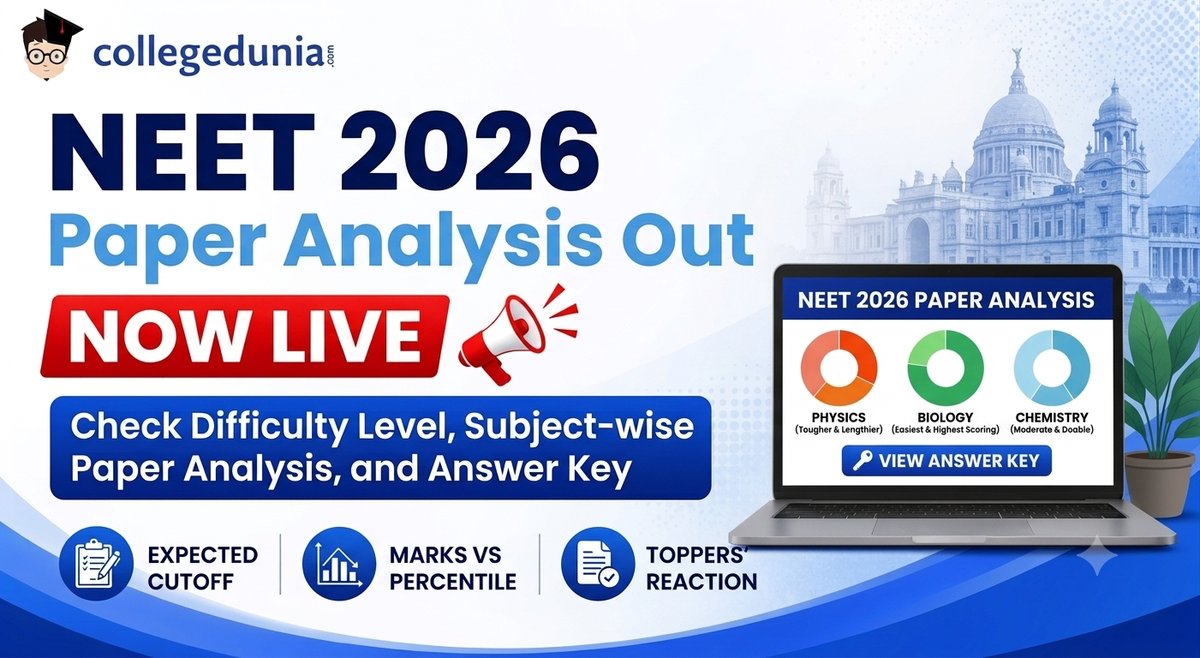
- Physics was comparatively tougher and lengthier. Students reported having taken 1.15 hours to complete the Physics section.
- Biology remained the highest-scoring and easiest among all three section.
- Chemistry section was doable and moderate. The Chemistry section was moderate and lengthy, and students took around 1 hour to complete the Chemistry section.
- Multiple reports confirm questions of assertion and reason, statement-based, to appear in the exam.
- Students also said that the Re NEET question paper was balanced between NCERT questions and other questions.
Candidates leaving the center after the NEET UG 2026 re-exam described the paper as good overall and well-aligned with their preparation, with only Physics proving slightly difficult. They called it a positive experience—adding to the consistent thread across cities that physics was the toughest section of the re-exam.
Check: Re-NEET UG 2026 Exam Over: Check NEET 2026 June 21 analysis, Difficulty Level and Answer Key
Check the Re-NEET 2026 Paper Discussion & Detailed Analysis here.
After the cancellation of the NEET 2026 exam held on 3 May 2026 due to the paper leak, many experts and students believe that the Re-NEET 2026 exam could be more difficult than the original paper. However, based on the analysis provided above, the expected increase in difficulty appears to be moderate rather than extreme.
Related Links:
- Re-NEET Answer Key 2026 (Soon): Check NEET Answer Key Live Updates, Code-Wise PDF, Release Date
- NEET UG 2026 Question Paper Analysis (Available)– Difficulty Level, Section-wise Review & Expected Cutoff (May 3)
- NEET Marks vs Rank 2026: Check NEET Course-wise Marks vs Rank, Safe Score, Rank Predictor, and Expected Cut off
- Re NEET 2026 Overall Difficulty
- Re-NEET Subject-wise Difficulty Level
- Re-NEET (21 June 2026) vs Cancelled NEET UG 2026 (3 May) Exam Analysis
- NEET UG 2026 (3 May 2026) Exam Analysis
4.2 NEET 2026 (3rd May) Subject-wise Analysis
4.3 NEET UG 2026 Student Reactions
- NEET 2025 Paper Analysis
- NEET Paper Analysis Last 10 years
6.1 NEET Section-wise Dominance
6.2 NEET Physics Analysis (2015–2024)
6.3 NEET Chemistry Analysis (2015–2024)
6.4 NEET Biology Analysis (Botany + Zoology) (2015–2024)
6.5 NEET Botany Analysis (2015–2024)
6.6 NEET Zoology Analysis (2015–2024)
- NEET UG 2026 FAQs
NEET 2026 June 21 Analysis
NEET 2026 re-exam paper analysis will be updated here once the exam concludes. The paper analysis are based on the students' live reactions from the exam centers.
| Particular | Difficulty Level | Paper Analysis |
| Overall | Moderate |
|
| Physics | Difficult and lengthy | Physics was tougher and lengthier among all three papers. Students reported having taken 1.15 hours to complete the physics section. |
| Chemistry | Moderate | The chemistry section was doable and moderate. The Chemistry section was moderate and lengthy, and students took around 1 hour to complete the Chemistry section. |
| Biology | Easy | Biology remained the highest-scoring and easiest among all three sections. |
Also Read
Re NEET Paper Analysis 2026: Overall Difficulty Expected
The Re NEET 2026 will follow a similar pattern as NEET 2026 (3 May 2026), with a total of 180 questions. But this time, NTA has extended the duration of the exam from 180 minutes to 195 minutes, an extra 15 minutes, to accommodate mandatory examination formalities such as documentation and verification.
- The Re NEET 2026 is expected to be moderately difficult in nature.
- Approximately 85% to 90% of the paper is drawn directly from NCERT books.
- Experts suggest a safe attempt of 145–155 questions to score competitively.
| Feature | Re NEET Paper Analysis (June 21) | NEET 2026 Paper Analysis (May 3) |
|---|---|---|
| Overall Difficulty | Moderate | Moderate |
| Physics difficulty level | Difficult and lengthy | Difficult |
| Chemistry difficulty level | Moderate | Moderate |
| Botany difficulty level | Easy | Easy |
Also Read
Re NEET 2026 Expected Marks vs Rank for 480 Marks ST CategoryRe NEET 2026 June 21 Analysis: Subject-wise Difficulty Level Expected
The subject-wise analysis indicates that Physics is expected to be the most challenging section with moderate scoring potential.
- Chemistry offers high-scoring opportunities due to its balanced and NCERT-based approach.
- Biology is likely to remain the easiest and most scoring subject, making it crucial for candidates aiming for a high overall score.
| Subject | Overall Difficulty Level | Scoring Potential |
|---|---|---|
| Physics | Difficult | Moderate |
| Chemistry | Moderate | High |
| Biology | Easy to Moderate | Very High |
Re-NEET 2026 Physics Paper Analysis
The NEET UG 2026 Re-exam Physics section was moderate to tough in difficulty. Candidates took around 1 to 1.5 minutes to solve 1 question. Candidates have to prepare JEE-level Physics to solve physics questions in NEET. Rotation questions were asked more.
- Most of the candidates attempted around 30 questions in the Physics section.
- Questions were application-based and involved lengthy calculations.
- Topics from Current Electricity, Electrostatics, Mechanics, and Magnetism had higher weightage.
- Accuracy and time management were major concerns.
| Aspect | Details |
|---|---|
| Expected Difficulty | Moderate to Difficult |
| Difficulty Percentage | Easy: 30% • Moderate: 45% • Difficult: 25% |
| Nature of Questions | Lengthy numerals, conceptual and application-based problems |
| Question Pattern | Formula-based, assertion-reason, statement-based, and multi-concept MCQs |
| Key Challenges | Time-consuming calculations, analytical thinking, and concept integration |
| High Weightage Topics | Current Electricity, Electrostatics, Mechanics, and Magnetism |
| Role in Exam | Rank Decider Section |
Re-NEET 2026 Chemistry Paper Analysis
The NEET UG 2026 Re-exam Chemistry section was moderate in difficulty. Candidates took around 1 hour to complete the chemistry section. The paper was NCERT-based.
- Inorganic Chemistry was largely NCERT-based.
- Physical Chemistry contained formula-based questions.
- Organic Chemistry featured a few tricky conceptual problems.
- Many candidates considered Chemistry the most balanced section.
| Aspect | Details |
|---|---|
| Expected Difficulty | Moderate |
| Difficulty Percentage | Easy: 40% • Moderate: 45% • Difficult: 15% |
| Nature of Questions | NCERT-based with conceptual and formula-based questions |
| Question Pattern | Direct factual, reaction-based, conceptual numericals, and statement-based MCQs |
| Key Challenges | Organic reaction mechanisms, Physical Chemistry calculations, and conceptual clarity |
| High Weightage Topics | Organic Chemistry, Chemical Bonding, Coordination Compounds, Electrochemistry, Thermodynamics, Biomolecules |
| Role in Exam | Moderate High-Scoring Section |
Re-NEET 2026 Biology Paper Analysis
The NEET UG 2026 Re-exam Biology section was easy to moderate in difficulty. Candidates took around 35-40 minutes to complete the Biology section.
- The paper was NCERT-based, and botany was slightly lengthier than zoology.
- There were statement-based and assertion-reason type questions in the exam.
- Biology remained the most scoring section, and students found Biology easier compared to Physics and Chemistry.
| Aspect | Details |
|---|---|
| Expected Difficulty | Easy |
| Difficulty Percentage | Easy: 55% • Moderate: 35% • Difficult: 10% |
| Nature of Questions | NCERT-centric with statement-based and conceptual questions |
| Question Pattern | statement-based and assertion-reason |
| Key Challenges | Similar-looking options, factual recall, and conceptual interpretation |
| High Weightage Topics | Botany was slightly lengthier than Zoology |
| Role in Exam | Highest Scoring Section |
Re-NEET UG 2026 Exam June 21: NEET UG 2026 Re-Exam Question Paper
The NEET UG 2026 Re-Exam has been concluded at 5:15 PM, and the question paper is provided below. Candidates can also find the subject-wise question papers link below:
| Question Paper Code | Question Paper PDF |
|---|---|
| Re NEET Question Paper | Download PDF |
| Physics Question Paper | Download PDF |
| Chemistry Question Paper | Download PDF |
| Botany Question Paper | Download PDF |
| Zoology Question Paper | Download PDF |
NEET UG 2026 Re-Exam Answer Key
| Answer Key | Answer Key PDF |
| Re NEET June 21 |
NEET UG 2026 Re-Exam Unofficial Answer Key
| Answer Key | Answer Key PDF |
| Re NEET June 21 (Unofficial) |
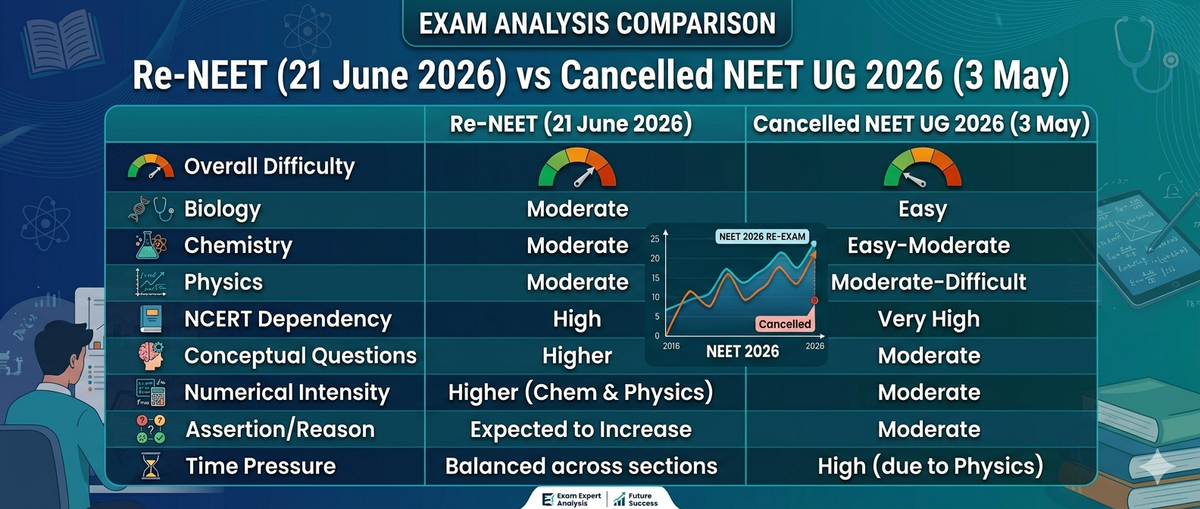
Re-NEET (21 June 2026) vs Cancelled NEET UG 2026 (3 May) Exam Analysis
Since the original examination was cancelled, examination experts often expect the re-test to maintain a similar syllabus coverage but may alter the difficulty distribution to ensure fairness and reduce predictability.
| Parameter | Expected Re-NEET (21 June) | Cancelled NEET (3 May) |
|---|---|---|
| Overall Difficulty | Moderate | Easy–Moderate |
| Biology | Easy–Moderate | Easy |
| Chemistry | Moderate | Easy–Moderate |
| Physics | Moderate | Moderate–Difficult |
| NCERT Dependency | High | Very High |
| Conceptual Questions | Higher | Moderate |
| Numerical Intensity | Higher in Chemistry and Physics | Moderate |
| Assertion/Reason | Expected to increase | Moderate |
| Time Pressure | Likely balanced across sections | High due to Physics |
NEET UG 2026 (3 May 2026) Exam Analysis
The early ground-level reactions from exam centres such as Kota indicate that the NEET UG 2026 paper was largely NCERT-oriented and balanced, with Biology emerging as the easiest section, while Physics acted as the major differentiator due to lengthy calculations and application-based questions.
Overall Student Reaction
| Parameter | Observation |
|---|---|
| Overall Difficulty | Easy to Moderate |
| Paper Nature | NCERT-focused with conceptual application |
| Most Scoring Section | Biology |
| Most Difficult Section | Physics |
| Time Management | Challenging because of Physics |
| Student Mood After Exam | Relieved but cautiously optimistic |
| Rank-Deciding Section | Physics |
NEET 2026 (3rd May) Subject-wise Analysis
- Biology was almost entirely NCERT-based, allowing serious attempts.
- Chemistry maintained a balance between theory and numericals.
- Physics required multiple concepts in a single question and consumed significant time.
- Students with strong NCERT preparation felt confident, while average aspirants struggled with Physics.
| Subject | Difficulty | Question Pattern | Major Topics | Student Opinion |
|---|---|---|---|---|
| Biology | Easy–Moderate | Fact-based, Assertion, Match-the-column | Genetics, Human Physiology, Ecology, Biotechnology, Reproduction | High scoring and manageable |
| Chemistry | Easy–Moderate | Theory + Numericals + Applications | Physical Chemistry, Organic Reactions, Inorganic NCERT | Balanced with a few tricky questions |
| Physics | Moderate–Difficult | Numerical and Multi-concept | Mechanics, Electromagnetism, Optics, Modern Physics | Lengthy and toughest section |
NEET UG 2026 Student Reactions
The experts from the Collegedunia interviewed the NEET aspirants on 3rd May 2026, after the exam was concluded, it was observed that strong NCERT command significantly improved scoring potential. The paper rewarded textbook preparation rather than excessive coaching-based tricks.
- Ankit: “Described the paper as "very good", found Biology extremely easy, and estimated that a well-prepared student could score 400–450+ marks comfortably.”
- Shojat Shakar (First Attempt): Rated the exam as fairly good, relied primarily on NCERT without coaching, biology was strongest, and Physics felt average.
NEET 2025 Paper Analysis
The NEET 2025 paper has been reported to be of an overall moderate to tough difficulty level.
- NEET 2025 Physics section was tough according to the appearing candidates. This section had a few new questions that were not part of any PYQs. Most questions were asked from the class 11th NCERT with major emphasis on topics like Mechanics, Modern Physics, and Electrostatics.
- Chemistry is reported to be of a moderate difficulty level. Most asked topics were from the Organic Chemistry of the 12th curriculum. It included some tough and lengthy numerical questions.
- Biology, divided into Botany and Zoology, was of an easy to moderate difficulty level. Biology has been reported as lengthy for both Botany and Zoology, with additions of some new questions.
| Subject | Expected Difficulty Level | Most Asked Topics with Weightage | Remarks |
|---|---|---|---|
| Botany | Easy |
| Mostly concept based questions with some diagram based lengthy questions |
| Zoology | Easy to Moderate |
| Conceptual but direct with diagram based questions and lengthy |
| Physics | Tough |
| Tough Numerical questions with some questions from JEE Main practice papers. Few new questions were included. |
| Chemistry | Moderate |
| Organic Chemistry from Class 12 dominated, numerical questions were lengthy with some new questions which were not in any PYQs. |
NEET Paper Analysis Last 10 years
Difficulty Trend
- 2015–2017: Easier papers
- 2018–2020: Tough phase (especially Physics)
- 2021–2024: Balanced but tricky
NEET didn’t get harder — it became more analytical and time-consuming
| Year | Overall Difficulty | Physics | Chemistry | Biology | Paper Nature | Good Attempts |
|---|---|---|---|---|---|---|
| 2024 | Moderate | Moderate–Difficult | Moderate | Easy | NCERT-based + mixed numericals | 165–170 |
| 2023 | Easy–Moderate | Moderate | Moderate–Tough | Easy (lengthy) | Numerical (Physics) + theory (Chem) | 170+ |
| 2022 | Moderate | Easy–Moderate | Moderate | Easy–Moderate | Fact-based + numerical mix | 170+ |
| 2021 | Moderate–Difficult | Difficult | Moderate | Easy–Moderate | Match-the-column + lengthy | 160–165 |
| 2020 | Moderate–Tough | Difficult | Moderate | Easy | Conceptual + NCERT-based | 165–170 |
| 2019 | Moderate | Moderate | Easy–Moderate | Easy | Concept-based shift begins | 155–160 |
| 2018 | Moderate–Difficult | Difficult | Moderate | Easy | Numerical-heavy (Physics) | 150–155 |
| 2017 | Moderate | Moderate | Easy–Moderate | Easy | NCERT-driven | 145–150 |
| 2016 | Moderate | Moderate | Moderate | Easy | Standardized NEET pattern begins | 140–145 |
| 2015 | Easy–Moderate | Easy–Moderate | Easy | Easy | Direct, memory-based | 140 |
NEET Section-wise Dominance
Physics is consistently the rank deciding section
| Section | 10-Year Trend |
|---|---|
| Physics | Toughest every single year |
| Chemistry | Most variable |
| Biology | Easiest and most scoring |
NEET Physics Analysis (2015–2024)
- Most consistent, toughest subject
- Shift: Formula → Conceptual numericals
- Mechanics dominates every year (~25%)
| Year | Difficulty | Nature of Questions | Key Focus Areas | Remarks |
|---|---|---|---|---|
| 2024 | Moderate–Difficult | Conceptual + Numerical | Mechanics, Current Electricity | Time-consuming |
| 2023 | Moderate | 78% Numerical | Mechanics, Modern Physics | Lengthy paper |
| 2022 | Easy–Moderate | Formula-based numericals | Thermodynamics, Electricity | Balanced |
| 2021 | Difficult | Conceptual | Mechanics, Electrostatics | Tough section |
| 2020 | Difficult | Numerical-heavy | Mechanics, Thermodynamics | Lengthy |
| 2019 | Moderate | Concept-based | Optics, Mechanics | Tricky |
| 2018 | Difficult | Multi-step numericals | Mechanics | Toughest |
| 2017 | Moderate | Concept + numerical | Electricity, Mechanics | Balanced |
| 2016 | Moderate | Formula-based | Basic Mechanics | Standard level |
| 2015 | Easy–Moderate | Direct formula-based | Basic Physics | Easier paper |
NEET Chemistry Analysis (2015–2024)
- Most balanced scoring subject
- Weightage is always evenly split:
- Organic (~30–35%)
- Inorganic (~30–35%)
- Physical (~30%)
| Year | Difficulty | Nature of Questions | Key Focus Areas | Remarks |
|---|---|---|---|---|
| 2024 | Moderate | NCERT + reaction-based | Organic, Equilibrium | Balanced |
| 2023 | Moderate–Tough | Theory-heavy | Bonding, Hydrocarbons | Few numericals |
| 2022 | Moderate | Fact-based + numericals | Mole concept, Bonding | NCERT-based |
| 2021 | Moderate | Balanced | Inorganic dominant | Scoring |
| 2020 | Moderate | Conceptual | Organic + Physical | Balanced |
| 2019 | Easy–Moderate | NCERT-based | Organic Chemistry | Easier |
| 2018 | Moderate | Mixed | Organic + Physical | Slightly tricky |
| 2017 | Easy–Moderate | NCERT-based | Inorganic | Scoring |
| 2016 | Moderate | Balanced | Physical + Inorganic | Standard |
| 2015 | Easy | Direct NCERT | Basic concepts | Easiest phase |
NEET Biology Analysis (Botany + Zoology) (2015–2024)
- Always easiest + highest scoring
- 90%+ questions from NCERT
- Trend shift:
- Memory → Statement-based → NCERT precision
| Year | Difficulty | Nature of Questions | Key Focus Areas | Remarks |
|---|---|---|---|---|
| 2024 | Easy | NCERT line-based | Genetics, Physiology | Most scoring |
| 2023 | Easy (lengthy) | Statement-based | Physiology, Reproduction | Time-consuming |
| 2022 | Easy–Moderate | Fact-based | Cell Biology, Ecology | Slightly lengthy |
| 2021 | Easy–Moderate | Match-the-column | Genetics, Biotechnology | Lengthy |
| 2020 | Easy | NCERT-based | Ecology, Genetics | Scoring |
| 2019 | Easy | Direct NCERT | Physiology, Plant Physiology | High scoring |
| 2018 | Easy | Memory-based | Biology basics | Lengthy |
| 2017 | Easy | Direct questions | Repeated topics | Very scoring |
| 2016 | Easy | NCERT-based | Basic Biology | Scoring |
| 2015 | Easy | Memory-based | Basic concepts | Easiest |
NEET Botany Analysis (2015–2024)
- Increasing weightage of:
- Ecology
- Genetics
- Cell Biology
| Year | Difficulty | Key Topics | Question Trend | Remarks |
|---|---|---|---|---|
| 2024 | Easy–Moderate | Ecology, Cell Biology | NCERT-based | Direct questions |
| 2023 | Moderate–Difficult | Plant Physiology, Genetics | Statement-based | Lengthy |
| 2022 | Easy–Moderate | Plant Physiology, Ecology | Fact-based | Moderate |
| 2021 | Moderate | Genetics, Biotechnology | Match-type | Lengthy |
| 2020 | Easy | Ecology, Genetics | Direct | Scoring |
| 2019 | Easy | Plant Physiology | Direct | High scoring |
| 2018 | Easy | Basic Botany | Memory-based | Lengthy |
| 2017 | Easy | Repeated topics | Direct | Scoring |
| 2016 | Easy | Basic NCERT | Direct | Easy |
| 2015 | Easy | Basic concepts | Memory-based | Very easy |
NEET Zoology Analysis (2015–2024)
Most repeated topics
- Human Physiology (dominates every year)
- Trend: Direct → Conceptual → Statement-based
| Year | Difficulty | Key Topics | Question Trend | Remarks |
|---|---|---|---|---|
| 2024 | Easy–Moderate | Human Physiology, Biomolecules | Direct | Scoring |
| 2023 | Easy–Moderate | Physiology, Reproduction | Statement-based | Lengthy |
| 2022 | Moderate | Physiology, Biotechnology | Conceptual | Slightly tough |
| 2021 | Easy–Moderate | Genetics, Physiology | Match-type | Lengthy |
| 2020 | Easy | Human Physiology | Direct | High scoring |
| 2019 | Easy | Physiology | Direct | Scoring |
| 2018 | Easy | Basic Zoology | Memory-based | Lengthy |
| 2017 | Easy | Repeated topics | Direct | Easy |
| 2016 | Easy | NCERT basics | Direct | Scoring |
| 2015 | Easy | Basic concepts | Memory-based | Very easy |
NEET UG 2026 Paper Analysis FAQs
Ques. Is the NEET paper tough in 2026?
Ans. Based on expert predictions and the expected exam pattern, NEET 2026 is likely to be moderate to moderately difficult rather than exceptionally tough.
The paper is expected to place greater emphasis on conceptual understanding and application-based learning while retaining a strong NCERT foundation.
- Physics: 45 Questions (Moderate to Difficult)
- Chemistry: 45 Questions (Moderate)
- Biology: 90 Questions (Easy to Moderate)
Ques. What is the difficulty level of NEET 2026 paper analysis?
Ans. The overall difficulty level of NEET 2026 is expected to be moderate to moderately difficult, with a noticeable shift toward conceptual and application-oriented questions.
- Physics is expected to serve as the rank-deciding section because of its conceptual and numerical nature.
- Chemistry may provide a balanced mix of factual and conceptual questions.
- Biology is expected to remain largely NCERT-based, making it comparatively more scoring.
Ques. What is the NEET marks prediction for 2026?
Ans. The expected marks prediction for NEET 2026 depends largely on the overall paper difficulty and candidate performance. If the paper follows the anticipated moderate to moderately difficult pattern, score distribution may remain competitive while slightly reducing the number of extremely high scores.
Expected Score Analysis
| Score Range | Expected Performance |
| 680–720 | Outstanding Performance |
| 650–679 | Excellent Chances for Top Government Medical Colleges |
| 600–649 | Strong Competitive Score |
| 550–599 | Good Score with Moderate Admission Opportunities |
| Below 550 | May require higher category cut-offs or private college options |



Comments
Found 1 Comment