




KCET 2027 is a state-level entrance examination conducted by the Karnataka Examinations Authority (KEA) for admission to undergraduate professional courses in Karnataka. KCET 2027 exam will be conducted around April 2027. In 2026, KCET exam was conducted on April 23- 24, 2026.
KCET exam is conducted offline in MCQ format. Each paper has 60 questions, with no negative marking. Every question will have 1 mark each.
- Candidates can expect the KCET 2027 notification to be out around January 2027. In 2026, the notification was published on January 16, 2026.
- KCET 2027 registration is expected to begin in January 2027 and will conclude around mid-February 2027. In the previous academic year, the KCET registration started on January 17, 2026, and concluded on February 16, 2026.
- KCET registration fee is INR 500 for GM, 2A, 2B, 3A, and 3B candidates and INR 250 for SC, ST, CAT-1, and all female candidates of Karnataka. The registration fee for KCET is INR 750 for GM Indian candidates outside of Karnataka.
- KCET 2027 exam will be 80 minutes (10 minutes for OMR instruction fill-up & 70 min for the test) for each subject.
- KCET syllabus is based on the 1st and 2nd Year PUC (Pre-University Course) set by Karnataka State Board guidelines.
- Candidates can download their KCET 2027 admit card around April 2027. In 2026, KCET admit card was released on April 11, 2026.
- KEA will publish the KCET 2027 result around June 2027. The KCET result for 2026 was published on June 6, 2026.
- Candidates securing a valid KCET rank can participate in KEA counselling, including document verification, option entry, and seat allotment from June 2027.
Candidates are advised to regularly check the KEA website for updates regarding KCET 2027 exam details.
Related Links:
- KCET 2027 Exam Dates: Expected April 2027, Important Dates and Notification to Counselling
- KCET Application:- Check How to Apply, Documents Required and Application Fees
- KCET Syllabus 2027: Topic-Wise Weightage, PDF Download Link, Exam Pattern & Books
KCET 2027 Exam Highlights
Karnataka Education Authority (KEA) conducts the Karnataka Common Entrance Test (KCET) annually. The important details regarding KCET 2027 are summarized below:
| Particulars | Details |
|---|---|
| Exam Name | Karnataka Common Entrance Test 2027 |
| Conducting Body | Karnataka Examinations Authority (KEA) |
| Exam Level | State Level |
| Exam Mode | Offline: Pen and Paper-Based |
| Subjects | Physics, Chemistry, Mathematics, Biology |
| Questions per Paper | 60 MCQs |
| Marks Per Paper | 60 |
| Duration per Paper | 80 minutes |
| Marking Scheme | No negative marking; +1 mark for each correct response |
| Exam Frequency | Once A Year |
Related Links:
- KCET Admit Card, Check Download Link, Exam Centres, Exam Day Guidelines
- KCET Reservation 2027: Category Wise Seats, Fee Concession and Cutoff Relaxation
Ques. Is KCET 2027 conducted online?
Ans. No, KCET is conducted in offline pen-and-paper mode.
KCET 2027 Exam Dates
KEA is expected to release the KCET exam dates 2027 along with the official notification. Based on 2026, candidates can expect the application process to begin in January 2027 and will conclude around mid-February 2027.
| Events | KCET 2027 Exam Dates | KCET 2026 Schedule |
|---|---|---|
| KCET 2027 Notification | January 2027 | January 16, 2026 |
| KCET 2027 Registration Begins | January- February, 2027 | January 17, 2026 |
| Last Date to Apply for KCET 2027 | February, 2027 | February 16, 2026 |
| Application Fee Payment Last Date | February, 2027 | February 18, 2026 |
| Application Correction | February- March 2027 | Late February- March 30, 2026 |
| KCET Admit Card Release | First Week of April 2027 | April 10, 2026 |
| Kannada Language Test | Third Week of April 2027 | April 22, 2026 |
| KCET 2027 Exam | Third Week of April 2027 | April 23- 24, 2026 |
| Provisional Answer Key | Last Week of April 2027 | April 27, 2026 |
| Answer Key Objection Window | April - May 2027 | April 27- 30, 2026 |
| Final Answer Key | May 2027 | May 10, 2026 |
| KCET 2027 Result | May- June 2027 | June 6, 2026 |
| Counselling Registration Begins | June 2027 | June 22, 2026 |
| Round 1 Mock Allotment and Option Entry | July 2027 | July 6- 9, 2026 |
| Round 1 Seat Allotment | July 2027 | July 14, 2026 |
| Round 2 Counselling and Mop-up Rounds | August- September 2027 | August 7- September 4, 2026 |
Also Check: KCET Exam Centers 2027: City List Expected, Allotted Center and Change Policy
Ques. Where can I check KCET 2027 official updates?
Ans. Candidates should regularly check the official Karnataka Examinations Authority website for KCET 2027 notifications, application, admit card, result and counselling updates.
KCET 2027 Registration: Step-by-Step Process
KCET 2027 registration is expected to begin in January 2027 and will conclude around mid-February 2027. In 2026 admission cycle, the KCET registration started on January 17, 2026 and concluded on February 16, 2026.
- Register on the KEA Portal: Visit cetonline.karnataka.gov.in, click "UGCET Online Application," and register with your mobile number and email ID. Save your application number and password.
- Complete Aadhaar-based e-KYC: This is mandatory. Complete Aadhaar-based digital verification before filling the main form. Applications without completed e-KYC are rejected.
- Fill the Application Form: Enter personal details, academic qualification, subject combination (PCM or PCB), medium of instruction, and preferred exam centres.
- Upload Photo and Signature: Upload a recent passport-size photograph (JPEG, 20- 50 KB) and signature (JPEG, 10- 30 KB) as per KEA specifications.
- Pay the Application Fee: Pay online through net banking, debit card, or credit card. The fee is non-refundable once paid.
- Submit and Save Confirmation: Submit the application and download the confirmation page. Your admit card will be issued against this registration number.
Watch the YouTube video by “Collegedunia Exams” to learn a step-by-step guide to filling out the KCET Application form.
Documents Required for KCET 2027 Application Form
The documents required for KCET 2027 Application form filling are listed below:
- Aadhaar Card / Valid Photo ID
- SSLC/10th Mark Sheet
- SSLC/12th Mark Sheet
- Study Certificate
- Caste Certificate (if applicable)
- Income Certificate for claiming income-based benefits
- Rural Study Certificate (if applicable)
- Kannada Medium Study Certificate (if applicable)
- Domicile/Relevant Eligibility Certificate
- Candidate’s Signature and passport-size photograph
- Parent’s Signature and Details
KCET 2027 Application Fee
The KCET 2027 Application fee is tabulated below for candidates from Karnataka and outside Karnataka. Check your KCET Registration Fee as per your category:
| Category | KCET Registration Fee |
|---|---|
| GM, 2A, 2B, 3A, and 3B | INR 500 |
| SC, ST, CAT-1 | INR 250 |
| GM (Outside Karnataka) | INR 750 |
Also Check: KCET Exam Day Guidelines: Dress code for Male & Female, Required Documents and OMR Sheet Instructions
Ques. Is KCET compulsory for all Karnataka colleges?
Ans. No. KCET applies to courses and seats covered under the KEA admission process. Other institutions and courses may follow separate admission procedures.
KCET 2027 Eligibility Criteria
The general eligibility requirements for candidates willing to appear for KCET 2027 exam are tabulated below:
| Parameters | Eligibility |
|---|---|
| Educational Qualification |
|
| Appearing Candidates | Eligible to apply but must submit proof of passing the qualifying exam during admission |
| Age Limit | No Upper Age Limit |
| Nationality | Indian citizen |
| Domicile | Candidates who claim Karnataka Quota must have studied for at least 7 academic years in recognized schools within Karnataka between Class 1 and Class 12, and passed either Class 10 or Class 12 from Karnataka |
Also Check: KCET Eligibility Criteria: Check Criteria for Age, Courses, Language Test, and Documents Required
Ques. Does KCET have a Kannada Language Test?
Ans. KEA conducts a Kannada Language Test for eligible Horanadu and Gadinadu Kannadiga candidates wherever applicable.
KCET 2027 Exam Pattern
KCET exam is conducted offline in MCQ format for Physics, Chemistry, and Maths/Biology. Each paper has 60 questions, with no negative marking. Every question carries 1 mark.
KCET Exam Pattern 2027: Key Points
- Each question carries 1 mark.
- Questions are objective-type MCQs.
- There is no negative marking for incorrect answers.
- Engineering aspirants generally appear for Physics, Chemistry and Mathematics.
- Candidates applying for BPharm and other courses appear for Physics, Chemistry and Biology.
- Each subject is conducted as a separate paper.
| Subjects | Total Questions | Total Marks |
|---|---|---|
| Physics | 60 | 60 |
| Chemistry | 60 | 60 |
| Maths/Bio | 60 | 60 |
| Total | 180 | 180 |
Related Link: KCET Exam Pattern 2027: Sections, Subject-wise Weightage, Marking Scheme and Question Papers
Ques. Is KCET only for engineering?
Ans. No. KCET is used for admission to several undergraduate professional courses, including engineering, pharmacy, agriculture, veterinary, nursing and other eligible programmes.
KCET 2027 Syllabus: Important Topics
KCET syllabus is based on the 1st and 2nd Year PUC (Pre-University Course) set by Karnataka State Board guidelines.
KCET 2027 Syllabus: Maths
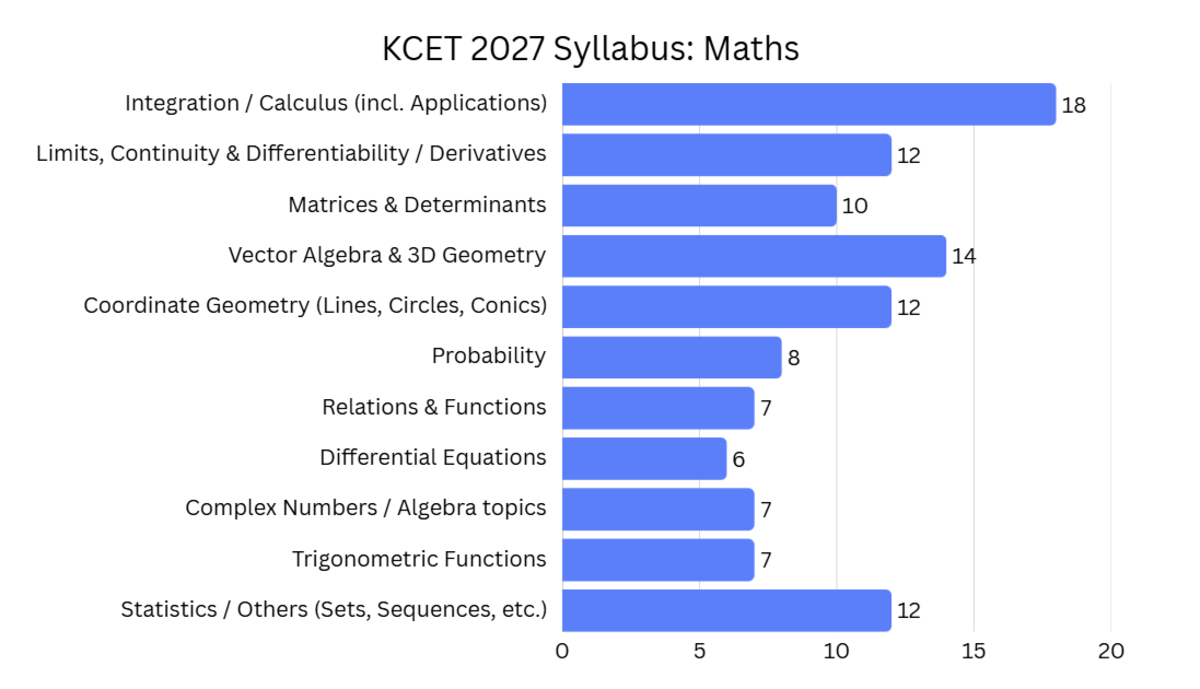
Integrals, Continuity and Differentiability, Determinants, Probability, Matrices, Vectors, and 3D Geometry are high weightage topics. The important topics from KCET Maths Syllabus are tabulated below:
| Chapter/Topic (PUC I & II) | Approx. Weightage |
|---|---|
| Integration / Calculus (incl. Applications) | 12- 18% |
| Limits, Continuity & Differentiability / Derivatives | 7- 12% |
| Matrices & Determinants | 7- 10% |
| Vector Algebra & 3D Geometry | 10- 14% |
| Coordinate Geometry (Lines, Circles, Conics) | 8- 12% |
| Probability | 6- 8% |
| Relations & Functions | 5- 7% |
| Differential Equations | 5- 6 |
| Complex Numbers / Algebra topics | 5- 7 |
| Trigonometric Functions | 5- 7% |
| Statistics / Others (Sets, Sequences, etc.) | 8- 12% |
KCET 2027 Syllabus: Physics
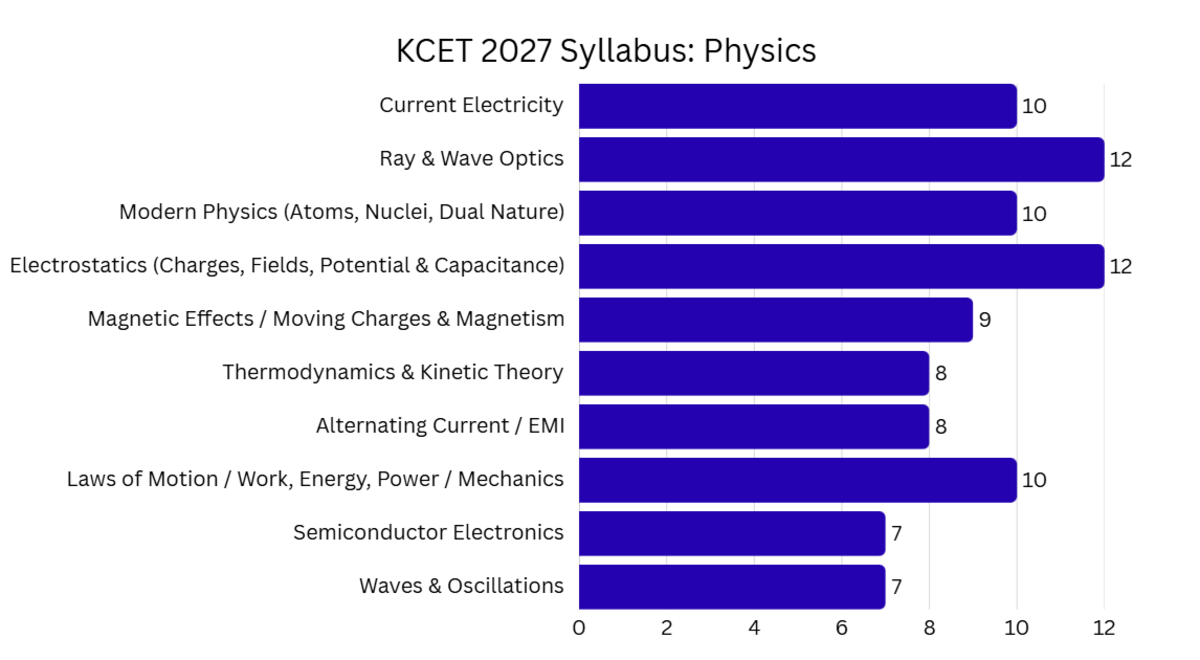
Some of the highly weighted topics of the KCET Physics paper are Electrostatics, Electromagnetic Induction, Optics, and Modern Physics. The important topics from KCET Physics Syllabus are tabulated below:
| Chapter/Topic (PUC I & II) | Approx. Weightage (%) |
|---|---|
| Current Electricity | 7- 10 |
| Ray & Wave Optics | 8- 12 |
| Modern Physics (Atoms, Nuclei, Dual Nature) | 8- 10 |
| Electrostatics (Charges, Fields, Potential & Capacitance) | 8- 12 |
| Magnetic Effects / Moving Charges & Magnetism | 7- 9 |
| Thermodynamics & Kinetic Theory | 5- 8 |
| Alternating Current / EMI | 5- 8 |
| Laws of Motion / Work, Energy, Power / Mechanics | 6- 10 |
| Semiconductor Electronics | 5- 7 |
| Waves & Oscillations | 5- 7 |
KCET 2027 Syllabus: Chemistry
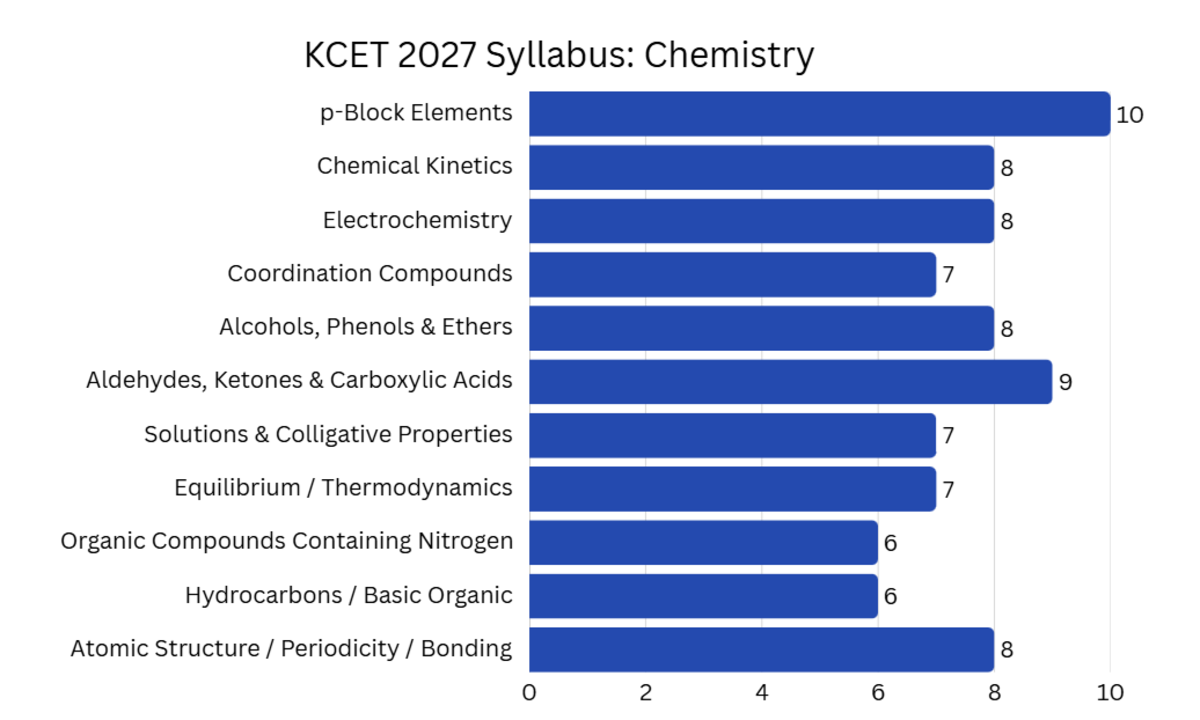
Some of the highly weighted topics of the KCET Chemistry paper are Alcohols, Phenols and Ethers, Solutions, Electrochemistry, Chemical Kinetics, and Coordination Compounds. The important topics from KCET Chemistry Syllabus are tabulated below:
| Chapter/Topic (PUC I & II) | Approx. Weightage (%) |
|---|---|
| p-Block Elements | 7- 10 |
| Chemical Kinetics | 6- 8 |
| Electrochemistry | 6- 8 |
| Coordination Compounds | 5- 7 |
| Alcohols, Phenols & Ethers | 6- 8 |
| Aldehydes, Ketones & Carboxylic Acids | 6- 9 |
| Solutions & Colligative Properties | 5- 7 |
| Equilibrium / Thermodynamics | 5- 7 |
| Organic Compounds Containing Nitrogen | 5- 6 |
| Hydrocarbons / Basic Organic | 4- 6 |
| Atomic Structure / Periodicity / Bonding | 5- 8 |
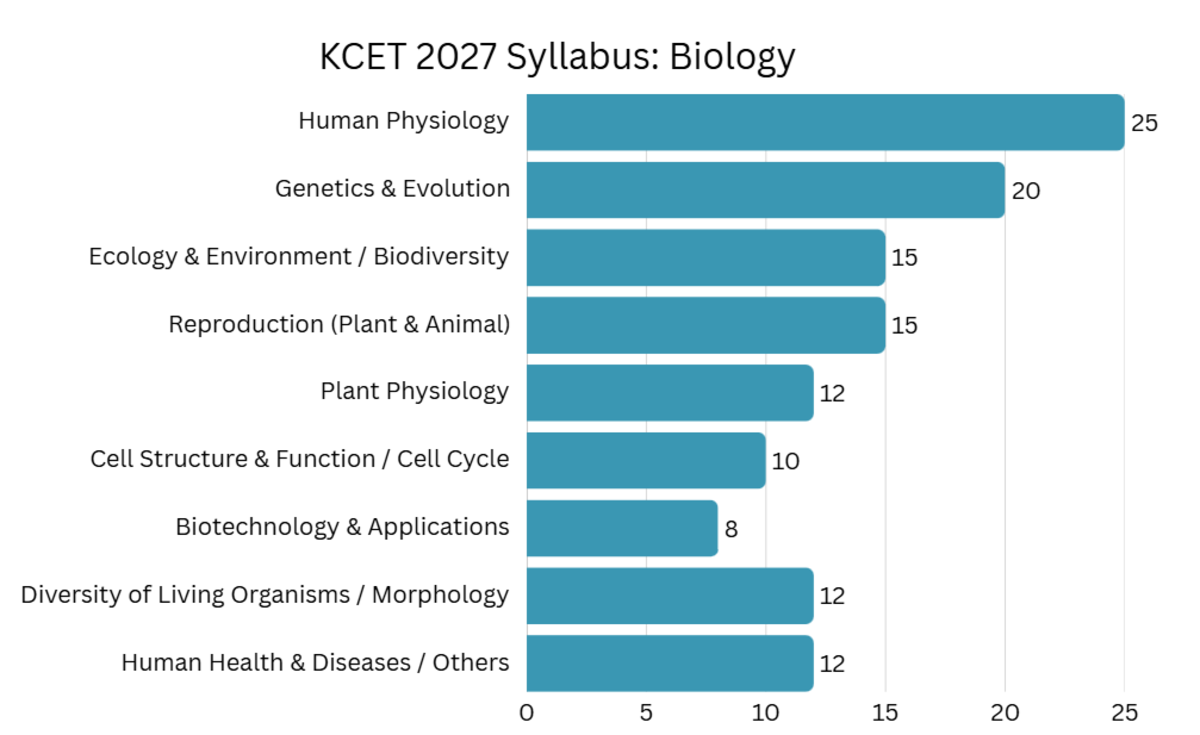
KCET 2027 Syllabus: Biology
Some of the highly weighted topics of the KCET Biology paper are Alcohols, Phenols and Ethers, Solutions, Electrochemistry, Chemical Kinetics, and Coordination Compounds. The important topics from KCET Biology Syllabus are tabulated below:
| Chapter/Topic (PUC I & II) | Approx. Weightage (%) |
|---|---|
| Human Physiology | 15- 25 |
| Genetics & Evolution | 15- 20 |
| Ecology & Environment / Biodiversity | 10- 15 |
| Reproduction (Plant & Animal) | 10- 15 |
| Plant Physiology | 8- 12 |
| Cell Structure & Function / Cell Cycle | 6- 10 |
| Biotechnology & Applications | 5- 8 |
| Diversity of Living Organisms / Morphology | 8- 12 |
| Human Health & Diseases / Others | 8- 12 |
Also Check:
- KCET Physics Syllabus 2027: Subject-wise Topics, Chapter-wise Weightage and PDF Download
- KCET Maths Syllabus 2027: Subject-Wise Topics, Chapter-Wise Weightage and PDF Download
- KCET Chemistry Syllabus 2027: Subject-Wise Topic List, Chapter Weightage and PDF Download
- KCET Biology Syllabus: Important Topics, Chapter-Wise Weightage, Best Books, Recent Changes
Ques. What documents are required for KCET counselling?
Ans. Candidates may need their KCET rank card, 10th and 12th/2nd PUC mark sheets, study certificate, Aadhaar, category certificate and other documents applicable to their eligibility.
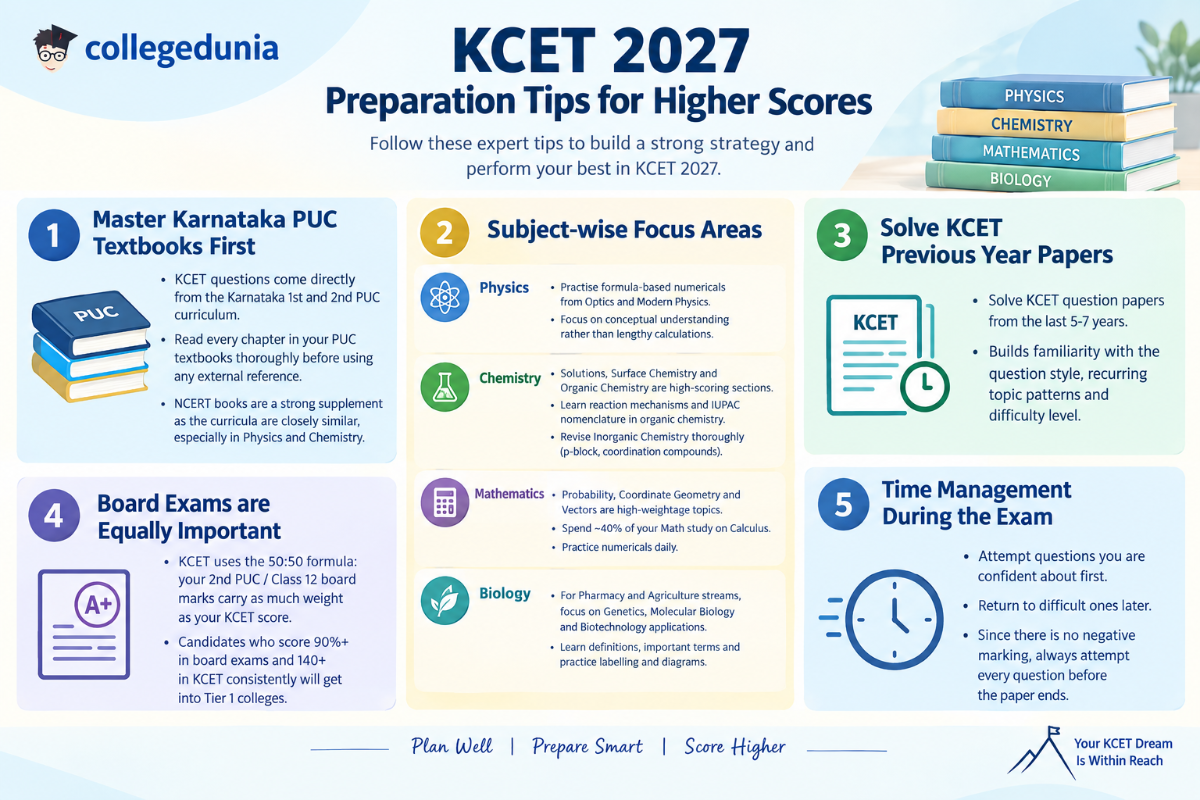
Preparation Tips for KCET 2027
For students preparing for KCET 2027, here are some tips that will help you prepare and score well.
Master Karnataka PUC Textbooks First
KCET questions come directly from the Karnataka 1st and 2nd PUC curriculum. You should read every chapter in your PUC textbooks thoroughly before using any external reference. NCERT books are a strong supplement because the curricula are closely similar, especially in Physics and Chemistry.
Subject-wise Focus Areas:
- Physics: Practise formula-based numericals from Optics and Modern Physics. Most questions are concept-based rather than lengthy calculations so focus on conceptual understanding.
- Chemistry: Solutions, Surface Chemistry, and Organic Chemistry are the highest-scoring sections. Learn reaction mechanisms and IUPAC nomenclature in organic chemistry. Revise Inorganic Chemistry thoroughly (p-block, coordination compounds).
- Mathematics: Probability, Coordinate Geometry, and Vectors are high-weightage topics. Spend roughly 40% of your Math study on Calculus. Practice numericals daily.
- Biology: For Pharmacy and Agriculture streams, Genetics, Molecular Biology, and Biotechnology applications are most important. Learn definitions, important terms and practice labelling and diagrams.
Solve KCET Previous Year Papers:
Solving KCET question papers from the last 5-7 years is one of the most effective ways to prepare. This builds familiarity with the question style, recurring topic patterns, and difficulty level.
Board Exams are Equally Important:
KCET uses the 50:50 formula: your 2nd PUC / Class 12 board marks carry as much weight as your KCET score. Candidates who score 90%+ in board exams and 140+ in KCET consistently will get into Tier 1 colleges.
Time Management During the Exam:
Attempt questions you are confident about first. Return to difficult ones later. Since there is no negative marking, always attempt every question before the paper ends.
Download KCET Previous Year Question Paper PDFs
| KCET Previous Year Question Paper | PDFs |
|---|---|
| KCET 2026 Question Paper with Solution PDF | Check Here |
| KCET 2025 Question Paper with Solution PDF | Check Here |
| KCET 2024 Question Paper with Solution PDF | Check Here |
| KCET 2023 Question Paper with Solution PDF | Check Here |
| KCET 2022 Question Paper with Solution PDF | Check Here |
| KCET 2021 Question Paper with Solution PDF | Check Here |
Related Links:
- KCET Preparation Tips, Best Books, Syllabus, and Important Topics
- KCET Best Books: Check Books for Subjects, Practice Questions, and PYQs
- KCET Question Paper (Available): Check Previous Year Question Paper with Solution PDF (2026-2004)
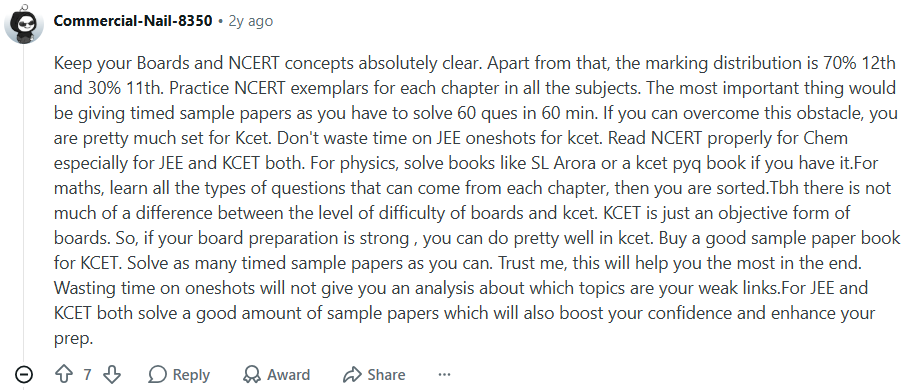
On discussion forums such as Reddit, a user asked about how to prepare for KCET and wanted some preparation tips. Based on this, a user shared:
Keep your Boards and NCERT concepts absolutely clear. The marking distribution is 70% for 12th and 30% for 11th. Practice NCERT exemplars for each chapter in all the subjects. Attempt timed sample papers, as you have to solve 60 questions in 60 min. Read NCERT properly for Chemistry. For physics, solve books like SL Arora or a KCET PYQ book if you have it. For maths, practice all the types of questions that can come from each chapter. KCET is just an objective form of boards. So, if your board preparation is strong, you can do pretty well in KCET.
Source: Reddit
Ques. When will KCET 2027 counselling start?
Ans. KCET 2027 counselling is expected to begin after the declaration of the result and rank list, likely from June or July 2027.
KCET 2027 Admit Card
Candidates can download their KCET 2027 admit card around April 2027. In 2026, KCET admit card was released on April 11, 2026.
How to Download KCET Admit Card 2027?
Follow these steps to download your KCET Admit Card:
- Step 1: Visit the official KEA website.
- Step 2: Click on the KCET 2027 admit card link.
- Step 3: Enter the required login credentials.
- Step 4: Submit the details.
- Step 5: Download the admit card.
- Step 6: Check the details printed on it.
- Step 7: Take a printout for the examination.
Documents to Carry to the KCET 2027 Exam Centre
- Printed copy of the KCET 2027 admit card (printout, not a mobile screenshot)
- One valid, original, government-issued photo ID (Aadhaar card, PAN card, passport, voter ID, or driving licence)
- Valid PwD Certificate, if applicable
Ques. What is the KCET 2027 exam pattern?
Ans. KCET is expected to have separate 60-question papers for Physics, Chemistry, Mathematics and Biology, with each paper carrying 60 marks.
KCET 2027 Result
KEA will publish the KCET 2027 result around June 2027. The KCET result for 2026 was published on June 6, 2026.
How to Check KCET Result 2027?
A step-by-step guide to check KCET Result 2027 is discussed below. Follow these steps to download your KCET scorecard 2027.
- Step 1: Visit the official KEA website.
- Step 2: Click on the KCET 2027 result link.
- Step 3: Enter the required credentials.
- Step 4: Submit the details.
- Step 5: Check the result.
- Step 6: Download the rank card.
- Step 7: Take a printout for counselling.
Details Mentioned in KCET 2027 Scorecard
The following details will be printed on your KCET scorecard:
- Candidate name
- Application number
- KCET Subject-wise marks
- KCET score
- Qualifying examination details
- KCET Rank
- KCET Qualifying status
Related Link: KCET Result at cetonline.karnataka.gov.in, Counselling, Cutoff and Marks
Ques. What is the KCET 2026 qualifying cutoff to get a valid rank?
Ans. To receive a valid KCET 2026 rank, General Merit (GM) candidates must score at least 50% marks in the CET papers for their stream. SC/ST and OBC candidates need at least 40%.
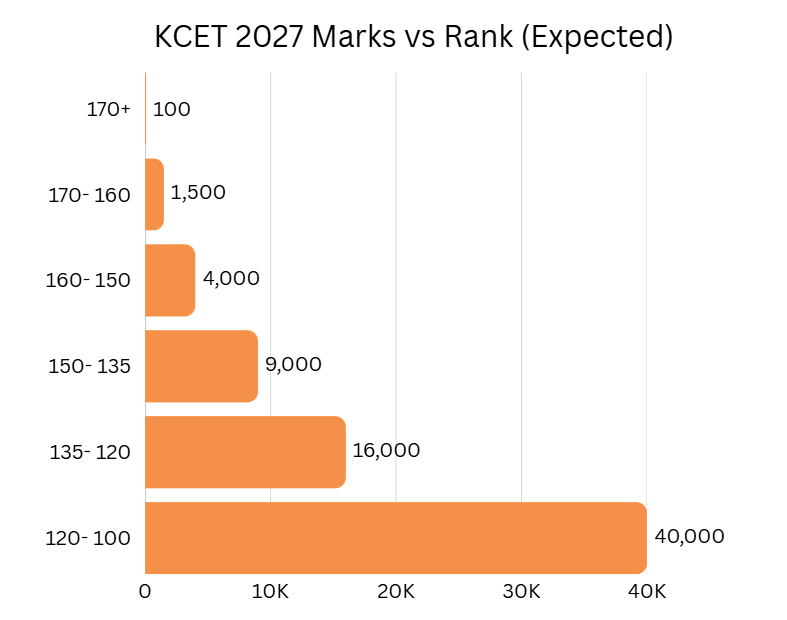
KCET 2027 Cutoff: Mark vs Rank (Expected)
The expected KCET marks vs. rank for 2027 is tabulated below:
| KCET Marks (Out of 180) | Expected KCET Rank | What It Means |
|---|---|---|
| 170+ | Top 100+ | State Topper Zone |
| 170- 160 | 100- 1500 | CSE at RVCE /PES |
| 160- 150 | 1500- 4000 | CSE/CSE Specialisation at Top Tier, all branches at Tier 1 colleges |
| 150- 135 | 4000- 9000 | ECE/ISE at top colleges; CSE at Tier 2 colleges |
| 135- 120 | 9000- 16000 | ECE/ ISE at mid-tier colleges; CSE at Tier-2 city colleges |
| 120- 100 | 16000- 40000 | Core branches at established colleges |
Also Check:
- KCET Marks vs Rank: Rank Card Out, Score to Rank Conversion and Category Wise Cutoff
- KCET College Predictor: Predict List of Colleges based on Karnataka CET Rank
Ques. Which KCET books 2027 are best for preparation?
Ans. The list of KCET books 2027 students must use to prepare well for the upcoming examination is Class 11 & 12 NCERT. The questions are directly asked from the NCERT books. Further, students must also practice previous years' question papers.
KCET 2027 Counselling Process
KEA conducts KCET counselling through a fully online centralised seat allotment system. Candidates securing a valid KCET rank can participate in KEA counselling, including document verification, option entry, and seat allotment from June 2027.
A brief KCET Counselling process is described below:
- Counselling Registration and Document Upload: Candidates with a valid KCET rank register separately for counselling on the KEA portal, pay the counselling fee, and upload all required certificates for online document verification.
- Document Verification: KEA verifies uploaded documents online: 10th marks card, 2nd PUC marks card, study certificate (domicile proof), caste certificate (if applicable), Aadhaar, and photographs. Verified candidates proceed to option entry.
- Option Entry (Choice Filling): You need to enter preferred college-course combinations in priority order. You can add as many choices as you want. Fill your choices carefully, as KEA publishes seat allotment based on it.
- Mock Seat Allotment: KEA releases a mock allotment based on your current option list and rank to know how choice filling works.
- Option Modification: After checking the mock allotment, you can rearrange, add, or delete preferences during the modification window. This is your last chance before the actual allotment.
- Round 1 Seat Allotment: KEA publishes provisional and then final allotment. If you are satisfied, pay the seat acceptance fee and report to the college by the deadline.
- Rounds 2 and 3 / Mop-up: Vacant seats from Round 1 and candidates who were not allotted or want to upgrade can participate with fresh option entry.
Related Links:
Top Colleges Accepting KCET 2027 Score
Here is a categorised list of the best colleges for KCET candidates:
| College | Location | Type | Popular KCET Courses |
|---|---|---|---|
| RVCE (RV College of Engineering) | Bengaluru | Government Aided Private | CSE, CSE-AI, ECE, Mechanical |
| BMSCE (BMS College of Engineering) | Bengaluru | Government Aided Private | CSE, ECE, Mechanical, Civil |
| MSRIT (M.S. Ramaiah Institute of Technology) | Bengaluru | Government Aided Private | CSE, ISE, ECE, Civil |
| UVCE (University Visvesvaraya College of Engineering) | Bengaluru | Government | CSE, ECE, Mechanical, Civil |
| PES University | Bengaluru | Private | CSE, CSE-AI, ECE, Mechanical |
| Bangalore Institute of Technology (BIT) | Bengaluru | Government Aided | CSE, ECE, Mechanical, Civil |
| SJCE (S.J. College of Engineering) | Mysuru | Government Aided | CSE, ECE, Mechanical, Civil |
| NIE (National Institute of Engineering) | Mysuru | Government Aided Private | CSE, ME, ECE, Civil |
| Dayananda Sagar College of Engineering (DSCE) | Bengaluru | Private | CSE, ECE, Mechanical, AI |
| NMAM Institute of Technology | Nitte (Udupi) | Government Aided Private | CSE, ECE, Civil, Mechanical |
Also Check: List of Top Colleges in India Accepting KCET
KCET 2027 FAQs
Ques. What is KCET 2027?
Ans. KCET 2027 is the Karnataka Common Entrance Test conducted by the Karnataka Examinations Authority for admission to eligible undergraduate professional courses in Karnataka.
Ques. When will KCET 2027 registration start?
Ans. Candidates can expect the KCET 2027 notification to be out around January 2027. In 2026, the notification was published on January 16, 2026.KCET 2027 registration is expected to begin in January 2027 and will conclude around mid-February 2027.
Ques. When will KCET 2027 be conducted?
Ans. KCET 2027 is expected to be conducted in April 2027. In 2026, KCET exam was conducted on April 23- 24, 2026.
Ques. Is there negative marking in KCET?
Ans. No, KCET does not generally have negative marking for incorrect answers.
Ques. How many questions are asked in each KCET paper?
Ans. Each KCET subject paper generally contains 60 questions. There is no negative marking. Every question will have 1 mark each.
Ques. What is the KCET 2027 syllabus?
Ans. The KCET syllabus is primarily based on the Karnataka 1st and 2nd PUC curriculum and covers Physics, Chemistry, Mathematics and Biology.
Ques. Can students from outside Karnataka apply for KCET?
Ans. Candidates from outside Karnataka can apply only if they satisfy the applicable eligibility conditions prescribed by KEA.
Ques. When will KCET 2027 admit card be released?
Ans. The KCET 2027 admit card is expected to be released before the examination, likely in April 2027.
Ques. When will KCET 2027 result be declared?
Ans. KCET 2027 result is expected to be released in May or June 2027.
Ques. How can I check KCET 2027 result?
Ans. Candidates can check the result through the official KEA website using their application/login credentials.
Ques. Can I change my choices after KCET mock allotment?
Ans. Yes. Candidates are generally allowed to modify their preferences during the option modification period announced by KEA.




Comments
Found 94 Comments
With a KCET rank of 23,785 under General Merit, you have excellent chances of securing popular branches like Computer Science or Information Science at reputable private institutes including Acharya Institute of Technology, REVA University, and Cambridge Institute of Technology. You can also target core electrical branches at top-tier colleges like Dayananda Sagar.
The KCET seat matrix for biology (PCB) students includes around 1,000 seats for B.Sc Agriculture, 1,500 for B.Sc Nursing, 500 for Veterinary Science (BVSc), and 5,000 for B.Pharma. These seats are distributed across government, aided, and private colleges, allocated according to your KCET rank and reservation category during counselling.
With a KCET General Merit rank of 10,500, you have excellent options. You can secure Computer Science (CSE) or Information Science (ISE) at mid-tier institutions like RNSIT (~10,500), BMSIT (~11,000), and New Horizon College of Engineering. Alternatively, if you target top-tier colleges, you can easily get Electronics and Communication (ECE) or Electrical and Electronics (EEE) at premier institutions like MSRIT, BMSCE, or PES University (South Campus).
For the KCET option entry in Aerospace Engineering, arrange your preferences based on college reputation and previous cutoff trends for the 3AG category. Place the highly competitive MSRIT first, followed by DSU, MSRUAS, MVJ, and REVA. This sequence maximizes your chances of securing the best possible placement.
If you have applied under both Karnataka OBC Category IIIA and Ex-Servicemen quota in KCET, enter your prediction category as 3AGM (Category IIIA General Merit) for normal reservation predictions and 3AKX for Ex-Servicemen under Category IIIA, if that option is available in the predictor. The exact code depends on the counseling portal or predictor being used, so check the category list provided there before submitting.
For KCET Veterinary (B.V.Sc. & A.H.) admission, the cutoff changes every year based on the number of applicants, seat availability, category, and counseling round. General Merit candidates often need a competitive rank within a few thousand to secure a government veterinary seat, while reserved-category cutoffs may be lower. Check the latest KEA counseling cutoff PDFs for exact category-wise ranks.
In the Karnataka Common Entrance Test PCB stream, a score of around 75 marks gives an approximate rank between 35,000 and 55,000, depending on board exam marks, normalization, and competition level that year. The exact rank can vary, so this is only an estimated range based on previous KCET trends.
With 148 marks in KCET and 294 in boards, you can expect a rank in the range of 8,000 to 15,000 in 2026, depending on normalization and competition levels. Variations in difficulty and student performance each year can shift rankings, so this estimate is approximate
With 61 marks in KCET (PCB) and 281/300 in boards, your estimated rank may fall around 25,000–45,000, depending on normalization. For Pharm D, cutoffs in colleges like Rajiv Gandhi University of Health Sciences affiliated institutes usually close between 30,000–70,000 ranks, varying yearly.
For Veterinary courses in Bangalore, through KCET, OBC 2A category candidates need a rank around 8,000 to 20,000 for government seats like Veterinary College Bangalore. Cutoffs vary yearly based on competition, seat availability, and reservation policies.
You can check here for the KCET Mock Test 2026: Download KCET Mock Test PDF, Steps To Access, Features and Benefits
To target around a 7,000 rank in Karnataka Common Entrance Test, scoring roughly 95–110 out of 180 in KCET is needed if you have about 298 marks in boards. Since KCET gives 50% weight to board marks, a balanced performance in both is important for achieving that rank.
To check women’s quota cutoff in KCET, visit the official website of Karnataka Examinations Authority. Go to the KCET section and download previous year cutoff PDFs. Check category-wise and gender-wise ranks under the “Women” column for your course and college. Compare your rank with the listed women’s quota closing rank.
Yes, you are eligible to appear for KCET again, even if you are in college. Since you completed 12th in 2022 with the required subjects, you can reattempt KCET to improve your rank. Ensure you meet the Karnataka domicile criteria and follow KEA application rules for the upcoming exam.
You can check here for the KCET Mock Test 2026: Download KCET Mock Test PDF, Steps To Access, Features, and Benefits
You can check here for the KCET Mock Test 2026: Download KCET Mock Test PDF, Steps To Access, Features and Benefits. You can download official KCET sample/model question papers directly from the Karnataka Examinations Authority (KEA) website under the question-paper section—official PDFs for past years (e.g., 2021–2025) are listed there for subjects like Physics, Chemistry, Maths, Biology and include answer keys.
To download official KCET (Karnataka Common Entrance Test) question papers with answer keys up to the year 2010, visit the Karnataka Examination Authority's (KEA) official portal. Navigate to the "Question Papers" section, where you will find downloadable PDFs for each year, including subjects like Physics, Chemistry, Mathematics, and Biology.
For KCET (Karnataka Common Entrance Test), the importance of subjects depends on the chosen stream. Physics, Chemistry, and Mathematics are crucial for engineering aspirants, with Physics testing concepts and numerical skills, Chemistry covering theory and reactions, and Mathematics emphasizing problem-solving. Biology and Chemistry are for medical aspirants, focusing on human biology, plant science, and chemical processes. English and logical reasoning play minor roles, while strong conceptual understanding in core subjects is key to scoring well