




As the KCET 2026 exam is scheduled for April 23 (Physics and Chemistry) & April 24 (Mathematics and Biology), students need to limit their resources and focus on strategising their preparation as per previous year trends and patterns.
Students should start their preparation with basic NCERTs to make a strong foundation, as the question papers will be based on the 1st and 2nd PUC syllabus prescribed by the Department of Pre-University Education of Karnataka State.
As ~75 days are left for the KCET exam student should finalise their study material so that they can revise it multiple times before the exam.
In this article, we have provided details about some of the most important books for every subject, such as Trueman’s Biology, H.C.Verma for Physics, etc.
Related Articles:
- KCET 2026 Preparation Tips, 3-month plan, and Strategy
- KCET 2026 Previous Year Papers and Solutions PDF
- KCET 2026 Free Mock Tests for Practice
Key Summary
- 80-90% of the questions come directly or indirectly from the NCERTs of classes 11 &12th.
- MTG Objective series dominates the MCQ practice books as it is the bestseller on Amazon and is recommended by many toppers.
- Modern’s ABC of Chemistry remains the most trusted theory book among Karnataka students as it is more aligned with PUC.
- Students need not overwhelm themselves by doing JEE Main-level books, as these are not required.
KCET 2026: Best Books
| Subject | Recommended Books |
|---|---|
| Physics |
|
| Chemistry |
|
| Mathematics |
|
| Biology |
|
How should I choose the Right Books
KCET 2026 is strictly based on the 1st & 2nd PUC syllabus as prescribed by the KEA. The questions asked in the exam are generally direct, conceptual, formula-based, and moderate.
The exam is very different from the national level exams, such as JEE Main and NEET UG, as in these exams deeper understanding of concepts is required.
Candidates should ensure the following things before choosing the right books to study:
- Understanding the exam pattern and questions trend, as 80-90% questions come directly from PUC/NCERT textbooks.
- NCERT books should be your foundation, and you should be thorough with them.
- Standard books for concept building and better explanations.
- If the book covers all the concepts required for the exam. And should avoid books with a deeper understanding if not required or relevant for your exam.
- The book should have chapter-wise questions to keep track of your understanding of the concepts.
- You should choose a book of mock tests and MCQ-based questions for practice.
- Karnataka-specific books to solve questions that are state syllabus specific.
- A previous year's questions booklet, as the questions may repeat in the exam, and PYQs help students understand the examiner’s mindset and the way questions are framed.
- The students are advised to buy the latest edition of the book to ensure the changes in the syllabus are present (If any).
KCET 2026: Chemistry Best Books
| Book Name | Author / Publisher | Why the majority of Students Use It | Best For |
|---|---|---|---|
| NCERT Chemistry Textbooks (Class 11 & 12) | NCERT | Foundation books as the majority of questions are sourced from them. | Complete syllabus, theory, basics, reactions |
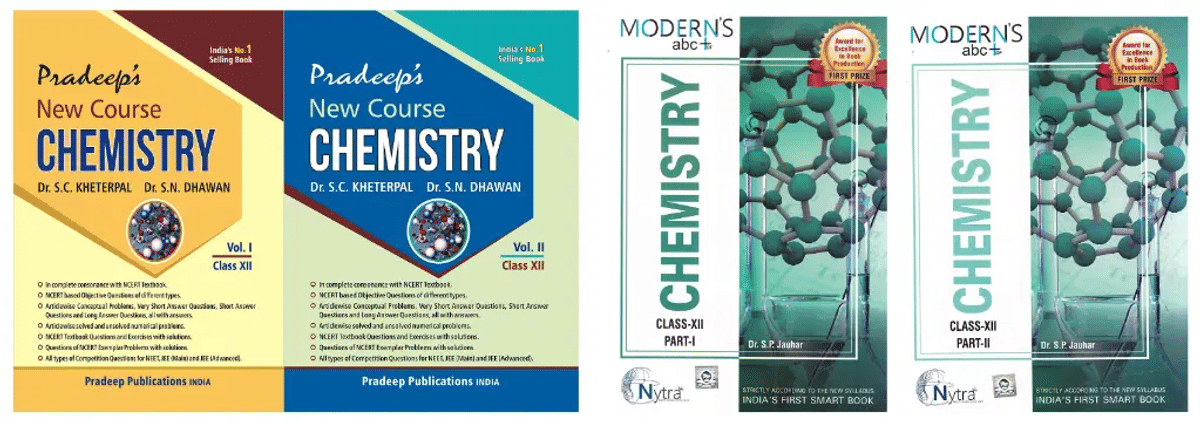
| Modern’s ABC of Chemistry (Part 1 & 2) | S.P. Jauhar / Modern Publishers | Excellent theory coverage, very popular in Karnataka PUC style, good for Physical & Inorganic | Theory building, detailed explanations |
| Objective Karnataka CET Chemistry | MTG Editorial Board (2026 edition) | Huge number of MCQs (18,000+), chapter-wise theory & 10 years PYQs, perfect for practice & speed | MCQ practice, revision, last 2 months |
| Pradeep’s New Course Chemistry (Class 11 & 12) | Pradeep Publications | Very detailed explanations, good numericals in Physical Chemistry, and an alternative to Modern ABC | Theory & numerical practice |
| Chemistry for 1st & 2nd Year PUC | Prof. Somashekara Prasad | Strictly PUC-aligned, simple language, good for quick revision | Supplementary theory, quick recap |
KCET 2026: Physics Best Books
| Book Name | Author / Publisher | Why the majority of Students Use It | Best For |
|---|---|---|---|
| NCERT Physics Textbooks (Class 11 & 12) | NCERT | Foundation books as the majority of questions are sourced from them. | Complete syllabus, theory, basics, derivations, examples |
| Concepts of Physics (Vol 1 & 2) | H.C. Verma | Excellent conceptual clarity, best solved examples & graded problems; topper favorite for understanding tough topics | Concept building, numericals, Mechanics, Optics, Modern Physics |
| Objective Karnataka CET Physics | MTG Editorial Board (2026 edition) | Huge MCQs (6500+), chapter-wise theory summary & 10 years PYQs (2016–2025), perfect for speed & KCET-specific practice | MCQ practice, revision, last 2–3 months, PYQ solving |
| Physics for Karnataka CET & COMEDK | K.L. Gomber & K.L. Gogia | Strictly PUC/KCET-aligned, good theory & practice problems; very popular in Karnataka coaching | Theory + KCET-level problems |
| Pradeep’s Fundamental Physics (Class 11 & 12) | Pradeep Publications | Detailed explanations, good numericals; solid alternative to H.C. Verma for students needing more step-by-step help | Theory + numerical practice |
KCET 2026: Mathematics Best Books
| Book Name | Author / Publisher | Why the majority of Students Use It | Best For |
|---|---|---|---|
| NCERT Mathematics Textbooks (Class 11 & 12) | NCERT | Foundation books as the majority of questions are sourced from them. | Complete syllabus, theory, formulas, basics |
| Objective Karnataka CET Mathematics | MTG Editorial Board (2026 edition) | Huge MCQs (6000+), chapter-wise theory summary & 10 years PYQs, perfect for speed & KCET-specific practice | MCQ practice, revision, last 2–3 months, PYQ solving |
| Mathematics for 1st & 2nd Year PUC | Dr. P.G. Umarani | Strictly PUC/KCET-aligned, excellent theory & graded problems; very popular in Karnataka | Theory building, PUC-style problems |
| R.D. Sharma Objective Mathematics (Vol 1 & 2) | R.D. Sharma / Dhanpat Rai | Graded problems from easy to tough, great for Calculus, Algebra & Coordinate Geometry | Concept clarity & graded numerical practice |
| Mathematics by Dinesh | Dinesh Publications | Clear explanations, variety of solved problems; good alternative for theory & practice | Theory & problem-solving |
KCET 2026: Biology Best Books
| Book Name | Author / Publisher | Why the majority of Students Use It | Best For |
|---|---|---|---|
| NCERT Biology Textbooks (Class 11 & 12) | NCERT | Foundation books as the majority of questions are sourced from them. | Complete syllabus, theory, diagrams, basics, and memorization |
| Objective Karnataka CET Biology | MTG Editorial Board (2026 edition) | Huge MCQs (7500+), chapter-wise theory summary & 10 years PYQs perfect for speed & KCET-specific practice | MCQ practice, revision, last 2–3 months, PYQ solving |
| Trueman's Elementary Biology (Vol 1 & 2) | K.N. Bhatia & M.P. Tyagi / Trueman Book Company | Very detailed theory, excellent for Botany & Zoology; popular alternative for a deeper understanding | Theory building, diagrams, Human & Plant Physiology |
| Pradeep’s A Textbook of Biology (Class 11 & 12) | Pradeep Publications | Comprehensive explanations, good diagrams & flowcharts; solid backup for NCERT | Theory + detailed topic-wise study |
| Handbook of Biology | Arihant Publications | Quick revision summaries, key points, diagrams & formulas; ideal for last-minute recap | Quick revision, formula/mnemonic retention, exam days |
KCET 2026: Practice & PYQ Best Books
| Book Name | Author / Publisher | Best for |
|---|---|---|
| MTG Objective Karnataka CET (Set of 3/4 Books) | MTG Editorial Board | 18,000+ MCQs per subject, chapter-wise theory summaries & 10 years PYQs with solutions; perfect for daily practice & mock tests |
| PW 20 Years Karnataka CET Chapterwise Solved Papers (2006–2025) | PW (Physics Wallah) | Chapter-wise PYQs with detailed solutions & practice questions; great for trend analysis & weak topic targeting |
| Vedantu 20 Years Karnataka CET Solved Papers (2006–2025) | Vedantu | 20 years PYQs with solutions & topic-wise segregation; includes mock tests for practice |
| Arihant 16 Years Solved Papers Karnataka CET Engineering Entrance (2010–2025) | Arihant Publications | 16 years PYQs & additional practice MCQs; good for speed & error analysis |
| Disha 21 Chapter-wise & Topic-wise Karnataka CET Previous Year Solved Papers (2025–2005) & Synopsis | Disha Publications | 21 years PYQs chapter/topic-wise & synopsis notes for quick revision with practice sets |
KCET 2026: Preparation Tips
KCET 2026 requires a disciplined preparation for at least 6 months. However, as only ~ 75 days are left for the exam, you can follow the 3-month plan given below to give your best shot at the KCET 2026 exam:
Timeline Division:
- Month 1: Build strong fundamentals using NCERT textbooks, clear the basic concepts, and make short notes for quick revision.
- Month 2: Focus on advanced problem-solving, mastering important topics, and solving daily sectional MCQs.
- Month 3: Intensive revision, full-length mocks, error analysis, and PYQs.
Daily Routine: Study consistently for 8-9 hours, giving around 2 hours per subject, and the rest of the hours should be used for mock tests, PYQs, and quick revision of what you have studied during the day.
Subject-Specific Tips
Physics
- Practice numerical as ~55% questions are numerical-based.
- Memorise formulas, as direct formula-based questions are common in Gravitation, Thermodynamics, and Current Electricity.
- Graph & diagram-based questions are frequent in Ray Optics, Kinematics, and Waves.
- Solve sectional PYQs for building strong concepts.
Chemistry
- Organic chemistry dominates in Chemistry. Students should focus on reactions, mechanisms, and Conversions.
- In Physical Chemistry, 25-30% are numerical questions. Students should practice calculations for Electrochemistry, Kinetics, etc.
- Inorganic Chemistry has more memory-based questions, which are around 20-25%.
Mathematics
- Focus on the highest weightage areas, such as Calculus (Integration, application, and Derivatives). It accounts for 15-18 questions almost every year.
- Some of the chapters, like Integrals, Matrices& Determinants, Vectors & 3D Geometry, are scoring as they are direct formula-based.
- Students should practice numericals to build accuracy and speed since 60-70% of questions are calculation-based.
Biology
- Must complete NCERT thoroughly, as most of the questions are NCERT-based.
- Memorisation is more important than logic in biology, as it is a fact-heavy subject with a lot of names to remember.
- Must do high-weightage chapters like Genetics and evolution, Human Physiology, etc.
- Diagrams are extremely important in biology, as diagram-based questions are consistent every year.
KCET 2026: Topper Recommendations
The toppers of the KCET exam have always recommended future aspirants to focus on NCERTs as these are the most important and reliable sources for the KCET exam 2026.
They have highlighted that NCERTs, along with MCQs and PYQs practice is sufficient to achieve a decent score in KCET 2026.
| Subject | Toppers' Choice |
|---|---|
| Physics | NCERT + H.C. Verma (Concepts of Physics Vol 1 & 2) |
| Chemistry | NCERT + Modern’s ABC of Chemistry (S.P. Jauhar) |
| Mathematics | NCERT + MTG Objective KCET Mathematics |
| Biology | NCERT + MTG Objective KCET Biology |
| PYQs & Practice | Vedantu 20 Years Solved Papers or MTG 10 Years |
KCET 2026: FAQs
Ques. Is NCERT enough for KCET 2026? Do I really need reference books?
Ans. Yes, NCERTs are enough as these are prescribed by KEA itself. However, if required, students can use reference books to clear some concepts or to gain a deeper understanding of some topics.
Ques. How many books should I buy per subject? Is buying 4-5 books per subject good?
Ans. Buying too many books or using multiple resources is the biggest mistake candidates make during their preparation. Students should always limit their resources and revise the already studied books or study material multiple times, and should take a mock test to test their preparation.
Ques. Which is the best objective book for all subjects in KCET 2026?
Ans. MTG Objective Karnataka CET series (2026 Edition) is the most popular among students. It has a huge MCQ bank with 18k+ questions per subject with 10-year PYQs and their solutions.
Ques. Are JEE Main books useful for KCET 2026?
Ans. KCET is a state-level exam which requires students to focus on books aligned with the PUC syllabus, whereas JEE Main books are too advanced as it provides deeper understanding of topics. Thus, JEE Mains books can confuse students and can waste their crucial time.
Ques. When should I start using objective & PYQ books?
Ans. Once your basic reading of NCERTs is done, you can solve sectional MCQs, and after 2-3 revisions, you can solve full-length mock tests. You can always refer to your PYQs, as it prevents you from reading irrelevant material and can help you limit your resources.



Comments