



Fertilization in plant is a reproduction phenomena. Plants reproduce themselves through various fertilization methods such as self fertilization, double fertilization, sporulation, vegetative propagation (asexual reproduction). Mechanism via which plants get fertilied are pollination, germination, ovulation and fertilization that leads to development of flower, seeds and fruits.
- Fertilization is directly refers to sexual reproduction in plants.
- It occurs by fusion of male gamete (Pollen) with female gamete (Ovum).
- This fusion takes place after pollination either self polination or cross pollination in plants.
- Pollen grains are transfered to female ovum via biotic and abiotic pollinators.
- Pollinators can be insects like butterfly and bees, or it can be air and water.
| Table of Content |
Keyterms: Plants, Humans, Food, Oxygen, Pollination, Germination, Zygote, Angiosperms, Embryo, Gametes, Seed, Ovum, Pollen
Also Read: Spore Formation, Pollination by Snails
What is Fertilization in Plants?
[Click Here for Sample Questions]
Fertilization in plants is a process during which they undergo pollination and germination. During this physicochemical process, the male gametes (known as pollen) gets fused with the female gametes (known as ovum) and forms diploid zygote.The whole process happens in a zygote which later germinates into a seed.
- During the process, male gametes are transferred into female reproductive organs through pollinators (butterflies, birds, honey bees, bats, and flower beetles).
- This leads to embryo formation.
- Flowers are the reproductive organs of angiosperms and reproduce in a completely different method.

The process of fertilization in plants is often categorized into four major stages.
- Pollination: during this, the male gametes covered during pollen are over-excited by water, wind, or through other agents like animals and insects. Then, the pollen is formed to land on the stigma of the plant. This process is named pollination.
- Germination: this is often a process during which the pollen enters the ovum. The tube is a passage for the pollen grain to succeed in the egg.
- Ovule Penetration: The plant part which contains the sperm penetrates the embryo sag or ovule.
- Fertilization: After successfully penetrating the ovule, the sperms travel through the tube to fertilize the egg. Most flower-bearing plants undergo double fertilization during which the polar nuclei and egg within the ovule are fertilized.
Post fertilization, the zygote cells divide and become an embryo which may even be termed as a developing plant. The embryo enveloped during a seed capsule lay dormant till favorable environmental conditions prevail to assist it to become a plant.
Also Read: Reproductive Systems in Humans
Fertilization in Seed Plants
[Click Here for Previous Year Questions]
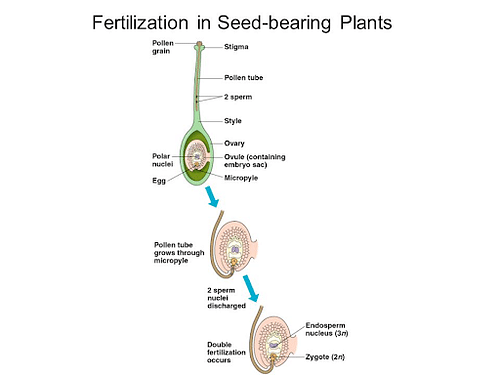
Pollen grains reaches to the female gamete at ovule, and formation of pollentube The tube penetrates to the egg cell within the archegonia.
Also Read: Pollen Grains
Fertilization in Flower Bearing Plants
[Click Here for Sample Questions]
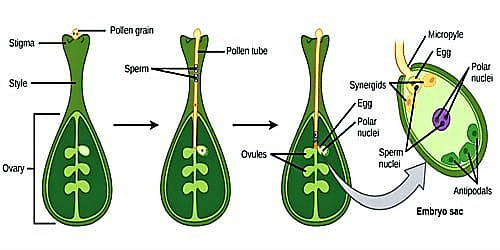
The pollentube enters into stigma and grows through stylus. This furthe enters in ovary and ovisac through micropyle.
- One male gametes are released into embryo sac.
- Gametes fusion occurs and form a zygote (syngamy).
- Other male gamete fuses with 2 polar nuclei and form endosperm.
- This fusion is called triple fusion.
- Syngamy and triple fusion together lead to double fertilization in plant.

Read More:
Self-Fertilization
[Click Here for Previous Year Questions]
Self-fertilization is a fusion of male and female gametes produced from the same plant. It occurs through self-pollination process.
- Almost 10-15% of total bloomin plants undergo self-fertilization.
- Few plants pollinates themselves without any pollinators.
- Examples of such plant is legume and soyabean.

SELF POLLINATION
Types of Fertilization
[Click Here for Sample Questions]
There are four types of fertilization, categorized mainly on the way by which pollen tubes enter the ovule or embryo sac.
- Porogamy
The most common sort of fertilization happens in flowering plants or angiosperms. During this form, a plant part reaches the ovule through a micropyle. An example is a lily.

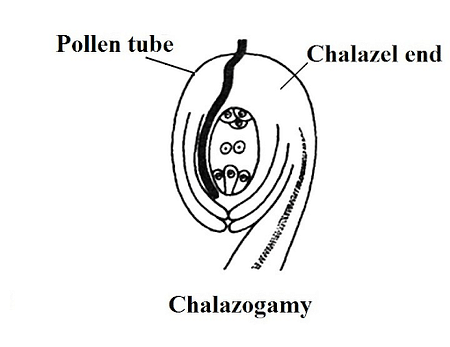
- Chalazogamy
This form of fertilization happens in a species casuarina. Here, the plant part permeates into the ovule through chalaza instead of entering through the micropyle. This is often not quite common. Examples are Betula, casuarina.
- Monogamy
This form of fertilization happens in cucurbit plants including bitter gourd, ridge gourd, various other gourd plants, and pumpkin. During this form, a plant part passes through integuments or its middle part to penetrate the ovule.
- Double Fertilization
Double Fertilization happens when one female gamete undergoes fusion with two male gametes. Here, one among the sperm cells undergoes fusion with the zygote while the opposite fuse with the 2 nuclei to supply endosperm. The whole angiosperm plants undergo the method of double fertilization. What makes Double Fertilization significant is:
- In double fertilization, two products are formed
- Increases the feasibility of the seeds of the angiosperm
- The plant will have a greater chance to survive and polyembryony (the chance to make quite one embryo from one seed or one fertile ovum)
- Double fertilization leads to an endosperm that nourishes the growing embryo
- The two male gametes are produced by pollen grains into effective use.
Also Read: Parts of a Seed
Things to Remember
- During a plant fertilization process, pollen reaches to stigma and enters into stylus to fuse with ovum.
- Fertilization takes place only after pollination.
- Pollination can be self or cross.
- Self pollination will initiate self fertilization and cross pollination leads in 4 different types.
- Monogamy, double fertilization, chalazogamy and porogamy.
- The types of fertilization are formed on the basis of ways by which pollen reaches to ovum.
- If ovum fuses with one male gamete and the other male gamete fuses with 2 polar nuclie, double fertilization will occur.
Previous Years Questions
- Vegetative propagation by leaves is seen in… [JKCET 2010]
- Vegetative propagation in water hyacinth takes place by...[AMUEEE 2013]
- Type of asexual reproduction found in Hydra is..[KEAM]
- Which of the following is having longitudinal binary fission ?….[KEAM]
- In grafting, the stock and scion should be joined….
- A clone is ......… [KCET 2011]
- Animals which possess cleidoic eggs exhibit….[KCET 2011]
- Which among these is not a post fertilization event ?...[KCET 2016]
- Mode of DNA replication in E. coli is….[UP CPMT 2005]
- Match each function below with the associated part or parts of the human male reproductive system shown in the figure.
- Banana is vegetatively propagated by… [AMUEEE 2012]
- A slender, prostrate subaerial branch of the stem which creeps along….
- Meiosis takes place in...[NEET 2013]
- The sexual reproduction is absent in….[NEET 1995]
- For union between stock and scion in grafting which one is the first to occur….[NEET 1990]
Sample Questions
Ques: What's Fertilization? (3 marks)
Ans. In plants, fertilization occurs after pollination and germination.
Fertilization is often defined as the fusion of the male gametes (pollen) with the feminine gametes (ovum) to make a diploid zygote. it's a physicochemical process that occurs after the pollination of the carpel. the entire series of this process takes place within the zygote to become a seed.
Ques: Define Fertilization Process. (2 marks)
Ans. In flowers, the pollen grain germinates after the pollination of the carpel. The pollen or male gametes fuses with ovum and dvelop an embryo. If triple fusion occurs, the plant will have double fertilization.
- Pollen transfered to stigma will make it way to ovum by pollentube.
- In embryo sac, fusion will take place.
- The exta male gamete will fuse with two polar nuclei that leads to double fertilization.
Ques: What are the kinds of Fertilization? (4 marks)
Ans. The fertilization process is often grouped into three types and is classified mainly supported by the entry of the plant part into the ovule.
- Porogamy: It is the common sort of fertilization in angiosperms or flowering plants. During this sort of fertilization, the plant part enters the ovule through the micropyle.
- Chalazogamy: A less common type happens in a plant like casuarina. Here, the gamete permeates into the ovule through chalaza instead of entering through the micropyle.
- Monogamy: This form of fertilization happens in cucurbit plants. A plant part passes through integuments or its middle part to penetrate the ovule.
- Double Fertilization: Double Fertilization happens when one female gamete undergoes fusion with two male gametes. Syngamy and triple fusio, together leads to double fertilization.
Ques: Define Double Fertilization. (3 marks)
Ans. Double fertilization may be a process of fertilization characterized by the fusion of a female gametophyte with two male gametes. During this mechanism, one sperm fuses with the egg-producing zygote, and therefore the other fuses with the 2 polar nuclei to form the endosperm. All angiosperm plants undergo a double fertilization process.
Ques: What's Self-Fertilization? (1 marks)
Ans. Self fertlization is reproduction of plants that happens after self pollination. Here, plants pollinates themselves without any biotic pollinator and the pollen fertilizes the ovum of the same plant.
Ques: Define term Monogamy. (2 marks)
Ans. This form of fertilization happens in cucurbit plants. During this form, a plant part passes through integuments or its middle part to penetrate the ovule. Examples of plant having monogamy type of fertilization are bitter gourd, ridge gourd, various other gourd plants, and pumpkin.
Ques: Write about the process of fertilization in flower-bearing plants. (3 marks)
Ans: In flower-bearing plants or angiosperms, a further fertilization process occurs within the central cell. Two sperm cells get released from either one among the pollen grain. The primary cell fuses with the zygote for egg fertilization and therefore the second fuses with the dual polar nuclei to supply endosperm.
Ques: Banana is a true fruit but is also a parthenocarpic fruit. Explain why. (Foreign 2010)
Ans: The fruit of banana is formed from the ovary, therefore it is a true fruit. It is a parthenocarpic fruit because the ovary develops into fruit without fertilisation and is therefore, seedless.
Ques: Name the mechanism for which the formation of seed takes place without fertilisation in angiosperms. Give an example of a species of flowering plants showing such seed formation. (Delhi 2010)
Ans: Apomixis is the mechanism that is responsible for the formation of seeds without fertilisation in angiosperms, e.g. grasses.
Ques: List the post-fertilisation events in angiosperms. (Delhi 2014)
Ans: The post-fertilisation events in angiosperms comprises:
(i) Endosperm and embryo development.
(ii) Maturation of ovule into seed.
(iii) Maturation of ovary into fruit.
For Latest Updates on Upcoming Board Exams, Click Here:https://t.me/class_10_12_board_updates
Do Check Out:



Comments