



Content Curator
A zygote is the beginning of all life. A zygote is a two-celled organism created when a sperm and an egg fuse. The male reproductive cell is sperm, and the female reproductive cell is the egg. Fertilization is the process of combining these cells, which leads to the development of the zygote. The zygote then splits, proliferates, and differentiates into various body tissues and organs. The sperm and the egg have all of the information about these cell division and differentiation pathways. As a result, it's critical to investigate how these cells are produced and the distinctions in the processes that influence them.
| Table of Content |
Keyterms: Zygote, Organism, Male reproductive cell, Sperm, Female reproductive cell, Cells, Fertilization, Tissue, Organs, Spermatogenesis, Haploid sperm, Diploid stem cell, Spermatogonium, Testis
Spermatogenesis
[Click Here for Sample Questions]
Spermatogenesis
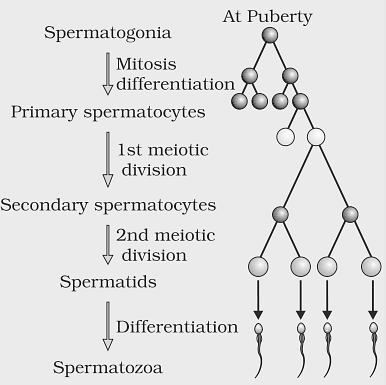
Spermatogenesis is the process of haploid sperm production from a diploid stem cell called spermatogonium. The procedure takes place within the testis' seminiferous tubules. It takes roughly 70 days to complete the process.
Also Read: Difference Between Gene and Allele
Oogenesis
[Click Here for Sample Questions]
Oogenesis
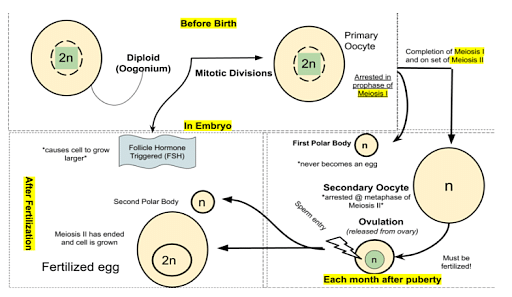
The formation of the ovum is known as oogenesis. The process takes place in the female's ovaries. A single ovum is produced by a single oogonium.
Difference Between Spermatogenesis and Oogenesis
[Click Here for Sample Questions]
Spermatogenesis and Oogenesis
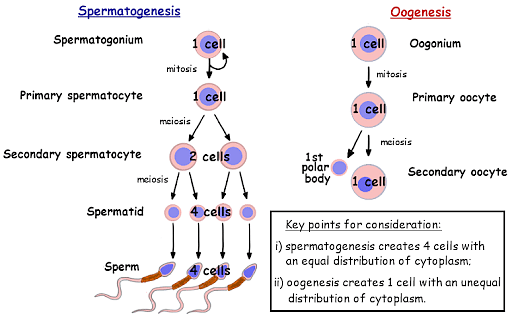
Male and female gametes are formed through the processes of spermatogenesis and oogenesis. Oogenesis contributes to the creation of ova, whereas spermatogenesis aids in the formation of sperm. When sperm and ova fertilise each other, a zygote is formed, which then grows into an embryo.
| Parameter | Spermatogenesis | Oogenesis |
|---|---|---|
| Definition | Spermatogenesis is the process of producing sperm from spermatogonia. | Oogenesis is the process of producing eggs from oogonia. |
| Location | It's found in the testes. | It takes place inside the ovary. |
| Rate of production | Every day, millions of sperm are formed. | Once a month, one ovum is released. |
| Growth Phase | The growth stage is really too short and simple. | The growth period lasts a long time. |
| Duration | From adolescence until death, spermatogenesis occurs every day. | From puberty through menopause, oogenesis occurs once a month. |
| Stages | The testis is the origin of all phases of spermatogenesis. | The oviduct is the final stage of oogenesis. |
| Release | The testis releases its sperm. | The ovary releases the ovums. |
| Cell division type | Equal. As a result, four haploid spermatids are produced. | Unequal. One haploid ovum and two polar bodies are formed as a result of this process. |
| Sertoli cells' function | During the activity, Sertoli cells play a supporting role. | Has no effect on oogenesis. |
| Quiet/resting stage | There is no stage of rest. | From the embryonic stage till puberty, the body is in a state of rest. |
| The resultant cells' motility | Sperm can move about. | Ovums do not move around. |
| Nuclear condensation | Nuclear condensation happens in the sperm. | In the ovum, there is no nuclear condensation. |
| Food reservation | In the sperms, there is very little food reservation. | The ovum stores a lot of food and metabolites. |
| Size of the resulting cells | Spermatids are a subset of spermatocytes that are smaller than spermatocytes. | The ovum is significantly larger than the oocytes. |
The two most important processes in life are spermatogenesis and oogenesis. It's easier to spot the difference between spermatogenesis and oogenesis because of their location and final outcome. Sperms are tiny and have a characteristic tail that allows them to move around. An ovum, on the other hand, is bigger and non-motile and lacks a tail. These cells have an even number of chromosomes, therefore when they combine to produce a zygote, the ensuing cell is diploid (2n).
Furthermore, these cells are the carriers of genetic information from parents to offspring, as well as the information of zygote and embryo differentiation into various tissue processes. In any creature, these cells are the foundation of genetic relationships. Any genetic alteration in these cells could have an impact on the development process, which could be discovered as early as the embryonic stage or appear later in life.
Also Read: Difference Between Euchromatin and Heterochromatin
How Are Sperms Formed?
[Click Here for Sample Questions]
The male gametes produced in the testis are referred to as sperms. Spermatogenesis is the process of sperm generation in the male testis.
Spermatogonium is the mother cell that produces sperm. These cells can be found in the male testis' tiny tubules. A diploid cell with 2n chromosomes is the spermatogonium. Each spermatogonium produces four haploid (n) spermatozoa.
Spermatogonium develops from spermatogenic germ cells. These germ cells are stem cells with the ability to regenerate themselves. The production of intermediate spermatogonia originates from the differentiation of spermatogenic germ cells, which then undergoes mitosis to yield type B spermatogonia.
Mitosis is then performed on these type B spermatogonia to yield primary spermatocytes. To produce secondary spermatocytes, primary spermatocytes go through meiosis I. Meiosis II occurs in the secondary spermatocytes, resulting in the production of four haploid spermatids. To create the sperm tail, these spermatids go through spermiogenesis.
When males reach puberty, spermatogenesis begins and continues for the rest of their lives. Every day, millions of sperm are created in this process. In humans, spermatic development takes roughly 70 days.
How does the process of Female Egg Production take place?
[Click Here for Sample Questions]
Oogenesis is the process by which eggs are created in a female's ovary. It is made from the oogonia found in the ovary. Meiosis produces the egg or ovum from the diploid primary oocyte. During meiosis I and II, two polar bodies are generated. Unlike spermatogenesis, which takes place every day, oogenesis takes place once a month, beginning at puberty and ending at menopause.
The oogonia, which is a stem cell, is the earliest female reproductive cell, similar to spermatogonia. As a result, oogonia are capable of self-renewal and differentiation. From the second to the seventh month of embryonic development, thousands of oogonia divide into about seven million germ cells.
The primary oocyte is produced when the oogonia divides through mitosis. These primary oocytes proceed through meiotic division until they reach the diplotene stage in the embryonic stage, after which they stop dividing and become quiescent. Until the female reaches puberty, the cell division process is halted. There have also been several primary oocytes discovered.to be kept until the age of 50. The majority of primary oocytes are destroyed, and just about 400 of them split into gametes.
The cell division process is resumed during puberty, when primary oocytes divide into secondary oocytes. A primary oocyte, on the other hand, divides unequally, producing one secondary oocyte and one polar body. The secondary oocytes contain the cytoplasm, whereas the polar body's nucleus is destroyed. These additional oocytes exit the ovary after ovulation.
Also Read:
Things To Remember
- A zygote is a two-celled organism created when a sperm and an egg fuse, through the process of fertilization.
- Spermatogenesis is the process of haploid sperm production from a diploid stem cell called spermatogonium. The procedure takes place within the testis' seminiferous tubules.
- Oogenesis is the process by which eggs are created in a female's ovary. It is made from the oogonia found in the ovary.
- Male and female gametes are formed through the processes of spermatogenesis and oogenesis. Oogenesis contributes to the creation of ova, whereas spermatogenesis aids in the formation of sperm.
- As there is no meiosis division in the Oogonium, the number of chromosomes will be the same as in humans. However, when the primary oocyte goes through meiosis cell divisions 1 and 2, the chromosomal number is cut in half, resulting in 46 chromosomes in the primary oocyte and 23 in the secondary oocyte, as well as one polar body and ovum.
- During oogenesis, a female fetus's ovary produces 7 million primary oocytes, which decrease to 2-4 million before birth. Only 40,000 initial oocytes are left after puberty in females, and this number drops to 480 after division in a reproductive phase of 11-50 years.
- Sperms are tiny and have a characteristic tail that allows them to move around. An ovum, on the other hand, is bigger and non-motile and lacks a tail.
Sample Questions
Question: Describe the process of spermatogenesis in brief. (3 marks)
Answer: The process of producing sperm from immature male germ cells is known as spermatogenesis. It begins at adolescence and normally lasts until death, however there is a minor decline in the number of sperm as one gets older.
During Spermatogenesis, the spermatogonia (2N) on the inner side of the seminiferous tubules grow and increase in number through mitotic divisions. They halt mitosis, expand, and mature into primary spermatocytes (2N). Meiosis occurs in each primary spermatocyte, resulting in the formation of two equal haploid secondary spermatocytes (N). After that, each secondary spermatocyte goes through a second meiotic division, resulting in four equal haploid cells known as spermatids (N). Thus, spermiogenesis provides sustenance to spermatids in order for them to produce sperm.
Question: What is Gametogenesis? (3 marks)
Answer: The production of sperm and ovum is referred to as gametogenesis. Male and female gametes are the terms for sperm and ovum. The testis of the male and the ovary of the female are where sperm and ovum are produced.
Gametogenesis is a biological process that involves the division and development of diploid or haploid precursor cells into mature haploid gametes. Alternation of generations is the existence of a multicellular, haploid phase in the life cycle between meiosis and gametogenesis.
Question: Does sperm or egg cell (ovum) determine the child's gender? (3 marks)
Answer: The male gametes are sperms, while the female gametes are ovum. They are also known as sex cells and are haploid cells. These cells are in charge of a baby's development.
Whether the baby is a girl or a boy, the father is responsible for determining the sex of the child. Men's sperm have two types of chromosomes, the X chromosome and the Y chromosome. Female egg cells, on the other hand, have only one type of chromosome, the X chromosome.
When the father's X chromosome unites with the mother's X chromosome to form a zygote, the zygote grows into a baby girl (XX). If a male's Y chromosome unites with a female's X chromosome to form a zygote, the zygote develops into a baby boy (XY). As a result of the preceding debate, it is apparent that sperm cells determine the baby's gender.
Question: What is the role of hormones in Spermatogenesis? (3 marks)
Answer:
- Spermatogenesis begins with a significant rise in the hypothalamus hormone Gonadotropin Releasing Hormone during puberty (GnRH).
- An increase in GnRH increases the release of two gonadotropins, LH (Luteinising Hormone) and FSH (Follicle Stimulating Hormone) by the anterior pituitary gland (Follicle Stimulating Hormone).
- LH stimulates androgen production and secretion by acting on Leydig cells. Androgens, in turn, stimulate the spermatogenesis process.
- FSH increases the release of certain substances that aid in the spermatogenesis process by acting on Sertoli cells.
Question: Define menstrual cycle in females? (3 marks)
Answer: The menstrual cycle is a rhythmic shift in female primates ((monkey, apes and humans) reproductive organs.
- The menstrual cycle is made up of cyclic events that occur from one menstruation to the next.
- Menarche is the name given to the first period of menstruation, which occurs during puberty.
- In human females, the average menstrual interval is 28-29 days.
Question: What is the function of Sertoli cells in sperm development? (2 marks)
Answer: Sertoli cells nourish sperm that are still growing. Sperm heads become attached in Sertoli cells after spermatogenesis to draw nutrients for subsequent growth.
Sertoli cells help germ cells become spermatozoa by facilitating direct interaction and managing the environment within the seminiferous tubules. The Sertoli cells are involved in the regulation of spermatogenesis by FSH and testosterone.
Question: Explain the development of an ovum from an oogonium in a human female? (3 marks)
Answer:
- In a human female, ovum develops from an oogonium.
- The primary oocyte is Oogonium, which enters meiosis-l. In prophase-l, division is still halted.
- The primary follicle is formed when the primary oocyte is surrounded by a layer of granulosa cells.
- A thecal layer and additional granulosa cells surround the primary follicle. Secondary follicle is the name for this stage.
- The secondary follicle produces an antrum cavity around the primary oocyte.
- An outer theca externa and an inner theca interna are formed in the thecal layer. The tertiary follicle is the name for this stage.
- The meiosis of the primary oocyte is completed, resulting in the formation of a big cell, the secondary oocyte, and a small cell, the first polar body.
- A mature follicle termed Graafian follicle develops from a tertiary follicle (mature ovum).
For Latest Updates on Upcoming Board Exams, Click Here: https://t.me/class_10_12_board_updates
Check-Out:



Comments