



Education Content Expert
Endemic Species are those plants and animals that exist only in one particular geographical region or area. Endemic species can be found in a small island, a mountain range, an estuary, a lake, a country, or any defined geographical region.
- Endemic species are confined to one location as they are highly adapted to climatic conditions and particular niches.
- Endemic species eat only certain types of plants or food found in that particular habitat.
- Kangaroo is an example of endangered species as it is only found in Australia.
Endemic species are vulnerable to extinction easily since they are unique to a particular geographical region. They are at risk of destruction when a new disease hits, the habitat is threatened, or an invasive species enters the region and becomes a competitor or predator.
Read More: NCERT Solutions for Class 12 Biology Biodiversity and Conservation
| Table of Content |
Key Terms: Endemic Species, Endangered Species, Extinction, Isolation, Ecology, Biogeography, Climate, Kangaroo, Biodiversity, Fauna, Flora
What are Endemic Species?
[Click Here for Sample Questions]
Endemic species are those species that are restricted to a geographical area and are not found in any other part of the world.
- Endemic plants and animals are most commonly found in isolated parts of the globe, like islands.
- The vulnerability of endemic species is enormous due to their smaller populations.
- A species can be endemic to an entire continent, or to only a minute area.
- There are multiple factors responsible for the creation and enhancement of endemism.
Biogeography, ecology, genetics, climate history, evolution, and genetic processes of population biology are the major factors for endemism. Ecological determinants such as ecological processes, species interactions, and abiotic factors support endemism.
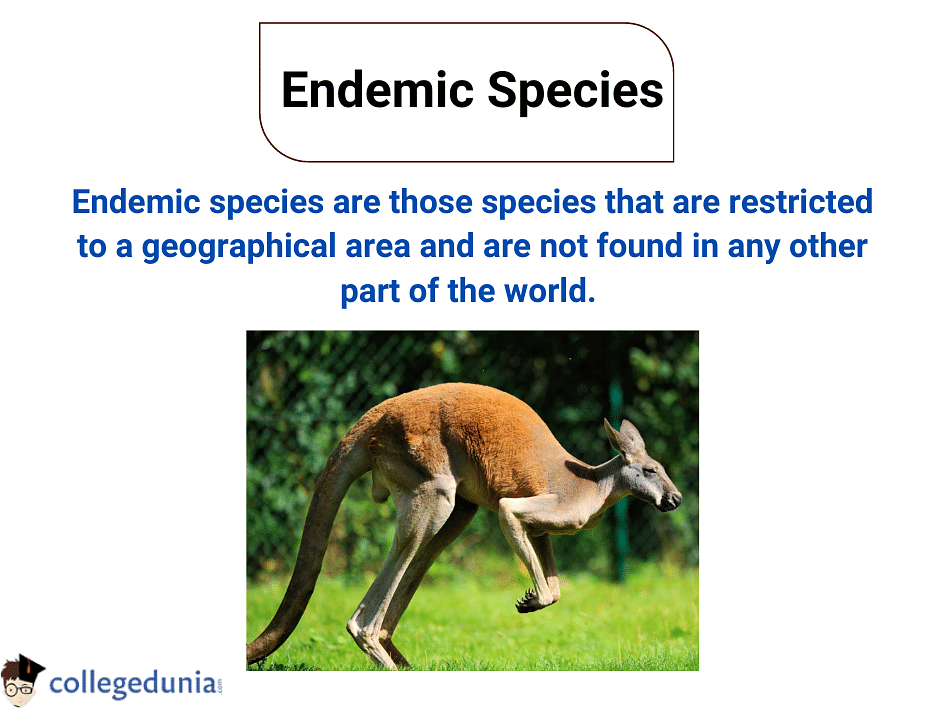
Endemic species
Read More:
| Relevant Concepts | ||
|---|---|---|
| Biodiversity and Conservation | Endemic Diseases | Conservation of Plants & Animals |
| List of Biosphere Reserves in India | Loss of Biodiversity | Biodiversity in Plants and Animals |
Features of Endemic Species
[Click Here for Previous Years' Questions]
Different endemic species throughout the world share some common features which are as follows:
- Endemic species are localized to a particular region as their ecological amplitude is quite narrow.
- Due to this reason, endemic species are unable to invade a new area.
- Endemic species have a low degree of genetic exchange and variation.
- Thus, they have saturated genomes and they lack the potential to migrate.
- They are highly vulnerable to extinction as they live in specific natural conditions with a low number of individuals.
- Changes in living conditions push the endemic species toward extinction.
- Due to their isolation, endemic species may acquire unique traits, specific to the climate of that particular region.
Read More: Biodiversity and Conservation Important Questions
Examples of Endemic Species
[Click Here for Sample Questions]
Endemic species are confined to a particular area because they are highly adapted to a particular climate and soil type. Species can be endemic to a particular continent, a part of a continent, or to a single island. Here are some examples of endemic species:
Endemic Species Fauna
Endemic Species Fauna refers to the animals that are endemic to a particular region. It means the animals that are found in only a particular area or part of the world are referred to as endemic species fauna:
- Tortoises of the Galápagos and the lemurs of Madagascar can be found on small islands.
- Antarctica, Hawaii, and Australia are all huge land masses that are habitats for a lot of endemic species.
- Kangaroos are endemic to Australia.
- Polar bears are endemic to the Arctic region.
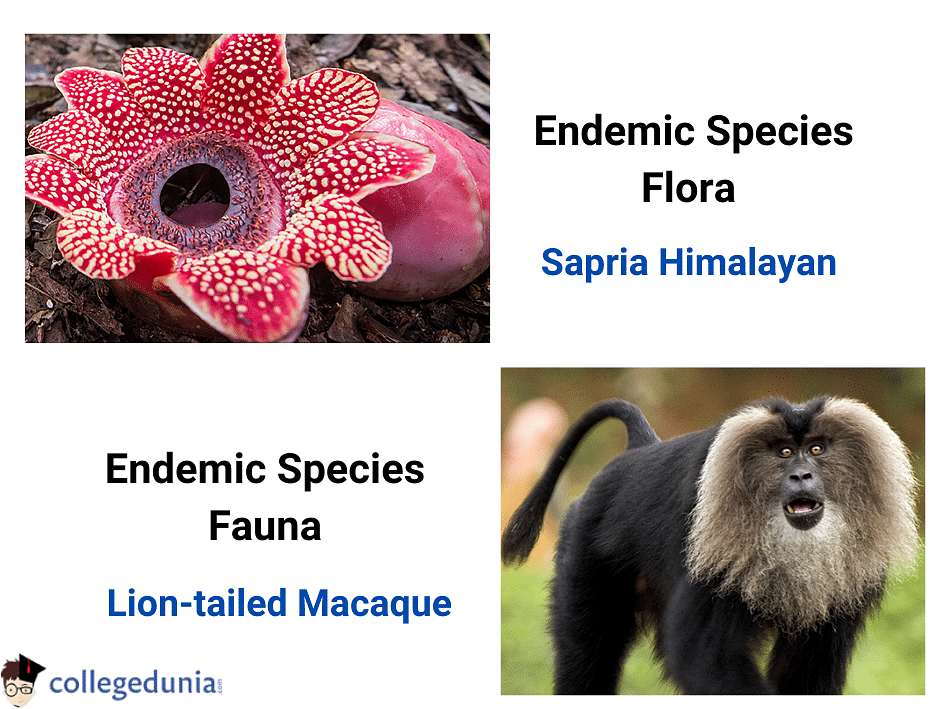
Endemic Species Fauna
Read More: Biodiversity and Conservation MCQ
Endemic Species Flora
Flora refers to a group of plants found in a specific area. Plants can also be endemic to some specific regions. Some plants thrive in deserts or near water, some in hilly areas, and some are indigenous to a particular region.
- The Redwood Forest on the West Coast of the United States is endemic as it is entirely limited to California.
- Sapria Himalayan is a rare and interesting root parasite plant that is endemic to northeastern India.
- Nepenthes Khasianais a carnivorous plant endemic to the Khasi Hills of Meghalaya.
Threats to Endemic Species
[Click Here for Previous Years' Questions]
Overexploitation of natural sources, i.e. overhunting, overfishing, and forest logging are some of the most prevalent threats to endemic species. Other threats to these species are:
- Endemic species are crucial as their well-being is an indicator of the climatic situation of a geographical region.
- Due to low geographical distribution, they are greatly vulnerable to extinction.
- As endemic species are genetically isolated and have fewer individuals, environmental changes due to natural and anthropogenic causes may prove to be disastrous to them.
- Other threats such as hunting, poaching, habitat fragmentation, and the introduction of invasive species may prove to be destructive for the endemic species.
- Owing to all these risks, endemic species require a higher degree of attention for conservation.
Read More: Megafauna
Endemic Species of India
[Click Here for Sample Questions]
Being a mega biodiversity country, India has various micro centers for endemic plants and animals.
- Eastern Himalayas, Western Ghats, and Western Himalayas are some of the regions occupied by endemic species.
- Almost 23% of flowering plants found in India are endemic along with a few members of Cycadaceae.
- Almost 60% of all endemic species in India live in the eastern Himalayas and the Western Ghats.
Here are some examples of endemic plants and animals found in India:
Asiatic Lion
- Also known as the Indian lions, Asiatic Lions are found in the Gir Forest National Park of Gujarat.
- Asiatic lions are genetically different from African lions.
- They show some different morphological features such as larger tail tuft, sparser mane on the head, etc.
- It is endangered and there are only 674 Asiatic lions according to the 2015 census.
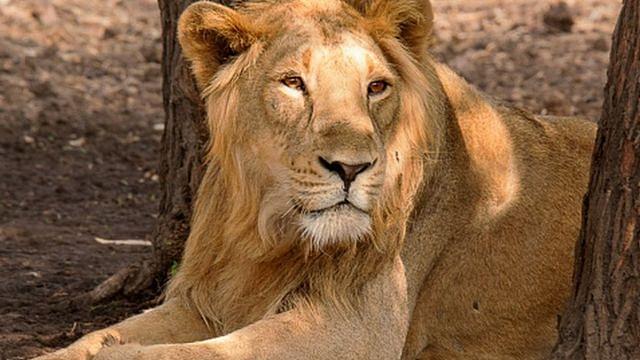
Asiatic Lion
Lion-tailed Macaque
- Lion-tailed Macaque is endemic to the Western Ghats of South India.
- It is among the rarest and most threatened monkeys with black hair with a silver-white mane around its neck and chin.
- Lion-tailed Macaque is now an endangered animal.
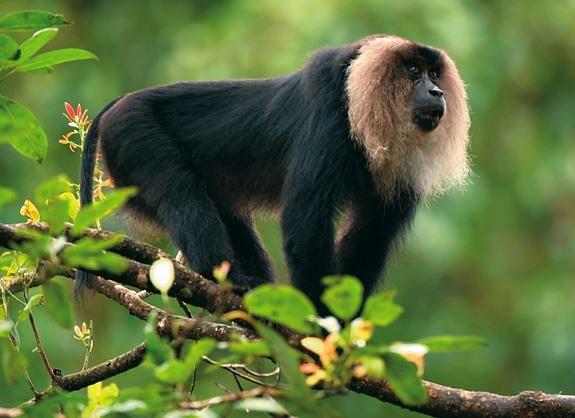
Lion-tailed Macaque
Purple Frog
- Purple frogs are endemic to the rainforest of the Western Ghats in India.
- They spend most of their life underground.
- Purple frogs are endangered on the IUCN list.
- A sucker-like mouth part is a characteristic feature of purple frogs.
- They are also known as pig-nosed frogs.

Purple Frog
Sangai Deer
- Sangai Deer is an endemic and endangered species of deer found only in Keibul Lamjao National Park of Manipur.
- The Keibul Lamjao National Park is a marshy wetland located in the southern parts of Loktak Lake.
- Sangai Deer are also called brow-antlered deer.

Sangai Deer
Read More: Mass Extinction
Kashmir Stag
- Kashmir stag is the only species of elk native to India.
- It is endemic in the dense riverside forests of Dachigam National Park, Kashmir Valley of Jammu and Kashmir, and Chamba in Himachal Pradesh.
- Its IUCN status is critically endangered.
- Kashmir stag is also known as Hangul.

Kashmir Stag
Nilgiri Tahr
- Nilgiri Tahrs are ungulates endemic to the Nilgiri Hills and southern parts of the Eastern and Western Ghats.
- They are wild sheep species that inhabit the open montane grassland habitat in Tamil Nadu and Kerala.
- Its IUCN status is endangered.

Nilgiri Tahr
Malabar Civet
- Malabar Civet is endemic to the Western Ghats.
- Its IUCN status is critically endangered.
- Malabar Civet is a nocturnal animal.

Malabar Civet
Nilgiri Blue Robin
- Also known as Nilgiri Shortwing, it is endemic to the Shola forests of the Nilgiri Hills.
- It is found to occur only above 1200 m altitudes in high-altitude grasslands of the Western Ghats.
- It is an endangered species.

Nilgiri Blue Robin
Namdapha Flying Squirrel
- Namdapha Flying Squirrel is an arboreal, nocturnal squirrel, endemic to northeastern India.
- It is found in Namdapha national park of Arunachal Pradesh.
- The arboreal and night-time or nocturnal squirrel population are not known.

Namdapha Flying Squirrel
Bronzeback Vine Snake
- Bronzeback Vine Snake is a mildly venomous snake endemic to the Western Ghats.
- It is also known as the Western Ghats bronze back.
- This snake is a grassland snake and a mildly venomous species.

Bronzeback Vine Snake
Pygmy Hog-Assam
- It is an endangered species found only in the foothills of Assam.
- The smallest wild pigs are the only members of the genus Porcula.

Pygmy Hog-Assam
Indian Giant Squirrel
- Indian giant squirrel or Malabar giant squirrel is a beautiful multi-colored squirrel found in the Malabar region of India.
- It is a large, diurnal, arboreal, and mainly herbivorous squirrel.

Indian Giant Squirrel
Indian Rhinoceros
- Indian Rhinoceros is a rhinoceros species native to the Indian Subcontinent.
- This rhinoceros is distinguished from the other rhinoceros species by the presence of a single horn.
- It was once present throughout the Indo-Gangetic plains, but now its range is now limited to northern India and southern Nepal.
- Its IUCN status is Vulnerable.

Indian Rhinoceros
Check More:
| Related Topics | ||
|---|---|---|
| Red Fox | Difference Between Species, Population, and Community | Red Data Book |
| Biodiversity Hotspot | Flagship Species | Difference Between Wildlife Sanctuary and National Park |
Things to Remember
- Endemic species are those species that are restricted to a particular region.
- They are highly vulnerable to extinction due to a lower degree of variation and fewer individuals.
- Endemic species have a lower degree of genetic exchange, thus, they have a saturated genome.
- Environmental changes along with human activities such as hunting, poaching, and habitat fragmentation threaten endemic species.
- India has a high number of endemic species across its different biological hotspots.
- Some of the endemic species in India are the Asiatic Lion, Lion-tailed Macaque, Kashmir Stag, Indian Rhinoceros, etc.
Previous Year Questions
- Occurrence of endemic species in South America and Australia… (AIIMS 2010)
- Which of the following species are restricted to a given area… (JIPMER 2001)
- Hotspots of biodiversity mean… (DUET 2010)
- Biodiversity of the geographical region represents… (NEET 2011)
- One of the most important functions of botanical gardens is that… (NEET 2005)
- BOD stands for? (JEE Mains 2016)
- Red Data Book deals with…
- Which of the following is an endangered species of India…
- Most of the endangered species are the victims of… (KCET 2009)
- Which endangered animal is the source of the world's finest… (NEET 2003)
- Endangered plant species are conserved… (COMEDK UGET 2015)
- Which one of the following is an endangered plant species…
Sample Questions
Ques. What is meant by endemic species? (1 Mark)
Ans. Endemic species are those species that live in a limited area, such as a mountain range, lake, or island, among others. Some examples of endemic species are Kangaroo in Australia, Asiatic Lion in India, etc.
Ques. What is the difference between endemic and exotic species? (1 Mark)
Ans. Endemic species are restricted to a particular geographical region whereas exotic species are species that are introduced from other geographical regions into an area.
Ques. Why do we need to protect endemic species? (2 Marks)
Ans. The importance of epidemic species is that they are highly valuable to biodiversity and they are rare. If they are extinct from their place then the population will reduce drastically. Thus, it is crucial to take proper care of this endemic species. Both endemic plants and animals are dependent on each other, thus, if a few endemic plants get extinct, then nearly 10 to 30 endemic animal species also get extinct.
Ques. What is Endemism? (1 Mark)
Ans. Endemism is the phenomenon where the geographical distribution of a taxon is restricted to a particular biogeographical region and not found anywhere else in the world.
Ques. Why are endemic species important? (1 Mark)
Ans. Endemic species are important because they maintain balance in the ecosystem. The extinction of these species may lead to the wipe-out of the complete ecosystem.
Ques. How is a ‘native’ species different from ‘endemic’ species? (1 Mark)
Ans. Native species are those who originated from a particular region. However, its distribution does not have to be restricted to a geographical region.
Ques. What is the main concern with endemic species? (2 Marks)
Ans. As the endemic species are restricted to a geographical region with a low degree of population they are vulnerable to extinction. Changes in their environment due to natural or man-made causes may lead to their complete extinction.
Ques. What are the main features of endemic species? (2 Marks)
Ans. The main features of endemic species are:
- Endemic species are localized in a particular biogeographical region and are not found anywhere else in the world.
- They have a low degree of genetic exchange and variation.
- Due to their isolation, they may acquire unique traits, specific to the climate of that particular region.
Ques. What are endemic species? (2 Marks)
Ans. Endemic species are the species whose geographical distribution is limited to one defined geographical region. In other words, they are found in that particular species but nowhere else in the whole world.
For example- Asiatic (distinct from African lions) lions are found in the Gir forest, Gujarat and nowhere else in the world. So we may say the Asiatic lions are endemic to Gir Forest, Gujarat.
Ques. Give some examples of plant species endemic to India. (2 Marks)
Ans. Some examples of the plants endemic to India are-
- Rhododendron (Ericaceae)
- Eleusine coracana (Poaceae)
- Beaumontia grandiflora (Apocynaceae)
- Caryota Urena (Arecaceae)
- Crotolaria juncea (Fabaceae)
- Aegle marmelos (Rutaceae)
Ques. How can we conserve the endemic species? (3 Marks)
Ans. Multiple approaches can be employed for the conservation of endemic species. Some of them are as follows-
- Ex-situ Methods- Botanical gardens, Zoo.
- In-situ Methods- National parks, Biosphere reserves, Sanctuaries.
- Biotechnological Methods- Seed preservation, Cryo-preservation, Seed banks.
Ques. Write some examples of animals endemic to India. (3 Marks)
Ans. Some of the examples of the animals endemic to India are-
- Asiatic Lion-endemic to Gir Forest, Gujarat
- Lion-tailed macaque- endemic western ghats
- Purple frog-western ghats
- Sangai Deer- Loktak lake
- Kashmir stag-Kashmir valley
- Nilgiri Tahr- Nilgiri Hills
- Malabar Civet-Western Ghats
- Nilgiri Blue Robin--Nilgiri Hills
- Indian Giant Squirrel
- Nilgiri Marten-Nilgiri Hills
- Indian rhinoceros- Indian subcontinent
Ques. What are the factors affecting the endemic species? (3 Marks)
Ans. Various factors are affecting the endemic species. Some of them are listed below-
- Habitat Fragmentation- Due to the fragmentation of habitat the endemic species are being further separated leading to the potential loss of the species.
- Environmental Pollution- It is another factor that is severely affecting the endemic species in India and all over the world.
For Latest Updates on Upcoming Board Exams, Click Here:https://t.me/class_10_12_board_updates
Check Out:




Comments