




CBSE Class 12 Mathematics Question Paper 2024 PDF (Set 2- 65/5/2) is available for download here. CBSE conducted the Mathematics exam on March 9, 2024 from 10:30 AM to 1:30 PM. The total marks for the theory paper are 80. The question paper contains 20% MCQ-based questions, 40% competency-based questions, and 40% short and long answer type questions.
Also Check: CBSE Class 12 Question Paper 2024 (All Subjects)
The Mathematics question paper includes the following types of questions:
- The question paper has 38 questions, all compulsory, for 80 marks in 3 hours, with 15 minutes of extra reading time
- Section A (Q1 to Q18) has 18 multiple choice questions and Q19 and Q20 are 2 assertion-reason questions, all of 1 mark each, and Section B (Q21 to Q25) has 5 very short answer questions of 2 marks each
- Section C (Q26 to Q31) has 6 short answer questions of 3 marks each, and Section D (Q32 to Q35) has 4 long answer questions of 5 marks each
- Section E (Q36 to Q38) has 3 case study based questions of 4 marks each
- There is no overall choice, but internal choice (OR) is given in 2 questions of Section B, 3 of Section C, 2 of Section D and 2 of Section E, and calculators are not allowed
CBSE Class 12 Mathematics Question Paper 2024 (Set 2- 65/5/2) with Answer Key
| CBSE Official PDF | CD PDF | CD PDF with Solutions |
|---|---|---|
| Download official PDF 4.68 MB | Download Collegedunia PDF 0.36 MB | Download solutions PDF 0.94 MB |
CBSE Class 12 Mathematics 2024 Set 2 (65/5/2) Questions with Solutions
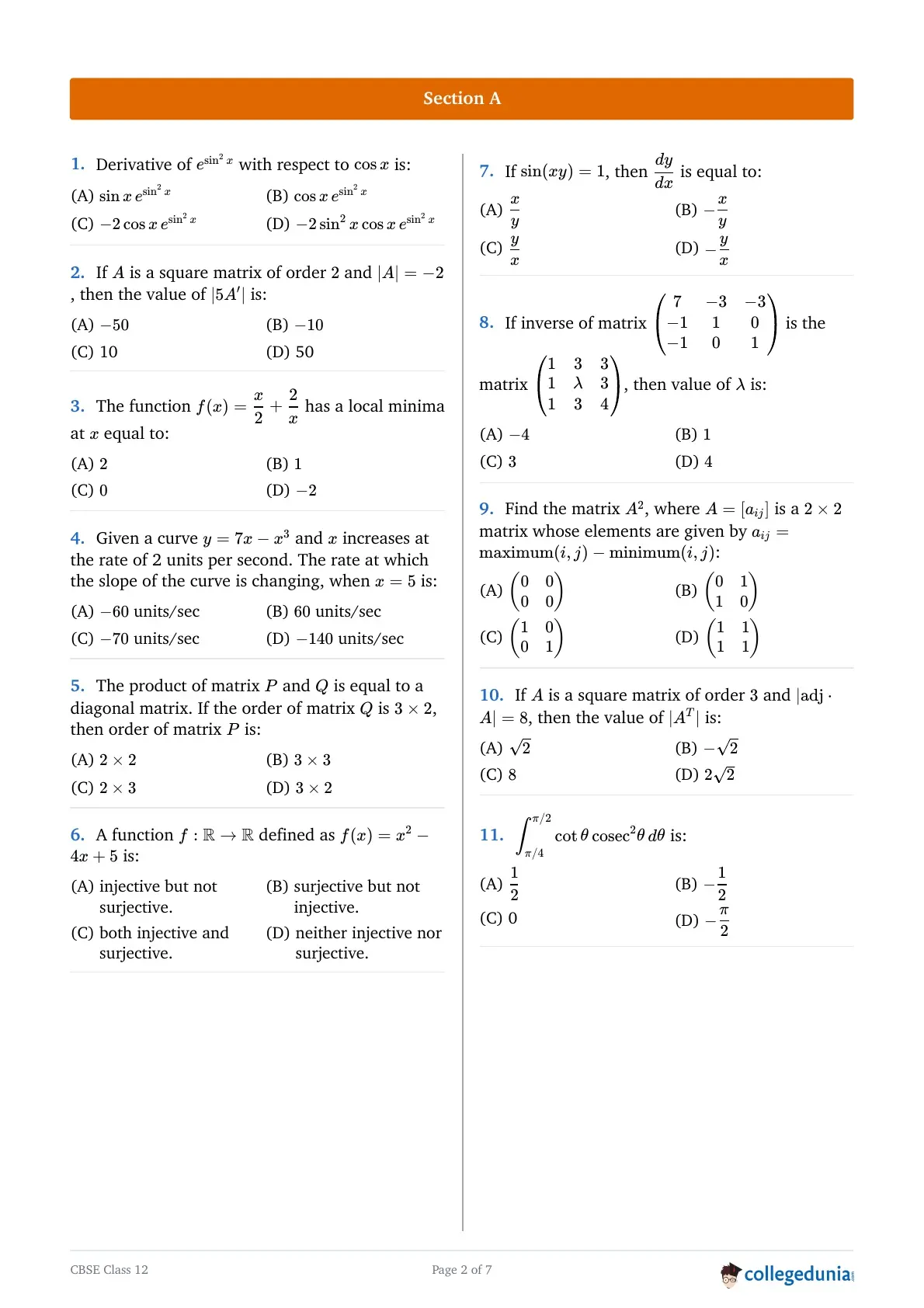
Derivative of \(e^{\sin^{2} x}\) with respect to \(\cos x\) is :
If \(A\) is a square matrix of order \(2\) and \(|A| = -2\), then value of \(|5A^{T}|\) is :
The function \(f(x) = \dfrac{x}{2} + \dfrac{2}{x}\) has a local minima at \(x\) equal to :
Given a curve \(y = 7x - x^{3}\) and \(x\) increases at the rate of 2 units per second. The rate at which the slope of the curve is changing, when \(x = 5\), is :
The product of matrix \(P\) and \(Q\) is equal to a diagonal matrix. If the order of matrix \(Q\) is \(3 \times 2\), then order of matrix \(P\) is :
A function \(f : \mathbb{R} \to \mathbb{R}\) defined as \(f(x) = x^2 - 4x + 5\) is :
If \(\sin(xy) = 1\), then \(\dfrac{dy}{dx}\) is equal to :
If inverse of matrix \(\begin{bmatrix} 7 & -3 & -3 \\ -1 & 1 & 0 \\ -1 & 0 & 1 \end{bmatrix}\) is the matrix \(\begin{bmatrix} 1 & 3 & 3 \\ 1 & \lambda & 3 \\ 1 & 3 & 4 \end{bmatrix}\), then value of \(\lambda\) is :
Find the matrix \(A^{2}\), where \(A = [a_{ij}]\) is a \(2 \times 2\) matrix whose elements are given by \(a_{ij} = \text{maximum}\,(i, j) - \text{minimum}\,(i, j)\) :
If \(A\) is a square matrix of order \(3\) such that the value of \(|\text{adj}\cdot A| = 8\), then the value of \(|A^{T}|\) is :
The value of \(\displaystyle\int_{\pi/4}^{\pi/2} \cot\theta\,\text{cosec}^{2}\theta\, d\theta\) is :
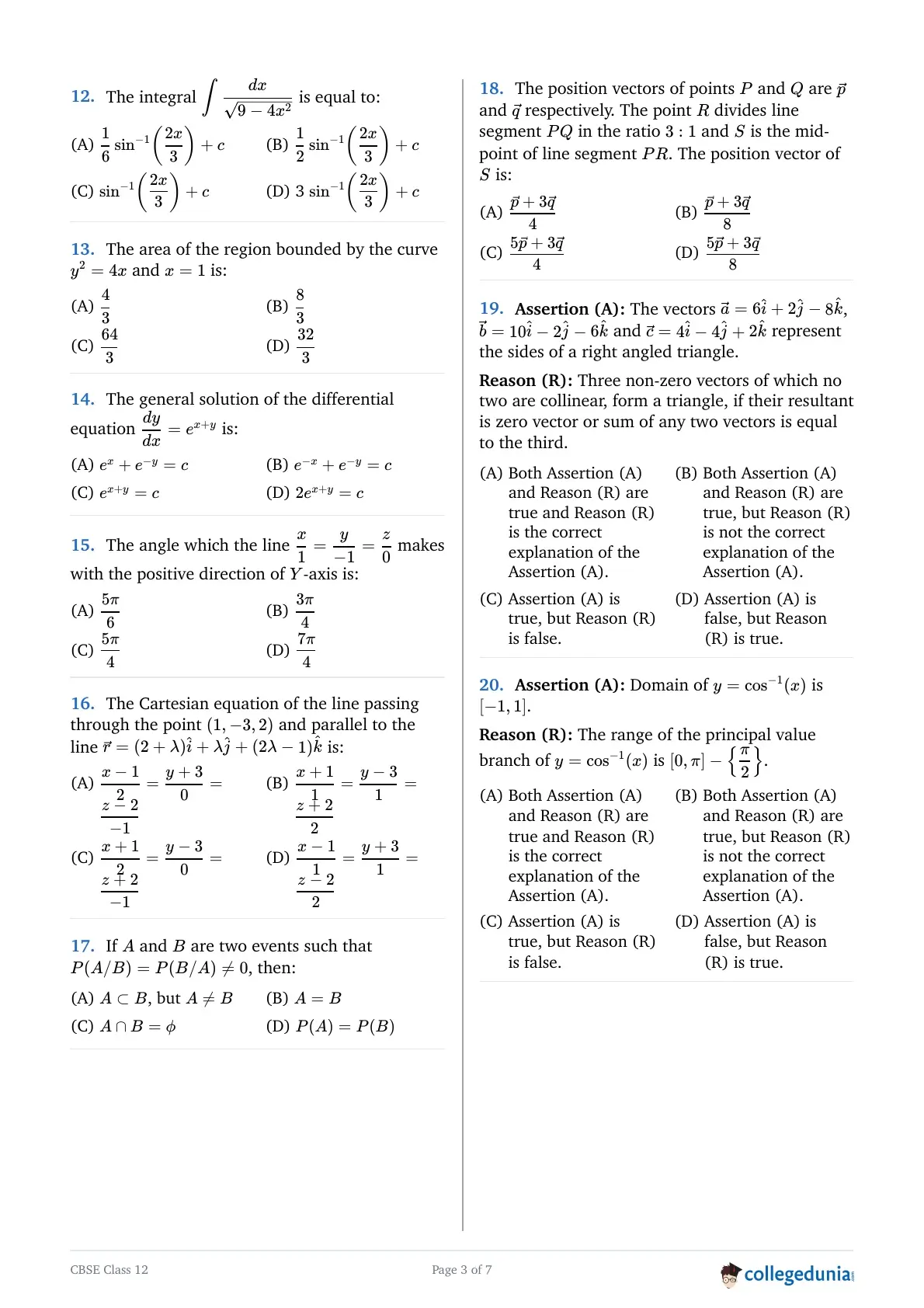
The integral \(\displaystyle\int \dfrac{dx}{\sqrt{9 - 4x^{2}}}\) is equal to :
The area of the region bounded by the curve \(y^{2} = 4x\) and \(x = 1\) is :
The general solution of the differential equation \(\frac{dy}{dx}=e^{x+y}\) is
The angle which the line \(\dfrac{x}{1} = \dfrac{y}{-1} = \dfrac{z}{0}\) makes with the positive direction of \(Y\)-axis is :
The Cartesian equation of the line passing through the point \((1, -3, 2)\) and parallel to the line :
\[ \vec{r} = (2 + \lambda)\hat{i} + \lambda\hat{j} + (2\lambda - 1)\hat{k} \] is
If A and B are events such that \(P(A|B)=P(B|A)\), then:
The position vectors of points \(P\) and \(Q\) are \(\vec{p}\) and \(\vec{q}\) respectively. The point \(R\) divides line segment \(PQ\) in the ratio \(3 : 1\) and \(S\) is the mid-point of line segment \(PR\). The position vector of \(S\) is :
Assertion (A) : The vectors
\(\vec{a} = 6\hat{i} + 2\hat{j} - 8\hat{k}\)
\(\vec{b} = 10\hat{i} - 2\hat{j} - 6\hat{k}\)
\(\vec{c} = 4\hat{i} - 4\hat{j} + 2\hat{k}\)
represent the sides of a right angled triangle.
Reason (R) : Three non-zero vectors of which none of two are collinear forms a triangle if their resultant is zero vector or sum of any two vectors is equal to the third.
Assertion (A) : Domain of \(y = \cos^{-1}(x)\) is \([-1, 1]\).
Reason (R) : The range of the principal value branch of \(y = \cos^{-1}(x)\) is \(\left[0, \pi\right] - \left\{\dfrac{\pi}{2}\right\}\).
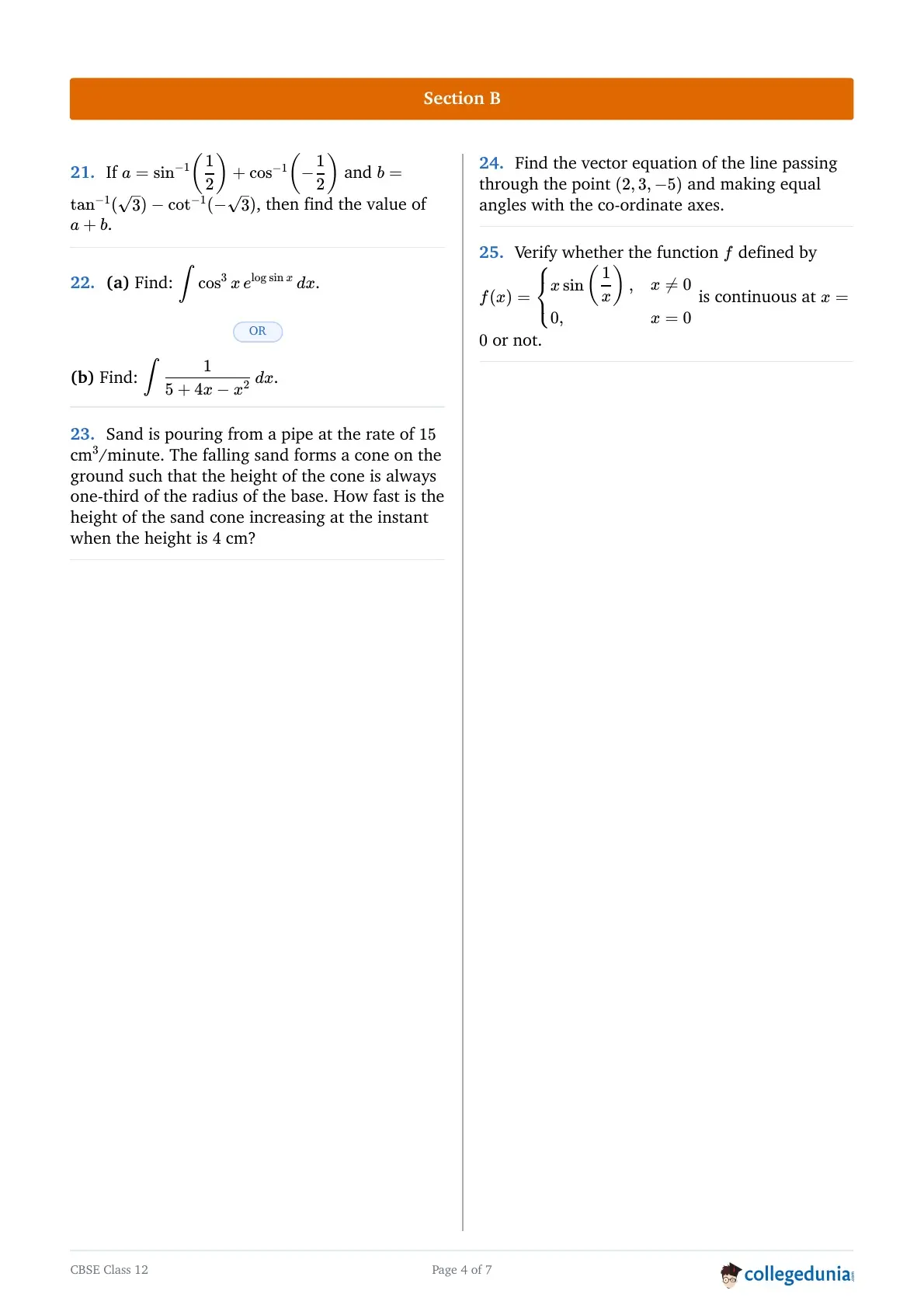
If \(a = \sin^{-1}\left(\dfrac{\sqrt{2}}{2}\right) + \cos^{-1}\left(-\dfrac{1}{2}\right)\) and
\(b = \tan^{-1}\left(\sqrt{3}\right) - \cot^{-1}\left(-\dfrac{1}{\sqrt{3}}\right)\)
then find the value of \(a + b\).
Find : \(\displaystyle\int \cos^{3}x\, e^{\log \sin x}\, dx\)
Find : \(\displaystyle \int \dfrac{1}{5 + 4x - x^{2}}\, dx\)
Sand is pouring from a pipe at the rate of \(15\) cm\(^{3}\)/minute. The falling sand forms a cone on the ground such that the height of the cone is always one-third of the radius of the base. How fast is the height of the sand cone increasing at the instant when the height is \(4\) cm ?
Find the vector equation of the line passing through the point \((2, 3, -5)\) and making equal angles with the co-ordinate axes.
Verify whether the function \(f\) defined by
\[ f(x) = \begin{cases} x\sin\left(\dfrac{1}{x}\right), & x \neq 0 \\ 0, & x = 0 \end{cases} \]
is continuous at \(x = 0\) or not.
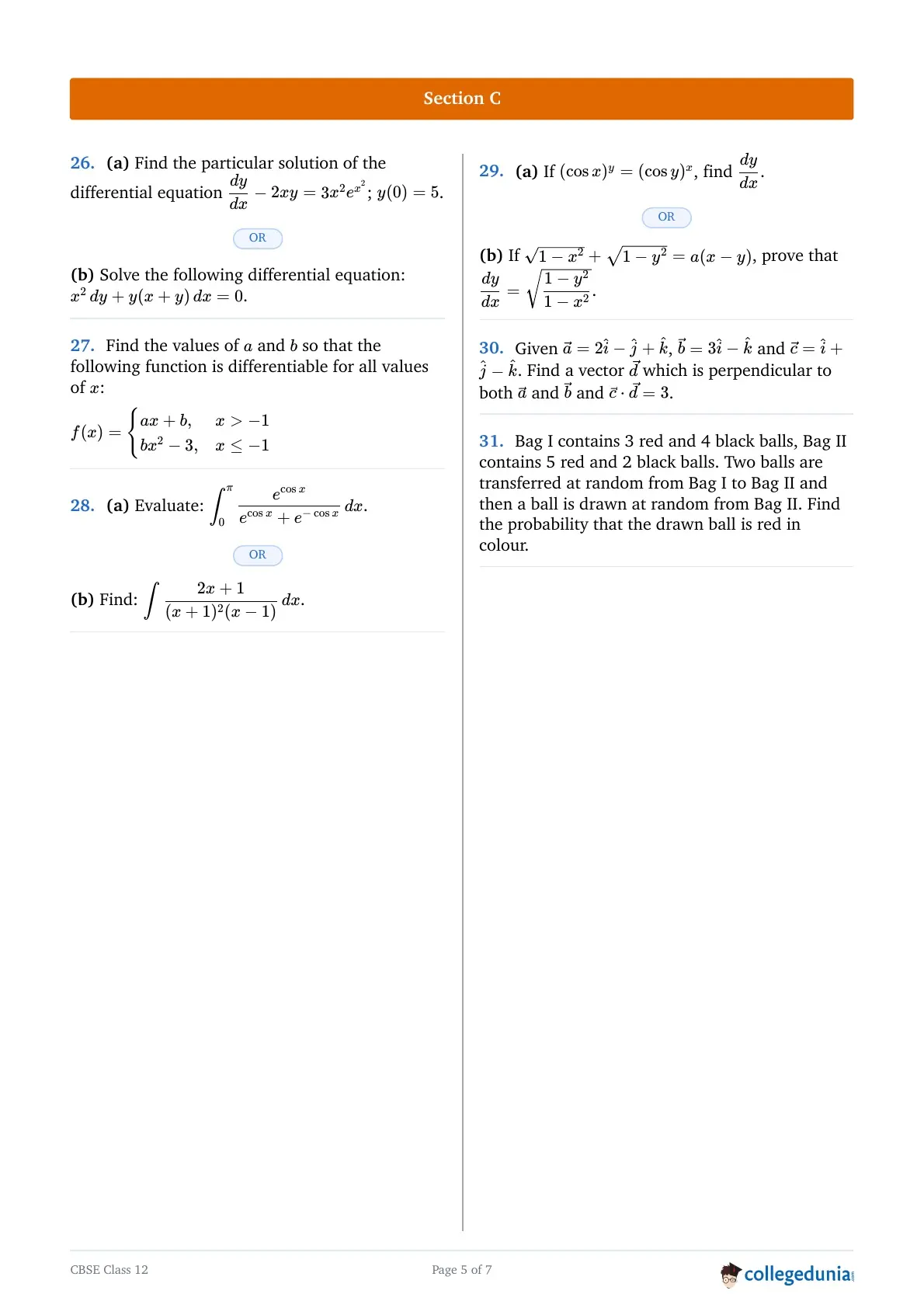
Find the particular solution of the differential equation
\(\dfrac{dy}{dx} - 2xy = 3x^{2} e^{x^{2}}\); \(y(0) = 5\).
Solve the following differential equation :
\(x^{2}\, dy + y(x + y)\, dx = 0\)
Find the values of \(a\) and \(b\) so that the following function is differentiable for all values of \(x\) :
\[ f(x) = \begin{cases} ax + b, & x > -1 \\ bx^{2} - 3, & x \leq -1 \end{cases} \]
Evaluate : \(\displaystyle \int_{0}^{\pi} \dfrac{e^{\cos x}}{e^{\cos x} + e^{-\cos x}}\, dx\)
If \(\sqrt{1-x^{2}} + \sqrt{1-y^{2}} = a(x - y)\), prove that \(\dfrac{dy}{dx} = \sqrt{\dfrac{1-y^{2}}{1-x^{2}}}\).
Find \(\dfrac{dy}{dx}\), if \((\cos x)^{y} = (\cos y)^{x}\).
If \(\sqrt{1 - x^2} + \sqrt{1 - y^2} = a(x - y)\), prove that \(\frac{dy}{dx} = \sqrt{\frac{1 - y^2}{1 - x^2}}\).
Given \(\vec{a} = 2\hat{i} - \hat{j} + \hat{k}\), \(\vec{b} = 3\hat{i} - \hat{k}\) and \(\vec{c} = 2\hat{i} + \hat{j} - 2\hat{k}\). Find a vector \(\vec{d}\) which is perpendicular to both \(\vec{a}\) and \(\vec{b}\) and \(\vec{c} \cdot \vec{d} = 3\).
Bag I contains \(3\) red and \(4\) black balls, Bag II contains \(5\) red and \(2\) black balls. Two balls are transferred at random from Bag I to Bag II and then a ball is drawn at random from Bag II. Find the probability that the drawn ball is red in colour.
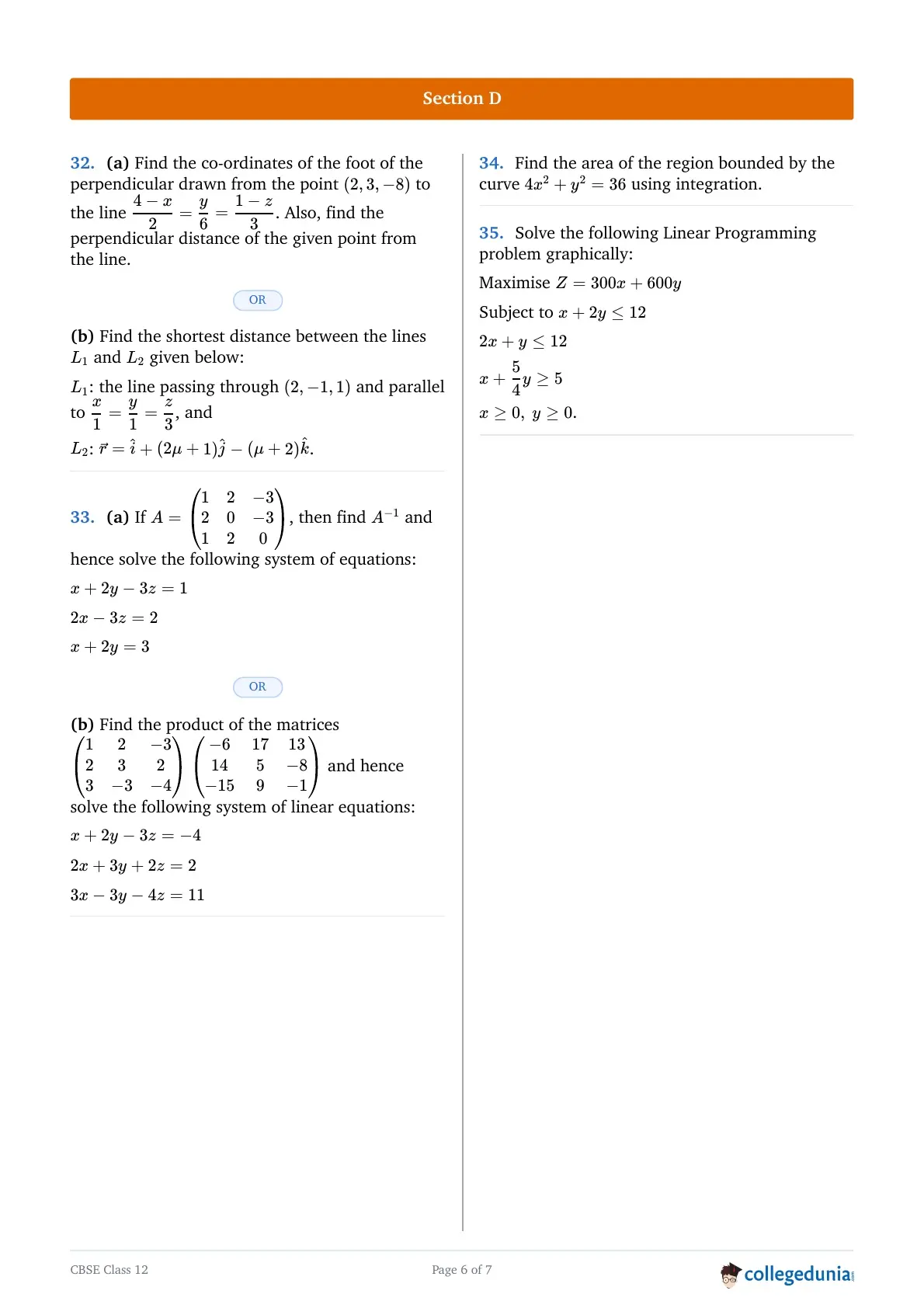
Find the co-ordinates of the foot of the perpendicular drawn from the point \((2, 3, -8)\) to the line \(\dfrac{4 - x}{2} = \dfrac{y}{6} = \dfrac{1 - z}{3}\).
Also, find the perpendicular distance of the given point from the line.
Find the shortest distance between the lines \(L_1\) & \(L_2\) given below :
\(L_1\) : The line passing through \((2, -1, 1)\) and parallel to \(\dfrac{x}{1} = \dfrac{y}{1} = \dfrac{z}{3}\)
\(L_2\) : \(\vec{r} = \hat{i} + (2\mu + 1)\hat{j} - (\mu + 2)\hat{k}\).
If \(A = \begin{bmatrix} 1 & 2 & -3 \\ 2 & 0 & -3 \\ 1 & 2 & 0 \end{bmatrix}\), then find \(A^{-1}\) and hence solve the following system of equations :
\(x + 2y - 3z = 1\)
\(2x - 3z = 2\)
\(x + 2y = 3\)
Find the product of the matrices \(\begin{bmatrix} 1 & 2 & -3 \\ 2 & 3 & 2 \\ 3 & -3 & -4 \end{bmatrix}\begin{bmatrix} -6 & 17 & 13 \\ 14 & 5 & -8 \\ -15 & 9 & -1 \end{bmatrix}\) and hence solve the system of linear equations :
\[ \begin{aligned} x + 2y - 3z &= -4 \\ 2x + 3y + 2z &= 2 \\ 3x - 3y - 4z &= 11 \end{aligned} \]
Find the area of the region bounded by the curve \(4x^{2} + y^{2} = 36\) using integration.
Solve the following Linear Programming problem graphically :
Maximise \(Z = 300x + 600y\)
Subject to
\[ \begin{aligned} x + 2y &\leq 12 \\ 2x + y &\leq 12 \\ x + \dfrac{5}{4}y &\geq 5 \\ x \geq 0,\ y &\geq 0. \end{aligned} \]
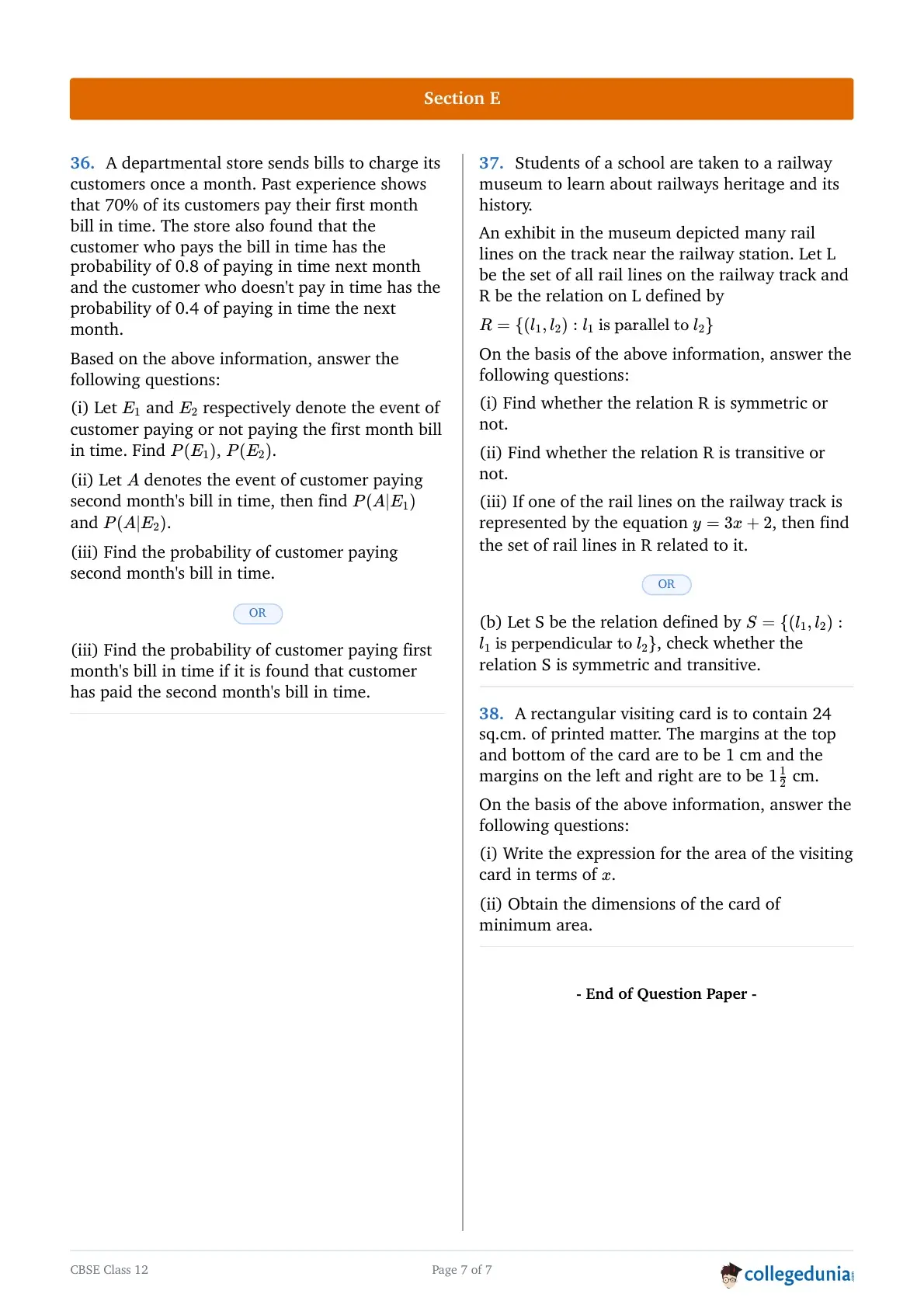
A departmental store sends bills to charge its customers once a month. Past experience shows that 70% of its customers pay their first month bill in time. The store also found that the customer who pays the bill in time has the probability of 0.8 of paying in time next month and the customer who doesn't pay in time has the probability of 0.4 of paying in time the next month.
Based on the above information, answer the following questions :
Let \(E_1\) and \(E_2\) respectively denote the event of customer paying or not paying the first month bill in time. Find \(P(E_1)\), \(P(E_2)\).
A departmental store sends bills to charge its customers once a month. Past experience shows that 70% of its customers pay their first month bill in time. The store also found that the customer who pays the bill in time has the probability of 0.8 of paying in time next month and the customer who doesn't pay in time has the probability of 0.4 of paying in time the next month.
Based on the above information, answer the following questions :
Let \(A\) denotes the event of customer paying second month's bill in time, then find \(P(A|E_1)\) and \(P(A|E_2)\).
A departmental store sends bills to charge its customers once a month. Past experience shows that 70% of its customers pay their first month bill in time. The store also found that the customer who pays the bill in time has the probability of 0.8 of paying in time next month and the customer who doesn't pay in time has the probability of 0.4 of paying in time the next month.
Based on the above information, answer the following questions :
Find the probability of customer paying second month's bill in time.
A departmental store sends bills to charge its customers once a month. Past experience shows that 70% of its customers pay their first month bill in time. The store also found that the customer who pays the bill in time has the probability of 0.8 of paying in time next month and the customer who doesn't pay in time has the probability of 0.4 of paying in time the next month.
Based on the above information, answer the following questions :
Find the probability of customer paying first month's bill in time if it is found that customer has paid the second month's bill in time.
Students of a school are taken to a railway museum to learn about railways heritage and its history.
An exhibit in the museum depicted many rail lines on the track near the railway station. Let \(L\) be the set of all rail lines on the railway track and \(R\) be the relation on \(L\) defined by
\(R = \{(l_1, l_2) : l_1 \text{ is parallel to } l_2\}\)
On the basis of the above information, answer the following questions :
Find whether the relation \(R\) is symmetric or not.
\includegraphics{images/mmath24_6551Q3636i_1.png}
Students of a school are taken to a railway museum to learn about railways heritage and its history.
An exhibit in the museum depicted many rail lines on the track near the railway station. Let \(L\) be the set of all rail lines on the railway track and \(R\) be the relation on \(L\) defined by
\(R = \{(l_1, l_2) : l_1 \text{ is parallel to } l_2\}\)
On the basis of the above information, answer the following questions :
Find whether the relation \(R\) is transitive or not.
\includegraphics{images/mmath24_6551Q3636ii_1.png}
Students of a school are taken to a railway museum to learn about railways heritage and its history.
An exhibit in the museum depicted many rail lines on the track near the railway station. Let \(L\) be the set of all rail lines on the railway track and \(R\) be the relation on \(L\) defined by
\(R = \{(l_1, l_2) : l_1 \text{ is parallel to } l_2\}\)
On the basis of the above information, answer the following questions :
If one of the rail lines on the railway track is represented by the equation \(y = 3x + 2\), then find the set of rail lines in \(R\) related to it.
\includegraphics{images/mmath24_6551Q3636iiia_1.png}
Students of a school are taken to a railway museum to learn about railways heritage and its history.
An exhibit in the museum depicted many rail lines on the track near the railway station. Let \(L\) be the set of all rail lines on the railway track and \(R\) be the relation on \(L\) defined by
\(R = \{(l_1, l_2) : l_1 \text{ is parallel to } l_2\}\)
On the basis of the above information, answer the following questions :
Let \(S\) be the relation defined by \(S = \{(l_1, l_2) : l_1 \text{ is perpendicular to } l_2\}\) check whether the relation \(S\) is symmetric and transitive.
\includegraphics{images/mmath24_6551Q3636iiibOR_1.png}
A rectangular visiting card is to contain 24 sq.cm. of printed matter. The margins at the top and bottom of the card are to be 1 cm and the margins on the left and right are to be \(1 frac{1}{2}\) cm as shown below :
On the basis of the above information, answer the following questions :
(i) Write the expression for the area of the visiting card in terms of \(x\).
(ii) Obtain the dimensions of the card of minimum area.
A rectangular visiting card is to contain 24 sq.cm. of printed matter. The margins at the top and bottom of the card are to be 1 cm and the margins on the left and right are to be \(1\tfrac{1}{2}\) cm as shown below :
On the basis of the above information, answer the following questions :
Write the expression for the area of the visiting card in terms of \(x\).
\includegraphics{images/mmath24_6551Q3737i_1.png}
A rectangular visiting card is to contain 24 sq.cm. of printed matter. The margins at the top and bottom of the card are to be 1 cm and the margins on the left and right are to be \(1\tfrac{1}{2}\) cm as shown below :
On the basis of the above information, answer the following questions :
Obtain the dimensions of the card of minimum area.
\includegraphics{images/mmath24_6551Q3737ii_1.png}
CBSE Class 12 Mathematics 2024 Question Paper Details
| Exam | CBSE Class 12 Board Examination 2024 |
| Subject | Mathematics |
| Paper code | 65/5/2 |
| Exam date | March 9, 2024 |
| Time allowed | 3 hours (plus 15 minutes of reading time, 10:15 AM to 10:30 AM) |
| Maximum marks | 80 |
| Total questions | 38 (attempt 38) |
CBSE Class 12 Mathematics Question Paper Pattern and Marking Scheme
The CBSE Class 12 Mathematics 2024 question paper is of 80 marks and has 38 questions, of which 38 are to be attempted. The tables below give the section-wise paper pattern and the split of marks, as printed in the official question paper.
CBSE Class 12 Mathematics Question Paper Pattern 2024
| Section | Questions | Question Type | Choice | Marks per Question | Marks |
|---|---|---|---|---|---|
| Section A | Q1-Q18 | Multiple choice questions (MCQs) | All 18 | 1 | 18 |
| Q19-Q20 | Assertion-Reason based questions | All 2 | 1 | 2 | |
| Section B | Q21-Q25 | Very short answer (VSA) questions | All 5 | 2 | 10 |
| Section C | Q26-Q31 | Short answer (SA) questions | All 6 | 3 | 18 |
| Section D | Q32-Q35 | Long answer (LA) questions | All 4 | 5 | 20 |
| Section E | Q36-Q38 | Case study based questions | All 3 | 4 | 12 |
| Total | 38 questions | Attempt 38 | 80 |
CBSE Class 12 Mathematics Marks Distribution 2024
| Question Type | Questions to Attempt | Marks per Question | Total Marks |
|---|---|---|---|
| Multiple choice questions (MCQs) (Section A) | 18 | 1 | 18 |
| Assertion-Reason based questions (Section A) | 2 | 1 | 2 |
| Very short answer (VSA) questions (Section B) | 5 | 2 | 10 |
| Short answer (SA) questions (Section C) | 6 | 3 | 18 |
| Long answer (LA) questions (Section D) | 4 | 5 | 20 |
| Case study based questions (Section E) | 3 | 4 | 12 |
| Total | 38 | 80 |



Comments