




CBSE Class 12 History Set 1 - (61/4/1) Question Paper 2026 with Solution PDF is available here for download. The CBSE board conducted Class 12 History Set 1 - (61/4/1) Exam on March 30, 2026.
The CBSE Class 12 History paper covers important topics from ancient, medieval, and modern Indian history, including themes like the Harappan civilization, Mughal period, colonial rule, and the freedom struggle. Students should focus on understanding key events, analyzing sources, and practicing structured answer writing with relevant examples. The exam is typically marked out of 100 marks, with 80 marks for the theory paper and 20 marks for internal assessment.
CBSE Class 12 History Set 1 - (61/4/1) Question Paper 2026 with Solution PDF
| CBSE Class 12 History Question Paper 2026 Set 1 - (61/4/1) | Download PDF | Check Solutions |


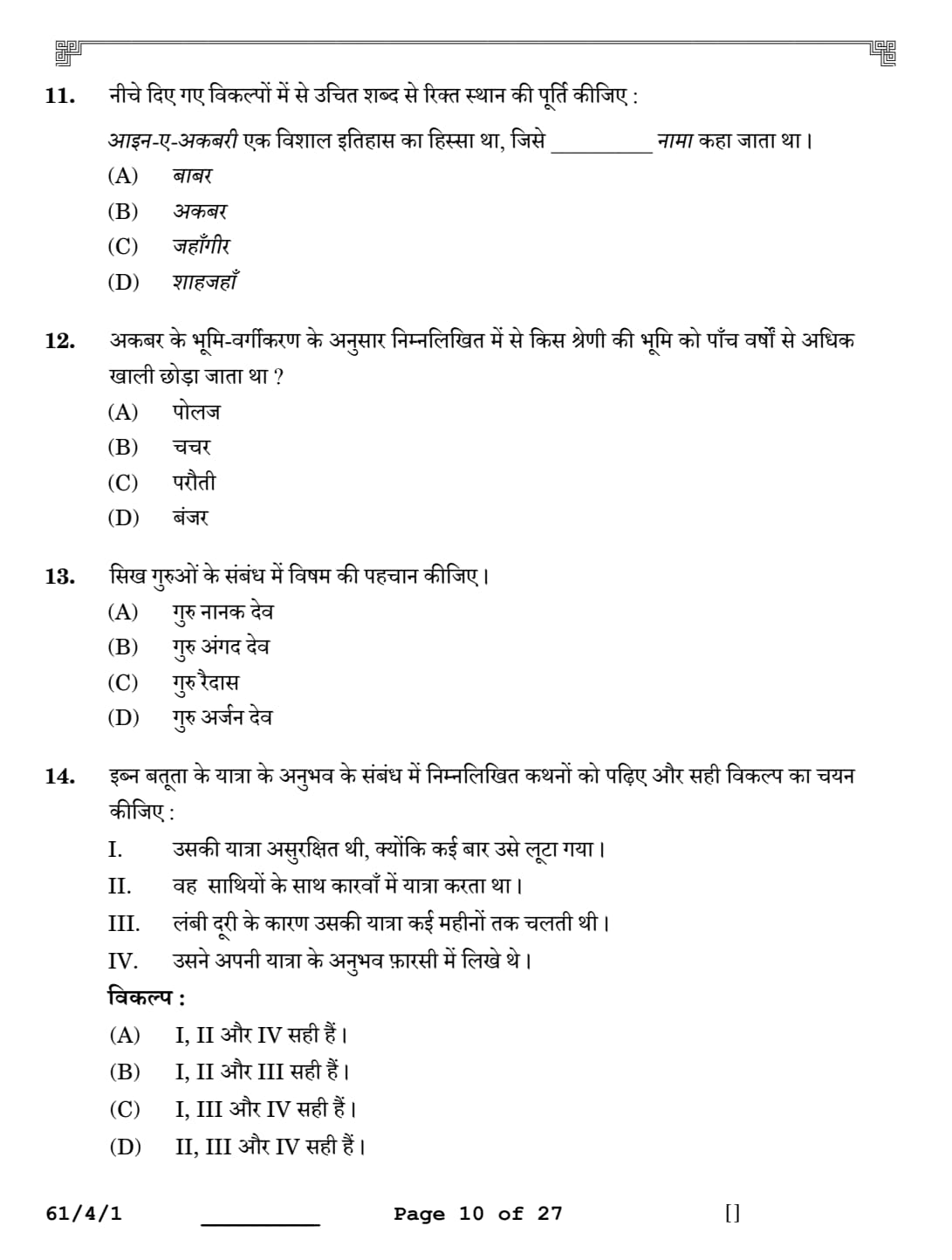
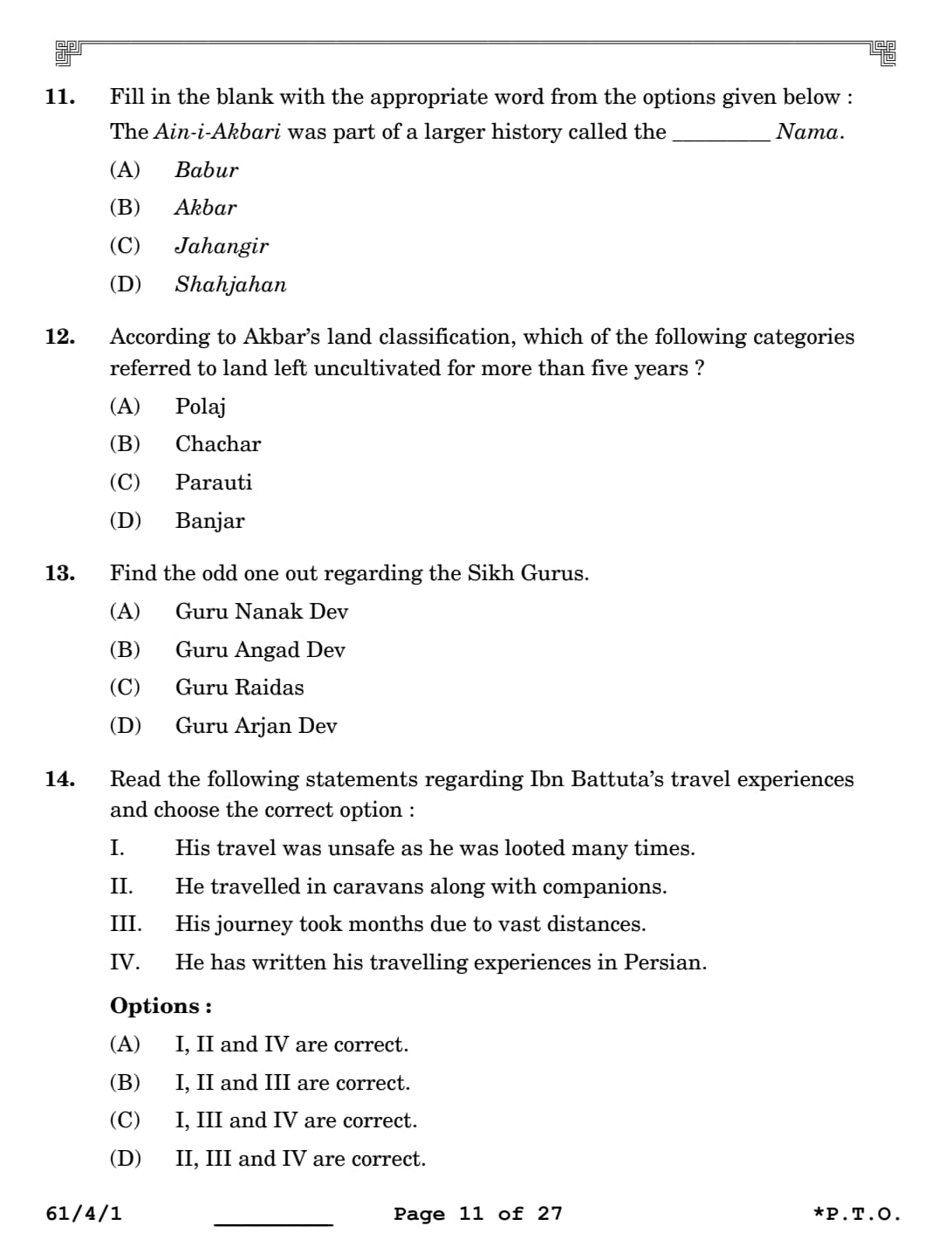


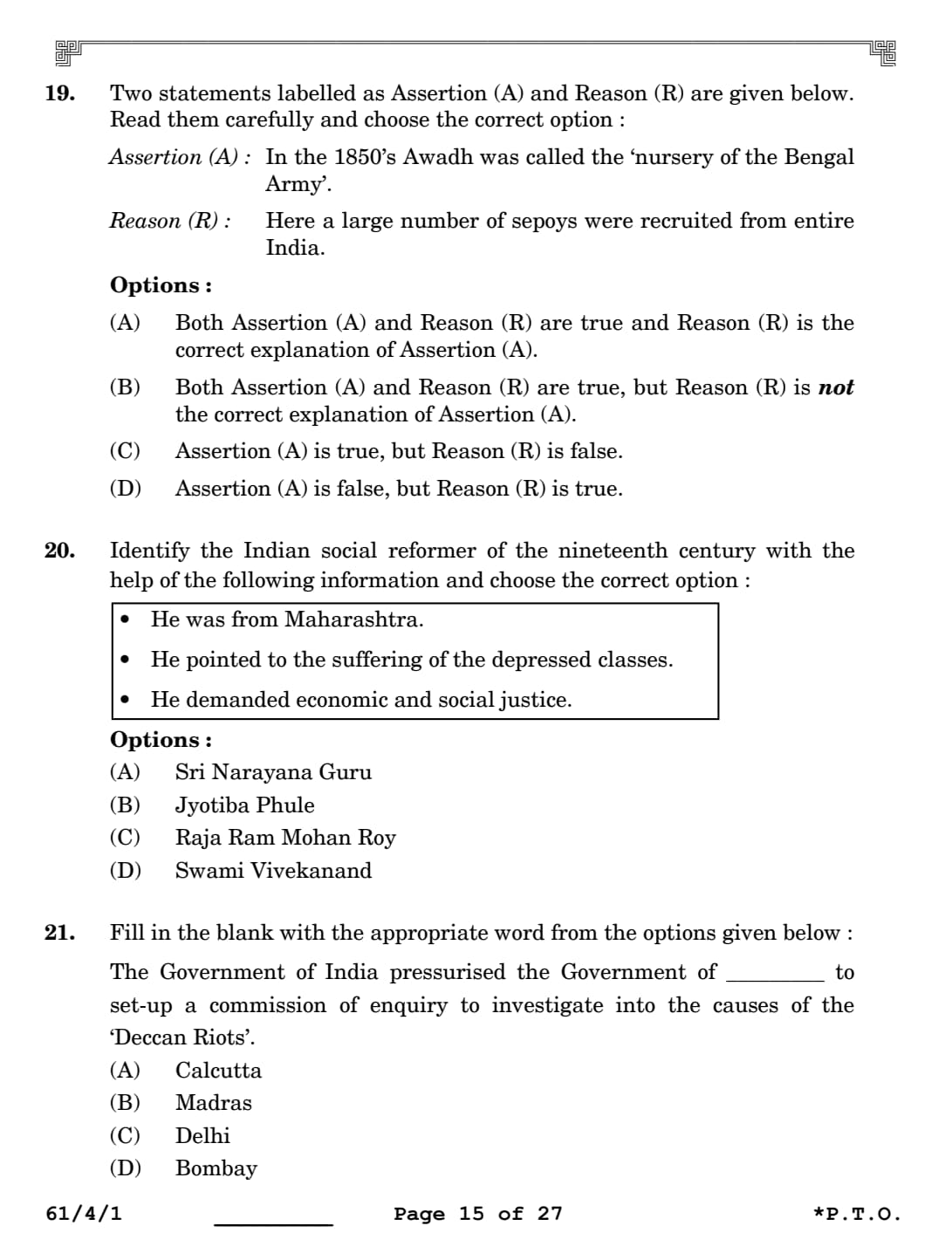


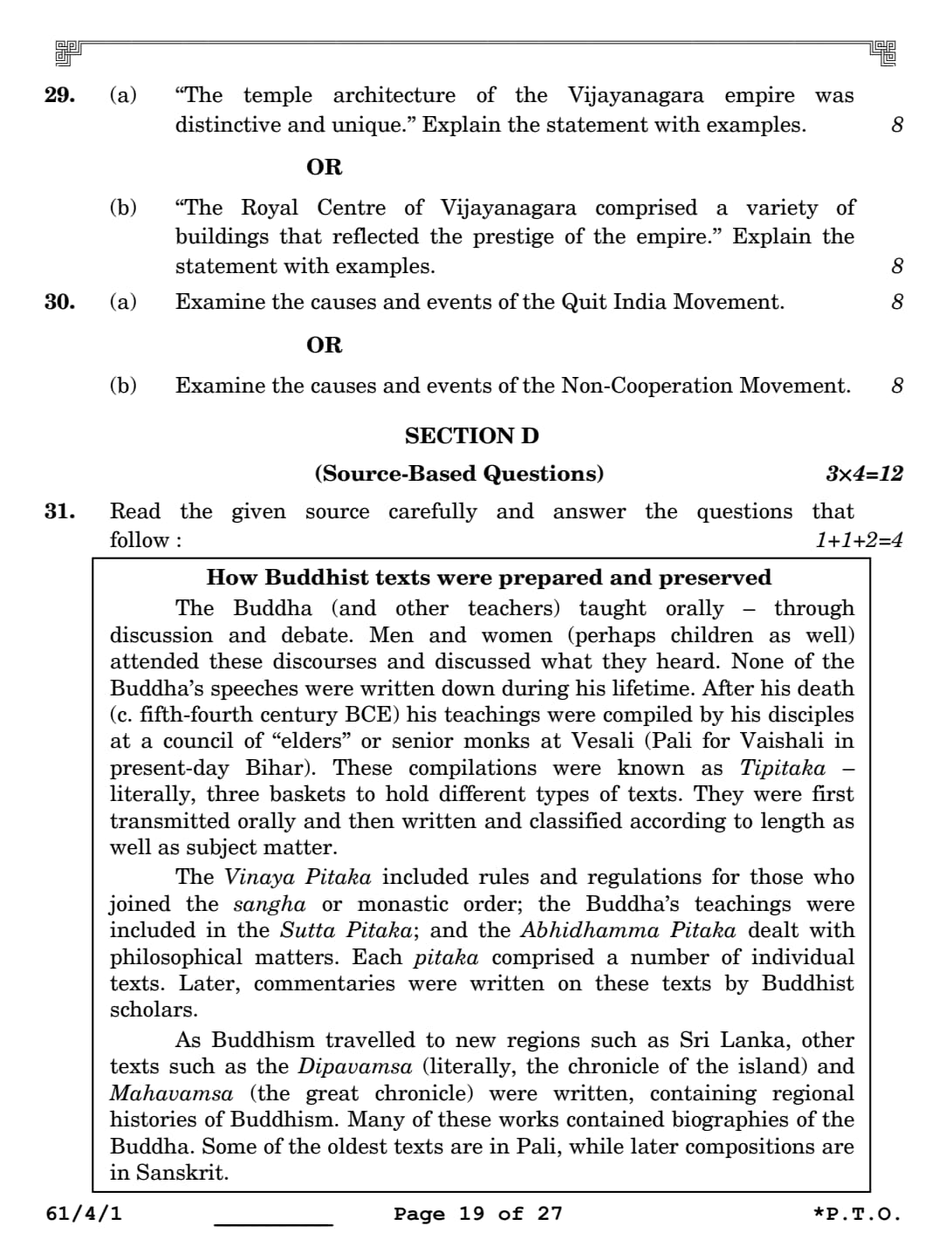




‘‘Mesopotamian texts mention contacts with Meluhha.’’ Which of the following statements is supported by archaeological interpretation regarding it ?
View Solution
Concept:
- Archaeological and literary evidence suggests that the Indus Valley Civilization (Harappa) had extensive maritime trade links with Mesopotamia.
- Mesopotamian cuneiform tablets from the 3rd millennium BCE refer to trade with three distant regions: Dilmun, Magan, and Meluhha.
- Historians use the types of goods traded and the geographic descriptions to identify these ancient locations.
Step 1: Analyzing Mesopotamian literary references to Meluhha
Mesopotamian texts describe Meluhha as a land of seafarers and a source of exotic products such as carnelian, lapis lazuli, copper, gold, and various types of wood.
The texts also mention a "Haja-bird" (identified by many as the peacock) belonging to Meluhha, which is a bird native to the Indian subcontinent.
These descriptions align closely with the natural resources and wildlife found in the Indus Valley region.
Step 2: Linking archaeological finds to the textual evidence
Archaeologists have discovered Harappan seals, weights, dice, and etched carnelian beads in Mesopotamian cities like Ur and Kish.
The standard of weights and the seal designs found in Mesopotamia are distinctly Harappan, proving a physical exchange of goods.
Since the artifacts match the products attributed to Meluhha in the texts, scholars conclude that Meluhha was the name used by Mesopotamians for the Harappan cultural and trading area.
Two statements labelled as Assertion (A) and Reason (R) are given below. Read them carefully and select the correct option :
Assertion (A) : Asoka was the first ruler who inscribed his messages to his subjects on stone surfaces and pillars.
Reason (R) : Asoka ensured that the message of dhamma reached as many people as possible.
View Solution
Concept:
- Emperor Ashoka of the Mauryan Empire revolutionized state communication by using epigraphy to speak directly to his people.
- He formulated a set of ethical codes known as ’Dhamma’ which emphasized non-violence, mutual respect, and social harmony.
- The medium of stone (rocks and pillars) was chosen for its permanence and public accessibility.
Step 1: Evaluating the Assertion regarding the medium of communication
Before Ashoka, there is no significant evidence of Indian monarchs using stone inscriptions for public edicts on such a massive scale.
Ashoka used polished sandstone pillars and natural rock surfaces across his vast empire to engrave his royal decrees.
This makes Assertion (A) historically accurate as he was indeed the pioneer of this method in the Indian subcontinent.
Step 2: Determining the link between the medium and the objective
Ashoka’s goal was the widespread dissemination of Dhamma to maintain social order and peace.
By placing these inscriptions in public places like market squares, pilgrim sites, and along major trade routes, he maximized the visibility of his message.
The use of durable stone ensured the message would last, and the choice of local scripts (Brahmi, Kharosthi) ensured people could understand it.
Therefore, the need to reach the masses (Reason) explains why he chose the innovative and durable method of stone inscriptions (Assertion).
Arrange the following literary compositions in chronological order and choose the correct option :
I. Ashtadhyayi of Panini
II. Harshcharita of Banabhatta
III. Arthashastra of Kautilya
IV. Natyashastra of Bharata
View Solution
Concept:
- Chronology in ancient Indian literature is established by comparing linguistic styles, historical references, and archaeological data.
- The texts mentioned span from the later Vedic/Mahajanapada period to the early medieval period.
Step 1: Establishing the approximate time periods for each text
I. Ashtadhyayi: Written by the grammarian Panini, it is dated to roughly the \( 5^{\text{th}} \text{ to } 4^{\text{th}} \) century BCE. It laid the foundation for Classical Sanskrit.
III. Arthashastra: Attributed to Kautilya (Chanakya), the advisor to Chandragupta Maurya, it is generally dated to the \( 4^{\text{th}} \text{ to } 3^{\text{rd}} \) century BCE.
IV. Natyashastra: Attributed to Bharata Muni, this treatise on performing arts is dated between 200 BCE and 200 CE.
II. Harshcharita: Written by Banabhatta, the court poet of King Harshavardhana, it belongs to the \( 7^{\text{th}} \) century CE.
Step 2: Ordering the texts from earliest to latest
Based on the centuries established:
1. Panini’s Ashtadhyayi (I) - \( 5^{\text{th}} \) Century BCE
2. Kautilya’s Arthashastra (III) - \( 4^{\text{th}} \) Century BCE
3. Bharata’s Natyashastra (IV) - \( \sim 1^{\text{st}} \) Century CE
4. Banabhatta’s Harshcharita (II) - \( 7^{\text{th}} \) Century CE
The correct chronological order is I - III - IV - II, which matches Option (C).
Identify this character of Mahabharata with the help of the following information and choose the correct option :
• He considered himself as a disciple of Dronacharya.
• He honoured his guru by giving his right hand thumb as Gurudakshina.
• He mastered archery through self-practice.
View Solution
Concept:
- The Mahabharata illustrates various socio-political themes, including the rigid caste-based access to education and the extreme devotion in the teacher-student relationship.
- The story of the Nishada prince, Ekalavya, is a key narrative regarding these themes.
Step 1: Linking the attributes to the story of Ekalavya
Ekalavya was a forest-dwelling Nishada who wanted to learn archery from Dronacharya, the teacher of the royal Pandavas and Kauravas.
Drona refused him due to his low social standing and his vow to make Arjuna the greatest archer.
Ekalavya did not give up; he built a clay statue of Drona and practiced in front of it as if the teacher were present.
Through this immense focus and self-study, he achieved a level of skill that surpassed Arjuna.
Step 2: Analyzing the sacrifice of the thumb
When Drona discovered Ekalavya’s prowess, he realized he had to fulfill his promise to Arjuna.
He asked Ekalavya for ’Gurudakshina’ (the fee for the teacher), specifically demanding Ekalavya’s right thumb.
Without the thumb, an archer cannot pull the bowstring effectively.
Ekalavya immediately cut off his thumb and offered it to the teacher he had never officially met. This act confirms the character as Ekalavya.
Study the given image of Buddha from the first century CE and identify the ancient school of Indian art of this from the following options :

View Solution
Concept:
- During the early centuries of the Common Era, Buddhist art evolved through different regional schools, most notably Gandhara and Mathura.
- The Gandhara School (located in modern-day Pakistan/Afghanistan) was heavily influenced by the Greco-Roman artistic traditions brought by Indo-Greeks.
Step 1: Identifying stylistic markers in the sculpture
The image provided shows a Buddha with a "Hellenistic" or Greek look.
Key features include: 1. Wavy hair instead of the tight curls found in later Indian styles. 2. A realistic, sharp nose and defined facial muscles. 3. Thick, heavy robes with deep, realistic folds that resemble a Roman toga.
These features are the specific characteristics of the Gandhara School of art.
Step 2: Differentiating from other schools
In the Mathura school, the Buddha’s robes are usually thin and cling to the body (transparent effect), and the hair is typically styled in spiral curls.
The Sarnath school (Gupta period) features extremely smooth, plain robes and a meditative, refined face.
The Amravati school focused more on narrative relief sculptures in white marble.
Because the image emphasizes realistic anatomy and heavy drapery, it is definitively a product of the Gandhara school.
OR
Question 5:
Note : The following question is for the Visually Impaired Candidates only,in lieu of Q. No. 5.
Which of the following is another name for Hinayana Buddhism ?
View Solution
Concept:
- Buddhism split into various sects over centuries due to differences in the interpretation of the Buddha’s teachings and monastic rules.
- The major early split resulted in the formation of the Hinayana (Lesser Vehicle) and Mahayana (Great Vehicle) traditions.
- Hinayana practitioners focused on individual salvation and followed the original, simpler teachings of the Buddha.
Step 1: Understanding the origin of the term ’Hinayana’
The term "Hinayana" was actually coined by the followers of the Mahayana sect to describe those who followed the older, more orthodox tradition.
The followers of this older tradition did not refer to themselves as Hinayana; instead, they called their school "Theravada," which literally translates to "The Way of the Elders."
Theravada is considered the most ancient and orthodox branch of Buddhism existing today.
Step 2: Evaluating the other options provided
- Vajrayana: Also known as the "Diamond Vehicle," this is a later form of Buddhism that involves tantric practices and is prominent in Tibet and Mongolia.
- Mahayana: This sect believes in the concept of Bodhisattvas and treats the Buddha as a god-like figure. It is the "Great Vehicle" and is distinct from Hinayana.
- Zen: This is a specific school of Mahayana Buddhism that originated in China (as Chan) and became highly influential in Japan, focusing on meditation (Zazen).
Match Column A with Column B regarding the important archaeological contributions and choose the correct option :

View Solution
Concept:
- The discovery and study of the Indus Valley Civilization involved several key archaeologists working under the Archaeological Survey of India (ASI).
- Each archaeologist contributed differently, ranging from specific site excavations to administrative documentation and the introduction of new scientific methodologies.
Step 1: Matching the pioneers of Harappa and Mohenjodaro
Daya Ram Sahni was an Indian archaeologist who led the excavations at Harappa in the Punjab province in 1921. His discovery of seals there was the first evidence of this ancient civilization.
Rakhal Das Banerji (R. D. Banerji) discovered similar seals at Mohenjodaro in Sindh in 1922, leading to the realization that these two sites belonged to the same single archaeological culture.
Step 2: Identifying contributions to methodology and history
R.E.M. Wheeler, as the Director-General of the ASI in the 1940s, introduced the use of stratigraphy in excavations instead of digging in arbitrary horizontal units. He famously noted that he brought military precision to the field.
S.N. Roy was a historian and archaeologist known for chronicling the development of the field in India. He authored the significant book, ‘The Story of Indian Archaeology’.
Matching these pairs gives: a-ii, b-i, c-iv, d-iii.
Which one of the following constituted ‘Stridhana’ owned by women according to the Dharmashastras ?
View Solution
Concept:
- According to ancient Dharmashastras (legal texts like Manusmriti), women had limited rights to property, primarily categorized as ’Stridhana’.
- Stridhana literally translates to "woman’s wealth" and was considered her absolute property, which she could pass on to her children.
Step 1: Defining the components of Stridhana
Stridhana consisted of gifts received by a woman at the time of her marriage (adhya-agni) or during the bridal procession (adhyavahanika).
It also included tokens of affection given by her father, mother, or brother, and gifts received after marriage from her husband’s family or her own relatives.
Step 2: Contrasting Stridhana with other property rights
The Dharmashastras generally prohibited women from hoarding family property or their husband’s wealth without permission.
While sons had a claim to paternal estate, women were usually excluded from inheriting land or paternal property unless specifically gifted. Stridhana was the only form of wealth over which a woman had significant control, often specifically inherited by daughters.
Therefore, Option (B) correctly identifies the core of what constituted Stridhana.
Which one of the following pairs is correctly matched ?

View Solution
Concept:
- Many foreign travellers visited India between the 13th and 18th centuries, leaving behind detailed accounts of the social, political, and economic conditions.
- Identifying their countries of origin is essential for understanding the perspective from which they wrote.
Step 1: Analyzing the origin of each traveller
Afanasii Nikitin was a Russian merchant who visited India in the 15th century and wrote ’A Journey Beyond the Three Seas’. He was from Russia, not Spain.
Jean-Baptiste Tavernier was a 17th-century French gem merchant and traveller who famously described the Peacock Throne and the Koh-i-Noor diamond. He was from France, not the Netherlands.
Marco Polo was a 13th-century Venetian merchant and explorer. Venice is in modern-day Italy. He visited South India on his way back from China.
Francisco Pelsaert was a merchant of the Dutch East India Company who visited India during the reign of Jahangir. He was from the Netherlands (Dutch), not Portugal.
Step 2: Selecting the correctly matched pair
Comparing the origins, only Marco Polo is correctly matched with Italy (Venice). The others have incorrect countries assigned in the options.
Which of the following statements about Mirabai are correct ?
I. She was married into Sisodia clan of Mewar.
II. She considered Krishna her divine lover.
III. Her spiritual guru was Ramanand.
IV. She founded a sect with a group of followers.
View Solution
Concept:
- Mirabai (c. 15th-16th century) was a prominent Bhakti saint and poetess from Rajasthan, known for her intense devotion to Lord Krishna.
- Her life reflects the challenges faced by women saints who defied social and patriarchal norms of the time.
Step 1: Verifying statements I and II
Statement I is correct: Mirabai was a Rajput princess from Merta who was married to Bhoj Raj, the son of Rana Sanga of the Sisodia clan of Mewar, against her wishes.
Statement II is correct: She rejected the comforts of the palace and traditional marriage, considering herself the consort of Lord Krishna (Giridhar Gopal). Her poetry expresses deep personal longing and love for him.
Step 2: Evaluating statements III and IV
Statement III is incorrect: According to traditions, her spiritual guru was Raidas (Ravidas), a leatherworker. This choice of a "low-caste" guru was a significant defiance of caste norms. Ramanand was the guru of Kabir and others, but lived much earlier.
Statement IV is incorrect: Mirabai did not intend to found a sect or have a formal group of followers. Her movement was one of personal, individual devotion. While her songs became popular, she did not establish a structured religious order.
Thus, only statements I and II are correct.
Which of the following regions was known as the ‘Raichur Doab’ that was captured by the Vijayanagara Empire in 1512 ?
View Solution
Concept:
- The word ’Doab’ refers to a fertile tract of land situated between two converging rivers.
- Geopolitically, the Raichur Doab was a highly contested territory in South India due to its extreme fertility and strategic location.
Step 1: Identifying the geographical location of Raichur Doab
The Raichur Doab is specifically the triangular region of land in the Deccan, bounded by the Krishna River to the north and the Tungabhadra River to the south.
Because of its agricultural productivity, it was the primary cause of conflict between the Vijayanagara Empire and the Bahmani Sultanate (and later the Bijapur Sultanate) for over two centuries.
Step 2: Linking the region to Vijayanagara history
In 1512, during the reign of Krishnadeva Raya, the greatest ruler of the Tuluva dynasty, the Vijayanagara Empire successfully captured the fortress of Raichur and the surrounding doab from the Sultan of Bijapur.
This victory was a high point in the military history of Vijayanagara, securing the empire’s northern frontier for a significant period.
Therefore, Option (D) correctly identifies the rivers defining this region.
Fill in the blank with the appropriate word from the options given below :
The Ain-i-Akbari was part of a larger history called the Nama.
View Solution
Concept:
- The *Akbarnama* is the official chronicles of the reign of Akbar, the third Mughal Emperor.
- It was commissioned by Akbar himself and written by his court historian and close friend, Abu’l Fazl.
- The work is divided into three volumes (daftars), each covering different aspects of the empire and the emperor’s life.
Step 1: Understanding the structure of Abu’l Fazl’s work
The *Akbarnama* consists of three books. The first book deals with Akbar’s ancestors and the birth of Akbar. The second book records the detailed events of Akbar’s reign up to the 46th year of his rule.
The third book is the most famous and is titled the *Ain-i-Akbari*. It deals with the administration, army, revenues, and the geography of the empire, as well as the traditions and culture of the people living in India.
Step 2: Identifying the correct title
Since the *Ain-i-Akbari* is the administrative volume of the larger historical project chronicling Akbar’s reign, the larger history is called the *Akbarnama* (or the Akbar-Nama).
Therefore, the blank should be filled with "Akbar", making the full name *Akbarnama*.
According to Akbar’s land classification, which of the following categories referred to land left uncultivated for more than five years ?
View Solution
Concept:
- Under the Mughal administration, particularly during Akbar’s reign, the land revenue system (Zabt) required a systematic classification of land based on its productivity.
- This classification was used to determine the tax (revenue) to be paid by the cultivators.
- The classification was mentioned in detail in the *Ain-i-Akbari*.
Step 1: Categorizing land based on cultivation frequency
The Mughal state divided land into four categories: 1. Polaj: Land which is annually cultivated for each crop in succession and is never allowed to lie fallow. 2. Parauti: Land left out of cultivation for a time (1-2 years) that it may recover its strength. 3. Chachar: Land that has lain fallow for three or four years. 4. Banjar: Land uncultivated for five years and more.
Step 2: Identifying the specific category
The question asks for the category that was left uncultivated for more than five years. Based on the administrative definitions provided by Abu’l Fazl, this category is ’Banjar’. Banjar land was often brought under cultivation through state-provided incentives like tax tax-free periods or lower rates to encourage agricultural expansion.
Find the odd one out regarding the Sikh Gurus.
View Solution
Concept:
- Sikhism was founded on the teachings of ten successive Gurus, starting from the 15th century.
- The lineage of the ten human Gurus ended with Guru Gobind Singh, who designated the *Guru Granth Sahib* as the eternal Guru.
- While many Bhakti and Sufi saints’ hymns are included in the Sikh scripture, they are not counted as part of the lineage of the ten Gurus.
Step 1: Identifying the official Sikh Gurus
Guru Nanak Dev (A) was the founder and the first Guru of Sikhism.
Guru Angad Dev (B) was the second Guru, who standardized the Gurmukhi script.
Guru Arjan Dev (D) was the fifth Guru, who compiled the *Adi Granth* and built the Harmandir Sahib (Golden Temple).
Step 2: Identifying the odd entry
Guru Raidas (also known as Bhagat Ravidas) was a 15th-16th century Bhakti saint and poet from North India. While his verses are highly respected and 41 of his hymns are included in the *Guru Granth Sahib*, he was not one of the ten designated Sikh Gurus. He was a contemporary of Guru Nanak but belonged to the broader Bhakti movement rather than the formal lineage of Sikh Gurus.
Read the following statements regarding Ibn Battuta’s travel experiences and choose the correct option :
I. His travel was unsafe as he was looted many times.
II. He travelled in caravans along with companions.
III. His journey took months due to vast distances.
IV. He has written his travelling experiences in Persian.
View Solution
Concept:
- Ibn Battuta was a 14th-century Moroccan traveller who reached India during the reign of Muhammad bin Tughlaq.
- His accounts provide a global perspective on the Islamic world and the Indian subcontinent during the medieval period.
Step 1: Analyzing statements I, II, and III
Statement I is correct: Ibn Battuta recorded that travel in the 14th century was hazardous. He was attacked by bands of robbers several times and once even narrowly escaped with his life during a journey from Multan to Delhi.
Statement II is correct: Due to safety concerns and logistics, he preferred travelling in large caravans with other merchants and travellers.
Statement III is correct: Distances were enormous. For example, he mentions it took 40 days to travel from Multan to Delhi and about 50 days from Sind to Delhi.
Step 2: Evaluating Statement IV
Statement IV is incorrect: Ibn Battuta was from Tangier, Morocco, and was a scholar of Islamic law (Qazi). He wrote his travelogue, famously known as the *Rihla*, in Arabic, not Persian. The work was dictated to a scribe, Ibn Juzayy, upon his return to Morocco.
Since statements I, II, and III are correct, the correct option is (B).
Who amongst the following was the leader of the Santhal rebellion ?
View Solution
Concept:
- The Santhal Rebellion (or Santhal Hool) occurred in 1855–56 in the Rajmahal hills (present-day Jharkhand/West Bengal).
- It was a major uprising by the Santhal tribe against the oppressive Zamindari system, the moneylenders (dikus), and the British colonial authorities who supported them.
Step 1: Identifying the leaders of the uprising
The rebellion was led by four brothers from the Murmu clan: Sidhu, Kanhu, Chand, and Bhairav. Sidhu and Kanhu (often referred to as Sidhu Manjhi and Kanhu Manjhi) were the primary leaders who claimed that they had a divine mandate from ’Thakur’ (God) to end the oppression of the outsider "dikus".
Step 2: Evaluating other tribal leaders
Birsa Munda (B) led the Munda Uprising (Ulgulan) in the 1890s in the Chhotanagpur region.
Alluri Sitarama Raju (C) led the Rampa Rebellion in Andhra Pradesh in the 1920s against British forest laws.
Jatra Bhagat (D) founded the Tana Bhagat movement among the Oraon tribe around 1914.
Thus, Sidhu Manjhi is the correct leader associated with the Santhals.
Which of the following regions was not a major centre of the Revolt of 1857 ?
View Solution
Concept:
- The Revolt of 1857, also known as the First War of Independence, was primarily concentrated in North and Central India.
- It began as a mutiny of sepoys in the East India Company’s army but quickly spread to include various sections of society, including displaced royalty and peasants.
- Southern India remained largely stable and did not experience the same scale of coordinated rebellion as the Gangetic plains.
Step 1: Identifying the major centres in North India
Meerut is historically significant as the place where the revolt broke out on May 10, 1857, after sepoys refused to use the new greased cartridges.
Kanpur became a major hub under the leadership of Nana Sahib, the adopted son of Peshwa Baji Rao II, who joined the rebels to reclaim his pension and title.
Lucknow was another critical centre where Begum Hazrat Mahal led the resistance after the British annexed Awadh in 1856.
Step 2: Evaluating the status of Mysore
Mysore, located in South India, had already undergone significant administrative changes after the fall of Tipu Sultan in 1799.
During 1857, while there were isolated incidents of unrest in the South, Mysore did not emerge as a "major centre" of the uprising. The revolt was largely a phenomenon of the Bengal Army and the northern feudal lords.
Therefore, Mysore is the correct answer as it was not a focal point of the 1857 rebellion.
Choose the correct option from the following to fill in the blank regarding the regions of nationalist leaders of India :
Bal Gangadhar Tilak : Maharashtra; Bipin Chandra Pal :
View Solution
Concept:
- During the early 20th century, the Indian National Congress saw the rise of a "militant nationalist" or "extremist" phase.
- This phase was dominated by a famous trio known as "Lal-Bal-Pal," representing different geographic regions of India united against British colonial rule.
- They advocated for Swadeshi, Boycott, and National Education as tools for achieving Swaraj.
Step 1: Identifying the ’Lal-Bal-Pal’ trio and their regions
Lala Lajpat Rai (Lal) was a prominent leader from Punjab, often called the ’Lion of Punjab’ (Sher-e-Punjab).
Bal Gangadhar Tilak (Bal) hailed from Maharashtra (then part of the Bombay Presidency) and is famous for his slogan, "Swaraj is my birthright and I shall have it."
Bipin Chandra Pal (Pal) was the third member of this group. He was a great orator and journalist who played a central role in the anti-partition movement (1905).
Step 2: Determining the region for Bipin Chandra Pal
Bipin Chandra Pal belonged to Bengal. He was one of the chief architects of the Swadeshi movement that originated in Bengal in response to Curzon’s partition plan.
Just as Tilak mobilized Maharashtra through the Ganpati and Shivaji festivals, Pal used the platform of journalism and public speeches to radicalize the youth of Bengal.
Therefore, the blank is correctly filled by ’Bengal’.
Match Column A with Column B regarding the important Committees of the Constituent Assembly and Presidents and choose the correct option :

View Solution
Concept:
- The Constituent Assembly of India appointed several committees to deal with different tasks of constitution-making.
- These committees included major committees (headed by top leaders) and minor committees/sub-committees.
- The division of labour allowed for deep specialization in areas like fundamental rights, federal structure, and procedural rules.
Step 1: Matching Committees to their respective chairmen
The Drafting Committee was the most important committee, tasked with preparing the actual text of the Constitution. It was chaired by Dr. B.R. Ambedkar (c-ii).
The States Committee (Committee for Negotiating with States) was headed by Jawaharlal Nehru (b-iii).
The Steering Committee, which managed the business and procedure of the Assembly, was chaired by the President of the Assembly himself, Dr. Rajendra Prasad (d-i).
The Fundamental Rights Sub-Committee was a specific body under the Advisory Committee. It was chaired by Acharya J.B. Kripalani (a-iv).
Step 2: Selecting the correct combination
Based on the matches: a-iv, b-iii, c-ii, and d-i. This corresponds to Option (A).
Two statements labelled as Assertion (A) and Reason (R) are given below. Read them carefully and choose the correct option :
Assertion (A) : In the 1850’s Awadh was called the ‘nursery of the Bengal Army’.
Reason (R) : Here a large number of sepoys were recruited from entire India.
View Solution
Concept:
- The Bengal Army was one of the three main armies of the British East India Company.
- Its recruitment policy favored high-caste Hindus (Brahmins and Rajputs) from specific geographic regions.
- Awadh was a major region of focus for British recruitment throughout the early 19th century.
Step 1: Verifying the Assertion
By the 1850s, Awadh had become the primary source of manpower for the Bengal Army. It is estimated that nearly every agricultural household in Awadh had at least one member serving in the army.
Because of this overwhelming concentration of soldiers from one region, British officers frequently referred to Awadh as the "nursery of the Bengal Army." Thus, Assertion (A) is true.
Step 2: Evaluating the Reason
The Reason (R) states that sepoys were recruited from "entire India". This is factually incorrect regarding the Bengal Army.
The Bengal Army specifically avoided recruiting from South India or the lower castes. It predominantly recruited from Awadh and the North-Western Provinces (modern-day Uttar Pradesh and Bihar).
The nickname ’nursery’ was given precisely because the recruitment was not from entire India, but specifically from Awadh. Since the reason contains a false historical claim, Reason (R) is false.
Therefore, Assertion (A) is true, but Reason (R) is false.
Identify the Indian social reformer of the nineteenth century with the help of the following information and choose the correct option :
• He was from Maharashtra.
• He pointed to the suffering of the depressed classes.
• He demanded economic and social justice.
View Solution
Concept:
- The 19th-century Indian Renaissance saw several reformers who fought against the caste system and for the rights of marginalized communities.
- These reformers often founded organizations to propagate their ideas and utilized literature to spread awareness.
Step 1: Filtering candidates by region and focus
Sri Narayana Guru (A) was a great reformer who fought against the caste system, but he was from Kerala, not Maharashtra.
Raja Ram Mohan Roy (C) and Swami Vivekanand (D) were both from Bengal. While they worked on social issues (like Sati and religious reform), their primary regional base was not Maharashtra.
Step 2: Identifying the specific contributions of Jyotiba Phule
Jyotiba Phule was a 19th-century reformer based in Pune, Maharashtra.
He dedicated his life to the upliftment of the "depressed classes" (Dalits) and women. In 1873, he founded the Satyashodhak Samaj (Society of Seekers of Truth) to demand social and economic justice.
He wrote ’Gulamgiri’ (Slavery), dedicated to the American movement to free slaves, linking the local caste struggle with global movements for human rights. This matches all the criteria in the question perfectly.
Fill in the blank with the appropriate word from the options given below :
The Government of India pressurised the Government of to set-up a commission of enquiry to investigate into the causes of the ‘Deccan Riots’.
View Solution
Concept:
- The Deccan Riots of 1875 were a series of peasant uprisings in the Poona and Ahmednagar districts of the Bombay Presidency.
- The riots were directed against the ’Sahukars’ (moneylenders) who used the Ryotwari system to exploit the indebted peasantry.
- The British authorities were initially reluctant to intervene but were forced to act as the unrest threatened agrarian stability.
Step 1: Understanding the administrative jurisdiction
The riots took place in the Bombay Presidency. Initially, the Government of Bombay was reluctant to admit that the uprising was due to the high land revenue rates or the failures of British policy. They preferred to view it as a law and order issue caused by the rapacity of moneylenders.
Step 2: Intervention by the Central Government
The Government of India, concerned that the unrest might spread to other regions, pressurized the provincial Government of Bombay to set up a formal commission of inquiry.
As a result, the Deccan Riots Commission was formed, which produced a report in 1878. This led to the passing of the Deccan Agriculturists’ Relief Act in 1879, which aimed to protect the peasants from the arrest and imprisonment for non-payment of debts.
Imagine you are writing a research project on Harappan agriculture. Which three informations on archaeological evidence would you cite to explain it ?
View Solution
Concept:
- Reconstruction of Harappan agriculture relies on ’archaeo-botanical’ evidence (charred grains) and ’archaeo-zoological’ evidence.
- Archaeologists also look for physical remains of agricultural tools and irrigation infrastructure to understand the technological level of the civilization.
Step 1: Evidence of ploughing and land preparation
Archaeologists have found terracotta models of the plough at sites in Cholistan and at Banawali (Haryana).
Even more significant is the discovery of a ploughed field at Kalibangan (Rajasthan), which dates back to the Early Harappan levels. This field has two sets of furrows at right angles to each other, suggesting that two different crops were grown together at the same time.
Step 2: Evidence of irrigation technology
Most Harappan sites were located in semi-arid lands where irrigation was probably required for agriculture.
Traces of canals have been found at the Harappan site of Shortughai in Afghanistan. Additionally, water reservoirs found in Dholavira (Gujarat) may have been used to store water for agriculture, demonstrating a high level of hydraulic engineering.
Step 3: Evidence from charred food grains
Archaeologists have recovered a wide variety of charred grains, including wheat, barley, lentil, chickpea, and sesame.
In Gujarat, finds of millets are frequent, and although rice finds are relatively rare, the diversity of these grains indicates a highly developed and varied agricultural system that supported a large urban population.
Imagine your school is hosting an exhibition on the Harappan civilization and you are responsible for the section on the Harappan script. Which three aspects of it would you explain to the visitors ?
View Solution
Concept:
- The Harappan script is one of the most enigmatic features of the civilization as it remains undeciphered to this day.
- It is mostly found on seals, copper tools, rims of jars, and small tablets, suggesting a widespread use in administration and trade.
Step 1: The nature of the script (Pictographic and non-alphabetic)
The Harappan script is not alphabetic (where each symbol stands for a vowel or a consonant) but pictographic/logographic.
It has too many signs—somewhere between 375 and 400—for it to be an alphabet. Each sign likely represented a word, an idea, or a syllable. This is a crucial point for visitors to understand why it is so difficult to read.
Step 2: Direction of writing
Archaeological evidence, particularly the spacing on seals, suggests that the script was written from right to left.
On some seals, there is wider spacing on the right and cramping on the left, which implies that the engraver started writing from the right and ran out of space as they moved toward the left side of the seal.
Step 3: Context of usage (The ’Signboard’)
The script was used for a variety of purposes. Most inscriptions are very short, the longest containing about 26 signs.
One of the most spectacular finds is a large ’signboard’ found at Dholavira, consisting of ten large signs made of white gypsum inlaid in a wooden board. This suggests that the script was used for public communication and as a symbol of authority or identification.
Describe any three features of the Mauryan administration.
View Solution
Concept:
- The Mauryan Empire (c. 321–185 BCE) was the first large-scale centralized empire in India.
- Its administration was characterized by a strong central authority, a massive military, and an efficient bureaucratic network described in the *Arthashastra* and Megasthenes’ *Indica*.
Step 1: Five major political centers
The empire was divided into administrative units with five major political centers: the capital, Pataliputra, and four provincial centers—Taxila, Ujjayini, Tosali, and Suvarnagiri.
These centers were strategically chosen; for example, Taxila and Ujjayini were on important long-distance trade routes, while Suvarnagiri (the "golden mountain") was important for tapping the gold mines of Karnataka.
Step 2: Military organization and committees
Megasthenes mentions a committee with six sub-committees for coordinating military activity.
One sub-committee looked after the navy, the second managed transport and provisions, the third was responsible for foot-soldiers (infantry), the fourth for horses (cavalry), the fifth for chariots, and the sixth for elephants. This demonstrates a highly sophisticated and specialized military bureaucracy.
Step 3: Appointment of Dhamma Mahamattas
Ashoka introduced a unique administrative feature by appointing special officers known as ’Dhamma Mahamattas’.
Their task was to spread the message of Dhamma (moral conduct) among the subjects, ensuring social harmony and loyalty to the state. This shows that the Mauryan administration was not just about tax and war, but also about the moral well-being and ideological unification of the empire.
Explain the barriers that Al-Biruni faced in understanding Indian society.
View Solution
Concept:
- Al-Biruni (11th century) was a polymath who arrived in India following the invasions of Mahmud of Ghazni.
- Despite his scholarly rigor, he acknowledged several "barriers" (obstacles) that prevented an outsider from fully grasping the nuances of Indian culture and social structure.
Step 1: The linguistic barrier
The first and most significant barrier was language. Al-Biruni noted that Sanskrit was extremely different from Arabic and Persian.
He explained that ideas and concepts in Sanskrit were not easily translatable because the language had a different grammatical structure and a vast vocabulary where one word could have multiple meanings. He had to rely on Brahmanas and translations of texts like the Patanjali’s *Yoga Sutras* to bridge this gap.
Step 2: Religious and social divergence
The second barrier was the difference in religious beliefs and social practices.
Coming from an Islamic background where social equality was a core principle (at least in theory), Al-Biruni found the rigid, hierarchical Varna system and the concept of "pollution" (untouchability) in India to be completely alien and difficult to justify logically. He spent a lot of time comparing Indian philosophy with Greek philosophy to make it more understandable to his readers.
Step 3: The insularity and ’Self-absorption’ of the people
The third barrier, according to Al-Biruni, was the insularity of the local people (especially the Brahmanas).
He observed that they were remarkably proud of their own culture and believed that no other land was like theirs and no other people possessed science like they did. This "self-absorption" or isolationist attitude made it difficult for him to have open scholarly exchanges with local intellectuals initially.
Explain the role of Guru Gobind Singh in Sikhism.
View Solution
Concept:
- Guru Gobind Singh (1666–1708) was the tenth and last human Guru of the Sikhs.
- His leadership transformed the Sikh community into a highly disciplined, militant, and spiritually cohesive brotherhood during a period of intense Mughal persecution.
Step 1: Creation of the Khalsa (1699)
The most significant contribution of Guru Gobind Singh was the foundation of the ’Khalsa Panth’ (the Army of the Pure) at Anandpur Sahib in 1699.
He institutionalized the ’Pahul’ (initiation ceremony) and established a distinct identity for Sikhs. He mandated the "Five Ks" (Kesh, Kangha, Kachera, Kara, and Kirpan) to ensure that a Sikh would always be identifiable and ready to stand for justice.
Step 2: Consolidation of Scripture and Ending the Human Lineage
Guru Gobind Singh finalized the *Adi Granth* by adding the hymns of his father, Guru Tegh Bahadur.
Shortly before his death, he declared that the lineage of human Gurus would end with him. He vested the spiritual authority of the Guru in the *Guru Granth Sahib* (the holy scripture) and the temporal authority in the *Khalsa Panth* (the community), ensuring the survival of the faith without a central human figurehead.
Step 3: Resistance and Military leadership
He led the Sikhs in numerous battles against the Mughal Empire and local hill rajas to protect religious freedom.
His life and sacrifice (including the loss of his four sons) served as a powerful inspiration for Sikhs to resist tyranny. He effectively merged the ’Bhakti’ (devotion) tradition of Guru Nanak with ’Shakti’ (power/military strength), creating a community of "Saint-Soldiers."
Explain the ‘Ultimate Reality’ principle in Kabir’s philosophy.
View Solution
Concept:
- Kabir (c. 14th-15th century) was a revolutionary Nirguna Bhakti saint who challenged established religious orthodoxies.
- His philosophy of ’Ultimate Reality’ (the Supreme God) was syncretic, drawing from both Islamic monotheism and Vedantic monism.
Step 1: The Oneness of God (Nirguna aspect)
Kabir’s primary principle was that the Ultimate Reality is one, regardless of the names given to it by different religions.
He used Islamic terms like ’Allah’, ’Khuda’, ’Hazrat’, and ’Pir’ alongside Hindu terms like ’Alakh’ (the unseen), ’Niranjan’ (formless), ’Brahman’, and ’Atman’. By doing so, he argued that the labels ’Hindu’ or ’Muslim’ were superficial and that the essence of divinity was universal and formless (*Nirguna*).
Step 2: Rejection of rituals and intermediaries
For Kabir, the Ultimate Reality could not be found in temples, mosques, or through complex rituals, sacrifices, or idol worship.
He believed that God resides within the heart of every individual. Therefore, he emphasized ’Sabda’ (the Word) and the importance of a true ’Guru’ who can guide the seeker to perceive this inner reality. He used simple, often paradoxical language (Ulatbansi) to shock people out of their conventional religious thinking.
Step 3: The path of Shunya (Emptiness/Absoluteness)
Kabir also drew upon Yogic and Sufi concepts of ’Shunya’ (the void) or ’Ana-had’ (the unstruck sound) to describe the mystical experience of merging with the Ultimate Reality.
His philosophy was not just intellectual but experiential; he taught that through constant remembrance of God’s name (Simran), one could attain a state of spiritual liberation while still living. This made the Ultimate Reality accessible to common people, regardless of their caste or creed.
How did the British exploit the Paharias of Rajmahal hills during the 18th century? Explain with examples.
View Solution
Concept:
- The Paharias were hunter-gatherers and shifting cultivators living in the Rajmahal hills.
- British colonial policy favored settled agriculture as it provided a stable source of revenue and a more "ordered" society.
- This led to a direct conflict between the ’hoe’ (represented by the Paharias) and the ’plough’ (represented by the British-backed settled cultivators).
Step 1: Encroachment on forest lands and resources
In the late 18th century, the British began encouraging the clearing of forests in the Rajmahal hills to expand settled agriculture.
As forests were cut down, the Paharias lost their primary source of livelihood—hunting and shifting cultivation (jhum). Their access to forest produce like mahua, silk cocoons, and resin was restricted, and their grazing lands for cattle were increasingly enclosed by the state.
Step 2: Policy of Pacification and the ’Santhal Factor’
Initially, the British tried to "pacify" the Paharias by giving their chiefs annual allowances in exchange for maintaining peace. However, many chiefs refused this, leading to violent clashes.
To permanently settle the issue, the British began settling the more industrious Santhals on the peripheries of the Rajmahal hills (Damin-i-Koh). The Santhals were given land and incentives to clear forests and practice settled plough agriculture. This effectively "boxed in" the Paharias to the higher, more barren parts of the hills, leading to extreme poverty and starvation.
Analyse how the Constituent Assembly of India addressed the issue of federalism.
View Solution
Concept:
- Federalism involves the distribution of powers between a central government and its constituent provincial units.
- The Constituent Assembly had to balance the demand for provincial autonomy with the need for a strong center to maintain national unity during the chaotic period of Partition.
Step 1: Creation of the Three Lists of Power
The Assembly established a clear division of legislative powers through three lists: the Union List (subjects like defense and foreign affairs), the State List (subjects like agriculture and health), and the Concurrent List (subjects where both could legislate, like education).
While the lists provided a framework for federalism, the Union List was significantly longer, and the ’Residuary Powers’ (powers not mentioned in any list) were vested in the Central government, indicating a tilt towards a strong center.
Step 2: Fiscal Federalism and the Center’s dominance
The debate on federalism was also financial. The Center was given control over the most lucrative sources of revenue, such as customs duties and income tax.
The provinces were made dependent on the Center for grants-in-aid. Some members, like K. Santhanam from Madras, argued that this would make the states "beggars at the door of the center," but the majority felt a strong financial center was necessary for national planning and security in a post-partition environment.
Describe the examples which show that Brahmanical ideas on kinship, marriage and ruling lineage were not universally followed during the early historical period in India.
View Solution
Concept:
- Brahmanical texts like the *Dharmashastras* and *Manusmriti* prescribed rigid rules for social behavior, including the Varna system and patrilineal succession.
- However, historical evidence from inscriptions and literary sources often shows a more diverse and flexible reality.
Step 1: Non-Kshatriya ruling lineages
According to the Shastras, only Kshatriyas could be kings. However, history is full of exceptions. The Mauryas, described as of ’low origin’ in Brahmanical texts, were a major imperial power.
The Shungas and Kanvas, who succeeded the Mauryas, were Brahmanas. Similarly, the Shakas and Kushanas from Central Asia were considered "Mlechchhas" (outsiders) but established powerful kingdoms, often adopting Indian titles and patronage of Buddhism.
Step 2: Deviations in marriage and kinship: The Satavahanas
The Satavahanas of the Deccan provide a striking contrast. While they claimed to be Brahmanas (destroyers of the pride of Kshatriyas), they practiced endogamy (marriage within the kin group), which contradicted the Brahmanical rule of exogamy (marriage outside the gotra).
Furthermore, Satavahana rulers often used metronymics (names derived from the mother, like Gautamiputra), suggesting that mothers occupied an important social position, although succession to the throne remained patrilineal.
Step 3: Complex kinship in the Mahabharata
The central plot of the Mahabharata itself revolves around a conflict within a single lineage over succession.
The practice of Polyandry (Draupadi marrying the five Pandavas) was a significant deviation from Brahmanical norms, which usually favored monogamy or polygyny. Such examples suggest that Brahmanical prescriptions were ideals that were frequently negotiated or ignored in practice.
Describe the process undertaken by V.S. Sukthankar and his team in preparing the critical edition of the Mahabharata.
View Solution
Concept:
- The Mahabharata had evolved over nearly 1000 years, leading to vast regional variations in the text.
- The Critical Edition project (started in 1919) was an ambitious attempt to reconstruct a version of the text that was common to all regional manuscripts.
Step 1: Collection and comparison of manuscripts
The project, led by the renowned Sanskritist V.S. Sukthankar at the Bhandarkar Oriental Research Institute in Pune, began by collecting hundreds of manuscripts from across the subcontinent.
These manuscripts were written in various scripts (Sarada, Devanagari, Grantha, Malayalam, etc.) and found in diverse locations from Kashmir in the north to Kerala in the south. The team then meticulously compared the verses from each manuscript to identify commonalities.
Step 2: Selection of common verses and documentation of variations
The scholars identified the verses that appeared in almost all regional versions. These were selected for the main body of the ’Critical Edition’.
However, they did not ignore the regional differences. The project dedicated nearly half of its 13,000 pages to documented "variations"—verses that appeared in only one or a few regional versions. This provided a panoramic view of how the epic had adapted to local cultural contexts over centuries.
Step 3: Significance of the 47-year project
The project took 47 years to complete. It proved two things: first, that there was a massive core of commonality across India regarding the central epic; and second, that social and cultural history in India was a process of constant negotiation between a dominant tradition and diverse local practices. This project remains one of the greatest feats of modern Indian philology.
‘‘The temple architecture of the Vijayanagara empire was distinctive and unique.’’ Explain the statement with examples.
View Solution
Concept:
- Vijayanagara architecture represents the final flowering of the southern Dravidian style, but with innovative imperial additions.
- Temples were not just religious centers but also symbols of the Rayas’ power, patronage, and cultural synthesis.
Step 1: The Royal Gateways: Raya Gopurams
The most striking feature of Vijayanagara temples is the addition of massive ’Raya Gopurams’ (royal gateways).
These towered over the central shrines and were often visible from miles away. They were built on a scale that signaled the presence and might of the king. Examples can be seen in the expansion of the Virupaksha temple and the Hampi complex, where the gateways often dwarf the main temple building.
Step 2: Elaborate Mandapas and Carved Pillars
Another unique feature is the development of the ’Kalyana Mandapa’ (marriage hall) and pillared pavilions.
The pillars were often carved with intricate figures of charging horses (yalis) or scenes from the epics. The Vitthala temple is famous for its 56 "musical pillars" that produce different notes when tapped, demonstrating extraordinary lithic craftsmanship and architectural innovation.
Step 3: The Stone Chariot and the Vitthala Temple
The Vitthala temple complex features a magnificent stone chariot carved out of multiple slabs of granite, designed to look like a single piece.
This chariot, along with the sprawling courtyard and the axial layout of the temple, illustrates the "imperial style" where the temple was designed as a space for grand state-sponsored festivals like the Rathotsava (chariot festival).
‘‘The Royal Centre of Vijayanagara comprised a variety of buildings that reflected the prestige of the empire.’’ Explain the statement with examples.
View Solution
Concept:
- The Royal Centre was located in the southwestern part of the settlement and contained over 60 temples and about 30 palaces.
- These secular and ceremonial structures were built using a mix of traditional granite and Indo-Islamic features, symbolizing the cosmopolitan nature of the state.
Step 1: The Mahanavami Dibba: A platform of power
One of the most impressive structures is the Mahanavami Dibba, a massive stone platform nearly 40 feet high.
It was the center of a grand 10-day state ceremony during the Mahanavami (Dussehra) festival. The Raya (King) would receive tributes from subordinate chiefs, watch military parades, and perform rituals here, making it a physical representation of imperial hierarchy and power.
Step 2: The Lotus Mahal and Indo-Islamic Synthesis
The Lotus Mahal, so named by 19th-century British travelers, is a beautiful two-storied structure that likely served as a council chamber for the king and his advisors.
It features arches and domes that show a strong influence of Islamic architectural styles from the neighboring Sultanates. This synthesis reflected the prestige of an empire that was not isolated but was a major player in the wider Deccan political landscape.
Step 3: The Elephant Stables and Hazara Rama Temple
The Elephant Stables, located near the Lotus Mahal, consisted of 11 large domed chambers to house royal elephants, further emphasizing the military might of the Raya.
The Hazara Rama Temple was another key building in the royal enclosure, intended only for the king and his family. Its walls are decorated with relief sculptures of scenes from the Ramayana and processions of soldiers and musicians, celebrating the divine associations of the monarchy.
Examine the causes and events of the Quit India Movement.
View Solution
Concept:
- The Quit India Movement (August 1942) was the third and final great mass struggle led by Mahatma Gandhi.
- It was launched at a time when World War II was at its peak and the British were facing significant pressure from the Japanese advance in Southeast Asia.
Step 1: Causes: The failure of the Cripps Mission
The immediate cause was the failure of the Cripps Mission in early 1942. Sir Stafford Cripps had failed to promise a definite timeline for independence or to give Indians control over defense.
This convinced Gandhi and the Congress that the British had no intention of granting real power. Simultaneously, the rising prices and shortages of essential goods due to the war were creating intense public resentment against British rule.
Step 2: The ’Do or Die’ call and the launch
On August 8, 1942, at the Gowalia Tank Maidan in Bombay, the Congress passed the Quit India Resolution.
Gandhi gave the famous mantra: "Do or Die" (Karo ya Maro). He called upon every Indian to behave as if they were already free. The British responded preemptively by arresting all top Congress leaders, including Gandhi and Nehru, on the morning of August 9th.
Step 3: The leaderless rebellion and widespread events
Because the leadership was in jail, the movement became a spontaneous, leaderless rebellion.
Young activists like Jayaprakash Narayan and Aruna Asaf Ali led underground resistance. In many parts of India, such as Satara (Maharashtra) and Tamluk (Bengal), ’Prati-Sarkar’ (parallel governments) were established. Despite brutal repression by the British, the movement proved that India could no longer be governed without the consent of its people.
Examine the causes and events of the Non-Cooperation Movement.
View Solution
Concept:
- The Non-Cooperation Movement (1920–22) was the first large-scale experiment with Satyagraha on a national level.
- It aimed to bring the British administration to a standstill by withdrawing all Indian cooperation from colonial institutions.
Step 1: Causes: Rowlatt Act, Jallianwala Bagh, and Khilafat
The movement was triggered by three main grievances: 1. The repressive Rowlatt Act (1919) which allowed for detention without trial. 2. The horrific Jallianwala Bagh Massacre in Amritsar. 3. The Khilafat issue, where Indian Muslims were protesting the ill-treatment of the Caliph of Turkey by the British. Gandhi saw this as an opportunity to unite Hindus and Muslims in a common struggle.
Step 2: Methods of Non-Cooperation
The movement unfolded in stages. It began with the surrender of titles (like Rabindranath Tagore surrendering his Knighthood).
This was followed by the boycott of government schools, colleges, and law courts. Thousands of students left government institutions. The most effective part was the boycott of foreign cloth, which was replaced by locally produced Khadi, leading to a massive drop in British textile imports.
Step 3: The Chauri Chaura incident and withdrawal
The movement saw unprecedented participation from peasants, workers, and students across India.
However, in February 1922, at Chauri Chaura (UP), a peaceful procession turned violent and burned down a police station, killing 22 policemen. Gandhi, who was strictly committed to non-violence, immediately called off the movement, realizing that the people were not yet fully trained in the discipline of Satyagraha. Although it ended abruptly, it transformed the nationalist struggle into a genuine mass movement.
Question 36:
Read the given source carefully and answer the questions that follow :
How Buddhist texts were prepared and preserved
The Buddha (and other teachers) taught orally – through discussion and debate. Men and women (perhaps children as well) attended these discourses and discussed what they heard. None of the Buddha’s speeches were written down during his lifetime. After his death (c. fifth-fourth century BCE) his teachings were compiled by his disciples at a council of ‘‘elders’’ or senior monks at Vesali (Pali for Vaishali in present-day Bihar). These compilations were known as Tipitaka – literally, three baskets to hold different types of texts. They were first transmitted orally and then written and classified according to length as well as subject matter.
The Vinaya Pitaka included rules and regulations for those who joined the sangha or monastic order; the Buddha’s teachings were included in the Sutta Pitaka; and the Abhidhamma Pitaka dealt with philosophical matters. Each pitaka comprised a number of individual texts. Later, commentaries were written on these texts by Buddhist scholars.
As Buddhism travelled to new regions such as Sri Lanka, other texts such as the Dipavamsa (literally, the chronicle of the island) and Mahavamsa (the great chronicle) were written, containing regional histories of Buddhism. Many of these works contained biographies of the Buddha. Some of the oldest texts are in Pali, while later compositions are in Sanskrit.
When Buddhism spread to East Asia, pilgrims such as Fa Xian and Xuan Zang travelled all the way from China to India in search of texts. These they took back to their own country, where they were translated by scholars. Indian Buddhist teachers also travelled to faraway places, carrying texts to disseminate the teachings of the Buddha. Buddhist texts were preserved in manuscripts for several centuries in monasteries in different parts of Asia. Modern translations have been prepared from Pali, Sanskrit, Chinese and Tibetan texts.
Explain why Buddha’s speeches were not written down during his lifetime.
View Solution
Concept:
- In ancient India, the tradition of preserving knowledge was predominantly oral rather than written.
- The Buddha, like many other contemporary teachers, followed the ’Shravaka’ tradition, where teachings were meant to be heard and memorized.
Step 1: The nature of ancient teaching methods
The Buddha taught orally through the medium of discussion and debate. His primary goal was to engage his listeners directly, adapting his message to the intellectual and emotional state of his audience. Oral communication allowed for a dynamic interaction that was more suited to spiritual instruction than static writing.
Step 2: Preservation through memory and chanting
None of the Buddha’s speeches were written down during his lifetime because the emphasis was on internalizing the teachings. His followers, including men and women, attended his discourses and committed his words to memory. It was only after his death (Mahaparinibbana) that a council of senior monks (Elders) was convened at Vesali to compile and standardize these memories into what became the Tipitaka.
Assess the impact of orally transmitting texts before writing them down for preservation.
View Solution
Concept:
- Oral transmission involves the collective memorization and rhythmic chanting of texts to ensure their survival over generations.
- This method has unique strengths and weaknesses regarding the accuracy and evolution of the information being preserved.
Step 1: Standardization through communal chanting
Oral transmission necessitated the classification of teachings based on length and subject matter to make them easier to memorize. By chanting the texts collectively at councils, the monks could cross-verify each other’s memories. This communal process acted as a "checking mechanism" that helped maintain a standardized version of the Buddha’s words before they were finally committed to writing centuries later.
Step 2: Adaptability and regional variations
A significant impact of oral transmission was that as Buddhism traveled to new regions like Sri Lanka, the core teachings could be adapted or supplemented with regional histories (like the *Dipavamsa* and *Mahavamsa*). While the central ’baskets’ (Pitakas) remained relatively stable, the oral nature allowed for the growth of diverse commentaries and biographies that enriched the Buddhist literary tradition before the era of widespread manuscript production.
Explain the differences between the Vinaya Pitaka and Sutta Pitaka.
View Solution
Concept:
- The ’Tipitaka’ (Three Baskets) forms the core of the Buddhist canon, with each ’basket’ serving a distinct purpose in the life of a practitioner.
- The division is based on whether the content deals with monastic discipline or philosophical teachings.
Step 1: Focus on Discipline: The Vinaya Pitaka
The Vinaya Pitaka was compiled specifically for those who joined the ’Sangha’ (monastic order) as monks or nuns. Its content consists of rules and regulations for monastic life, covering everything from the procedure of joining the order to the daily conduct, dress, and food of the monks. It is essentially a legalistic and administrative manual for the community.
Step 2: Focus on Doctrine: The Sutta Pitaka
In contrast, the Sutta Pitaka is the collection of the Buddha’s actual teachings, sermons, and discourses. It contains the ethical and philosophical core of Buddhism, explaining concepts like the Four Noble Truths and the Eightfold Path. While the Vinaya is for the Sangha, the Sutta Pitaka contains guidance relevant to both the monastic community and the lay followers.
Question 39:
Read the given source carefully and answer the questions that follow :
Trade between the hill tribes and the plains, c. 1595
This is how Abu’l Fazl describes the transactions between the hill tribes and the plains in the suba of Awadh (part of present-day Uttar Pradesh) :
From the northern mountains quantities of goods are carried on the backs of men, of stout ponies and of goats, such as gold, copper, lead, musk, tails of the kutas cow (the yak), honey, chuk (an acid composed of orange juice and lemon boiled together), pomegranate seed, ginger, long pepper, majith (a plant producing a red dye) root, borax, zedoary (a root resembling turmeric), wax, woollen stuffs, wooden ware, hawks, falcons, black falcons, merlins (a kind of bird), and other articles. In exchange they carry back white and coloured clothes, amber, salt, asafoetida, ornaments, glass and earthen ware.
Why was trade between the mountains and plains important for the Mughal economy ?
View Solution
Concept:
- Pre-modern economies relied heavily on regional specialization and the exchange of locally unavailable resources.
- The Mughal economy was highly integrated, with trade linking the resource-rich peripheral mountains with the central agricultural plains.
Step 1: Supply of essential raw materials
The northern mountains were a crucial source of essential metals and minerals that were scarce in the plains. This included gold, copper, and lead. These materials were vital for the Mughal state, not just for manufacturing tools and ornaments, but also for minting the vast quantity of coinage required for the ’Zabt’ revenue system and the monetized economy of the empire.
Step 2: Access to high-value exotic goods
Apart from metals, the mountains provided high-value goods like musk, yak tails (kutas), and medicinal herbs that fetched high prices in the urban markets of the plains. By taxing this trade through ’zakat’ and other transit duties, the Mughal state increased its non-agricultural revenue. The diversity of these goods also supported specialized urban industries, such as perfume-making and luxury craftsmanship, which were hallmarks of Mughal prestige.
How did the people of the plains benefit from trade with the hill tribes ?
View Solution
Concept:
- Trade between the plains and the hills was a symbiotic relationship where each side fulfilled the other’s needs.
- For the people of the plains, the hill tribes acted as suppliers of forest-based and mountain-based resources that were essential for medicine, construction, and luxury.
Step 1: Procurement of specialized commodities
The people of the plains gained access to a vast array of specialized products that they could not produce themselves. This included medicinal roots like zedoary (resembling turmeric) and ginger, as well as specialized food products like honey and chuk (a concentrated acid of orange and lemon juice). These were used for both culinary and medicinal purposes in the households of the plains.
Step 2: Acquisition of raw materials and luxury items
Additionally, the plains received industrial raw materials like borax and wax, and wooden ware for household use. High-status individuals in the plains also benefited from the trade in falcons and hawks used for hunting, and musk and gold for luxury consumption. In exchange, the plains people exported manufactured goods like cloth and essential minerals like salt, which were in high demand in the mountains, creating a balanced and beneficial exchange.
How did Abu’l Fazl describe the variety of goods carried by the hill tribes ?
View Solution
Concept:
- Abu’l Fazl’s *Ain-i-Akbari* provides a detailed statistical and descriptive record of the various regions of the Mughal Empire.
- His description of the suba of Awadh includes a vivid catalog of the commodities involved in the trans-Himalayan trade.
Step 1: Listing natural and mineral resources
Abu’l Fazl notes that the hill tribes carried a heavy variety of goods on the backs of men, ponies, and goats. Among the minerals and metals, he specifically mentions gold, copper, lead, and borax. He also highlights biological products like musk and the tails of the kutas cow (the yak). This illustrates the rich mineral and animal wealth of the northern mountains.
Step 2: Categorizing agricultural and manufactured items
Furthermore, he describes a wide range of forest and agricultural produce: honey, chuk (boiled citrus juice), pomegranate seeds, ginger, long pepper, and roots like majith (used for red dye) and zedoary. He also mentions manufactured items like woollen stuffs, wooden ware, and livestock like hawks and falcons. His detailed list emphasizes the sheer diversity and the specialized nature of the mountain economy, showcasing it as a vital component of the larger Mughal commercial network.
Comprehension Passage for Question 42 to 44:
Question 42:
Read the given source carefully and answer the questions that follow :
What the sepoys thoughtbr> This is one of the arzis (petition or application) of rebel sepoys that have survived :
A century ago the British arrived in Hindostan and gradually entertained troops in their service, and became masters of every state. Our forefathers have always served them, and we also entered their service ... By the mercy of God and with our assistance the British also conquered every place they liked, in which thousands of us, Hindostani men were sacrificed, but we never made any excuses or pretences nor revolted ... But in the year eighteen fifty seven the British issued an order that new cartridges and muskets which had arrived from England were to be issued; in the former of which the fats of cows and pigs were mixed; and also that attah of wheat mixed with powdered bones was to be eaten; and even distributed them in every Regiment of infantry, cavalry and artillery ...
They gave these cartridges to the sowars (mounted soldiers) of the 3
rd Light Cavalry, and ordered them to bite them; the troopers objected to it, and said that they would never bite them, for if they did, their religion and faith would be destroyed ... upon this the British officers paraded the men of the 3 Regiments and having prepared 1,400 English soldiers, and other Battalions of European troops and Horse Artillery, surrounded them, and placing six guns before each of the infantry regiments, loaded the guns with grape and made 84 new troopers prisoners, and put them in jail with irons on them ... The reason that the sowars of the Cantonment were put into jail was that we should be frightened into biting the new cartridges. On this account we and all our country-men having united together, have fought the British for the preservation of our faith ... we have been compelled to make war for two years and the Rajahs and Chiefs who are with us in faith and religion, are still so, and have undergone all sorts of trouble; we have fought for two years in order that our faith and religion may not be polluted. If the religion of a Hindoo or Mussalman is lost, what remains in the world ?
How did the sepoys justify their rebellion in the ‘arzi’ (petition) ?
View Solution
Concept:
- The ’arzis’ were petitions written by rebel sepoys to document their grievances and articulate the reasons for their collective uprising.
- These documents provide a crucial perspective on the conflict between traditional religious values and colonial military innovations.
Step 1: Highlighting a century of loyal service
The sepoys pointed out that they and their forefathers had served the British faithfully for a hundred years since their arrival in Hindostan.
They emphasized that through their sacrifices and assistance, the British had conquered various states without the sepoys ever making excuses or revolting previously.
Step 2: Identifying the threat to religious identity
The primary justification for the rebellion was the perceived attempt by the British to destroy their religion.
The sepoys cited the introduction of new cartridges greased with cow and pig fat and the mixing of bone dust in wheat flour (*attah*) as deliberate acts to "pollute" both Hindus and Muslims.
They argued that since their faith was being lost, they were compelled to unite and fight for its preservation.
How did the British introduce the new cartridges ?
View Solution
Concept:
- The introduction of the Enfield rifle and its specific ammunition was a key technical change that had unintended social consequences.
- The British administrative approach to this change was characterized by a lack of consultation and a reliance on military discipline.
Step 1: Systematic distribution across all regiments
In 1857, the British issued a general order to distribute new cartridges and muskets that had arrived from England.
These were distributed to every regiment of the infantry, cavalry, and artillery, signaling a universal change in military equipment.
Step 2: Coercive implementation and punishment at Meerut
At places like Meerut, the British attempted to force the *sowars* (cavalrymen) of the 3rd Light Cavalry to use the cartridges by ordering them to bite the grease-coated paper.
When the soldiers refused on religious grounds, the British officers arrested 84 troopers, put them in irons, and imprisoned them to serve as an example to others. This act of force directly triggered the outbreak of the revolt.
Why did the sepoys and Indian chiefs work together ?
View Solution
Concept:
- The 1857 Revolt was not just a military mutiny but a broader socio-political uprising that saw the collaboration of different classes.
- The alliance between the soldiers and the traditional elite was based on a shared sense of existential threat.
Step 1: Shared religious and cultural mission
Both the sepoys and the Indian Rajahs/Chiefs felt that their "faith and religion" were under attack by British policies of annexation and social reform.
They believed that the British intended to pollute their caste and religion to eventually convert them to Christianity. This shared fear created a powerful ideological bond between the two groups.
Step 2: Mutual political and military dependence
The sepoys required leaders with political authority and financial resources to provide a legitimate alternative to British rule.
The Rajahs and Chiefs, many of whom had lost their lands or pensions (like Nana Sahib), needed a disciplined military force to reclaim their power.
By working together, they aimed to restore the old order and ensure that their "faith and religion may not be polluted."
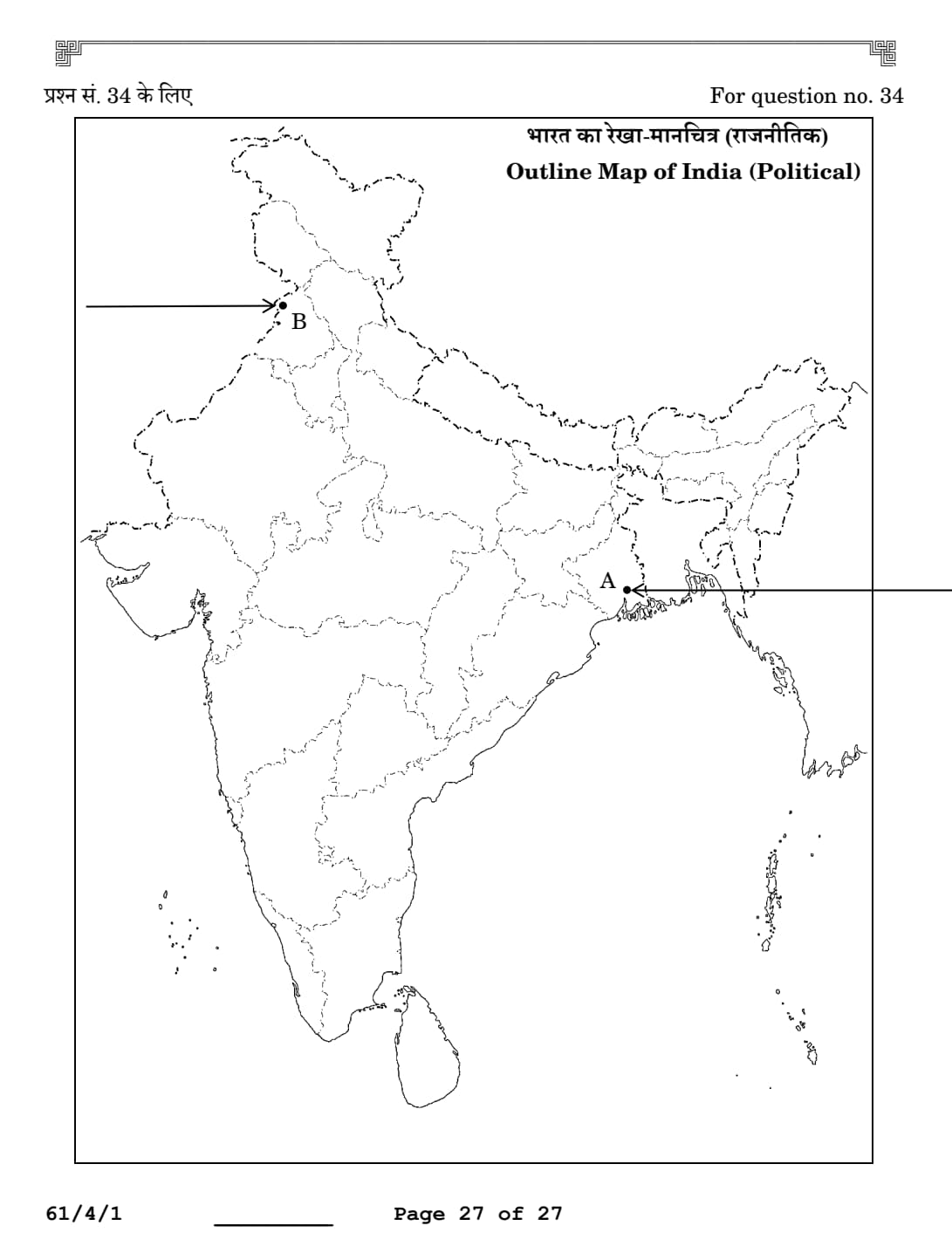
On the given political outline map of India, locate and label the following places with appropriate symbols :
(i) Dholavira − A mature Harappan site
(ii) Nagarjunakonda − An Ancient Buddhist site
(iii) (a) Agra − A territory under the Mughals
OR
(b) Bijapur − A medieval period state

View Solution
Concept:
- Historical mapping requires placing archeological and imperial sites in their correct modern geographical contexts.
- Identifying these sites helps in visualizing the territorial reach of ancient civilizations and medieval sultanates.
Step 1: Identifying the geographic location of Dholavira and Nagarjunakonda
Dholavira is located in the Kutch district of Gujarat. It is a prominent Harappan site known for its unique water management systems.
Nagarjunakonda is situated in Andhra Pradesh. It was a flourishing center of Mahayana Buddhism and architecture during the early centuries of the Common Era.
Step 2: Identifying the medieval centers: Agra and Bijapur
Agra is located in Uttar Pradesh and was the premier capital of the Mughal Empire for much of the 16th and 17th centuries.
Bijapur is located in Karnataka. It was the seat of the Adil Shahi dynasty and a major rival to the Vijayanagara Empire and later the Mughals.

On the same political outline map of India, two places have been marked as ‘A’ and ‘B’, as the centres of the Indian National Movement. Identify them and write their correct names.
View Solution
Concept:
- The geography of the Indian National Movement is marked by cities that hosted major sessions, protests, or incidents.
- Identifying these locations is essential to understanding the pan-Indian nature of the freedom struggle.
Step 1: Identifying Point ‘A’ in West Bengal
Point ‘A’ is located in the southern part of West Bengal. This represents Calcutta (Kolkata).
It was the capital of British India until 1911 and served as a major center for political mobilization during the Swadeshi movement and early Congress sessions.
Step 2: Identifying Point ‘B’ in Punjab
Point ‘B’ is located in the northern state of Punjab. This represents Amritsar.
It is historically significant as the site of the Jallianwala Bagh Massacre in 1919, which transformed the national movement under Mahatma Gandhi’s leadership.
Note : The following questions from 47 to 51 are for the Visually Impaired Candidates only:
Mention any one mature Harappan site in present Pakistan.
View Solution
Concept:
- The Indus Valley Civilization spanned a vast area including parts of modern-day India, Pakistan, and Afghanistan.
- ’Mature’ Harappan sites are those that reached a peak of urban planning and standardization between c. 2600 and 1900 BCE.
Step 1: Identifying key urban centers in the Indus basin
The most prominent sites of the Indus Valley Civilization are located along the Indus River and its tributaries.
Among these, Harappa was the first site to be discovered and excavated in 1921. It is located in the Montgomery district of the Punjab province in Pakistan.
Step 2: Confirming the current geographic status
Harappa is a premier example of a mature Harappan site characterized by a citadel and a lower town.
Since the partition of India in 1947, this site remains within the borders of present-day Pakistan. Other major mature sites in Pakistan include Mohenjodaro (Sindh) and Chanhudaro (Sindh).
Mention one ancient Buddhist site in Eastern India.
View Solution
Concept:
- Buddhism originated and initially flourished in the Gangetic plains of Eastern India.
- Eastern India includes the modern states of Bihar, West Bengal, and Odisha, which house some of the most sacred pilgrimage and educational centers of Buddhism.
Step 1: Identifying significant sites in the life of the Buddha
Bodhgaya, located in the Gaya district of Bihar, is arguably the most important Buddhist site in the world.
It is situated in the eastern part of India and is the place where Siddhartha Gautama attained supreme enlightenment (Nirvana) under the Bodhi tree.
Step 2: Listing architectural and educational centers
Apart from Bodhgaya, Eastern India is home to Nalanda, which was a world-renowned monastic university between the 5th and 12th centuries CE.
Other notable sites in this region include Vikramshila and the stupa sites of Ratnagiri in Odisha.
Name any one territory which was under the Mughals.
View Solution
Concept:
- The Mughal Empire, at its zenith, covered almost the entire Indian subcontinent.
- Its administrative structure was divided into ’Subas’ (provinces), which were the primary units of governance.
Step 1: Identifying core imperial territories
Delhi was one of the most critical territories and administrative centers of the Mughal Empire.
It served as the imperial capital for several rulers, most notably under Shah Jahan, who built the city of Shahjahanabad (Old Delhi) and the Red Fort.
Step 2: Acknowledging the expansion under different rulers
Under Akbar, the empire expanded to include territories like Bengal, Gujarat, and parts of the Deccan.
However, the Delhi-Agra region remained the political heartland or the ’Suba of Delhi’ throughout the Mughal era.
Name any one neighbouring kingdom of the Vijayanagara empire.
View Solution
Concept:
- The Vijayanagara Empire (1336–1646) shared its northern and eastern boundaries with several rival powers.
- These geopolitical relationships were defined by frequent conflicts over fertile tracts of land and strategic trade routes.
Step 1: Identifying northern rivals
To the north of the Tungabhadra River, the Vijayanagara Empire shared its border with the Deccani Sultanates.
The Bijapur Sultanate (ruled by the Adil Shahi dynasty) was a primary neighbor and a frequent adversary. The two powers constantly fought for control over the fertile Raichur Doab.
Step 2: Identifying eastern and western neighbors
To the northeast, the Vijayanagara Empire bordered the Gajapati kingdom of Odisha.
Other neighboring states included the Sultanates of Golconda and Ahmednagar. The combined forces of these neighbors eventually defeated Vijayanagara at the Battle of Talikota in 1565.
Name any two centres of the Indian National Movement.
View Solution
Concept:
- The Indian National Movement was a spatially diverse struggle with different cities and villages becoming symbolic of the fight against British rule.
- These centers are often associated with specific events like massacres, satyagrahas, or the breaking of colonial laws.
Step 1: Describing the significance of Amritsar
Amritsar in Punjab is a major center of the national movement.
It is the site of the Jallianwala Bagh Massacre (1919), where hundreds of peaceful protestors were killed by British forces under General Dyer. This incident became a turning point, radicalizing the entire country and leading to the Non-Cooperation Movement.
Step 2: Describing the significance of Champaran
Champaran in Bihar is another crucial center, famous for the first Satyagraha launched by Mahatma Gandhi in India (1917).
He went there to protest against the oppressive indigo plantation system (Tinkathia system). Gandhi’s success in Champaran established his leadership and proved the effectiveness of non-violent civil disobedience on Indian soil.
CBSE Class 12 History Exam Pattern
| Part | MCQs | Short Answer | Long Answer | Source Based | Total Marks |
|---|---|---|---|---|---|
| Part I | 7 questions (1 mark each) | 2 questions(3 marks each) | 1 question (8 marks) | 1 question (4 marks) | 25 |
| Part II | 7 questions (1 mark each) | 2 questions(3 marks each) | 1 question (8 marks) | 1 question (4 marks) | 25 |
| Part III | 7 questions (1 mark each) | 2 questions(3 marks each) | 1 question (8 marks) | 1 question (4 marks) | 25 |
| Map Work | – | – | – | – | 5 |
| Project Work | – | – | – | – | 20 |
| Total | 100 | ||||



Comments