




Re-NEET 2026 Physics Question Paper is available here. NTA conducted NEET 2026 re-exam on 21 June in single shift from 2 PM to 5:15 PM. NEET Re-Test question question paper consists of 180 questions for 720 marks to be attempted in 3 hours and 15 minutes.
- NEET Physics Question Paper 2026 consists of 45 questions for 180 marks.
- Each correct answer carries 4 marks and incorrect answer has a negative marking of 1.
Candidates can download Re-NEET 2026 Physics Question Paper with Answer Key and Solution PDF from the links provided below
Re-NEET 2026 Physics Question Paper with Solution PDF
| NEET Re-Exam Physics Question Paper 2026 | Download PDF | Check Solution |
A photon and an electron, each of \(10\,eV\) energy, move in free space.
The ratio of linear momentum of electron \(P_e\) to that of photon \(P_{ph}\), \[ \frac{P_e}{P_{ph}} \]
is :
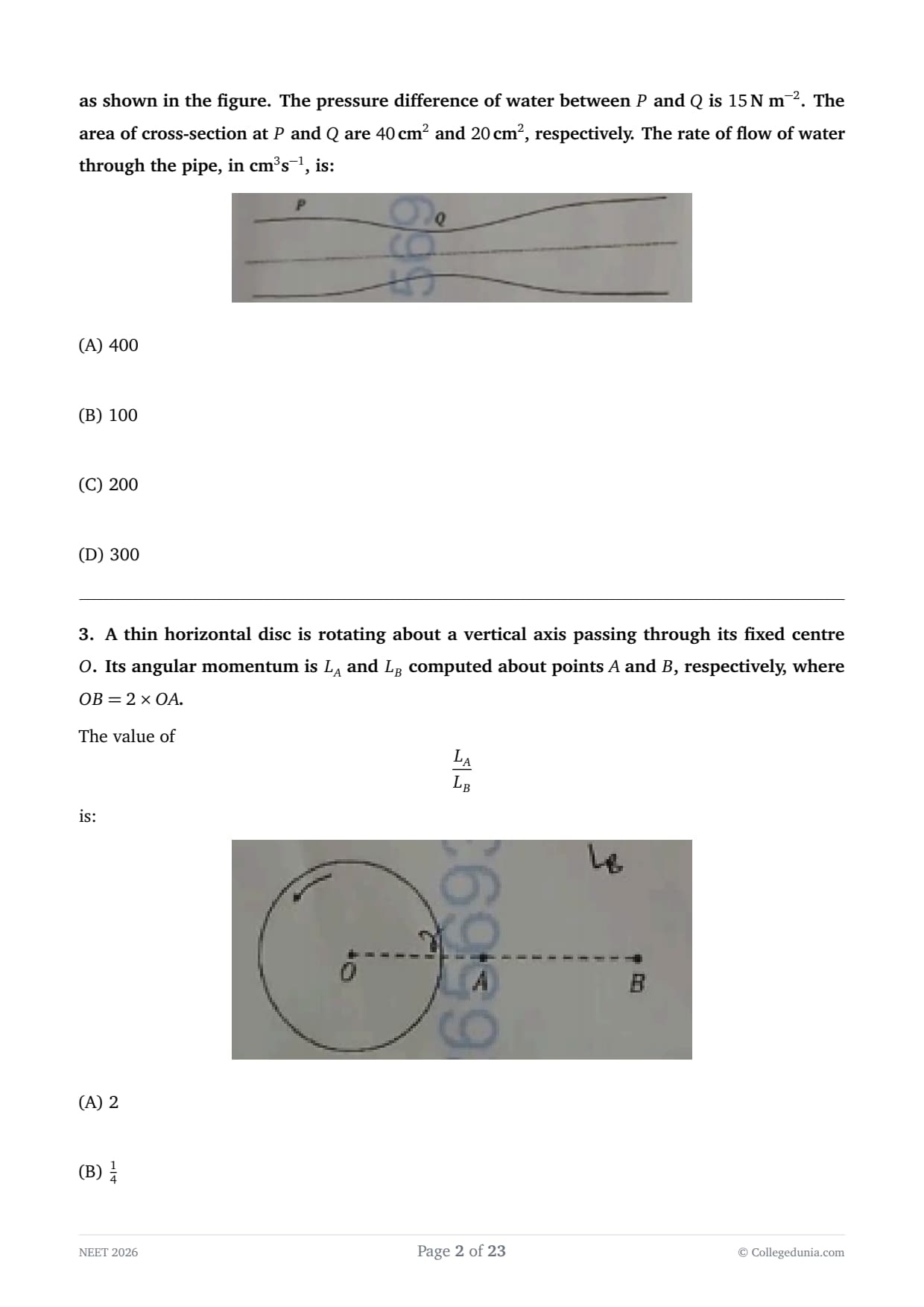
Water flows in a streamline motion through a horizontal pipe of circular cross-section as shown in the figure.
The pressure difference of water between \(P\) and \(Q\) is \(15\,N m^{-2}\).
The area of cross-section at \(P\) and \(Q\) are \(40\,cm^2\) and \(20\,cm^2\), respectively.
The rate of flow of water through the pipe, in \(cm^3s^{-1}\), is:

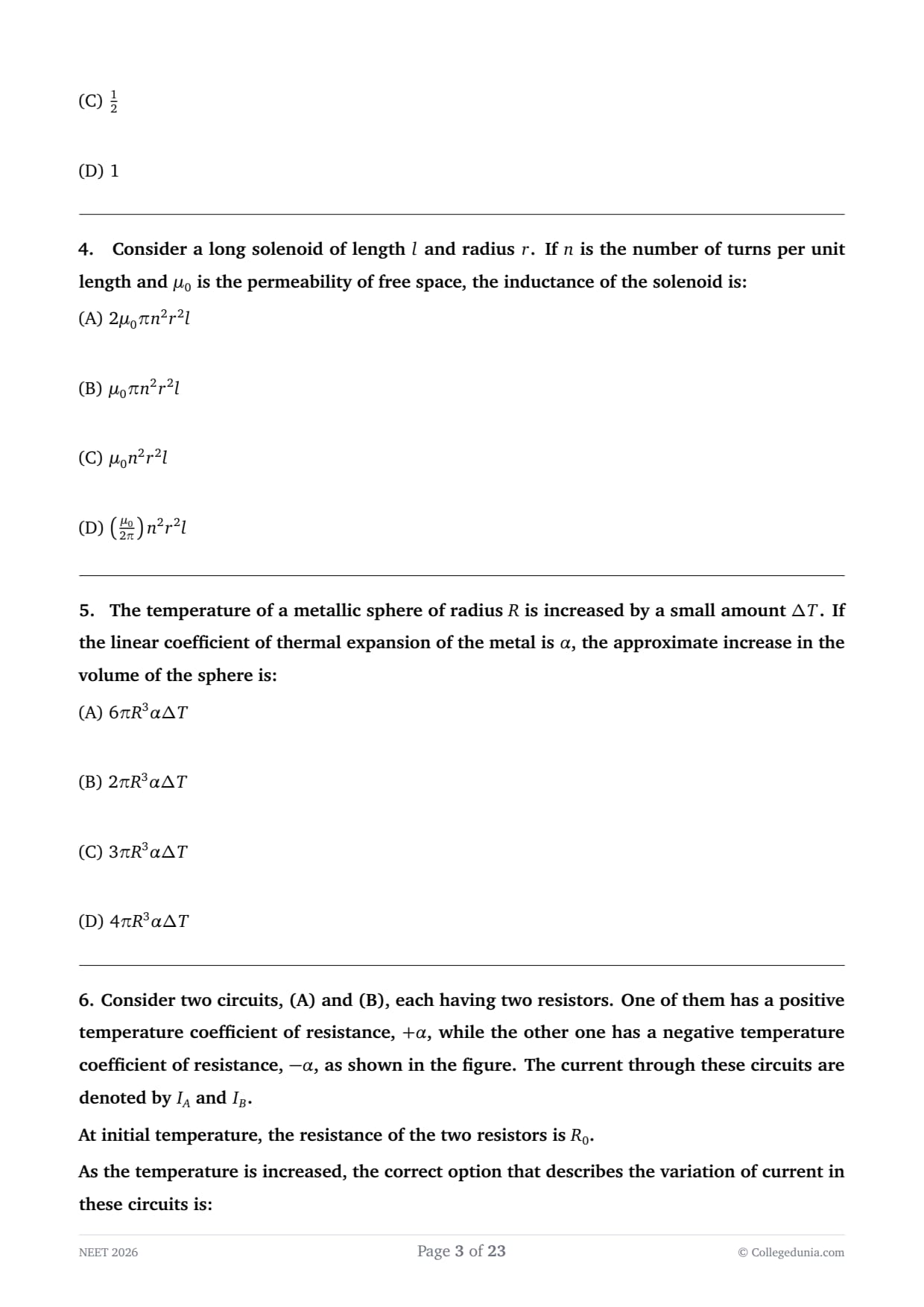
A thin horizontal disc is rotating about a vertical axis passing through its fixed centre \(O\).
Its angular momentum is \(L_A\) and \(L_B\) computed about points \(A\) and \(B\), respectively, where \(OB=2\times OA\).
The value of \[ \frac{L_A}{L_B} \]
is:

Consider a long solenoid of length \(l\) and radius \(r\).
If \(n\) is the number of turns per unit length and \(\mu_0\) is the permeability of free space,
the inductance of the solenoid is:
The temperature of a metallic sphere of radius \(R\) is increased by a small amount \(\Delta T\).
If the linear coefficient of thermal expansion of the metal is \(\alpha\), the approximate increase in the volume of the sphere is:
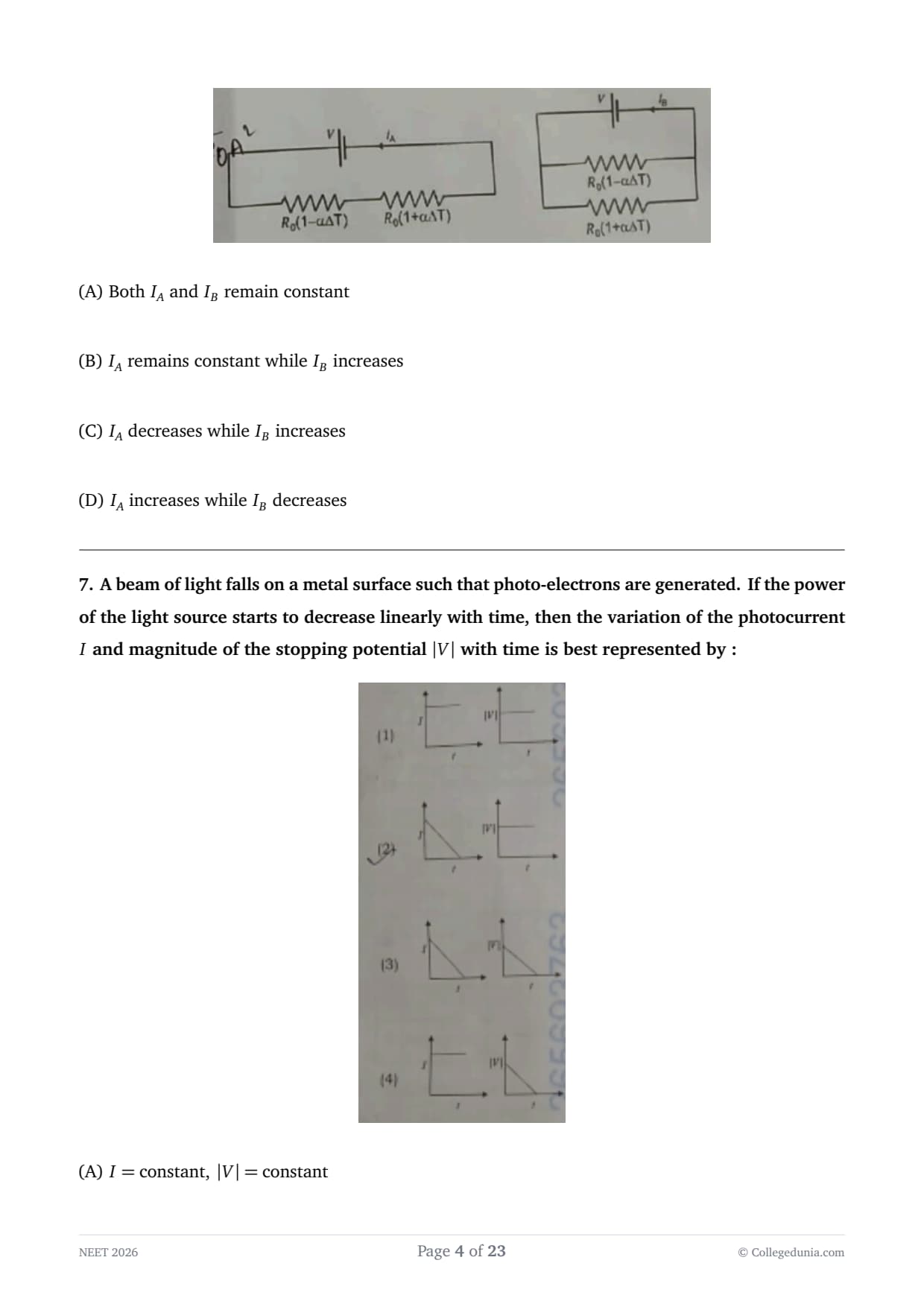
Consider two circuits, (A) and (B), each having two resistors.
One of them has a positive temperature coefficient of resistance, \(+\alpha\), while the other one has a negative temperature coefficient of resistance, \(-\alpha\), as shown in the figure.
The current through these circuits are denoted by \(I_A\) and \(I_B\).
At initial temperature, the resistance of the two resistors is \(R_0\).
As the temperature is increased, the correct option that describes the variation of current in these circuits is:

A beam of light falls on a metal surface such that photo-electrons are generated.
If the power of the light source starts to decrease linearly with time, then the variation of the photocurrent \(I\) and magnitude of the stopping potential \(|V|\) with time is best represented by :

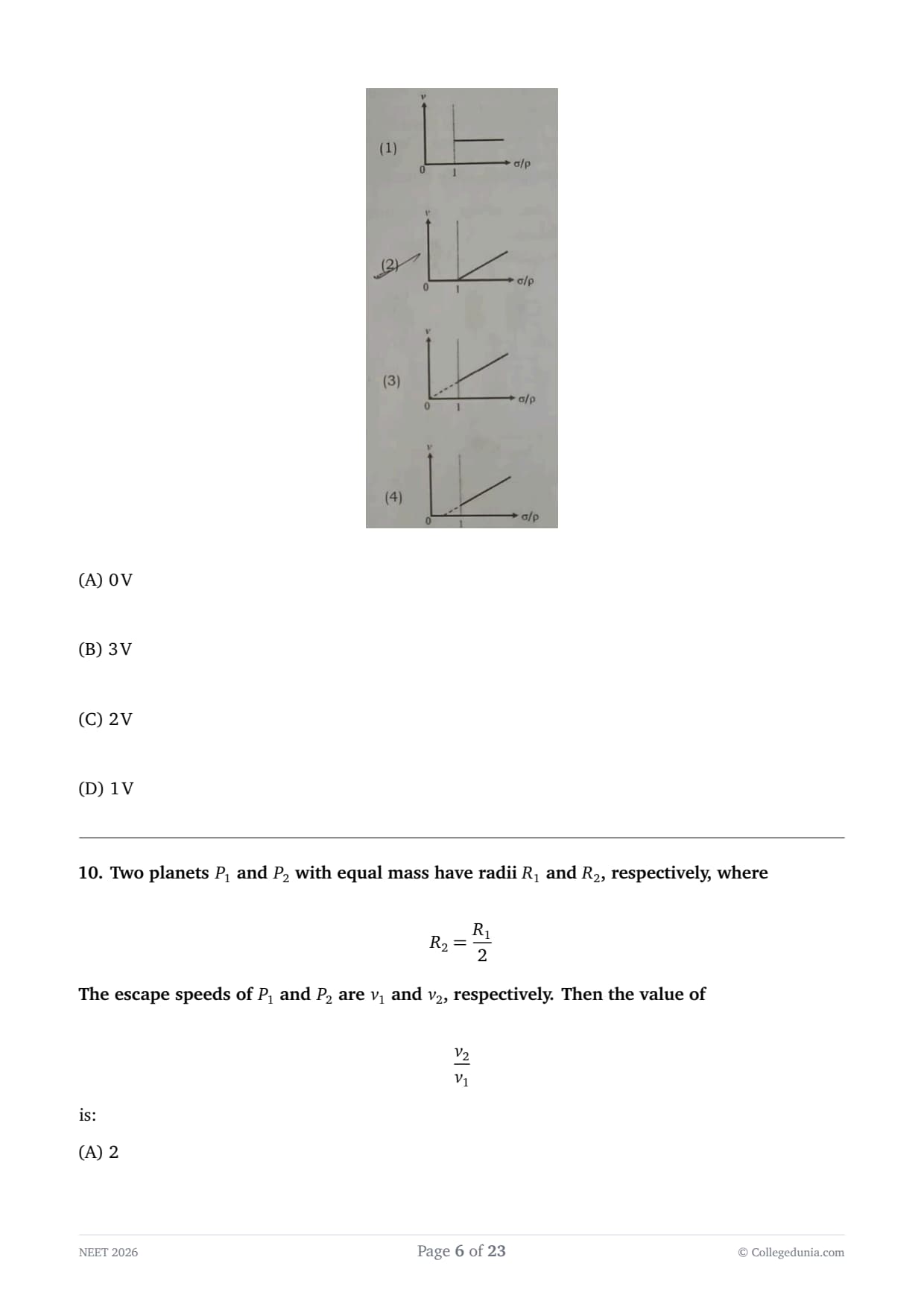
In the measurement of viscosity of liquids using terminal velocity experiment, spherical balls of same radius but having different densities are used.
The variation of the terminal velocity (\(v\)) with the ratio of density of spherical ball (\(\sigma\)) to density of the liquid (\(\rho\)), is best represented by:

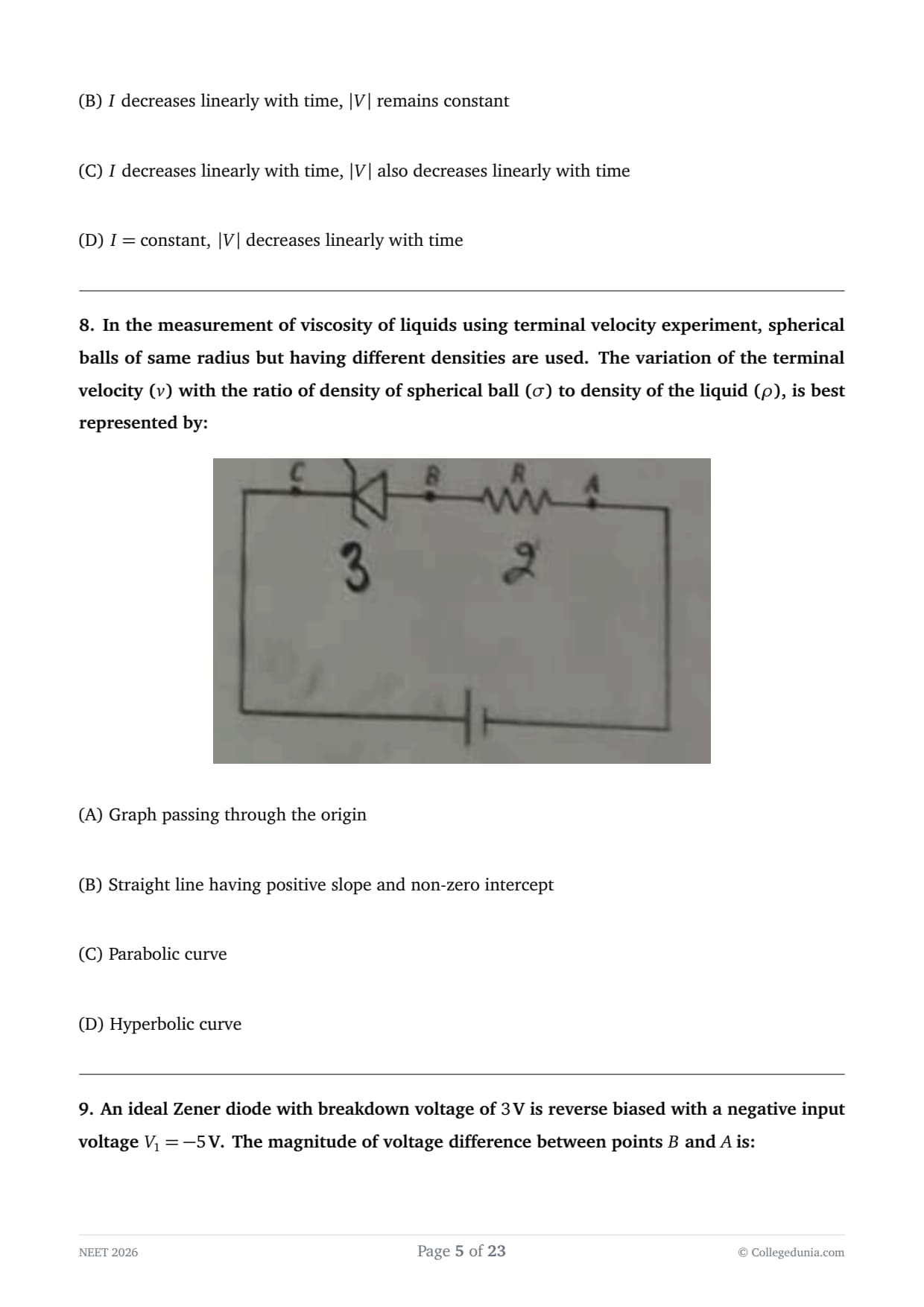
An ideal Zener diode with breakdown voltage of \(3\,V\) is reverse biased with a negative input voltage \(V_1=-5\,V\).
The magnitude of voltage difference between points \(B\) and \(A\) is:

Two planets \(P_1\) and \(P_2\) with equal mass have radii \(R_1\) and \(R_2\), respectively, where
\[ R_2=\frac{R_1}{2} \]
The escape speeds of \(P_1\) and \(P_2\) are \(v_1\) and \(v_2\), respectively.
Then the value of
\[ \frac{v_2}{v_1} \]
is:
An AC voltage \[ V=220\sin(2\times10^{3}t)\ Volt \]
is applied to a series LCR circuit. Then the current amplitude in the circuit is:
Given:
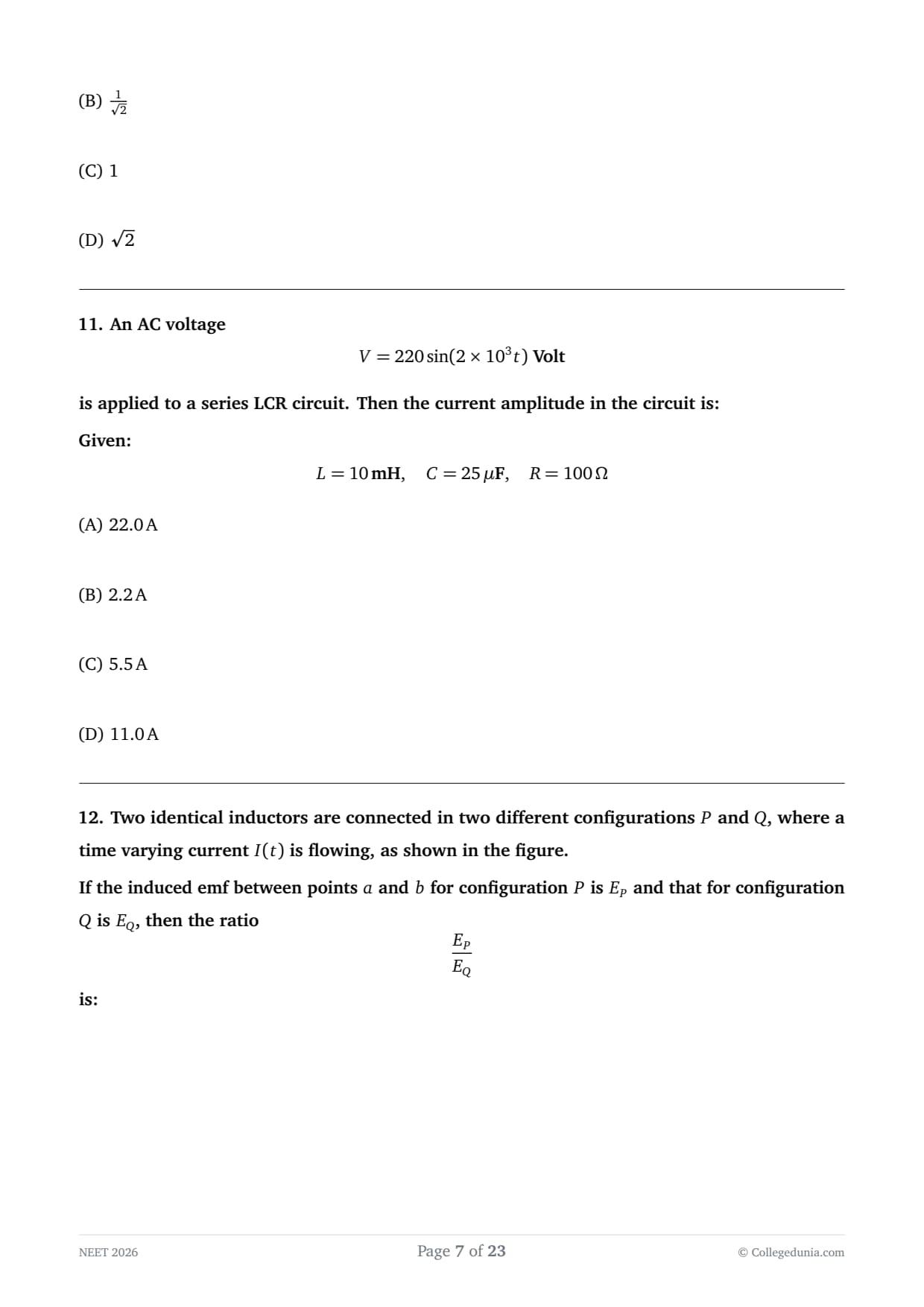
Two identical inductors are connected in two different configurations \(P\) and \(Q\), where a time varying current \(I(t)\) is flowing, as shown in the figure.
If the induced emf between points \(a\) and \(b\) for configuration \(P\) is \(E_P\) and that for configuration \(Q\) is \(E_Q\), then the ratio \[ \frac{E_P}{E_Q} \]
is:

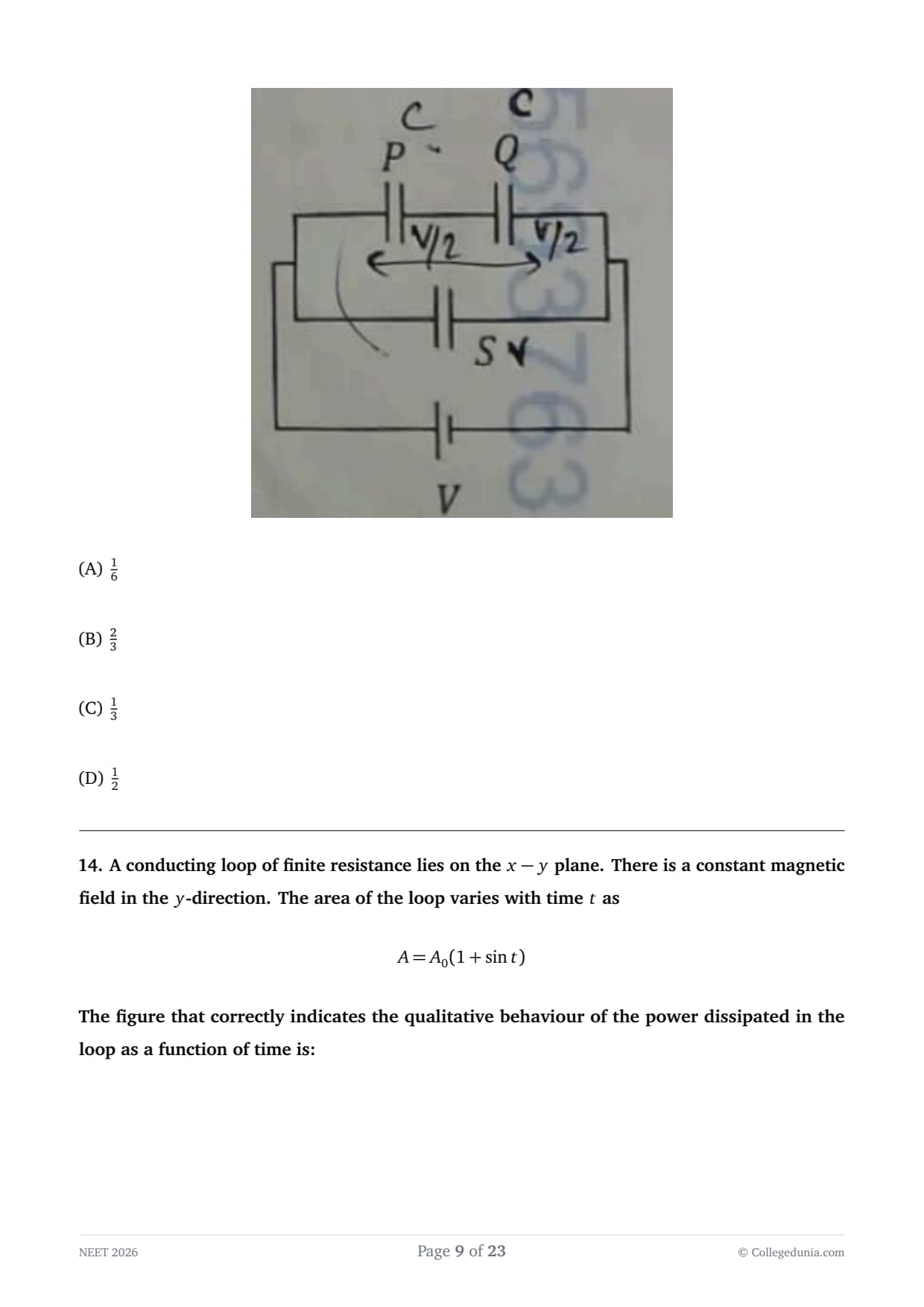
Three identical capacitors \(P\), \(Q\) and \(S\), each of capacitance \(C\), are connected to a battery of voltage \(V\), as shown in the figure.
If the potential energy stored in the capacitor \(P\) and total energy stored in the system are \(U_P\) and \(U_T\), respectively, then the ratio \[ \frac{U_P}{U_T} \]
is:

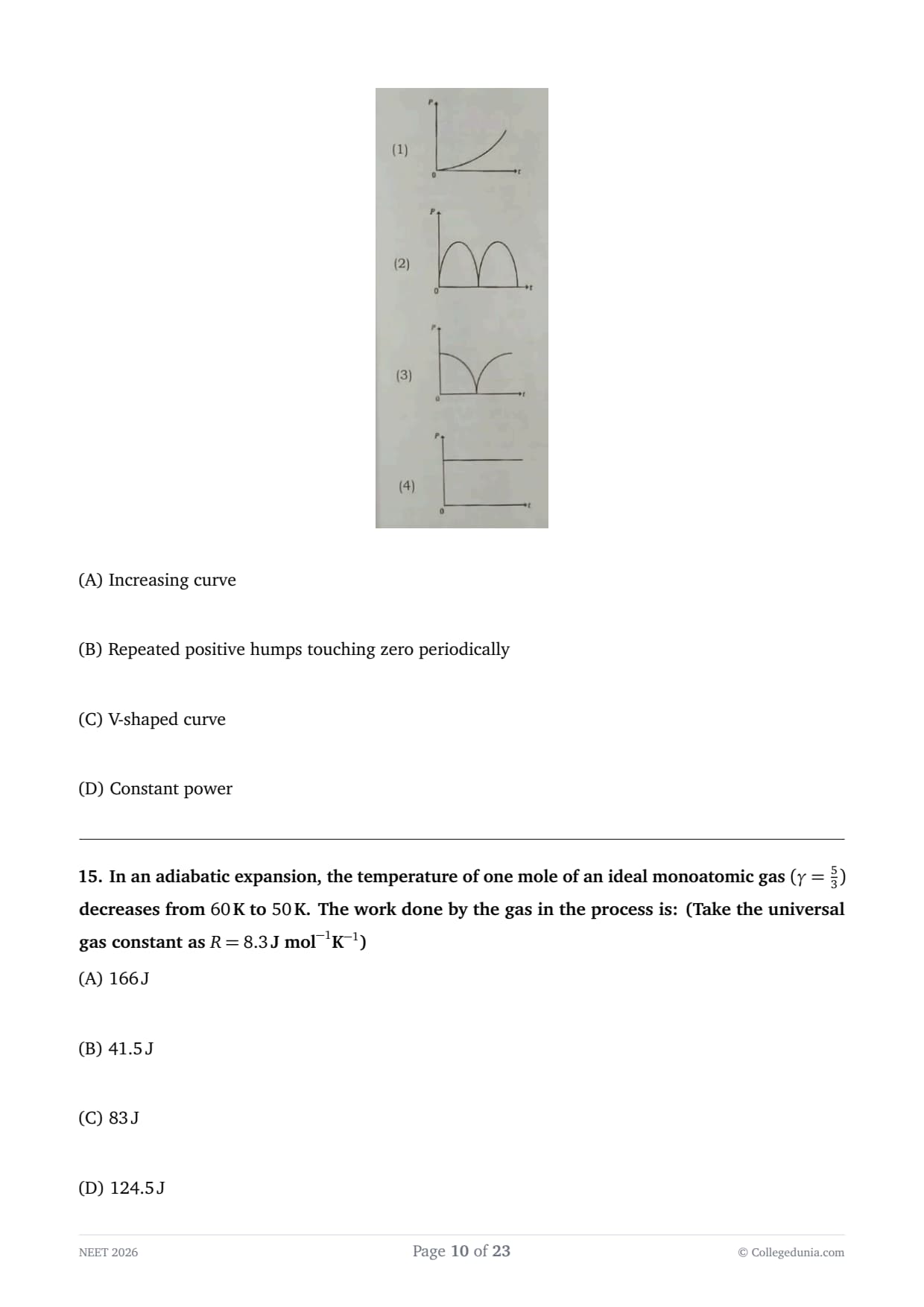
A conducting loop of finite resistance lies on the \(x-y\) plane.
There is a constant magnetic field in the \(y\)-direction.
The area of the loop varies with time \(t\) as \[ A=A_0(1+\sin t) \]
The figure that correctly indicates the qualitative behaviour of the power dissipated in the loop as a function of time is:

In an adiabatic expansion, the temperature of one mole of an ideal monoatomic gas \((\gamma=\frac{5}{3})\) decreases from \(60\,K\) to \(50\,K\).
The work done by the gas in the process is:
(Take the universal gas constant as \(R=8.3\,J mol^{-1}K^{-1}\))
Consider a particle moving along a straight line, whose position as a function of time is given by \[ s(t)=\alpha t^2-\beta t+\gamma \]
where \(\alpha=1\,m s^{-2}\), \(\beta=6\,m s^{-1}\) and \(\gamma=5\,m\).
The average speed of the particle, in \(m s^{-1}\), from \(t=0\) to \(t=6\,s\) is:
The following table presents the part of the electromagnetic spectrum and their corresponding major applications.
Match the following and choose the correct option.
An ideal gas is made of polyatomic molecules.
Each molecule has three translational, three rotational and \(f\) number of vibrational modes.
If the ratio of heat capacities \[ \frac{C_P}{C_V}=\frac{8}{7} \]
then the value of \(f\) is:
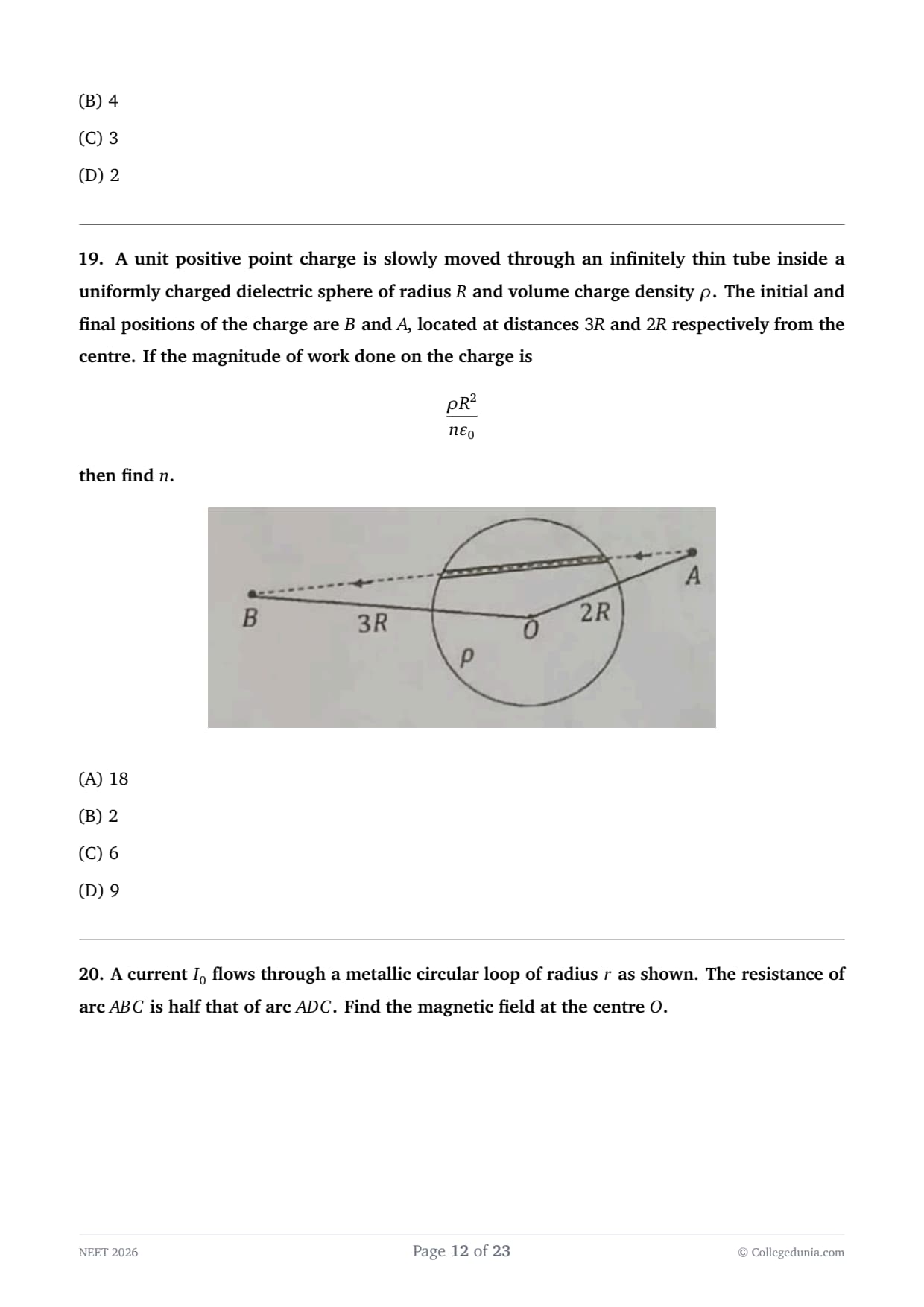
A unit positive point charge is slowly moved through an infinitely thin tube inside a uniformly charged dielectric sphere of radius \(R\) and volume charge density \(\rho\).
The initial and final positions of the charge are \(B\) and \(A\), located at distances \(3R\) and \(2R\) respectively from the centre.
If the magnitude of work done on the charge is \[ \frac{\rho R^2}{n\varepsilon_0} \]
then find \(n\).

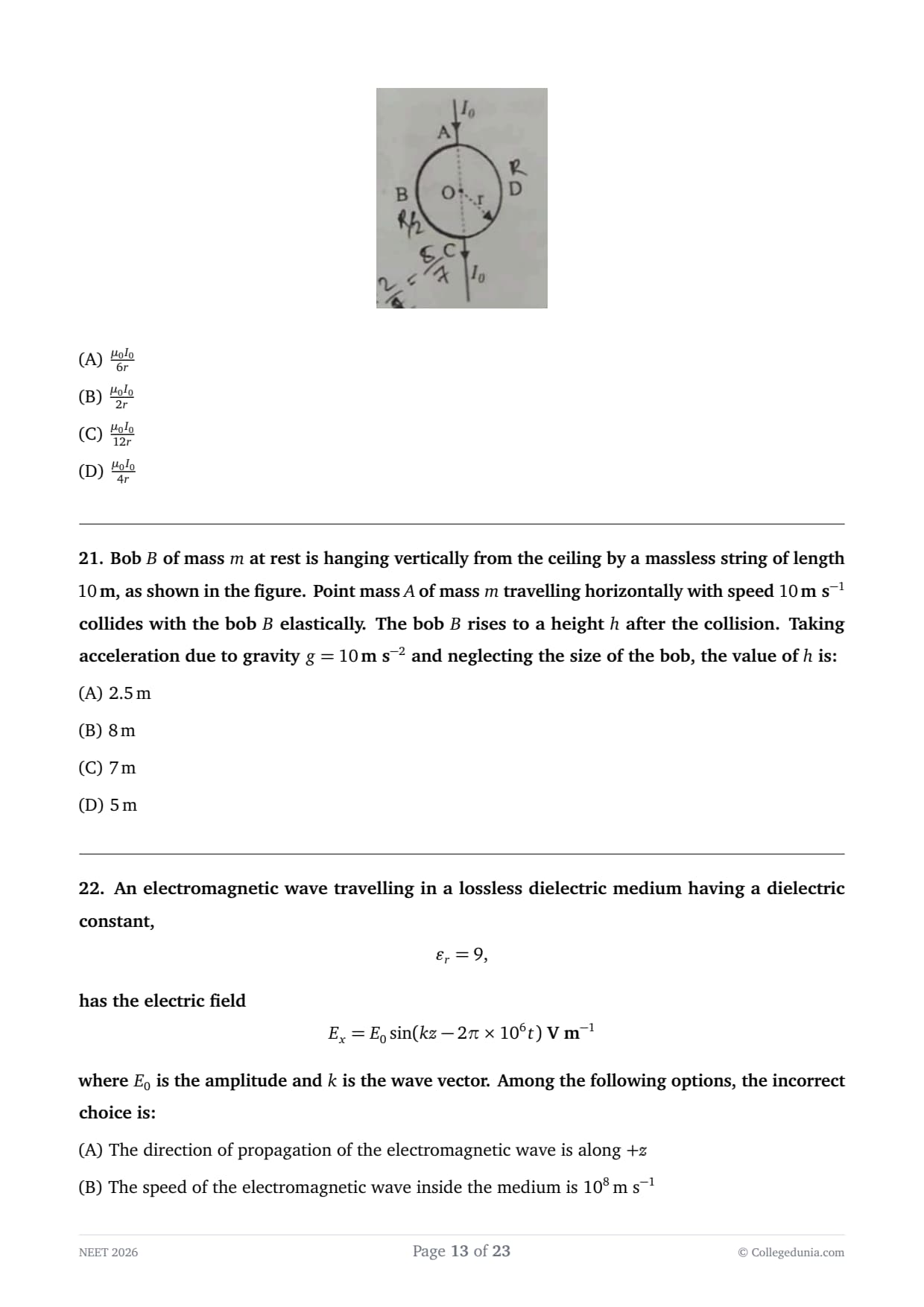
A current \(I_0\) flows through a metallic circular loop of radius \(r\) as shown.
The resistance of arc \(ABC\) is half that of arc \(ADC\).
Find the magnetic field at the centre \(O\).

Bob \(B\) of mass \(m\) at rest is hanging vertically from the ceiling by a massless string of length \(10\,m\), as shown in the figure.
Point mass \(A\) of mass \(m\) travelling horizontally with speed \(10\,m s^{-1}\) collides with the bob \(B\) elastically.
The bob \(B\) rises to a height \(h\) after the collision.
Taking acceleration due to gravity \(g=10\,m s^{-2}\) and neglecting the size of the bob, the value of \(h\) is:
An electromagnetic wave travelling in a lossless dielectric medium having a dielectric constant, \[ \varepsilon_r = 9, \]
has the electric field \[ E_x=E_0\sin(kz-2\pi\times10^6 t)\ V m^{-1} \]
where \(E_0\) is the amplitude and \(k\) is the wave vector.
Among the following options, the incorrect choice is:
A particle of mass \(M\) moves along the horizontal \(x\)-axis from \(x=0\) to \(x=L\).
The coefficient of kinetic friction varies as \[ \mu_k(x)=\frac{\mu_0}{L}x \]
where \(\mu_0\) and \(L\) are constants.
If the total work done by friction during the motion is \[ -\frac{\mu_0 MgL}{n} \]
where \(g\) is the acceleration due to gravity, find \(n\).
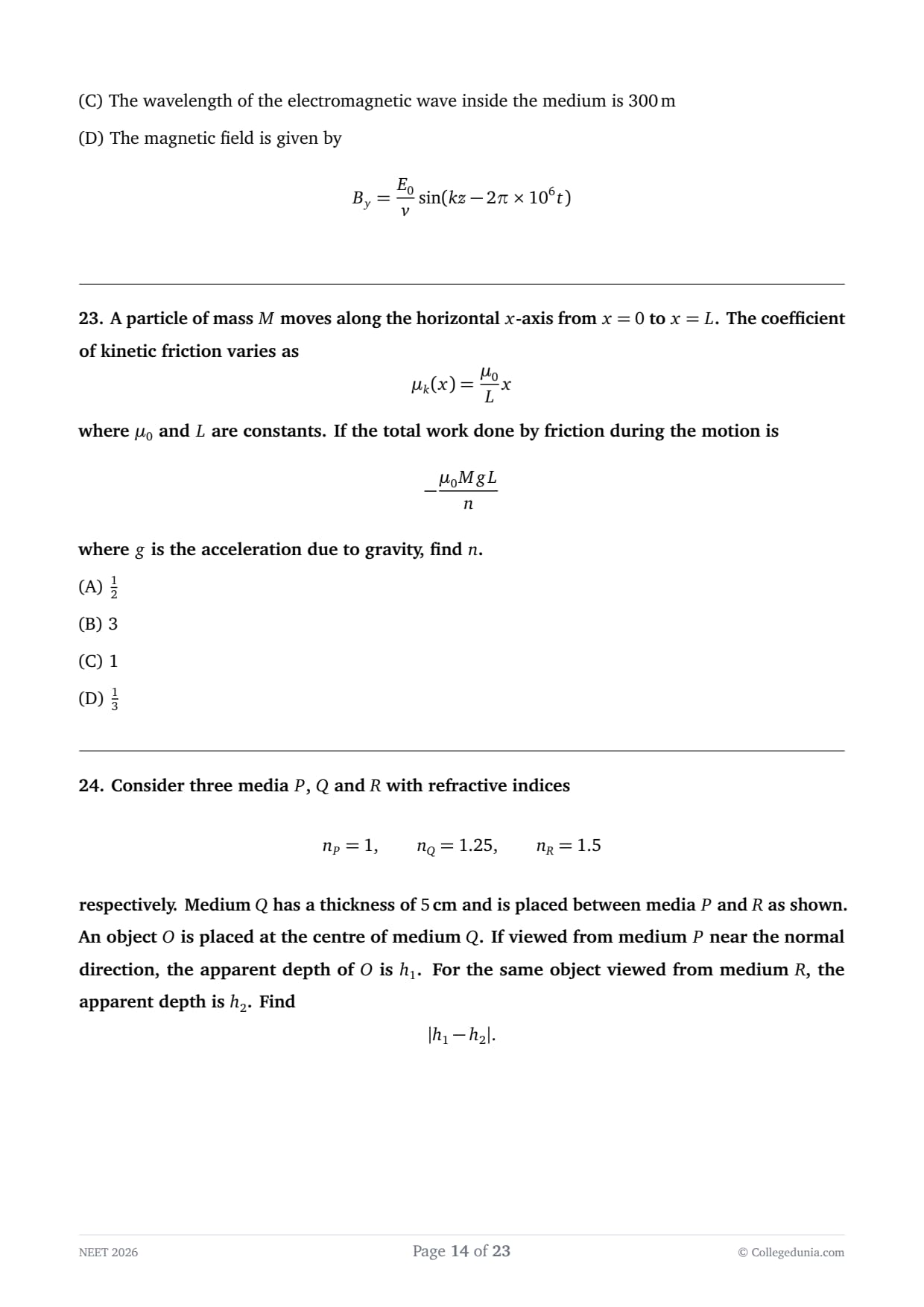
Consider three media \(P\), \(Q\) and \(R\) with refractive indices \[ n_P=1,\qquad n_Q=1.25,\qquad n_R=1.5 \]
respectively.
Medium \(Q\) has a thickness of \(5\,cm\) and is placed between media \(P\) and \(R\) as shown.
An object \(O\) is placed at the centre of medium \(Q\).
If viewed from medium \(P\) near the normal direction, the apparent depth of \(O\) is \(h_1\).
For the same object viewed from medium \(R\), the apparent depth is \(h_2\).
Find \[ |h_1-h_2|. \]

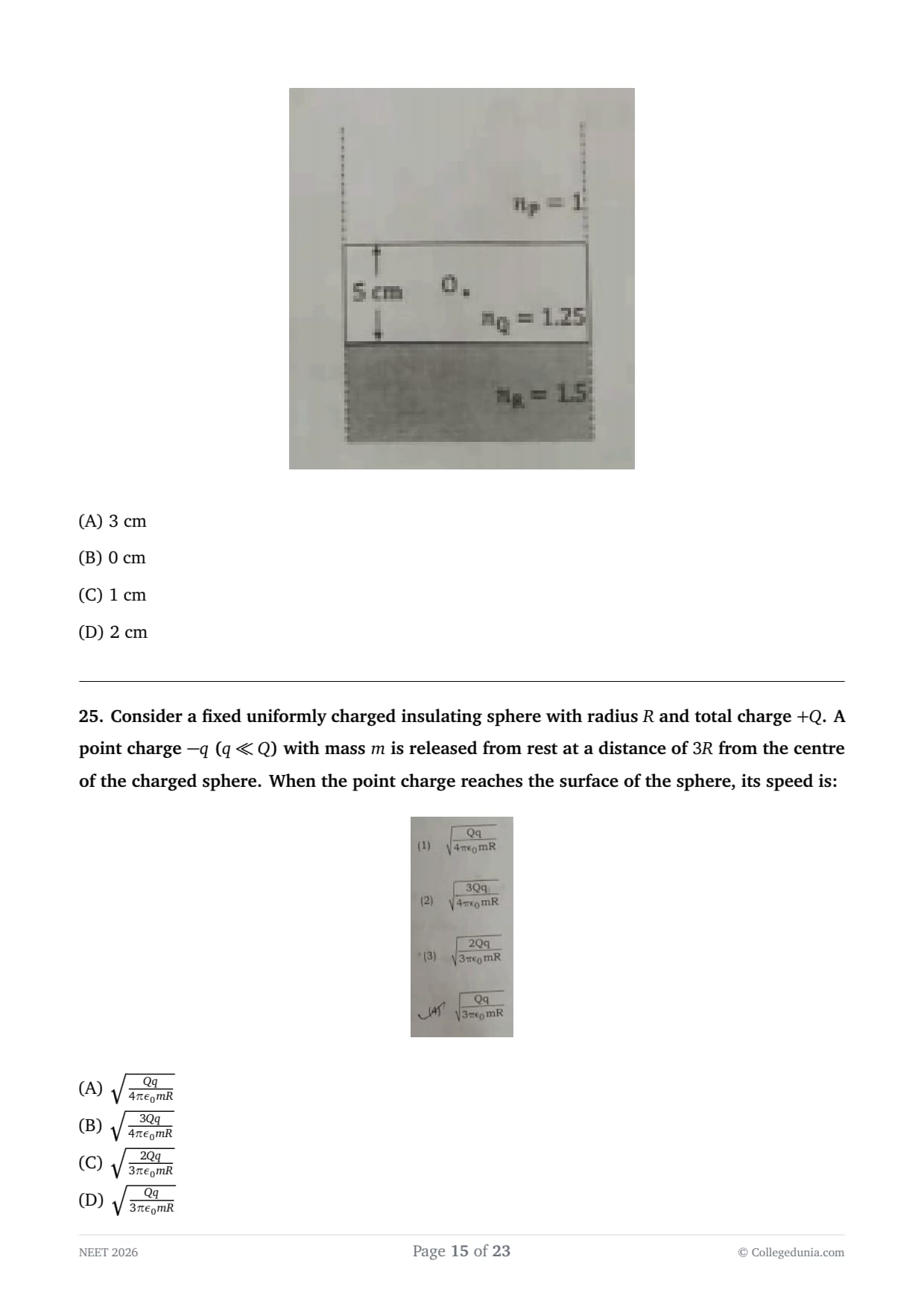
Consider a fixed uniformly charged insulating sphere with radius \(R\) and total charge \(+Q\).
A point charge \(-q\) (\(q \ll Q\)) with mass \(m\) is released from rest at a distance of \(3R\) from the centre of the charged sphere.
When the point charge reaches the surface of the sphere, its speed is:

A car travels on a circular racetrack of radius \(50\,m\), which is banked at an angle \(\theta\).
If the car travels at a speed \(10\,m s^{-1}\), then the wear and tear on its tyres is minimum.
Taking \(g=10\,m s^{-2}\), the value of \(\theta\) is:
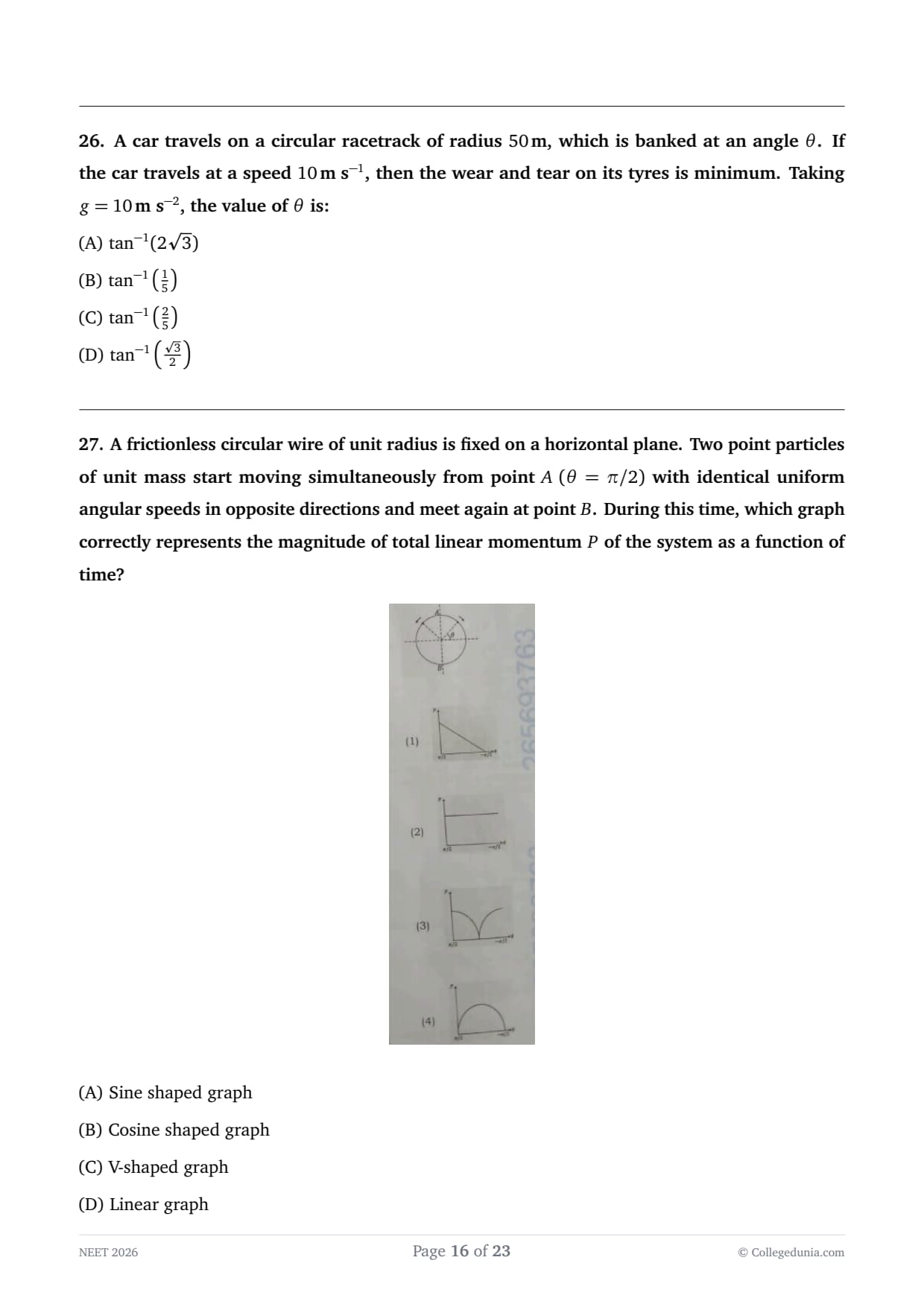
A frictionless circular wire of unit radius is fixed on a horizontal plane.
Two point particles of unit mass start moving simultaneously from point \(A\) \((\theta=\pi/2)\) with identical uniform angular speeds in opposite directions and meet again at point \(B\).
During this time, which graph correctly represents the magnitude of total linear momentum \(P\) of the system as a function of time?

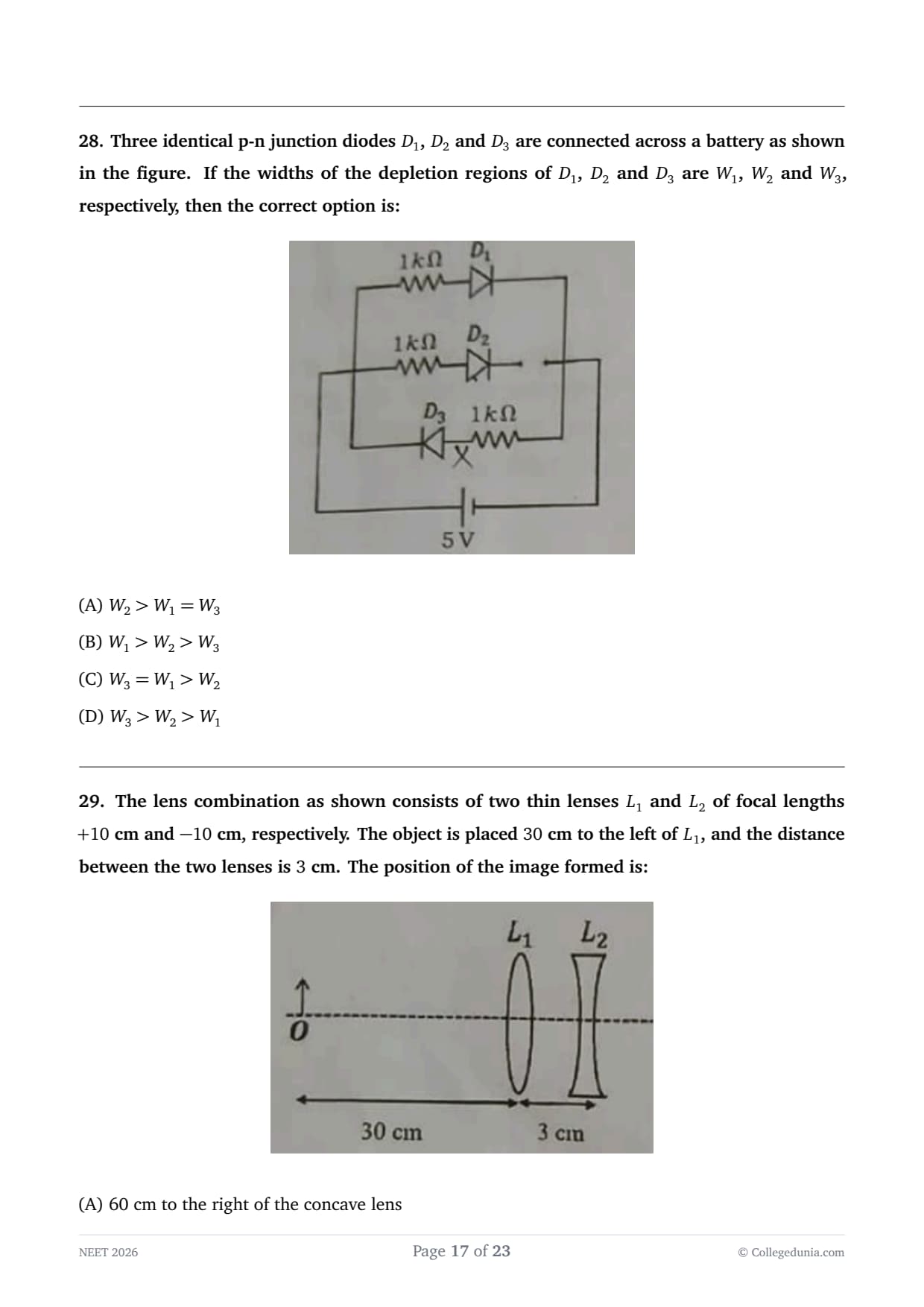
Three identical p-n junction diodes \(D_1\), \(D_2\) and \(D_3\) are connected across a battery as shown in the figure.
If the widths of the depletion regions of \(D_1\), \(D_2\) and \(D_3\) are \(W_1\), \(W_2\) and \(W_3\), respectively, then the correct option is:

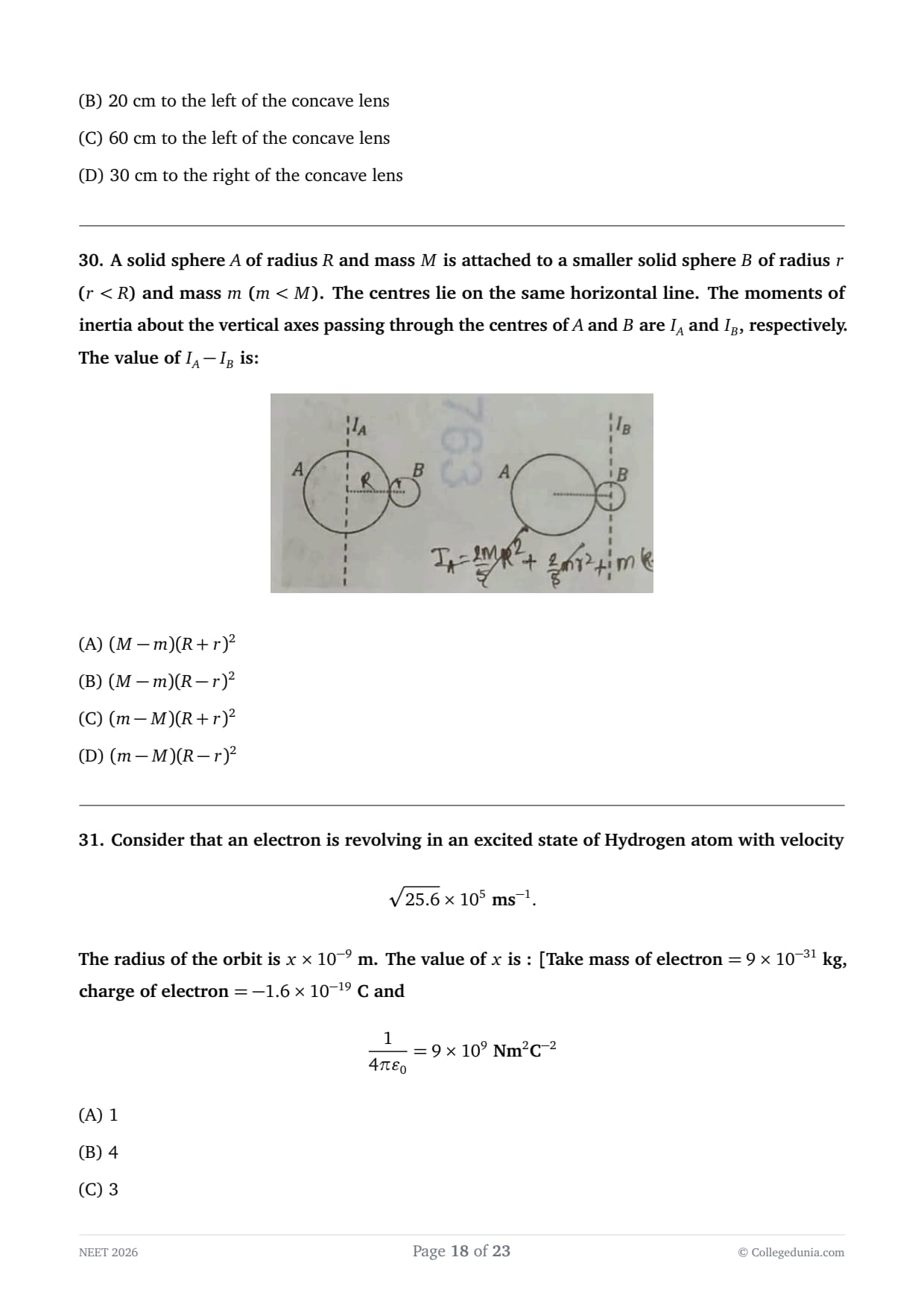
The lens combination as shown consists of two thin lenses \(L_1\) and \(L_2\) of focal lengths \(+10\ cm\) and \(-10\ cm\), respectively.
The object is placed \(30\ cm\) to the left of \(L_1\), and the distance between the two lenses is \(3\ cm\).
The position of the image formed is:

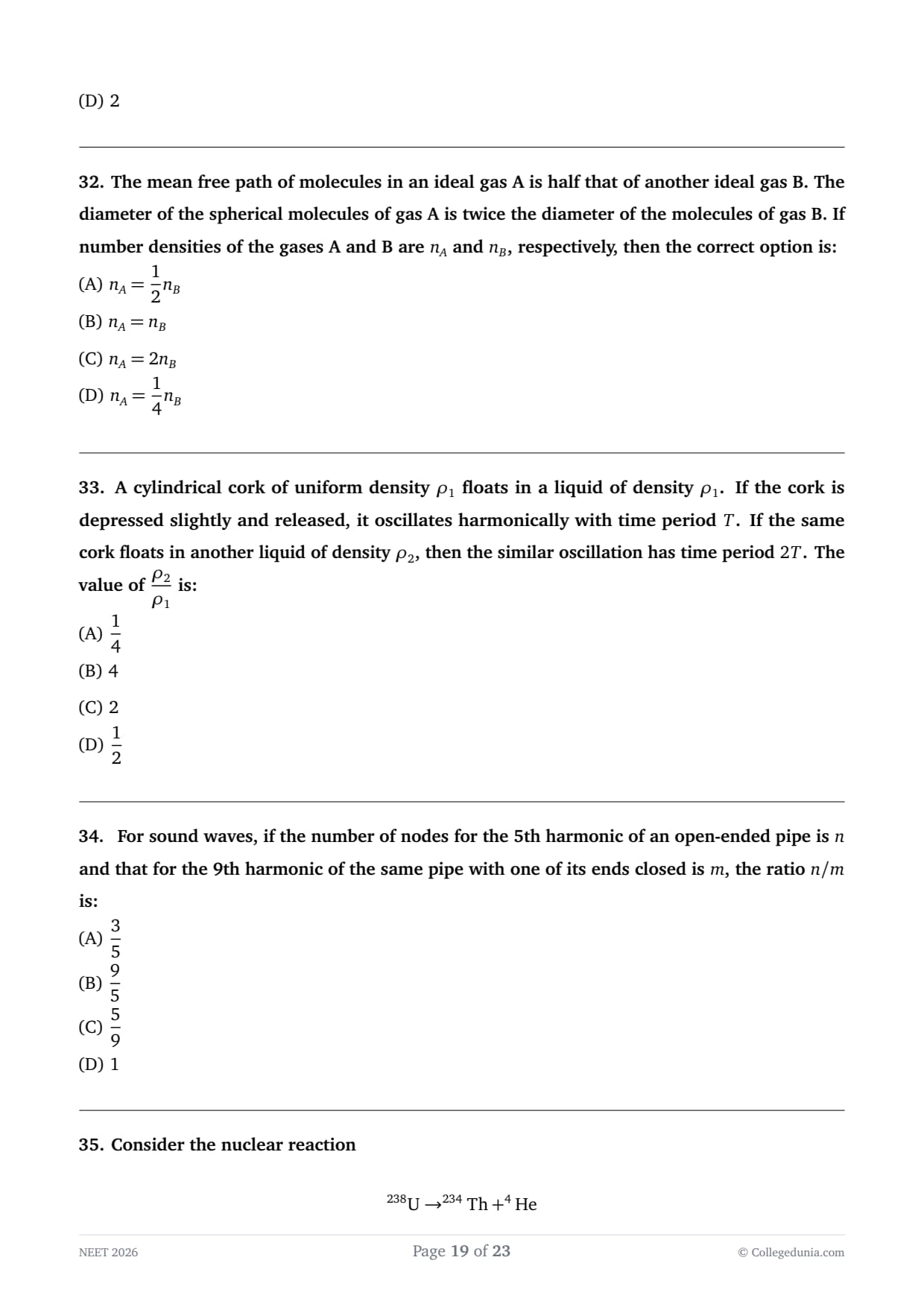
A solid sphere \(A\) of radius \(R\) and mass \(M\) is attached to a smaller solid sphere \(B\) of radius \(r\) and mass \(m\).
The centres lie on the same horizontal line.
The moments of inertia about the vertical axes passing through the centres of \(A\) and \(B\) are \(I_A\) and \(I_B\), respectively.
The value of \(I_A-I_B\) is:

Consider that an electron is revolving in an excited state of Hydrogen atom with velocity \[ \sqrt{25.6}\times10^5 \ ms^{-1}. \]
The radius of the orbit is \(x\times10^{-9}\) m. The value of \(x\) is :
[Take mass of electron \(=9\times10^{-31}\) kg, charge of electron \(=-1.6\times10^{-19}\) C and \[ \frac{1}{4\pi\varepsilon_0}=9\times10^9 \ Nm^2C^{-2} \]
The mean free path of molecules in an ideal gas A is half that of another ideal gas B.
The diameter of the spherical molecules of gas A is twice the diameter of the molecules of gas B.
If number densities of the gases A and B are \(n_A\) and \(n_B\), respectively, then the correct option is:
A cylindrical cork of uniform density \(\rho_1\) floats in a liquid of density \(\rho_1\).
If the cork is depressed slightly and released, it oscillates harmonically with time period \(T\).
If the same cork floats in another liquid of density \(\rho_2\), then the similar oscillation has time period \(2T\).
The value of \(\dfrac{\rho_2}{\rho_1}\) is:
For sound waves, if the number of nodes for the 5th harmonic of an open-ended pipe is \(n\) and that for the 9th harmonic of the same pipe with one of its ends closed is \(m\), the ratio \(n/m\) is:
Consider the nuclear reaction \[ ^{238}\mathrm{U} \rightarrow ^{234}\mathrm{Th} + ^{4}\mathrm{He} \]
Take masses of \(^{238}\mathrm{U}\), \(^{234}\mathrm{Th}\),
and \(^{4}\mathrm{He}\)
as \[ 238.050\,u,\qquad 234.043\,u,\qquad 4.003\,u \]
respectively.
The \(Q\)-value for the reaction, in keV, is: \[ 1u = 931.5\ \mathrm{MeV}/c^2 \]
Which of the following measurements has the highest index of correction?
In a solar system, the time period of revolution of a planet tracing a circular orbit of radius \(R\) is proportional to:
Consider that \(\sigma_s\), \(k_B\), and \(b\) represent Stefan-Boltzmann constant, Boltzmann constant, and Wien's displacement law constant, respectively.
The dimension of \(\sigma_s k_B^{-1} b\) is:
A ray of light with wavelength \(\lambda\) is incident on three different photoelectric cells.
The threshold wavelengths are \(\lambda_1\), \(\lambda_2\), and \(\lambda_3\), and the magnitudes of stopping potentials are \(V_1\), \(V_2\), and \(V_3\), respectively.
If \[ \lambda_1 \le \lambda, \qquad \lambda_2 > \lambda, \qquad \lambda_3 \gg \lambda \]
the correct option is:
One main scale division (MSD) of a Vernier calliper is \(1\) mm and the Vernier scale has \(10\) divisions.
When the jaws touch, the Vernier scale shifts to the left and the \(4^{th}\) Vernier division coincides with a main scale division.
If the measured length is \(1\) cm, the actual length is:
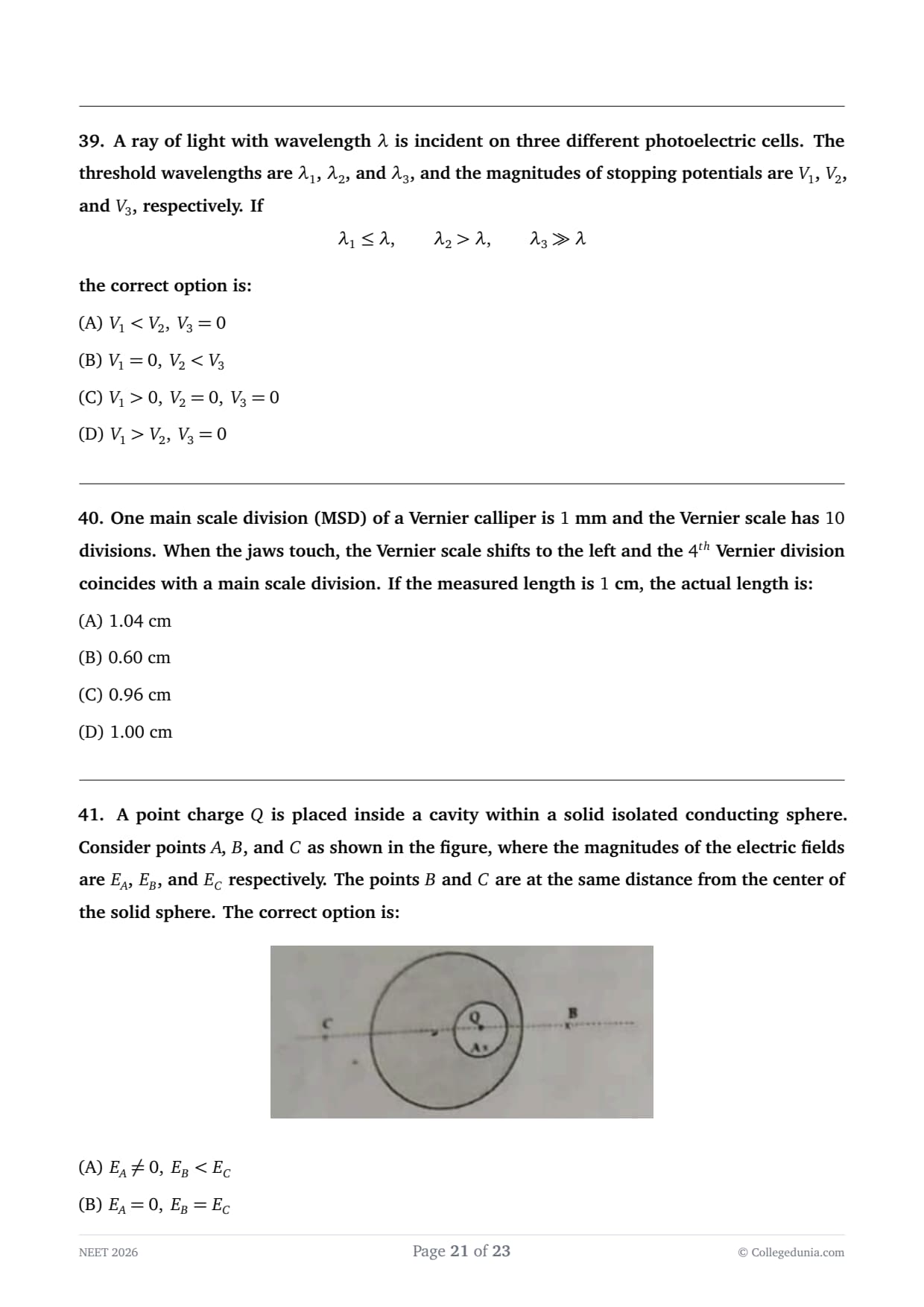
A point charge \(Q\) is placed inside a cavity within a solid isolated conducting sphere. Consider points \(A\), \(B\), and \(C\) as shown in the figure, where the magnitudes of the electric fields are \(E_A\), \(E_B\), and \(E_C\) respectively. The points \(B\) and \(C\) are at the same distance from the center of the solid sphere. The correct option is:

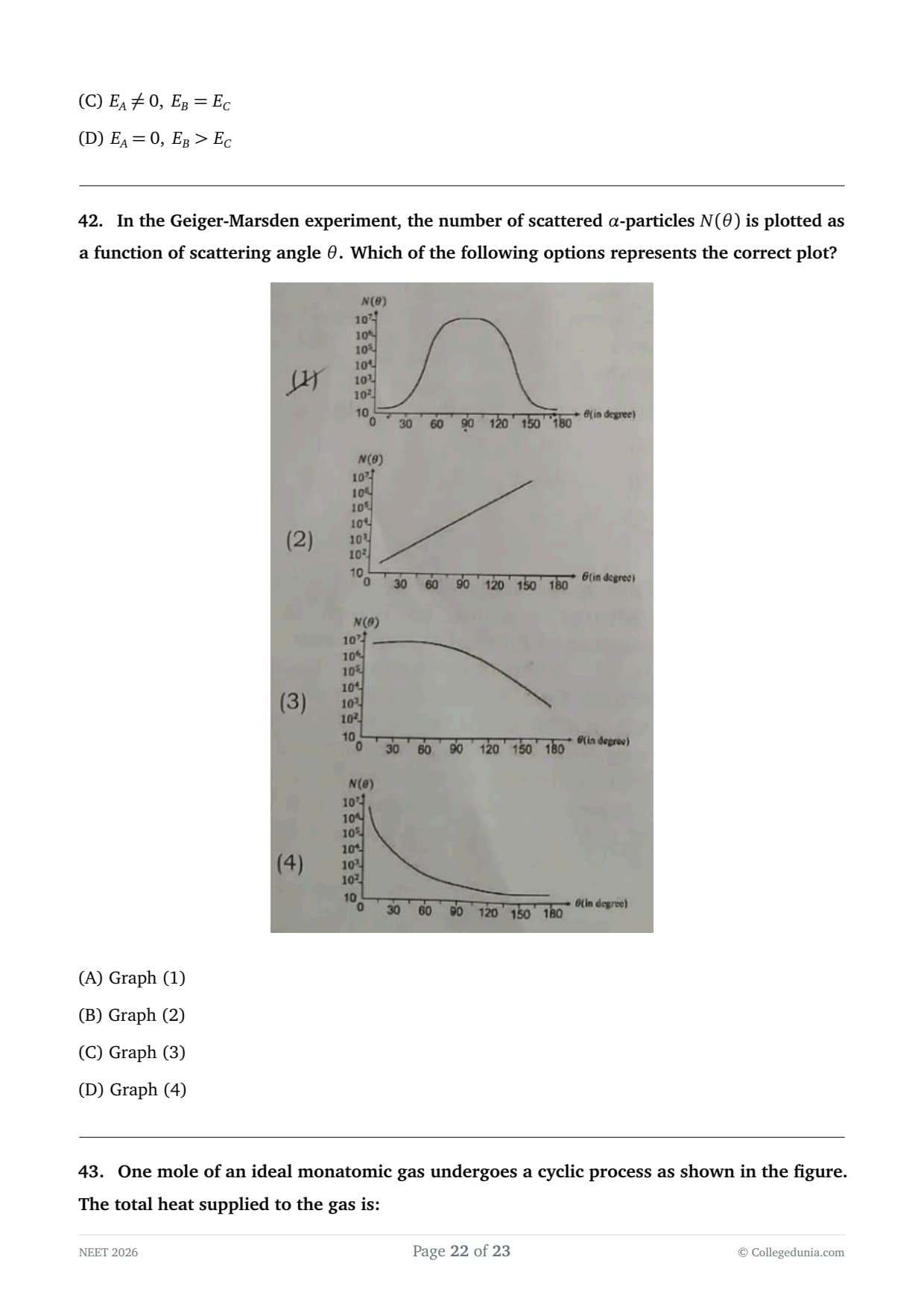
In the Geiger-Marsden experiment, the number of scattered \(\alpha\)-particles \(N(\theta)\) is plotted as a function of scattering angle \(\theta\). Which of the following options represents the correct plot?

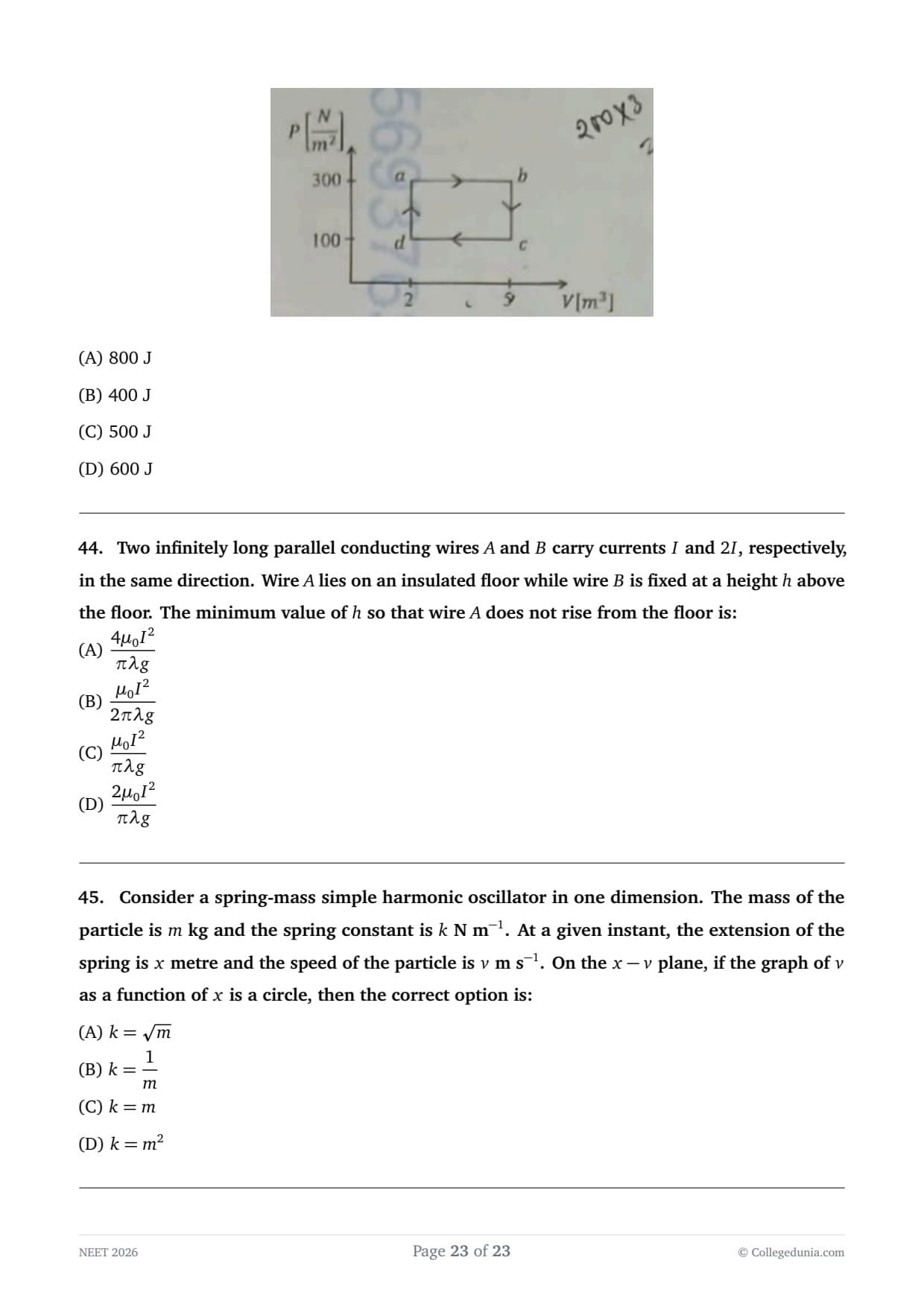
One mole of an ideal monatomic gas undergoes a cyclic process as shown in the figure. The total heat supplied to the gas is:

Two infinitely long parallel conducting wires \(A\) and \(B\) carry currents \(I\) and \(2I\), respectively, in the same direction. Wire \(A\) lies on an insulated floor while wire \(B\) is fixed at a height \(h\) above the floor. The minimum value of \(h\) so that wire \(A\) does not rise from the floor is:
Consider a spring-mass simple harmonic oscillator in one dimension. The mass of the particle is \(m\) kg and the spring constant is \(k\) N m\(^{-1}\). At a given instant, the extension of the spring is \(x\) metre and the speed of the particle is \(v\) m s\(^{-1}\). On the \(x-v\) plane, if the graph of \(v\) as a function of \(x\) is a circle, then the correct option is:
NEET 2026 Physics Topic-Wise Weightage
| Topic | Expected Questions |
|---|---|
| Current Electricity | 3–4 |
| Electrostatic Potential and Capacitance | 2–3 |
| Gravitation | 2–3 |
| Ray Optics and Optical Instruments | 2–3 |
| Atoms | 2–3 |
| Semiconductor Electronics | 2–3 |
| Units and Measurements | 2–3 |
| Motion in a Straight Line | 2 |
| Laws of Motion | 2 |
| Work, Energy, and Power | 2 |
| System of Particles and Rotational Motion | 2 |
| Oscillations | 2 |
| Alternating Current | 2 |
| Electromagnetic Waves | 2 |
| Dual Nature of Radiation and Matter | 2 |
| Moving Charges and Magnetism | 2 |
| Mechanical Properties of Fluids | 1–2 |
| Thermodynamics | 1–2 |
| Kinetic Theory | 1–2 |
| Wave Optics | 1–2 |
| Motion in a Plane | 1 |
| Waves | 1 |
| Electric Charges and Fields | 1 |
| Magnetism and Matter | 1 |
| Electromagnetic Induction | 1 |
| Experimental Skills | 1 |
| Mechanical Properties of Solids | 1 |
| Thermal Properties of Matter | 1 |
| Nuclei | 1 |



Comments