CUET 2026 May 26 Shift 1 General Aptitude Test Question Paper is available for download here. NTA is conducting the CUET 2026 exam from 11th May to 31st May.
- CUET 2026 General Aptitude Test exam consists of 50 questions for 250 marks to be attempted in 60 minutes.
- As per the marking scheme, 5 marks are awarded for each correct answer, and 1 mark is deducted for incorrect answer.
Candidates can download CUET 2026 May 26 Shift 1 General Aptitude Test Question Paper with Answer Key and Solution PDF from links provided below.
Related Links:
- CUET 2026 May 26 Shift 1 General Aptitude Test Answer Key
- CUET 2026 General Aptitude Test Marks vs Percentile-Expected
CUET 2026 General Aptitude Test May 26 Shift 1 Question Paper with Solution PDF
| CUET May 26 Shift 1 General Aptitude Test Question Paper 2026 | Download PDF | Check Solutions |
A cube of side 125 cm is painted red on all the faces and then cut into smaller cubes of side 25 cm each. Find the number of smaller cubes having at least two faces painted.
View Solution
Step 1: Understanding the Question:
In this problem, a larger cube is painted on all outer faces and then partitioned into smaller, identical cubes.
We are asked to find the number of these smaller cubes that have at least two of their faces painted.
The phrase "at least two faces painted" refers to cubes that have either exactly two faces painted or exactly three faces painted.
No smaller cube can have more than three faces painted, so this covers all possibilities of two or more painted faces.
Step 2: Key Formula or Approach:
Let the side length of the larger cube be \( L \) and the side length of each smaller cube be \( s \).
The number of divisions along each edge of the larger cube is given by the ratio \( n \):
\[ n = \frac{L}{s} \]
The standard formulas for the number of painted faces on the smaller cubes are as follows:
1. Cubes with exactly 3 faces painted (located at the corners): \( N_3 = 8 \) (always constant for any \( n \ge 2 \)).
2. Cubes with exactly 2 faces painted (located on the edges): \( N_2 = 12(n - 2) \).
The total number of cubes with at least two faces painted is:
\[ N_{at least 2} = N_2 + N_3 = 12(n - 2) + 8 \]
Step 3: Detailed Explanation:
1. We begin by identifying the side of the larger cube, which is \( L = 125 cm \).
2. Next, we find the side of each smaller cube, which is \( s = 25 cm \).
3. We compute the number of parts \( n \) along each edge of the larger cube:
\[ n = \frac{125}{25} = 5 \]
4. We determine the number of smaller cubes that have exactly three faces painted. These cubes are situated at the 8 corner vertices of the larger cube. Thus, \( N_3 = 8 \).
5. We calculate the number of smaller cubes that have exactly two faces painted. These cubes lie along the 12 edges of the larger cube, excluding the corner cubes.
Using the formula \( 12(n - 2) \), we substitute \( n = 5 \):
\[ N_2 = 12 \times (5 - 2) = 12 \times 3 = 36 \]
6. To find the number of smaller cubes with at least two faces painted, we sum the two quantities:
\[ N_{at least 2} = N_2 + N_3 = 36 + 8 = 44 \]
7. This gives us a total of 44 smaller cubes that satisfy the given condition.
Step 4: Final Answer:
Therefore, the number of smaller cubes having at least two faces painted is 44, which corresponds to option (C).
Quick Tip: For any cube of side \( L \) cut into smaller cubes of side \( s \) with \( n = L/s \):
- Cubes with 3 faces painted = 8
- Cubes with 2 faces painted = \( 12(n - 2) \)
- Cubes with 1 face painted = \( 6(n - 2)^2 \)
- Cubes with 0 faces painted = \( (n - 2)^3 \)
Remembering these standard formulas helps in solving cube partitioning questions rapidly during examinations.
In a square, lengths of the diagonals are (4k+6) cm and (7k -3) cm. The area of the square (in \(cm^2\)) is:
View Solution
Step 1: Understanding the Question:
In a square, both diagonals are of equal length.
We are given two algebraic expressions representing the lengths of these diagonals: \( (4k+6) cm \) and \( (7k-3) cm \).
We need to determine the area of the square using these given expressions.
Step 2: Key Formula or Approach:
Since the diagonals of a square are always equal, we equate the two expressions to find the value of the unknown variable \( k \):
\[ 4k + 6 = 7k - 3 \]
Once the value of \( k \) is found, we substitute it back to compute the actual length of the diagonal \( d \).
The area of a square in terms of its diagonal \( d \) is given by:
\[ Area = \frac{1}{2} \times d^2 \]
Step 3: Detailed Explanation:
1. Let us denote the two diagonals of the square as \( d_1 \) and \( d_2 \).
2. Since the diagonals of any square are congruent, we have:
\[ d_1 = d_2 \]
3. Substituting the given algebraic expressions:
\[ 4k + 6 = 7k - 3 \]
4. To solve for \( k \), we rearrange the terms by shifting the variable term \( 4k \) to the right-hand side and the constant term \( -3 \) to the left-hand side:
\[ 6 + 3 = 7k - 4k \]
5. Simplifying both sides yields:
\[ 9 = 3k \]
6. Dividing by 3, we find the value of \( k \):
\[ k = 3 \]
7. Now, we substitute this value of \( k \) back into the expression for either diagonal to find its length:
\[ d = 4k + 6 = 4(3) + 6 = 12 + 6 = 18 cm \]
8. We can also verify this value using the second expression:
\[ d = 7(3) - 3 = 21 - 3 = 18 cm \]
The diagonal length is consistently calculated as \( 18 cm \).
9. Next, we compute the area of the square using the diagonal length:
\[ Area = \frac{1}{2} \times d^2 = \frac{1}{2} \times (18)^2 \]
10. Calculating the square of 18 gives 324:
\[ Area = \frac{1}{2} \times 324 = 162 cm^2 \]
Step 4: Final Answer:
The area of the square is \( 162 cm^2 \), which corresponds to option (B).
Quick Tip: The area of a square can be expressed using either its side \( a \) or its diagonal \( d \).
While the basic formula is \( Area = a^2 \), using the diagonal formula \( Area = \frac{d^2}{2} \) directly avoids the extra step of finding the side length \( a = \frac{d}{\sqrt{2}} \), saving time.
A boy leaves his house. He travels 6 km towards South, then travels 8 km towards West and further travels 9 km towards South. How far and in which direction is he from his house now?
View Solution
Step 1: Understanding the Question:
This question involves tracking the movement of a boy starting from his house and determining his final position relative to the starting point.
We need to calculate both the straight-line distance and the direction from the starting point to the ending point.
Step 2: Key Formula or Approach:
We can represent the directions on a standard Cartesian coordinate system where:
- North is along the positive y-axis.
- South is along the negative y-axis.
- East is along the positive x-axis.
- West is along the negative x-axis.
Let the starting point (the house) be the origin \( (0, 0) \).
The total net displacement in the horizontal (East-West) direction is \( \Delta x \), and the total net displacement in the vertical (North-South) direction is \( \Delta y \).
The shortest direct distance \( D \) is calculated using the Pythagorean theorem:
\[ D = \sqrt{(\Delta x)^2 + (\Delta y)^2} \]
Step 3: Detailed Explanation:
1. Let the boy's house be at the origin \( O(0, 0) \).
2. First, the boy travels \( 6 km \) towards the South.
His position becomes \( (0, -6) \).
3. Second, he travels \( 8 km \) towards the West.
His position becomes \( (-8, -6) \).
4. Third, he travels \( 9 km \) further towards the South.
His position becomes \( (-8, -6 - 9) = (-8, -15) \).
5. Now, we analyze the net displacements:
- Total vertical displacement towards South: \( 6 km + 9 km = 15 km \).
- Total horizontal displacement towards West: \( 8 km \).
6. These displacements form a right-angled triangle where the legs are \( 8 km \) and \( 15 km \).
7. We apply the Pythagorean theorem to find the hypotenuse, which represents the direct distance:
\[ D = \sqrt{8^2 + 15^2} \]
8. Computing the squares:
\[ 8^2 = 64 \]
\[ 15^2 = 225 \]
\[ D = \sqrt{64 + 225} = \sqrt{289} \]
9. Since \( 17 \times 17 = 289 \), the direct distance is:
\[ D = 17 km \]
10. To find the direction, we observe that the boy has moved South and West from the starting point.
Therefore, his direction from the house is South-West.
Step 4: Final Answer:
The boy is at a distance of 17 km in the South-West direction from his house, which corresponds to option (B).
Quick Tip: Remembering common Pythagorean triplets can help solve distance problems without calculations.
Some standard triplets are:
- \( (3, 4, 5) \)
- \( (5, 12, 13) \)
- \( (8, 15, 17) \)
Here, the legs are 8 and 15, so the hypotenuse is instantly identified as 17.
The sum of three numbers is 136. If the ratio between the first number and the second number is 2:3 and that between the second and the third number is 5: 3, then the first number is:
View Solution
Step 1: Understanding the Question:
We are given two separate ratios of three numbers and their sum, which is 136.
Our objective is to combine these separate ratios into a single continuous ratio for the three numbers and then find the value of the first number.
Step 2: Key Formula or Approach:
Let the three numbers be \( A \), \( B \), and \( C \).
We are given the ratios \( A : B = 2 : 3 \) and \( B : C = 5 : 3 \).
To combine these into a single ratio \( A : B : C \), we make the terms corresponding to the common variable \( B \) equal in both ratios by finding their Least Common Multiple (LCM).
Step 3: Detailed Explanation:
1. Let the three numbers be \( A \), \( B \), and \( C \).
2. The ratio of the first number to the second number is:
\[ A : B = 2 : 3 \]
3. The ratio of the second number to the third number is:
\[ B : C = 5 : 3 \]
4. The term for \( B \) is 3 in the first ratio and 5 in the second ratio. The LCM of 3 and 5 is 15.
5. To make the \( B \) term equal to 15 in both ratios:
- Multiply both terms of the ratio \( A : B \) by 5:
\[ A : B = (2 \times 5) : (3 \times 5) = 10 : 15 \]
- Multiply both terms of the ratio \( B : C \) by 3:
\[ B : C = (5 \times 3) : (3 \times 3) = 15 : 9 \]
6. Combining these, we obtain the unified ratio:
\[ A : B : C = 10 : 15 : 9 \]
7. Let the actual values of the three numbers be \( 10x \), \( 15x \), and \( 9x \), where \( x \) is a constant multiplier.
8. We are given that the sum of these three numbers is 136:
\[ 10x + 15x + 9x = 136 \]
9. Combining the like terms:
\[ 34x = 136 \]
10. Solving for \( x \):
\[ x = \frac{136}{34} = 4 \]
11. Now, we compute the first number \( A \):
\[ A = 10x = 10 \times 4 = 40 \]
Step 4: Final Answer:
The value of the first number is 40, which corresponds to option (B).
Quick Tip: To quickly merge two ratios \( A : B = a : b \) and \( B : C = c : d \), you can write:
\[ A : B : C = (a \times c) : (b \times c) : (b \times d) \]
Applying this directly here:
\[ A : B : C = (2 \times 5) : (3 \times 5) : (3 \times 3) = 10 : 15 : 9 \]
This saves time during exams by skipping intermediate steps.
The volume of a cylinder having base radius 3 cm is 396 \(cm^3\). Find its curved surface area (in \(cm^2\)). (Use \(\pi\) = 22/7)
View Solution
Step 1: Understanding the Question:
We are given the volume of a cylinder and its base radius. We are required to calculate its curved surface area (CSA).
Step 2: Key Formula or Approach:
The volume \( V \) of a cylinder is given by:
\[ V = \pi r^2 h \]
The curved surface area (CSA) of a cylinder is given by:
\[ CSA = 2\pi rh \]
We can first find the height \( h \) using the volume formula and then compute the CSA.
Alternatively, we can express the curved surface area in terms of the volume:
\[ CSA = \frac{2 \times Volume}{r} \]
Step 3: Detailed Explanation:
1. Let the base radius of the cylinder be \( r = 3 cm \).
2. Let the volume of the cylinder be \( V = 396 cm^3 \).
3. Let the height of the cylinder be \( h \).
4. First, let us solve using the standard method by finding the height \( h \):
\[ V = \pi r^2 h \]
Substituting the given values and \( \pi = \frac{22}{7} \):
\[ 396 = \frac{22}{7} \times 3^2 \times h \]
\[ 396 = \frac{22}{7} \times 9 \times h \]
\[ 396 = \frac{198}{7} \times h \]
5. Solving for \( h \):
\[ h = 396 \times \frac{7}{198} = 2 \times 7 = 14 cm \]
6. Now, we use the height \( h = 14 cm \) to find the curved surface area (CSA):
\[ CSA = 2\pi rh \]
7. Substituting the values:
\[ CSA = 2 \times \frac{22}{7} \times 3 \times 14 \]
8. Simplifying the expression:
\[ CSA = 2 \times 22 \times 3 \times 2 \]
\[ CSA = 44 \times 6 = 264 cm^2 \]
Step 4: Final Answer:
The curved surface area of the cylinder is \( 264 cm^2 \), which corresponds to option (C).
Quick Tip: You can relate Volume and Curved Surface Area directly using:
\[ CSA = \frac{2V}{r} \]
Let's check this shortcut:
\[ CSA = \frac{2 \times 396}{3} = 2 \times 132 = 264 cm^2 \]
This formula bypasses the calculation of height \( h \), giving the answer directly.
Three statements are given below followed by their conclusions. Choose the best option that fits :
Statements:
1. All lemons are plums.
2. All plums are dates.
3. Some dates are mangoes.
Conclusions:
I. Some lemons are mangoes.
II. Some mangoes are plums.
III. All lemons are dates.
IV. Some mangoes are dates.
View Solution
Step 1: Understanding the Question:
This question is based on syllogisms. We need to evaluate the validity of four conclusions based on three given statements.
Step 2: Key Formula or Approach:
We can represent the relationships between different sets (lemons, plums, dates, and mangoes) using a Venn diagram:
- "All A are B" implies that the circle representing set A lies completely inside the circle representing set B.
- "Some A are B" implies that the circles representing sets A and B overlap with each other.
Step 3: Detailed Explanation:
1. Let the sets of lemons, plums, dates, and mangoes be represented by \( L \), \( P \), \( D \), and \( M \) respectively.
2. Statement 1 states: "All lemons are plums." This means that the set \( L \) is completely inside the set \( P \) (\( L \subseteq P \)).
3. Statement 2 states: "All plums are dates." This means that the set \( P \) is completely inside the set \( D \) (\( P \subseteq D \)).
4. Combining these two nested statements, since \( L \subseteq P \) and \( P \subseteq D \), it is mathematically certain that \( L \subseteq D \). This means "All lemons are dates." Therefore, Conclusion III is valid.
5. Statement 3 states: "Some dates are mangoes." This means there is an intersection between the set of dates \( D \) and the set of mangoes \( M \) (\( D \cap M \neq \emptyset \)).
6. This intersecting set of mangoes does not necessarily overlap with the subset of plums \( P \) or the subset of lemons \( L \).
7. Let us analyze Conclusion I: "Some lemons are mangoes." Since there is no definite overlap between \( L \) and \( M \), this is not necessarily true. Therefore, Conclusion I does not follow.
8. Let us analyze Conclusion II: "Some mangoes are plums." Since there is no definite overlap between \( M \) and \( P \), this is also not necessarily true. Therefore, Conclusion II does not follow.
9. Let us analyze Conclusion IV: "Some mangoes are dates." Since "Some dates are mangoes" implies a mutual intersection, it is always true that "Some mangoes are dates." Therefore, Conclusion IV is valid.
10. Thus, only Conclusions III and IV follow.
Step 4: Final Answer:
Both conclusions III and IV follow, which corresponds to option (D).
Quick Tip: In syllogisms, when sets are nested:
- "All A are B" and "All B are C" always leads to the definite conclusion "All A are C".
- The statement "Some A are B" is symmetric and always implies "Some B are A".
What will be the next number of the series: 3, 6, 10.5, 17, 26, ?
View Solution
Step 1: Understanding the Question:
We are given a number series: 3, 6, 10.5, 17, 26. We need to find the next number in this sequence.
Step 2: Key Formula or Approach:
We can identify the underlying pattern by analyzing the first-order differences (the differences between consecutive terms) and, if needed, the second-order differences (the differences between those differences).
Step 3: Detailed Explanation:
1. Let the terms of the series be \( T_1 = 3 \), \( T_2 = 6 \), \( T_3 = 10.5 \), \( T_4 = 17 \), \( T_5 = 26 \). We need to determine \( T_6 \).
2. First, let us find the first-order differences between consecutive terms:
- Difference 1: \( T_2 - T_1 = 6 - 3 = 3 \)
- Difference 2: \( T_3 - T_2 = 10.5 - 6 = 4.5 \)
- Difference 3: \( T_4 - T_3 = 17 - 10.5 = 6.5 \)
- Difference 4: \( T_5 - T_4 = 26 - 17 = 9 \)
3. The first-order differences are: 3, 4.5, 6.5, 9.
4. Next, let us calculate the second-order differences by taking the difference of these values:
- Second Difference 1: \( 4.5 - 3 = 1.5 \)
- Second Difference 2: \( 6.5 - 4.5 = 2.0 \)
- Second Difference 3: \( 9 - 6.5 = 2.5 \)
5. The second-order differences are: 1.5, 2.0, 2.5.
6. We observe a clear linear pattern where the second-order difference increases by 0.5 at each step.
7. Following this pattern, the next second-order difference should be:
\[ 2.5 + 0.5 = 3.0 \]
8. We add this value to the last first-order difference (9) to get the next difference:
\[ 9 + 3.0 = 12 \]
9. Finally, we add this difference to the last term of the series (26) to find the next term:
\[ T_6 = 26 + 12 = 38 \]
Step 4: Final Answer:
The next number of the series is 38, which corresponds to option (B).
Quick Tip: When the terms of a series increase gradually, always write down the first-order differences.
If the pattern is not obvious, calculate the second-order differences. Many competitive exam series are quadratic sequences where the second-order differences are constant or in arithmetic progression.
A train running at the speed of 80 km/h crosses a 450 m long tunnel in 36 seconds. The length of the train (in m) is:
View Solution
Step 1: Understanding the Question:
A moving train crosses a tunnel of a given length. We are given the speed of the train, the length of the tunnel, and the time taken to cross the tunnel. We need to find the length of the train.
Step 2: Key Formula or Approach:
The fundamental relation is:
\[ Distance = Speed \times Time \]
When a train crosses a tunnel, the total distance covered is the sum of the length of the train and the length of the tunnel:
\[ Total Distance = L_{train} + L_{tunnel} \]
We must convert the speed from \(km/h\) to \(m/s\) using the conversion factor:
\[ 1 km/h = \frac{5}{18} m/s \]
Step 3: Detailed Explanation:
1. Let the length of the train be \( L \) meters.
2. The length of the tunnel is given as \( 450 m \).
3. The total distance to be covered by the train to completely clear the tunnel is:
\[ Distance = L + 450 \]
4. The speed of the train is given as \( 80 km/h \). We convert this into meters per second (\(m/s\)):
\[ Speed = 80 \times \frac{5}{18} = \frac{400}{18} = \frac{200}{9} m/s \]
5. The time taken to cross the tunnel is given as \( 36 seconds \).
6. Now, using the formula \( Distance = Speed \times Time \):
\[ L + 450 = \frac{200}{9} \times 36 \]
7. Simplifying the expression on the right-hand side:
\[ L + 450 = 200 \times 4 \]
\[ L + 450 = 800 \]
8. Solving for \( L \):
\[ L = 800 - 450 = 350 m \]
9. Thus, the length of the train is 350 meters.
Step 4: Final Answer:
The length of the train is 350 meters, which corresponds to option (A).
Quick Tip: Always ensure unit consistency. Since the options and tunnel length are in meters and the time is in seconds, converting the speed from \(km/h\) to \(m/s\) at the beginning is a necessary step.
Multiplying by \(\frac{5}{18}\) is the standard shortcut to convert from \(km/h\) to \(m/s\).
A tap can fill a tank in 6 hours. After half the tank is filled, three more similar taps are opened. What is the total time taken to fill the tank completely?
View Solution
Step 1: Understanding the Question:
A single tap can fill a tank in 6 hours. Initially, only one tap is operational until half of the tank is filled. After this, three more identical taps are opened. We need to find the total time taken to fill the entire tank.
Step 2: Key Formula or Approach:
We use the rate of work concept:
- Let the total capacity of the tank be 1 unit.
- The rate of one tap is the fraction of the tank filled per hour: \( Rate = \frac{1}{Time taken} \).
- The time taken to complete a certain amount of work is:
\[ Time = \frac{Work to be done}{Rate of work} \]
Step 3: Detailed Explanation:
1. The total time taken by a single tap to fill the tank completely is \( 6 hours \).
2. Therefore, the rate of filling of one tap is \( \frac{1}{6} \) of the tank per hour.
3. The process is divided into two distinct parts.
4. Part 1: Filling the first half of the tank.
- The amount of work to be done is \( \frac{1}{2} \) of the total capacity.
- Only 1 tap is open during this stage.
- The time taken to fill the first half of the tank is:
\[ Time_1 = \frac{1}{2} \times 6 = 3 hours \]
5. Part 2: Filling the remaining half of the tank.
- The remaining work is \( \frac{1}{2} \) of the total capacity.
- Three more identical taps are opened, making the total number of active taps equal to \( 1 + 3 = 4 \).
- Since all 4 taps are identical, their combined filling rate is:
\[ Combined Rate = 4 \times \frac{1}{6} = \frac{2}{3} of the tank per hour \]
- The time taken to fill the remaining half of the tank is:
\[ Time_2 = \frac{Remaining Work}{Combined Rate} = \frac{1/2}{2/3} = \frac{1}{2} \times \frac{3}{2} = \frac{3}{4} hours \]
6. Converting \( \frac{3}{4} hours \) into minutes:
\[ Time_2 = \frac{3}{4} \times 60 = 45 minutes \]
7. Now, we sum the times from both parts to find the total time taken:
\[ Total Time = Time_1 + Time_2 = 3 hours + 45 minutes = 3 hours 45 minutes \]
Step 4: Final Answer:
The total time taken to fill the tank completely is 3 hours 45 minutes, which corresponds to option (D).
Quick Tip: For identical workers, the time taken is inversely proportional to the number of workers.
If 1 tap takes 3 hours to fill the remaining half of the tank, then 4 taps will take:
\[ \frac{3 hours}{4} = 45 minutes \]
Thus, the total time is simply \( 3 hours + 45 minutes = 3 hours 45 minutes \).
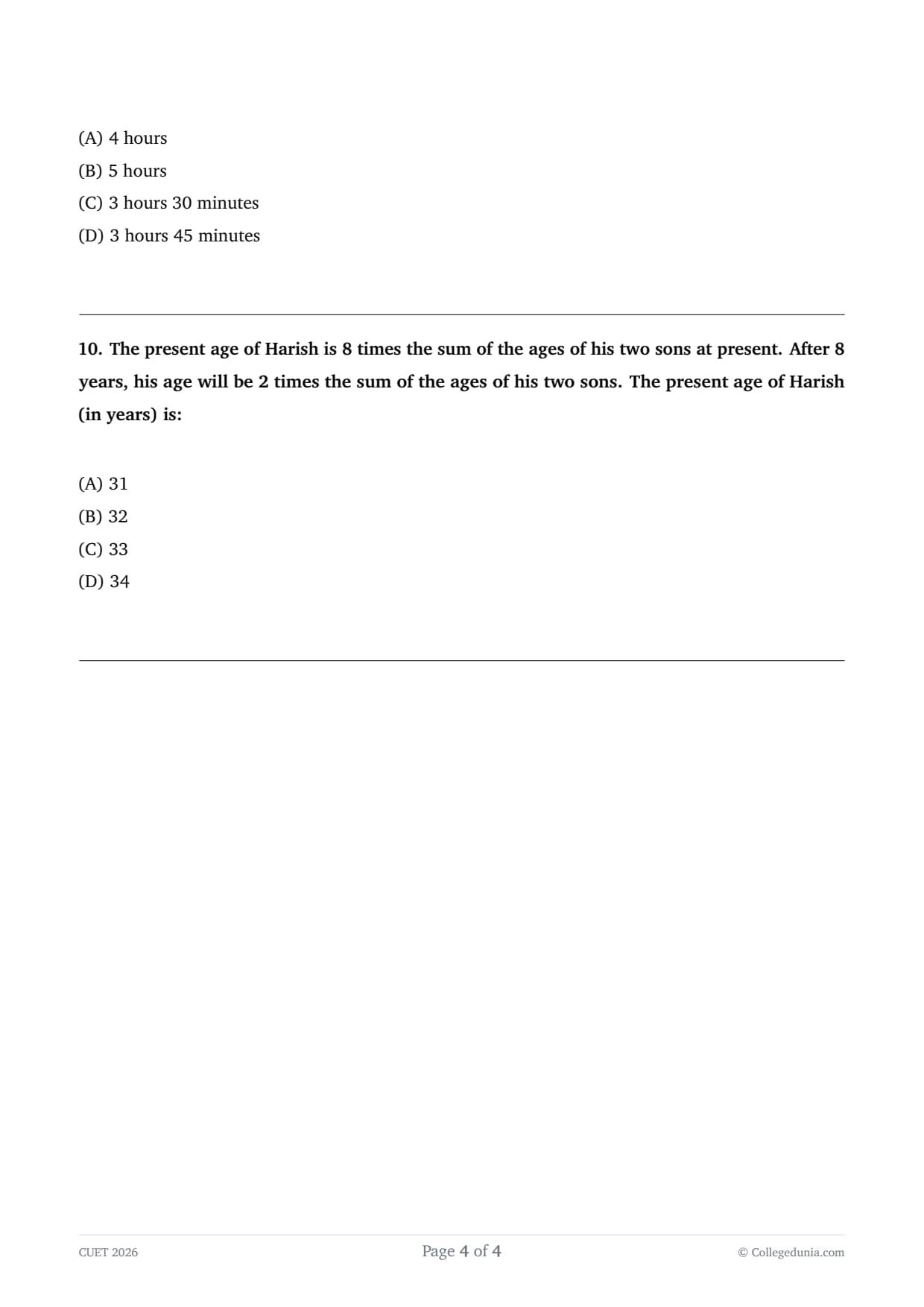
The present age of Harish is 8 times the sum of the ages of his two sons at present. After 8 years, his age will be 2 times the sum of the ages of his two sons. The present age of Harish (in years) is:
View Solution
Step 1: Understanding the Question:
This problem involves determining the present age of Harish using linear equations. We are given the relationships between Harish's age and the sum of his two sons' ages at two different time points: at present and 8 years in the future.
Step 2: Key Formula or Approach:
Let \( H \) represent the present age of Harish.
Let \( S \) represent the sum of the present ages of his two sons.
We establish two equations based on the conditions:
1. At present: \( H = 8S \).
2. After 8 years: Harish's age increases by 8 years, while each of his two sons also ages by 8 years. Thus, the sum of their ages increases by \( 2 \times 8 = 16 \) years.
The new relationship is:
\[ H + 8 = 2(S + 16) \]
Step 3: Detailed Explanation:
1. Let Harish's present age be \( H \) years.
2. Let the sum of the present ages of his two sons be \( S \) years.
3. According to the first condition:
\[ H = 8S \quad --- (Equation 1) \]
4. Now, let us consider the scenario after 8 years:
- Harish's age will be \( H + 8 \).
- The sum of the ages of his two sons will be \( S + 8 + 8 = S + 16 \) (since there are two sons, both ages increase by 8).
5. According to the second condition:
\[ H + 8 = 2(S + 16) \quad --- (Equation 2) \]
6. We can now solve these equations by substituting the value of \( H \) from Equation 1 into Equation 2:
\[ 8S + 8 = 2(S + 16) \]
7. Expanding the right side of the equation:
\[ 8S + 8 = 2S + 32 \]
8. Rearranging the terms to isolate the variable \( S \):
\[ 8S - 2S = 32 - 8 \]
\[ 6S = 24 \]
9. Dividing by 6, we get:
\[ S = 4 \]
10. Now, we find the present age of Harish by substituting \( S = 4 \) back into Equation 1:
\[ H = 8 \times 4 = 32 years \]
Step 4: Final Answer:
The present age of Harish is 32 years, which corresponds to option (B).
Quick Tip: Be careful with age problems involving multiple people.
After \( T \) years, the sum of the ages of \( N \) people increases by \( N \times T \), not just \( T \).
Here, since there are two sons, the sum of their ages increases by \( 2 \times 8 = 16 \). Avoiding this common trap is key to getting the correct answer.
CUET UG 2026 Exam Pattern
| Parameter | Details |
|---|---|
| Exam Name | Common University Entrance Test (CUET UG) 2026 |
| Conducting Body | National Testing Agency (NTA) |
| Exam Mode | Computer-Based Test (CBT) |
| Exam Duration | 60 minutes per test |
| Total Sections | 3 (Languages, Domain Subjects, General Test) |
| Question Type | Multiple Choice Questions (MCQs) |
| Questions per Test | 50 questions (all compulsory) |
| Marking Scheme | +5 for correct, -1 for incorrect |
| Maximum Marks | 250 marks per test |
| Maximum Subject Choices | 5 subjects in total |
| Syllabus Base | Class 12 NCERT (mainly for Domain Subjects) |





Comments