CUET 2026 May 22 Shift 2 English Question Paper is available for download here. NTA is conducting the CUET 2026 exam from 11th May to 31st May.
- CUET 2026 English exam consists of 50 questions for 250 marks to be attempted in 60 minutes.
- As per the marking scheme, 5 marks are awarded for each correct answer, and 1 mark is deducted for incorrect answer.
Candidates can download CUET 2026 May 22 Shift 2 English Question Paper with Answer Key and Solution PDF from links provided below.
Related Links:
CUET 2026 English May 22 Shift 2 Question Paper with Solution PDF
| CUET May 22 Shift 2 English Question Paper 2026 | Download PDF | Check Solutions |
"Recalcitrant" means:
View Solution
Step 1: Understanding the Question:
The question asks us to identify the correct meaning of the vocabulary word "recalcitrant" from the given multiple-choice options.
Step 2: Detailed Explanation:
Definition of Recalcitrant: The word "recalcitrant" is an adjective that describes a person who has an obstinately uncooperative attitude toward authority or discipline.
Etymology: It originates from the Latin word "recalcitrare", which literally translates to "to kick back" (from "re-" meaning back and "calcitrare" meaning to kick, from "calx" meaning heel).
Analyzing Option (A) - Obedient: This is the exact antonym of recalcitrant, as an obedient person complies with rules or authority.
Analyzing Option (B) - Stubborn: While "stubborn" is a close synonym representing determination not to change one's mind, it is more general and does not necessarily imply active resistance to authority.
Analyzing Option (C) - Resistant: This refers to offering resistance to something, but it is less descriptive of an active, rebellious behavioral attitude compared to other options.
Analyzing Option (D) - Defiant: This term refers to showing open resistance and bold disobedience to authority, which captures the rebellious, active "kicking back" connotation of recalcitrant most accurately.
Step 3: Final Answer:
Therefore, while "stubborn" and "resistant" are near-synonyms, "defiant" is the most precise and contextually appropriate option that matches the core definition of "recalcitrant".
Quick Tip: When faced with multiple closely related synonyms in vocabulary questions, look closely at the etymological root of the word.
"Recalcitrant" contains the root related to kicking back against authority, which aligns perfectly with being "defiant".
Learning roots, prefixes, and suffixes can help you distinguish between subtle differences in synonyms.
"Make up" means:
View Solution
Step 1: Understanding the Question:
This question asks for the definition of the highly versatile phrasal verb "make up".
Step 2: Detailed Explanation:
Nature of Phrasal Verbs: Phrasal verbs in English often carry multiple idiomatic meanings depending on the context in which they are used.
Analyzing Option (A) - Invent a story: "Make up" commonly means to fabricate or invent a story, excuse, or explanation. For instance, "He had to make up an excuse for being late to class." This is a highly frequent usage tested in competitive exams.
Analyzing Option (B) - Reconcile: "Make up" also means to restore friendly relations after a quarrel or disagreement. For example, "After their argument, they decided to make up and move forward."
Analyzing Option (C) - Apply cosmetics: This is another literal/common meaning, referring to applying make-up or cosmetics to the face. For example, "The actors need to make up before going on stage."
Analyzing Option (D) - Break friendship: This is incorrect, as "break up" or "fall out" would represent ending a relationship or friendship.
Note on Exam Context: Because options (A), (B), and (C) are all grammatically and semantically valid definitions of "make up", the question represents a polysemous word scenario. In standard answer keys where a single option is circled, (A) is often designated as the primary figurative translation, but a comprehensive understanding recognizes the validity of (A), (B), and (C).
Step 3: Final Answer:
Therefore, the primary idiomatic meaning highlighted in standard assessments is option (A), though options (B) and (C) are also linguistically correct.
Quick Tip: Phrasal verbs are highly contextual and often have multiple disparate meanings.
Create a mind map for common phrasal verbs like "make up", "bring up", "take off", and "go over" to memorize their various uses.
Always eliminate the option that is definitively antonymous or unrelated, such as "break friendship" in this case.
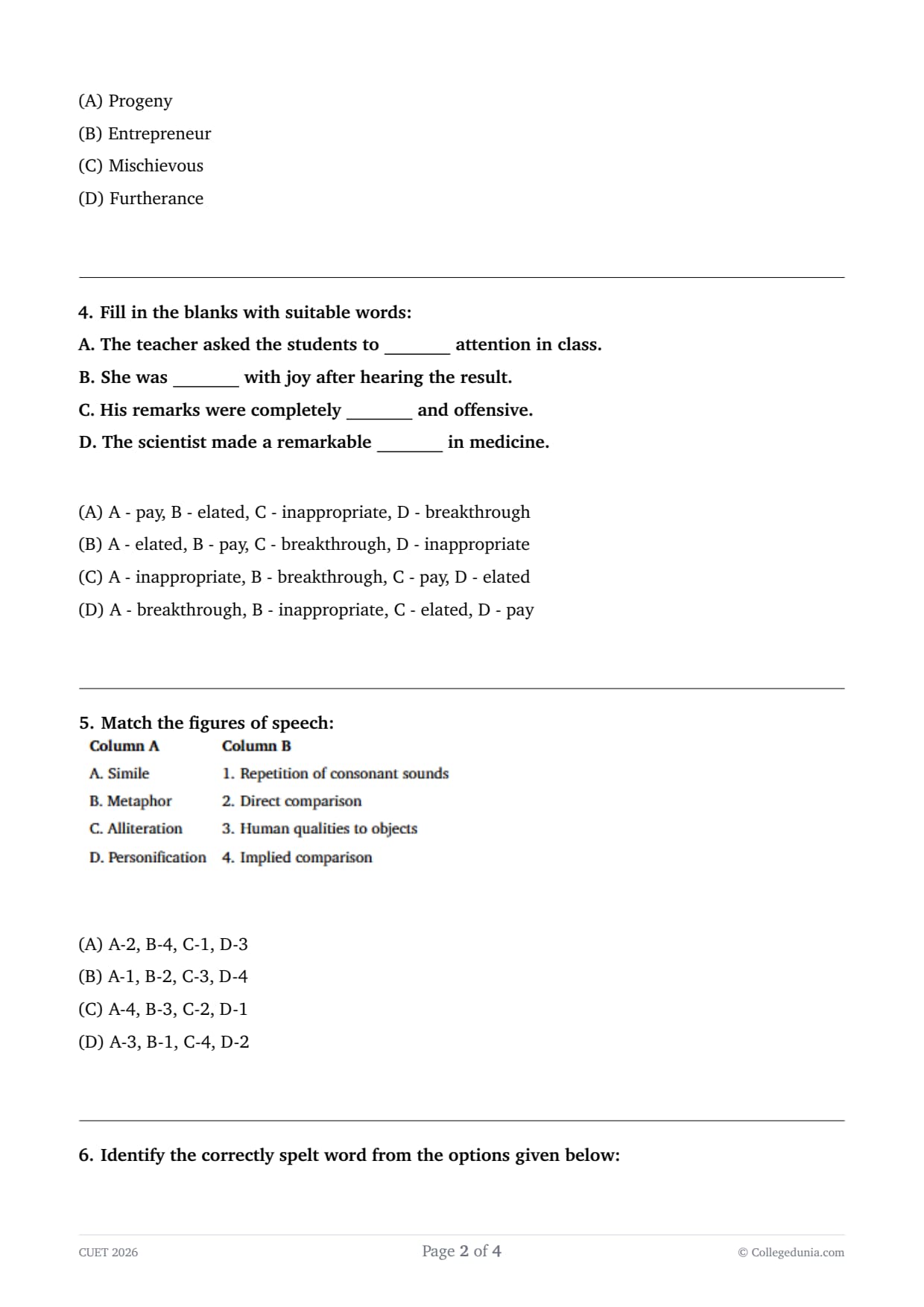
Identify the nouns.
View Solution
Step 1: Understanding the Question:
The question requires us to analyze a list of words and identify which of them function as nouns in standard English grammar.
Step 2: Detailed Explanation:
Option (A) - Progeny: This is a noun referring to the offspring or descendants of a person, animal, or plant. For example, "They were proud of their progeny." Since it represents a category of living beings, it is classified as a noun.
Option (B) - Entrepreneur: This is a noun representing a person who sets up a business or businesses, taking on financial risks in the hope of profit. The suffix "-eur" typically denotes an agent or person performing an action, confirming its status as a noun.
Option (C) - Mischievous: This is an adjective, not a noun. It describes a person, animal, or behavior that is playfully malicious or causes minor trouble. The suffix "-ous" is a classic adjective-forming suffix. For example, "The mischievous puppy chewed the shoe."
Option (D) - Furtherance: This is an abstract noun meaning the advancement or promotion of a scheme, plan, or interest. The suffix "-ance" is a standard suffix used to convert verbs (to further) into abstract nouns (furtherance).
Step 3: Final Answer:
Therefore, the nouns in the list are options (A) Progeny, (B) Entrepreneur, and (D) Furtherance, whereas option (C) is an adjective.
Quick Tip: Identifying parts of speech is simplified by analyzing word suffixes.
Suffixes like "-ance", "-ence", "-er", "-or", "-eur", and "-ity" almost always indicate nouns.
Suffixes like "-ous", "-ful", "-less", and "-ive" generally indicate adjectives.
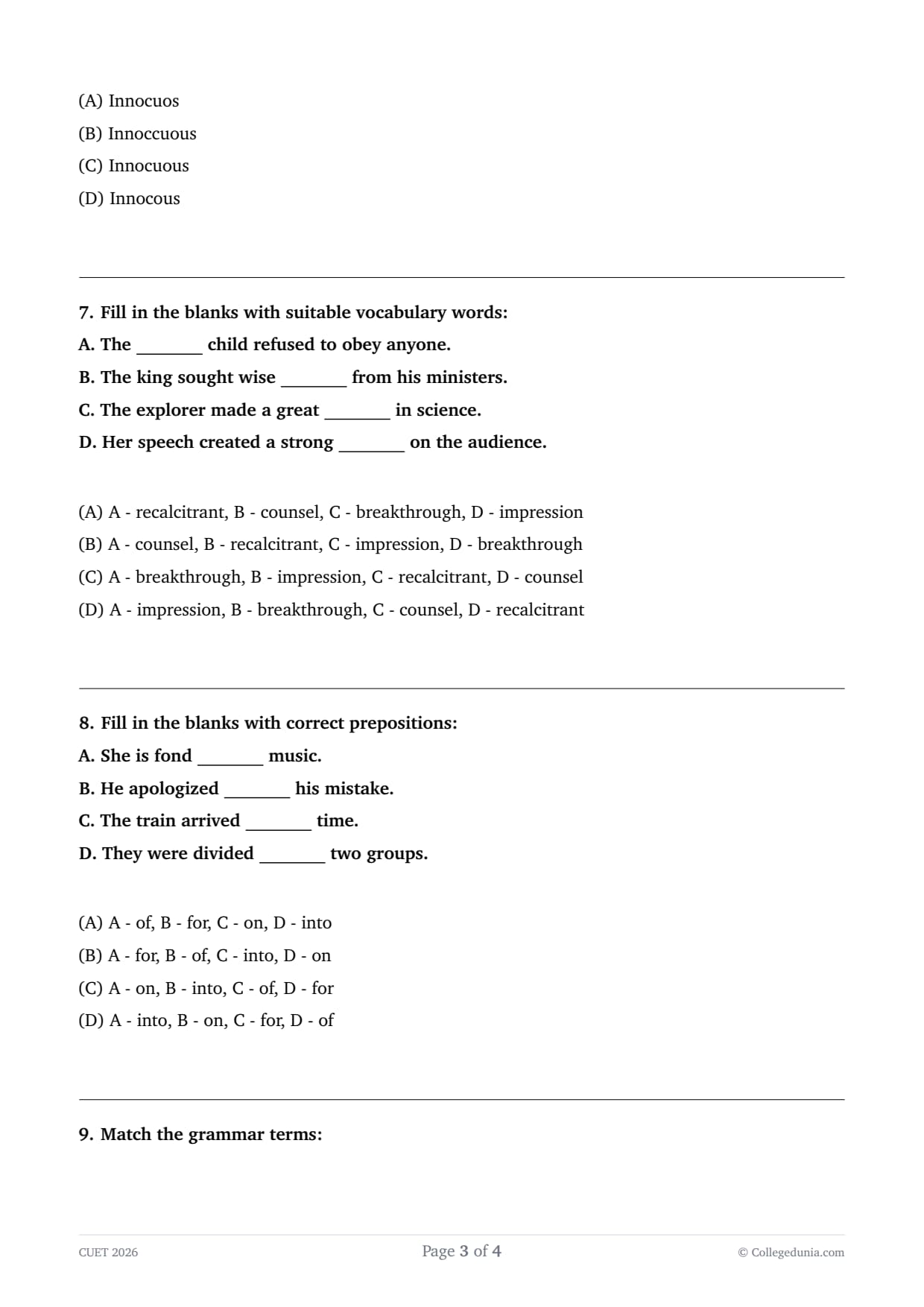
Fill in the blanks with suitable words:
A. The teacher asked the students to _________ attention in class.
B. She was _________ with joy after hearing the result.
C. His remarks were completely _________ and offensive.
D. The scientist made a remarkable _________ in medicine.
View Solution
Step 1: Understanding the Question:
The question asks us to fill in the blanks of four independent sentences using the most appropriate vocabulary words from the options provided.
Step 2: Detailed Explanation:
Analyzing Sentence A: "The teacher asked the students to __________ attention in class." In English, "pay attention" is a fixed collocation meaning to listen, watch, or focus on something carefully. Thus, "pay" is the correct verb here.
Analyzing Sentence B: "She was __________ with joy after hearing the result." The prepositional phrase "with joy" requires an adjective that describes an intense state of happiness. "Elated", which means extremely happy or proud, fits perfectly.
Analyzing Sentence C: "His remarks were completely __________ and offensive." The coordinating conjunction "and" connects words of similar grammatical function and tone. "Offensive" is a negative adjective, so we need another negative adjective. "Inappropriate" perfectly complements "offensive".
Analyzing Sentence D: "The scientist made a remarkable __________ in medicine." The verb phrase "made a remarkable..." requires a noun that denotes a major discovery or progress. "Breakthrough" means an important discovery or event that helps to solve a situation or provide progress, making it the ideal fit.
Step 3: Final Answer:
Therefore, matching each sentence with its correct vocabulary term yields the sequence: A - pay, B - elated, C - inappropriate, and D - breakthrough, corresponding to option (A).
Quick Tip: In fill-in-the-blank questions involving multiple sentences, start with the absolute certainties.
Common collocations like "pay attention" or "make a breakthrough" can be solved instantly, allowing you to use the process of elimination for trickier sentences.
Check that the selected words match the grammatical parts of speech required by each blank.
Match the figures of speech:
View Solution
Step 1: Understanding the Question:
The question requires us to match classical figures of speech in Column A with their correct definitions listed in Column B.
Step 2: Detailed Explanation:
Analyzing Simile (A): A simile is a figure of speech that directly compares two different things using comparative words such as "like" or "as". Therefore, it matches description 2, "Direct comparison". For example, "as brave as a lion."
Analyzing Metaphor (B): A metaphor is a figure of speech that makes an implicit, implied, or hidden comparison between two things that are unrelated but share some common characteristics. Unlike similes, it does not use "like" or "as". Thus, it matches description 4, "Implied comparison". For example, "time is a thief."
Analyzing Alliteration (C): Alliteration is the literary device where the same consonant sound is repeated at the beginning of adjacent or closely connected words in a sentence. This matches description 1, "Repetition of consonant sounds". For example, "Peter Piper picked a peck of pickled peppers."
Analyzing Personification (D): Personification is a figurative device in which non-human things, objects, or abstract ideas are given human traits, emotions, or intentions. This matches description 3, "Human qualities to objects". For example, "the wind whispered through the trees."
Step 3: Final Answer:
Therefore, the correct matching is A matches with 2, B with 4, C with 1, and D with 3, which corresponds to option (A).
Quick Tip: Remember that a simile always makes an explicit direct comparison using "like" or "as", whereas a metaphor makes an indirect or implied comparison without these words.
Alliteration concerns the repetition of consonant sounds specifically at the start of words, which is easy to spot visually.
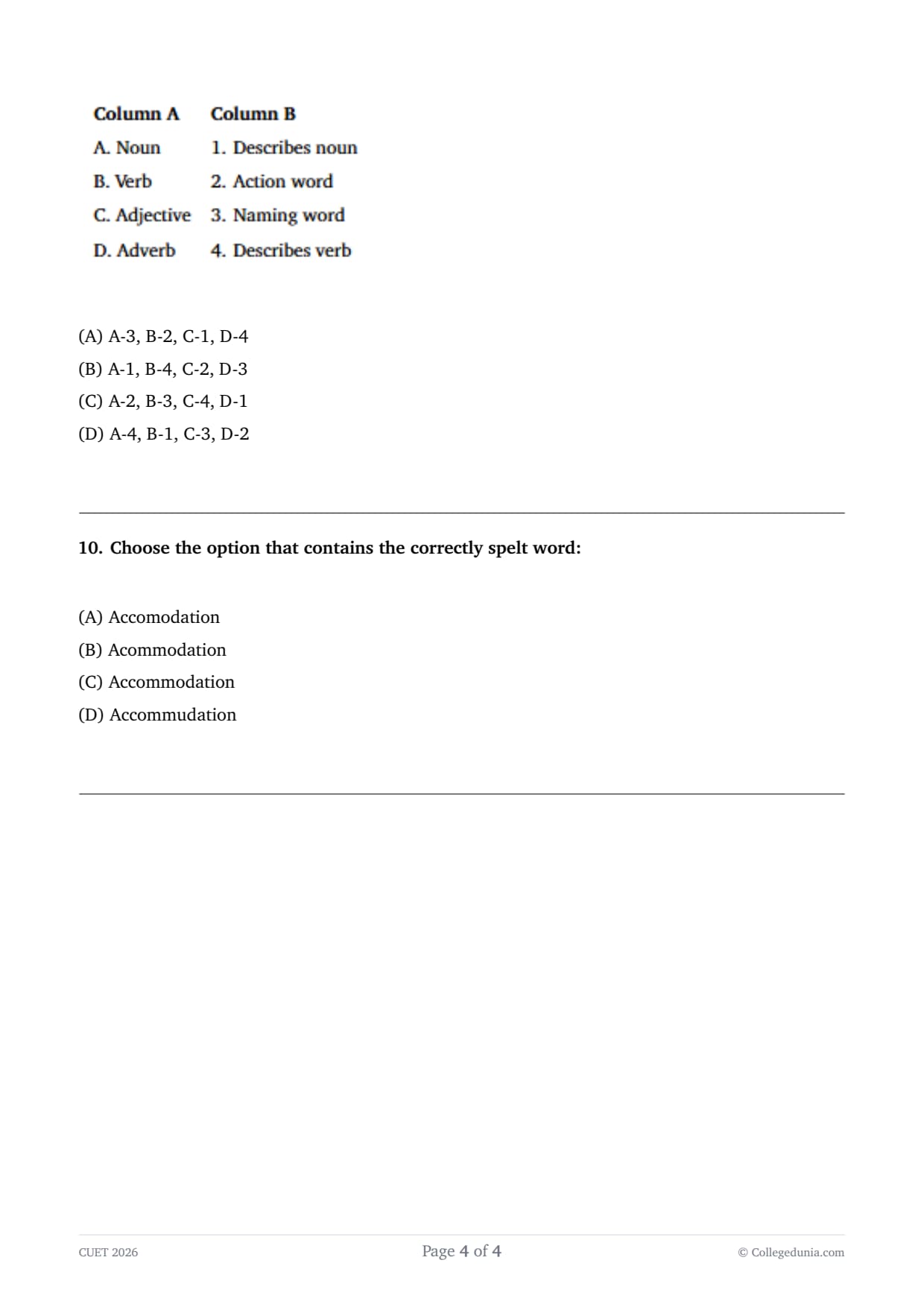
Identify the correctly spelt word from the options given below:
View Solution
Step 1: Understanding the Question:
This spelling-based question asks us to identify the standard, correct spelling of a specific vocabulary word meaning harmless or safe.
Step 2: Detailed Explanation:
Definition and Use: The word "innocuous" is an adjective used to describe something that is not harmful, offensive, or injurious. For example, "The medicine was completely innocuous, having no side effects."
Etymological Roots: It comes from the classical Latin "innocuus", formed by combining the prefix "in-" (meaning "not") and the root adjective "nocuus" (meaning "harmful", derived from the verb "nocere", which means "to hurt").
Analyzing Option (A) - Innocuos: This spelling incorrectly omits the letter 'u' before the ending letter 'o', which disrupts the correct standard pronunciation and orthography.
Analyzing Option (B) - Innoccuous: This spelling introduces an incorrect double 'c'. While the word has a double 'n' near the beginning, it only contains a single 'c' before the suffix.
Analyzing Option (C) - Innocuous: This is the perfectly correct orthographic form, maintaining the double 'n', single 'c', and the correct "-uous" suffix.
Analyzing Option (D) - Innocous: This spelling is severely misspelled, missing both the double 'n' structure and the correct vowel configuration in the suffix.
Step 3: Final Answer:
Therefore, the only correctly spelled option representing the standard English dictionary form of the word is option (C).
Quick Tip: To master spelling words like "innocuous", break them down by their Latin roots: "in-" (not) + "nocere" (harm) + adjective suffix "-ous".
Be mindful of words that feature double consonants; "innocuous" has a double 'n' but a single 'c'.
Fill in the blanks with suitable vocabulary words:
A. The__________ child refused to obey anyone.
B. The king sought wise __________ from his ministers.
C. The explorer made a great __________ in science.
D. Her speech created a strong__________ on the audience.
View Solution
Step 1: Understanding the Question:
The question tests contextual vocabulary usage by asking us to fill in the blanks of four sentences with the most suitable words from the list.
Step 2: Detailed Explanation:
Analyzing Sentence A: "The __________ child refused to obey anyone." The blank requires an adjective describing a child who is stubbornly disobedient. "Recalcitrant" means having an obstinately uncooperative attitude toward authority, which fits this context perfectly.
Analyzing Sentence B: "The king sought wise __________ from his ministers." In political and historical contexts, rulers seek advice or guidance. "Counsel" functions as a noun meaning advisory advice, making it the correct term.
Analyzing Sentence C: "The explorer made a great __________ in science." In academic and scientific fields, a major discovery or advancement is referred to as a "breakthrough". Thus, "breakthrough" is the correct noun for this blank.
Analyzing Sentence D: "Her speech created a strong __________ on the audience." The idiom "to create an impression on someone" means to leave a lasting impact or positive effect. This makes "impression" the correct choice here.
Step 3: Final Answer:
Therefore, the correct mapping of words to their respective blanks is A - recalcitrant, B - counsel, C - breakthrough, and D - impression, which matches option (A).
Quick Tip: Differentiate between "counsel" (advice/to advise) and "council" (a group of people gathered for consultation).
In fill-in-the-blank vocabulary matches, cross-reference words with the syntactic structure of the sentences (e.g., checking if a noun, adjective, or verb is required).
Fill in the blanks with correct prepositions:
A. She is fond __________ music.
B. He apologized __________ his mistake.
C. The train arrived __________ time.
D. They were divided __________ two groups.
View Solution
Step 1: Understanding the Question:
This question tests our command of English prepositions by requiring us to complete four sentences using correct fixed prepositions and common prepositional phrases.
Step 2: Detailed Explanation:
Analyzing Sentence A: "She is fond __________ music." The adjective "fond" is always paired with the fixed preposition "of" when indicating a liking or affection for something. Thus, "of" is the correct choice.
Analyzing Sentence B: "He apologized __________ his mistake." The verb "apologize" takes different prepositions depending on the object. You apologize "to" a person, but you apologize "for" an action or mistake. Therefore, "for" is correct here.
Analyzing Sentence C: "The train arrived __________ time." The phrase "on time" is an idiomatic prepositional phrase meaning punctual or according to the schedule, which is standard in English usage.
Analyzing Sentence D: "They were divided __________ two groups." When splitting a whole entity into separate component parts or groups, the verb "divide" is followed by the preposition "into".
Step 3: Final Answer:
Combining these matches results in the sequence A - of, B - for, C - on, and D - into, which perfectly aligns with option (A).
Quick Tip: Prepositions are often "fixed" in English, meaning they must follow specific verbs, nouns, or adjectives regardless of literal meaning.
Memorize preposition pairs like "fond of", "apologize for", and "depend on" to solve grammar questions quickly.
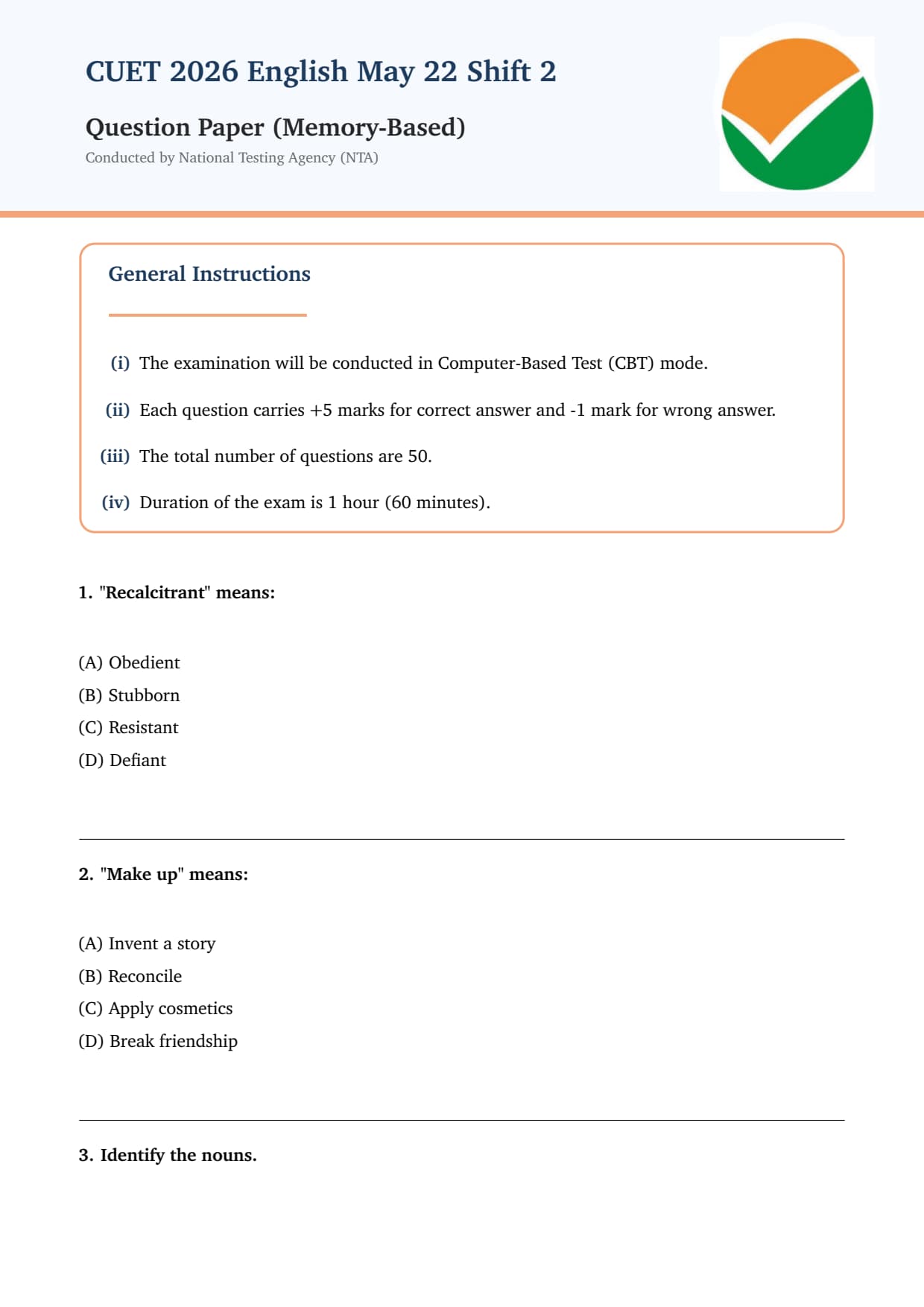
Match the grammar terms:
View Solution
Step 1: Understanding the Question:
This matching question tests the fundamental definitions of the primary parts of speech in English grammar.
Step 2: Detailed Explanation:
Analyzing Noun (A): A noun is a word that functions as the name of some specific thing or set of things, such as living creatures, objects, places, actions, qualities, states of existence, or ideas. Therefore, it is commonly defined as a "Naming word", matching with 3.
Analyzing Verb (B): A verb is a word used to describe an action, state, or occurrence. It forms the main grammatical engine of a sentence. It is characterized as an "Action word", matching with 2.
Analyzing Adjective (C): An adjective is a word that modifies, qualifies, or describes a noun or a pronoun by providing more details about its size, color, quantity, or qualities. Thus, it "Describes noun", matching with 1.
Analyzing Adverb (D): An adverb is a word that modifies or describes a verb, an adjective, or another adverb, often indicating how, when, where, or to what extent an action is performed. Therefore, it "Describes verb", matching with 4.
Step 3: Final Answer:
The correct matches are A-3, B-2, C-1, and D-4, which corresponds to option (A).
Quick Tip: Understanding the basic definitions of parts of speech is essential for sentence structure analysis and syntax error detection.
Always remember that adjectives describe nouns, while adverbs describe verbs, adjectives, or other adverbs.
Choose the option that contains the correctly spelt word:
View Solution
Step 1: Understanding the Question:
The question presents four spelling variations of the same word and asks us to identify the standard, correct spelling.
Step 2: Detailed Explanation:
Word Definition: "Accommodation" is a noun referring to a room, group of rooms, or building in which someone may live or stay. It can also mean a convenient arrangement, agreement, or compromise.
Analyzing the Correct Spelling: The standard dictionary spelling of the word is "Accommodation". It contains a double 'c' and a double 'm'.
Analyzing Common Pitfalls: This word is highly notorious in English spelling tests because people frequently fail to include both sets of double letters.
Analyzing Option (A) - Accomodation: This option is incorrect as it contains a double 'c' but misses the double 'm' (it has only a single 'm').
Analyzing Option (B) - Acommodation: This option is incorrect because it contains a double 'm' but misses the double 'c' (having only a single 'c').
Analyzing Option (D) - Accommudation: This option is incorrect because it changes the 'o' to a 'u', which is phonetically and orthographically wrong.
Step 3: Final Answer:
Therefore, the only option with the correct double 'c' and double 'm' spelling is option (C).
Quick Tip: To easily memorize the spelling of "accommodation", use this simple mnemonic memory aid:
"Accommodation is big enough to accommodate two cats (cc) and two mice (mm)."
This will help you remember to include both double letters every time.
CUET UG 2026 Exam Pattern
| Parameter | Details |
|---|---|
| Exam Name | Common University Entrance Test (CUET UG) 2026 |
| Conducting Body | National Testing Agency (NTA) |
| Exam Mode | Computer-Based Test (CBT) |
| Exam Duration | 60 minutes per test |
| Total Sections | 3 (Languages, Domain Subjects, General Test) |
| Question Type | Multiple Choice Questions (MCQs) |
| Questions per Test | 50 questions (all compulsory) |
| Marking Scheme | +5 for correct, -1 for incorrect |
| Maximum Marks | 250 marks per test |
| Maximum Subject Choices | 5 subjects in total |
| Syllabus Base | Class 12 NCERT (mainly for Domain Subjects) |





Comments