CUET 2026 May 22 Shift 2 Chemistry Question Paper is available for download here. NTA conducted the CUET 2026 exam from 11th May to 31st May.
- CUET 2026 Chemistry exam consists of 50 questions for 250 marks to be attempted in 60 minutes.
- As per the marking scheme, 5 marks are awarded for each correct answer, and 1 mark is deducted for incorrect answer.
Candidates can download CUET 2026 May 22 Shift 2 Chemistry Question Paper with Answer Key and Solution PDF from links provided below.
Related Links:
CUET 2026 Chemistry May 22 Shift 2 Question Paper with Solution PDF
| CUET May 22 Shift 2 Chemistry Question Paper 2026 | Download PDF | Check Solutions |
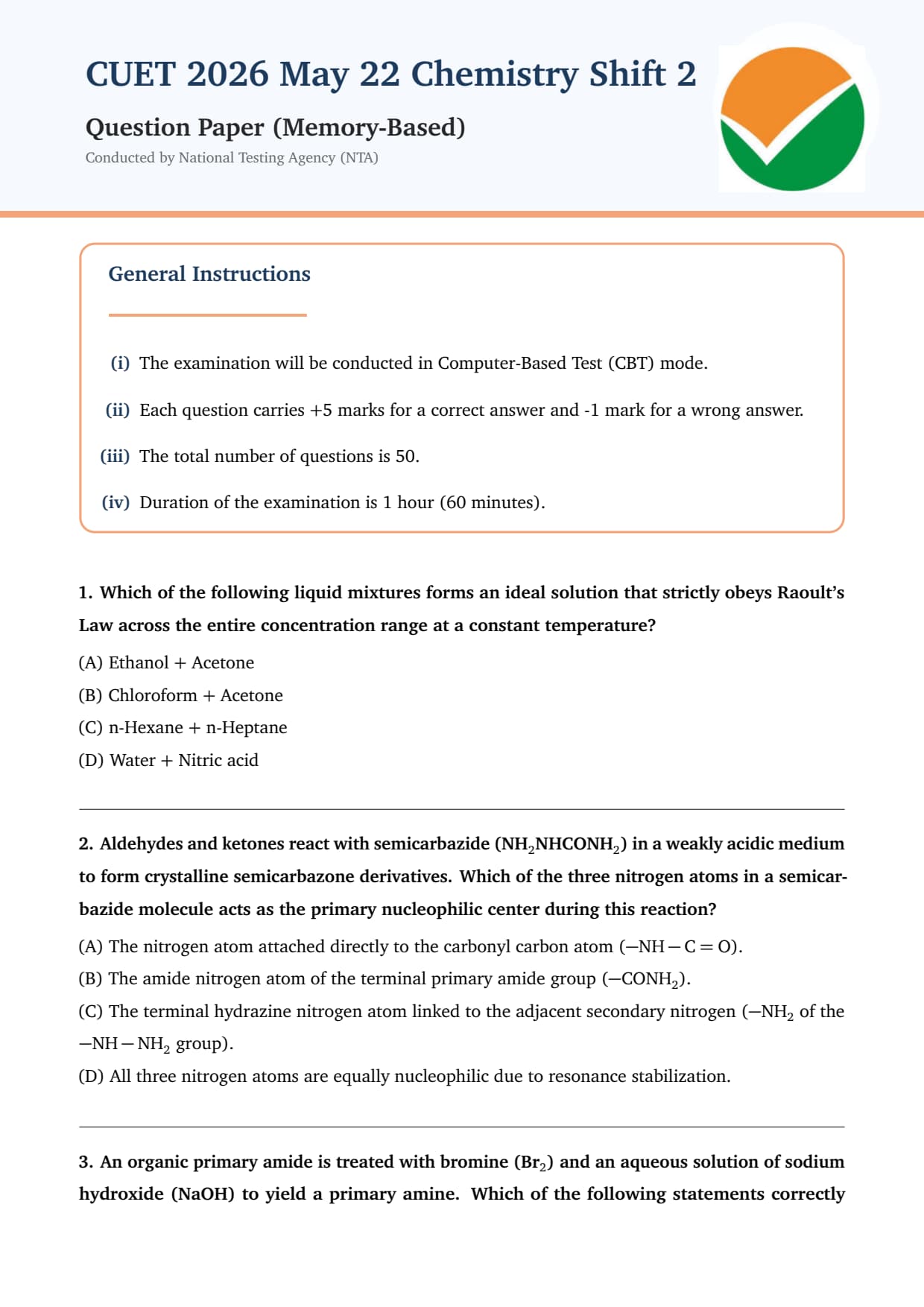
Which of the following liquid mixtures forms an ideal solution that strictly obeys Raoult's Law across the entire concentration range at a constant temperature?
View Solution
Concept:
An ideal solution is formed when the solute-solute (\(A-A\)) and solvent-solvent (\(B-B\)) intermolecular attractive forces are nearly identical in magnitude and nature to the newly formed solute-solvent (\(A-B\)) interactions. For ideal solutions, the enthalpy of mixing is zero (\(\Delta H_{mix} = 0\)) and the volume change on mixing is zero (\(\Delta V_{mix} = 0\)).
Step 1: Analyze the chemical nature of the components in each mixture.
Ideal solutions are typically formed by mixing two chemical compounds that share highly similar molecular structures, polarities, and functional groups.
n-Hexane and n-Heptane are both straight-chain non-polar alkanes that interact purely through weak London dispersion forces. Because their structural environments are nearly identical, their mixture forms a near-perfect Ideal Solution.
Step 2: Contrast with non-ideal solution types.
Ethanol + Acetone: Shows positive deviation from Raoult's law because acetone breaks the strong hydrogen-bonded networks of ethanol.
Chloroform + Acetone: Shows negative deviation because a new, strong intermolecular hydrogen bond forms between the chloroform hydrogen and the acetone carbonyl oxygen.
Water + Nitric acid: Forms a maximum boiling azeotrope due to strong negative deviations from Raoult's law. Quick Tip: Look for homologous pairs on the exam to identify ideal solutions quickly: n-Hexane + n-Heptane, Bromoethane + Chloroethane, and Benzene + Toluene are the three primary NCERT examples.
Aldehydes and ketones react with semicarbazide (\( NH_2NHCONH_2 \)) in a weakly acidic medium to form crystalline semicarbazone derivatives. Which of the three nitrogen atoms in a semicarbazide molecule acts as the primary nucleophilic center during this reaction?
View Solution
Concept:
Nucleophilic addition-elimination reactions of carbonyl compounds with ammonia derivatives depend on the availability of a lone pair of electrons on the attacking nitrogen atom. A nitrogen atom whose lone pair is delocalized into an adjacent system via resonance will have reduced electron density, making it non-nucleophilic.
Step 1: Examine the resonance stabilization pathways within semicarbazide.
Semicarbazide has the structural formula: \[ H_2\overset{1}{N}-\overset{2}{NH}-\overset{O}{C}-\overset{3}{NH}_2 \] The lone pairs of electrons on both Nitrogen-2 (\(-NH-\)) and Nitrogen-3 (\(-CONH_2\)) are positioned immediately adjacent to the electron-withdrawing carbonyl group (\(C=O\)). These lone pairs participate in resonance delocalization into the oxygen atom: \[ -\ddot{N}H-C=O \quad \longleftrightarrow \quad -\overset{+}{N}H=C-O^- \] This significant resonance delocalization strongly reduces the nucleophilic reactivity of these two nitrogen atoms.
Step 2: Identify the highly nucleophilic nitrogen center.
The lone pair on the terminal Nitrogen-1 (\(-NH_2\) of the hydrazine end) is isolated from the carbonyl group by an intervening nitrogen atom. Because its lone pair cannot participate in resonance stabilization with the carbonyl group, it remains fully localized and highly available for nucleophilic attack on the electrophilic carbonyl carbon of an aldehyde or ketone. Quick Tip: Remember that only the terminal \(-NH_2\) group furthest from the carbonyl is nucleophilic in semicarbazide. When writing out the reaction product, always link this specific terminal nitrogen to the carbonyl carbon to form a \( C=N \) double bond.
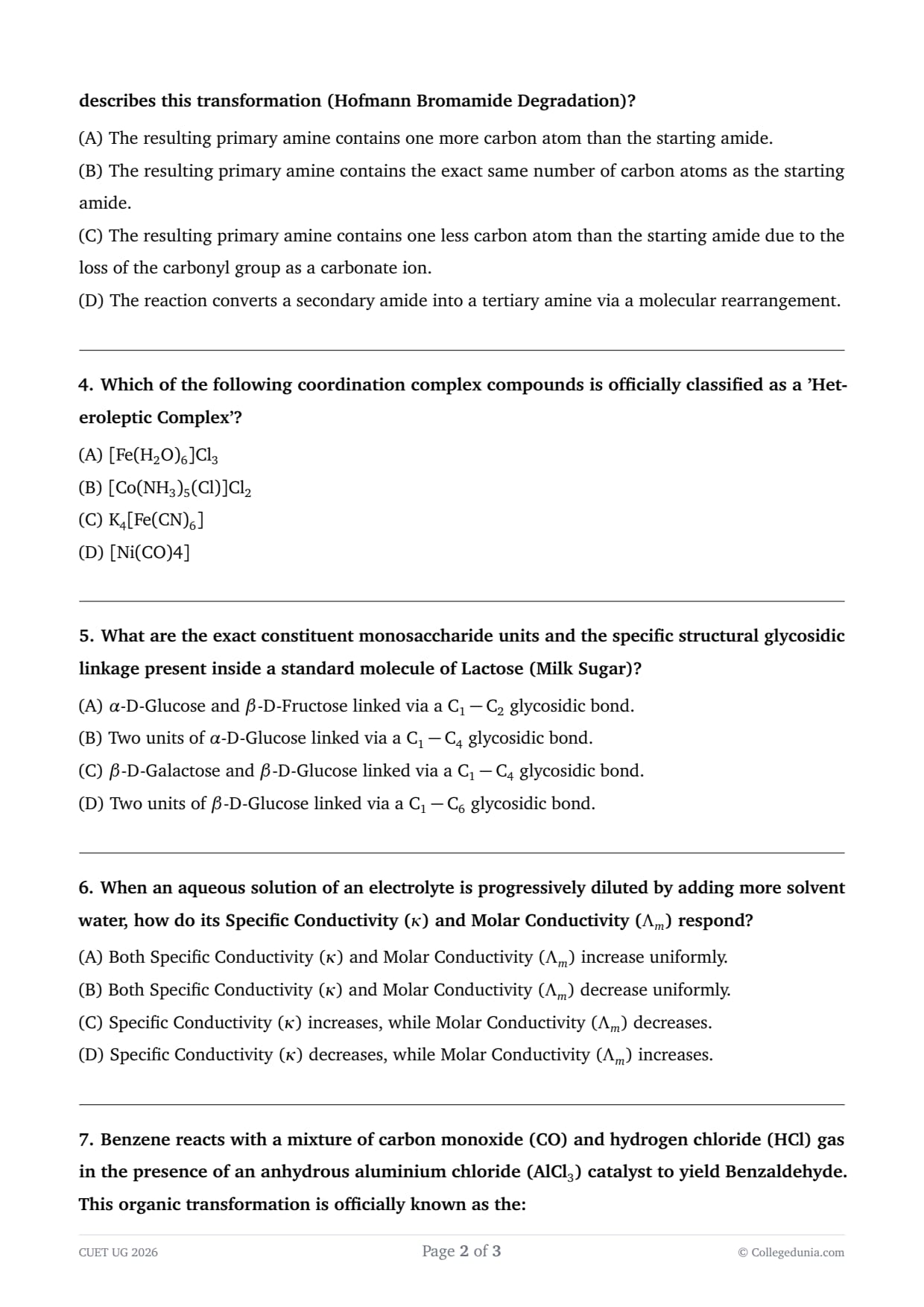
An organic primary amide is treated with bromine (\( Br_2 \)) and an aqueous solution of sodium hydroxide (\( NaOH \)) to yield a primary amine. Which of the following statements correctly describes this transformation (Hofmann Bromamide Degradation)?
View Solution
Concept:
The Hofmann Bromamide Degradation Reaction is a classic step-down degradation method used in organic synthesis to convert a primary amide into a primary amine with a shorter carbon chain length. The general chemical equation is: \[ R-CONH_2 + Br_2 + 4NaOH \quad \longrightarrow \quad R-NH_2 + Na_2CO_3 + 2NaBr + 2H_2O \]
Step 1: Analyze the migration mechanism of the reaction.
During the reaction pathway, an intermediate *nitrene* or *isocyanate* is generated. The alkyl or aryl group (\(R\)) migrates directly from the carbonyl carbon to the adjacent nitrogen atom.
Step 2: Track the carbon atom balance across the products.
The central carbonyl carbon (\(-C=O\)) of the primary amide is completely extruded from the organic chain and eliminated as a mineral byproduct in the form of sodium carbonate (\(Na_2CO_3\)). As a direct consequence, the resulting primary amine (\(R-NH_2\)) contains exactly one less carbon atom than the parent starting amide. Quick Tip: Hofmann Bromamide Degradation is a vital tool for organic "step-down" convergence conversions. For example, treating Ethanamide (\(CH_3CONH_2\)) under these reaction conditions skips the carbonyl group entirely to produce Methanamine (\(CH_3NH_2\)).
Which of the following coordination complex compounds is officially classified as a 'Heteroleptic Complex'?
View Solution
Concept:
Coordination complexes are classified into two structural categories based on the variety of ligands bound to the central metal atom:
Homoleptic Complexes: Complexes in which the central metal atom is bound to only one type of ligand group (e.g., all water molecules or all cyanide ions).
Heteroleptic Complexes: Complexes in which the central metal atom is bound to more than one type of ligand group simultaneously.
Step 1: Analyze the ligand composition inside the coordination sphere for each option.
Examine the ligands enclosed within the square brackets:
\( [Fe(H_2O)_6]Cl_3 \): Contains only 6 aqua (\(H_2O\)) ligands. [Homoleptic]
\( K_4[Fe(CN)_6] \): Contains only 6 cyanido (\(CN^-\)) ligands. [Homoleptic]
\( [Ni(CO)_4] \): Contains only 4 carbonyl (\(CO\)) ligands. [Homoleptic]
Step 2: Identify the complex with a mixed ligand environment.
In \( [Co(NH_3)_5(Cl)]Cl_2 \), the coordination sphere contains two completely different types of ligands bound directly to the central Cobalt core: 5 neutral ammine (\(NH_3\)) molecules and 1 anionic chlorido (\(Cl^-\)) ion. Because it features a mixed ligand assembly, it is classified as a Heteroleptic Complex. Quick Tip: To identify homoleptic vs. heteroleptic complexes quickly, look inside the square brackets. If you see two or more distinct chemical formulas listed next to the metal symbol, it is a Heteroleptic Complex. Ignore any counter-ions outside the brackets.
What are the exact constituent monosaccharide units and the specific structural glycosidic linkage present inside a standard molecule of Lactose (Milk Sugar)?
View Solution
Concept:
Lactose is a reducing disaccharide sugar found naturally in milk. Its structure consists of two distinct hexose monosaccharide rings linked together through a dehydration condensation bridge known as a glycosidic bond.
Step 1: Identify the monomer sub-units of Lactose.
Lactose is formed by the condensation of one molecule of \(\beta\)-D-galactose and one molecule of \(\beta\)-D-glucose.
Step 2: Trace the carbon positions that form the glycosidic bridge.
The glycosidic linkage is formed between the anomeric Carbon-1 (\(C_1\)) of the \(\beta\)-D-galactose ring and the alcohol Carbon-4 (\(C_4\)) of the adjacent \(\beta\)-D-glucose ring. This specific arrangement is designated as a \(\beta(1\rightarrow4)\) glycosidic linkage.
Step 3: Verify why lactose acts as a reducing sugar.
Because the anomeric center of the glucose ring (Carbon-1) remains free and unbound, it can easily open into its straight-chain aldehyde form. This allows lactose to reduce Tollens' and Fehling's test reagents, making it a reducing sugar. Quick Tip: Remember that Lactose is the only major disaccharide in the NCERT curriculum that contains Galactose as a building block. It uses a \(\beta\)-linkage, distinguishing it from maltose which uses an \(\alpha\)-linkage.
When an aqueous solution of an electrolyte is progressively diluted by adding more solvent water, how do its Specific Conductivity (\( \kappa \)) and Molar Conductivity (\( \Lambda_m \)) respond?
View Solution
Concept:
The electrical conductivity profiles of an electrolytic solution depend on the concentration of ions present per unit volume, as well as the total mobility of those ions within the solvent matrix.
Step 1: Evaluate the behavior of Specific Conductivity (\(\kappa\)) upon dilution.
Specific conductivity (\(\kappa\)) is defined as the conductance of exactly a one-centimeter cube unit volume of a solution. When a solution is diluted, the total number of current-carrying ions per unit volume decreases steadily. As a direct result, Specific Conductivity (\(\kappa\)) always decreases with dilution for both strong and weak electrolytes.
Step 2: Evaluate the behavior of Molar Conductivity (\(\Lambda_m\)) upon dilution.
Molar conductivity (\(\Lambda_m = \frac{\kappa}{C}\)) is the conducting power of all the ions produced by dissolving one mole of an electrolyte. Upon dilution, the concentration (\(C\)) decreases. For strong electrolytes, interionic attractions decrease, allowing ions to move more freely. For weak electrolytes, the degree of dissociation (\(\alpha\)) increases sharply, generating a larger number of total ions. Consequently, Molar Conductivity (\(\Lambda_m\)) always increases with dilution. Quick Tip: Keep this clear rule memorized: dilution increases molar conductivity (\(\Lambda_m\)) due to increased ion mobility and dissociation, but decreases specific conductivity (\(\kappa\)) because ion density per unit volume drops.
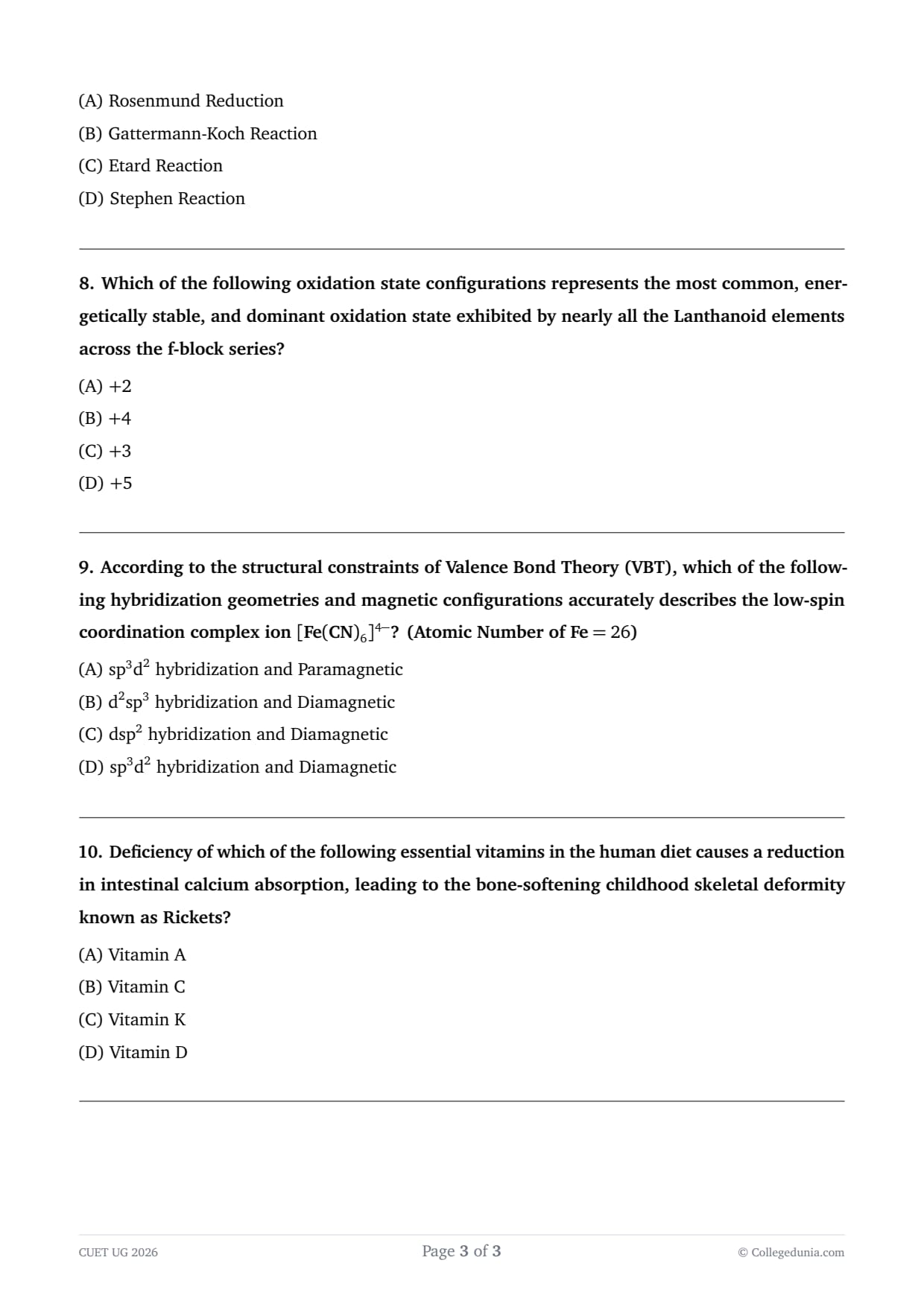
Benzene reacts with a mixture of carbon monoxide (\( CO \)) and hydrogen chloride (\( HCl \)) gas in the presence of an anhydrous aluminium chloride (\( AlCl_3 \)) catalyst to yield Benzaldehyde. This organic transformation is officially known as the:
View Solution
Concept:
Formylation is an electrophilic aromatic substitution reaction used to introduce a formyl group (\(-CHO\)) directly into an activated aromatic benzene ring core.
Step 1: Identify the active reagents and chemical conversion.
The reaction uses a mixture of high-pressure \( CO \) and \( HCl \) gas, which reacts in situ under the influence of a Lewis acid catalyst (\(AlCl_3\)) to form a reactive formyl cation intermediate (\([HC=O]^+\)). This intermediate attacks the benzene ring to yield benzaldehyde: \[ C_6H_6 + CO + HCl \xrightarrow{Anhydrous AlCl_3 / CuCl} C_6H_5CHO + HCl \]
This specific synthesis pathway is called the Gattermann-Koch Reaction.
Step 2: Differentiate from alternative aldehyde name reactions.
Rosenmund Reduction: Converts an acyl chloride into an aldehyde using hydrogen gas over a poisoned palladium catalyst (\(H_2/Pd-BaSO_4\)).
Etard Reaction: Oxidizes toluene to benzaldehyde using chromyl chloride (\(CrO_2Cl_2\)).
Stephen Reaction: Reduces a nitrile to an aldehyde using tin(II) chloride and hydrochloric acid (\(SnCl_2/HCl\)). Quick Tip: To remember the Gattermann-Koch reaction easily, connect the word "Koch" to the formula of its core reagents: Carbon monoxide + hydrogen chloride can be read phonetically as "C-O-H-Cl" (similar to Koch).
Which of the following oxidation state configurations represents the most common, energetically stable, and dominant oxidation state exhibited by nearly all the Lanthanoid elements across the f-block series?
View Solution
Concept:
The electronic configurations of the lanthanoids generally follow the pattern \( [Xe] \, 4f^{0-14} \, 5d^{0-1} \, 6s^2 \). Their oxidation stability patterns depend on how easily they can lose their outer \(6s\) and \(5d\) electrons along with inner \(4f\) electrons.
Step 1: Evaluate the general ionic stabilization pattern of lanthanoids.
Across the lanthanoid series, the \( +3 \) oxidation state is the most common and dominant oxidation state. Forming the trivalent aquated ions (\(Ln^{3+}\)) involves removing the two outer \(6s\) valence electrons along with one additional electron from either the \(5d\) or \(4f\) subshells. This state is highly stable across the entire series due to favorable hydration and lattice energies.
Step 2: Analyze exceptions to the general rule.
While certain elements can exhibit alternative \( +2 \) or \( +4 \) oxidation states, they do so only when the loss of electrons yields an exceptionally stable empty (\(4f^0\)), half-filled (\(4f^7\)), or fully filled (\(4f^{14}\)) subshell configuration. For example:
\(Ce^{4+}\) is stable because it achieves an empty \(4f^0\) noble gas core.
\(Eu^{2+}\) is stable because it achieves a half-filled \(4f^7\) subshell.
However, these alternative ions act as strong oxidizing or reducing agents, readily reverting back to the dominant \( +3 \) state. Quick Tip: If an f-block lanthanoid question asks for the most stable or dominant oxidation state without naming a specific element, \( +3 \) is always the correct choice.
According to the structural constraints of Valence Bond Theory (VBT), which of the following hybridization geometries and magnetic configurations accurately describes the low-spin coordination complex ion \( [Fe(CN)_6]^{4-} \)? (Atomic Number of \( Fe = 26 \))
View Solution
Concept:
Valence Bond Theory determines the hybridization and geometry of coordination complexes by evaluating whether the incoming ligands are weak-field or strong-field, which dictates whether the d-orbital electrons pair up.
Step 1: Determine the oxidation state and electronic configuration of Iron.
Let the unknown oxidation state of Iron be \( x \). Cyanide is an anionic ligand (\(CN^-\)): \[ x + 6(-1) = -4 \quad \Rightarrow \quad x - 6 = -4 \quad \Rightarrow \quad x = +2 \]
The electronic configuration of a neutral Iron atom (\( Z = 26 \)) is \( [Ar] \, 3d^6 \, 4s^2 \). For the divalent ion (\( Fe^{2+} \)), remove the two \(4s\) electrons: \[ Fe^{2+} = [Ar] \, 3d^6 \, 4s^0 \]
Step 2: Analyze the effect of the ligand on d-orbital electron pairing.
The cyanido (\(CN^-\)) ligand is a strong-field ligand. It forces the 6 electrons in the \(3d\) orbitals to pair up completely within the lower-energy \(t_{2g}\) orbitals: \[ \text{3d configuration after pairing} = \boxed{\uparrow\downarrow} \;\; \boxed{\uparrow\downarrow} \;\; \boxed{\uparrow\downarrow} \;\; \boxed{\phantom{\uparrow\downarrow}} \;\; \boxed{\phantom{\uparrow\downarrow}} \]
Because all 6 electrons are completely paired up, the complex contains zero unpaired electrons, making it Diamagnetic.
Step 3: Identify the vacant orbitals available for hybridization.
Pairing up the electrons leaves two internal \(3d\) orbitals completely empty. These two empty \(3d\) orbitals combine with the vacant \(4s\) orbital and three \(4p\) orbitals to form six equivalent hybrid orbitals:\[ \text{Hybridization} = d^2sp^3 \qquad \text{(Inner orbital octahedral complex)} \] Quick Tip: Strong-field ligands like \( CN^- \) and \( CO \) drive electron pairing, which typically results in inner-orbital \( d^2sp^3 \) hybridizations for octahedral complexes. Weak-field ligands like \( Cl^- \) or \( F^- \) result in outer-orbital \( sp^3d^2 \) configurations.
Deficiency of which of the following essential vitamins in the human diet causes a reduction in intestinal calcium absorption, leading to the bone-softening childhood skeletal deformity known as Rickets?
View Solution
Concept:
Vitamins are essential organic micro-nutrients required in small amounts to carry out vital metabolic and physiological functions within the human body. They are broadly classified into fat-soluble vitamins (A, D, E, K) and water-soluble vitamins (B-complex, C).
Step 1: Analyze the physiological function of Vitamin D.
Vitamin D (calciferol) is a fat-soluble vitamin that plays a vital role in maintaining skeletal health by regulating calcium and phosphorus absorption in the intestines. It can be synthesized by the body when skin is exposed to solar ultraviolet radiation.
Step 2: Link a deficiency in this vitamin to its clinical symptoms.
A deficiency in Vitamin D impairs the body's ability to calcify and harden bone tissue. In children, this structural weakness leads to Rickets, a deformity characterized by soft, bowed legs and malformed joints. In adults, this same deficiency leads to a condition known as osteomalacia. Quick Tip: Keep this quick summary of common NCERT vitamin deficiencies memorized: Vitamin A deficiency = Night Blindness Vitamin C deficiency = Scurvy (bleeding gums) Vitamin D deficiency = Rickets (bone softening) Vitamin K deficiency = Increased blood clotting time (hemorrhage)
CUET UG 2026 Exam Pattern
| Parameter | Details |
|---|---|
| Exam Name | Common University Entrance Test (CUET UG) 2026 |
| Conducting Body | National Testing Agency (NTA) |
| Exam Mode | Computer-Based Test (CBT) |
| Exam Duration | 60 minutes per test |
| Total Sections | 3 (Languages, Domain Subjects, General Test) |
| Question Type | Multiple Choice Questions (MCQs) |
| Questions per Test | 50 questions (all compulsory) |
| Marking Scheme | +5 for correct, -1 for incorrect |
| Maximum Marks | 250 marks per test |
| Maximum Subject Choices | 5 subjects in total |
| Syllabus Base | Class 12 NCERT (mainly for Domain Subjects) |





Comments