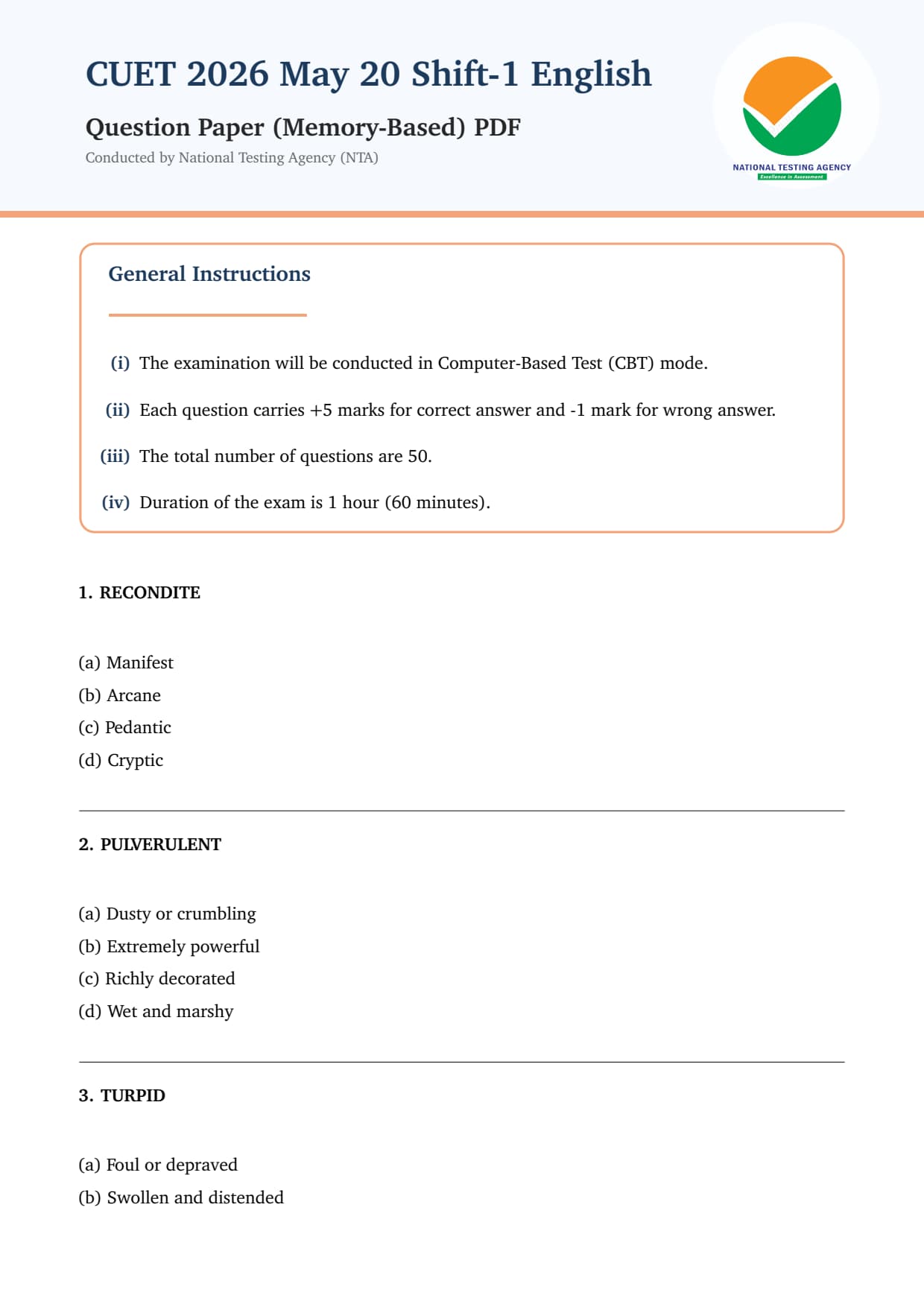
CUET 2026 May 20 Shift 1 English Question Paper is available for download here. NTA is conducting the CUET 2026 exam from 11th May to 31st May.

  • CUET 2026 English exam consists of 50 questions for 250 marks to be attempted in 60 minutes.
  • As per the marking scheme, 5 marks are awarded for each correct answer, and 1 mark is deducted for incorrect answer.

Candidates can download CUET 2026 May 20 Shift 1 English Question Paper with Answer Key and Solution PDF from links provided below.

Related Links:

CUET 2026 English May 20 Shift 1 Question Paper with Solution PDF

CUET May 20 Shift 1 English Question Paper 2026 Download PDF Check Solutions


Question 1:

RECONDITE

  • (a) Manifest
  • (b) Arcane
  • (c) Pedantic
  • (d) Cryptic
Correct Answer: (b) Arcane
View Solution


Step 1: Understanding the Concept:

Vocabulary tests require analyzing the precise semantic definitions of words, often focusing on advanced literary, academic, or GRE-level terms. The word "recondite" is an adjective used to describe knowledge or subjects that are deep, hidden from view, and difficult for an ordinary person to comprehend.


Step 2: Detailed Explanation:

Let's analyze the precise meanings of the given options:
RECONDITE: (Of a subject or knowledge) little known; abstruse, obscure, or hidden from mental view.
Manifest (Antonym): Clear, obvious, or easily perceived by the eye or mind.
Arcane (Synonym): Understood by few; mysterious, secret, or obscure. This perfectly matches the core meaning of "recondite" as both refer to specialized, hidden knowledge.
Pedantic: Excessively concerned with minor details or rules; displaying academic learning in an annoying way.
Cryptic: Having a meaning that is mysterious, obscure, or written in a hidden code (usually applied to messages, expressions, or puzzles rather than fields of knowledge).

Thus, "Arcane" is the most accurate synonym for "Recondite".


Step 3: Final Answer:

The closest synonym to RECONDITE is Arcane (Option b). Quick Tip: To remember both words, link them together in a phrase describing specialized academic fields: {"Recondite philosophies and arcane rituals."} Both words share the prefix-vibe of being hidden away in a secret archive!


Question 2:

PULVERULENT

  • (a) Dusty or crumbling
  • (b) Extremely powerful
  • (c) Richly decorated
  • (d) Wet and marshy
Correct Answer: (a) Dusty or crumbling
View Solution


Step 1: Understanding the Concept:

Using etymological roots (the origin of words) can help decode rare vocabulary words. The adjective "pulverulent" originates from the Latin root word pulvis or {pulver-, which directly translates to "dust". Understanding this root connection makes it easy to isolate the correct definition.


Step 2: Detailed Explanation:

Let's evaluate the definitions of the options provided:
PULVERULENT: Consisting of or covered with fine powder or dust; crumbling easily into fine particles.
Extremely powerful: Described by words like potent, omnipotent, or mighty.
Richly decorated: Described by words like ornate, baroque, or flamboyant.
Wet and marshy: Described by words like miry, swampy, or boggy.

Since the word is directly linked to dust and powder formations, option (a) is the accurate semantic definition.


Step 3: Final Answer:

PULVERULENT means dusty or crumbling (Option a). Quick Tip: Connect this word to a common English verb you already know: {Pulverize (which means to crush something into tiny, fine particles or dust). A substance that has been pulverized becomes {pulverulent}!


Question 3:

TURPID

  • (a) Foul or depraved
  • (b) Swollen and distended
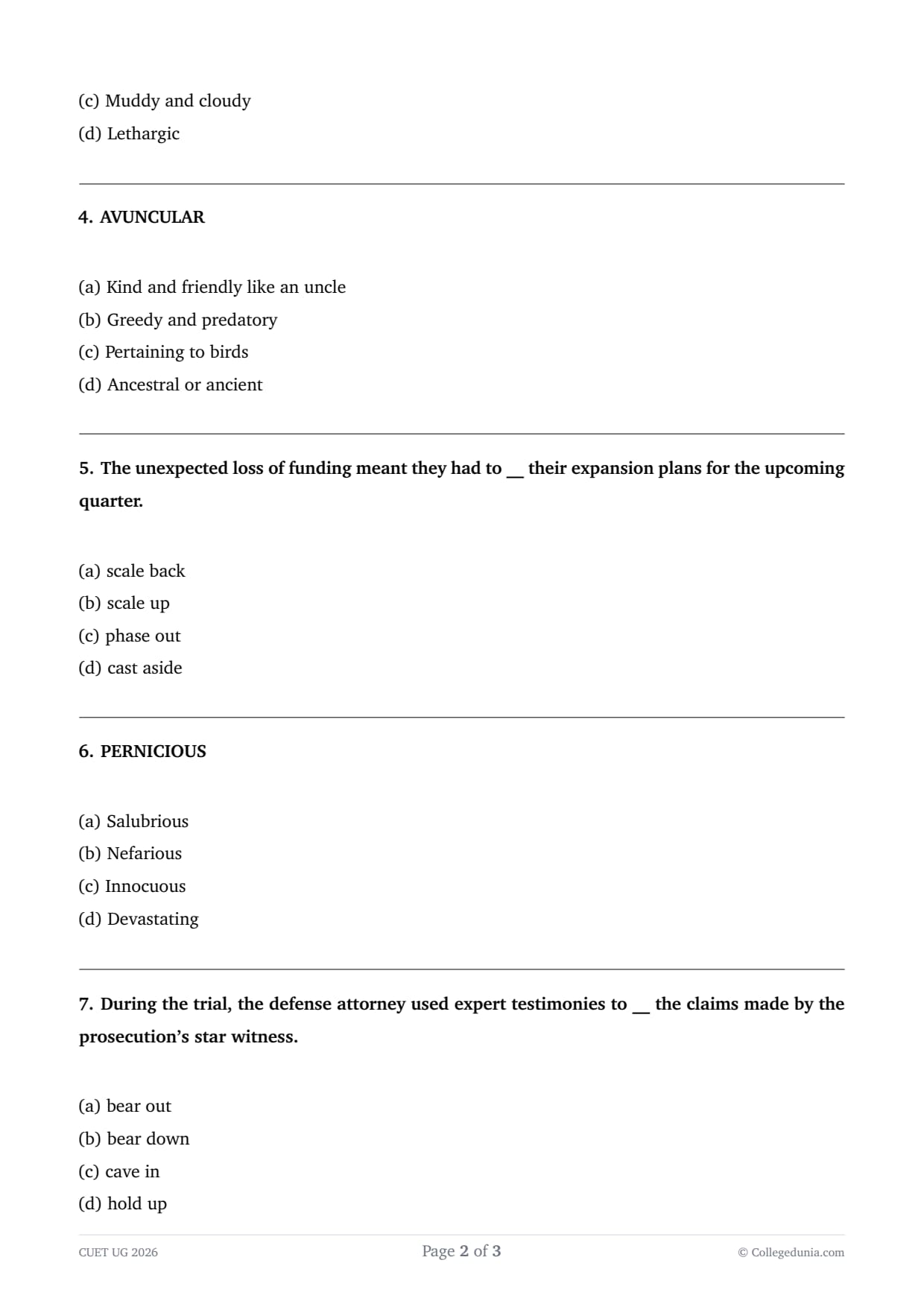
  • (c) Muddy and cloudy
  • (d) Lethargic
Correct Answer: (a) Foul or depraved
View Solution


Step 1: Understanding the Concept:

Advanced English vocabulary tests often include words that look and sound nearly identical but have completely distinct definitions (homophones or near-homophones). The word "turpid" must be carefully distinguished from its close linguistic relatives: turgid (swollen) and turbid (muddy).


Step 2: Detailed Explanation:

Let's look at the definitions of the word and clear up any confusion with similar terms:
TURPID: Viscous, foul, base, or morally depraved. It is directly related to the noun "turpitude" (as in moral turpitude, which refers to wicked or shameful behavior). Therefore, "foul or depraved" is the correct definition.
Swollen and distended: This is the definition for Turgid (or tumid).
Muddy and cloudy: This is the definition for Turbid (used to describe thick, cloudy liquids or muddy water containing stirred-up sediment).
Lethargic: This is closely associated with Torpid (meaning mentally or physically inactive; sluggish).

By clarifying these subtle differences, we can confidently choose option (a).


Step 3: Final Answer:

TURPID means foul or depraved (Option a). Quick Tip: Keep these four similar-looking words organized in your mind with a quick memory chart: {Turpid} \(\rightarrow\) Depraved (Think: Moral {turpitude}) {Turbid} \(\rightarrow\) Muddy (Think: {Turbulence} in water) {Turgid} \(\rightarrow\) Swollen (Think: {Turgor} pressure in plant cells) {Torpid} \(\rightarrow\) Sluggish (Think: Inactive/dormant like a {torpedo} at rest)


Question 4:

AVUNCULAR

  • (a) Kind and friendly like an uncle
  • (b) Greedy and predatory
  • (c) Pertaining to birds
  • (d) Ancestral or ancient
Correct Answer: (a) Kind and friendly like an uncle
View Solution


Step 1: Understanding the Concept:

Advanced English vocabulary contains specialized adjectives derived from Latin roots that describe behaviors characteristic of specific family relationships. The word "avuncular" comes directly from the Latin noun avunculus, which translates to "maternal uncle".


Step 2: Detailed Explanation:

Let's analyze the semantic definitions of all the options:
AVUNCULAR: Kind, warm, patient, and friendly, specifically reminiscent of the supportive, non-disciplinary relationship an uncle typically shares with his nieces or nephews.
Greedy and predatory: Described by adjectives like rapacious, voracious, or predatory.
Pertaining to birds: Described by the adjective Avian. (A common trap due to the similar starting letters 'av-').
Ancestral or ancient: Described by adjectives like atavistic, hereditary, or ancient.

Therefore, option (a) perfectly captures the exact dictionary definition of the word.


Step 3: Final Answer:

AVUNCULAR means kind and friendly like an uncle (Option a). Quick Tip: To build a stronger relational vocabulary, group "avuncular" with these other family-derived adjectives: {Avuncular \(\rightarrow\) Like an uncle {Patrilineal / Paternal} \(\rightarrow\) Like a father {Matrilineal / Maternal} \(\rightarrow\) Like a mother {Fraternal} \(\rightarrow\) Like a brother {Sororal} \(\rightarrow\) Like a sister


Question 5:

The unexpected loss of funding meant they had to __ their expansion plans for the upcoming quarter.

  • (a) scale back
  • (b) scale up
  • (c) phase out
  • (d) cast aside
Correct Answer: (a) scale back
View Solution


Step 1: Understanding the Concept:

Sentence completion questions rely on recognizing contextual clues to determine the logical tone of a sentence. In this sentence, the key constraint is a negative event: an "unexpected loss of funding". This structural constraint dictates that the missing phrasal verb must describe a reduction, compromise, or retraction of growth plans.


Step 2: Detailed Explanation:

Let's evaluate how each phrasal verb fits the financial context of the sentence:
Scale back (Correct): To reduce the size, scope, or extent of an operation or plan. If an organization suddenly loses money, the most logical immediate step is to downsize or reduce their growth targets for that quarter.
Scale up (Antonym): To increase the size or scope of something. It is illogical to increase expansion when you lack funds.
Phase out: To gradually bring something to an end or discontinue it in systematic stages. This is typically used for products or long-standing policies, not immediate quarterly growth schedules.
Cast aside: To discard or reject something completely because it is no longer wanted. While it sounds plausible, it implies total emotional or physical abandonment, whereas "scale back" is the standard business terminology for managing budget deficits.


Step 3: Final Answer:

The correct phrasal verb to fill the blank is "scale back" (Option a). Quick Tip: Think of the word "scale" as a mechanical volume knob or a slider on a map. When you lose resources, you must slide the knob downward, which means you scale back. When you gain resources, you slide it upward, which means you scale up!


Question 6:

PERNICIOUS

  • (a) Salubrious
  • (b) Nefarious
  • (c) Innocuous
  • (d) Devastating
Correct Answer: (d) Devastating
View Solution


Step 1: Understanding the Concept:

Analyzing structural descriptions in texts involves understanding words that convey harm or damage. The word "pernicious" is an impactful adjective used to describe things that cause serious harm, injury, or ruin, often in a quiet, subtle, or hidden manner over a long period.


Step 2: Detailed Explanation:

Let's look at the definitions of all the choices to find the closest semantic match:
PERNICIOUS: Having a harmful effect, especially in a gradual or subtle way; highly destructive, fatal, or ruinous.
Salubrious (Antonym): Health-giving; healthy or pleasant.
Nefarious: Wicked, villainous, or criminal (typically used to describe actions, people, or plots rather than general damaging effects).
Innocuous (Antonym): Not harmful or offensive; safe.
Devastating (Synonym): Highly destructive, damaging, or overwhelming. Out of all the choices, "devastating" is the closest operational match to describe the severe, ruinous impact implied by "pernicious".


Step 3: Final Answer:

The closest synonym to PERNICIOUS is Devastating (Option d). Quick Tip: A classic medical and literary phrase to keep memorized is {"pernicious anemia"} or {"pernicious rumors"}. These are threats that sneak up quietly but have a devastating or highly destructive outcome if left unchecked!


Question 7:

During the trial, the defense attorney used expert testimonies to __ the claims made by the prosecution's star witness.

  • (a) bear out
  • (b) bear down
  • (c) cave in
  • (d) hold up
Correct Answer: (a) bear out
View Solution


Step 1: Understanding the Concept:

Sentence completion questions involving phrasal verbs require analyzing the context and relationship between the subjects. Here, a defense attorney is using "expert testimonies" in relation to "claims". In a legal setting, evidence or testimony is introduced either to support/confirm a claim or to refute it. We must look at the definitions of the phrasal verbs to see which one logically fits this context.


Step 2: Detailed Explanation:

Let's analyze the meaning of each phrasal verb:
Bear out (Correct): To support, confirm, substantiate, or corroborate a statement or claim. If the expert testimonies matched or supported the defense's perspective of the witness's claims (or supported the defense's own claims about them), "bear out" fits perfectly as a term meaning to substantiate.
Bear down: To press down heavily, exert maximum effort, or move threateningly toward someone. This does not fit the context of managing arguments or testimonies.
Cave in: To collapse inward, or to yield/submit under pressure. This is an action a person takes when giving up, not a function of a testimony.
Hold up: While "hold up" can mean to remain valid or stand up to scrutiny (e.g., "The claims didn't hold up"), it is an intransitive verb phrase in that context. You cannot actively "hold up the claims" to mean confirm them in standard legal vocabulary testing the way you can "bear them out".

Therefore, "bear out" is the most appropriate phrasal verb.


Step 3: Final Answer:

The correct phrasal verb to fill the blank is "bear out". Quick Tip: Think of {"bear out"} as meaning {"to carry out the truth"} of something. Whenever you see a sentence where evidence, facts, data, or testimonies confirm a theory or statement, "bear out" is the standard phrase to use!


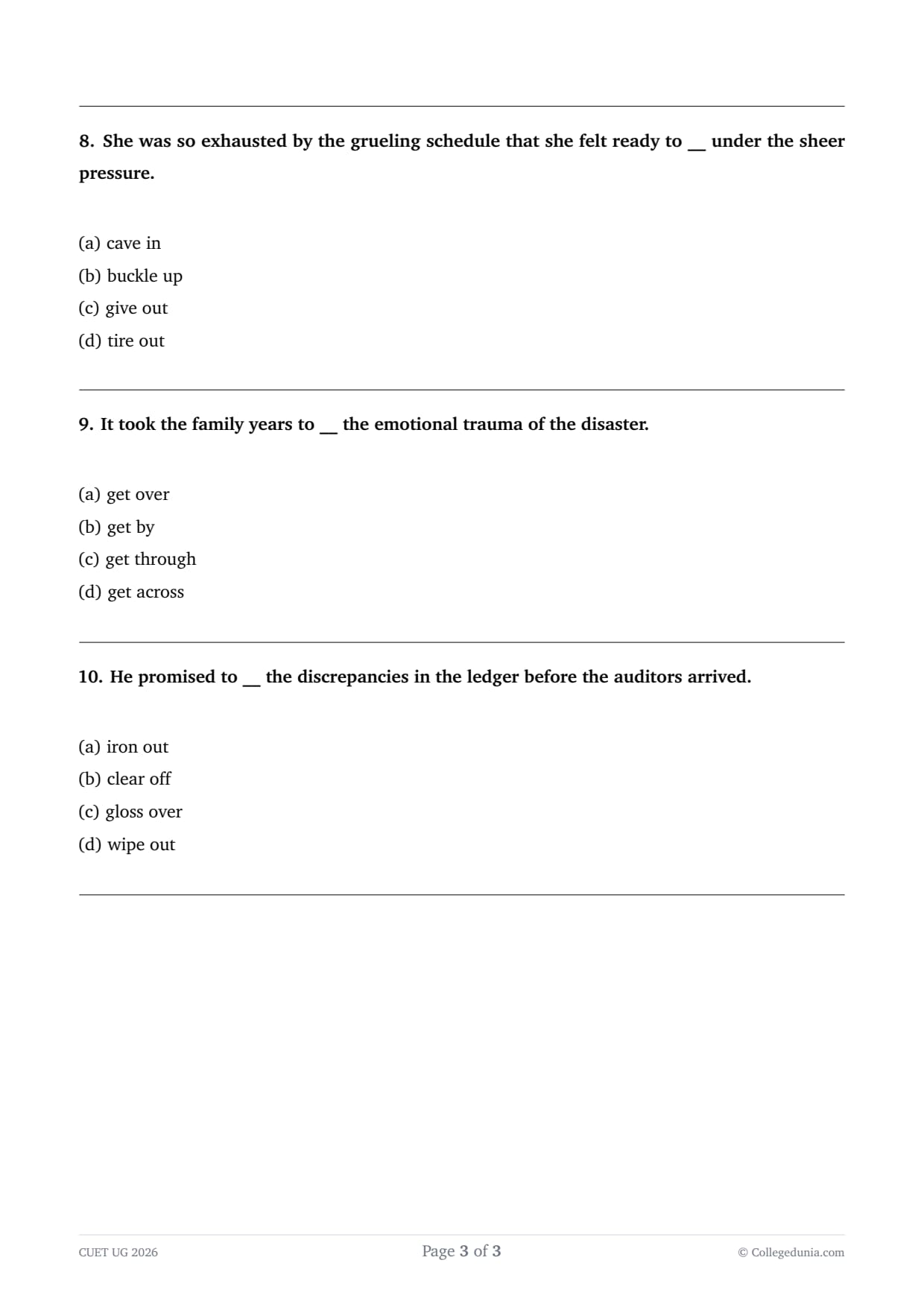
Question 8:

She was so exhausted by the grueling schedule that she felt ready to __ under the sheer pressure.

  • (a) cave in
  • (b) buckle up
  • (c) give out
  • (d) tire out
Correct Answer: (a) cave in
View Solution


Step 1: Understanding the Concept:

The context of this sentence highlights a person experiencing extreme exhaustion due to a "grueling schedule" and facing "sheer pressure". The preposition "under" immediately following the blank is a critical structural clue. We need a phrasal verb that naturally pairs with "under" to mean collapsing, surrendering, or breaking down due to mental or physical stress.


Step 2: Detailed Explanation:

Let's look at how the options interact with the word "under":
Cave in (Correct): To collapse inward physically, or figuratively to yield, surrender, or break down under pressure. The phrase "cave in under pressure" is a idiomatic expression in English.
Buckle up: To fasten one's seatbelt in a vehicle. (If the option were "buckle under", it could mean to yield, but "buckle up under" is incorrect).
Give out: To break down, stop functioning, or be exhausted (e.g., "Her legs gave out"). While it matches the exhaustion theme, it does not grammatically take the preposition "under" in this manner (you don't say "give out under the pressure" to mean surrender, you just say "give out").
Tire out: To make someone completely exhausted. This is a transitive verb phrase usually requiring an object (e.g., "The schedule tired her out"), and it is redundant when "exhausted" is already used in the sentence.

Thus, "cave in" is the grammatically and contextually perfect selection.


Step 3: Final Answer:

The correct phrasal verb to fill the blank is "cave in". Quick Tip: Visualize a structural cave-off. When a tunnel or ceiling has too much weight or pressure placed on top of it, it collapses inward—it {caves in}. People do the same thing mentally when they are overwhelmed by stress!


Question 9:

It took the family years to __ the emotional trauma of the disaster.

  • (a) get over
  • (b) get by
  • (c) get through
  • (d) get across
Correct Answer: (a) get over
View Solution


Step 1: Understanding the Concept:

This sentence refers to processing and recovering from an "emotional trauma". Phrasal verbs starting with "get" have wildly different meanings depending on their particle. We need a phrase that specifically denotes emotional recovery, moving past a painful experience, or returning to a normal state of mind.


Step 2: Detailed Explanation:

Let's break down the definitions of these common "get" phrasal verbs:
Get over (Correct): To recover from an ailment, an illness, a disappointment, or an emotional trauma. It means you have processed the grief or pain and can now move forward with your life.
Get by: To manage to survive or cope with minimal resources (e.g., "We don't have much money, but we get by"). This does not fit recovering from trauma.
Get through: To finish a difficult task or endure a tough period while it is happening (e.g., "We will get through this winter"). While close, you generally "get through" an event while it is active, but you "get over" the lingering emotional trauma left behind after the event is over.
Get across: To successfully communicate or explain an idea so that others understand it (e.g., "He tried to get his point across"). This is irrelevant to the context.

Therefore, "get over" is the most accurate phrase for recovering from trauma.


Step 3: Final Answer:

The correct phrasal verb to fill the blank is "get over". Quick Tip: Think of an emotional problem or trauma as a tall wall blocking your path. To continue moving forward with your life, you have to climb up and {get over} it. Once you are on the other side, you have recovered!


Question 10:

He promised to __ the discrepancies in the ledger before the auditors arrived.

  • (a) iron out
  • (b) clear off
  • (c) gloss over
  • (d) wipe out
Correct Answer: (a) iron out
View Solution


Step 1: Understanding the Concept:

The context involves a "ledger" containing "discrepancies" (errors, inconsistencies, or mismatches) that need to be dealt with before an official review by "auditors". To satisfy auditors, accounting errors must be actively resolved, corrected, or smoothed out so that everything balances correctly.


Step 2: Detailed Explanation:

Let's analyze the figurative meanings of the choices:
Iron out (Correct): To resolve, smooth over, eliminate, or find a solution for minor problems, errors, or discrepancies. Just as an iron removes wrinkles from fabric to make it smooth, "ironing out discrepancies" means fixing accounting errors so the ledger is smooth and accurate.
Clear off: To remove items from a surface (e.g., "clear off the table") or to pay off a debt. It does not mean solving specific line-item discrepancies.
Gloss over: To deliberately ignore, conceal, or treat an error lightly to avoid trouble. While a dishonest accountant might try to do this before auditors arrive, "promising" to do so usually implies a constructive action to rectify errors rather than an act of active concealment, making (a) the standard professional expression tested here.
Wipe out: To completely destroy or erase something. You cannot simply erase portions of an official ledger without creating more auditing issues.

Thus, "iron out" is the most precise and idiomatic choice.


Step 3: Final Answer:

The correct phrasal verb to fill the blank is "iron out". Quick Tip: Think of any problem, misunderstanding, or mathematical discrepancy as an ugly wrinkle on a clean shirt. To make the situation perfect and professional, you need to use your tools to {iron out} those wrinkles!

CUET UG 2026 Exam Pattern

Parameter Details
Exam Name Common University Entrance Test (CUET UG) 2026
Conducting Body National Testing Agency (NTA)
Exam Mode Computer-Based Test (CBT)
Exam Duration 60 minutes per test
Total Sections 3 (Languages, Domain Subjects, General Test)
Question Type Multiple Choice Questions (MCQs)
Questions per Test 50 questions (all compulsory)
Marking Scheme +5 for correct, -1 for incorrect
Maximum Marks 250 marks per test
Maximum Subject Choices 5 subjects in total
Syllabus Base Class 12 NCERT (mainly for Domain Subjects)

CUET UG 2026 Paper Analysis