




While answering the question about how many chapters in CBSE class 12 chemistry, you must know that there are 10 chapters. You must have a detailed insight into CBSE class 12 chapters -
- The syllabus is divided into theory and practical. The maximum marks for theory are 70 and for practical are 30.
- The 10 chapters are divided into 3 main sections.
- The question paper design of chemistry class 12 focuses on remembering and understanding, applying and analysing, evaluating and creating.
Students must be aware of how many chapters in CBSE Class 12 Chemistry there are for a strategic approach.
.
Also Read
Key Summary
- The chemistry syllabus of Class 12 is divided into theory and practical. Both subparts require proper preparation and attention.
- Before your preparation, you must have a clear understanding of how many chapters in CBSE Class 12 Chemistry.
- It is also important for students to acquaint themselves with the exam pattern, question paper design and the objective of CBSE class 12 Chemistry.
- The chapters and subtopics of CBSE class 12 chemistry are designed in such a manner that students can ace their exams after knowing how many chapters in CBSE Class 12 Chemistry are there.
- Students should devote an hour daily to preparing for the other subjects as well.
- The initial and major step for chemistry chapters should be to prepare a Class 12 Chemistry chapter list. Then you must thoroughly understand and revise the NCERT Chemistry book before switching to any other resources
How many chapters are there in CBSE Class 12 Chemistry?
There are a total of 10 chapters in CBSE class 12 Chemistry. All the chapters are divided for the ease of understanding and learning. Read the table below to understand the chapter-wise weightage for the exam.
Theory
After knowing the answer to How many chapters in CBSE Class 12 Chemistry exist you must look at the list of the theory chapters in Class 12 Chemistry
| S. No. | Title | Marks |
|---|---|---|
| 1. | Solutions | 7 |
| 2. | Electrochemistry | 9 |
| 3. | Chemical Kinetics | 7 |
| 4. | d -and f -Block Elements | 7 |
| 5. | Coordination Compounds | 7 |
| 6. | Haloalkanes and Haloarenes | 6 |
| 7. | Alcohols, Phenols and Ethers | 6 |
| 8. | Aldehydes, Ketones and Carboxylic Acids | 8 |
| 9. | Amines | 6 |
| 10. | Biomolecules | 7 |
| Total | 70 |

Practical
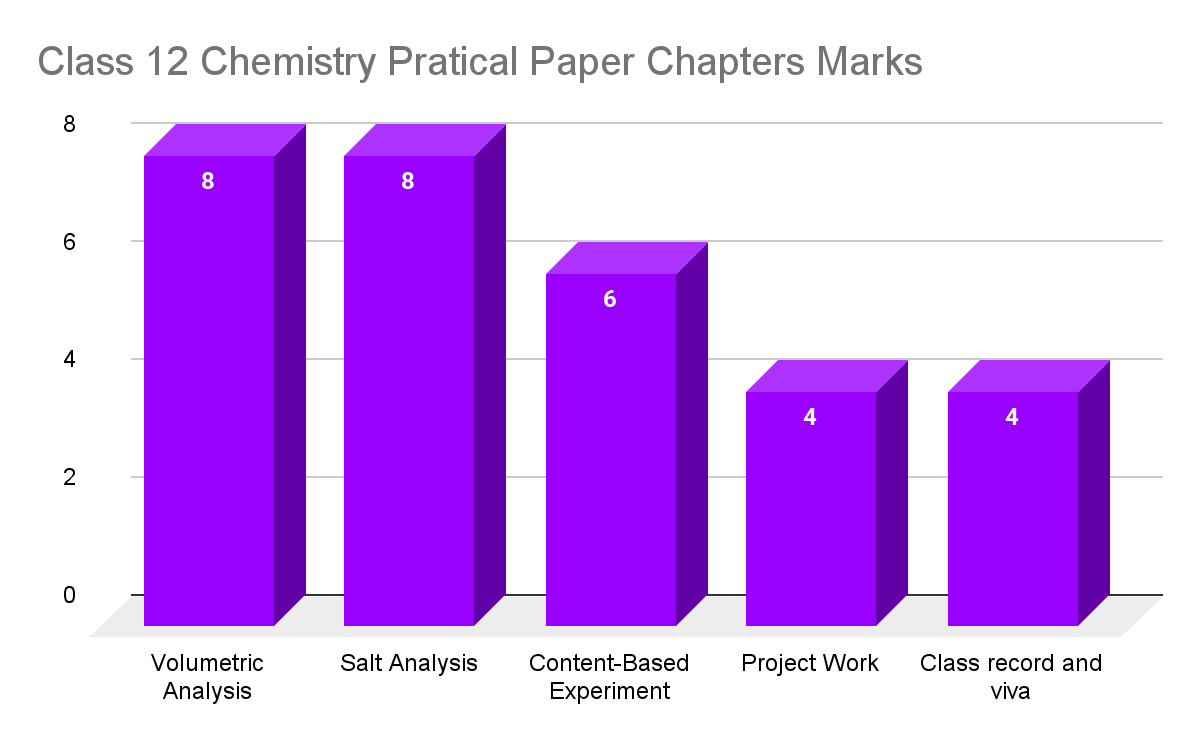
The evaluation scheme of the practical examination of CBSE class 12 chemistry is as follows-
| Evaluation Scheme for Examination | Marks |
|---|---|
| Volumetric Analysis | 8 |
| Salt Analysis | 8 |
| Content-Based Experiment | 6 |
| Project Work | 4 |
| Class record and viva | 4 |
| Total | 30 |
Also Read
CBSE Class 12 Grading System 2026, CGPA, Grade Point and PercentageQUESTION PAPER DESIGN CLASSES XI & XII
Once you have clarity on how many chapters in CBSE Class 12 Chemistry there are, you need to focus on the design of the question paper. You can refer to the table below to understand how the question paper is designed and how marks are allocated
| S. No. | Domain | Marks | % |
| 1. | Remembering and Understanding: Exhibit memory of previously learned material by recalling facts, terms, basic concepts and answers. Demonstrate understanding of facts and ideas by organising, comparing, translating, interpreting, giving descriptions and stating main ideas. | 28 | 40 |
| 2. | Applying: Solve problems to new situations by applying acquired knowledge, facts, techniques and rules in a different way. | 21 | 30 |
| 3. | Analysing, Evaluating and Creating: motives or causes. Make inferences and find evidence to support generalizations. Present and defend opinions by making judgments about information, the validity of ideas or the quality of work based on a set of criteria. Compile information together in a different way by combining elements in a new pattern or proposing alternative solutions. | 21 | 30 |
- No chapter-wise weightage is provided; however, care to be taken to cover all the chapters after knowing how many chapters in CBSE Class 12 Chemistry exist..
- Suitable internal variations may be made for generating various templates.
- There will be no overall choice in the question paper.
- However, 33% internal choices will be given in all the sections.
Also Read
CBSE Class 12 NotesCBSE Class 12 Chemistry: Exam Pattern
The insights into the CBSE Class 12 Chemistry Exam Pattern are given below. Students must keep in mind the exam pattern while answering the question How many chapters in CBSE Class 12 Chemistry and preparing for the examination.
- Question Paper Pattern-
- Competency-based questions in the form of MCQs, case-based questions, source-based questions, or any other types - 40-50%
- Select response type or MCQs – 20%
- Short answer/long answer type questions- 30-40%
- The new syllabus focuses on the applicability
- It is designed to enhance critical thinking and improve analytical skills.
- The revised syllabus is perfectly aligned with NEP 2020
- Based on the new syllabus, the overall learning outcome will be better.
Also Read
CBSE Class 12 Exam Pattern 2025-26CBSE Class 12 Chemistry Chapters Preparation Tips
After knowing the answer to how many chapters in CBSE Class 12 Chemistry exist, you can follow the preparation tips below to ace your chemistry exam-
- Practice and thoroughly revise the chemistry NCERT book before switching to any other sources. NCERT helps in strengthening your basic concepts.
- Instead of piling everything, students must devote 1-2 hours daily to preparation.
- Once your syllabus is 60-70% complete, students must start practising previous year questions and mock tests.
- Students must analyse their performance after every mock and identify the weak areas, and then devote extra time to those concepts.
- It is also important to take good care of your health so that students can devote themselves completely to Class 12 exam preparation.
- Do not juggle between too many sources. Wisely choose 2-3 sources and trust those sources throughout your preparation journey.
- The school examinations must be taken seriously; they are a great way to prepare yourself for the final class 12 chemistry board exam.
CBSE Class 12 Chemistry: Objective
The curriculum of Chemistry at the second phase of the Secondary stage has been designed to:
- Equip the learners with tools to understand the working of Chemistry, rather than mere facts about it
- Develop the necessary conceptual foundations of chemistry and the ability to apply them to real-life situations
- Enable the learners to represent chemical phenomena at macroscopic, molecular, and symbolic levels;
- Make the learners identify patterns and form connections that underlie various chemical phenomena;
- Prepare the learners to contribute to frontier research areas related to climate change, environmental issues, materials science, biology and medicine, etc.
- Inculcate problem-solving skills in the learners and integrate life skills and values in the context of chemistry
Also Read
CBSE Class 12 Preparation TipsHow many chapters in CBSE class 12 chemistry FAQs
Ques. Is NCERT enough for complete preparation?
Ans. Yes, NCERT should be everyone’s priority. It is quite complete in itself. For additional practice, students must do mock tests and previous year questions. In case a student wants to explore beyond NCERT, they can refer to H.C. Verma.
Ques. When will the CBSE class 12 examination be held?
Ans. As per the latest update, the 12th class board exams will be held from February 15 to April 4, 2026. Students mustn’t wait till the last day for preparation; they should begin their consistent and strategic preparation from the first day onwards.
Ques. What is the difficulty level of the CBSE class 12 Chemistry exam?
Ans. Most students rate the exam as moderate, but it feels tough to those who haven’t revised the NCERT multiple times.
- Physical chemistry is mostly numerical + conceptual.
- Organic Chemistry is Application-based, with reaction mechanisms, conversions, and reasoning. This is often considered the trickiest part.
- Inorganic Chemistry is Direct from NCERT.
Also Read



Comments