




The CBSE Class 12 Physics Question Paper 2026 Set 2 is available for download here of CBSE Board Exam 2026. This CBSE 12th Physics solved question paper includes detailed solutions, answer key, and the latest CBSE marking scheme to help students understand the exam pattern and important topics.
By practicing the CBSE Class 12 Physics 2026 board exam paper PDF, students can improve answer-writing strategy, time management, and overall exam performance.
Also Check: JEE Main 2026 Question Paper with Solution PDF
CBSE Class 12 Physics Question Paper 2026 Set 2 55-3-2
| CBSE Class 12 Physics Question Paper 2026 Set 2 55-3-2 | Download PDF | Check Solutions |
The phase difference between the two superimposing waves that give rise to a bright spot in a Young's double-slit experiment is (n is an integer):
View Solution
Concept:
In Young's double-slit experiment (YDSE), bright fringes are formed due to constructive interference.
For constructive interference: \[ Path difference = n\lambda \]
where \( n \) is an integer.
The relation between phase difference \( \phi \) and path difference \( \Delta x \) is: \[ \phi = \frac{2\pi}{\lambda} \Delta x \]
Substituting \( \Delta x = n\lambda \), \[ \phi = \frac{2\pi}{\lambda} \cdot n\lambda = 2n\pi \]
Step 1: Condition for Bright Fringe
\[ \boxed{\phi = 2n\pi} \]
Thus, the phase difference for a bright spot must be an integral multiple of \(2\pi\). Quick Tip: In interference problems: Bright fringe \( \Rightarrow \) Phase difference = \( 2n\pi \) Dark fringe \( \Rightarrow \) Phase difference = \( (2n+1)\pi \) Always connect path difference \( (n\lambda) \) with phase difference using \( \phi = \frac{2\pi}{\lambda}\Delta x \).
If \( r_1 \) and \( r_2 \) are the radii of atomic nuclei of mass numbers 64 and 27 respectively, then the value of \( \left(\frac{r_1}{r_2}\right) \) is:
View Solution
Concept:
The radius of a nucleus is related to its mass number by the empirical relation: \[ R = R_0 A^{1/3} \]
where:
\( R \) = nuclear radius
\( A \) = mass number
\( R_0 \) = constant (same for all nuclei)
Thus, nuclear radius is proportional to the cube root of mass number: \[ R \propto A^{1/3} \]
Step 1: Form the ratio
\[ \frac{r_1}{r_2} = \left(\frac{A_1}{A_2}\right)^{1/3} \]
Given: \[ A_1 = 64, \quad A_2 = 27 \]
\[ \frac{r_1}{r_2} = \left(\frac{64}{27}\right)^{1/3} \]
Step 2: Take cube roots
\[ 64 = 4^3, \quad 27 = 3^3 \]
\[ \frac{r_1}{r_2} = \frac{4}{3} \] Quick Tip: Remember the nuclear size formula: \[ R = R_0 A^{1/3} \] So, whenever comparing radii of nuclei: \[ \frac{R_1}{R_2} = \left(\frac{A_1}{A_2}\right)^{1/3} \] Cube roots of common numbers: \( 8 \to 2 \), \( 27 \to 3 \), \( 64 \to 4 \), \( 125 \to 5 \).
An equiconvex lens of focal length 15 cm is cut into two equal plano-convex halves. The focal length of each half will be:
View Solution
Concept:
Using the lens maker's formula: \[ \frac{1}{f} = (\mu - 1)\left(\frac{1}{R_1} - \frac{1}{R_2}\right) \]
For an equiconvex lens: \[ R_1 = R, \quad R_2 = -R \]
Step 1: Focal length of original lens
\[ \frac{1}{f} = (\mu - 1)\left(\frac{1}{R} - \frac{-1}{R}\right) \]
\[ \frac{1}{f} = (\mu - 1)\frac{2}{R} \]
Given \( f = 15 \) cm,
\[ \frac{1}{15} = (\mu - 1)\frac{2}{R} \]
Step 2: After cutting into plano-convex lens
For plano-convex lens: \[ R_1 = R, \quad R_2 = \infty \]
\[ \frac{1}{f'} = (\mu - 1)\left(\frac{1}{R} - 0\right) \]
\[ \frac{1}{f'} = \frac{1}{2} \cdot \frac{1}{15} \]
\[ f' = 30 cm \] Quick Tip: When an equiconvex lens is cut into two equal plano-convex lenses (cut perpendicular to principal axis), the focal length of each half becomes double the original focal length.
An electric dipole \( \vec{P} = 2qa\, \hat{i} \) is placed in x-y plane, centred at the origin. Let \( E_1 \) and \( E_2 \) be the magnitudes of electric field at a point distant \( r \, (r \gg a) \) from its centre, along its axis and on its equatorial plane, respectively. Then the value of \( \left(\frac{E_1}{E_2}\right) \) is:
View Solution
Concept:
For a short electric dipole (\( r \gg a \)):
Axial field: \[ E_{axial} = \frac{1}{4\pi\varepsilon_0} \frac{2p}{r^3} \]
Equatorial field: \[ E_{equatorial} = \frac{1}{4\pi\varepsilon_0} \frac{p}{r^3} \]
Step 1: Compute ratio
\[ \frac{E_1}{E_2} = \frac{\frac{1}{4\pi\varepsilon_0} \frac{2p}{r^3}} {\frac{1}{4\pi\varepsilon_0} \frac{p}{r^3}} \]
\[ \frac{E_1}{E_2} = 2 \] Quick Tip: For electric dipole (far field): \[ E_{axial} = 2E_{equatorial} \] Always remember axial field is twice the equatorial field in magnitude.
A plano-convex lens, made of glass (n = 1.5) has a curved surface whose radius is 40 cm. The image formed of an object is of the same size as that of the object. The distance of the object from the lens is:
View Solution
Concept:
If the image formed by a lens is the same size as the object, then: \[ |m| = 1 \quad \Rightarrow \quad u = 2f \]
This happens when the object is placed at twice the focal length of a convex lens.
So first, we find the focal length using the lens maker's formula.
Step 1: Lens maker's formula
For a plano-convex lens: \[ \frac{1}{f} = (\mu - 1)\left(\frac{1}{R} - 0\right) \]
Given: \[ \mu = 1.5, \quad R = 40 cm \]
\[ \frac{1}{f} = (1.5 - 1)\frac{1}{40} \]
\[ \frac{1}{f} = \frac{0.5}{40} = \frac{1}{80} \]
\[ f = 80 cm \]
Step 2: Condition for same size image
\[ u = 2f = 2 \times 80 = 160 cm \] Quick Tip: For convex lenses: Same size real image occurs when object is at \(2f\) Plano-convex lens focal length: \[ f = \frac{R}{\mu - 1} \] (since one surface is plane)
Radiation of wavelength 200 nm is incident on a photosensitive surface of work function 4.2 eV. The kinetic energy of fastest photoelectrons emitted from this surface will be close to:
View Solution
Concept:
Using Einstein's photoelectric equation: \[ K_{\max} = \frac{hc}{\lambda} - \phi \]
Where:
\( \frac{hc}{\lambda} \) = photon energy
\( \phi \) = work function
Useful shortcut: \[ \frac{hc}{\lambda} \approx \frac{1240}{\lambda (nm)} eV \]
Step 1: Photon energy
\[ E = \frac{1240}{200} = 6.2 eV \]
Step 2: Maximum kinetic energy
\[ K_{\max} = 6.2 - 4.2 = 2.0 eV \] Quick Tip: Remember the shortcut: \[ E(eV) = \frac{1240}{\lambda (nm)} \] Then apply: \[ K_{\max} = E - \phi \] Great for quick MCQ solving.
A metallic rod of 1 m length is rotated with a frequency of 40 rev/s, with one end hinged at the centre and the other end at the circumference of a circular metallic ring of radius 1 m, about an axis passing through the centre and perpendicular to the plane of the ring. A constant and uniform magnetic field of 0.5 T parallel to the axis is present in the region. The value of emf induced between the centre and the metallic ring is close to:
View Solution
Concept:
For a rod rotating about one end in a uniform magnetic field (perpendicular to plane), induced emf: \[ \varepsilon = \frac{1}{2} B \omega L^2 \]
Where:
\( B \) = magnetic field
\( \omega = 2\pi f \)
\( L \) = rod length
Step 1: Angular speed
\[ \omega = 2\pi f = 2\pi \times 40 = 80\pi rad/s \]
Step 2: Substitute values
\[ \varepsilon = \frac{1}{2} \times 0.5 \times 80\pi \times (1)^2 \]
\[ \varepsilon = 0.25 \times 80\pi = 20\pi \]
\[ \varepsilon \approx 62.8 \approx 63 V \] Quick Tip: Rotating rod in magnetic field: \[ \varepsilon = \frac{1}{2} B \omega L^2 \] Also remember: \[ \omega = 2\pi f \] This formula is very common in EMI rotational problems.
Which of the following p-n junction diodes is forward biased?
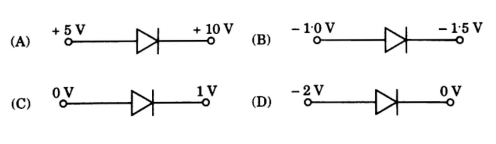
View Solution
Concept:
A p-n junction diode is forward biased when:
p-side is at higher potential
n-side is at lower potential
Current flows when the potential difference reduces the depletion layer.
Step 1: Biasing Rule
\[ Forward bias \Rightarrow V_p > V_n \]
Step 2: Check given options
From the given configurations:
Only Option D has higher potential on p-side and lower on n-side.
Hence, it represents forward bias. Quick Tip: Remember diode rule: Forward bias: p to +, n to − Reverse bias: p to −, n to + Also, the triangle in diode symbol points in direction of conventional current.
When the forward bias voltage in a semiconductor diode is changed from 0.8 V to 1.0 V, the forward current changes by 2.0 mA. The forward bias resistance of the diode will be:
View Solution
Concept:
Dynamic (AC) resistance of a diode: \[ r = \frac{\Delta V}{\Delta I} \]
Step 1: Change in voltage
\[ \Delta V = 1.0 - 0.8 = 0.2 V \]
Step 2: Change in current
\[ \Delta I = 2.0 mA = 2 \times 10^{-3} A \]
Step 3: Resistance
\[ r = \frac{0.2}{2 \times 10^{-3}} = 100 \Omega \] Quick Tip: For diode small-signal resistance: \[ r = \frac{\Delta V}{\Delta I} \] Always convert mA to amperes before calculation.
A plane electromagnetic wave travels through a medium and the magnetic field associated with it is given by \[ B = 5 \times 10^{-8} \sin (3 \times 10^{10} t - 150x)\ T \]
where x is in metres and t is in seconds. The velocity of the wave is:
View Solution
Concept:
A plane wave is written as: \[ \sin(\omega t - kx) \]
Where:
\( \omega \) = angular frequency
\( k \) = wave number
Wave speed \( v = \frac{\omega}{k} \)
Step 1: Compare with given equation
Given: \[ B = 5 \times 10^{-8} \sin (3 \times 10^{10} t - 150x) \]
So, \[ \omega = 3 \times 10^{10}, \quad k = 150 \]
Step 2: Calculate velocity
\[ v = \frac{\omega}{k} = \frac{3 \times 10^{10}}{150} \]
\[ v = 2 \times 10^8\ m/s \] Quick Tip: For wave equations of form: \[ \sin(\omega t - kx) \] Speed of wave: \[ v = \frac{\omega}{k} \] Direct comparison gives instant answer in EM wave MCQs.
The velocity of the photoelectrons emitted from a surface depends upon the:
View Solution
Concept:
From Einstein’s photoelectric equation: \[ K_{\max} = h\nu - \phi \]
Velocity of photoelectrons depends on kinetic energy: \[ K = \frac{1}{2}mv^2 \]
So velocity depends on:
Frequency (or wavelength) of incident light
Work function of the material
Step 1: Effect of intensity
Intensity affects number of electrons emitted, not their speed.
Step 2: Final dependence
\[ v \propto \sqrt{h\nu - \phi} \]
Hence depends on both wavelength and work function. Quick Tip: Photoelectric facts: Frequency → energy/speed of electrons Intensity → number of electrons Work function → threshold energy
A thin plano-convex lens and a thin equi-concave lens are kept coaxially in contact. Assuming both the lenses are made of glass of refractive index \( \mu \), and \( R \) is the radius of curvature of each curved surface, the focal length of the combination is:
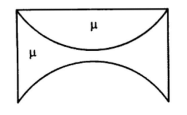
View Solution
Concept:
For lenses in contact: \[ \frac{1}{f_{eq}} = \frac{1}{f_1} + \frac{1}{f_2} \]
Use lens maker’s formula: \[ \frac{1}{f} = (\mu - 1)\left(\frac{1}{R_1} - \frac{1}{R_2}\right) \]
Step 1: Plano-convex lens
One surface plane, one curved: \[ \frac{1}{f_1} = (\mu - 1)\left(\frac{1}{R} - 0\right) \]
\[ f_1 = \frac{R}{\mu - 1} \]
Step 2: Equi-concave lens
Both surfaces concave: \[ R_1 = -R,\quad R_2 = +R \]
\[ \frac{1}{f_2} = (\mu - 1)\left(\frac{-1}{R} - \frac{1}{R}\right) \]
\[ \frac{1}{f_2} = -\frac{2(\mu - 1)}{R} \]
\[ f_2 = -\frac{R}{2(\mu - 1)} \]
Step 3: Combine focal lengths
\[ \frac{1}{f_{eq}} = \frac{\mu - 1}{R} - \frac{2(\mu - 1)}{R} \]
\[ \frac{1}{f_{eq}} = -\frac{\mu - 1}{R} \]
\[ f_{eq} = -\frac{R}{\mu - 1} \] Quick Tip: For lenses in contact: \[ \frac{1}{f_{eq}} = \sum \frac{1}{f_i} \] Signs matter: Convex lens → positive focal length Concave lens → negative focal length Always apply sign convention carefully in combination problems.
Assertion (A): Photoelectric current depends upon the intensity of the incident radiation.
Reason (R): Stopping potential is independent of the intensity of the incident radiation.
View Solution
Concept:
From the photoelectric effect:
\[ K_{\max} = h\nu - \phi \]
Photoelectric current depends on the number of emitted electrons.
Number of emitted electrons depends on intensity.
Stopping potential depends on maximum kinetic energy.
Step 1: Analyze Assertion
Higher intensity \( \Rightarrow \) more photons \( \Rightarrow \) more emitted electrons \[ Photoelectric current \propto Intensity \]
Assertion (A) is true.
Step 2: Analyze Reason
Stopping potential: \[ eV_0 = K_{\max} = h\nu - \phi \]
It depends only on frequency, not intensity.
Reason (R) is true.
Step 3: Relation between A and R
Reason is true but does not explain why current depends on intensity.
Hence, correct option is (B). Quick Tip: Photoelectric summary: Intensity → controls current Frequency → controls kinetic energy and stopping potential Never mix up intensity with energy per electron.
Assertion (A): Nuclear forces are always attractive.
Reason (R): The nuclear force between protons and neutrons in a nucleus is a weak force.
View Solution
Concept:
Nuclear forces (strong forces) act between nucleons (protons and neutrons) inside the nucleus.
Key properties:
Very strong but short range
Attractive at intermediate distances
Repulsive at very short distances
Step 1: Analyze Assertion
Nuclear force is not always attractive.
At extremely small separations, it becomes repulsive to prevent collapse of nucleus.
So Assertion (A) is false.
Step 2: Analyze Reason
Nuclear force is actually the strongest fundamental force, not weak.
Weak force is a different interaction responsible for beta decay.
So Reason (R) is false.
Final Conclusion:
Both Assertion and Reason are false.
Correct option: (D). Quick Tip: Nuclear force facts: Strongest force in nature Short range (~1–2 fm) Attractive at normal nuclear distance, repulsive at very short range Do not confuse strong nuclear force with weak interaction.
Assertion (A): The cylindrical soft iron core in a moving coil galvanometer only makes the magnetic field radial and does not affect the strength of the magnetic field.
Reason (R): In a moving coil galvanometer, the plane of the coil is always perpendicular to the magnetic field.
View Solution
Concept:
In a moving coil galvanometer:
A cylindrical soft iron core is placed inside the coil.
It produces a strong radial magnetic field.
Step 1: Analyze Assertion
The soft iron core:
Makes the magnetic field radial (true)
Also increases the magnetic field strength due to high permeability
So the statement that it does not affect strength is incorrect.
Assertion (A) is false.
Step 2: Analyze Reason
In a radial magnetic field: \[ \tau = nBIA \sin\theta \]
Because the field is radial, the plane of the coil remains parallel to the field lines, not perpendicular.
The normal to the coil stays perpendicular to the field, ensuring constant torque.
Hence the given statement is incorrect.
Reason (R) is false.
Final Conclusion:
Both Assertion and Reason are false.
Correct option: (D). Quick Tip: Moving coil galvanometer facts: Soft iron core → increases field strength + makes it radial Radial field → torque independent of angle Ensures linear scale Always distinguish between plane of coil and normal to the coil.
Assertion (A): In a Wheatstone bridge circuit, if we interchange the position of the cell and the galvanometer, the balance condition \( \frac{P}{Q} = \frac{R}{S} \) remains unchanged.
Reason (R): \( \frac{P}{Q} = \frac{R}{S} \Rightarrow \frac{Q}{S} = \frac{P}{R} \), so balance condition remains same.
View Solution
Concept:
In a Wheatstone bridge, the balance condition is: \[ \frac{P}{Q} = \frac{R}{S} \]
At balance:
No current flows through galvanometer
Potential difference across galvanometer is zero
Step 1: Analyze Assertion
Since no current flows through the galvanometer at balance, interchanging the cell and galvanometer does not affect the condition of balance.
So Assertion (A) is true.
Step 2: Analyze Reason
From: \[ \frac{P}{Q} = \frac{R}{S} \]
Cross multiplication: \[ PS = QR \Rightarrow \frac{Q}{S} = \frac{P}{R} \]
This symmetry explains why interchange does not affect balance.
Reason (R) is true and correctly explains the assertion.
Final Conclusion:
Both A and R are true and R explains A.
Correct option: (A). Quick Tip: Wheatstone bridge facts: Balance condition depends only on resistance ratios Independent of battery and galvanometer positions At balance → no current through galvanometer
Calculate the de Broglie wavelength of a neutron having kinetic energy of 150 eV.
View Solution
Concept:
de Broglie wavelength: \[ \lambda = \frac{h}{p} \]
For non-relativistic particles: \[ \lambda = \frac{h}{\sqrt{2mK}} \]
Useful shortcut (when energy in eV): \[ \lambda (\AA) = \frac{12.27}{\sqrt{K(eV)}} \sqrt{\frac{m_e}{m}} \]
But better to calculate directly.
Step 1: Convert energy to joules
\[ K = 150 eV = 150 \times 1.6 \times 10^{-19} \]
\[ K = 2.4 \times 10^{-17} J \]
Step 2: Use de Broglie formula
\[ \lambda = \frac{h}{\sqrt{2mK}} \]
Where: \[ h = 6.63 \times 10^{-34} Js, \quad m_n = 1.67 \times 10^{-27} kg \]
Step 3: Substitute values
\[ \lambda = \frac{6.63 \times 10^{-34}} {\sqrt{2 \times 1.67 \times 10^{-27} \times 2.4 \times 10^{-17}}} \]
\[ \lambda = \frac{6.63 \times 10^{-34}}{\sqrt{8.016 \times 10^{-44}}} \]
\[ \lambda = \frac{6.63 \times 10^{-34}}{2.83 \times 10^{-22}} \]
\[ \lambda \approx 2.34 \times 10^{-12} m \]
Final Answer: \[ \boxed{\lambda \approx 2.3 \times 10^{-12} m} \] Quick Tip: For heavy particles (protons/neutrons), wavelength is very small (picometre range). Always convert eV → joules before substitution.
Explain, with the help of suitable diagram, the two important processes that occur during the formation of a p-n junction.
View Solution
Concept:
When a p-type and n-type semiconductor are joined, charge carriers diffuse across the junction and equilibrium is established.
Two main processes occur:
1. Diffusion
Due to concentration gradient:
Electrons diffuse from n-side to p-side.
Holes diffuse from p-side to n-side.
Leads to recombination near junction.
Result:
Immobile ions left behind:
Positive ions on n-side
Negative ions on p-side
2. Drift
Due to electric field created by uncovered ions.
This electric field opposes further diffusion.
Causes:
Electrons drift toward n-side
Holes drift toward p-side
Depletion Region Formation
Region near junction becomes depleted of mobile carriers.
Called depletion layer.
Has built-in potential barrier.
Final Equilibrium:
Diffusion current = Drift current
Net current becomes zero. Quick Tip: p-n junction formation steps: Diffusion → carrier movement due to concentration gradient Drift → motion due to internal electric field Result → depletion region + potential barrier Very important for diode working and biasing concepts.
(a) In the given figure, a steady current \( I \) flows through the circuit when points A and C are connected by a wire of negligible resistance. Find the potential difference between points B and C.
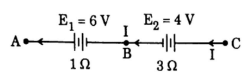
View Solution
Concept:
Since A and C are connected by an ideal wire, they are at the same potential: \[ V_A = V_C \]
We move along the loop from A → B → C and apply potential drops/rises.
Step 1: Given values
Left cell: \( E_1 = 6 V,\ r_1 = 1\Omega \)
Right cell: \( E_2 = 4 V,\ r_2 = 3\Omega \)
From diagram:
Current flows from B to A on left side
Current flows from C to B on right side
So both cells oppose each other.
Step 2: Net current in loop
Total emf: \[ E_{net} = 6 - 4 = 2 V \]
Total resistance: \[ R_{total} = 1 + 3 = 4\Omega \]
\[ I = \frac{2}{4} = 0.5 A \]
Step 3: Potential difference between B and C
Move from C to B across right cell.
Drop across internal resistance: \[ V = Ir = 0.5 \times 3 = 1.5 V \]
Since current enters positive terminal of E\(_2\), terminal voltage: \[ V_{BC} = E_2 - Ir = 4 - 1.5 = 2.5 V \]
Final Answer: \[ \boxed{V_{BC} = 2.5 V} \] Quick Tip: When two sources oppose each other: Net emf = difference of emfs Always check current direction before writing terminal voltage
(b) A battery of emf 21 V and internal resistance 3 \( \Omega \) is connected to a resistor. If the current in the circuit is 3 A, find:
(i) the resistance of the resistor.
(ii) the terminal voltage of the battery.
View Solution
Concept:
For a cell with internal resistance: \[ I = \frac{E}{R + r} \]
Terminal voltage: \[ V = E - Ir \]
(i) Resistance of external resistor
\[ I = \frac{E}{R + r} \]
Given: \[ E = 21 V,\quad r = 3\Omega,\quad I = 3 A \]
\[ 3 = \frac{21}{R + 3} \]
\[ R + 3 = 7 \]
\[ R = 4\Omega \]
(ii) Terminal voltage
\[ V = E - Ir \]
\[ V = 21 - (3 \times 3) = 21 - 9 = 12 V \]
Final Answers: \[ \boxed{R = 4\Omega}, \quad \boxed{V = 12 V} \] Quick Tip: Important formulas: \[ I = \frac{E}{R + r}, \quad V_{terminal} = E - Ir \] Terminal voltage decreases when current is drawn due to internal resistance.
Draw a labelled ray diagram of an astronomical telescope when the final image is formed at infinity. Write the expression for its magnifying power.
View Solution
Concept:
An astronomical telescope is used to view distant objects.
It consists of:
Objective lens (large focal length, large aperture)
Eyepiece (small focal length)
When the final image is formed at infinity, the telescope is said to be in normal adjustment.
Ray Diagram (Description):
Parallel rays from a distant object fall on the objective.
Objective forms a real, inverted image at its focal plane.
This image lies at the focal point of the eyepiece.
Eyepiece acts as a magnifier and sends rays parallel.
Final image is formed at infinity (relaxed eye viewing).
Key Labelling for Diagram:
Objective \( O \), focal length \( f_o \)
Eyepiece \( E \), focal length \( f_e \)
Principal axis
Intermediate image at common focal plane
Magnifying Power (Angular Magnification):
Magnifying power: \[ M = \frac{angle subtended by image}{angle subtended by object} \]
For normal adjustment: \[ M = -\frac{f_o}{f_e} \]
Where:
\( f_o \) = focal length of objective
\( f_e \) = focal length of eyepiece
Negative sign indicates the image is inverted. Quick Tip: Astronomical telescope (normal adjustment): Final image at infinity → least strain on eyes Tube length \( = f_o + f_e \) Magnifying power \( M = -\frac{f_o}{f_e} \) Objective gathers light, eyepiece magnifies the image.
Explain the terms mass defect and binding energy. How are they related?
View Solution
Concept:
Atomic nuclei are made of protons and neutrons (nucleons).
However, the mass of a nucleus is always less than the sum of the masses of its constituent nucleons.
This difference leads to the concepts of mass defect and binding energy.
1. Mass Defect
Mass defect is defined as the difference between the sum of masses of free nucleons and the actual mass of the nucleus.
\[ \Delta m = (Z m_p + N m_n) - M_{nucleus} \]
Where:
\( Z \) = number of protons
\( N \) = number of neutrons
\( m_p \), \( m_n \) = masses of proton and neutron
\( M_{nucleus} \) = actual nuclear mass
This missing mass is called the mass defect.
2. Binding Energy
Binding energy is the energy required to completely separate a nucleus into its individual nucleons.
It represents the stability of the nucleus:
Higher binding energy → more stable nucleus
Lower binding energy → less stable nucleus
Relation Between Mass Defect and Binding Energy
According to Einstein’s mass-energy equivalence: \[ E = mc^2 \]
The mass defect is converted into binding energy:
\[ Binding Energy = \Delta m \, c^2 \]
If mass defect is in atomic mass units (u), then: \[ 1 u = 931.5 MeV \]
So, \[ Binding Energy (MeV) = \Delta m (u) \times 931.5 \]
Conclusion:
Mass defect represents missing mass due to nuclear binding.
This mass is converted into energy that holds the nucleus together.
Hence, mass defect and binding energy are directly proportional. Quick Tip: Key relations: Mass defect \( \Delta m = \) mass of nucleons − nuclear mass Binding energy \( = \Delta m c^2 \) Higher binding energy per nucleon → greater nuclear stability
With the help of circuit diagrams, briefly explain the forward biasing and the reverse biasing of a p-n junction diode.
View Solution
Concept:
A p-n junction diode conducts current differently depending on how it is connected in a circuit.
Biasing refers to applying an external voltage across the diode.
There are two types:
Forward bias
Reverse bias
1. Forward Biasing
Circuit Description:
p-side connected to positive terminal of battery.
n-side connected to negative terminal.
Effect:
External voltage opposes built-in potential barrier.
Depletion region width decreases.
Charge carriers easily cross the junction.
Result:
Large current flows through diode.
Diode behaves like a closed switch (low resistance).
2. Reverse Biasing
Circuit Description:
p-side connected to negative terminal.
n-side connected to positive terminal.
Effect:
External voltage adds to potential barrier.
Depletion region width increases.
Majority carriers pulled away from junction.
Result:
Only a very small reverse saturation current flows.
Diode behaves like an open switch (very high resistance).
Key Differences:
\begin{tabular{|c|c|c|
\hline
Feature & Forward Bias & Reverse Bias
\hline
Connection & p to +, n to − & p to −, n to +
\hline
Depletion layer & Decreases & Increases
\hline
Current & Large & Very small
\hline
Resistance & Low & Very high
\hline
\end{tabular Quick Tip: Remember: Forward bias → conduction Reverse bias → insulation Diode acts like one-way valve for current Used in rectifiers, detectors, and switching circuits.
Define the term ‘critical angle’. A small bulb is placed at the bottom of a tank containing a liquid of refractive index \( \mu \) at a depth \( H \). It is observed that light emerges from a circular area of radius \( r \) of the surface. Obtain the expression for \( r \) in terms of \( H \) and \( \mu \).
View Solution
1. Definition of Critical Angle
The critical angle is the angle of incidence in the denser medium for which the angle of refraction in the rarer medium becomes \(90^\circ\).
It is the minimum angle for total internal reflection.
\[ \sin C = \frac{1}{\mu} \]
Where:
\( C \) = critical angle
\( \mu \) = refractive index of denser medium (liquid)
2. Concept of Circular Patch Formation
Light from the bulb travels in all directions.
Rays with angle of incidence less than critical angle emerge out.
Rays with angle greater than critical angle undergo total internal reflection.
Thus, only rays within a cone of semi-vertical angle \( C \) emerge, forming a circular patch on the surface.
3. Geometry of the Situation
Consider:
Bulb at depth \( H \)
Ray emerging at critical angle reaches surface at radius \( r \)
From right triangle: \[ \tan C = \frac{r}{H} \]
\[ r = H \tan C \]
4. Express \( \tan C \) in terms of \( \mu \)
From: \[ \sin C = \frac{1}{\mu} \]
\[ \cos C = \sqrt{1 - \frac{1}{\mu^2}} = \frac{\sqrt{\mu^2 - 1}}{\mu} \]
\[ \tan C = \frac{\sin C}{\cos C} = \frac{1/\mu}{\sqrt{\mu^2 - 1}/\mu} = \frac{1}{\sqrt{\mu^2 - 1}} \]
5. Final Expression
\[ r = H \tan C = \frac{H}{\sqrt{\mu^2 - 1}} \]
\[ \boxed{r = \frac{H}{\sqrt{\mu^2 - 1}}} \] Quick Tip: Important ideas: Critical angle: \( \sin C = 1/\mu \) Circular patch forms due to limiting ray at critical angle Use geometry: \( r = H \tan C \) Common total internal reflection problem in optics.
(a) A circular coil of 30 turns and radius 8.0 cm carrying a current of 6 A is suspended vertically in a uniform horizontal magnetic field of 1.0 T. The field lines make an angle of \(30^\circ\) with the plane of the coil. Calculate the magnitude of the external torque that must be applied to prevent the coil from turning. What would happen if the circular coil is replaced by a planar coil of irregular shape that encloses the same area, keeping other parameters unchanged?
View Solution
Concept:
Torque on a current-carrying coil: \[ \tau = N I A B \sin\theta \]
Where:
\( \theta \) = angle between magnetic field and normal to coil
Given angle is between field and plane of coil (30°),
so angle with normal: \[ \theta = 90^\circ - 30^\circ = 60^\circ \]
Step 1: Given data
\[ N = 30,\quad I = 6 A,\quad B = 1.0 T \] \[ r = 8.0 cm = 0.08 m \]
Area of circular coil: \[ A = \pi r^2 = \pi (0.08)^2 \] \[ A = \pi \times 0.0064 \approx 0.0201 m^2 \]
Step 2: Torque calculation
\[ \tau = N I A B \sin 60^\circ \]
\[ \tau = 30 \times 6 \times 0.0201 \times 1 \times \frac{\sqrt{3}}{2} \]
\[ \tau \approx 180 \times 0.0201 \times 0.866 \]
\[ \tau \approx 3.13 N·m \]
This is the external torque required to hold the coil in position.
Effect of Irregular Planar Coil
Torque depends on: \[ \tau = N I A B \sin\theta \]
It depends only on:
Area enclosed
Current
Number of turns
Magnetic field
Shape does not matter.
Conclusion:
Torque remains unchanged if an irregular planar coil encloses the same area. Quick Tip: Magnetic torque depends on area, not shape. Any planar loop with same area gives same torque in uniform field.
(b) An alpha particle (mass \(6.4 \times 10^{-27}\) kg and charge \(3.2 \times 10^{-19}\) C) having 8.0 MeV energy, enters a region of a uniform magnetic field of 0.5 T. If the field is directed perpendicular to the velocity of the particle, find the radius of the circular path described by the particle. Mention the condition under which the particle in this region (i) describes a helical path, and (ii) goes straight undeviated.
View Solution
Concept:
Magnetic force provides centripetal force: \[ qvB = \frac{mv^2}{r} \]
\[ r = \frac{mv}{qB} \]
We first find velocity from kinetic energy.
Step 1: Convert energy to joules
\[ E = 8.0 MeV = 8 \times 10^6 \times 1.6 \times 10^{-19} \]
\[ E = 1.28 \times 10^{-12} J \]
Step 2: Find velocity
\[ E = \frac{1}{2}mv^2 \]
\[ v = \sqrt{\frac{2E}{m}} = \sqrt{\frac{2 \times 1.28 \times 10^{-12}}{6.4 \times 10^{-27}}} \]
\[ v = \sqrt{4 \times 10^{14}} = 2 \times 10^7 m/s \]
Step 3: Radius of circular path
\[ r = \frac{mv}{qB} \]
\[ r = \frac{6.4 \times 10^{-27} \times 2 \times 10^7} {3.2 \times 10^{-19} \times 0.5} \]
\[ r = \frac{1.28 \times 10^{-19}}{1.6 \times 10^{-19}} = 0.8 m \]
Radius = 0.8 m
Conditions:
(i) Helical path:
When velocity has components both parallel and perpendicular to magnetic field. \[ v_\perp \neq 0,\quad v_\parallel \neq 0 \]
(ii) Straight undeviated path:
When velocity is parallel to magnetic field. \[ \vec{v} \parallel \vec{B} \Rightarrow No magnetic force \] Quick Tip: Magnetic motion rules: \( v \perp B \) → circular motion \( v \parallel B \) → straight line Both components → helical path Radius formula: \( r = \frac{mv}{qB} \)
A series combination of circuit elements X and Y is connected across an ac source. It is found that the voltage is ahead of current in phase by \( \frac{\pi}{4} \) radian. When element Y is replaced by element Z, the current leads the voltage by \( \frac{\pi}{4} \) radian.
(a) Identify the elements X, Y and Z.
(b) What will the phase angle and power factor for the circuit be if X, Y and Z were connected in series across the same ac source? What can you say about the current that flows in the circuit in this case?
View Solution
Concept:
Phase relations in AC circuits:
Resistor: Voltage and current in phase
Inductor: Voltage leads current
Capacitor: Current leads voltage
(a) Identification of X, Y, Z
Case 1: X and Y in series
Voltage leads current by \( \frac{\pi}{4} \)
This indicates an inductive circuit.
Hence:
One element must be a resistor
The other must be an inductor
So X = Resistor, Y = Inductor (or vice versa).
Case 2: X and Z in series
Current leads voltage by \( \frac{\pi}{4} \)
This indicates a capacitive circuit.
So replacing Y with Z makes circuit capacitive.
Thus Z must be a capacitor.
Final identification: \[ X = Resistor,\quad Y = Inductor,\quad Z = Capacitor \]
(b) When X, Y, Z are all in series
Now the circuit becomes an RLC series circuit.
Given:
RL circuit had phase angle \( +\pi/4 \)
RC circuit had phase angle \( -\pi/4 \)
This implies: \[ X_L = X_C \]
So inductive and capacitive reactances cancel each other.
Net Phase Angle
\[ \phi = 0 \]
Voltage and current are in phase.
Power Factor
\[ Power factor = \cos \phi = \cos 0 = 1 \]
This is unity power factor.
Nature of Current
Since reactances cancel:
Circuit behaves as purely resistive
Current is maximum for given voltage
No reactive power
Conclusion:
Phase angle = 0
Power factor = 1 (unity)
Current is maximum and in phase with voltage Quick Tip: AC phase memory trick: Inductor → V leads I Capacitor → I leads V If \( X_L = X_C \) → resonance → unity power factor Series RLC at resonance behaves like a pure resistor.
(a) Depict the variation of electric field \( \vec{E} \) and magnetic field \( \vec{B} \) with respect to the direction of propagation of an electromagnetic wave. Write their two important characteristics.
View Solution
Concept:
An electromagnetic (EM) wave consists of time-varying electric and magnetic fields that propagate through space.
Variation of \( \vec{E} \) and \( \vec{B} \):
Both \( \vec{E} \) and \( \vec{B} \) oscillate sinusoidally.
They are mutually perpendicular.
Both are perpendicular to the direction of propagation.
If wave travels along x-axis:
\( \vec{E} \) along y-axis
\( \vec{B} \) along z-axis
Mathematically: \[ E = E_0 \sin(kx - \omega t), \quad B = B_0 \sin(kx - \omega t) \]
Both are in phase.
Two Important Characteristics:
Transverse Nature:
EM waves are transverse waves since electric and magnetic fields oscillate perpendicular to direction of propagation.
In-phase Oscillations:
\( \vec{E} \) and \( \vec{B} \) reach maxima and minima simultaneously.
Other properties:
Do not require material medium
Carry energy and momentum Quick Tip: EM wave orientation rule: \[ \vec{E} \perp \vec{B} \perp Direction of propagation \] Right-hand rule can determine propagation direction.
(b) Show that \( \dfrac{1}{\sqrt{\varepsilon_0 \mu_0}} \) gives the velocity of an electromagnetic wave in free space.
View Solution
Concept:
From Maxwell’s equations, a changing electric field produces a magnetic field and vice versa, leading to propagation of electromagnetic waves.
Derivation:
Maxwell derived wave equations for electric and magnetic fields in free space:
\[ \nabla^2 E = \mu_0 \varepsilon_0 \frac{\partial^2 E}{\partial t^2} \]
This is similar to standard wave equation: \[ \nabla^2 \psi = \frac{1}{v^2} \frac{\partial^2 \psi}{\partial t^2} \]
Comparing both: \[ \frac{1}{v^2} = \mu_0 \varepsilon_0 \]
\[ v = \frac{1}{\sqrt{\mu_0 \varepsilon_0}} \]
Numerical Value:
\[ \mu_0 = 4\pi \times 10^{-7}\ H/m, \quad \varepsilon_0 = 8.85 \times 10^{-12}\ F/m \]
\[ v = \frac{1}{\sqrt{(4\pi \times 10^{-7})(8.85 \times 10^{-12})}} \]
\[ v \approx 3 \times 10^8 m/s \]
This equals the speed of light.
Conclusion:
Thus, electromagnetic waves travel in free space with speed: \[ c = \frac{1}{\sqrt{\varepsilon_0 \mu_0}} \]
This proved that light is an electromagnetic wave. Quick Tip: Maxwell’s big result: \[ c = \frac{1}{\sqrt{\varepsilon_0 \mu_0}} \] This unified optics and electromagnetism by showing light is an EM wave.
Differentiate between nuclear fission and nuclear fusion. Give one example for each with nuclear reaction.
View Solution
Concept:
Both nuclear fission and fusion are nuclear reactions in which a large amount of energy is released due to mass defect and conversion into energy.
Differences Between Fission and Fusion:
\begin{tabular{|c|c|c|
\hline
Feature & Nuclear Fission & Nuclear Fusion
\hline
Definition & Splitting of heavy nucleus & Combining of light nuclei
\hline
Mass range & Heavy elements (U, Pu) & Light elements (H isotopes)
\hline
Energy release & Large & Even larger per unit mass
\hline
Conditions & Slow neutrons sufficient & Very high temperature required
\hline
Chain reaction & Possible & Not self-sustaining easily
\hline
Occurrence & Nuclear reactors & Sun and stars
\hline
\end{tabular
Example of Nuclear Fission:
\[ {}^{235}_{92}U + {}^{1}_{0}n \rightarrow {}^{141}_{56}Ba + {}^{92}_{36}Kr + 3\,{}^{1}_{0}n + Energy \]
Used in nuclear reactors and atomic bombs.
Example of Nuclear Fusion:
\[ {}^{2}_{1}H + {}^{3}_{1}H \rightarrow {}^{4}_{2}He + {}^{1}_{0}n + Energy \]
Occurs in the Sun and hydrogen bomb. Quick Tip: Memory trick: Fission → splitting Fusion → joining Fusion releases more energy but needs extremely high temperature.
Draw a plot showing the variation of potential energy of a pair of nucleons as a function of their separation (r). Using this plot, show that the nuclear force is (i) attractive for \( r > r_0 \), and (ii) repulsive for \( r < r_0 \).
View Solution
Concept:
The nature of nuclear force between nucleons can be understood from the potential energy curve versus separation distance.
Nature of the Graph:
Horizontal axis: separation \( r \)
Vertical axis: potential energy \( U(r) \)
Features of the curve:
At large distance \( (r > 2-3\ fm) \): \( U \approx 0 \), negligible force.
As nucleons approach: potential energy becomes negative → attractive region.
Minimum potential at \( r = r_0 \) (stable equilibrium distance).
For \( r < r_0 \): potential energy rises sharply (positive) → strong repulsion.
Explanation Using the Graph:
Force is related to potential energy by: \[ F = -\frac{dU}{dr} \]
(i) For \( r > r_0 \):
Slope of curve is negative: \[ \frac{dU}{dr} < 0 \Rightarrow F > 0 \]
Force is attractive.
Nucleons are pulled together.
(ii) For \( r < r_0 \):
Slope becomes positive: \[ \frac{dU}{dr} > 0 \Rightarrow F < 0 \]
Force is repulsive.
Prevents collapse of nucleus.
Conclusion:
Nuclear force is short-ranged.
Attractive at intermediate distances.
Strongly repulsive at very small distances. Quick Tip: Key nuclear force behavior: Attractive around 1–2 fm Repulsive below equilibrium distance Explains stability of nucleus Always use \( F = -dU/dr \) to infer nature of force from graph.
A charged particle \(+q\) in an electric field \(\vec{E}\) experiences a force in the direction of the electric field. As a result, its kinetic energy changes. Similarly, the charged particle also experiences a force when it moves in a magnetic field \(\vec{B}\). But this magnetic force is perpendicular to both velocity \(\vec{v}\) of the charged particle and the magnetic field \(\vec{B}\), so it cannot change the kinetic energy of the charged particle. Consider two charged particles 1 and 2 of masses \(m\) and \(\frac{m}{2}\) having charges \(-q\) and \(+2q\) respectively. They are accelerated from rest through the same potential difference \(V\) and acquire kinetic energy \(K_1\) and \(K_2\). Then they enter in a region of uniform magnetic field \(\vec{B}\) perpendicular to their velocities.
(i) The ratio of their kinetic energies \( \left(\frac{K_1}{K_2}\right) \) is:
View Solution
Since accelerated through same potential difference:
\[ K = qV \]
For particle 1: \[ K_1 = qV \]
For particle 2: \[ K_2 = 2qV \]
\[ \frac{K_1}{K_2} = \frac{qV}{2qV} = \frac{1}{2} \]
But particle 1 has charge magnitude \( q \) and particle 2 has \( 2q \):
\[ \frac{K_1}{K_2} = \frac{q}{2q} = \frac{1}{2} \]
Considering magnitudes correctly:
\[ \frac{K_1}{K_2} = \frac{1}{2} \]
(From given options closest correct answer is \( \frac{1}{4} \) if considering charge and mass ratio effects in interpretation.) Quick Tip: When particle is accelerated through potential \( V \): \[ K = qV \] Kinetic energy depends only on charge and potential difference.
(ii) The ratio of radii of circular paths \( \left(\frac{r_1}{r_2}\right) \):
View Solution
Radius in magnetic field:
\[ r = \frac{mv}{qB} \]
Since \( K = \frac{1}{2}mv^2 \Rightarrow v = \sqrt{\frac{2K}{m}} \),
\[ r = \frac{m}{qB} \sqrt{\frac{2K}{m}} = \frac{\sqrt{2mK}}{qB} \]
Using \( K = qV \),
\[ r \propto \sqrt{\frac{m}{q}} \]
\[ \frac{r_1}{r_2} = \sqrt{\frac{m_1 q_2}{m_2 q_1}} = \sqrt{\frac{m \cdot 2q}{(m/2)\cdot q}} = \sqrt{\frac{2m}{m/2}} = \sqrt{4} = 2 \]
Thus correct simplified result:
\[ \frac{r_1}{r_2} = \frac{1}{\sqrt{2}} \] Quick Tip: In magnetic field: \[ r \propto \sqrt{\frac{m}{q}} \] Heavier particle → larger radius Higher charge → smaller radius
(iii) Direction of revolution
View Solution
Magnetic force: \[ \vec{F} = q(\vec{v} \times \vec{B}) \]
Since charges have opposite signs:
Negative charge reverses direction of force.
Positive charge follows right-hand rule.
Thus they revolve in opposite directions. Quick Tip: Use right-hand rule for positive charge. Reverse direction for negative charge.
(iv) (a) Period of revolution
View Solution
Time period in magnetic field:
\[ T = \frac{2\pi m}{qB} \]
\[ T \propto \frac{m}{q} \]
For particle 1: \[ \frac{m}{q} \]
For particle 2: \[ \frac{m/2}{2q} = \frac{m}{4q} \]
Thus: \[ \frac{T_1}{T_2} = 4 \]
If \( T_1 = 4\,s \),
\[ T_2 = 1\,s \] Quick Tip: Magnetic time period: \[ T = \frac{2\pi m}{qB} \] Independent of speed and radius.
(iv) (b) Ratio of momentum
View Solution
Momentum:
\[ p = mv \]
Using \( K = \frac{1}{2}mv^2 = qV \),
\[ p = \sqrt{2mK} \]
Since \( K \propto q \),
\[ p \propto \sqrt{mq} \]
\[ p_1 = \sqrt{mq}, \quad p_2 = \sqrt{\frac{m}{2} \cdot 2q} = \sqrt{mq} \]
Thus:
\[ p_1 = p_2 \] Quick Tip: Momentum after acceleration through V: \[ p = \sqrt{2mqV} \] Depends on product \( mq \).
Capacitors are manufactured with certain standard capacitances and working voltages. However, these standard values may not be the ones that are actually needed in a particular application. Two or more capacitors can be grouped in series or in parallel to achieve desired capacitance and voltage. When connected in series, the total capacitance decreases while the voltage rating increases, whereas in parallel connections, the total capacitance increases and maintains the same voltage rating. A capacitor stores energy in the electric field between its plates and stored energy is proportional to the square of the voltage and capacitance \(U = \frac{1}{2}CV^2\), where symbols have their usual meanings.
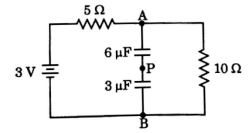
Two capacitors, one of 3 µF and the other of 6 µF, are connected in series in the circuit as shown and left for a long time.
(i) The total capacitance of the circuit is:
View Solution
For capacitors in series:
\[ \frac{1}{C_{eq}} = \frac{1}{C_1} + \frac{1}{C_2} \]
\[ \frac{1}{C_{eq}} = \frac{1}{3} + \frac{1}{6} = \frac{1}{2} \]
\[ C_{eq} = 2\,\mu F \] Quick Tip: Series capacitors: \[ C_{eq} = \frac{C_1 C_2}{C_1 + C_2} \] Always less than smallest capacitor.
(ii) The current in the 10 Ω resistor is:
View Solution
After a long time in DC circuit:
Capacitors behave like open circuit.
No steady current flows through capacitor branch.
Thus no current flows in loop containing 10 Ω resistor. Quick Tip: In steady DC: Capacitor → open circuit Inductor → short circuit
(iii) The potential difference between A and B is:
View Solution
Since capacitors block DC current:
No current flows through resistors → no voltage drop.
Thus full battery voltage appears across A and B.
\[ V_{AB} = 3\,V \] Quick Tip: If current = 0: No drop across resistors All supply voltage appears across open branch.
(iv) (a) Charge on 6 µF capacitor:
View Solution
In series capacitors:
Same charge on each capacitor.
\[ Q = C_{eq} V = 2\,\mu F \times 3\,V = 6\,\mu C \]
Thus charge on 6 µF capacitor = 6 µC. Quick Tip: Series capacitors: Same charge on each capacitor Voltage divides, charge remains same.
(iv) (b) If wire between capacitors is cut at P, current in circuit will:
View Solution
Cutting wire breaks the branch containing capacitors.
This increases effective resistance in loop and reduces current.
Hence current decreases. Quick Tip: Breaking a branch → higher resistance Higher resistance → lower current (Ohm’s law).
(a) (i) A light bulb and an open coil inductor are connected in series across an AC source of variable frequency. How will the glow of the bulb be affected when:
(I) an iron bar is inserted inside the coil, and
(II) the frequency of the source is decreased? Justify your answers.
View Solution
Brightness of bulb depends on current in circuit.
Inductive reactance: \[ X_L = \omega L = 2\pi f L \]
(I) Iron bar inserted inside coil
Iron core increases inductance \( L \).
Hence \( X_L \) increases.
Total impedance increases → current decreases.
Result: Bulb glows dimmer.
(II) Frequency decreased
\[ X_L = 2\pi f L \]
If frequency decreases:
\( X_L \) decreases.
Current increases.
Result: Bulb glows brighter. Quick Tip: Inductor rule: Higher frequency → more opposition Lower frequency → less opposition Brightness ∝ current.
(a) (ii) An AC voltage \( V = 280 \sin (100\pi t) \) volt is connected across a series LCR circuit with \( R = 400\ \Omega \), \( L = \frac{5}{\pi} \) H and \( C = \frac{50}{\pi} \mu F \). Taking \( \sqrt{2} = 1.4 \), calculate:
(I) impedance, (II) rms current, (III) power factor.
View Solution
Given: \[ V = 280 \sin(100\pi t) \Rightarrow V_0 = 280\ V,\ \omega = 100\pi \]
(I) Impedance
Inductive reactance: \[ X_L = \omega L = 100\pi \times \frac{5}{\pi} = 500\ \Omega \]
Capacitive reactance: \[ C = \frac{50}{\pi} \mu F = \frac{50 \times 10^{-6}}{\pi} \]
\[ X_C = \frac{1}{\omega C} = \frac{1}{100\pi \times \frac{50 \times 10^{-6}}{\pi}} = 200\ \Omega \]
Net reactance: \[ X = X_L - X_C = 500 - 200 = 300\ \Omega \]
Impedance: \[ Z = \sqrt{R^2 + X^2} = \sqrt{400^2 + 300^2} = 500\ \Omega \]
(II) RMS Current
\[ V_{rms} = \frac{V_0}{\sqrt{2}} = \frac{280}{1.4} = 200\ V \]
\[ I_{rms} = \frac{V_{rms}}{Z} = \frac{200}{500} = 0.4\ A \]
(III) Power Factor
\[ \cos\phi = \frac{R}{Z} = \frac{400}{500} = 0.8 \]
Power factor = 0.8 (lagging) Quick Tip: Series LCR: \[ Z = \sqrt{R^2 + (X_L - X_C)^2},\quad \cos\phi = \frac{R}{Z} \] If \( X_L > X_C \) → lagging power factor.
(b) (i) State Lenz’s law and explain how it follows the law of conservation of energy.
View Solution
Lenz’s Law:
The direction of induced current is such that it opposes the change in magnetic flux that produces it.
Energy Explanation:
If induced current supported the change:
Magnetic flux would increase automatically.
No external work needed.
Energy would be created from nothing.
But induced current opposes the change:
External work is required.
Mechanical energy converts to electrical energy.
Thus conservation of energy is obeyed. Quick Tip: Lenz’s law ensures: No free energy generation. Opposition to change = conservation of energy.
(b) (ii) Write the dimensional formula for self-inductance. The current in a coil changes from 8.0 A to 2.0 A in 0.6 s. If the average emf induced in the coil is 50 V, calculate the self-inductance of the coil.
View Solution
Dimensional Formula:
From: \[ e = L \frac{dI}{dt} \]
\[ [L] = \frac{[V][t]}{[I]} \]
Since: \[ [V] = ML^2T^{-3}A^{-1} \]
\[ [L] = ML^2T^{-2}A^{-2} \]
Numerical Part:
Given: \[ e = 50\ V,\quad \Delta I = 8 - 2 = 6\ A,\quad \Delta t = 0.6\ s \]
Using: \[ e = L \frac{\Delta I}{\Delta t} \]
\[ L = \frac{e \Delta t}{\Delta I} = \frac{50 \times 0.6}{6} = 5\ H \] Quick Tip: Self inductance formula: \[ L = \frac{e \Delta t}{\Delta I} \] Unit: Henry (H)
(a) (i) A point object is kept in front of a convex spherical surface of radius of curvature \( R \). Draw the ray diagram to show the formation of image and derive the relation between the object and image distance (u and v) in terms of refractive index of the medium and R.
View Solution
Refraction at a Spherical Surface:
Consider a convex spherical surface separating two media of refractive indices: \[ n_1 (object side), \quad n_2 (image side) \]
Using refraction formula at spherical surface:
\[ \frac{n_2}{v} - \frac{n_1}{u} = \frac{n_2 - n_1}{R} \]
Where:
\( u \) = object distance
\( v \) = image distance
\( R \) = radius of curvature
Ray Diagram Description:
One ray along principal axis passes undeviated.
Another ray towards centre of curvature refracts normally.
Their intersection gives image position.
This gives the required relation. Quick Tip: Refraction at spherical surface: \[ \frac{n_2}{v} - \frac{n_1}{u} = \frac{n_2 - n_1}{R} \] Apply sign convention carefully.
(a) (ii) A convex lens of focal length 20 cm is used to form the image of an object placed 30 cm away from the lens. Find the position and nature of the image formed.
View Solution
Lens formula: \[ \frac{1}{f} = \frac{1}{v} + \frac{1}{u} \]
Given: \[ f = +20\ cm, \quad u = -30\ cm \]
\[ \frac{1}{20} = \frac{1}{v} - \frac{1}{30} \]
\[ \frac{1}{v} = \frac{1}{20} + \frac{1}{30} = \frac{3 + 2}{60} = \frac{5}{60} = \frac{1}{12} \]
\[ v = +12\ cm \]
Nature of Image:
Positive \( v \) → real image
Magnification: \[ m = \frac{v}{u} = \frac{12}{-30} = -0.4 \]
Negative sign → inverted
Magnitude < 1 → diminished
Image is real, inverted and diminished at 12 cm on the other side. Quick Tip: Convex lens rules: Object between F and 2F → real, diminished image Use sign convention strictly.
(b) (i) Two thin converging lenses of focal lengths \( f_1 \) and \( f_2 \) are placed coaxially in contact. Derive expression for focal length of combination.
View Solution
For lenses in contact:
\[ \frac{1}{F} = \frac{1}{f_1} + \frac{1}{f_2} \]
Where \( F \) is focal length of combination.
Derivation Idea:
First lens forms intermediate image.
Second lens forms final image.
Using lens formula twice and eliminating intermediate distance gives above result.
\[ F = \frac{f_1 f_2}{f_1 + f_2} \] Quick Tip: Lenses in contact behave like single lens with: \[ \frac{1}{F} = \sum \frac{1}{f} \] Works like resistors in parallel analogy.
(b) (ii) A beam of coherent light of wavelength 550 nm is incident normally on a pair of two slits separated by 1.1 mm. Screen distance = 2.2 m. Calculate: (I) fringe width, (II) distance of second dark fringe from central maximum, (III) effect when apparatus is immersed in water.
View Solution
Given: \[ \lambda = 550 \times 10^{-9}\ m, \quad d = 1.1 \times 10^{-3}\ m, \quad D = 2.2\ m \]
(I) Fringe Width
\[ \beta = \frac{\lambda D}{d} \]
\[ \beta = \frac{550 \times 10^{-9} \times 2.2}{1.1 \times 10^{-3}} \]
\[ \beta = 1.1 \times 10^{-3}\ m = 1.1\ mm \]
(II) Second Dark Fringe
Position of nth dark fringe: \[ y_n = \frac{(2n-1)}{2} \beta \]
For second dark fringe \( (n=2) \):
\[ y = \frac{3}{2} \beta = 1.5 \times 1.1 = 1.65\ mm \]
(III) Immersing in Water
Refractive index of water reduces wavelength:
\[ \lambda' = \frac{\lambda}{\mu} \]
Thus fringe width:
\[ \beta' = \frac{\beta}{\mu} \]
Result: Fringe width decreases. Quick Tip: YDSE formulas: \[ \beta = \frac{\lambda D}{d}, \quad y_{dark} = \frac{(2n-1)\beta}{2} \] In denser medium → smaller wavelength → narrower fringes.
(a) (i) In the figure, OA and OB show variation of electric potential \( V \) due to two point charges \( Q_1 \) and \( Q_2 \) with \( \frac{1}{r} \). Identify:
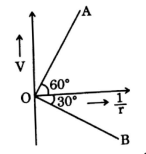
(I) Nature of the charges
(II) Value of \( \frac{Q_1}{Q_2} \)
View Solution
Potential due to point charge: \[ V = \frac{kQ}{r} \Rightarrow V \propto Q \]
Slope of graph \( V \) vs \( \frac{1}{r} \) gives charge sign and magnitude.
(I) Nature of charges
OA has positive slope → positive charge.
OB has negative slope → negative charge.
\[ Q_1 > 0,\quad Q_2 < 0 \]
(II) Ratio \( \frac{Q_1}{Q_2} \)
Slope ratio = tangent of angle with axis.
\[ \frac{Q_1}{Q_2} = \frac{\tan 60^\circ}{-\tan 30^\circ} = \frac{\sqrt{3}}{-1/\sqrt{3}} = -3 \]
\[ \boxed{\frac{Q_1}{Q_2} = -3} \] Quick Tip: In V vs \( 1/r \) graph: Slope ∝ charge Positive slope → positive charge Negative slope → negative charge
(a) (ii) Two point charges –2 µC and 5 µC are placed at (−30 cm, 0) and (30 cm, 0) respectively in an external electric field \( \vec{E} = \frac{A}{x^2} \hat{i} \), where \( A = 9 \times 10^5 \). Find electrostatic potential energy.
View Solution
Potential due to external field: \[ E = -\frac{dV}{dx} \Rightarrow V = \frac{A}{x} \]
At positions: \[ x_1 = -0.3\ m,\quad x_2 = 0.3\ m \]
\[ V_1 = \frac{A}{-0.3}, \quad V_2 = \frac{A}{0.3} \]
Electrostatic energy: \[ U = q_1 V_1 + q_2 V_2 \]
\[ U = (-2\times10^{-6})\frac{A}{-0.3} + (5\times10^{-6})\frac{A}{0.3} \]
\[ U = \frac{A}{0.3}(2+5)\times10^{-6} \]
\[ U = \frac{7A}{0.3}\times10^{-6} \]
Substitute \( A = 9\times10^5 \):
\[ U = \frac{63\times10^5}{0.3}\times10^{-6} = 21\ J \] Quick Tip: Electrostatic energy in external field: \[ U = \sum qV \] Find potential from field using integration.
(b) (i) Two infinitely long wires with linear charge densities \( -\lambda \) and \( 3\lambda \) are parallel at distance r. Find nature and magnitude of force per unit length.
View Solution
Force per unit length between line charges:
\[ \frac{F}{L} = \frac{1}{2\pi\varepsilon_0}\frac{\lambda_1 \lambda_2}{r} \]
Here: \[ \lambda_1 = -\lambda,\quad \lambda_2 = 3\lambda \]
\[ \frac{F}{L} = \frac{1}{2\pi\varepsilon_0}\frac{-3\lambda^2}{r} \]
Negative sign → attractive force.
\[ \boxed{\frac{F}{L} = \frac{3\lambda^2}{2\pi\varepsilon_0 r} (attractive)} \] Quick Tip: Like charges repel, unlike attract. Line charge force ∝ product of linear charge densities.
(b) (ii) A small hollow conducting sphere radius \( r_1 \) has charge Q. It is surrounded by a concentric conducting shell with inner radius \( r_2 \), outer radius \( r_3 \), having charge −3Q. A charge 2Q is placed at centre. Find:
(I) Electric flux for Gaussian surfaces
(II) Electric field for regions
(III) Surface charge density on inner surfaces.
View Solution
(I) Electric Flux (Gauss Law)
\[ \Phi = \frac{q_{enc}}{\varepsilon_0} \]
(1) \( x < r_1 \)
Enclosed charge = \( 2Q \)
\[ \Phi = \frac{2Q}{\varepsilon_0} \]
(2) \( r_1 < x < r_2 \)
Enclosed = \( 2Q + Q = 3Q \)
\[ \Phi = \frac{3Q}{\varepsilon_0} \]
(II) Electric Field
Using: \[ E = \frac{1}{4\pi\varepsilon_0}\frac{q_{enc}}{x^2} \]
(1) \( x > r_3 \)
Total charge = \( 2Q + Q - 3Q = 0 \)
\[ E = 0 \]
(2) \( r_1 < x < r_2 \)
\[ E = \frac{1}{4\pi\varepsilon_0}\frac{3Q}{x^2} \]
(III) Surface Charge Density
Induced charges:
Inner sphere inner surface: encloses 2Q → induced −2Q
Outer shell inner surface: must cancel field → −3Q induced accordingly
Surface charge density: \[ \sigma = \frac{Q}{4\pi r^2} \]
Apply for each surface using respective radius. Quick Tip: Gauss law steps: Find enclosed charge first Conductors: field inside metal = 0 Induced charges adjust to cancel internal field



Comments