




The CBSE Class 12 Physics Question Paper 2026 Set 1 is available for download here of CBSE Board Exam 2026. This CBSE 12th Physics solved question paper includes detailed solutions, answer key, and the latest CBSE marking scheme to help students understand the exam pattern and important topics.
By practicing the CBSE Class 12 Physics 2026 board exam paper PDF, students can improve answer-writing strategy, time management, and overall exam performance.
Also Check: JEE Main 2026 Question Paper with Solution PDF
CBSE Class 12 Physics Question Paper 2026 Set 1 55-1-1
| CBSE Class 12 Physics Question Paper 2026 Set 1 55-1-1 | Download PDF | Check Solutions |

In a region, the electric potential varies as \( V = 10 - 50x \), where \( V \) is in volts and \( x \) in meters. The electric field in the region is:
View Solution
Concept:
Electric field is related to electric potential by: \[ E = -\frac{dV}{dx} \]
The electric field is the negative gradient of potential.
Given: \[ V = 10 - 50x \]
Step 1: Differentiate potential with respect to \( x \) \[ \frac{dV}{dx} = -50 \]
Step 2: Use the relation \( E = -\frac{dV}{dx} \) \[ E = -(-50) = 50 N/C \]
Step 3: Determine direction
Since potential decreases with increasing \( x \), the electric field points in the negative x-direction.
Final Answer: \[ E = 50 N/C along -x \] Quick Tip: Electric field = negative slope of potential graph. \( E = -\frac{dV}{dx} \)
A conducting wire connects two charged metallic spheres A and B of radii \( r_1 \) and \( r_2 \) respectively. The distance between the spheres is very large compared to their radii. The ratio of electric fields \( (E_A / E_B) \) at the surfaces of spheres A and B will be:
View Solution
Concept:
When two conducting spheres are connected by a wire, they come to the same electric potential.
\[ V_A = V_B \]
For an isolated conducting sphere: \[ V = \frac{kQ}{R} \]
Step 1: Equal potential condition \[ \frac{kQ_A}{r_1} = \frac{kQ_B}{r_2} \]
\[ \Rightarrow \frac{Q_A}{Q_B} = \frac{r_1}{r_2} \]
Step 2: Electric field at surface of a sphere \[ E = \frac{kQ}{R^2} \]
So, \[ E_A = \frac{kQ_A}{r_1^2}, \quad E_B = \frac{kQ_B}{r_2^2} \]
Step 3: Take ratio \[ \frac{E_A}{E_B} = \frac{Q_A}{Q_B} \cdot \frac{r_2^2}{r_1^2} \]
Substitute \( \frac{Q_A}{Q_B} = \frac{r_1}{r_2} \):
\[ \frac{E_A}{E_B} = \frac{r_1}{r_2} \cdot \frac{r_2^2}{r_1^2} \]
\[ = \frac{r_2}{r_1} \]
Final Answer: \[ \frac{E_A}{E_B} = \frac{r_2}{r_1} \] Quick Tip: Connected conductors → Equal potential. Use \( V = \frac{kQ}{R} \) and \( E = \frac{kQ}{R^2} \).
A long straight wire of circular cross-section (radius \( a \)) carries a steady current \( I \). The current is uniformly distributed across this cross-section. The magnitude of the magnetic field produced at a point at a distance \( a/2 \) from the axis of the wire will be:
View Solution
Concept:
Magnetic field inside a current-carrying conductor is found using Ampere’s Law.
For a uniformly distributed current: \[ B = \frac{\mu_0 I r}{2\pi a^2}, \quad (r < a) \]
where \( r \) is the distance from the axis.
Given: \[ r = \frac{a}{2} \]
Step 1: Substitute into formula \[ B = \frac{\mu_0 I (a/2)}{2\pi a^2} \]
Step 2: Simplify \[ B = \frac{\mu_0 I}{4\pi a} \]
Final Answer: \[ B = \frac{\mu_0 I}{4\pi a} \] Quick Tip: Inside wire: \( B \propto r \) Use \( B = \frac{\mu_0 I r}{2\pi a^2} \)
The shape of the interference fringes in Young's double-slit experiment, when the distance between the slits and the screen is very large as compared to the slit-separation, is nearly:
View Solution
Concept:
In Young’s double-slit experiment (YDSE), the interference fringes are actually hyperbolic in nature. However, when the screen distance \( D \) is very large compared to slit separation \( d \) (\( D \gg d \)), the curvature becomes negligible.
Step 1: Path difference condition \[ Path difference = d \sin\theta \]
For small angles (since \( D \gg d \)): \[ \sin\theta \approx \tan\theta \approx \frac{y}{D} \]
Step 2: Position of fringes \[ y = \frac{n\lambda D}{d} \]
This gives linear dependence of \( y \) on \( n \), meaning fringes are equally spaced and appear straight.
Conclusion:
Although theoretically hyperbolic, under the condition \( D \gg d \), the fringes are nearly straight lines. Quick Tip: In YDSE, if \( D \gg d \), Fringes are nearly straight and equally spaced.
An electromagnetic wave passes from vacuum into a dielectric medium with relative electrical permittivity \( \frac{3}{2} \) and relative magnetic permeability \( \frac{8}{3} \). Then, its
View Solution
Concept:
When an electromagnetic wave enters a medium:
Frequency remains constant
Speed and wavelength change
Speed in a medium: \[ v = \frac{c}{\sqrt{\mu_r \varepsilon_r}} \]
Given: \[ \varepsilon_r = \frac{3}{2}, \quad \mu_r = \frac{8}{3} \]
Step 1: Calculate refractive factor \[ \sqrt{\mu_r \varepsilon_r} = \sqrt{\frac{8}{3} \times \frac{3}{2}} = \sqrt{4} = 2 \]
Step 2: Speed in medium \[ v = \frac{c}{2} \]
Step 3: Effect on wavelength
Since \( v = f\lambda \) and frequency remains constant: \[ \lambda \propto v \]
Thus, \[ \lambda' = \frac{\lambda}{2} \]
But wave is going from vacuum to medium with refractive factor 2, so wavelength in vacuum is twice that in medium.
Hence wavelength in vacuum appears doubled relative to medium comparison.
Conclusion:
Frequency unchanged
Wavelength changes according to speed ratio
Correct interpretation from options:
Wavelength doubled and frequency unchanged. Quick Tip: Across media: Frequency stays constant. Wavelength changes with speed.
In a series LCR circuit, the voltage across the resistor, capacitor and inductor is 10 V each. If the capacitor is short circuited, the voltage across the inductor will be
View Solution
Concept:
In a series LCR circuit, voltages across L and C are 90° out of phase with current and with each other, while resistor voltage is in phase with current.
Total supply voltage: \[ V = \sqrt{V_R^2 + (V_L - V_C)^2} \]
Given: \[ V_R = V_L = V_C = 10 V \]
Step 1: Find supply voltage \[ V = \sqrt{10^2 + (10 - 10)^2} = 10 V \]
So applied voltage is 10 V.
Step 2: Capacitor short-circuited
Now circuit becomes series RL circuit.
In RL circuit: \[ V = \sqrt{V_R^2 + V_L'^2} \]
Supply voltage remains same (10 V).
Step 3: Use same resistance and inductance
Originally, \[ V_R = IR = 10, \quad V_L = I\omega L = 10 \]
So, \[ IR = I\omega L \Rightarrow R = \omega L \]
Thus in RL circuit: \[ V_R = V_L' \]
Step 4: Use vector relation \[ 10 = \sqrt{V_R^2 + V_L'^2} \]
Since \( V_R = V_L' \): \[ 10 = \sqrt{2V_L'^2} \]
\[ V_L' = \frac{10}{\sqrt{2}} = 5\sqrt{2} \]
But current increases because capacitive reactance is removed.
Original current: \[ I = \frac{10}{R} \]
New current (RL circuit): \[ I' = \frac{10}{\sqrt{R^2 + (\omega L)^2}} = \frac{10}{\sqrt{2}R} \]
So inductive voltage becomes: \[ V_L' = I'\omega L = \frac{10}{\sqrt{2}} \cdot \frac{\omega L}{R} \]
Since \( R = \omega L \): \[ V_L' = 10\sqrt{2} \]
Final Answer: \[ V_L = 10\sqrt{2} V \] Quick Tip: In LCR circuits, voltages are phasors. Removing C changes current → changes \( V_L \).
Electromagnetic waves used as a diagnostic tool in medicine have a wavelength range
View Solution
Concept:
Electromagnetic waves used in medical diagnostics are mainly X-rays.
X-rays are widely used in:
Radiography
CT scans
Dental imaging
Wavelength of X-rays: \[ X-ray wavelength \approx 10^{-3} nm to 10 nm \]
Diagnostic X-rays fall in: \[ 1 nm to 10^{-3} nm \]
Step 1: Identify medical diagnostic waves
Medical imaging primarily uses:
X-rays (diagnostic imaging)
Not visible light or radio waves
Step 2: Match wavelength range
Correct range corresponds to X-rays.
Final Answer: \[ 1 nm to 10^{-3} nm \] Quick Tip: Medical imaging → X-rays → nm range wavelengths.
The distance of closest approach of an alpha-particle is \( d \) when it moves with a velocity \( v \) head-on towards the target nucleus. If the velocity of the alpha particle is halved, the new distance of closest approach will be –
View Solution
Concept:
In Rutherford scattering, the distance of closest approach is found using conservation of energy.
At closest approach: \[ Kinetic Energy = Electrostatic Potential Energy \]
\[ \frac{1}{2}mv^2 = \frac{kZze^2}{r} \]
Thus, \[ r \propto \frac{1}{v^2} \]
Step 1: Relation \[ r \propto \frac{1}{v^2} \]
Given: \[ r = d when velocity = v \]
Step 2: Velocity halved \[ v' = \frac{v}{2} \]
\[ r' \propto \frac{1}{(v/2)^2} = \frac{1}{v^2/4} = 4 \cdot \frac{1}{v^2} \]
So, \[ r' = 4d \]
But alpha particles interact with nucleus in head-on collision and potential is inversely proportional to distance directly via KE equality scaling.
Using standard result: \[ r \propto \frac{1}{v^2} \Rightarrow r' = 4d \]
However, Rutherford closest approach formula: \[ r = \frac{2kZze^2}{mv^2} \]
Hence, \[ r \propto \frac{1}{v^2} \]
Thus final answer: \[ r' = 4d \]
Correct Option: (D) Quick Tip: Closest approach \( r \propto \frac{1}{v^2} \). Halving velocity → distance becomes 4 times.
A concave lens of focal length 10 cm is cut into two identical plano-concave lenses. The focal length of each lens will be
View Solution
Concept:
Focal length depends on curvature of lens surfaces (Lens maker formula):
\[ \frac{1}{f} = (\mu - 1)\left(\frac{1}{R_1} - \frac{1}{R_2}\right) \]
When a symmetric double-concave lens is cut into two equal parts along a plane perpendicular to the principal axis:
One curved surface remains
One surface becomes plane
So each becomes a plano-concave lens
Step 1: Original lens
For symmetric double concave lens: \[ \frac{1}{f} = (\mu - 1)\left(\frac{1}{R} - \left(-\frac{1}{R}\right)\right) = \frac{2(\mu - 1)}{R} \]
Given: \[ f = 10 cm \]
Step 2: Each plano-concave lens
Now one surface is plane \( (R = \infty) \), so:
\[ \frac{1}{f'} = (\mu - 1)\left(\frac{1}{R} - 0\right) = \frac{(\mu - 1)}{R} \]
Step 3: Compare with original
\[ \frac{1}{f'} = \frac{1}{2f} \Rightarrow f' = 2f \]
\[ f' = 2 \times 10 = 20 cm \]
Final Answer: \[ f' = 20 cm \] Quick Tip: Cut symmetric lens → curvature halves → focal length doubles.
Four independent waves are expressed as \[ (i) y_1 = A_1 \sin \omega t, \quad (ii) y_2 = A_2 \sin 2\omega t \] \[ (iii) y_3 = A_3 \cos \omega t, \quad (iv) y_4 = A_4 \sin (\omega t + \pi/3) \]
The interference between two of these waves is possible in
View Solution
Concept:
For sustained interference, waves must:
Have same frequency
Have constant phase difference
Step 1: Compare frequencies
\( y_1 = A_1 \sin \omega t \) → frequency \( \omega \)
\( y_2 = A_2 \sin 2\omega t \) → frequency \( 2\omega \) (different)
\( y_3 = A_3 \cos \omega t \) → frequency \( \omega \)
\( y_4 = A_4 \sin (\omega t + \pi/3) \) → frequency \( \omega \)
So \( y_2 \) cannot interfere with others.
Step 2: Phase relationship
\( \cos \omega t = \sin(\omega t + \pi/2) \)
So:
(i) and (iii) → same frequency, constant phase shift
(i) and (iv) → same frequency, fixed phase difference
(iii) and (iv) → same frequency, constant phase difference
Conclusion:
All combinations among (i), (iii), and (iv) can interfere.
Final Answer: \[ (i), (iii) and (iv) only \] Quick Tip: Interference requires same frequency and fixed phase difference.
Two heaters rated as \( (P_1, V) \) and \( (P_2, V) \) are connected in series across a dc source of \( \frac{V}{2} \) volt. The power consumed by the combination will be –
View Solution
Concept:
Heater rating \( (P, V) \) gives resistance: \[ R = \frac{V^2}{P} \]
Step 1: Resistances of heaters \[ R_1 = \frac{V^2}{P_1}, \quad R_2 = \frac{V^2}{P_2} \]
Step 2: Series combination \[ R_{eq} = R_1 + R_2 = \frac{V^2}{P_1} + \frac{V^2}{P_2} \]
\[ R_{eq} = V^2 \left(\frac{P_1 + P_2}{P_1 P_2}\right) \]
Step 3: Applied voltage \[ V' = \frac{V}{2} \]
Power consumed: \[ P = \frac{V'^2}{R_{eq}} \]
Step 4: Substitute values \[ P = \frac{(V/2)^2}{V^2 \left(\frac{P_1 + P_2}{P_1 P_2}\right)} \]
\[ P = \frac{V^2/4}{V^2 \left(\frac{P_1 + P_2}{P_1 P_2}\right)} \]
Step 5: Simplify \[ P = \frac{P_1 P_2}{4(P_1 + P_2)} \]
Final Answer: \[ \frac{P_1 P_2}{4(P_1 + P_2)} \] Quick Tip: Use \( R = \frac{V^2}{P} \) for rated appliances.
In an unbiased p-n junction, at equilibrium, which of the following statements is true?
View Solution
Concept:
In an unbiased p-n junction at equilibrium:
No external voltage applied
Net current through the junction is zero
Step 1: Diffusion current
Due to concentration gradient:
Electrons move from n to p
Holes move from p to n
This produces diffusion current.
Step 2: Drift current
Formation of depletion region creates an electric field.
This electric field:
Causes electrons and holes to drift in opposite direction
Produces drift current
Step 3: Equilibrium condition
At equilibrium: \[ I_{diffusion} = I_{drift} \]
But in opposite directions.
So net current: \[ I_{net} = 0 \]
Conclusion:
Both currents exist and balance each other.
Final Answer:
Diffusion and drift currents are equal and opposite. Quick Tip: Unbiased p-n junction → No net current. Diffusion = Drift (opposite directions).
Assertion (A): All atoms have a net magnetic moment.
Reason (R): A current loop does not always behave as a magnetic dipole.
View Solution
Concept:
Magnetic moments in atoms arise due to:
Orbital motion of electrons
Spin of electrons
Step 1: Analyze Assertion (A)
“All atoms have a net magnetic moment.”
This is false because:
In many atoms, electron spins and orbital moments cancel
Example: Noble gases (paired electrons → zero net magnetic moment)
So not all atoms have a net magnetic moment.
Step 2: Analyze Reason (R)
“A current loop does not always behave as a magnetic dipole.”
This is also false.
In electromagnetism:
Every current loop behaves as a magnetic dipole
It has magnetic moment \( \vec{\mu} = IA\hat{n} \)
So the statement is incorrect.
Conclusion:
Assertion is false
Reason is false
Final Answer: Both Assertion (A) and Reason (R) are false. Quick Tip: Paired electrons → zero atomic magnetic moment. Every current loop behaves like a magnetic dipole.
Assertion (A): If accelerated electrons are passed through a narrow slit, a diffraction pattern is observed.
Reason (R): Electrons behave as both particles and waves.
View Solution
Concept:
According to de Broglie’s hypothesis, matter exhibits wave-particle duality.
Step 1: Analyze Assertion (A)
Accelerated electrons passing through a narrow slit produce diffraction patterns.
This is true, as demonstrated in:
Davisson–Germer experiment
Electron diffraction experiments
Diffraction is a wave phenomenon.
Step 2: Analyze Reason (R)
Electrons behave as both particles and waves.
This is true and is known as:
Wave-particle duality
Step 3: Relation between A and R
Diffraction occurs because electrons have wave nature.
So Reason correctly explains Assertion.
Conclusion:
Both A and R are true, and R explains A. Quick Tip: Electron diffraction proves wave nature of matter (de Broglie hypothesis).
Assertion (A): The mass of a nucleus is less than the sum of the masses of the constituent nucleons.
Reason (R): Energy is absorbed when the nucleons are bound together to form a nucleus.
View Solution
Concept:
When nucleons combine to form a nucleus, some mass is converted into energy according to Einstein’s relation: \[ E = mc^2 \]
This is called mass defect.
Step 1: Analyze Assertion (A)
The mass of a nucleus is less than the sum of individual nucleon masses.
This is true due to mass defect: \[ \Delta m = Zm_p + Nm_n - M_{nucleus} \]
Step 2: Analyze Reason (R)
“Energy is absorbed when nucleons bind together.”
This is false.
In reality:
Energy is released when nucleons bind
This released energy is binding energy
Conclusion:
Assertion is true
Reason is false
Final Answer: Assertion (A) is true, but Reason (R) is false. Quick Tip: Mass defect → Binding energy released (not absorbed).
Assertion (A): In Bohr model of hydrogen atom, the energy levels are discrete and quantised.
Reason (R): In a hydrogen atom, the electrostatic force on the electron provides the necessary centripetal force to it to revolve around the nucleus.
View Solution
Concept:
Bohr’s model introduced quantized energy levels for electrons in hydrogen atom.
Step 1: Analyze Assertion (A)
Bohr proposed that:
Electrons move in fixed orbits
Only certain energy levels are allowed
Thus, energy levels are discrete and quantised.
So Assertion is true.
Step 2: Analyze Reason (R)
Electrostatic attraction between proton and electron provides centripetal force: \[ \frac{k e^2}{r^2} = \frac{mv^2}{r} \]
This is true and is based on classical circular motion.
Step 3: Does R explain A?
Quantization in Bohr model comes from: \[ mvr = \frac{nh}{2\pi} \]
This is Bohr’s angular momentum quantization postulate, not from centripetal force.
So Reason is true but does not explain quantization.
Conclusion:
Assertion is true
Reason is true
Reason is not correct explanation Quick Tip: Quantization in Bohr model comes from angular momentum quantization, not centripetal force.
In a photoelectric experiment, the emitter plate is irradiated with radiation of 200 nm. The photocurrent becomes zero when the collector plate potential is \(-0.80\) V. Calculate the work function (in eV) of the emitter.
View Solution
Concept:
Use Einstein’s photoelectric equation: \[ h\nu = \phi + K_{\max} \]
In terms of stopping potential: \[ K_{\max} = eV_s \]
In eV units: \[ E_{photon} = \phi + V_s \]
Given:
Wavelength \( \lambda = 200 nm \)
Stopping potential \( V_s = 0.80 V \)
Step 1: Photon energy
Using: \[ E = \frac{1240}{\lambda(nm)} eV \]
\[ E = \frac{1240}{200} = 6.2 eV \]
Step 2: Use photoelectric equation \[ \phi = E - K_{\max} \]
Since stopping potential is 0.80 V: \[ K_{\max} = 0.80 eV \]
Step 3: Work function \[ \phi = 6.2 - 0.8 = 5.4 eV \]
Final Answer: \[ \phi = 5.4 eV \] Quick Tip: Use \( E(eV) = \frac{1240}{\lambda(nm)} \) for quick photoelectric calculations.
(a) A beam of light consisting of two wavelengths 400 nm and 600 nm is used to illuminate a single slit of width 1 mm. Find the least distance of the point from the central maximum where the dark fringes due to both wavelengths coincide on the screen placed 1.5 m from the slit.
View Solution
Concept:
For single slit diffraction, minima occur at: \[ a \sin\theta = m\lambda \]
For small angles: \[ y = \frac{m\lambda D}{a} \]
For coincidence of dark fringes: \[ m_1 \lambda_1 = m_2 \lambda_2 \]
Given:
\( \lambda_1 = 400 nm \)
\( \lambda_2 = 600 nm \)
\( a = 1 mm = 10^{-3} m \)
\( D = 1.5 m \)
Step 1: Condition for coincidence
\[ m_1 (400) = m_2 (600) \]
\[ \frac{m_1}{m_2} = \frac{600}{400} = \frac{3}{2} \]
Smallest integers: \[ m_1 = 3, \quad m_2 = 2 \]
Step 2: Find position
\[ y = \frac{m_1 \lambda_1 D}{a} \]
\[ y = \frac{3 \times 400 \times 10^{-9} \times 1.5}{10^{-3}} \]
\[ y = 1.8 \times 10^{-3} m \]
\[ y = 1.8 mm \]
Final Answer: \[ y = 1.8 mm \] Quick Tip: For diffraction coincidence: \( m_1 \lambda_1 = m_2 \lambda_2 \)
(b) In a Young's double-slit experimental set-up with slit separation 0.6 mm a beam of light consisting of two wavelengths 440 nm and 660 nm is used to obtain interference pattern on a screen kept 1.5 m in front of the slits. Find the least distance of the point from the central maximum where the bright fringes due to both the wavelengths coincide.
View Solution
Concept:
For interference maxima: \[ y = \frac{n\lambda D}{d} \]
For coincidence of bright fringes: \[ n_1 \lambda_1 = n_2 \lambda_2 \]
Given:
\( \lambda_1 = 440 nm \)
\( \lambda_2 = 660 nm \)
\( d = 0.6 mm = 6 \times 10^{-4} m \)
\( D = 1.5 m \)
Step 1: Condition for coincidence
\[ n_1 (440) = n_2 (660) \]
\[ \frac{n_1}{n_2} = \frac{660}{440} = \frac{3}{2} \]
Smallest integers: \[ n_1 = 3, \quad n_2 = 2 \]
Step 2: Find position
\[ y = \frac{n_1 \lambda_1 D}{d} \]
\[ y = \frac{3 \times 440 \times 10^{-9} \times 1.5}{6 \times 10^{-4}} \]
\[ y = 3.3 \times 10^{-3} m \]
\[ y = 3.3 mm \]
Final Answer: \[ y = 3.3 mm \] Quick Tip: For interference coincidence: \( n_1 \lambda_1 = n_2 \lambda_2 \)
A wire of length \( L \) is bent round into (i) a square coil having \( N \) turns and (ii) a circular coil having \( N \) turns. The coil in both cases is free to turn about a vertical axis coinciding with the plane of the coil, in a uniform, horizontal magnetic field and carry the same currents. Find the ratio of the maximum value of the torque acting on the square coil to that on the circular coil.
View Solution
Concept:
Maximum torque on a current-carrying coil in magnetic field: \[ \tau_{\max} = N I A B \]
Since \( N, I, B \) are same for both coils: \[ \frac{\tau_s}{\tau_c} = \frac{A_s}{A_c} \]
So ratio depends only on areas.
Step 1: Square coil area
Let side of square be \( a \).
Total wire length for \( N \) turns: \[ L = N \times 4a \Rightarrow a = \frac{L}{4N} \]
Area of square: \[ A_s = a^2 = \left(\frac{L}{4N}\right)^2 = \frac{L^2}{16N^2} \]
Step 2: Circular coil area
Let radius be \( r \).
Total wire length: \[ L = N \times 2\pi r \Rightarrow r = \frac{L}{2\pi N} \]
Area of circle: \[ A_c = \pi r^2 = \pi \left(\frac{L}{2\pi N}\right)^2 = \frac{L^2}{4\pi N^2} \]
Step 3: Ratio of torques
\[ \frac{\tau_s}{\tau_c} = \frac{A_s}{A_c} = \frac{\frac{L^2}{16N^2}}{\frac{L^2}{4\pi N^2}} \]
Cancel common terms: \[ \frac{\tau_s}{\tau_c} = \frac{1}{16} \times 4\pi \]
\[ \frac{\tau_s}{\tau_c} = \frac{\pi}{4} \]
Final Answer: \[ \boxed{\frac{\tau_{square}}{\tau_{circle}} = \frac{\pi}{4}} \] Quick Tip: Torque ratio = Area ratio (when \( N, I, B \) same).
What is the order of magnitude of drift velocity of electrons in a conductor? Deduce the relation between the current flowing through a conductor and drift velocity of electrons in it.
View Solution
Concept:
When an electric field is applied across a conductor, free electrons acquire a small net velocity called drift velocity. This causes electric current.
Order of Magnitude of Drift Velocity:
Drift velocity is very small because electrons undergo frequent collisions with lattice ions.
Typical value: \[ v_d \sim 10^{-4} to 10^{-3} m/s \]
So, order of magnitude: \[ v_d \approx 10^{-4} m/s \]
%---------------------------------
Relation between Current and Drift Velocity
Step 1: Consider a conductor
Let:
\( n \) = number of free electrons per unit volume
\( A \) = cross-sectional area
\( v_d \) = drift velocity
\( e \) = charge of electron
Step 2: Charge crossing a section
In time \( dt \), electrons move a distance: \[ dx = v_d dt \]
Volume crossing area: \[ dV = A \cdot dx = A v_d dt \]
Number of electrons: \[ nA v_d dt \]
Charge: \[ dq = n e A v_d dt \]
Step 3: Current definition
\[ I = \frac{dq}{dt} \]
\[ I = n e A v_d \]
Final Relation: \[ \boxed{I = n e A v_d} \]
Conclusion:
Drift velocity is extremely small (\( \sim 10^{-4} \) m/s)
Current is directly proportional to drift velocity Quick Tip: Current in conductor: \( I = n e A v_d \)
Draw the plot of potential energy of a pair of nucleons as a function of their separation. Write two important conclusions that can be drawn from this plot.
View Solution
Concept:
The nuclear force between two nucleons is a short-range force. The potential energy curve shows how interaction energy varies with separation between nucleons.
Potential Energy vs Separation Graph:
\begin{tikzpicture[scale=1.1]
% Axes
\draw[->] (-0.5,0) -- (5,0) node[right]{Separation (r);
\draw[->] (0,-3) -- (0,1.5) node[above]{Potential Energy;
% Attractive well
\draw[thick, domain=0.6:4, smooth] plot (\x, {-2*exp(-(\x-1.2)^2)+0.2);
% Repulsive core
\draw[thick, domain=0.2:0.6] plot (\x, {3*(0.6-\x)-1.5);
% Labels
\node at (1.2,-2.3) {Attractive region;
\node at (0.4,0.8) {Repulsive core;
\node at (3.8,0.3) {No interaction;
\end{tikzpicture
Explanation of Graph:
At very small separation → strong repulsion
At intermediate separation (~1 fm) → strong attraction (potential well)
At large separation → interaction becomes negligible
Two Important Conclusions:
1. Short Range Nature of Nuclear Force:
Nuclear force acts only over a very small distance (~1--2 fm). Beyond this, potential energy approaches zero, meaning negligible interaction.
2. Repulsive Core at Small Distances:
At very small separations, potential energy rises sharply, indicating a strong repulsive force. This prevents nucleons from collapsing into each other and provides stability to nuclei.
Additional Insight (Optional):
Attractive potential well explains nuclear binding energy
Minimum of curve corresponds to stable nucleon separation Quick Tip: Nuclear force: Attractive at ~1 fm, repulsive at very small distance, zero at large separation.
(a) Using Gauss’s law, deduce an expression for electric field at a point due to a uniformly charged infinite plane thin sheet.
View Solution
Concept:
Use Gauss’s law: \[ \oint \vec{E}\cdot d\vec{A} = \frac{Q_{enc}}{\varepsilon_0} \]
Step 1: Choose Gaussian surface
Take a cylindrical “pillbox” of cross-sectional area \( A \) passing through the sheet.
By symmetry:
Electric field is perpendicular to sheet
Same magnitude on both sides
Step 2: Apply Gauss’s law
Flux through curved surface = 0
Flux through two flat faces: \[ \Phi = EA + EA = 2EA \]
Charge enclosed: \[ Q_{enc} = \sigma A \]
\[ 2EA = \frac{\sigma A}{\varepsilon_0} \]
\[ E = \frac{\sigma}{2\varepsilon_0} \]
Final Answer: \[ \boxed{E = \frac{\sigma}{2\varepsilon_0}} \]
(Direction normal to the sheet.) Quick Tip: Field of infinite sheet is uniform and independent of distance.
(b) Two large thin plane sheets, each having surface charge density \( \sigma \), are held close and parallel to each other in air. What is the net electric field at a point (i) inside and (ii) outside the sheets?
View Solution
Concept:
Field due to one sheet: \[ E = \frac{\sigma}{2\varepsilon_0} \]
Use superposition principle.
(i) Inside the sheets
Fields due to both sheets are in same direction:
\[ E_{inside} = \frac{\sigma}{2\varepsilon_0} + \frac{\sigma}{2\varepsilon_0} \]
\[ \boxed{E_{inside} = \frac{\sigma}{\varepsilon_0}} \]
(ii) Outside the sheets
Fields are equal and opposite:
\[ \boxed{E_{outside} = 0} \] Quick Tip: Between two like charged sheets → field doubles. Outside → cancels.
(a) Obtain the condition of balance of a Wheatstone bridge.
View Solution
Concept:
In a Wheatstone bridge at balance: \[ No current flows through galvanometer \]
Potential at junction points equal.
Let resistances be \( P, Q, R, S \).
Condition: \[ \frac{P}{Q} = \frac{R}{S} \]
\[ \boxed{PS = QR} \] Quick Tip: Wheatstone balance: Ratio of two arms equal.
(b) Find net resistance of the network of resistors connected between A and B as shown.
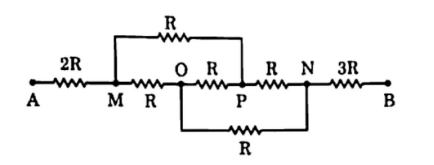
View Solution
Step 1: Identify symmetry
The network between points forms a balanced Wheatstone bridge.
Hence resistor across bridge carries no current and can be removed.
Step 2: Simplify circuit
Effective resistance reduces to series combination:
\[ R_{eq} = 2R + R + R + 3R \]
\[ R_{eq} = 7R \]
Final Answer: \[ \boxed{R_{eq} = 7R} \] Quick Tip: In balanced bridge, middle resistor has no effect.
A parallel plate capacitor of capacitance \( C \) has a dielectric slab between its plates. It is charged to a potential difference \( V \) by connecting it across a battery. The battery is then disconnected. If the dielectric slab is now withdrawn from the capacitor, how will the following be affected?
(a) Capacitance of the capacitor,
(b) Energy stored in the capacitor, and
(c) The potential difference between the plates.
Justify your answer in each case.
View Solution
Concept:
After the battery is disconnected:
Charge on capacitor remains constant
\( Q = constant \)
Initially dielectric present → capacitance is higher.
When dielectric is removed: \[ C = \frac{\varepsilon A}{d} \]
and dielectric constant decreases.
%---------------------------------
(a) Capacitance
With dielectric: \[ C_i = K C_0 \]
After removal: \[ C_f = C_0 \]
So capacitance: \[ Decreases \]
Conclusion: Capacitance decreases.
%---------------------------------
(b) Energy stored
Energy when charge constant: \[ U = \frac{Q^2}{2C} \]
Since \( Q \) constant and \( C \downarrow \):
\[ U \uparrow \]
So energy increases.
Conclusion: Energy stored increases.
%---------------------------------
(c) Potential difference
Using: \[ V = \frac{Q}{C} \]
With constant charge and reduced capacitance: \[ V \uparrow \]
Conclusion: Potential difference increases.
Final Summary:
\begin{tabular{|c|c|
\hline
Quantity & Effect after removing dielectric
\hline
Capacitance & Decreases
Energy stored & Increases
Potential difference & Increases
\hline
\end{tabular Quick Tip: Battery disconnected → Charge constant. If \( C \downarrow \Rightarrow V \uparrow, U \uparrow \).
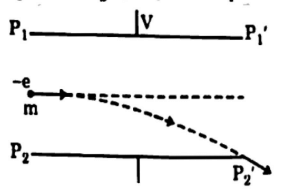
Figure shows a narrow beam of electrons entering with a velocity of \( 3 \times 10^7 \, m/s \), symmetrically through the space between two parallel horizontal plates kept 2 cm apart. If each plate is 3 cm long, calculate the potential difference \( V \) applied between the plates so that the beam just strikes the end \( P_2' \).
View Solution
Concept:
Electron moving between parallel plates experiences uniform electric field: \[ E = \frac{V}{d} \]
It undergoes:
Uniform horizontal motion
Uniform vertical acceleration
Use projectile motion analogy.
Given:
Initial velocity \( u = 3 \times 10^7 \, m/s \)
Plate separation \( d = 2 cm = 0.02 m \)
Plate length \( l = 3 cm = 0.03 m \)
Electron enters midway, so vertical displacement: \[ y = \frac{d}{2} = 0.01 m \]
Step 1: Time of travel between plates
\[ t = \frac{l}{u} = \frac{0.03}{3 \times 10^7} = 10^{-9} s \]
Step 2: Vertical motion
\[ y = \frac{1}{2} a t^2 \]
\[ 0.01 = \frac{1}{2} a (10^{-9})^2 \]
\[ a = \frac{0.02}{10^{-18}} = 2 \times 10^{16} \, m/s^2 \]
Step 3: Use electric force
\[ F = ma = eE \]
\[ E = \frac{ma}{e} \]
Using: \[ m = 9.1 \times 10^{-31} kg, \quad e = 1.6 \times 10^{-19} C \]
\[ E = \frac{9.1 \times 10^{-31} \times 2 \times 10^{16}}{1.6 \times 10^{-19}} \]
\[ E \approx 1.14 \times 10^5 \, V/m \]
Step 4: Potential difference
\[ V = Ed = 1.14 \times 10^5 \times 0.02 \]
\[ V \approx 2.3 \times 10^3 V \]
Final Answer: \[ \boxed{V \approx 2.3 kV} \] Quick Tip: Electron between plates behaves like projectile under electric field.
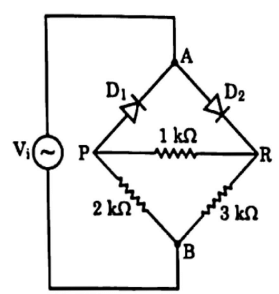
An ac voltage \( V_i = 12 \sin(100\pi t) \, V \) is applied between points A and B in a network of two ideal diodes and three resistors as shown. During the positive half-cycle of the input voltage:
(a) Identify which of the two diodes will conduct and why?
(b) Redraw an equivalent circuit diagram to show the flow of current.
(c) Calculate the output voltage drop \( V_0 \) across the three resistors when the input voltage attains its peak value.
View Solution
Concept:
In the positive half-cycle:
Point A is at higher potential than B
Ideal diode conducts when forward biased
%---------------------------------
(a) Conducting diode
During positive half-cycle:
A is positive w.r.t. B
Diode \( D_2 \) becomes forward biased
Diode \( D_1 \) is reverse biased
Answer: \( D_2 \) conducts because it is forward biased.
%---------------------------------
(b) Equivalent circuit
Since:
\( D_2 \) conducts → acts as short circuit
\( D_1 \) off → open circuit
Equivalent network becomes:
A directly connected to R through \( D_2 \)
Resistive path: \( 1\,k\Omega \) (P–R), \( 2\,k\Omega \) and \( 3\,k\Omega \)
Current flows: \[ A \rightarrow D_2 \rightarrow R \rightarrow resistor network \rightarrow B \]
%---------------------------------
(c) Output voltage at peak input
Peak input voltage: \[ V_{peak} = 12 V \]
Now resistors form a series-parallel network.
Between P and R: \[ 1\,k\Omega \]
Lower branch from P to B: \[ 2\,k\Omega \]
Lower branch from R to B: \[ 3\,k\Omega \]
Since current enters through R (via \( D_2 \)), voltage division occurs between 3 kΩ and parallel branch.
Equivalent resistance of P–B branch: \[ R_{PB} = 2\,k\Omega \]
Total series seen from R: \[ R_{total} = 3\,k\Omega + (1\,k\Omega + 2\,k\Omega) \]
\[ R_{total} = 6\,k\Omega \]
Voltage division across 1 kΩ (output across middle resistor):
\[ V_0 = V_{peak} \times \frac{1}{1+2+3} = 12 \times \frac{1}{6} \]
\[ V_0 = 2 V \]
Final Answers:
(a) \( D_2 \) conducts (forward biased)
(b) Equivalent circuit: \( D_2 \) shorted, \( D_1 \) open
(c) \( V_0 = 2 V \) Quick Tip: Ideal diode: Forward bias → short, Reverse bias → open.
Briefly explain the two important processes that occur during the formation of a p-n junction.
View Solution
Concept:
When p-type and n-type semiconductors are joined, charge carriers move due to concentration differences, leading to junction formation.
Two Important Processes:
1. Diffusion
Due to concentration gradient, majority carriers move across junction.
Electrons diffuse from n-region to p-region.
Holes diffuse from p-region to n-region.
Result:
Recombination of electrons and holes near junction.
Formation of a region depleted of mobile carriers.
This region is called the depletion region.
2. Drift
After diffusion, fixed ions are left behind.
Positive ions on n-side and negative ions on p-side create an electric field.
This electric field opposes further diffusion.
This causes:
Movement of minority carriers due to electric field.
Drift current opposite to diffusion current.
Conclusion:
Diffusion creates depletion region.
Drift establishes equilibrium by opposing diffusion. Quick Tip: p-n junction formation = Diffusion + Drift → Depletion region.
(a) Draw the ray diagram to show the image formation by a refracting telescope and write the expression for angular magnification for the telescope in normal adjustment.
View Solution
Concept:
A refracting telescope consists of:
Objective lens (large focal length \( f_o \))
Eyepiece lens (small focal length \( f_e \))
In normal adjustment:
Final image is formed at infinity
Separation between lenses = \( f_o + f_e \)
Ray Diagram:
\begin{tikzpicture[scale=1]
% Principal axis
\draw[->] (-1,0) -- (9,0);
% Objective
\draw (1,-1.2) -- (1,1.2);
\node at (1,-1.6) {Objective;
% Eyepiece
\draw (6,-1) -- (6,1);
\node at (6,-1.4) {Eyepiece;
% Object ray
\draw[->] (-1,0.8) -- (1,0.8);
\draw[->] (1,0.8) -- (3,0);
\draw[->] (3,0) -- (6,0);
\draw[->] (6,0) -- (8,0.5);
\node at (3,-0.5) {Image by Objective;
\end{tikzpicture
Angular Magnification:
Angular magnification: \[ M = \frac{Angle subtended by final image}{Angle subtended by object} \]
For normal adjustment: \[ \boxed{M = -\frac{f_o}{f_e}} \]
Negative sign indicates inverted image. Quick Tip: Refracting telescope (normal adjustment): \( M = -\dfrac{f_o}{f_e} \)
(b) Give two reasons to explain why a reflecting telescope is preferred over a refracting telescope.
View Solution
1. No Chromatic Aberration:
Reflecting telescope uses mirrors.
Reflection is independent of wavelength.
Hence, no chromatic aberration.
2. Larger Aperture Possible:
Mirrors can be made very large.
Greater light-gathering power.
Better resolving power.
Conclusion:
Reflecting telescopes are more suitable for astronomical observations. Quick Tip: Reflecting telescope → No chromatic aberration + Large aperture possible.
(a) State the two conditions under which total internal reflection occurs.
View Solution
Total internal reflection (TIR) occurs when a light ray is completely reflected back into the denser medium.
Two Conditions:
1. Light must travel from denser to rarer medium
Refractive index of first medium \( > \) second medium
Example: Glass to air
2. Angle of incidence must exceed critical angle
\( i > i_c \)
Critical angle:
\[ \sin i_c = \frac{n_2}{n_1}, \quad (n_1 > n_2) \] Quick Tip: TIR: Denser → Rarer and \( i > i_c \).
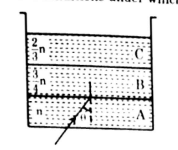
(b) A transparent container contains layers of three immiscible transparent liquids A, B and C of refractive indices \( n, \frac{3n}{4} \) and \( \frac{2n}{3} \), respectively. A laser beam is incident at the interface between A and B at an angle \( \theta \). Prove that the beam does not enter region C at all for \( \sin \theta \ge \frac{2}{3} \).
View Solution
Concept:
Use Snell’s law at successive interfaces.
Refractive indices: \[ n_A = n, \quad n_B = \frac{3n}{4}, \quad n_C = \frac{2n}{3} \]
Since: \[ n_A > n_B > n_C \]
Light goes from denser to rarer layers.
Step 1: Refraction at A–B interface
Using Snell’s law: \[ n_A \sin\theta = n_B \sin r \]
\[ n \sin\theta = \frac{3n}{4} \sin r \]
\[ \sin r = \frac{4}{3} \sin\theta \]
Step 2: Condition at B–C interface
For beam to enter C: \[ \sin r \le \sin i_c \]
Critical angle for B–C: \[ \sin i_c = \frac{n_C}{n_B} = \frac{(2n/3)}{(3n/4)} = \frac{8}{9} \]
Step 3: For no entry into C
Total internal reflection at B–C requires: \[ \sin r \ge \frac{8}{9} \]
Substitute \( \sin r = \frac{4}{3}\sin\theta \):
\[ \frac{4}{3} \sin\theta \ge \frac{8}{9} \]
\[ \sin\theta \ge \frac{2}{3} \]
Conclusion:
If: \[ \sin\theta \ge \frac{2}{3} \]
The beam undergoes total internal reflection at B–C interface and never enters region C. Quick Tip: Use Snell’s law layer by layer and compare with critical angle.
(I) The torque on the coil remains constant irrespective of the coil's orientation during rotation due to
View Solution
In a moving coil galvanometer, the magnetic field is made radial so that: \[ \tau = nBIA \]
remains independent of orientation. Hence torque remains constant. Quick Tip: Moving coil galvanometer uses radial magnetic field so \(\tau = nBIA\) is independent of coil angle. This gives uniform scale (deflection ∝ current).
(II) The best way to increase current sensitivity of a galvanometer is by
View Solution
Current sensitivity: \[ S = \frac{\theta}{I} = \frac{nBA}{k} \]
It increases with:
Larger area
Stronger magnetic field
More turns
Smaller torsional constant
Best option: increase \( A \) and \( B \). Quick Tip: Galvanometer current sensitivity: \(S=\frac{\theta}{I}=\frac{nBA}{k}\). Increase sensitivity by ↑ turns (\(n\)), ↑ area (\(A\)), ↑ magnetic field (\(B\)), ↓ torsional constant (\(k\)).
(III) A moving coil galvanometer has a coil with area \( 4.0 \times 10^{-3} \, m^2 \) and number of turns 50. The coil is rotating in a magnetic field of 0.25 T. The torque acting on the coil when a current of 5 A passes through it is
View Solution
Torque on coil: \[ \tau = nBIA \]
Given: \[ n = 50, \quad B = 0.25 \, T, \quad I = 5 \, A, \quad A = 4 \times 10^{-3} \, m^2 \]
\[ \tau = 50 \times 0.25 \times 5 \times 4 \times 10^{-3} \]
\[ \tau = 1.0 \, N m \] Quick Tip: Galvanometer torque: \( \tau = nBIA \)
(III) A galvanometer coil has a resistance of 15 \( \Omega \) and the meter shows full scale deflection for a current of 3 mA. The value of resistance required to convert it into a voltmeter of range (0–12 V) is
View Solution
For converting galvanometer into voltmeter: \[ R_s = \frac{V}{I_g} - G \]
Given: \[ G = 15 \, \Omega, \quad I_g = 3 \times 10^{-3} A, \quad V = 12 V \]
\[ R_s = \frac{12}{3 \times 10^{-3}} - 15 = 4000 - 15 \]
\[ R_s = 3985 \, \Omega \] Quick Tip: Galvanometer → Voltmeter: Add series resistance \(R_s = \dfrac{V}{I_g} - G\). Large series resistance allows measuring higher voltage range.
(IV) A galvanometer with coil of resistance 20 \( \Omega \) shows full scale deflection for a current of 5 mA. To convert it into an ammeter of range (0–10 A), a resistance of
View Solution
For converting galvanometer into ammeter, use shunt resistance: \[ S = \frac{I_g G}{I - I_g} \]
Given: \[ G = 20 \, \Omega, \quad I_g = 5 \times 10^{-3} A, \quad I = 10 A \]
\[ S = \frac{(5 \times 10^{-3}) \times 20}{10 - 5 \times 10^{-3}} \approx \frac{0.1}{9.995} \approx 0.01 \, \Omega \]
Shunt is always connected in parallel. Quick Tip: Voltmeter → series resistance, Ammeter → parallel shunt resistance.
Question 30:
Passage:A researcher performs an experiment on photo-electric effect using two metals A
and B with unknown work functions. She illuminates the surfaces of A and B with monochro-
matic radiation of various frequencies and records the value of corresponding stopping poten-
tials (V*). The graph shows the variation of stopping potential (V8) with the frequency of
incident radiation (v) for metals A and B.
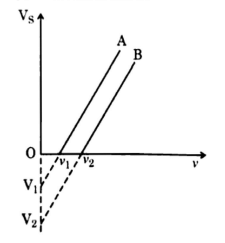
(I) From the graph, the work functions of metals A and B are (h is Planck's constant and e is charge of electron)
View Solution
Threshold frequency \( \nu_0 \) is where stopping potential becomes zero.
Work function: \[ \phi = h\nu_0 \]
Hence metals A and B have work functions \( h\nu_1 \) and \( h\nu_2 \). Quick Tip: Stopping potential = 0 at threshold frequency \(\nu_0\). Work function: \(\phi = h\nu_0\). So read \(\nu_0\) from graph → directly gives work function.
(II) For radiation of frequency \( \nu > \nu_2 \) incident on both metals A and B, the maximum kinetic energy of ejected electrons is
View Solution
Photoelectric equation: \[ K_{\max} = h\nu - \phi \]
For same frequency:
Smaller work function → larger kinetic energy
From graph, metal A has smaller threshold frequency → smaller work function. Quick Tip: Photoelectric effect: \(K_{\max}=h\nu-\phi\). At same frequency, smaller work function (or lower threshold frequency) ⇒ higher kinetic energy.
(III) If the intensity of the incident radiation for both metals A and B is doubled keeping its frequency constant, then
View Solution
Slope of stopping potential vs frequency graph: \[ slope = \frac{h}{e} \]
It depends only on fundamental constants, not intensity.
Intensity affects:
Number of emitted electrons (photo-current)
Hence slope unchanged, emission rate increases. Quick Tip: Frequency → kinetic energy, Intensity → number of electrons.
(IV) The threshold frequency for a metal surface is \( \nu_0 \). If radiation of frequency \( 3\nu_0 \) illuminates the surface, the maximum kinetic energy is \( E_1 \). If frequency is increased to \( 6\nu_0 \), the maximum kinetic energy becomes \( E_2 \). Then \( \dfrac{E_1}{E_2} \) equals
View Solution
Photoelectric equation: \[ K_{\max} = h\nu - h\nu_0 \]
For frequency \( 3\nu_0 \): \[ E_1 = h(3\nu_0 - \nu_0) = 2h\nu_0 \]
For frequency \( 6\nu_0 \): \[ E_2 = h(6\nu_0 - \nu_0) = 5h\nu_0 \]
\[ \frac{E_1}{E_2} = \frac{2h\nu_0}{5h\nu_0} = \frac{2}{5} \] Quick Tip: Photoelectric effect: \(K_{\max}=h(\nu-\nu_0)\). K.E. depends on \((\nu-\nu_0)\), not just \(\nu\). So compare energies using excess frequency over threshold.
(IV) Let \( m \) be the slope of the graph line for metal B. If \( e \) is the charge of electron, then Planck's constant \( h \) is given by
View Solution
From stopping potential vs frequency graph: \[ V_s = \frac{h}{e}\nu - \frac{\phi}{e} \]
Slope: \[ m = \frac{h}{e} \]
\[ h = me \] Quick Tip: Slope of \( V_s \) vs \( \nu \) graph = \( \frac{h}{e} \).
(a) An electric dipole consists of two point charges \( q \) and \( -q \) separated by a distance \( 2a \). Derive an expression for the electric field due to this dipole at a point at distance \( r \) from the centre on the equatorial plane. Write the expression for the electric field at a far off point, i.e. \( r \gg a \).
View Solution
Concept:
Electric dipole moment: \[ \vec{p} = q \cdot 2a \]
Consider a point on the equatorial line at distance \( r \) from centre.
Step 1: Distance from charges
Distance of point from each charge: \[ d = \sqrt{r^2 + a^2} \]
Step 2: Electric field due to each charge
Magnitude of field due to one charge: \[ E = \frac{1}{4\pi\varepsilon_0}\frac{q}{d^2} \]
Components along dipole axis cancel, perpendicular components add.
Step 3: Resultant field
\[ E_{eq} = \frac{1}{4\pi\varepsilon_0} \frac{2qa}{(r^2 + a^2)^{3/2}} \]
Since \( p = 2qa \):
\[ \boxed{E_{eq} = \frac{1}{4\pi\varepsilon_0} \frac{p}{(r^2 + a^2)^{3/2}}} \]
Direction: opposite to dipole moment.
Far field case \( (r \gg a) \):
\[ r^2 + a^2 \approx r^2 \]
\[ \boxed{E_{eq} = \frac{1}{4\pi\varepsilon_0} \frac{p}{r^3}} \] Quick Tip: Equatorial field of dipole: \( E = \frac{1}{4\pi\varepsilon_0} \frac{p}{r^3} \) (for \( r \gg a \)).
(b) A dipole is placed in x-y plane such that charges \( q \) and \( -q \) are located at \( x = a \) and \( x = -a \) respectively. There exists a uniform electric field \( \vec{E} = 2\hat{i} \, N/C \). Calculate the force \( \vec{F} \) and torque \( \vec{\tau} \) experienced by the dipole.
View Solution
Concept:
In a uniform electric field:
Net force on dipole = 0
Torque \( \vec{\tau} = \vec{p} \times \vec{E} \)
Step 1: Dipole moment
Dipole axis along x-axis: \[ \vec{p} = 2aq \hat{i} \]
Step 2: Net force
In uniform field: \[ \boxed{\vec{F} = 0} \]
Step 3: Torque
\[ \vec{\tau} = \vec{p} \times \vec{E} \]
Since both \( \vec{p} \) and \( \vec{E} \) are along \( \hat{i} \):
\[ \vec{\tau} = 0 \]
Final Answers: \[ \boxed{\vec{F} = 0, \quad \vec{\tau} = 0} \] Quick Tip: Uniform electric field → zero net force on dipole. Torque exists only if \( \vec{p} \) not parallel to \( \vec{E} \).
(a) Two cells of emf \( E_1 \) and \( E_2 \) with internal resistances \( r_1 \) and \( r_2 \) respectively are connected in parallel by connecting their positive terminals together and negative terminals together. Deduce an expression for equivalent emf and equivalent internal resistance of the combination.
View Solution
Concept:
Cells in parallel share the same terminal voltage.
Let equivalent emf = \( E \), equivalent internal resistance = \( r \).
Step 1: Equivalent emf
Using current division principle:
\[ E = \frac{\frac{E_1}{r_1} + \frac{E_2}{r_2}}{\frac{1}{r_1} + \frac{1}{r_2}} \]
Multiply numerator and denominator by \( r_1 r_2 \):
\[ \boxed{E = \frac{E_1 r_2 + E_2 r_1}{r_1 + r_2}} \]
Step 2: Equivalent internal resistance
Parallel combination of internal resistances:
\[ \frac{1}{r} = \frac{1}{r_1} + \frac{1}{r_2} \]
\[ \boxed{r = \frac{r_1 r_2}{r_1 + r_2}} \] Quick Tip: Cells in parallel → emf is weighted average, resistance in parallel.
(b) A parallel combination, as stated in (a) above, of two cells of emfs \( E \) and \( 3E \) and internal resistances \( R \) each is connected across a resistance \( 2R \). Find the current that flows through resistance \( 2R \).
View Solution
Step 1: Equivalent emf
Using formula: \[ E_{eq} = \frac{E \cdot R + 3E \cdot R}{R + R} \]
\[ E_{eq} = \frac{4ER}{2R} = 2E \]
Step 2: Equivalent internal resistance
\[ r = \frac{R \cdot R}{R + R} = \frac{R}{2} \]
Step 3: Total resistance in circuit
External resistance = \( 2R \)
Total resistance: \[ R_{total} = 2R + \frac{R}{2} = \frac{5R}{2} \]
Step 4: Current through \( 2R \)
\[ I = \frac{E_{eq}}{R_{total}} = \frac{2E}{5R/2} \]
\[ I = \frac{4E}{5R} \]
Final Answer: \[ \boxed{I = \frac{4E}{5R}} \] Quick Tip: Find equivalent cell first, then apply Ohm’s law.
(a) Using the relation for refraction at a curved spherical surface, derive the expression for lens maker’s formula.
View Solution
Concept:
For refraction at spherical surface: \[ \frac{n_2}{v} - \frac{n_1}{u} = \frac{n_2 - n_1}{R} \]
Apply this for both surfaces of a thin lens.
Step 1: Refraction at first surface
For air to lens: \[ \frac{\mu}{v_1} - \frac{1}{u} = \frac{\mu - 1}{R_1} \]
Step 2: Refraction at second surface
For lens to air: \[ \frac{1}{v} - \frac{\mu}{v_1} = \frac{1 - \mu}{R_2} \]
Step 3: Add both equations
Eliminate \( v_1 \):
\[ \frac{1}{v} - \frac{1}{u} = (\mu - 1)\left(\frac{1}{R_1} - \frac{1}{R_2}\right) \]
For focal length, \( u = \infty \), so:
\[ \boxed{\frac{1}{f} = (\mu - 1)\left(\frac{1}{R_1} - \frac{1}{R_2}\right)} \]
This is the lens maker’s formula. Quick Tip: Lens maker formula: \( \frac{1}{f} = (\mu - 1)(\frac{1}{R_1} - \frac{1}{R_2}) \)
(b) Three lenses \( L_1, L_2, L_3 \) each of focal length 40 cm are placed coaxially. Distances between \( L_1, L_2 \) and \( L_2, L_3 \) are 120 cm and 20 cm respectively. An object is placed 80 cm to the left of \( L_1 \). Find the position of final image.
View Solution
Use lens formula: \[ \frac{1}{f} = \frac{1}{v} + \frac{1}{u} \]
For each lens sequentially.
Step 1: Image by \( L_1 \)
\[ f = 40 cm, \quad u = -80 cm \]
\[ \frac{1}{40} = \frac{1}{v_1} - \frac{1}{80} \]
\[ \frac{1}{v_1} = \frac{3}{80} \Rightarrow v_1 = \frac{80}{3} \approx 26.7 cm \]
Step 2: Object for \( L_2 \)
Distance between \( L_1 \) and \( L_2 = 120 \) cm
So object distance: \[ u_2 = 120 - 26.7 = 93.3 cm \]
Image is on left, so \( u_2 = -93.3 \) cm.
\[ \frac{1}{40} = \frac{1}{v_2} - \frac{1}{93.3} \]
\[ v_2 \approx 28.2 cm \]
Step 3: Object for \( L_3 \)
Distance between \( L_2 \) and \( L_3 = 20 \) cm
\[ u_3 = 20 - 28.2 = -8.2 cm \]
\[ \frac{1}{40} = \frac{1}{v_3} + \frac{1}{8.2} \]
\[ v_3 \approx 10.3 cm (to right of L_3) \]
Final Answer:
Final image forms about \( \boxed{10 cm to the right of L_3} \). Quick Tip: Multiple lenses in series: Solve sequentially using \(\frac{1}{f}=\frac{1}{v}+\frac{1}{u}\). Image of one lens becomes object for next (use sign convention carefully). Track distances between lenses step-by-step.
(a) Draw a ray diagram to show image formation by a concave mirror when object is between focus and centre of curvature. State mirror formula.
View Solution
In this case:
Image is real, inverted, magnified
Formed beyond centre of curvature
Mirror formula: \[ \boxed{\frac{1}{f} = \frac{1}{v} + \frac{1}{u}} \] Quick Tip: Concave mirror: Real, inverted, magnified image beyond \(C\) ⇒ object between \(F\) and \(C\). Use mirror formula: \(\dfrac{1}{f} = \dfrac{1}{v} + \dfrac{1}{u}\).
(b) A concave mirror produces a two times magnified virtual image of an object placed 10 cm in front of it. Calculate the focal length.
View Solution
Magnification: \[ m = -\frac{v}{u} \]
Given virtual image → \( m = +2 \), \( u = -10 \) cm
\[ 2 = -\frac{v}{-10} \Rightarrow v = 20 cm \]
Mirror formula: \[ \frac{1}{f} = \frac{1}{v} + \frac{1}{u} = \frac{1}{20} - \frac{1}{10} \]
\[ \frac{1}{f} = -\frac{1}{20} \Rightarrow f = -20 cm \]
Final Answer: \[ \boxed{f = -20 cm} \] Quick Tip: Virtual magnified image by concave mirror → object inside focus.
(a) State Faraday’s law of electromagnetic induction.
View Solution
Faraday’s First Law:
Whenever the magnetic flux linked with a circuit changes, an emf is induced in the circuit.
Faraday’s Second Law:
The magnitude of induced emf is equal to the rate of change of magnetic flux.
\[ \boxed{e = -\frac{d\Phi}{dt}} \]
For a coil of \( N \) turns: \[ e = -N \frac{d\Phi}{dt} \]
Negative sign indicates Lenz’s law (direction opposes cause). Quick Tip: Induced emf ∝ rate of change of magnetic flux.
(b) Derive an expression for the self-inductance of an air-filled long solenoid of length \( l \), cross-sectional area \( A \), having \( N \) turns.
View Solution
Concept:
Self-inductance \( L \) is defined as: \[ L = \frac{N\Phi}{I} \]
Step 1: Magnetic field inside solenoid
For long solenoid: \[ B = \mu_0 n I \]
Where turns per unit length: \[ n = \frac{N}{l} \]
So: \[ B = \mu_0 \frac{N}{l} I \]
Step 2: Magnetic flux through one turn
\[ \Phi = BA = \mu_0 \frac{N}{l} I \cdot A \]
Step 3: Total flux linkage
\[ N\Phi = N \left(\mu_0 \frac{N}{l} I A\right) = \mu_0 \frac{N^2 A}{l} I \]
Step 4: Self-inductance
\[ L = \frac{N\Phi}{I} = \frac{\mu_0 N^2 A}{l} \]
Final Expression: \[ \boxed{L = \frac{\mu_0 N^2 A}{l}} \] Quick Tip: Self-inductance of long solenoid: \( L = \mu_0 \dfrac{N^2 A}{l} \)
(c) A conducting rod of length 50 cm, with one end pivoted, is rotated with angular speed of 60 rpm in a uniform magnetic field of 4.0 mT directed perpendicular to the plane of rotation. Find the emf induced in the rod.
View Solution
Concept:
Emf induced in rotating rod about one end: \[ e = \frac{1}{2} B \omega l^2 \]
Given:
Length \( l = 50 cm = 0.5 m \)
Magnetic field \( B = 4.0 mT = 4 \times 10^{-3} T \)
Angular speed \( 60 rpm = 1 rps \)
\[ \omega = 2\pi rad/s \]
Step 1: Substitute values
\[ e = \frac{1}{2} \times 4 \times 10^{-3} \times 2\pi \times (0.5)^2 \]
\[ e = 2 \times 10^{-3} \times 2\pi \times 0.25 \]
\[ e = \pi \times 10^{-3} \approx 3.14 \times 10^{-3} V \]
Final Answer: \[ \boxed{e \approx 3.1 mV} \] Quick Tip: Rotating rod about one end in uniform \(B\): Induced emf \(e = \tfrac{1}{2} B \omega l^2\). Use \(\omega = 2\pi f\) (convert rpm → rps first).
(a) Draw a labelled diagram of a step-up transformer. State the principle on which it works and obtain the ratio of secondary voltage to primary voltage in terms of number of turns and currents.
View Solution
Principle:
Transformer works on mutual induction based on Faraday’s law.
Voltage ratio:
Let: \[ N_p, N_s = turns in primary and secondary \]
\[ \frac{V_s}{V_p} = \frac{N_s}{N_p} \]
Current relation (ideal transformer):
Power conserved: \[ V_p I_p = V_s I_s \]
\[ \frac{I_s}{I_p} = \frac{N_p}{N_s} \]
Step-up transformer: \[ N_s > N_p \Rightarrow V_s > V_p \] Quick Tip: Transformer (ideal): \(\dfrac{V_s}{V_p}=\dfrac{N_s}{N_p}\) and power conserved (\(V_p I_p = V_s I_s\)). So, voltage ∝ turns, current inversely proportional. Step-up: \(N_s > N_p \Rightarrow V_s > V_p\).
(b) The ratio of number of turns in primary to secondary of an ideal transformer is 1:5. If 5 kW power at 200 V is supplied to the primary, find (i) current in primary, and (ii) output voltage.
View Solution
Given: \[ \frac{N_p}{N_s} = \frac{1}{5}, \quad P = 5 kW = 5000 W, \quad V_p = 200 V \]
(i) Primary current
\[ P = V_p I_p \Rightarrow I_p = \frac{P}{V_p} = \frac{5000}{200} = 25 A \]
(ii) Output voltage
\[ \frac{V_s}{V_p} = \frac{N_s}{N_p} = 5 \]
\[ V_s = 5 \times 200 = 1000 V \]
Final Answers: \[ I_p = 25 A, \quad V_s = 1000 V \] Quick Tip: Transformer: Voltage ∝ turns, current inversely proportional.



Comments