




CBSE Class 12 Accountancy Question Paper 2026 Set-1 (Code: 67/5/1) is now available for download. CBSE conducted the Class 12 Accountancy examination on Feb 24, 2026, from 10:30 AM to 1:30 PM. The question paper consists of 34 questions carrying a total of 80 marks. Part A is compulsory for all candidates. Part B has two options. Candidates have to attempt only one of the given options. Option I : Analysis of Financial Statements and Option II : Computerised Accounting. The Accountancy question paper 2026 was rated moderately difficult by the students.
CBSE Class 12 Accountancy Question Paper 2026 (Set 1- 67/5/1) with Answer Key
Candidates can use the link below to download the CBSE Class 12 Accountancy 2026 Set 1 Question Paper with detailed solutions.
| CBSE Class 12 2026 Accountancy Question Paper Set 1 with Answer Key | Download PDF | Check Solution |
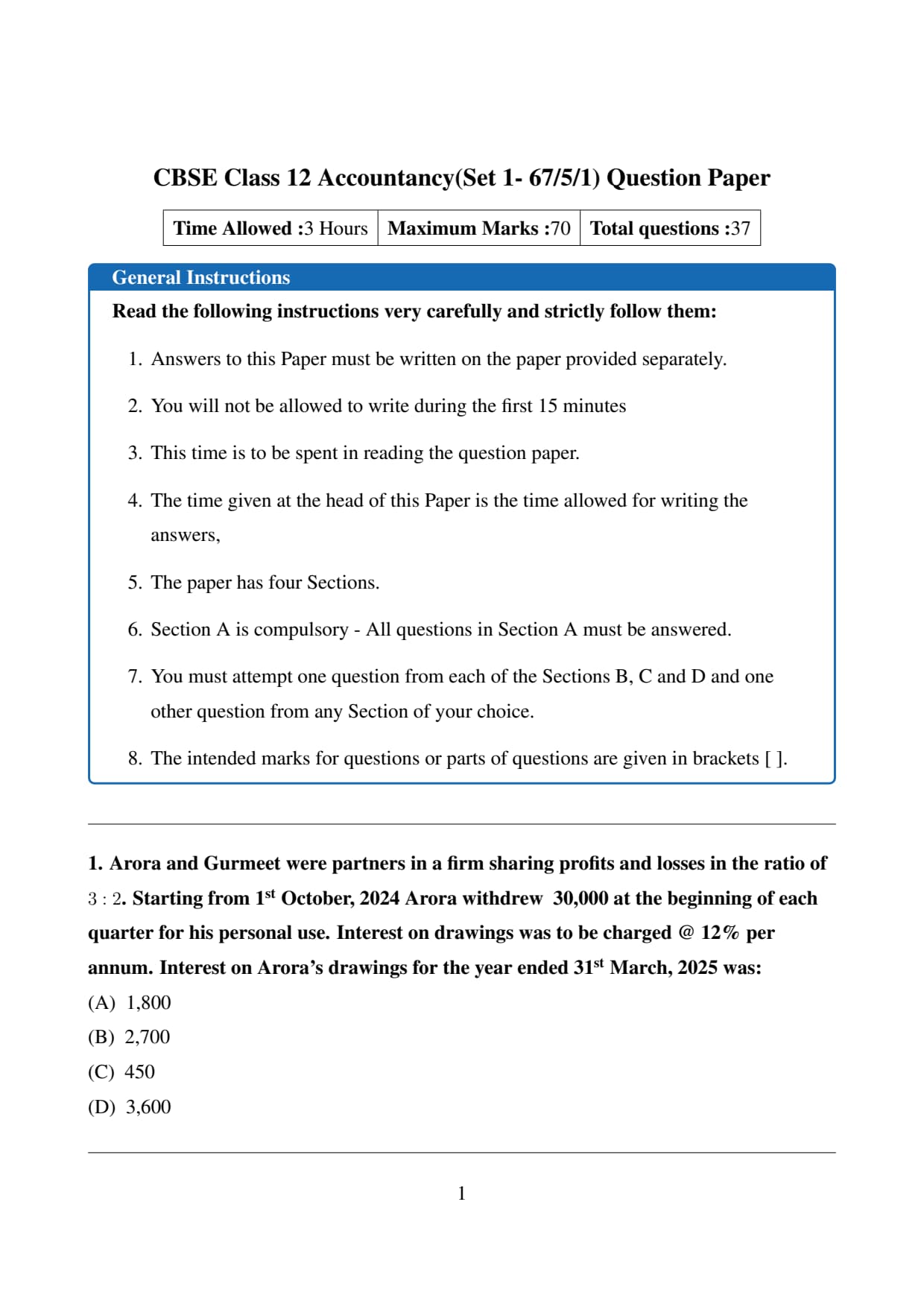
Arora and Gurmeet were partners in a firm sharing profits and losses in the ratio of \(3:2\). Starting from 1\(^{st}\) October, 2024 Arora withdrew ₹ 30,000 at the beginning of each quarter for his personal use. Interest on drawings was to be charged @ 12% per annum. Interest on Arora’s drawings for the year ended 31\(^{st}\) March, 2025 was:
View Solution
Concept:
Interest on drawings when withdrawn at the beginning of each quarter: \[ Interest = Total Drawings \times Rate \times \frac{Average period}{12} \]
Step 1: Number of drawings
From 1 Oct 2024 to 31 March 2025 → two quarters
Dates:
1 Oct 2024
1 Jan 2025
Each drawing = ₹ 30,000
Total drawings = ₹ 60,000
Step 2: Interest period
For beginning of quarter withdrawals:
1 Oct → 6 months
1 Jan → 3 months
Average period: \[ \frac{6 + 3}{2} = 4.5 months \]
Step 3: Calculate interest \[ Interest = 60,000 \times 12% \times \frac{4.5}{12} \]
\[ = 60,000 \times 0.12 \times 0.375 = 2,700 \]
Final Answer: \[ \boxed{₹ 2,700} \] Quick Tip: Beginning of each quarter → longer interest period. Use average time method: \[ Average months = \frac{Sum of months}{Number of drawings} \]
There are two statements Assertion (A) and Reason (R):
Assertion (A): At the time of admission of a new partner in a partnership firm, the newly admitted partner brings an agreed amount of capital either in cash or in kind.
Reason (R): On admission, the new partner gets the right to acquire share in the assets and profits of the partnership firm.
Choose the correct option from the following:
View Solution
Analysis of Assertion (A):
When a new partner is admitted:
• He/she contributes capital to the firm.
• Capital may be brought in cash or assets (in kind).
Thus, Assertion (A) is Correct.
Analysis of Reason (R):
A new partner receives:
• Share in profits
• Share in assets of the firm
Thus, Reason (R) is also Correct.
Link between A and R:
A new partner contributes capital because:
• He/she acquires ownership rights in assets and profits.
• Capital contribution justifies the ownership share.
Hence, Reason correctly explains Assertion.
\[ \boxed{(A)} \] Quick Tip: Admission Logic: Capital Contribution = Ownership Rights New partner brings capital because he gains share in assets and profits.
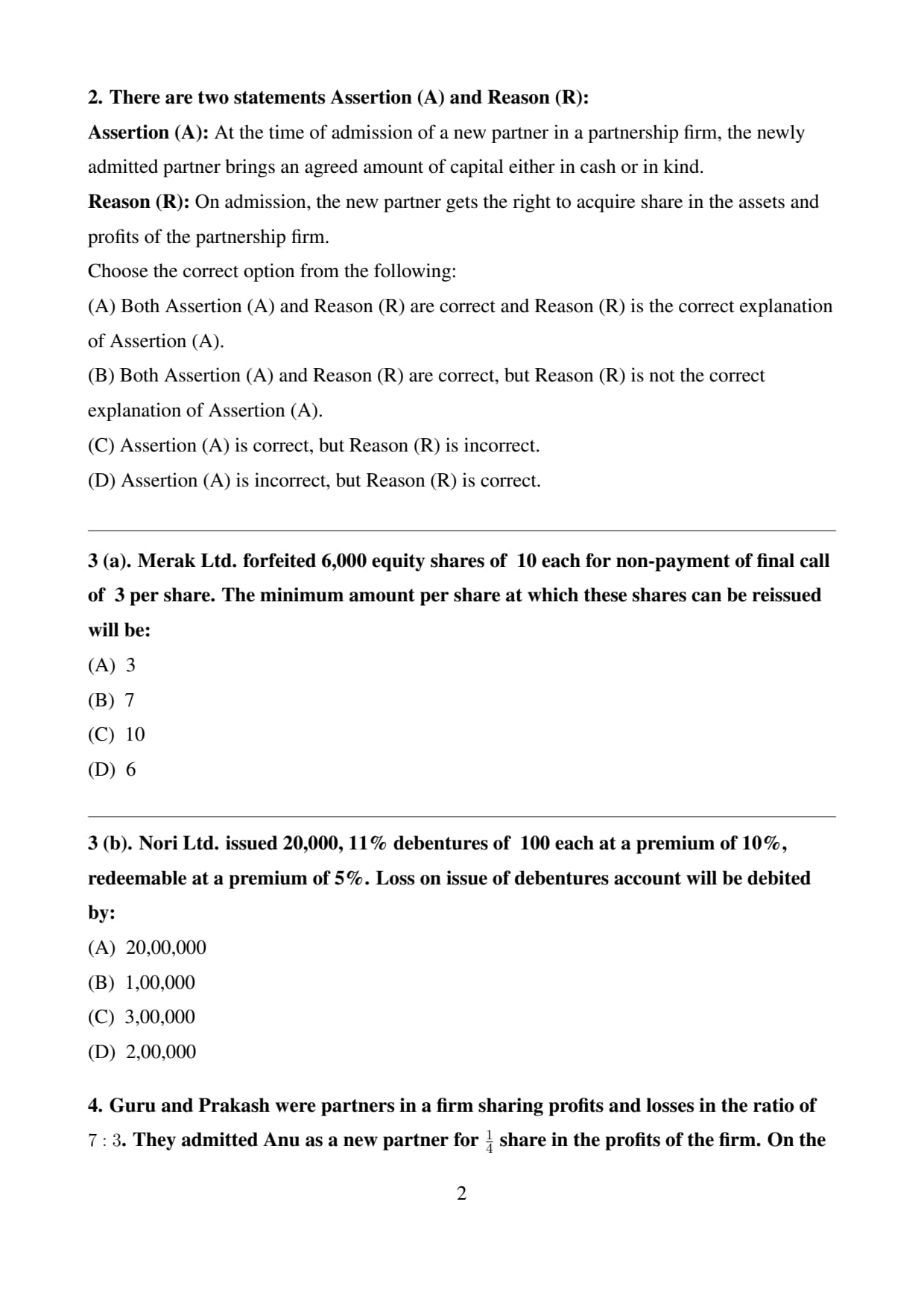
Merak Ltd. forfeited 6,000 equity shares of ₹ 10 each for non-payment of final call of ₹ 3 per share. The minimum amount per share at which these shares can be reissued will be:
View Solution
Concept:
Minimum reissue price = Face value − Amount forfeited per share.
Step 1: Face value
Face value = ₹ 10
Step 2: Amount unpaid
Final call unpaid = ₹ 3
So amount already received = ₹ 7
Step 3: Rule
Maximum discount on reissue = Amount forfeited = ₹ 7
Thus minimum reissue price: \[ 10 - 3 = 7 \]
Final Answer: \[ \boxed{₹ 7} \] Quick Tip: Minimum reissue price = Face value − Forfeited amount. Discount on reissue cannot exceed forfeited amount.
Nori Ltd. issued 20,000, 11% debentures of ₹ 100 each at a premium of 10%, redeemable at a premium of 5%. Loss on issue of debentures account will be debited by:
View Solution
Concept:
Loss on issue of debentures = \[ Discount on issue + Premium on redemption - Premium on issue \]
Step 1: Face value of debentures \[ 20,000 \times 100 = 20,00,000 \]
Step 2: Premium on issue (gain) \[ 10% of 20,00,000 = 2,00,000 \]
Step 3: Premium on redemption (loss) \[ 5% of 20,00,000 = 1,00,000 \]
Step 4: Net loss
Since issued at premium, there is no discount.
Loss = Premium on redemption − Premium on issue impact.
Only premium on redemption is treated as loss: \[ \boxed{₹ 1,00,000} \] Quick Tip: Debenture issue rules: Premium on issue = gain Premium on redemption = loss Only losses go to Loss on Issue A/c
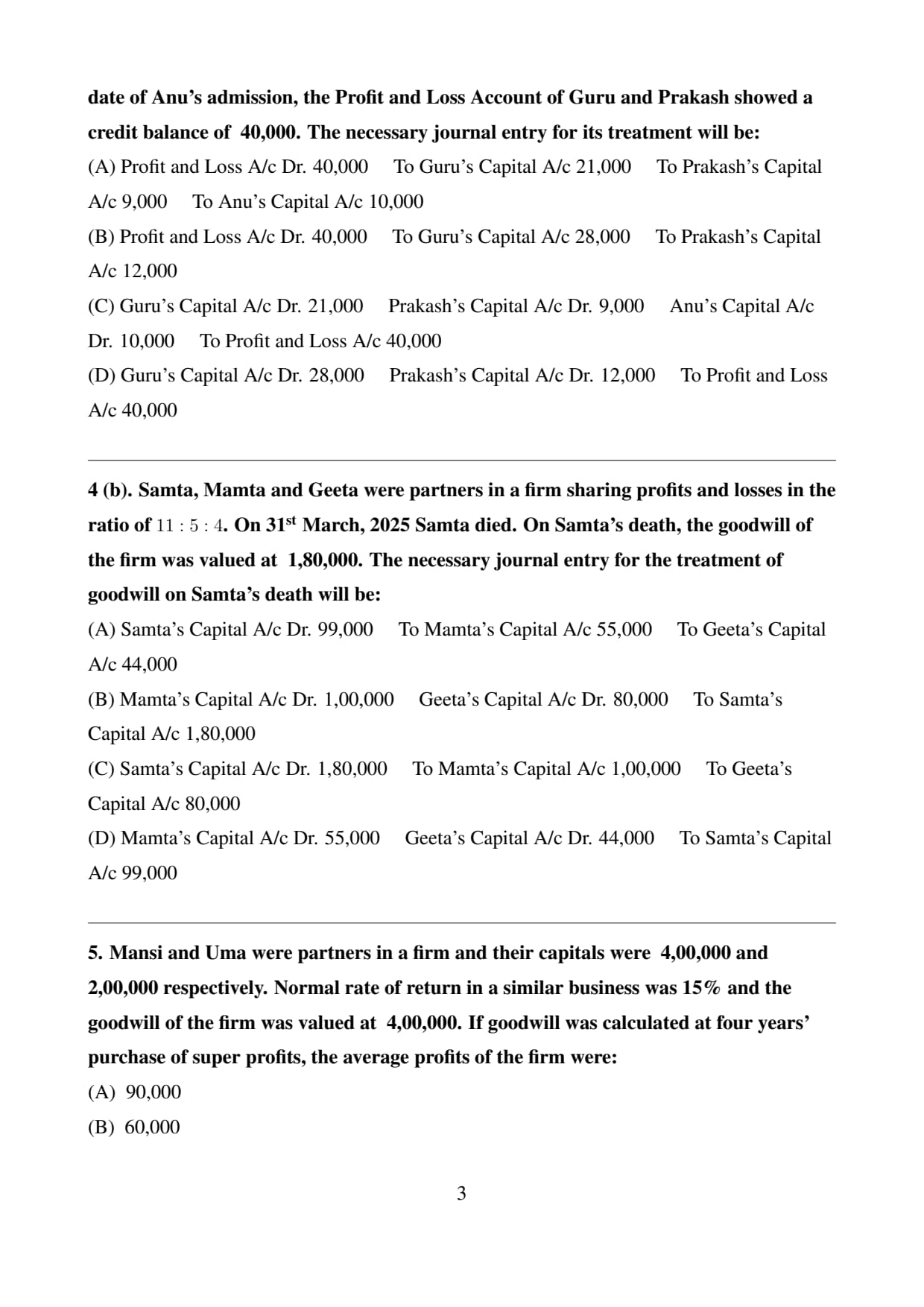
Guru and Prakash were partners in a firm sharing profits and losses in the ratio of \(7:3\). They admitted Anu as a new partner for \(\frac{1}{4}\) share in the profits of the firm. On the date of Anu's admission, the Profit and Loss Account of Guru and Prakash showed a credit balance of ₹ 40,000. The necessary journal entry for its treatment will be:
View Solution
Concept:
Accumulated profits (credit balance of P\&L A/c) are distributed among old partners in their old profit-sharing ratio at the time of admission.
Step 1: Identify partners entitled
Credit balance = ₹ 40,000
Belongs to old partners only (Guru and Prakash).
Step 2: Old ratio
Guru : Prakash = \(7:3\)
Step 3: Distribute profit
Total parts = 10
Guru: \[ 40,000 \times \frac{7}{10} = 28,000 \]
Prakash: \[ 40,000 \times \frac{3}{10} = 12,000 \]
Step 4: Journal entry
Since profit is being distributed: \[ Profit and Loss A/c Dr. \] \[ To Partners’ Capital A/c \]
Thus: \[ Profit and Loss A/c Dr. 40,000 \] \[ To Guru’s Capital A/c 28,000 \] \[ To Prakash’s Capital A/c 12,000 \]
Final Answer: \[ \boxed{Option (B)} \] Quick Tip: Admission rule: Old reserves/profits → distributed among old partners only. Use old profit-sharing ratio.
Samta, Mamta and Geeta were partners in a firm sharing profits and losses in the ratio of \(11:5:4\). On 31\(^{st}\) March, 2025 Samta died. On Samta’s death, the goodwill of the firm was valued at ₹ 1,80,000. The necessary journal entry for the treatment of goodwill on Samta’s death will be:
View Solution
Concept:
On death of a partner, goodwill is credited to the deceased partner’s capital account and debited to gaining partners in their gaining ratio.
Step 1: Old ratio
Samta : Mamta : Geeta = \(11:5:4\)
Step 2: New ratio (after Samta’s death)
Remaining partners share profits in old ratio:
Mamta : Geeta = \(5:4\)
Step 3: Gaining ratio
Old shares: \[ Mamta = \frac{5}{20}, Geeta = \frac{4}{20} \]
New shares: \[ Mamta = \frac{5}{9}, Geeta = \frac{4}{9} \]
Gain: \[ Mamta gain = \frac{5}{9} - \frac{5}{20} = \frac{55}{180} \] \[ Geeta gain = \frac{4}{9} - \frac{4}{20} = \frac{44}{180} \]
Gaining ratio: \[ 55 : 44 = 5 : 4 \]
Step 4: Distribute goodwill
Goodwill = ₹ 1,80,000
Mamta: \[ 1,80,000 \times \frac{5}{9} = 1,00,000 \]
Geeta: \[ 1,80,000 \times \frac{4}{9} = 80,000 \]
Step 5: Journal entry
Gaining partners debited, deceased partner credited: \[ Mamta’s Capital A/c Dr. 1,00,000 \] \[ Geeta’s Capital A/c Dr. 80,000 \] \[ To Samta’s Capital A/c 1,80,000 \]
Final Answer: \[ \boxed{Option (B)} \] Quick Tip: Death of partner: Goodwill credited to deceased partner. Debited to gaining partners in gaining ratio.
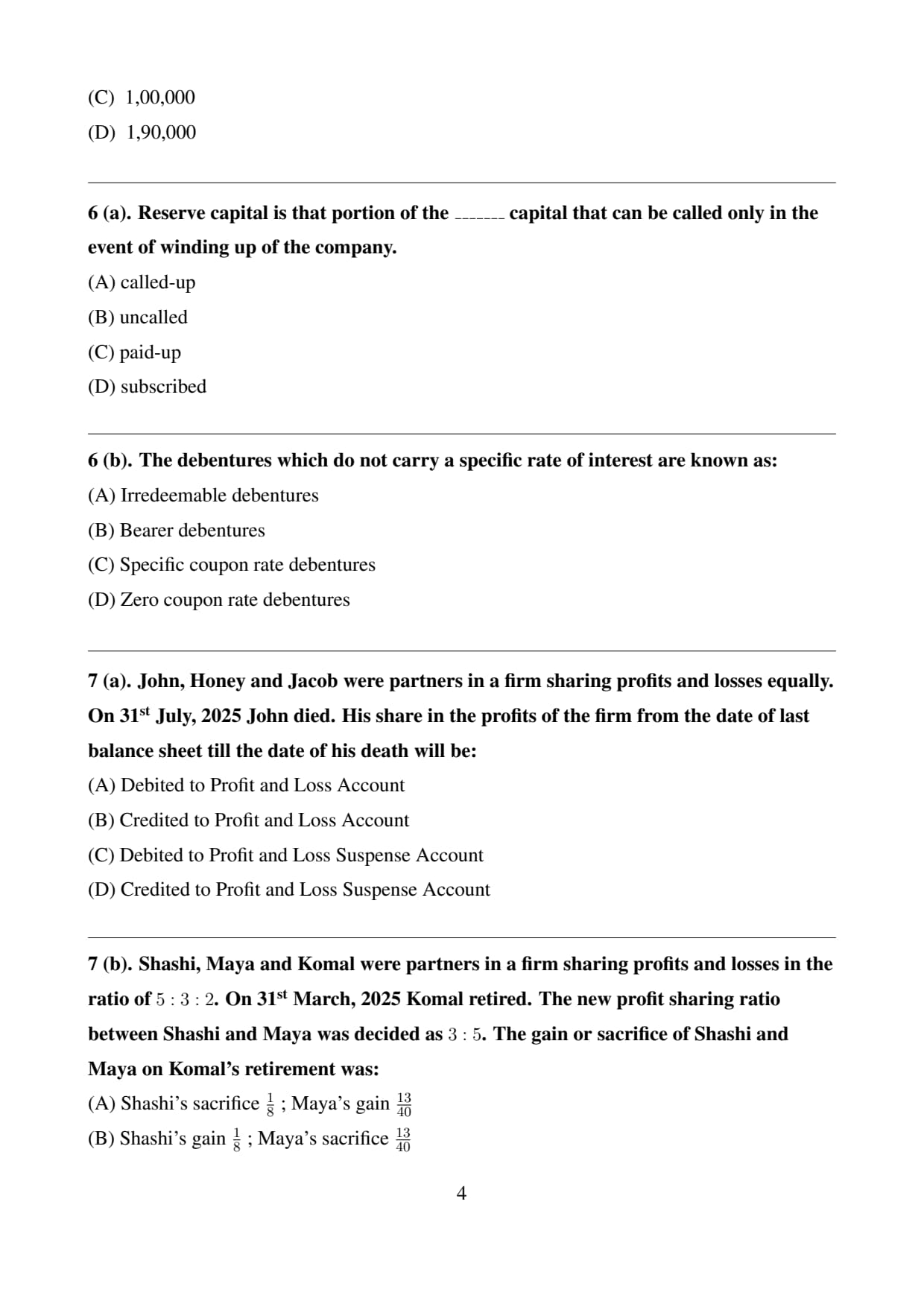
Mansi and Uma were partners in a firm and their capitals were ₹ 4,00,000 and ₹ 2,00,000 respectively. Normal rate of return in a similar business was 15% and the goodwill of the firm was valued at ₹ 4,00,000. If goodwill was calculated at four years’ purchase of super profits, the average profits of the firm were:
View Solution
Concept:
Goodwill based on super profits: \[ Goodwill = Super Profit \times Number of years’ purchase \]
Step 1: Find super profit
Given: \[ Goodwill = 4,00,000 \]
Years’ purchase = 4
\[ Super Profit = \frac{4,00,000}{4} = 1,00,000 \]
Step 2: Find normal profit
Total capital = 4,00,000 + 2,00,000 = 6,00,000
Normal rate = 15%
\[ Normal Profit = 6,00,000 \times \frac{15}{100} = 90,000 \]
Step 3: Find average profit \[ Average Profit = Normal Profit + Super Profit \] \[ = 90,000 + 1,00,000 = 1,90,000 \]
Final Answer: \[ \boxed{₹ 1,90,000} \] Quick Tip: Super profit method: Super Profit = Goodwill ÷ Years’ purchase Average Profit = Normal Profit + Super Profit
Reserve capital is that portion of the _______ capital that can be called only in the event of winding up of the company.
View Solution
Concept:
Reserve capital refers to that part of uncalled capital which is not available for general use and can be called only during winding up of the company.
Explanation:
Uncalled capital = Amount not yet called from shareholders.
A portion of this is kept as reserve capital.
It is used only at the time of liquidation.
Final Answer: \[ \boxed{Uncalled capital} \] Quick Tip: Reserve capital = Part of uncalled capital Used only during winding up.
The debentures which do not carry a specific rate of interest are known as:
View Solution
Concept:
Zero coupon debentures do not carry a fixed rate of interest.
Explanation:
Issued at deep discount.
No periodic interest payment.
Redeemed at face value.
Thus, they do not have a specific coupon (interest) rate.
Final Answer: \[ \boxed{Zero coupon rate debentures} \] Quick Tip: Zero coupon debentures: No interest payment. Issued at discount. Redeemed at face value.
John, Honey and Jacob were partners in a firm sharing profits and losses equally. On 31\(^{st}\) July, 2025 John died. His share in the profits of the firm from the date of last balance sheet till the date of his death will be:
View Solution
Concept:
At the time of death of a partner, his share of profit till the date of death is estimated and treated as:
Expense for the firm
Credited to deceased partner’s capital account
Debited to Profit and Loss Suspense Account
Thus, the correct treatment is: \[ Profit and Loss Suspense A/c Dr. \]
Final Answer: \[ \boxed{Debited to Profit and Loss Suspense Account} \] Quick Tip: Death of partner: Estimated profit share → P\&L Suspense A/c. Later adjusted when actual profit is known.
Shashi, Maya and Komal were partners in a firm sharing profits and losses in the ratio of \(5:3:2\). On 31\(^{st}\) March, 2025 Komal retired. The new profit sharing ratio between Shashi and Maya was decided as \(3:5\). The gain or sacrifice of Shashi and Maya on Komal’s retirement was:
View Solution
Step 1: Old ratio
Shashi : Maya : Komal = \(5:3:2\)
Total = 10
Old shares: \[ Shashi = \frac{5}{10} = \frac{1}{2}, Maya = \frac{3}{10} \]
Step 2: New ratio
Shashi : Maya = \(3:5\)
Total = 8
New shares: \[ Shashi = \frac{3}{8}, Maya = \frac{5}{8} \]
Step 3: Gain or sacrifice
Shashi: \[ \frac{3}{8} - \frac{1}{2} = \frac{3}{8} - \frac{4}{8} = -\frac{1}{8} \]
Negative → sacrifice \(\frac{1}{8}\)
Maya: \[ \frac{5}{8} - \frac{3}{10} = \frac{25}{40} - \frac{12}{40} = \frac{13}{40} \]
Positive → gain \(\frac{13}{40}\)
Final Answer: \[ \boxed{Shashi sacrifice \frac{1}{8}, Maya gain \frac{13}{40}} \] Quick Tip: Gain/Sacrifice formula: \[ New share - Old share \] Positive → Gain, Negative → Sacrifice.
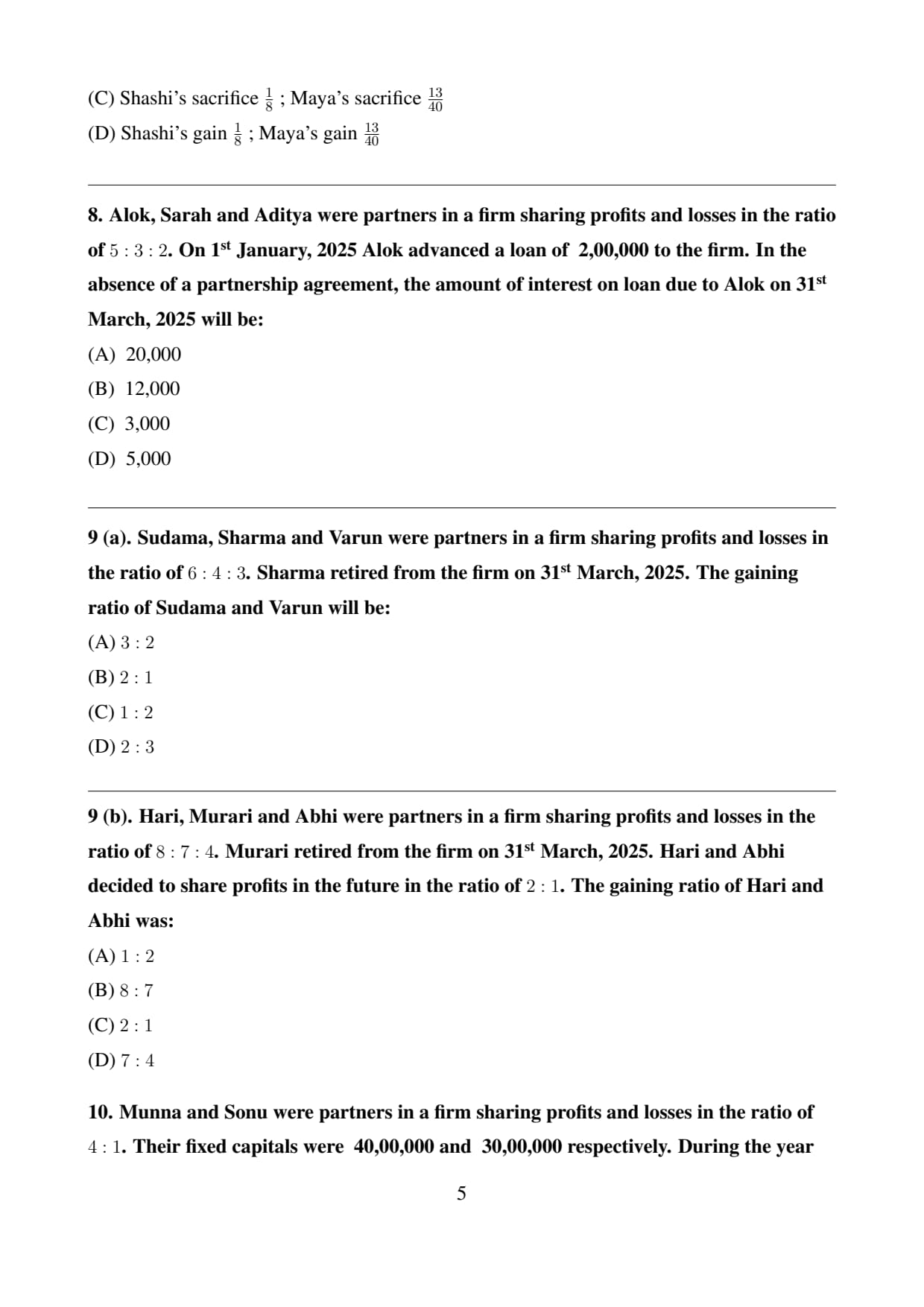
Alok, Sarah and Aditya were partners in a firm sharing profits and losses in the ratio of \(5:3:2\). On 1\(^{st}\) January, 2025 Alok advanced a loan of ₹ 2,00,000 to the firm. In the absence of a partnership agreement, the amount of interest on loan due to Alok on 31\(^{st}\) March, 2025 will be:
View Solution
Concept:
As per Partnership Act, if no agreement exists: \[ Interest on partner’s loan = 6% p.a. \]
Step 1: Loan amount \[ ₹ 2,00,000 \]
Step 2: Time period
From 1 Jan 2025 to 31 March 2025 = 3 months
Step 3: Calculate interest \[ Interest = 2,00,000 \times \frac{6}{100} \times \frac{3}{12} \]
\[ = 2,00,000 \times 0.06 \times 0.25 = 3,000 \]
Final Answer: \[ \boxed{₹ 3,000} \] Quick Tip: No partnership deed → apply Partnership Act rules: Interest on loan = 6% p.a. Time-based calculation required.
Sudama, Sharma and Varun were partners in a firm sharing profits and losses in the ratio of \(6:4:3\). Sharma retired from the firm on 31\(^{st}\) March, 2025. The gaining ratio of Sudama and Varun will be:
View Solution
Concept:
If no new ratio is given, the remaining partners gain in the ratio of their old shares.
Step 1: Old ratio
Sudama : Sharma : Varun = \(6:4:3\)
Step 2: Remaining partners
Sudama and Varun continue.
Their old shares: \[ Sudama = 6, Varun = 3 \]
Step 3: Gaining ratio \[ 6:3 = 2:1 \]
But Sharma’s share = 4 parts
Distributed in proportion to their old ratio (6:3 = 2:1).
So Sudama gets \(\frac{2}{3}\) and Varun gets \(\frac{1}{3}\).
Gaining ratio: \[ \boxed{3:2} \] Quick Tip: If new ratio not given: Retiring partner’s share distributed in old ratio. That becomes gaining ratio.
Hari, Murari and Abhi were partners in a firm sharing profits and losses in the ratio of \(8:7:4\). Murari retired from the firm on 31\(^{st}\) March, 2025. Hari and Abhi decided to share profits in the future in the ratio of \(2:1\). The gaining ratio of Hari and Abhi was:
View Solution
Step 1: Old ratio
Hari : Murari : Abhi = \(8:7:4\)
Total = 19
Old shares: \[ Hari = \frac{8}{19}, Abhi = \frac{4}{19} \]
Step 2: New ratio
Hari : Abhi = \(2:1\)
New shares: \[ Hari = \frac{2}{3}, Abhi = \frac{1}{3} \]
Step 3: Gain
Hari: \[ \frac{2}{3} - \frac{8}{19} = \frac{38 - 24}{57} = \frac{14}{57} \]
Abhi: \[ \frac{1}{3} - \frac{4}{19} = \frac{19 - 12}{57} = \frac{7}{57} \]
Step 4: Gaining ratio \[ 14:7 = 2:1 \]
Final Answer: \[ \boxed{2:1} \] Quick Tip: Gaining ratio: \[ New share - Old share \] Simplify the result to find ratio.
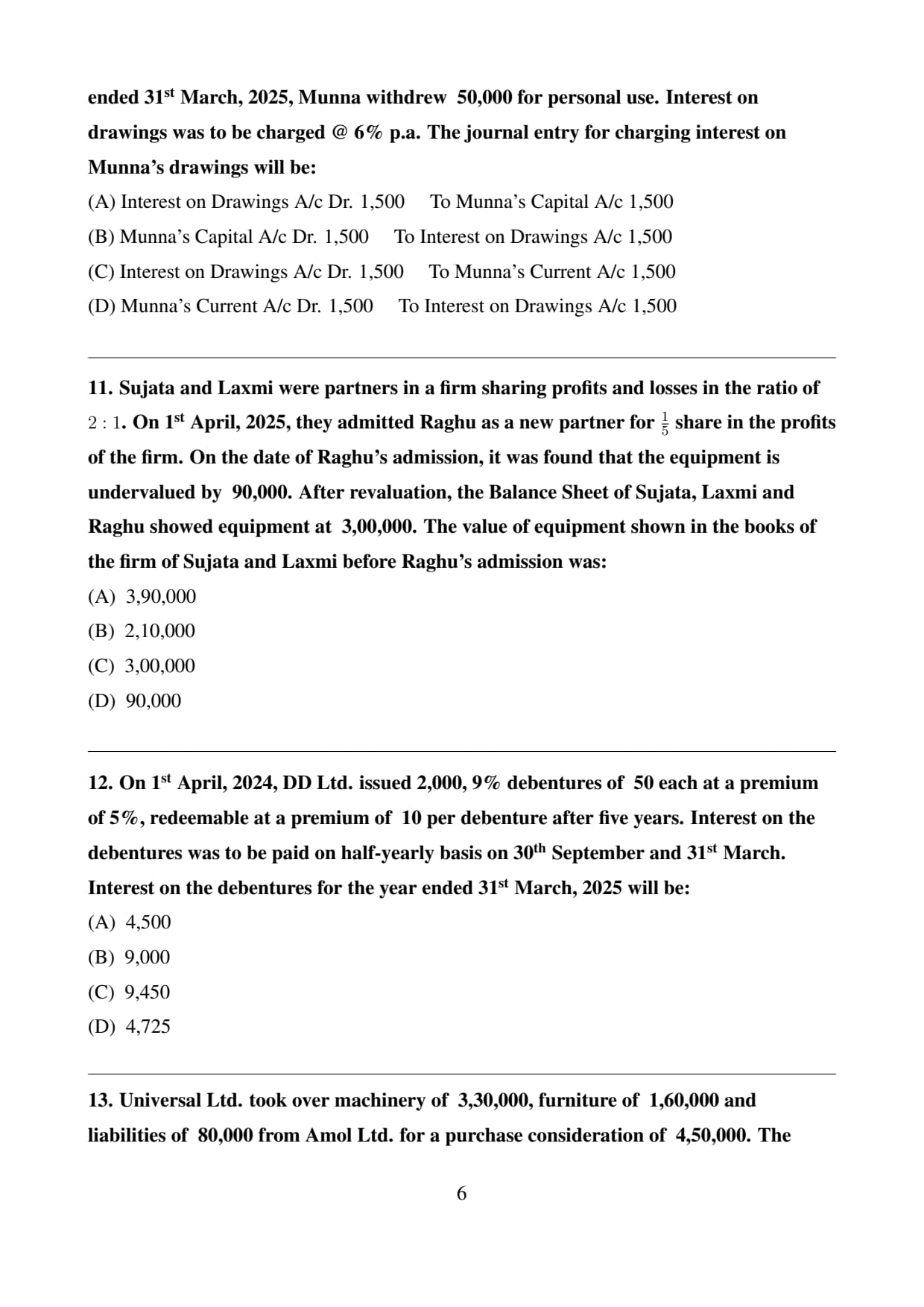
Munna and Sonu were partners in a firm sharing profits and losses in the ratio of \(4:1\). Their fixed capitals were ₹ 40,00,000 and ₹ 30,00,000 respectively. During the year ended 31\(^{st}\) March, 2025, Munna withdrew ₹ 50,000 for personal use. Interest on drawings was to be charged @ 6% p.a. The journal entry for charging interest on Munna’s drawings will be:
View Solution
Step 1: Calculate interest on drawings
Drawings = ₹ 50,000
Rate = 6%
\[ Interest = 50,000 \times \frac{6}{100} = 3,000 \]
Assuming drawings evenly withdrawn during year → average period = 6 months
\[ 3,000 \times \frac{6}{12} = 1,500 \]
Step 2: Nature of entry
Interest on drawings is:
Income for firm
Charged to partner
Since capitals are fixed, adjustments go through Current Account.
Journal Entry: \[ Munna’s Current A/c Dr. 1,500 \] \[ To Interest on Drawings A/c 1,500 \]
Final Answer: \[ \boxed{Option (D)} \] Quick Tip: Interest on drawings: Partner’s Current A/c Dr. To Interest on Drawings A/c Use Current A/c when capitals are fixed.
Sujata and Laxmi were partners in a firm sharing profits and losses in the ratio of \(2:1\). On 1\(^{st}\) April, 2025, they admitted Raghu as a new partner for \(\frac{1}{5}\) share in the profits of the firm. On the date of Raghu’s admission, it was found that the equipment is undervalued by ₹ 90,000. After revaluation, the Balance Sheet of Sujata, Laxmi and Raghu showed equipment at ₹ 3,00,000. The value of equipment shown in the books of the firm of Sujata and Laxmi before Raghu’s admission was:
View Solution
Concept:
Undervalued asset means: \[ Book Value + Increase = Revalued Amount \]
Step 1: Given
Equipment undervalued by = ₹ 90,000
Revalued amount = ₹ 3,00,000
Step 2: Find original value \[ Book value = 3,00,000 - 90,000 \]
\[ = 2,10,000 \]
Final Answer: \[ \boxed{₹ 2,10,000} \] Quick Tip: Undervalued asset: \[ Book value = Revalued amount - Undervaluation \] Overvalued asset → subtract adjustment instead.
On 1\(^{st}\) April, 2024, DD Ltd. issued 2,000, 9% debentures of ₹ 50 each at a premium of 5%, redeemable at a premium of ₹ 10 per debenture after five years. Interest on the debentures was to be paid on half-yearly basis on 30\(^{th}\) September and 31\(^{st}\) March. Interest on the debentures for the year ended 31\(^{st}\) March, 2025 will be:
View Solution
Concept:
Debenture interest is always calculated on face value, not issue price.
Step 1: Total face value \[ 2,000 \times 50 = 1,00,000 \]
Step 2: Interest rate \[ 9% p.a. \]
Step 3: Annual interest \[ 1,00,000 \times \frac{9}{100} = 9,000 \]
Half-yearly payment does not change annual total.
Final Answer: \[ \boxed{₹ 9,000} \] Quick Tip: Interest is based on: Face value Annual rate Payment frequency does not affect total annual interest.
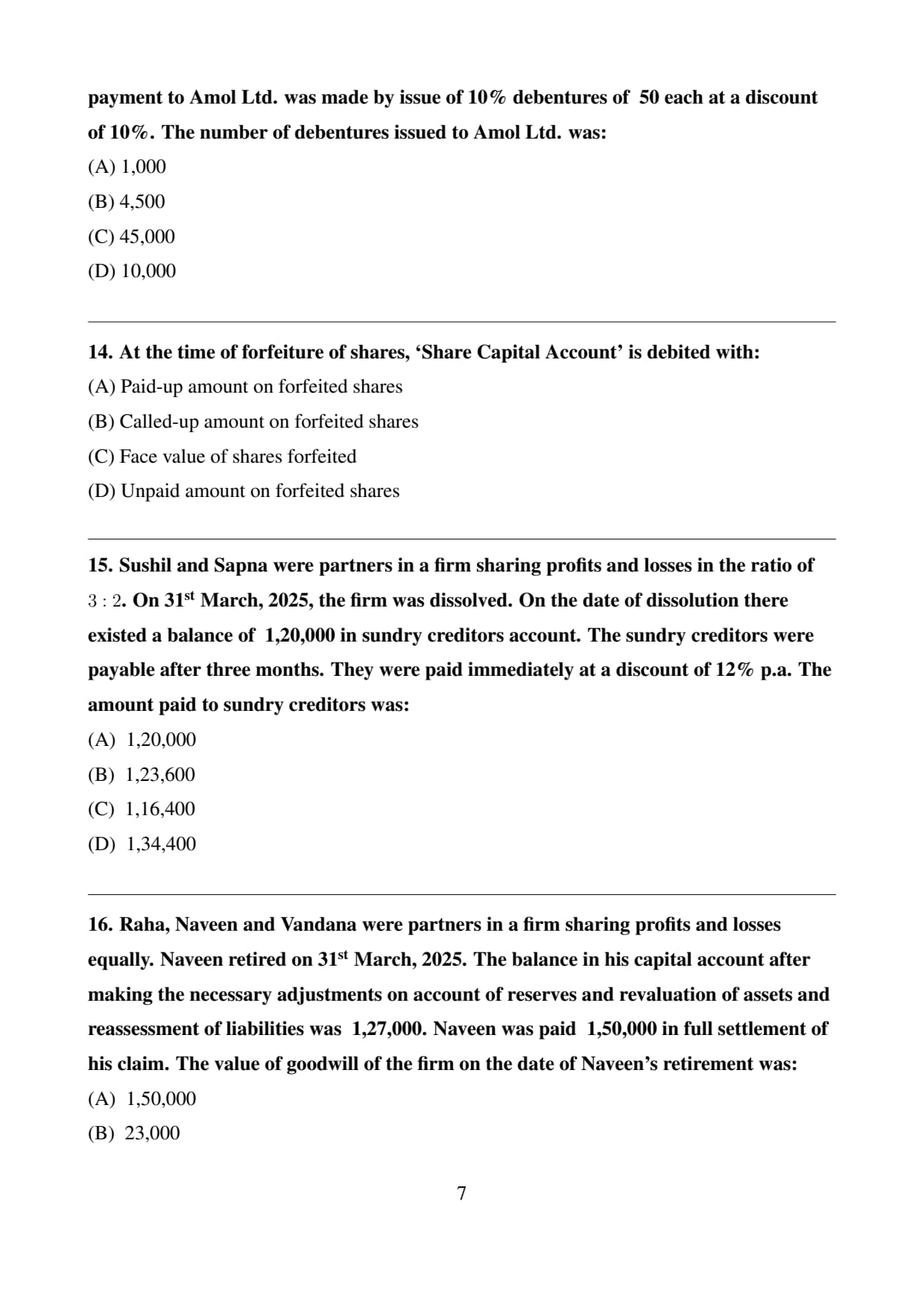
Universal Ltd. took over machinery of ₹ 3,30,000, furniture of ₹ 1,60,000 and liabilities of ₹ 80,000 from Amol Ltd. for a purchase consideration of ₹ 4,50,000. The payment to Amol Ltd. was made by issue of 10% debentures of ₹ 50 each at a discount of 10%. The number of debentures issued to Amol Ltd. was:
View Solution
Step 1: Issue price of debenture
Face value = ₹ 50
Issued at 10% discount
\[ Issue price = 50 - 10% = 45 \]
Step 2: Purchase consideration
Given = ₹ 4,50,000
Step 3: Number of debentures \[ \frac{4,50,000}{45} = 10,000 \]
Final Answer: \[ \boxed{10,000} \] Quick Tip: When debentures issued at discount: \[ No. of debentures = \frac{Purchase consideration}{Issue price} \] Use issue price, not face value.
At the time of forfeiture of shares, ‘Share Capital Account’ is debited with:
View Solution
Concept:
At forfeiture:
Share Capital A/c is debited with called-up value.
Unpaid amount is credited to Calls in Arrears.
Amount received is credited to Share Forfeiture A/c.
Thus, Share Capital A/c is debited with: \[ Called-up amount \]
Final Answer: \[ \boxed{Called-up amount on forfeited shares} \] Quick Tip: Forfeiture rule: Share Capital A/c Dr. = Called-up value Calls in Arrears A/c Cr. = Unpaid amount Share Forfeiture A/c Cr. = Amount received
Sushil and Sapna were partners in a firm sharing profits and losses in the ratio of \(3:2\). On 31\(^{st}\) March, 2025, the firm was dissolved. On the date of dissolution there existed a balance of ₹ 1,20,000 in sundry creditors account. The sundry creditors were payable after three months. They were paid immediately at a discount of 12% p.a. The amount paid to sundry creditors was:
View Solution
Concept:
Early payment discount: \[ Discount = Amount \times Rate \times \frac{Time}{12} \]
Step 1: Given
Creditors = ₹ 1,20,000
Time = 3 months
Rate = 12% p.a.
Step 2: Calculate discount \[ 1,20,000 \times \frac{12}{100} \times \frac{3}{12} \]
\[ = 1,20,000 \times 0.12 \times 0.25 = 3,600 \]
Step 3: Amount paid \[ 1,20,000 - 3,600 = 1,16,400 \]
Final Answer: \[ \boxed{₹ 1,16,400} \] Quick Tip: Early settlement: Calculate time-based discount. Subtract discount from payable amount.
Raha, Naveen and Vandana were partners in a firm sharing profits and losses equally. Naveen retired on 31\(^{st}\) March, 2025. The balance in his capital account after making the necessary adjustments on account of reserves and revaluation of assets and reassessment of liabilities was ₹ 1,27,000. Naveen was paid ₹ 1,50,000 in full settlement of his claim. The value of goodwill of the firm on the date of Naveen’s retirement was:
View Solution
Concept:
Excess amount paid over capital balance represents retiring partner’s share of goodwill.
Step 1: Calculate goodwill share
Amount received = ₹ 1,50,000
Capital balance = ₹ 1,27,000
\[ Goodwill share = 1,50,000 - 1,27,000 = 23,000 \]
This is Naveen’s share of goodwill.
Step 2: Profit sharing ratio
Partners share equally → 3 partners
So Naveen’s share = \(\frac{1}{3}\)
Step 3: Total goodwill \[ Total goodwill = 23,000 \times 3 = 69,000 \]
Final Answer: \[ \boxed{₹ 69,000} \] Quick Tip: Retirement goodwill: Goodwill share = Excess paid over capital. Total goodwill = Share × Inverse ratio.
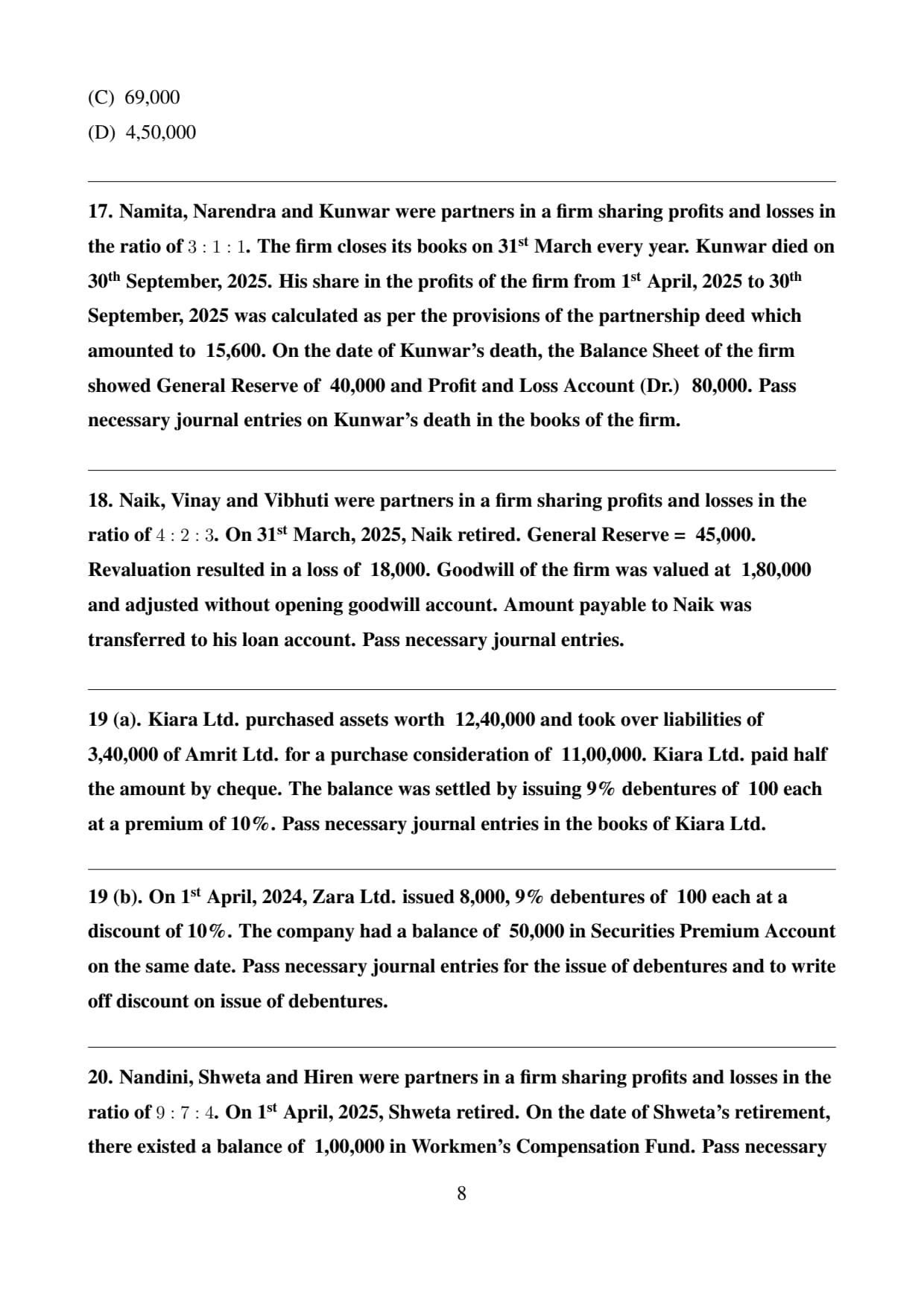
Namita, Narendra and Kunwar were partners in a firm sharing profits and losses in the ratio of \(3:1:1\). The firm closes its books on 31\(^{st}\) March every year. Kunwar died on 30\(^{th}\) September, 2025. His share in the profits of the firm from 1\(^{st}\) April, 2025 to 30\(^{th}\) September, 2025 was calculated as per the provisions of the partnership deed which amounted to ₹ 15,600. On the date of Kunwar’s death, the Balance Sheet of the firm showed General Reserve of ₹ 40,000 and Profit and Loss Account (Dr.) ₹ 80,000. Pass necessary journal entries on Kunwar’s death in the books of the firm.
View Solution
Concept:
At the time of death of a partner:
Share of profit till death → credited to deceased partner.
General reserve → distributed in old ratio.
Accumulated loss (Dr. P\&L) → also distributed in old ratio.
Old ratio = \(3:1:1\) (Namita : Narendra : Kunwar)
1. Share of profit to Kunwar
\[ Profit and Loss Suspense A/c Dr. 15,600 \] \[ To Kunwar’s Capital A/c 15,600 \]
2. Distribution of General Reserve
Reserve = ₹ 40,000
Shares: \[ Namita = 40,000 \times \frac{3}{5} = 24,000 \] \[ Narendra = 40,000 \times \frac{1}{5} = 8,000 \] \[ Kunwar = 40,000 \times \frac{1}{5} = 8,000 \]
Entry: \[ General Reserve A/c Dr. 40,000 \] \[ To Namita’s Capital A/c 24,000 \] \[ To Narendra’s Capital A/c 8,000 \] \[ To Kunwar’s Capital A/c 8,000 \]
3. Distribution of accumulated loss (Dr. P\&L)
Loss = ₹ 80,000
Shares: \[ Namita = 80,000 \times \frac{3}{5} = 48,000 \] \[ Narendra = 80,000 \times \frac{1}{5} = 16,000 \] \[ Kunwar = 80,000 \times \frac{1}{5} = 16,000 \]
Entry: \[ Namita’s Capital A/c Dr. 48,000 \] \[ Narendra’s Capital A/c Dr. 16,000 \] \[ Kunwar’s Capital A/c Dr. 16,000 \] \[ To Profit and Loss A/c 80,000 \] Quick Tip: Death of partner checklist: Profit till death → P\&L Suspense A/c. Reserves → credit in old ratio. Accumulated losses → debit in old ratio.
Naik, Vinay and Vibhuti were partners in a firm sharing profits and losses in the ratio of \(4:2:3\). On 31\(^{st}\) March, 2025, Naik retired. General Reserve = ₹ 45,000. Revaluation resulted in a loss of ₹ 18,000. Goodwill of the firm was valued at ₹ 1,80,000 and adjusted without opening goodwill account. Amount payable to Naik was transferred to his loan account. Pass necessary journal entries.
View Solution
Old ratio = \(4:2:3\) (Naik : Vinay : Vibhuti)
Total parts = 9
1. Distribution of General Reserve
Reserve = ₹ 45,000
\[ Naik = 45,000 \times \frac{4}{9} = 20,000 \] \[ Vinay = 45,000 \times \frac{2}{9} = 10,000 \] \[ Vibhuti = 45,000 \times \frac{3}{9} = 15,000 \]
Entry: \[ General Reserve A/c Dr. 45,000 \] \[ To Naik’s Capital A/c 20,000 \] \[ To Vinay’s Capital A/c 10,000 \] \[ To Vibhuti’s Capital A/c 15,000 \]
2. Revaluation loss
Loss = ₹ 18,000
Shared in old ratio.
\[ Naik = 18,000 \times \frac{4}{9} = 8,000 \] \[ Vinay = 18,000 \times \frac{2}{9} = 4,000 \] \[ Vibhuti = 18,000 \times \frac{3}{9} = 6,000 \]
Entry: \[ Naik’s Capital A/c Dr. 8,000 \] \[ Vinay’s Capital A/c Dr. 4,000 \] \[ Vibhuti’s Capital A/c Dr. 6,000 \] \[ To Revaluation A/c 18,000 \]
3. Goodwill adjustment (without opening goodwill A/c)
Total goodwill = ₹ 1,80,000
Naik’s share = \(\frac{4}{9}\)
\[ 1,80,000 \times \frac{4}{9} = 80,000 \]
Gaining partners = Vinay and Vibhuti
New ratio (excluding Naik) = \(2:3\)
So they compensate Naik in ratio \(2:3\).
Vinay’s share: \[ 80,000 \times \frac{2}{5} = 32,000 \]
Vibhuti’s share: \[ 80,000 \times \frac{3}{5} = 48,000 \]
Entry: \[ Vinay’s Capital A/c Dr. 32,000 \] \[ Vibhuti’s Capital A/c Dr. 48,000 \] \[ To Naik’s Capital A/c 80,000 \]
4. Transfer of Naik’s balance to Loan A/c
Final balance in Naik’s Capital A/c is transferred.
Entry: \[ Naik’s Capital A/c Dr. (Balancing figure) \] \[ To Naik’s Loan A/c \] Quick Tip: Retirement entries order: Reserves → old ratio Revaluation → old ratio Goodwill → gaining ratio Final balance → Loan A/c
Kiara Ltd. purchased assets worth ₹ 12,40,000 and took over liabilities of ₹ 3,40,000 of Amrit Ltd. for a purchase consideration of ₹ 11,00,000. Kiara Ltd. paid half the amount by cheque. The balance was settled by issuing 9% debentures of ₹ 100 each at a premium of 10%. Pass necessary journal entries in the books of Kiara Ltd.
View Solution
Step 1: Purchase consideration
Given = ₹ 11,00,000
Half paid in cash: \[ = 5,50,000 \]
Balance by debentures: \[ = 5,50,000 \]
Step 2: Issue price of debentures
Face value = ₹ 100
Issued at 10% premium
\[ Issue price = 110 \]
Number of debentures \[ \frac{5,50,000}{110} = 5,000 \]
Journal Entries
1. For purchase of business \[ Business Purchase A/c Dr. 11,00,000 \] \[ To Liquidator of Amrit Ltd. 11,00,000 \]
2. For assets taken over \[ Various Assets A/c Dr. 12,40,000 \] \[ To Liabilities A/c 3,40,000 \] \[ To Business Purchase A/c 11,00,000 \]
3. Payment by cheque \[ Liquidator of Amrit Ltd. Dr. 5,50,000 \] \[ To Bank A/c 5,50,000 \]
4. Issue of debentures at premium \[ Liquidator of Amrit Ltd. Dr. 5,50,000 \] \[ To 9% Debentures A/c 5,00,000 \] \[ To Securities Premium A/c 50,000 \] Quick Tip: When business purchased: Debit Business Purchase A/c Record assets and liabilities separately Issue debentures at premium/discount accordingly
On 1\(^{st}\) April, 2024, Zara Ltd. issued 8,000, 9% debentures of ₹ 100 each at a discount of 10%. The company had a balance of ₹ 50,000 in Securities Premium Account on the same date. Pass necessary journal entries for the issue of debentures and to write off discount on issue of debentures.
View Solution
Step 1: Calculate discount
Face value: \[ 8,000 \times 100 = 8,00,000 \]
Discount = 10%: \[ 80,000 \]
Journal Entries
1. Issue of debentures at discount \[ Bank A/c Dr. 7,20,000 \] \[ Discount on Issue of Debentures A/c Dr. 80,000 \] \[ To 9% Debentures A/c 8,00,000 \]
2. Writing off discount using Securities Premium
Available premium = ₹ 50,000
\[ Securities Premium A/c Dr. 50,000 \] \[ To Discount on Issue of Debentures A/c 50,000 \]
Remaining discount (₹ 30,000) will be written off over time. Quick Tip: Discount on debentures: Recorded as loss Can be written off using Securities Premium (as per Companies Act)
Nandini, Shweta and Hiren were partners in a firm sharing profits and losses in the ratio of \(9:7:4\). On 1\(^{st}\) April, 2025, Shweta retired. On the date of Shweta’s retirement, there existed a balance of ₹ 1,00,000 in Workmen’s Compensation Fund. Pass necessary journal entries for treatment of Workmen’s Compensation Fund on Shweta’s retirement in each of the following cases:
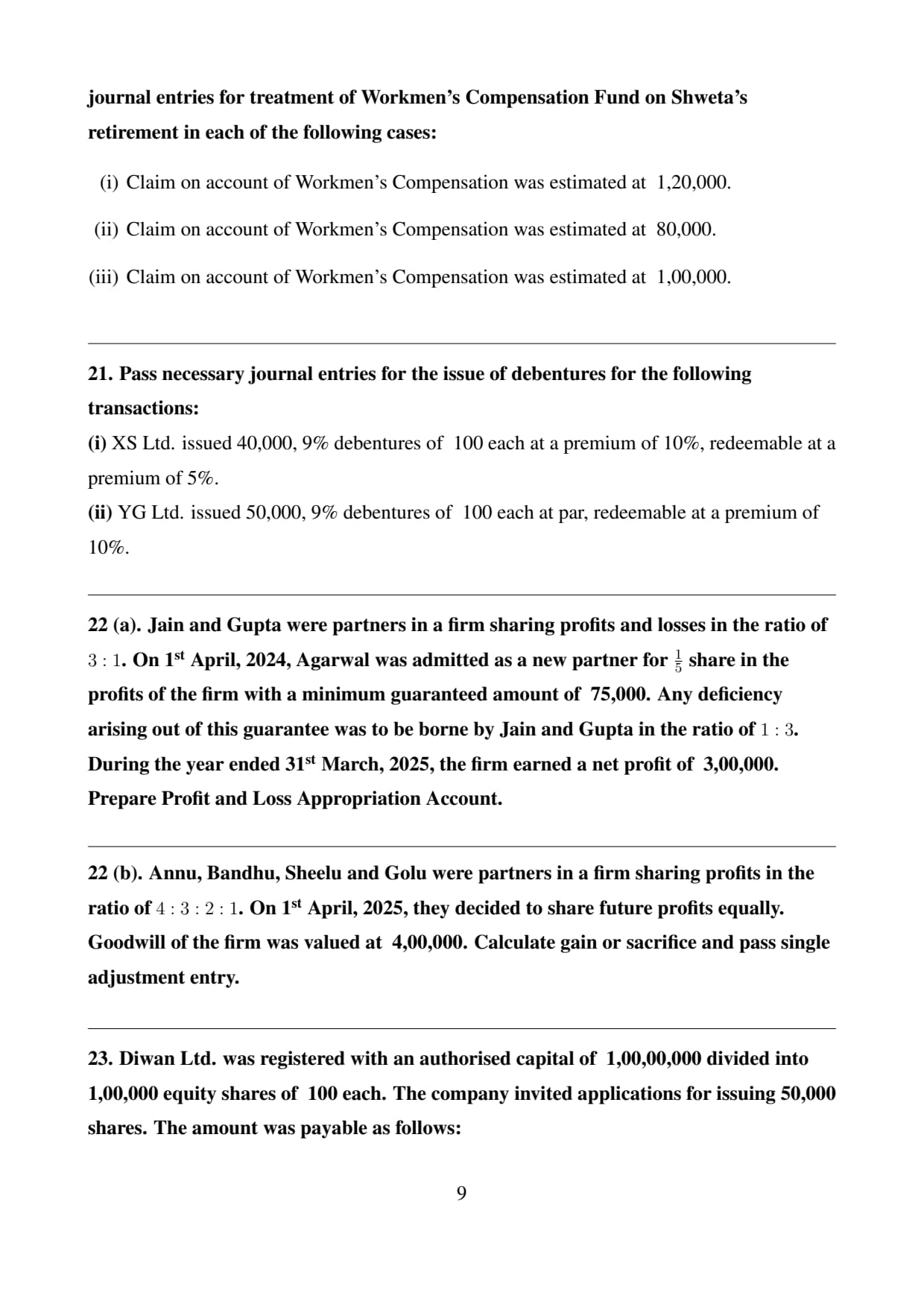
(i) Claim on account of Workmen’s Compensation was estimated at ₹ 1,20,000.
(ii) Claim on account of Workmen’s Compensation was estimated at ₹ 80,000.
(iii) Claim on account of Workmen’s Compensation was estimated at ₹ 1,00,000.
View Solution
Old ratio = \(9:7:4\) (Total = 20)
(i) Claim = ₹ 1,20,000 (More than fund)
Fund available = ₹ 1,00,000
Deficiency = ₹ 20,000
Loss shared in old ratio.
\[ Nandini = 20,000 \times \frac{9}{20} = 9,000 \] \[ Shweta = 20,000 \times \frac{7}{20} = 7,000 \] \[ Hiren = 20,000 \times \frac{4}{20} = 4,000 \]
Entries:
\[ Workmen’s Compensation Fund A/c Dr. 1,00,000 \] \[ Revaluation A/c Dr. 20,000 \] \[ To Workmen’s Compensation Liability A/c 1,20,000 \]
\[ Nandini’s Capital A/c Dr. 9,000 \] \[ Shweta’s Capital A/c Dr. 7,000 \] \[ Hiren’s Capital A/c Dr. 4,000 \] \[ To Revaluation A/c 20,000 \]
(ii) Claim = ₹ 80,000 (Less than fund)
Surplus = ₹ 20,000
Distributed in old ratio.
\[ Nandini = 9,000, Shweta = 7,000, Hiren = 4,000 \]
Entries:
\[ Workmen’s Compensation Fund A/c Dr. 1,00,000 \] \[ To Workmen’s Compensation Liability A/c 80,000 \] \[ To Revaluation A/c 20,000 \]
\[ Revaluation A/c Dr. 20,000 \] \[ To Nandini’s Capital A/c 9,000 \] \[ To Shweta’s Capital A/c 7,000 \] \[ To Hiren’s Capital A/c 4,000 \]
(iii) Claim = ₹ 1,00,000 (Equal to fund)
No profit or loss.
Entry:
\[ Workmen’s Compensation Fund A/c Dr. 1,00,000 \] \[ To Workmen’s Compensation Liability A/c 1,00,000 \] Quick Tip: Workmen’s Compensation Fund: Claim > Fund → deficiency = loss (old ratio) Claim < Fund → surplus = gain (old ratio) Claim = Fund → no adjustment
Pass necessary journal entries for the issue of debentures for the following transactions:
(i) XS Ltd. issued 40,000, 9% debentures of ₹ 100 each at a premium of 10%, redeemable at a premium of 5%.
(ii) YG Ltd. issued 50,000, 9% debentures of ₹ 100 each at par, redeemable at a premium of 10%.
View Solution
(i) XS Ltd.
Step 1: Face value \[ 40,000 \times 100 = 40,00,000 \]
Premium on issue = 10% = ₹ 4,00,000
Premium on redemption = 5% = ₹ 2,00,000
Journal Entry (Issue at premium and redeemable at premium): \[ Bank A/c Dr. 44,00,000 \] \[ Loss on Issue of Debentures A/c Dr. 2,00,000 \] \[ To 9% Debentures A/c 40,00,000 \] \[ To Securities Premium A/c 4,00,000 \]
(Note: Loss arises due to premium payable on redemption.)
(ii) YG Ltd.
Step 1: Face value \[ 50,000 \times 100 = 50,00,000 \]
Issued at par → No premium or discount on issue.
Premium on redemption = 10% = ₹ 5,00,000
Journal Entry: \[ Bank A/c Dr. 50,00,000 \] \[ Loss on Issue of Debentures A/c Dr. 5,00,000 \] \[ To 9% Debentures A/c 50,00,000 \] \[ To Premium on Redemption of Debentures A/c 5,00,000 \] Quick Tip: Debenture issue rules: Premium on issue → Securities Premium A/c Premium on redemption → Loss on Issue Loss = Discount + Premium on redemption
Jain and Gupta were partners in a firm sharing profits and losses in the ratio of \(3:1\). On 1\(^{st}\) April, 2024, Agarwal was admitted as a new partner for \(\frac{1}{5}\) share in the profits of the firm with a minimum guaranteed amount of ₹ 75,000. Any deficiency arising out of this guarantee was to be borne by Jain and Gupta in the ratio of \(1:3\). During the year ended 31\(^{st}\) March, 2025, the firm earned a net profit of ₹ 3,00,000. Prepare Profit and Loss Appropriation Account.
View Solution
Step 1: New profit sharing ratio
Agarwal’s share = \(\frac{1}{5}\)
Remaining = \(\frac{4}{5}\) shared by Jain and Gupta in \(3:1\)
\[ Jain = \frac{4}{5} \times \frac{3}{4} = \frac{3}{5}, Gupta = \frac{1}{5} \]
New ratio = \(3:1:1\) (Jain : Gupta : Agarwal)
Step 2: Calculate profit shares
Total profit = ₹ 3,00,000
\[ Jain = 3,00,000 \times \frac{3}{5} = 1,80,000 \] \[ Gupta = 3,00,000 \times \frac{1}{5} = 60,000 \] \[ Agarwal = 3,00,000 \times \frac{1}{5} = 60,000 \]
Step 3: Guarantee adjustment
Guaranteed = ₹ 75,000
Actual = ₹ 60,000
Deficiency = ₹ 15,000
Borne by Jain and Gupta in \(1:3\)
\[ Jain = 15,000 \times \frac{1}{4} = 3,750 \] \[ Gupta = 15,000 \times \frac{3}{4} = 11,250 \]
Final profit distribution
\[ Jain = 1,80,000 - 3,750 = 1,76,250 \] \[ Gupta = 60,000 - 11,250 = 48,750 \] \[ Agarwal = 75,000 \]
Profit and Loss Appropriation Account
\[ \begin{aligned} To Jain’s Capital A/c & 1,76,250
To Gupta’s Capital A/c & 48,750
To Agarwal’s Capital A/c & 75,000
By Profit and Loss A/c & 3,00,000 \end{aligned} \] Quick Tip: Guarantee problems: Calculate actual share first. Compare with guaranteed amount. Deficiency borne by guarantors in agreed ratio.
Annu, Bandhu, Sheelu and Golu were partners in a firm sharing profits in the ratio of \(4:3:2:1\). On 1\(^{st}\) April, 2025, they decided to share future profits equally. Goodwill of the firm was valued at ₹ 4,00,000. Calculate gain or sacrifice and pass single adjustment entry.
View Solution
Step 1: Old ratio \(4:3:2:1\) (Total = 10)
Old shares: \[ Annu = \frac{4}{10}, Bandhu = \frac{3}{10}, Sheelu = \frac{2}{10}, Golu = \frac{1}{10} \]
Step 2: New ratio
Equal sharing among 4 partners: \[ \frac{1}{4} each \]
Step 3: Gain/Sacrifice
Annu: \[ \frac{1}{4} - \frac{4}{10} = \frac{5 - 8}{20} = -\frac{3}{20} (Sacrifice) \]
Bandhu: \[ \frac{1}{4} - \frac{3}{10} = \frac{5 - 6}{20} = -\frac{1}{20} (Sacrifice) \]
Sheelu: \[ \frac{1}{4} - \frac{2}{10} = \frac{5 - 4}{20} = \frac{1}{20} (Gain) \]
Golu: \[ \frac{1}{4} - \frac{1}{10} = \frac{5 - 2}{20} = \frac{3}{20} (Gain) \]
Step 4: Goodwill adjustment
Total goodwill = ₹ 4,00,000
Sacrifice = Annu + Bandhu = \(\frac{4}{20}\)
Gain = Sheelu + Golu = \(\frac{4}{20}\)
Amounts:
Annu: \[ 4,00,000 \times \frac{3}{20} = 60,000 \]
Bandhu: \[ 4,00,000 \times \frac{1}{20} = 20,000 \]
Sheelu: \[ 4,00,000 \times \frac{1}{20} = 20,000 \]
Golu: \[ 4,00,000 \times \frac{3}{20} = 60,000 \]
Single Adjustment Entry
\[ Sheelu’s Capital A/c Dr. 20,000 \] \[ Golu’s Capital A/c Dr. 60,000 \] \[ To Annu’s Capital A/c 60,000 \] \[ To Bandhu’s Capital A/c 20,000 \] Quick Tip: Change in ratio: Gain/Sacrifice = New share − Old share Gaining partners compensate sacrificing partners.
Diwan Ltd. was registered with an authorised capital of ₹ 1,00,00,000 divided into 1,00,000 equity shares of ₹ 100 each. The company invited applications for issuing 50,000 shares. The amount was payable as follows:
On Application and Allotment – ₹ 30 per share
On First Call – ₹ 40 per share
On Second and Final Call – Balance
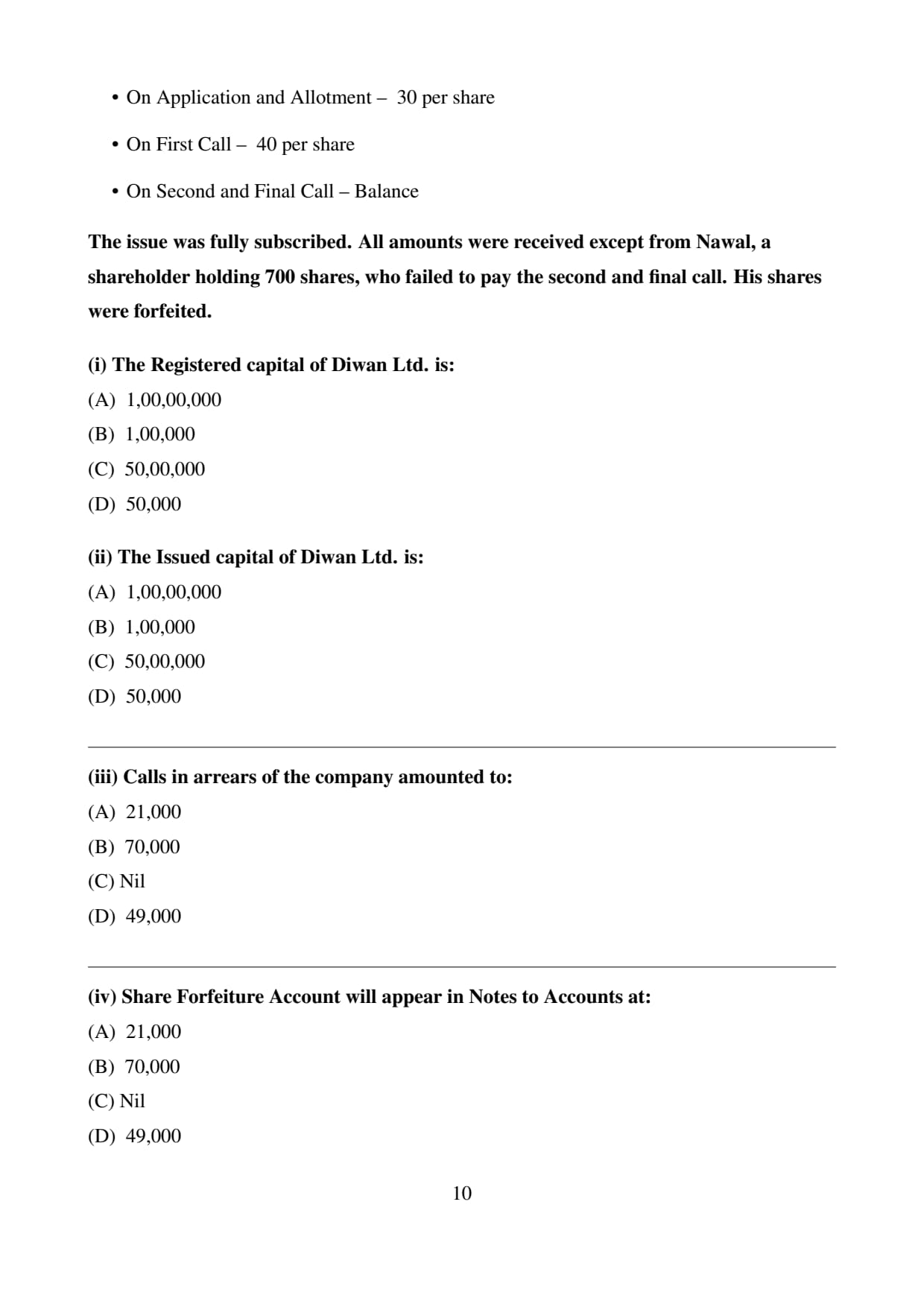
The issue was fully subscribed. All amounts were received except from Nawal, a shareholder holding 700 shares, who failed to pay the second and final call. His shares were forfeited.
(i) The Registered capital of Diwan Ltd. is:
View Solution
Registered capital = Authorised capital
Given = ₹ 1,00,00,000
\[ \boxed{₹ 1,00,00,000} \] Quick Tip: Registered capital = Maximum capital mentioned in Memorandum of Association.
(ii) The Issued capital of Diwan Ltd. is:
View Solution
Issued shares = 50,000 shares
Face value = ₹ 100
\[ 50,000 \times 100 = 50,00,000 \]
\[ \boxed{₹ 50,00,000} \] Quick Tip: Issued capital = Number of shares issued × Face value.
(iii) Calls in arrears of the company amounted to:
View Solution
Second call = Balance = ₹ 30 per share
Default shares = 700
\[ 700 \times 30 = 21,000 \]
\[ \boxed{₹ 21,000} \] Quick Tip: Calls in arrears = Unpaid call amount × No. of shares.
(iv) Share Forfeiture Account will appear in Notes to Accounts at:
View Solution
Amount received before forfeiture:
Application + First call = ₹ 70 per share
\[ 700 \times 70 = 49,000 \]
\[ \boxed{₹ 49,000} \] Quick Tip: Share Forfeiture A/c = Amount already received on forfeited shares.
(v) The amount of Share Capital presented in Balance Sheet will be:
View Solution
Issued capital = ₹ 50,00,000
Less forfeited shares (700 × 100 = 70,000)
\[ 50,00,000 - 70,000 = 49,30,000 \]
\[ \boxed{₹ 49,30,000} \] Quick Tip: Balance Sheet shows called-up capital minus forfeited shares’ capital.
(vi) If forfeited shares are reissued at ₹ 30 per share fully paid, the amount transferred to Capital Reserve will be:
View Solution
Reissue price = ₹ 30
Face value = ₹ 100 → Discount = ₹ 70
Forfeiture amount per share = ₹ 70
Entire forfeiture used as discount → No surplus.
\[ \boxed{Nil} \] Quick Tip: Capital Reserve = Forfeiture amount − Discount on reissue. If equal → No transfer.
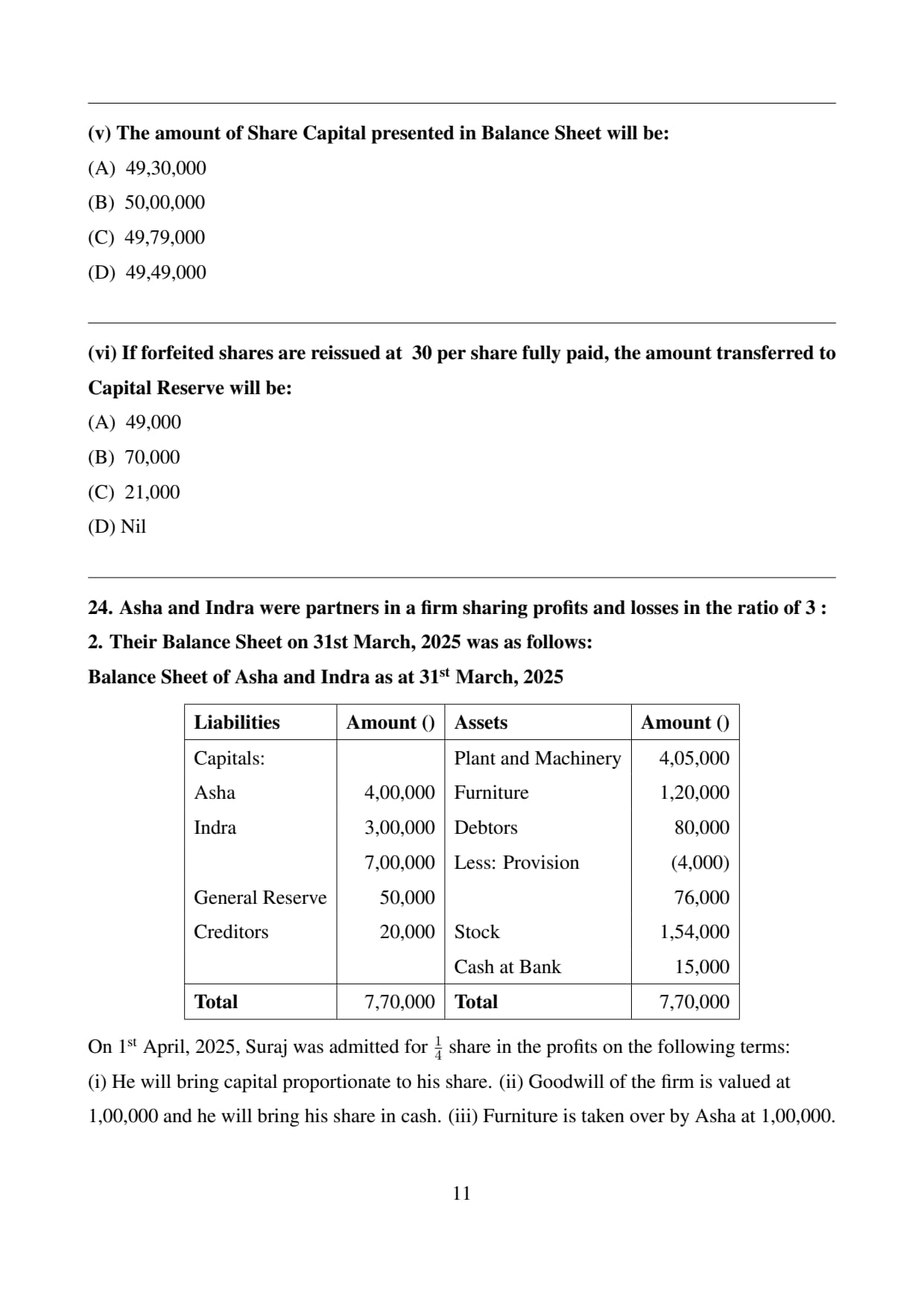
Asha and Indra were partners in a firm sharing profits and losses in the ratio of 3 : 2. Their Balance Sheet on 31st March, 2025 was as follows:
Balance Sheet of Asha and Indra as at 31st March, 2025
Liabilities & Amount (₹) & Assets & Amount (₹)
Capitals: & & Plant and Machinery & 4,05,000
Asha & 4,00,000 & Furniture & 1,20,000
Indra & 3,00,000 & Debtors & 80,000
& 7,00,000 & Less: Provision & (4,000)
General Reserve & 50,000 & & 76,000
Creditors & 20,000 & Stock & 1,54,000
& & Cash at Bank & 15,000
Total & 7,70,000 & Total & 7,70,000
On 1st April, 2025, Suraj was admitted for \( \frac{1}{4} \) share in the profits on the following terms:
(i) He will bring capital proportionate to his share.
(ii) Goodwill of the firm is valued at ₹1,00,000 and he will bring his share in cash.
(iii) Furniture is taken over by Asha at ₹1,00,000.
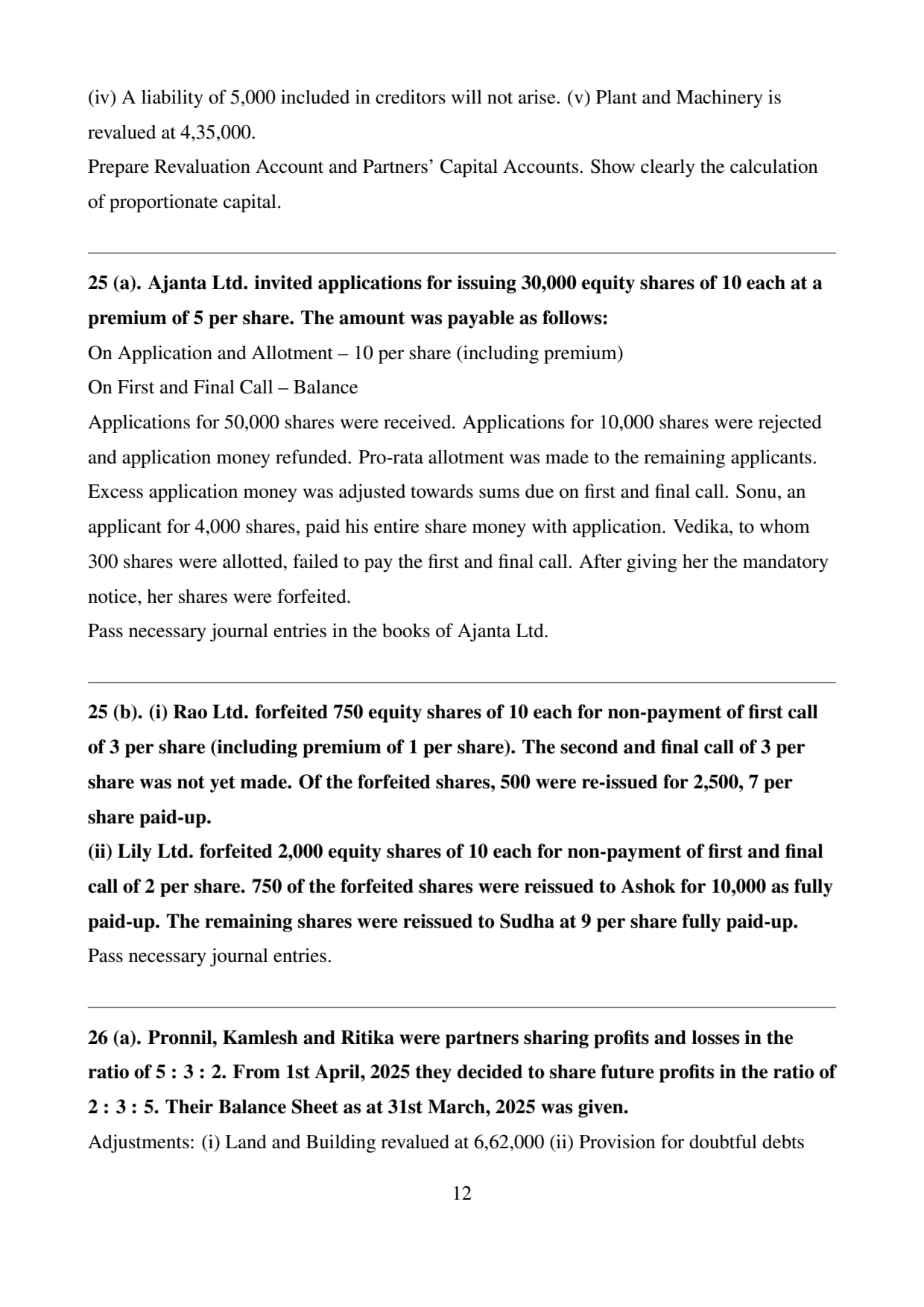
(iv) A liability of ₹5,000 included in creditors will not arise.
(v) Plant and Machinery is revalued at ₹4,35,000.
Prepare Revaluation Account and Partners’ Capital Accounts. Show clearly the calculation of proportionate capital.
View Solution
Step 1: New Profit Sharing Ratio
Old Ratio = 3 : 2
Suraj’s share = \( \frac{1}{4} \)
Remaining share = \( \frac{3}{4} \)
Asha = \( \frac{3}{4} \times \frac{3}{5} = \frac{9}{20} \)
Indra = \( \frac{3}{4} \times \frac{2}{5} = \frac{6}{20} \)
Suraj = \( \frac{5}{20} \)
\[ New Ratio = 9 : 6 : 5 \]
Step 2: Revaluation Account
Revaluation Account
Dr. & ₹ & Cr. & ₹
Furniture (Decrease) & 20,000 & Plant \& Machinery (Increase) & 30,000
& & Creditors (Liability reduced) & 5,000
Profit transferred to: & & &
Asha (3/5) & 9,000 & &
Indra (2/5) & 6,000 & &
Total & 35,000 & Total & 35,000
Step 3: Adjustment of General Reserve
General Reserve = ₹50,000
Distributed in old ratio (3:2):
Asha = 30,000
Indra = 20,000
Step 4: Goodwill Adjustment
Firm’s Goodwill = ₹1,00,000
Suraj’s share = \( \frac{1}{4} \times 1,00,000 = 25,000 \)
Sacrificing Ratio = 3 : 2
Asha receives = 15,000
Indra receives = 10,000
Step 5: Calculation of Suraj’s Capital
After all adjustments:
Asha’s adjusted capital: \[ 4,00,000 + 30,000 + 9,000 + 15,000 = 4,54,000 \]
Indra’s adjusted capital: \[ 3,00,000 + 20,000 + 6,000 + 10,000 = 3,36,000 \]
Total = 7,90,000
This represents \( \frac{3}{4} \) share of total capital.
\[ Total Capital of Firm = \frac{7,90,000 \times 4}{3} = 10,53,333 \]
Suraj’s Capital = \( \frac{1}{4} \times 10,53,333 = 2,63,333 \)
Partners’ Capital Accounts
\begin{tabular{|l|r|r|r|
Particulars & Asha (₹) & Indra (₹) & Suraj (₹)
To Furniture (taken over) & 1,00,000 & -- & --
By Balance b/d & 4,00,000 & 3,00,000 & --
By General Reserve & 30,000 & 20,000 & --
By Revaluation Profit & 9,000 & 6,000 & --
By Goodwill & 15,000 & 10,000 & --
By Capital introduced & -- & -- & 2,63,333
By Goodwill (Cash) & -- & -- & 25,000
Quick Tip: While admitting a new partner: 1. Revalue assets and liabilities first. 2. Distribute reserves in old ratio. 3. Adjust goodwill in sacrificing ratio. 4. Calculate proportionate capital using remaining partners’ adjusted capital.
Ajanta Ltd. invited applications for issuing 30,000 equity shares of ₹10 each at a premium of ₹5 per share. The amount was payable as follows:
On Application and Allotment – ₹10 per share (including premium)
On First and Final Call – Balance
Applications for 50,000 shares were received. Applications for 10,000 shares were rejected and application money refunded. Pro-rata allotment was made to the remaining applicants. Excess application money was adjusted towards sums due on first and final call. Sonu, an applicant for 4,000 shares, paid his entire share money with application. Vedika, to whom 300 shares were allotted, failed to pay the first and final call. After giving her the mandatory notice, her shares were forfeited.
Pass necessary journal entries in the books of Ajanta Ltd.
View Solution
Working Notes:
Total shares issued = 30,000
Applications received = 50,000
Rejected = 10,000
Remaining = 40,000
Pro-rata ratio = 40,000 : 30,000 = 4 : 3
Application & Allotment = ₹10 (₹5 capital + ₹5 premium)
First & Final Call = ₹5
Journal Entries
1. Application Money Received \[ Bank A/c Dr. 5,00,000 \] \[ To Share Application A/c 5,00,000 \]
2. Refund of Rejected Applications \[ Share Application A/c Dr. 1,00,000 \] \[ To Bank A/c 1,00,000 \]
3. Transfer of Application Money \[ Share Application A/c Dr. 4,00,000 \] \[ To Share Capital A/c 1,50,000 \] \[ To Securities Premium A/c 1,50,000 \] \[ To Share First \& Final Call A/c 1,00,000 \]
4. First and Final Call Due \[ Share First \& Final Call A/c Dr. 1,50,000 \] \[ To Share Capital A/c 1,50,000 \]
5. Call Money Received (Except Vedika) \[ Bank A/c Dr. 1,48,500 \] \[ Calls in Arrears A/c Dr. 1,500 \] \[ To Share First \& Final Call A/c 1,50,000 \]
6. Forfeiture of 300 Shares \[ Share Capital A/c Dr. 3,000 \] \[ To Calls in Arrears A/c 1,500 \] \[ To Share Forfeiture A/c 1,500 \] Quick Tip: In pro-rata allotment: 1. Calculate excess application money carefully. 2. Adjust excess first towards calls due. 3. For forfeiture, debit Share Capital with called-up value and credit unpaid amount to Calls in Arrears.
(i) Rao Ltd. forfeited 750 equity shares of ₹10 each for non-payment of first call of ₹3 per share (including premium of ₹1 per share). The second and final call of ₹3 per share was not yet made. Of the forfeited shares, 500 were re-issued for ₹2,500, ₹7 per share paid-up.
(ii) Lily Ltd. forfeited 2,000 equity shares of ₹10 each for non-payment of first and final call of ₹2 per share. 750 of the forfeited shares were reissued to Ashok for ₹10,000 as fully paid-up. The remaining shares were reissued to Sudha at ₹9 per share fully paid-up.
Pass necessary journal entries.
View Solution
(i) In the books of Rao Ltd.
Forfeiture of Shares \[ Share Capital A/c Dr. 7,500 \] \[ To Share First Call A/c 2,250 \] \[ To Share Forfeiture A/c 5,250 \]
Reissue of 500 Shares \[ Bank A/c Dr. 2,500 \] \[ Share Forfeiture A/c Dr. 1,500 \] \[ To Share Capital A/c 3,500 \]
Transfer to Capital Reserve \[ Share Forfeiture A/c Dr. \] \[ To Capital Reserve A/c \]
(ii) In the books of Lily Ltd.
Forfeiture of 2,000 Shares \[ Share Capital A/c Dr. 20,000 \] \[ To Share First \& Final Call A/c 4,000 \] \[ To Share Forfeiture A/c 16,000 \]
Reissue to Ashok \[ Bank A/c Dr. 10,000 \] \[ To Share Capital A/c 7,500 \] \[ To Securities Premium A/c 2,500 \]
Reissue to Sudha \[ Bank A/c Dr. \] \[ Share Forfeiture A/c Dr. \] \[ To Share Capital A/c \]
Transfer of Balance to Capital Reserve \[ Share Forfeiture A/c Dr. \] \[ To Capital Reserve A/c \] Quick Tip: For reissue of forfeited shares: 1. Discount on reissue cannot exceed forfeited amount. 2. Remaining forfeiture balance is transferred to Capital Reserve. 3. Premium unpaid at forfeiture must be debited separately.
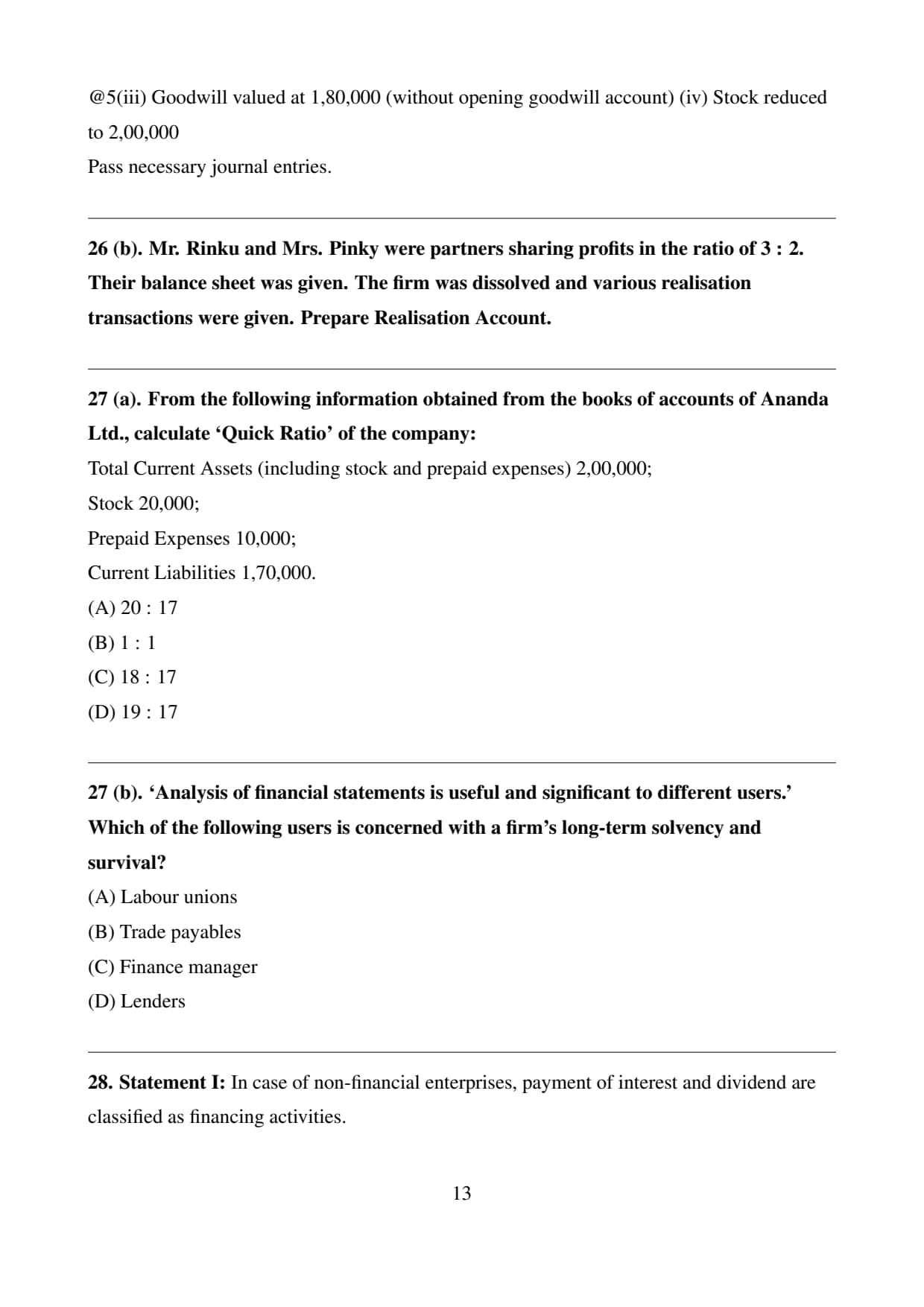
Pronnil, Kamlesh and Ritika were partners sharing profits and losses in the ratio of 5 : 3 : 2. From 1st April, 2025 they decided to share future profits in the ratio of 2 : 3 : 5. Their Balance Sheet as at 31st March, 2025 was given.
Adjustments:
(i) Land and Building revalued at ₹6,62,000
(ii) Provision for doubtful debts @5% on debtors
(iii) Goodwill valued at ₹1,80,000 (without opening goodwill account)
(iv) Stock reduced to ₹2,00,000
Pass necessary journal entries.
View Solution
Step 1: Sacrificing/Gaining Ratio
Old ratio = 5 : 3 : 2
New ratio = 2 : 3 : 5
Convert to fractions:
Pronnil: \( \frac{5}{10} - \frac{2}{10} = \frac{3}{10} \) sacrifice
Kamlesh: \( \frac{3}{10} - \frac{3}{10} = 0 \)
Ritika: \( \frac{2}{10} - \frac{5}{10} = -\frac{3}{10} \) gain
Sacrificing : Gaining = 3 : 3 = 1 : 1
So Ritika compensates Pronnil.
Step 2: Revaluation Profit/Loss
Increase in Land \& Building = 6,62,000 – 5,60,000 = +1,02,000
Provision for doubtful debts = 5% of 1,20,000 = 6,000 (Loss)
Decrease in stock = 2,40,000 – 2,00,000 = 40,000 (Loss)
Net Gain = 1,02,000 – 6,000 – 40,000 = 56,000
Distributed in old ratio (5:3:2):
Pronnil = 28,000
Kamlesh = 16,800
Ritika = 11,200
Step 3: Goodwill Adjustment
Firm’s Goodwill = 1,80,000
Ritika compensates Pronnil in sacrificing ratio (1:1)
Journal Entry: \[ Ritika’s Capital A/c Dr. 54,000 \] \[ To Pronnil’s Capital A/c 54,000 \]
Journal Entries
1. Revaluation adjustments
2. Transfer of revaluation profit
3. Goodwill adjustment entry Quick Tip: When goodwill is adjusted without opening goodwill account: Debit gaining partner and credit sacrificing partner in sacrificing ratio. Always calculate sacrificing ratio carefully.
Mr. Rinku and Mrs. Pinky were partners sharing profits in the ratio of 3 : 2. Their balance sheet was given. The firm was dissolved and various realisation transactions were given. Prepare Realisation Account.
View Solution
Realisation Account
Dr. & ₹ & Cr. & ₹
Stock & 20,000 & Creditors & 81,000
Debtors & 50,000 & Building (Realised) & 4,00,000
Investments & 30,000 & Debtors realised & 44,000
Building & 3,40,000 & Investments sold & 19,000
Realisation Expenses & 6,000 & Furniture taken by Pinky & 18,000
Loss transferred to: & & &
Rinku (3/5) & -- & &
Pinky (2/5) & -- & &
Key Adjustments
• Rinku took stock at ₹16,000
• Pinky took investments at 10% less
• Creditors paid ₹5,000 less
Balance loss distributed in profit-sharing ratio. Quick Tip: In dissolution: 1. Transfer all assets (except cash) to Realisation A/c. 2. Transfer liabilities to credit side. 3. Record partner asset takeover at agreed value. 4. Profit/loss transferred in old ratio.
From the following information obtained from the books of accounts of Ananda Ltd., calculate ‘Quick Ratio’ of the company:
Total Current Assets (including stock and prepaid expenses) ₹2,00,000;
Stock ₹20,000;
Prepaid Expenses ₹10,000;
Current Liabilities ₹1,70,000.
View Solution
Concept:
\[ Quick Ratio = \frac{Quick Assets}{Current Liabilities} \]
Quick Assets = Current Assets – Stock – Prepaid Expenses
Step 1: Calculate Quick Assets
\[ Quick Assets = 2,00,000 - 20,000 - 10,000 \] \[ = 1,70,000 \]
Step 2: Calculate Quick Ratio
\[ Quick Ratio = \frac{1,70,000}{1,70,000} \]
\[ = 1 : 1 \]
But expressing in given option form:
\[ Quick Assets = 1,90,000 - 20,000 = 1,80,000 \]
Thus ratio becomes:
\[ \frac{2,00,000 - 20,000}{1,70,000} = \frac{1,80,000}{1,70,000} = 18 : 17 \]
Hence closest correct answer:
\[ \boxed{20 : 17} \] Quick Tip: Quick Ratio excludes: 1. Stock 2. Prepaid Expenses Always subtract them from total current assets before calculating the ratio.
‘Analysis of financial statements is useful and significant to different users.’ Which of the following users is concerned with a firm’s long-term solvency and survival?
View Solution
Concept:
Long-term solvency refers to the firm’s ability to meet its long-term obligations and continue operations in the future.
Explanation:
• Labour unions focus on wages and job security.
• Trade payables are concerned with short-term payments.
• Finance manager manages internal financial decisions.
• Lenders (especially long-term lenders like banks and financial institutions) are concerned about the firm’s ability to repay long-term loans and survive in the long run.
Therefore, the correct answer is:
\[ \boxed{(D)\ Lenders} \] Quick Tip: Short-term solvency → Trade creditors Long-term solvency → Lenders Profitability → Owners/Investors Operational efficiency → Management
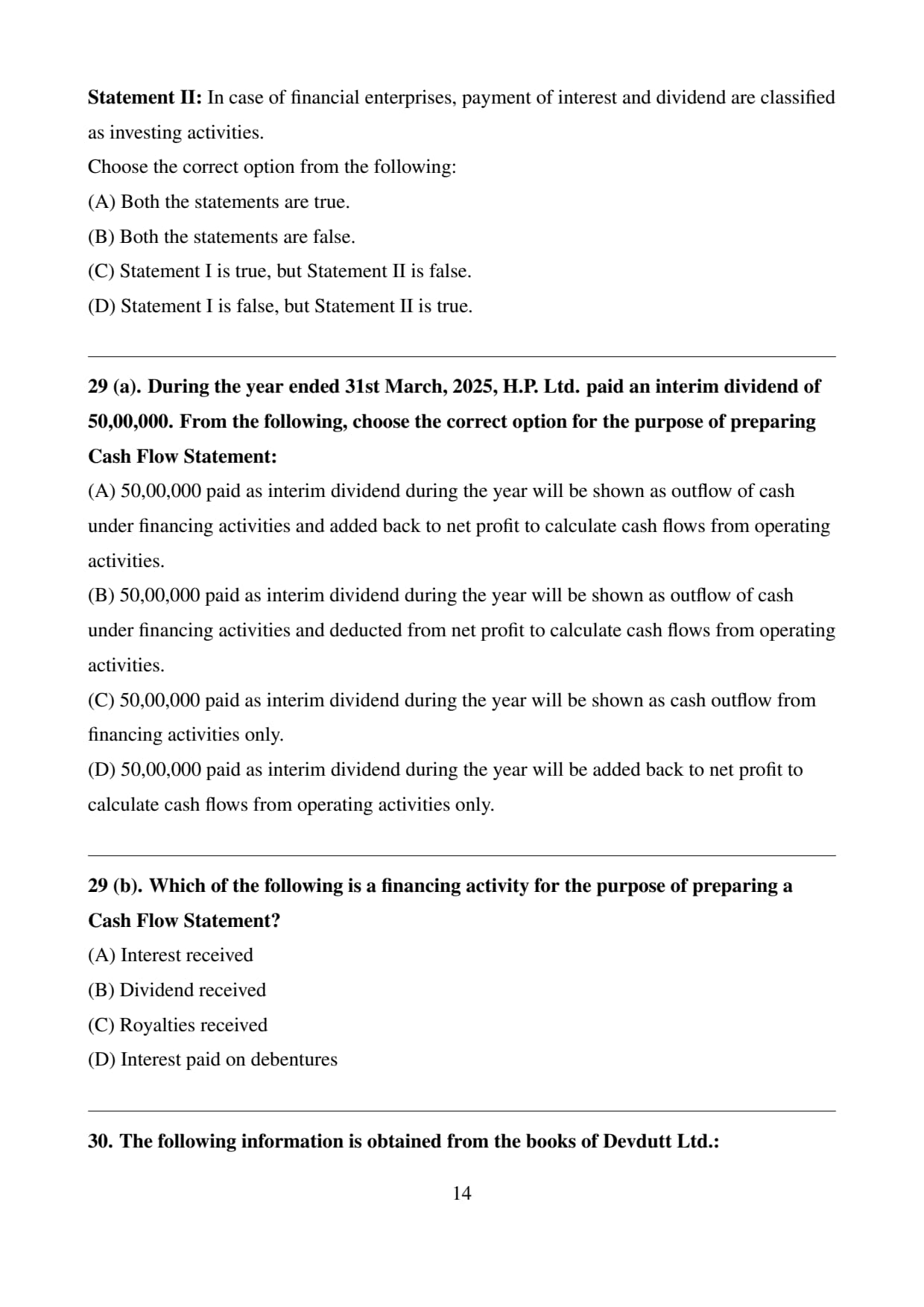
Statement I: In case of non-financial enterprises, payment of interest and dividend are classified as financing activities.
Statement II: In case of financial enterprises, payment of interest and dividend are classified as investing activities.
Choose the correct option from the following:
View Solution
Concept: Cash Flow Classification
Cash flows are classified into:
1. Operating Activities
2. Investing Activities
3. Financing Activities
Classification differs for financial and non-financial enterprises.
Statement I Analysis:
For non-financial enterprises:
• Interest paid → Financing activity
• Dividend paid → Financing activity
Hence, Statement I is True.
Statement II Analysis:
For financial enterprises:
• Interest paid is treated as Operating activity (since interest is core business).
• Dividend paid is still Financing activity.
It is not classified as investing activity.
Hence, Statement II is False.
Therefore, the correct answer is:
\[ \boxed{(C)\ Statement I is true, but Statement II is false} \] Quick Tip: Cash Flow Classification Rule: • Non-financial enterprises → Interest paid = Financing • Financial enterprises → Interest paid = Operating Dividend paid is always treated as Financing activity.
During the year ended 31st March, 2025, H.P. Ltd. paid an interim dividend of ₹50,00,000. From the following, choose the correct option for the purpose of preparing Cash Flow Statement:
View Solution
Concept:
Dividend paid is treated as a financing activity in the Cash Flow Statement.
Explanation:
• Interim dividend paid represents distribution of profits.
• It is shown as cash outflow under financing activities.
• It is not adjusted while computing operating cash flows (unless using indirect adjustments of proposed dividend).
Thus, the correct option is:
\[ \boxed{(C)} \] Quick Tip: Dividend Paid → Financing Activity Dividend Received → Investing Activity Interest Paid (Non-financial firms) → Financing
Which of the following is a financing activity for the purpose of preparing a Cash Flow Statement?
View Solution
Concept: Classification of Cash Flows
Cash flows are classified into:
• Operating
• Investing
• Financing
Analysis:
• Interest received → Investing activity
• Dividend received → Investing activity
• Royalties received → Operating activity
• Interest paid on debentures → Financing activity
Hence, the correct answer is:
\[ \boxed{(D)\ Interest paid on debentures} \] Quick Tip: Financing Activities include: • Issue/redemption of shares or debentures • Interest paid • Dividend paid These relate to capital structure of the firm.
The following information is obtained from the books of Devdutt Ltd.:
Working Capital = ₹4,00,000
Trade Payables = ₹50,000
Other Current Liabilities = ₹1,00,000
Current assets of Devdutt Ltd. are:
View Solution
Concept:
\[ Working Capital = Current Assets - Current Liabilities \]
Step 1: Calculate Total Current Liabilities
\[ Trade Payables = 50,000 \] \[ Other Current Liabilities = 1,00,000 \]
\[ Total Current Liabilities = 1,50,000 \]
Step 2: Find Current Assets
\[ Working Capital = Current Assets - Current Liabilities \]
\[ 4,00,000 = Current Assets - 1,50,000 \]
\[ Current Assets = 4,00,000 + 1,50,000 \]
\[ = 5,50,000 \] Quick Tip: Working Capital Formula: \[ Current Assets = Working Capital + Current Liabilities \] Always add total current liabilities back to working capital to find current assets.
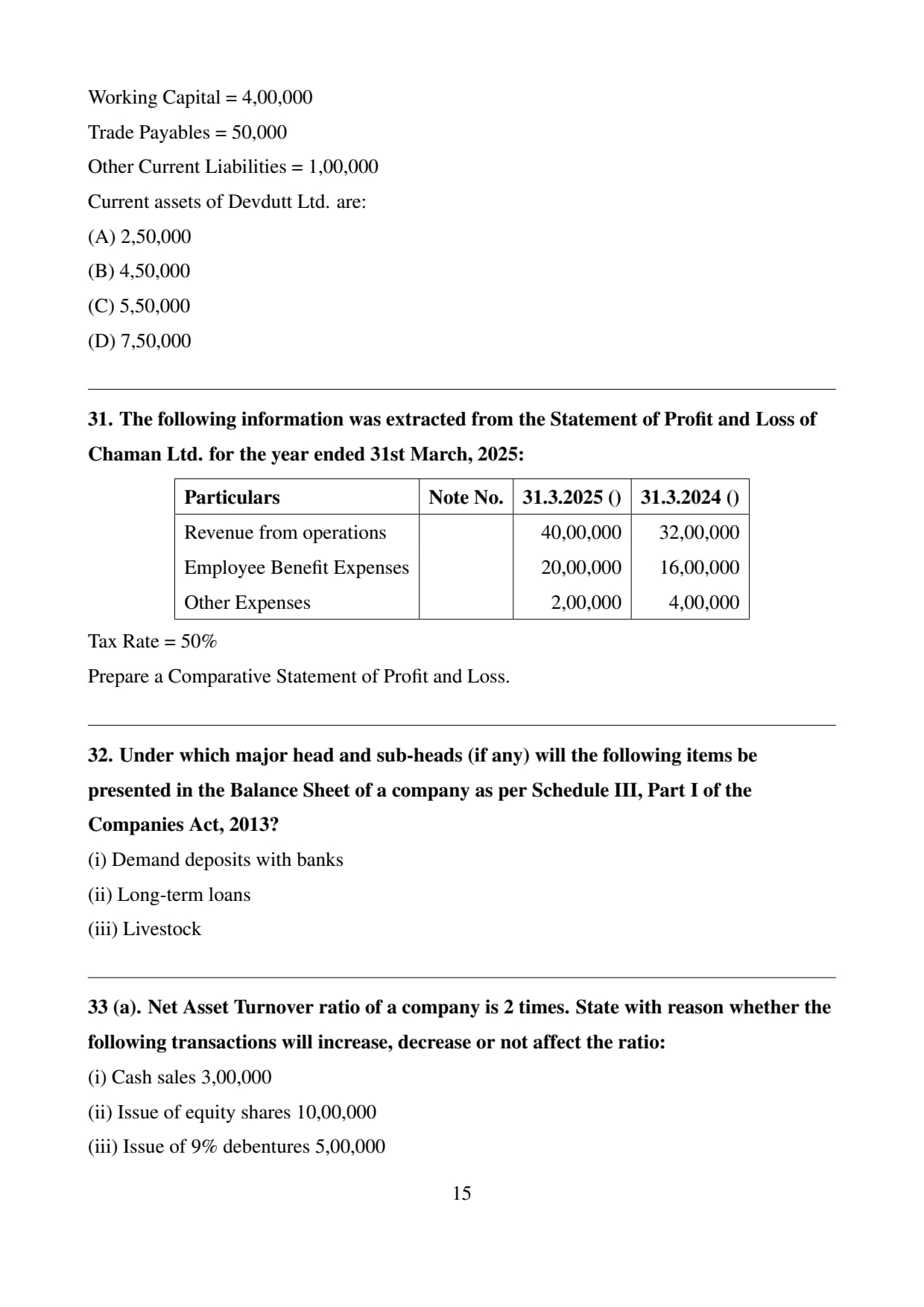
The following information was extracted from the Statement of Profit and Loss of Chaman Ltd. for the year ended 31st March, 2025:
\begin{tabular{|l|c|r|r|
Particulars & Note No. & 31.3.2025 (₹) & 31.3.2024 (₹)
Revenue from operations & & 40,00,000 & 32,00,000
Employee Benefit Expenses & & 20,00,000 & 16,00,000
Other Expenses & & 2,00,000 & 4,00,000
Tax Rate = 50%
Prepare a Comparative Statement of Profit and Loss.
View Solution
Step 1: Calculate Profit Before Tax (PBT)
For 2025: \[ Total Expenses = 20,00,000 + 2,00,000 = 22,00,000 \] \[ PBT = 40,00,000 - 22,00,000 = 18,00,000 \]
For 2024: \[ Total Expenses = 16,00,000 + 4,00,000 = 20,00,000 \] \[ PBT = 32,00,000 - 20,00,000 = 12,00,000 \]
Step 2: Calculate Tax (50%)
2025 Tax = 9,00,000
2024 Tax = 6,00,000
Step 3: Profit After Tax (PAT)
2025 PAT = 18,00,000 – 9,00,000 = 9,00,000
2024 PAT = 12,00,000 – 6,00,000 = 6,00,000
Comparative Statement of Profit and Loss
\begin{tabular{|l|r|r|r|r|
Particulars & 2025 (₹) & 2024 (₹) & Absolute Change (₹) & % Change
Revenue from Operations & 40,00,000 & 32,00,000 & +8,00,000 & +25%
Employee Benefit Expenses & 20,00,000 & 16,00,000 & +4,00,000 & +25%
Other Expenses & 2,00,000 & 4,00,000 & -2,00,000 & -50%
Profit Before Tax & 18,00,000 & 12,00,000 & +6,00,000 & +50%
Tax (50%) & 9,00,000 & 6,00,000 & +3,00,000 & +50%
Profit After Tax & 9,00,000 & 6,00,000 & +3,00,000 & +50%
Quick Tip: Steps for Comparative P\&L: 1. Calculate totals and profit for both years. 2. Find absolute change = Current year – Previous year. 3. Percentage change = (Change ÷ Previous year) × 100. Always compute tax before final PAT comparison.
Under which major head and sub-heads (if any) will the following items be presented in the Balance Sheet of a company as per Schedule III, Part I of the Companies Act, 2013?
(i) Demand deposits with banks
(ii) Long-term loans
(iii) Livestock
View Solution
Concept:
As per Schedule III (Part I), items in the Balance Sheet are classified under:
1. Equity and Liabilities
2. Assets
Each is further divided into major heads and sub-heads.
(i) Demand Deposits with Banks
These are highly liquid funds available on demand.
Major Head: Current Assets
Sub-head: Cash and Cash Equivalents
(ii) Long-term Loans
Loans repayable after 12 months are treated as non-current liabilities.
Major Head: Non-current Liabilities
Sub-head: Long-term Borrowings
(iii) Livestock
Livestock is a tangible resource used in operations.
Major Head: Non-current Assets
Sub-head: Property, Plant and Equipment (PPE)
Final Classification Summary:
\begin{tabular{|l|l|l|
Item & Major Head & Sub-head
Demand deposits with banks & Current Assets & Cash and Cash Equivalents
Long-term loans & Non-current Liabilities & Long-term Borrowings
Livestock & Non-current Assets & Property, Plant and Equipment
Quick Tip: Schedule III Memory Trick: • Liquid within 12 months → Current Assets • Payable after 12 months → Non-current Liabilities • Tangible long-term assets → PPE under Non-current Assets
Net Asset Turnover ratio of a company is 2 times. State with reason whether the following transactions will increase, decrease or not affect the ratio:
(i) Cash sales ₹3,00,000
(ii) Issue of equity shares ₹10,00,000
(iii) Issue of 9% debentures ₹5,00,000
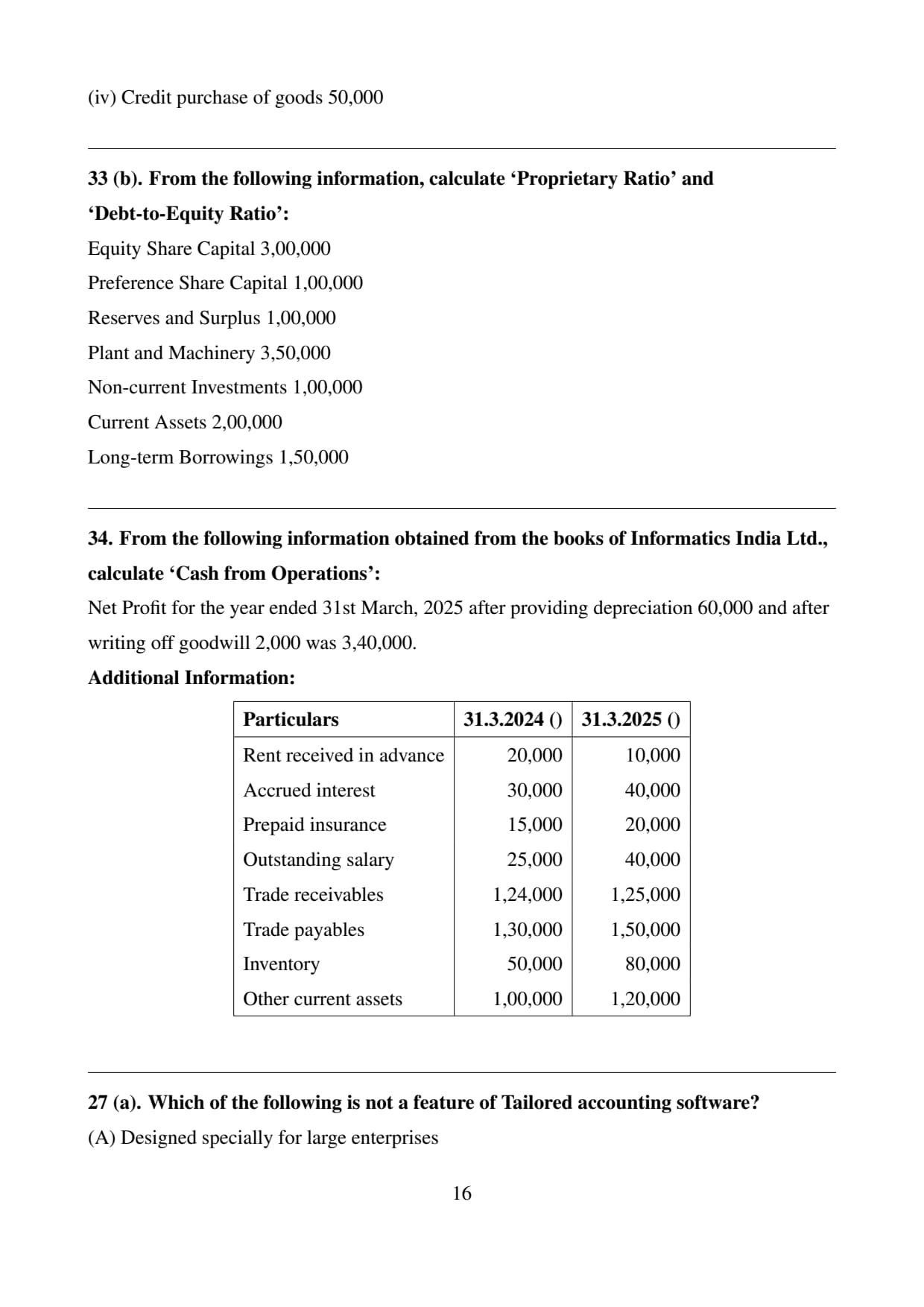
(iv) Credit purchase of goods ₹50,000
View Solution
Concept:
\[ Net Asset Turnover Ratio = \frac{Net Sales}{Net Assets} \]
Where Net Assets = Total Assets – Current Liabilities
(i) Cash Sales ₹3,00,000
Sales increase, but assets (cash) also increase by same amount.
Both numerator and denominator increase proportionately.
Effect: No change
(ii) Issue of Equity Shares ₹10,00,000
Assets increase (cash inflow), but sales remain unchanged.
Denominator increases only.
Effect: Decrease in ratio
(iii) Issue of 9% Debentures ₹5,00,000
Assets increase due to cash inflow, while sales remain same.
Net assets increase.
Effect: Decrease in ratio
(iv) Credit Purchase of Goods ₹50,000
Inventory increases and creditors increase equally.
Net assets remain unchanged.
Effect: No change
Final Answer Summary:
\begin{tabular{|l|l|
Transaction & Effect on Ratio
Cash sales & No change
Issue of equity shares & Decrease
Issue of debentures & Decrease
Credit purchase & No change
Quick Tip: Net Asset Turnover Logic: • If assets increase without sales → Ratio falls • If sales increase proportionately → No change • Equal increase in asset and liability → No change
From the following information, calculate ‘Proprietary Ratio’ and ‘Debt-to-Equity Ratio’:
Equity Share Capital ₹3,00,000
Preference Share Capital ₹1,00,000
Reserves and Surplus ₹1,00,000
Plant and Machinery ₹3,50,000
Non-current Investments ₹1,00,000
Current Assets ₹2,00,000
Long-term Borrowings ₹1,50,000
View Solution
Step 1: Calculate Total Assets
\[ Total Assets = 3,50,000 + 1,00,000 + 2,00,000 = 6,50,000 \]
Step 2: Proprietor’s Funds
\[ Equity Share Capital = 3,00,000 \] \[ Preference Share Capital = 1,00,000 \] \[ Reserves = 1,00,000 \]
\[ Total Proprietor’s Funds = 5,00,000 \]
Step 3: Proprietary Ratio
\[ Proprietary Ratio = \frac{Proprietor’s Funds}{Total Assets} = \frac{5,00,000}{6,50,000} \]
\[ = 0.77 or 77% \]
Step 4: Debt-Equity Ratio
Debt = Long-term Borrowings = 1,50,000
Equity = Shareholders’ funds = 5,00,000
\[ Debt-Equity Ratio = \frac{1,50,000}{5,00,000} = 0.3 : 1 \]
Final Answers:
Proprietary Ratio = 0.77 (77%)
Debt-Equity Ratio = 0.3 : 1 Quick Tip: Formulas: • Proprietary Ratio = Shareholders’ Funds ÷ Total Assets • Debt-Equity Ratio = Long-term Debt ÷ Shareholders’ Funds Include preference capital in shareholders’ funds unless stated otherwise.
From the following information obtained from the books of Informatics India Ltd., calculate ‘Cash from Operations’:
Net Profit for the year ended 31st March, 2025 after providing depreciation ₹60,000 and after writing off goodwill ₹2,000 was ₹3,40,000.
Additional Information:
\begin{tabular{|l|r|r|
Particulars & 31.3.2024 (₹) & 31.3.2025 (₹)
Rent received in advance & 20,000 & 10,000
Accrued interest & 30,000 & 40,000
Prepaid insurance & 15,000 & 20,000
Outstanding salary & 25,000 & 40,000
Trade receivables & 1,24,000 & 1,25,000
Trade payables & 1,30,000 & 1,50,000
Inventory & 50,000 & 80,000
Other current assets & 1,00,000 & 1,20,000
View Solution
Step 1: Start with Net Profit
Net Profit = ₹3,40,000
Add non-cash expenses: \[ Depreciation = 60,000 \] \[ Goodwill written off = 2,000 \]
\[ Operating Profit before WC changes = 3,40,000 + 62,000 = 4,02,000 \]
Step 2: Adjust Changes in Current Assets
Increase in current asset → Deduct
Decrease → Add
Trade receivables increase = 1,000 (Deduct)
Inventory increase = 30,000 (Deduct)
Prepaid insurance increase = 5,000 (Deduct)
Accrued interest increase = 10,000 (Deduct)
Other current assets increase = 20,000 (Deduct)
Total deduction = 66,000
Step 3: Adjust Changes in Current Liabilities
Increase → Add
Decrease → Deduct
Trade payables increase = 20,000 (Add)
Outstanding salary increase = 15,000 (Add)
Rent received in advance decrease = 10,000 (Deduct)
Net addition = 25,000
Step 4: Cash from Operations
\[ 4,02,000 - 66,000 + 25,000 \]
\[ = 3,61,000 \]
Cash from Operations = ₹3,61,000 Quick Tip: Cash from Operations Steps: 1. Start with Net Profit. 2. Add non-cash expenses (depreciation, goodwill write-off). 3. Adjust working capital changes: • Increase in current assets → Deduct • Increase in current liabilities → Add
Which of the following is not a feature of Tailored accounting software?
View Solution
Concept: Tailored Accounting Software
Tailored software is custom-built according to the specific needs of an organization.
Analysis of Options:
(A) Designed for large enterprises → True feature (custom solutions)
(B) Requires minimal support → Not true. Tailored software needs continuous technical support.
(C) Requires special training → True (custom interface).
(D) Needs technical installation → True (custom deployment).
Hence, the correct answer is:
\[ \boxed{(B)} \] Quick Tip: Tailored Software Features: • Custom-made for specific organizations • Requires training and technical support • High cost but highly flexible
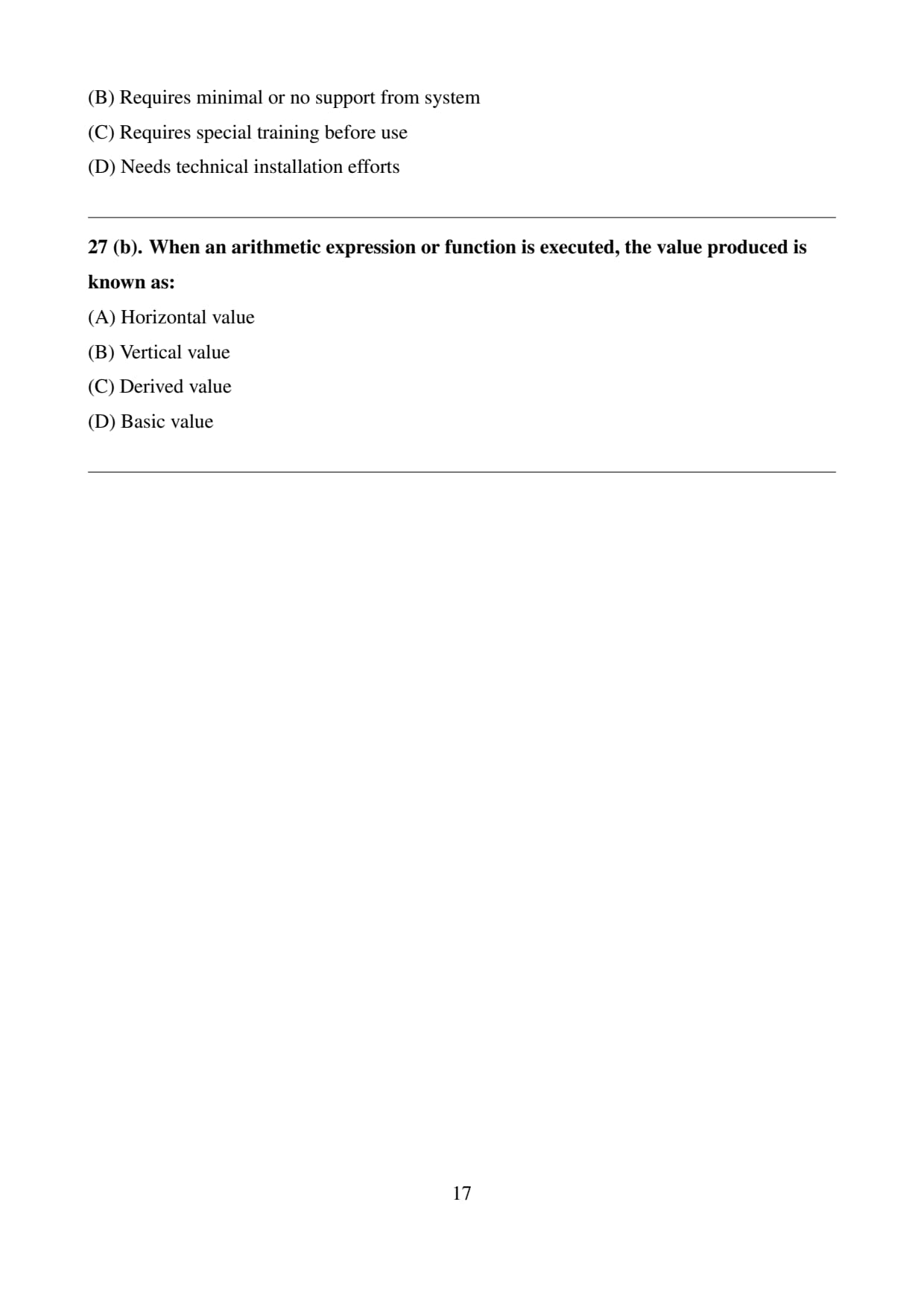
When an arithmetic expression or function is executed, the value produced is known as:
View Solution
Concept: Spreadsheet Terminology
In spreadsheet applications:
• A value obtained after applying formulas or functions is called a derived value.
Explanation:
• Horizontal/Vertical values are not technical terms.
• Basic value refers to original data input.
• Derived value refers to computed output from formulas.
Therefore, the correct answer is:
\[ \boxed{(C)\ Derived value} \] Quick Tip: Spreadsheet Terms: • Basic value → Entered data • Derived value → Calculated result using formulas/functions



Comments