




The CBSE conducted the Class 12 Physics Board Exam on February 21, 2025, from 10:30 AM to 1:30 PM. The Physics theory paper has 70 marks, while 30 marks are allocated for the practical assessment.
The question paper includes multiple-choice questions (1 mark each), short-answer questions (2-3 marks each), and long-answer questions (5 marks each).
Latest- Download CBSE Class 12 Question Papers for all subjects
CBSE Class 12 Physics 55-2-2 Question Paper and Detailed Solutions PDF is available for download here.
CBSE Class 12 2025 Physics 55-2-2 Question Paper with Solution PDF
| CBSE Class 12 Physics Question Paper With Answer Key | Download | Check Solutions |

Two identical point charges are placed at the two vertices A and B of an equilateral triangle of side \( l \). The magnitude of the electric field at the third vertex P is \( E \). If a hollow conducting sphere of radius \( l/4 \) is placed at P, the magnitude of the electric field at point P now becomes:
View Solution
A battery of e.m.f. 12 V and internal resistance 0.5 \( \Omega \) is connected to a 9.5 \( \Omega \) resistor through a key. The ratio of potential difference between the two terminals of the battery, when the key is open to that when the key is closed, is:
View Solution
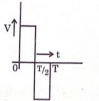
The alternating current \( I \) in an inductor is observed to vary with time \( t \) as shown in the graph for a cycle.
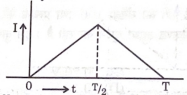
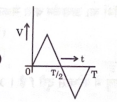
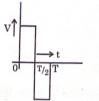
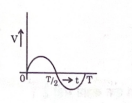
Which one of the following graphs is the correct representation of wave form of voltage \( V \) with time \( t \)?
- (A)
![]()
- (B)
![]()
- (C)
![]()
- (D)
![]()

A diamagnetic substance is brought, one by one, near the north pole and the south pole of a bar magnet. It is:
View Solution
Two long solenoids of radii \( r_1 \) and \( r_2 \) (\( > r_1 \)) and number of turns per unit length \( n_1 \) and \( n_2 \) respectively are co-axially wrapped one over the other. The ratio of self-inductance of inner solenoid to their mutual inductance is:
View Solution
A 1 cm straight segment of a conductor carrying 1 A current in \( x \)-direction lies symmetrically at the origin of Cartesian coordinate system. The magnetic field due to this segment at point (1m, 1m, 0) is:
View Solution
A coil of an AC generator, having 100 turns and area 0.1 m² each, rotates at half a rotation per second in a magnetic field of 0.02 T. The maximum emf generated in the coil is:
View Solution
Atomic spectral emission lines of hydrogen atom are incident on a zinc surface. The lines which can emit photoelectrons from the surface are members of:
View Solution
The focal length of a concave mirror in air is \( f \). When the mirror is immersed in a liquid of refractive index \( \frac{3}{5} \), its focal length will become:
View Solution
Which one of the following statements is correct?
Electric field due to static charges is:
View Solution
When the resistance measured between p and n ends of a p-n junction diode is high, it can act as a/an:
View Solution
The energy of an electron in a hydrogen atom in ground state is -13.6 eV. Its energy in an orbit corresponding to quantum number \( n \) is -0.544 eV. The value of \( n \) is:
View Solution
Assertion (A): Out of Infrared and radio waves, the radio waves show more diffraction effect.
Reason (R): Radio waves have greater frequency than infrared waves.
View Solution
Assertion (A): In an ideal step-down transformer, the electrical energy is not lost.
Reason (R): In a step-down transformer, voltage decreases but the current increases.
View Solution
Assertion (A): In Bohr model of hydrogen atom, the angular momentum of an electron in \( n \)th orbit is proportional to the square root of its orbit radius \( r_n \).
Reason (R): According to Bohr model, electron can jump to its nearest orbits only.
View Solution
Assertion (A): In a semiconductor diode, the thickness of the depletion layer is not fixed.
Reason (R): Thickness of depletion layer in a semiconductor device depends upon many factors such as biasing of the semiconductor.
View Solution
The threshold voltage of a silicon diode is 0.7 V. It is operated at this point by connecting the diode in series with a battery of \( V \) volt and a resistor of 1000 \( \Omega \). Find the value of \( V \) when the current drawn is 15 mA.
View Solution
Show the refraction of light wave at a plane interface using Huygens' principle and prove Snell's law.
View Solution
Two convex lenses A and B, each of focal length 10.0 cm, are mounted on an optical bench at 50.0 cm and 70.0 cm respectively. An object is mounted at 20.0 cm. Find the nature and position of the final image formed by the combination.
View Solution
Radiations of two frequencies are incident on a metal surface of work function 2.0 eV one by one. The energies of their photons are 2.5 eV and 4.5 eV respectively. Find the ratio of the maximum speed of the electrons emitted in the two cases.
View Solution
(a) Two wires of the same material and the same radius have their lengths in the ratio 2:3. They are connected in parallel to a battery which supplies a current of 15 A. Find the current through the wires.
View Solution
In the circuit, three ideal cells of e.m.f. \( V \), \( V \), and \( 2V \) are connected to a resistor of resistance \( R \), a capacitor of capacitance \( C \), and another resistor of resistance \( 2R \) as shown in the figure. In the steady state, find (i) the potential difference between P and Q, (ii) the potential difference across capacitor C.
View Solution
(a) Define resistivity of a conductor. Discuss its dependence on temperature of the conductor and draw a plot of resistivity of copper as a function of temperature.
View Solution
"A low voltage battery from which high current is required must have low internal resistance." Justify.
View Solution
"A high voltage battery must have a large internal resistance." Justify.
View Solution
(a) When a parallel beam of light enters water surface obliquely at some angle, what is the effect on the width of the beam?
View Solution
With the help of a ray diagram, show that a straw appears bent when it is partly dipped in water and explain it.
View Solution
Differentiate between the peak value and root mean square value of an alternating current. Derive the expression for the root mean square value of alternating current, in terms of its peak value.
View Solution
(a) How is an electromagnetic wave produced?
View Solution
An electromagnetic wave is travelling in vertically upward direction. At an instant, its electric field vector points in west direction. In which direction does the magnetic field vector point at that instant?
View Solution
Estimate the ratio of shortest wavelength of radio waves to the longest wavelength of gamma waves.
View Solution
(a) In a region of a uniform electric field \( \mathbf{E} \), a negatively charged particle is moving with a constant velocity \( \mathbf{v} = -v_0 \hat{i} \) near a long straight conductor coinciding with XX' axis and carrying current \( I \) towards -X axis. The particle remains at a distance \( d \) from the conductor.
View Solution
What are the various forces acting on the charged particle?
View Solution
Find the value of \( v_0 \) in terms of \( E \), \( d \), and \( I \).
View Solution
Two infinitely long conductors kept along XX' and YY' axes are carrying current \( I_1 \) and \( I_2 \) along -X axis and -Y axis respectively. Find the magnitude and direction of the net magnetic field produced at point P(X, Y).
View Solution
(a) What are majority and minority charge carriers in an extrinsic semiconductor?
View Solution
A p-n junction is forward biased. Describe the movement of the charge carriers which produce current in it.
View Solution
The graph shows the variation of current with voltage for a p-n junction diode. Estimate the dynamic resistance of the diode at \( V = -0.6 \) V.
View Solution
Show the variation of binding energy per nucleon with mass number. Write the significance of the binding energy curve.
View Solution
Two nuclei with lower binding energy per nucleon form a nucleus with more binding energy per nucleon.
(i) What type of nuclear reaction is it?
View Solution
Whether the total mass of nuclei increases, decreases or remains unchanged?
View Solution
Does the process require energy or produce energy?
View Solution
The straight line graphs obtained for two metals:
View Solution
The graph between \( V_0 \) and \( \nu \) for two metals shows that both graphs are straight lines, indicating a linear relationship between the stopping potential and frequency. Since the slope of the graph is constant, the lines are parallel to each other.
Thus, the correct answer is (B), as the straight line graphs obtained for two metals are parallel to each other. Quick Tip: In the photoelectric effect, the stopping potential is linearly related to the frequency of the incident light, and the graphs for different metals are parallel.
The value of Planck's constant for this metal is:
View Solution
From the equation \( eV_0 = h(\nu - \nu_0) \), comparing it with the equation of a straight line \( y = mx + c \), the slope \( m \) is given by:
\[ m = \frac{h}{e} \]
This shows that Planck’s constant \( h \) can be expressed as \( h = e \times m \), where \( m \) is the slope of the graph and \( e \) is the charge of the electron. Thus, the correct value of Planck's constant for this metal is \( \frac{e}{m} \). Quick Tip: The slope of the \( V_0 \) vs \( \nu \) graph gives the value of Planck's constant.
The intercepts on \( \nu \)-axis and \( V_0 \)-axis of the graph are respectively:
View Solution
The intercept on the \( V_0 \)-axis is \( V_0 \) when \( \nu = \nu_0 \), and the intercept on the \( \nu \)-axis occurs when \( V_0 = 0 \). Thus:
- The intercept on the \( V_0 \)-axis gives the stopping potential \( V_0 \) corresponding to \( \nu = \nu_0 \).
- The intercept on the \( \nu \)-axis gives \( \nu_0 \), the threshold frequency.
Thus, the intercepts on the axes are \( \frac{h \nu_0}{e} \) for the \( V_0 \)-axis and \( \nu_0 \) for the \( \nu \)-axis. Quick Tip: The intercepts on the \( V_0 \)-axis and \( \nu \)-axis provide useful information about the threshold frequency and stopping potential.
When the wavelength of a photon is doubled, how many times its wave number and frequency become, respectively?
View Solution
The wavelength \( \lambda \) and frequency \( \nu \) of a photon are related by the equation:
\[ c = \lambda \nu \]
Where:
- \( c \) is the speed of light,
- \( \lambda \) is the wavelength,
- \( \nu \) is the frequency.
When the wavelength \( \lambda \) is doubled, the frequency \( \nu \) becomes halved, because the speed of light \( c \) is constant. Therefore:
\[ \nu' = \frac{\nu}{2} \]
The wave number \( k \), which is the reciprocal of the wavelength, is given by:
\[ k = \frac{1}{\lambda} \]
When the wavelength is doubled, the wave number becomes halved:
\[ k' = \frac{k}{2} \]
Thus, the wave number becomes \( \frac{1}{2} \) times, and the frequency becomes \( \frac{1}{2} \) times.
Thus, the correct answer is:
Correct Answer: (B) \( \frac{1}{2} \), \( \frac{1}{2} \) Quick Tip: When the wavelength of a photon is doubled, its frequency and wave number both decrease by a factor of 2.
The momentum of a photon is \( 5.0 \times 10^{-29} \, kg \cdot m/s \). Ignoring relativistic effects (if any), the wavelength of the photon is:
View Solution
The momentum \( p \) of a photon is related to its wavelength \( \lambda \) by the equation:
\[ p = \frac{h}{\lambda} \]
Where \( h \) is Planck's constant. Rearranging for \( \lambda \):
\[ \lambda = \frac{h}{p} \]
Substituting the known values:
- \( h = 6.626 \times 10^{-34} \, J \cdot s \),
- \( p = 5.0 \times 10^{-29} \, kg \cdot m/s \).
\[ \lambda = \frac{6.626 \times 10^{-34}}{5.0 \times 10^{-29}} = 1.33 \times 10^{-5} \, m = 13.3 \, \mum \]
Thus, the wavelength of the photon is:
Correct Answer: (D) 13.3 m Quick Tip: The wavelength of a photon can be calculated from its momentum using the formula \( \lambda = \frac{h}{p} \).
The electric field between the plates of a parallel plate capacitor is \( E \). Now the separation between the plates is doubled and simultaneously the applied potential difference between the plates is reduced to half of its initial value. The new value of the electric field between the plates will be:
View Solution
The electric field \( E \) between the plates of a parallel plate capacitor is given by:
\[ E = \frac{V}{d} \]
Where:
- \( V \) is the potential difference across the plates,
- \( d \) is the separation between the plates.
When the separation \( d \) is doubled, and the potential difference \( V \) is reduced to half, the new electric field \( E' \) is given by:
\[ E' = \frac{V/2}{2d} = \frac{E}{2} \]
Thus, the new electric field between the plates will be half of the initial value, corresponding to option (D). Quick Tip: The electric field in a parallel plate capacitor is directly proportional to the potential difference and inversely proportional to the separation between the plates.
A constant electric field is to be maintained between the two plates of a capacitor whose separation \( d \) changes with time. Which of the graphs correctly depict the potential difference (V) to be applied between the plates as a function of separation between the plates (\( d \)) to maintain the constant electric field?
View Solution
The electric field \( E \) between the plates of a parallel plate capacitor is related to the potential difference and separation by:
\[ E = \frac{V}{d} \]
To maintain a constant electric field, the potential difference \( V \) must be directly proportional to the separation \( d \). Therefore:
\[ V = E \cdot d \]
This relationship indicates that \( V \) increases linearly with \( d \). Hence, the graph of \( V \) versus \( d \) will be a straight line, confirming that option (C) is correct. Quick Tip: To maintain a constant electric field in a parallel plate capacitor, the potential difference must be proportional to the separation between the plates.
In the above figure, P and Q are the two parallel plates of a capacitor. Plate Q is at positive potential with respect to plate P. MN is an imaginary line drawn perpendicular to the plates. Which of the graphs shows correctly the variations of the magnitude of electric field strength \( E \) along the line MN?
View Solution
The electric field between two parallel plates of a capacitor is uniform and directed from the positive to the negative plate. Between the plates, the electric field is constant. Outside the plates, the electric field is zero.
In the given diagram, plate Q is at a positive potential, and plate P is at a negative potential. The electric field is directed from plate Q to plate P. Along the line MN, which is perpendicular to the plates, the electric field strength will be uniform between the plates and zero outside.
Thus, the correct graph showing the electric field strength variation would be a constant value between the plates, and zero outside the plates. This corresponds to option (B). Quick Tip: The electric field between two parallel plates of a capacitor is uniform, and it is zero outside the plates.
Three parallel plates are placed above each other with equal displacement \( d \) between neighbouring plates. The electric field between the first pair of the plates is \( E_1 \), and the electric field between the second pair of the plates is \( E_2 \). The potential difference between the third and the first plate is:
View Solution
The potential difference between two plates is given by the product of the electric field and the separation between the plates.
If \( E_1 \) is the electric field between the first pair of plates and \( E_2 \) is the electric field between the second pair of plates, then the potential difference between the first and third plates is the sum of the individual potential differences across the two sections.
The potential difference between the plates is:
\[ V = E_1 \cdot \frac{d}{2} + E_2 \cdot \frac{d}{2} = \frac{d(E_1 + E_2)}{2} \]
Thus, the correct answer is \( \frac{d(E_1 + E_2)}{2} \), corresponding to option (D). Quick Tip: For multiple parallel plates, the potential difference between the plates is the sum of the potential differences across each section of the capacitor.
A material of dielectric constant \( K \) is filled in a parallel plate capacitor of capacitance \( C \). The new value of its capacitance becomes:
View Solution
When a dielectric material of dielectric constant \( K \) is inserted into a parallel plate capacitor, the capacitance increases by a factor of \( K \). The new capacitance \( C' \) is given by:
\[ C' = K \cdot C \]
Thus, the new capacitance becomes \( CK \), corresponding to option (C). Quick Tip: The capacitance of a parallel plate capacitor increases by a factor equal to the dielectric constant when a dielectric material is inserted.
(a) (i) A thin pencil of length \( f/4 \) is placed coinciding with the principal axis of a mirror of focal length \( f \). The image of the pencil is real and enlarged, just touches the pencil. Calculate the magnification produced by the mirror.
View Solution
A ray of light is incident on a refracting face AB of a prism ABC at an angle of \( 45^\circ \). The ray emerges from face AC and the angle of deviation is \( 15^\circ \). The angle of prism is \( 30^\circ \). Show that the emergent ray is normal to the face AC from which it emerges out. Find the refraction index of the material of the prism.
View Solution
Light consisting of two wavelengths 600 nm and 480 nm is used to obtain interference fringes in a double slit experiment. The screen is placed 1.0 m away from slits which are 1.0 mm apart.
(i) Calculate the distance of the third bright fringe on the screen from the central maximum for wavelength 600 nm.
View Solution
Find the least distance from the central maximum where the bright fringes due to both the wavelengths coincide.
View Solution
(a) (i) A small conducting sphere A of radius \( r \) charged to a potential \( V \), is enclosed by a spherical conducting shell B of radius \( R \). If A and B are connected by a thin wire, calculate the final potential on sphere A and shell B.
View Solution
Write two characteristics of equipotential surfaces. A uniform electric field of 50 NC\(^{-1}\) is set up in a region along the \( x \)-axis. If the potential at the origin \( (0, 0) \) is 220 V, find the potential at a point \( (4m, 3m) \).
View Solution
What is the difference between an open surface and a closed surface?
View Solution
Define electric flux through a surface. Give the significance of a Gaussian surface. A charge outside a Gaussian surface does not contribute to total electric flux through the surface. Why?
View Solution
A small spherical shell \( S_1 \) has point charges \( q_1 = -3 \, \mu C \), \( q_2 = -2 \, \mu C \) and \( q_3 = 9 \, \mu C \) inside it. This shell is enclosed by another big spherical shell \( S_2 \). A point charge \( Q \) is placed in between the two surfaces \( S_1 \) and \( S_2 \). If the electric flux through the surface \( S_2 \) is four times the flux through surface \( S_1 \), find charge \( Q \).
View Solution
(a) (i) What is the source of force acting on a current-carrying conductor placed in a magnetic field? Obtain the expression for the force acting between two long straight parallel conductors carrying steady currents and hence define Ampère’s law.
View Solution
A point charge \( q \) is moving with velocity \( \mathbf{v} \) in a uniform magnetic field \( \mathbf{B} \). Find the work done by the magnetic force on the charge.
View Solution
Explain the necessary conditions in which the trajectory of a charged particle is helical in a uniform magnetic field.
View Solution
A current-carrying loop can be considered as a magnetic dipole placed along its axis. Explain.
View Solution
Obtain the relation for magnetic dipole moment \( \mathbf{M} \) of a current-carrying coil. Give the direction of \( \mathbf{M} \).
View Solution
A current-carrying coil is placed in an external uniform magnetic field. The coil is free to turn in the magnetic field. What is the net force acting on the coil? Obtain the orientation of the coil in stable equilibrium. Show that in this orientation the flux of the total field (field produced by the loop + external field) through the coil is maximum.
View Solution



Comments