



Content Curator
Starch is a white powder carbohydrate that is considered an important component of a diet. Starch is odourless and tasteless carbohydrate insoluble in alcohol, cold waters, and many other solvents. Starch is made up of 1,4 glycosidic linkage between glucose monomers. The molecular formula of starch is (C6H10O5)n. It is found in our daily eatable substances like corn, rice, and potato.
Starch is a long-chain polymer made up of sugar molecules connected through glycosidic linkage. Starch comprises two-parts - Amylose and Amylopectin. Amylose is a linear polymer part of the starch, whereas Amylopectin is a branched part.
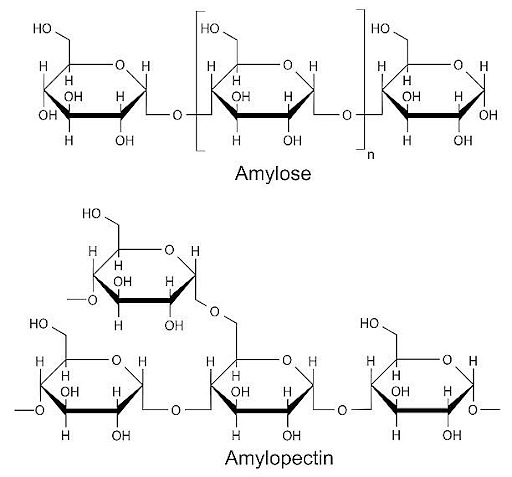
Structure of Starch
Starch with water forms a lyophilic solution when heated. This lyophilic solution is prepared by heating a mixture of starch and water at 100oC. The Hydroxide Group (OH) forms a hydrogen bonding with a water molecule in a solution.
| Table of Content |
Key Terms: Starch, Colloidal Solution, Colloids, Glycosidic Linkage, Lyophilic Colloidal Solution
Aim
[Click Here for Sample Questions]
To prepare a lyophilic colloidal solution of Starch.
Also Read: To prepare a colloidal solution of egg albumin
Theory
[Click Here for Sample Questions]
Starch when heated with a dispersion medium such as water forms a colloidal solution. This solution is accelerated by heating. The mixture of starch and water gets heated at about 100o temperature. In this solution, water acts as a dispersion medium. The solution is stable in the dispersion medium and remains unaffected by the electrolytic impurity.
Read More:
| Related Articles | ||
|---|---|---|
| All about solutions | Types of solutions | Electrolytic cell |
Materials Required
[Click Here for Sample Questions]
- 500 gm starch
- Distilled water
- Filter paper
- Beaker (about 50 to 250 mL)
- Glass rod
- Tripod stand
- Funnel
- Wire gauze
- Pestle and mortar
- Burner
Procedure
[Click Here for Sample Questions]
- To prepare a 100 mL solution in water, take about 0.5 to 1 gm of starch.
- Take this amount of starch and pour it into a mortar. Then, pour a few drops of distilled water. Now, with the help of a pestle, crush the starch into a paste.
- Add this paste to a 50mL beaker.
- In the next step, take a 250mL beaker and 100mL of distilled water in it. Place the wire gauze on the tripod stand and put the burner under it.
- On the burner and place the 250mL beaker (filled with 100mL water) on wire gauze. Let the beaker heat till water starts boiling.
- As soon as the water starts boiling, start adding a paste of starch (kept in a 50mL beaker). Keep stirring the mixture by using the glass rod. Boil the mixture for 10 minutes.
- After boiling, keep the mixture to get cool.
- When the beaker gets cool, filter the solution. For filtering, place a filter paper inside a funnel. Pour the solution with the help of filter paper and collect it into another beaker.
- The filtered content collected is a lyophilic starch solution.
Read More:
| Related Topics | ||
|---|---|---|
Precautions To Be Taken
[Click Here for Sample Questions]
While performing this experiment, we need to take care of some instructions to protect ourselves. The precautions to take while performing are given below:
- First, ensure the beakers, mortar, and other apparatus used for the experiment are cleaned. Any kind of impurities or dirt that remains in the apparatus may lead the experiment to be unsuccessful.
- The starch and water you are using must be of good quality. Before using make sure, the starch is white and properly clean. Use distilled water only for an experiment.
- While making a paste of starch in mortar make sure it is a fine thin paste and does not contain granules.
- Never add the paste of starch to cold water. Wait till the water starts boiling.
- While adding a starch paste, add it slowly making a thin stream to boiling water.
- Continuously stir the solution to avoid the formation of precipitates. Stir till the contents get completely dissolved in water.
Things to Remember
- Starch is a long-chain polymer made up of sugar molecules connected through glycosidic linkage.
- Starch when heated with a dispersion medium such as water forms a colloidal solution.
- Colloids are mixtures where microscopic insoluble particles of one substance are dispersed in another substance.
- Starch solution is stable in the dispersion medium and remains unaffected by the electrolytic impurity.
Read More:
| Relevant Articles | ||
|---|---|---|
Sample Questions
Ques 1. What do you mean by colloidal? [1 mark]
Ans. A colloidal or colloidal solution is defined as a solution prepared by suspending the substance consisting of dispersed insoluble particles throughout another substance. It is also known as a colloidal suspension.
Ques 2. What is a lyophilic solution? Give two examples. [1 mark]
Ans. The lyophilic solution is a solution prepared by direct mixing of substances in dispersing medium. Some examples of lyophilic solutions are Starch and Rubber.
Ques 3. Why are lyophilic solutions reversible? [1 mark]
Ans. A lyophilic solution is reversible because the dispersion medium of a solution can be isolated from colloidal by evaporation.
Ques 4. What is the basic difference between the lyophilic and lyophobic solution? [1 mark]
Ans. Lyophilic solutions are solvents-loving solutions in which a solute particle is solvated by solvent particles. Whereas lyophobic solution is solvent hating solution in which the solution is stabilized colloidal particle charges instead of salvation.
Ques 5. Why is starch pestle into a thin paste while preparing colloidal solution? [1 mark]
Ans. Starch is pestle into thin paste because the particles of paste are quite large enough to form a colloidal solution with water.
Ques 6. Why do we continuously stir the solution? [1 mark]
Ans. To prevent the precipitate formation we continuously stir the solution.
Ques 7. What is starch? Name the two components of starch. [1 mark]
Ans. Starch is a long-chain polymer made up of sugar molecules connected through glycosidic linkage. It is a white-colored, tasteless, odorless carbohydrate present in corn, rice, and potato. The molecular formula of starch is (C6H10O5)n. The two components of starch are - Amylose and Amylopectin.
Ques 8. Why is the starch colloidal solution lyophilic in nature? [1 mark]
Ans. The colloidal solution of starch contains starch molecules that are dispersed in water. There is a strong affection between the water and starch molecules. The OH group present in a starch interact with water molecules resulting in the formation of hydrogen bonding.
Ques 9. Why is starch dissolved in hot water but not in cold water? [1 mark]
Ans. Starch is soluble in hot water. The semi-crystalline structure of starch becomes loose and the amylose starts forming a network with water molecules through hydrogen bonding.
Ques 10. How can we prepare a starch colloidal solution? [1 mark]
Ans. To prepare a starch colloidal solution, add 1 gm of starch (obtained either from corn or potato) to 10mL of distilled water. Stir the solution properly. Then add it to 100 mL distilled boiling water. Stir the solution continuously and keep it boiling for 10 minutes. Keep it to cool. Filter the solution using filter paper. The filtered content collected is a starch colloidal solution.
Check-Out:




Comments