



Content Curator
Quantitative Analysis method is used to determine the quantity of a given substance. In this process, the known substance is dissolved in an unknown composition of water to form a precipitate. The formed precipitate is then isolated, dried and weighed.
| Table of Content |
Key Terms: Quantitative Analysis, Carbon, Hydrogen, Ion, wate, Chemical analysis, compound mass, percentage mass, atmosphere
Quantitative Analysis
[Click Here for Sample Questions]
Quantitative Analysis is a method that is used to determine the percentage of a particular element or ion in a sample.
Several methods are used to determine Quantitative Analysis. These methods use both physical and chemical properties of the substance. Gravimetric Quantitative Analysis is a chemical analysis method that has great significance. This analysis can be used to determine the percentage of a particular element or ion in a given sample.
With the help of the chemical formula along with the mass of the precipitate, the mass of the ion of interest can be determined from the percentage mass composition of the precipitate. The ion of the present interest within the main compound can further be calculated from the mass of the ion of interest and the original compound mass.
Also Read: Electrochemistry
Quantitative Analysis of Organic Compounds
[Click Here for Sample Questions]
The estimation of the percentage composition of the various elements present in a compound helps in determining the formula of the compound. The different methods that are used for the estimation of various elements are described below:
Estimation of Carbon and Hydrogen
[Click Here for Sample Questions]
Estimation of Carbon and Hydrogen is done together by Liebig’s Combustion Method. According to the method, the already weighted amount of the given compound is strongly heated with excess copper oxide in an atmosphere involving air and oxygen. This way both carbon and hydrogen get oxidised to water or H2O and CO2 or Carbon dioxide. Both of them are separately collected and weighted. The percentage of Carbon and Hydrogen within the compound is as follows:
% C= 12/44 x Mass of formed CO2/ Mass of the Substance x 100
% H= 1/18 x Mass of formed H2/ Mass of Substance x 100
Also Read: Mole fraction
Estimation of Nitrogen
[Click Here for Sample Questions]
Estimation of Nitrogen can be done by two methods- the Dumas method and Kjeldahl’s method.
Dumas Method
Dumas method applies to all the Nitrogen-containing compounds. The basic principle includes an organic compound containing nitrogen gets heated with Copper Oxide and it releases Nitrogen while the oxides are produced in addition to other elements like water vapour, carbon dioxide, etc. On passing over the heated copper, the nitrogen oxides are decreased into free nitrogen and the entire nitrogen is collected over the Potassium Hydroxide or KOH solution. The collected nitrogen volume is measured and from this, the percentage of the present nitrogen within the compound can be calculated.
% N= 28/22400 x Volume of the Nitrogen at NTP/ Mass of Compound x 100
Kjeldahl’s Method
Kjeldahl digestion or Kjeldahl’s method is used to determine the nitrogen amount in organic fertilizers and other food materials. Even though this method is far easier than the Dumas method, it cannot be applied to all forms of nitrogenous compounds such as nitrate. This method is developed by Johan Kjeldahl in the year 1883 and is considered important for analysing protein elements.
Estimation of Halogen
Carius Method is used to estimate the amount of Halogen present. In this process, the organic substance which contains the halogen group is heated with the fuming Nitric acid along with some Silver Nitrate crystals in a sealed tube. When the silver halide is extracted, it gets separated, washed, cleaned, dried and weighed. From that accumulated mass of silver halide, the Halogen percentage can be calculated.
% Halogen= Obtained Mass of Silver Halide x Atomic Mass of Halogen X 100/ Molar Mass of Silver Halide x Mass of the compound taken
This method cannot give accurate results when it deals with Iodine. This is because Silver Iodine is quite soluble in Nitric acid and some iodine is also formed even in the presence of excess silver nitrate.
Also Read: Batteries
Estimation of Sulphur
[Click Here for Sample Questions]
Sulphur can also be estimated through the Carius method. Here, instead of the Silver Nitrate, only Nitric acid is used with the compound. This way, the Sulphur from the compound is transformed into Sulphuric Acid after the oxidation process. Then Barium Chloride is used to precipitate the Barium Sulphate. After that, the Barium Sulphate or BaSO4 gets cleaned, dried and weighed. The Sulphur percentage can be calculated using the following formula:
% S= 32/133 x Mass of BaSO4/ Mass of the Compound x 100
Estimation of Phosphorus
The compound containing phosphorous is heated in presence of the fuming Nitric acid. The Phosphorus within the compound is transformed into Phosphoric acid after the oxidization. After adding the Magnesia mixture, the Phosphoric acid is precipitated. To obtain Magnesium Pyrophosphate, the precipitated Magnesium Ammonium Phosphate is ignited.
2MgNH4PO4 → Mg2P2O7 + 2NH3 + H2O
The Phosphorus percentage is calculated using the following method:
% P= 62/222 x Mg2P2O7 /Mass of Compound x 100
Also Read: Anode and Cathode
Determination of the Molecular Formula of the Compound
[Click Here for Sample Questions]
The molecular formula of the compound indicates the actual number of atoms of various elements present in the molecule of the compound. The molecular formula can be the same as the empirical formula or can be a simple multiple of it.
Molecular formula= N x Empirical Formula
Where,
N is the whole number. The value of N can be calculated as:
N= Molecular Mass/ Empirical Formula Mass
Also Read: Noble gases
Things to Remember
- Quantitative Analysis is used to determine the percentage of a particular element or ion in an organic compound.
- The formula of a compound can be estimated with the percentage composition of the various elements present in the compound.
- Carbon and Hydrogen are estimated by Liebig’s Combustion Method.
- The mass percentage of Nitrogen is determined with the help of the Dumas method and Kjeldahl’s method.
- The Carius method is used to determine the percentage of Halogen and Surphur.
Also Read:
Sample Questions
Ques: Carius Method for Halogen estimation measures the number of Halogens by using the process of: (1 Mark)
(A) Titration
(B) Fractional Distillation
(C) Precipitate Formation
(D) None of the above
Ans: The Correct answer is (C) Precipitation Formation Method
Ques: Which of these following compounds is not involved with Kjeldahl’s process? (1 Mark)
(A) NaOH
(B) H2SO4
(C) NH3
(D) NO
Ans: The correct answer is (D). NO is involved in Kjeldahl’s process.
Ques: In Lassaigne’s test the organic compound is mixed with Na which further followed by extraction with the help of distilled water: (1 Mark)
(A) Nax
(B) NaCN
(C) NaNC
(D) Na2S
Ans: The correct answer is (C). NaNC is not mixed with Na in Lassaigne’s test.
Ques: In one of Duma’s experiments, 0.1877g of an organic substance created 31.7cc of nitrogen gas at 14oC and 758 mm Hg pressure. Calculate the amount of Nitrogen percentage within the compound. (Aqueous Tension= 12mm) (2 Mark)
Ans: Volume of N2 at STP = V1 + (P-p) 273/(t+273) x 760
Substitute the values V1 = 31.7 x (758 – 12) x 273/(14+ 273) x 760 = 29.6mL
Mass of 29.6mL of nitrogen = 28/22400 = 29.6g
% of nitrogen = 28/22400 x 29.6 x 100/0.1877 = 19.72%
Ques: 0.15 g of an organic compound gave 0.12 g of AgBr by the Carius method. Find the percentage of Br in the compound. (2 Mark)
Ans: The percentage of Br in the compound can be calculated as:

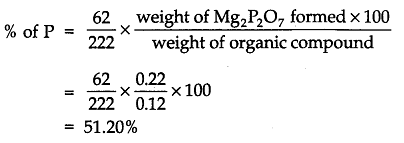
Ques: 0 .12 g of an organic compound containing phosphorous gave 0.22 g of Mg2 P2O7 by usual analysis. Calculate the percentage of phosphorous in the compound. (2 Mark)
Ans: The percentage of phosphorous can be calculated as:
Ques: (a) What is the basic principle involved in the estimation of nitrogen by the Dumas method.
(b) In a Dumas nitrogen estimation method, 0.30 g of an organic compound gave 50 cm3 of N2 collected at 300 K and 715 mm Hg pressure. Calculate the percentage composition of nitrogen in the compound. (Vapour pressure of water at 300 K is 15 mm Hg) (5 Marks)
Ans: (a) In the Dumas method, the nitrogenous compound is heated with copper oxide in an atmosphere of carbon dioxide to yield free nitrogen.

Ques: Differentiate between the principle of estimation of nitrogen in an organic compound by (i) Dumas method (ii) Kjeldahl’s method. (2 Marks)
Ans: (i) Dumas method: In this method, the organic compound is heated strongly with an excess of CuO ‘ (Cupric Oxide) in an atmosphere of CO2. In this experiment, nitrogen, CO2 and H2O are obtained.
(ii) Kjeldahl’s method: A known mass of the organic compound is heated strongly with H2SO4, a little potassium sulphate and a little mercury (a catalyst). As a result, the nitrogen present in the organic compound is converted to ammonium sulphate.
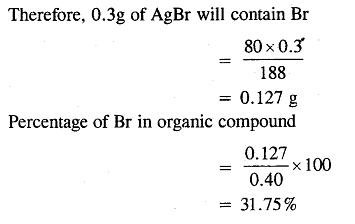
Ques: 0.40 g of an organic compound gave 0.3g of AgBr by the Carius method. Find the percentage of bromine in the compound. (2 Marks)
Ans: Mass of compound = 0.40 g
Now, 188 g of AgBr contains bromine = 80g.
Ques: 0.2595g of an organic compound when treated with the Carius method, gave 0.35g of BaSO4. Calculate the percentage of Sulphur in the compound. (2 Marks)
Ans: Here the mass of substance taken = 0.35g
Mass of BaSO4 ppt. formed = 0.35g
Now 1 mole of BaSO4 = 1 g. atom of Sulphur
233 g of BaSO4 = 32g of S
- e. 233g of BaS04 contains 32g of Sulphur
Therefore 0.35g of BaSO4 will contain Sulphur
Ques: Discuss the principle of estimation of halogens, sulphur and phosphorus present in an organic compound. (5 Marks)
Ans: Estimation of halogens: For this, the organic substance is oxidised with fuming nitric acid in the presence of silver nitrate. The halogen of the substance is thus converted to silver halide which is separated and weighed:
Weight of organic compound = w gm
weight of silver halide = x g.

Estimation of sulphur: For this, the organic substance is heated with fuming nitric acid but no silver nitrate is added. The sulphur present in the substance is oxidised to sulphuric acid which is then precipitated as barium sulphate by adding an excess amount of barium chloride solution. From the weight of BaSO4, the percentage of sulphur can be calculated.

Estimation of phosphorous: For the estimation of phosphorous, the organic substance is heated with fuming nitric acid and phosphorous is oxidised to phosphoric acid. The phosphoric acid is precipitated as ammonium phosphomolybdate, (NH4)3PO4.12MOO3, by adding ammonia and ammonium molybdate solution which is then separated, dried and weighed.

For Latest Updates on Upcoming Board Exams, Click Here: https://t.me/class_10_12_board_updates
Check-Out:



Comments