


(a) Name the various organs of human excretory system. Draw a labelled diagram of human excretory system. What is the function of excretory system in humans? ?(b) What is meant by dialysis? What type of patients are put on dialysis?

Collegedunia Team logo

Collegedunia Team

Content Curator

The Human Excretory System is composed of several organs and structures responsible for removing waste products from the body. These organs include the kidneys, ureters, bladder, and urethra. The kidneys filter waste from the blood and produce urine, which is carried to the bladder for storage until it is eliminated from the body through the urethra.

(a) The organs of the human excretory system are kidneys, ureters, bladder, and urethra.
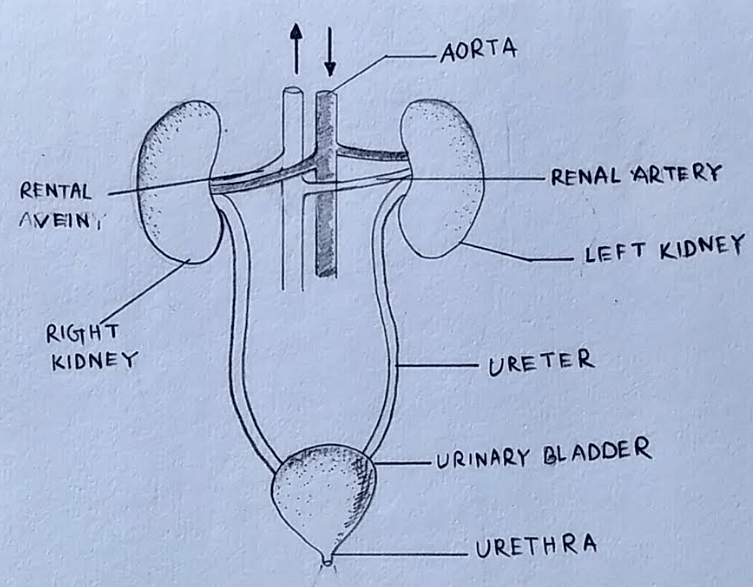
Labelled Diagram of Human Excretory System

Labelled Diagram of Human Excretory System

Functions of Human Excretory System

The human excretory system helps remove waste products from the body and maintain homeostasis. Its main functions include:

  1. Filtering waste products such as urea and creatinine from the blood and removing them as urine.
  2. Regulating fluid and electrolyte balance.
  3. Regulating blood pressure.
  4. Maintaining pH balance.
  5. Excretion of waste products like carbon dioxide through the lungs.
  6. Elimination of waste products produced during metabolism through the skin in the form of sweat.

(b) Dialysis is a medical treatment used to filter waste and excess fluids from the blood of people with kidney failure. It uses a machine to artificially filter the blood and remove waste and fluids, which helps to keep the body in balance and prevent complications from kidney failure. Dialysis is a medical treatment for patients with kidney failure, who are unable to remove waste and excess fluid from their bodies efficiently.

Dialysis

Dialysis

Also check:

CBSE CLASS XII Related Questions

  • 1.
    In the following figure, two ways of pairing of two homologous pairs of chromosomes are shown. Which of the following phenomena is expressed?

      • Linkage of genes
      • Independent assortment of genes
      • Multiple alleles
      • Incomplete dominance

    • 2.
      Monascus purpureus is a yeast used commercially in the production of which one of the following?

        • Ethanol
        • Streptokinase
        • Citric acid
        • Statins

      • 3.
        The foetal ejection reflex in human triggers the release of _______ hormone from _______

          • oxytocin, foetal pituitary
          • oxytocin, maternal pituitary
          • human chorionic gonadotropin, placenta
          • progesterone, corpus luteum

        • 4.
          The idea of use and disuse of organs for evolution of organism was proposed by

            • Charles Darwin
            • Thomas Malthus
            • Hugo De Vries
            • Lamarck

          • 5.
            Arrange the following in the correct sequence of their evolution and select the correct option:
            (i) Seaweed
            (ii) Invertebrates
            (iii) Jawless fish

              • (i), (ii), (iii)
              • (i), (iii), (ii)
              • (ii), (iii), (i)
              • (ii), (i), (iii)

            • 6.
              Assertion (A): The embryo with 8 to 16 blastomeres is called a morula.
              Reason (R): The morula continues to divide and transform into trophoblast.

                • Both Assertion (A) and Reason (R) are true and Reason (R) is the correct explanation of the Assertion (A).
                • Both Assertion (A) and Reason (R) are true, but Reason (R) is not the correct explanation of the Assertion (A).
                • Assertion (A) is true, but Reason (R) is false.
                • Assertion (A) is false, but Reason (R) is true.
              CBSE CLASS XII Previous Year Papers

              Comments


              No Comments To Show
