



Content Curator
The kidneys, which are two reddish-brown bean-shaped structures, are located on either side of the spine on the upper and lower back. A kidney in an adult measure roughly 10 cm long, 6 cm wide, and 4 cm thick and weighs 150–170 grams.
Kidneys are the primary organs of the human excretory system; they filter blood before becoming urine. Additionally, they control and maintain the proper ratios and concentrations of water, acids, and electrolytes in the human body.
Read More: Blood Group Test
| Table of Content |
Key Terms: Kidney, Excretion, Urine, Renal Artery, Renal Vein, Ureter, Calyces
Structure of Kidney
[Click Here for Sample Questions]
The Kidney has a reddish-brown bean-shaped structure. It is convex in shape on the outside and concave on the inside. The inner side consists of the renal artery, renal vein, and ureter.
- There is a notch on the inner side of the kidney called the renal hilum through which the renal artery enters and the renal vein and ureter leave.
- The hilum extends towards the inside of the kidney into a funnel-shaped place called the renal pelvis.
- The renal pelvis has projections called calyces.
- The minor calyces merge to form three major calyces that merge into the renal pelvis.
- The minor calyces are hollow tubes responsible for collecting urine.
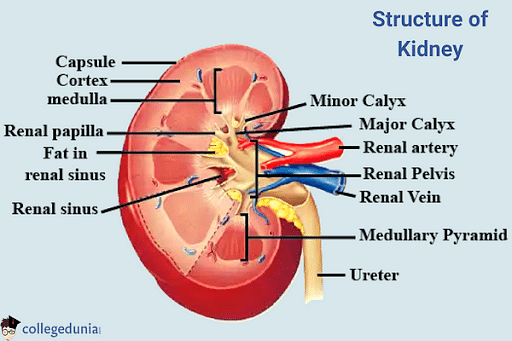
Structure of Kidney
- On the outside, the kidney is surrounded by a connective tissue called the renal capsule, which helps the kidney maintain its shape and also protects its inner tissues.
- Inside the renal capsule is the renal cortex which is a soft, vascular tissue this is followed by the renal medulla.
- The renal medulla consists of several compartments called the renal/medullary pyramids.
- Renal pyramids are cone-shaped structures with their apices pointed towards the centre of the kidney.
- The apex of each renal pyramid is connected to a minor calyx.
- The cortex extends between the medullary pyramids as columns known as Columns of Bertini.
- Embedded in the renal medulla lies the Nephron, which is the functional unit of the kidney.
Read More: Nephron
Function of Kidney
[Click Here for Previous Year Questions]
There are several functions of the Kidney.
Removal of Waste Products and Excess Fluids
The primary function of the kidney is to filter the blood to form urine.
- Each kidney filters the blood and harmful wastes, which are then eliminated in the urine.
- Two significant waste products that our body excretes through urine are urea and creatinine.
- Blood tests will show elevated levels of urea and creatinine when both kidneys are failing.
- The maintenance of fluid balance by excreting excess water as urine while retaining the necessary amount of water in the body, which is vital for survival, is the second most significant role of the kidney.
Reabsorption of Nutrients
Another crucial function of the kidneys is the regulation of many chemicals and minerals.
- Some nutrients include sodium, potassium, hydrogen, calcium, phosphorus, magnesium, and bicarbonate, as well as the maintenance of the normal fluid composition of the body.
- Reabsorbed products include glucose, amino acids, bicarbonate, water, phosphate, chloride, sodium, magnesium and potassium ions.
Maintaining the pH Level of our Body
The pH readings between 7.35 and 7.45 are considered to be appropriate for humans.
- The body goes into a state of acidemia or alkalemia depending on whether the amount is below or over this range.
- The kidneys regulate the body's acid-base balance by reabsorbing bicarbonate from the urine and excreting hydrogen ions, acid ions, and base ions.
- If the pH is acceptable, the kidneys can store bicarbonate and release it if the acidity level increases. They can excrete acid, which they can then use to make new bicarbonate.
Osmolality Regulation
Osmolality, or the ratio of bodily fluids to minerals, is a measurement of the electrolyte-water balance in the body.
- The kidneys work in conjunction with the pituitary gland located in the hypothalamus of the brain to regulate the electrolyte-water balance of our body.
- Pituitary gland releases an antidiuretic hormone in response to rising blood plasma osmolality (ADH).
- The kidney adjusts in a number of ways in response, including increasing urine concentration and increasing water reabsorption.
- It also allows water to enter the body again and retain urea in the kidney's medulla rather than excreting it because this substance draws in water.
Regulating Blood Pressure
One of the functions of the kidney is to regulate Blood Pressure.
- When necessary, the kidneys control blood pressure, but they only make gradual changes. By influencing changes in the fluid around cells, they modify the long-term pressure in the arteries.
- Renin, angiotensin, aldosterone, prostaglandin, and other hormones that the kidneys produce play important roles in maintaining stable blood pressure management through regulating salt and water balance in the body.
Secretion of Hormones and Enzymes
Kidneys also secret hormones and enzymes.
- Erythropoietin: This regulates the process of erythropoiesis or the creation of red blood cells. In reaction to hypoxia, it is released. As a result of decreased erythropoietin production brought on by kidney failure, RBC production also decreases, resulting in low haemoglobin levels (anaemia).
- Renin: The amount of blood plasma, lymph, and interstitial fluid is controlled by this enzyme. By regulating angiotensin and aldosterone, it also regulates blood pressure.
- Calcitriol: This is the vitamin D metabolite that affects hormones. It enhances the intestines' ability to absorb calcium. It boosts the kidney's ability to reabsorb phosphate while also increasing the amount of calcium that the intestines can absorb.
Diseases of Kidneys
[Click Here for Sample Questions]
Some of the diseases of the kidneys are:
Uremia
Uremia is a deadly condition that can result in renal failure because it damages the kidneys and causes a buildup of urea and other toxins in the blood. Hemodialysis can be used to get rid of urea.
Renal Calculi
These mineral and salt deposits, often known as kidney stones, are found throughout our bodies. If they obstruct the ureter, they may interfere with kidney function and produce severe discomfort. The stones can be broken up with medication, or they can be made to pass through the urine by increasing diet and water intake.
Diabetic Nephropathy
The kidney's capillaries are damaged in persons with diabetic nephropathy as a result of long-term diabetes. Years after the damage first begins to develop, the symptoms might not show up.
Read Also:
| Topic Related Concepts | ||
|---|---|---|
| Urine Infection | Circulatory System | Excretion in Human Beings |
| Gastric | Kidney Function Test | What are Antibiotics? |
Kidney Treatments
[Click Here for Previous Year Questions]
Some treatments for the kidney include,
- Kidney Transplant: Transplanting the kidney with end-stage renal disease(ESRD) can help restore kidney functions. The transplantation of the kidney is done either by a living donor or a deceased organ donor.
- Antibiotics: Kidneys are affected by infections that are caused by bacteria. It can be treated with antibiotics. Taking the blood or urine sample can aid the antibiotic treatment.
- Nephrostomy: Herein, a tube is placed via the skin into the kidney. Urine, in this procedure, gets drained from the kidney, thus bypassing the blockages found in urine flow.
- Lithotripsy: A couple of kidney stones get shattered into smaller pieces and pass through the urine. However, the stones which aren’t can be treated by lithotripsy. Lithotripsy can be done by means of a machine that projects ultrasound waves via the body.
- Dialysis: Kidney failure typically causes the blood to stop filtering the blood, thus increasing the necessity to filter blood. It can be done via the help of dialysis. Hemodialysis is among the most common dialysis method,
- Hemodialysis: In hemodialysis, a person suffering from renal failure is connected to the dialysis machine aiding to filter the blood. Herein, the blood is artificially filtered and further returned back to the body.
- Nephrectomy: It is usually used to remove a kidney. A nephrectomy is performed for people who suffer from kidney cancer or severe kidney damage.
- Peritoneal Dialysis: Herein, large amounts of a special fluid are placed in the abdomen via the help of a catheter, enabling the body to filter the blood by utilising the natural membrane lining the abdomen.
Things to Remember
- The kidneys are reddish-brown bean-shaped organs located just below the spine one on each side.
- The inner side consists of the renal artery, renal vein, and ureter.
- The outer side contains the renal capsule, renal cortex and renal medulla.
- The nephron is the functional unit of the kidney.
- The primary function of the kidney is to filter the blood and remove waste products from the body through urine.
- It also helps maintain electrolyte-water levels, regulates blood pressure and secretes enzymes and hormones.
- The improper functioning of kidneys can lead to various diseases such as uremia, kidney stones etc.
Previous Year Questions
- Effective filtration pressure in glomerulus … [KCET 2011]
- Facultative absorption of water from primary urine … [KCET 2016]
- Mammalian kidney is … [AMUEEE 2013]
- A fall in glomerular filtration rate activates … [KCET 2015]
- Compare the statements A and B … [KCET 2010]
- Columns of Bertin is the structure … [JIPMER 2016]
- What causes the liquid part of blood filter … [JIPMER 1996]
- Ureotelic animals excrete out … [JIPMER 1996]
Sample Questions
Ques. What is a nephron? [1 mark]
Ans. The nephron is the functional unit of a kidney.
Ques. What are some of the diseases of the kidney? [1 mark]
Ans. The improper functioning of kidneys can potentially lead to diseases like uremia, kidney stones etc.
Ques. Name two waste products that the kidney excretes. [1 mark]
Ans. The kidney excretes urea and creatinine.
Ques. What is calcitriol? [2 marks]
Ans. Calcitriol is the vitamin D metabolite which affects hormones. It is responsible to boost the intestines' ability to absorb calcium and to reabsorb phosphate while also increasing the amount of calcium that the intestines can absorb.
Ques. What is Lithotripsy? [2 marks]
Ans. Some kidney stones get shattered into smaller pieces and pass via the urine. However, the stones that aren’t can be treated with the help of lithotripsy. Lithotripsy is performed by a machine that projects ultrasound waves via the body.
Ques. List some important functions of kidneys. [3 marks]
Ans. Important functions of kidneys are:
- Removal of waste products
- Reabsorption of nutrients
- Maintaining water-electrolyte level
- Regulate blood pressure
- Maintain pH levels
Ques. Describe the anatomical features of the human kidney with a suitable diagram. [5 marks]
Ans. The kidneys, which are two reddish-brown bean-shaped structures, are shielded from injury by the lower ribs and are located on either side of the spine on the upper and lower back.
The kidney is convex in shape on the outside and concaves on the inside. The inner side consists of the renal artery, renal vein, and ureter. There is a notch on the inner side of the kidney called the renal hilum through which the renal artery enters and the renal vein and ureter leave.
The hilum extends towards the inside of the kidney into a funnel-shaped place called the renal pelvis. The renal pelvis has projections called calyces.
On the outside, the kidney is surrounded by a connective tissue called a renal capsule, which helps the kidney maintain its shape and also protects its inner tissues. Inside the renal capsule is the renal cortex which is a soft, vascular tissue this is followed by the renal medulla.
The renal medulla consists of several compartments called the renal/medullary pyramids. The apex of each renal pyramid is connected to a minor calyx. The cortex extends between the medullary pyramids as columns known as Columns of Bertini. Embedded in the renal medulla lies the Nephron, which is the functional unit of the kidney.
Also Check:



Comments