


Exams Prep Master
Homologous and analogous structures are commonly misunderstood and also, they are key concepts for comprehending the similarities and differences among various animals and plants. Homologous structures have comparable morphology, anatomy, embryology and genetics but perform different functions. Analogous structures are structures that have similar anatomical characteristics and yet they perform the same function. Here, we will discuss the difference between homologous and analogous structures in detail along with some important questions.
| Table of Content |
Key Terms: Anatomical structure, Animals, Morphological, Plants, Organisms, Vertebrate, Genetics, morphology, anatomy, embryology, Homologous structures
Also read: Morphology of Plants
What are Homologous Structures?
[Click Here for Sample Questions]
Definition
Homologous structures are morphological characteristics which are shared by species that have a common ancestor. It means that they are closely related species frequently share homologous characteristics, which are structurally similar but serve the same or distinct functions.

Degree of relatedness
Whenever classified based on phylogenetic relationships, organisms that share a common ancestor frequently form a monophyletic group. The fact that patterns of development throughout embryology are often highly similar among creatures with homologous features demonstrates this strong link. The embryo forms of all vertebrate animals, for example, have a remarkably similar appearance.
Examples for Homologous Structures
[Click Here for Sample Questions]
Animal Kingdom
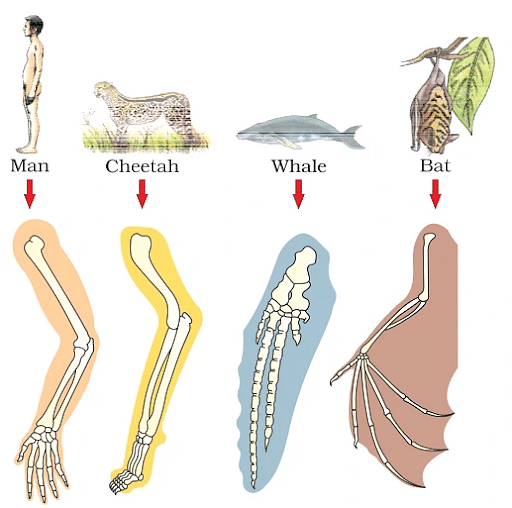
Animals with homologous structures can be found in abundance. The limbs of vertebrates are a classic example, with a basic pattern that is shared by all members but has been evolved and adapted for varied uses. Even though a bat and a bird have wings but a human does not, the same bones, the humerus, radius, and ulna, may be found in the arms of a bird, a bat, and a human, for example. In some vertebrate species, the bones are changed for flying, while in others, they are used for walking and running.

Plant Kingdom
Homologous structures can be seen in the leaves of some plants. The leaves of some of the plants evolved from the same basic design and parent, but others were modified to store water (such as cactus), while the others were adapted to trap insects (e.g., Pitcher plant and Venus’s fly trap).

Also Read:
| Related Articles | ||
|---|---|---|
| Evolution | Biological Evolution and Evidence Paleontology Anatomy Embryology | Origin and Evolution of Man |
What are Analogous Structures?
[Click Here for Sample Questions]
Definition
Analogous structures originated independently to perform the same or comparable functions, and hence may appear to have a similar structure on the surface, however this is often not the case.
Degree of relatedness
Organisms with similar features are rarely closely related and so do not have a common ancestor, so a monophyletic phylogenetic tree would not exist. Instead, each organism's equivalent structure evolved independently to serve the same or similar functions. Despite the fact that the structures are not homologous and they frequently adapt creatures for the same function, such as flying. Convergent evolution can produce similar features, such as the streamlined body form of squid and fish, which both make swimming easier. When species from all around the world exhibit the same morphological adaptations to environmental conditions, this is known as convergent evolution.
Examples for Analogous Structures
[Click Here for Sample Questions]
Animal Kingdom
The wings of birds and the wings of insects are examples of similar structures found in the animal kingdom. Bird wings are made up of hollow bones that originated in chordate mammals. Insect wings evolved independently of early aquatic insects' gill systems.
Plant Kingdom
Succulent leaves, similar to those found on cactus in the New World, are used to store water in African euphorbias. The modified storage leaves of these plants, on the other hand, reflect convergent evolution, as they evolved independently from different ancestor plants. Euphorbias and cacti have separate evolutionary origins, despite the fact that their leaves serve the same function.
Difference between Homologous and Analogous Structures
[Click Here for Sample Questions]
The key difference between Homologous and Analogous Structures are:
| Characteristics | Homologous Structures | Analogous Structures |
|---|---|---|
| Definition | Homologous structures are structures that evolve in organisms which share a common ancestor | Analogous structures are structures that evolve separately in organisms. and which often have a similar function |
| Degree of relatedness among organisms | Closely related, share a common ancestor | Not closely related, do not share a common ancestor |
| Developmental pattern | Often similar | Different |
| Functions | Can be the same or different | Often similar |
| Animal examples | The limbs of vertebrate animals | Wings of birds and insects |
| Plant examples | Modified leaves such as the pitcher plant and Venus’s fly trap and that of a cactus | Leaves of cacti and euphorbias |
| Anatomy | Has similar anatomy | Has Dissimilar anatomy |
| Inheritance of Ancestor | Has inherited from common ancestor | Has not inherited from ancestor |
| Evolution | A result of divergent evolution | A result of convergent evolution |
Also Read:
| Related Articles | ||
|---|---|---|
| Charles Darwin Theory | Vestigial Organs | What is Genetics |
Homologous vs Analogous
[Click Here for Sample Questions]
Biologists frequently seek for parallels in structure, function, and evolutionary lineage when comparing and contrasting certain traits in species. Even though they serve distinct roles in different animals, homologous features of animals with comparable structure are categorised as such if they have a same evolutionary origin. The wing of a bat and the arm of a human are two typical examples of homologous structures. Internal bone structure is identical in both, and their evolutionary origins as mammals are obvious. The wing of a bat, on the other hand, is used for flight, but a person's arm is used to carry objects or do other jobs and is not designed for flight. Similarly, a dog's leg, a bird's wing, and a whale's fin are all similar to the human arms. Such structures were said to have been diverged during time, implying that they may have served the same purpose in the common ancestor organism at one time.

Many structures that appear to be very similar, on the other hand, have very different evolutionary antecedents. Analogous or homoplastic structures are those that have converged to have the similar or same functions despite having different beginnings. Consider the evolution of bird wings and insect wings. Them organisms have wings that allow them to fly, but the development of wings on birds and insects evolved independently and then converged to allow both to operate similarly. By comparing DNA sequences in these organisms, it can be demonstrated that whereas birds and insects evolved from distinct parent species, they both have the ability to fly. The observation of these two different sets of wings would also reveal that, while they perform comparable functions, they are physically and physiologically distinct. As seen in the diagram above, bird wings (3) are similar to bat wings (2) and dinosaur wings (1).
Things to Remember
- Homologous structures are seen in a monophyletic living species that have a common ancestor.
- Organisms that do not share any of the common ancestor can be found in the Analogous structures.
- Embryological development patterns are generally comparable in organisms with a similar feature.
- Analogous structures always have comparable or identical functions, whereas in the case of the homologous structures do not always.
Also Read:
Solved Questions
Ques. Define the term species? (1 mark)
Ans. A species is a group or population of individuals with the ability to interbreed and create viable offspring.
Ques. Why it is necessary for scientist to understanding the difference between analogous and homologous similar structures for scientists? (2 marks)
Ans. It is critical to know the similarities and distinctions between the diverse creatures. Scientists employ animals for biological processes and medicinal treatments instead of doing extensive and perhaps deadly experiments on people.
Ques. Explain how Darwinian selection theory explains antibiotic resistance in bacteria. (2 marks)
Ans. The environment, according to Darwin's observation, picks things with favourable variations, and these creatures are capable of surviving. When a colony of bacteria is attacked by a particular antibiotic, sensitive bacteria die off, but bacteria with beneficial mutations become resistant to antibiotics even in the presence of an antibiotic, allowing them to live, thrive, and multiply as the other competitive bacteria die out. As a result, the number of bacteria is increasing. Furthermore, they mass-transfer these bacterium-resistant genes to other bacteria. As a result, antibiotic-resistant bacteria have spread rapidly, causing the entire species to become antibiotic-resistant.
Ques. Find out about any new fossil discoveries or evolution conflicts in newspapers and popular science pieces. (2 marks)
Ans. The discovery of dinosaur fossils yielded some surprising results. It describes the evolution of reptiles during the Jurassic period. This discovery paved the way for the evolution of other species such as mammals and birds. Two strange fossils discovered recently in China have sparked a debate about the evolution of birds. Confucius-ornis was one such early bird genus. These crow-sized creatures thrived in China throughout the Cretaceous period.
Ques. Investigate whether animals other than humans have self-consciousness using the internet and popular science literature. (2 marks)
Ans. Self-consciousness is seen in a wide range of animals, not only humans. The Dolphin is one such example. They are thought to have a high intelligence level. They also have a feeling of self and can recognise themselves amid others. They communicate with each other by whistling, tail-slapping, and making body movements. Other creatures that show self-consciousness include the crow, parrot, gorilla, orangutan, and chimp.
Ques. Is it possible to refer to human evolution as an adaptive radiation? (2 marks)
Ans. Adaptive radiation is an evolutionary process that results in the emergence of new species from a single common ancestor, but in the case of human evolution, despite sharing a common ancestor, we humans have undergone a gradual but significant change in our eating habits, bodily structure, and so on. Diversification and radiating into various species, which is a distinguishing aspect of adaptive radiation, are not part of human evolution.
Ques. Trace the various aspects of human evolution. (3 marks)
Ans. The following are the elements that make up human evolution:
- The human brain's volume
- The skeleton's structure
- Maintain a good posture
- Dietary preferences are number four.
- Personality qualities
Ques. Describe an adaptive radiation example. (2 marks)
Ans. Adaptive radiation occurs when individuals of a particular assemblage or lineage diverge evolutionarily into a variety of diverse forms. These are the forms that are shaped by natural selection and resource or habitat utilisation. The Darwin's finches of the Galapagos Islands shared or shared ancestors, whereas humans now have various types of modified beaks dependent on food preferences. These finches have developed diverse eating preferences and beak types to fit their feeding behaviours. Distinct finch species with different food preferences have developed from a single seed-eating progenitor, such as blood-sucking, insectivorous creatures, and so on.
Ques. Explain the evolution of a single animal, such as a horse. (3 marks)
Ans.
- An increase in bodily size is a common occurrence.
- Neck lengthening
- The third digit's expansion
- To eat on grass, the teeth's structural composition has been improved.
- The limbs are becoming more elongated.
- Decrease in the lateral digits over time
- Backbone fortified
- The development of the sense organs and the brain
For Latest Updates on Upcoming Board Exams, Click Here: https://t.me/class_10_12_board_updates
Check-Out:



Comments