




CBSE Class 12 Mathematics Set 1- (65/2/1) Question Paper 2026 is available for download here. CBSE conducted Class 12 Mathematics exam on March 9, 2026 from 10:30 AM to 1:30 PM. The Mathematics theory paper is of 80 marks, and the internal assessment is of 20 marks.
Mathematics question paper includes MCQs (1 mark each), short-answer type questions (2 & 3 marks each), and long-answer type questions (4 & 6 marks each) which makes up the total of 80 marks.
Download CBSE Class 12 Mathematics Set 1- (65/2/1) Question Paper 2026 with detailed solutions from the links provided below.
CBSE Class 12 Mathematics Set 1- (65/2/1) Question Paper 2026 with Solution PDF
| CBSE Class 12 Mathematics Question Paper 2026 Set 1- (65/2/1) | Download PDF | Check Solutions |





A relation \(R\) on set \(A = \{1, 2, 3\}\) defined as \(R = \{(1, 1), (2, 2), (1, 2)\}\) is
View Solution
Concept:
A relation \(R\) on set \(A\) is reflexive if \((a, a) \in R\) for every \(a \in A\).
A relation \(R\) on set \(A\) is symmetric if \((a, b) \in R \implies (b, a) \in R\).
A relation \(R\) on set \(A\) is transitive if \((a, b) \in R\) and \((b, c) \in R \implies (a, c) \in R\).
Step 1: Checking for Reflexivity
For \(R\) to be reflexive on \(A = \{1, 2, 3\}\), the pairs \((1, 1)\), \((2, 2)\), and \((3, 3)\) must belong to \(R\).
In the given relation \(R = \{(1, 1), (2, 2), (1, 2)\}\), we see that \((3, 3) \notin R\).
Hence, the relation is not reflexive.
Step 2: Checking for Symmetry
For \(R\) to be symmetric, if \((1, 2) \in R\), then \((2, 1)\) must also be in \(R\).
Here, \((1, 2) \in R\) but \((2, 1) \notin R\).
Hence, the relation is not symmetric.
Step 3: Checking for Transitivity
We check all pairs \((a, b)\) and \((b, c)\) to see if \((a, c) \in R\).
For \((1, 1)\) and \((1, 2)\), we have \((1, 2) \in R\).
For \((1, 2)\) and \((2, 2)\), we have \((1, 2) \in R\).
There are no other pairs that violate the condition.
Hence, the relation is transitive only. Quick Tip: To check for transitivity, look for pairs where the second element of the first pair matches the first element of the second pair.
If you cannot find a counter-example \((a, b), (b, c) \in R\) but \((a, c) \notin R\), the relation is transitive.
If \(A\) and \(B\) are square matrices of same order, then which of the following statements is/are always true ?
(i) \((A + B) (A - B) = A^2 - B^2\)
(ii) \(AB = BA\)
(iii) \((A + B)^2 = A^2 + AB + BA + B^2\)
(iv) \(AB = 0 \implies A = 0\) or \(B = 0\)
View Solution
Concept:
Matrix multiplication is not commutative in general, i.e., \(AB \neq BA\).
Algebraic identities in matrices must respect the order of multiplication.
Zero divisors exist in matrices; a product can be zero without either matrix being zero.
Step 1: Evaluating statement (i)
\((A + B)(A - B) = A(A - B) + B(A - B)\)
\(= A^2 - AB + BA - B^2\).
This is equal to \(A^2 - B^2\) only if \(AB = BA\).
Since \(AB \neq BA\) always, this statement is not always true.
Step 2: Evaluating statement (ii)
\(AB = BA\) is the commutative property.
Matrix multiplication is non-commutative in general.
Thus, this is not always true.
Step 3: Evaluating statement (iii)
\((A + B)^2 = (A + B)(A + B)\)
\(= A(A + B) + B(A + B)\)
\(= A^2 + AB + BA + B^2\).
This expansion is always valid for any square matrices \(A\) and \(B\).
Step 4: Evaluating statement (iv)
In matrices, \(AB = 0\) does not necessarily imply \(A = 0\) or \(B = 0\).
For example, let \(A = \begin{bmatrix} 0 & 1 \\ 0 & 0 \end{bmatrix}\) and \(B = \begin{bmatrix} 1 & 0 \\ 0 & 0 \end{bmatrix}\).
Then \(AB = \begin{bmatrix} 0 & 0 \\ 0 & 0 \end{bmatrix}\), but \(A \neq 0\) and \(B \neq 0\). Quick Tip: Remember that \((A+B)(A-B) = A^2 - B^2\) and \((A+B)^2 = A^2 + 2AB + B^2\) are ONLY true if matrices \(A\) and \(B\) commute (\(AB=BA\)).
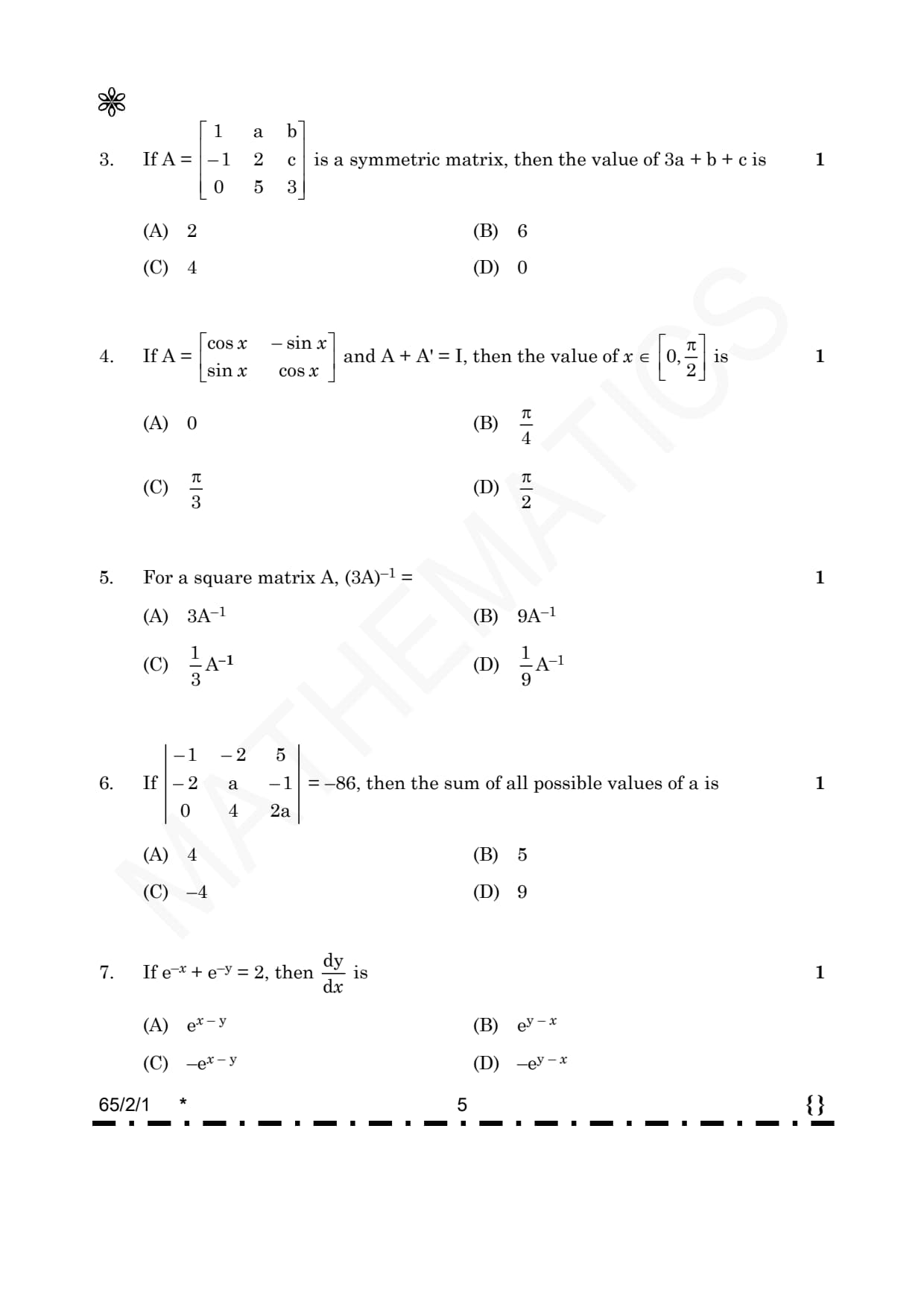
If \(A = \begin{bmatrix} 1 & a & b \\ -1 & 2 & c \\ 0 & 5 & 3 \end{bmatrix}\) is a symmetric matrix, then the value of \(3a + b + c\) is
View Solution
Concept:
A square matrix \(A\) is symmetric if \(A = A^T\).
This implies the elements satisfy \(a_{ij} = a_{ji}\) for all \(i, j\).
Step 1: Identify relationships from symmetry
Since \(A\) is symmetric, \(A = A^T\):
\(\begin{bmatrix} 1 & a & b \\ -1 & 2 & c \\ 0 & 5 & 3 \end{bmatrix} = \begin{bmatrix} 1 & -1 & 0 \\ a & 2 & 5 \\ b & c & 3 \end{bmatrix}\)
Step 2: Solve for variables \(a, b, c\)
Comparing corresponding elements:
\(a = -1\)
\(b = 0\)
\(c = 5\)
Step 3: Calculate the final expression
Substitute values into \(3a + b + c\):
\(3(-1) + 0 + 5\)
\(= -3 + 5\)
\(= 2\) Quick Tip: In a symmetric matrix, elements are mirrored across the main diagonal.
Simply equate \(a_{12} = a_{21}\), \(a_{13} = a_{31}\), and \(a_{23} = a_{32}\).
If \(A = \begin{bmatrix} \cos x & -\sin x \\ \sin x & \cos x \end{bmatrix}\) and \(A + A' = I\), then the value of \(x \in [0, \pi/2]\) is
View Solution
Concept:
\(A'\) denotes the transpose of matrix \(A\).
\(I\) is the identity matrix of the same order.
Matrix addition is performed element-wise.
Step 1: Determine the transpose \(A'\)
Given \(A = \begin{bmatrix} \cos x & -\sin x \\ \sin x & \cos x \end{bmatrix}\).
The transpose Interchanges rows and columns:
\(A' = \begin{bmatrix} \cos x & \sin x \\ -\sin x & \cos x \end{bmatrix}\)
Step 2: Set up the equation \(A + A' = I\)
\(\begin{bmatrix} \cos x & -\sin x \\ \sin x & \cos x \end{bmatrix} + \begin{bmatrix} \cos x & \sin x \\ -\sin x & \cos x \end{bmatrix} = \begin{bmatrix} 1 & 0
0 & 1 \end{bmatrix}\)
\(\begin{bmatrix} 2\cos x & 0 \\ 0 & 2\cos x \end{bmatrix} = \begin{bmatrix} 1 & 0 \\ 0 & 1 \end{bmatrix}\)
Step 3: Solve for \(x\)
Comparing the diagonal elements:
\(2\cos x = 1 \implies \cos x = \frac{1}{2}\).
For \(x \in [0, \pi/2]\), \(\cos x = \frac{1}{2}\) gives:
\(x = \frac{\pi}{3}\). Quick Tip: Adding a matrix to its transpose always results in a symmetric matrix.
The off-diagonal elements in this specific problem \((-\sin x + \sin x)\) automatically become zero.
For a square matrix \(A\), \((3A)^{-1} =\)
View Solution
Concept:
Inverse property of scalar multiplication: If \(k\) is a non-zero scalar and \(A\) is an invertible matrix, then \((kA)^{-1} = \frac{1}{k} A^{-1}\).
Step 1: Apply the scalar inverse property
In the given problem, the scalar is \(k = 3\).
Using the property \((kA)^{-1} = \frac{1}{k} A^{-1}\):
\((3A)^{-1} = \frac{1}{3} A^{-1}\).
Step 2: Verify the result
If we multiply \((3A)\) by \((\frac{1}{3}A^{-1})\):
\((3 \cdot \frac{1}{3}) (A \cdot A^{-1}) = 1 \cdot I = I\).
Since the product is the identity matrix, \(\frac{1}{3}A^{-1}\) is indeed the inverse.
Quick Tip: Do not confuse this with determinant properties.
For a matrix of order \(n\), \(|kA| = k^n |A|\), but for inverses, \((kA)^{-1} = \frac{1}{k} A^{-1}\) regardless of the order.
If \( \begin{vmatrix} -1 & -2 & 5 \\ -2 & a & -1 \\ 0 & 4 & 2a \end{vmatrix} = -86 \), then the sum of all possible values of \( a \) is
View Solution
Concept:
Expansion of a \( 3 \times 3 \) determinant.
Formation and properties of quadratic equations.
Sum of roots of a quadratic equation \( Ax^2 + Bx + C = 0 \) is \( -\frac{B}{A} \).
Step 1: Expand the given determinant along the first row
Expand the determinant \( \Delta = -86 \):
\[ (-1) \begin{vmatrix} a & -1 \\ 4 & 2a \end{vmatrix} - (-2) \begin{vmatrix} -2 & -1 \\ 0 & 2a \end{vmatrix} + 5 \begin{vmatrix} -2 & a \\ 0 & 4 \end{vmatrix} = -86 \]
Evaluate the minor determinants:
\[ -1(2a^2 - (-4)) + 2(-4a - 0) + 5(-8 - 0) = -86 \]
\[ -1(2a^2 + 4) - 8a - 40 = -86 \]
Step 2: Simplify the equation to a standard quadratic form
Distribute the negative sign and combine constants:
\[ -2a^2 - 4 - 8a - 40 = -86 \]
\[ -2a^2 - 8a - 44 = -86 \]
Add 86 to both sides:
\[ -2a^2 - 8a + 42 = 0 \]
Divide by -2 to simplify coefficients:
\[ a^2 + 4a - 21 = 0 \]
Step 3: Find the sum of all possible values of \( a \)
The values of \( a \) are the roots of the quadratic equation \( a^2 + 4a - 21 = 0 \).
Using the sum of roots formula \( Sum = -\frac{b}{a} \):
\[ Sum = -\frac{4}{1} = -4 \] Quick Tip: Expand along the column or row with zeros to simplify calculations.
In questions asking for the 'sum' or 'product' of values, avoid solving for individual roots to save time.
If \( e^{-x} + e^{-y} = 2 \), then \( \frac{dy}{dx} \) is
View Solution
Concept:
Differentiation of exponential functions \( \frac{d}{dx}(e^{f(x)}) = e^{f(x)} \cdot f'(x) \).
Implicit differentiation where \( y \) is treated as a function of \( x \).
Laws of exponents: \( \frac{e^A}{e^B} = e^{A-B} \).
Step 1: Differentiate the equation implicitly with respect to \( x \)
The given equation is \( e^{-x} + e^{-y} = 2 \).
Differentiating both sides:
\[ \frac{d}{dx}(e^{-x}) + \frac{d}{dx}(e^{-y}) = \frac{d}{dx}(2) \]
Using the chain rule:
\[ e^{-x}(-1) + e^{-y}(-1)\frac{dy}{dx} = 0 \]
\[ -e^{-x} - e^{-y}\frac{dy}{dx} = 0 \]
Step 2: Isolate the derivative \( \frac{dy}{dx} \)
Move the term involving \( \frac{dy}{dx} \) to the right side:
\[ -e^{-x} = e^{-y}\frac{dy}{dx} \]
Divide both sides by \( e^{-y} \):
\[ \frac{dy}{dx} = \frac{-e^{-x}}{e^{-y}} \]
Step 3: Simplify the expression using exponent properties
Apply the quotient rule for exponents \( \frac{a^m}{a^n} = a^{m-n} \):
\[ \frac{dy}{dx} = -e^{-x - (-y)} \]
\[ \frac{dy}{dx} = -e^{-x + y} \]
\[ \frac{dy}{dx} = -e^{y - x} \] Quick Tip: When differentiating implicit functions, remember that every \( y \) term differentiated must be multiplied by \( \frac{dy}{dx} \).
Keep track of signs carefully when dealing with negative exponents.
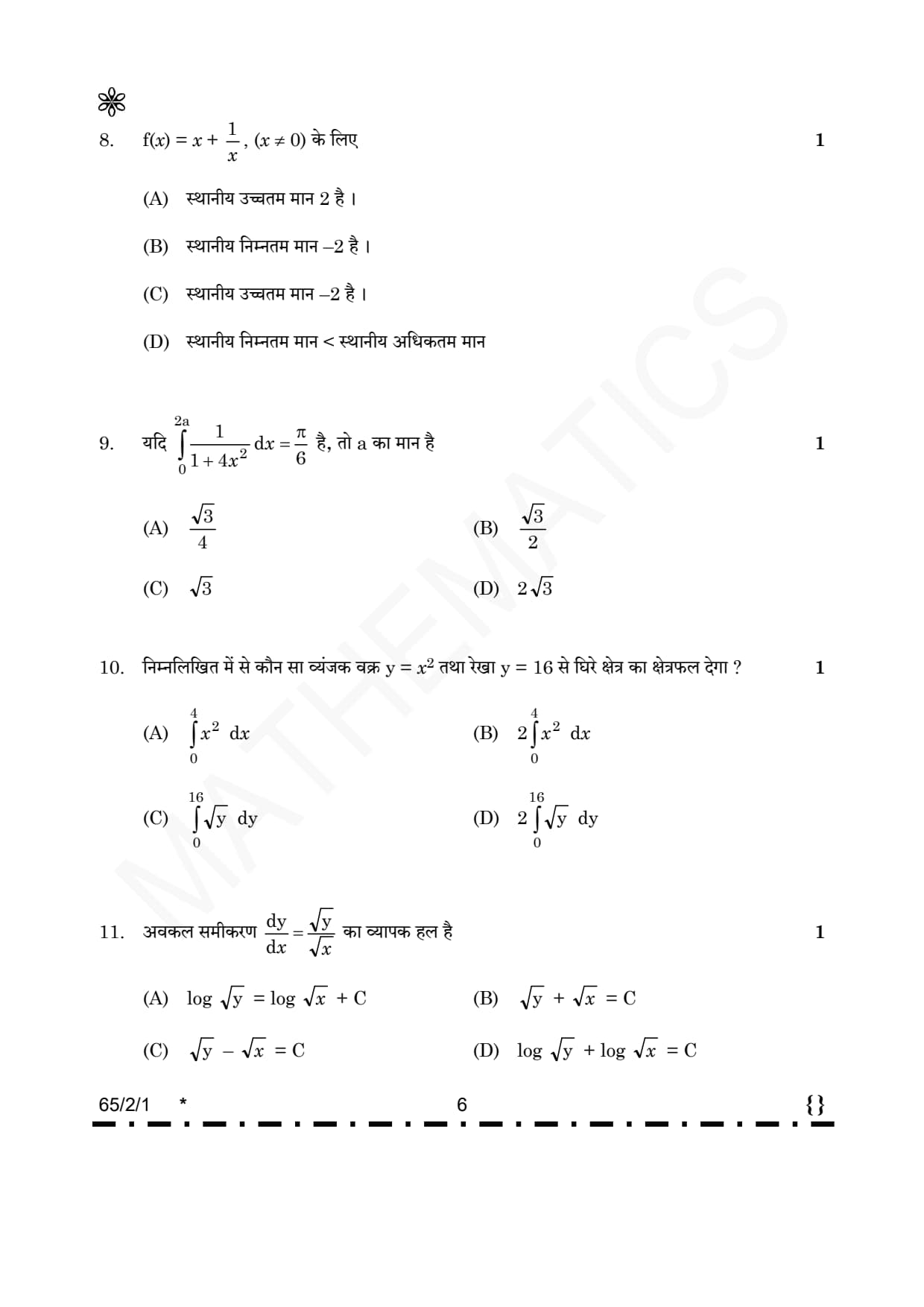
For \( f(x) = x + \frac{1}{x} \) (\( x \neq 0 \))
View Solution
Concept:
Critical points occur where \( f'(x) = 0 \).
Local maxima and minima are determined by checking the sign of \( f''(x) \).
Second Derivative Test: \( f''(x) < 0 \implies Max \), \( f''(x) > 0 \implies Min \).
Step 1: Find the first derivative and critical points
Given \( f(x) = x + x^{-1} \).
Differentiate with respect to \( x \):
\[ f'(x) = 1 - \frac{1}{x^2} \]
To find critical points, set \( f'(x) = 0 \):
\[ 1 - \frac{1}{x^2} = 0 \implies x^2 = 1 \implies x = 1, -1 \]
Step 2: Perform the Second Derivative Test
Differentiate \( f'(x) \) to get \( f''(x) \):
\[ f''(x) = \frac{d}{dx}(1 - x^{-2}) = 2x^{-3} = \frac{2}{x^3} \]
At \( x = 1 \):
\[ f''(1) = \frac{2}{1^3} = 2 > 0 \quad (Local Minimum at x=1) \]
At \( x = -1 \):
\[ f''(-1) = \frac{2}{(-1)^3} = -2 < 0 \quad (Local Maximum at x=-1) \]
Step 3: Calculate the extreme values
Local Minimum Value at \( x = 1 \):
\[ f(1) = 1 + \frac{1}{1} = 2 \]
Local Maximum Value at \( x = -1 \):
\[ f(-1) = -1 + \frac{1}{-1} = -2 \]
Thus, the local maximum value is \( -2 \). Quick Tip: Counter-intuitively, for some functions like this, the local maximum value can be smaller than the local minimum value.
Always verify using derivatives rather than assuming magnitudes.
If \( \int_{0}^{2a} \frac{1}{1 + 4x^2} dx = \frac{\pi}{6} \), then the value of \( a \) is
View Solution
Concept:
Standard integration formula: \( \int \frac{1}{1 + (kx)^2} dx = \frac{1}{k} \tan^{-1}(kx) \).
Fundamental Theorem of Calculus for definite integrals.
Inverse trigonometric values: \( \tan^{-1}(\sqrt{3}) = \frac{\pi}{3} \).
Step 1: Evaluate the definite integral
Rewrite the integrand: \( 1 + 4x^2 = 1 + (2x)^2 \).
The integral is:
\[ I = \int_{0}^{2a} \frac{1}{1 + (2x)^2} dx = \left[ \frac{1}{2} \tan^{-1}(2x) \right]_{0}^{2a} \]
Substituting the limits:
\[ I = \frac{1}{2} [\tan^{-1}(2(2a)) - \tan^{-1}(0)] \]
\[ I = \frac{1}{2} \tan^{-1}(4a) \]
Step 2: Solve for the variable \( a \)
Set the result equal to the given value \( \frac{\pi}{6} \):
\[ \frac{1}{2} \tan^{-1}(4a) = \frac{\pi}{6} \]
Multiply by 2:
\[ \tan^{-1}(4a) = \frac{\pi}{3} \]
Taking tangent of both sides:
\[ 4a = \tan\left(\frac{\pi}{3}\right) \]
Step 3: Final Calculation
Substitute the value \( \tan(\pi/3) = \sqrt{3} \):
\[ 4a = \sqrt{3} \]
\[ a = \frac{\sqrt{3}}{4} \] Quick Tip: Always remember the \( \frac{1}{k} \) factor when using the \( \tan^{-1} \) formula for terms like \( (kx)^2 \).
Double-check your inverse trig values for standard angles (\( 30^\circ, 45^\circ, 60^\circ \)).
Which of the following expressions will give the area of region bounded by the curve \( y = x^2 \) and line \( y = 16 \)?
View Solution
Concept:
Area bounded by curves can be calculated using integration with respect to \( x \) or \( y \).
Area with respect to y-axis: \( \int x \, dy \).
Symmetry of curves (Parabola \( y = x^2 \) is symmetric about the y-axis).
Step 1: Analyze the region and boundaries
The curve is \( y = x^2 \), which means \( x = \pm \sqrt{y} \).
The horizontal boundary is \( y = 16 \).
The region starts at the origin \( (0,0) \) and goes up to \( y = 16 \).
Step 2: Set up integration with respect to \( y \)
Integration along the y-axis covers horizontal strips.
For one side (the first quadrant), the area is \( \int_{0}^{16} x \, dy \).
Substituting \( x = \sqrt{y} \):
\[ Area_{side} = \int_{0}^{16} \sqrt{y} \, dy \]
Step 3: Apply symmetry to find total area
Since the parabola is symmetric about the y-axis, the total area is double the area on one side.
Total Area = \( 2 \times \int_{0}^{16} \sqrt{y} \, dy \).
This matches option (D). Quick Tip: When a curve is symmetric about the y-axis, calculating area with respect to \( y \) and doubling is often the most direct method.
Visualizing the bounded region helps in determining the correct variable for integration.
The general solution of the differential equation \( \frac{dy}{dx} = \frac{\sqrt{y}}{\sqrt{x}} \) is
View Solution
Concept:
A first-order differential equation can be solved using the variable separable method if it can be written in the form \( f(y)dy = g(x)dx \).
The integral of \( x^n \) is \( \frac{x^{n+1}}{n+1} + C \).
Step 1: Separate the variables
The given differential equation is:
\[ \frac{dy}{dx} = \frac{\sqrt{y}}{\sqrt{x}} \]
Separating the terms of \( y \) on the left and \( x \) on the right:
\[ \frac{1}{\sqrt{y}} dy = \frac{1}{\sqrt{x}} dx \]
This can be written as:
\[ y^{-1/2} dy = x^{-1/2} dx \]
Step 2: Integrate both sides
Integrating both sides of the equation:
\[ \int y^{-1/2} dy = \int x^{-1/2} dx \]
Applying the power rule for integration:
\[ \frac{y^{1/2}}{1/2} = \frac{x^{1/2}}{1/2} + C' \]
\[ 2\sqrt{y} = 2\sqrt{x} + C' \]
Step 3: Simplify the general solution
Divide the entire equation by 2:
\[ \sqrt{y} = \sqrt{x} + \frac{C'}{2} \]
Let \( \frac{C'}{2} = C \), a constant:
\[ \sqrt{y} - \sqrt{x} = C \] Quick Tip: Always separate variables completely before integrating.
The constant of integration can be adjusted (e.g., \( C/2 \) becomes \( C \)) to match the form of the given options.
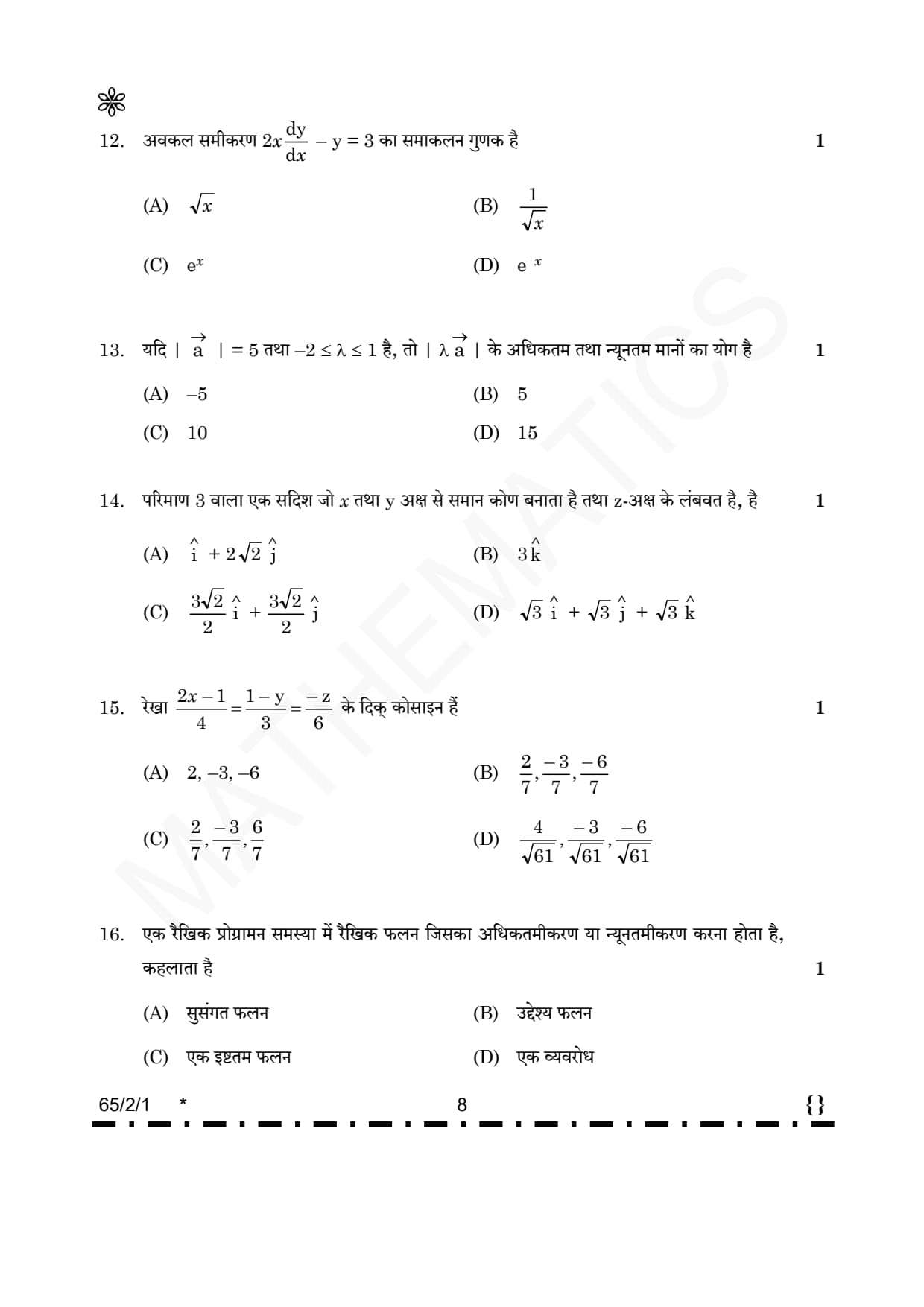
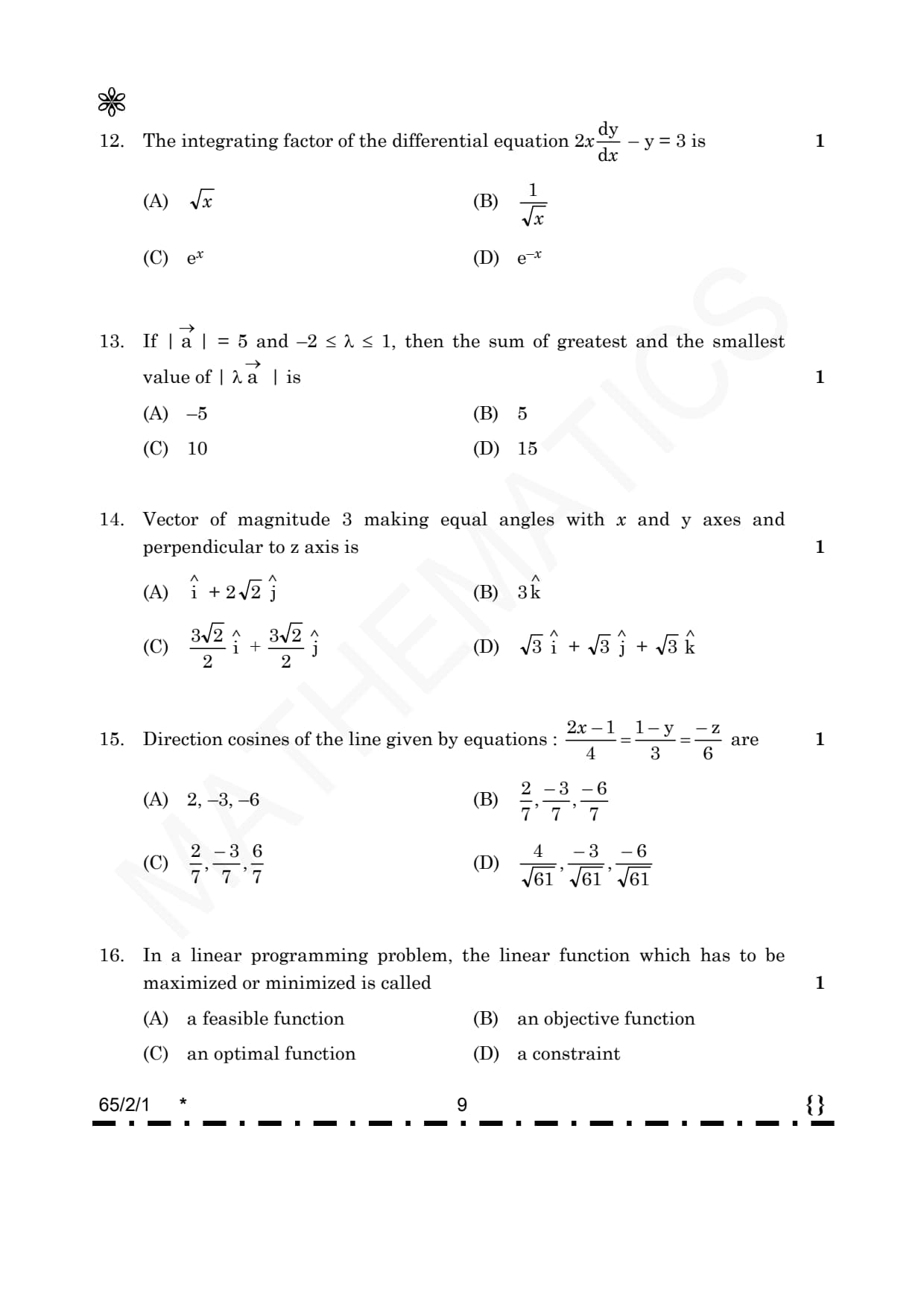
The integrating factor of the differential equation \( 2x \frac{dy}{dx} - y = 3 \) is
View Solution
Concept:
A linear differential equation of the form \( \frac{dy}{dx} + P(x)y = Q(x) \) has an integrating factor (I.F.) given by \( e^{\int P(x) dx} \).
\( \int \frac{1}{x} dx = \log|x| \) and \( e^{\log f(x)} = f(x) \).
Step 1: Write the equation in standard form
The given equation is:
\[ 2x \frac{dy}{dx} - y = 3 \]
To get \( \frac{dy}{dx} \) with a coefficient of 1, divide the whole equation by \( 2x \):
\[ \frac{dy}{dx} - \frac{1}{2x} y = \frac{3}{2x} \]
Comparing this with \( \frac{dy}{dx} + P(x)y = Q(x) \), we get:
\[ P(x) = -\frac{1}{2x} \]
Step 2: Calculate the Integrating Factor
Using the formula \( I.F. = e^{\int P(x) dx} \):
\[ I.F. = e^{\int -\frac{1}{2x} dx} \]
\[ I.F. = e^{-\frac{1}{2} \int \frac{1}{x} dx} \]
\[ I.F. = e^{-\frac{1}{2} \log x} \]
Step 3: Simplify using logarithmic properties
Apply the property \( n \log a = \log a^n \):
\[ I.F. = e^{\log x^{-1/2}} \]
Since \( e^{\log f(x)} = f(x) \):
\[ I.F. = x^{-1/2} \]
\[ I.F. = \frac{1}{\sqrt{x}} \] Quick Tip: Before identifying \( P(x) \), ensure the coefficient of \( \frac{dy}{dx} \) is exactly 1.
Be careful with the negative sign in \( P(x) \), as it directly affects the exponent of the Integrating Factor.
If \( |\vec{a}| = 5 \) and \( -2 \leq \lambda \leq 1 \), then the sum of greatest and the smallest value of \( |\lambda \vec{a}| \) is
View Solution
Concept:
For any scalar \( \lambda \) and vector \( \vec{a} \), the magnitude of the product is \( |\lambda \vec{a}| = |\lambda| |\vec{a}| \).
The magnitude of a vector is always a non-negative real number.
Step 1: Express the magnitude function
Given \( |\vec{a}| = 5 \), the magnitude of \( \lambda \vec{a} \) is:
\[ f(\lambda) = |\lambda \vec{a}| = |\lambda| \cdot 5 \]
We are given the interval for \( \lambda \) as \( [-2, 1] \).
Step 2: Find the smallest value
The smallest value of \( |\lambda| \) in the range \( [-2, 1] \) is 0 (which occurs at \( \lambda = 0 \)).
Smallest value of \( |\lambda \vec{a}| = 0 \cdot 5 = 0 \).
Step 3: Find the greatest value
The greatest value of \( |\lambda| \) in the range \( [-2, 1] \) is \( |-2| = 2 \).
Greatest value of \( |\lambda \vec{a}| = 2 \cdot 5 = 10 \).
Step 4: Calculate the sum
Sum of greatest and smallest values:
\[ Sum = 10 + 0 = 10 \] Quick Tip: Magnitude is always absolute. Even if \( \lambda \) is negative, \( |\lambda \vec{a}| \) is positive.
In an interval spanning across zero, the minimum absolute value is always zero.
Vector of magnitude 3 making equal angles with \( x \) and \( y \) axes and perpendicular to \( z \) axis is
View Solution
Concept:
If a vector makes angles \( \alpha, \beta, \gamma \) with the axes, its direction cosines are \( \cos \alpha, \cos \beta, \cos \gamma \).
Property of direction cosines: \( \cos^2 \alpha + \cos^2 \beta + \cos^2 \gamma = 1 \).
A vector \( \vec{v} \) of magnitude \( r \) is given by \( r(l\hat{i} + m\hat{j} + n\hat{k}) \).
Step 1: Determine the direction cosines
The vector is perpendicular to the \( z \)-axis, so \( \gamma = 90^\circ \).
This means \( n = \cos \gamma = \cos 90^\circ = 0 \).
It makes equal angles with \( x \) and \( y \) axes, so \( \alpha = \beta \).
This means \( l = m \).
Step 2: Solve for \( l \) and \( m \)
Using \( l^2 + m^2 + n^2 = 1 \):
\[ l^2 + l^2 + 0 = 1 \]
\[ 2l^2 = 1 \implies l = \frac{1}{\sqrt{2}} \]
So, \( l = \frac{1}{\sqrt{2}} \) and \( m = \frac{1}{\sqrt{2}} \).
Step 3: Construct the vector
Given magnitude \( r = 3 \):
\[ \vec{v} = 3 \left( \frac{1}{\sqrt{2}} \hat{i} + \frac{1}{\sqrt{2}} \hat{j} + 0\hat{k} \right) \]
\[ \vec{v} = \frac{3}{\sqrt{2}} \hat{i} + \frac{3}{\sqrt{2}} \hat{j} \]
Rationalizing the denominator (multiply by \( \sqrt{2}/\sqrt{2} \)):
\[ \vec{v} = \frac{3\sqrt{2}}{2} \hat{i} + \frac{3\sqrt{2}}{2} \hat{j} \] Quick Tip: Perpendicular to the z-axis implies the vector lies in the XY plane (z-component is 0).
Equal angles with X and Y axes in the XY plane always imply a \( 45^\circ \) inclination.
Direction cosines of the line given by equations : \( \frac{2x - 1}{4} = \frac{1 - y}{3} = \frac{-z}{6} \) are
View Solution
Concept:
Standard symmetric form of a line: \( \frac{x - x_1}{a} = \frac{y - y_1}{b} = \frac{z - z_1}{c} \), where \( a, b, c \) are direction ratios.
Direction cosines \( l, m, n \) are given by \( \frac{a}{\sqrt{a^2+b^2+c^2}}, \frac{b}{\sqrt{a^2+b^2+c^2}}, \frac{c}{\sqrt{a^2+b^2+c^2}} \).
Step 1: Convert to standard form
The given equations are:
\[ \frac{2x - 1}{4} = \frac{1 - y}{3} = \frac{-z}{6} \]
Adjust the numerators so coefficients of \( x, y, z \) are \( +1 \):
\[ \frac{2(x - 1/2)}{4} = \frac{-(y - 1)}{3} = \frac{z}{-6} \]
Divide denominators accordingly:
\[ \frac{x - 1/2}{2} = \frac{y - 1}{-3} = \frac{z}{-6} \]
Step 2: Identify direction ratios and magnitude
The direction ratios are \( (a, b, c) = (2, -3, -6) \).
Calculate the magnitude \( \sqrt{a^2 + b^2 + c^2} \):
\[ \sqrt{2^2 + (-3)^2 + (-6)^2} = \sqrt{4 + 9 + 36} = \sqrt{49} = 7 \]
Step 3: Calculate direction cosines
The direction cosines are:
\[ l = \frac{2}{7}, \quad m = \frac{-3}{7}, \quad n = \frac{-6}{7} \] Quick Tip: Always ensure \( x, y, z \) have a coefficient of \( +1 \) in the numerator before identifying direction ratios.
Direction cosines are simply direction ratios normalized by their magnitude.
In a linear programming problem, the linear function which has to be maximized or minimized is called
View Solution
Concept:
Linear Programming Problem (LPP) deals with optimization (maximization or minimization).
Constraints are linear inequalities or equations that restrict the variables.
The target function representing cost, profit, etc., is the central focus of optimization.
Step 1: Definition of components in LPP
In any LPP, we have variables (usually \( x, y \)) and a primary function that we want to either maximize (like profit) or minimize (like cost).
This function is of the form \( Z = ax + by \).
Step 2: Identify the specific term
The function \( Z = ax + by \), which represents the goal of the problem, is technically termed the "Objective Function".
The other terms like 'constraints' refer to the limitations, and 'feasible region' refers to the set of possible solutions. Quick Tip: Always identify the objective function first in an LPP; it is the only function containing the 'Z' variable.
Constraints are the 'subject to' inequalities, while the objective function is the 'maximize/minimize' equation.
For the feasible region shown below, the non-trivial constraints of the linear programming problem are

View Solution
Concept:
The equation of a line passing through intercepts \( (a, 0) \) and \( (0, b) \) is \( \frac{x}{a} + \frac{y}{b} = 1 \).
For a region shaded towards the origin (including \( (0,0) \)), the inequality for a line \( Ax + By = C \) (where \( C > 0 \)) is usually \( Ax + By \leq C \).
Step 1: Find the equation of the first boundary line
Observing the graph, the first line passes through \( (5, 0) \) and \( (0, 5) \).
Using the intercept form:
\[ \frac{x}{5} + \frac{y}{5} = 1 \implies x + y = 5 \]
Since the shaded region is towards the origin, the inequality is \( x + y \leq 5 \).
Step 2: Find the equation of the second boundary line
The second line passes through \( (9, 0) \) and \( (0, 3) \).
Using the intercept form:
\[ \frac{x}{9} + \frac{y}{3} = 1 \]
Multiply the entire equation by 9:
\[ x + 3y = 9 \]
Since the shaded region is towards the origin, the inequality is \( x + 3y \leq 9 \).
Step 3: Combine the constraints
The non-trivial constraints (excluding \( x, y \geq 0 \)) defining this feasible region are:
\( x + y \leq 5 \) and \( x + 3y \leq 9 \). Quick Tip: For lines with positive intercepts, a region shaded "below" or "towards the origin" always uses the \( \leq \) sign.
Quickly check the intercepts on the axes from the graph to write the line equations in seconds.
For two events \( A \) and \( B \) such that \( P(A) \neq 0 \) and \( P(B) \neq 1 \), \( P(A'/B') = \)
View Solution
Concept:
Concept:
Conditional Probability: \( P(X/Y) = \frac{P(X \cap Y)}{P(Y)} \).
De Morgan's Law: \( A' \cap B' = (A \cup B)' \).
Complementary Event: \( P(E') = 1 - P(E) \).
Step 1: Apply the definition of conditional probability
By the definition of conditional probability:
\[ P(A'/B') = \frac{P(A' \cap B')}{P(B')} \]
Step 2: Use De Morgan's Law to simplify the numerator
According to De Morgan's Law, the intersection of complements is the complement of the union:
\[ A' \cap B' = (A \cup B)' \]
Therefore, the probability is:
\[ P(A' \cap B') = P((A \cup B)') \]
Step 3: Apply the complement rule
Using the rule \( P(E') = 1 - P(E) \):
\[ P((A \cup B)') = 1 - P(A \cup B) \]
Substituting this back into the expression from Step 1:
\[ P(A'/B') = \frac{1 - P(A \cup B)}{P(B')} \] Quick Tip: Complementary probabilities in conditional statements like \( P(A'/B) = 1 - P(A/B) \) only work if the condition (the part after the slash) remains identical.
When the condition itself is a complement (like \( B' \)), you must expand using the full formula.
Assertion (A) : \( |\vec{a} \times \vec{b}|^2 + (\vec{a} \cdot \vec{b})^2 = |\vec{a}|^2 |\vec{b}|^2 \)
Reason (R) : \( |\vec{a} \times \vec{b}| = (\vec{a} \cdot \vec{b}) \tan \theta, \theta \neq \frac{\pi}{2} \)
View Solution
Concept:
Dot Product: \( \vec{a} \cdot \vec{b} = |\vec{a}| |\vec{b}| \cos \theta \).
Cross Product Magnitude: \( |\vec{a} \times \vec{b}| = |\vec{a}| |\vec{b}| \sin \theta \).
Trigonometric Identity: \( \sin^2 \theta + \cos^2 \theta = 1 \) and \( \tan \theta = \frac{\sin \theta}{\cos \theta} \).
Step 1: Verify Assertion (A)
Let \( |\vec{a}| = a \) and \( |\vec{b}| = b \).
LHS = \( (ab \sin \theta)^2 + (ab \cos \theta)^2 \)
\(= a^2b^2 \sin^2 \theta + a^2b^2 \cos^2 \theta \)
\(= a^2b^2 (\sin^2 \theta + \cos^2 \theta) \)
\(= a^2b^2 (1) = |\vec{a}|^2 |\vec{b}|^2 \).
Thus, Assertion (A) is true. This is known as Lagrange's Identity.
Step 2: Verify Reason (R)
RHS of Reason = \( (\vec{a} \cdot \vec{b}) \tan \theta \)
\(= (ab \cos \theta) \left( \frac{\sin \theta}{\cos \theta} \right) \)
\(= ab \sin \theta \).
LHS of Reason = \( |\vec{a} \times \vec{b}| = ab \sin \theta \).
Thus, Reason (R) is true.
Step 3: Check if R explains A
If we substitute \( |\vec{a} \times \vec{b}| = (\vec{a} \cdot \vec{b}) \tan \theta \) into the identity in (A):
\( (\vec{a} \cdot \vec{b})^2 \tan^2 \theta + (\vec{a} \cdot \vec{b})^2 = (\vec{a} \cdot \vec{b})^2 (1 + \tan^2 \theta) \)
\(= (\vec{a} \cdot \vec{b})^2 \sec^2 \theta = (ab \cos \theta)^2 \cdot \frac{1}{\cos^2 \theta} = a^2b^2 \).
Since the relation in R can be used to derive/prove A, it serves as a correct explanation. Quick Tip: Lagrange's Identity is one of the most important relationships between dot and cross products.
Whenever you see cross product squared and dot product squared added together, think of the Pythagorean identity \( \sin^2 + \cos^2 = 1 \).
Assertion (A) : A line can have direction cosines \( < 1, 1, 1 > \)
Reason (R) : \( \cos \theta = 1 \) is possible for \( \theta = 0 \)
View Solution
Concept:
Direction Cosines \( (l, m, n) \) of a line must satisfy the identity \( l^2 + m^2 + n^2 = 1 \).
Maximum and minimum values of the cosine function are \( 1 \) and \( -1 \).
Step 1: Verify Assertion (A)
Let the given values be \( l = 1, m = 1, n = 1 \).
We check the sum of squares:
\( l^2 + m^2 + n^2 = 1^2 + 1^2 + 1^2 = 1 + 1 + 1 = 3 \).
Since \( 3 \neq 1 \), these values cannot be the direction cosines of any line.
Thus, Assertion (A) is false.
Step 2: Verify Reason (R)
The reason states that \( \cos \theta = 1 \) is possible for \( \theta = 0 \).
We know that the cosine of zero degrees is exactly 1.
Thus, Reason (R) is true.
Step 3: Conclusion
Since Assertion (A) is false and Reason (R) is true, we select option (D). Quick Tip: Direction cosines are essentially components of a unit vector; hence their sum of squares must always be 1.
Direction ratios can be \( <1, 1, 1> \), but direction cosines would then be \( <1/\sqrt{3}, 1/\sqrt{3}, 1/\sqrt{3}> \).
Check whether \( f : R - \{3\} \to R \) defined as \( f(x) = \frac{x - 2}{x - 3} \) is onto or not.
View Solution
Concept:
A function \( f: A \to B \) is said to be onto (surjective) if every element in the codomain \( B \) has at least one pre-image in the domain \( A \).
This means the range of the function must be equal to its codomain.
Step 1: Express \( x \) in terms of \( y \)
Let \( y = f(x) \), where \( y \in R \) (Codomain).
\[ y = \frac{x - 2}{x - 3} \]
Multiplying both sides by \( (x - 3) \):
\[ y(x - 3) = x - 2 \]
\[ xy - 3y = x - 2 \]
\[ xy - x = 3y - 2 \]
\[ x(y - 1) = 3y - 2 \]
\[ x = \frac{3y - 2}{y - 1} \]
Step 2: Analyze the existence of pre-image
For \( x \) to be defined as a real number, the denominator \( (y - 1) \) must not be zero.
If \( y = 1 \), then there is no real value of \( x \) such that \( f(x) = 1 \).
Check if \( y = 1 \) is in the codomain:
The codomain is given as \( R \), which contains the element 1.
Step 3: Conclusion on onto property
Since \( 1 \in R \) (Codomain) but has no pre-image in the domain \( R - \{3\} \), the range of the function is \( R - \{1\} \).
As Range \( \neq \) Codomain, the function is not onto. Quick Tip: To check if a function is onto, solve for \( x \). If any value in the codomain makes the expression for \( x \) undefined, the function is not onto.
For rational functions of form \( \frac{ax+b}{cx+d} \), the range is always \( R - \{a/c\} \).
Check whether \( f : Z \times Z \to Z \times Z \) (where \( Z \) is the set of integers) defined as \( f(x, y) = (2y, 3x) \) is injective or not.
View Solution
Concept:
A function \( f: A \to B \) is injective (one-to-one) if \( f(x_1) = f(x_2) \implies x_1 = x_2 \) for all \( x_1, x_2 \in A \).
For a mapping on a Cartesian product, we assume two pairs have equal images and prove the original pairs must be identical.
Step 1: Set up the equality of images
Let \( (x_1, y_1) \) and \( (x_2, y_2) \) be two elements in the domain \( Z \times Z \).
Suppose their images are equal:
\[ f(x_1, y_1) = f(x_2, y_2) \]
By the definition of the function:
\[ (2y_1, 3x_1) = (2y_2, 3x_2) \]
Step 2: Equate the corresponding components
For two ordered pairs to be equal, their corresponding components must be equal:
\[ 2y_1 = 2y_2 \implies y_1 = y_2 \]
\[ 3x_1 = 3x_2 \implies x_1 = x_2 \]
Step 3: Conclusion on injectivity
Since \( x_1 = x_2 \) and \( y_1 = y_2 \), it follows that:
\[ (x_1, y_1) = (x_2, y_2) \]
As equality of images implies equality of elements, the function \( f \) is injective. Quick Tip: When checking injectivity for vector-valued functions, treat each component separately.
If each coordinate function is independent and injective, the entire mapping is injective.
If \( x = a \sin^3 t, y = b \cos^3 t \), then find \( \frac{dy}{dx} \) at \( t = \frac{\pi}{4} \).
View Solution
Concept:
Parametric differentiation: If \( x = f(t) \) and \( y = g(t) \), then \( \frac{dy}{dx} = \frac{dy/dt}{dx/dt} \).
Chain rule for differentiation: \( \frac{d}{dt}[f(t)^n] = n f(t)^{n-1} f'(t) \).
Step 1: Differentiate \( x \) with respect to \( t \)
Given \( x = a \sin^3 t \):
\[ \frac{dx}{dt} = a \cdot 3 \sin^2 t \cdot \frac{d}{dt}(\sin t) \]
\[ \frac{dx}{dt} = 3a \sin^2 t \cos t \]
Step 2: Differentiate \( y \) with respect to \( t \)
Given \( y = b \cos^3 t \):
\[ \frac{dy}{dt} = b \cdot 3 \cos^2 t \cdot \frac{d}{dt}(\cos t) \]
\[ \frac{dy}{dt} = 3b \cos^2 t (-\sin t) \]
\[ \frac{dy}{dt} = -3b \cos^2 t \sin t \]
Step 3: Find the derivative \( \frac{dy}{dx} \)
\[ \frac{dy}{dx} = \frac{-3b \cos^2 t \sin t}{3a \sin^2 t \cos t} \]
\[ \frac{dy}{dx} = -\frac{b}{a} \cdot \frac{\cos t}{\sin t} \]
\[ \frac{dy}{dx} = -\frac{b}{a} \cot t \]
Step 4: Evaluate at \( t = \frac{\pi}{4} \)
At \( t = \frac{\pi}{4} \):
\[ \frac{dy}{dx} = -\frac{b}{a} \cot\left(\frac{\pi}{4}\right) \]
Since \( \cot(45^\circ) = 1 \):
\[ \frac{dy}{dx} = -\frac{b}{a} \] Quick Tip: Always keep the negative sign from the derivative of cosine visible throughout the calculation.
Simplifying the trigonometric ratio to \( \cot t \) makes the final substitution much faster.
Find the absolute maximum value of \( f(x) = \cos x + \sin^2 x, x \in [0, \pi] \).
View Solution
Concept:
To find the absolute maximum of a function on a closed interval, we evaluate the function at critical points and at the endpoints of the interval.
Critical points are where \( f'(x) = 0 \).
Step 1: Find the derivative and critical points
Given \( f(x) = \cos x + \sin^2 x \).
\[ f'(x) = -\sin x + 2 \sin x \cos x \]
\[ f'(x) = \sin x (2 \cos x - 1) \]
Set \( f'(x) = 0 \):
1. \( \sin x = 0 \implies x = 0, \pi \) (Endpoints).
2. \( 2 \cos x - 1 = 0 \implies \cos x = \frac{1}{2} \implies x = \frac{\pi}{3} \).
Step 2: Evaluate the function at endpoints and critical points
- At \( x = 0 \):
\[ f(0) = \cos 0 + \sin^2 0 = 1 + 0 = 1 \]
- At \( x = \pi \):
\[ f(\pi) = \cos \pi + \sin^2 \pi = -1 + 0 = -1 \]
- At \( x = \frac{\pi}{3} \):
\[ f\left(\frac{\pi}{3}\right) = \cos\left(\frac{\pi}{3}\right) + \sin^2\left(\frac{\pi}{3}\right) = \frac{1}{2} + \left(\frac{\sqrt{3}}{2}\right)^2 = \frac{1}{2} + \frac{3}{4} = \frac{5}{4} = 1.25 \]
Step 3: Determine the absolute maximum
Comparing the values: \( 1, -1, 1.25 \).
The greatest value is \( \frac{5}{4} \).
Hence, absolute maximum value is \( \frac{5}{4} \). Quick Tip: Always check the endpoints of the interval; local maxima from derivatives aren't always global maxima.
Converting the function to a single trig variable (using \( \sin^2 x = 1 - \cos^2 x \)) can sometimes simplify the calculation.
If the volume of a solid hemisphere increases at a uniform rate, prove that its surface area varies inversely as its radius.
View Solution
Concept:
Volume of a solid hemisphere, \( V = \frac{2}{3}\pi r^3 \).
Total Surface area of a solid hemisphere, \( S = 3\pi r^2 \).
Rate of change is the derivative with respect to time \( t \).
Step 1: Use the uniform rate of volume
Given that volume increases at a uniform rate, \( \frac{dV}{dt} = k \) (constant).
Since \( V = \frac{2}{3}\pi r^3 \):
\[ \frac{d}{dt}\left(\frac{2}{3}\pi r^3\right) = k \]
\[ \frac{2}{3}\pi (3r^2) \frac{dr}{dt} = k \]
\[ 2\pi r^2 \frac{dr}{dt} = k \implies \frac{dr}{dt} = \frac{k}{2\pi r^2} \]
Step 2: Find the rate of change of surface area
We need to find \( \frac{dS}{dt} \) where \( S = 3\pi r^2 \):
\[ \frac{dS}{dt} = \frac{d}{dt}(3\pi r^2) = 6\pi r \frac{dr}{dt} \]
Step 3: Substitute and prove
Substitute the expression for \( \frac{dr}{dt} \) into the surface area equation:
\[ \frac{dS}{dt} = 6\pi r \left( \frac{k}{2\pi r^2} \right) \]
\[ \frac{dS}{dt} = \frac{3k}{r} \]
Since \( 3k \) is a constant, we have:
\[ \frac{dS}{dt} \propto \frac{1}{r} \]
Hence, the rate of surface area varies inversely as its radius. Quick Tip: "Uniform rate" always implies the derivative with respect to time is constant.
Be careful to distinguish between Curved Surface Area (\( 2\pi r^2 \)) and Total Surface Area (\( 3\pi r^2 \)) for a solid hemisphere.
If \( \vec{AB} = \hat{j} + \hat{k} \) and \( \vec{AC} = 3\hat{i} - \hat{j} + 4\hat{k} \) represent the two vectors along the sides AB and AC of \( \Delta ABC \), prove that the median \( \vec{AD} = \frac{\vec{AB} + \vec{AC}}{2} \), where D is midpoint of BC. Hence, find the length of median AD.
View Solution
Concept:
The position vector of the midpoint of a line segment joining two points is the average of their position vectors.
Vector addition and the concept of relative position vectors: \( \vec{PQ} = \vec{Q} - \vec{P} \).
Step 1: Prove the vector expression for the median
Let the position vectors of vertices A, B, and C be \( \vec{a}, \vec{b}, \) and \( \vec{c} \) respectively.
By definition:
\( \vec{AB} = \vec{b} - \vec{a} \) and \( \vec{AC} = \vec{c} - \vec{a} \).
D is the midpoint of BC, so its position vector \( \vec{d} = \frac{\vec{b} + \vec{c}}{2} \).
The median vector \( \vec{AD} = \vec{d} - \vec{a} \):
\[ \vec{AD} = \frac{\vec{b} + \vec{c}}{2} - \vec{a} \]
\[ \vec{AD} = \frac{\vec{b} + \vec{c} - 2\vec{a}}{2} \]
\[ \vec{AD} = \frac{(\vec{b} - \vec{a}) + (\vec{c} - \vec{a})}{2} = \frac{\vec{AB} + \vec{AC}}{2} \] (Proved).
Step 2: Calculate the vector \( \vec{AD} \)
\[ \vec{AD} = \frac{(\hat{j} + \hat{k}) + (3\hat{i} - \hat{j} + 4\hat{k})}{2} \]
\[ \vec{AD} = \frac{3\hat{i} + 0\hat{j} + 5\hat{k}}{2} \]
\[ \vec{AD} = \frac{3}{2}\hat{i} + \frac{5}{2}\hat{k} \]
Step 3: Find the length (magnitude) of the median
Length \( |\vec{AD}| = \sqrt{\left(\frac{3}{2}\right)^2 + (0)^2 + \left(\frac{5}{2}\right)^2} \)
\[ |\vec{AD}| = \sqrt{\frac{9}{4} + \frac{25}{4}} \]
\[ |\vec{AD}| = \sqrt{\frac{34}{4}} = \frac{\sqrt{34}}{2} units \] Quick Tip: Think of the median as the vector diagonal of a parallelogram divided by two.
Midpoint formulas in vectors are algebraically identical to midpoint formulas in coordinate geometry.
Find the co-ordinates of the point on the line \( \vec{r} = -\hat{j} + 3\hat{k} + \lambda(2\hat{i} - 2\hat{j} + \hat{k}) \) such that the sum of co-ordinates is 3.
View Solution
Concept:
Any general point on a line in vector form can be written as \( (x, y, z) \) by grouping terms with and without \( \lambda \).
If a condition is given for coordinates, solve the linear equation in \( \lambda \).
Step 1: Find the general coordinates of any point on the line
The line is \( \vec{r} = (2\lambda)\hat{i} + (-1 - 2\lambda)\hat{j} + (3 + \lambda)\hat{k} \).
Coordinates of a general point \( P(x, y, z) \) are:
\[ x = 2\lambda \]
\[ y = -1 - 2\lambda \]
\[ z = 3 + \lambda \]
Step 2: Apply the sum condition
The problem states that the sum of coordinates is 3:
\[ x + y + z = 3 \]
Substitute the parametric expressions:
\[ (2\lambda) + (-1 - 2\lambda) + (3 + \lambda) = 3 \]
Step 3: Solve for \( \lambda \)
Combine like terms:
\[ 2\lambda - 2\lambda + \lambda - 1 + 3 = 3 \]
\[ \lambda + 2 = 3 \]
\[ \lambda = 1 \]
Step 4: Determine the coordinates of the point
Substitute \( \lambda = 1 \) back into the expressions for \( x, y, z \):
\[ x = 2(1) = 2 \]
\[ y = -1 - 2(1) = -3 \]
\[ z = 3 + 1 = 4 \]
Hence, the co-ordinates of the point are \( (2, -3, 4) \). Quick Tip: A vector line equation \( \vec{r} = \vec{a} + \lambda\vec{b} \) is just a collection of three parametric equations.
Always verify your final point by checking if the sum of its coordinates matches the given condition.
Find : \( \int \frac{x + 2}{\sqrt{9x - x^2}} \, dx \)
View Solution
Concept:
Integration of the form \( \int \frac{px+q}{\sqrt{ax^2+bx+c}} \, dx \).
Express the numerator as \( px+q = A \cdot \frac{d}{dx}(quadratic) + B \).
Use substitution for the first part and completion of squares for the second part.
Step 1: Express the numerator in terms of the derivative of the quadratic
The derivative of the expression inside the square root is \( \frac{d}{dx}(9x - x^2) = 9 - 2x \).
Let \( x + 2 = A(9 - 2x) + B \).
Comparing coefficients of \( x \): \( 1 = -2A \implies A = -\frac{1}{2} \).
Comparing constants: \( 2 = 9A + B \implies 2 = 9(-\frac{1}{2}) + B \implies B = 2 + \frac{9}{2} = \frac{13}{2} \).
So, \( x + 2 = -\frac{1}{2}(9 - 2x) + \frac{13}{2} \).
Step 2: Split the integral into two parts
\[ I = \int \frac{-\frac{1}{2}(9 - 2x) + \frac{13}{2}}{\sqrt{9x - x^2}} \, dx \]
\[ I = -\frac{1}{2} \int \frac{9 - 2x}{\sqrt{9x - x^2}} \, dx + \frac{13}{2} \int \frac{1}{\sqrt{9x - x^2}} \, dx \]
Let \( I = I_1 + I_2 \).
Step 3: Evaluate the first integral \( I_1 \)
For \( I_1 = -\frac{1}{2} \int \frac{9 - 2x}{\sqrt{9x - x^2}} \, dx \), let \( 9x - x^2 = t \).
Then \( (9 - 2x) \, dx = dt \).
\[ I_1 = -\frac{1}{2} \int t^{-1/2} \, dt = -\frac{1}{2} [2t^{1/2}] = -\sqrt{9x - x^2} \]
Step 4: Evaluate the second integral \( I_2 \) by completing the square
For \( I_2 = \frac{13}{2} \int \frac{1}{\sqrt{9x - x^2}} \, dx \), consider the quadratic part:
\( 9x - x^2 = -(x^2 - 9x) = -[x^2 - 9x + (9/2)^2 - (9/2)^2] = (9/2)^2 - (x - 9/2)^2 \).
\[ I_2 = \frac{13}{2} \int \frac{dx}{\sqrt{(\frac{9}{2})^2 - (x - \frac{9}{2})^2}} \]
Using \( \int \frac{dx}{\sqrt{a^2 - x^2}} = \sin^{-1}(\frac{x}{a}) \):
\[ I_2 = \frac{13}{2} \sin^{-1}\left(\frac{x - 9/2}{9/2}\right) = \frac{13}{2} \sin^{-1}\left(\frac{2x - 9}{9}\right) \]
Step 5: Combine the results
\[ I = -\sqrt{9x - x^2} + \frac{13}{2} \sin^{-1}\left(\frac{2x - 9}{9}\right) + C \] Quick Tip: Always separate the integral into a 'substitution part' and a 'standard formula part'.
Check your values of A and B by expanding back to see if you get the original numerator.
Evaluate : \( \int_{\pi/12}^{5\pi/12} \frac{dx}{1 + \sqrt{\cot x}} \)
View Solution
Concept:
Use the property \( \int_{a}^{b} f(x) \, dx = \int_{a}^{b} f(a + b - x) \, dx \).
Convert the cotangent function into sine and cosine.
Step 1: Simplify the integrand
Let \( I = \int_{\pi/12}^{5\pi/12} \frac{1}{1 + \sqrt{\frac{\cos x}{\sin x}}} \, dx = \int_{\pi/12}^{5\pi/12} \frac{\sqrt{\sin x}}{\sqrt{\sin x} + \sqrt{\cos x}} \, dx \) --- (1)
Step 2: Apply the integration property
Sum of limits: \( a + b = \frac{\pi}{12} + \frac{5\pi}{12} = \frac{6\pi}{12} = \frac{\pi}{2} \).
Using \( \int_{a}^{b} f(x) \, dx = \int_{a}^{b} f(\frac{\pi}{2} - x) \, dx \):
\[ I = \int_{\pi/12}^{5\pi/12} \frac{\sqrt{\sin(\pi/2 - x)}}{\sqrt{\sin(\pi/2 - x)} + \sqrt{\cos(\pi/2 - x)}} \, dx \]
\[ I = \int_{\pi/12}^{5\pi/12} \frac{\sqrt{\cos x}}{\sqrt{\cos x} + \sqrt{\sin x}} \, dx \] --- (2)
Step 3: Add equations (1) and (2)
\[ 2I = \int_{\pi/12}^{5\pi/12} \frac{\sqrt{\sin x} + \sqrt{\cos x}}{\sqrt{\sin x} + \sqrt{\cos x}} \, dx \]
\[ 2I = \int_{\pi/12}^{5\pi/12} 1 \, dx = [x]_{\pi/12}^{5\pi/12} \]
Step 4: Solve for \( I \)
\[ 2I = \frac{5\pi}{12} - \frac{\pi}{12} = \frac{4\pi}{12} = \frac{\pi}{3} \]
\[ I = \frac{\pi}{6} \] Quick Tip: Whenever the limits add up to \( \pi/2 \) in a trig integral, the answer is often half the difference of the limits.
The transformation from \( 1/(1+\sqrt{\cot x}) \) to \( \sqrt{\sin x}/(\sqrt{\sin x}+\sqrt{\cos x}) \) is a standard technique.
Evaluate : \( \int_{-\pi/6}^{\pi/2} (\sin |x| + \cos |x|) \, dx \)
View Solution
Concept:
Split the integral at points where the modulus argument changes sign (\( x = 0 \)).
Recall \( |x| = x \) for \( x \geq 0 \) and \( |x| = -x \) for \( x < 0 \).
Step 1: Split the integral at \( x = 0 \)
\[ I = \int_{-\pi/6}^{0} (\sin |x| + \cos |x|) \, dx + \int_{0}^{\pi/2} (\sin |x| + \cos |x|) \, dx \]
Step 2: Remove modulus using appropriate signs
For \( x \in [-\pi/6, 0] \), \( |x| = -x \).
For \( x \in [0, \pi/2] \), \( |x| = x \).
\[ I = \int_{-\pi/6}^{0} (\sin(-x) + \cos(-x)) \, dx + \int_{0}^{\pi/2} (\sin x + \cos x) \, dx \]
Since \( \sin(-x) = -\sin x \) and \( \cos(-x) = \cos x \):
\[ I = \int_{-\pi/6}^{0} (-\sin x + \cos x) \, dx + \int_{0}^{\pi/2} (\sin x + \cos x) \, dx \]
Step 3: Integrate each term
\[ I = [\cos x + \sin x]_{-\pi/6}^{0} + [-\cos x + \sin x]_{0}^{\pi/2} \]
Step 4: Evaluate limits
Part 1: \( (\cos 0 + \sin 0) - (\cos(-\pi/6) + \sin(-\pi/6)) = (1 + 0) - (\frac{\sqrt{3}}{2} - \frac{1}{2}) = 1 - \frac{\sqrt{3}}{2} + \frac{1}{2} = \frac{3 - \sqrt{3}}{2} \).
Part 2: \( (-\cos(\pi/2) + \sin(\pi/2)) - (-\cos 0 + \sin 0) = (0 + 1) - (-1 + 0) = 1 + 1 = 2 \).
Step 5: Final addition
\[ I = \frac{3 - \sqrt{3}}{2} + 2 = \frac{3 - \sqrt{3} + 4}{2} = \frac{7 - \sqrt{3}}{2} \] Quick Tip: Always handle absolute values by splitting the interval at zero.
Remember the parity of trig functions: \( \cos \) is even, \( \sin \) is odd.
If \( \frac{d}{dx}(F(x)) = \frac{1}{e^x + 1} \), then find \( F(x) \) given that \( F(0) = \log \frac{1}{2} \).
View Solution
Concept:
Integrating a rate of change function to find the original function.
Use algebraic manipulation to integrate functions involving \( e^x \).
Step 1: Set up the integral for \( F(x) \)
\[ F(x) = \int \frac{1}{e^x + 1} \, dx \]
Step 2: Use a trick to integrate
Multiply numerator and denominator by \( e^{-x} \):
\[ F(x) = \int \frac{e^{-x}}{1 + e^{-x}} \, dx \]
Alternatively, add and subtract \( e^x \) in numerator:
\[ \int \frac{1+e^x-e^x}{e^x+1} dx = \int (1 - \frac{e^x}{e^x+1}) dx \]
Step 3: Integrate
Using the second method:
\[ F(x) = x - \log(e^x + 1) + C \]
Step 4: Find the constant \( C \)
Given \( F(0) = \log(1/2) = -\log 2 \).
\[ -\log 2 = 0 - \log(e^0 + 1) + C \]
\[ -\log 2 = -\log(1 + 1) + C \]
\[ -\log 2 = -\log 2 + C \implies C = 0 \]
Step 5: State the final function
\[ F(x) = x - \log(e^x + 1) \] Quick Tip: For integrals like \( 1/(e^x+1) \), substituting \( t = e^x \) is another valid approach.
Remember that \( \log(1/2) = \log(2^{-1}) = -\log 2 \).
Solve the following differential equation : \( x \frac{dy}{dx} = y - x \sin^2\left(\frac{y}{x}\right) \), given that \( y(1) = \frac{\pi}{6} \)
View Solution
Concept:
This is a homogeneous differential equation because it involves the term \( y/x \).
Substitute \( y = vx \) and \( \frac{dy}{dx} = v + x \frac{dv}{dx} \).
Step 1: Apply the substitution
Let \( y = vx \). Then \( \frac{dy}{dx} = v + x \frac{dv}{dx} \).
The equation becomes:
\[ x \left(v + x \frac{dv}{dx}\right) = vx - x \sin^2 v \]
Divide both sides by \( x \):
\[ v + x \frac{dv}{dx} = v - \sin^2 v \]
Step 2: Separate the variables
\[ x \frac{dv}{dx} = -\sin^2 v \]
\[ \frac{dv}{\sin^2 v} = -\frac{dx}{x} \]
\[ \csc^2 v \, dv = -\frac{dx}{x} \]
Step 3: Integrate both sides
\[ \int \csc^2 v \, dv = -\int \frac{1}{x} \, dx \]
\[ -\cot v = -\log|x| + C \]
\[ \cot\left(\frac{y}{x}\right) = \log|x| + C \]
Step 4: Apply initial condition
Given \( y(1) = \pi/6 \). When \( x = 1 \), \( y = \pi/6 \).
\[ \cot\left(\frac{\pi/6}{1}\right) = \log|1| + C \]
\[ \cot\left(\frac{\pi}{6}\right) = 0 + C \]
\[ \sqrt{3} = C \]
Step 5: State the final solution
\[ \cot\left(\frac{y}{x}\right) = \log|x| + \sqrt{3} \] Quick Tip: In homogeneous equations, the \( v \) term usually cancels out immediately after substitution.
Check the domain of \( \cot \) to ensure your solution is valid for the given point.
Find the general solution of the differential equation : \( y \log y \frac{dx}{dy} + x = \frac{2}{y} \).
View Solution
Concept:
This is a linear differential equation in the form \( \frac{dx}{dy} + P(y)x = Q(y) \).
Calculate the Integrating Factor \( I.F. = e^{\int P(y) \, dy} \).
Step 1: Write the equation in standard form
Divide the whole equation by \( y \log y \):
\[ \frac{dx}{dy} + \frac{1}{y \log y} x = \frac{2}{y^2 \log y} \]
Here, \( P(y) = \frac{1}{y \log y} \) and \( Q(y) = \frac{2}{y^2 \log y} \).
Step 2: Calculate the Integrating Factor
\[ I.F. = e^{\int \frac{1}{y \log y} \, dy} \]
Let \( \log y = u \implies \frac{1}{y} \, dy = du \).
\[ \int \frac{1}{u} \, du = \log u = \log(\log y) \]
\[ I.F. = e^{\log(\log y)} = \log y \]
Step 3: Solve the differential equation
The solution is given by \( x \cdot (I.F.) = \int Q(y) \cdot (I.F.) \, dy \).
\[ x \log y = \int \frac{2}{y^2 \log y} \cdot \log y \, dy \]
\[ x \log y = \int \frac{2}{y^2} \, dy \]
Step 4: Integrate and simplify
\[ x \log y = 2 \left[-\frac{1}{y}\right] + C \]
\[ x \log y = C - \frac{2}{y} \] Quick Tip: When the derivative is \( dx/dy \), the equation is linear in \( x \).
The Integrating Factor \( e^{\log(something)} \) simply results in 'something'.
Solve the following linear programming problem graphically :
Maximize \( Z = 10500x + 9000y \)
Subject to constraints
\( x + y \leq 50 \)
\( 2x + y \leq 80 \)
\( x, y \geq 0 \)
View Solution
Concept:
Corner Point Method: Find the vertices of the feasible region and evaluate the objective function at each.
The region must satisfy all inequalities simultaneously in the first quadrant.
Step 1: Plot the lines and find the feasible region
Line 1: \( x + y = 50 \). Intercepts are \( (50, 0) \) and \( (0, 50) \).
Line 2: \( 2x + y = 80 \). Intercepts are \( (40, 0) \) and \( (0, 80) \).
Region \( x, y \geq 0 \) means first quadrant.
Region \( x + y \leq 50 \) is below Line 1.
Region \( 2x + y \leq 80 \) is below Line 2.
The common shaded region is a quadrilateral.
Step 2: Find the point of intersection of the two lines
Solve \( 2x + y = 80 \) and \( x + y = 50 \).
Subtracting the equations: \( (2x + y) - (x + y) = 80 - 50 \implies x = 30 \).
Substitute \( x = 30 \) in \( x + y = 50 \implies y = 20 \).
The intersection point is \( (30, 20) \).
Step 3: Identify the corner points of the feasible region
The corner points are:
1. \( O(0, 0) \)
2. \( A(40, 0) \) --- (Lower x-intercept among the two lines)
3. \( B(30, 20) \) --- (Intersection point)
4. \( C(0, 50) \) --- (Lower y-intercept among the two lines)
Step 4: Evaluate the objective function \( Z = 10500x + 9000y \)
At \( O(0, 0) \): \( Z = 0 \).
At \( A(40, 0) \): \( Z = 10500(40) + 0 = 4,20,000 \).
At \( B(30, 20) \): \( Z = 10500(30) + 9000(20) = 3,15,000 + 1,80,000 = 4,95,000 \).
At \( C(0, 50) \): \( Z = 0 + 9000(50) = 4,50,000 \).
Step 5: Find the maximum value
Comparing all values, the maximum value is \( 4,95,000 \).
It occurs at the point \( (30, 20) \).
 Quick Tip: For \( \leq \) constraints with positive coefficients, the feasible region is always 'towards' the origin.
Always verify the intersection point by plugging it back into both constraint equations.
The probability of hitting the target by a trained sniper is three times the probability of not hitting the target on a stormy day due to high wind speed.
The sniper fired two shots on the target on a stormy day when wind speed was very high.
Find the probability that
(i) target is hit
(ii) atleast one shot misses the target.

View Solution
Concept:
Let \( p \) be the probability of hitting the target and \( q \) be the probability of missing.
Since hitting and missing are complementary events, \( p + q = 1 \).
Bernoulli trials are used for repeated independent experiments.
Step 1: Calculate individual probabilities \( p \) and \( q \)
Given that probability of hitting is three times the probability of missing:
\( p = 3q \)
Since \( p + q = 1 \):
\( 3q + q = 1 \implies 4q = 1 \implies q = \frac{1}{4} \)
Then \( p = 3 \times \frac{1}{4} = \frac{3}{4} \).
Step 2: Find the probability that the target is hit
The target is hit if at least one of the two shots hits.
\( P(target is hit) = 1 - P(both shots miss) \)
\( P(target is hit) = 1 - (q \times q) \)
\( P(target is hit) = 1 - \left(\frac{1}{4}\right)^2 = 1 - \frac{1}{16} = \frac{15}{16} \).
Step 3: Find the probability that atleast one shot misses
At least one shot misses is the complement of both shots hitting.
\( P(atleast one miss) = 1 - P(both shots hit) \)
\( P(atleast one miss) = 1 - (p \times p) \)
\( P(atleast one miss) = 1 - \left(\frac{3}{4}\right)^2 = 1 - \frac{9}{16} = \frac{7}{16} \). Quick Tip: "At least one" problems are almost always solved faster using the complement: \( 1 - P(none) \).
Always ensure that the sum of elementary probabilities \( p \) and \( q \) equals 1.
Mother, Father and Son line up at random for a family picture.
Let events E : Son on one end and F : Father in the middle.
Find P(E/F).
View Solution
Concept:
The sample space \( S \) for 3 people (M, F, S) consists of \( 3! = 6 \) arrangements.
Conditional probability \( P(E/F) = \frac{P(E \cap F)}{P(F)} = \frac{n(E \cap F)}{n(F)} \).
Step 1: Identify the sample space and Event F
Sample space \( S = \{MFS, MSF, FMS, FSM, SMF, SFM\} \).
Event F (Father in the middle):
\( F = \{MFS, SFM\} \)
So, \( n(F) = 2 \).
Step 2: Identify Event E and intersection \( E \cap F \)
Event E (Son on one end):
\( E = \{MFS, FMS, SMF, SFM\} \)
The intersection \( E \cap F \) (Father in middle AND Son on an end):
In \( MFS \), Father is middle, Son is on an end.
In \( SFM \), Father is middle, Son is on an end.
So, \( E \cap F = \{MFS, SFM\} \) and \( n(E \cap F) = 2 \).
Step 3: Calculate the conditional probability
\( P(E/F) = \frac{n(E \cap F)}{n(F)} = \frac{2}{2} = 1 \). Quick Tip: If every arrangement in event F also satisfies event E, the conditional probability \( P(E/F) \) is always 1.
List out permutations for small sets to avoid logical errors.
If \( P = \begin{bmatrix} 1 & -1 & 0 \\ 2 & 3 & 4 \\ 0 & 1 & 2 \end{bmatrix} \) and \( Q = \begin{bmatrix} 2 & 2 & -4 \\ -4 & 2 & -4 \\ 2 & -1 & 5 \end{bmatrix} \), find \( (QP) \) and hence solve the following system of equations using matrices :
\( x - y = 3 \)
\( 2x + 3y + 4z = 17 \)
\( y + 2z = 7 \)
View Solution
Concept:
Matrix multiplication \( QP \).
If \( QP = kI \), then \( P^{-1} = \frac{1}{k}Q \).
A system of equations \( AX = B \) is solved as \( X = A^{-1}B \).
Step 1: Calculate the product \( QP \)
\[ QP = \begin{bmatrix} 2 & 2 & -4 \\ -4 & 2 & -4 \\ 2 & -1 & 5 \end{bmatrix} \begin{bmatrix} 1 & -1 & 0 \\ 2 & 3 & 4 \\ 0 & 1 & 2 \end{bmatrix} \]
Performing matrix multiplication:
\( R_1: (2\cdot1+2\cdot2-4\cdot0), (2\cdot-1+2\cdot3-4\cdot1), (2\cdot0+2\cdot4-4\cdot2) = [6, 0, 0] \)
\( R_2: (-4\cdot1+2\cdot2-4\cdot0), (-4\cdot-1+2\cdot3-4\cdot1), (-4\cdot0+2\cdot4-4\cdot2) = [0, 6, 0] \)
\( R_3: (2\cdot1-1\cdot2+5\cdot0), (2\cdot-1-1\cdot3+5\cdot1), (2\cdot0-1\cdot4+5\cdot2) = [0, 0, 6] \)
So, \( QP = 6I \).
Step 2: Express the system in matrix form \( AX = B \)
The equations are:
\( \begin{bmatrix} 1 & -1 & 0 \\ 2 & 3 & 4 \\ 0 & 1 & 2 \end{bmatrix} \begin{bmatrix} x \\ y \\ z \end{bmatrix} = \begin{bmatrix} 3 \\ 17 \\ 7 \end{bmatrix} \)
This is of the form \( PX = B \), where \( P \) is the matrix given in the question.
Step 3: Solve for X
From \( QP = 6I \), we have \( P^{-1} = \frac{1}{6}Q \).
\( X = P^{-1}B = \frac{1}{6}QB \)
\( \begin{bmatrix} x \\ y \\ z \end{bmatrix} = \frac{1}{6} \begin{bmatrix} 2 & 2 & -4 \\ -4 & 2 & -4 \\ 2 & -1 & 5 \end{bmatrix} \begin{bmatrix} 3 \\ 17 \\ 7 \end{bmatrix} \)
\( x = \frac{1}{6}(2\cdot3 + 2\cdot17 - 4\cdot7) = \frac{1}{6}(6 + 34 - 28) = \frac{12}{6} = 2 \).
\( y = \frac{1}{6}(-4\cdot3 + 2\cdot17 - 4\cdot7) = \frac{1}{6}(-12 + 34 - 28) = \frac{-6}{6} = -1 \).
\( z = \frac{1}{6}(2\cdot3 - 1\cdot17 + 5\cdot7) = \frac{1}{6}(6 - 17 + 35) = \frac{24}{6} = 4 \).
Solution: \( x = 2, y = -1, z = 4 \). Quick Tip: The "hence" keyword implies you must use the matrix product result to find the inverse, rather than calculating adj(A) manually.
Verify the solution by plugging \( (2, -1, 4) \) back into the original equations.
Obtain the value of \( \Delta = \begin{vmatrix} 1+x & 1 & 1 \\ 1 & 1+y & 1 \\ 1 & 1 & 1+z \end{vmatrix} \) in terms of \( x, y \) and \( z \).
Further, if \( \Delta = 0 \) and \( x, y, z \) are non-zero real numbers, prove that \( x^{-1} + y^{-1} + z^{-1} = -1 \).
View Solution
Concept:
Properties of determinants.
Factoring out terms from rows or columns.
Step 1: Factor out x, y, z from columns
Since \( x, y, z \neq 0 \), factor out \( x \) from \( C_1 \), \( y \) from \( C_2 \), and \( z \) from \( C_3 \):
\( \Delta = xyz \begin{vmatrix} \frac{1}{x}+1 & \frac{1}{y} & \frac{1}{z} \\ \frac{1}{x} & \frac{1}{y}+1 & \frac{1}{z} \\ \frac{1}{x} & \frac{1}{y} & \frac{1}{z}+1 \end{vmatrix} \)
Step 2: Apply row transformation
Perform \( R_1 \to R_1 + R_2 + R_3 \):
\( \Delta = xyz \begin{vmatrix} 1+\frac{1}{x}+\frac{1}{y}+\frac{1}{z} & 1+\frac{1}{x}+\frac{1}{y}+\frac{1}{z} & 1+\frac{1}{x}+\frac{1}{y}+\frac{1}{z} \\ \frac{1}{x} & \frac{1}{y}+1 & \frac{1}{z} \\ \frac{1}{x} & \frac{1}{y} & \frac{1}{z}+1 \end{vmatrix} \)
Factoring out \( (1 + \frac{1}{x} + \frac{1}{y} + \frac{1}{z}) \) from \( R_1 \):
\( \Delta = xyz(1 + \frac{1}{x} + \frac{1}{y} + \frac{1}{z}) \begin{vmatrix} 1 & 1 & 1 \\ \frac{1}{x} & \frac{1}{y}+1 & \frac{1}{z} \\ \frac{1}{x} & \frac{1}{y} & \frac{1}{z}+1 \end{vmatrix} \)
Step 3: Simplify the remaining determinant
Perform \( C_2 \to C_2 - C_1 \) and \( C_3 \to C_3 - C_1 \):
\( \Delta = xyz(1 + \frac{1}{x} + \frac{1}{y} + \frac{1}{z}) \begin{vmatrix} 1 & 0 & 0 \\ \frac{1}{x} & 1 & 0 \\ \frac{1}{x} & 0 & 1 \end{vmatrix} \)
The determinant of the identity-like matrix is 1.
\( \Delta = xyz(1 + \frac{1}{x} + \frac{1}{y} + \frac{1}{z}) = xyz + yz + xz + xy \).
Step 4: Prove the given condition
If \( \Delta = 0 \):
\( xyz(1 + \frac{1}{x} + \frac{1}{y} + \frac{1}{z}) = 0 \)
Since \( x, y, z \neq 0 \), the product \( xyz \neq 0 \).
\( 1 + \frac{1}{x} + \frac{1}{y} + \frac{1}{z} = 0 \)
\( x^{-1} + y^{-1} + z^{-1} = -1 \). (Proved) Quick Tip: Factoring out variables to create common terms in rows/columns is a very common trick for symmetric-looking determinants.
Always look for transformations that result in a row or column of 1s.
Find the sub intervals in which \( f(x) = \cot^{-1} (\sin x + \cos x), x \in (0, \pi) \) is increasing and decreasing.
View Solution
Concept:
A function is increasing where \( f'(x) > 0 \) and decreasing where \( f'(x) < 0 \).
Derivative of \( \cot^{-1} u \) is \( \frac{-1}{1+u^2} \frac{du}{dx} \).
Step 1: Find the derivative \( f'(x) \)
Let \( u = \sin x + \cos x \). Then \( f(x) = \cot^{-1} u \).
\( f'(x) = \frac{-1}{1 + (\sin x + \cos x)^2} \times (\cos x - \sin x) \)
\( f'(x) = \frac{\sin x - \cos x}{1 + (\sin x + \cos x)^2} \).
Step 2: Identify the sign of the derivative
The denominator \( 1 + (\sin x + \cos x)^2 \) is always positive for all \( x \).
The sign of \( f'(x) \) depends solely on the numerator \( \sin x - \cos x \).
Set \( f'(x) = 0 \):
\( \sin x - \cos x = 0 \implies \tan x = 1 \).
In the interval \( (0, \pi) \), \( x = \frac{\pi}{4} \).
Step 3: Determine intervals
1. For \( x \in (0, \pi/4) \): \( \cos x > \sin x \implies \sin x - \cos x < 0 \).
Thus, \( f'(x) < 0 \), so \( f(x) \) is decreasing.
2. For \( x \in (\pi/4, \pi) \):
- In \( (\pi/4, \pi/2) \), \( \sin x > \cos x \).
- In \( (\pi/2, \pi) \), \( \sin x > 0 \) and \( \cos x < 0 \), so \( \sin x - \cos x > 0 \).
In both cases, \( f'(x) > 0 \), so \( f(x) \) is increasing. Quick Tip: Use test values like \( x = \pi/6 \) and \( x = \pi/2 \) to check signs in sub-intervals quickly.
Ignore denominators that are always positive (like \( 1 + u^2 \)) when checking for inequalities.
A rectangle of perimeter 36 cm is revolved around one of its sides to sweep out a cylinder of maximum volume.
Find the dimensions of the rectangle.

View Solution
Concept:
Let the sides of the rectangle be \( r \) and \( h \).
Volume of cylinder \( V = \pi r^2 h \).
Perimeter of rectangle \( 2(r + h) = 36 \).
Step 1: Express Volume as a single-variable function
Given \( 2(r + h) = 36 \implies r + h = 18 \implies h = 18 - r \).
Volume \( V(r) = \pi r^2 (18 - r) = \pi (18r^2 - r^3) \).
Step 2: Find critical points
\( V'(r) = \pi (36r - 3r^2) \).
Set \( V'(r) = 0 \):
\( 3\pi r (12 - r) = 0 \implies r = 12 \) (since \( r=0 \) is not possible).
Step 3: Verify maximum using second derivative test
\( V''(r) = \pi (36 - 6r) \).
At \( r = 12 \): \( V''(12) = \pi (36 - 72) = -36\pi < 0 \).
Since \( V''(r) \) is negative, the volume is maximum at \( r = 12 \).
Step 4: Determine dimensions
When \( r = 12 cm \):
\( h = 18 - 12 = 6 cm \).
The dimensions of the rectangle are 12 cm and 6 cm. Quick Tip: When a rectangle is revolved around side \( h \), that side becomes the height and the other side \( r \) becomes the radius.
In optimization, the variable with the higher power in the formula (here \( r \)) usually takes a larger share of the total sum.
Find the domain of \( g(x) = \cos^{-1} (x^2 - 1) \). Hence, find the value of \( x \) for which \( g(x) = \frac{\pi}{3} \).
Also, write the range of \( \cos^{-1} x \) other than its principal branch.
View Solution
Concept:
Domain of \( \cos^{-1} u \) is \( -1 \leq u \leq 1 \).
Range of \( \cos^{-1} x \) (principal) is \( [0, \pi] \).
Step 1: Find the domain
For \( \cos^{-1} (x^2 - 1) \) to be defined:
\( -1 \leq x^2 - 1 \leq 1 \)
Add 1 to all sides:
\( 0 \leq x^2 \leq 2 \)
Taking the square root:
\( -\sqrt{2} \leq x \leq \sqrt{2} \).
Domain: \( [-\sqrt{2}, \sqrt{2}] \).
Step 2: Solve for \( g(x) = \pi/3 \)
\( \cos^{-1} (x^2 - 1) = \frac{\pi}{3} \)
\( x^2 - 1 = \cos(\pi/3) = \frac{1}{2} \)
\( x^2 = 1 + \frac{1}{2} = \frac{3}{2} \)
\( x = \pm \sqrt{\frac{3}{2}} \).
Step 3: Write the range other than principal branch
The principal branch range is \( [0, \pi] \).
Any other interval of the form \( [k\pi, (k+1)\pi] \) for \( k \in Z, k \neq 0 \) is a valid branch.
Examples: \( [\pi, 2\pi] \) or \( [-\pi, 0] \). Quick Tip: When solving \( x^2 \leq a \), the solution is always the interval \( [-\sqrt{a}, \sqrt{a}] \).
The cosine function repeats its range every \( \pi \) units in different "chunks" for its inverse to exist.
A line passing through the points \( A(1, 2, 3) \) and \( B(5, 8, 11) \) intersects the line \( \vec{r} = 4\hat{i} + \hat{j} + \lambda(5\hat{i} + 2\hat{j} + \hat{k}) \). Find the co-ordinates of the point of intersection. Hence, write the equation of a line passing through the point of intersection and perpendicular to both the lines.
View Solution
Concept:
Equation of line through two points \( (x_1,y_1,z_1) \) and \( (x_2,y_2,z_2) \).
Intersection of lines: equating general points.
Perpendicularity: direction ratios are given by the cross product of the two lines' directions.
Step 1: Find the equation of line AB
Direction ratios of AB: \( (5-1, 8-2, 11-3) = (4, 6, 8) \to (2, 3, 4) \).
Equation of Line 1: \( \vec{r} = (\hat{i} + 2\hat{j} + 3\hat{k}) + \mu(2\hat{i} + 3\hat{j} + 4\hat{k}) \).
Step 2: Find the point of intersection
General point on Line 1: \( (1+2\mu, 2+3\mu, 3+4\mu) \).
General point on Line 2: \( (4+5\lambda, 1+2\lambda, \lambda) \).
Equating the coordinates:
1) \( 1 + 2\mu = 4 + 5\lambda \implies 2\mu - 5\lambda = 3 \)
2) \( 2 + 3\mu = 1 + 2\lambda \implies 3\mu - 2\lambda = -1 \)
3) \( 3 + 4\mu = \lambda \implies \lambda - 4\mu = 3 \).
Substitute (3) into (1): \( 2\mu - 5(3 + 4\mu) = 3 \implies 2\mu - 15 - 20\mu = 3 \implies -18\mu = 18 \implies \mu = -1 \).
Then \( \lambda = 3 + 4(-1) = -1 \).
Point of intersection: \( (1+2(-1), 2+3(-1), 3+4(-1)) = (-1, -1, -1) \).
Step 3: Find the perpendicular direction
Directions of the two lines: \( \vec{d_1} = (2, 3, 4) \) and \( \vec{d_2} = (5, 2, 1) \).
Direction of perpendicular line \( \vec{n} = \vec{d_1} \times \vec{d_2} \):
\( \vec{n} = \begin{vmatrix} \hat{i} & \hat{j} & \hat{k}
2 & 3 & 4
5 & 2 & 1 \end{vmatrix} = \hat{i}(3-8) - \hat{j}(2-20) + \hat{k}(4-15) = -5\hat{i} + 18\hat{j} - 11\hat{k} \).
Step 4: Write the required equation
The line passes through \( (-1, -1, -1) \) with DRs \( (-5, 18, -11) \).
Equation: \( \frac{x+1}{-5} = \frac{y+1}{18} = \frac{z+1}{-11} \). Quick Tip: Always check the intersection point in the third coordinate equation to ensure the lines actually intersect.
The cross product of two vectors gives a vector perpendicular to both, which is perfect for finding the direction of a common perpendicular.
Smoking increases the risk of lung problems. A study revealed that 170 in 1000 males who smoke develop lung complications, while 120 out of 1000 females who smoke develop lung related problems. In a colony, 50 people were found to be smokers of which 30 are males. A person is selected at random from these 50 people and tested for lung related problems. Based on the given information,

what is the probability that selected person is a female ?
View Solution
Concept:
Probability of an event is the ratio of the number of favorable outcomes to the total number of outcomes.
\( P(E) = \frac{n(E)}{n(S)} \).
Step 1: Identify the total number of smokers and the number of female smokers
The total number of smokers in the colony is given as \( 50 \).
The number of male smokers is given as \( 30 \).
The number of female smokers is \( 50 - 30 = 20 \).
Step 2: Calculate the probability of selecting a female
Let \( F \) be the event that the selected person is a female.
\[ P(F) = \frac{Number of females}{Total number of smokers} \]
\[ P(F) = \frac{20}{50} \]
\[ P(F) = \frac{2}{5} = 0.4 \] Quick Tip: Always identify the total sample space clearly before calculating probabilities. Reducing fractions to decimals can make comparisons easier in multi-part questions.
If a male person is selected, what is the probability that he will not be suffering from lung problems ?
View Solution
Concept:
The probability of a complement event \( P(E') = 1 - P(E) \).
Conditional probability \( P(L'|M) \) represents the probability of not having lung problems given the person is male.
Step 1: Determine the probability of a male smoker having lung problems
From the study, \( 170 \) out of \( 1000 \) males develop complications.
Let \( M \) be the event that the person is male and \( L \) be the event that the person has lung problems.
\[ P(L|M) = \frac{170}{1000} = 0.17 \]
Step 2: Calculate the probability of not having lung problems
The probability that he will not suffer from lung problems is the complement:
\[ P(L'|M) = 1 - P(L|M) \]
\[ P(L'|M) = 1 - 0.17 \]
\[ P(L'|M) = 0.83 \] Quick Tip: Subtraction from 1 is the fastest way to find the probability of "not" happening. Ensure you use the rate provided for the specific gender mentioned in the condition.
A person selected at random is detected with lung complications. Find the probability that selected person is a female.
View Solution
Concept:
Bayes' Theorem is used to find reverse conditional probabilities.
\( P(F|L) = \frac{P(F) \cdot P(L|F)}{P(M) \cdot P(L|M) + P(F) \cdot P(L|F)} \).
Step 1: Define the known probabilities
Let \( M \): Male smoker, \( F \): Female smoker, \( L \): Person has lung complications.
\( P(M) = \frac{30}{50} = 0.6 \)
\( P(F) = \frac{20}{50} = 0.4 \)
\( P(L|M) = \frac{170}{1000} = 0.17 \)
\( P(L|F) = \frac{120}{1000} = 0.12 \)
Step 2: Apply Bayes' Theorem
We need to find \( P(F|L) \):
\[ P(F|L) = \frac{0.4 \times 0.12}{(0.6 \times 0.17) + (0.4 \times 0.12)} \]
\[ P(F|L) = \frac{0.048}{0.102 + 0.048} \]
\[ P(F|L) = \frac{0.048}{0.150} \]
Step 3: Simplify the fraction
\[ P(F|L) = \frac{48}{150} \]
Dividing by 6:
\[ P(F|L) = \frac{8}{25} = 0.32 \] Quick Tip: The denominator in Bayes' Theorem represents the "Total Probability" of the condition occurring. Double-check your decimal multiplications (e.g., \( 0.4 \times 0.12 \)) to avoid calculation errors.
A person selected at random is not having lung problems, find the probability that the person is a male.
View Solution
Concept:
Bayes' Theorem for the complement event \( L' \).
Total probability of not having lung problems must be calculated first.
Step 1: Calculate complement conditional probabilities
\( P(L'|M) = 1 - 0.17 = 0.83 \)
\( P(L'|F) = 1 - 0.12 = 0.88 \)
Step 2: Apply Bayes' Theorem for \( P(M|L') \)
\[ P(M|L') = \frac{P(M) \cdot P(L'|M)}{P(M) \cdot P(L'|M) + P(F) \cdot P(L'|F)} \]
\[ P(M|L') = \frac{0.6 \times 0.83}{(0.6 \times 0.83) + (0.4 \times 0.88)} \]
\[ P(M|L') = \frac{0.498}{0.498 + 0.352} \]
\[ P(M|L') = \frac{0.498}{0.850} \]
Step 3: Simplify the final probability
\[ P(M|L') = \frac{498}{850} = \frac{249}{425} \approx 0.585 \] Quick Tip: When dealing with "not having problems," ensure you use the complement rates (0.83 and 0.88). Bayes' Theorem works exactly the same way for "success" or "failure" conditions.
A racing track is build around an elliptical ground whose equation is given by \( 9x^2 + 16y^2 = 144 \). The width of the track is 3 m.

Express \( y \) as a function of \( x \) from the given equation of ellipse.
View Solution
Concept:
An ellipse equation \( Ax^2 + By^2 = C \) can be rearranged to express one variable in terms of another.
Standard form is \( \frac{x^2}{a^2} + \frac{y^2}{b^2} = 1 \).
Step 1: Isolate the \( y^2 \) term
Starting with the equation:
\[ 9x^2 + 16y^2 = 144 \]
Subtract \( 9x^2 \) from both sides:
\[ 16y^2 = 144 - 9x^2 \]
Step 2: Solve for \( y \)
Divide by 16:
\[ y^2 = \frac{144 - 9x^2}{16} \]
\[ y^2 = \frac{9(16 - x^2)}{16} \]
Taking the square root:
\[ y = \frac{3}{4} \sqrt{16 - x^2} \] (considering the upper half for the function). Quick Tip: Factoring out constants before dividing helps in simplifying square roots. In area problems, we usually take the positive root to represent the curve in the first and second quadrants.
Integrate the function obtained in (i) with respect to \( x \).
View Solution
Concept:
Standard Integral: \( \int \sqrt{a^2 - x^2} \, dx = \frac{x}{2} \sqrt{a^2 - x^2} + \frac{a^2}{2} \sin^{-1} \left( \frac{x}{a} \right) + C \).
Step 1: Set up the integral
We need to evaluate \( \int \frac{3}{4} \sqrt{16 - x^2} \, dx \).
Identify \( a^2 = 16 \), so \( a = 4 \).
Step 2: Apply the standard integration formula
\[ \int \frac{3}{4} \sqrt{4^2 - x^2} \, dx = \frac{3}{4} \left[ \frac{x}{2} \sqrt{16 - x^2} + \frac{16}{2} \sin^{-1} \left( \frac{x}{4} \right) \right] \]
\[ = \frac{3}{4} \left[ \frac{x}{2} \sqrt{16 - x^2} + 8 \sin^{-1} \left( \frac{x}{4} \right) \right] \]
\[ = \frac{3x}{8} \sqrt{16 - x^2} + 6 \sin^{-1} \left( \frac{x}{4} \right) + C \] Quick Tip: Memorize the \( \sqrt{a^2 - x^2} \) integral formula; it is the most common formula in area-under-curve problems. Distribute the outside constant carefully to each term in the bracket.
Find the area of the region enclosed within the elliptical ground excluding the track using integration.
View Solution
Concept:
Area of an ellipse is \( 4 \times \) area in the first quadrant.
Total area = \( 4 \int_{0}^{a} y \, dx \).
Step 1: Determine the limits of integration
From the equation \( \frac{x^2}{16} + \frac{y^2}{9} = 1 \), the semi-major axis is \( a = 4 \).
The limits for the first quadrant are \( x = 0 \) to \( x = 4 \).
Step 2: Calculate the definite integral
Area = \( 4 \int_{0}^{4} \frac{3}{4} \sqrt{16 - x^2} \, dx = 3 \int_{0}^{4} \sqrt{16 - x^2} \, dx \).
Using the integrated result from (ii):
\[ Area = 3 \left[ \frac{x}{2} \sqrt{16 - x^2} + 8 \sin^{-1} \left( \frac{x}{4} \right) \right]_{0}^{4} \]
\[ Area = 3 \left[ (0 + 8 \sin^{-1}(1)) - (0 + 8 \sin^{-1}(0)) \right] \]
\[ Area = 3 \left[ 8 \cdot \frac{\pi}{2} - 0 \right] \]
\[ Area = 12\pi sq m \] Quick Tip: For an ellipse \( \frac{x^2}{a^2} + \frac{y^2}{b^2} = 1 \), the area is simply \( \pi ab \).
Calculation: \( \pi \times 4 \times 3 = 12\pi \). Use this to verify your integration result.
Write the co-ordinates of the points P and Q where the outer edge of the track cuts \( x \)-axis and \( y \)-axis in first quadrant and find the area of the triangle formed by points P, O, Q using integration.
View Solution
Concept:
The outer boundary is formed by adding the width to the inner semi-axes.
Area of triangle bounded by a line and axes is \( \int y \, dx \).
Step 1: Find the outer coordinates
Inner semi-axes: \( a = 4, b = 3 \).
Width of track = \( 3 m \).
Outer semi-axes: \( A = 4 + 3 = 7, B = 3 + 3 = 6 \).
Point \( P \) (on \( x \)-axis): \( (7, 0) \).
Point \( Q \) (on \( y \)-axis): \( (0, 6) \).
Origin \( O \): \( (0, 0) \).
Step 2: Find the equation of line PQ and integrate
Equation of line in intercept form: \( \frac{x}{7} + \frac{y}{6} = 1 \implies y = 6 \left( 1 - \frac{x}{7} \right) \).
Area \( \Delta POQ = \int_{0}^{7} 6 \left( 1 - \frac{x}{7} \right) \, dx \).
\[ Area = 6 \left[ x - \frac{x^2}{14} \right]_{0}^{7} \]
\[ Area = 6 \left[ 7 - \frac{49}{14} \right] = 6 [ 7 - 3.5 ] = 6 \times 3.5 = 21 sq m \] Quick Tip: Always visualize the width correctly; it is added to both dimensions. Area of a right-angled triangle is \( \frac{1}{2} \times base \times height = \frac{1}{2} \cdot 7 \cdot 6 = 21 \).
Sports car racing is a form of motorsport which uses sports car prototypes. The competition is held on special tracks designed in various shapes. The equation of one such track is given as follows : \( f(x) = \begin{cases} x^4 - 4x^2 + 4, & 0 \leq x < 3
x^2 + 40, & x \geq 3 \end{cases} \).

Find \( f'(x) \) for \( 0 < x < 3 \).
View Solution
Concept:
Power Rule of differentiation: \( \frac{d}{dx}(x^n) = nx^{n-1} \).
Step 1: Identify the function in the given interval
For the interval \( 0 < x < 3 \), the function is defined as:
\[ f(x) = x^4 - 4x^2 + 4 \]
Step 2: Differentiate term by term
\[ f'(x) = \frac{d}{dx}(x^4) - \frac{d}{dx}(4x^2) + \frac{d}{dx}(4) \]
\[ f'(x) = 4x^{4-1} - 4(2x^{2-1}) + 0 \]
\[ f'(x) = 4x^3 - 8x \] Quick Tip: The derivative of a constant is always zero. Ensure you are using the correct piece of the piecewise function for the given domain.
Find \( f'(4) \).
View Solution
Concept:
For a piecewise function, determine the derivative of the specific piece containing the point.
Step 1: Identify the relevant piece of the function
Since \( x = 4 \) satisfies the condition \( x \geq 3 \), we use the second piece:
\[ f(x) = x^2 + 40 \]
Step 2: Differentiate and substitute
Derivative for \( x > 3 \):
\[ f'(x) = \frac{d}{dx}(x^2 + 40) = 2x \]
Substitute \( x = 4 \):
\[ f'(4) = 2(4) = 8 \] Quick Tip: Always check the domain conditions \( x < 3 \) or \( x \geq 3 \) before differentiating. Pointwise derivatives are calculated from the general derivative of that interval.
Test for continuity of \( f(x) \) at \( x = 3 \).
View Solution
Concept:
A function is continuous at \( x = c \) if LHL = RHL = \( f(c) \).
Step 1: Calculate Left Hand Limit (LHL)
\[ LHL = \lim_{x \to 3^-} f(x) = \lim_{x \to 3^-} (x^4 - 4x^2 + 4) \]
\[ LHL = 3^4 - 4(3^2) + 4 = 81 - 36 + 4 = 49 \]
Step 2: Calculate Right Hand Limit (RHL) and \( f(3) \)
\[ RHL = \lim_{x \to 3^+} f(x) = \lim_{x \to 3^+} (x^2 + 40) \]
\[ RHL = 3^2 + 40 = 9 + 40 = 49 \]
Also, \( f(3) = 3^2 + 40 = 49 \).
Step 3: Conclude the test
Since \( LHL = RHL = f(3) = 49 \), the function \( f(x) \) is continuous at \( x = 3 \). Quick Tip: Continuity ensures there are no jumps or holes in the track design. If any one limit differs, the function is immediately classified as discontinuous.
Test for differentiability of \( f(x) \) at \( x = 3 \).
View Solution
Concept:
A function is differentiable at \( x = c \) if LHD = RHD.
Step 1: Calculate Left Hand Derivative (LHD)
For \( x < 3 \), \( f'(x) = 4x^3 - 8x \).
\[ LHD = \lim_{x \to 3^-} (4x^3 - 8x) \]
\[ LHD = 4(3^3) - 8(3) = 4(27) - 24 = 108 - 24 = 84 \]
Step 2: Calculate Right Hand Derivative (RHD)
For \( x > 3 \), \( f'(x) = 2x \).
\[ RHD = \lim_{x \to 3^+} (2x) \]
\[ RHD = 2(3) = 6 \]
Step 3: Conclude the test
Since \( LHD = 84 \) and \( RHD = 6 \), and \( LHD \neq RHD \), the function \( f(x) \) is not differentiable at \( x = 3 \). Quick Tip: A function can be continuous but not differentiable (a "sharp corner"). Always calculate the limits of the derived pieces from both sides to check differentiability.
CBSE Class 12 Mathematics Chapter-Wise Weightage
| S.No | Units | Marks |
|---|---|---|
| I | Relations and Functions | 08 |
| II | Algebra | 10 |
| III | Calculus | 35 |
| IV | Vectors and Three-Dimensional Geometry | 14 |
| V | Linear Programming | 05 |
| VI | Probability | 08 |
| Total (Theory) | 80 | |
| Internal Assessment | 20 |



Comments