




CBSE Class 12 English Core Set 3 - (1/5/3) Question Paper 2026 is available for download here. CBSE conducted the Class 12 English Core exam on March 12, 2026, from 10:30 AM to 1:30 PM. The English Core theory paper is of 80 marks, and the internal assessment is of 20 marks.
Also Check: CBSE Class 12 Question Paper 2026 (All Subjects)
The paper has 13 questions, all compulsory, in three sections:
- Section A: Reading Skills (22 marks)
- Section B: Creative Writing Skills (18 marks)
- Section C: Literature (40 marks)
CBSE Class 12 English Core Set 3 - (1/5/3) Question Paper 2026 with Solution PDF
| CBSE Official PDF | CD PDF | CD PDF with Solutions |
|---|---|---|
| Download official PDF 0.66 MB | Download Collegedunia PDF 0.29 MB | – |
CBSE Class 12 English Core 2026 Set 3 (1/5/3) Questions with Solutions
Question 1 (Passage / Extract):
Read the following passage carefully :
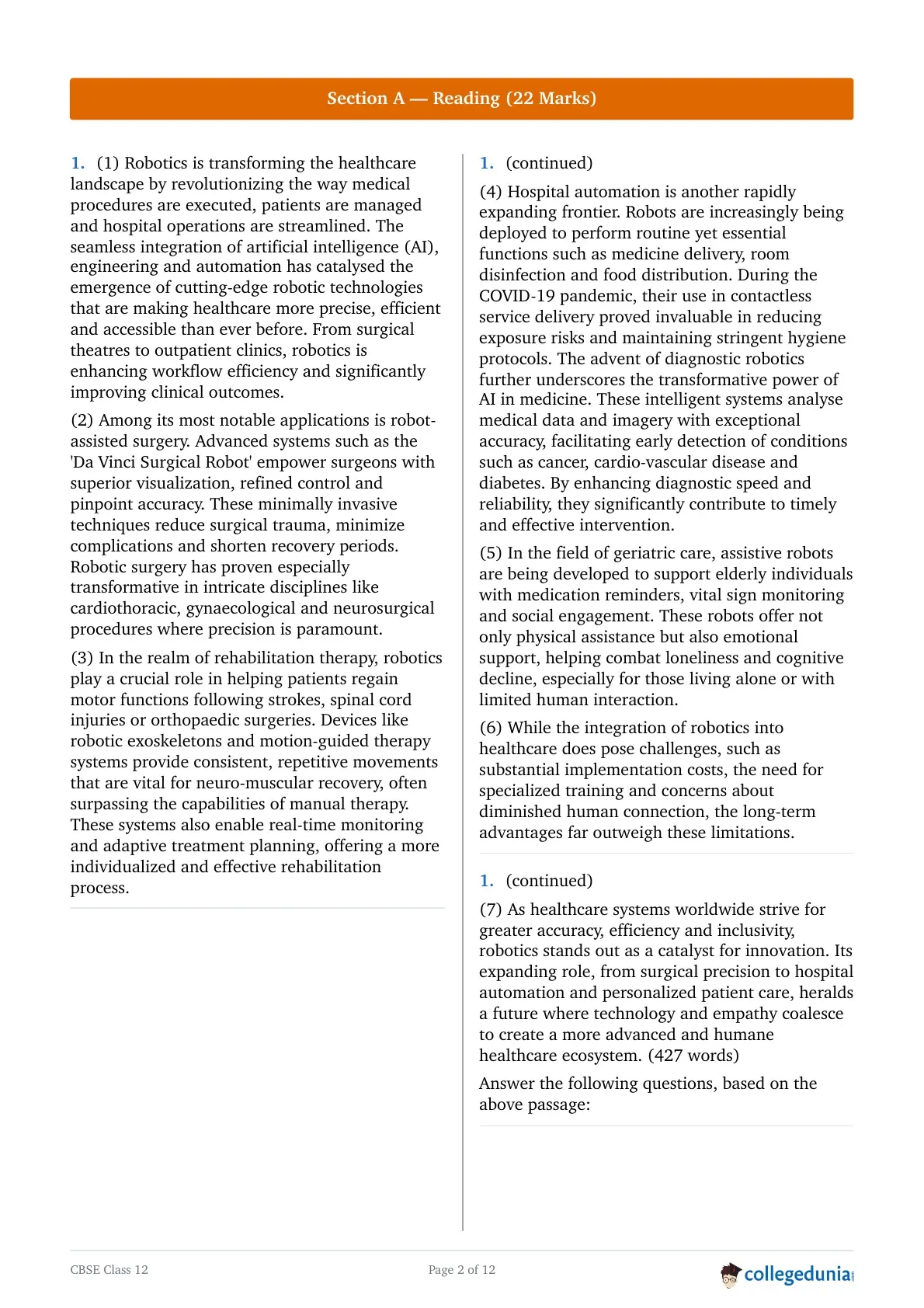
(1) Robotics is transforming the healthcare landscape by revolutionizing the way medical procedures are executed, patients are managed and hospital operations are streamlined. The seamless integration of artificial intelligence (AI), engineering and automation has catalysed the emergence of cutting-edge robotic technologies that are making healthcare more precise, efficient and accessible than ever before. From surgical theatres to outpatient clinics, robotics is enhancing workflow efficiency and significantly improving clinical outcomes.
(2) Among its most notable applications is robot-assisted surgery. Advanced systems such as the ‘Da Vinci Surgical Robot’ empower surgeons with superior visualization, refined control and pinpoint accuracy. These minimally invasive techniques reduce surgical trauma, minimize complications and shorten recovery periods. Robotic surgery has proven especially transformative in intricate disciplines like cardiothoracic, gynaecological and neurosurgical procedures where precision is paramount.
(3) In the realm of rehabilitation therapy, robotics play a crucial role in helping patients regain motor functions following strokes, spinal cord injuries or orthopaedic surgeries. Devices like robotic exoskeletons and motion-guided therapy systems provide consistent, repetitive movements that are vital for neuro-muscular recovery — often surpassing the capabilities of manual therapy. These systems also enable real-time monitoring and adaptive treatment planning, offering a more individualized and effective rehabilitation process.
(4) Hospital automation is another rapidly expanding frontier. Robots
Read More
are increasingly being deployed to perform routine yet essential functions such as medicine delivery, room disinfection and food distribution. During the COVID-19 pandemic, their use in contactless service delivery proved invaluable in reducing exposure risks and maintaining stringent hygiene protocols. The advent of diagnostic robotics further underscores the transformative power of AI in medicine. These intelligent systems analyse medical data and imagery with exceptional accuracy, facilitating early detection of conditions such as cancer, cardio-vascular disease and diabetes. By enhancing diagnostic speed and reliability, they significantly contribute to timely and effective intervention.(5) In the field of geriatric care, assistive robots are being developed to support elderly individuals with medication reminders, vital sign monitoring and social engagement. These robots offer not only physical assistance but also emotional support, helping combat loneliness and cognitive decline — especially for those living alone or with limited human interaction.
(6) While the integration of robotics into healthcare does pose challenges — such as substantial implementation costs, the need for specialized training and concerns about diminished human connection — the long-term advantages far outweigh these limitations.
(7) As healthcare systems worldwide strive for greater accuracy, efficiency and inclusivity, robotics stands out as a catalyst for innovation. Its expanding role — from surgical precision to hospital automation and personalized patient care — heralds a future where technology and empathy coalesce to create a more advanced and humane healthcare ecosystem. (427 words)
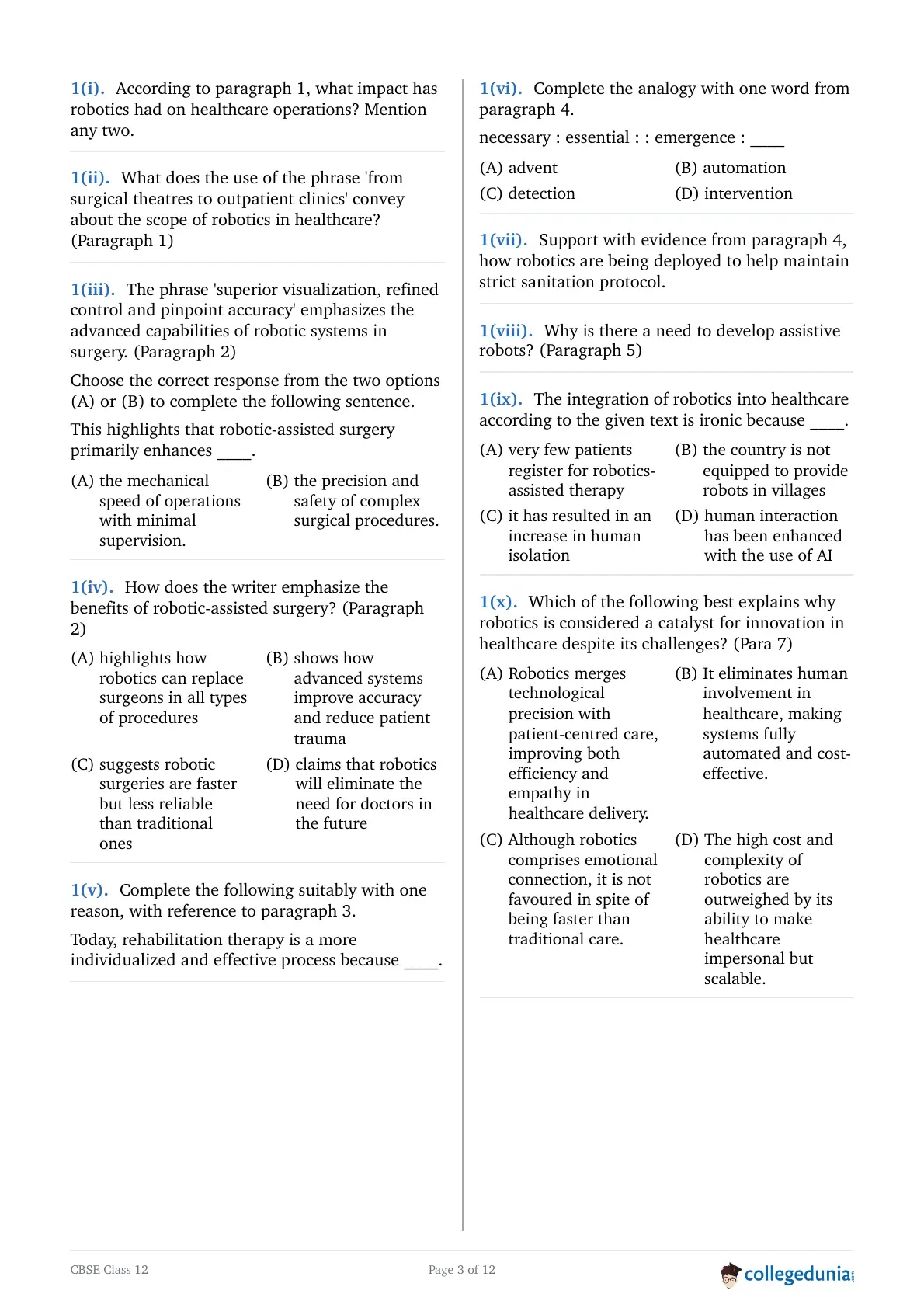
According to paragraph 1, what impact has robotics had on healthcare operations ? Mention any two.
What does the use of the phrase ‘from surgical theatres to outpatient clinics’ convey about the scope of robotics in healthcare ? (Paragraph 1)
The phrase ‘superior visualization, refined control and pinpoint accuracy’ emphasizes the advanced capabilities of robotic systems in surgery. (Paragraph 2)
Choose the correct response from the two options (A) or (B) to complete the following sentence.
This highlights that robotic-assisted surgery primarily enhances __________.
How does the writer emphasize the benefits of robotic-assisted surgery ? (Paragraph 2)
Complete the following suitably with one reason, with reference to paragraph 3.
Today, rehabilitation therapy is a more individualized and effective process because __________.
Complete the analogy with one word from paragraph 4.
necessary : essential : : emergence : __________
Support with evidence from paragraph 4, how robotics are being deployed to help maintain strict sanitation protocol.
The integration of robotics into healthcare according to the given text is ironic because ___________.
Which of the following best explains why robotics is considered a catalyst for innovation in healthcare despite its challenges ? (Para 7)
Question 2 (Passage / Extract):
Read the following passage carefully :
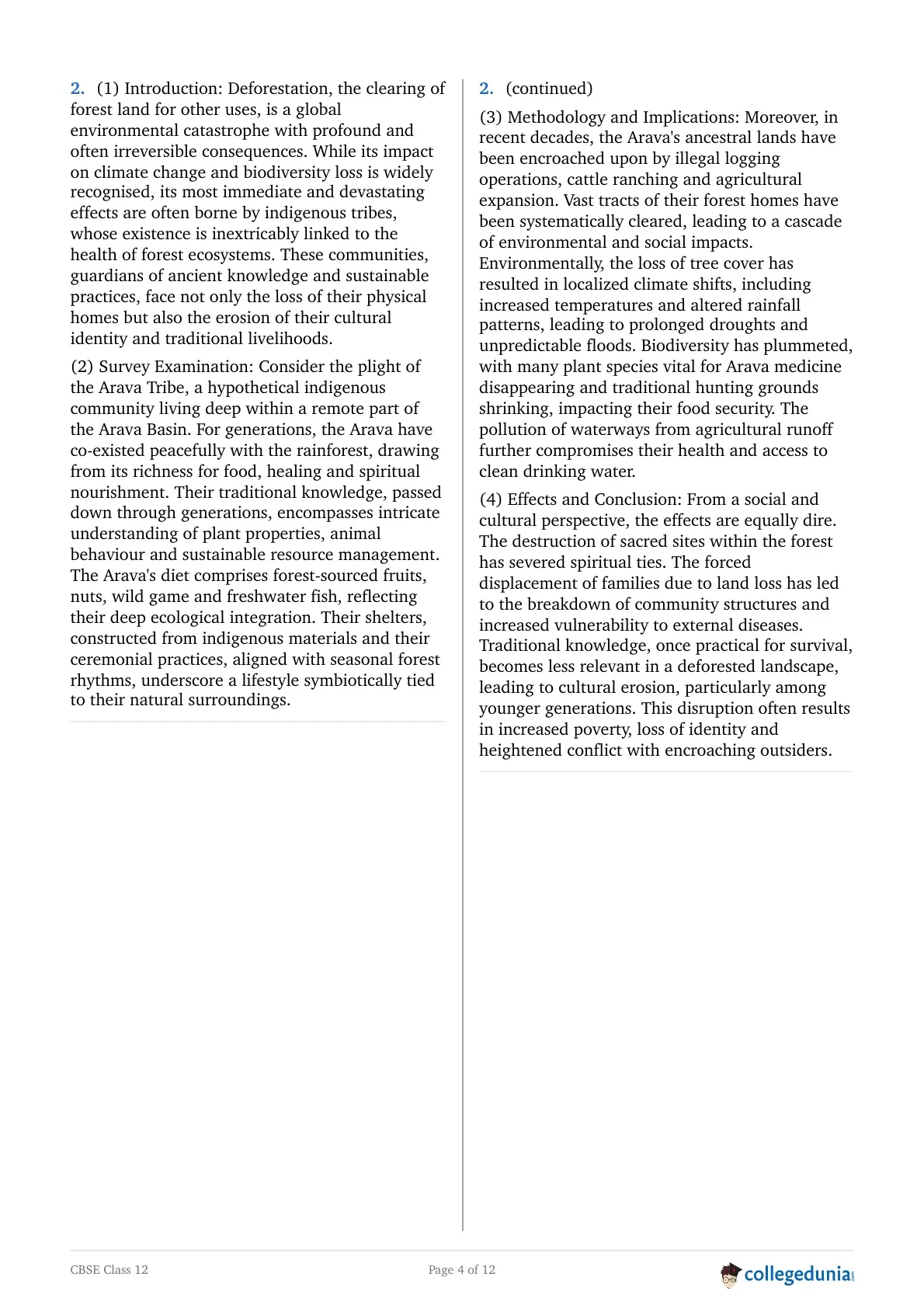
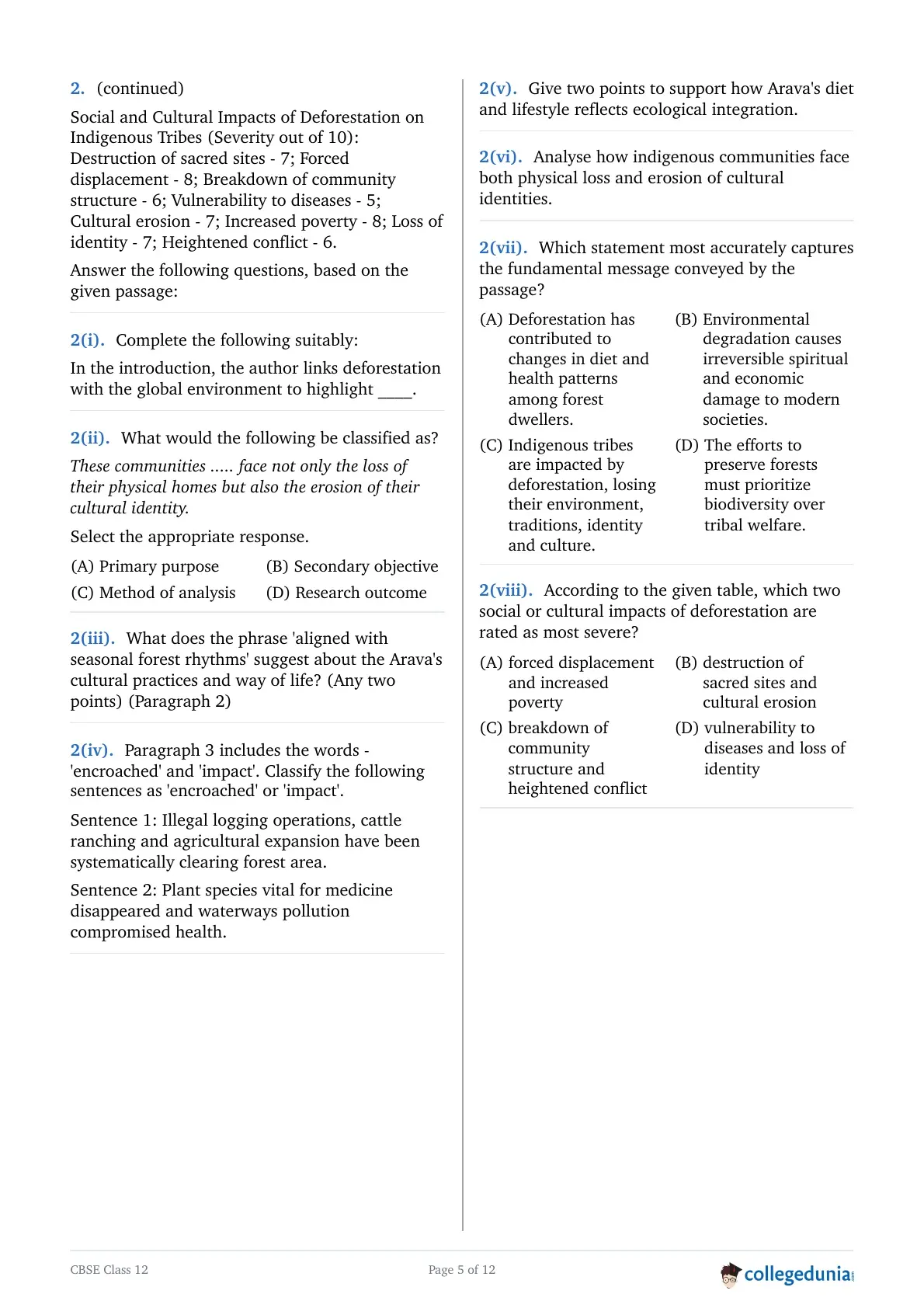
(1) Introduction : Deforestation, the clearing of forest land for other uses, is a global environmental catastrophe with profound and often irreversible consequences. While its impact on climate change and biodiversity loss is widely recognised, its most immediate and devastating effects are often borne by indigenous tribes, whose existence is inextricably linked to the health of forest ecosystems. These communities, guardians of ancient knowledge and sustainable practices, face not only the loss of their physical homes but also the erosion of their cultural identity and traditional livelihoods.
(2) Survey Examination : Consider the plight of the Arava Tribe, a hypothetical indigenous community living deep within a remote part of the Arava Basin. For generations, the Arava have co-existed peacefully with the rainforest, drawing from its richness for food, healing and spiritual nourishment. Their traditional knowledge, passed down through generations, encompasses intricate understanding of plant properties, animal behaviour and sustainable resource management. The Arava’s diet comprises forest-sourced fruits, nuts, wild game and freshwater fish, reflecting their deep ecological integration. Their shelters, constructed from indigenous materials and their ceremonial practices, aligned with seasonal forest rhythms, underscore a lifestyle symbiotically tied to their natural surroundings.
(3) Methodology and Implications : Moreover, in recent decades, the Arava’s ancestral lands have been encroached upon by illegal logging operations, cattle ranching and agricultural expansion. Vast tracts of their forest homes have been systematically cleared, leading to a cascade of environmental and social impacts. Environmentally, the loss of tree cover has resulted in localized climate shifts, including increased temperatures and altered rainfall patterns, leading to prolonged droughts and unpredictable floods. Biodiversity has plummeted, with many plant species vital for Arava medicine disappearing and traditional hunting grounds shrinking, impacting their food security. The pollution of waterways from agricultural runoff further compromises their health and access to clean drinking water.
(4) Effects and Conclusion : From a social and cultural perspective, the effects are equally dire. The destruction of sacred sites within the forest has severed spiritual ties. The forced displacement of families due to land loss has led to the breakdown of community structures and increased vulnerability to external diseases. Traditional knowledge, once practical for survival, becomes less relevant in a deforested landscape, leading to cultural erosion, particularly among younger generations. This disruption often results in increased poverty, loss of identity and heightened conflict with encroaching outsiders.
Social and Cultural Impacts of Deforestation on Indigenous Tribes
Read More
| S.No. | Types of impact | Severity (on the scale of 1 – 10) |
|---|---|---|
| 1 | Destruction of sacred sites | 7 |
| 2 | Forced displacement | 8 |
| 3 | Breakdown of community structure | 6 |
| 4 | Vulnerability to diseases | 5 |
| 5 | Cultural erosion | 7 |
| 6 | Increased poverty | 8 |
| 7 | Loss of identity | 7 |
| 8 | Heightened conflict | 6 |
Complete the following suitably :
In the introduction, the author links deforestation with the global environment to highlight __________.
What would the following be classified as ?
These communities ..... face not only the loss of their physical homes but also the erosion of their cultural identity.
Select the appropriate response.
What does the phrase ‘aligned with seasonal forest rhythms’ suggest about the Arava’s cultural practices and way of life ? (Any two points) (Paragraph 2)
Paragraph 3 includes the words — ‘encroached’ and ‘impact’. Classify the following sentences as ‘encroached’ or ‘impact’.
Sentence 1 : Illegal logging operations, cattle ranching and agricultural expansion have been systematically clearing forest area.
Sentence 2 : Plant species vital for medicine disappeared and waterways pollution compromised health.
Give two points to support how Arava’s diet and lifestyle reflects ecological integration.
Analyse how indigenous communities face both physical loss and erosion of cultural identities.
Which statement most accurately captures the fundamental message conveyed by the passage ?
According to the given table, which two social or cultural impacts of deforestation are rated as most severe ?
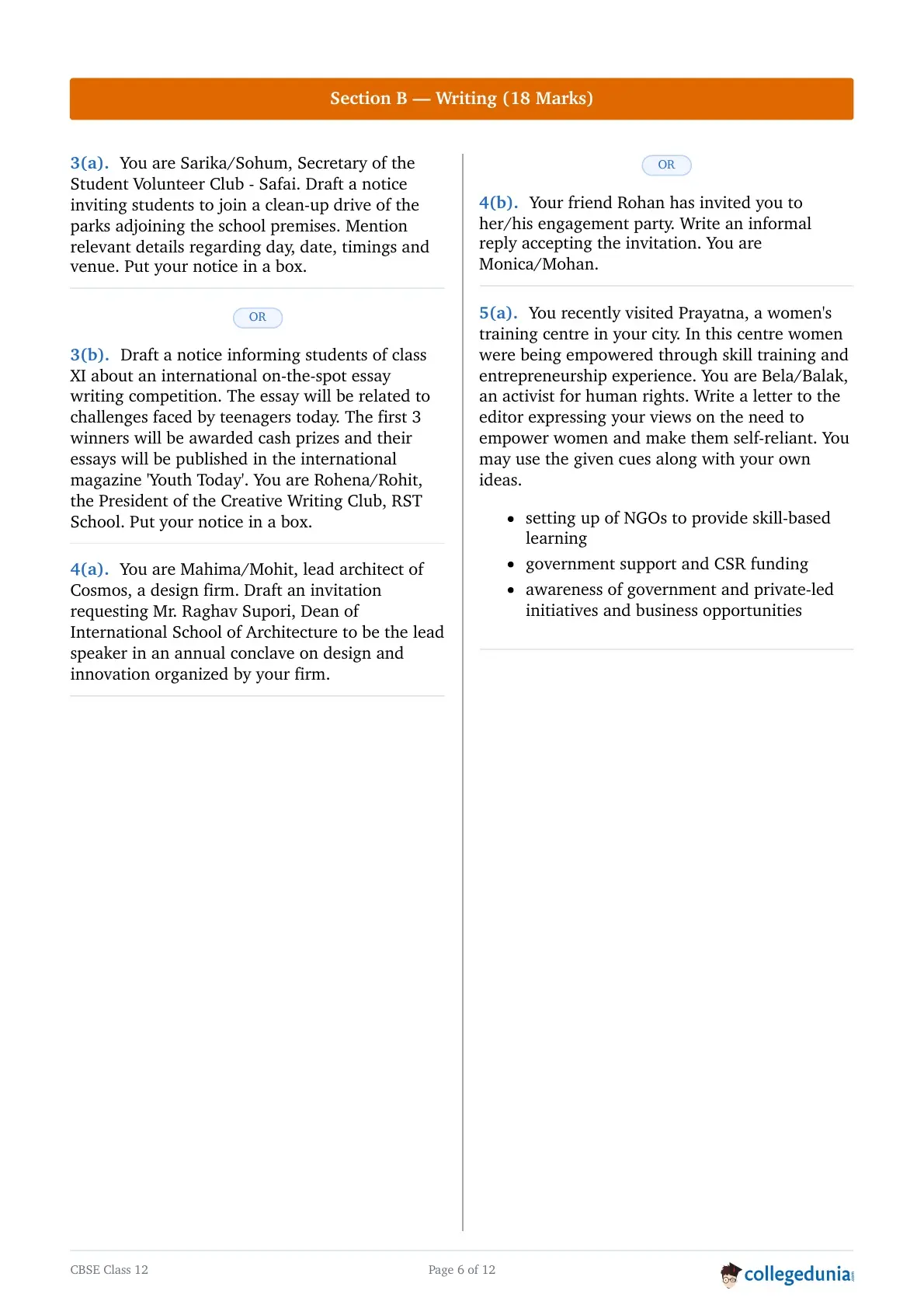
Attempt any one of the two, (a) or (b), in about 50 words.
You are Sarika/Sohum, Secretary of the Student Volunteer Club – Safai. Draft a notice inviting students to join a clean-up drive of the parks adjoining the school premises. Mention relevant details regarding day, date, timings and venue. Put your notice in a box.
Attempt any one of the two, (a) or (b), in about 50 words.
Draft a notice informing students of class XI about an international on-the-spot essay writing competition. The essay will be related to challenges faced by teenagers today. The first 3 winners will be awarded cash prizes and their essays will be published in the international magazine ‘Youth Today’. You are Rohena/Rohit, the President of the Creative Writing Club, RST School. Put your notice in a box.
You are Mahima/Mohit, lead architect of Cosmos, a design firm. Draft an invitation requesting Mr. Raghav Supori, Dean of International School of Architecture to be the lead speaker in an annual conclave on design and innovation organized by your firm. (Write in about 50 words.)
Your friend Rohan has invited you to her/his engagement party. Write an informal reply accepting the invitation. You are Monica/Mohan. (Write in about 50 words.)
You recently visited Prayatna, a women’s training centre in your city. In this centre women were being empowered through skill training and entrepreneurship experience. You are Bela/Balak, an activist for human rights. Write a letter to the editor expressing your views on the need to empower women and make them self-reliant. You may use the given cues along with your own ideas. (Write in 120 - 150 words.)
- setting up of NGOs to provide skill-based learning
- government support and CSR funding
- awareness of government and private-led initiatives and business opportunities
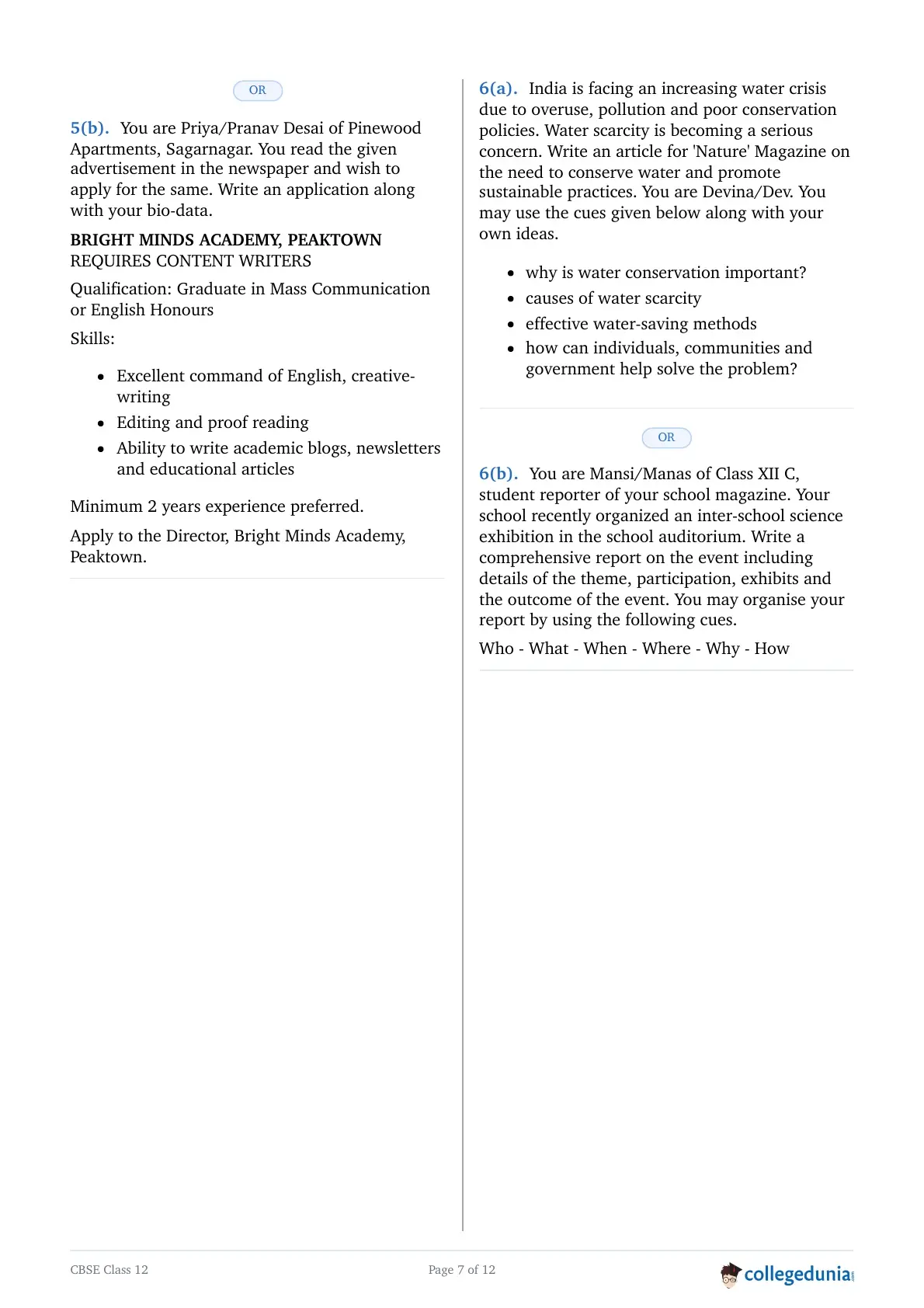
You are Priya/Pranav Desai of Pinewood Apartments, Sagarnagar. You read the given advertisement in the newspaper and wish to apply for the same. Write an application along with your bio-data. (Write in 120 - 150 words.)
| BRIGHT MINDS ACADEMY PEAKTOWN REQUIRES CONTENT WRITERS Qualification : Graduate in Mass Communication or English Honours Skills : - Excellent command of English, creative-writing, - Editing and proof reading - Ability to write academic blogs, newsletters and educational articles Minimum 2 years experience preferred Apply to the Director, Bright Minds Academy, Peaktown |
Attempt any one of the two, (a) or (b), in 120 – 150 words.
(a) India is facing an increasing water crisis due to overuse, pollution and poor conservation policies. Water scarcity is becoming a serious concern. Write an article for ‘Nature’ Magazine on the need to conserve water and promote sustainable practices. You are Devina/ Dev. You may use the cues given below along with your own ideas.
- why is water conservation important ?
- causes of water scarcity
- effective water-saving methods
- how can individuals, communities and government help solve the problem ?
(b) You are Mansi/Manas of Class XII C, student reporter of your school magazine. Your school recently organized an inter-school science exhibition in the school auditorium. Write a comprehensive report on the event including details of the theme, participation, exhibits and the outcome of the event. You may organise your report by using the following cues.
Who – What – When – Where – Why – How
Question 7(a) (Passage / Extract):
Read the following extract and answer the questions that follow.
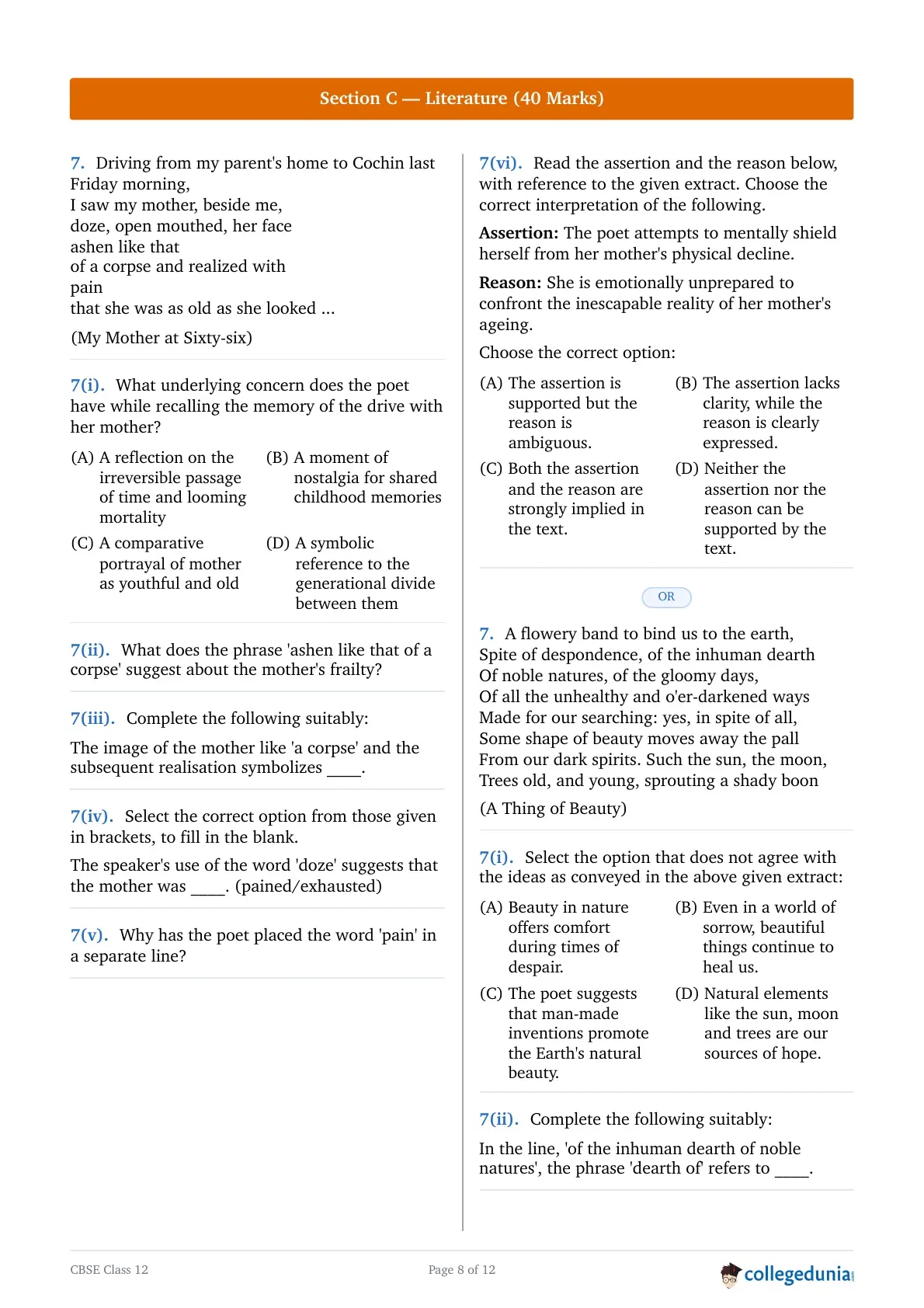
Driving from my parent’s
home to Cochin last Friday
morning, I saw my mother,
beside me,
doze, open mouthed, her face
ashen like that
of a corpse and realized with
pain
that she was as old as she looked …
(My Mother at Sixty-six)
What underlying concern does the poet have while recalling the memory of the drive with her mother ?
What does the phrase ‘ashen like that of a corpse’ suggest about the mother’s frailty ?
Complete the following suitably :
The image of the mother like ‘a corpse’ and the subsequent realisation symbolizes __________.
Select the correct option from those given in brackets, to fill in the blank.
The speaker’s use of the word ‘doze’ suggests that the mother was __________. (pained/exhausted)
Read the assertion and the reason below, with reference to the given extract. Choose the correct interpretation of the following.
Assertion : The poet attempts to mentally shield herself from her mother’s physical decline.
Reason : She is emotionally unprepared to confront the inescapable reality of her mother’s ageing.
Choose the correct option :
Question 7(b)-OR (Passage / Extract):
Read the following extract and answer the questions that follow.
A flowery band to bind us to the earth,
Spite of despondence, of the inhuman dearth
Of noble natures, of the gloomy days,
Of all the unhealthy and o’er-darkened ways
Read More
Made for our searching: yes, in spite of all,Some shape of beauty moves away the pall
From our dark spirits. Such the sun, the moon,
Trees old, and young, sprouting a shady boon
(A Thing of Beauty)
Select the option that does not agree with the ideas as conveyed in the above given extract :
Complete the following suitable :
In the line, ‘of the inhuman dearth of noble natures’, the phrase ‘dearth of’ refers to _________.
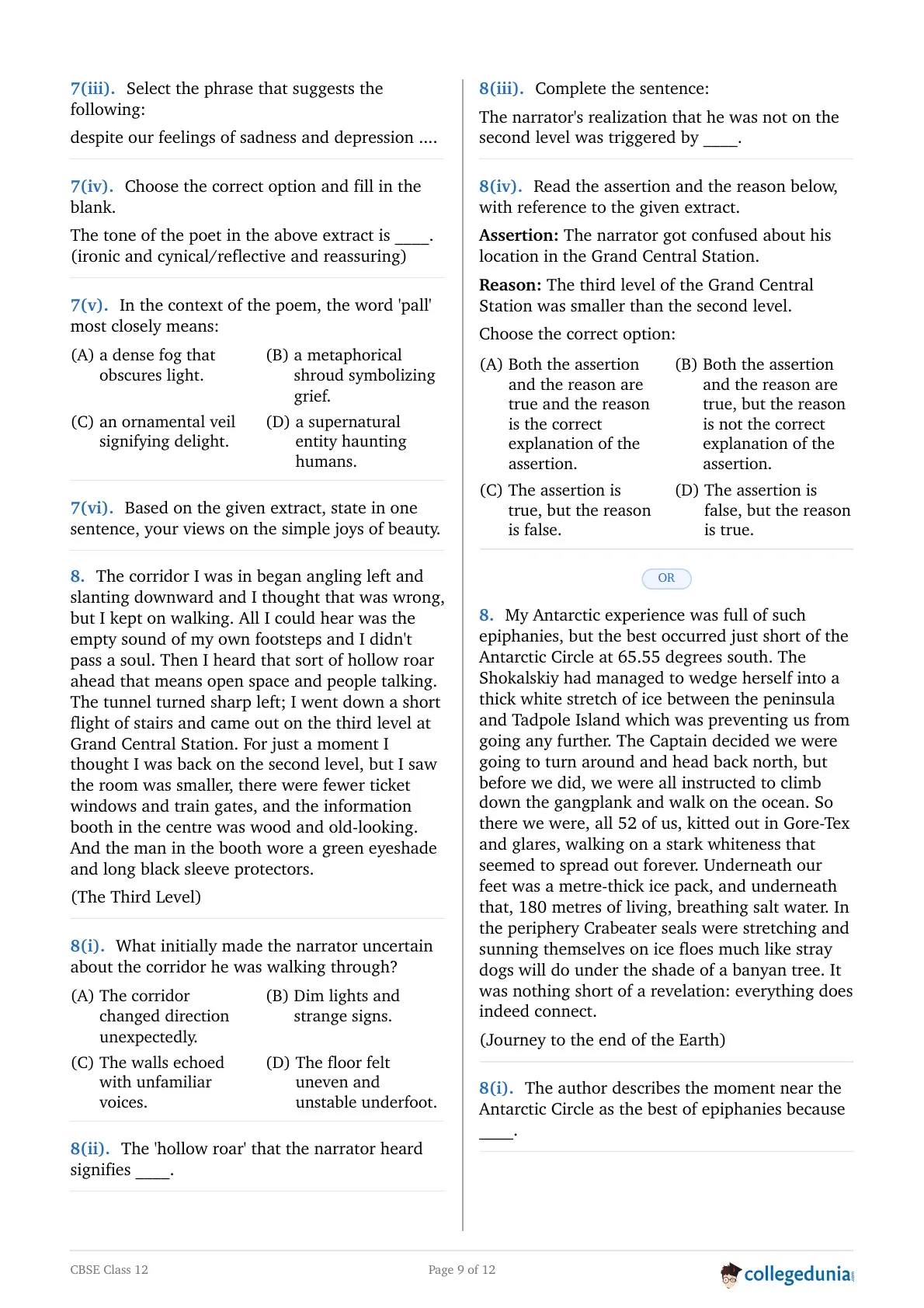
Select the phrase that suggests the following :
despite our feelings of sadness and depression ....
Choose the correct option and fill in the blank.
The tone of the poet in the above extract is ____________. (ironic and cynical/reflective and reassuring)
In the context of the poem, the word ‘pall’ most closely means :
Based on the given extract, state in one sentence, your views on the simple joys of beauty.
Question 8(a) (Passage / Extract):
The corridor I was in began angling left and slanting downward and I thought that was wrong, but I kept on walking. All I could hear was the empty sound of my own footsteps and I didn’t pass a soul. Then I heard that sort of hollow roar ahead that means open space and people talking. The tunnel turned sharp left; I went down a short flight of stairs and came out
Read More
on the third level at Grand Central Station. For just a moment I thought I was back on the second level, but I saw the room was smaller, there were fewer ticket windows and train gates, and the information booth in the centre was wood and old-looking. And the man in the booth wore a green eyeshade and long black sleeve protectors.(The Third Level)
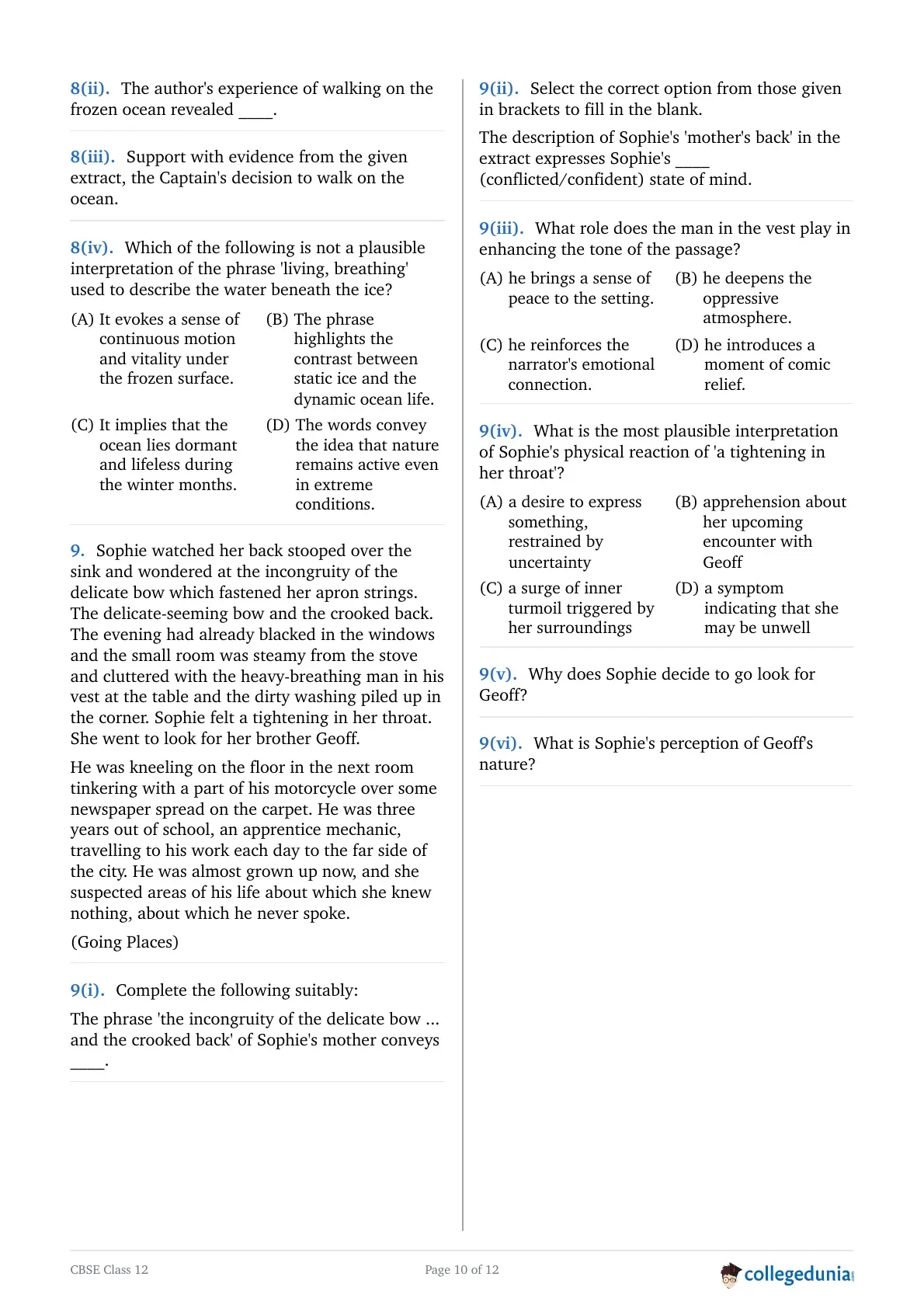
What initially made the narrator uncertain about the corridor he was walking through ?
The ‘hollow roar’ that the narrator heard signifies __________.
Complete the sentence :
The narrator’s realization that he was not on the second level was triggered by _________.
Read the assertion and the reason below, with reference to the given extract.
Assertion : The narrator got confused about his location in the Grand Central Station.
Reason : The third level of the Grand Central Station was smaller than the second level.
Choose the correct option :
Question 8(b)-OR (Passage / Extract):
My Antarctic experience was full of such epiphanies, but the best occurred just short of the Antarctic Circle at 65.55 degrees south. The Shokalskiy had managed to wedge herself into a thick white stretch of ice between the peninsula and Tadpole Island which was preventing us from going any further. The Captain decided we were going to turn around and head back north, but before we did, we were all instructed to climb down the gangplank and walk on the ocean. So there we were, all
Read More
52 of us, kitted out in Gore-Tex and glares, walking on a stark whiteness that seemed to spread out forever. Underneath our feet was a metre-thick ice pack, and underneath that, 180 metres of living, breathing salt water. In the periphery Crabeater seals were stretching and sunning themselves on ice floes much like stray dogs will do under the shade of a banyan tree. It was nothing short of a revelation: everything does indeed connect.(Journey to the end of the Earth)
The author describes the moment near the Antarctic Circle as the best of epiphanies because _________.
The author’s experience of walking on the frozen ocean revealed ___________.
Support with evidence from the given extract, the Captain’s decision to walk on the ocean.
Which of the following is not a plausible interpretation of the phrase ‘living, breathing’ used to describe the water beneath the ice ?
Question 9(a) (Passage / Extract):
Read the following extract and answer the questions that follow.
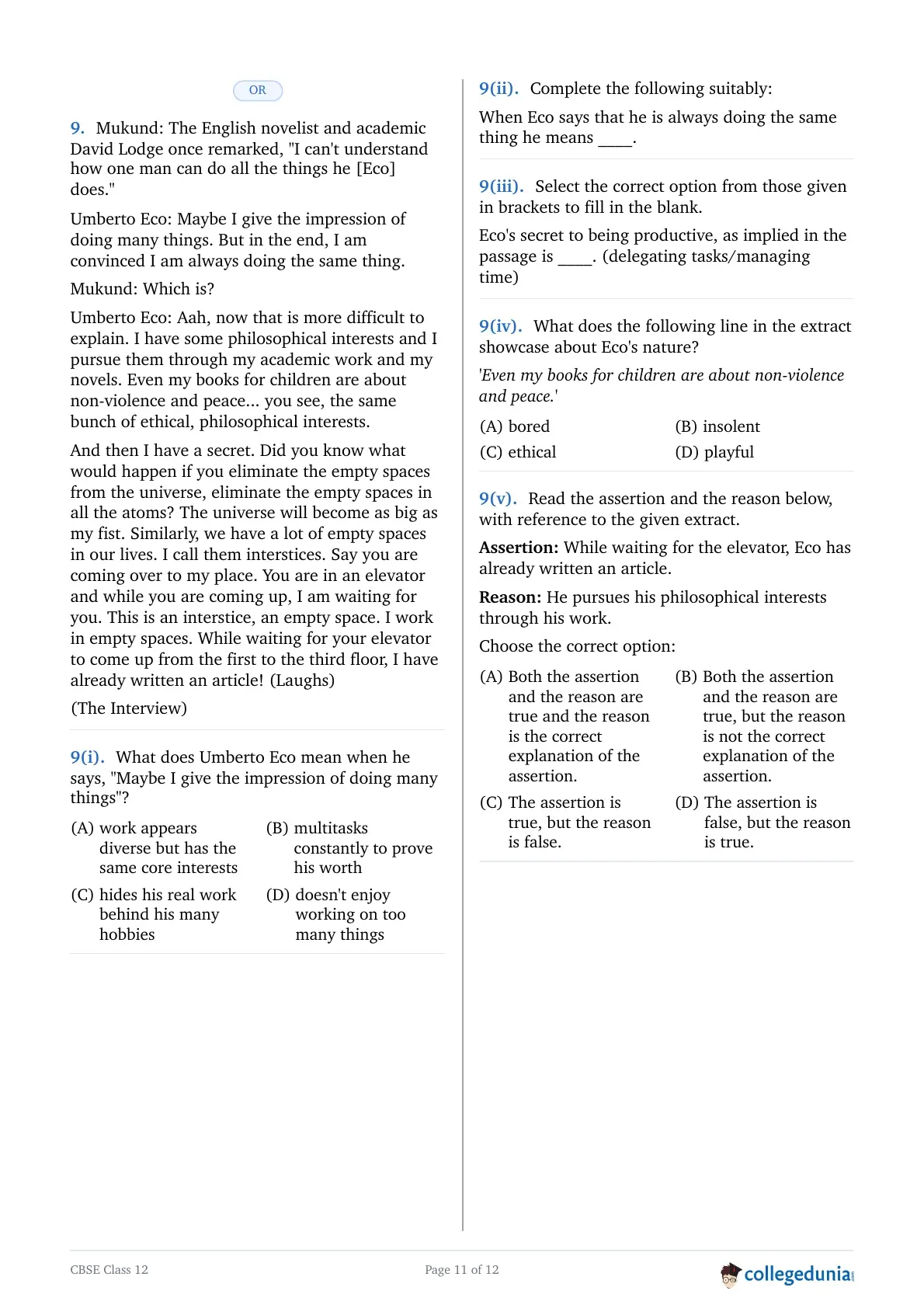
Sophie watched her back stooped over the sink and wondered at the incongruity of the delicate bow which fastened her apron strings. The delicate-seeming bow and the crooked back. The evening had already blacked in the windows and the small room was steamy from the stove and cluttered with the heavy-breathing man in his vest at the table and the dirty washing piled up in the corner. Sophie
Read More
felt a tightening in her throat. She went to look for her brother Geoff.He was kneeling on the floor in the next room tinkering with a part of his motorcycle over some newspaper spread on the carpet. He was three years out of school, an apprentice mechanic, travelling to his work each day to the far side of the city. He was almost grown up now, and she suspected areas of his life about which she knew nothing, about which he never spoke.
(Going Places)
Complete the following suitably :
The phrase ‘the incongruity of the delicate bow … and the crooked back’ of Sophie’s mother conveys ___________.
Select the correct option from those given in brackets to fill in the blank.
The description of Sophie’s ‘mother’s back’ in the extract expresses Sophie’s ____________ (conflicted/confident) state of mind.
What role does the man in the vest play in enhancing the tone of the passage ?
What is the most plausible interpretation of Sophie’s physical reaction of ‘a tightening in her throat’ ?
Question 9(b)-OR (Passage / Extract):
Read the following extract and answer the questions that follow.
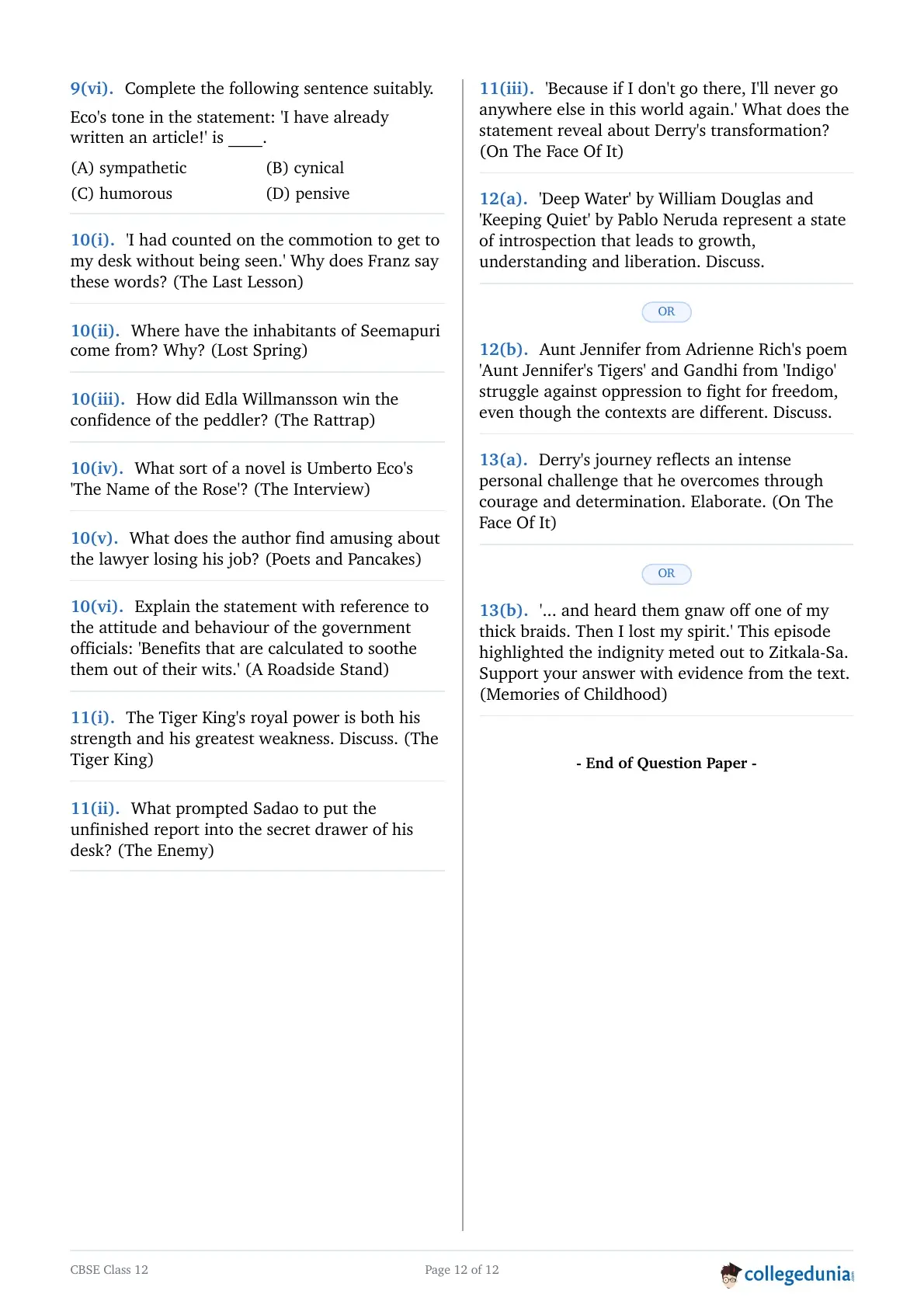
Mukund : The English novelist and academic David Lodge once remarked, ‘‘I can’t understand how one man can do all the things he [Eco] does.’’
Umberto Eco : Maybe I give the impression of doing many things. But in the end, I am convinced I am always doing the same thing.
Mukund : Which is ?
Umberto Eco : Aah, now that is more difficult to explain. I have some philosophical interests and I pursue them through my academic work and my novels. Even my books for children are about non-violence and peace … you see, the same bunch of ethical,
Read More
philosophical interests.And then I have a secret. Did you know what would happen if you eliminate the empty spaces from the universe, eliminate the empty spaces in all the atoms ? The universe will become as big as my fist. Similarly, we have a lot of empty spaces in our lives. I call them interstices. Say you are coming over to my place. You are in an elevator and while you are coming up, I am waiting for you. This is an interstice, an empty space. I work in empty spaces. While waiting for your elevator to come up from the first to the third floor, I have already written an article ! (Laughs)
(The Interview)
What does Umberto Eco mean when he says, ‘‘Maybe I give the impression of doing many things’’ ?
Complete the following suitably :
When Eco says that he is always doing the same thing he means __________.
Select the correct option from those given in brackets to fill in the blank.
Eco’s secret to being productive, as implied in the passage is __________ (delegating tasks/managing time).
What does the following line in the extract showcase about Eco’s nature ?
‘Even my books for children are about non-violence and peace.’
Read the assertion and the reason below, with reference to the given extract.
Assertion : While waiting for the elevator, Eco has already written an article.
Reason : He pursues his philosophical interests through his work.
Choose the correct option :
Complete the following sentence suitably.
Eco’s tone in the statement : ‘I have already written an article !’ is ________.
‘I had counted on the commotion to get to my desk without being seen.’ Why does Franz say these words? (The Last Lesson)
Where have the inhabitants of Seemapuri come from ? Why ? (Lost Spring)
How did Edla Willmansson win the confidence of the peddler? (The Rattrap)
What sort of a novel is Umberto Eco’s ‘The Name of the Rose’? (The Interview)
What does the author find amusing about the lawyer losing his job? (Poets and Pancakes)
Explain the statement with reference to the attitude and behaviour of the government officials :
“Benefits that are calculated to soothe them out of their wits.” (A Roadside Stand)
The Tiger King’s royal power is both his strength and his greatest weakness. Discuss. (The Tiger King)
What prompted Sadao to put the unfinished report into the secret drawer of his desk? (The Enemy)
‘Because if I don’t go there, I’ll never go anywhere else in this world again.’ What does the statement reveal about Derry’s transformation? (On The Face Of It)
‘Deep Water’ by William Douglas and ‘Keeping Quiet’ by Pablo Neruda represent a state of introspection that leads to growth, understanding and liberation. Discuss.
Aunt Jennifer from Adrienne Rich’s poem ‘Aunt Jennifer’s Tigers’ and Gandhi from ‘Indigo’ struggle against oppression to fight for freedom, even though the contexts are different. Discuss.
Derry’s journey reflects an intense personal challenge that he overcomes through courage and determination. Elaborate. (On The Face Of It)
(Answer in 120-150 words)
‘... and heard them gnaw off one of my thick braids. Then I lost my spirit.’ This episode highlighted the indignity meted out to Zitkala-Sa. Support your answer with evidence from the text. (Memories of Childhood)
(Answer in 120-150 words)
CBSE Class 12 English Question Paper Pattern and Marking Scheme
The CBSE Class 12 English Core theory paper is of 80 marks (time allowed: 3 hours, plus 15 minutes of reading time) and the internal assessment is of 20 marks. The paper has 13 questions, all compulsory, in three sections. Choice is given in Questions 3 to 13.
CBSE Class 12 English Core Question Paper Pattern 2026
| Section | Q. No. | Type of Questions | Choice | Marks |
|---|---|---|---|---|
| Section A: Reading Skills | 1 | Unseen passage with 10 questions (MCQs, short answers and inference) | All compulsory | 12 |
| 2 | Unseen case-based passage with 8 questions | All compulsory | 10 | |
| Section B: Creative Writing Skills | 3 | Notice or invitation / reply (about 50 words) | Any one of two | 4 |
| 4 | Notice or invitation / reply (about 50 words) | Any one of two | 4 | |
| 5 | Letter or job application with bio-data (120 - 150 words) | Any one of two | 5 | |
| 6 | Article or report (120 - 150 words) | Any one of two | 5 | |
| Section C: Literature | 7 | Extract-based questions, 6 parts of 1 mark (Flamingo / Vistas) | Any one of two extracts | 6 |
| 8 | Extract-based questions, 4 parts of 1 mark | Any one of two extracts | 4 | |
| 9 | Extract-based questions, 6 parts of 1 mark | Any one of two extracts | 6 | |
| 10 | Short-answer questions, 2 marks each (40 - 50 words) | Any five of six | 10 | |
| 11 | Short-answer questions, 2 marks each (40 - 50 words) | Any two of three | 4 | |
| 12 | Long-answer question (120 - 150 words) | Any one of two | 5 | |
| 13 | Long-answer question (120 - 150 words) | Any one of two | 5 | |
| TOTAL (Section A 22 + Section B 18 + Section C 40) | 80 | |||
CBSE Class 12 English Core Marking Scheme 2026
| Type of Question | Marks | How the Marks Are Distributed |
|---|---|---|
| Reading comprehension (Q1 - Q2) | 1 or 2 per part | Marks for understanding; no mark is deducted for mistakes in grammar, spelling or word limit if the core idea is identified |
| Notice / invitation (Q3 - Q4) | 4 | Format 1 + Content 2 + Expression 1 |
| Letter / job application (Q5) | 5 | Format 1 + Content 2 + Expression 2 |
| Article / report (Q6) | 5 | Format 1 + Content 2 + Expression 2 |
| Extract-based questions (Q7 - Q9) | 1 per part | One mark for each correct answer |
| Short answers (Q10 - Q11) | 2 | Content 1 + Expression 1 |
| Long answers (Q12 - Q13) | 5 | Content 3 + Expression 2 |
CBSE Class 12 English Core Section-Wise Weightage
| Section | Marks | Expected Weightage |
|---|---|---|
| Section A: Reading Skills | 22 | 27.5% |
| Section B: Creative Writing Skills | 18 | 22.5% |
| Section C: Literature | 40 | 50% |
| TOTAL | 80 | 100% |



Comments