




CBSE Class 12 English Core Compartment Set 3 - (1/7/3) Question Paper 2026 is available for download here. CBSE conducted the Class 12 English Core Compartment (supplementary) examination on July 28, 2026, from 10:30 AM to 1:30 PM. The English Core paper is of 80 marks and the time allowed is 3 hours. This paper carries the Q.P. code 1/7/3 and is of Set 3. The question paper was handed out at 10:15 AM, and the first 15 minutes were given for reading it.
Also Check: CBSE Class 12 Question Paper 2026 (All Subjects)
The paper has 13 questions, all compulsory, in three sections:
- Section A: Reading Skills (22 marks)
- Section B: Creative Writing Skills (18 marks)
- Section C: Literature (40 marks)
CBSE Class 12 English Core Compartment Set 3 - (1/7/3) Question Paper 2026 PDF
| CBSE Official PDF | CD PDF | CD PDF with Solutions |
|---|---|---|
| Download official PDF 0.31 MB | Download Collegedunia PDF 0.29 MB | – |
CBSE Class 12 English Core Compartment 2026 Set 3 (1/7/3) Questions with Solutions
Question 1 (Passage / Extract):
Read the following passage carefully :
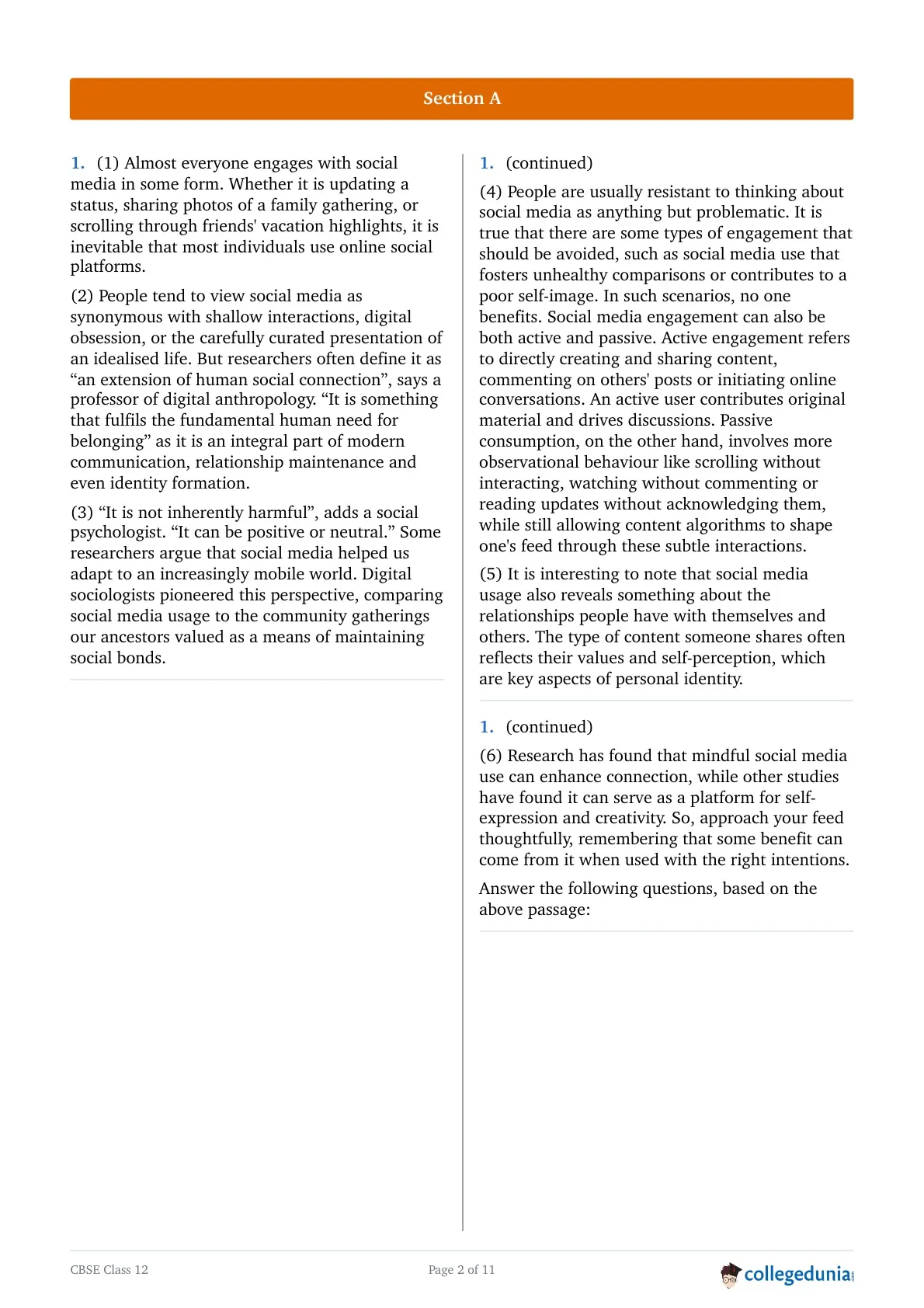
(1) Almost everyone engages with social media in some form. Whether it is updating a status, sharing photos of a family gathering, or scrolling through friends’ vacation highlights, it is inevitable that most individuals use online social platforms.
(2) People tend to view social media as synonymous with shallow interactions, digital obsession, or the carefully curated presentation of an idealised life. But researchers often define it as ‘‘an extension of human social connection’’, says a professor of digital anthropology. ‘‘It is something that fulfils the fundamental human need for belonging’’ as it is an integral part of modern communication, relationship maintenance and even identity formation.
(3) ‘‘It is not inherently harmful’’, adds a social psychologist. ‘‘It can be positive or neutral.’’ Some researchers argue that social media helped us adapt to an increasingly mobile world. Digital sociologists pioneered this perspective, comparing social media usage to the community gatherings our ancestors valued as a means of maintaining social bonds.
(4) People are usually resistant to thinking about social media as anything but problematic. It is true that there are some types of engagement
Read More
that should be avoided, such as social media use that fosters unhealthy comparisons or contributes to a poor self-image. In such scenarios, no one benefits. Social media engagement can also be both active and passive. Active engagement refers to directly creating and sharing content, commenting on others’ posts or initiating online conversations. An active user contributes original material and drives discussions. Passive consumption, on the other hand, involves more observational behaviour like scrolling without interacting, watching without commenting or reading updates without acknowledging them, while still allowing content algorithms to shape one’s feed through these subtle interactions.(5) It is interesting to note that social media usage also reveals something about the relationships people have with themselves and others. The type of content someone shares often reflects their values and self-perception, which are key aspects of personal identity.
(6) Research has found that mindful social media use can enhance connection, while other studies have found it can serve as a platform for self-expression and creativity. So, approach your feed thoughtfully, remembering that some benefit can come from it when used with the right intentions.
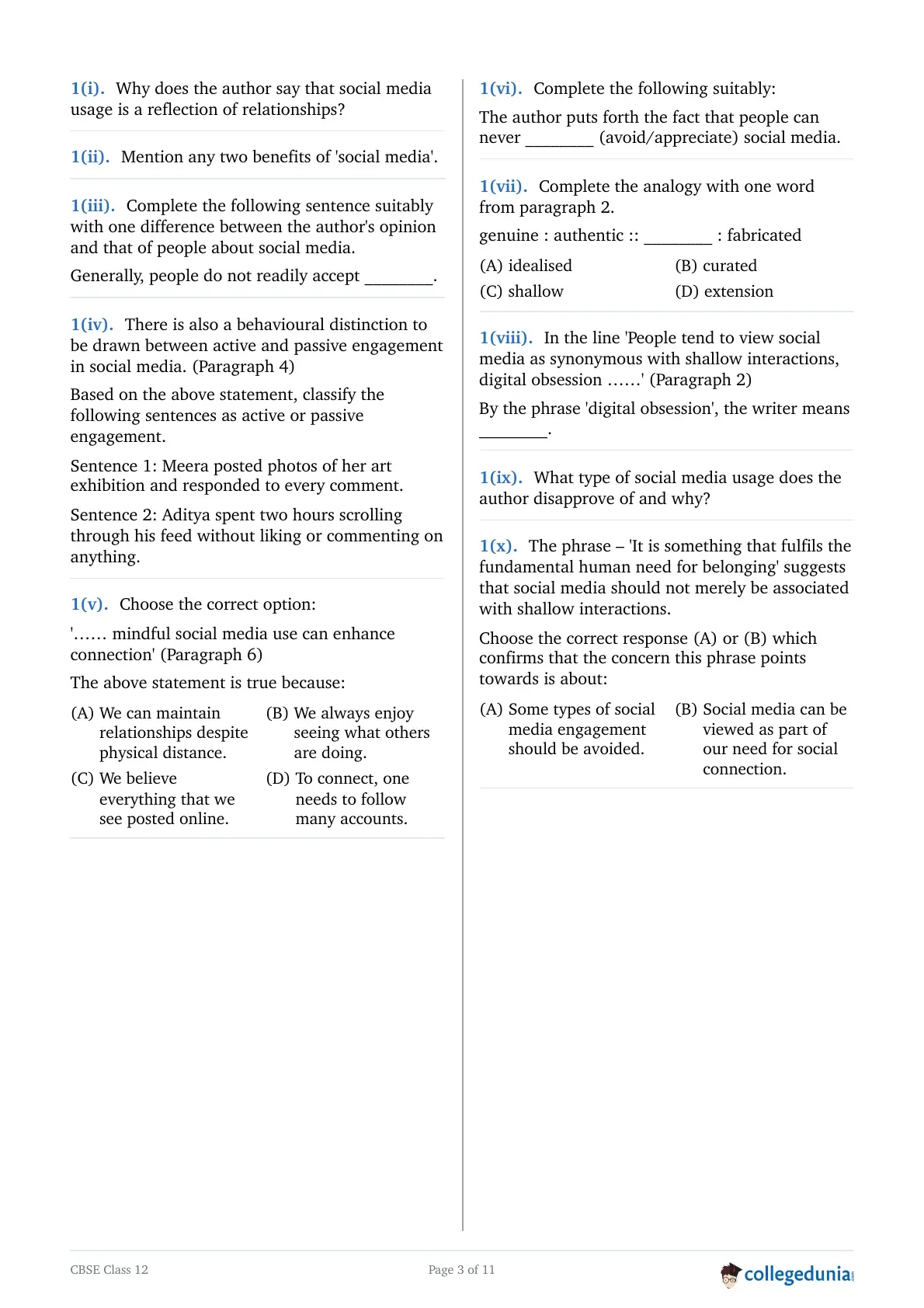
Why does the author say that social media usage is a reflection of relationships ?
Complete the following sentence suitably with one difference between the author’s opinion and that of people about social media.
Generally, people do not readily accept __________.
There is also a behavioural distinction to be drawn between active and passive engagement in social media. (Paragraph 4)
Based on the above statement, classify the following sentences as active or passive engagement.
Sentence 1 : Meera posted photos of her art exhibition and responded to every comment.
Sentence 2 : Aditya spent two hours scrolling through his feed without liking or commenting on anything.
Choose the correct option :
...... mindful social media use can ‘enhance connection’ (Paragraph 6)
The above statement is true because :
Complete the following suitably :
The author puts forth the fact that people can never __________ (avoid/appreciate) social media.
Complete the analogy with one word from paragraph 2.
genuine : authentic : : __________ : fabricated
In the line ‘People tend to view social media as synonymous with shallow interactions, digital obsession ..........’ (Paragraph 2)
By the phrase ‘digital obsession’, the writer means __________.
What type of social media usage does the author disapprove of and why ?
The phrase – ‘It is something that fulfils the fundamental human need for belonging’ suggests that social media should not merely be associated with shallow interactions.
Choose the correct response (A) or (B) which confirms that the concern this phrase points towards is about :
Question 2 (Passage / Extract):
Read the following passage carefully :
(1) Introduction :
Students constantly seek methods to enhance their learning experience and academic performance. This research shows that music has long been considered a potential factor in creating productive study environments. It examines the influence of different music genres, including classical Indian music, on students’ concentration, retention, and overall study effectiveness. The current investigation provides insights into how various musical elements impact cognitive functions during study sessions among secondary school students. The study is relevant in the present times as digital influences govern our lives to quite an extent and pose a distraction.
(2) Methodology :
A structured questionnaire along with controlled study sessions was employed to gather information on the subject. Participants were exposed to different music conditions while completing standardized comprehension and memory tasks to measure performance objectively.
(3) Survey Examination :
Among the 140 study participants, 68 were boys and 72 were girls. For analytical purposes, the study considered both subjective preferences and objective performance metrics for each type of music condition during study sessions.
(4) Results :
Read More
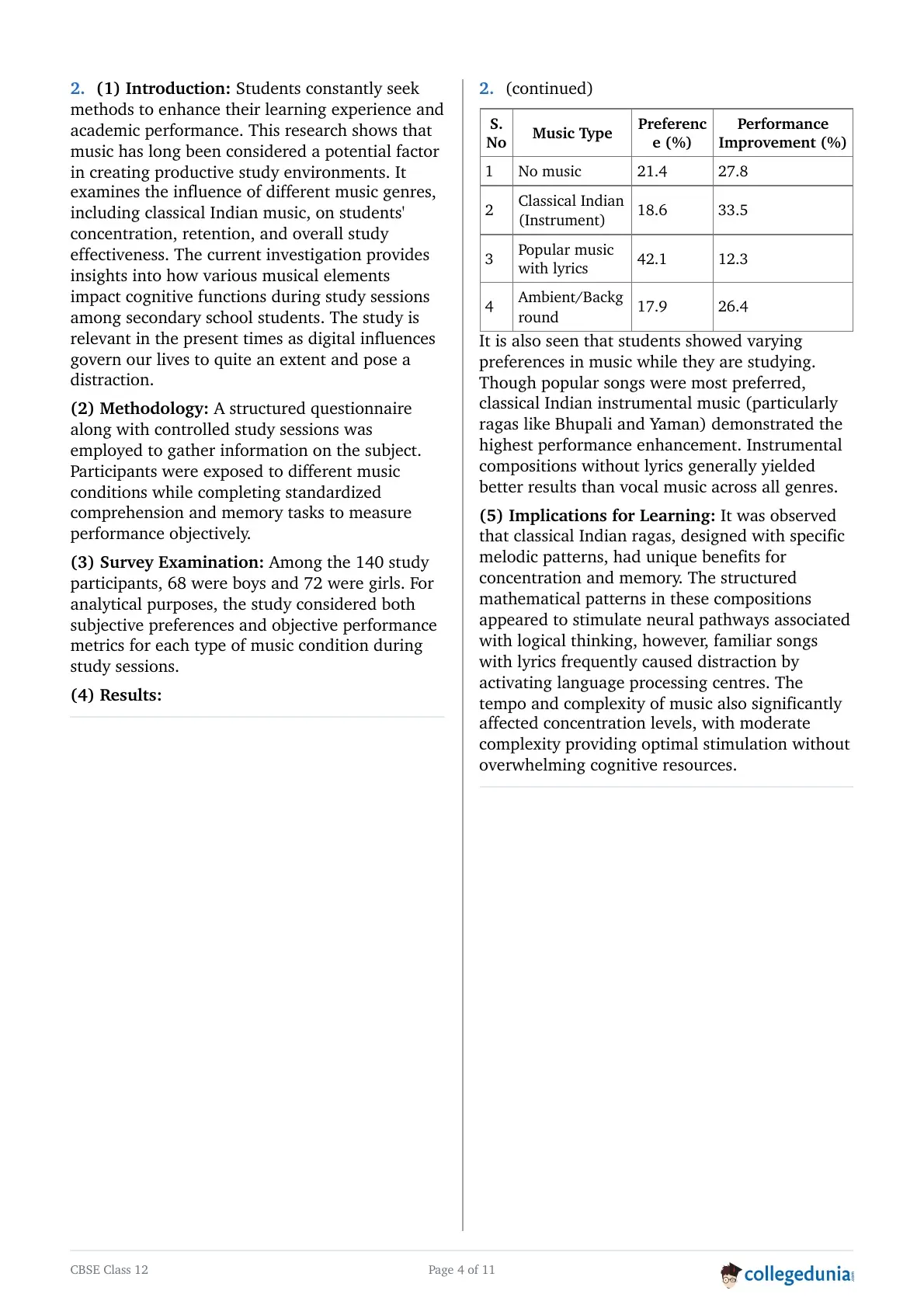
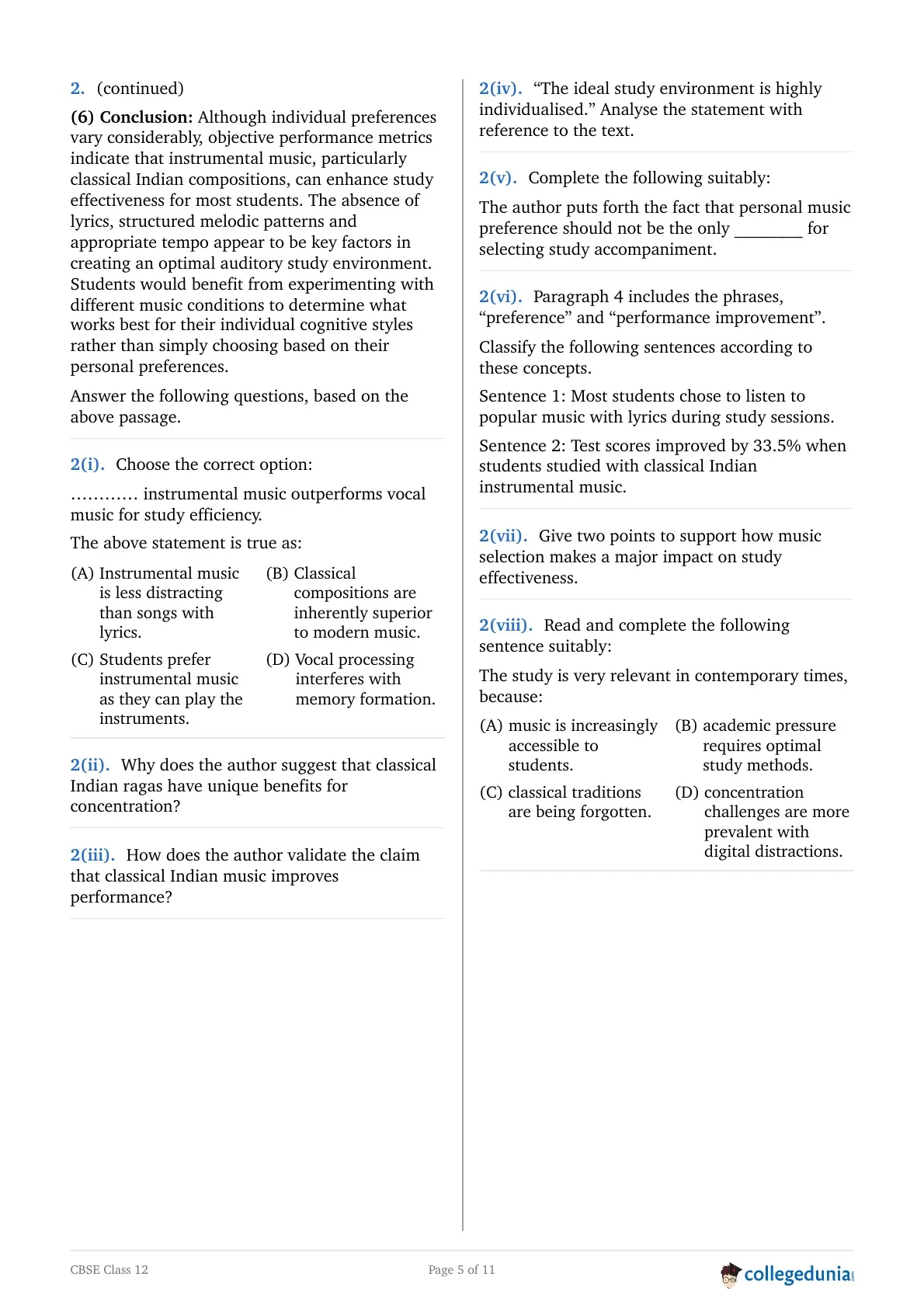
| S.No | Music Type | Preference (%) | Performance Improvement (%) |
|---|---|---|---|
| 1. | No music | 21·4 | 27·8 |
| 2. | Classical Indian (Instrument) | 18·6 | 33·5 |
| 3. | Popular music with lyrics | 42·1 | 12·3 |
| 4. | Ambient/Background | 17·9 | 26·4 |
It is also seen that students showed varying preferences in music while they are studying. Though popular songs were most preferred, classical Indian instrumental music (particularly ragas like Bhupali and Yaman) demonstrated the highest performance enhancement. Instrumental compositions without lyrics generally yielded better results than vocal music across all genres.
(5) Implications for Learning :
It was observed that classical Indian ragas, designed with specific melodic patterns, had unique benefits for concentration and memory. The structured mathematical patterns in these compositions appeared to stimulate neutral pathways associated with logical thinking, however, familiar songs with lyrics frequently caused distraction by activating language processing centres. The tempo and complexity of music also significantly affected concentration levels, with moderate complexity providing optimal stimulation without overwhelming cognitive resources.
(6) Conclusion :
Although individual preferences vary considerably, objective performance metrics indicate that instrumental music, particularly classical Indian compositions, can enhance study effectiveness for most students. The absence of lyrics, structured melodic patterns and appropriate tempo appear to be key factors in creating an optimal auditory study environment. Students would benefit from experimenting with different music conditions to determine what works best for their individual cognitive styles rather than simply choosing based on their personal preferences.
Choose the correct option :
............ instrumental music outperforms vocal music for study efficiency.
The above statement is true as :
Why does the author suggest that classical Indian ragas have unique benefits for concentration ?
How does the author validate the claim that classical Indian music improves performance ?
‘‘The ideal study environment is highly individualised.’’ Analyse the statement with reference to the text.
Complete the following suitably :
The author puts forth the fact that personal music preference should not be the only __________ for selecting study accompaniment.
Paragraph 4 includes the phrases, ‘‘preference’’ and ‘‘performance improvement’’.
Classify the following sentences according to these concepts.
Sentence 1 : Most students chose to listen to popular music with lyrics during study sessions.
Sentence 2 : Test scores improved by 33·5% when students studied with classical Indian instrumental music.
Give two points to support how music selection makes a major impact on study effectiveness.
Read and complete the following sentence suitably :
The study is very relevant in contemporary times, because :
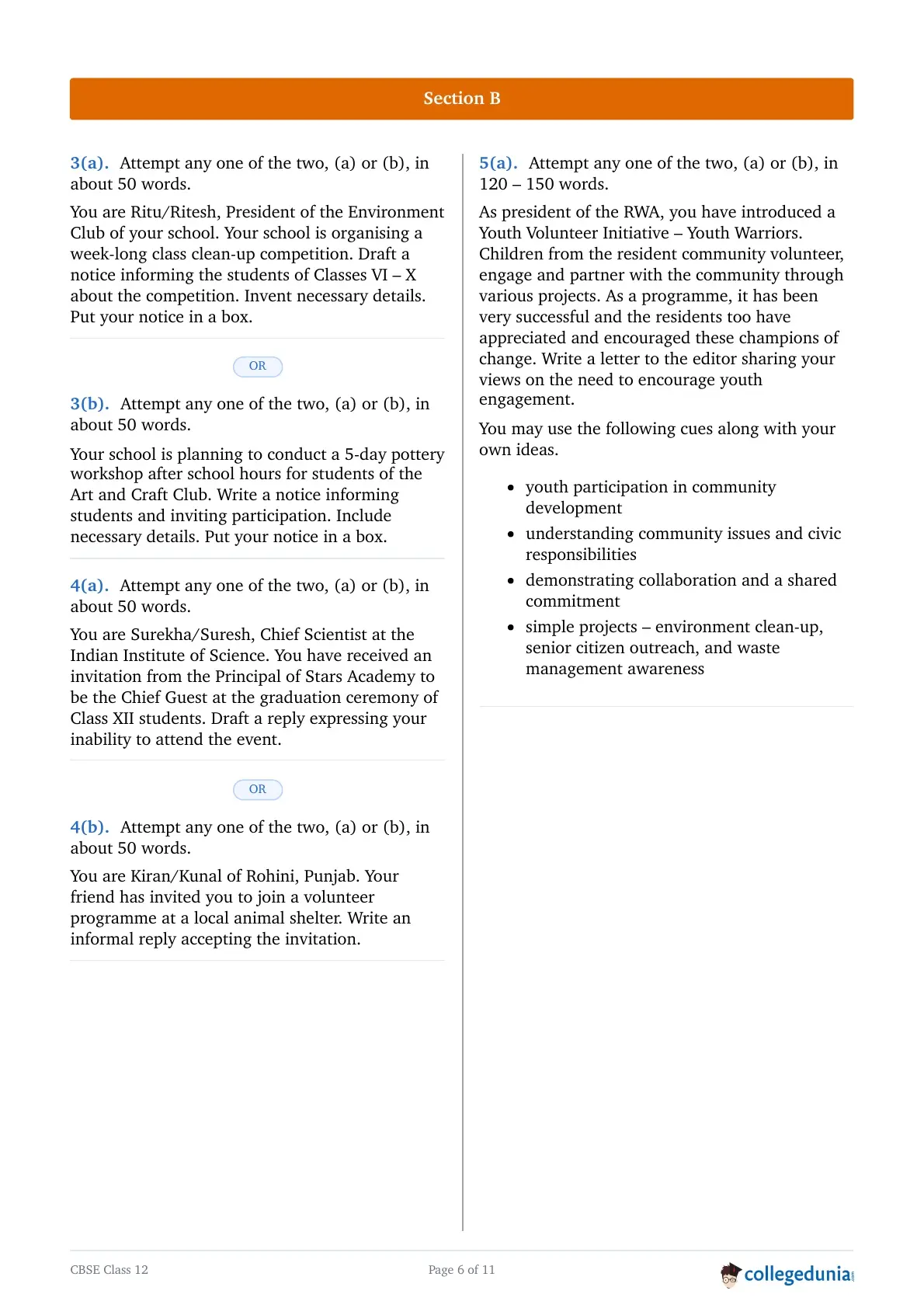
(Answer in about 50 words.) You are Ritu/Ritesh, President of the Environment Club of your school. Your school is organising a week-long class clean-up competition. Draft a notice informing the students of Classes VI – X about the competition. Invent necessary details. Put your notice in a box.
(Answer in about 50 words.) Your school is planning to conduct a 5-day pottery workshop after school hours for students of the Art and Craft Club. Write a notice informing students and inviting participation. Include necessary details. Put your notice in a box.
(Answer in about 50 words.) You are Surekha/Suresh, Chief Scientist at the Indian Institute of Science. You have received an invitation from the Principal of Stars Academy to be the Chief Guest at the graduation ceremony of Class XII students. Draft a reply expressing your inability to attend the event.
(Answer in about 50 words.) You are Kiran/Kunal of Rohini, Punjab. Your friend has invited you to join a volunteer programme at a local animal shelter. Write an informal reply accepting the invitation.
(Answer in 120 – 150 words.) As president of the RWA, you have introduced a Youth Volunteer Initiative – Youth Warriors. Children from the resident community volunteer, engage and partner with the community through various projects. As a programme, it has been very successful and the residents too have appreciated and encouraged these champions of change. Write a letter to the editor sharing your views on the need to encourage youth engagement. You may use the following cues along with your own ideas.
- youth participation in community development
- understanding community issues and civic responsibilities
- demonstrating collaboration and a shared commitment
- simple projects – environment clean-up, senior citizen outreach, and waste management awareness
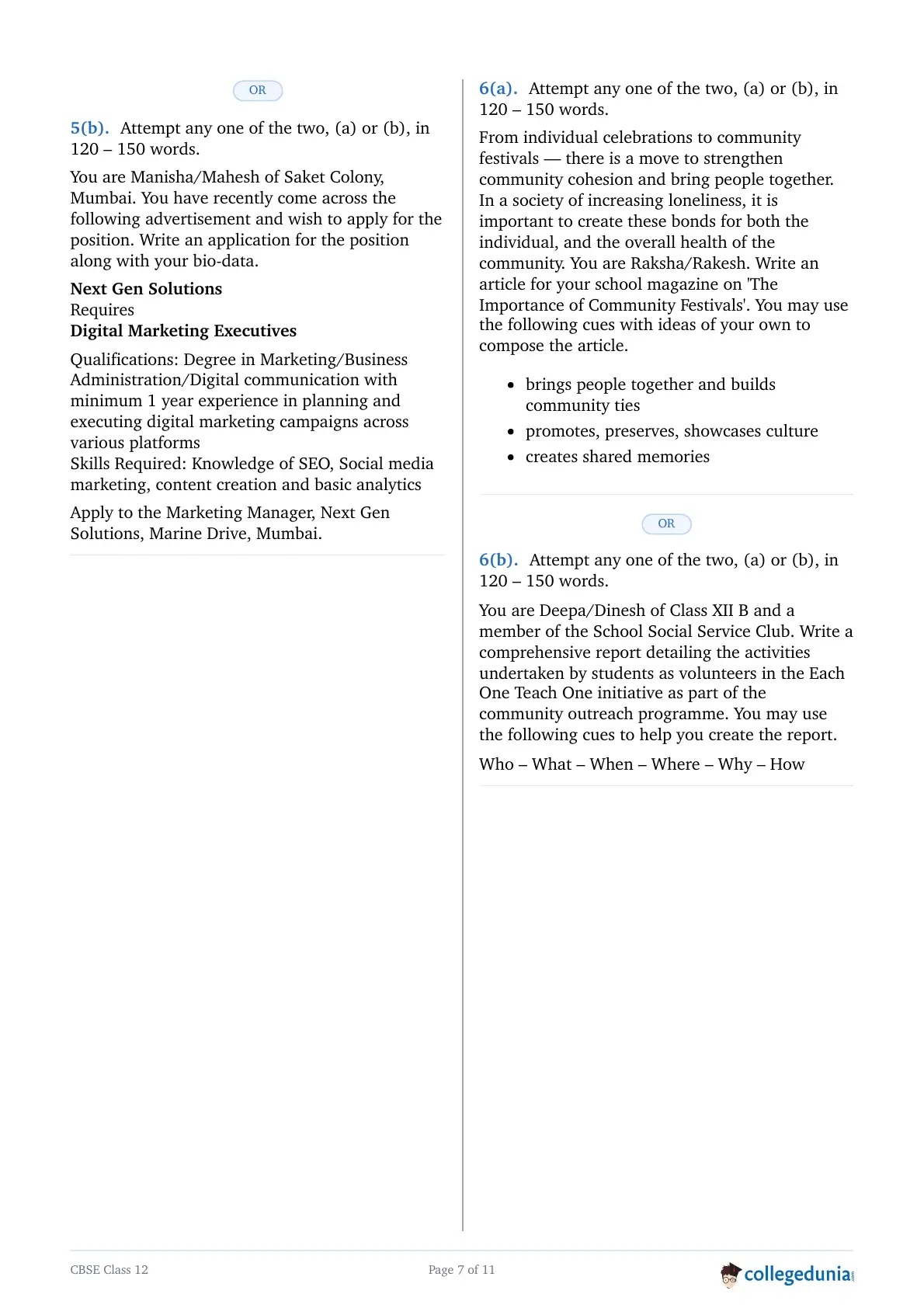
(Answer in 120 – 150 words.) You are Manisha/Mahesh of Saket Colony, Mumbai. You have recently come across the following advertisement and wish to apply for the position. Write an application for the position along with your bio-data.
Next Gen Solutions Requires Digital Marketing Executives
|
Apply to the Marketing Manager, Next Gen Solutions, Marine Drive, Mumbai.
(Answer in 120 – 150 words.) From individual celebrations to community festivals — there is a move to strengthen community cohesion and bring people together. In a society of increasing loneliness, it is important to create these bonds for both the individual, and the overall health of the community. You are Raksha/Rakesh. Write an article for your school magazine on ‘The Importance of Community Festivals’. You may use the following cues with ideas of your own to compose the article.
- brings people together and builds community ties
- promotes, preserves, showcases culture
- creates shared memories
(Answer in 120 – 150 words.) You are Deepa/Dinesh of Class XII B and a member of the School Social Service Club. Write a comprehensive report detailing the activities undertaken by students as volunteers in the Each One Teach One initiative as part of the community outreach programme. You may use the following cues to help you create the report. Who - What – When – Where – Why – How
Question 7(a) (Passage / Extract):
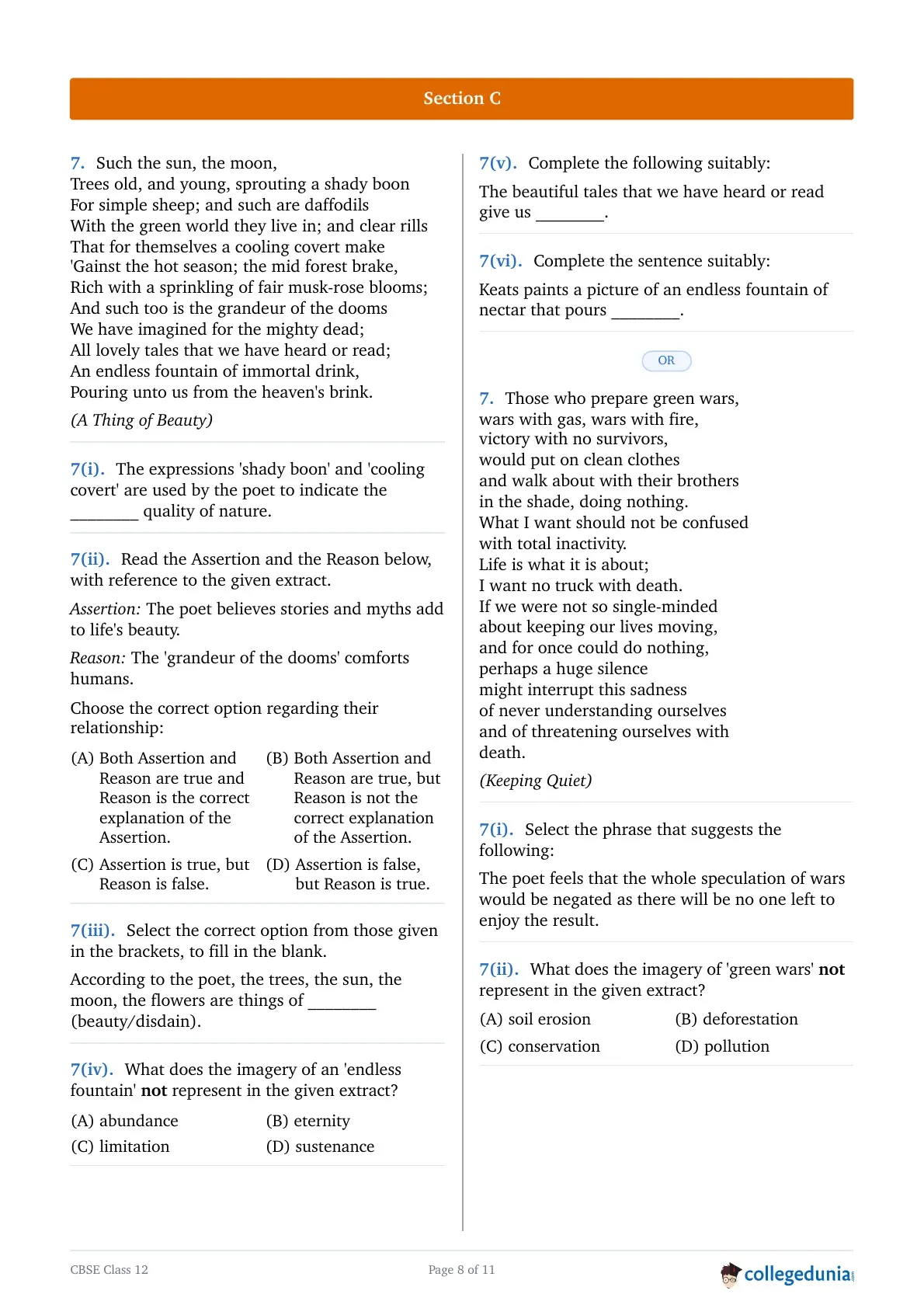
Such the sun, the moon,
Trees old, and young, sprouting a shady boon
For simple sheep; and such are daffodils
With the green world they live in; and clear rills
That for themselves a cooling covert make
‘Gainst the hot season; the mid forest brake,
Read More
Rich with a sprinkling of fair musk-rose blooms;And such too is the grandeur of the dooms
We have imagined for the mighty dead;
All lovely tales that we have heard or read;
An endless fountain of immortal drink,
Pouring unto us from the heaven’s brink.
(A Thing of Beauty)
The expressions ‘shady boon’ and ‘cooling covert’ are used by the poet to indicate the _________ quality of nature.
Read the Assertion and the Reason below, with reference to the given extract.
Assertion : The poet believes stories and myths add to life’s beauty.
Reason : The ‘grandeur of the dooms’ comforts humans.
Choose the correct option regarding their relationship :
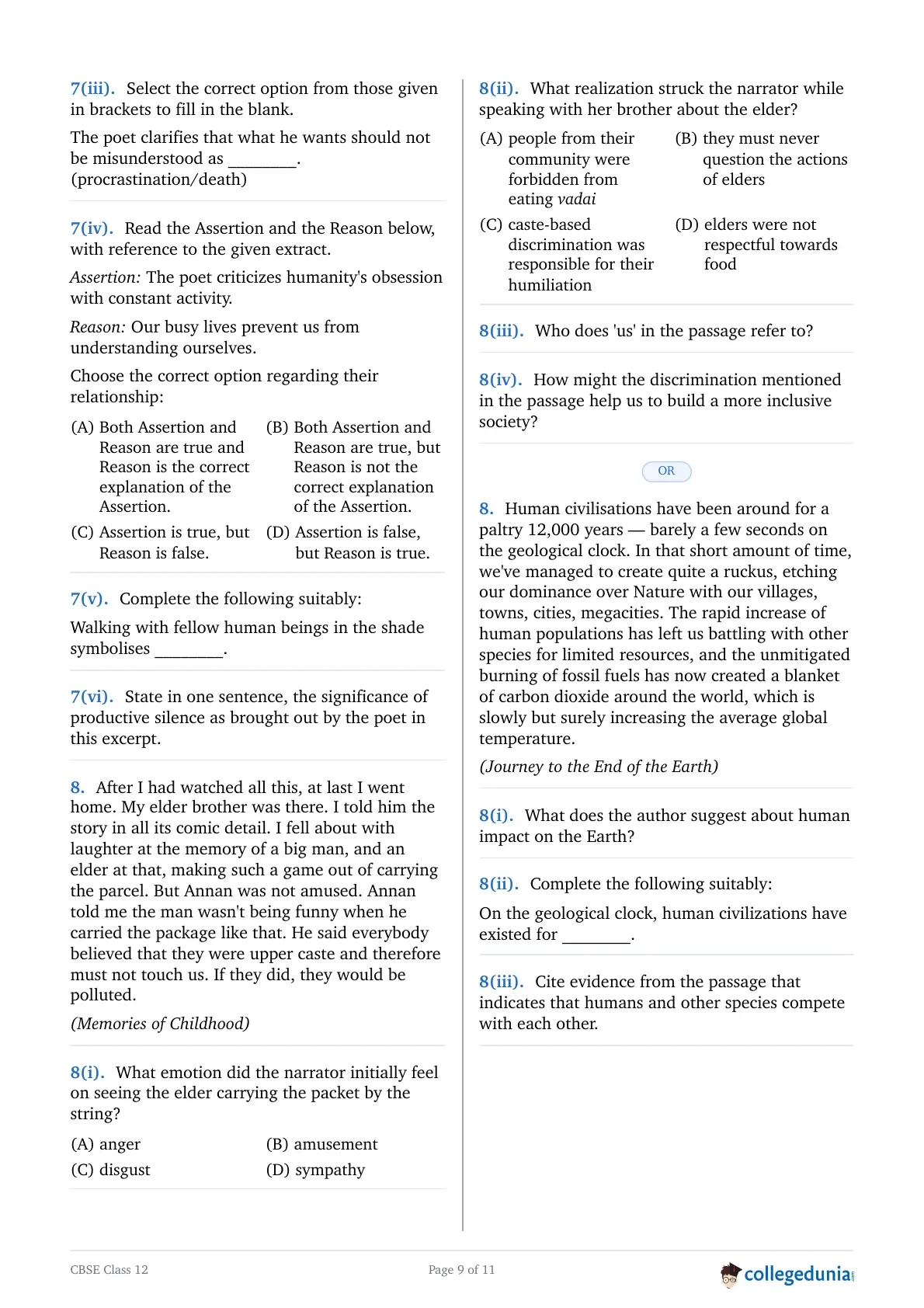
Select the correct option from those given in the brackets, to fill in the blank.
According to the poet, the trees, the sun, the moon, the flowers are things of __________ (beauty/disdain).
What does the imagery of an ‘endless fountain’ not represent in the given extract ?
Complete the following suitably :
The beautiful tales that we have heard or read give us ___________ .
Complete the sentence suitably :
Keats paints a picture of an endless fountain of nectar that pours of ___________.
Question 7(b)-OR (Passage / Extract):
Those who prepare green wars,
wars with gas, wars with fire,
victory with no survivors,
would put on clean clothes
and walk about with their
brothers
in the shade, doing nothing.
What I want should not be
confused
with total inactivity.
Life is what it is about;
Read More
I want no truck with death.If we were not so single-minded
about keeping our lives moving,
and for once could do nothing,
perhaps a huge silence
might interrupt this sadness
of never understanding ourselves
and of threatening ourselves with
death.
(Keeping Quiet)
Select the phrase that suggests the following :
The poet feels that the whole speculation of wars would be negated as there will be no one left to enjoy the result.
What does the imagery of ‘green wars’ not represent in the given extract ?
Select the correct option from those given in brackets to fill in the blank.
The poet clarifies that what he wants should not be misunderstood as _____________. (procrastination/death)
Read the Assertion and the Reason below, with reference to the given extract.
Assertion : The poet criticizes humanity’s obsession with constant activity.
Reason : Our busy lives prevent us from understanding ourselves.
Choose the correct option regarding their relationship :
Complete the following suitably :
Walking with fellow human beings in the shade symbolises __________.
State in one sentence, the significance of productive silence as brought out by the poet in this excerpt.
Question 8(a) (Passage / Extract):
After I had watched all this, at last I went home. My elder brother was there. I told him the story in all its comic detail. I fell about with laughter at the memory of a big man, and an elder at that, making such a game out of carrying the parcel. But Annan
Read More
was not amused. Annan told me the man wasn’t being funny when he carried the package like that. He said everybody believed that they were upper caste and therefore must not touch us. If they did, they would be polluted.(Memories of Childhood)
What emotion did the narrator initially feel on seeing the elder carrying the packet by the string ?
What realization struck the narrator while speaking with her brother about the elder ?
How might the discrimination mentioned in the passage help us to build a more inclusive society ?
Question 8(b)-OR (Passage / Extract):
Human civilisations have been around for a paltry 12,000 years — barely a few seconds on the geological clock. In that short amount of time, we’ve managed to create quite a ruckus, etching our dominance over Nature with our villages, towns, cities, megacities. The rapid increase of human populations
Read More
has left us battling with other species for limited resources, and the unmitigated burning of fossil fuels has now created a blanket of carbon dioxide around the world, which is slowly but surely increasing the average global temperature.(Journey to the end of the Earth)
Complete the following suitably :
On the geological clock, human civilizations have existed for ___________.
Cite evidence from the passage that indicates that humans and other species compete with each other.
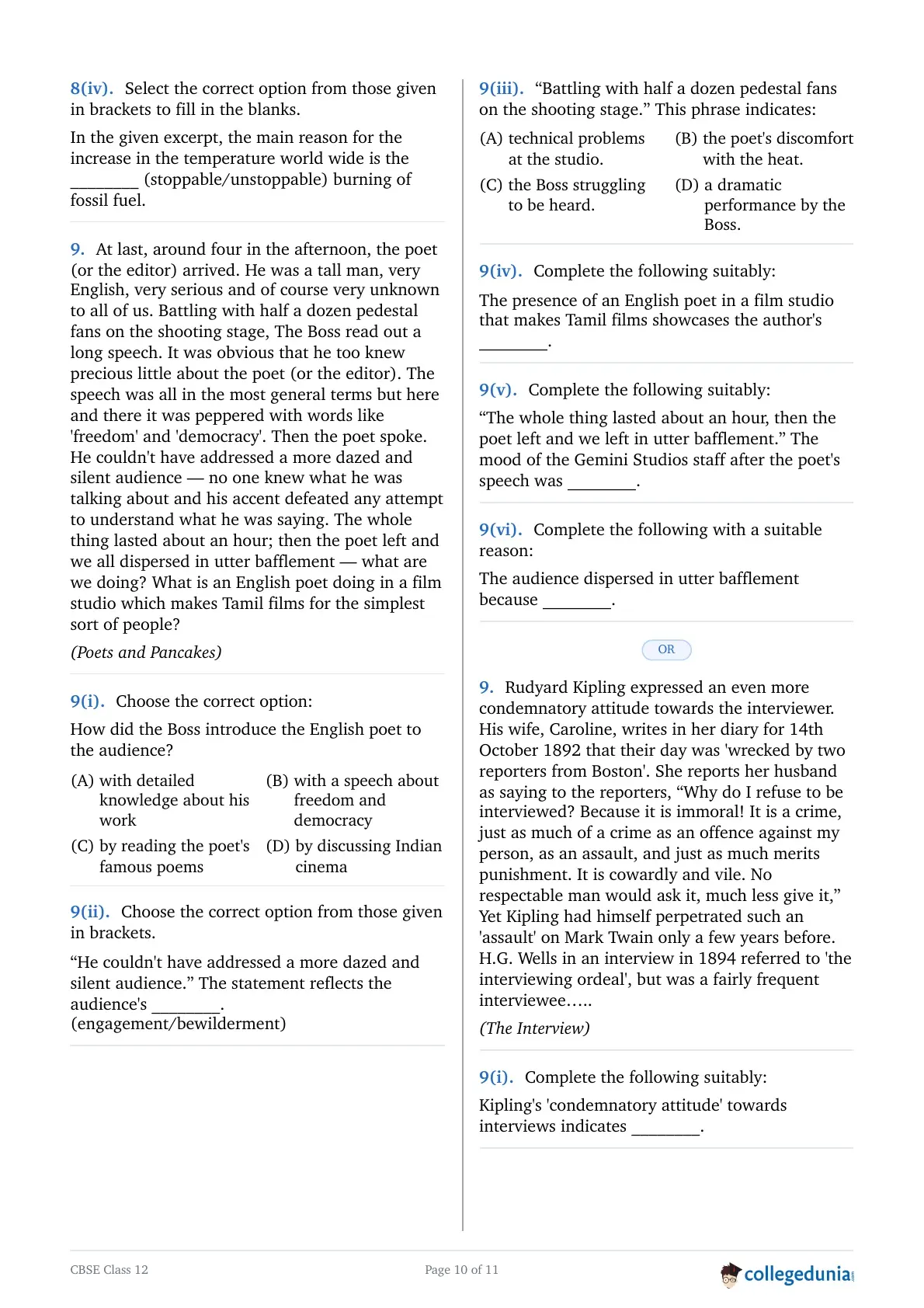
Select the correct option from those given in brackets to fill in the blanks.
In the given excerpt, the main reason for the increase in the temperature world wide is the ____________ (stoppable/unstoppable) burning of fossil fuel.
Question 9(a) (Passage / Extract):
At last, around four in the afternoon, the poet (or the editor) arrived. He was a tall man, very English, very serious and of course very unknown to all of us. Battling with half a dozen pedestal fans on the shooting stage, The Boss read out a long speech. It was obvious that he too knew precious little about the poet (or the editor). The speech was all in the most general terms but here and there it was peppered with words like ‘freedom’ and ‘democracy’.
Read More
Then the poet spoke. He couldn’t have addressed a more dazed and silent audience — no one knew what he was talking about and his accent defeated any attempt to understand what he was saying. The whole thing lasted about an hour; then the poet left and we all dispersed in utter bafflement — what are we doing? What is an English poet doing in a film studio which makes Tamil films for the simplest sort of people?(Poets and Pancakes)
Choose the correct option :
How did the Boss introduce the English poet to the audience ?
Choose the correct option from those given in brackets.
‘‘He couldn’t have addressed a more dazed and silent audience.’’ The statement reflects the audience’s ___________ (engagement/bewilderment)
‘‘Battling with half a dozen pedestal fans on the shooting stage.’’ This phrase indicates :
Complete the following suitably :
The presence of an English poet in a film studio that makes Tamil films showcases the author’s ____________.
Complete the following suitably :
‘‘The whole thing lasted about an hour, then the poet left and we left in utter bafflement.’’
The mood of the Gemini Studios staff after the poet’s speech was __________.
Complete the following with a suitable reason :
The audience dispersed in utter bafflement because ___________.
Question 9(b)-OR (Passage / Extract):
Rudyard Kipling expressed an even more condemnatory attitude towards the interviewer. His wife, Caroline, writes in her diary for 14th October 1892 that their day was ‘wrecked by two reporters from Boston’. She reports her husband as saying to the reporters, “Why do I refuse to be interviewed? Because it is immoral! It is a crime, just as much of a crime as an offence against
Read More
my person, as an assault, and just as much merits punishment. It is cowardly and vile. No respectable man would ask it, much less give it,” Yet Kipling had himself perpetrated such an ‘assault’ on Mark Twain only a few years before. H.G. Wells in an interview in 1894 referred to ‘the interviewing ordeal’, but was a fairly frequent interviewee.....(The Interview)
Complete the following suitably :
Kipling’s ‘condemnatory attitude’ towards interviews indicates ___________.
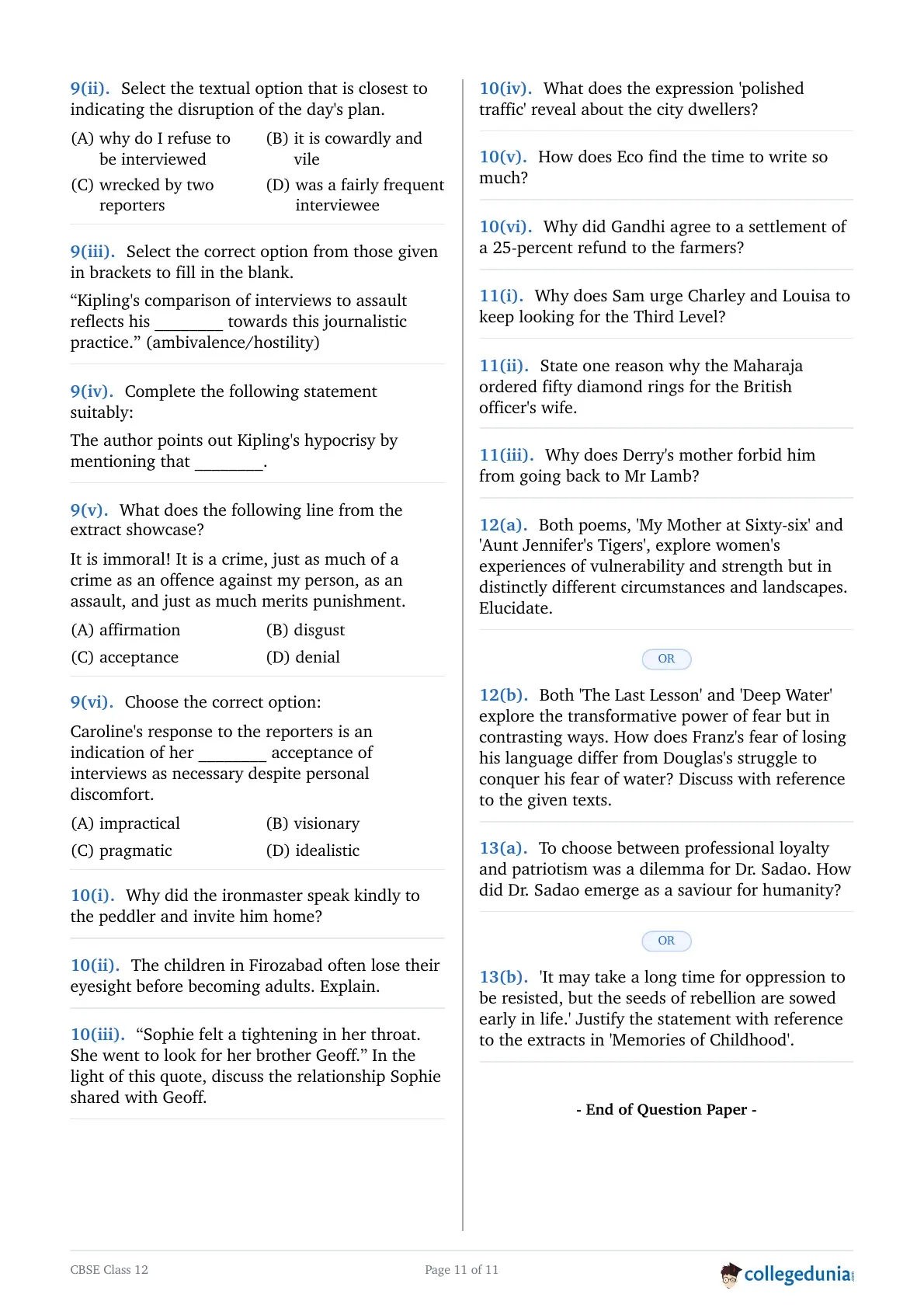
Select the textual option that is closest to indicating the disruption of the day’s plan.
Select the correct option form those given in brackets to fill in the blank.
‘‘Kipling’s comparison of interviews to assault reflects his _____________ towards this journalistic practice.’’ (ambivalence/hostility)
Complete the following statement suitably :
The author points out Kipling’s hypocrisy by mentioning that _______________.
What does the following line from the extract showcase ?
It is immoral! It is a crime, just as much of a crime as an offence against my person, as an assault, and just as much merits punishment.
Choose the correct option :
Caroline’s response to the reporters is an indication of her __________ acceptance of interviews as necessary despite personal discomfort.
Why did the ironmaster speak kindly to the peddler and invite him home ? (The Rattrap)
The children in Firozabad often lose their eyesight before becoming adults. Explain. (Lost Spring)
‘‘Sophie felt a tightening in her throat. She went to look for her brother Geoff.’’ In the light of this quote, discuss the relationship Sophie shared with Geoff. (Going Places)
What does the expression ‘polished traffic’ reveal about the city dwellers ? (A Roadside Stand)
Why did Gandhi agree to a settlement of a 25-percent refund to the farmers ? (Indigo)
Why does Sam urge Charley and Louisa to keep looking for the Third Level ? (The Third Level)
State one reason why the Maharaja ordered fifty diamond rings for the British officer’s wife. (The Tiger King)
Why does Derry’s mother forbid him from going back to Mr. Lamb ? (On The Face Of It)
(Answer in 120 – 150 words.) Both poems, ‘My Mother at Sixty-six’ and ‘Aunt Jennifer’s Tigers’, explore women’s experiences of vulnerability and strength but in distinctly different circumstances and landscapes. Elucidate.
(Answer in 120 – 150 words.) Both ‘The Last Lesson’ and ‘Deep Water’ explore the transformative power of fear but in contrasting ways. How does Franz’s fear of losing his language differ from Douglas’s struggle to conquer his fear of water. Discuss with reference to the given texts.
(Answer in 120 – 150 words.) To choose between professional loyalty and patriotism was a dilemma for Dr. Sadao. How did Dr. Sadao emerge as a saviour for humanity ? (The Enemy)
(Answer in 120 – 150 words.) ‘It may take a long time for oppression to be resisted, but the seeds of rebellion are sowed early in life.’ Justify the statement with reference to the extracts in ‘Memories of Childhood’.
CBSE Class 12 English Core Compartment 2026 Set 3 - (1/7/3) Exam Pattern and Marking Scheme
| Section | Content | Marks |
|---|---|---|
| A | Reading Skills (two unseen passages) | 22 |
| B | Creative Writing Skills | 18 |
| C | Literature | 40 |
| Total | 13 questions | 80 |
CBSE Class 12 English Core Compartment 2026 Set 3 - (1/7/3) Question Paper FAQs
Ques. How many questions are there in the CBSE Class 12 English Core Compartment 2026 paper (Set 3 - 1/7/3)?
Ans. The paper has 13 questions and all of them are compulsory.
Ques. How are the marks divided in the English Core Compartment 2026 paper?
Ans. Section A (Reading Skills) carries 22 marks, Section B (Creative Writing Skills) 18 marks and Section C (Literature) 40 marks, for a total of 80 marks.
Ques. Is there a word limit for the answers?
Ans. Yes. Separate instructions are given with each question and part, and candidates must adhere to the prescribed word limit.
Ques. How much time is given for the CBSE Class 12 English Core Compartment 2026 paper?
Ans. The paper is of 3 hours (10:30 AM to 1:30 PM). The question paper is distributed at 10:15 AM and candidates get 15 minutes to read it before they start writing.
Ques. When was the CBSE Class 12 English Core Compartment 2026 exam held?
Ans. The Class 12 compartment (supplementary) paper of English Core was held on July 28, 2026.
Ques. Where can I get the official CBSE Class 12 English Core Compartment question paper?
Ans. The official question papers are published on the CBSE website, cbse.gov.in. You can also download the official PDF from the table above.



Comments