




CBSE Class 12 Compartment Exam For students who failed in 1 or 2 subjects in the Class 12 exams. CBSE Class 12 exams are tentatively scheduled for July 15th 2026.
- To clear the compartment exam you need to score a minimum of 33 marks out of 100 in each subject.
- Generally, a well-structured plan of studying for 6-8 hours daily is enough to clear the exam within the next 30 days.
- NCERT Textbooks and previous year compartment papers are the most important resources for preparing.
Also Read
- CBSE Class 12 Compartment Exam vs Improvement Exam 2026: Key Differences and Which to Choose
- How to Give an Improvement Exam for CBSE Class 12 Exam
CBSE Class 12 Compartment Exam 2026 Overview
The CBSE Class 12 Compartment Exam is held every year for students who fail in one or two subjects in the main board examination. Clearing the compartment exam means you earn your Class 12 certificate in the same academic year, without repeating the full year of study.
| Parameter | Details |
|---|---|
| Conducting Body | Central Board of Secondary Education (CBSE) |
| Exam Name | CBSE Class 12 Compartment Exam 2026 |
| Expected Exam Date | July 15 2026 (exact dates to be notified at cbse.gov.in) |
| Subjects Covered | All main Class 12 subjects across Science, Commerce, and Arts streams |
| Total Marks per Subject | 100 (Theory + Practical, as applicable per subject) |
| Passing Marks | 33 out of 100 (33%) in each subject |
| Eligibility | Students who failed in 1 or 2 subjects in CBSE Class 12 main exam 2026 |
| Official Website | cbse.gov.in |
Ques. When is the CBSE Class 12 Compartment Exam 2026 expected to be held?
Ans. The CBSE Class 12 Compartment Exam 2026 is expected on July 15, 2026, approximately 4-6 weeks after the declaration of the main board results. The exact schedule and date sheet will be published on the official CBSE website at cbse.gov.in.
30-Day Study Plan for CBSE Class 12 Compartment 2026
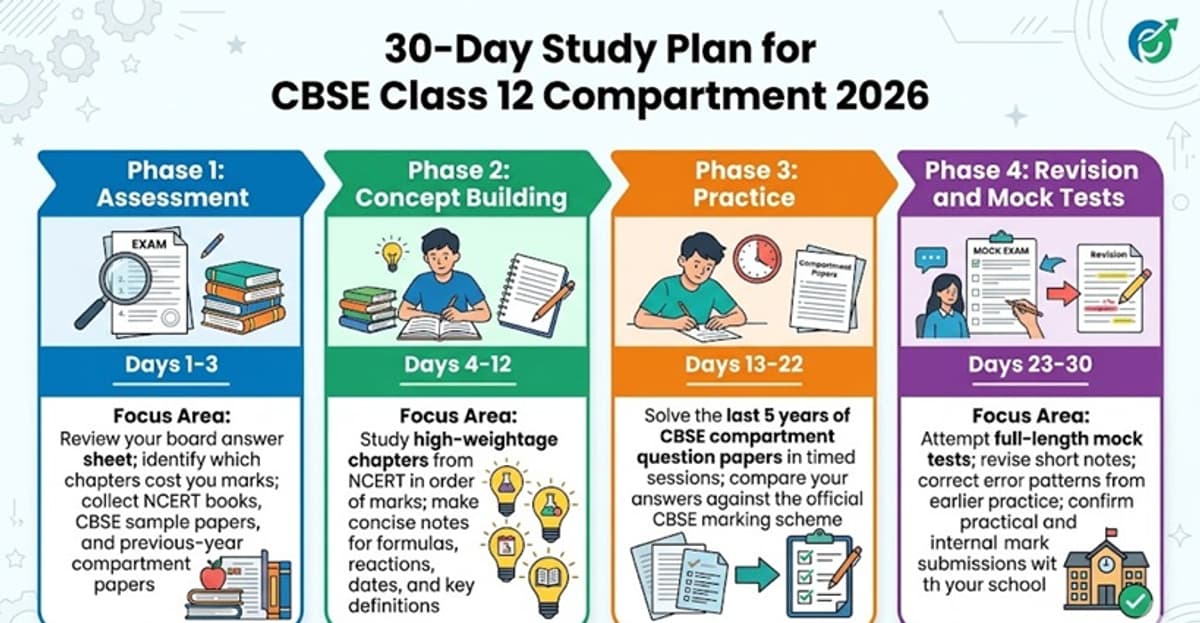
Divide your 30 days into four phases: assessment, concept building, practice, and revision. This prevents last-minute cramming and ensures you cover all high-weightage chapters with time to spare for mock tests.
| Phase | Days | Focus Area |
|---|---|---|
| Phase 1: Assessment | Days 1-3 | Review your board answer sheet; identify which chapters cost you marks; collect NCERT books, CBSE sample papers, and previous-year compartment papers |
| Phase 2: Concept Building | Days 4-12 | Study high-weightage chapters from NCERT in order of marks; make concise notes for formulas, reactions, dates, and key definitions |
| Phase 3: Practice | Days 13-22 | Solve the last 5 years of CBSE compartment question papers in timed sessions; compare your answers against the official CBSE marking scheme |
| Phase 4: Revision and Mock Tests | Days 23-30 | Attempt full-length mock tests; revise short notes; correct error patterns from earlier practice; confirm practical and internal mark submissions with your school |
Daily schedule tip: Study 6–8 hours each day, split into 90-minute focused blocks with 15-minute breaks. Begin each session by revising the previous day’s notes before starting new content. This spaced-repetition habit significantly improves retention.
Ques. Is 30 days enough to prepare for the CBSE Class 12 Compartment Exam?
Ans. Yes, 30 days is sufficient to clear the CBSE Class 12 Compartment Exam if you study 6-8 hours daily with a structured plan. The passing mark is 33%, which is achievable through focused study of NCERT textbooks and consistent practice with previous-year compartment papers.
Subject-Wise Preparation Strategy for CBSE Class 12 Compartment Exam
Each CBSE Class 12 subject has its own blueprint and question pattern. The strategies below help you maximise marks in the shortest time, focusing effort where it counts most.
| Subject | Preparation Strategy | Key Resource |
|---|---|---|
| Mathematics | Practise NCERT exercises and examples daily; focus on Integration, Vectors, and Probability; solve at least 3-4 full-length papers under timed conditions | NCERT Class 12 Maths, CBSE Sample Papers |
| Physics | Revise all derivations and circuit diagrams; prioritise Electrostatics, Current Electricity, and Optics; practise numerical problems chapter by chapter | NCERT Physics Part 1 and Part 2 |
| Chemistry | Memorise NCERT reaction mechanisms and equations; revise Organic Chemistry, Electrochemistry, and Surface Chemistry; practise naming reactions daily | NCERT Chemistry Part 1 and Part 2 |
| Biology | Focus on labelled diagrams (cell division, reproductive systems, genetics); revise Biotechnology, Ecology, and Human Reproduction for high-mark questions | NCERT Biology, CBSE marking scheme |
| English | Revise all prose and poetry chapters from Flamingo and Vistas; practise letter writing, notice, and report writing formats with official word-limit discipline | NCERT Flamingo, Vistas, CBSE writing skill booklet |
| Accountancy | Practise journal entries, trial balance, and financial ratio analysis daily; solve previous-year practical problems step by step to build accuracy and speed | NCERT Accountancy Part 1 and Part 2 |
| Economics | Understand and draw demand-supply and production diagrams; revise key definitions and government budget concepts; practise MCQs and short-answer questions | NCERT Macroeconomics, NCERT Microeconomics |
| History / Political Science | Create chapter-wise timelines and topic maps; practise source-based and map-based questions; revise structured 6-mark and 8-mark answer formats | NCERT textbooks, CBSE previous-year compartment papers |

Ques. Can NCERT books alone help you pass the CBSE Class 12 Compartment Exam?
Ans. Yes. NCERT textbooks are the single most important resource for CBSE Class 12 Compartment Exam preparation. The vast majority of questions are directly based on NCERT content. Supplement your NCERT study with CBSE sample papers, previous-year compartment papers, and official marking schemes for best results.
Important Topics to Focus On
When time is limited, target the chapters that carry the highest marks in the CBSE Class 12 blueprint. The table below lists the most important topics per stream based on the official CBSE marking scheme.
| Stream | Subject | High-Priority Topics (Approximate Marks) |
|---|---|---|
| Science | Physics | Electrostatics (8 marks), Current Electricity (7 marks), Optics (14 marks), Semiconductor Electronics (8 marks), Dual Nature of Radiation |
| Chemistry | Coordination Compounds (5 marks), Electrochemistry (5 marks), Aldehydes and Carboxylic Acids (10 marks), Biomolecules and Polymers | |
| Mathematics | Calculus and Integration (35 marks), Vectors and 3D Geometry (17 marks), Algebra and Matrices (13 marks), Probability (8 marks) | |
| Commerce | Accountancy | Partnership Accounts (30 marks), Cash Flow Statement (12 marks), Financial Statement Analysis, Issue and Forfeiture of Shares |
| Business Studies | Management Functions (16 marks), Marketing Management (16 marks), Financial Management (15 marks), Consumer Protection | |
| Arts | History | Bricks Beads and Bones, An Empire Across Three Continents, Friezes and Fire (source-based questions carry high marks) |
| Political Science | Cold War Era, India’s Foreign Policy, Regional Aspirations, Rise of Popular Movements, Recent Developments in Indian Politics |

Key Tips to Clear the CBSE Compartment Exam 2026
Beyond a structured timetable, the right exam habits and mindset will directly affect your score. Follow these practical tips to make the most of your 30 days.
- NCERT is your primary resource: Nearly 80-90% of CBSE Class 12 questions are directly based on NCERT text, examples, and exercises. Master NCERT before any supplementary material.
- Solve CBSE compartment papers from previous years: compartment exam papers often follow similar patterns; these are the best mock tests you can use.
- Study the official CBSE marking scheme: download the marking scheme PDFs from cbse.gov.in to understand exactly how step marks are awarded in Mathematics, Physics, Accountancy, and other subjects.
- Attempt every question in the exam: CBSE Class 12 has no negative marking; never leave any question blank even if you are unsure of the answer.
- Write neat, structured answers: use bullet points, labelled diagrams, and clear headings in descriptive subjects like English, History, Biology, and Political Science; presentation earns marks.
- Confirm practical and internal marks with your school: coordinate with your school to ensure all practical submissions and internal assessment marks are updated before the exam.
- Stop new topics in the last 5 days: use the final days only for revision of your short notes, formula sheets, and confidence-building mock tests.
- Sleep 7-8 hours daily: a rested mind retains information far better than a tired one; do not trade sleep for extra study hours in the final week.
CBSE Class 12 Compartment Exam Preparation Tips: Reddit Discussion
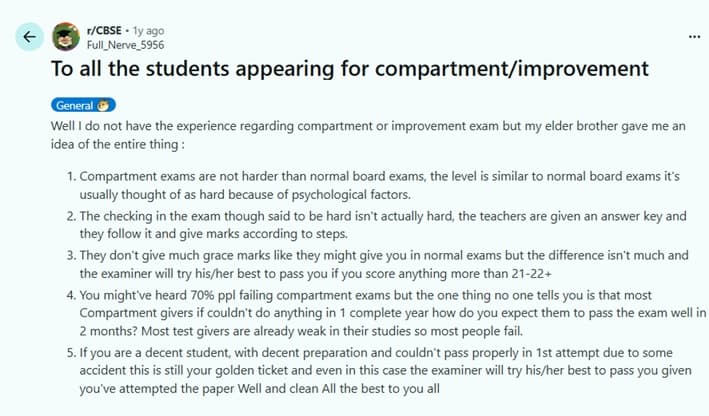
A User on the r/CBSE thread on Reddit gives important tips to handle CBSE compartment exam pressure and explains how the compartment exam is different from the main board exam.
Related News



Comments