




CBSE Class 12 Chemistry Question Paper 2025 Code 56/S/3 (Compartment) is available for download here. CBSE conducted the Class 12 Chemistry exam on July 15, 2025 from 10:30 AM to 1:30 PM. The Chemistry theory paper is of 70 marks.
Also Check: CBSE Class 12 Question Paper 2025 (All Subjects)
The Chemistry question paper includes the following types of questions:
- The question paper has 33 questions, all compulsory, for 70 marks in 3 hours, with 15 minutes of extra reading time
- Section A (Q1 to Q16) has 16 multiple choice questions of 1 mark each, and Section B (Q17 to Q21) has 5 very short answer questions of 2 marks each
- Section C (Q22 to Q28) has 7 short answer questions of 3 marks each
- Section D (Q29 and Q30) has 2 case study-based questions of 4 marks each, and Section E (Q31 to Q33) has 3 long answer questions of 5 marks each
- There is no overall choice, but internal choice (OR) is given in a few questions of Sections B to E, and calculators are not allowed
CBSE Class 12 Chemistry Question Paper 2025 Code 56/S/3 (Compartment) PDF
| CBSE Official PDF | CD PDF | CD PDF with Solutions |
|---|---|---|
| Download official PDF 0.53 MB | Download Collegedunia PDF 0.39 MB | Download solutions PDF 0.59 MB |
CBSE Class 12 Chemistry Compartment 2025 Set 3 (56/S/3) Questions with Solutions
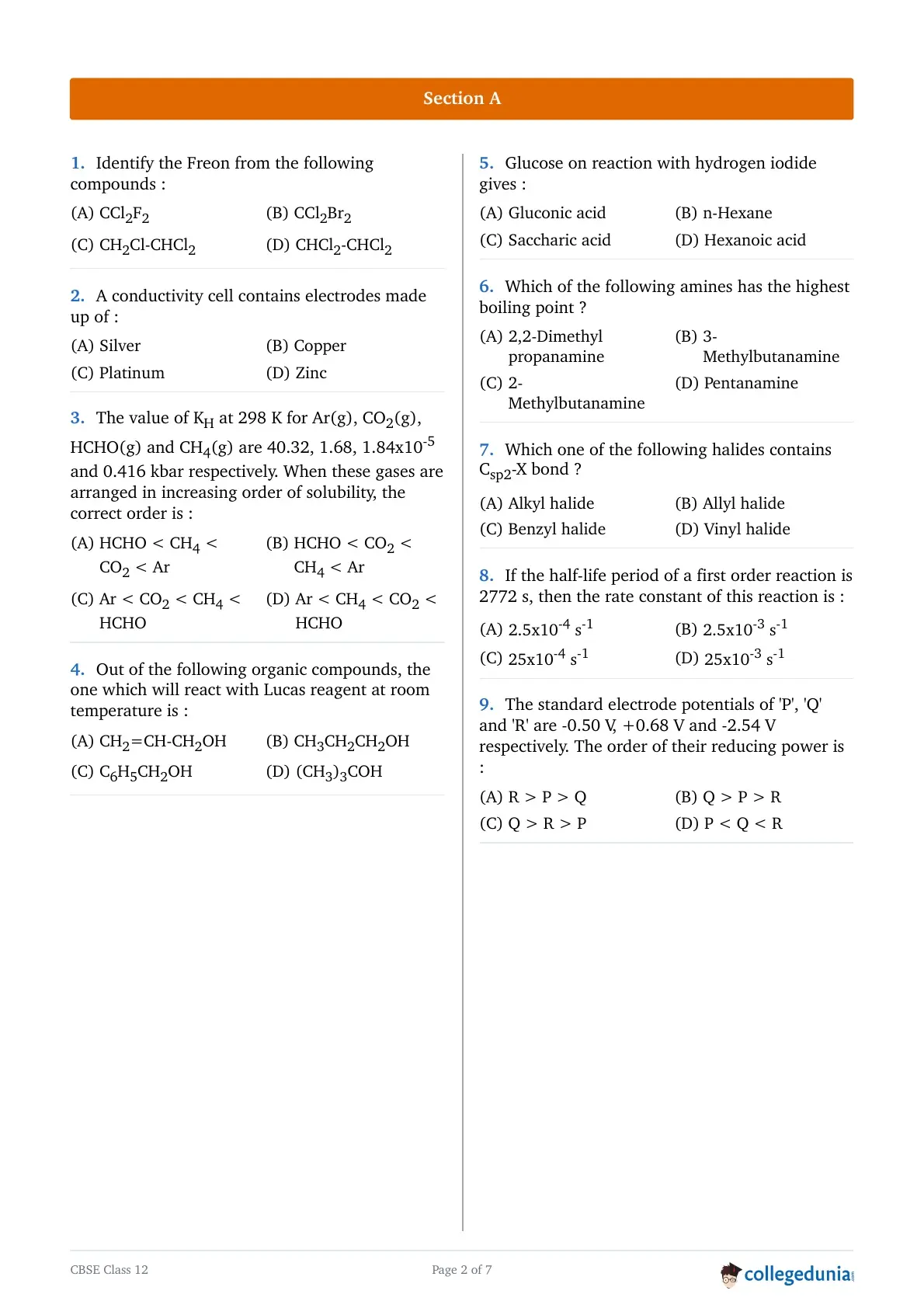
Identify the Freon from the following compounds :
A conductivity cell contains electrodes made up of :
The value of KH at 298 K for Ar(g), CO2(g), HCHO(g) and CH4(g) are 40.32, 1.68, 1.84x10⁻⁵ and 0.416 kbar respectively. When these gases are arranged in increasing order of solubility, the correct order is :
Out of the following organic compounds, the one which will react with Lucas reagent at room temperature is :
Glucose on reaction with hydrogen iodide gives :
Which of the following amines has the highest boiling point ?
Which one of the following halides contains Csp2-X bond ?
If the half-life period of a first order reaction is 2772 s, then the rate constant of this reaction is :
The standard electrode potentials of 'P', 'Q' and 'R' are -0.50 V, +0.68 V and -2.54 V respectively. The order of their reducing power is :
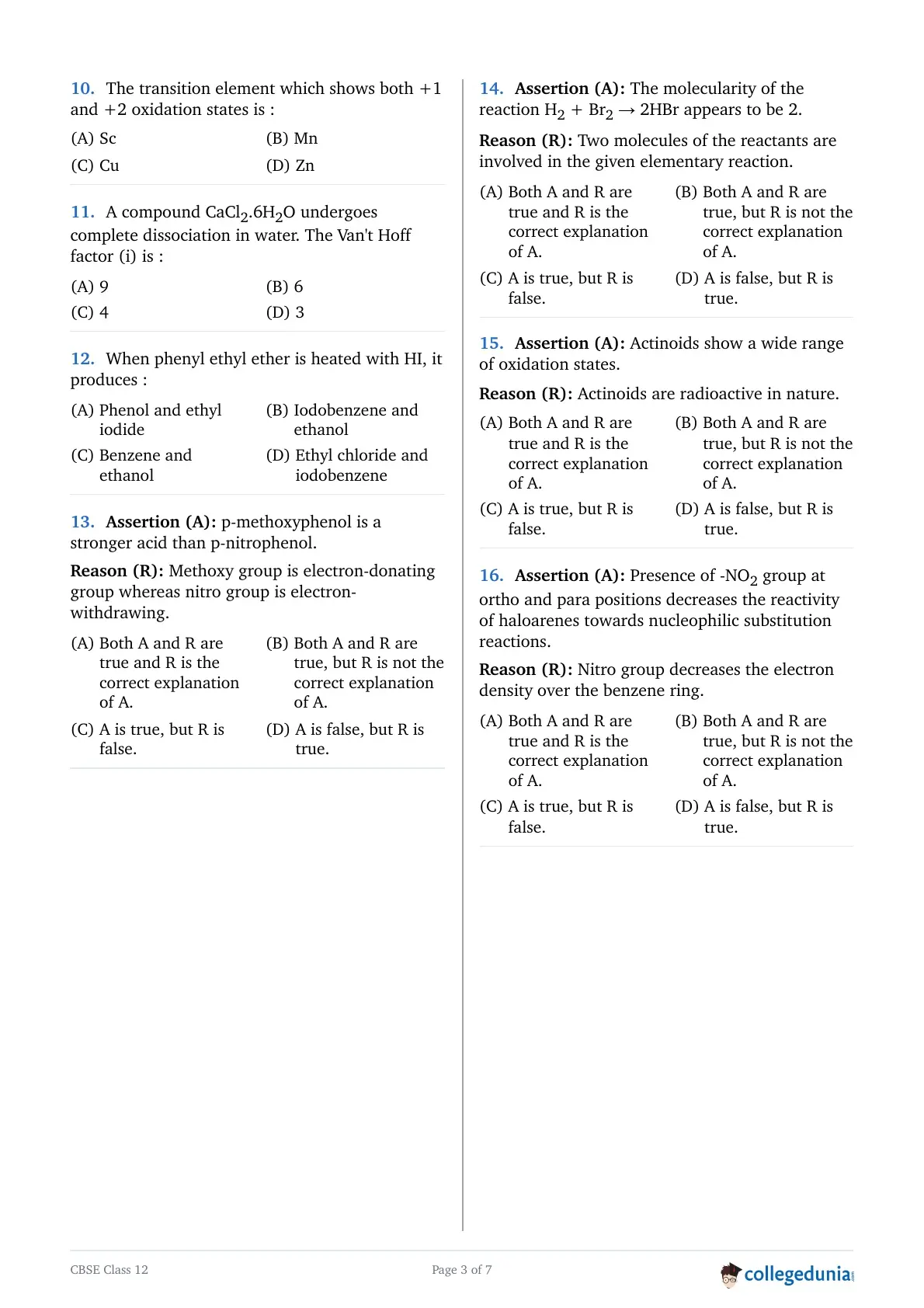
Which of the following transition metals shows +1 and +2 oxidation states ?
A compound CaCl2.6H2O undergoes complete dissociation in water. The Van't Hoff factor (i) is :
When phenyl ethyl ether is heated with HI, it produces :
Assertion (A): p-methoxyphenol is a stronger acid than p-nitrophenol.
Reason (R): Methoxy group is electron-donating group whereas nitro group is electron-withdrawing.
Assertion (A): The molecularity of the reaction H2 + Br2 → 2HBr appears to be 2.
Reason (R): Two molecules of the reactants are involved in the given elementary reaction.
Assertion (A): Actinoids show wide range of oxidation states.
Reason (R): Actinoids are radioactive in nature.
Assertion (A): Presence of -NO2 group at ortho and para positions decreases the reactivity of haloarenes towards nucleophilic substitution reactions.
Reason (R): Nitro group decreases the electron density over the benzene ring.
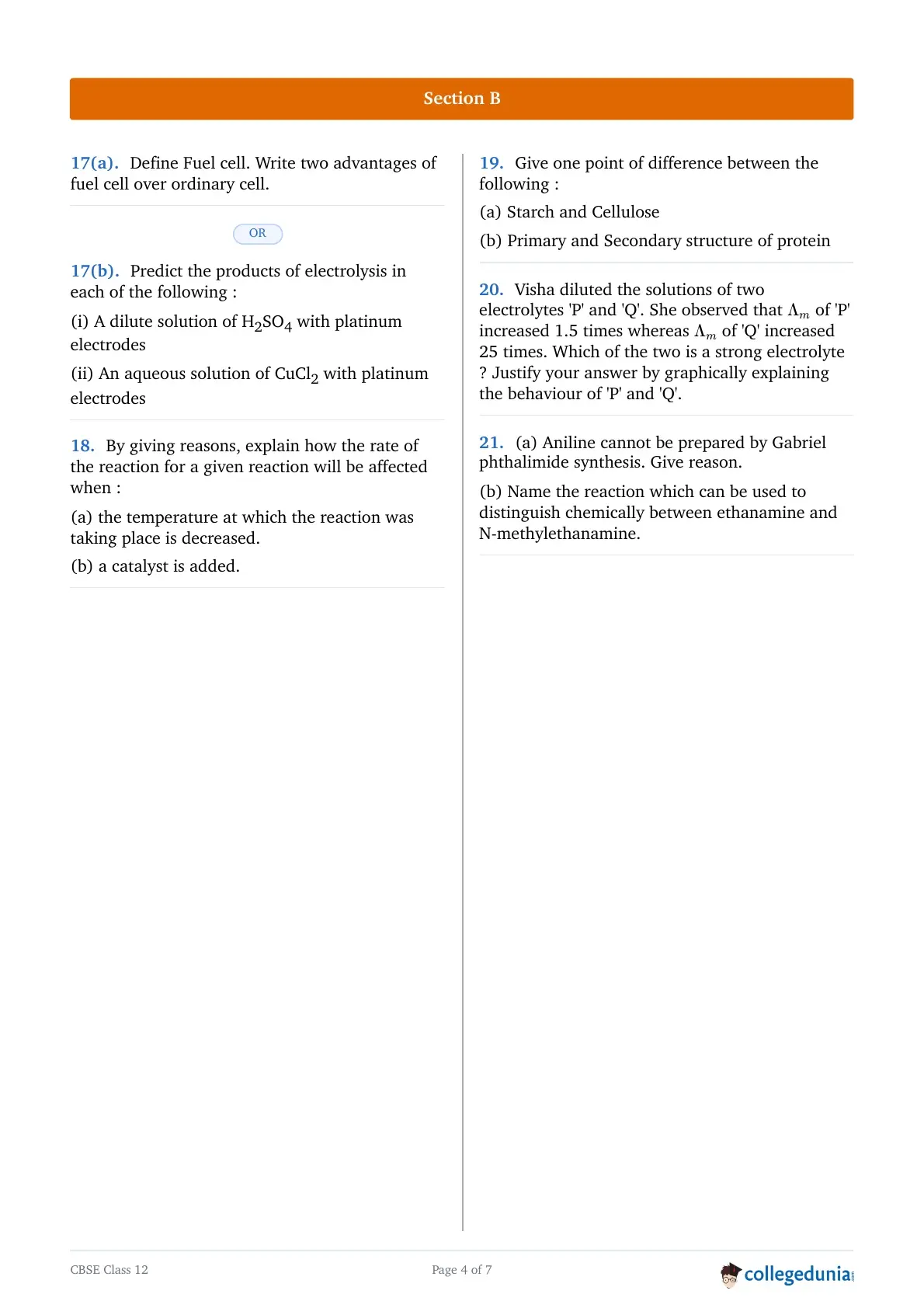
Define fuel cell. Give two advantages of fuel cell over ordinary cell.
Predict the products of electrolysis in each of the following :
(i) A dilute solution of H2SO4 with platinum electrodes
(ii) An aqueous solution of CuCl2 with platinum electrodes
By giving reasons, explain how the rate of the reaction for a given reaction will be affected when :
(a) the temperature at which the reaction was taking place is decreased.
(b) a catalyst is added.
Give one point of difference between the following :
(a) Starch and Cellulose
(b) Primary and Secondary structure of protein
Visha diluted the solutions of two electrolytes 'P' and 'Q'. She observed that Lambda_m of 'P' increased 1.5 times whereas Lambda_m of 'Q' increased 25 times. Which of the two is a strong electrolyte ? Justify your answer by graphically explaining the behaviour of 'P' and 'Q'.
(a) Aniline cannot be prepared by Gabriel phthalimide synthesis. Give reason.
(b) Name the reaction which can be used to distinguish chemically between ethanamine and N-methylethanamine.
Give reasons for the following :
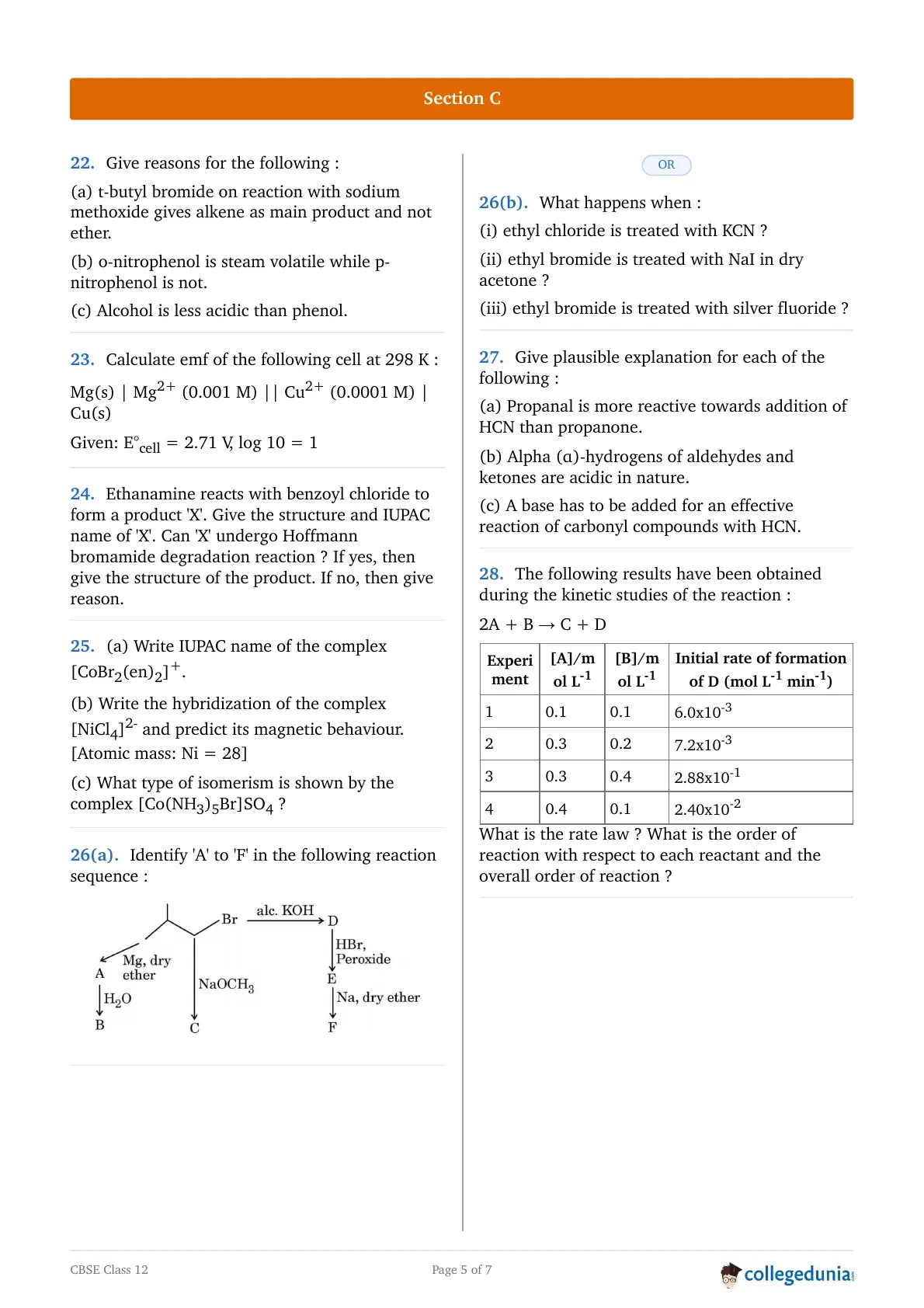
(a) t-butyl bromide on reaction with sodium methoxide gives alkene as main product and not ether.
(b) o-nitrophenol is steam volatile while p-nitrophenol is not.
(c) Alcohol is less acidic than phenol.
Calculate emf of the following cell at 298 K :
Mg(s) | Mg2+ (0.001 M) || Cu2+ (0.0001 M) | Cu(s)
Given: E°cell = 2.71 V, log 10 = 1
Ethanamine reacts with benzoyl chloride to form a product 'X'. Give the structure and IUPAC name of 'X'. Can 'X' undergo Hoffmann bromamide degradation reaction ? If yes, then give the structure of the product. If no, then give reason.
(a) Write IUPAC name of the complex [CoBr2(en)2]+.
(b) Write the hybridization of the complex [NiCl4]2- and predict its magnetic behaviour. [Atomic mass: Ni = 28]
(c) What type of isomerism is shown by the complex [Co(NH3)5Br]SO4 ?
Identify 'A' to 'F' in the following reaction sequence :
1-Bromo-2-methylpropane [(CH3)2CHCH2Br] on treatment with Mg/dry ether gives A, which on reaction with H2O gives B.
1-Bromo-2-methylpropane on treatment with NaOCH3 gives C.
1-Bromo-2-methylpropane on treatment with alc. KOH gives D, D on reaction with HBr/Peroxide gives E, and E on reaction with Na/dry ether gives F.
What happens when :
(i) ethyl chloride is treated with KCN ?
(ii) ethyl bromide is treated with NaI in dry acetone ?
(iii) ethyl bromide is treated with silver fluoride ?
Give plausible explanation for each of the following :
(a) Propanal is more reactive towards addition of HCN than propanone.
(b) Alpha (α)-hydrogens of aldehydes and ketones are acidic in nature.
(c) A base has to be added for an effective reaction of carbonyl compounds with HCN.
The following results have been obtained during the kinetic studies of the reaction :
2A + B → C + D
| Experiment | [A]/mol L-1 | [B]/mol L-1 | Initial rate of formation of D (mol L-1 min-1) |
|---|---|---|---|
| 1 | 0.1 | 0.1 | 6.0x10⁻³ |
| 2 | 0.3 | 0.2 | 7.2x10⁻³ |
| 3 | 0.3 | 0.4 | 2.88x10⁻¹ |
| 4 | 0.4 | 0.1 | 2.40x10⁻² |
What is the rate law ? What is the order of reaction with respect to each reactant and the overall order of reaction ?
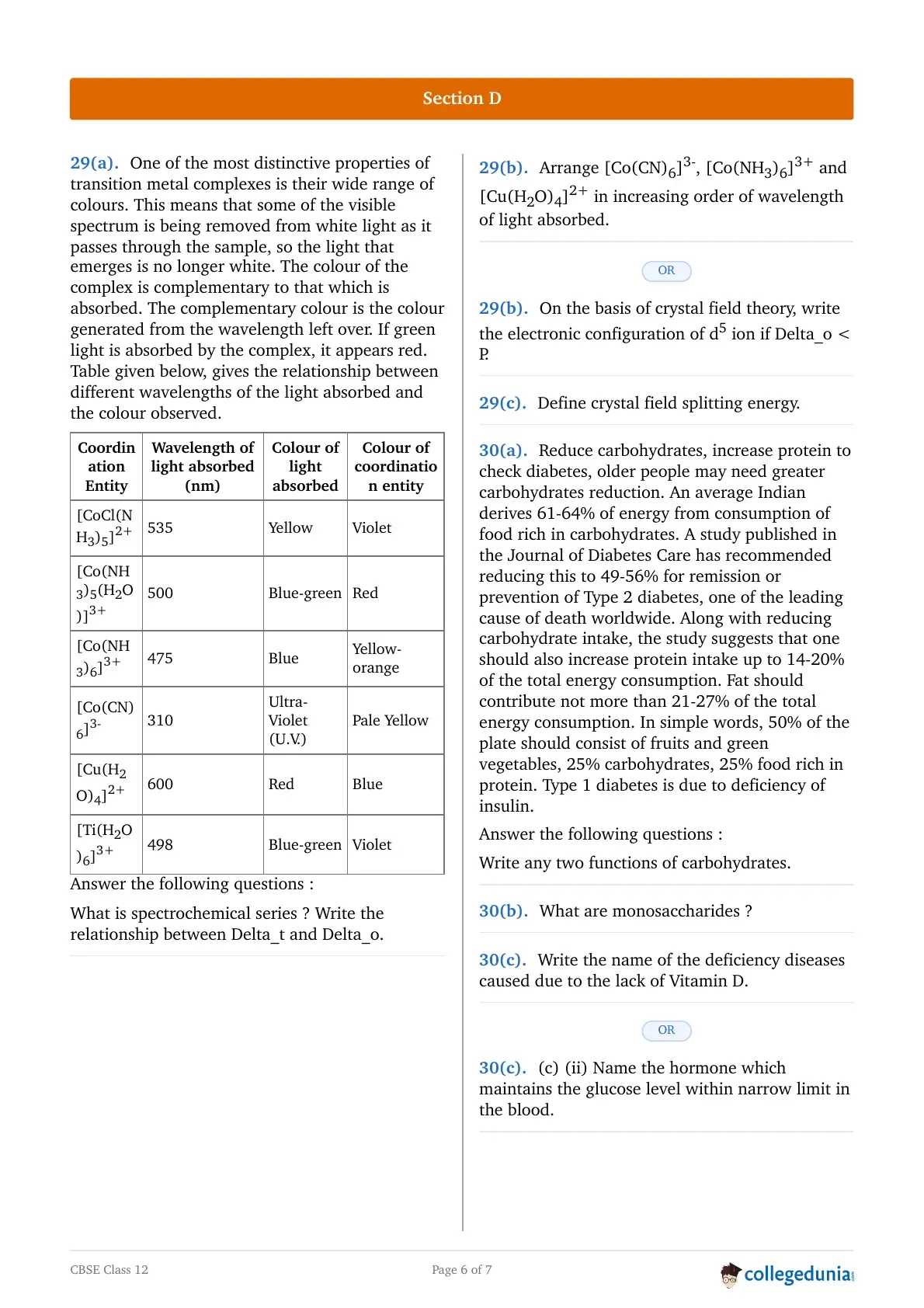
One of the most distinctive properties of transition metal complexes is their wide range of colours. This means that some of the visible spectrum is being removed from white light as it passes through the sample, so the light that emerges is no longer white. The colour of the complex is complementary to that which is absorbed. The complementary colour is the colour generated from the wavelength left over. If green light is absorbed by the complex, it appears red. Table given below, gives the relationship between different wavelengths of the light absorbed and the colour observed.
| Coordination Entity | Wavelength of light absorbed (nm) | Colour of light absorbed | Colour of coordination entity |
|---|---|---|---|
| [CoCl(NH3)5]2+ | 535 | Yellow | Violet |
| [Co(NH3)5(H2O)]3+ | 500 | Blue-green | Red |
| [Co(NH3)6]3+ | 475 | Blue | Yellow-orange |
| [Co(CN)6]3- | 310 | Ultra-Violet (U.V.) | Pale Yellow |
| [Cu(H2O)4]2+ | 600 | Red | Blue |
| [Ti(H2O)6]3+ | 498 | Blue-green | Violet |
Answer the following questions :
What is spectrochemical series ? Write the relationship between Delta_t and Delta_o.
Arrange [Co(CN)6]3-, [Co(NH3)6]3+ and [Cu(H2O)4]2+ in increasing order of wavelength of light absorbed.
On the basis of crystal field theory, write the electronic configuration for \(d^5\) ion for which \(\Delta_o \lt P\)
What is crystal field splitting energy?
Reduce carbohydrates, increase protein to check diabetes, older people may need greater carbohydrates reduction. An average Indian derives 61-64% of energy from consumption of food rich in carbohydrates. A study published in the Journal of Diabetes Care has recommended reducing this to 49-56% for remission or prevention of Type 2 diabetes, one of the leading cause of death worldwide. Along with reducing carbohydrate intake, the study suggests that one should also increase protein intake up to 14-20% of the total energy consumption. Fat should contribute not more than 21-27% of the total energy consumption. In simple words, 50% of the plate should consist of fruits and green vegetables, 25% carbohydrates, 25% food rich in protein. Type 1 diabetes is due to deficiency of insulin.
Answer the following questions :
Write any two functions of carbohydrates.
What are monosaccharides ?
Write the name of the deficiency diseases caused due to the lack of Vitamin D.
(c) (ii) Name the hormone which maintains the glucose level within narrow limit in the blood.
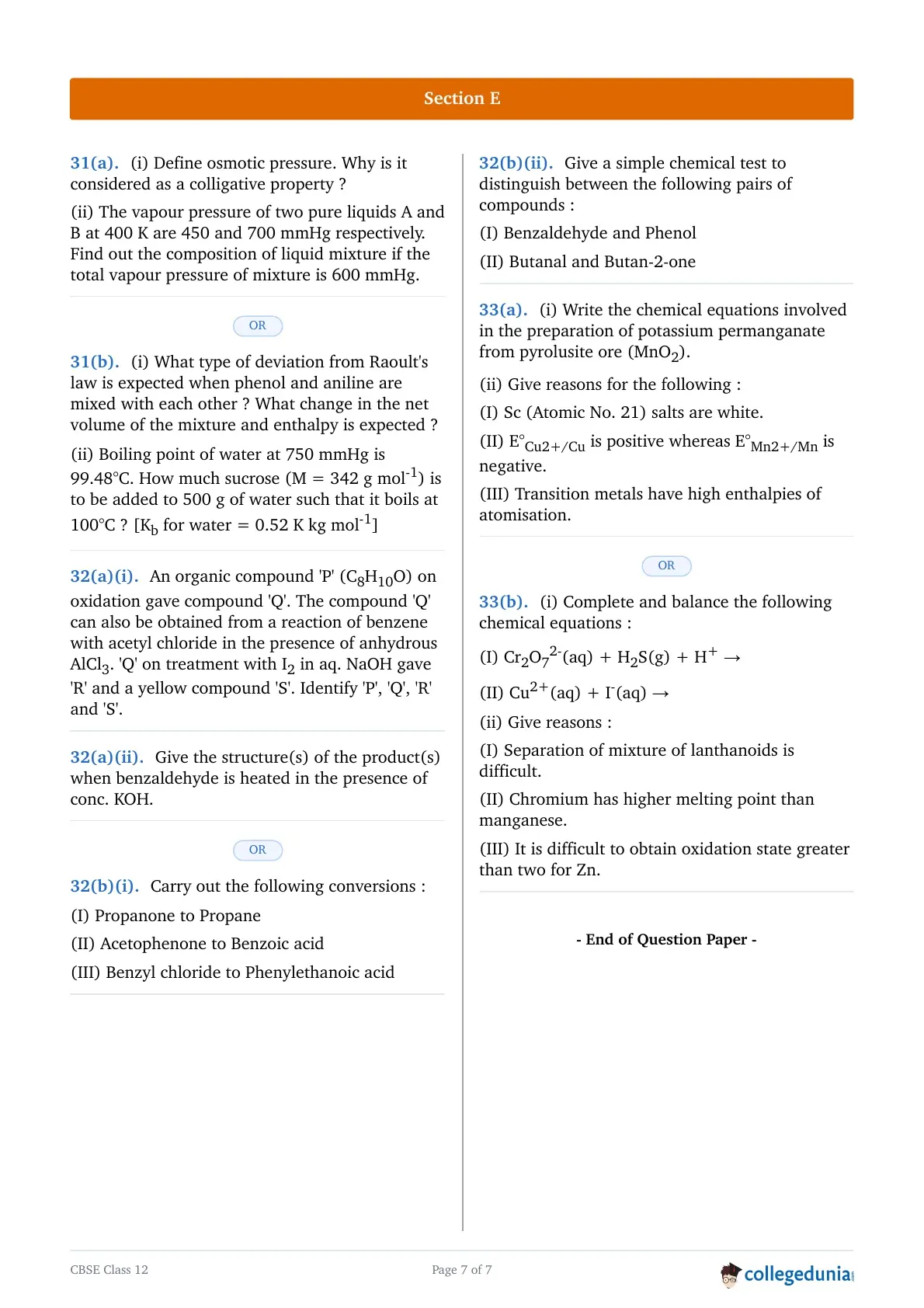
(i) Define osmotic pressure. Why is it considered as a colligative property ?
(ii) The vapour pressure of two pure liquids A and B at 400 K are 450 and 700 mmHg respectively. Find out the composition of liquid mixture if the total vapour pressure of mixture is 600 mmHg.
(i) What type of deviation from Raoult's law is expected when phenol and aniline are mixed with each other ? What change in the net volume of the mixture and enthalpy is expected ?
(ii) Boiling point of water at 750 mmHg is 99.48°C. How much sucrose (M = 342 g mol-1) is to be added to 500 g of water such that it boils at 100°C ? [Kb for water = 0.52 K kg mol-1]
An organic compound 'P' (C8H10O) on oxidation gave compound 'Q'. The compound 'Q' can also be obtained from a reaction of benzene with acetyl chloride in the presence of anhydrous AlCl3. 'Q' on treatment with I2 in aq. NaOH gave 'R' and a yellow compound 'S'. Identify 'P', 'Q', 'R' and 'S'.
Give the structure(s) of the product(s) when benzaldehyde is heated in the presence of conc. KOH.
Carry out the following conversions :
(I) Propanone to Propane
(II) Acetophenone to Benzoic acid
(III) Benzyl chloride to Phenylethanoic acid
Give a simple chemical test to distinguish between the following pairs of compounds :
(I) Benzaldehyde and Phenol
(II) Butanal and Butan-2-one
(i) Write the chemical equations involved in the preparation of potassium permanganate from pyrolusite ore (MnO2).
(ii) Give reasons for the following :
(I) Sc (Atomic No. 21) salts are white.
(II) E°Cu2+/Cu is positive whereas E°Mn2+/Mn is negative.
(III) Transition metals have high enthalpies of atomisation.
(i) Complete and balance the following chemical equations :
(I) Cr2O72-(aq) + H2S(g) + H+ →
(II) Cu2+(aq) + I-(aq) →
(ii) Give reasons :
(I) Separation of mixture of lanthanoids is difficult.
(II) Chromium has higher melting point than manganese.
(III) It is difficult to obtain oxidation state greater than two for Zn.
CBSE Class 12 Chemistry 2025 Question Paper Details
| Exam | CBSE Class 12 Board Examination 2025 |
| Subject | Chemistry |
| Paper code | 56/S/3 (Compartment) |
| Exam date | July 15, 2025 |
| Time allowed | 3 hours (plus 15 minutes of reading time, 10:15 AM to 10:30 AM) |
| Maximum marks | 70 |
| Total questions | 33 (attempt 33) |
CBSE Class 12 Chemistry Question Paper Pattern and Marking Scheme
The CBSE Class 12 Chemistry 2025 question paper is of 70 marks and has 33 questions, of which 33 are to be attempted. The tables below give the section-wise paper pattern and the split of marks, as printed in the official question paper.
CBSE Class 12 Chemistry Question Paper Pattern 2025
| Section | Questions | Question Type | Choice | Marks per Question | Marks |
|---|---|---|---|---|---|
| Section A | Q1-Q16 | Multiple choice questions (MCQs) | All 16 | 1 | 16 |
| Section B | Q17-Q21 | Very short answer questions | All 5 | 2 | 10 |
| Section C | Q22-Q28 | Short answer questions | All 7 | 3 | 21 |
| Section D | Q29-Q30 | Case study-based questions | All 2 | 4 | 8 |
| Section E | Q31-Q33 | Long answer questions | All 3 | 5 | 15 |
| Total | 33 questions | Attempt 33 | 70 |
CBSE Class 12 Chemistry Marks Distribution 2025
| Question Type | Questions to Attempt | Marks per Question | Total Marks |
|---|---|---|---|
| Multiple choice questions (MCQs) (Section A) | 16 | 1 | 16 |
| Very short answer questions (Section B) | 5 | 2 | 10 |
| Short answer questions (Section C) | 7 | 3 | 21 |
| Case study-based questions (Section D) | 2 | 4 | 8 |
| Long answer questions (Section E) | 3 | 5 | 15 |
| Total | 33 | 70 |



Comments