


The CBSE Class 12 Chemistry 2026 question paper with solutions (Set 56/3/3) is available here for free download. CBSE Class 12 Chemistry 2026 was conducted by the Central Board of Secondary Education on February 28, 2026, as a 70-mark, 3-hour theory paper of 33 questions across five sections (A to E).
| CBSE Class 12 Chemistry 2026 Question Paper with Solutions (Set 56/3/3) | Download PDF | Check Solutions |
CBSE Class 12 Chemistry 2026 Questions with Solutions
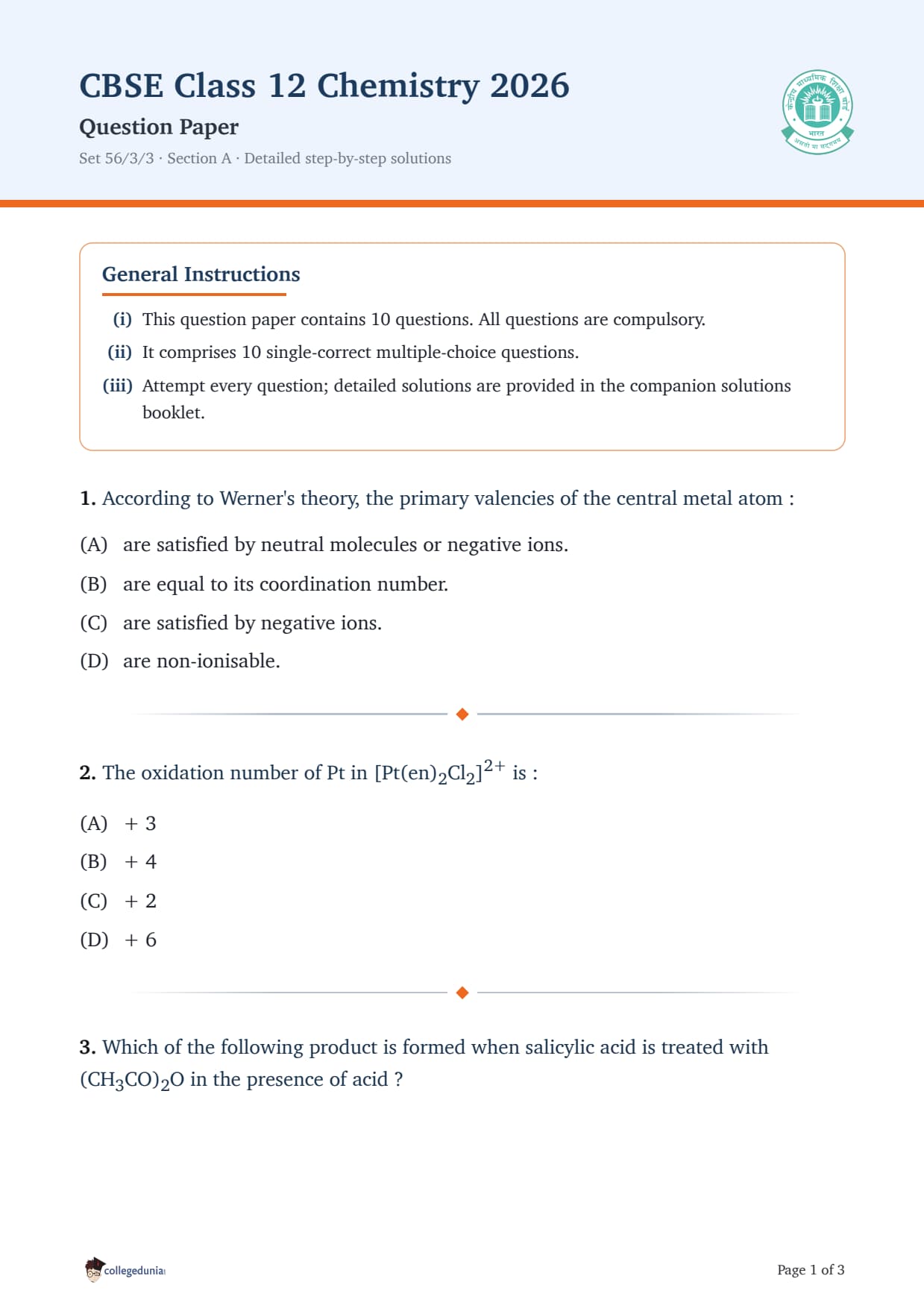
According to Werner's theory, the primary valencies of the central metal atom :
The oxidation number of Pt in [Pt(en)2Cl2]2+ is :
Which of the following product is formed when salicylic acid is treated with (CH3CO)2O in the presence of acid ?
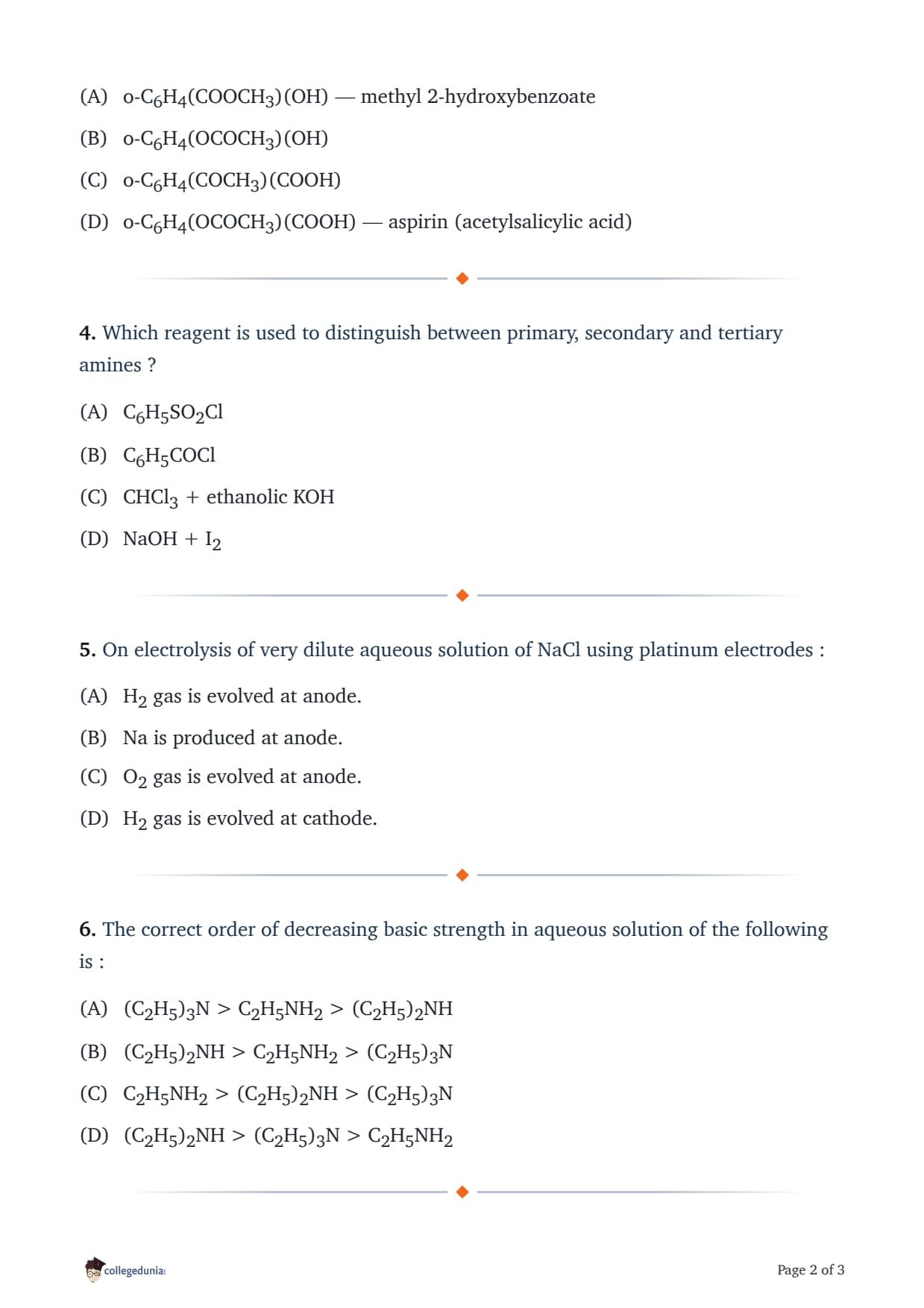
Which reagent is used to distinguish between primary, secondary and tertiary amines ?
On electrolysis of very dilute aqueous solution of NaCl using platinum electrodes :
The correct order of decreasing basic strength in aqueous solution of the following is :
The mole fraction of a solute in 2.0 molal aqueous solution is :
Which of the following transition metals shows +1 and +2 oxidation states ?
On hydrolysis, which of the following carbohydrates gives only β-glucose ?
Consider the following compounds : Chlorobenzene (I), 2,4,6-trinitrochlorobenzene (II), 2,4-dinitrochlorobenzene (III), 4-nitrochlorobenzene (IV). The correct order of increasing ease of nucleophilic substitution reactions of these compounds is :
CBSE Class 12 Chemistry 2026 Exam Pattern and Marking Scheme
The CBSE Class 12 Chemistry 2026 theory paper (subject code 043) carried 70 marks over 3 hours, with all 33 questions compulsory and no negative marking. The internal assessment carries a separate 30 marks.
- Total: 33 questions, 70 marks, 3 hours (held 10:30 AM to 1:30 PM)
- Section A: Q1 to 16, multiple choice, 1 mark each
- Section B: Q17 to 21, very short answer, 2 marks each
- Section C: Q22 to 28, short answer, 3 marks each
- Section D: Q29 to 30, case-based, 4 marks each
- Section E: Q31 to 33, long answer, 5 marks each
- No negative marking; internal choice is given in some questions of Sections B to E (none in Section A)
High-Weightage Chapters in CBSE Class 12 Chemistry to Focus On First
By domain the 70 marks split as Organic 33, Physical 23 and Inorganic 14, so Organic Chemistry is the single biggest scoring block. Lead your revision with the heaviest chapters:
- Electrochemistry - 9 marks, the heaviest single chapter (numerical-heavy Physical Chemistry)
- Aldehydes, Ketones and Carboxylic Acids - 8 marks, the top Organic chapter
- Solutions, Chemical Kinetics, Coordination Compounds, the d- and f-Block Elements, Biomolecules - 7 marks each
- Haloalkanes and Haloarenes, Alcohols Phenols and Ethers, Amines - 6 marks each
How to Use the CBSE Class 12 Chemistry 2026 Question Paper
Solve the paper as a timed 3-hour mock first, then check every answer against the solutions before revising your weak areas.
- Attempt all 33 questions in one 3-hour sitting - there is no negative marking, so leave nothing blank
- Review every answer against the solution PDF, especially the Physical Chemistry numericals that students found the most time-consuming this year
- Redo the Organic Chemistry questions first - at 33 of the 70 marks they are the biggest, most scoring block
CBSE Class 12 Chemistry Good Score and Passing Benchmark
- The pass mark is 33%, i.e. 23 out of 70 in the theory paper
- Aim for 50+ out of 70 for a strong board result and a competitive college profile
- The 2026 paper was rated moderate and fully NCERT-based, so disciplined NCERT revision was enough to score well
CBSE Class 12 Chemistry 2026 Question Paper FAQs
Ques. Was the CBSE Class 12 Chemistry 2026 question paper tough?
Ans. Most students rated the 2026 paper moderate and well balanced. Organic Chemistry was straightforward and scoring, the MCQs drew mixed reactions, and Physical Chemistry felt slightly challenging because of the calculation-based numericals. It stayed fully within the NCERT syllabus.
Ques. What is a good score in CBSE Class 12 Chemistry?
Ans. The pass mark is 33% (23 out of 70 in theory). A good score is 50+ out of 70; toppers cross 65, which is realistic for this NCERT-based paper with no negative marking.
Ques. Which chapters have the highest weightage in CBSE Class 12 Chemistry?
Ans. Electrochemistry (9 marks) and Aldehydes, Ketones and Carboxylic Acids (8 marks) lead, followed by Solutions, Chemical Kinetics, Coordination Compounds, the d- and f-Block Elements and Biomolecules at 7 marks each. By domain, Organic carries 33 marks, Physical 23 and Inorganic 14.
Ques. Is there negative marking in CBSE Class 12 Chemistry?
Ans. No. There is no negative marking in the CBSE Class 12 Chemistry theory paper, so you should attempt every question, including all 16 one-mark MCQs in Section A.
Ques. Does CBSE release the official Class 12 Chemistry question paper and answer key?
Ans. Yes. CBSE publishes the official question papers and marking schemes on its academic website cbseacademic.nic.in (main site cbse.gov.in). The set-wise solutions on this page are prepared by subject experts for quick checking.
Ques. Where can I download the CBSE Class 12 Chemistry 2026 question paper with solutions PDF for free?
Ans. You can download the CBSE Class 12 Chemistry 2026 (Set 56/3/3) question paper with full solutions free from the table above on Collegedunia, and check every question with its worked solution in the index below.



Comments