




CBSE Class 12 Business Studies Question Paper 2026 Set - 1 (66/4/1) is now available for download. CBSE conducted the Class 12 Business Studies examination on March 28, 2026, from 10:30 AM to 1:30 PM. The Business Studies theory paper is of 80 marks, while 20 marks are allocated for the project work. The question paper contains:
Also Check: CBSE Class 12 Question Paper 2026 (All Subjects)
- 20% MCQ-based questions
- 40% competency-based questions
- 40% short and long answer type questions
CBSE Class 12 Business Studies Set 1- (66/4/1) Question Paper 2026 with Solution PDF
| CBSE Official PDF | CD PDF | CD PDF with Solutions |
|---|---|---|
| Download official PDF 0.61 MB | Download Collegedunia PDF 0.23 MB | – |
CBSE Class 12 Business Studies 2026 Set 1 (66/4/1) Questions with Solutions
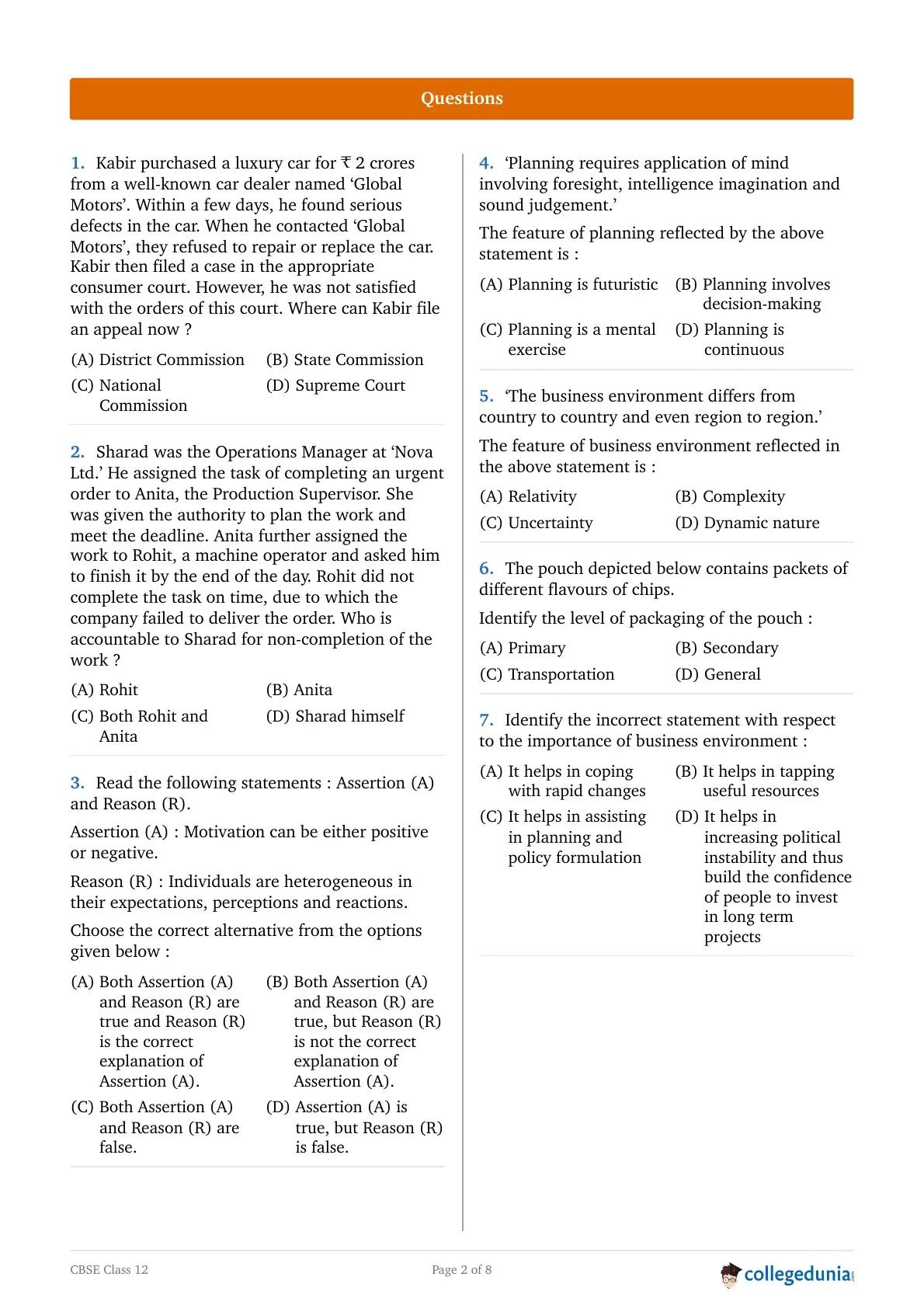
Kabir purchased a luxury car for ₹ 2 crores from a well-known car dealer named ‘Global Motors’. Within a few days, he found serious defects in the car. When he contacted ‘Global Motors’, they refused to repair or replace the car. Kabir then filed a case in the appropriate consumer court. However, he was not satisfied with the orders of this court. Where can Kabir file an appeal now ?
Sharad was the Operations Manager at ‘Nova Ltd.’ He assigned the task of completing an urgent order to Anita, the Production Supervisor. She was given the authority to plan the work and meet the deadline. Anita further assigned the work to Rohit, a machine operator and asked him to finish it by the end of the day. Rohit did not complete the task on time, due to which the company failed to deliver the order. Who is accountable to Sharad for non-completion of the work ?
Read the following statements : Assertion (A) and Reason (R).
Assertion (A) : Motivation can be either positive or negative.
Reason (R) : Individuals are heterogeneous in their expectations, perceptions and reactions.
Choose the correct alternative from the options given below :
‘Planning requires application of mind involving foresight, intelligence imagination and sound judgement.’
The feature of planning reflected by the above statement is :
‘The business environment differs from country to country and even region to region.’
The feature of business environment reflected in the above statement is :
The pouch depicted below contains packets of different flavours of chips.
Identify the level of packaging of the pouch :

Identify the incorrect statement with respect to the importance of business environment :
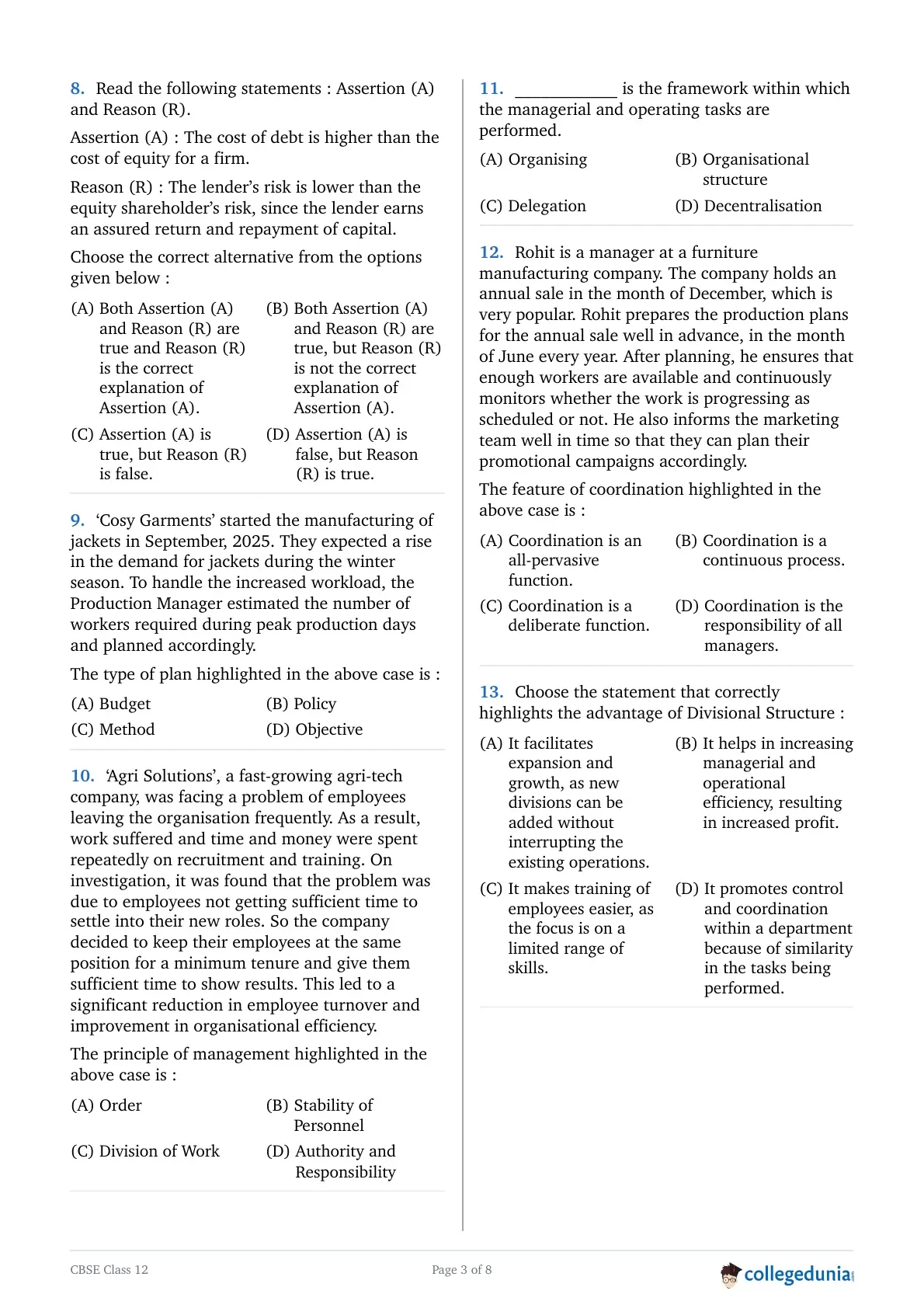
Read the following statements : Assertion (A) and Reason (R).
Assertion (A) : The cost of debt is higher than the cost of equity for a firm.
Reason (R) : The lender’s risk is lower than the equity shareholder’s risk, since the lender earns an assured return and repayment of capital.
Choose the correct alternative from the options given below :
‘Cosy Garments’ started the manufacturing of jackets in September, 2025. They expected a rise in the demand for jackets during the winter season. To handle the increased workload, the Production Manager estimated the number of workers required during peak production days and planned accordingly.
The type of plan highlighted in the above case is :
‘Agri Solutions’, a fast-growing agri-tech company, was facing a problem of employees leaving the organisation frequently. As a result, work suffered and time and money were spent repeatedly on recruitment and training. On investigation, it was found that the problem was due to employees not getting sufficient time to settle into their new roles. So the company decided to keep their employees at the same position for a minimum tenure and give them sufficient time to show results. This led to a significant reduction in employee turnover and improvement in organisational efficiency.
The principle of management highlighted in the above case is :
____________ is the framework within which the managerial and operating tasks are performed.
Rohit is a manager at a furniture manufacturing company. The company holds an annual sale in the month of December, which is very popular. Rohit prepares the production plans for the annual sale well in advance, in the month of June every year. After planning, he ensures that enough workers are available and continuously monitors whether the work is progressing as scheduled or not. He also informs the marketing team well in time so that they can plan their promotional campaigns accordingly.
The feature of coordination highlighted in the above case is :
Choose the statement that correctly highlights the advantage of Divisional Structure :
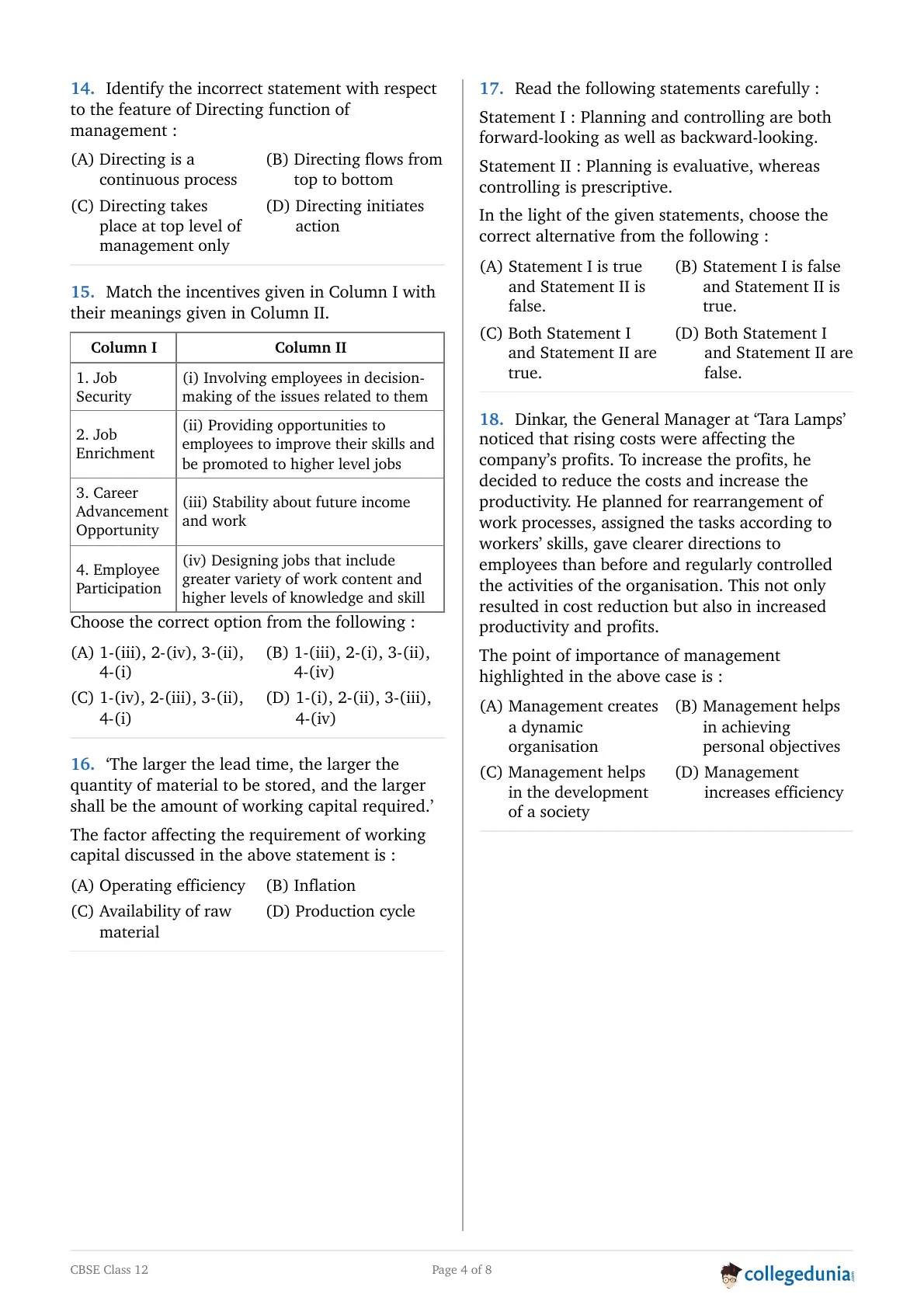
Identify the incorrect statement with respect to the feature of Directing function of management :
Match the incentives given in Column I with their meanings given in Column II.
| Column I | Column II |
|---|---|
| 1. Job Security | (i) Involving employees in decision-making of the issues related to them |
| 2. Job Enrichment | (ii) Providing opportunities to employees to improve their skills and be promoted to higher level jobs |
| 3. Career Advancement Opportunity | (iii) Stability about future income and work |
| 4. Employee Participation | (iv) Designing jobs that include greater variety of work content and higher levels of knowledge and skill |
Choose the correct option from the following :
‘The larger the lead time, the larger the quantity of material to be stored, and the larger shall be the amount of working capital required.’
The factor affecting the requirement of working capital discussed in the above statement is :
Read the following statements carefully :
Statement I : Planning and controlling are both forward-looking as well as backward-looking.
Statement II : Planning is evaluative, whereas controlling is prescriptive.
In the light of the given statements, choose the correct alternative from the following :
Dinkar, the General Manager at ‘Tara Lamps’ noticed that rising costs were affecting the company’s profits. To increase the profits, he decided to reduce the costs and increase the productivity. He planned for rearrangement of work processes, assigned the tasks according to workers’ skills, gave clearer directions to employees than before and regularly controlled the activities of the organisation. This not only resulted in cost reduction but also in increased productivity and profits.
The point of importance of management highlighted in the above case is :
Read the following statements carefully :
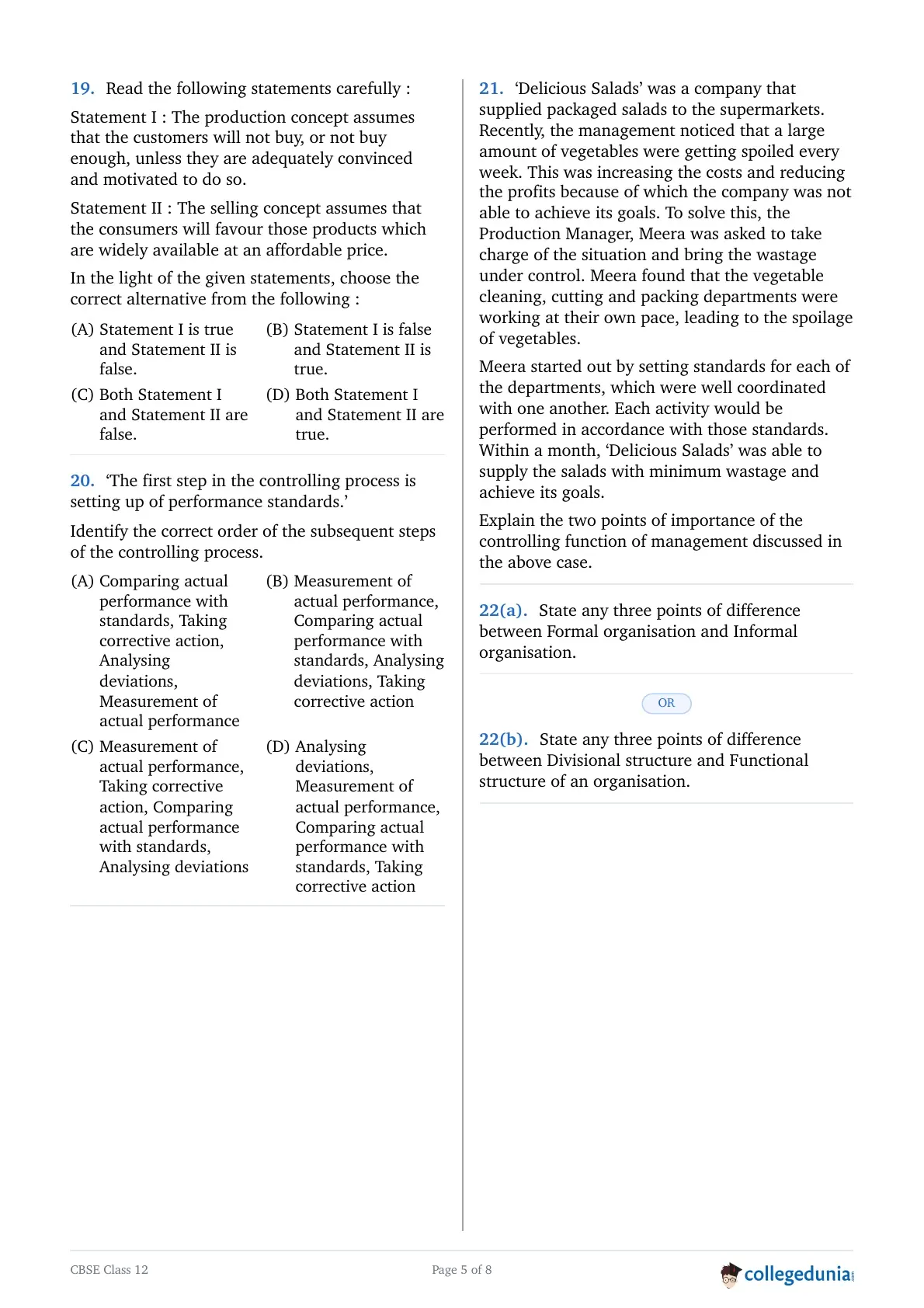
Statement I : The production concept assumes that the customers will not buy, or not buy enough, unless they are adequately convinced and motivated to do so.
Statement II : The selling concept assumes that the consumers will favour those products which are widely available at an affordable price.
In the light of the given statements, choose the correct alternative from the following :
‘The first step in the controlling process is setting up of performance standards.’
Identify the correct order of the subsequent steps of the controlling process.
‘Delicious Salads’ was a company that supplied packaged salads to the supermarkets. Recently, the management noticed that a large amount of vegetables were getting spoiled every week. This was increasing the costs and reducing the profits because of which the company was not able to achieve its goals. To solve this, the Production Manager, Meera was asked to take charge of the situation and bring the wastage under control. Meera found that the vegetable cleaning, cutting and packing departments were working at their own pace, leading to the spoilage of vegetables.
Meera started out by setting standards for each of the departments, which were well coordinated with one another. Each activity would be performed in accordance with those standards. Within a month, ‘Delicious Salads’ was able to supply the salads with minimum wastage and achieve its goals.
Explain the two points of importance of the controlling function of management discussed in the above case.
State any three points of difference between Formal organisation and Informal organisation.
State any three points of difference between Divisional structure and Functional structure of an organisation.
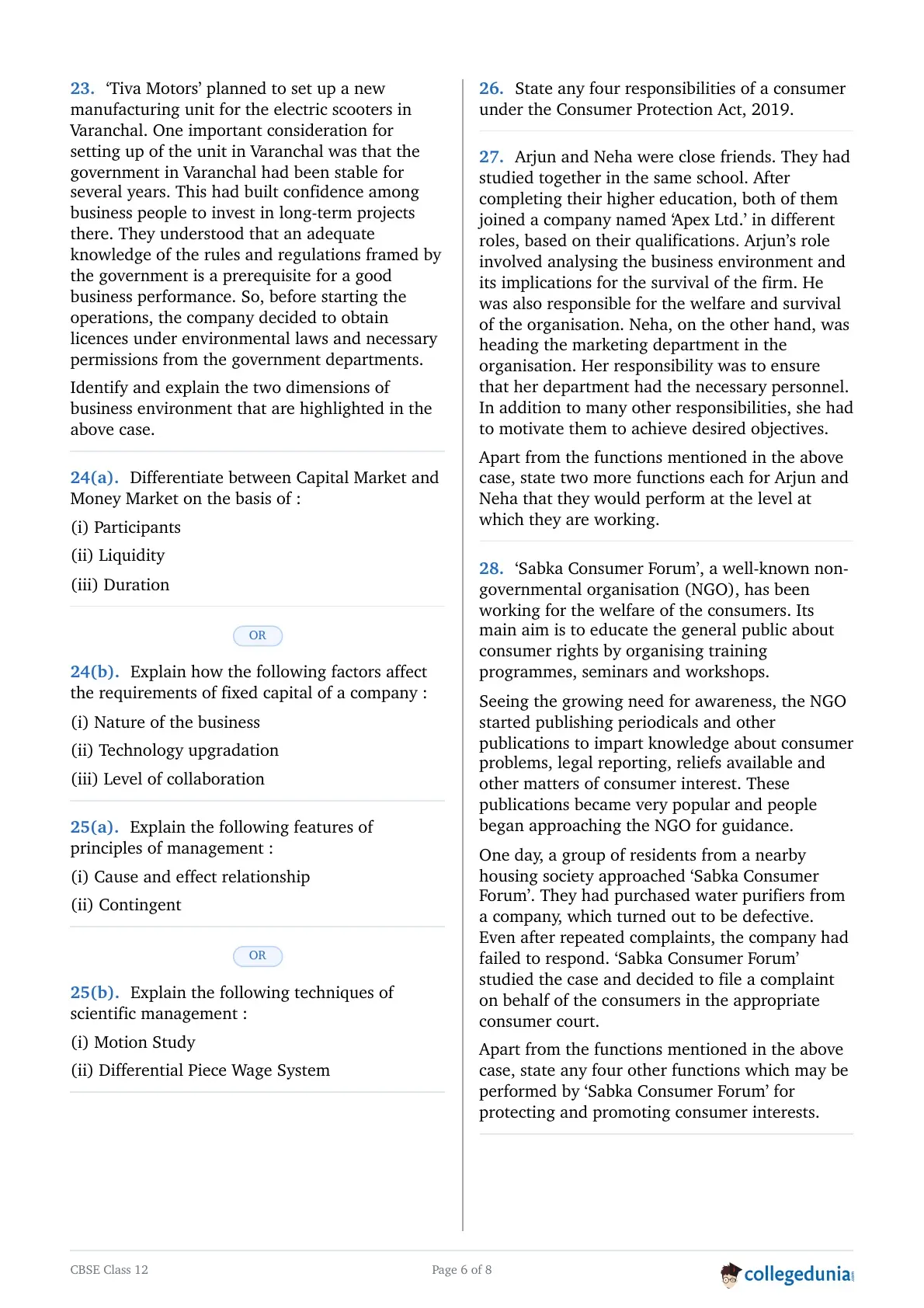
‘Tiva Motors’ planned to set up a new manufacturing unit for the electric scooters in Varanchal. One important consideration for setting up of the unit in Varanchal was that the government in Varanchal had been stable for several years. This had built confidence among business people to invest in long-term projects there. They understood that an adequate knowledge of the rules and regulations framed by the government is a prerequisite for a good business performance. So, before starting the operations, the company decided to obtain licences under environmental laws and necessary permissions from the government departments.
Identify and explain the two dimensions of business environment that are highlighted in the above case.
Differentiate between Capital Market and Money Market on the basis of :
(i) Participants
(ii) Liquidity
(iii) Duration
Explain how the following factors affect the requirements of fixed capital of a company :
(i) Nature of the business
(ii) Technology upgradation
(iii) Level of collaboration
Explain the following features of principles of management :
(i) Cause and effect relationship
(ii) Contingent
Explain the following techniques of scientific management :
(i) Motion Study
(ii) Differential Piece Wage System
State any four responsibilities of a consumer under the Consumer Protection Act, 2019.
Arjun and Neha were close friends. They had studied together in the same school. After completing their higher education, both of them joined a company named ‘Apex Ltd.’ in different roles, based on their qualifications. Arjun’s role involved analysing the business environment and its implications for the survival of the firm. He was also responsible for the welfare and survival of the organisation. Neha, on the other hand, was heading the marketing department in the organisation. Her responsibility was to ensure that her department had the necessary personnel. In addition to many other responsibilities, she had to motivate them to achieve desired objectives.
Apart from the functions mentioned in the above case, state two more functions each for Arjun and Neha that they would perform at the level at which they are working.
‘Sabka Consumer Forum’, a well-known non-governmental organisation (NGO), has been working for the welfare of the consumers. Its main aim is to educate the general public about consumer rights by organising training programmes, seminars and workshops.
Seeing the growing need for awareness, the NGO started publishing periodicals and other publications to impart knowledge about consumer problems, legal reporting, reliefs available and other matters of consumer interest. These publications became very popular and people began approaching the NGO for guidance.
One day, a group of residents from a nearby housing society approached ‘Sabka Consumer Forum’. They had purchased water purifiers from a company, which turned out to be defective. Even after repeated complaints, the company had failed to respond. ‘Sabka Consumer Forum’ studied the case and decided to file a complaint on behalf of the consumers in the appropriate consumer court.
Apart from the functions mentioned in the above case, state any four other functions which may be performed by ‘Sabka Consumer Forum’ for protecting and promoting consumer interests.
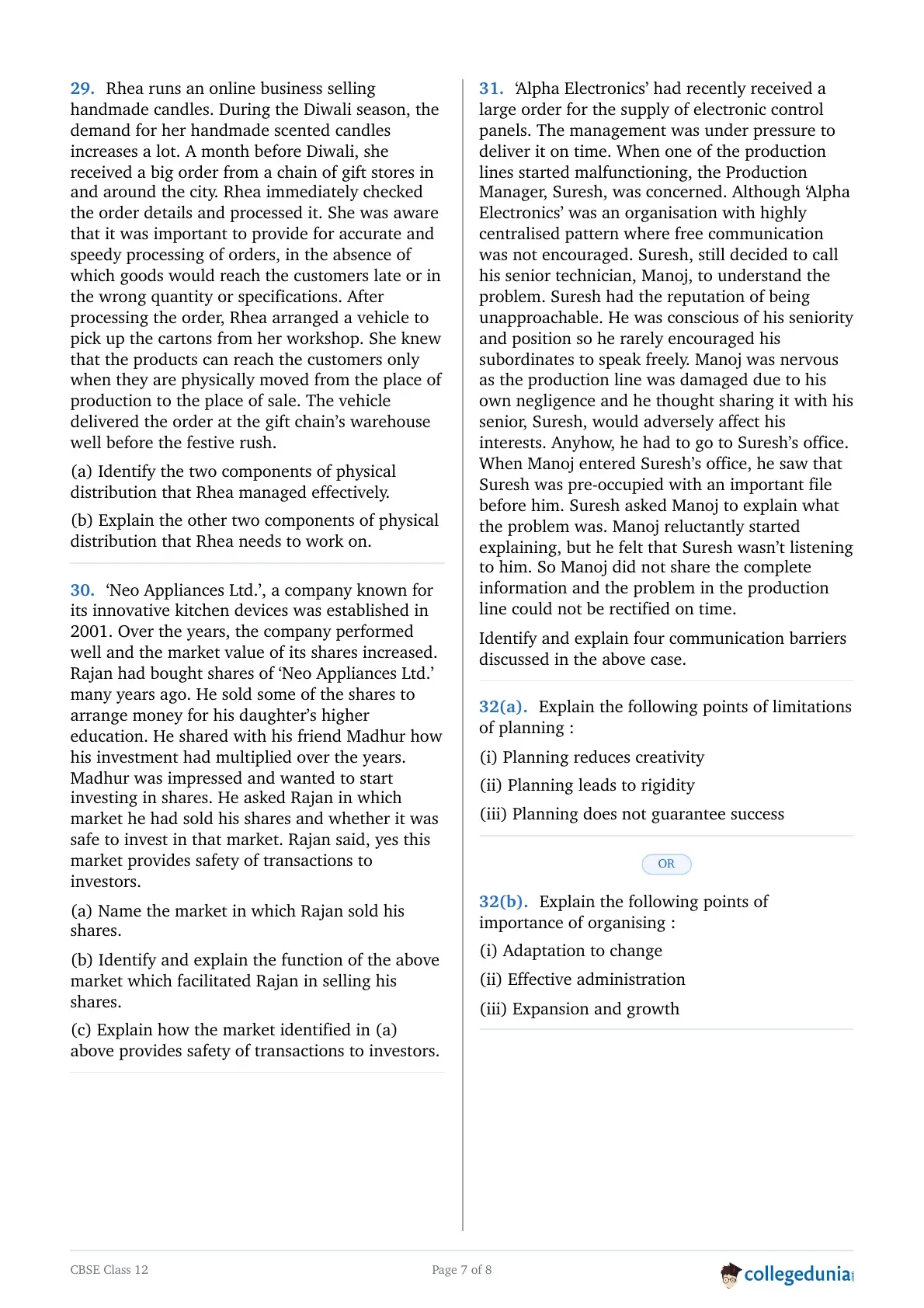
Rhea runs an online business selling handmade candles. During the Diwali season, the demand for her handmade scented candles increases a lot. A month before Diwali, she received a big order from a chain of gift stores in and around the city. Rhea immediately checked the order details and processed it. She was aware that it was important to provide for accurate and speedy processing of orders, in the absence of which goods would reach the customers late or in the wrong quantity or specifications. After processing the order, Rhea arranged a vehicle to pick up the cartons from her workshop. She knew that the products can reach the customers only when they are physically moved from the place of production to the place of sale. The vehicle delivered the order at the gift chain’s warehouse well before the festive rush.
(a) Identify the two components of physical distribution that Rhea managed effectively.
(b) Explain the other two components of physical distribution that Rhea needs to work on.
‘Neo Appliances Ltd.’, a company known for its innovative kitchen devices was established in 2001. Over the years, the company performed well and the market value of its shares increased. Rajan had bought shares of ‘Neo Appliances Ltd.’ many years ago. He sold some of the shares to arrange money for his daughter’s higher education. He shared with his friend Madhur how his investment had multiplied over the years. Madhur was impressed and wanted to start investing in shares. He asked Rajan in which market he had sold his shares and whether it was safe to invest in that market. Rajan said, yes this market provides safety of transactions to investors.
(a) Name the market in which Rajan sold his shares.
(b) Identify and explain the function of the above market which facilitated Rajan in selling his shares.
(c) Explain how the market identified in (a) above provides safety of transactions to investors.
‘Alpha Electronics’ had recently received a large order for the supply of electronic control panels. The management was under pressure to deliver it on time. When one of the production lines started malfunctioning, the Production Manager, Suresh, was concerned. Although ‘Alpha Electronics’ was an organisation with highly centralised pattern where free communication was not encouraged. Suresh, still decided to call his senior technician, Manoj, to understand the problem. Suresh had the reputation of being unapproachable. He was conscious of his seniority and position so he rarely encouraged his subordinates to speak freely. Manoj was nervous as the production line was damaged due to his own negligence and he thought sharing it with his senior, Suresh, would adversely affect his interests. Anyhow, he had to go to Suresh’s office. When Manoj entered Suresh’s office, he saw that Suresh was pre-occupied with an important file before him. Suresh asked Manoj to explain what the problem was. Manoj reluctantly started explaining, but he felt that Suresh wasn’t listening to him. So Manoj did not share the complete information and the problem in the production line could not be rectified on time.
Identify and explain four communication barriers discussed in the above case.
Explain the following points of limitations of planning :
(i) Planning reduces creativity
(ii) Planning leads to rigidity
(iii) Planning does not guarantee success
Explain the following points of importance of organising :
(i) Adaptation to change
(ii) Effective administration
(iii) Expansion and growth
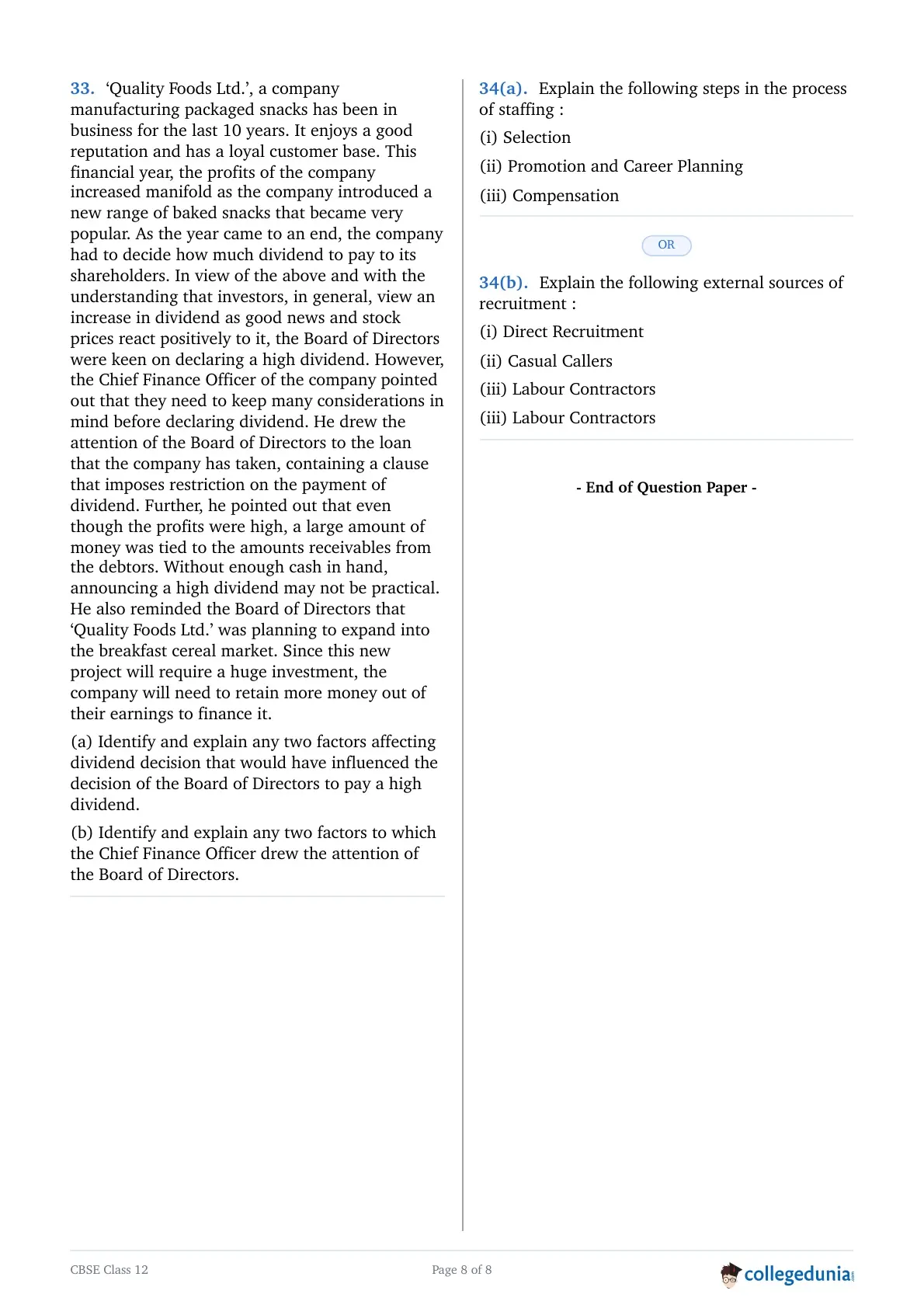
‘Quality Foods Ltd.’, a company manufacturing packaged snacks has been in business for the last 10 years. It enjoys a good reputation and has a loyal customer base. This financial year, the profits of the company increased manifold as the company introduced a new range of baked snacks that became very popular. As the year came to an end, the company had to decide how much dividend to pay to its shareholders. In view of the above and with the understanding that investors, in general, view an increase in dividend as good news and stock prices react positively to it, the Board of Directors were keen on declaring a high dividend. However, the Chief Finance Officer of the company pointed out that they need to keep many considerations in mind before declaring dividend. He drew the attention of the Board of Directors to the loan that the company has taken, containing a clause that imposes restriction on the payment of dividend. Further, he pointed out that even though the profits were high, a large amount of money was tied to the amounts receivables from the debtors. Without enough cash in hand, announcing a high dividend may not be practical. He also reminded the Board of Directors that ‘Quality Foods Ltd.’ was planning to expand into the breakfast cereal market. Since this new project will require a huge investment, the company will need to retain more money out of their earnings to finance it.
(a) Identify and explain any two factors affecting dividend decision that would have influenced the decision of the Board of Directors to pay a high dividend.
(b) Identify and explain any two factors to which the Chief Finance Officer drew the attention of the Board of Directors.
Explain the following steps in the process of staffing :
(i) Selection
(ii) Promotion and Career Planning
(iii) Compensation
Explain the following external sources of recruitment :
(i) Direct Recruitment
(ii) Casual Callers
(iii) Labour Contractors
(iii) Labour Contractors
CBSE Class 12 Business Studies Question Paper Pattern and Marking Scheme
The CBSE Class 12 Business Studies 2026 theory paper is of 80 marks and has 34 questions, all compulsory; five questions carry an internal choice (OR). The tables below give the paper pattern and the marking rules from the official CBSE question paper and marking scheme.
CBSE Class 12 Business Studies Question Paper Pattern 2026
| Questions | Question Type | Marks per Question | Marks |
|---|---|---|---|
| Q1 - Q20 | Multiple choice questions (MCQs) | 1 | 20 |
| Q21 - Q24 | Short answer type questions (50 to 75 words) | 3 | 12 |
| Q25 - Q30 | Answer type questions (about 150 words) | 4 | 24 |
| Q31 - Q34 | Long answer type questions (about 200 words) | 6 | 24 |
| Total | 34 questions | 80 |
CBSE Class 12 Business Studies Marking Scheme 2026
| Marking point | How it is applied |
|---|---|
| Value-point marking | Marks are awarded against the value points (steps) given in the official marking scheme; the marks of an answer are split across its parts and value points. |
| Own expression | The marking scheme carries suggested value points only. A correct answer in the student's own words is awarded due marks. |
| Competency-based questions | If a competency-based answer is not from the marking scheme but shows the correct competency, due marks are awarded. |
| Errors | An error is penalised only once; no marks are deducted for its cumulative effect. |
| Incorrect answer | A totally incorrect answer is awarded zero (0) marks. |
| Choice (OR) questions | If both options of a question with internal choice are attempted, marks are awarded for both and the higher score is taken; if only one option is attempted, the other is marked NA (not attempted). |
| Scale of marks | The full scale of 0 to 80 marks is used and full marks are awarded whenever the answer deserves them. |
CBSE Class 12 Business Studies Chapter-Wise Weightage
| Unit No. | Unit Name | Marks |
|---|---|---|
| Part A: Principles and Functions of Management | ||
| 1. | Nature and Significance of Management | 16 Marks |
| 2. | Principles of Management | |
| 3. | Business Environment | |
| 4. | Planning | 14 Marks |
| 5. | Organizing | |
| 6. | Staffing | 20 Marks |
| 7. | Directing | |
| 8. | Controlling | |
| Total | 50 Marks | |
| Part B: Business Finance and Marketing | ||
| 9. | Financial Management | 15 Marks |
| 10. | Financial Markets | |
| 11. | Marketing Management | 15 Marks |
| 12. | Consumer Protection | |
| Total | 30 Marks | |
| Part C: Project Work | ||
| 1. | Project (One) | 20 Marks |
| Grand Total | 100 Marks | |



Comments