


CBSE Class 12 Business Studies Question Paper 2025 PDF along with Solutions will be available for download here. CBSE Class 12 Business Studies exam is scheduled on February 22, 2025. The total marks for the theory paper are 80. The question paper contains 20% MCQ-based questions, 40% competency-based questions, and 40% short and long answer type questions.
The question paper and solution PDF will be available for download here.
CBSE Class 12 Business Studies Set 2 (66/2/2) Question Paper 2025 with Solution PDF
| CBSE Class 12 Business Studies Question Paper 2025 with Solution PDF | Download | Check Solutions |

To ensure that enough funds are available at right time to honour the commitments and to carry out the plans' is discussed in which of the following concepts?
View Solution
Financial Planning ensures that adequate funds are available at the right time so the organization can fulfill its commitments and implement its plans without disruption. It involves estimating capital requirements, determining the sources of funds, and managing financial resources efficiently.
Why not others?
- Capital Structure deals with the mix of debt and equity.
- Financial Leverage refers to the use of debt to increase return on equity.
- Investment Decision involves deciding where to invest funds.
None of these directly ensure availability of funds \textit{at the right time — that is the role of Financial Planning. Quick Tip: Financial Planning = Right Funds at Right Time. It’s all about budgeting and readiness.
Read the following statements carefully:
Statement - I: The cost of debt is more than the cost of equity.
Statement - II: Lenders risk is lower than the equity shareholders risk.
In the light of the given statements, choose the correct alternative from the following:
View Solution
Statement I is false because the cost of debt is actually \textit{less than the cost of equity. This is because:
1. Interest on debt is tax-deductible.
2. Debt holders have a fixed return and lower risk compared to equity shareholders.
Statement II is true because lenders (debt holders) bear less risk than equity shareholders. They are paid before shareholders in the event of liquidation, and their returns (interest) are fixed. Quick Tip: Debt is cheaper but riskier for firms. Equity is costlier but gives flexibility.
‘Increase in the profit earned by the equity shareholders due to the presence of fixed financial charges like interest’ is called:
View Solution
Trading on Equity (also called Financial Leverage) occurs when a company uses fixed-cost capital such as debt or preference shares. When the return on total capital exceeds the cost of debt, the surplus profits enhance the return for equity shareholders.
For example, if a company borrows at 10% but earns a return of 15%, the excess return benefits equity holders — this is Trading on Equity.
Why not others?
- Financial Planning is about budgeting and fund arrangement.
- Dividend Decision deals with profit distribution.
- Financing Decision is broader and includes choosing funding sources. Quick Tip: Trading on equity works best when return > cost of borrowing. Otherwise, it magnifies losses.
Akshara runs a business in the name of ‘AK Solutions’ in a well reputed area of her city where people provide spaces to students as library, as study centres and as training and event centres to businesses. Akshara provides only conference halls to big and small enterprises for their meetings and events.
Suddenly, in July 2024, floods affected some libraries and study centres in her neighbouring area. The exams were fast approaching and students were facing a lot of problems as these study centres and libraries had to be closed.
Taking advantage of this opportunity and to help the students ‘AK Solutions’ adapted itself to the needs of the environment, they decided to convert some of their conference halls into libraries and study centres. They also decided to provide food and other facilities required by the students at subsidized rates. This initiative increased their business manifold and earned them significant goodwill.
The feature of management highlighted in the above case is:
View Solution
The scenario illustrates how management adapts to changes in the external environment. ‘AK Solutions’ responded to the floods and the closure of local libraries by transforming their facilities to meet new demands. This showcases the dynamic nature of management — the ability to change and evolve strategies and structures based on current needs.
Why not others?
- (A) Management is a continuous process — true, but the focus here is on adapting to change.
- (B) Management is an intangible force — not clearly demonstrated in this case.
- (D) Management is a group activity — though management involves people, the emphasis in this case is on adaptation. Quick Tip: "Dynamic" means flexible and adaptable. Management = Evolving with the environment.
Match the techniques of scientific management given in Column – I with their meaning given in Column – II:
Column – I Column – II
View Solution
- (a) Method Study is about determining the best method to perform a job, hence (iv).
- (b) Motion Study examines physical movements during work to eliminate unnecessary actions, hence (i).
- (c) Time Study sets the standard time for performing a task, hence (iii).
- (d) Fatigue Study figures out when rest breaks are needed for efficiency, hence (ii).
Each technique improves productivity by streamlining operations scientifically. Quick Tip: Taylor’s techniques = Smart work, not just hard work. Match terms logically.
Assertion (A): Planning involves looking ahead and preparing for the future.
Reason (R): The purpose of planning is to meet future events effectively to the best advantage of an organization.
In the context of the above statements, choose the correct option:
View Solution
Planning is a function of management that is future-oriented. It means anticipating what is to come and making provisions for it in advance.
The Reason correctly explains that the purpose of planning is to deal with future uncertainties and be prepared for upcoming challenges and opportunities. Quick Tip: Planning = Foreseeing + Readiness. It bridges the gap between the present and the future.
Identify the dimension of business environment illustrated by the given picture:

View Solution
The image and examples indicate how technology changes influence consumer preferences and business operations. Businesses must adapt to these changes to survive and grow in the market. Quick Tip: Technological Environment = Innovations + Obsolescence. Stay updated or stay behind.
As per the Consumer Protection Act, 2019 which of the following statement is correct?
View Solution
According to the Consumer Protection Act, 2019, if a party is not satisfied with the decision of the National Commission, they can appeal to the Supreme Court. Appeals progress from District → State → National → Supreme Court. Quick Tip: Consumer Protection Act Appeal Path: District → State → National → Supreme Court.
The process of organizing allows a business enterprise to accommodate changes in the business environment. It allows the organization structure to be suitably modified to pave the way for a smooth transition.
The point of importance of organizing function of management highlighted in the above lines is:
View Solution
Organizing provides flexibility and helps businesses adapt their structure and operations to environmental changes. This ensures smooth transitions and continued efficiency in uncertain times. Quick Tip: Organizing = Structure + Flexibility = Adaptability to business changes.
Nimesh was working as a Production Manager in H.L. Ltd., an electrical wire manufacturing company. One of the vendors who was supplying copper to H.L. Ltd. wanted to close down his business within 15 days as he had to go abroad to live with his son. The vendor was selling all his stocks at 60% discount. Nimesh wrote a letter to the General Manager to seek approval for procurement of this material. But due to rigid rules and cumbersome procedures there was delay in getting sanction and order could not be placed.
The type of communication barrier that led to procedural delay was:
View Solution
Organizational barriers occur due to rigid rules, procedures, and hierarchical red-tapism that delay decision-making and effective communication. Nimesh faced delay due to such organizational inefficiencies. Quick Tip: Rigid rules = Organizational Barrier. Affects flow, speed, and clarity of communication.
A buyer buys a product or service for what it does for him / her or the benefit it provides to him / her. There can be three type of benefits, a consumer may seek to satisfy from the purchase of a product: (i) Functional benefits, (ii) Social benefits and (iii) \underline{\hspace{3cm
View Solution
Psychological benefits are those that satisfy a customer’s emotional or mental needs. These include the feelings of satisfaction, pride, prestige, or personal identity a consumer derives from using or owning a product. For instance, people often buy branded clothes, luxury cars, or eco-friendly products not just for their function but for the psychological value they bring, like confidence or a sense of well-being. These benefits go beyond practical use and help shape a buyer’s self-image and internal satisfaction. Quick Tip: Emotional or mental satisfaction = Psychological benefit. Think of feelings like pride or happiness after a purchase.
"The obligation of a subordinate to properly perform the assigned duty" is called:
View Solution
Responsibility refers to the duty assigned to a subordinate by a superior to carry out specific tasks. It implies the obligation to perform the assigned work properly and timely. While authority gives the right to command and accountability ensures answerability, responsibility is what binds a person to complete the task entrusted to them. It flows from top to bottom in the hierarchy and is essential to organizational discipline and efficiency. Quick Tip: Responsibility = Obligation to complete tasks. It comes after delegation and before accountability in the chain.
‘Isha Sweets’ was set by Isha Sharma to prepare and sell organic, vegan and healthy sweets alternatives like hazelnuts date ladoos, dry fruit date burfi, stuffed mejdool date etc. For the last many years, the demand for her products was very high as people these days prefer to buy healthier alternatives for consumption as well as gifting purposes. But this year suddenly, the cost of dates, dry fruits and other ingredients used for preparing these healthy sweets had increased. With rising prices of raw materials, larger amounts of funds were required to maintain a constant volume of production and sales. As a result, the working capital requirement of ‘Isha Sweets’ became higher.
The factor which led to an increase in the working capital requirements of ‘Isha Sweets’ was:
View Solution
Inflation refers to the general rise in the price level of goods and services in an economy. When prices of raw materials like dates and dry fruits rise, more capital is required to purchase the same quantity of inputs. This results in increased working capital requirements for the business. In the case of ‘Isha Sweets’, inflation directly impacted their cost structure, pushing them to arrange additional funds to maintain regular production and sales levels despite the rising costs. Quick Tip: Price rise of inputs = Inflation. More cost = More working capital needed.
Atul was working as an employee in a readymade garments factory. He was very sincere and dedicated and always completed his work in time. It pained him to see that his colleagues were reluctant to do the work even though they had the ability to do it.
Due to his good behaviour and willingness to work, he was promoted to the post of the supervisor of the same team in which he was a worker earlier. He understood very well that it was not always possible to get the best of work from employees merely by exercising formal authority. He had insights into the causes of behaviour of people. He knew how to get the work done by the workers in a desired manner to achieve the organizational objectives. Under his supervision even the workers who were reluctant to work started working efficiently and effectively.
From the following, identify the concept used by Atul, as a supervisor to get the work completed:
View Solution
Leadership is the ability to influence and guide individuals or groups towards the achievement of goals. In this case, Atul used his understanding of human behavior and interpersonal skills to motivate his team to perform better. He did not rely solely on formal authority but led by example, demonstrating sincerity and dedication. His leadership encouraged even the least motivated workers to improve their efficiency. True leaders inspire others, gain their trust, and create an environment where people are driven to succeed. Quick Tip: Leadership = Influencing others positively to achieve goals, even without formal power.
Choose the statement that correctly highlights the benefit of using internal sources of recruitment.
View Solution
Internal sources of recruitment refer to filling up job positions from within the organization, such as through promotions or transfers. This simplifies the selection process as the employees are already known to the organization, their performance records are available, and the cultural fit is assured. It saves time, cost, and training efforts as compared to hiring from outside. Moreover, internal recruitment also boosts employee morale and motivation, as it reflects the organization’s faith in its existing workforce. Quick Tip: Internal recruitment = Quicker, cheaper, reliable. Based on known talent within the organization.
Statement – I : Staffing is that part of the process of management which is concerned with obtaining, utilizing and maintaining a satisfied and satisfactory workforce.
Statement – II :Staffing is a continuous process.
In the light of the given statements, choose the correct alternative from the following:
View Solution
Statement I is true as staffing is a managerial function that ensures the right people are available for the right jobs. It includes recruitment, selection, training, placement, promotion, and performance appraisal—aiming to maintain a satisfied and effective workforce.
Statement II is also true because staffing is an ongoing process. As people leave, retire, or get promoted, the organization must continuously recruit and train new employees. Hence, staffing cannot be a one-time activity; it must be ongoing to meet organizational needs. Quick Tip: Staffing = Right people + Right time + Ongoing cycle. Both definitions are essential and valid.
CVX Ltd. was a leading company, manufacturing home appliances like food processors, juicers and mixer grinders. The company was earning good profits and was paying high dividends to its shareholders consistently. The company now decided to manufacture soup-making machines, pop-up toasters and electric irons. The company wanted to enter into emerging markets out of India also. Entering these markets will require additional capital investment which will facilitate in production and distribution infrastructure etc. For this, the management decided to retain money out of their earnings to finance the required investment and distribute smaller dividend to the shareholders.
The factor affecting dividend decision which was kept in mind by the management of CVX Ltd. for entering into emerging markets and launching new products was:
View Solution
Dividend decisions are influenced by the company’s future growth prospects. In this case, CVX Ltd. was planning to expand into emerging markets and launch new product lines. These activities require heavy capital investment. Instead of distributing all profits as dividends, the company decided to retain a part of the earnings to finance these projects. This indicates that the management prioritized growth over immediate shareholder returns. Thus, “growth opportunities” was the deciding factor influencing the dividend decision. Quick Tip: When a firm retains earnings for expansion, it is guided by \textbf{growth opportunities} as a dividend decision factor.
Assertion (A): Directing facilitates introduction of needed changes in the organization.
Reason (R): Directing increases resistance to changes in the organization.
Choose the correct alternative from the alternatives given below:
View Solution
Directing is a key function of management that involves guiding, leading, and motivating employees to achieve organizational goals. It plays an essential role in implementing and facilitating changes within an organization, by ensuring communication and leadership are aligned with change management. Hence, Assertion (A) is correct.
However, Reason (R) incorrectly states that directing increases resistance to change. In fact, good directing practices such as clear communication, motivation, and leadership help reduce resistance. Therefore, Reason (R) is false. Quick Tip: Directing \textbf{reduces} resistance to change through communication and motivation, not increases it.
Kavi works as a Marketing Manager in a stationery mart. It deals in various types of stationery items for many schools across the country. When new session starts in schools, Kavi forecasts the sales of different stationery products for each school for every month. All items are represented in numbers so that it becomes easier for him to compare the actual sales with expected sales.
The type of plan discussed above is:
View Solution
A budget is a quantitative plan for a specific period, usually expressed in monetary terms or physical units. It involves forecasting and estimating future financial outcomes or quantities. In this case, Kavi prepares a plan indicating the expected sales of various items and compares them with actual sales. This characteristic of using numbers to control and evaluate performance fits the definition of a budget. Quick Tip: \textbf{Budget = Numerical forecast.} Helpful in controlling by comparing actual and expected results.
“It is the process of designing and maintaining an environment in which individuals, working together in groups, efficiently accomplish selected aims.” Identify the process.
View Solution
Management is defined as the process of designing and maintaining an environment in which individuals work in groups to achieve organizational goals efficiently and effectively. The key functions—planning, organizing, staffing, directing, and controlling—all aim to ensure the coordinated efforts of people to fulfill the enterprise’s objectives. This holistic definition clearly aligns with the statement provided. Quick Tip: \textbf{Management} = Group activity + Goal-oriented + Integrative process.
Aman, a young graduate, was living away from home in another city. He had problems in cooking and heating food. He decided to purchase a microwave oven for the same. He went to the market, visited many shops and compared various microwave oven brands available in the market. He compared features, price, after-sale-service and customer reviews etc. to make an informed choice as per his needs. After selecting the oven, he checked that it should have an ISI mark. This gave him confidence about the safety, standards and quality of the oven. After reaching home he followed the manufacturer's instructions for safe installation and use of microwave oven. This helped him in avoiding any risk associated with the usage of microwave oven. By doing all this Aman kept in mind various responsibilities while purchasing and using the microwave oven. Still he left some of the responsibilities that were not fulfilled by him.
State any three such responsibilities.
View Solution
While Aman exercised consumer awareness by comparing features, checking ISI mark, and following manufacturer instructions, he failed to complete some essential consumer responsibilities. Keeping a cash memo is important for any legal or return purposes. Validating warranty ensures he can claim after-sales service. Also, being aware of legal rights and redressal mechanisms is part of being a responsible consumer. These steps ensure complete protection and accountability while making purchases. Quick Tip: \textbf{Consumer Responsibilities} include checking warranties, keeping bills, and knowing legal rights for grievance redressal.
(a) Explain the following functions of Stock Exchange:
View Solution
Liquidity and Marketability: Stock Exchanges provide a continuous market for
securities where investors can buy/sell as needed, offering liquidity.
• Pricing of Securities: Prices of securities are determined through the forces of demand
and supply in the stock market.
• Safety of Transaction: Transactions on stock exchanges are regulated and monitored
by SEBI, ensuring transparency and security.
Stock exchanges serve as platforms for trading of securities. By offering liquidity, proper pricing, and transaction safety, they enhance investor confidence and economic activity. These functions are critical for a healthy financial market. Quick Tip: \textbf{Quick Tip:} SEBI regulates stock exchanges to ensure safe and transparent dealings in the securities market.
(a) Give the meaning of ‘Money Market’. Differentiate between ‘Capital Market’ and ‘Money Market’ on the basis of:
View Solution
Money Market: It is a market for short-term funds which deals in
monetary assets having a maturity period of less than one year.
Differences:
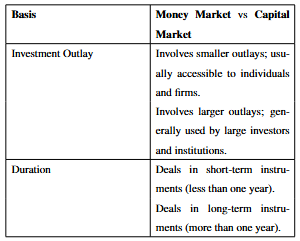
Money market is ideal for liquidity management while capital market is used for long-term financing. Investors choose between them based on the required duration and amount of investment. Quick Tip: \textbf{Quick Tip:} Treasury bills, commercial paper, and call money are common instruments in the money market.
Radhika started a business of supplying high class facial kits to beauty parlours...
View Solution
Radhika faced communication breakdown due to ineffective transfer of product information. Good communication helps in building clarity, understanding, and motivation among employees, which directly affects performance. Quick Tip: \textbf{Quick Tip:} Effective communication reduces misunderstandings and improves coordination in business activities.
(a) Explain the following principles of management given by Fayol:
View Solution
• Unity of Command: An employee should receive orders from one superior only. This
avoids confusion and conflict.
• Order: There should be an orderly arrangement of men and materials to ensure
efficiency and smooth workflow.
Fayol’s principles provide a foundation for modern managerial practices. Unity of command ensures discipline, while order prevents wastage of time and resources. Quick Tip: \textbf{Quick Tip:} Fayol gave 14 principles, and these two promote clarity and efficiency in an organisation.
(a) Explain the following features of co-ordination:
View Solution
• Unity of Action: Co-ordination integrates group efforts and ensures all activities are
directed towards common goals.
• Continuous Process: It is required at all levels and in all departments, throughout the
management process.
Without coordination, departments may work in isolation leading to inefficiency. Regular coordination fosters teamwork and goal alignment. Quick Tip: \textbf{Quick Tip:} Coordination binds all management functions together—planning, organising, directing, and controlling.
The demand for take away food business is increasing day-by-day. People working in multi-national companies have to work till night very often and they are reluctant to cook food. Taking advantage of this opportunity, Amit and Bijoy started 'Langar', a take away food business. The food became famous because of its good quality and standards of hygiene followed by them.
Over the years, the business became very profitable. They decided to expand the business by opening more branches in different cities. To ensure consistent food quality at all branches and to maintain the hygiene and quality they planned to import machines with advanced technology. The cost of each machine was Rs. 12 crores. They knew that this decision has to be taken very carefully, as it involves a huge cost and that the decision, once taken is irreversible.
View Solution
(i) The financial decision is Capital Budgeting Decision.
(ii) Two factors affecting it are:
• Cost of Equipment: Machines cost 12 crores; high cost makes this decision significant.
• Risk Involved: As the decision is irreversible and involves heavy investment, it carries financial risk.
Capital budgeting involves evaluating large investments in assets. Decisions are made after considering cost, return, and risks. Here, the purchase of machines with advanced tech was crucial for quality and consistency. Quick Tip: \textbf{Quick Tip:} Capital budgeting decisions are long-term and irreversible—always evaluate cost, returns, and associated risk.
Going to gym and following a protein diet has become a popular trend these days. However, with the busy work culture, many people, especially the youth struggle to find time for weight loss programmes.
Anika was working in a multi-national company, wanted to join a gym for weight loss but could not find time. There is no good gym near her house. One day, Anika was walking out of the office during lunch time and saw an attractive poster of a gym which was near her house. Anika was curious to enquire about their weight loss programme. Next day, when she went to the gym, she was surprised to know about various schemes offered by the gym. They were not only offering 50% discount on the fee of weight loss programme, but were also providing free coach facility and free protein diet for the customer. But these offers were valid only for 10 days. Attracted by these schemes Anika immediately submitted the fee and joined the gym.
View Solution
(i) The element of marketing-mix is Promotion. It refers to all activities
undertaken to inform customers about the product and persuade them to buy it.
(ii) Tools of promotion used:
• Advertising: The gym used an attractive poster as a form of advertisement.
• Sales Promotion: They offered a 50% discount, free coach facility, and free protein diet
as promotional tools.
Promotion is a vital element of the marketing mix that helps create awareness about products and services and persuades customers to make purchases. In this case, the gym used posters to attract attention (advertising), and schemes like discounts and freebies (sales promotion) to influence customer decision-making. These limited-time offers created urgency, prompting Anika to join immediately. Quick Tip: \textbf{Quick Tip:} Promotion includes tools like advertising, personal selling, sales promotion, PR, and direct marketing to attract and retain customers.
Nisha had given some old dresses of her own to her house-helper Beenu. After a few days, Nisha was happily surprised when she saw Beenu wearing one of the dresses beautifully refurbished. On enquiry, Beenu told Nisha that this was done by her daughter who had just completed her Class 12th studies. Beenu also told Nisha that she was a little concerned as her daughter did not want to study further. Nisha was very much impressed by the creativity of Beenu's daughter, so she decided to setup a small business for her. Nisha bought 15 sewing machines and appointed 15 girls to refurbish the old dresses. Nisha also arranged old dresses from various sources and employed a person who will sell these dresses at a very low cost for the one's who could not purchase new dresses due to their low income.
Nisha divided the girls in three equal groups, each having five sewing machines. Each group was given a target of refurbishing 150 old dresses in a fortnight with a cost of Rs. 30 per dress.
After a fortnight, Nisha who was supervising this business with Beenu was informed that Group I was able to meet the target by refurbishing 150 old dresses at a cost of Rs. 30 per dress. Group II was able to refurbish 150 old dresses at a cost of Rs. 35 per dress, whereas Group III could refurbish only 140 old dresses but at a cost of Rs. 27 per dress.
View Solution
(i) The three concepts of management are:
• Group I – Effectiveness: Achieved target of 150 dresses within specified cost.
• Group II – Effectiveness (but not efficiency): Achieved target but at higher cost.
• Group III – Efficiency (but not effectiveness): Lower cost but could not meet the target.
(ii)
• Effectiveness: Doing the right task, completing activities to achieve goals.
• Efficiency: Doing the task correctly with minimum cost/resources.
Effectiveness is important for achieving organizational goals, but both efficiency and effectiveness together ensure best results.
Effectiveness focuses on goal achievement, while efficiency focuses on cost minimization. In this case, Group I achieved both and is ideal. Group II achieved the goal at a higher cost, and Group III worked efficiently but didn't meet the target. Quick Tip: \textbf{Quick Tip:} Efficiency is about “doing things right”; effectiveness is about “doing the right things.” Both are vital in management.
Prachi is working as an academic counsellor for specially abled students at one of the top schools to provide special support and guidance to these students. She clearly states in advance the methods of teaching and tackling the students. She ensures that the goals are clearly stated for each and every teacher so that they act as a guide for deciding what action should be taken and in which direction.
Her well laid plans will serve as a basis for coordinating the activities and efforts of teachers teaching different subjects to these students. It helps the teachers in bringing clarity of thought and action to their work.
Identify and explain the two points of importance of ‘Planning’ function of management highlighted in the above para.
View Solution
The two points of importance of planning are:
• Provides direction: Planning helps in defining goals and strategies so that efforts move
in one direction.
• Facilitates coordination: Planning brings unity and alignment among departments and
individuals.
Planning provides a sense of direction to teachers by pre-defining goals and teaching methods. It ensures clarity in work and helps coordinate the actions of teachers handling different subjects for the same group of students. Quick Tip: \textbf{Quick Tip:} Planning guides action, sets priorities, and aligns all activities in the same direction.
(a) Explain the following steps in the process of selection:
View Solution
The steps in the process of selection are:
• Selection Decision: Final choice of the candidate from among those who passed all previous stages.
• Medical Examination: Conducted to ensure physical fitness of the selected candidate.
• Job Offer: A formal offer is made to the selected candidate with terms and conditions.
• Contract of Employment: Agreement signed by both employer and employee laying down job terms.
These steps help organizations ensure that the right candidates are selected who are fit for the job and willing to accept the offer under mutual agreement. Quick Tip: \textbf{Quick Tip:} The selection process filters the best fit through multiple assessments, medical checkups, and formal agreements.
(b) Explain the following financial incentives:
View Solution
• Profit sharing: Distribution of a portion of the profits among employees.
• Co-partnership: Employees are given shares and become part-owners of the company.
• Productivity linked wage incentives: Wages tied to performance and productivity levels.
• Perquisites: Additional benefits like car, house, medical aid etc. apart from salary.
These financial incentives motivate employees by providing monetary benefits linked to the performance and success of the organization. Quick Tip: \textbf{Quick Tip:} Financial incentives improve performance, motivation, and employee loyalty.
Asha was running a business of producing and selling pickles, murabbas and papad etc. On receiving an urgent bulk order, she instructed the workers to work overtime. The workers agreed but their efficiency declined and the production was also not as per schedule. On investigation, she found that the new workers were not trained properly. Therefore, she appointed a supervisor and instructed him to monitor the work. The supervisor observed that the workers were not doing their work efficiently. He found out that they were not fully aware of the proper method of doing the work. Hence, he gave them on-the-job training. Thereafter, the workers became more regular and efficient. Consequently, the production was as per schedule.
View Solution
(i) The function of management discussed is Controlling. (ii) Importance of controlling:
• Helps in achieving organizational goals.
• Judging accuracy of standards.
• Making efficient use of resources.
• Improves employee motivation.
• Facilitates coordination in action.
Controlling ensures that activities are being performed according to plans. Asha appointed a supervisor to monitor and correct deviations. This helped identify that new workers were not performing properly. Training improved efficiency and ensured timely production. Quick Tip: \textbf{Quick Tip:} Controlling compares actual performance with standards and takes corrective action.
(a) State any three advantages and any three limitations of informal organization.
View Solution
Advantages:
• Faster communication.
• Enhances cooperation and coordination.
• Fulfills social needs.
Limitations:
• Spreads rumours.
• May resist change.
• Lack of accountability.
Informal organization helps in quick decision-making and builds relationships but can also create conflict or spread misinformation if not managed well. Quick Tip: \textbf{Quick Tip:} Informal networks can support or undermine formal systems—balance both.
(b) State any three advantages and any three disadvantages of divisional structure of organization.
View Solution
Advantages:
• Accountability for performance.
• Product specialization.
• Quick decision-making.
Disadvantages:
• Duplication of resources.
• Conflicts among divisions.
• High cost.
Divisional structure gives focus and speed in operations but may lead to inefficiencies due to duplication and internal rivalry. Quick Tip: \textbf{Quick Tip:} Use divisional structure when product lines are diverse and need independent handling.
Ravi and Megha started ‘Energylights’, an enterprise for manufacturing LED lights. They wanted to reduce their production cost and selected such a location for their business where labour was available at low cost and the production material was easily available. The LED lights produced by them were of good quality and also economical. Their customers were satisfied with their product and they could easily cover their costs and earn a reasonable profit. The demand for their LED lights started increasing and they decided to increase their production capacity. They decided to install solar panels in their factory premises and also started recycling of water and waste material. They also appointed a separate department to look after their social welfare programmes. Quoting lines from the above para, identify and explain any three factors which were taken into consideration by Ravi and Megha to determine the price of their LED lights.
View Solution
Three factors considered:
• Cost of product: ”They could easily cover their costs and earn a reasonable profit.”
• Demand: ”The demand for their LED lights started increasing.”
• Product quality and differentiation: ”The LED lights produced by them were of good quality and also economical.”
Ravi and Megha considered cost, market demand, and product quality while pricing their LED lights. These factors ensured their product remained competitive and profitable, while fulfilling customer satisfaction and meeting social responsibilities. Quick Tip: \textbf{Quick Tip:} Pricing depends on cost, customer demand, and competition—balance all three wisely.





Comments