The CBSE Board conducted Class 12 Retail Exam 2026 on March 24, 2026. Class 12 Retail Question Paper with Solution PDF is available here for download.
The CBSE Class 12 Retail paper covered key topics from retail management, customer service, merchandising, and sales techniques. Students should focus on understanding retail operations, customer handling, and sales strategies. The exam is marked out of 100, with 60 marks for the theory paper and 40 for internal assessment.
CBSE Class 12 Retail Question Paper 2026 with Solution PDF
| CBSE Class 12 Retail Question Paper 2026 | Download PDF | Check Solution |
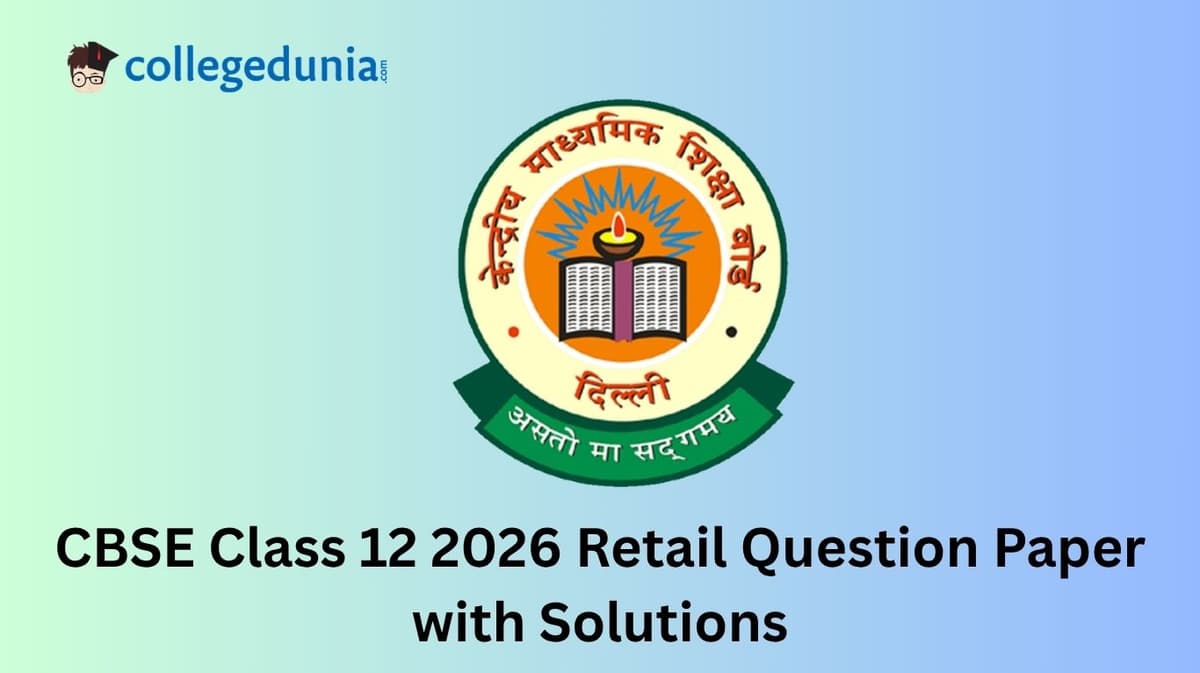
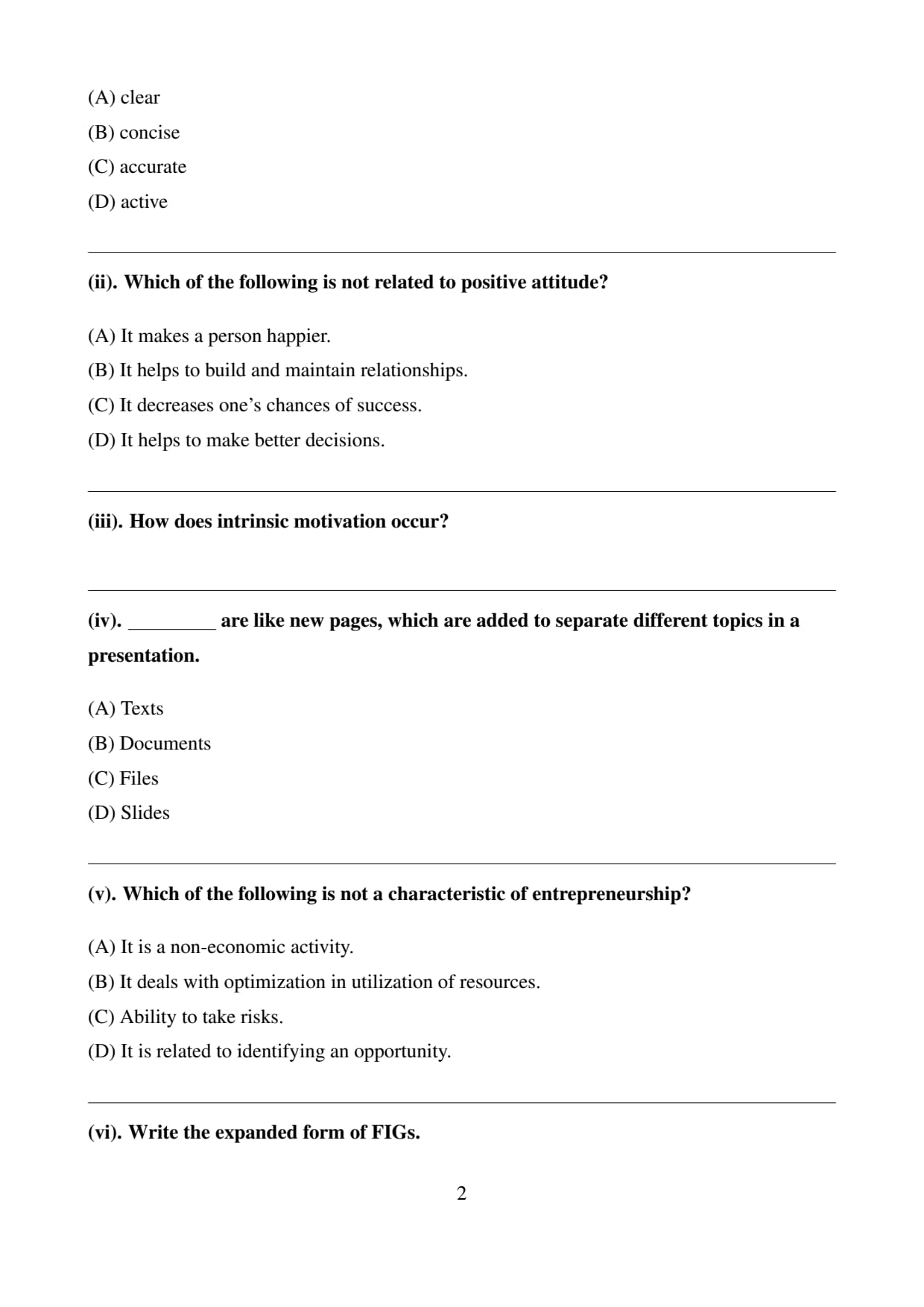
A statement which conveys the exact message that you are trying to convey to the other person is called a/an _______ statement.
View Solution
\textcolor{red{Step 1: Understanding the requirement.
The question focuses on identifying the type of statement that conveys the exact intended meaning without any error or misinterpretation.
\textcolor{red{Step 2: Analyzing the options.
(A) Clear: Easy to understand but may not guarantee exact correctness.
(B) Concise: Short and brief, but may miss complete accuracy.
(C) Accurate: Correct. It ensures the message is precise and exact.
(D) Active: Refers to sentence structure, not meaning.
\textcolor{red{Step 3: Conclusion.
Thus, the correct term is accurate.
\textcolor{red{ Final Answer: accurate. Quick Tip: \textbf{Accuracy} ensures correctness of information, while clarity and conciseness improve presentation.
Which of the following is not related to positive attitude?
View Solution
\textcolor{red{Step 1: Understanding positive attitude.
A positive attitude helps individuals stay motivated, optimistic, and productive in different situations.
\textcolor{red{Step 2: Evaluating options.
(A): True. Positive attitude improves happiness.
(B): True. It strengthens relationships.
(C): Incorrect. Positive attitude actually increases chances of success.
(D): True. It helps in making better decisions.
\textcolor{red{Step 3: Conclusion.
Thus, the option not related to positive attitude is (C).
\textcolor{red{ Final Answer: It decreases one's chances of success. Quick Tip: A positive attitude boosts confidence, improves relationships, and increases chances of success.
How does intrinsic motivation occur?
View Solution
\textcolor{red{Step 1: Define intrinsic motivation.
Intrinsic motivation refers to performing an activity for its own satisfaction rather than for external rewards.
\textcolor{red{Step 2: Understand internal factors.
It occurs when a person is driven by internal desires such as interest, enjoyment, curiosity, or personal satisfaction.
\textcolor{red{Step 3: Role of personal interest.
When individuals find an activity interesting or enjoyable, they engage in it willingly without needing external pressure.
\textcolor{red{Step 4: Role of self-satisfaction.
The feeling of achievement, learning, or personal growth encourages continued participation.
\textcolor{red{Step 5: Conclusion.
Thus, intrinsic motivation occurs when a person is internally driven by interest, enjoyment, and self-satisfaction.
Quick Tip: Intrinsic motivation comes from within—focus on interest, passion, and self-growth rather than rewards.
_____ are like new pages, which are added to separate different topics in a presentation.
View Solution
\textcolor{red{Step 1: Understanding presentation structure.
Presentation software me content ko organize karne ke liye alag-alag pages use kiye jate hain jisse har topic clearly represent ho sake.
\textcolor{red{Step 2: Concept of slides.
In pages ko slides kaha jata hai. Har slide ek specific topic ya information ko represent karta hai aur presentation ko structured banata hai.
\textcolor{red{Step 3: Analysis of options.
(A) Texts: Sirf content ka part hai, page nahi.
(B) Documents: Yeh complete file hoti hai, individual page nahi.
(C) Files: Yeh storage unit hai, presentation ka page nahi.
(D) Slides: Correct. Yeh presentation ke individual pages hote hain.
\textcolor{red{Step 4: Conclusion.
Isliye presentation me new pages ko slides kaha jata hai.
\textcolor{red{ Final Answer: Slides. Quick Tip: Presentation = Slides ka collection hota hai. Har slide ek alag idea ya topic represent karta hai.
Which of the following is not a characteristic of entrepreneurship?
View Solution
\textcolor{red{Step 1: Understanding entrepreneurship.
Entrepreneurship ek economic activity hoti hai jisme business ideas ko develop kiya jata hai aur profit earn karne ke liye resources ka use hota hai.
\textcolor{red{Step 2: Key characteristics.
Entrepreneurship ke main features hote hain: risk-taking, opportunity identification aur efficient use of resources. Yeh sab economic activities ka part hote hain.
\textcolor{red{Step 3: Analysis of options.
(A) It is a non-economic activity: Incorrect statement, kyunki entrepreneurship economic activity hai.
(B) Optimization of resources: Yeh entrepreneurship ka important feature hai.
(C) Ability to take risks: Core characteristic hai.
(D) Identifying opportunity: Yeh entrepreneurship ka starting point hai.
\textcolor{red{Step 4: Conclusion.
Isliye option (A) hi aisa statement hai jo entrepreneurship ka characteristic nahi hai.
\textcolor{red{ Final Answer: It is a non-economic activity. Quick Tip: Entrepreneurship hamesha economic activity hoti hai jisme risk-taking aur opportunity identification shamil hote hain.
Write the expanded form of FIGs.
View Solution
\textcolor{red{Step 1: Identify the abbreviation.
The term “FIGs” is an abbreviation used in the context of finance and business sectors.
\textcolor{red{Step 2: Expand the term.
FIG stands for Financial Institutions Group.
\textcolor{red{Step 3: Understand its meaning.
It refers to a group that deals with financial institutions such as banks, insurance companies, and investment firms.
\textcolor{red{Step 4: Consider plural usage.
“FIGs” indicates multiple Financial Institutions Groups.
\textcolor{red{Step 5: Final conclusion.
Thus, the expanded form of FIGs is Financial Institutions Group.
Quick Tip: FIG = Financial Institutions Group, commonly used in finance and consulting domains.
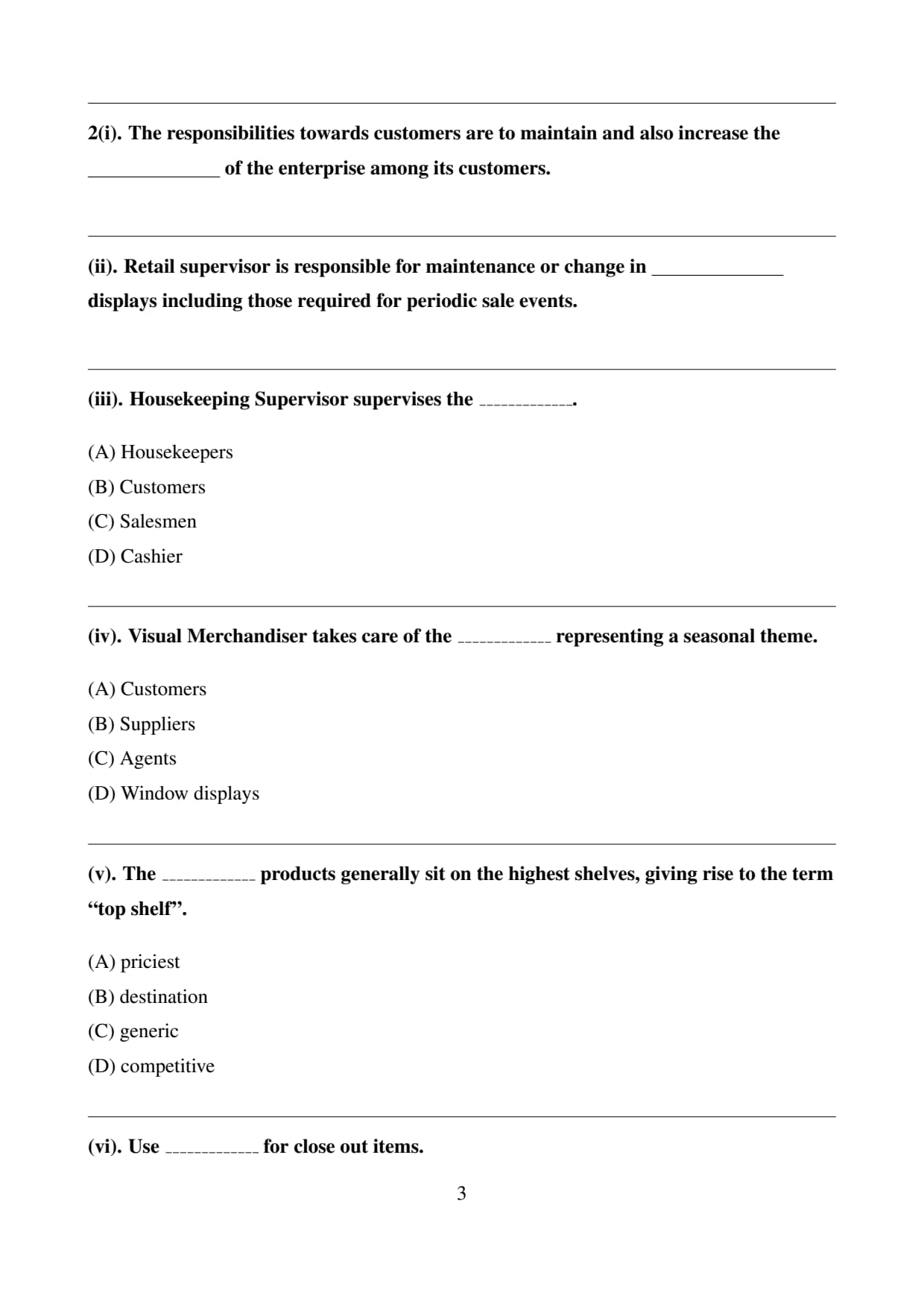
The responsibilities towards customers are to maintain and also increase the _____ of the enterprise among its customers.
View Solution
\textcolor{red{Step 1: Understand the context.
The statement is about responsibilities towards customers and improving the enterprise’s position among them.
\textcolor{red{Step 2: Identify key idea.
Businesses aim to build a positive image and trust among customers.
\textcolor{red{Step 3: Determine correct word.
The correct term is goodwill, which means reputation and trust of the enterprise.
\textcolor{red{Step 4: Conclusion.
Hence, the blank is filled with goodwill.
Quick Tip: Goodwill reflects customer trust and brand reputation, which is essential for long-term business success.
Retail supervisor is responsible for maintenance or change in _____ displays including those required for periodic sale events.
View Solution
\textcolor{red{Step 1: Understand the role.
A retail supervisor manages store layout and display of products.
\textcolor{red{Step 2: Identify the display type.
Displays in retail stores are used to present products attractively to customers.
\textcolor{red{Step 3: Determine correct term.
The correct term is merchandise, referring to products displayed in stores.
\textcolor{red{Step 4: Conclusion.
Hence, the blank is filled with merchandise.
Quick Tip: Merchandise display helps attract customers and increases sales during promotions.
Housekeeping Supervisor supervises the ______ .
View Solution
\textcolor{red{Step 1: Understanding the role.
A housekeeping supervisor is responsible for managing and overseeing cleaning staff in hotels, hospitals, or organizations.
\textcolor{red{Step 2: Evaluating options.
(A): Correct. They supervise housekeepers.
(B): Customers are served, not supervised.
(C): Salesmen belong to sales department.
(D): Cashiers handle transactions.
\textcolor{red{Step 3: Conclusion.
Thus, a housekeeping supervisor supervises housekeepers.
\textcolor{red{ Final Answer: Housekeepers. Quick Tip: Housekeeping supervisors ensure cleanliness standards by managing housekeeping staff.
Visual Merchandiser takes care of the _______ representing a seasonal theme.
View Solution
\textcolor{red{Step 1: Understanding the role.
A visual merchandiser is responsible for designing attractive displays in retail stores to attract customers.
\textcolor{red{Step 2: Evaluating options.
(A): Customers are targeted, not managed.
(B): Suppliers provide goods.
(C): Agents are intermediaries.
(D): Correct. Visual merchandisers design window displays for themes.
\textcolor{red{Step 3: Conclusion.
Thus, they take care of window displays.
\textcolor{red{ Final Answer: Window displays. Quick Tip: Visual merchandising focuses on store presentation, especially window displays, to attract customers.
The _____ products generally sit on the highest shelves, giving rise to the term “top shelf”.
View Solution
\textcolor{red{Step 1: Understanding the phrase.
The term "top shelf" refers to products placed at higher shelves, usually premium or expensive items.
\textcolor{red{Step 2: Evaluating options.
(A): Correct. Expensive (priciest) products are placed on top shelves.
(B): Destination is unrelated.
(C): Generic products are usually cheaper.
(D): Competitive is not relevant here.
\textcolor{red{Step 3: Conclusion.
Thus, the correct word is priciest.
\textcolor{red{ Final Answer: priciest. Quick Tip: “Top shelf” items usually refer to premium or high-priced products placed for visibility and branding.
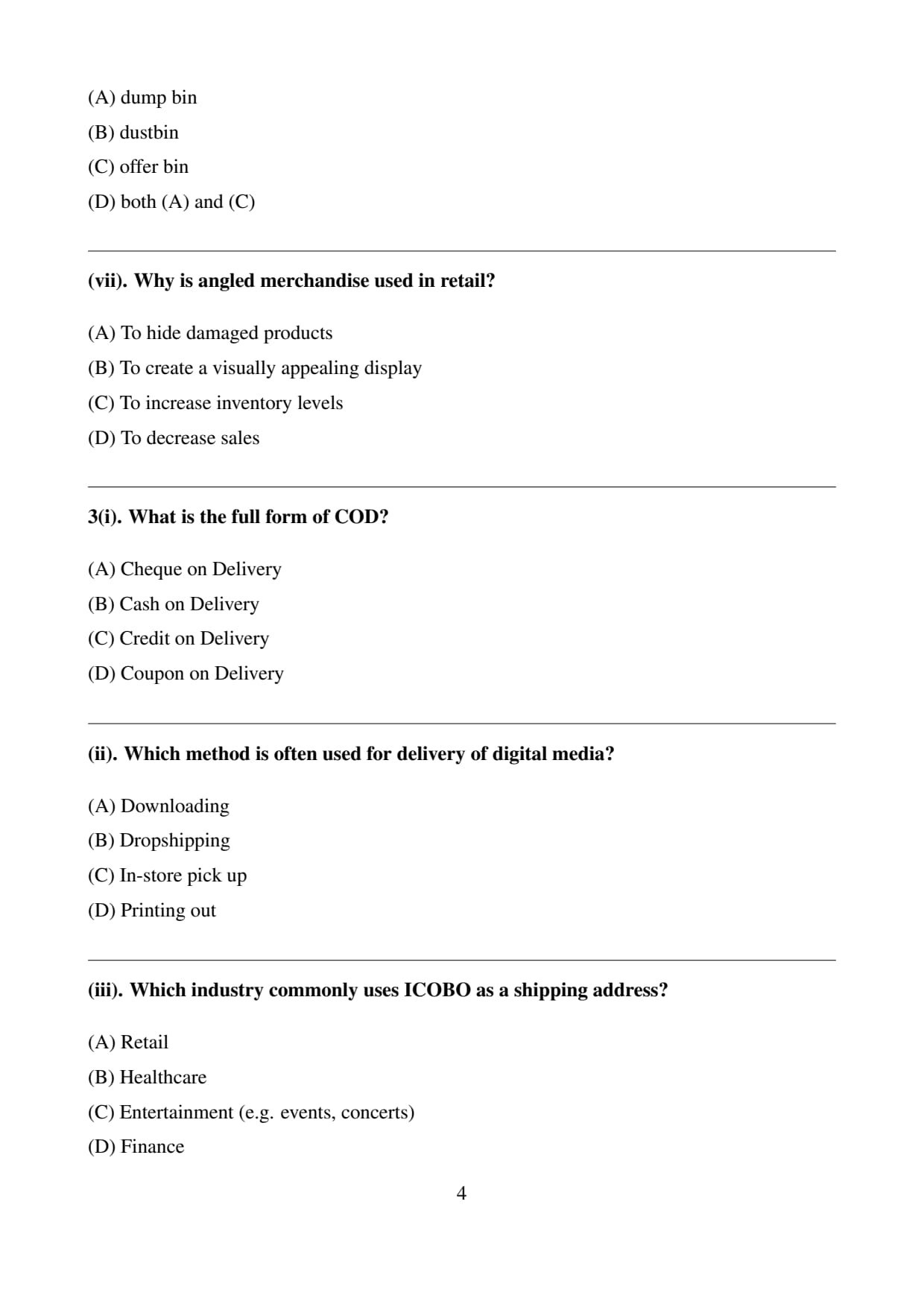
Use _____ for close out items.
View Solution
\textcolor{red{Step 1: Understanding close out items.
Close out items are products that need to be sold quickly, often at discounted prices, to clear inventory.
\textcolor{red{Step 2: Evaluating options.
(A) Dump bin: Used in retail to display discounted or clearance items.
(B) Dustbin: Used for waste, not for selling products.
(C) Offer bin: Also used to display discounted or promotional items.
(D): Correct, as both dump bin and offer bin are used for close out items.
\textcolor{red{Step 3: Conclusion.
Thus, both dump bin and offer bin are used for close out items.
\textcolor{red{ Final Answer: both (A) and (C). Quick Tip: Retailers use bins like dump bins and offer bins to quickly sell discounted or clearance products.
Why is angled merchandise used in retail?
View Solution
\textcolor{red{Step 1: Understanding angled merchandise.
Angled merchandise refers to arranging products at an angle so that they are more visible and attractive to customers.
\textcolor{red{Step 2: Evaluating options.
(A): Not correct, as it is not used to hide defects.
(B): Correct. It enhances visual appeal and attracts customers.
(C): Does not affect inventory levels.
(D): It actually helps increase sales, not decrease.
\textcolor{red{Step 3: Conclusion.
Thus, angled merchandise is used to create an attractive display.
\textcolor{red{ Final Answer: To create a visually appealing display. Quick Tip: Product placement and display techniques directly influence customer attention and sales.
What is the full form of COD?
View Solution
\textcolor{red{Step 1: Understanding COD.
COD is a commonly used payment method in e-commerce and retail.
\textcolor{red{Step 2: Meaning of COD.
COD stands for Cash on Delivery, where the customer pays for the product at the time of delivery instead of paying in advance.
\textcolor{red{Step 3: Conclusion.
Thus, the correct full form is Cash on Delivery.
\textcolor{red{ Final Answer: Cash on Delivery. Quick Tip: COD is widely used in online shopping where customers prefer paying after receiving the product.
Which method is often used for delivery of digital media?
View Solution
\textcolor{red{Step 1: Understanding digital media delivery.
Digital media such as music, videos, and software are delivered electronically rather than physically.
\textcolor{red{Step 2: Evaluating options.
(A): Correct. Downloading is the standard method for digital delivery.
(B): Dropshipping is used for physical goods.
(C): In-store pickup is for physical products.
(D): Printing is not a delivery method for digital media.
\textcolor{red{Step 3: Conclusion.
Thus, downloading is the correct method.
\textcolor{red{ Final Answer: Downloading. Quick Tip: Digital products are usually delivered instantly via downloading or streaming.
Which industry commonly uses ICOBO as a shipping address?
View Solution
\textcolor{red{Step 1: Understanding ICOBO.
ICOBO stands for "In Care Of Box Office", used as a temporary delivery address.
\textcolor{red{Step 2: Application.
It is commonly used in event management and entertainment industries where tickets or items are collected at the venue.
\textcolor{red{Step 3: Conclusion.
Thus, it is mainly used in entertainment (events, concerts).
\textcolor{red{ Final Answer: Entertainment (e.g. events, concerts). Quick Tip: ICOBO is often used when tickets are collected directly from the venue instead of home delivery.
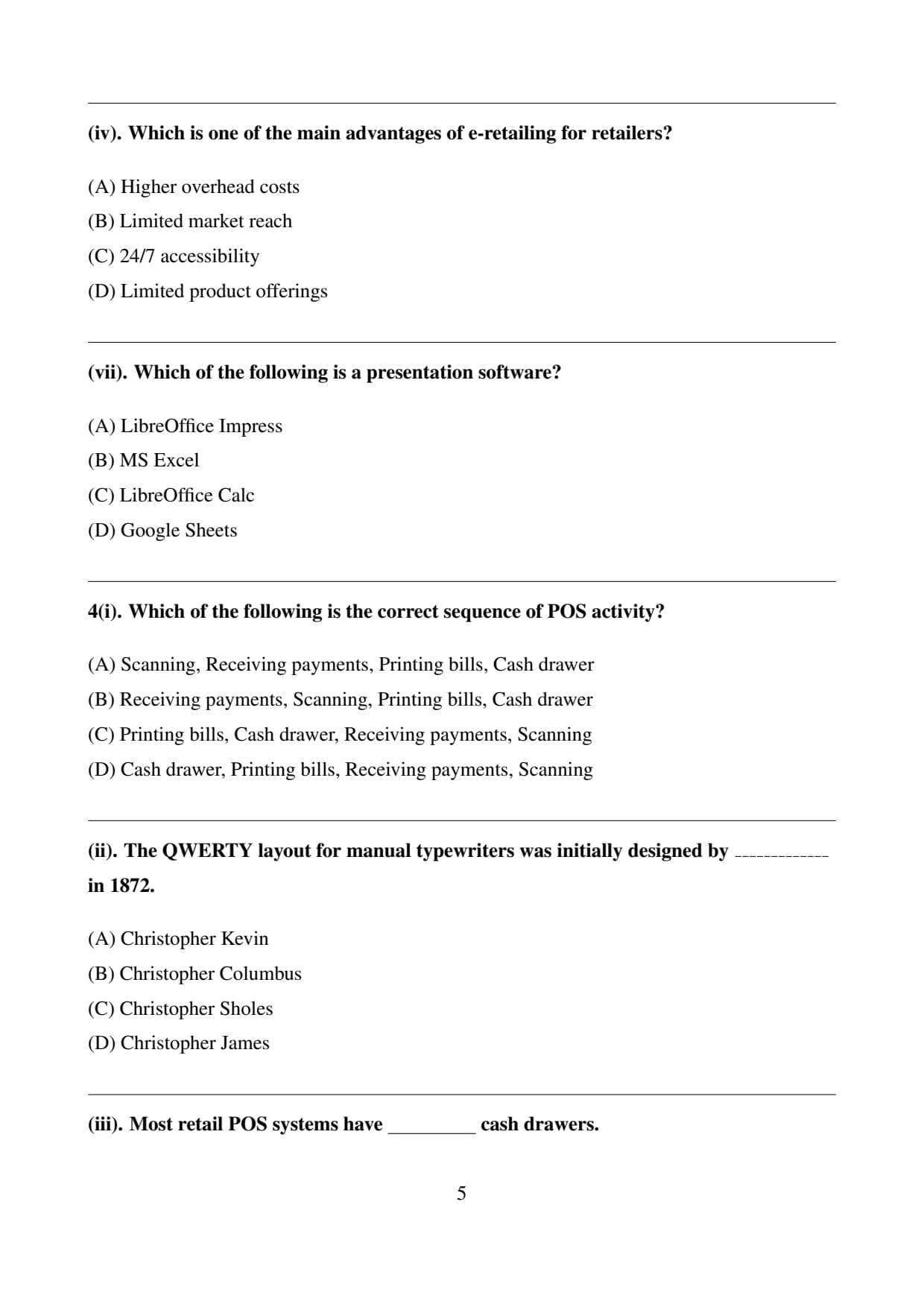
Which is one of the main advantages of e-retailing for retailers?
View Solution
\textcolor{red{Step 1: Understanding e-retailing.
E-retailing refers to selling products online through websites or apps.
\textcolor{red{Step 2: Evaluating options.
(A): Higher costs are disadvantages.
(B): Online platforms expand reach.
(C): Correct. E-retailing allows 24/7 access to customers.
(D): Online stores usually offer more variety.
\textcolor{red{Step 3: Conclusion.
Thus, the main advantage is 24/7 accessibility.
\textcolor{red{ Final Answer: 24/7 accessibility. Quick Tip: E-commerce allows businesses to operate anytime, increasing sales opportunities.
Which of the following is a presentation software?
View Solution
\textcolor{red{Step 1: Understanding presentation software.
Presentation software ka use slides banane, content present karne aur visual communication ke liye kiya jata hai, jaise PowerPoint ya Impress.
\textcolor{red{Step 2: Identifying correct software.
LibreOffice Impress specifically ek presentation tool hai jo slides create karne ke liye design kiya gaya hai.
\textcolor{red{Step 3: Analysis of options.
(A) LibreOffice Impress: Correct. Yeh presentation software hai.
(B) MS Excel: Spreadsheet software hai.
(C) LibreOffice Calc: Spreadsheet software hai.
(D) Google Sheets: Online spreadsheet tool hai.
\textcolor{red{Step 4: Conclusion.
Isliye LibreOffice Impress hi presentation software hai.
\textcolor{red{ Final Answer: LibreOffice Impress. Quick Tip: Presentation software examples: MS PowerPoint, LibreOffice Impress, Google Slides.
Which of the following is the correct sequence of POS activity?
View Solution
\textcolor{red{Step 1: Understanding POS system.
POS (Point of Sale) system is used in retail to complete a transaction from product selection to payment and billing.
\textcolor{red{Step 2: Identifying correct sequence.
First, items are scanned.
Then, the customer makes payment.
After payment, the system prints the bill.
Finally, the cash drawer opens to store cash.
\textcolor{red{Step 3: Conclusion.
Thus, the correct sequence is option (A).
\textcolor{red{ Final Answer: Scanning, Receiving payments, Printing bills, Cash drawer. Quick Tip: POS systems follow a logical flow: scan → pay → bill → cash handling.
The QWERTY layout for manual typewriters was initially designed by ______ in 1872.
View Solution
\textcolor{red{Step 1: Understanding QWERTY layout.
The QWERTY keyboard layout is the standard keyboard used in typewriters and computers.
\textcolor{red{Step 2: Historical fact.
It was designed by Christopher Latham Sholes in 1872 to prevent typewriter jams by spacing commonly used letters.
\textcolor{red{Step 3: Conclusion.
Thus, the correct answer is Christopher Sholes.
\textcolor{red{ Final Answer: Christopher Sholes. Quick Tip: QWERTY layout was designed to reduce mechanical jamming in early typewriters.
Most retail POS systems have _____ cash drawers.
View Solution
\textcolor{red{Step 1: Understand POS systems.
POS (Point of Sale) systems are used in retail stores to handle billing, payments, and transactions.
\textcolor{red{Step 2: Identify hardware components.
A POS system typically includes devices like a computer, barcode scanner, receipt printer, and cash drawer.
\textcolor{red{Step 3: Analyze the statement.
The sentence refers to how many cash drawers are usually connected to a retail POS system.
\textcolor{red{Step 4: Determine the correct word.
Generally, a POS system is connected to one cash drawer for handling transactions.
\textcolor{red{Step 5: Final answer.
Thus, the blank is filled with one.
Quick Tip: A standard POS setup usually connects to a single cash drawer for managing cash transactions.
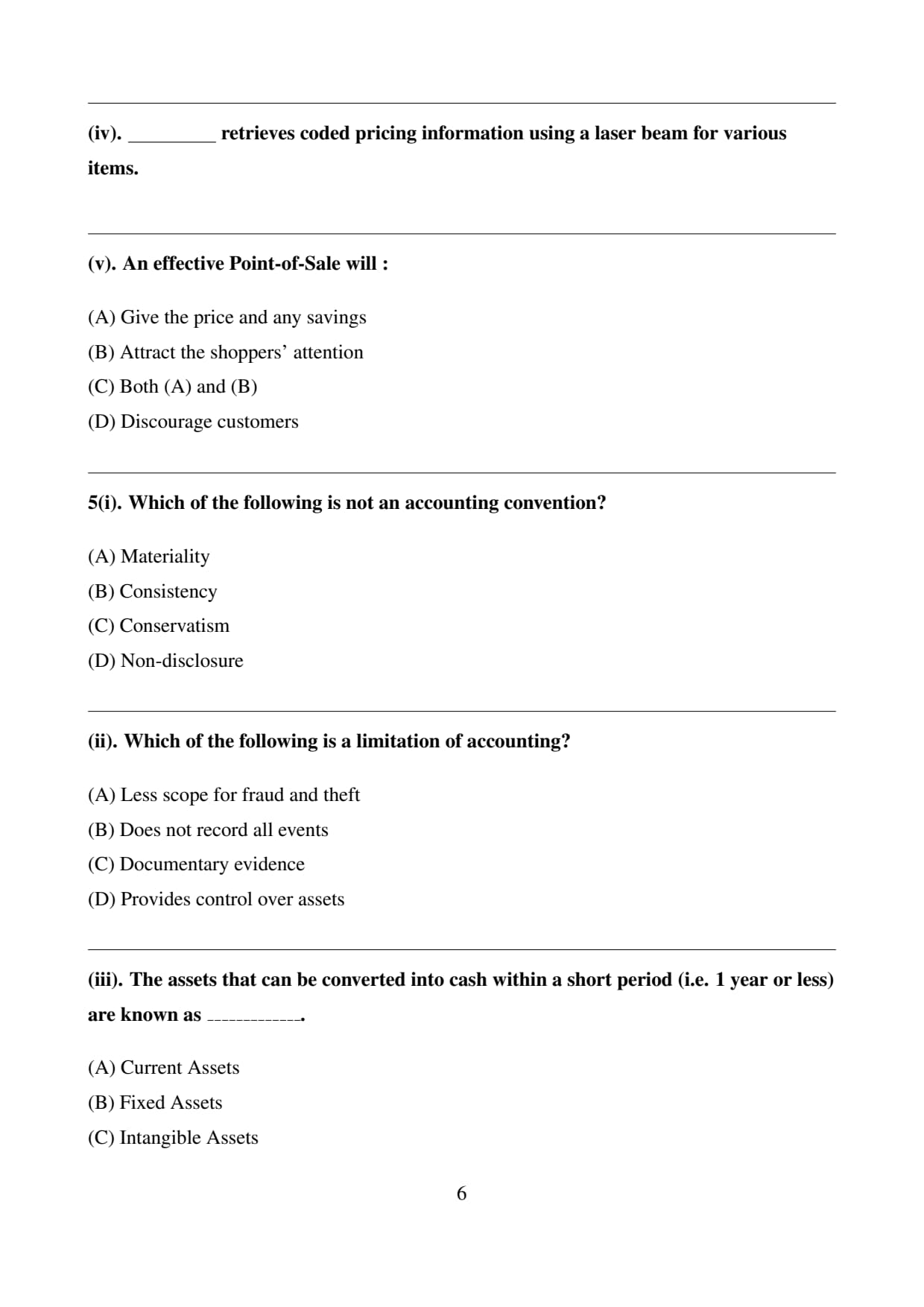
______ retrieves coded pricing information using a laser beam for various items.
View Solution
\textcolor{red{Step 1: Understand the context.
The question refers to a device used in retail systems to read product information.
\textcolor{red{Step 2: Identify key clue.
The phrase “using a laser beam” indicates scanning technology.
\textcolor{red{Step 3: Recall relevant device.
A barcode scanner uses laser beams to read coded information from product barcodes.
\textcolor{red{Step 4: Function of the device.
It retrieves pricing and product details stored in the system database.
\textcolor{red{Step 5: Final answer.
Thus, the correct answer is Barcode Scanner.
Quick Tip: Barcode scanners use laser beams to quickly read product information in retail stores.
An effective Point-of-Sale will :
View Solution
\textcolor{red{Step 1: Understanding Point-of-Sale (POS).
Point-of-Sale ka matlab hota hai wo place ya display jahan customer product ko dekhta hai aur purchase decision leta hai. Yeh marketing ka important part hota hai.
\textcolor{red{Step 2: Features of an effective POS.
Ek effective POS system ya display customer ko clear information deta hai jaise price aur discounts, aur saath hi unka attention attract karta hai taaki wo product kharidne ke liye motivate ho.
\textcolor{red{Step 3: Analysis of options.
(A) Give the price and any savings: Correct. Yeh customer ko informed decision lene me help karta hai.
(B) Attract the shoppers' attention: Correct. Yeh marketing ka key objective hai.
(C) Both (A) and (B): Correct. Dono features ek effective POS ke liye zaroori hain.
(D) Discourage customers: Incorrect. POS ka purpose customers ko attract karna hota hai, discourage nahi.
\textcolor{red{Step 4: Conclusion.
Isliye ek effective POS system price information bhi deta hai aur customer attention bhi attract karta hai.
\textcolor{red{ Final Answer: Both (A) and (B). Quick Tip: Effective POS = Clear information + Attractive display = Better sales.
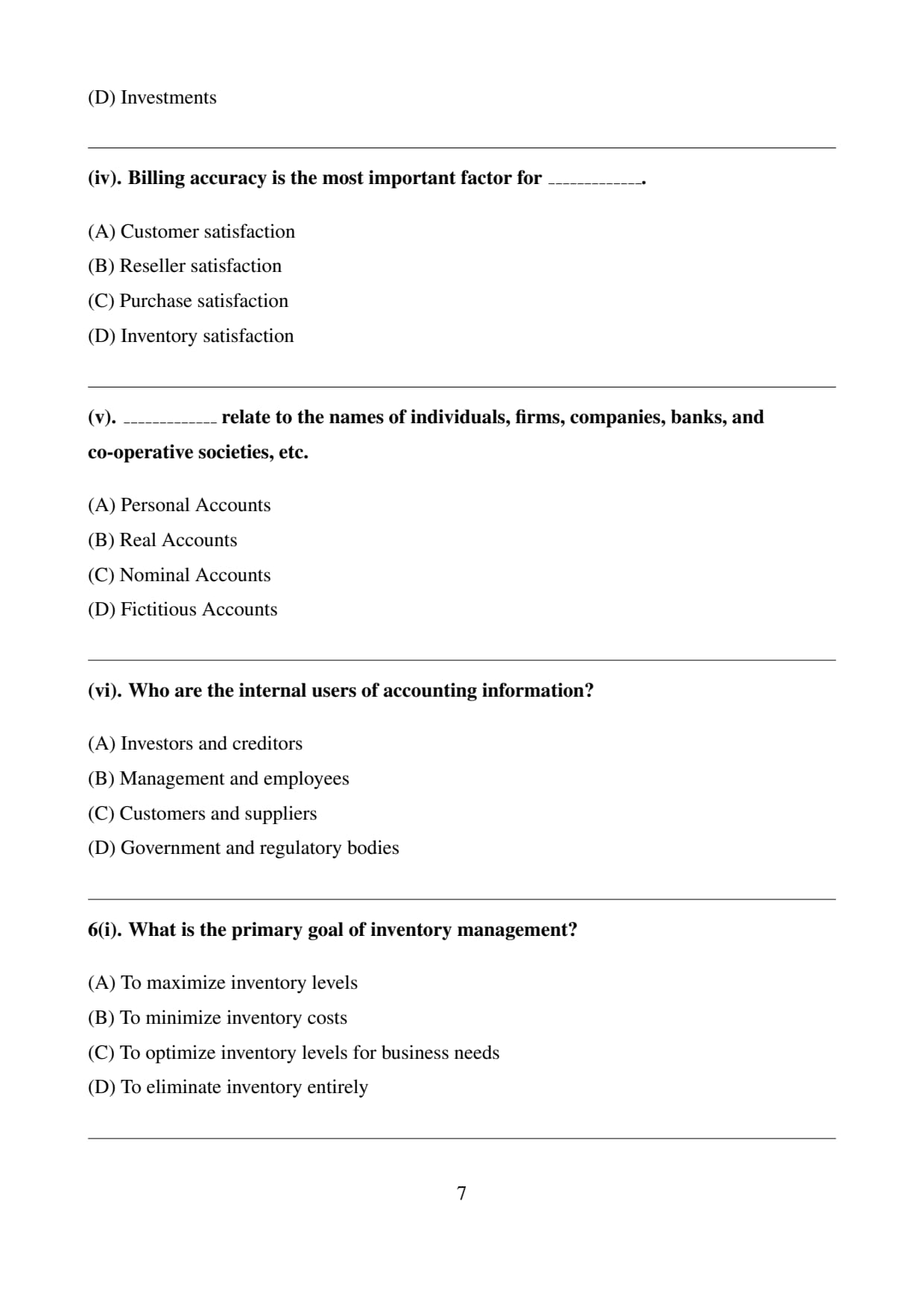
Which of the following is not an accounting convention?
View Solution
\textcolor{red{Step 1: Understanding accounting conventions.
Accounting conventions wo accepted principles hote hain jo financial statements ko prepare karne me help karte hain. Yeh practical guidelines provide karte hain jisse accounts uniform aur reliable bane.
\textcolor{red{Step 2: Common accounting conventions.
Important conventions me Materiality, Consistency aur Conservatism shamil hote hain. Yeh accounting practices ko standardize karte hain.
\textcolor{red{Step 3: Analysis of options.
(A) Materiality: Yeh ek accounting convention hai jo important information ko highlight karta hai.
(B) Consistency: Yeh bhi convention hai jo ensure karta hai ki same methods follow ho.
(C) Conservatism: Yeh principle losses ko jaldi recognize karta hai aur profits ko cautiously treat karta hai.
(D) Non-disclosure: Incorrect. Accounting me transparency important hoti hai, isliye disclosure hota hai, non-disclosure convention nahi hai.
\textcolor{red{Step 4: Conclusion.
Isliye Non-disclosure accounting convention nahi hai.
\textcolor{red{ Final Answer: Non-disclosure. Quick Tip: Accounting me disclosure important hota hai—financial information ko hide nahi kiya jata.
Which of the following is a limitation of accounting?
View Solution
\textcolor{red{Step 1: Understanding limitations of accounting.
Accounting records only financial transactions and ignores qualitative or non-monetary events.
\textcolor{red{Step 2: Evaluating options.
(A): Advantage, not limitation.
(B): Correct. Accounting does not record all events.
(C): Advantage, provides proof.
(D): Advantage, ensures control.
\textcolor{red{Step 3: Conclusion.
Thus, limitation is that accounting does not record all events.
\textcolor{red{ Final Answer: Does not record all events. Quick Tip: Accounting records only measurable financial transactions, not qualitative factors like employee morale.
The assets that can be converted into cash within a short period (i.e. 1 year or less) are known as _____ .
View Solution
\textcolor{red{Step 1: Understanding asset types.
Assets are classified based on liquidity, i.e., how quickly they can be converted into cash.
\textcolor{red{Step 2: Evaluating options.
(A): Correct. Current assets are converted into cash within a year.
(B): Fixed assets are long-term.
(C): Intangible assets lack physical form.
(D): Investments may not be short-term.
\textcolor{red{Step 3: Conclusion.
Thus, such assets are called current assets.
\textcolor{red{ Final Answer: Current Assets. Quick Tip: Examples of current assets include cash, inventory, and accounts receivable.
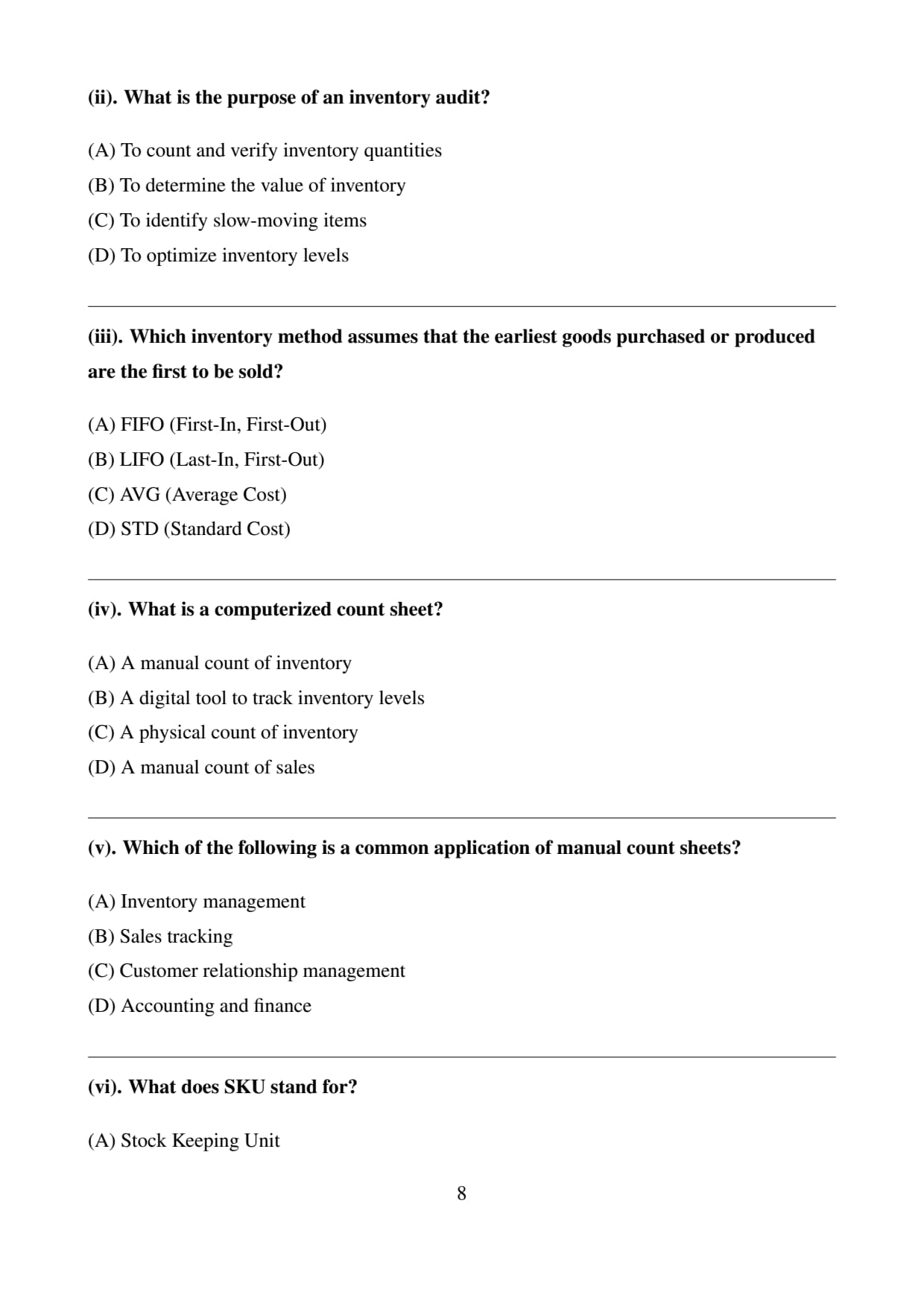
Billing accuracy is the most important factor for ______ .
View Solution
\textcolor{red{Step 1: Understanding billing accuracy.
Billing accuracy ensures customers are charged correctly for their purchases.
\textcolor{red{Step 2: Evaluating impact.
(A): Correct. Accurate billing improves customer trust and satisfaction.
(B): Not directly related.
(C): Not a standard concept.
(D): Inventory is unrelated.
\textcolor{red{Step 3: Conclusion.
Thus, billing accuracy is key for customer satisfaction.
\textcolor{red{ Final Answer: Customer satisfaction. Quick Tip: Accurate billing builds trust and improves long-term customer relationships.
______ relate to the names of individuals, firms, companies, banks, and co-operative societies, etc.
View Solution
\textcolor{red{Step 1: Understanding account types.
Accounts are classified into personal, real, and nominal accounts.
\textcolor{red{Step 2: Definition.
Personal accounts relate to individuals, firms, companies, banks, and institutions.
\textcolor{red{Step 3: Evaluating options.
(A): Correct. Covers individuals and organizations.
(B): Relates to assets.
(C): Relates to expenses and incomes.
(D): Not a standard classification here.
\textcolor{red{Step 4: Conclusion.
Thus, the correct answer is personal accounts.
\textcolor{red{ Final Answer: Personal Accounts. Quick Tip: Personal accounts include natural persons, artificial persons, and representative accounts.
Who are the internal users of accounting information?
View Solution
\textcolor{red{Step 1: Understanding users of accounting information.
Accounting information ke users do type ke hote hain: internal users aur external users. Internal users organization ke andar ke log hote hain jo decision-making me involved hote hain.
\textcolor{red{Step 2: Identifying internal users.
Internal users mainly management aur employees hote hain. Management is information ka use planning, controlling aur decision-making ke liye karta hai, jabki employees apni job security aur performance evaluate karte hain.
\textcolor{red{Step 3: Analysis of options.
(A) Investors and creditors: External users hote hain.
(B) Management and employees: Correct. Yeh internal users hain.
(C) Customers and suppliers: Yeh bhi external users hain.
(D) Government and regulatory bodies: Yeh external stakeholders hain.
\textcolor{red{Step 4: Conclusion.
Isliye accounting information ke internal users management aur employees hote hain.
\textcolor{red{ Final Answer: Management and employees. Quick Tip: Internal users = Organization ke andar ke log (management, employees); External users = outsiders (investors, government, creditors).
What is the primary goal of inventory management?
View Solution
\textcolor{red{Step 1: Understanding inventory management.
Inventory management focuses on maintaining the right balance between supply and demand.
\textcolor{red{Step 2: Evaluating options.
(A): Too much inventory increases costs.
(B): Cost minimization is important but not the sole goal.
(C): Correct. It ensures optimal stock levels to meet demand without excess.
(D): Eliminating inventory is not practical.
\textcolor{red{Step 3: Conclusion.
Thus, the main goal is to optimize inventory levels.
\textcolor{red{ Final Answer: To optimize inventory levels for business needs. Quick Tip: Good inventory management balances stock availability and cost efficiency.
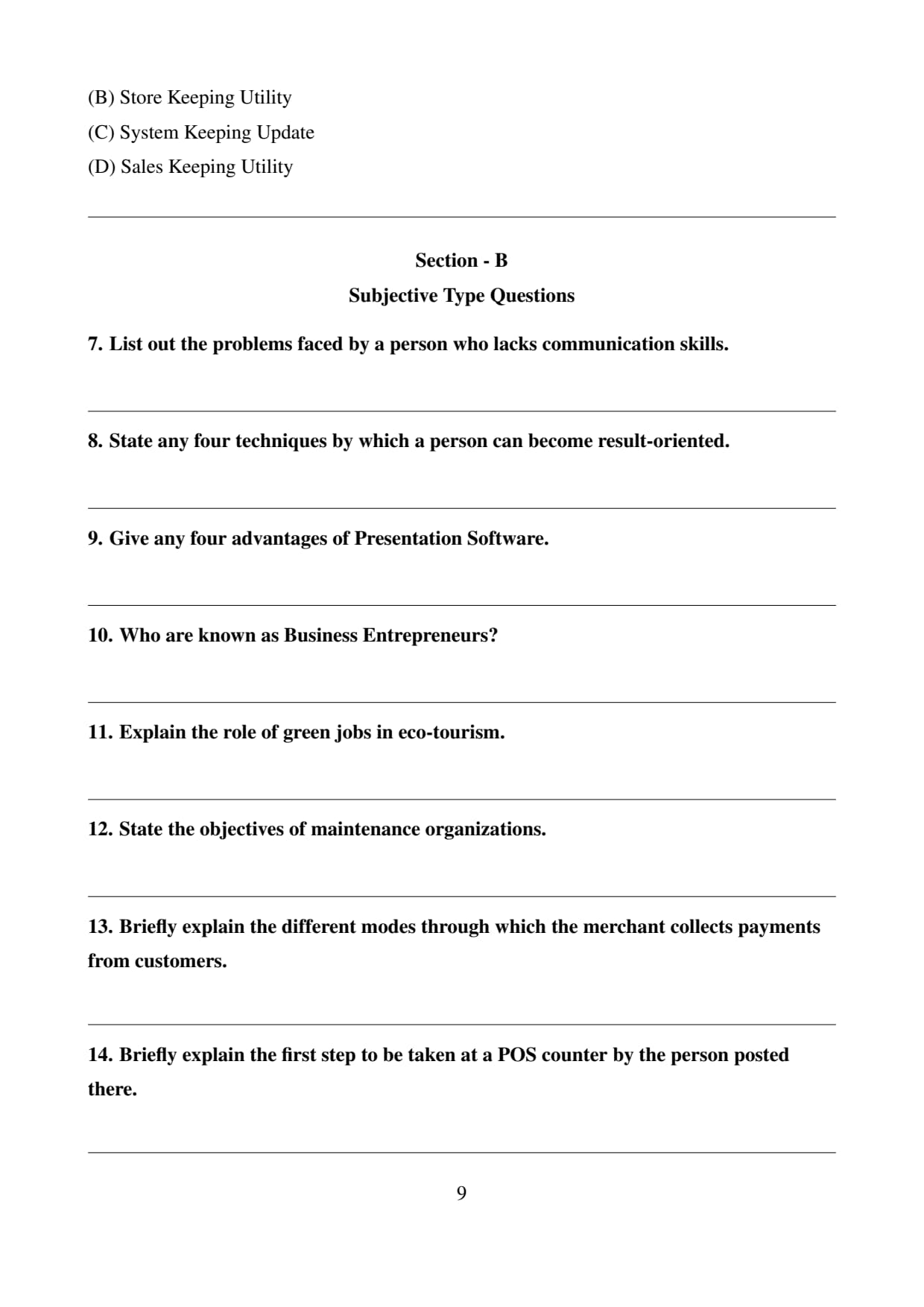
What is the purpose of an inventory audit?
View Solution
\textcolor{red{Step 1: Understanding inventory audit.
An inventory audit involves physically checking stock and matching it with recorded data.
\textcolor{red{Step 2: Evaluating options.
(A): Correct. Audit ensures quantity accuracy.
(B): Valuation is secondary.
(C): Analysis task, not audit purpose.
(D): Inventory optimization is a management function.
\textcolor{red{Step 3: Conclusion.
Thus, the main purpose is to verify inventory quantities.
\textcolor{red{ Final Answer: To count and verify inventory quantities. Quick Tip: Inventory audits help detect discrepancies between actual and recorded stock.
Which inventory method assumes that the earliest goods purchased or produced are the first to be sold?
View Solution
\textcolor{red{Step 1: Understanding inventory methods.
Inventory valuation ke liye alag-alag methods use kiye jate hain jaise FIFO, LIFO aur Average Cost. Yeh methods decide karte hain ki kaunsa stock pehle sell hua maana jayega.
\textcolor{red{Step 2: Concept of FIFO.
FIFO ka full form hai First-In, First-Out. Is method me jo goods sabse pehle purchase ya produce hote hain, unhe sabse pehle sell maana jata hai.
\textcolor{red{Step 3: Analysis of options.
(A) FIFO: Correct. Earliest goods first sell hote hain.
(B) LIFO: Latest goods pehle sell hote hain.
(C) AVG: Average cost method use hota hai.
(D) STD: Standard costing method hai.
\textcolor{red{Step 4: Conclusion.
Isliye FIFO method earliest goods ko pehle sell assume karta hai.
\textcolor{red{ Final Answer: FIFO (First-In, First-Out). Quick Tip: FIFO = Old stock first sell. LIFO = New stock first sell.
What is a computerized count sheet?
View Solution
\textcolor{red{Step 1: Understanding count sheets.
Count sheet ka use inventory ko record karne aur track karne ke liye hota hai. Yeh traditionally manual bhi ho sakta hai aur computerized bhi.
\textcolor{red{Step 2: Computerized count sheet.
Computerized count sheet ek digital system hota hai jo inventory levels ko automatically track karta hai aur data ko efficiently manage karta hai.
\textcolor{red{Step 3: Analysis of options.
(A) Manual count: Yeh computerized nahi hai.
(B) Digital tool: Correct. Yeh computerized count sheet hai.
(C) Physical count: Yeh manual process hai.
(D) Sales count: Inventory se related nahi hai.
\textcolor{red{Step 4: Conclusion.
Isliye computerized count sheet ek digital tool hota hai jo inventory track karta hai.
\textcolor{red{ Final Answer: A digital tool to track inventory levels. Quick Tip: Computerized systems manual errors ko reduce karte hain aur real-time tracking provide karte hain.
Which of the following is a common application of manual count sheets?
View Solution
\textcolor{red{Step 1: Understanding manual count sheets.
Manual count sheets ka use items ko manually count aur record karne ke liye hota hai, especially inventory check ke time.
\textcolor{red{Step 2: Purpose of manual count sheets.
Yeh sheets mainly stock verification aur inventory management ke liye use hoti hain taaki accurate quantity maintain ki ja sake.
\textcolor{red{Step 3: Analysis of options.
(A) Inventory management: Correct. Yeh primary use hai.
(B) Sales tracking: Yeh alag system se hota hai.
(C) CRM: Customer data se related hai.
(D) Accounting: Broader field hai, specific use nahi.
\textcolor{red{Step 4: Conclusion.
Isliye manual count sheets ka main use inventory management me hota hai.
\textcolor{red{ Final Answer: Inventory management. Quick Tip: Manual count sheets mainly stock verification aur inventory accuracy maintain karne ke liye use hote hain.
What does SKU stand for?
View Solution
\textcolor{red{Step 1: Understanding SKU.
SKU is a unique identifier used in inventory management to track products.
\textcolor{red{Step 2: Evaluating options.
(A): Correct. SKU stands for Stock Keeping Unit.
(B), (C), (D): Incorrect expansions.
\textcolor{red{Step 3: Conclusion.
Thus, SKU means Stock Keeping Unit.
\textcolor{red{ Final Answer: Stock Keeping Unit. Quick Tip: SKU helps businesses track inventory efficiently and uniquely identify each product.
List out the problems faced by a person who lacks communication skills.
View Solution
\textcolor{red{Step 1: Understand communication skills.
Communication skills help in expressing ideas clearly and understanding others effectively.
\textcolor{red{Step 2: Identify common problems.
A person lacking communication skills may face misunderstandings and confusion while interacting with others.
\textcolor{red{Step 3: Social impact.
They may find it difficult to build relationships and may experience low confidence or hesitation.
\textcolor{red{Step 4: Professional impact.
Such individuals may face problems in teamwork, poor job performance, and limited career growth.
\textcolor{red{Step 5: Conclusion.
Thus, lack of communication skills leads to misunderstandings, low confidence, weak relationships, and poor career opportunities.
Quick Tip: Effective communication is key to success in both personal and professional life.
State any four techniques by which a person can become result-oriented.
View Solution
\textcolor{red{Step 1: Set clear goals.
Define specific and achievable goals to stay focused.
\textcolor{red{Step 2: Plan and prioritize.
Organize tasks based on importance and deadlines.
\textcolor{red{Step 3: Maintain discipline.
Stay consistent and avoid procrastination.
\textcolor{red{Step 4: Monitor progress.
Track performance regularly and make improvements.
\textcolor{red{Step 5: Stay motivated.
Keep a positive mindset and focus on outcomes.
Quick Tip: Result-oriented people focus on outcomes, not just activities.
Give any four advantages of Presentation Software.
View Solution
\textcolor{red{Step 1: Visual enhancement.
It improves understanding using images, charts, and graphics.
\textcolor{red{Step 2: Organized content.
Information can be structured clearly using slides.
\textcolor{red{Step 3: Audience engagement.
Animations and multimedia make presentations more attractive.
\textcolor{red{Step 4: Easy editing and sharing.
Presentations can be easily modified and shared digitally.
\textcolor{red{Step 5: Professional delivery.
It helps in presenting ideas confidently and effectively.
Quick Tip: Use visuals and minimal text to make presentations more effective.
Who are known as Business Entrepreneurs?
View Solution
\textcolor{red{Step 1: Understand the term Entrepreneur.
An entrepreneur is a person who identifies business opportunities and takes initiative to start a new venture.
\textcolor{red{Step 2: Define Business Entrepreneurs.
Business entrepreneurs are individuals who establish, organize, and manage a business with the objective of earning profit.
\textcolor{red{Step 3: Highlight key characteristics.
They take risks, invest capital, make decisions, and bring innovation in products or services.
\textcolor{red{Step 4: Conclusion.
Thus, those individuals who start and run a business by taking risks and aiming for profit are known as Business Entrepreneurs.
Quick Tip: Entrepreneur = Risk taker + Organizer + Innovator + Profit seeker.
Explain the role of green jobs in eco-tourism.
View Solution
\textcolor{red{Step 1: Define Green Jobs.
Green jobs are employment opportunities that help protect the environment and promote sustainable development.
\textcolor{red{Step 2: Define Eco-tourism.
Eco-tourism refers to responsible travel to natural areas that conserves the environment and improves the well-being of local people.
\textcolor{red{Step 3: Role of Green Jobs in Eco-tourism.
Green jobs support eco-tourism by promoting sustainable practices such as waste management, conservation of biodiversity, and use of renewable resources.
\textcolor{red{Step 4: Economic and environmental benefits.
They create employment for local communities while ensuring minimal environmental impact and preservation of natural resources.
\textcolor{red{Step 5: Conclusion.
Thus, green jobs play a vital role in making eco-tourism sustainable and beneficial for both environment and society.
Quick Tip: Green jobs = Environment protection + Sustainable income generation.
State the objectives of maintenance organizations.
View Solution
\textcolor{red{Step 1: Ensure smooth functioning.
The main objective is to keep equipment and systems in proper working condition.
\textcolor{red{Step 2: Minimize downtime.
Maintenance organizations aim to reduce breakdowns and avoid delays in operations.
\textcolor{red{Step 3: Improve efficiency.
Regular maintenance helps in improving performance and productivity of machines.
\textcolor{red{Step 4: Ensure safety.
Proper maintenance reduces risks and ensures safety of workers and equipment.
\textcolor{red{Step 5: Extend equipment life.
Maintenance increases the lifespan of machines and reduces replacement costs.
Quick Tip: Good maintenance ensures efficiency, safety, and longer life of equipment.
Briefly explain the different modes through which the merchant collects payments from customers.
View Solution
\textcolor{red{Step 1: Cash payments.
Customers can pay directly using physical cash at the store.
\textcolor{red{Step 2: Card payments.
Debit and credit cards are used through POS machines for electronic transactions.
\textcolor{red{Step 3: Digital payments.
Payments can be made using mobile wallets, UPI, or online banking apps.
\textcolor{red{Step 4: Cheque payments.
Some merchants accept cheques as a mode of payment.
\textcolor{red{Step 5: Contactless payments.
Technologies like NFC allow quick tap-and-pay transactions.
Quick Tip: Modern payment systems include cash, cards, and digital methods like UPI and wallets.
Briefly explain the first step to be taken at a POS counter by the person posted there.
View Solution
\textcolor{red{Step 1: Greet the customer.
The person at the POS counter should welcome the customer politely.
\textcolor{red{Step 2: Receive items for billing.
Collect the items purchased by the customer for processing.
\textcolor{red{Step 3: Check items.
Ensure all items are properly placed and ready for scanning.
\textcolor{red{Step 4: Start scanning.
Begin scanning barcodes using the POS system to generate the bill.
\textcolor{red{Step 5: Confirm details.
Verify items and prices before proceeding to payment.
Quick Tip: Always start POS interaction with a polite greeting and proper item handling.
What are the responsibilities of a billing incharge?
View Solution
\textcolor{red{Step 1: Understand the role.
A billing incharge is responsible for managing all billing-related activities in a business or retail setup.
\textcolor{red{Step 2: Key responsibilities.
The billing incharge prepares accurate bills, processes transactions, and ensures proper recording of sales data.
\textcolor{red{Step 3: Handling payments and records.
They manage cash, digital payments, and maintain billing records to avoid errors or discrepancies.
\textcolor{red{Step 4: Customer interaction.
They assist customers during billing, resolve queries, and ensure smooth checkout experience.
\textcolor{red{Step 5: Conclusion.
Thus, a billing incharge ensures accurate billing, proper record-keeping, and efficient customer service.
Quick Tip: Billing incharge = Accurate billing + Payment handling + Customer support.
What is the purpose of a stockroom in inventory handling?
View Solution
\textcolor{red{Step 1: Define stockroom.
A stockroom is a storage area where goods and inventory are kept safely before being displayed or sold.
\textcolor{red{Step 2: Purpose of storage.
It helps in proper organization and storage of products to prevent damage and loss.
\textcolor{red{Step 3: Inventory management.
Stockroom supports inventory control by tracking stock levels, restocking items, and avoiding shortages or overstocking.
\textcolor{red{Step 4: Operational efficiency.
It ensures smooth business operations by providing timely availability of goods for sale or distribution.
\textcolor{red{Step 5: Conclusion.
Thus, the stockroom plays a key role in efficient inventory handling and management.
Quick Tip: Stockroom = Organized storage + Inventory control + Smooth operations.
Briefly explain the success factors of e-Retailing.
View Solution
\textcolor{red{Step 1: User-friendly website.
A simple and easy-to-navigate website improves customer experience.
\textcolor{red{Step 2: Product variety and quality.
Offering a wide range of good quality products attracts more customers.
\textcolor{red{Step 3: Secure payment system.
Safe and reliable payment options build trust among customers.
\textcolor{red{Step 4: Efficient delivery system.
Fast and reliable delivery ensures customer satisfaction.
\textcolor{red{Step 5: Customer service.
Good support and easy return policies increase customer loyalty.
Quick Tip: Success in e-retailing depends on trust, convenience, and customer satisfaction.
Raj and his partner Ram are dealing in a Garment business. They are planning to enter into e-marketing. Explain the attributes of e-marketing to them.
View Solution
\textcolor{red{Step 1: Global reach.
E-marketing allows businesses to reach customers worldwide beyond physical boundaries.
\textcolor{red{Step 2: Cost-effectiveness.
It is cheaper than traditional marketing methods like print or TV ads.
\textcolor{red{Step 3: Targeted marketing.
Businesses can target specific customer groups based on preferences and behavior.
\textcolor{red{Step 4: Real-time interaction.
Customers can interact instantly through websites, emails, and social media.
\textcolor{red{Step 5: Measurable results.
Performance can be tracked using analytics tools for better decision-making.
Quick Tip: E-marketing helps businesses grow faster with lower cost and better targeting.
What is Strip Reader Interface?
View Solution
\textcolor{red{Step 1: Define the term.
A Strip Reader Interface refers to a device or system used to read data stored on magnetic strips.
\textcolor{red{Step 2: Identify its usage.
It is commonly used in debit cards, credit cards, and ID cards.
\textcolor{red{Step 3: Working mechanism.
The device reads encoded information when the card is swiped through the reader.
\textcolor{red{Step 4: Application.
It is widely used in POS systems for processing payments.
\textcolor{red{Step 5: Conclusion.
Thus, it enables quick and secure reading of card information for transactions.
Quick Tip: Magnetic strip readers are essential for card-based payment systems.
Briefly explain the responsibilities of a Front Desk Supervisor.
View Solution
\textcolor{red{Step 1: Supervise front desk operations.
The Front Desk Supervisor ensures smooth functioning of reception activities and manages staff duties.
\textcolor{red{Step 2: Handle customer interactions.
They greet guests, resolve complaints, and ensure high levels of customer satisfaction.
\textcolor{red{Step 3: Manage bookings and records.
They oversee reservations, check-ins, check-outs, and maintain proper records.
\textcolor{red{Step 4: Train and guide staff.
They provide training to front desk staff and ensure proper service standards.
\textcolor{red{Step 5: Ensure coordination.
They coordinate with other departments for smooth operations.
Quick Tip: A Front Desk Supervisor plays a key role in customer satisfaction and smooth hotel operations.
How is Point of Sale marketing done? Explain.
View Solution
\textcolor{red{Step 1: Define POS marketing.
Point of Sale (POS) marketing is done at the place where customers make purchases.
\textcolor{red{Step 2: Use product displays.
Attractive displays, banners, and posters are used to attract customer attention.
\textcolor{red{Step 3: Promotions and offers.
Discounts, coupons, and special offers are provided at the checkout point.
\textcolor{red{Step 4: Use digital screens.
Electronic displays and advertisements are used to influence buying decisions.
\textcolor{red{Step 5: Encourage impulse buying.
Products are placed strategically near the counter to increase sales.
Quick Tip: POS marketing focuses on influencing customers right at the purchase point.
State any four features of retail billing.
View Solution
\textcolor{red{Step 1: Fast billing process.
Retail billing systems provide quick and efficient billing of items.
\textcolor{red{Step 2: Barcode integration.
They use barcode scanners for accurate product identification.
\textcolor{red{Step 3: Automatic calculations.
Prices, taxes, and discounts are calculated automatically.
\textcolor{red{Step 4: Multiple payment options.
They support cash, card, and digital payments.
\textcolor{red{Step 5: Record keeping.
All transactions are stored for future reference and reporting.
Quick Tip: Retail billing systems save time and reduce human errors in transactions.
Company Z, a large retailer, is conducting a verification count of the inventory in their warehouse. The warehouse is dimly lit, and the inventory is stored in narrow aisles. The company has a history of inventory discrepancies and wants to ensure accurate counts. What is verification count? Explain the purpose of conducting a verification count of inventory.
View Solution
\textcolor{red{Step 1: Define Verification Count.
Verification count refers to the process of physically counting the inventory items and matching them with recorded stock data to ensure accuracy.
\textcolor{red{Step 2: Understand the need in this case.
In the given situation, the warehouse conditions (dim lighting and narrow aisles) and past discrepancies increase the chances of errors in inventory records.
\textcolor{red{Step 3: Purpose - Accuracy of records.
The main purpose is to verify that the actual stock matches the recorded inventory, ensuring correctness in stock data.
\textcolor{red{Step 4: Purpose - Identify discrepancies.
It helps in identifying missing, damaged, or excess items and detecting errors, theft, or misplacement.
\textcolor{red{Step 5: Purpose - Improve control and decision-making.
Accurate inventory helps in better stock management, reduces losses, and supports effective business decisions.
\textcolor{red{Step 6: Conclusion.
Thus, verification count ensures inventory accuracy, reduces discrepancies, and improves overall warehouse management.
Quick Tip: Verification count = Physical check of stock to match records and avoid inventory errors.
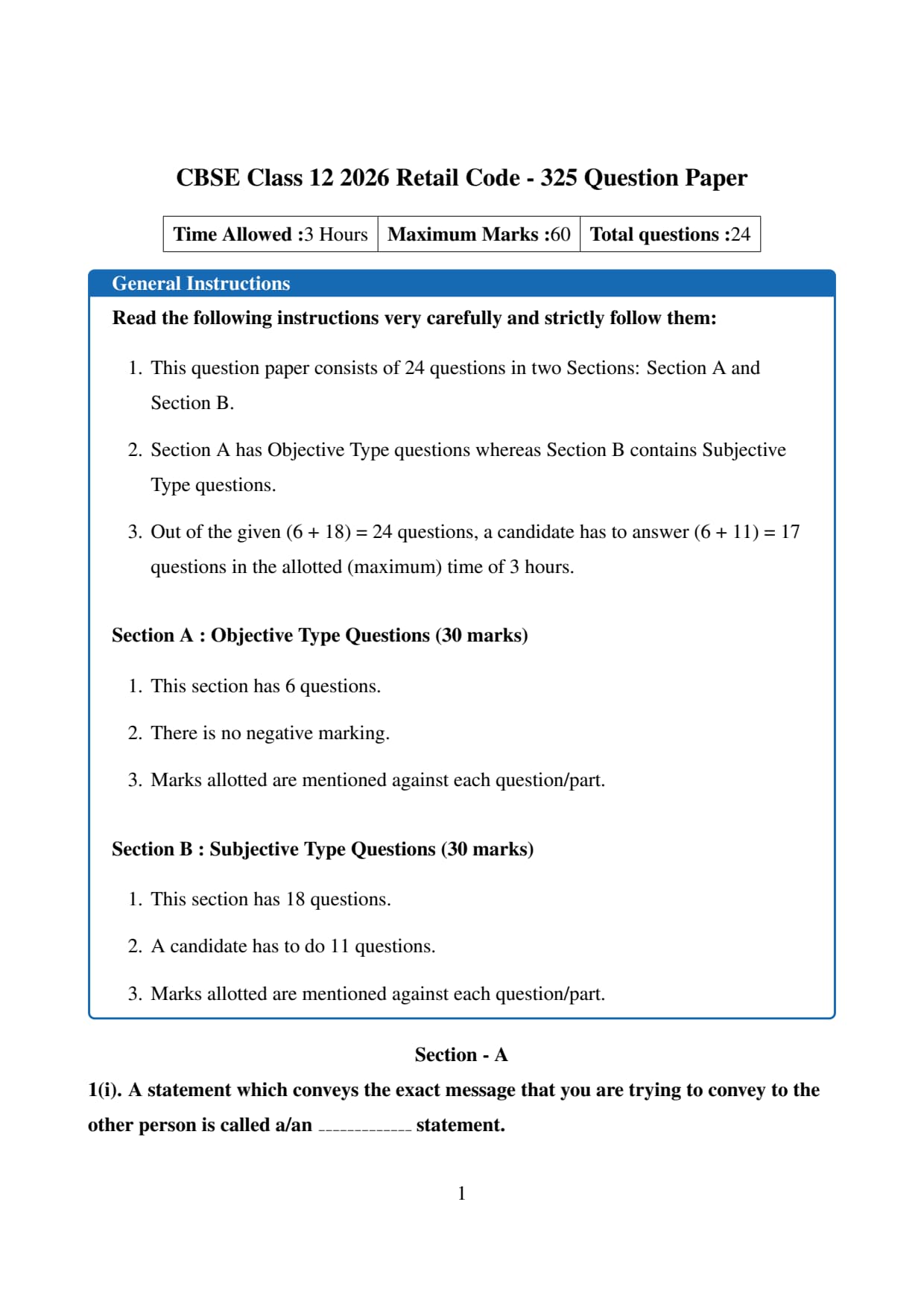
Journalize the following transactions:
2022
March 1 Manohar Lal and Sons started a business with cash ₹ 60,000
March 2 Purchased furniture for cash ₹ 10,000
March 4 Purchased goods for cash ₹ 25,000
March 5 Bought goods from Kamlesh ₹ 15,000
View Solution
\textcolor{red{Step 1: Identify accounts involved.
Each transaction affects two accounts — one debit and one credit based on accounting rules.
\textcolor{red{Step 2: Apply rules of accounting.
- Personal A/c: Debit the receiver, Credit the giver
- Real A/c: Debit what comes in, Credit what goes out
- Nominal A/c: Debit expenses, Credit incomes
\textcolor{red{Step 3: Journal Entries.
\begin{tabular{|l|l|l|r|r|
\hline
Date & Particulars & L.F. & Debit (₹) & Credit (₹)
\hline
March 1 & Cash A/c Dr. & & 60,000 &
& \quad To Capital A/c & & & 60,000
& (Being business started with cash) & & &
\hline
March 2 & Furniture A/c Dr. & & 10,000 &
& \quad To Cash A/c & & & 10,000
& (Being furniture purchased for cash) & & &
\hline
March 4 & Purchases A/c Dr. & & 25,000 &
& \quad To Cash A/c & & & 25,000
& (Being goods purchased for cash) & & &
\hline
March 5 & Purchases A/c Dr. & & 15,000 &
& \quad To Kamlesh A/c & & & 15,000
& (Being goods purchased on credit from Kamlesh) & & &
\hline
\end{tabular
\textcolor{red{Step 4: Conclusion.
All transactions are recorded by following debit and credit rules ensuring proper accounting records.
Quick Tip: Remember: Cash coming in = Debit Cash
Cash going out = Credit Cash
Purchase of goods = Debit Purchases
COMPLETE MARATHON I CLASS 12 I RETAIL I LAST MINUTE REVISION



Comments