


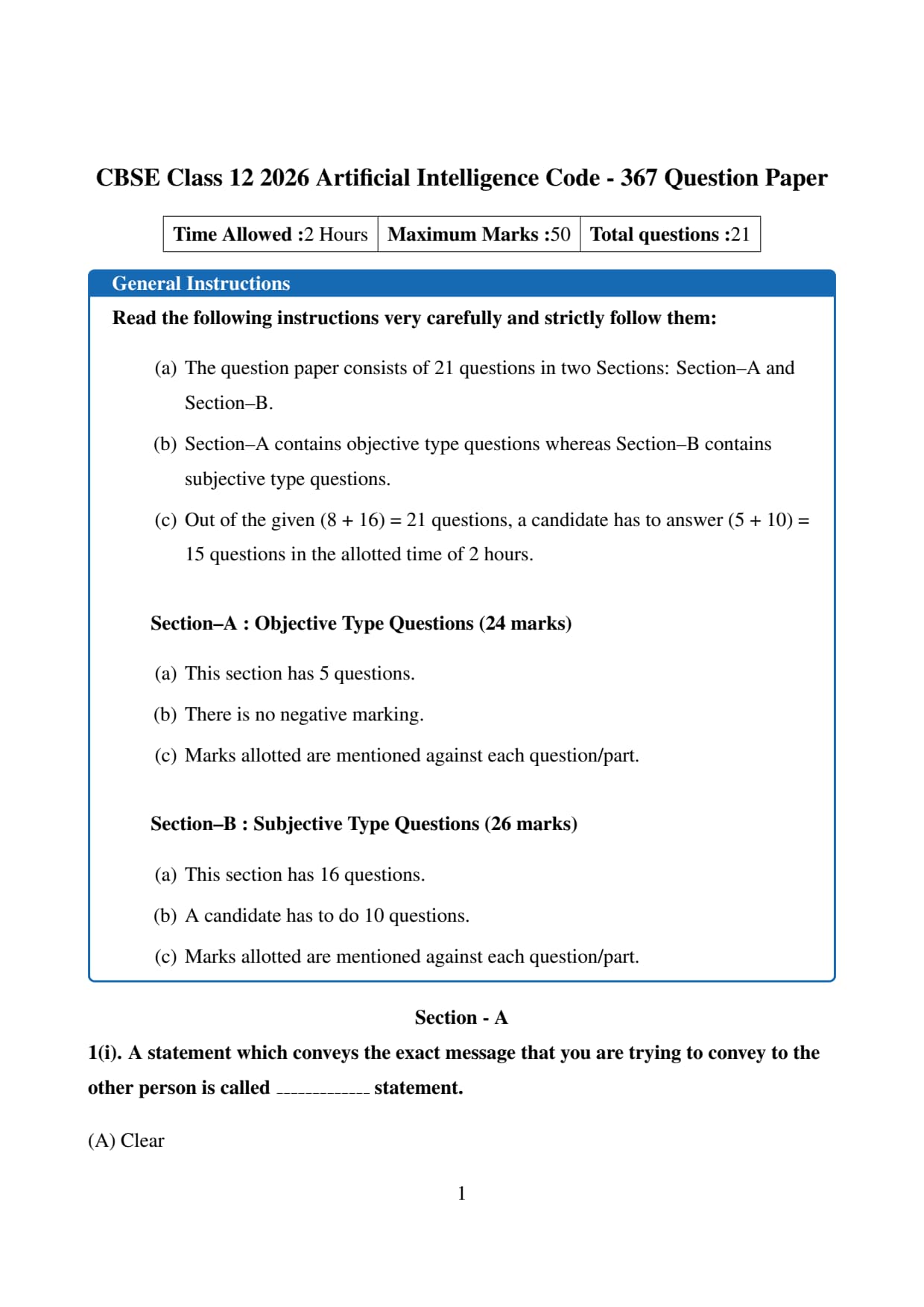
The CBSE Board conducted Class 12 Artificial Intelligence Exam 2026 on March 24, 2026. Class 12 Artificial Intelligence Question Paper with Solution PDF is available here for download.
The CBSE Class 12 Artificial Intelligence paper covered key topics from AI fundamentals, machine learning, data handling, and AI applications. Students should focus on understanding AI concepts, data analysis, and real-world applications of artificial intelligence. The exam is marked out of 100, with 50 marks for the theory paper and 50 for practical work and internal assessment.
CBSE Class 12 Artificial Intelligence Question Paper 2026 with Solution PDF
| CBSE Class 12 Artificial Intelligence Question Paper 2026 | Download PDF | Check Solution |

A statement which conveys the exact message that you are trying to convey to the other person is called ______ statement.
View Solution
Step 1: Understanding the requirement.
The question focuses on identifying the type of statement that conveys the exact intended message to another person without any distortion or misunderstanding.
Step 2: Analyzing the options.
(A) Clear: A clear statement is easy to understand, but it may not always ensure exactness of meaning.
(B) Concise: A concise statement is brief and to the point, but it may omit details and not fully capture exact meaning.
(C) Accurate: Correct. An accurate statement conveys information precisely and exactly as intended, without errors or ambiguity.
(D) Active: Refers to sentence structure (active voice), not the precision of meaning.
Step 3: Conclusion.
Since the question emphasizes conveying the exact message, the most appropriate term is accurate.
Final Answer: Accurate. Quick Tip: In communication, \textbf{accuracy} ensures that the message is correct and precise, while clarity and conciseness improve readability but do not guarantee exact meaning.
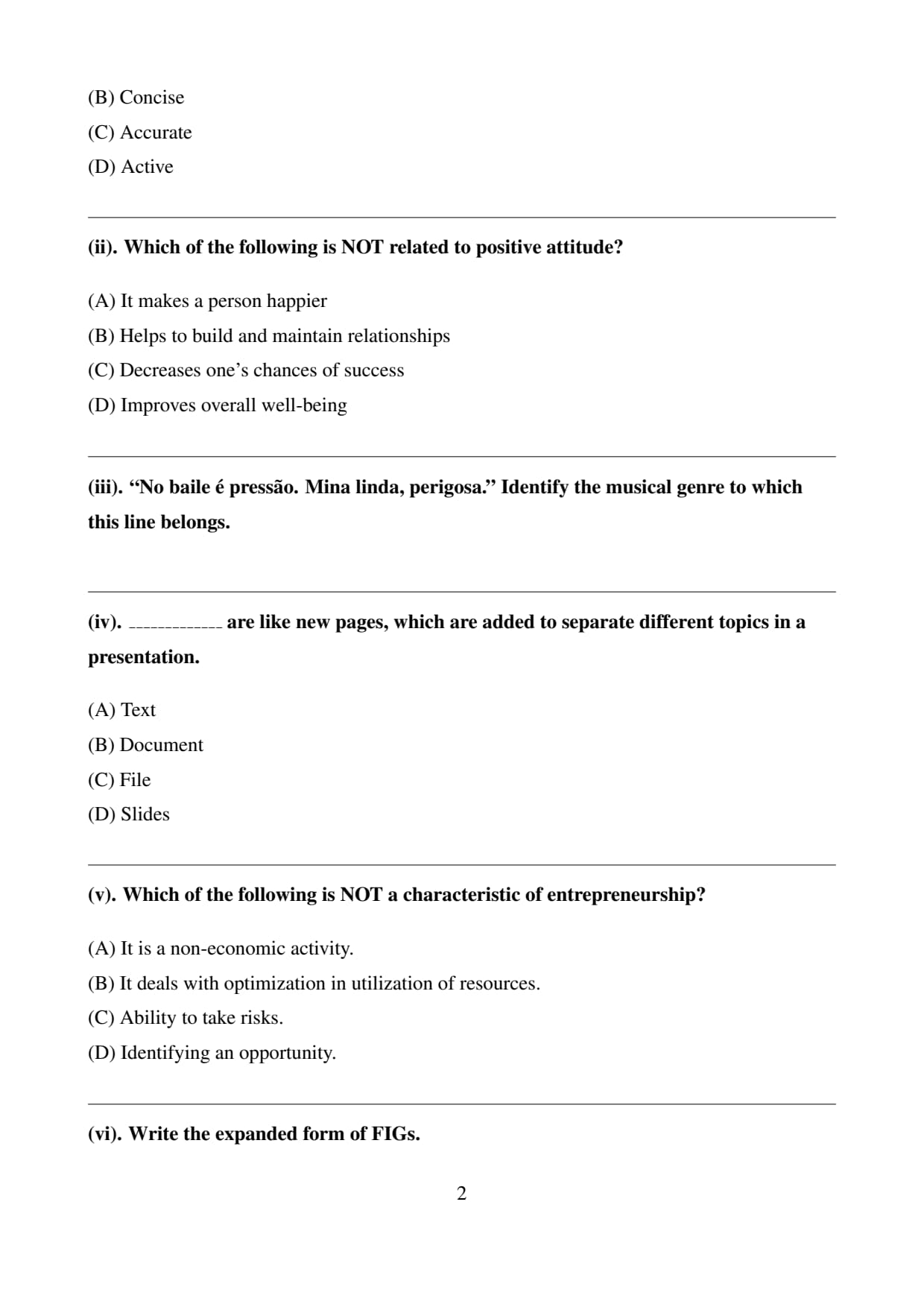
Which of the following is NOT related to positive attitude?
View Solution
Step 1: Understanding positive attitude.
Positive attitude ka matlab hota hai optimistic thinking, confidence aur constructive behavior. Yeh ek person ko life me better decisions lene aur challenges ko effectively handle karne me help karta hai.
Step 2: Effects of positive attitude.
Positive attitude generally happiness increase karta hai, relationships improve karta hai aur success ke chances ko badhata hai. Yeh overall mental aur emotional well-being ko bhi enhance karta hai.
Step 3: Analysis of options.
(A) It makes a person happier: Correct relation hai, kyunki positive attitude happiness increase karta hai.
(B) Helps to build and maintain relationships: Correct hai, positive mindset se relationships strong bante hain.
(C) Decreases one’s chances of success: Incorrect relation hai, kyunki positive attitude success ke chances ko kam nahi, balki badhata hai.
(D) Improves overall well-being: Yeh bhi positive attitude ka important benefit hai.
Step 4: Conclusion.
Isliye option (C) hi aisa statement hai jo positive attitude se related nahi hai.
Final Answer: Decreases one’s chances of success. Quick Tip: Positive attitude hamesha growth, success aur better relationships se juda hota hai. Agar koi option negative outcome batata hai, toh wo correct answer ho sakta hai.
“No baile é pressão. Mina linda, perigosa.” Identify the musical genre to which this line belongs.
View Solution
Step 1: Understand the context of the sentence.
The given line uses informal language and slang such as “baile”, “mina”, and “pressão”, which are commonly used in Brazilian urban culture.
Step 2: Identify cultural references.
The term “baile” often refers to “baile funk”, a popular party culture associated with Brazilian music, especially in Rio de Janeiro.
Step 3: Analyze the style of expression.
The short, rhythmic phrasing and use of street-style expressions are characteristic of Funk music rather than classical or formal genres.
Step 4: Relate to known music genres.
Although hip-hop also uses slang, the specific references like “baile” strongly point toward Funk Carioca (Brazilian Funk), which is distinct in style and context.
Step 5: Conclude the genre.
Thus, the sentence belongs to the Funk (Funk Carioca) musical genre.
Quick Tip: Words like “baile”, “mina”, and rhythmic slang-heavy lines are strong indicators of Brazilian Funk music.
______ are like new pages, which are added to separate different topics in a presentation.
View Solution
Step 1: Understanding the concept.
The question refers to presentation software (like PowerPoint), where content is divided into separate sections or pages to organize information effectively.
Step 2: Analyzing the options.
(A) Text: Text is content written on a page, not the page itself.
(B) Document: A document is a complete file, not individual pages within a presentation.
(C) File: A file is the entire saved presentation, not its parts.
(D) Slides: Correct. Slides are individual pages in a presentation used to separate and present different topics.
Step 3: Conclusion.
Thus, in a presentation, different topics are separated using slides.
Final Answer: Slides. Quick Tip: In presentation software like PowerPoint or Google Slides, each page is called a \textbf{slide}, and each slide represents a separate idea or topic.
Which of the following is NOT a characteristic of entrepreneurship?
View Solution
Step 1: Understanding entrepreneurship.
Entrepreneurship ka matlab hota hai naye business ideas ko identify karna, resources ko efficiently use karna aur profit earn karne ke liye risk lena. Yeh ek economic activity hai jo value creation aur wealth generation se judi hoti hai.
Step 2: Key characteristics of entrepreneurship.
Entrepreneurship ke important features hote hain: opportunity identification, risk-taking ability, innovation aur efficient use of resources. Yeh sab economic activities ka part hote hain.
Step 3: Analysis of options.
(A) It is a non-economic activity: Incorrect statement, kyunki entrepreneurship clearly ek economic activity hai jo profit aur value creation se related hai.
(B) Optimization in utilization of resources: Correct characteristic hai, kyunki entrepreneur resources ka best use karta hai.
(C) Ability to take risks: Yeh entrepreneurship ka core feature hai.
(D) Identifying an opportunity: Yeh bhi essential characteristic hai, kyunki business opportunity identify karna entrepreneurship ka starting point hota hai.
Step 4: Conclusion.
Isliye option (A) hi aisa statement hai jo entrepreneurship ka characteristic nahi hai.
Final Answer: It is a non-economic activity. Quick Tip: Entrepreneurship hamesha economic activity hoti hai jisme profit earning, risk-taking aur resource utilization shamil hote hain.
Write the expanded form of FIGs.
View Solution
Step 1: Identify the abbreviation.
The term “FIGs” is an abbreviation commonly used in the field of finance and banking.
Step 2: Expand the abbreviation.
FIG stands for Financial Institutions Group.
Step 3: Understand its usage.
It is used to refer to a group or division that deals with financial institutions such as banks, insurance companies, and investment firms.
Step 4: Note the plural form.
“FIGs” is simply the plural form, indicating multiple Financial Institutions Groups.
Step 5: State the final answer.
Thus, the expanded form of FIGs is Financial Institutions Group.
Quick Tip: Remember: FIG = Financial Institutions Group, commonly used in banking and finance sectors.
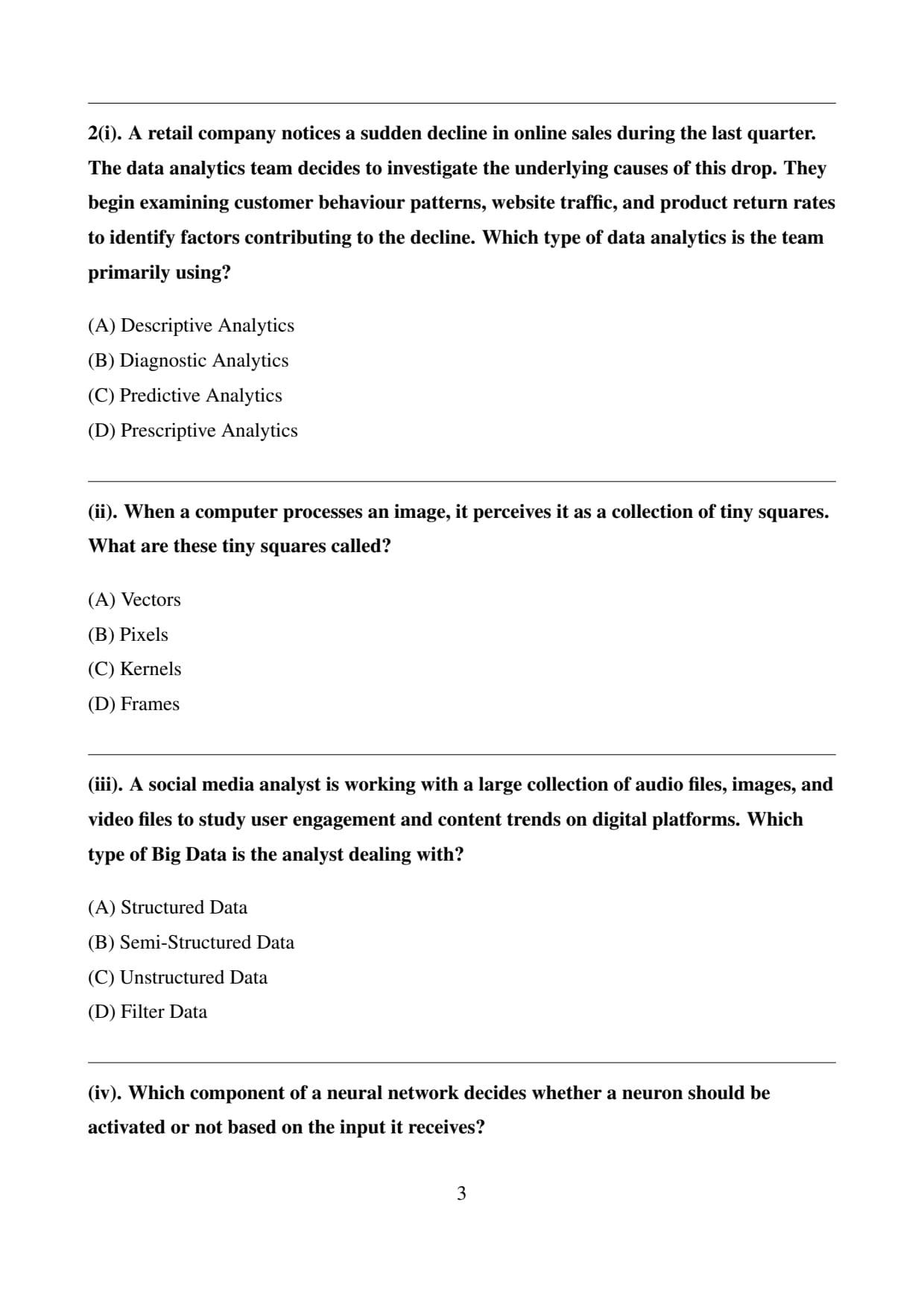
A retail company notices a sudden decline in online sales during the last quarter. The data analytics team decides to investigate the underlying causes of this drop. They begin examining customer behaviour patterns, website traffic, and product return rates to identify factors contributing to the decline. Which type of data analytics is the team primarily using?
View Solution
Step 1: Understanding the scenario.
The company is experiencing a decline in sales and is trying to find the reasons behind it by analyzing various factors such as customer behavior, traffic, and return rates.
Step 2: Understanding types of analytics.
Descriptive Analytics: Tells what has happened in the past.
Diagnostic Analytics: Explains why something happened.
Predictive Analytics: Forecasts future trends.
Prescriptive Analytics: Suggests actions to take.
Step 3: Matching with the scenario.
Since the team is investigating the cause of the decline, they are focusing on understanding why it happened, which is the main goal of diagnostic analytics.
Step 4: Conclusion.
Thus, the correct type of analytics being used is Diagnostic Analytics.
Final Answer: Diagnostic Analytics. Quick Tip: Remember: \textbf{Descriptive = What happened, Diagnostic = Why it happened, Predictive = What will happen, Prescriptive = What should be done}.
When a computer processes an image, it perceives it as a collection of tiny squares. What are these tiny squares called?
View Solution
Step 1: Understanding digital images.
Computer me image ko directly continuous form me nahi samjha jata. Instead, image ko chhote-chhote square units me divide kiya jata hai jisse computer easily process kar sake.
Step 2: Concept of pixels.
In chhote squares ko pixels kaha jata hai (Picture Elements). Har pixel ek specific color aur intensity represent karta hai. Jitne zyada pixels honge, utni hi image ki quality aur resolution better hogi.
Step 3: Analysis of options.
(A) Vectors: Incorrect. Vectors mathematical representation hote hain, image ke tiny squares nahi.
(B) Pixels: Correct. Image ke smallest units pixels hote hain.
(C) Kernels: Incorrect. Kernel image processing me filters ke liye use hota hai, squares nahi.
(D) Frames: Incorrect. Frames video ke context me use hote hain, image ke basic units nahi.
Step 4: Conclusion.
Isliye image ke tiny squares ko pixels kaha jata hai.
Final Answer: Pixels. Quick Tip: Image resolution = number of pixels. Zyada pixels hone par image zyada clear aur detailed hoti hai.
A social media analyst is working with a large collection of audio files, images, and video files to study user engagement and content trends on digital platforms. Which type of Big Data is the analyst dealing with?
View Solution
Step 1: Understanding the data type.
The question involves audio, images, and videos, which do not follow a fixed structure like tables or databases.
Step 2: Types of Big Data.
(A) Structured Data: Organized in tables with rows and columns.
(B) Semi-Structured Data: Has partial structure (like XML or JSON).
(C) Unstructured Data: Correct. Includes audio, images, and videos without predefined format.
(D) Filter Data: Not a recognized category of Big Data.
Step 3: Conclusion.
Hence, the analyst is dealing with unstructured data.
Final Answer: Unstructured Data. Quick Tip: Data like images, videos, and audio that do not fit into tables or predefined formats are called \textbf{unstructured data}.
Which component of a neural network decides whether a neuron should be activated or not based on the input it receives?
View Solution
Step 1: Understanding neural networks.
In a neural network, each neuron processes input signals and decides whether to pass the signal forward.
Step 2: Role of components.
(A) Activation Function: Correct. It determines whether the neuron activates (fires) or not.
(B) Bias: Adjusts output but does not decide activation alone.
(C) Weight: Represents importance of inputs.
(D) Neuron: Basic unit, not the decision-making function.
Step 3: Conclusion.
Thus, the activation function controls whether a neuron activates or not.
Final Answer: Activation Function. Quick Tip: Activation functions like ReLU, Sigmoid, and Tanh introduce non-linearity and decide neuron activation.
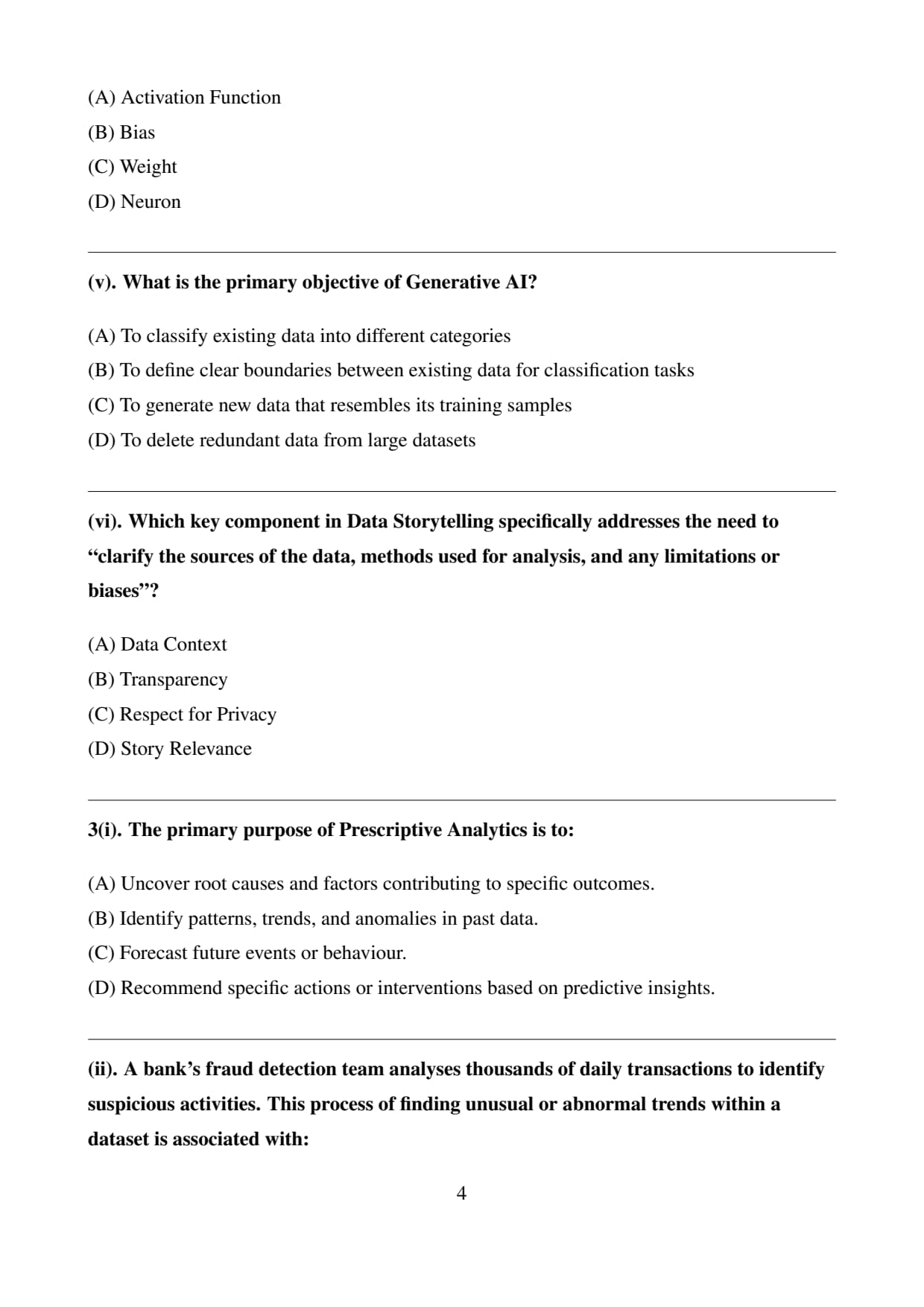
What is the primary objective of Generative AI?
View Solution
Step 1: Understanding Generative AI.
Generative AI focuses on creating new content such as text, images, audio, or video based on patterns learned from training data.
Step 2: Evaluating options.
(A): Classification task, not generative.
(B): Related to classification boundaries.
(C): Correct. Generative AI creates new data similar to training data.
(D): Data cleaning, not generation.
Step 3: Conclusion.
Thus, the primary objective of Generative AI is to generate new data resembling training samples.
Final Answer: To generate new data that resembles its training samples. Quick Tip: Generative AI models like ChatGPT and DALL·E create new content based on learned patterns.
Which key component in Data Storytelling specifically addresses the need to “clarify the sources of the data, methods used for analysis, and any limitations or biases”?
View Solution
Step 1: Understanding Data Storytelling components.
Data storytelling me different components hote hain jo ensure karte hain ki data clearly aur ethically present ho. Inme clarity, relevance, privacy aur transparency jaise factors important hote hain.
Step 2: Meaning of transparency.
Transparency ka matlab hota hai data ke sources, analysis methods aur possible limitations ko clearly disclose karna. Isse audience ko trust build hota hai aur wo data ko better samajh paate hain.
Step 3: Analysis of options.
(A) Data Context: Yeh data ka background batata hai, lekin sources aur limitations ko specifically address nahi karta.
(B) Transparency: Correct. Yeh directly data sources, methods aur biases ko explain karta hai.
(C) Respect for Privacy: Yeh personal data protection se related hai, analysis explanation se nahi.
(D) Story Relevance: Yeh content ki usefulness se related hai, transparency se nahi.
Step 4: Conclusion.
Isliye jo component data sources, methods aur limitations ko clarify karta hai, wo Transparency hai.
Final Answer: Transparency. Quick Tip: Data storytelling me trust build karne ke liye transparency bahut important hoti hai—hamesha data ke source aur limitations mention karein.
The primary purpose of Prescriptive Analytics is to:
View Solution
Step 1: Understanding types of analytics.
Analytics ke 4 main types hote hain: Descriptive (past data), Diagnostic (causes), Predictive (future forecasting) aur Prescriptive (decision making).
Step 2: Meaning of prescriptive analytics.
Prescriptive analytics ka main aim hota hai recommendations dena—yaani ki “kya action lena chahiye” based on predictive insights aur data analysis.
Step 3: Analysis of options.
(A) Diagnostic analytics ka role hai.
(B) Descriptive analytics ka function hai.
(C) Predictive analytics ka kaam hai.
(D) Correct. Prescriptive analytics actionable recommendations deta hai.
Step 4: Conclusion.
Isliye prescriptive analytics ka main purpose recommendations dena hota hai.
Final Answer: Recommend actions based on insights. Quick Tip: Prescriptive Analytics = “What should we do?” (Action-oriented insights).
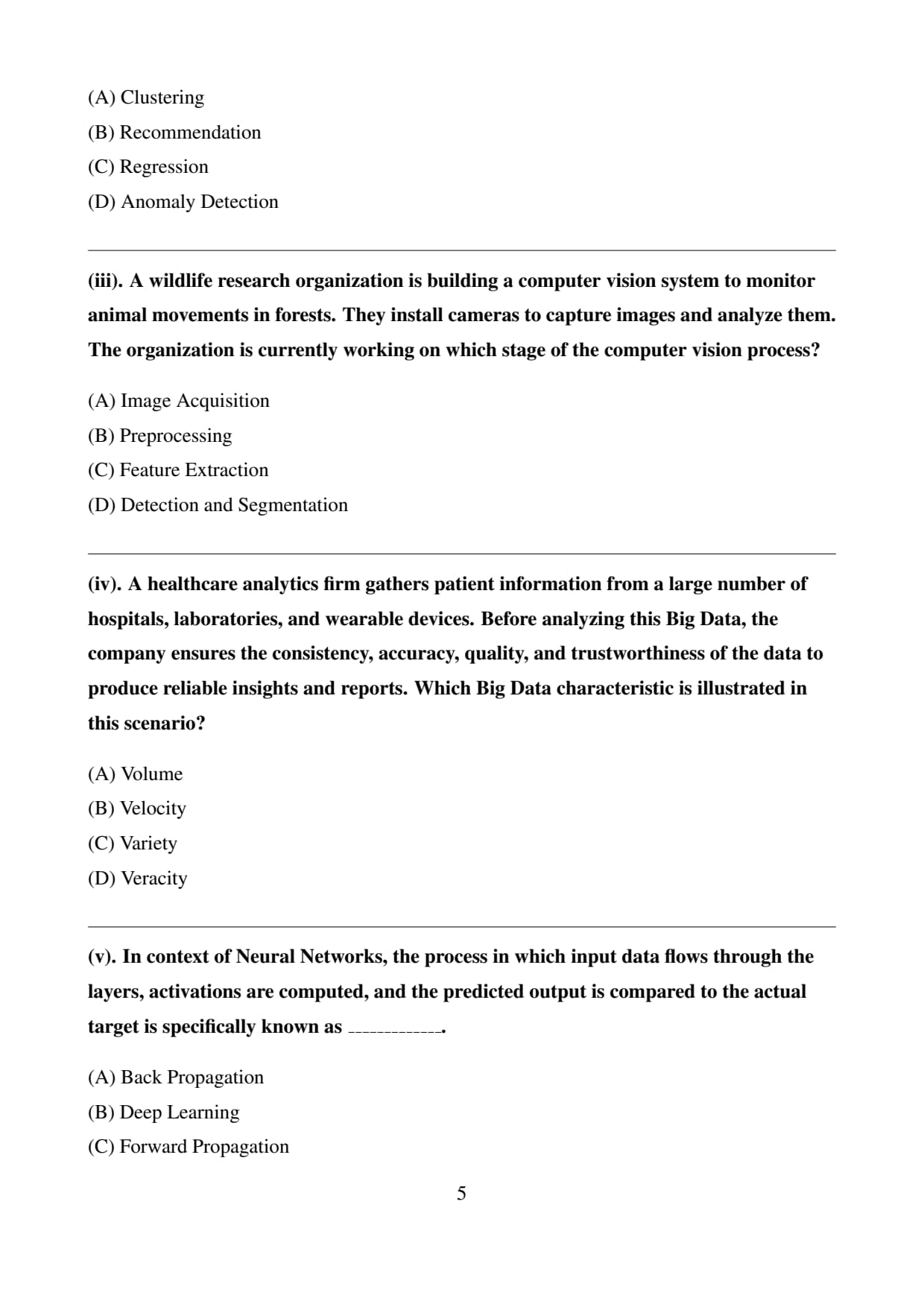
A bank’s fraud detection team analyses thousands of daily transactions to identify suspicious activities. This process of finding unusual or abnormal trends within a dataset is associated with:
View Solution
Step 1: Understanding the scenario.
Question me fraud detection ki baat ho rahi hai jahan unusual transactions ko identify kiya jata hai jo normal pattern se different hote hain.
Step 2: Concept of anomaly detection.
Anomaly detection ek technique hai jo dataset me unusual ya abnormal patterns ko identify karti hai. Yeh fraud detection, security aur monitoring systems me widely use hoti hai.
Step 3: Analysis of options.
(A) Clustering: Similar data ko group karta hai, anomalies detect nahi karta directly.
(B) Recommendation: Suggestions dene ke liye use hota hai.
(C) Regression: Prediction ke liye use hota hai.
(D) Anomaly Detection: Correct. Yeh abnormal patterns detect karta hai.
Step 4: Conclusion.
Isliye fraud detection ka process anomaly detection se related hai.
Final Answer: Anomaly Detection. Quick Tip: Anomaly detection ka use fraud detection, network security aur fault detection me hota hai.
A wildlife research organization is building a computer vision system to monitor animal movements in forests. They install cameras to capture images and analyze them. The organization is currently working on which stage of the computer vision process?
View Solution
Step 1: Understanding the process.
The organization is installing cameras to capture images of animals in forests, which indicates the initial stage of collecting visual data.
Step 2: Stages of computer vision.
(A) Image Acquisition: Capturing images using cameras or sensors.
(B) Preprocessing: Cleaning or enhancing captured images.
(C) Feature Extraction: Identifying patterns or features in images.
(D) Detection and Segmentation: Identifying and separating objects in images.
Step 3: Conclusion.
Since the focus is on capturing images, the stage is Image Acquisition.
Final Answer: Image Acquisition. Quick Tip: Computer vision starts with \textbf{image acquisition}, followed by preprocessing, feature extraction, and object detection.
A healthcare analytics firm gathers patient information from a large number of hospitals, laboratories, and wearable devices. Before analyzing this Big Data, the company ensures the consistency, accuracy, quality, and trustworthiness of the data to produce reliable insights and reports. Which Big Data characteristic is illustrated in this scenario?
View Solution
Step 1: Understanding the scenario.
The focus is on ensuring data is accurate, consistent, reliable, and trustworthy before analysis.
Step 2: Big Data characteristics.
(A) Volume: Amount of data.
(B) Velocity: Speed of data generation.
(C) Variety: Different types of data.
(D) Veracity: Quality, accuracy, and reliability of data.
Step 3: Conclusion.
Since the scenario emphasizes data quality and trustworthiness, it represents Veracity.
Final Answer: Veracity. Quick Tip: \textbf{Veracity} in Big Data refers to how accurate, reliable, and trustworthy the data is.
In context of Neural Networks, the process in which input data flows through the layers, activations are computed, and the predicted output is compared to the actual target is specifically known as _____ .
View Solution
Step 1: Understanding neural network flow.
The question describes the process where input passes through layers, activations are calculated, and output is generated.
Step 2: Differentiating processes.
(A) Back Propagation: Used to update weights based on error.
(B) Deep Learning: A broader concept, not a specific step.
(C) Forward Propagation: Correct. Input flows forward through the network to produce output.
(D) Optimization: Refers to improving model parameters.
Step 3: Conclusion.
Thus, the described process is Forward Propagation.
Final Answer: Forward Propagation. Quick Tip: \textbf{Forward propagation} computes outputs, while \textbf{backpropagation} updates weights using errors.
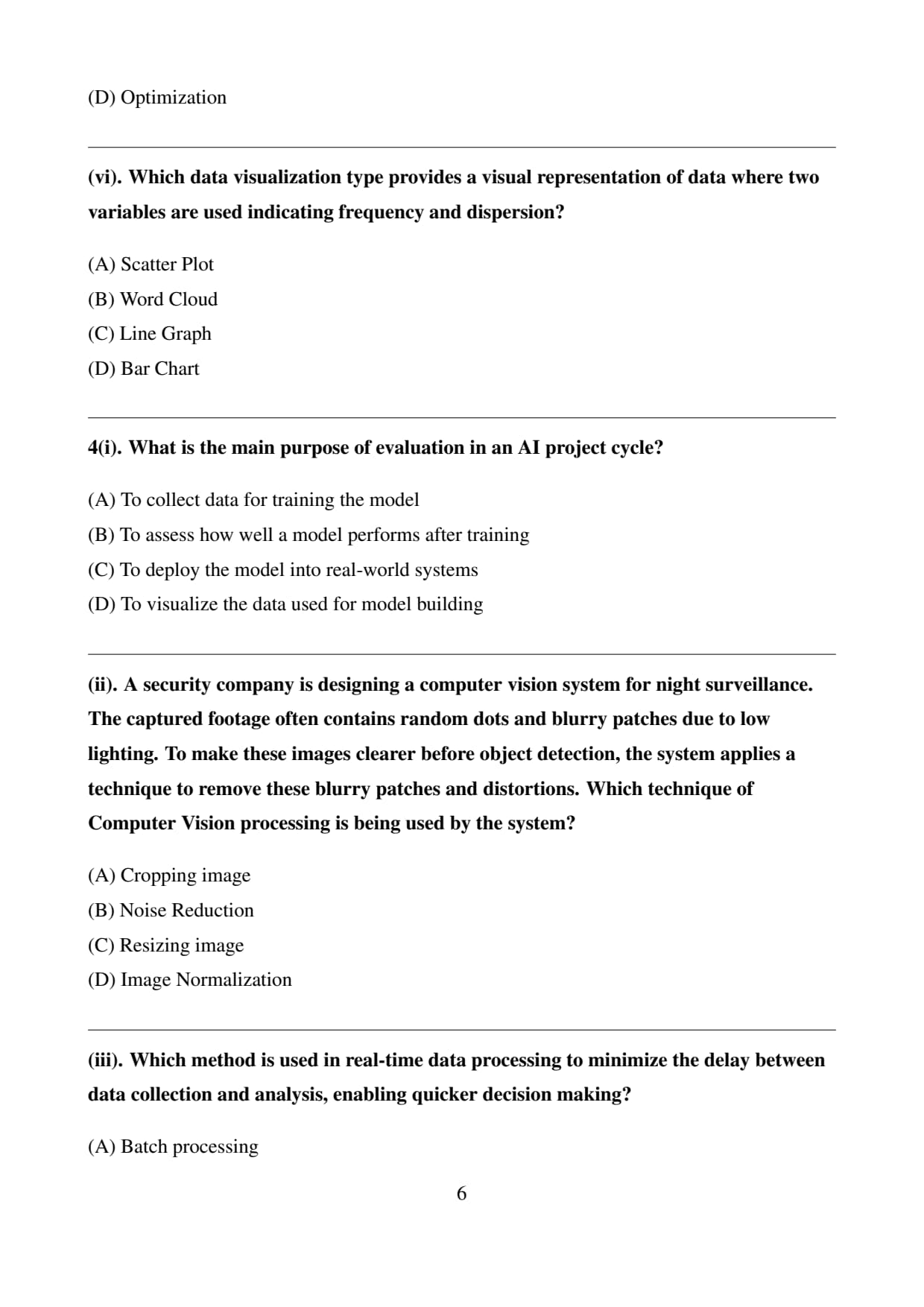
Which data visualization type provides a visual representation of data where two variables are used indicating frequency and dispersion?
View Solution
Step 1: Understanding the requirement.
The question asks for a visualization that shows the relationship between two variables and helps in understanding distribution, frequency, and dispersion.
Step 2: Analyzing the options.
(A) Scatter Plot: Correct. It displays values for two variables and helps visualize correlation and spread.
(B) Word Cloud: Used for text frequency visualization.
(C) Line Graph: Shows trends over time.
(D) Bar Chart: Compares categorical data.
Step 3: Conclusion.
Thus, the correct visualization is Scatter Plot.
Final Answer: Scatter Plot. Quick Tip: Scatter plots are useful for identifying relationships, correlations, and patterns between two variables.
What is the main purpose of evaluation in an AI project cycle?
View Solution
Step 1: Understanding evaluation.
Evaluation in AI refers to checking the performance of a trained model using test data and performance metrics.
Step 2: Analyzing options.
(A): Data collection is part of data preparation.
(B): Correct. Evaluation measures model performance after training.
(C): Deployment is a later stage.
(D): Visualization is part of data analysis.
Step 3: Conclusion.
Thus, evaluation is used to assess model performance after training.
Final Answer: To assess how well a model performs after training. Quick Tip: Evaluation metrics like accuracy, precision, recall, and F1-score help measure model performance.
A security company is designing a computer vision system for night surveillance. The captured footage often contains random dots and blurry patches due to low lighting. To make these images clearer before object detection, the system applies a technique to remove these blurry patches and distortions. Which technique of Computer Vision processing is being used by the system?
View Solution
Step 1: Understanding the problem.
The images contain random dots and distortions caused by low lighting conditions, which are referred to as noise.
Step 2: Identifying the technique.
(A) Cropping: Removes parts of an image.
(B) Noise Reduction: Correct. Removes unwanted distortions and improves image clarity.
(C) Resizing: Changes image dimensions.
(D) Normalization: Adjusts pixel intensity values.
Step 3: Conclusion.
Thus, the technique used to remove distortions is Noise Reduction.
Final Answer: Noise Reduction. Quick Tip: Noise reduction techniques like smoothing filters help improve image quality before further processing.
Which method is used in real-time data processing to minimize the delay between data collection and analysis, enabling quicker decision making?
View Solution
Step 1: Understanding real-time processing.
Real-time data processing ka matlab hota hai data ko turant process karna jaise hi wo generate hota hai, bina delay ke.
Step 2: Concept of stream processing.
Stream processing ek technique hai jisme data continuous flow me process hota hai. Yeh real-time insights provide karta hai aur delay ko minimize karta hai.
Step 3: Analysis of options.
(A) Batch processing: Data ko ek saath process karta hai, real-time nahi.
(B) Stream processing: Correct. Real-time processing ke liye use hota hai.
(C) Predictive analysis: Future prediction ke liye hota hai, processing method nahi.
(D) Descriptive analysis: Past data analysis ke liye use hota hai.
Step 4: Conclusion.
Isliye real-time processing ke liye stream processing use hota hai.
Final Answer: Stream processing. Quick Tip: Real-time systems jaise stock market aur fraud detection me stream processing ka use hota hai.
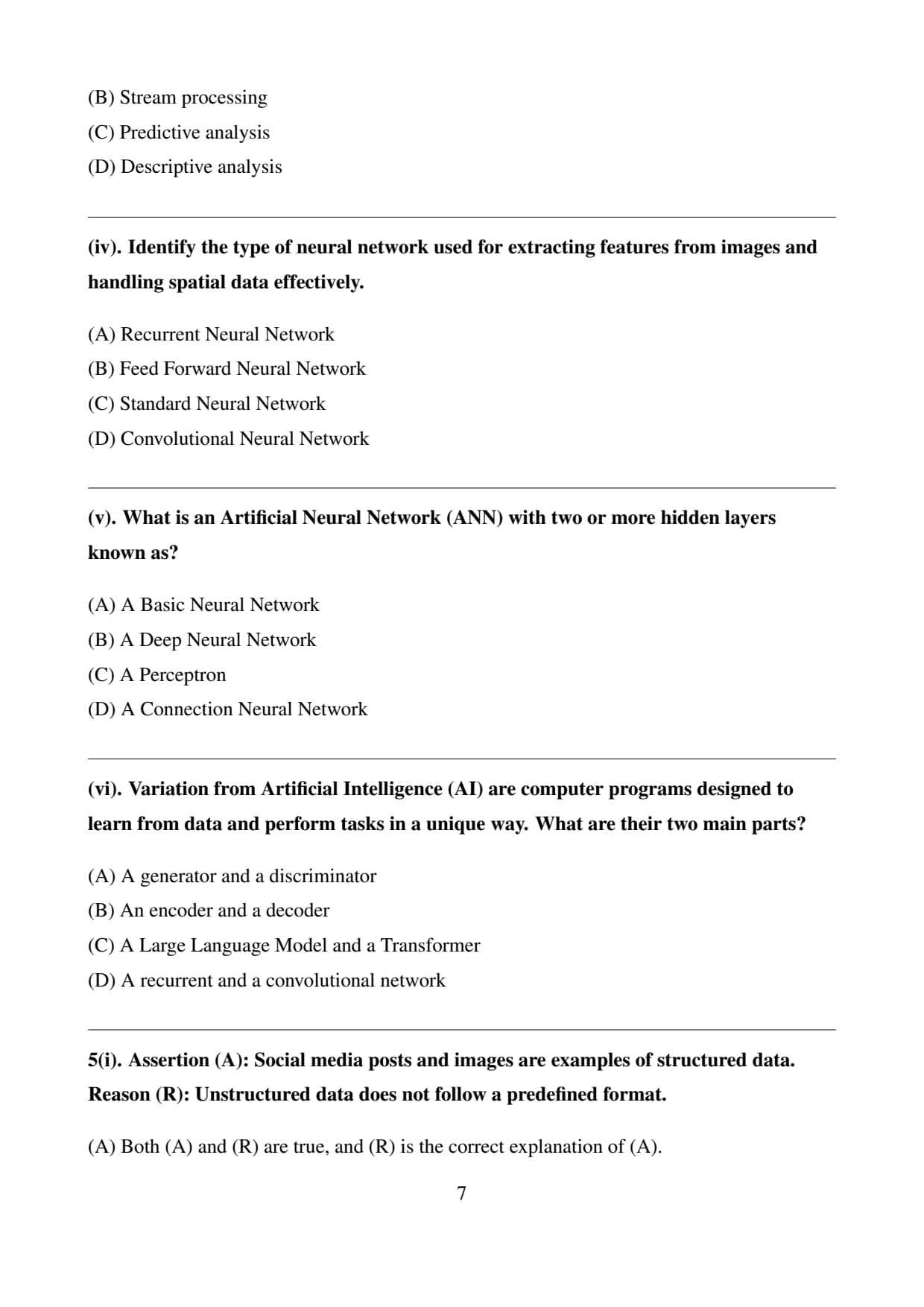
Identify the type of neural network used for extracting features from images and handling spatial data effectively.
View Solution
Step 1: Understanding the problem.
Question me image processing aur spatial data ki baat ho rahi hai. Humein aisa neural network identify karna hai jo images se features extract kar sake.
Step 2: Concept of CNN.
Convolutional Neural Network (CNN) specially design kiya gaya hai image processing ke liye. Yeh filters aur convolution operations use karke image ke features (edges, shapes, patterns) detect karta hai.
Step 3: Analysis of options.
(A) RNN: Sequential data ke liye use hota hai (text, time series).
(B) Feed Forward: General purpose network hai, image-specific nahi.
(C) Standard NN: Generic term hai, specific nahi.
(D) CNN: Correct. Image aur spatial data ke liye best suited hai.
Step 4: Conclusion.
Isliye image processing ke liye CNN use hota hai.
Final Answer: Convolutional Neural Network. Quick Tip: CNN = Images + Pattern recognition. Yeh computer vision ka core model hai.
What is an Artificial Neural Network (ANN) with two or more hidden layers known as?
View Solution
Step 1: Understanding ANN structure.
Artificial Neural Network me layers hote hain: input layer, hidden layers aur output layer. Hidden layers data processing me important role play karte hain.
Step 2: Concept of deep neural network.
Jab ek ANN me multiple (2 ya usse zyada) hidden layers hote hain, tab use Deep Neural Network (DNN) kaha jata hai. Yeh complex patterns ko learn karne me capable hota hai.
Step 3: Analysis of options.
(A) Basic NN: Simple network hota hai, deep nahi.
(B) Deep NN: Correct. Multiple hidden layers wale networks ko deep kaha jata hai.
(C) Perceptron: Single-layer model hota hai.
(D) Connection NN: Standard term nahi hai.
Step 4: Conclusion.
Isliye multiple hidden layers wale ANN ko Deep Neural Network kaha jata hai.
Final Answer: A Deep Neural Network. Quick Tip: “Deep” ka matlab hota hai multiple hidden layers—jitni zyada layers, utni complex learning.
Variation from Artificial Intelligence (AI) are computer programs designed to learn from data and perform tasks in a unique way. What are their two main parts?
View Solution
Step 1: Understanding the concept.
The question refers to a type of AI model that learns in a unique way by generating and evaluating data, commonly known as Generative Adversarial Networks (GANs).
Step 2: Components of GAN.
Generator: Creates new data samples similar to training data.
Discriminator: Evaluates whether the generated data is real or fake.
Step 3: Evaluating options.
(A): Correct. GAN consists of a generator and a discriminator.
(B): Used in autoencoders.
(C): Refers to NLP models.
(D): Types of neural networks, not components of GAN.
Step 4: Conclusion.
Thus, the two main parts are generator and discriminator.
Final Answer: A generator and a discriminator. Quick Tip: GANs work like a game: the generator tries to fool the discriminator, and the discriminator tries to detect fake data.
Assertion (A): Social media posts and images are examples of structured data.
Reason (R): Unstructured data does not follow a predefined format.
View Solution
Step 1: Understanding Assertion.
Social media posts and images do not follow a structured format like tables, so they are examples of unstructured data, not structured data. Hence, Assertion (A) is false.
Step 2: Understanding Reason.
Unstructured data is defined as data that does not follow a predefined format. This statement is correct.
Step 3: Conclusion.
Thus, Assertion (A) is false, but Reason (R) is true.
Final Answer: (C) Quick Tip: Examples of unstructured data include images, videos, audio, and social media posts.
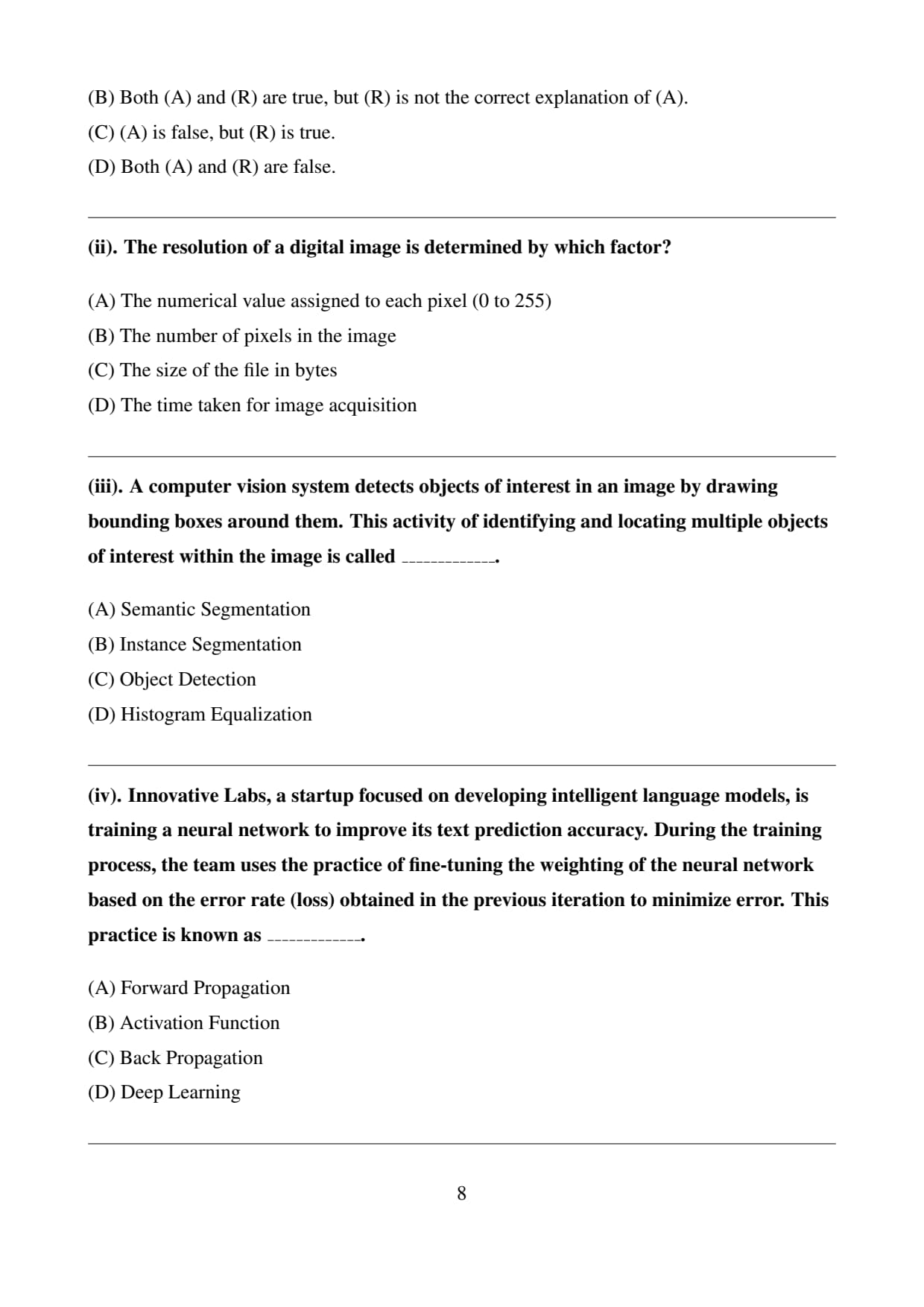
The resolution of a digital image is determined by which factor?
View Solution
Step 1: Understanding image resolution.
Image resolution refers to the amount of detail an image holds, which depends on the number of pixels used to form the image.
Step 2: Evaluating options.
(A): Refers to pixel intensity, not resolution.
(B): Correct. More pixels mean higher resolution and better detail.
(C): File size depends on compression and format.
(D): Not related to resolution.
Step 3: Conclusion.
Thus, resolution is determined by the number of pixels in the image.
Final Answer: The number of pixels in the image. Quick Tip: Higher pixel count means better image clarity and resolution.
A computer vision system detects objects of interest in an image by drawing bounding boxes around them. This activity of identifying and locating multiple objects of interest within the image is called _____ .
View Solution
Step 1: Understanding the task.
The system is identifying objects and drawing bounding boxes around them, which indicates both localization and classification.
Step 2: Analyzing options.
(A) Semantic Segmentation: Labels each pixel but does not draw bounding boxes.
(B) Instance Segmentation: Identifies each object separately at pixel level.
(C) Object Detection: Correct. Detects and localizes objects using bounding boxes.
(D) Histogram Equalization: Enhances image contrast.
Step 3: Conclusion.
Thus, the described activity is Object Detection.
Final Answer: Object Detection. Quick Tip: Object detection identifies and locates objects using bounding boxes, while segmentation works at pixel level.
Innovative Labs, a startup focused on developing intelligent language models, is training a neural network to improve its text prediction accuracy. During the training process, the team uses the practice of fine-tuning the weighting of the neural network based on the error rate (loss) obtained in the previous iteration to minimize error. This practice is known as _______ .
View Solution
Step 1: Understanding the process.
The question describes adjusting weights of a neural network based on the error (loss) from previous output.
Step 2: Key concept.
Backpropagation is the algorithm used to update weights by propagating the error backward through the network to minimize loss.
Step 3: Evaluating options.
(A): Forward propagation computes output, not error correction.
(B): Activation function decides neuron output.
(C): Correct. Backpropagation updates weights using error.
(D): Deep learning is a broader concept.
Step 4: Conclusion.
Thus, the process is Back Propagation.
Final Answer: Back Propagation. Quick Tip: Backpropagation helps neural networks learn by minimizing error through weight adjustment.
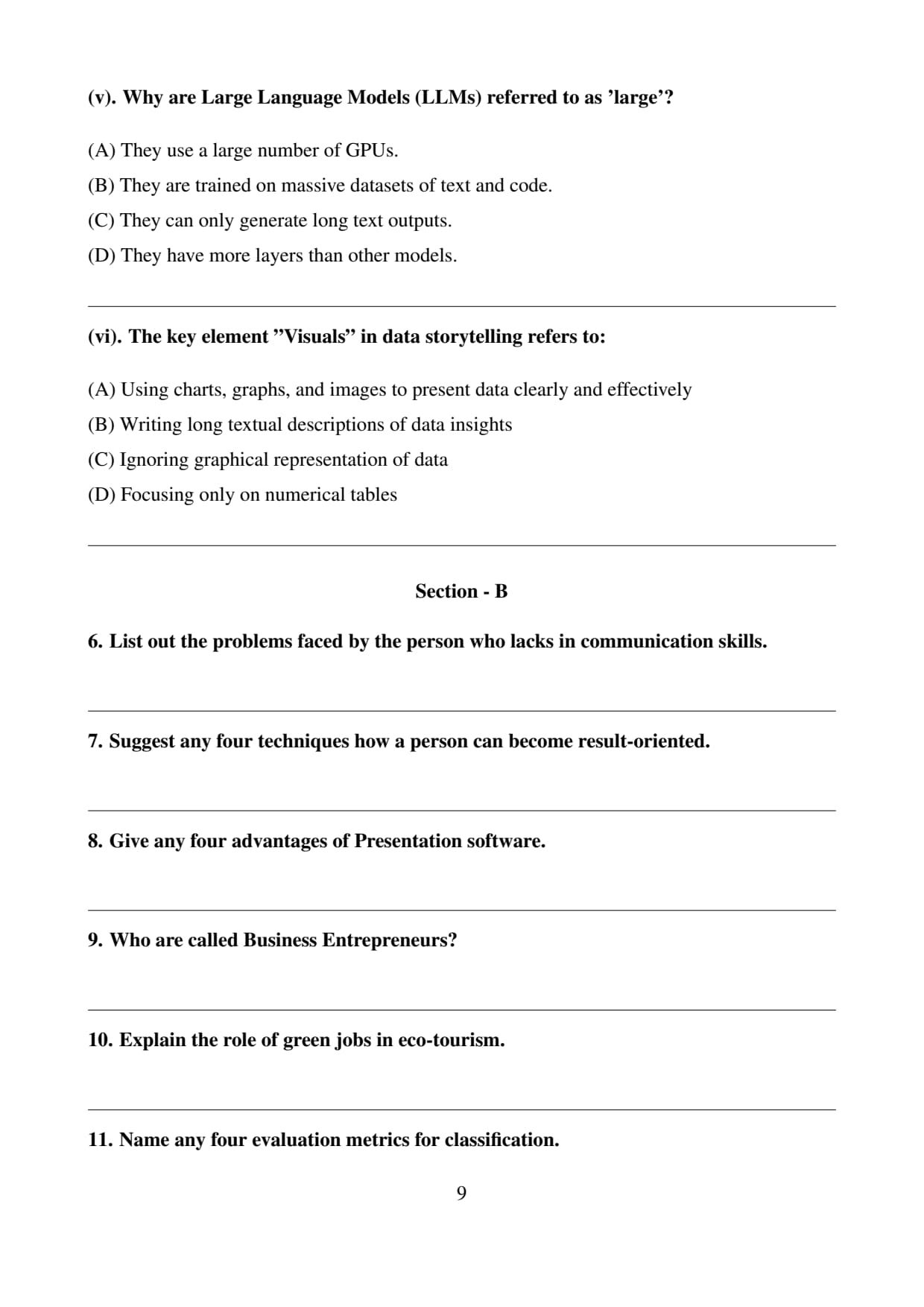
Why are Large Language Models (LLMs) referred to as 'large'?
View Solution
Step 1: Understanding LLMs.
Large Language Models are called "large" because they are trained on vast amounts of data and contain a large number of parameters.
Step 2: Evaluating options.
(A): Hardware usage is not the defining factor.
(B): Correct. LLMs are trained on massive datasets of text and code.
(C): Output length is not the reason.
(D): Depth contributes but is not the primary reason.
Step 3: Conclusion.
Thus, LLMs are referred to as "large" mainly because of the vast data they are trained on.
Final Answer: They are trained on massive datasets of text and code. Quick Tip: LLMs are "large" due to both massive training data and billions of parameters.
The key element "Visuals" in data storytelling refers to:
View Solution
Step 1: Understanding data storytelling.
Data storytelling ka main objective hota hai data ko aise present karna ki audience easily samajh sake. Isme visuals ka role bahut important hota hai.
Step 2: Meaning of visuals.
Visuals ka matlab hota hai charts, graphs, images, dashboards etc. jo complex data ko simple aur clear format me represent karte hain. Yeh understanding ko fast aur effective banata hai.
Step 3: Analysis of options.
(A) Correct. Visuals ka use data ko clearly represent karne ke liye hota hai.
(B) Incorrect. Yeh textual explanation hai, visuals nahi.
(C) Incorrect. Visuals ko ignore karna data storytelling ka opposite hai.
(D) Incorrect. Sirf tables par focus karna visuals ka purpose fulfill nahi karta.
Step 4: Conclusion.
Isliye visuals ka main purpose data ko graphs aur charts ke through clearly present karna hota hai.
Final Answer: Using charts, graphs, and images. Quick Tip: Visuals complex data ko simple banate hain—“A good graph is worth a thousand numbers.”
List out the problems faced by the person who lacks in communication skills.
View Solution
Step 1: Understand communication skills.
Communication skills involve the ability to express ideas clearly, listen effectively, and interact appropriately with others.
Step 2: Identify workplace problems.
A person lacking communication skills may face misunderstandings, inability to convey ideas properly, and difficulty in teamwork.
Step 3: Identify personal and social issues.
Such individuals may struggle to build relationships, lack confidence, and face social isolation.
Step 4: Identify career-related problems.
They may face poor job performance, limited career growth, and difficulty in leadership roles.
Step 5: Summarize the problems.
Thus, lack of communication skills leads to misunderstandings, low confidence, poor relationships, and limited career opportunities.
Quick Tip: Good communication skills are essential for success in personal life, teamwork, and career growth.
Suggest any four techniques how a person can become result-oriented.
View Solution
Step 1: Set clear goals.
Define specific, measurable, and achievable goals to stay focused.
Step 2: Plan and prioritize tasks.
Organize tasks based on importance and deadlines to improve efficiency.
Step 3: Maintain discipline and consistency.
Stay committed to completing tasks regularly without procrastination.
Step 4: Monitor progress.
Regularly review performance and make improvements where necessary.
Step 5: Stay motivated.
Keep a positive mindset and focus on achieving desired outcomes.
Quick Tip: Being result-oriented means focusing on outcomes rather than just activities.
Give any four advantages of Presentation software.
View Solution
Step 1: Enhances visual communication.
Presentation software helps in using images, charts, and graphics for better understanding.
Step 2: Organizes content effectively.
It allows information to be structured into slides for clarity.
Step 3: Improves audience engagement.
Animations and multimedia make presentations more interesting.
Step 4: Easy editing and sharing.
Presentations can be easily edited, saved, and shared digitally.
Step 5: Supports professional delivery.
It helps presenters deliver information confidently and professionally.
Quick Tip: Use visuals and minimal text in slides to make presentations more effective.
Who are called Business Entrepreneurs?
View Solution
Step 1: Understand the term Entrepreneur.
Entrepreneur wo vyakti hota hai jo naye business ideas ko identify karta hai aur unhe reality mein convert karta hai.
Step 2: Define Business Entrepreneurs.
Business Entrepreneurs un logon ko kaha jata hai jo profit earning ke objective se business start karte hain aur usko manage aur expand karte hain.
Step 3: Role of risk and innovation.
Ye log risk lete hain, capital invest karte hain aur naye products ya services introduce karte hain market mein.
Step 4: Value creation.
Business entrepreneurs employment generate karte hain, economy ko grow karte hain aur customer needs ko satisfy karte hain.
Step 5: Conclusion.
Isliye, jo vyakti business establish karta hai, risk leta hai aur profit earn karne ke liye usko operate karta hai, use Business Entrepreneur kaha jata hai.
Quick Tip: Remember: Entrepreneur = Risk taker + Innovator + Business creator. Profit ke liye business chalana iska main goal hota hai.
Explain the role of green jobs in eco-tourism.
View Solution
Step 1: Define green jobs.
Green jobs are employment opportunities that contribute to preserving or restoring the environment.
Step 2: Link with eco-tourism.
Eco-tourism focuses on responsible travel to natural areas, conserving the environment and improving local well-being.
Step 3: Role in environmental conservation.
Green jobs help in protecting biodiversity, managing waste, and reducing pollution in tourist areas.
Step 4: Support local communities.
They create sustainable livelihood opportunities for local people, such as eco-guides and conservation workers.
Step 5: Promote sustainable tourism.
They ensure that tourism activities are eco-friendly and do not harm natural resources.
Quick Tip: Green jobs make eco-tourism sustainable by balancing economic growth with environmental protection.
Name any four evaluation metrics for classification.
View Solution
Step 1: Understand classification evaluation.
Evaluation metrics are used to measure the performance of classification models.
Step 2: Accuracy.
Accuracy measures the proportion of correct predictions out of total predictions.
Step 3: Precision.
Precision measures how many of the predicted positive cases are actually correct.
Step 4: Recall.
Recall measures how many actual positive cases are correctly identified.
Step 5: F1-Score.
F1-score is the harmonic mean of precision and recall, providing a balance between them.
Quick Tip: Accuracy alone is not enough—use precision, recall, and F1-score for better evaluation of models.
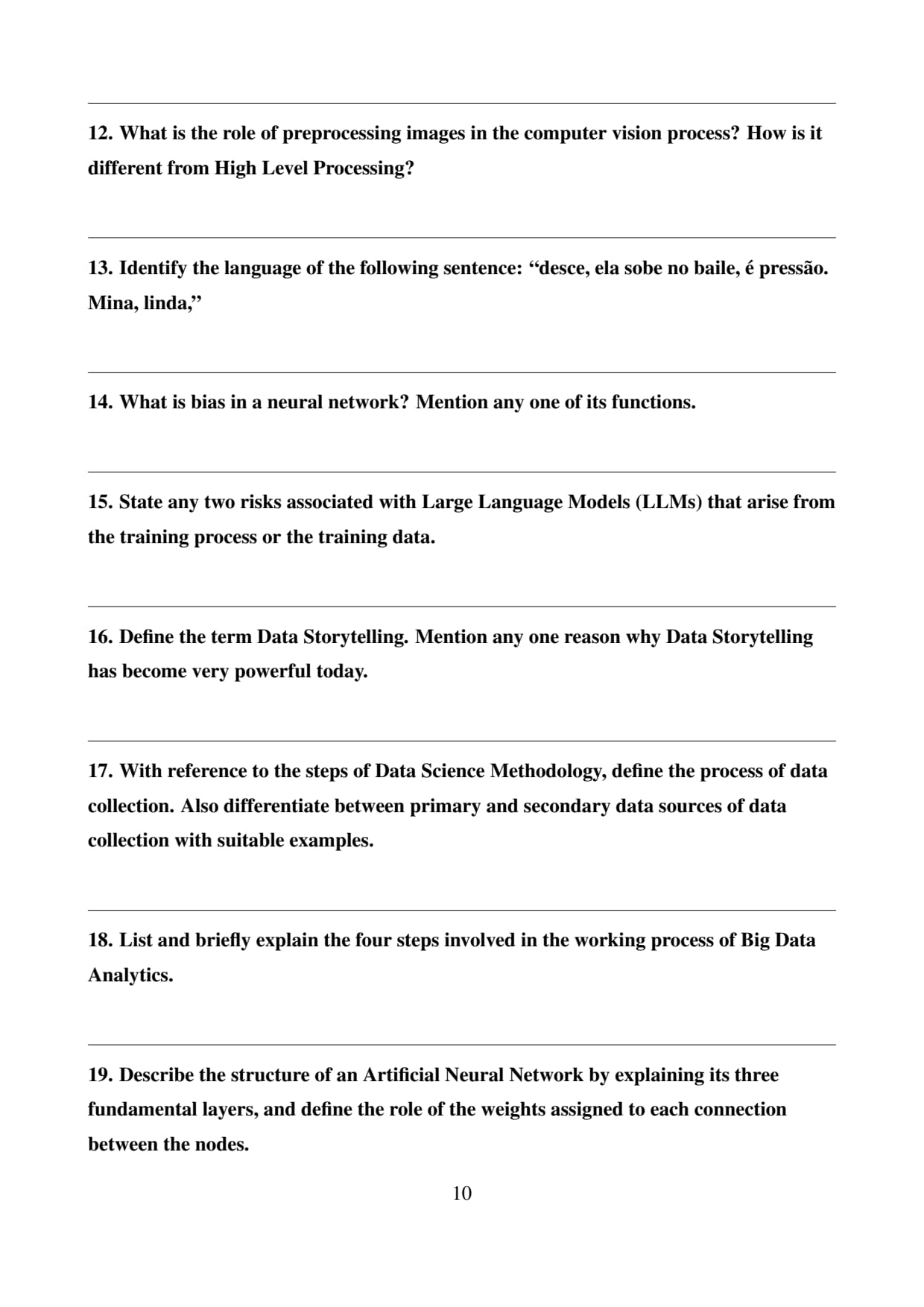
What is the role of preprocessing images in the computer vision process? How is it different from High Level Processing?
View Solution
Step 1: Define preprocessing in computer vision.
Preprocessing involves preparing raw images for further analysis by improving their quality and removing noise.
Step 2: Role of preprocessing.
It includes tasks like resizing, normalization, filtering, and noise reduction to make images suitable for processing.
Step 3: Importance of preprocessing.
It enhances image clarity and helps algorithms perform more accurately and efficiently.
Step 4: Define high-level processing.
High-level processing involves interpreting the image, such as object detection, recognition, and decision-making.
Step 5: Difference between both.
Preprocessing focuses on improving image quality, while high-level processing focuses on extracting meaning and insights from the image.
Quick Tip: Preprocessing improves image quality, whereas high-level processing interprets and understands the image.
Identify the language of the following sentence: “desce, ela sobe no baile, é pressão. Mina, linda,”
View Solution
Step 1: Observe the vocabulary.
The sentence contains words like “ela”, “baile”, “pressão”, “mina”, and “linda”, which are commonly used in a specific language.
Step 2: Identify linguistic patterns.
Words such as “ela” (she), “linda” (beautiful), and “pressão” (pressure) are characteristic of the Portuguese language.
Step 3: Consider accents and spelling.
The presence of accented characters like “ã” in “pressão” further confirms it belongs to Portuguese.
Step 4: Cultural context.
The slang terms like “baile” and “mina” are widely used in Brazilian Portuguese, especially in music and street culture.
Step 5: Conclude the language.
Thus, the given sentence is in Portuguese.
Quick Tip: Look for common words and accents—Portuguese often uses “ão”, “ela”, and “linda”.
What is bias in a neural network? Mention any one of its functions.
View Solution
Step 1: Define bias.
Bias in a neural network is an additional parameter added to the weighted sum of inputs before applying the activation function.
Step 2: Understand its purpose.
It helps the model shift the activation function, allowing the neuron to fit the data better.
Step 3: Mathematical role.
The output of a neuron is calculated as: weighted sum of inputs + bias, which improves flexibility.
Step 4: Function of bias.
Bias allows the neural network to produce a non-zero output even when all input values are zero.
Step 5: Conclude importance.
Thus, bias increases the learning capability and accuracy of the neural network.
Quick Tip: Bias acts like the intercept in linear equations, helping shift the output for better fitting.
State any two risks associated with Large Language Models (LLMs) that arise from the training process or the training data.
View Solution
Step 1: Understand LLM risks.
LLMs are trained on large datasets, which may contain errors, biases, or sensitive information.
Step 2: Bias in training data.
If the training data contains social or cultural biases, the model may produce biased or unfair outputs.
Step 3: Data privacy issues.
Training data may include sensitive or personal information, leading to privacy risks if the model reproduces such data.
Step 4: Misinformation risk.
Models may generate incorrect or misleading information due to imperfect training data.
Step 5: Conclude risks.
Thus, major risks include bias, privacy concerns, and misinformation.
Quick Tip: Always evaluate LLM outputs critically—training data quality directly affects model reliability.
Define the term Data Storytelling. Mention any one reason why Data Storytelling has become very powerful today.
View Solution
Step 1: Define Data Storytelling.
Data Storytelling is the process of presenting data in a meaningful and engaging way using visuals, narratives, and context to communicate insights clearly to the audience.
Step 2: Explain its components.
It combines three key elements: data, visuals (charts/graphs), and narrative (story) to make information easy to understand and impactful.
Step 3: State one reason for its importance.
One major reason why Data Storytelling has become powerful today is the huge increase in data generation, making it necessary to simplify complex data for better decision-making.
Step 4: Explain the impact.
It helps organizations and individuals quickly understand insights, identify trends, and take informed decisions effectively.
Quick Tip: Remember: Data + Visuals + Story = Data Storytelling. It turns complex data into simple and actionable insights.
With reference to the steps of Data Science Methodology, define the process of data collection. Also differentiate between primary and secondary data sources of data collection with suitable examples.
View Solution
Step 1: Define Data Collection.
Data collection is the process of gathering relevant data from various sources to answer a problem or support decision-making in Data Science.
Step 2: Explain its role in methodology.
It is an important step in Data Science Methodology as the quality and accuracy of collected data directly affect the results and insights.
Step 3: Define Primary Data.
Primary data is the data collected directly by the researcher for a specific purpose.
Example: Surveys, interviews, experiments.
Step 4: Define Secondary Data.
Secondary data is the data that has already been collected and published by others.
Example: Government reports, websites, research papers.
Step 5: Key difference.
Primary data is original and specific but time-consuming, whereas secondary data is easily available but may not be fully relevant.
Quick Tip: Primary = First-hand data (you collect)
Secondary = Already available data (others collected)
List and briefly explain the four steps involved in the working process of Big Data Analytics.
View Solution
Step 1: Data Collection.
Large volumes of structured and unstructured data are collected from multiple sources such as social media, sensors, and databases.
Step 2: Data Storage.
The collected data is stored using technologies like Hadoop or cloud storage systems to handle large-scale data efficiently.
Step 3: Data Processing.
Data is cleaned, organized, and processed using tools like MapReduce or Spark to extract useful information.
Step 4: Data Analysis and Visualization.
Processed data is analyzed to identify patterns and insights, and results are presented using charts, dashboards, and reports.
Quick Tip: Big Data Process = Collect → Store → Process → Analyze. This flow helps in turning raw data into valuable insights.
Describe the structure of an Artificial Neural Network by explaining its three fundamental layers, and define the role of the weights assigned to each connection between the nodes.
View Solution
Step 1: Define Artificial Neural Network (ANN).
An Artificial Neural Network (ANN) is a computational model inspired by the human brain, consisting of interconnected nodes (neurons) that process information.
Step 2: Explain Input Layer.
The input layer is the first layer of the network that receives raw data from the external environment. Each neuron in this layer represents a feature of the input data.
Step 3: Explain Hidden Layer.
The hidden layer(s) lie between input and output layers and perform complex computations. These layers process the input using activation functions and extract patterns or relationships.
Step 4: Explain Output Layer.
The output layer produces the final result of the network, such as classification or prediction, based on the processed data.
Step 5: Role of Weights.
Weights are numerical values assigned to connections between neurons. They determine the importance of input signals. During training, these weights are adjusted to minimize error and improve accuracy.
Quick Tip: ANN structure = Input → Hidden → Output. Weights decide how strongly one neuron influences another.
Differentiate between Generative AI and Discriminative AI based on their Purpose, Training Focus, Application, and Models.
View Solution
Step 1: Define Generative AI.
Generative AI focuses on generating new data similar to existing data. It learns the underlying distribution of data to create new outputs.
Step 2: Define Discriminative AI.
Discriminative AI focuses on distinguishing between different classes of data and predicting labels based on input features.
Step 3: Difference in Purpose and Training.
Generative AI models the joint probability and generates data, while Discriminative AI models conditional probability and classifies data.
Step 4: Difference in Applications.
Generative AI is used in image generation, text creation, and chatbots, whereas Discriminative AI is used in classification tasks like spam detection and image recognition.
Step 5: Difference in Models.
Generative models include GANs and VAEs, while Discriminative models include Logistic Regression, SVM, and Neural Networks for classification.
Quick Tip: Generative = Creates data
Discriminative = Classifies data
Define the terms ‘Data’ and ‘Data Visualization’. Explain the uses of the ‘Heat Map’ and ‘Candlestick Chart’ visualization types.
View Solution
Step 1: Define Data.
Data refers to raw facts, figures, or observations collected for analysis and processing.
Step 2: Define Data Visualization.
Data Visualization is the graphical representation of data using charts, graphs, and maps to make information easy to understand.
Step 3: Explain Heat Map.
A Heat Map uses color variations to represent data values. It is used to identify patterns, trends, and intensity in large datasets, such as website activity or temperature variation.
Step 4: Explain Candlestick Chart.
A Candlestick Chart is used in financial analysis to show price movements of stocks. It displays opening, closing, highest, and lowest prices within a time period.
Step 5: Applications.
Heat maps help in quick pattern recognition, while candlestick charts help investors analyze market trends and make trading decisions.
Quick Tip: Heat Map = Color-based pattern analysis
Candlestick = Financial price movement visualization




Comments