




CUET 2026 May 30 Shift 1 Mass Media Question Paper is available for download here. NTA conducted the CUET 2026 exam from 11th May to 31st May.
- CUET 2026 Mass Media exam consists of 50 questions for 250 marks to be attempted in 60 minutes.
- As per the marking scheme, 5 marks are awarded for each correct answer, and 1 mark is deducted for incorrect answer.
Candidates can download CUET 2026 May 30 Shift 1 Mass Media Question Paper with Answer Key and Solution PDF from links provided below.
CUET 2026 Mass Media May 30 Shift 1 Question Paper with Solution PDF
| CUET May 30 Shift 1 Mass Media Question Paper 2026 | Download PDF | Check Solutions |



In 1973, the Supreme Court held that the "Fundamental Rights can be amended but the basic structure of the Constitution cannot be destroyed". Identify the case.
View Solution
Concept:
The doctrine of the "Basic Structure" is a landmark judicial principle in Indian constitutional law.
It restricts the amending power of Parliament under Article 368 so that the foundational philosophy and essential framework of the Constitution cannot be dismantled or altered.
Step 1: Understanding the Historical Context:
Prior to 1973, there was an intense conflict between the Judiciary and the Parliament regarding the scope of amending Fundamental Rights.
In the Golaknath case (1967), the Supreme Court ruled that Parliament had no power to amend Fundamental Rights.
Parliament responded by passing the 24th and 25th Constitutional Amendment Acts, asserting unlimited amending authority under Article 368.
Step 2: The Kesavananda Bharati Ruling:
On April 24, 1973, a historic 13-judge constitutional bench delivered the verdict in Kesavananda Bharati vs. State of Kerala.
By a majority of 7 to 6, the Supreme Court overruled the Golaknath verdict.
The court recognized that Parliament indeed has wide powers to amend any provision of the Constitution, including the Fundamental Rights, but established an indispensable caveat: Parliament cannot alter or destroy the "basic structure" or essential features of the Indian Constitution.
Step 3: Evaluating the Options:
Option (A), Golaknath vs. State of Punjab (1967), ruled that Fundamental Rights could not be amended at all.
Option (B), Kesavananda Bharati vs. State of Kerala (1973), introduced the basic structure doctrine.
Option (C), Romesh Thappar vs. State of Madras (1950), dealt with freedom of speech and the press.
Option (D), Umed Ram Sharma vs. State of Himachal Pradesh (1986), affirmed the right to life encompassing access to roads.
Final Answer:
Therefore, the correct answer is (B) Keshavananda Bharati vs. State of Kerala.
The Hindustan Times Business daily Mint was published in partnership with–?
View Solution
Concept:
International collaborations in Indian print journalism gained substantial momentum in the 2000s, enabling domestic newspapers to syndication-partner with premier global media houses to enhance content quality and prestige.
Step 1: Background of Mint Newspaper:
Mint is a prominent Indian business and financial daily newspaper launched on February 1, 2007, by HT Media Ltd, the publisher of Hindustan Times.
It was introduced in an innovative Berliner format, designed by legendary media designer Mario Garcia, to appeal to young executives and business readers.
Step 2: The International Partnership:
To deliver world-class financial reporting, HT Media entered into a strategic collaboration and exclusive content-sharing agreement with Dow Jones & Company.
Under this exclusive agreement, Mint was published in an editorial partnership with The Wall Street Journal (WSJ).
This partnership allowed Mint to syndicate premium international business news, market analyses, and commentary directly from The Wall Street Journal.
Step 3: Analyzing the Other Options:
The Washington Post and The New York Times syndication deals in India are mostly limited to occasional features and do not form the founding operational partnership of Mint.
The Courier has no such association with HT Media.
Thus, The Wall Street Journal is the correct international media partner.
Final Answer:
Therefore, the correct answer is (D) Wall Street Journal.
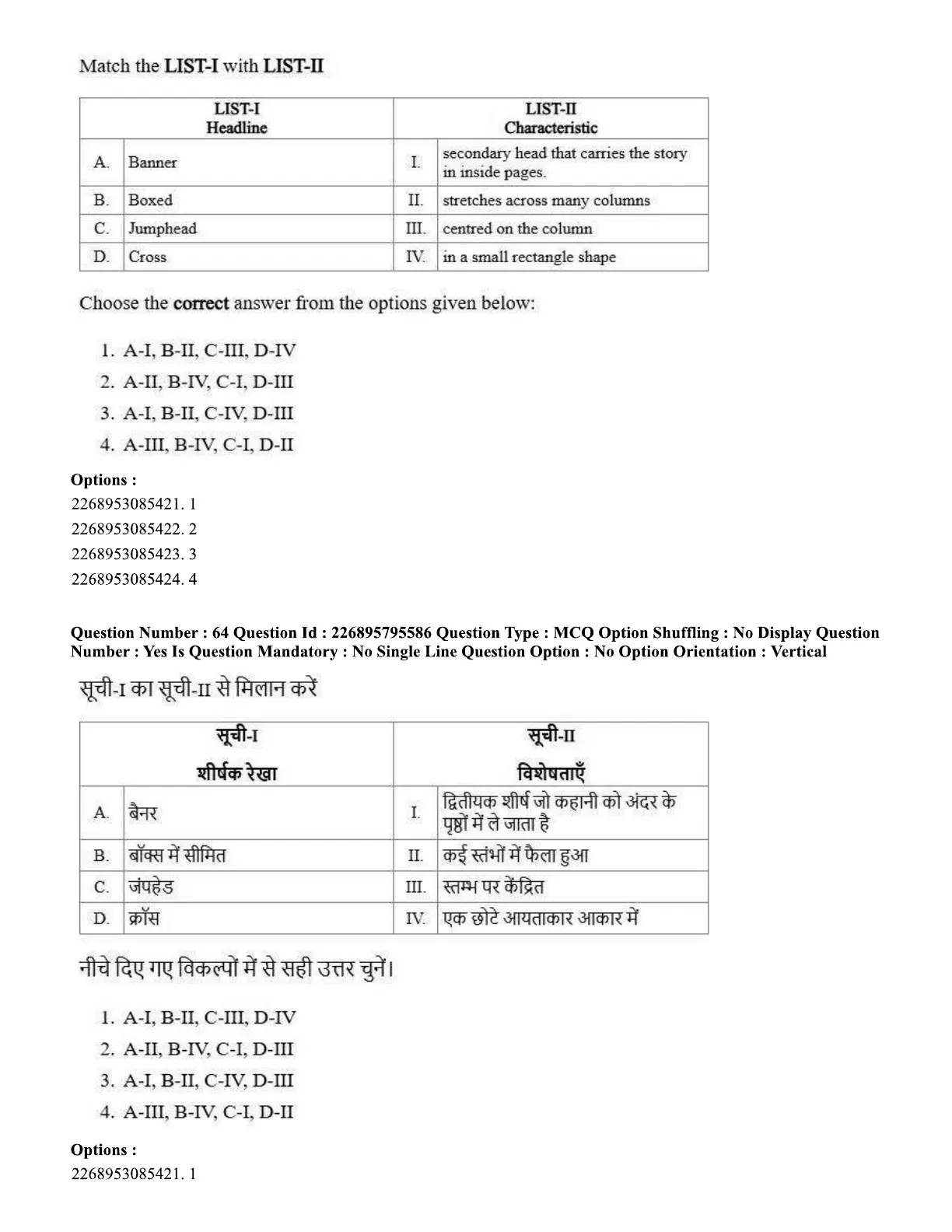
Match the LIST-I with LIST-II

Choose the correct answer from the options given below:
View Solution
Concept:
Different social media platforms are tailored around specialized communication modalities, ranging from visual communication and microblogging to professional networking and instant messaging.
Step 1: Identifying Features of Each Platform:
A. Snapchat: Launched primarily as a multimedia mobile application focused on ephemeral image and video sharing with filters; hence it matches with II (Photo Sharing Application).
B. X (Twitter): A renowned online microblogging and social networking service where users post short text updates formerly known as tweets; hence it matches with III (Microblogging site).
C. LinkedIn: A business and employment-oriented platform designed specifically for career development, recruitment, and corporate networking; hence it matches with IV (Professional networking site).
D. WhatsApp: An internationally popular freeware, cross-platform centralized instant messaging and VoIP application; hence it matches with I (Chatting platform).
Step 2: Combining the Pairings:
The matching pairs are:
A \(\rightarrow\) II
B \(\rightarrow\) III
C \(\rightarrow\) IV
D \(\rightarrow\) I
Step 3: Verification against Given Options:
Option (B) represents the exact mapping of A-II, B-III, C-IV, D-I.
Final Answer:
Therefore, the correct answer is (B) A-II, B-III, C-IV, D-I.
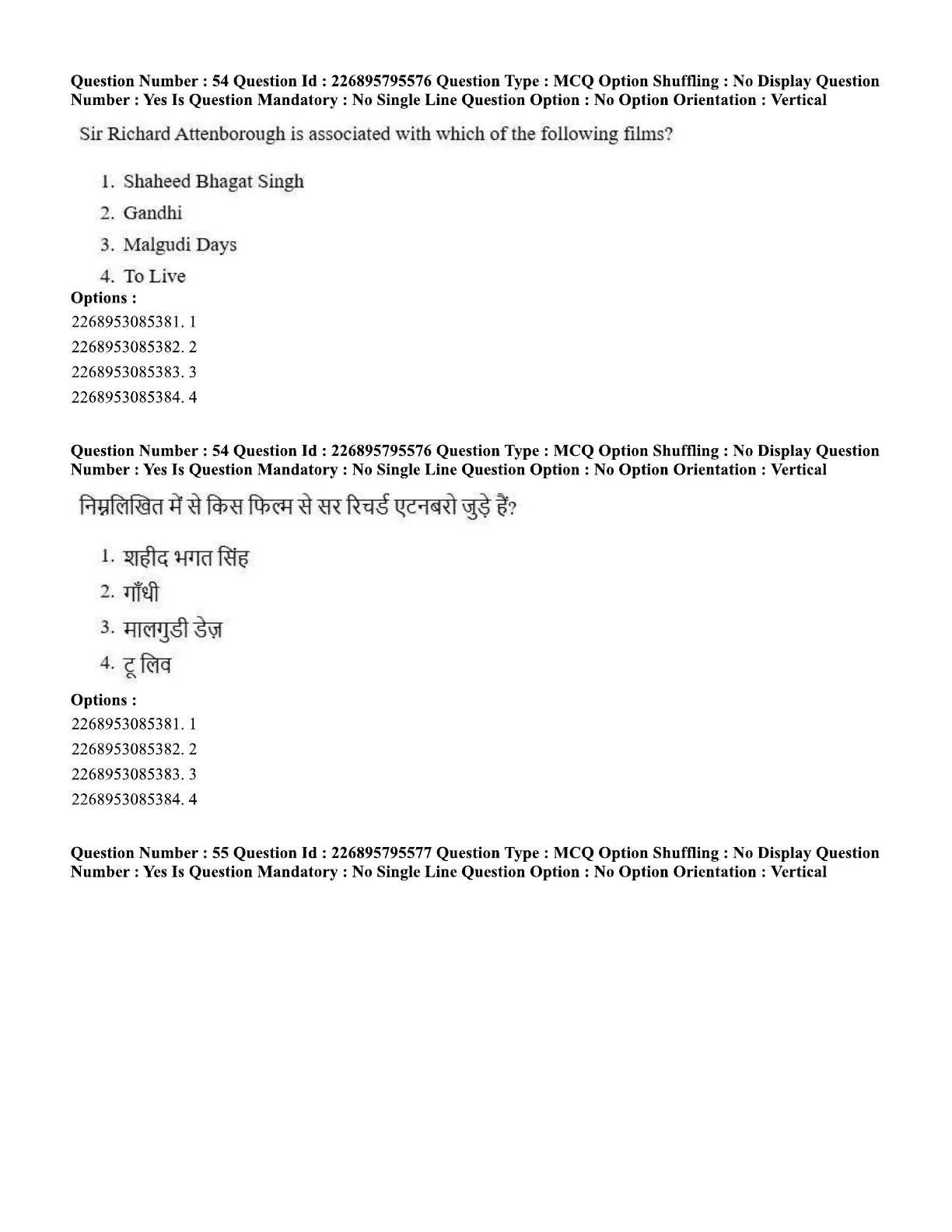
Sir Richard Attenborough is associated with which of the following films?
View Solution
Concept:
Biographical cinema represents a major genre in global film history where directors portray the life journey and philosophy of historical figures through narrative and artistic techniques.
Step 1: Background of Sir Richard Attenborough:
Sir Richard Attenborough was a celebrated English actor, filmmaker, and entrepreneur.
He harboured a long-cherished dream spanning over two decades to bring the life of Mahatma Gandhi to the silver screen.
Step 2: The Film ’Gandhi’ (1982):
In 1982, Attenborough directed and produced the epic biographical film Gandhi, depicting the life of Mohandas Karamchand Gandhi from his formative years in South Africa to his assassination in 1948.
The film starred Sir Ben Kingsley in the titular role and featured prominent Indian artists like Rohini Hattangadi, Amrish Puri, and Roshan Seth.
The film received universal critical acclaim and won eight Academy Awards (Oscars), including Best Picture and Best Director for Attenborough, as well as Best Costume Design for Bhanu Athaiya.
Step 3: Examining Other Options:
Shaheed Bhagat Singh films were directed by Indian filmmakers such as Rajkumar Santoshi and Guddu Dhanoa.
Malgudi Days was a celebrated television series directed by Shankar Nag based on the works of R.K. Narayan.
To Live is a 1994 Chinese drama film directed by Zhang Yimou.
Final Answer:
Therefore, the correct answer is (B) Gandhi.
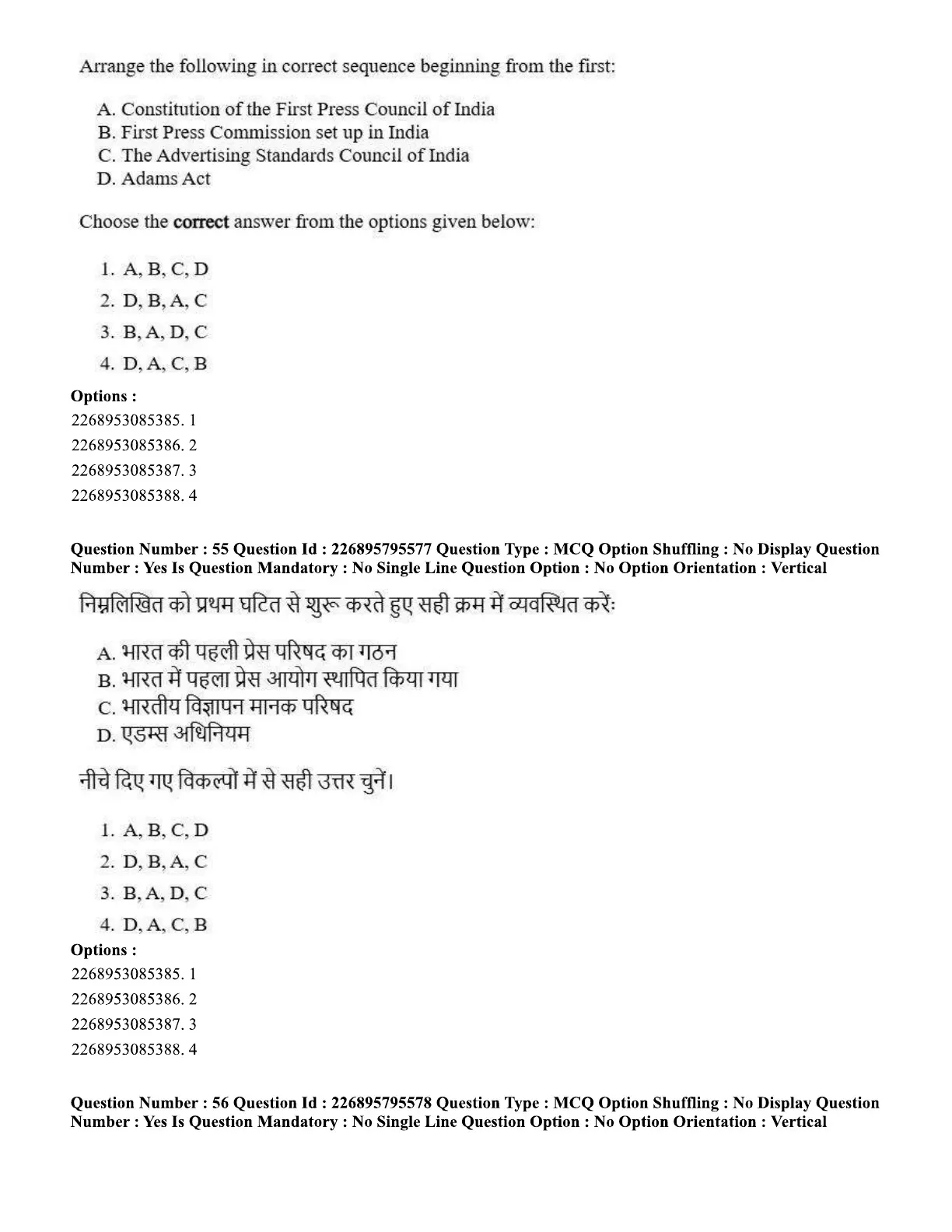
Arrange the following in correct sequence beginning from the first:
A. Constitution of the First Press Council of India
B. First Press Commission set up in India
C. The Advertising Standards Council of India
D. Adams Act
Choose the correct answer from the options given below:
View Solution
Concept:
The history of press regulations, statutory oversight bodies, and self-regulatory advertising organizations in India spans from the colonial era through post-independence institution-building.
Step 1: Identifying the Year of Each Event:
D. Adams Act (Licensing Regulations): Promulgated in 1823 by Acting Governor-General John Adams, requiring every printer and publisher to obtain a prior licence to publish a newspaper or book.
B. First Press Commission set up in India: Established in 1952 under the chairmanship of Justice J.S. Rajadhyaksha to inquire into the state of the press and ensure journalistic ethics.
A. Constitution of the First Press Council of India: Formed on July 4, 1966 (operationalized in November 1966) following the recommendations of the First Press Commission.
C. The Advertising Standards Council of India (ASCI): Established in 1985 as a self-regulatory voluntary organization to ensure truthfulness and fairness in advertising.
Step 2: Chronological Sequencing:
Arranging these events chronologically from earliest to latest:
1. 1823: Adams Act (D)
2. 1952: First Press Commission (B)
3. 1966: Constitution of the First Press Council of India (A)
4. 1985: The Advertising Standards Council of India (C)
Step 3: Determining the Correct Option:
The sequence is D \(\rightarrow\) B \(\rightarrow\) A \(\rightarrow\) C, which directly corresponds to option (B).
Final Answer:
Therefore, the correct answer is (B) D, B, A, C.
Which of the following statements are correct about the First Media Age?
A. It influences individual experience of space and time.
B. Pre-disposed to state control.
C. It is centered where few speak to many.
D. An instrument of regimes of stratification and inequality.
Choose the correct answer from the options given below:
View Solution
Concept:
Media theorists like Mark Poster and David Holmes distinguish between the "First Media Age" (dominated by broadcast models) and the "Second Media Age" (dominated by network, interactive, and digital technologies).
Step 1: Understanding First Media Age Characteristics:
The First Media Age corresponds to traditional mass communication characterized by:
1. Centralized production and broadcast model: A centralized few produce messages for an undifferentiated mass audience, which means "few speak to many" (Statement C is correct).
2. One-way communication flow: It offers little or no scope for feedback or participation by the public.
3. Hegemony and political regulation: Because transmission infrastructure required significant capital and licensing, it was pre-disposed to state control or commercial oligopoly (Statement B is correct).
4. Social hierarchy: It served as an ideological state apparatus or commercial tool that sustained existing regimes of social stratification and inequality (Statement D is correct).
Step 2: Analyzing Statement A:
Statement A emphasizes the profound alteration of an individual’s personal agency and subjective experience of space and time through interactivity, mobile connectivity, and non-linear digital networks.
This personalized redefinition of time and space is a hallmark of the Second Media Age (digital/network age), not the broadcast-dominated First Media Age.
Step 3: Evaluating the Combination:
Statements B, C, and D accurately capture the broadcast ethos of the First Media Age.
Final Answer:
Therefore, the correct answer is (D) B, C and D only.
Second Media Age = Networked, interactive, many-to-many, decentered individual experience.
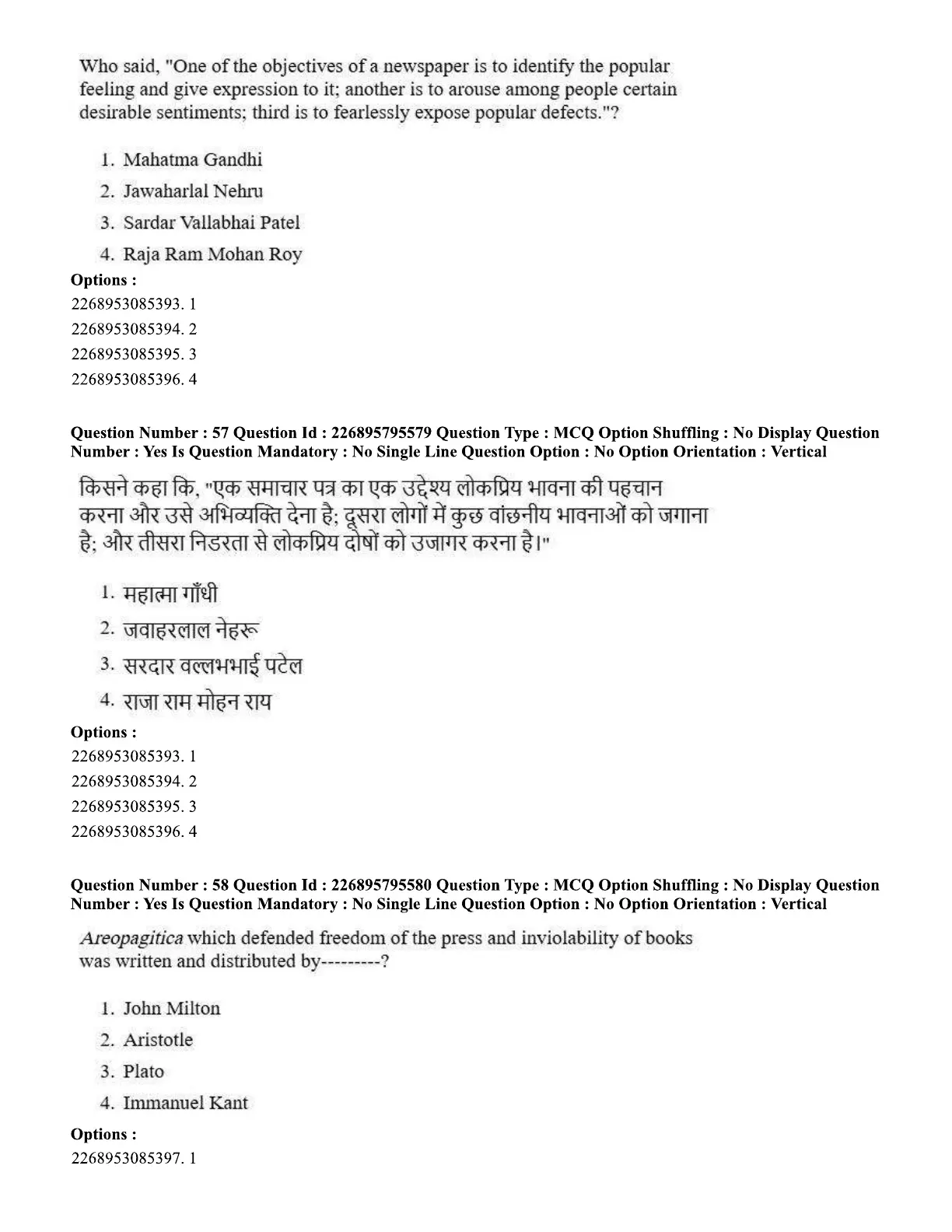
Who said, "One of the objectives of a newspaper is to identify the popular feeling and give expression to it; another is to arouse among people certain desirable sentiments; third is to fearlessly expose popular defects."?
View Solution
Concept:
Journalism during the Indian freedom struggle was regarded not as an industry, but as a selfless mission of public education, moral elevation, and national awakening.
Step 1: Identifying the Context and Source:
This celebrated definition of the fundamental objectives of journalism was penned by Mahatma Gandhi in Chapter XIV of his autobiography, The Story of My Experiments with Truth.
Gandhi reflected deeply on the purpose of the press based on his pioneering editorial experiences with his weekly newspaper Indian Opinion in South Africa.
Step 2: Examining Gandhi’s Triple Objectives:
According to Mahatma Gandhi, journalism must fulfill three cardinal purposes:
1. Understand popular feeling and give voice to public aspirations.
2. Inspire and awaken desirable moral and civic sentiments among the citizens.
3. Fearlessly criticize, introspect, and expose public defects and societal weaknesses without malice.
Gandhi firmly believed that newspapers should rely solely on public support without commercial advertising compromising their editorial integrity.
Step 3: Comparing with Other Leaders:
Jawaharlal Nehru founded National Herald and defended press freedom, but did not author this exact quotation.
Raja Ram Mohan Roy championed Indian press freedom through Mirat-ul-Akhbar and Sambad Kaumudi.
Thus, the quotation belongs unequivocally to Mahatma Gandhi.
Final Answer:
Therefore, the correct answer is (A) Mahatma Gandhi.
Areopagitica which defended freedom of the press and inviolability of books was written and distributed by ?
View Solution
Concept:
The philosophical foundation of freedom of expression and the press finds its earliest and most passionate defence in classical political treatises opposing pre-publication state censorship.
Step 1: Background of the Work:
In 1644, the eminent English poet and scholar John Milton wrote and distributed the polemical pamphlet titled Areopagitica: A Speech of Mr. John Milton for the Liberty of Unlicenc’d Printing, to the Parliament of England.
Step 2: Purpose and Argument of Areopagitica:
The treatise was composed in response to the Licensing Order of June 16, 1643, through which the English Parliament sought to censor and approve all publications prior to print.
Milton forcefully argued that pre-publication censorship insults the intelligence of citizens and stifles truth.
He famously asserted that truth must engage in open encounter with falsehood, coining the self-righting principle of the "marketplace of ideas":
"Let her and Falsehood grapple; who ever knew Truth put to the worse, in a free and open encounter?"
He also emphasized the inviolability of books, stating that "as good almost kill a man as kill a good book; who kills a man kills a reasonable creature, God’s image; but he who destroys a good book, kills reason itself."
Step 3: Verification of Other Thinkers:
Aristotle and Plato were ancient Greek philosophers, living centuries prior to the printing press.
Immanuel Kant wrote on enlightenment and autonomy in the 18th century.
Final Answer:
Therefore, the correct answer is (A) John Milton.
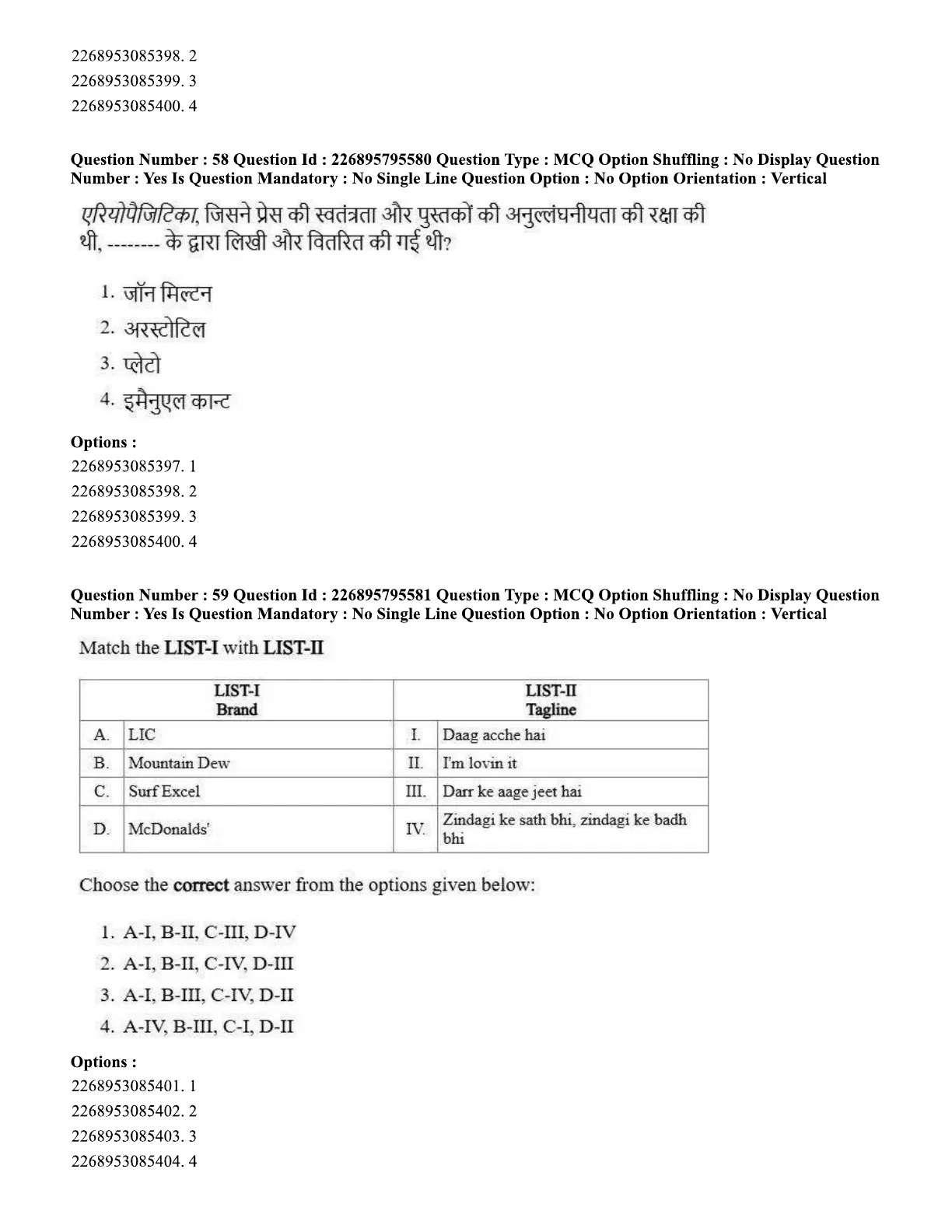
Match the LIST-I with LIST-II

Choose the correct answer from the options given below:
View Solution
Concept:
A tagline or slogan is a memorable phrase used in marketing and advertising to communicate a brand’s value proposition, positioning, and emotional connection to its target consumers.
Step 1: Identifying Each Brand’s Slogan:
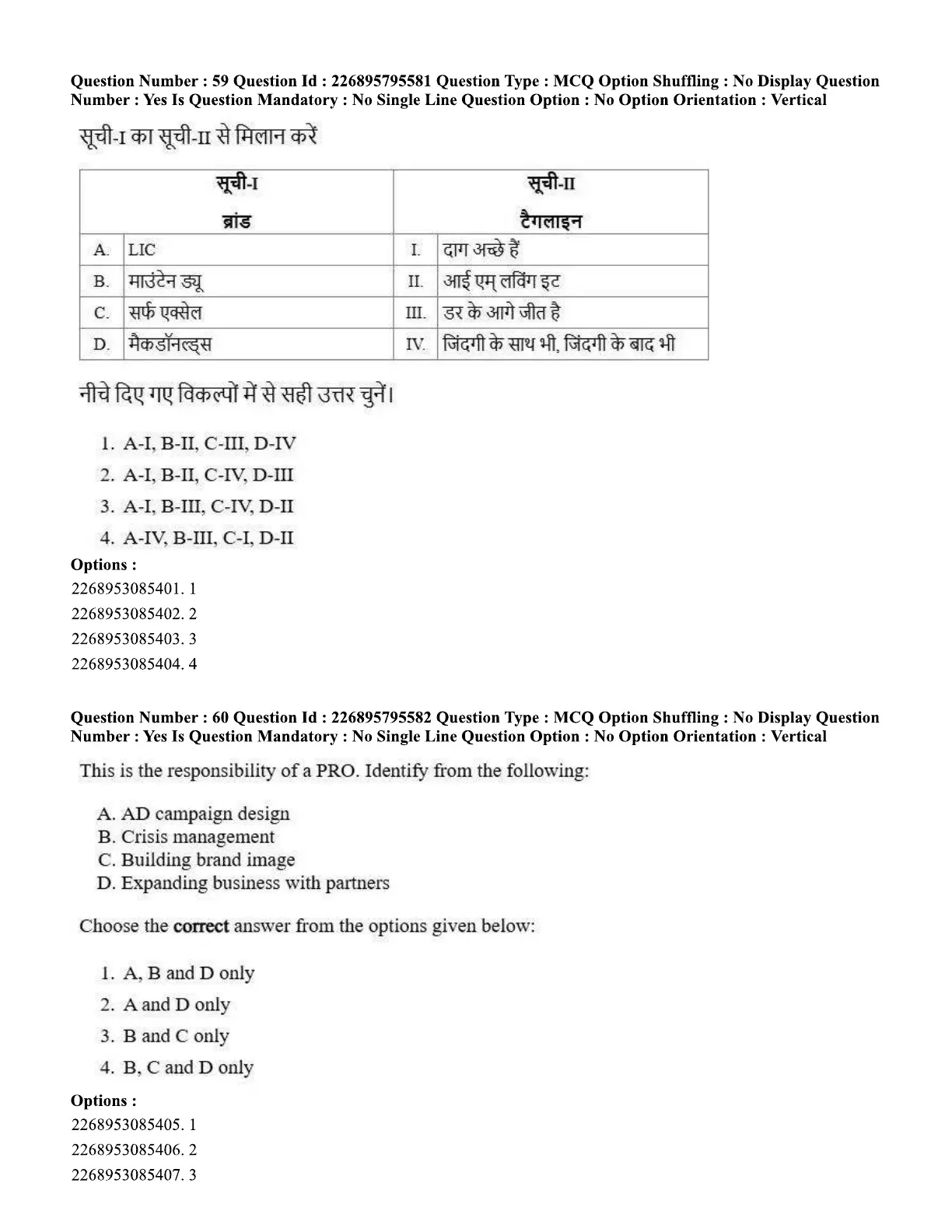
A. LIC (Life Insurance Corporation of India): Renowned for the trusted promise of financial security throughout life and beyond death: "Zindagi ke sath bhi, zindagi ke badh bhi" (IV).
B. Mountain Dew: The high-energy carbonated soft drink brand by PepsiCo uses the adrenaline-pumping tagline: "Darr ke aage jeet hai" (III).
C. Surf Excel: The detergent powder brand by Hindustan Unilever established a transformative emotional proposition with its campaign: "Daag acche hai" (Dirt is good) (I).
D. McDonald’s: The global fast-food giant uses its iconic international corporate slogan: "I’m lovin’ it" (II).
Step 2: Mapping the Corresponding Associations:
The matched pairs are:
A \(\rightarrow\) IV
B \(\rightarrow\) III
C \(\rightarrow\) I
D \(\rightarrow\) II
Step 3: Verification with Options:
Checking the options reveals that option (D) displays the exact combination: A-IV, B-III, C-I, D-II.
Final Answer:
Therefore, the correct answer is (D) A-IV, B-III, C-I, D-II.
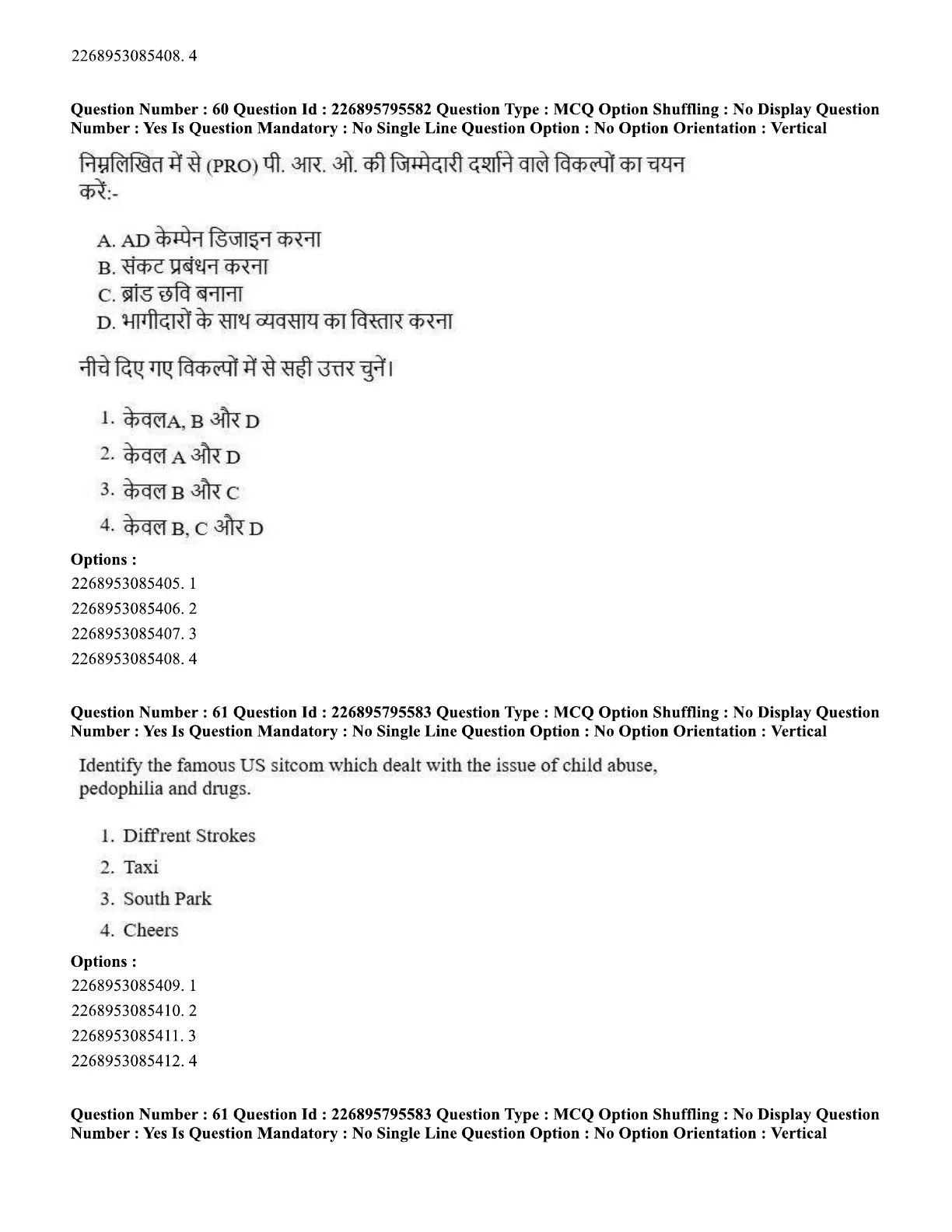
This is the responsibility of a PRO. Identify from the following:
A. AD campaign design
B. Crisis management
C. Building brand image
D. Expanding business with partners
Choose the correct answer from the options given below:
View Solution
Concept:
A Public Relations Officer (PRO) is entrusted with managing two-way communication between an organization and its diverse stakeholders to build, maintain, and protect corporate goodwill and reputation.
Step 1: Examining Key PR Responsibilities:
The core domain of a PRO includes:
1. Crisis Management (B): Devising strategic crisis communication plans, mitigating bad press, handling hostile inquiries during emergencies, and protecting corporate integrity.
2. Building Brand Image (C): Maintaining sustained positive publicity, issuing press releases, organizing press conferences, and cultivating stakeholder goodwill.
Step 2: Differentiating Non-PR Roles:
A. AD Campaign Design: This is the core task of advertising agencies and creative departments (copywriters, art directors), not the primary functional role of a PR officer.
D. Expanding Business with Partners: This falls under the domain of business development, corporate sales, and strategic management teams.
Step 3: Evaluating the Options:
Since AD campaign design belongs to advertising and expanding business belongs to commercial business development, only B and C form the direct professional duties of a PRO.
Final Answer:
Therefore, the correct answer is (C) B and C only.
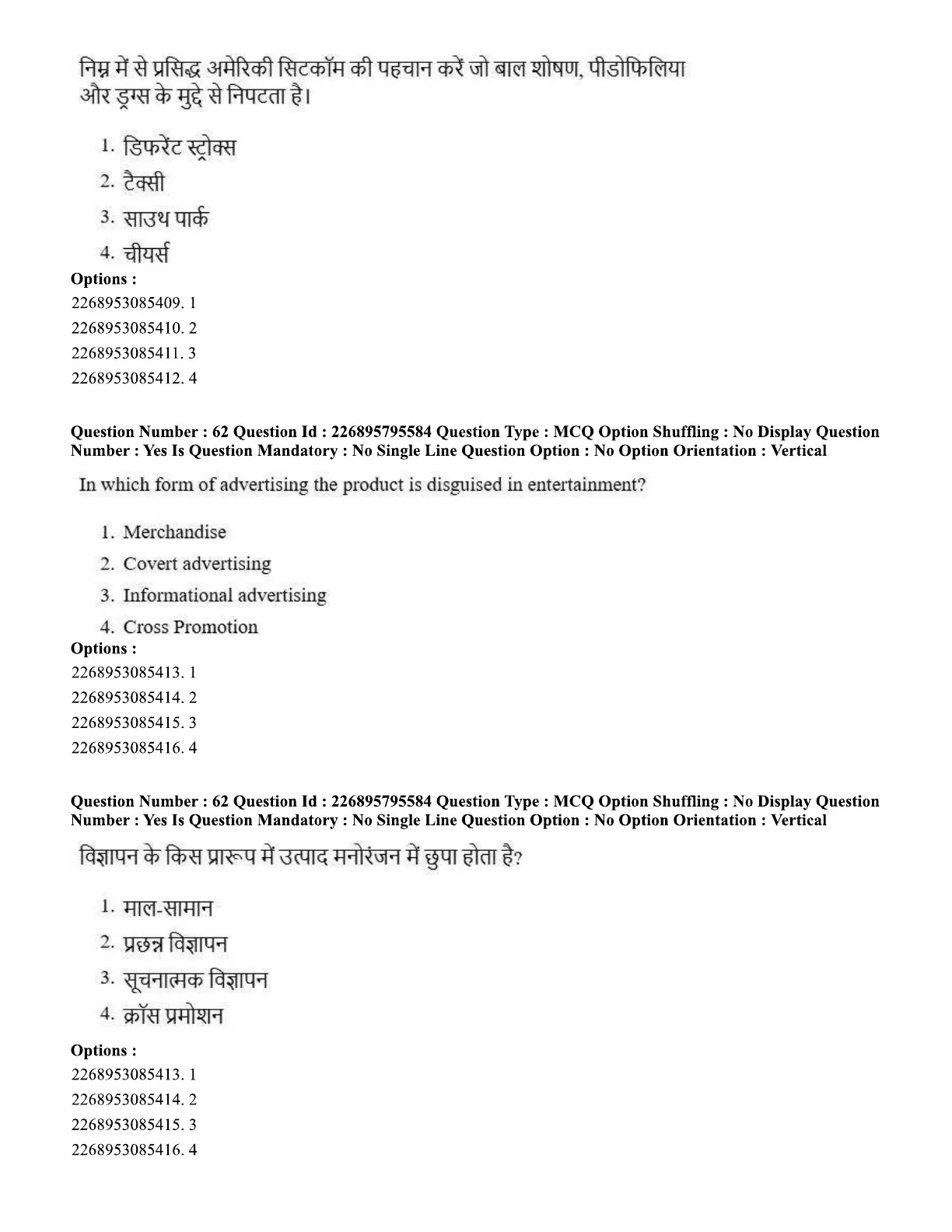
Identify the famous US sitcom which dealt with the issue of child abuse, pedophilia and drugs.
View Solution
Concept:
In American television history, several popular sitcoms utilized the "Very Special Episode" narrative format to step outside their conventional comedic tone and educate the public on sensitive socio-cultural crises.
Step 1: Background of Diff’rent Strokes:
Diff’rent Strokes was an iconic American television sitcom that aired from 1978 to 1986, following the lives of two African American boys from Harlem who are taken in by a wealthy white businessman.
Step 2: Addressing Sensitive Social Issues:
The sitcom became historically renowned for tackling grave real-world issues:
1. Pedophilia and Child Sexual Abuse: The landmark two-part 1983 episode titled "The Bicycle Man" tackled child grooming and pedophilia head-on, alerting children and parents to the warning signs of sexual predators.
2. Drug Abuse: The series addressed substance abuse in several episodes, most notably featuring First Lady Nancy Reagan in the 1983 episode "The Reporter" to promote the "Just Say No" anti-drug initiative.
Step 3: Evaluating Other Sitcoms:
Taxi focused on the workplace lives of New York taxi drivers.
Cheers was set in a Boston bar focusing on camaraderie and romance.
South Park is an animated adult satire series, not a classic live-action family sitcom recognized for these pioneering public service episodes.
Final Answer:
Therefore, the correct answer is (A) Diff’rent Strokes.
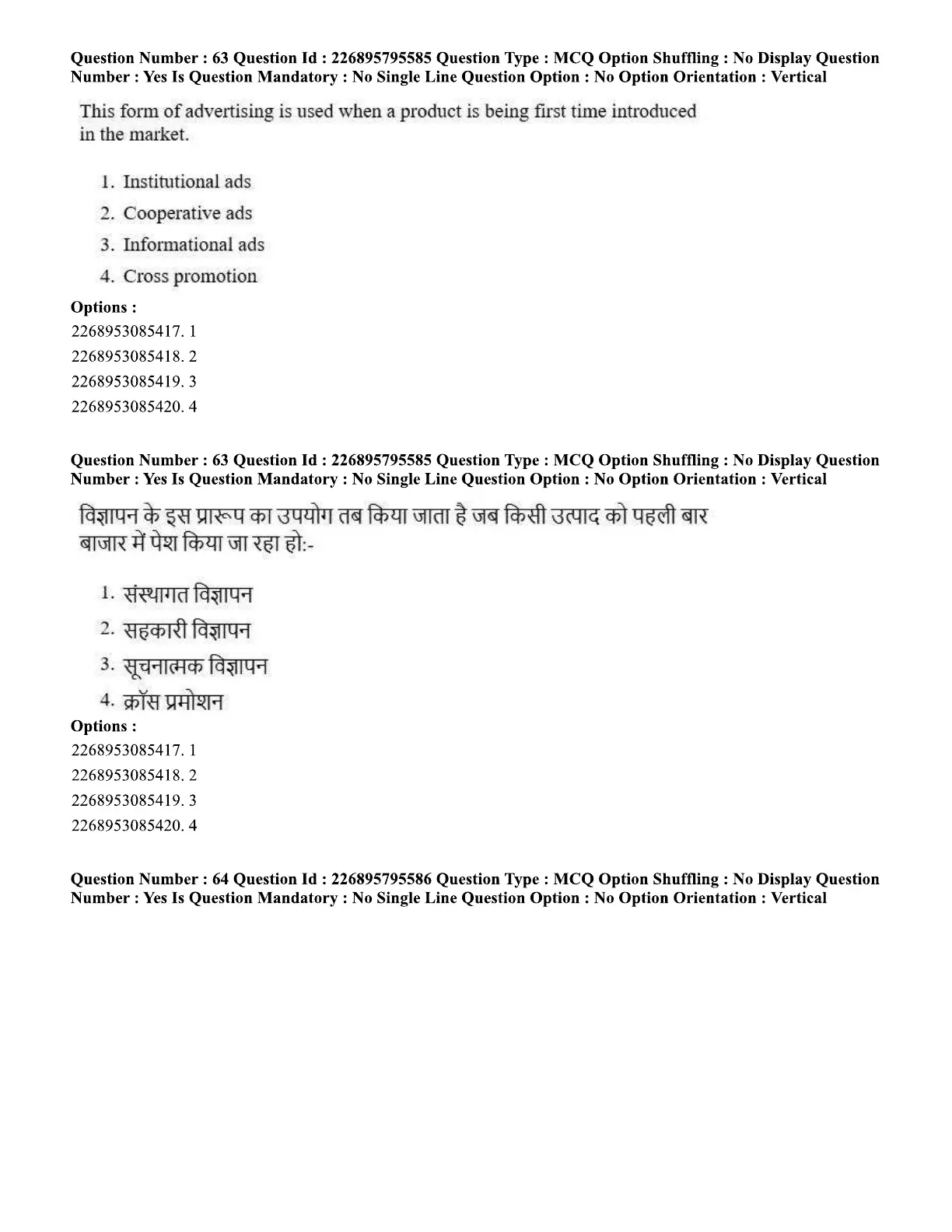
In which form of advertising the product is disguised in entertainment?
View Solution
Concept:
Modern marketing frequently blends promotional messages into entertainment media so seamlessly that viewers absorb the brand impression without perceiving it as an overt sales pitch.
Step 1: Understanding Covert Advertising:
Covert advertising (also known as product placement, embedded marketing, or stealth advertising) is a marketing technique where branded goods, services, or logos are subtly incorporated into films, television shows, video games, or music videos.
Instead of running a separate commercial break, the product becomes an organic part of the plot, setting, or dialogue of the entertainment production.
Step 2: Mechanism and Purpose:
Because audience members often skip, mute, or tune out conventional commercials, advertisers disguise commercial messages within popular entertainment.
Viewers see their favorite characters using a specific smartphone, driving a particular car, or drinking a branded beverage, creating subconscious brand affinity and credibility.
Step 3: Analyzing Alternative Terms:
Merchandise: Involves licensing and selling tangible products (like toys or apparel) bearing a movie’s characters.
Informational advertising: Uses rational, explicit product specifications and facts without disguising the intent.
Cross-promotion: A collaborative marketing campaign where two or more brands jointly promote each other.
Final Answer:
Therefore, the correct answer is (B) Covert advertising.
This form of advertising is used when a product is being first time introduced in the market.
View Solution
Concept:
Advertising objectives evolve according to the product life cycle (PLC).
During the introductory or pioneering stage, consumer awareness is non-existent, necessitating communication designed to build primary demand.
Step 1: Understanding Informational (Pioneering) Advertising:
When a brand-new category or innovative product enters the market for the first time, consumers need to be educated about what the product is, how it works, what problems it solves, and where it can be purchased.
Informational advertising (also termed pioneering or educative advertising) fulfills this foundational objective by explaining features, usage instructions, and benefits clearly.
Step 2: Differentiating from Other Forms:
1. Institutional ads: Focus on building long-term corporate reputation and trust for an institution rather than selling a specific new product.
2. Cooperative ads: A cost-sharing arrangement where manufacturers and local retailers share the advertising expense.
3. Cross promotion: Marketing strategy where two separate companies combine resources to promote complementary offerings.
Step 3: Conclusion:
Since consumers must first learn and understand a brand-new offering before developing brand loyalty, informational advertising is the essential tool at the launch stage.
Final Answer:
Therefore, the correct answer is (C) Informational ads.
Introduction \(\rightarrow\) Informational / Pioneering Ads.
Growth \(\rightarrow\) Persuasive / Competitive Ads.
Maturity \(\rightarrow\) Reminder Ads.
Match the LIST-I with LIST-II

Choose the correct answer from the options given below:
View Solution
Concept:
In print newspaper layout and design, sub-editors utilize a specialized terminology of headlines to guide readership, establish visual hierarchy, and enhance aesthetic layout.
Step 1: Defining Each Headline Type:
A. Banner: A prominent, large headline that stretches across all or many columns across the width of the page (II).
B. Boxed: A headline placed within a border or small rectangle shape, often highlighting a sidebar, brief, or feature story (IV).
C. Jumphead: When a major front-page story continues ("jumps") to an interior page, the headline placed over the continuation on the inside page is called a jumphead (I).
D. Cross (Crosshead): A small, centered headline placed directly over a single column within the body of a story to break up dense blocks of type and sustain visual interest (III).
Step 2: Analyzing the Matches:
A \(\rightarrow\) II
B \(\rightarrow\) IV
C \(\rightarrow\) I
D \(\rightarrow\) III
Step 3: Verification with Options:
Comparing this established sequence with the given options confirms that option (B) represents the exact correspondence: A-II, B-IV, C-I, D-III.
Final Answer:
Therefore, the correct answer is (B) A-II, B-IV, C-I, D-III.
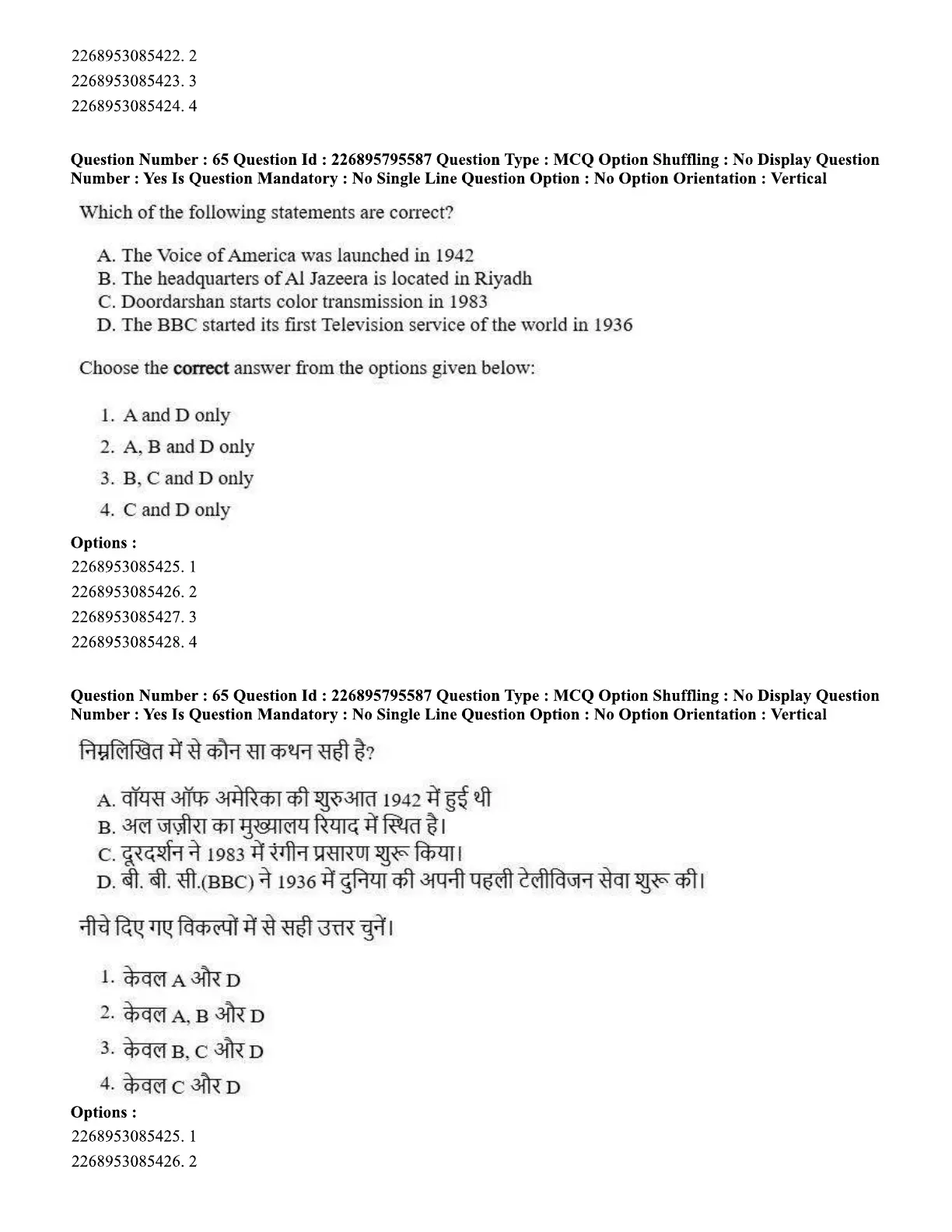
Which of the following statements are correct?
A. The Voice of America was launched in 1942
B. The headquarters of Al Jazeera is located in Riyadh
C. Doordarshan starts color transmission in 1983
D. The BBC started its first Television service of the world in 1936
Choose the correct answer from the options given below:
View Solution
Concept:
Understanding historical timelines and headquarters of global and national broadcasting networks is essential in the study of international communication and electronic media.
Step 1: Analysis of Statement A:
Voice of America (VOA), the official international radio broadcaster of the United States government, was established in February 1942 during World War II to counter Nazi propaganda.
Hence, statement A is correct.
Step 2: Analysis of Statement B:
Al Jazeera Media Network is an international news conglomerate founded by the government of Qatar, with its global headquarters based in Doha, Qatar, not Riyadh, Saudi Arabia.
Hence, statement B is incorrect.
Step 3: Analysis of Statement C:
Doordarshan inaugurated regular color transmission in India in 1982 during the 9th Asian Games held in New Delhi (with Prime Minister Indira Gandhi’s address on Independence Day, August 15, 1982).
Hence, citing 1983 makes statement C incorrect.
Step 4: Analysis of Statement D:
The British Broadcasting Corporation (BBC) launched the world’s first regular high-definition public television broadcast service from Alexandra Palace in London on November 2, 1936.
Hence, statement D is correct.
Step 5: Synthesizing the Findings:
Only statements A and D are true.
Final Answer:
Therefore, the correct answer is (A) A and D only.
BBC TV service \(\rightarrow\) 1936.
Voice of America \(\rightarrow\) 1942.
Al Jazeera \(\rightarrow\) Doha (Qatar).
Doordarshan Color TV \(\rightarrow\) 1982 (Asian Games).
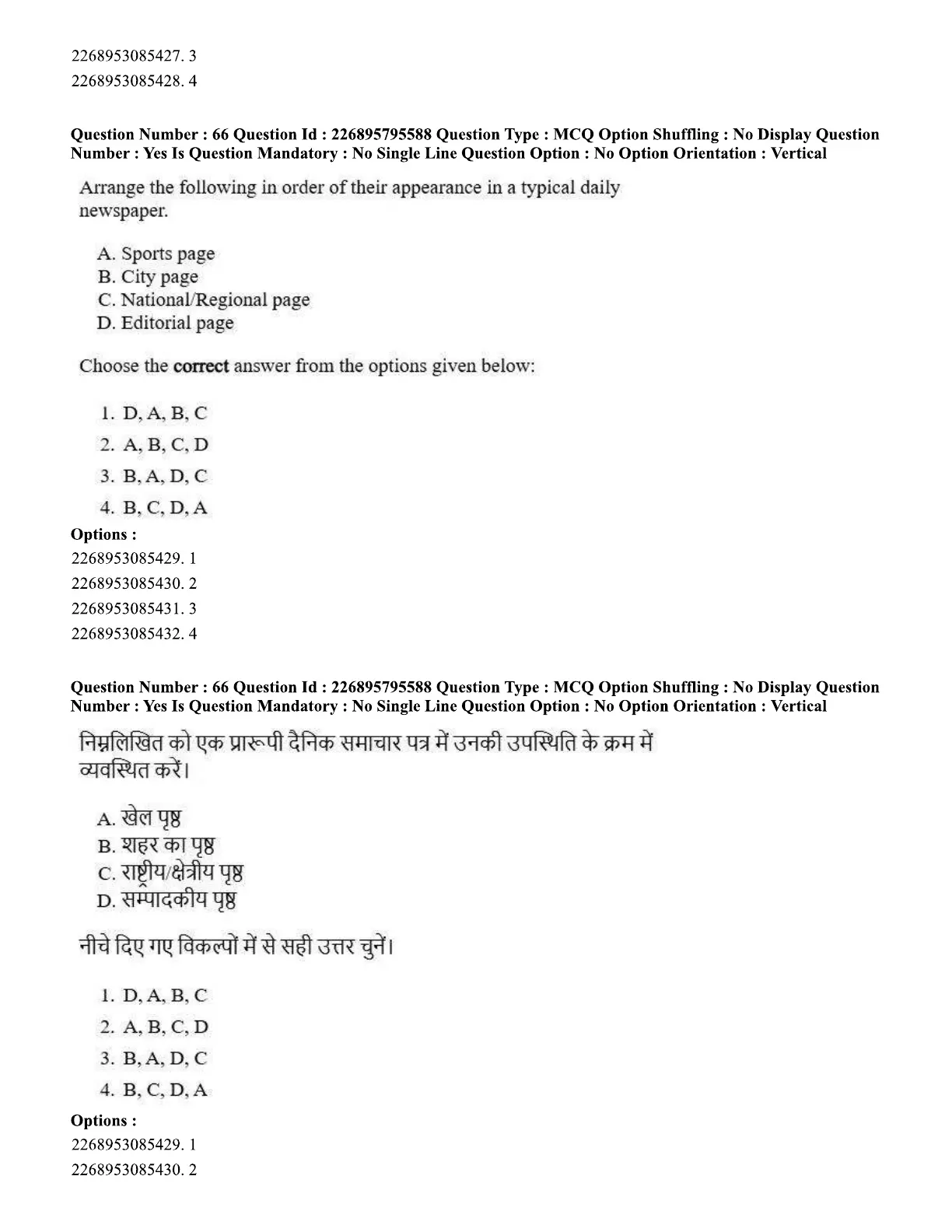
Arrange the following in order of their appearance in a typical daily newspaper.
A. Sports page
B. City page
C. National/Regional page
D. Editorial page
Choose the correct answer from the options given below:
View Solution
Concept:
A broadsheet daily newspaper follows a conventional pagination and sectional organization that systematically leads the reader from local matters to broader national concerns, intellectual discourse, and finally sports and entertainment.
Step 1: Typical Newspaper Pagination Flow:
A standard Indian daily broadsheet newspaper is structured into recognizable sections:
1. Front Page & City / Local News (B): Following the main headlines on page one, pages 2 to 4 are dedicated to local metro and municipal news.
2. Regional and National News (C): The subsequent pages expand coverage to state politics, federal governance, and nationwide developments.
3. Editorial Page / Op-Ed (D): Positioned right in the middle section of the newspaper (typically around page 8 to 12), featuring the editor’s view, columnists, and letters to the editor.
4. Sports Page (A): Situated at the very back of the newspaper (the back page or penultimate pages) along with business and international affairs.
Step 2: Ordering the Given Options:
Following this logical sequencing from front to back:
City page (B) \(\rightarrow\) National/Regional page (C) \(\rightarrow\) Editorial page (D) \(\rightarrow\) Sports page (A).
Step 3: Verification against Options:
This sequence directly matches option (D).
Final Answer:
Therefore, the correct answer is (D) B, C, D, A.
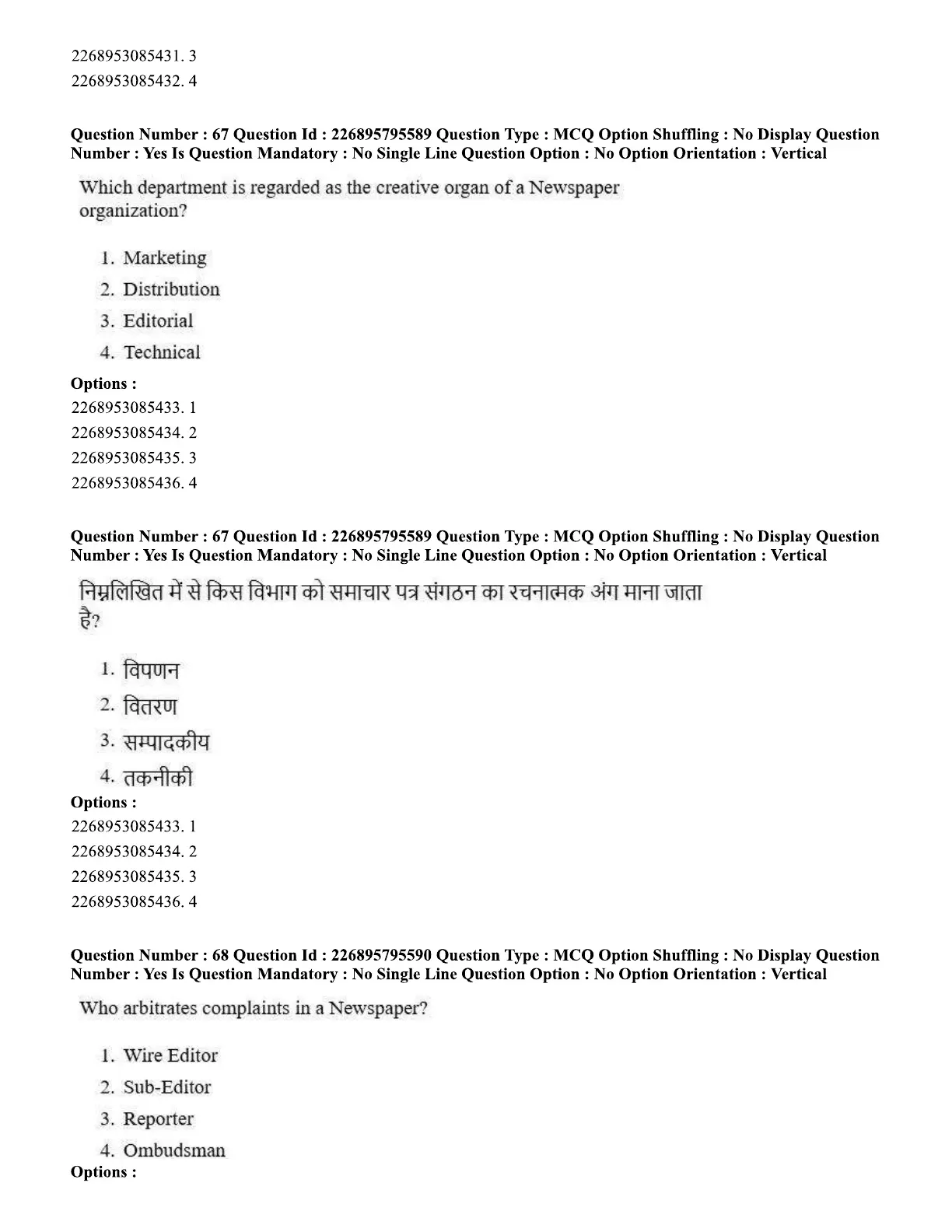
Which department is regarded as the creative organ of a Newspaper organization?
View Solution
Concept:
A modern newspaper enterprise is composed of diverse commercial, administrative, and content departments, with the editorial wing acting as the intellectual heart and soul of the publication.
Step 1: The Function of the Editorial Department:
The editorial department is directly responsible for conceptualizing, reporting, writing, editing, and curating all journalistic content.
It includes journalists, reporters, columnists, cartoonists, sub-editors, and the editor-in-chief who produce the stories, design the headlines, write the editorials, and establish the newspaper’s creative voice.
For this reason, communication scholars and media practitioners consider the editorial department the "creative organ" or "nerve center" of a newspaper organization.
Step 2: Examining Other Departments:
1. Marketing: Responsible for brand promotions, space selling for advertisements, and revenue generation.
2. Distribution / Circulation: Manages logistical networks, vendor coordination, and daily delivery to subscribers.
3. Technical / Production: Operates the printing presses, prepress hardware, paper stock, and ink technologies.
Step 3: Conclusion:
While business departments generate revenues and maintain operations, the creation of unique, meaningful, and creative intellectual output is the sole mandate of the editorial department.
Final Answer:
Therefore, the correct answer is (C) Editorial.
Who arbitrates complaints in a Newspaper?
View Solution
Concept:
Media accountability systems rely heavily on internal self-regulation to address readers’ grievances, correct errors transparently, and uphold professional journalistic standards without external state intervention.
Step 1: Role of an Ombudsman:
An ombudsman (often designated as the Readers’ Editor or Public Editor) is an independent official appointed by a newspaper or broadcasting organization to investigate and arbitrate complaints received from the public regarding bias, factual inaccuracies, ethical violations, or unfair reporting.
The ombudsman operates independently of the day-to-day editorial hierarchy and publishes regular columns addressing readers’ critiques and correcting published errors.
Step 2: Examining Other Roles:
1. Wire Editor: Curates and evaluates copy incoming from national and international news agencies (such as PTI, Reuters, AFP).
2. Sub-Editor: Edits reporter copy for grammar, style, legality, clarity, and writes appropriate headlines.
3. Reporter: Investigates events, gathers information from sources, and writes news stories on the ground.
Step 3: Conclusion:
None of the newsroom staff (reporters, sub-editors, or wire editors) act as neutral arbiters of public grievances against the paper. That dedicated quasi-judicial function belongs exclusively to the ombudsman.
Final Answer:
Therefore, the correct answer is (D) Ombudsman.
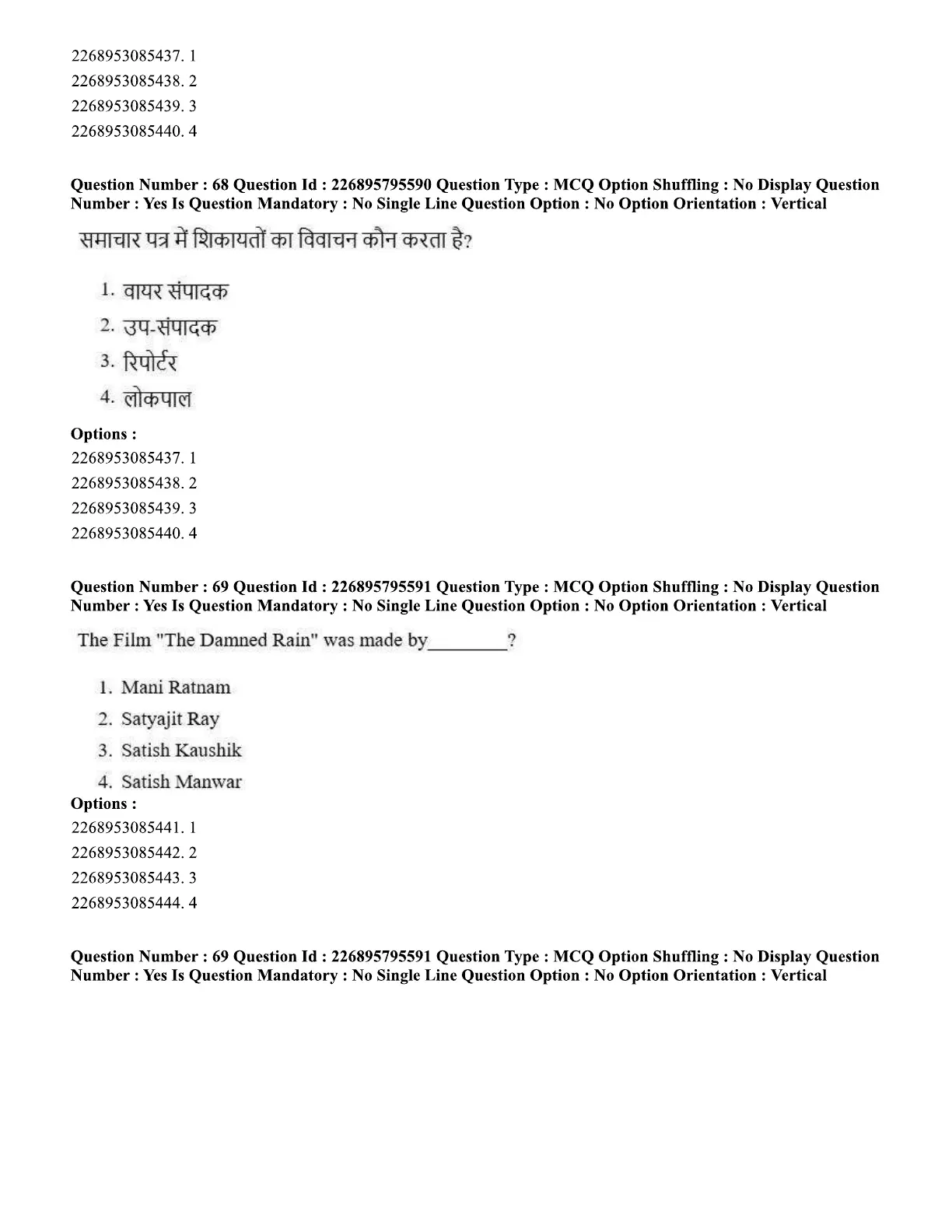
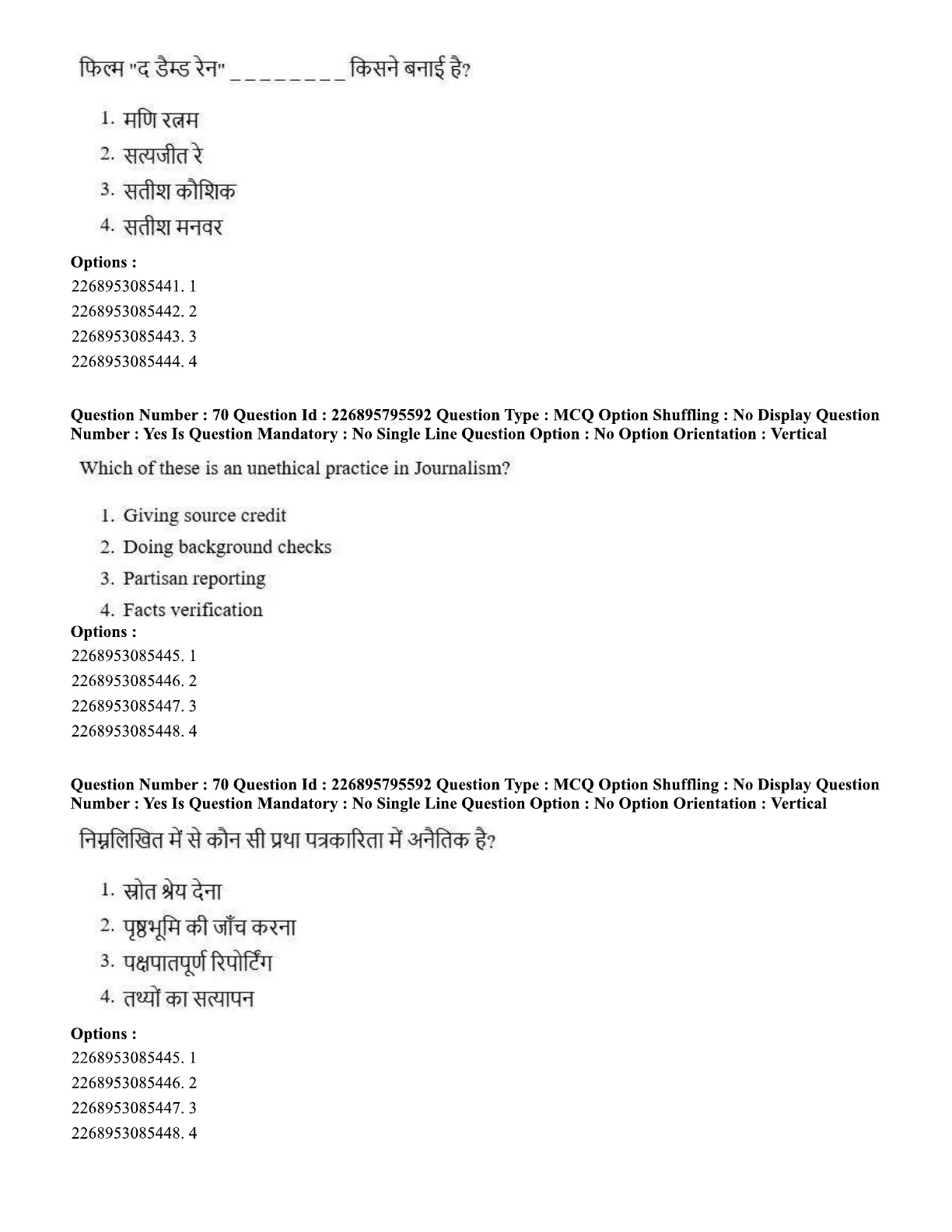
The Film "The Damned Rain" was made by ?
View Solution
Concept:
Regional Indian parallel and social realist cinema frequently engages with distressing contemporary issues, such as agrarian distress, climate unpredictability, and socioeconomic vulnerability.
Step 1: Background of the Film:
The Damned Rain is the internationally acclaimed English title of the 2009 Indian Marathi-language drama film Gabhricha Paus.
The film was written and directed by debutant filmmaker Satish Manwar.
Step 2: Theme and Critical Acclaim:
The film poignantly portrays the heart-wrenching plight of a debt-ridden cotton farmer in the drought-prone Vidarbha region of Maharashtra.
It portrays the psychological toll on the farmer and his family as they anxiously await rain while facing agricultural bankruptcy and the pervasive threat of suicide.
The film was screened at numerous prestigious international film festivals, including the Rotterdam International Film Festival and the Mumbai Film Festival, earning widespread acclaim for its sensitive, realistic direction by Satish Manwar.
Step 3: Analyzing Other Options:
Mani Ratnam is celebrated for classics such as Roja, Bombay, and Nayagan.
Satyajit Ray directed monumental masterworks including Pather Panchali and Charulata.
Satish Kaushik was a Bollywood director and actor known for popular commercial films like Tere Naam.
Final Answer:
Therefore, the correct answer is (D) Satish Manwar.
Which of these is an unethical practice in Journalism?
View Solution
Concept:
Journalistic ethics constitute a set of core principles and codes of conduct—including truthfulness, objectivity, impartiality, accountability, and fairness—designed to safeguard the public interest and maintain credibility.
Step 1: Understanding Partisan Reporting:
Partisan reporting occurs when a journalist or news outlet displays overt, biased loyalty toward a specific political party, faction, or ideological group.
Such reporting distorts facts, selectively suppresses vital information, and misleads readers to serve political agendas.
Because journalism is expected to function as the independent "Fourth Estate" holding power accountable without bias, partisan reporting represents a gross breach of professional ethics.
Step 2: Evaluating the Other Practices:
1. Giving source credit: This is an exemplary ethical practice that avoids plagiarism and acknowledges where information originated.
2. Doing background checks: Essential due diligence that guarantees historical accuracy and context.
3. Facts verification: A primary ethical mandate ensuring that only verified truths reach the public.
Step 3: Conclusion:
Options (A), (B), and (D) are fundamental tenets of good journalism, whereas partisan reporting is fundamentally unethical.
Final Answer:
Therefore, the correct answer is (C) Partisan reporting.
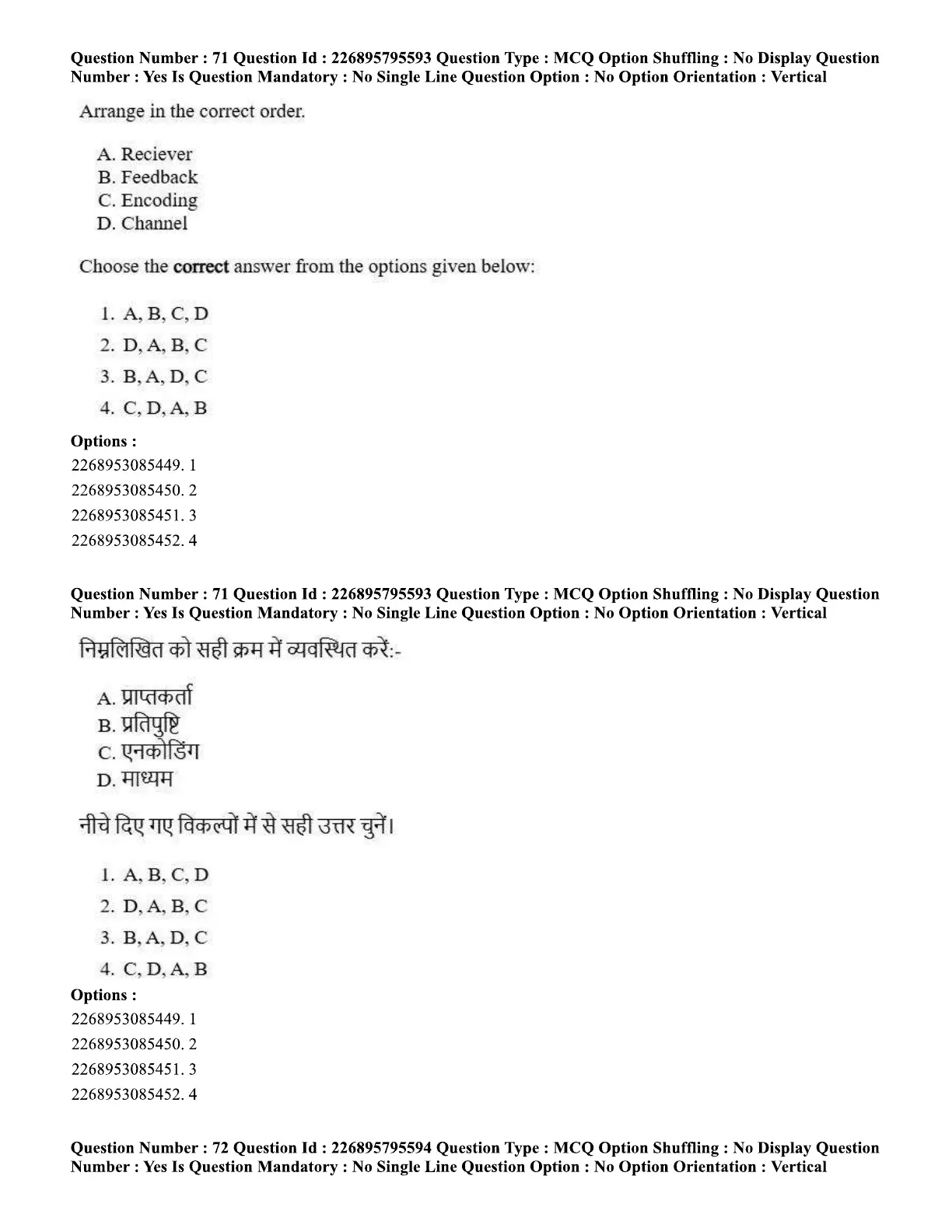
Arrange in the correct order.
A. Receiver
B. Feedback
C. Encoding
D. Channel
Choose the correct answer from the options given below:
View Solution
Concept:
The linear and transactional communication models (such as those of Shannon-Weaver, Berlo, and Schramm) delineate the transmission of information along a sequential path from originator to recipient and back.
Step 1: Standard Elements in the Communication Process:
The classic communication sequence progresses through the following steps:
1. Sender / Source: Conceives the idea.
2. Encoding (C): Converting the thought into a symbolic code, words, or visuals.
3. Message / Channel (D): Transmitting the encoded signal across a chosen physical medium or pathway.
4. Decoding / Receiver (A): The target recipient who receives the signal and interprets its meaning.
5. Feedback (B): The recipient’s response communicated back to the sender, completing the communication loop.
Step 2: Organizing the Given Sequence:
Among the four given elements:
First comes Encoding (C).
Next is the transmission via the Channel (D).
Then the signal reaches the Receiver (A).
Finally, the receiver responds with Feedback (B).
Step 3: Verification with Options:
The logical progression is C \(\rightarrow\) D \(\rightarrow\) A \(\rightarrow\) B, which corresponds to option (D).
Final Answer:
Therefore, the correct answer is (D) C, D, A, B.
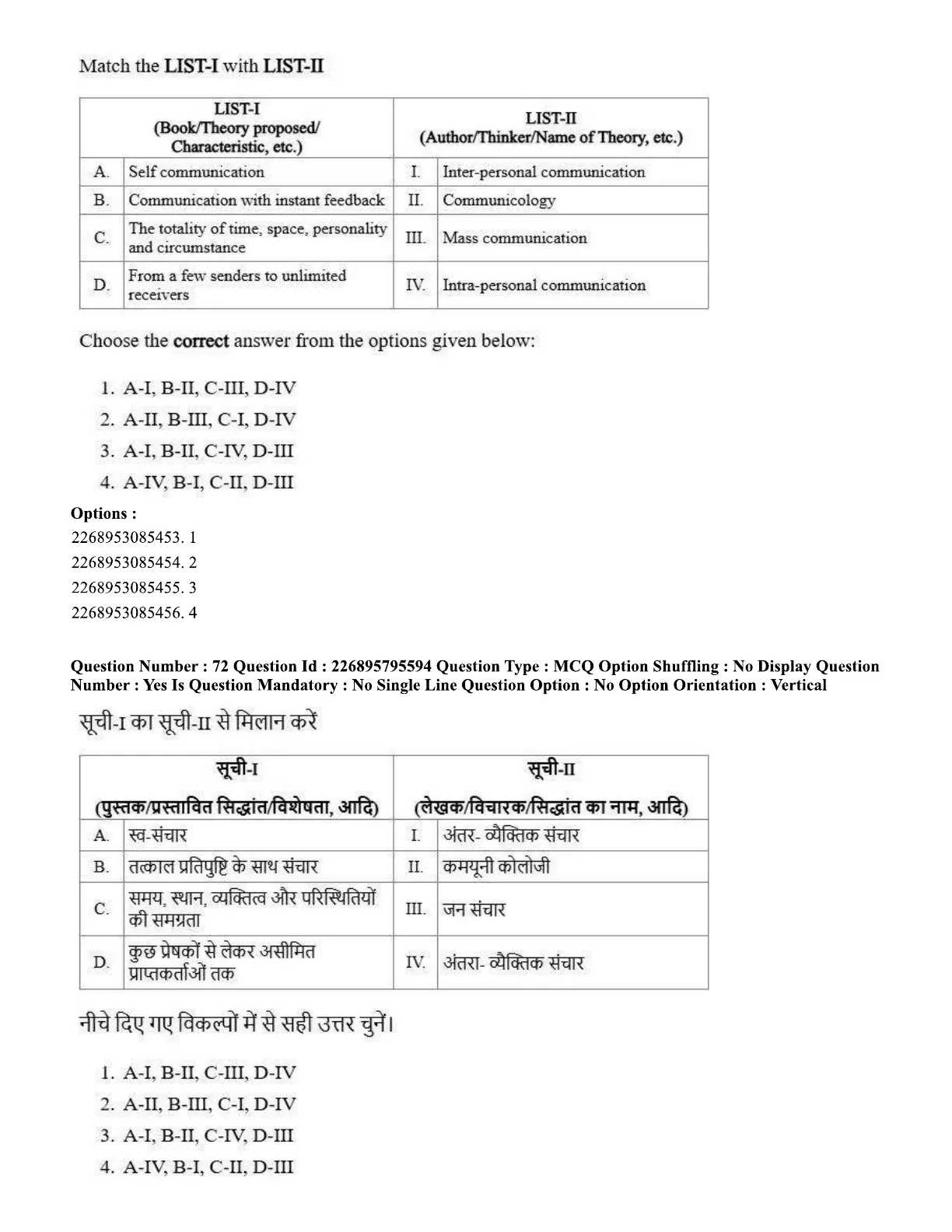
Match the LIST-I with LIST-II

Choose the correct answer from the options given below:
View Solution
Concept:
Human communication operates across distinct operational levels, defined by the relationship between the sender and receiver, feedback immediacy, contextual scope, and the dissemination apparatus.
Step 1: Analyzing Each Characteristic in List-I:
A. Self communication: Internal thought processes, self-talk, introspection, and meditation within oneself; this is universally defined as Intra-personal communication (IV).
B. Communication with instant feedback: Face-to-face or direct dialogue between two or more individuals that allows immediate, reciprocal reactions; this characterizes Inter-personal communication (I).
C. The totality of time, space, personality and circumstance: In academic communication studies, the comprehensive scientific study of human discourse across contextual systems of space, time, and human behavior is referred to as Communicology (II).
D. From a few senders to unlimited receivers: The dissemination of messages from a centralized institutional source to a vast, anonymous, and heterogeneous audience defines Mass communication (III).
Step 2: Matching the Pairs:
A \(\rightarrow\) IV
B \(\rightarrow\) I
C \(\rightarrow\) II
D \(\rightarrow\) III
Step 3: Verification with Given Options:
This matches option (D): A-IV, B-I, C-II, D-III.
Final Answer:
Therefore, the correct answer is (D) A-IV, B-I, C-II, D-III.
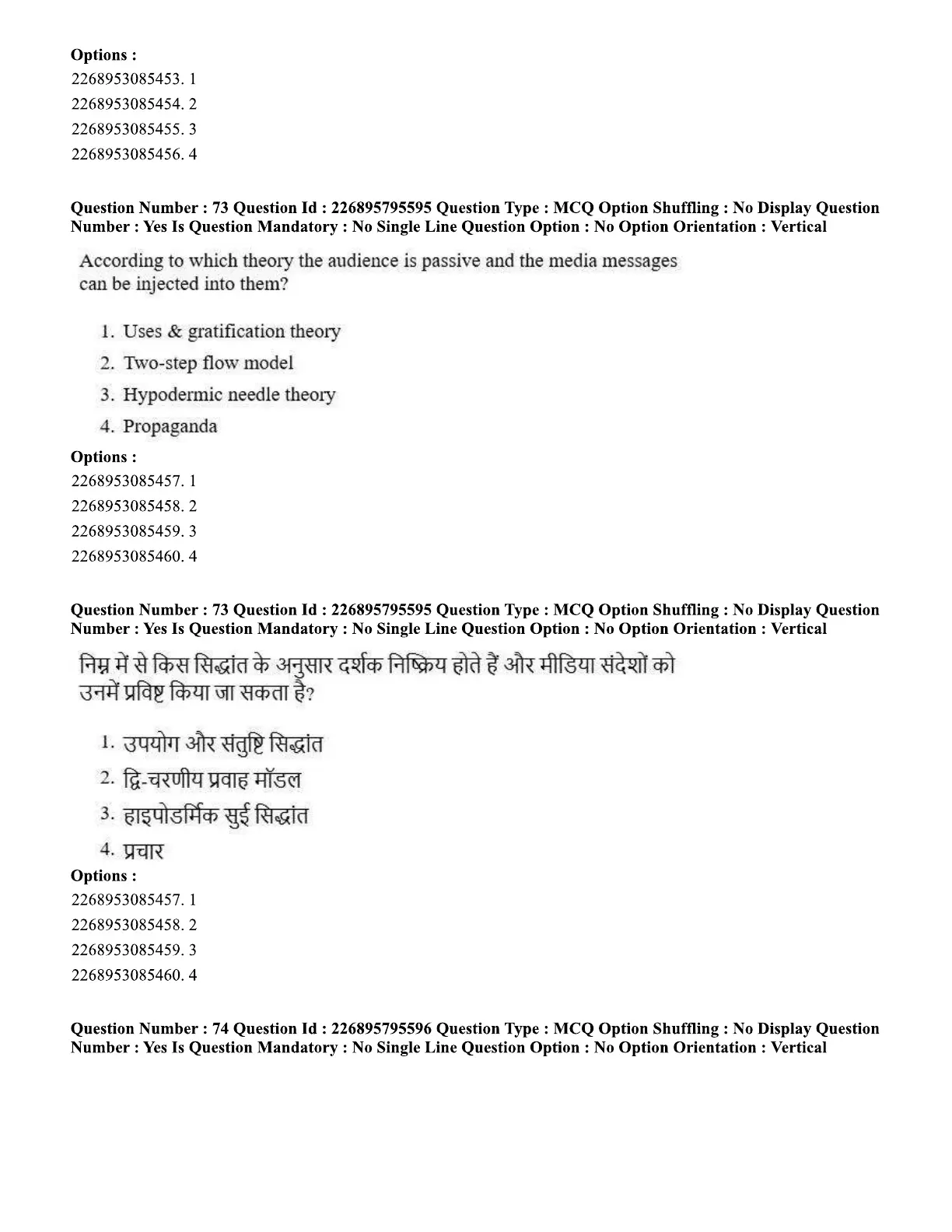
According to which theory the audience is passive and the media messages can be injected into them?
View Solution
Concept:
Early media effect theories conceptualized mass media as having uniform, direct, immediate, and powerful psychological impacts upon an atomized and defenseless public.
Step 1: Understanding the Hypodermic Needle Theory:
The Hypodermic Needle Theory (also widely referred to as the Magic Bullet Theory) emerged during the 1920s and 1930s following the observed power of wartime propaganda and Orson Welles’ 1938 The War of the Worlds radio broadcast.
The core assumption of this theory posits that media messages are like a chemical substance injected via a hypodermic needle directly into the bloodstream of a passive audience.
The audience members are viewed as uniform, vulnerable, and unable to resist or critically evaluate the incoming stimuli, resulting in immediate, predictable behavioral reactions.
Step 2: Differentiating from Alternative Theories:
1. Uses and Gratification Theory: Argues the exact opposite: audiences are active, goal-oriented, and choose media to satisfy specific personal needs.
2. Two-Step Flow Model: Developed by Lazarsfeld and Katz, proving that media influence is mediated through interpersonal networks and "opinion leaders," rather than direct injection.
3. Propaganda: Refers to the deliberate systematic dissemination of information, but the specific theoretical model comparing message transmission to an injection is the hypodermic needle theory.
Final Answer:
Therefore, the correct answer is (C) Hypodermic needle theory.
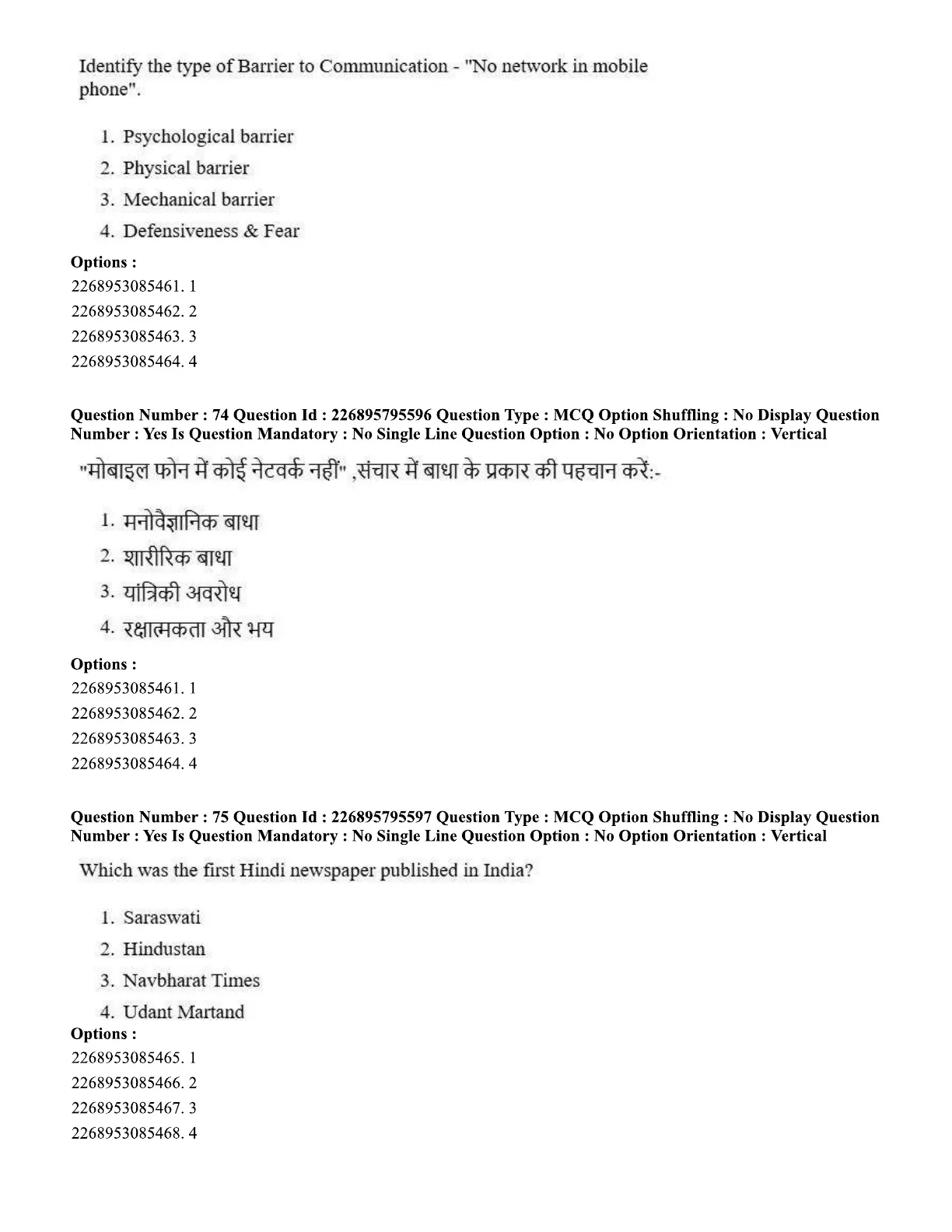
Identify the type of Barrier to Communication - "No network in mobile phone".
View Solution
Concept:
Communication barriers are factors that disrupt, distort, or prevent the smooth transmission and reception of messages between the sender and receiver.
Step 1: Understanding Mechanical (Technological) Barriers:
Mechanical barriers arise from defects, failures, or limitations in the physical instruments, technological transmission channels, or hardware used to transmit messages.
In electronic and telecommunications, problems such as poor mobile reception, complete network breakdown, weak signal, technical static, computer malfunction, or disrupted telephone lines prevent the encoded signals from reaching their destination.
Therefore, "No network in mobile phone" represents a classic mechanical barrier (or technological channel failure).
Step 2: Analyzing Other Types of Barriers:
1. Psychological barriers: Arise from emotional states, prejudices, closed-mindedness, stress, or inattention.
2. Physical barriers: Environmental constraints such as geographical distance, ambient room noise, or physical walls separating people.
3. Defensiveness & Fear: Emotional attitudes where fear of authority or criticism inhibits honest communication.
Step 3: Conclusion:
Because the disruption originates entirely from the technological apparatus and wireless transmission network failing to connect the devices, it is categorized as a mechanical barrier.
Final Answer:
Therefore, the correct answer is (C) Mechanical barrier.
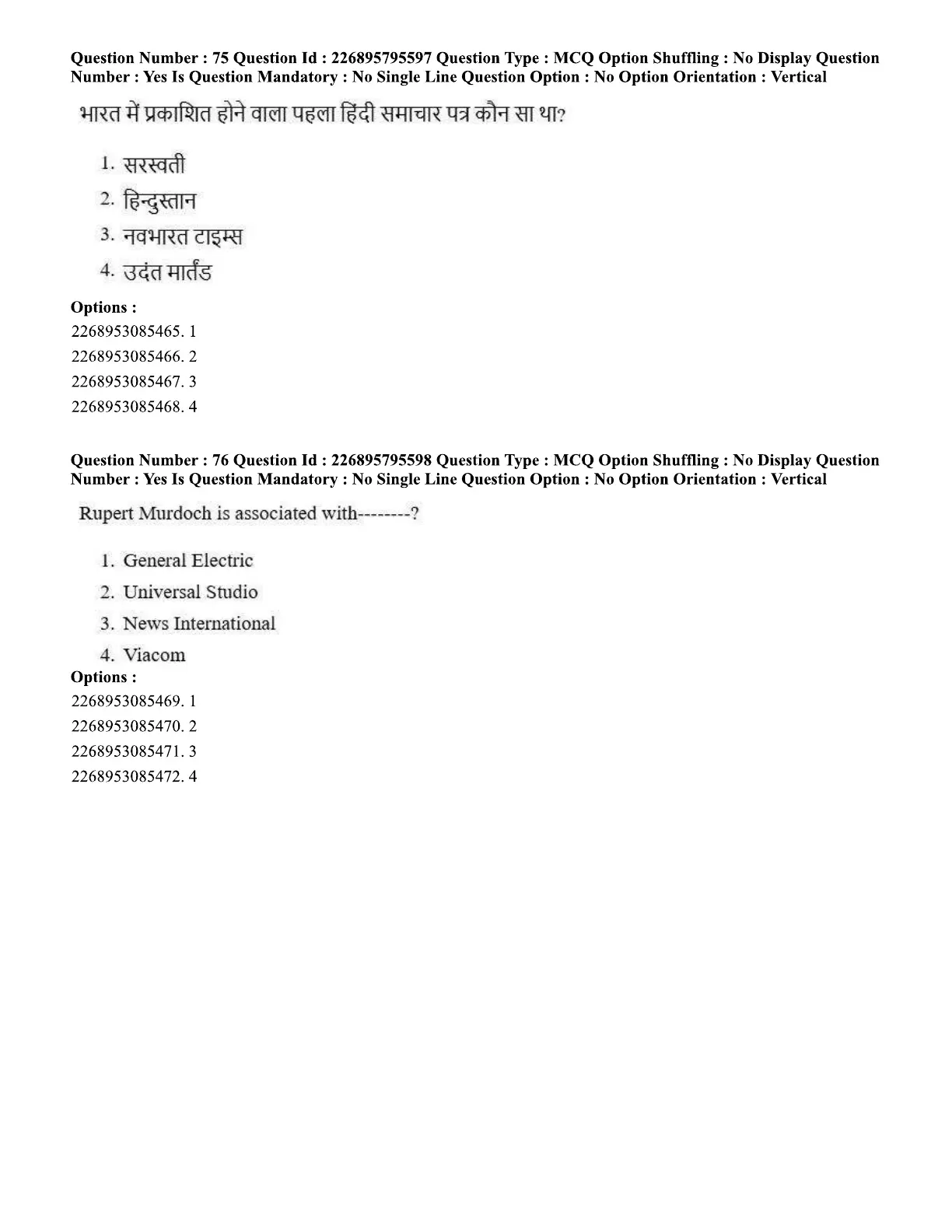
Which was the first Hindi newspaper published in India?
View Solution
Concept:
The emergence of Indian vernacular journalism played a foundational role in cultural renaissance, linguistic standardization, and nationalist awakening during the 19th century.
Step 1: Historical Origin of Udant Martand:
The first newspaper in the Hindi language was Udant Martand (meaning "The Rising Sun").
It was published for the first time on May 30, 1826, in Calcutta (now Kolkata) by Pandit Jugal Kishore Shukla, who served as both its editor and publisher.
Step 2: Format and Significance:
Published as a weekly every Tuesday, Udant Martand used the Devanagari script and a mix of Khari Boli and Braj Bhasha to report on contemporary socioeconomic and political events.
Although financial difficulties and high postal rates forced it to close down the following year in December 1827, its launch was so historic that May 30 is celebrated across India every year as "Hindi Journalism Day" (Hindi Patrakarita Diwas).
Step 3: Examining the Other Options:
Saraswati was an influential Hindi literary monthly founded in 1900, edited famously by Mahavir Prasad Dwivedi.
Hindustan is a prominent Hindi daily founded in 1936.
Navbharat Times is a major daily founded in 1946 by Bennett, Coleman & Co. Ltd.
Final Answer:
Therefore, the correct answer is (D) Udant Martand.
Rupert Murdoch is associated with ?
View Solution
Concept:
Media conglomerates and global press barons have shaped modern transnational communication through aggressive consolidation, vertical integration, and cross-media ownership across multiple continents.
Step 1: Identifying Rupert Murdoch’s Media Empire:
Keith Rupert Murdoch is an Australian-born American media tycoon who created one of the world’s largest and most influential media conglomerates, News Corporation (News Corp).
His extensive global holdings have spanned newspapers, book publishing, satellite television, and broadcast networks across Australia, the United Kingdom, and the United States.
Step 2: Association with News International:
In the United Kingdom, Murdoch’s major publishing operations were consolidated under the subsidiary known as News International (later rebranded as News UK).
Through News International, Murdoch acquired and controlled prominent national British newspapers including The Sun, The Times, The Sunday Times, and the former News of the World.
News International became synonymous with his aggressive tabloid journalism and political influence in British public life.
Step 3: Evaluating the Other Conglomerates:
General Electric historically owned the NBC television network before selling it to Comcast.
Universal Studio is a subsidiary of Comcast/NBCUniversal.
Viacom (now Paramount Global) was developed by the Redstone family through National Amusements.
Therefore, Murdoch is directly associated with News International.
Final Answer:
Therefore, the correct answer is (C) News International.
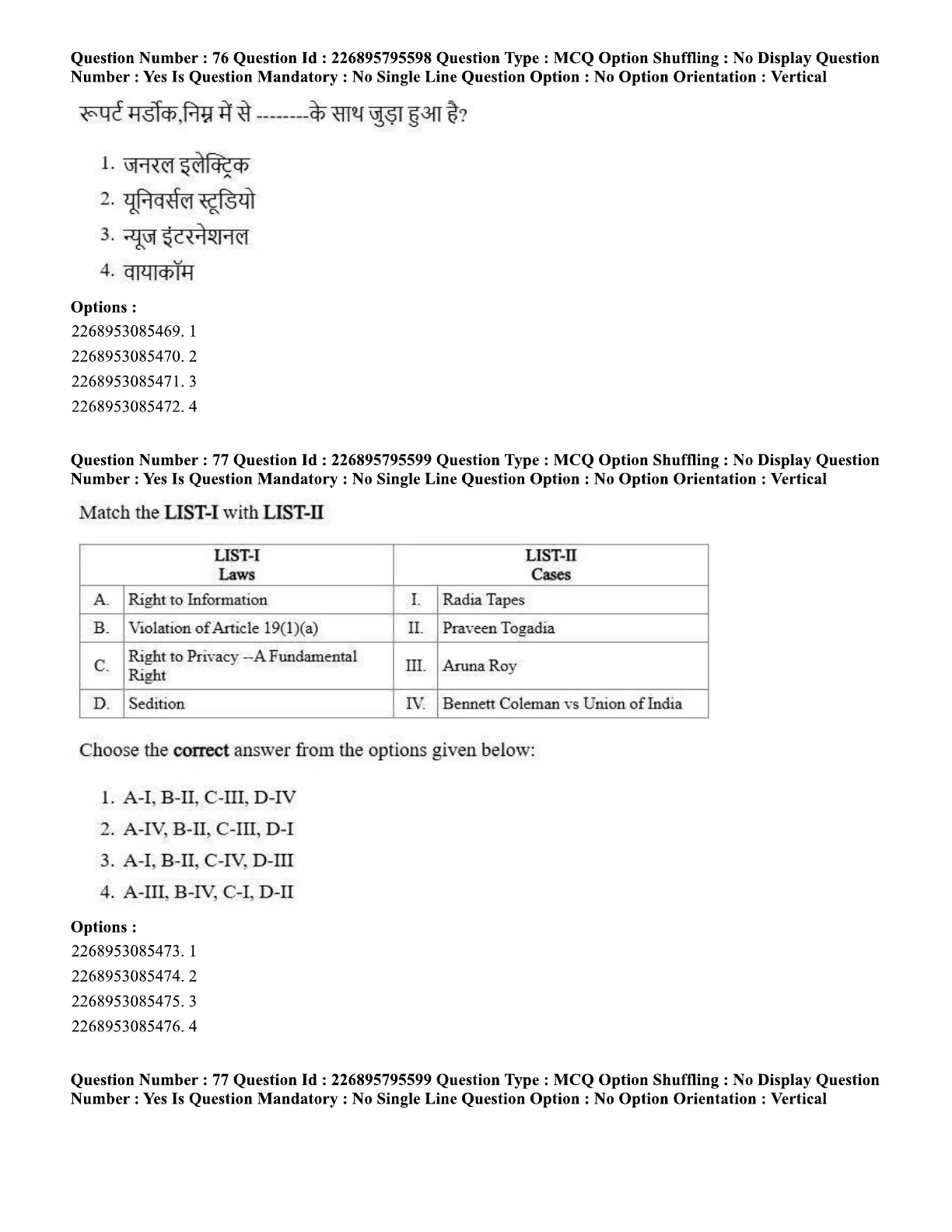
Match the LIST-I with LIST-II

Choose the correct answer from the options given below:
View Solution
Concept:
Indian media jurisprudence has evolved through seminal Supreme Court litigations and socio-political campaigns that define constitutional speech, institutional transparency, privacy, and state security.
Step 1: Analyzing Each Law and Case Association:
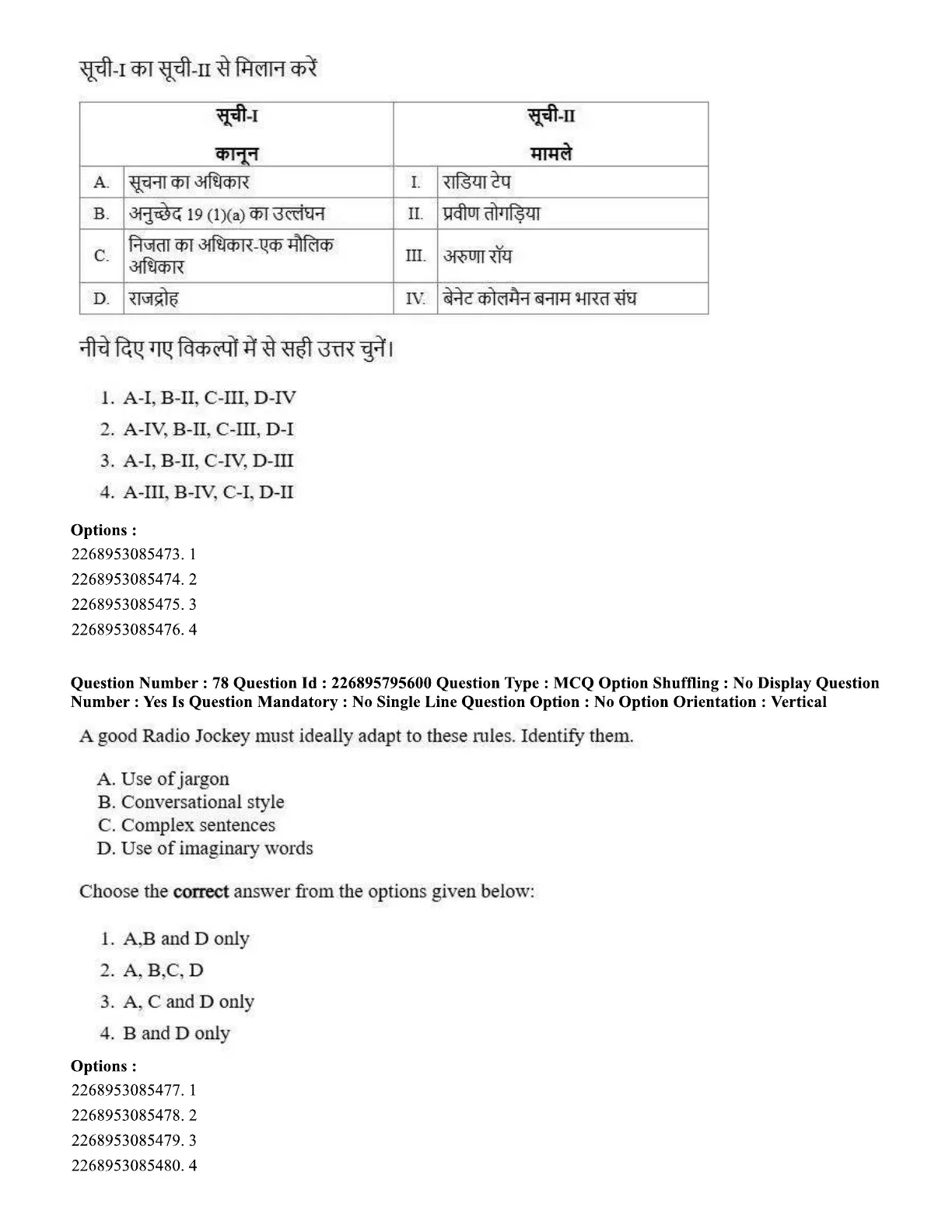
A. Right to Information (RTI): Aruna Roy, through the Mazdoor Kisan Shakti Sangathan (MKSS), spearheaded the grassroots social movement in Rajasthan that led directly to the enactment of the Right to Information Act, 2005 (III).
B. Violation of Article 19(1)(a): In Bennett Coleman vs Union of India (1972), the Supreme Court struck down the central government’s newsprint quota policy, ruling that capping page limits violated the freedom of speech and expression of newspapers under Article 19(1)(a) (IV).
C. Right to Privacy – A Fundamental Right: The leak of the telephone wiretaps known as the Radia Tapes prompted industrialist Ratan Tata to approach the Supreme Court, seeking the enforcement of the right to privacy against unauthorized media dissemination of intercepted conversations (I).
D. Sedition: Various public speeches by right-wing leader Praveen Togadia attracted charges under IPC Section 124A (sedition) and related hate speech provisions across multiple state jurisdictions (II).
Step 2: Combining the Matches:
A \(\rightarrow\) III
B \(\rightarrow\) IV
C \(\rightarrow\) I
D \(\rightarrow\) II
Step 3: Verification with the Given Options:
The matched sequence corresponds uniquely to option (D): A-III, B-IV, C-I, D-II.
Final Answer:
Therefore, the correct answer is (D) A-III, B-IV, C-I, D-II.
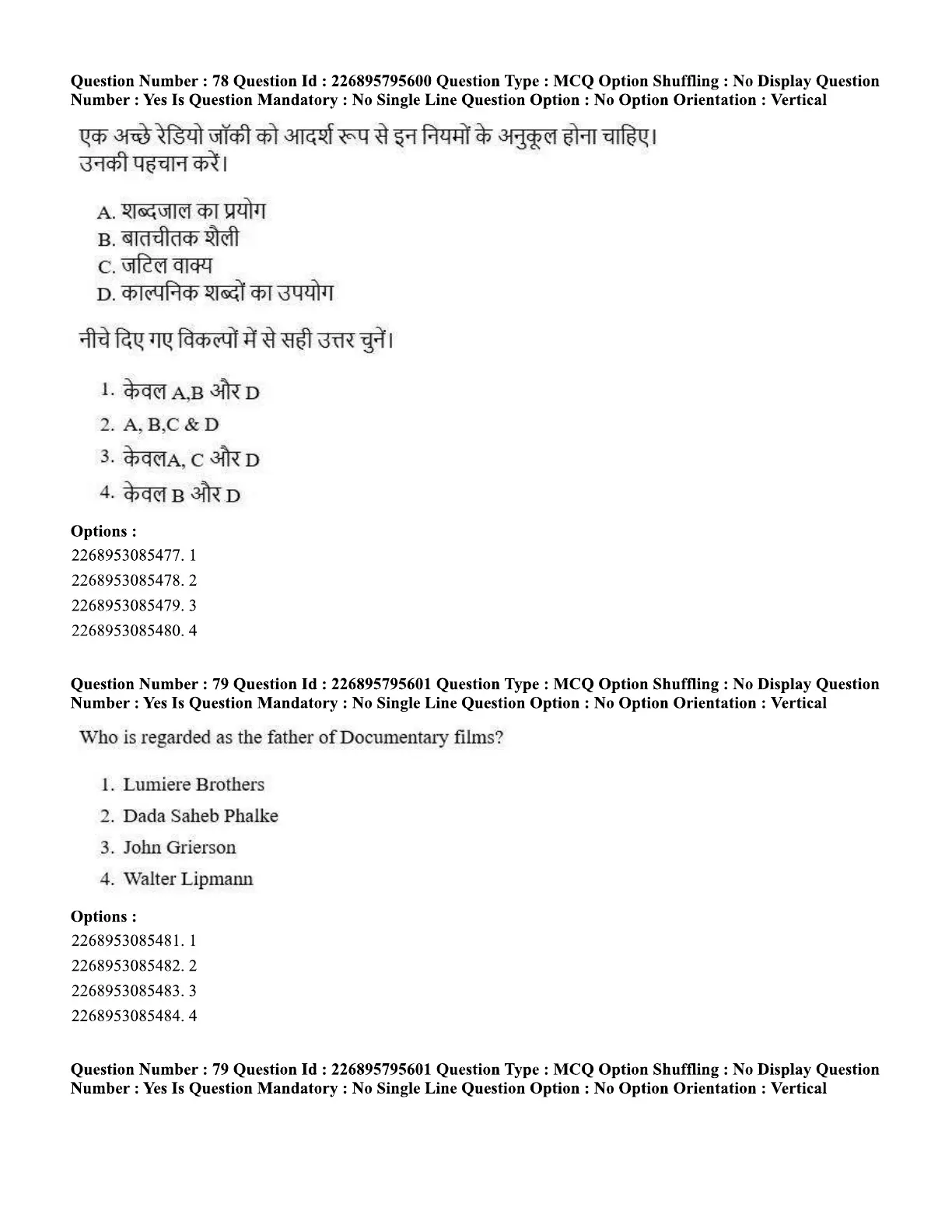
A good Radio Jockey must ideally adapt to these rules. Identify them.
A. Use of jargon
B. Conversational style
C. Complex sentences
D. Use of imaginary words
Choose the correct answer from the options given below:
View Solution
Concept:
Radio is an exclusively acoustic and blind medium known as the "theatre of the mind," requiring specialized broadcast presentation principles to connect warmly and visually with the listening audience.
Step 1: Essential Characteristics of Radio Jockeying:
1. Conversational Style (B): Radio is a one-to-one intimate medium; an RJ must speak naturally, informally, and personably, as if conversing directly with a single friend rather than addressing an anonymous crowd.
2. Use of Imaginary / Imagery Words (D): Since listeners cannot see the presenter or setting, an RJ must use vivid descriptive language and word pictures (imagery) to evoke sensory stimulation and ignite the listener’s mental imagination.
Step 2: Rules to Avoid in Radio Presentation:
A. Use of jargon: Technical jargon, obscure terms, and convoluted slang alienate general listeners and cause communication failure.
C. Complex sentences: Radio copy is written for the ear, not the eye; listeners cannot re-read a sentence, making long and complex syntax fatal to comprehension. Short, punchy sentences are mandatory.
Step 3: Evaluating the Options:
Since jargon (A) and complex sentences (C) must be avoided, only B and D represent professional presentation rules that an RJ should embrace.
Final Answer:
Therefore, the correct answer is (D) B and D only.
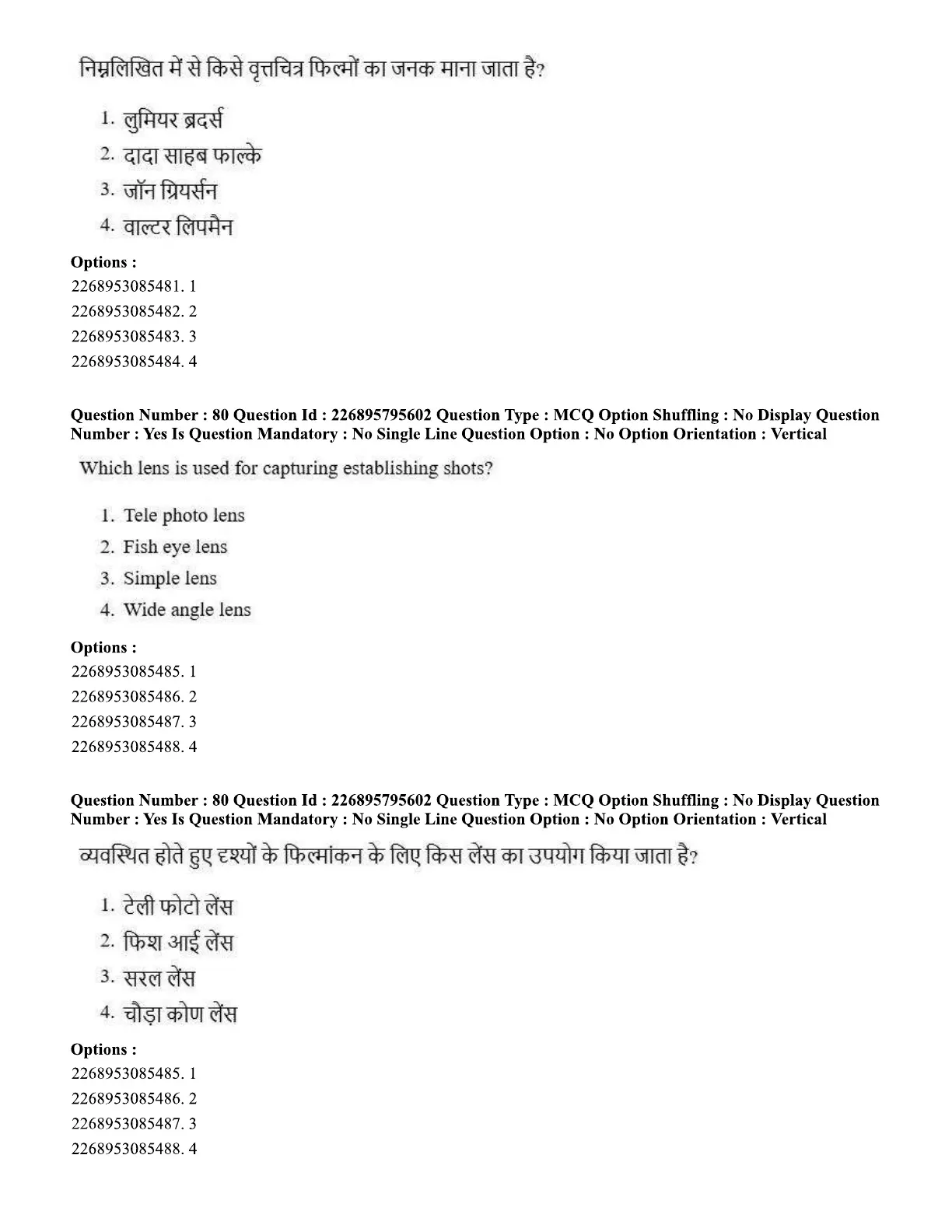
Who is regarded as the father of Documentary films?
View Solution
Concept:
Documentary cinema is a non-fictional motion picture genre designed to instruct, educate, or maintain a historical record of reality through creative treatment.
Step 1: Background of John Grierson:
John Grierson was a Scottish filmmaker, critic, and theoretician who is universally acknowledged as the "father of documentary film."
In February 1926, while reviewing Robert Flaherty’s non-fiction film Moana in the New York Sun, Grierson coined the term "documentary," defining it famously as the "creative treatment of actuality."
Step 2: Grierson’s Contributions to the Movement:
Grierson founded and spearheaded the British Documentary Film Movement in the 1930s, working through government agencies like the Empire Marketing Board (EMB) and the General Post Office (GPO) Film Unit.
He believed cinema should be an instrument of public education, civic democracy, and social change rather than mere escapist entertainment.
He also founded the National Film Board of Canada (NFB) in 1939, institutionalizing documentary filmmaking worldwide.
Step 3: Analyzing Other Personalities:
The Lumiere Brothers invented the Cinematographe and filmed the earliest actuality reels.
Dadasaheb Phalke is revered as the father of Indian cinema.
Walter Lippmann was an American public intellectual who formulated theories on public opinion.
Final Answer:
Therefore, the correct answer is (C) John Grierson.
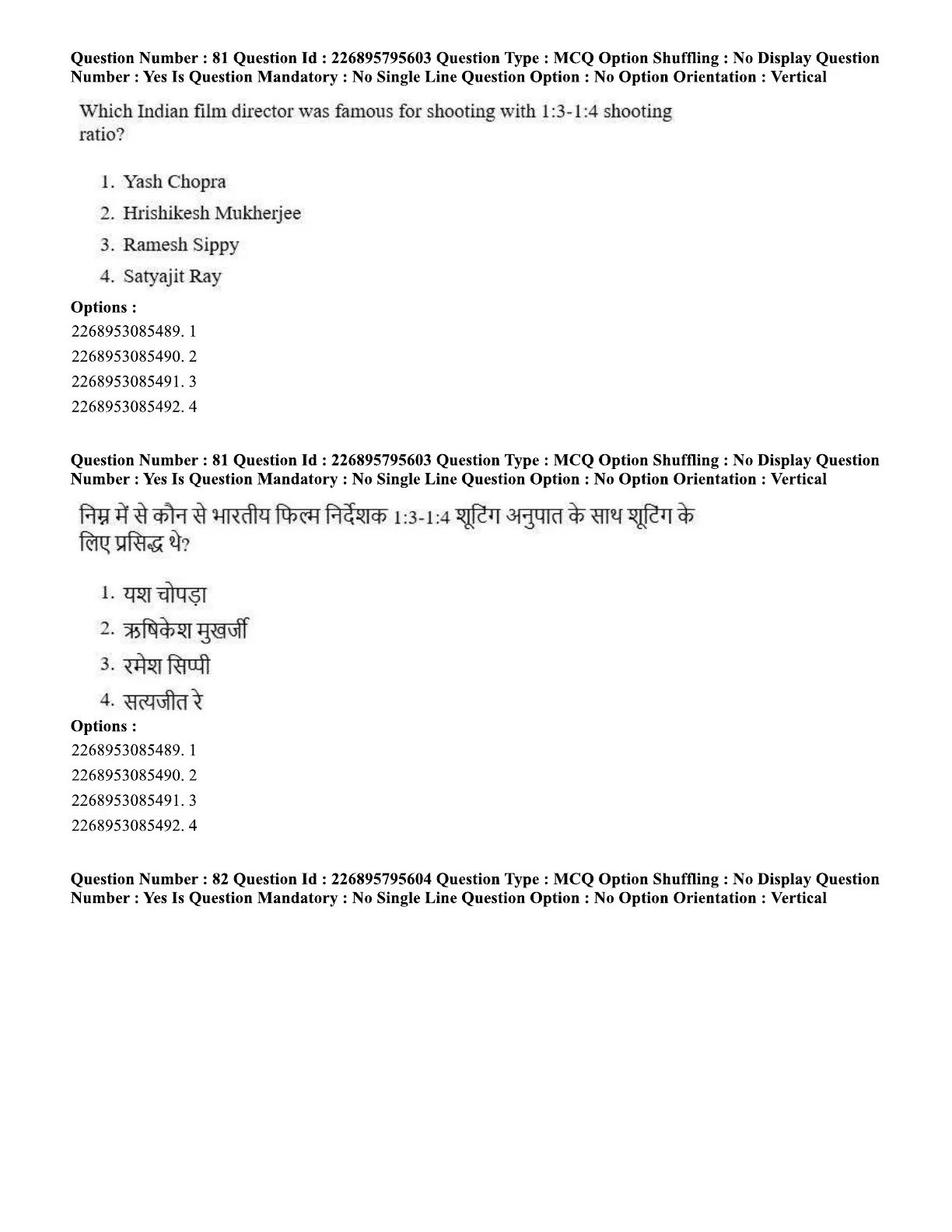
Which lens is used for capturing establishing shots?
View Solution
Concept:
Camera optics and shot compositions determine how spatial relationships, environmental context, and narrative settings are conveyed to the viewer in visual storytelling.
Step 1: Understanding an Establishing Shot:
An establishing shot is an extreme long shot or wide shot positioned at the beginning of a scene or film sequence.
Its primary function is to establish the geography, time, setting, and spatial relationships between the characters and their physical environment, orienting the viewer before moving into closer shots.
Step 2: Characteristics of a Wide-Angle Lens:
A wide-angle lens has a short focal length (typically below 35mm in full-frame photography).
This optical design offers a substantially wider field of view than the human eye, allowing the camera to capture vast panoramic vistas, expansive architecture, and broad landscapes.
It provides deep depth of field, keeping both the foreground elements and the distant background in sharp focus, making it the ideal optical tool for shooting establishing shots.
Step 3: Comparing with Other Lenses:
1. Telephoto lens: Has a long focal length that narrows the angle of view and flattens perspective, intended for distant close-ups.
2. Fish-eye lens: An ultra-wide lens that introduces extreme curvilinear barrel distortion, unsuitable for standard realistic establishing framing.
3. Simple lens: A basic single optical element lacking technical correction for aberration.
Final Answer:
Therefore, the correct answer is (D) Wide angle lens.
Which Indian film director was famous for shooting with 1:3-1:4 shooting ratio?
View Solution
Concept:
In traditional photochemical film production, the "shooting ratio" represents the proportion of total raw film footage exposed to the final length of film utilized in the completed release print.
Step 1: Understanding Shooting Ratios:
Commercial cinema typically operates on high shooting ratios such as 1:10, 1:20, or even higher, exposing multiple takes from numerous camera angles.
Conversely, art cinema and low-budget auteurs aim for extremely low shooting ratios to minimize film stock waste and processing expenses.
Step 2: Satyajit Ray’s Methodical Precision:
Legendary Indian filmmaker Satyajit Ray was universally renowned for his exceptional economy of film raw stock, regularly maintaining an extraordinarily low shooting ratio of 1:3 to 1:4.
Ray planned his productions with meticulous pre-visualization in his notebooks (kheror khata), creating detailed sketches, precise storyboards, dialogue scripts, and camera movements before arriving on set.
Because he visualized the final cut in advance and edited in his mind, Ray rarely shot unnecessary safety takes or extraneous coverage, achieving masterpiece films with unprecedented efficiency.
Step 3: Examining Other Directors:
Yash Chopra and Ramesh Sippy were grand commercial Bollywood filmmakers whose lavish multi-star productions and action sequences required high shooting ratios.
While Hrishikesh Mukherjee edited carefully, media textbooks specifically highlight Satyajit Ray’s benchmark 1:3 to 1:4 ratio as a historic testament to artistic discipline.
Final Answer:
Therefore, the correct answer is (D) Satyajit Ray.
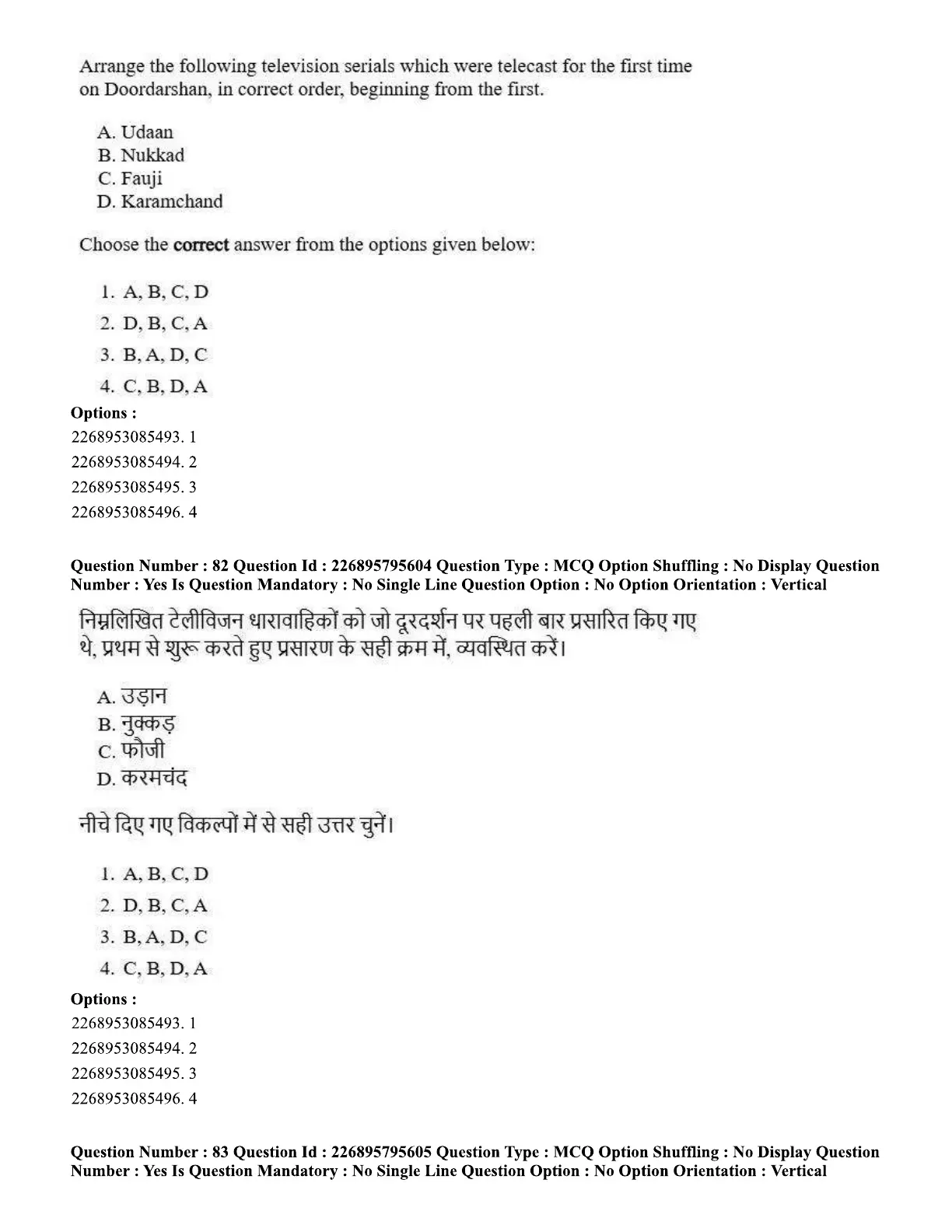
Arrange the following television serials which were telecast for the first time on Doordarshan, in correct order, beginning from the first.
A. Udaan
B. Nukkad
C. Fauji
D. Karamchand
Choose the correct answer from the options given below:
View Solution
Concept:
The golden era of Doordarshan in the 1980s saw the emergence of iconic indigenous television fiction serials covering detective fiction, social realism, military life, and women empowerment.
Step 1: Identifying the Premiere Years of Each Serial:
D. Karamchand: India’s first celebrated detective television series, starring Pankaj Kapur as the carrot-munching private investigator and Sushmita Mukherjee as Kitty, debuted on Doordarshan in 1985.
B. Nukkad: Directed by Kundan Shah and Saeed Akhtar Mirza, focusing on the struggles and hopes of working-class street dwellers, first aired in 1986.
C. Fauji: Directed by Col. Raj Kumar Kapoor, depicting the training of Indian Army commandos and launching Shah Rukh Khan’s acting career, premiered in January 1989.
A. Udaan: Written and directed by Kavita Choudhary, chronicling the inspiring struggle of a woman aspiring to become an IPS officer, aired later in 1989 (running until 1991).
Step 2: Chronological Sequence:
Arranging from the earliest first telecast to the latest:
1. 1985: Karamchand (D)
2. 1986: Nukkad (B)
3. Early 1989: Fauji (C)
4. Late 1989: Udaan (A)
Step 3: Verification with Options:
The sequence D \(\rightarrow\) B \(\rightarrow\) C \(\rightarrow\) A corresponds directly to option (B).
Final Answer:
Therefore, the correct answer is (B) D, B, C, A.
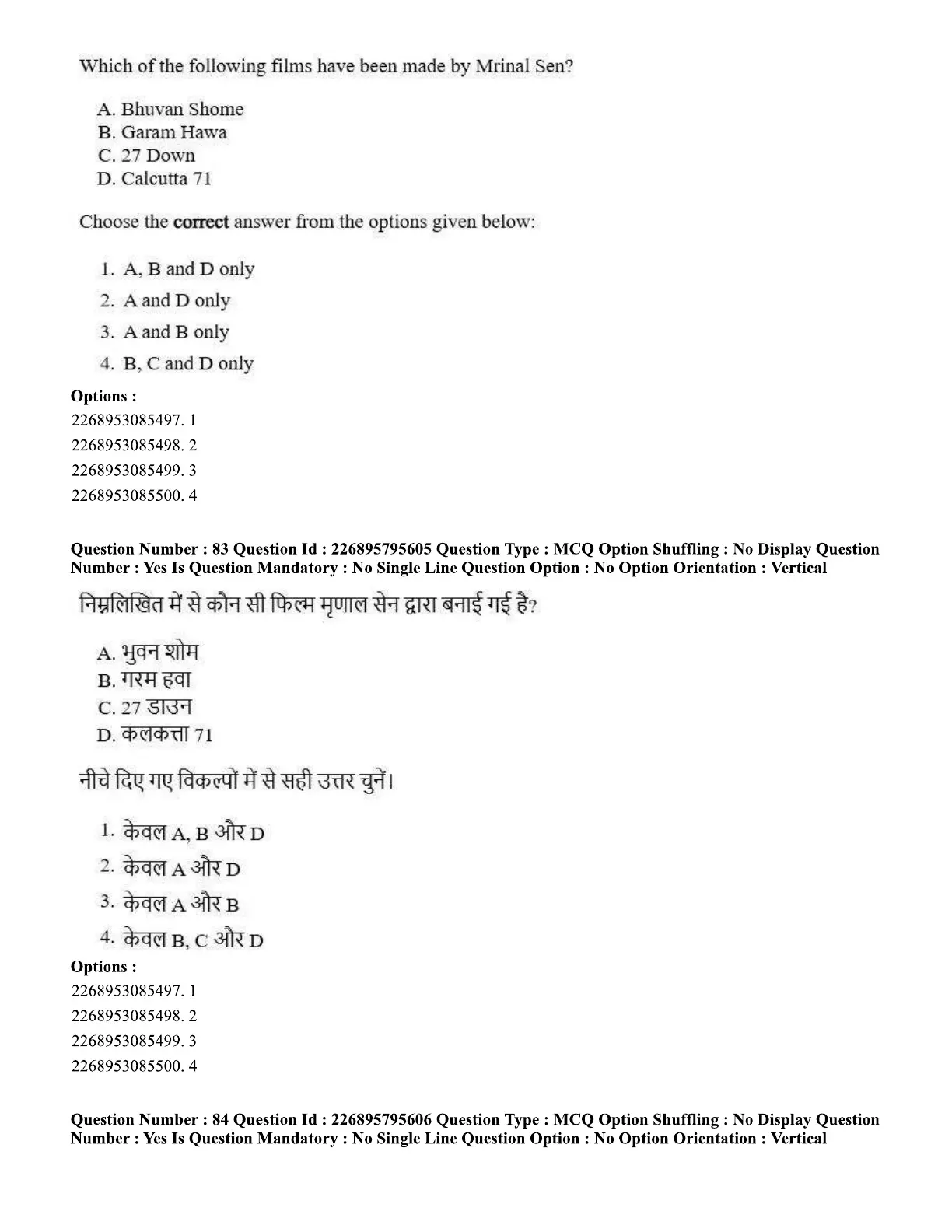
Which of the following films have been made by Mrinal Sen?
A. Bhuvan Shome
B. Garam Hawa
C. 27 Down
D. Calcutta 71
Choose the correct answer from the options given below:
View Solution
Concept:
The Indian New Wave or Parallel Cinema movement of the late 1960s and 1970s was spearheaded by visionary directors who broke away from mainstream commercial formulas to address social reality and political turbulence.
Step 1: Examining Mrinal Sen’s Filmography:
Mrinal Sen was one of the foremost pioneers of Indian parallel cinema alongside Satyajit Ray and Ritwik Ghatak:
1. Bhuvan Shome (1969): Directed by Mrinal Sen, starring Utpal Dutt. Funded by the Film Finance Corporation (FFC), this landmark Hindi film is universally acknowledged as the official launchpad of the Indian New Wave.
2. Calcutta 71 (1972): Directed by Mrinal Sen, this film is the second part of his acclaimed political "Calcutta Trilogy" (comprising Interview, Calcutta 71, and Padatik) examining political unrest and poverty.
Step 2: Identifying Directors of the Other Films:
B. Garam Hawa (1973): The iconic drama dealing with the plight of North Indian Muslims after Partition was directed by M.S. Sathyu, not Mrinal Sen.
C. 27 Down (1974): A poignant railway-centered drama directed by Awtar Krishna Kaul.
Step 3: Evaluating the Options:
Only films A (Bhuvan Shome) and D (Calcutta 71) were made by Mrinal Sen.
Final Answer:
Therefore, the correct answer is (B) A and D only.
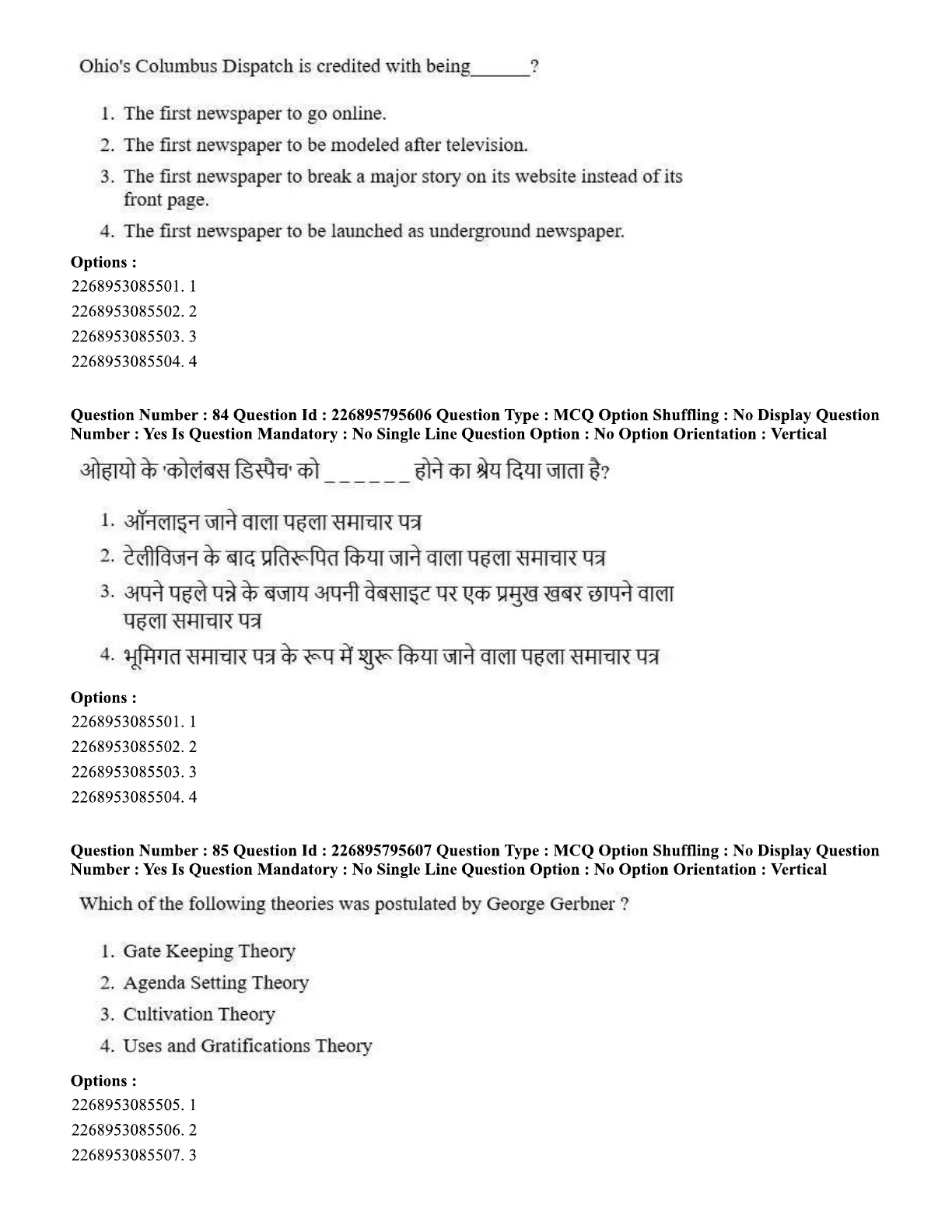
Ohio’s Columbus Dispatch is credited with being ?
View Solution
Concept:
The digital revolution in print media commenced in the late 20th century through early experiments connecting newsrooms directly to telecommunication networks and electronic terminal screens.
Step 1: Historic Milestone of The Columbus Dispatch:
On July 1, 1980, The Columbus Dispatch, a daily broadsheet based in Columbus, Ohio, made global media history by becoming the first newspaper in the world to go online.
Step 2: Technical Execution:
Working in a pioneering experiment with CompuServe (the commercial online service provider) and the Associated Press (AP), text from The Columbus Dispatch was converted into electronic data and transmitted over telephone lines.
Subscribers equipped with home computers and dial-up modems could read the daily news electronically on their monitors hours before physical printed papers were delivered to doorsteps.
Step 3: Analyzing Alternative Options:
USA Today (launched in 1982) is famously credited with being modeled after television, featuring short snippets and colorful graphics.
Breaking online stories before print became common much later with the World Wide Web in the late 1990s.
Therefore, The Columbus Dispatch holds the distinct honour of being the first newspaper to go online.
Final Answer:
Therefore, the correct answer is (A) The first newspaper to go online.
Which of the following theories was postulated by George Gerbner?
View Solution
Concept:
Mass communication theorists examine how long-term exposure to media messages, especially television, subtly conditions and cultivates the public’s perception of social reality.
Step 1: Understanding George Gerbner’s Postulation:
Cultivation Theory was formulated by professor George Gerbner and his colleagues at the Annenberg School for Communication (University of Pennsylvania) in the late 1960s and 1970s.
Gerbner initiated the Cultural Indicators Project to assess whether heavy television viewing cultivates exaggerated perceptions of violence and crime in the real world.
Step 2: Key Concepts of Cultivation Theory:
Gerbner found that heavy viewers develop what he termed the "Mean World Syndrome"—a cynical belief that the world is far more dangerous, hostile, and menacing than it actually is.
He also identified processes such as "mainstreaming" (blurring of distinct cultural attitudes into a common TV-mediated view) and "resonance" (when real-world events amplify television portrayals).
Step 3: Differentiating Other Theorists:
1. Gatekeeping Theory: Formulated by Kurt Lewin (1947) and applied to newsrooms by David Manning White (1950).
2. Agenda Setting Theory: Postulated by Maxwell McCombs and Donald Shaw (1972).
3. Uses and Gratifications Theory: Developed by Elihu Katz, Jay Blumler, and Michael Gurevitch.
Final Answer:
Therefore, the correct answer is (C) Cultivation Theory.
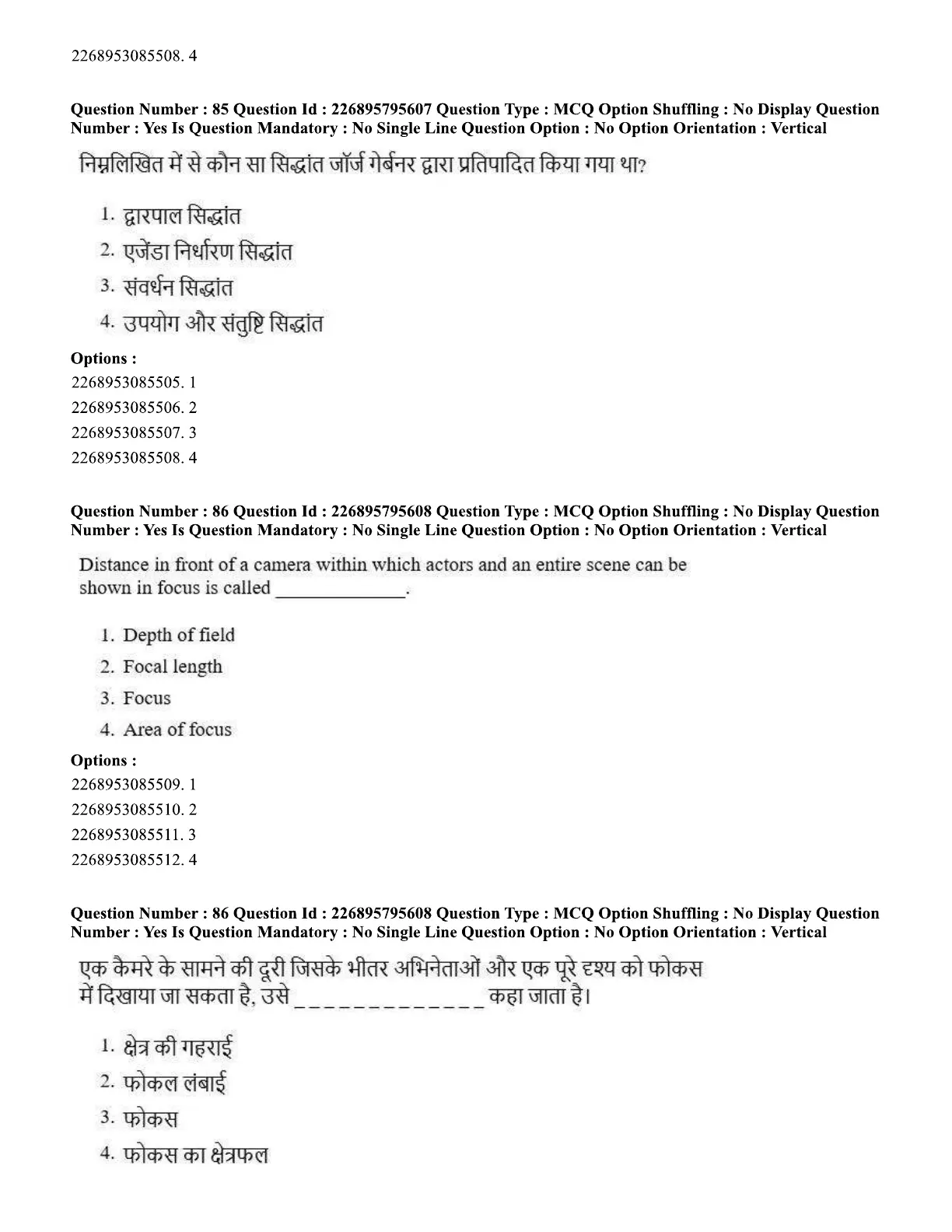
Distance in front of a camera within which actors and an entire scene can be shown in focus is called .
View Solution
Concept:
In cinematography and still photography, the optical control of sharpness across different planes of distance creates visual depth, directs audience attention, and defines spatial aesthetics.
Step 1: Defining Depth of Field (DoF):
Depth of field is technically defined as the zone or range of distance in front of the camera—between the nearest and farthest objects—that appears acceptably sharp and in clear focus in the final recorded image.
When actors and background scenery remain sharply rendered across a broad spatial distance, the shot is said to exhibit a deep depth of field (deep focus).
When only the subject is in focus while the background is softly blurred, it has a shallow depth of field.
Step 2: Factors Controlling Depth of Field:
Depth of field is determined by three variables:
1. Aperture (f-stop): Smaller apertures (large f-numbers like f/16) yield deeper depth of field.
2. Focal length: Shorter focal lengths (wide lenses) provide greater depth of field.
3. Camera-to-subject distance: Greater distance from the subject increases depth of field.
Step 3: Distinguishing Alternative Optical Terms:
Focal length is the physical distance between the optical center of the lens and the image sensor.
Focus is the adjustment of lens elements to converge light rays sharply onto the focal plane.
Thus, the specific zone of acceptable sharpness across a scene is called depth of field.
Final Answer:
Therefore, the correct answer is (A) Depth of field.
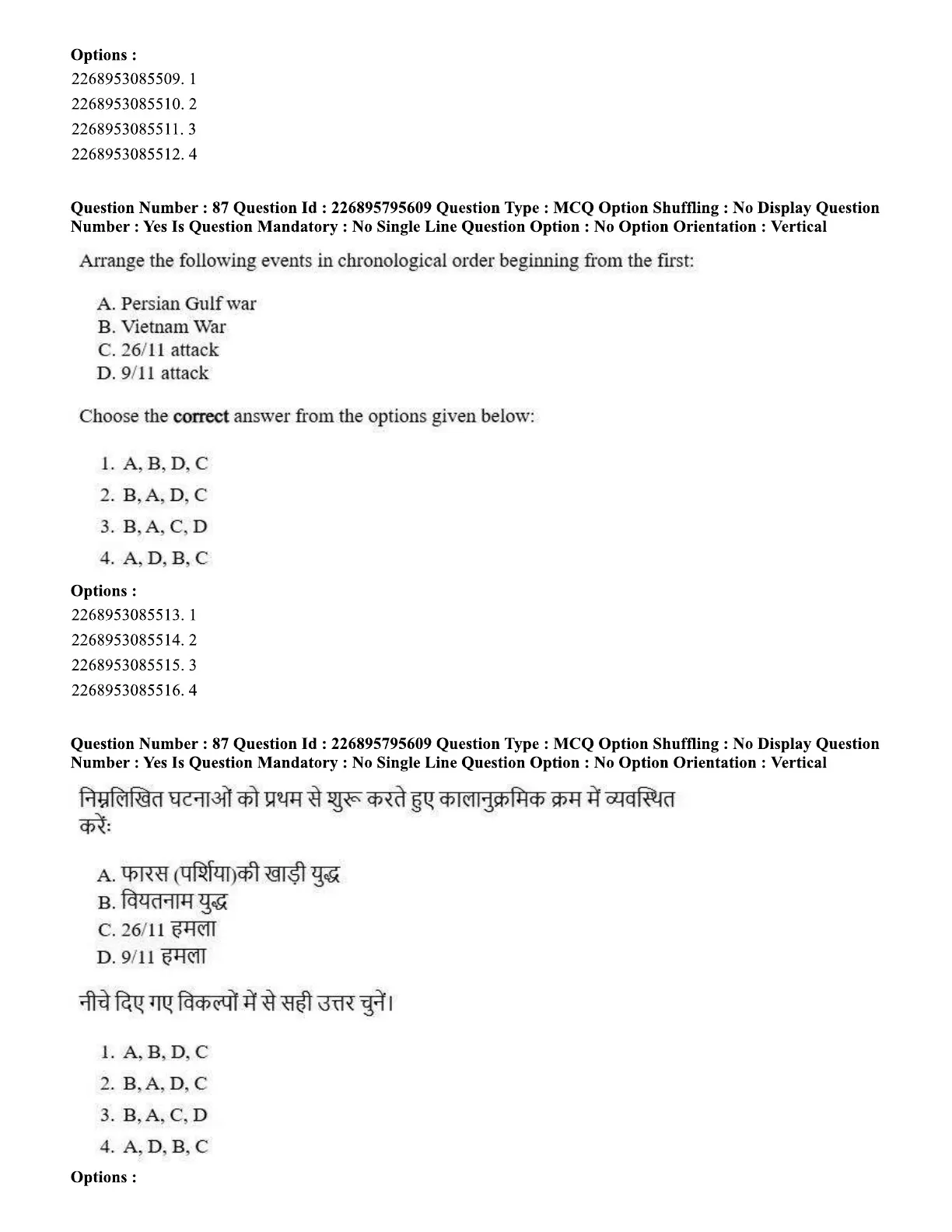
Arrange the following events in chronological order beginning from the first:
A. Persian Gulf war
B. Vietnam War
C. 26/11 attack
D. 9/11 attack
Choose the correct answer from the options given below:
View Solution
Concept:
Major geopolitical crises and televised conflicts have fundamentally reshaped modern global journalism, war reporting methodologies, and 24-hour live news coverage.
Step 1: Identifying the Historical Timeline:
B. Vietnam War (1955–1975): Known as the world’s first "television war," where uncensored broadcast reporting directly influenced anti-war public sentiment, concluding with the fall of Saigon in April 1975.
A. Persian Gulf War (1990–1991): Operations Desert Shield and Desert Storm marked the historic debut of real-time, 24-hour live satellite war broadcasting, establishing CNN as a premier global network.
D. 9/11 Attacks (September 11, 2001): Al-Qaeda coordinated four terrorist airplane hijackings against the World Trade Center and Pentagon in the United States, watched live by billions worldwide.
C. 26/11 Mumbai Terror Attacks (November 26, 2008): Lashkar-e-Taiba terrorists carried out coordinated attacks across Mumbai, including at the Taj Mahal Palace Hotel, leading to major debates on live television operational protocol.
Step 2: Chronological Ordering:
Arranging from the earliest event to the most recent:
1. 1955–1975: Vietnam War (B)
2. 1990–1991: Persian Gulf War (A)
3. 2001: 9/11 Attacks (D)
4. 2008: 26/11 Attacks (C)
Step 3: Verification with Options:
The sequence B \(\rightarrow\) A \(\rightarrow\) D \(\rightarrow\) C corresponds to option (B).
Final Answer:
Therefore, the correct answer is (B) B, A, D, C.
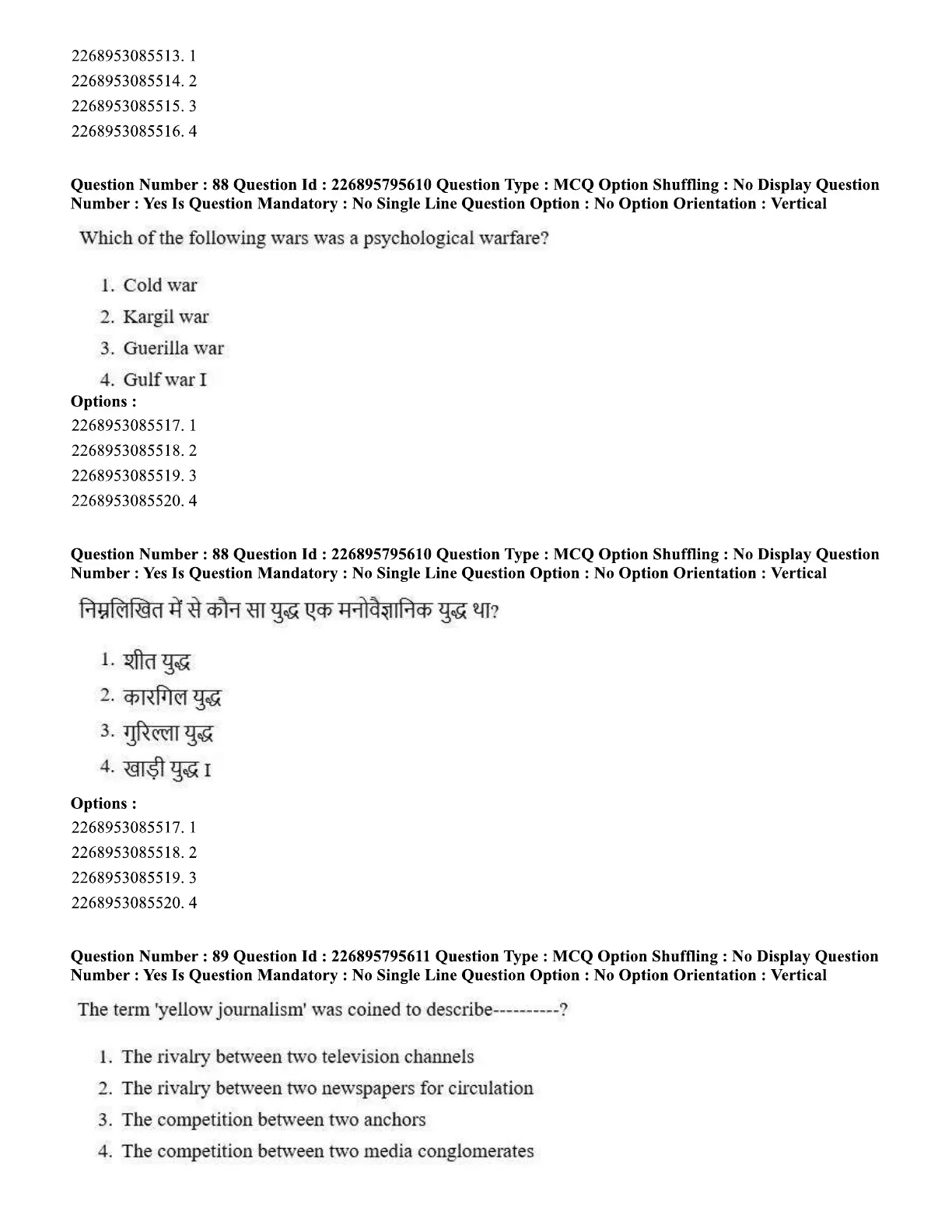
Which of the following wars was a psychological warfare?
View Solution
Concept:
Psychological warfare involves the strategic use of propaganda, ideological messaging, economic intimidation, intelligence operations, and cultural influence to demoralize an adversary without direct armed confrontation.
Step 1: Analyzing the Cold War:
The Cold War (1947–1991) was an intense geopolitical and ideological confrontation between the Western Bloc (led by the United States) and the Eastern Bloc (led by the Soviet Union).
Because both superpowers possessed massive nuclear arsenals, direct military conflict threatened mutual assured destruction.
Consequently, the war was fought primarily through psychological warfare, state-sponsored international radio broadcasting (e.g., Voice of America, Radio Free Europe, Radio Moscow), media disinformation, space and arms race spectacles, and espionage.
Step 2: Examining the Other Options:
1. Kargil War (1999): An active, direct conventional military clash fought between Indian and Pakistani armed forces in high-altitude Himalayan terrain.
2. Guerilla War: A combat strategy where irregular combatants use ambushes, raids, and mobility against conventional forces.
3. Gulf War I (1991): A conventional, massive direct military conflict carried out by a US-led international coalition to liberate Kuwait.
Step 3: Conclusion:
Among the given options, the Cold War is the paramount historical embodiment of sustained global psychological warfare.
Final Answer:
Therefore, the correct answer is (A) Cold war.
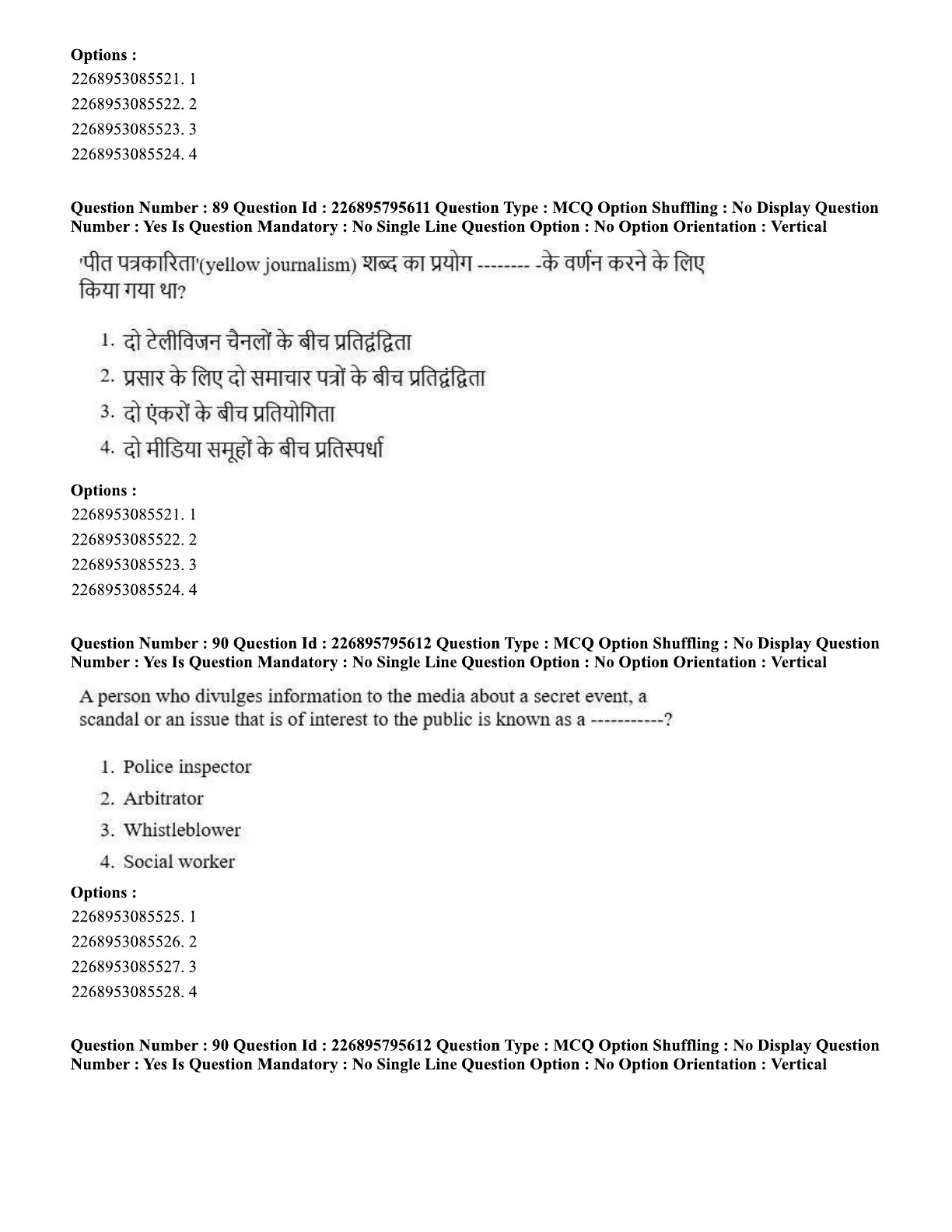
The term ’yellow journalism’ was coined to describe ?
View Solution
Concept:
Sensationalism and unethical reportage in journalism trace back to late 19th-century commercial newspaper circulation wars in the United States.
Step 1: Historical Origin of Yellow Journalism:
The term "yellow journalism" was coined in the late 1890s during the ferocious circulation battle in New York City between two major press magnates:
1. Joseph Pulitzer, owner of the New York World.
2. William Randolph Hearst, owner of the New York Journal.
Step 2: The Battle of the "Yellow Kid":
Both newspapers fiercely competed for readership by sensationalizing crime stories, fabricating interviews, employing screaming banner headlines, and engaging in jingoistic warmongering during the Spanish-American War.
The rivalry centered around a popular comic strip character, "The Yellow Kid" (drawn by R.F. Outcault in bright yellow ink).
Hearst lured the artist away from Pulitzer with astronomical pay, after which Pulitzer hired another artist to draw the same character, resulting in two competing papers simultaneously printing the "Yellow Kid."
Editor Ervin Wardman coined the phrase "yellow journalism" to denounce this reckless, sensationalized competition for newspaper circulation.
Step 3: Evaluating the Options:
The term originated strictly within print newspaper circulation battles long before television channels, anchors, or contemporary multi-platform conglomerates existed.
Final Answer:
Therefore, the correct answer is (B) The rivalry between two newspapers for circulation.
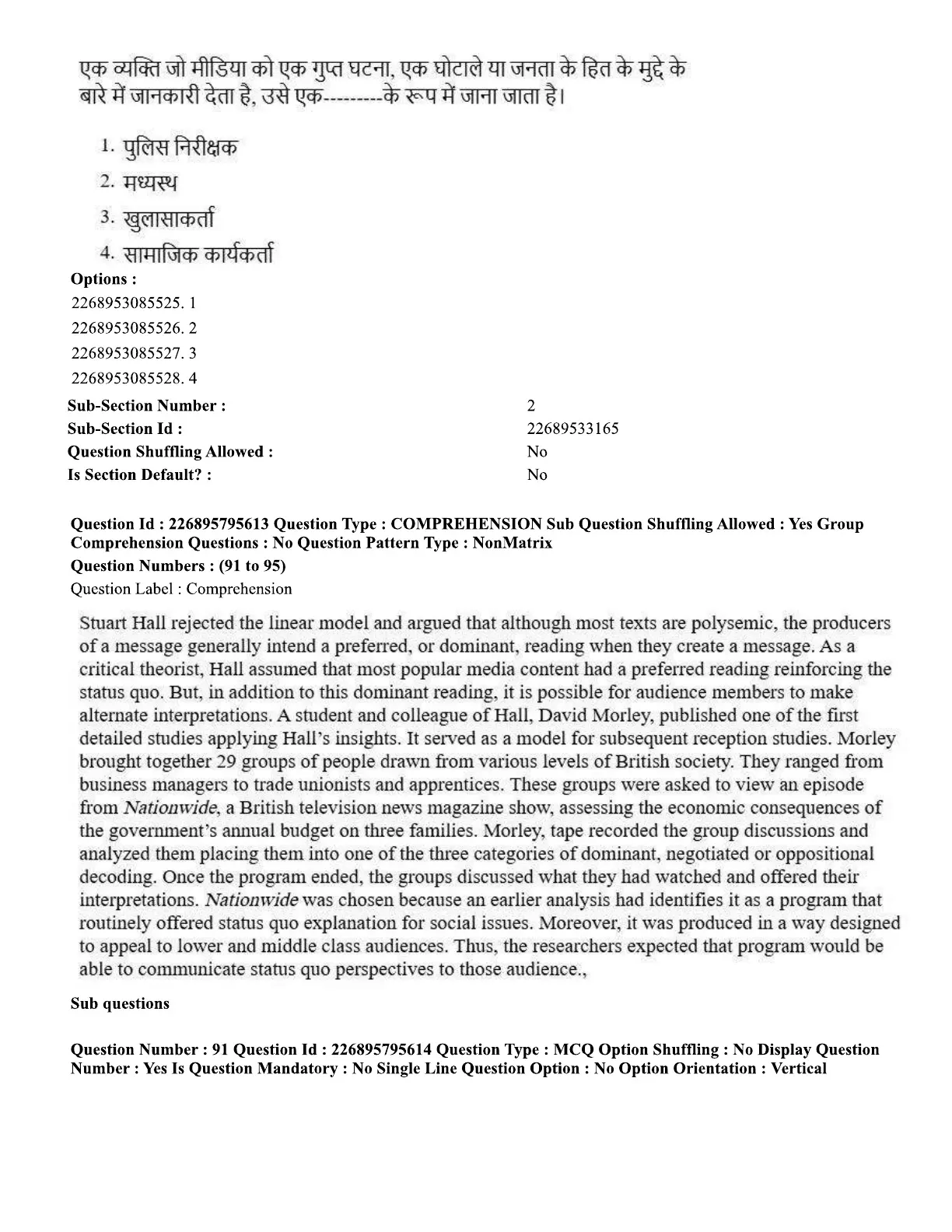
A person who divulges information to the media about a secret event, a scandal or an issue that is of interest to the public is known as a ?
View Solution
Concept:
Investigative journalism relies fundamentally on brave insiders who expose corruption, illegal activities, or ethical breaches within powerful organizations to inform the public.
Step 1: Defining a Whistleblower:
A whistleblower is an insider—such as an employee, government official, or corporate worker—who reveals confidential evidence of fraud, corruption, illicit conduct, public health hazards, or major scandals occurring within an institution.
By sharing this suppressed information with investigative journalists, enforcement agencies, or the public, whistleblowers act as vital watchdogs of public interest.
Step 2: Famous Examples in Media History:
Famous whistleblowers include:
1. Mark Felt ("Deep Throat"): Secretly disclosed the Watergate cover-up to Washington Post reporters Bob Woodward and Carl Bernstein.
2. Edward Snowden: Disclosed classified global surveillance operations conducted by intelligence agencies.
Step 3: Evaluating the Other Roles:
1. Police inspector: An official law enforcement officer investigating statutory crimes.
2. Arbitrator: An independent judicial arbiter chosen by disputing parties to settle a civil dispute outside court.
3. Social worker: A professional aiding disadvantaged individuals and communities.
Final Answer:
Therefore, the correct answer is (C) Whistleblower.
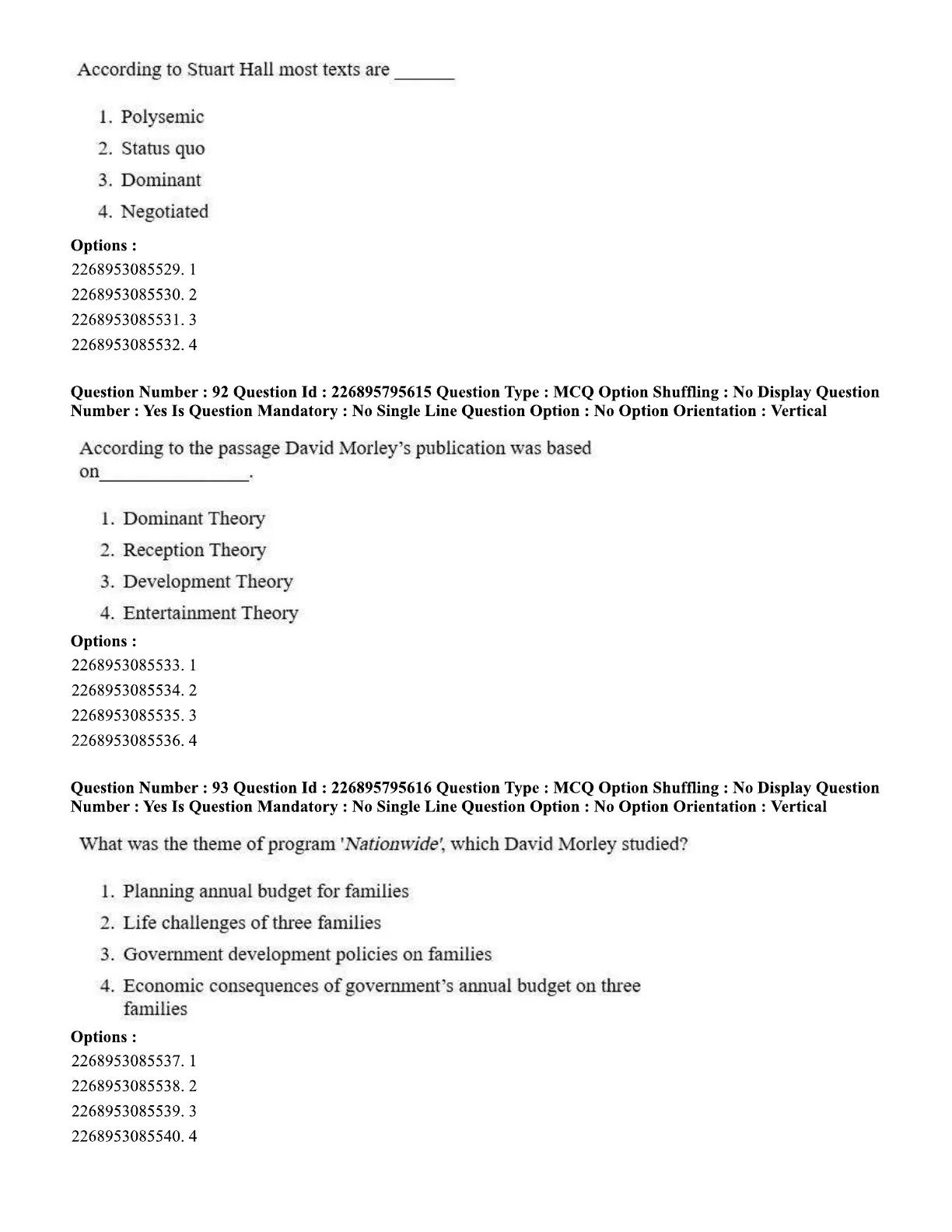
Stuart Hall rejected the linear model and argued that although most texts are polysemic, the producers of a message generally intend a preferred, or dominant, reading when they create a message.
As a critical theorist, Hall assumed that most popular media content had a preferred reading reinforcing the status quo.
But, in addition to this dominant reading, it is possible for audience members to make alternate interpretations.
A student and colleague of Hall, David Morley, published one of the first detailed studies applying Hall’s insights.
It served as a model for subsequent reception studies.
Morley brought together 29 groups of people drawn from various levels of British society.
They ranged from business managers to trade unionists and apprentices.
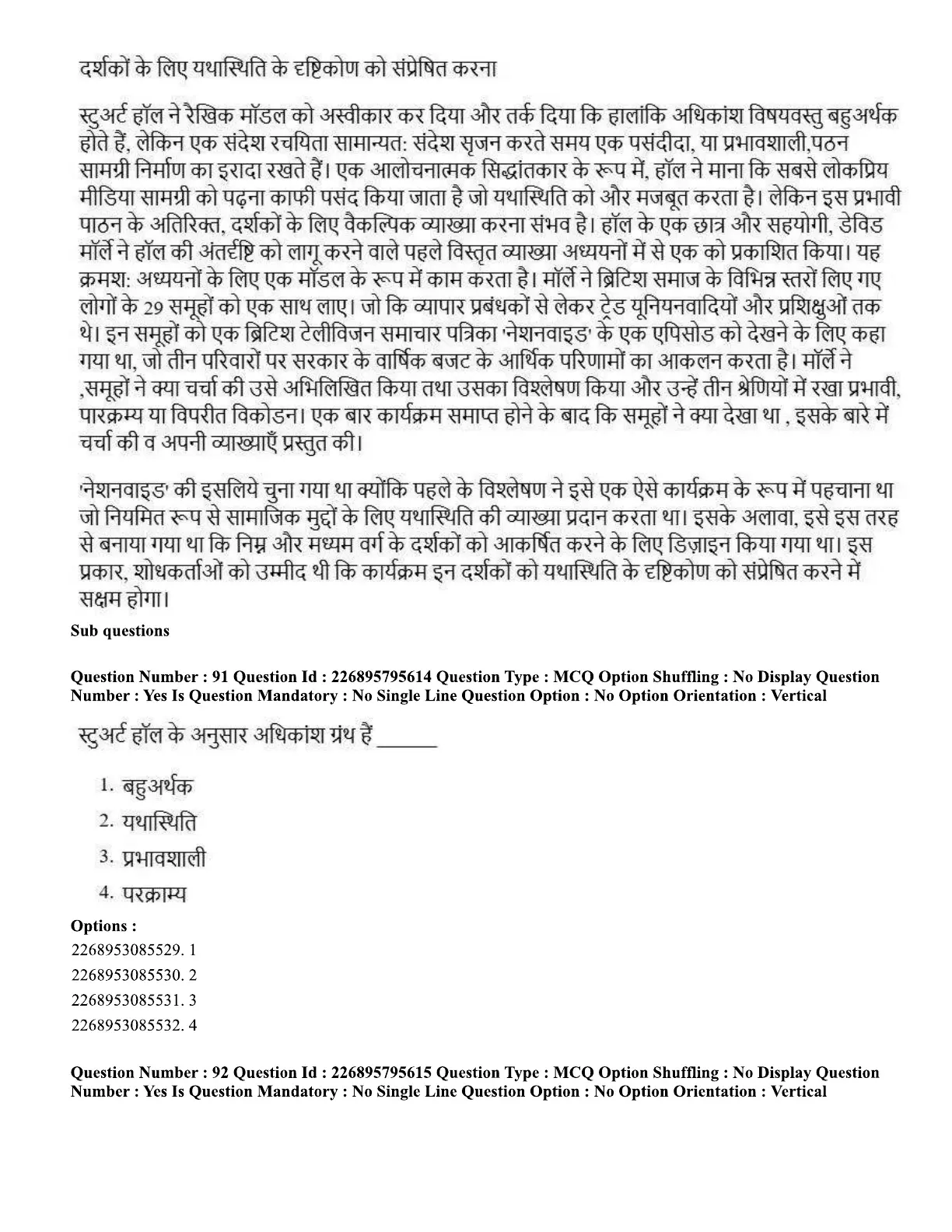
These groups were asked to view an episode from Nationwide, a British television news magazine show, assessing the economic consequences of the government’s annual budget on three families.
Morley tape-recorded the group discussions and analyzed them, placing them into one of the three categories of dominant, negotiated, or oppositional decoding.
Once the program ended, the groups discussed what they had watched and offered their interpretations.
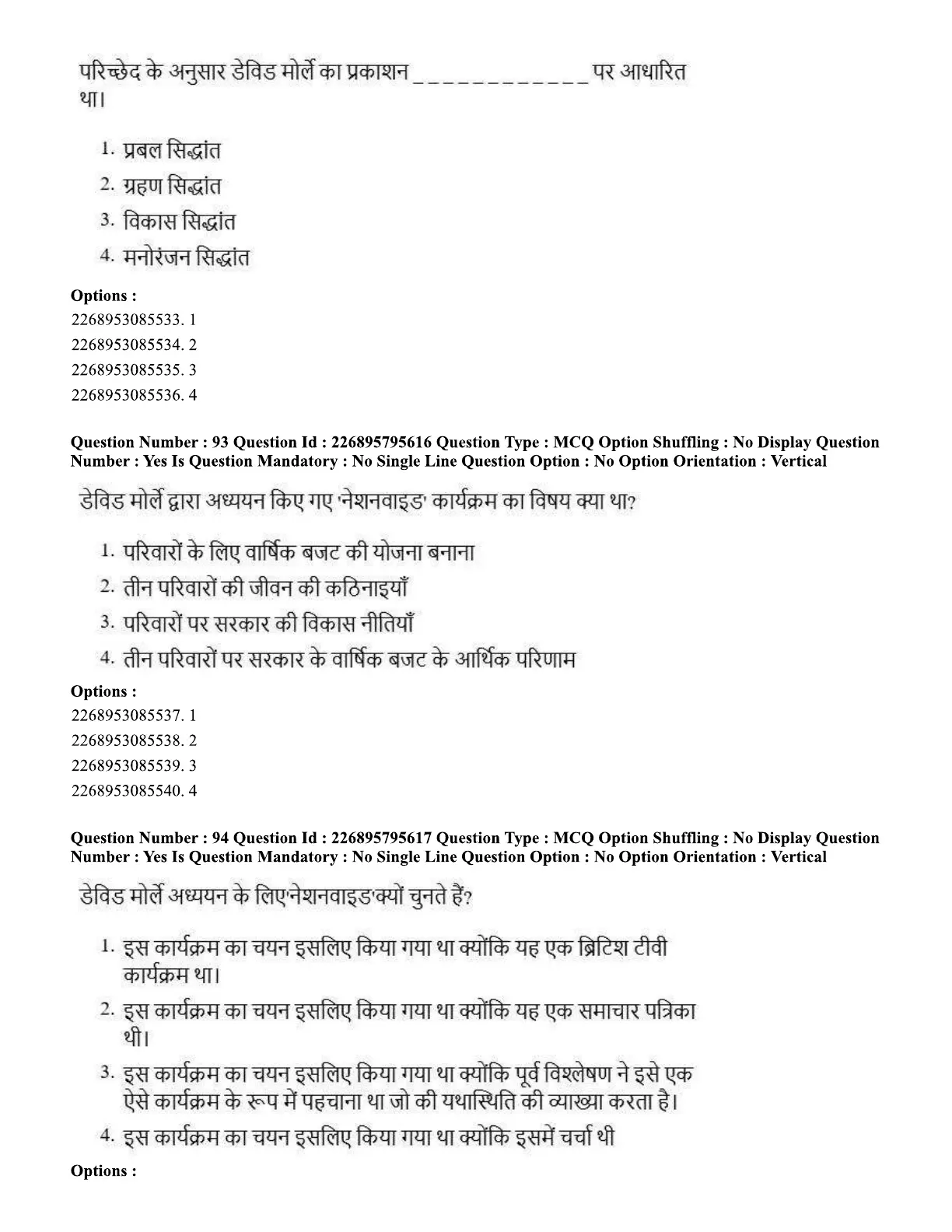
Nationwide was chosen because an earlier analysis had identified it as a program that routinely offered status quo explanations for social issues.
Moreover, it was produced in a way designed to appeal to lower- and middle-class audiences.
Thus, the researchers expected that the program would be able to communicate status quo perspectives to those audiences.
Question 41:
According to Stuart Hall, most texts are
View Solution
Concept:
The question tests Stuart Hall’s reception theory and his understanding of how audiences interpret media texts.
Hall rejected the idea that communication is simply a linear process in which a sender transmits a fixed meaning to a passive receiver.
According to the passage, media texts are generally polysemic, meaning that they can contain or generate multiple possible meanings and interpretations.
Step 1: Understanding Stuart Hall’s View:
Stuart Hall argued that media communication involves both encoding and decoding.
Producers encode messages with particular meanings and may intend a preferred or dominant interpretation.
However, audiences are not necessarily passive recipients of that intended meaning.
They may interpret the same media text in different ways depending on their social background, experiences, knowledge, and viewpoints.
Step 2: Understanding the Term Polysemic:
The term “polysemic” refers to the capacity of a text to have multiple meanings or to allow multiple interpretations.
This is central to Hall’s approach because the meaning encoded by producers does not automatically become the only meaning decoded by audiences.
Therefore, a single media text can generate dominant, negotiated, or oppositional interpretations.
Step 3: Evaluating the Options:
Option (A), Polysemic, is directly supported by the passage, which states that most texts are polysemic.
Option (B), Status quo, describes a perspective that may be reinforced by dominant media readings, but it does not describe the nature of most texts.
Option (C), Dominant, refers to the preferred reading intended by producers and is not synonymous with the nature of all texts.
Option (D), Negotiated, is one possible form of audience decoding, not a characteristic of most texts.
Step 4: Final Answer:
The passage explicitly states that Stuart Hall considered most texts to be polysemic, while producers generally intend a preferred or dominant reading.
Therefore, the correct answer is (A) Polysemic.
Producers may encode a preferred meaning, but audiences can interpret the same text differently because media texts are generally polysemic.
The three major decoding positions discussed in Hall’s model are dominant, negotiated, and oppositional.
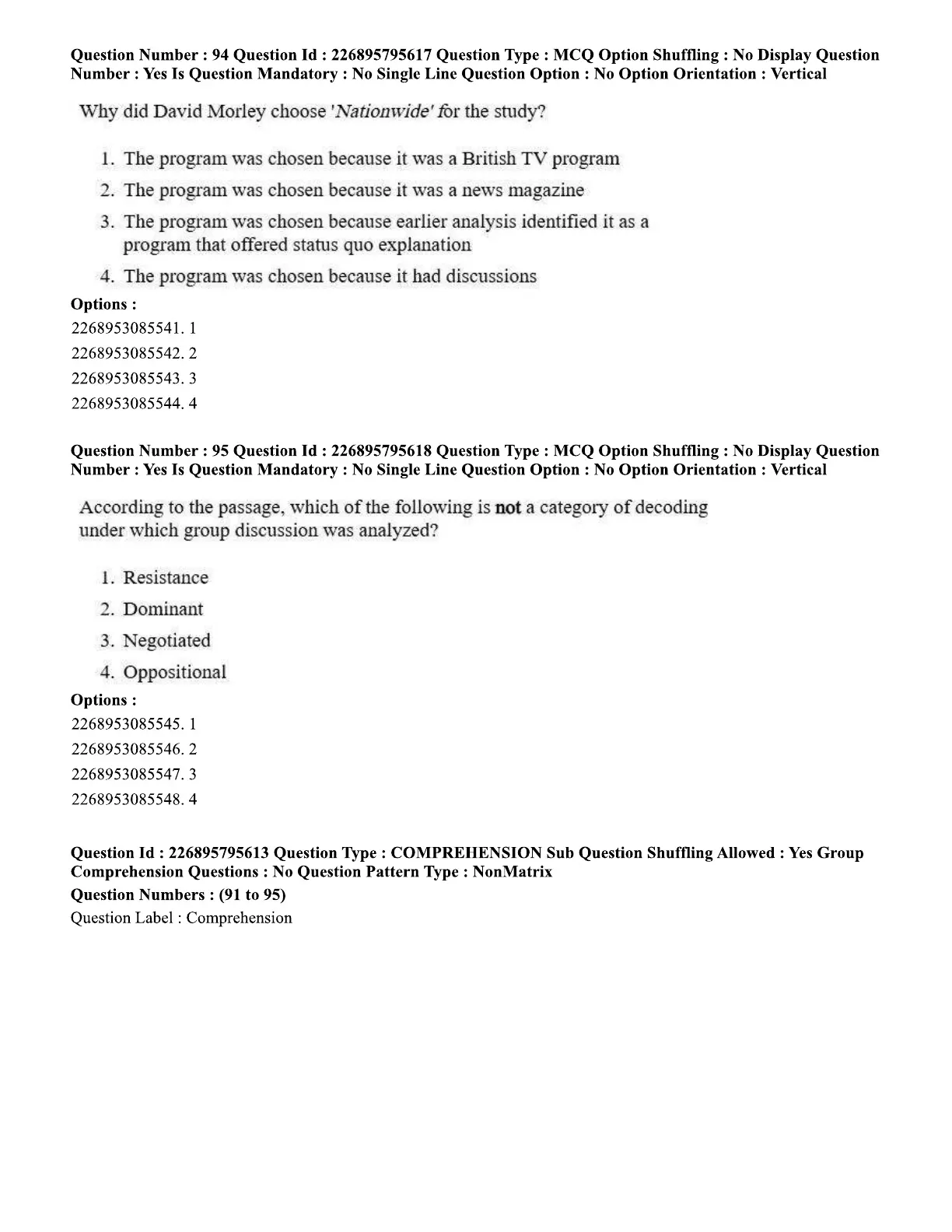
According to the passage, David Morley’s publication was based on
View Solution
Concept:
The question examines the theoretical foundation of David Morley’s study of audience interpretations of media messages.
The passage explains that Morley was a student and colleague of Stuart Hall and that his work applied Hall’s insights to audience reception.
Therefore, the relevant concept is reception theory, which focuses on how audiences interpret and make meaning from media content.
Step 1: Understanding the Passage:
The passage states that Stuart Hall proposed that most texts are polysemic and that producers generally intend a preferred or dominant reading.
However, audiences may produce alternative interpretations of the same media message.
This relationship between media messages and audience interpretation forms an important part of reception studies.
Step 2: Connecting Morley’s Work with Hall’s Ideas:
David Morley conducted a detailed study applying Stuart Hall’s theoretical insights.
He brought together 29 groups representing different levels of British society.
These groups watched an episode of the television program Nationwide and subsequently discussed and interpreted what they had watched.
Morley analyzed these interpretations according to dominant, negotiated, and oppositional decoding positions.
Step 3: Evaluating the Options:
Option (A), Dominant Theory, is incorrect because dominant decoding is only one category used to analyze audience interpretations.
It does not describe the broader theoretical basis of Morley’s publication.
Option (B), Reception Theory, is correct because the passage explicitly states that Morley’s study served as a model for subsequent reception studies and applied Hall’s insights to audience interpretations.
Option (C), Development Theory, is not mentioned as the theoretical basis of Morley’s research.
Option (D), Entertainment Theory, is also not identified in the passage and does not explain the study’s focus on audience decoding.
Step 4: Final Answer:
David Morley’s publication applied Stuart Hall’s ideas to the way different social groups interpreted media content.
This approach is fundamentally associated with reception theory and audience reception studies.
Therefore, the correct answer is (B) Reception Theory.
Remember that Hall’s framework examines how audiences decode messages differently, while Morley applied these ideas through empirical group-based audience research.
What was the theme of the program “Nationwide”, which David Morley studied?
View Solution
Concept:
The question asks for the specific subject or theme of the television program episode examined in David Morley’s audience study.
The answer can be obtained directly from the comprehension passage by identifying what the selected episode of Nationwide focused on.
This is a factual comprehension question, so the exact wording and meaning of the passage are important.
Step 1: Locating the Relevant Information:
The passage describes David Morley’s study involving 29 groups of people from different levels of British society.
These groups were asked to watch an episode of Nationwide, which is described as a British television news magazine show.
The passage then specifies the subject of the episode that the groups viewed.
Step 2: Identifying the Program Theme:
According to the passage, the episode assessed the economic consequences of the government’s annual budget on three families.
Therefore, the central theme was not simply the preparation or planning of an annual budget.
Instead, the program examined how the government’s annual budget affected the economic circumstances of three families.
Step 3: Evaluating the Options:
Option (A), Planning annual budget for families, changes the focus from the consequences of a government budget to the planning of family budgets.
Therefore, it is not supported by the passage.
Option (B), Life challenges of three families, is too general because the passage specifically identifies the economic consequences of the government’s annual budget.
Option (C), Government development policies on families, is not the stated theme of the episode.
Option (D), Economic consequences of government’s annual budget on three families, accurately reproduces the central idea given in the passage.
Step 4: Final Answer:
The episode of Nationwide selected for Morley’s study dealt with the economic consequences of the government’s annual budget on three families.
This subject provided a useful basis for studying how different social groups interpreted the same media presentation.
Therefore, the correct answer is (D) Economic consequences of government’s annual budget on three families.
Here, the key phrase is “economic consequences of the government’s annual budget on three families”.
Choose the option that preserves this meaning without adding or removing important details.
Why did David Morley choose “Nationwide” for the study?
View Solution
Concept:
This question tests the reader’s ability to identify the specific reason given in the passage for selecting the television program Nationwide for David Morley’s research.
The passage provides several characteristics of the program, but one particular characteristic explains why it was considered suitable for the study.
Step 1: Understanding the Purpose of the Study:
David Morley’s research examined how different social groups interpreted the same media content.
He selected 29 groups from different levels of British society, including business managers, trade unionists, and apprentices.
These groups watched the same episode and then discussed and interpreted what they had seen.
Step 2: Identifying the Selection Criterion:
The passage specifically states that Nationwide was chosen because an earlier analysis had identified it as a program that routinely offered status quo explanations for social issues.
This characteristic was important because the researchers wanted to examine how audiences responded to media content presenting a particular perspective.
The program was also designed to appeal to lower- and middle-class audiences, making it suitable for the research context.
Step 3: Evaluating the Options:
Option (A) is incomplete because being a British television program was descriptive information, not the principal reason for selection.
Option (B) is also descriptive because the program being a news magazine does not explain the specific research reason for choosing it.
Option (C) is correct because it directly reflects the passage’s explanation that earlier analysis had identified Nationwide as a program offering status quo explanations for social issues.
Option (D) is incorrect because discussions occurred as part of the research procedure rather than being the reason for selecting the program.
Step 4: Final Answer:
David Morley chose Nationwide because previous analysis had identified the program as one that routinely provided status quo explanations for social issues.
This made it appropriate for examining how different groups decoded and interpreted a media message.
Therefore, the correct answer is (C) The program was chosen because earlier analysis identified it as a program that offered status quo explanation.
Here, “British TV program” and “news magazine” describe Nationwide, but the stated reason for choosing it was its previously identified status quo explanation of social issues.
According to the passage, which of the following is not a category of decoding under which group discussion was analyzed?
View Solution
Concept:
The question tests understanding of the three categories of decoding used in David Morley’s analysis of the group discussions.
In Stuart Hall’s framework, audiences can respond to a media message through dominant, negotiated, or oppositional readings.
The passage states that Morley analyzed the discussions by placing the groups into these three categories.
Step 1: Identifying the Decoding Categories:
The passage explains that Morley brought together 29 groups from different levels of British society.
After watching an episode of Nationwide, the groups discussed what they had watched and offered their interpretations.
Morley recorded these discussions and analyzed them according to three categories of decoding.
Step 2: Listing the Categories Given in the Passage:
The passage explicitly identifies the three categories as dominant, negotiated, and oppositional decoding.
A dominant decoding accepts the preferred meaning of the media text.
A negotiated decoding accepts some elements of the preferred meaning while modifying or questioning others.
An oppositional decoding understands the preferred meaning but interprets the message from an alternative or contrary viewpoint.
Step 3: Evaluating the Options:
Option (B), Dominant, is one of the three categories explicitly mentioned in the passage.
Option (C), Negotiated, is also explicitly identified as a category of decoding.
Option (D), Oppositional, is the third category directly stated in the passage.
Option (A), Resistance, does not appear in the passage as one of the three categories under which Morley analyzed the group discussions.
Although resistance may describe a general response to dominant media meanings, it is not one of the three categories listed in this passage.
Step 4: Final Answer:
The three decoding categories mentioned are dominant, negotiated, and oppositional.
Since “Resistance” is not included in this list, it is the category that was not used for the analysis described in the passage.
Therefore, the correct answer is (A) Resistance.
In Hall’s decoding framework, remember the sequence dominant, negotiated, and oppositional.
Any option outside this three-part classification should be treated as the likely answer when the question asks which category was not used.
People and Cultures
The Internet provides instant online access to information about other cultures and people, and this should give us a better understanding of our neighbours and perhaps some motivation to co-exist peacefully.
However, the evidence seems to be to the contrary.
According to the Centre for Systemic Peace, while conflict between national powers has decreased, societal wars have increased.
It would seem that knowledge about others, those we live closest to, does not necessarily lead to better communication.
In addition, some evidence shows that we mostly access information that supports our existing views of the world.
People also have access to increasing amounts of information about what is happening in their own and other countries.
This is especially important in countries where media are government controlled.
For example, people in Pakistan and Afghanistan learn more about military actions in their countries by accessing CNN.com than through their local newspapers.
In some ways, the Internet has democratized information, in that more people control and disseminate information than ever before.
For this reason, leaders in some countries try to limit their citizens’ access to information.
According to some net watchers, China was the year’s worst abuser of Internet freedom in 2015.
Question 46:
Which source provides instant online information?
View Solution
Concept:
This is a direct comprehension question based on the opening sentence of the passage.
The passage discusses how the Internet has changed access to information about other cultures, people, and events around the world.
The key phrase in the passage directly identifies the source that provides instant online access to information.
Step 1: Understanding the Main Idea:
The passage begins by discussing the role of the Internet in providing information about other cultures and people.
It suggests that access to such information could potentially improve understanding among people and encourage peaceful coexistence.
Thus, the Internet is presented as an important medium for obtaining information quickly and widely.
Step 2: Locating the Evidence:
The opening sentence explicitly states that the Internet provides instant online access to information about other cultures and people.
This statement directly answers the question without requiring an inference.
Therefore, the correct response must identify the Internet as the source of instant online information.
Step 3: Evaluating the Options:
Option (A), People, is not correct because people may create or share information, but they are not identified as the source providing instant online access in the passage.
Option (B), Neighbours, are discussed in relation to understanding other people, but they are not the source of instant online information.
Option (C), Internet, directly matches the opening statement of the passage.
Option (D), Society, is discussed in the context of societal wars, but it is not described as the source of instant online information.
Step 4: Final Answer:
The passage explicitly identifies the Internet as the medium that provides instant online access to information about other cultures and people.
Therefore, the correct answer is (C) Internet.
Here, the first sentence directly states that the Internet provides instant online access to information.
This makes Internet the most precise answer.
According to the Centre for Systemic Peace, what has increased over the years?
View Solution
Concept:
This question tests the reader’s ability to identify a specific comparison made in the passage regarding changes in conflict.
The passage refers to the Centre for Systemic Peace and contrasts conflict between national powers with societal wars.
The important point is that these two forms of conflict have moved in opposite directions.
Step 1: Understanding the Relevant Statement:
The passage states that the Internet should ideally improve understanding among people and encourage peaceful coexistence.
However, the evidence mentioned in the passage does not completely support this expectation.
The Centre for Systemic Peace is cited to demonstrate this contradiction.
Step 2: Identifying the Change Described:
According to the passage, conflict between national powers has decreased.
At the same time, societal wars have increased.
The question asks specifically what has increased, so attention must be given to the second part of this comparison.
Step 3: Evaluating the Options:
Option (A), National Power, is incorrect because the passage discusses conflict between national powers, and that conflict has decreased rather than increased.
Option (B), Close Communication Ties, is incorrect because the passage actually suggests that greater knowledge does not necessarily produce better communication.
Option (C), Societal Wars, is correct because the passage explicitly states that societal wars have increased.
Option (D), Freedom, is incorrect because the passage later discusses restrictions on Internet freedom rather than stating that freedom has increased.
Step 4: Final Answer:
The Centre for Systemic Peace is cited in the passage to show that although conflict between national powers has decreased, societal wars have increased.
Therefore, the correct answer is (C) Societal Wars.
In this passage, the key contrast is that conflict between national powers decreased, whereas societal wars increased.
According to the passage, what is the source of information for the people in Pakistan for seeking news about military actions in their countries?
View Solution
Concept:
This is a factual comprehension question requiring the identification of a specific source of information mentioned in the passage.
The passage gives Pakistan and Afghanistan as examples of countries where government-controlled media can affect access to information.
It then identifies the source through which people in these countries learn more about military actions.
Step 1: Understanding the Context:
The passage explains that people have increasing access to information about events occurring in their own countries and elsewhere.
This access becomes particularly significant in countries where the media are controlled by the government.
The passage uses Pakistan and Afghanistan as examples to explain why alternative information sources can be important.
Step 2: Identifying the Specific Source:
The passage states that people in Pakistan and Afghanistan learn more about military actions in their countries by accessing CNN.com than through their local newspapers.
This gives a direct comparison between CNN.com and local newspapers.
The question asks specifically for the source of information, so the exact source named in the passage should be selected.
Step 3: Evaluating the Options:
Option (A), Local newspapers, is incorrect because the passage specifically states that people learn more by accessing CNN.com than through their local newspapers.
Option (B), Radio, is not mentioned as the relevant source of information in this example.
Option (C), CNN.com, is directly identified by the passage as the source people access for information about military actions.
Option (D), Internet, is a broader category, while CNN.com is the specific source named in the passage.
Therefore, the more precise answer is CNN.com.
Step 4: Final Answer:
The passage specifically states that people in Pakistan and Afghanistan obtain more information about military actions by accessing CNN.com than through their local newspapers.
Therefore, the correct answer is (C) CNN.com.
Here, “Internet” is a broad medium, whereas “CNN.com” is the specific source identified in the example.
Which country was the worst abuser of Internet freedom in 2015?
View Solution
Concept:
This question asks for a specific factual detail given near the end of the comprehension passage.
The passage discusses the democratizing potential of the Internet but also explains that some governments attempt to restrict citizens’ access to information.
The final sentence provides a specific country associated with the restriction of Internet freedom in 2015.
Step 1: Understanding Internet Freedom:
The passage explains that the Internet has, in some ways, democratized information.
More people can control and disseminate information than ever before.
This increased access to information can be particularly important where traditional media are government controlled.
Step 2: Identifying Government Restrictions:
The passage notes that leaders in some countries attempt to limit their citizens’ access to information.
This establishes a contrast between the Internet’s potential to broaden information access and attempts by authorities to restrict that access.
The passage then provides a specific example concerning Internet freedom in 2015.
Step 3: Evaluating the Options:
Option (A), Pakistan, is mentioned in the passage as a country where people access CNN.com for information about military actions, but it is not identified as the worst abuser of Internet freedom.
Option (B), China, is explicitly identified as the year’s worst abuser of Internet freedom in 2015 according to the net watchers mentioned in the passage.
Option (C), Afghanistan, is mentioned alongside Pakistan in the discussion of alternative information access, but it is not given the stated distinction.
Option (D), North Korea, is not identified in the passage as the worst abuser in 2015.
Step 4: Final Answer:
The passage explicitly states that, according to some net watchers, China was the year’s worst abuser of Internet freedom in 2015.
Therefore, the correct answer is (B) China.
The final sentence of this passage directly identifies China in connection with Internet freedom in 2015.
What kind of information do we usually access?
View Solution
Concept:
The question examines the passage’s observation about people’s information-selection behaviour on the Internet.
Although the Internet provides access to a very large amount of information, the passage suggests that having access to information does not necessarily mean that people will seek out or accept every available perspective.
Instead, people may preferentially access information that confirms what they already believe.
Step 1: Understanding the Main Idea:
The passage begins by suggesting that Internet access to information about different cultures and people should improve understanding and encourage peaceful coexistence.
However, the evidence discussed in the passage presents a more complicated picture.
Greater access to information does not automatically result in better communication or greater understanding.
Step 2: Identifying the Relevant Statement:
The passage explicitly states that some evidence shows that people mostly access information that supports their existing views of the world.
This means that users may tend to select information that confirms their previous beliefs, opinions, or understanding rather than deliberately seeking information that challenges those views.
The question directly reflects this statement.
Step 3: Evaluating the Options:
Option (A), That supports our existing views, is correct because it directly matches the observation made in the passage.
Option (B), That supports military actions, is incorrect because military actions are mentioned only as an example of information accessed by people in Pakistan and Afghanistan.
Option (C), That supports the government, is not the general tendency identified in the passage.
Option (D), That supports the media, is also not stated as the general pattern of information access.
Thus, only Option (A) accurately reflects the passage’s central statement about people’s information choices.
Step 4: Final Answer:
According to the passage, people generally tend to access information that supports their existing views of the world.
This observation highlights the fact that increased access to information does not necessarily lead to broader understanding or better communication.
Therefore, the correct answer is (A) That supports our existing views.
The passage clearly identifies confirmation of existing views as the general pattern of information access.
Do not confuse this with the separate example concerning military information in Pakistan and Afghanistan.
CUET UG 2026 Exam Pattern
| Parameter | Details |
|---|---|
| Exam Name | Common University Entrance Test (CUET UG) 2026 |
| Conducting Body | National Testing Agency (NTA) |
| Exam Mode | Computer-Based Test (CBT) |
| Exam Duration | 60 minutes per test |
| Total Sections | 3 (Languages, Domain Subjects, General Test) |
| Question Type | Multiple Choice Questions (MCQs) |
| Questions per Test | 50 questions (all compulsory) |
| Marking Scheme | +5 for correct, -1 for incorrect |
| Maximum Marks | 250 marks per test |
| Maximum Subject Choices | 5 subjects in total |
| Syllabus Base | Class 12 NCERT (mainly for Domain Subjects) |



Comments