CUET 2026 May 29 Shift 2 Political Science Question Paper is available for download here. NTA conducted the CUET 2026 exam from 11th May to 31st May.

  • CUET 2026 Political Science exam consists of 50 questions for 250 marks to be attempted in 60 minutes.
  • As per the marking scheme, 5 marks are awarded for each correct answer, and 1 mark is deducted for incorrect answer.

Candidates can download CUET 2026 May 29 Shift 2 Political Science Question Paper with Answer Key and Solution PDF from links provided below.

Related Links:

CUET 2026 Political Science May 29 Shift 2 Question Paper with Solution PDF

CUET May 29 Shift 2 Political Science Question Paper 2026 Download PDF Check Solutions


Question 1:

What was the major impact of the 1947 Partition on the population?

  • (A) Economic prosperity
  • (B) Large-scale migration and violence
  • (C) Cultural renaissance
  • (D) Industrial growth
Correct Answer: (B) Large-scale migration and violence
View Solution

Step 1: Recall the Partition of India.
In 1947, British India was divided into two independent nations:
\[ India \] and \[ Pakistan \]
This event is known as the Partition of India.
Step 2: Understand its impact on people.
The Partition resulted in one of the largest human migrations in history.
Millions of people crossed borders to move to areas where their religious communities were in the majority.
Step 3: Identify the major consequence.
The migration was accompanied by:
Communal riots
Violence and loss of life
Displacement of millions of people
Refugee crises
Therefore, the most significant impact on the population was:
\[ \boxed{Large-scale\ migration\ and\ violence} \]
Hence, the correct answer is:
\[ \boxed{(B)} \] Quick Tip: The Partition of 1947 led to: One of the largest mass migrations in human history Widespread communal violence Millions of refugees in India and Pakistan Remember: \[ \boxed{Partition \Rightarrow Migration\ +\ Violence} \]


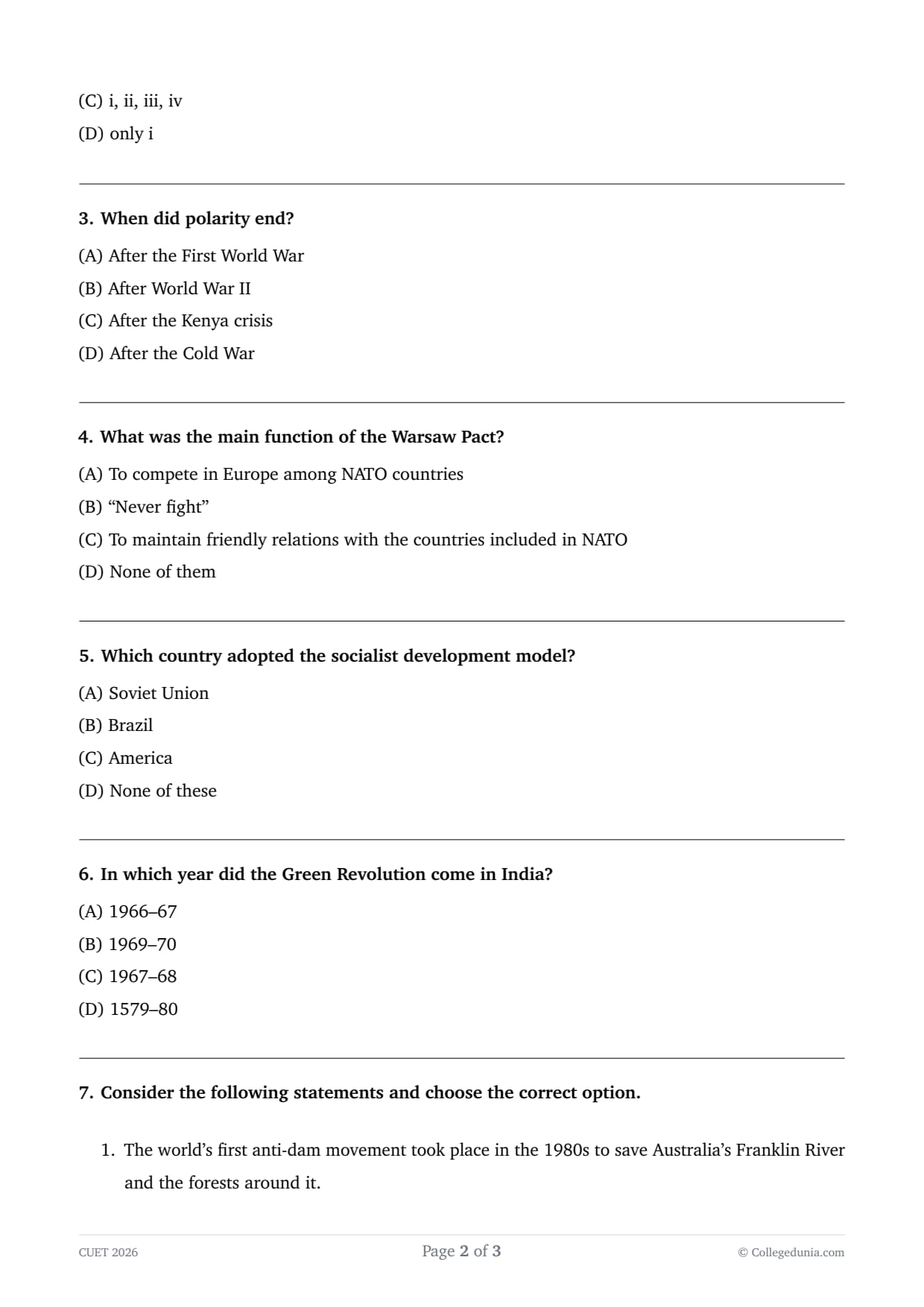
Question 2:

Consider the following statements and select the correct option.
i. The countries involved in the Non-Aligned Movement had established a new international economic system.
ii. The Non-Aligned Movement gave a platform to newly independent countries to remain separate from the superpowers.
iii. The first conference of the Non-Aligned Movement was held in 1961 in Belgrade, Serbia.
iv. The first Non-Aligned Conference included 25 countries.
Choose the correct answer from the options given below:

  • (A) i, ii
  • (B) i, ii, iii
  • (C) i, ii, iii, iv
  • (D) only i
Correct Answer: (C) i, ii, iii, iv
View Solution

Step 1: Examine Statement (i).
The Non-Aligned Movement (NAM) countries advocated the establishment of a more equitable international economic order and worked towards a new international economic system.
\[ \boxed{Statement (i)\ is\ Correct} \]
Step 2: Examine Statement (ii).
NAM provided a platform for newly independent nations to avoid alignment with either the USA-led or USSR-led bloc during the Cold War.
\[ \boxed{Statement (ii)\ is\ Correct} \]
Step 3: Examine Statement (iii).
The First Non-Aligned Summit was held in:
\[ 1961 \] at \[ Belgrade, Yugoslavia \] (present-day Serbia).
\[ \boxed{Statement (iii)\ is\ Correct} \]
Step 4: Examine Statement (iv).
The first NAM Summit at Belgrade was attended by:
\[ 25 countries \] \[ \boxed{Statement (iv)\ is\ Correct} \]
Step 5: Select the correct option.
Since all four statements are correct,
\[ \boxed{i, ii, iii and iv} \] are the correct statements.
Therefore,
\[ \boxed{(C)} \] is the correct answer. Quick Tip: Important facts about NAM: First Summit: \(\boxed{1961}\) Venue: \(\boxed{Belgrade}\) Participating countries: \(\boxed{25}\) Objective: Remain independent of both Cold War power blocs. Founding leaders commonly associated with NAM include: \[ Jawaharlal\ Nehru \] \[ Josip\ Broz\ Tito \] \[ Gamal\ Abdel\ Nasser\ \] \[ Sukarno \] \[ Kwame\ Nkrumah \]


Question 3:

When did polarity end?

  • (A) After the First World War
  • (B) After World War II
  • (C) After the Kenya crisis
  • (D) After the Cold War
Correct Answer: (D) After the Cold War
View Solution

Step 1: Understand the meaning of polarity.
In international relations, polarity refers to the distribution of power among major countries.
During the Cold War, the world was characterized by:
\[ \boxed{Bipolarity} \] with two superpowers:
\[ USA \] and \[ USSR \]
Step 2: Recall the end of the Cold War.
The Cold War ended with the disintegration of the Soviet Union in:
\[ 1991 \]
This marked the collapse of one of the two power blocs.
Step 3: Determine when bipolarity ended.
Since bipolarity depended on the existence of two rival superpowers, it came to an end when the Soviet Union dissolved.
Therefore,
\[ \boxed{Bipolarity ended after the Cold War} \]
Hence, the correct answer is:
\[ \boxed{(D)} \] Quick Tip: Cold War Period: \[ 1945-1991 \] Two Superpowers: \[ \boxed{USA} \] and \[ \boxed{USSR} \] After the collapse of the Soviet Union in 1991: \[ \boxed{Bipolarity\ ended} \] This is a frequently asked CUET question from Contemporary World Politics.


Question 4:

What was the main function of the Warsaw Pact?

  • (A) To compete in Europe among NATO countries
  • (B) ``Never fight''
  • (C) To maintain friendly relations with the countries included in NATO
  • (D) None of them
Correct Answer: (A) To compete in Europe among NATO countries
View Solution

Step 1: Recall the Warsaw Pact.
The Warsaw Pact was a military alliance formed in:
\[ 1955 \] under the leadership of the Soviet Union.
It included the communist countries of Eastern Europe.
Step 2: Understand its purpose.
The Warsaw Pact was created as a response to:
\[ \boxed{NATO (North Atlantic Treaty Organization)} \] which was led by the United States and its Western allies.
Step 3: Identify the main function.
Its primary objective was to provide collective military security for the socialist bloc and counter the influence of NATO in Europe.
Thus, among the given options, the closest correct statement is:
\[ \boxed{To compete in Europe among NATO countries} \]
Therefore,
\[ \boxed{(A)} \] is the correct answer. Quick Tip: Cold War Military Alliances: \[ \boxed{NATO (1949)} \] \[ \boxed{Warsaw\ Pact (1955)} \] NATO represented the Western Bloc, while the Warsaw Pact represented the Soviet-led Eastern Bloc. Remember: \[ NATO \leftrightarrow Warsaw\ Pact \] This opposition was a key feature of Cold War bipolarity.


Question 5:

Which country adopted the socialist development model?

  • (A) Soviet Union
  • (B) Brazil
  • (C) America
  • (D) None of these
Correct Answer: (A) Soviet Union
View Solution

Step 1: Recall the socialist development model.
The socialist development model is based on:
State ownership of major industries
Centralized economic planning
Reduction of economic inequalities
Collective welfare over private profit
Step 2: Identify the country associated with socialism.
After the Bolshevik Revolution of 1917, the Soviet Union adopted a socialist economic system based on the ideas of Karl Marx and Vladimir Lenin.
Step 3: Evaluate the options.
Soviet Union \(\rightarrow\) Adopted the socialist model \(\checkmark\)
Brazil \(\rightarrow\) Followed a mixed/capitalist-oriented economy \(\times\)
America (USA) \(\rightarrow\) Capitalist economy \(\times\)
None of these \(\rightarrow\) Incorrect \(\times\)
Therefore,
\[ \boxed{Soviet Union} \] adopted the socialist development model.
Hence, the correct answer is:
\[ \boxed{(A)} \] Quick Tip: During the Cold War: \[ \boxed{USA \rightarrow Capitalist\ Model} \] \[ \boxed{USSR \rightarrow Socialist\ Model} \] The Soviet economy was characterized by: Central planning State ownership Five-Year Plans A common CUET question from The End of Bipolarity.


Question 6:

In which year did the Green Revolution come in India?

  • (A) 1966--67
  • (B) 1969--70
  • (C) 1967--68
  • (D) 1579--80
Correct Answer: (A) 1966--67
View Solution

Step 1: Recall the Green Revolution.
The Green Revolution refers to the introduction of:
High Yielding Variety (HYV) seeds
Chemical fertilizers
Modern irrigation methods
Improved agricultural technology to increase agricultural production.
Step 2: Identify when it was introduced in India.
The Green Revolution was launched in India during:
\[ \boxed{1966--67} \] under the guidance of agricultural scientists and policymakers.
Step 3: Understand its impact.
The Green Revolution led to:
Increased wheat and rice production
Greater food security
Reduction in dependence on food imports
Agricultural modernization
Therefore,
\[ \boxed{1966--67} \] is the correct year associated with the beginning of the Green Revolution in India.
Hence, the correct answer is:
\[ \boxed{(A)} \] Quick Tip: Key facts about the Green Revolution: \[ \boxed{Started in India: 1966--67} \] \[ \boxed{Father of Green Revolution in India: M. S. Swaminathan} \] Major beneficiaries: \[ Punjab, Haryana and Western Uttar Pradesh \] Main crops: \[ Wheat and Rice \]


Question 7:

Consider the following statements and choose the correct option.
i. The world's first anti-dam movement took place in the 1980s to save Australia's Franklin River and the forests around it.
ii. Hole in the ozone layer is a big threat to human health.
iii. The main concern of the northern countries was not about the hole in the ozone layer and global warming.
iv. Development modalities were suggested as ``Agenda 21'' in the Rio Conference (Earth Summit).
Choose the correct answer from the options given below:

  • (A) Only i and ii
  • (B) Only i, ii and iv
  • (C) All of the above
  • (D) None of the above
Correct Answer: (B) Only i, ii and iv
View Solution

Step 1: Examine Statement (i).
The famous anti-dam movement in the 1980s aimed to save Australia's Franklin River and surrounding forests from dam construction.
\[ \boxed{Statement (i)\ is\ Correct} \]
Step 2: Examine Statement (ii).
Depletion of the ozone layer increases exposure to harmful ultraviolet (UV) radiation, causing skin cancer, cataracts and other health problems.
\[ \boxed{Statement (ii)\ is\ Correct} \]
Step 3: Examine Statement (iii).
Developed northern countries were deeply concerned about environmental issues such as:
Ozone layer depletion
Global warming
Climate change
Therefore, the statement that their main concern was \emph{not about these issues is incorrect.
\[ \boxed{Statement (iii)\ is\ Incorrect} \]
Step 4: Examine Statement (iv).
At the Rio Earth Summit (1992), a comprehensive action plan for sustainable development called:
\[ \boxed{Agenda 21} \] was adopted.
\[ \boxed{Statement (iv)\ is\ Correct} \]
Step 5: Select the correct option.
Correct statements are:
\[ \boxed{i,\; ii,\; iv} \] while statement (iii) is incorrect.
Hence, the correct answer is:
\[ \boxed{(B)} \] Quick Tip: Important Environmental Politics Facts: Franklin River Movement \(\rightarrow\) Australia (1980s) Rio Earth Summit \(\rightarrow\) 1992 Agenda 21 \(\rightarrow\) Sustainable Development Action Plan Ozone depletion \(\rightarrow\) Serious threat to human health Remember: \[ \boxed{Rio\ Summit \Rightarrow Agenda 21} \]


Question 8:

When was Akali Dal formed?

  • (A) Year 1920
  • (B) Year 1936
  • (C) Year 1994
  • (D) Year 1963
Correct Answer: (A) Year 1920
View Solution

Step 1: Recall the origin of the Akali Dal.
The Akali Dal, officially known as the Shiromani Akali Dal (SAD), is a prominent political organization associated with the Sikh community in Punjab.
Step 2: Identify the year of formation.
The Shiromani Akali Dal was established in:
\[ \boxed{1920} \] during the Gurdwara Reform Movement.
Step 3: Understand its objective.
The party was formed to:
Protect Sikh religious interests
Support the Gurdwara Reform Movement
Represent Sikh political aspirations
Therefore,
\[ \boxed{1920} \] is the correct year of formation.
Hence, the correct answer is:
\[ \boxed{(A)} \] Quick Tip: Important Political Party Formation Years: \[ \boxed{Shiromani\ Akali\ Dal\ =\ 1920} \] The party emerged during the: \[ \boxed{Gurdwara\ Reform\ Movement} \] and became one of the major regional political parties in Punjab.


Question 9:

Who first started the movement for independence in 1988 in the Soviet Union?

  • (A) Estonia
  • (B) Latvia
  • (C) Lithuania
  • (D) Ukraine
Correct Answer: (C) Lithuania
View Solution

Step 1: Recall the decline of the Soviet Union.
During the late 1980s, reforms such as:
\[ Glasnost \] and \[ Perestroika \] encouraged nationalist movements in several Soviet republics.
Step 2: Identify the first republic to demand independence.
Among the Soviet republics, Lithuania emerged as the leading force demanding greater autonomy and independence.
In 1988, a strong independence movement began there, which later inspired similar movements in other republics.
Step 3: Determine the correct answer.
The first major movement for independence in the Soviet Union is associated with:
\[ \boxed{Lithuania} \]
Therefore,
\[ \boxed{(C)} \] is the correct answer. Quick Tip: Important facts related to the disintegration of the USSR: Reforms: \(\boxed{Glasnost\ and\ Perestroika}\) Independence movement began strongly in: \(\boxed{Lithuania (1988)}\) Soviet Union dissolved in: \(\boxed{1991}\) Remember: \[ \boxed{Lithuania \rightarrow First\ major\ independence\ movement} \]


Question 10:

Which of the following statements about ``Shock Therapy'' is false?

  • (A) Shock therapy was adopted in 1990.
  • (B) Shock therapy had a good impact on economies.
  • (C) The process of shock therapy began after the fall of the communist system.
  • (D) Treatment by delivering blood is called shock therapy.
Correct Answer: (B) Shock therapy had a good impact on economies.
View Solution

Step 1: Recall the meaning of Shock Therapy.
Shock Therapy refers to the rapid transition from a socialist economy to a market economy in the former Soviet Union and East European countries after the collapse of communism.
Step 2: Understand when it was introduced.
The policy was introduced around: \[ \boxed{1990} \] and gained momentum after the disintegration of the Soviet system.
Thus,
\[ \boxed{Statements (A)\ and\ (C)\ are\ Correct} \]
Step 3: Assess its impact.
NCERT notes that Shock Therapy resulted in:
Economic decline in many regions
Rise in unemployment
Inflation
Increase in poverty and inequality
Therefore, it did \emph{not have an overall good impact on the economies concerned.
\[ \boxed{Statement (B)\ is\ False} \]
Step 4: Select the false statement.
Among the given options, the incorrect statement is:
\[ \boxed{Shock\ therapy\ had\ a\ good\ impact\ on\ economies} \]
Hence, the correct answer is:
\[ \boxed{(B)} \] Quick Tip: Shock Therapy involved: Privatization of state-owned industries Free-market reforms Removal of price controls Opening economies to global trade Consequences: \[ \boxed{Unemployment} \] \[ \boxed{Inflation} \] \[ \boxed{Economic\ hardship} \] Remember: \[ \boxed{Shock Therapy \neq Economic\ Success} \] This is a frequently asked CUET question from The End of Bipolarity.

CUET UG 2026 Exam Pattern

Parameter Details
Exam Name Common University Entrance Test (CUET UG) 2026
Conducting Body National Testing Agency (NTA)
Exam Mode Computer-Based Test (CBT)
Exam Duration 60 minutes per test
Total Sections 3 (Languages, Domain Subjects, General Test)
Question Type Multiple Choice Questions (MCQs)
Questions per Test 50 questions (all compulsory)
Marking Scheme +5 for correct, -1 for incorrect
Maximum Marks 250 marks per test
Maximum Subject Choices 5 subjects in total
Syllabus Base Class 12 NCERT (mainly for Domain Subjects)

CUET UG 2026 Paper Analysis