




CUET 2026 May 15 Shift 1 Sociology Question Paper is available for download here. NTA is conducting the CUET 2026 exam from 11th May to 31st May.
- CUET 2026 Sociology exam consists of 50 questions for 250 marks to be attempted in 60 minutes.
- As per the marking scheme, 5 marks are awarded for each correct answer, and 1 mark is deducted for incorrect answer.
Candidates can download CUET 2026 May 15 Shift 1 Sociology Question Paper with Answer Key and Solution PDF from links provided below.
Related Links:
CUET 2026 Sociology May 15 Shift 1 Question Paper with Solution PDF
| CUET May 15 Shift 1 Sociology Question Paper 2026 | Download PDF | Check Solutions |

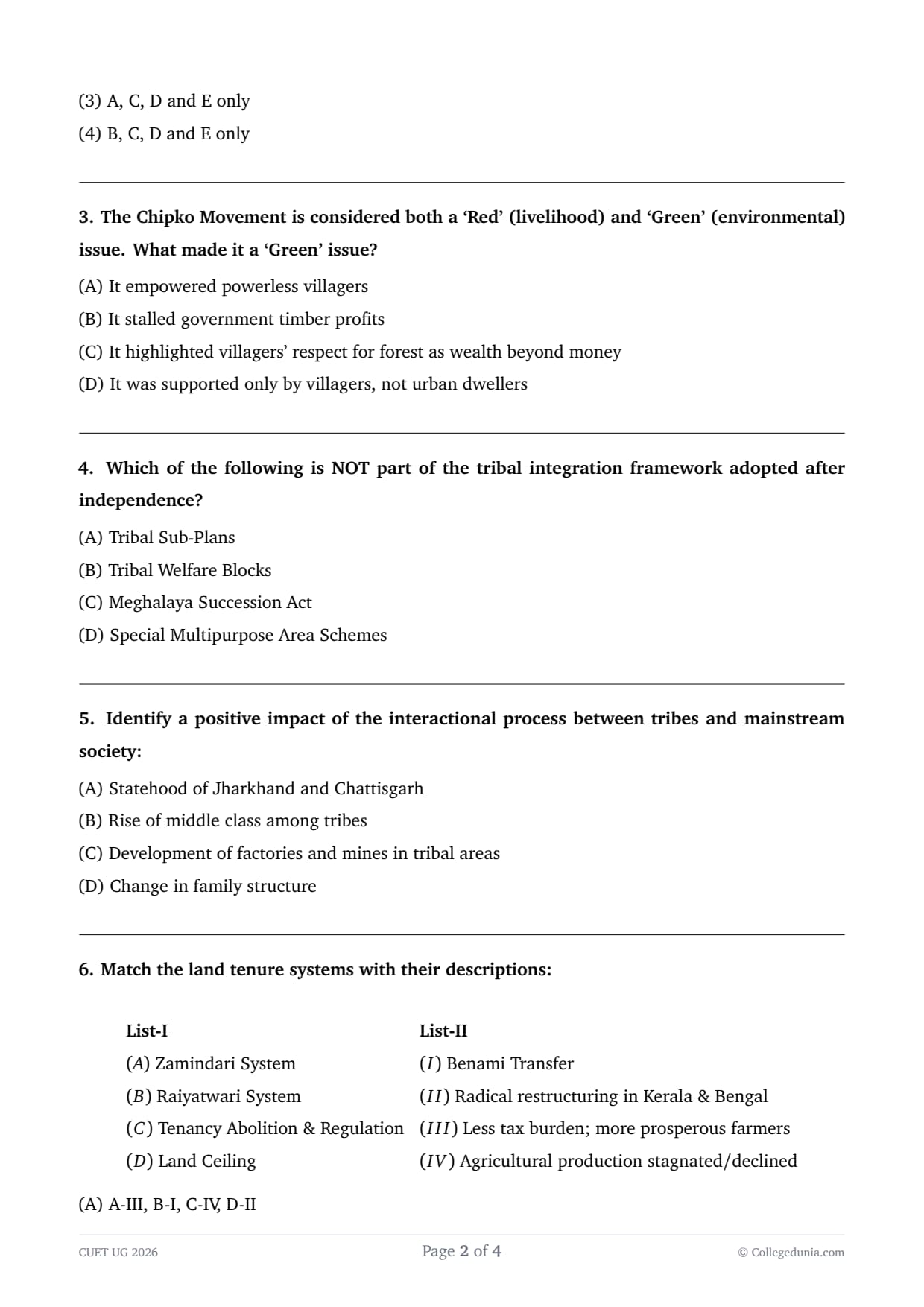
Which of the following is the largest tribal group in India?
During the colonial period, weekly markets in tribal areas underwent significant changes. Which of the following changes took place?
[A.] Tribals lost control over their land
[B.] Roads and transport networks expanded
[C.] Forest resources became more accessible to tribal communities
[D.] Tribal communities were increasingly introduced to the use of money
[E.] Traders and moneylenders entered tribal areas
Choose the correct answer:
The Chipko Movement is considered both a ‘Red’ (livelihood) and ‘Green’ (environmental) issue. What made it a ‘Green’ issue?
Which of the following is NOT part of the tribal integration framework adopted after independence?
Identify a positive impact of the interactional process between tribes and mainstream society:
Match the land tenure systems with their descriptions:
\[ \begin{array}{ll} \textbf{List-I} & \textbf{List-II}
(A)\ Zamindari System & (I)\ Benami Transfer
(B)\ Raiyatwari System & (II)\ Radical restructuring in Kerala \& Bengal
(C)\ Tenancy Abolition \& Regulation & (III)\ Less tax burden; more prosperous farmers
(D)\ Land Ceiling & (IV)\ Agricultural production stagnated/declined \end{array} \]
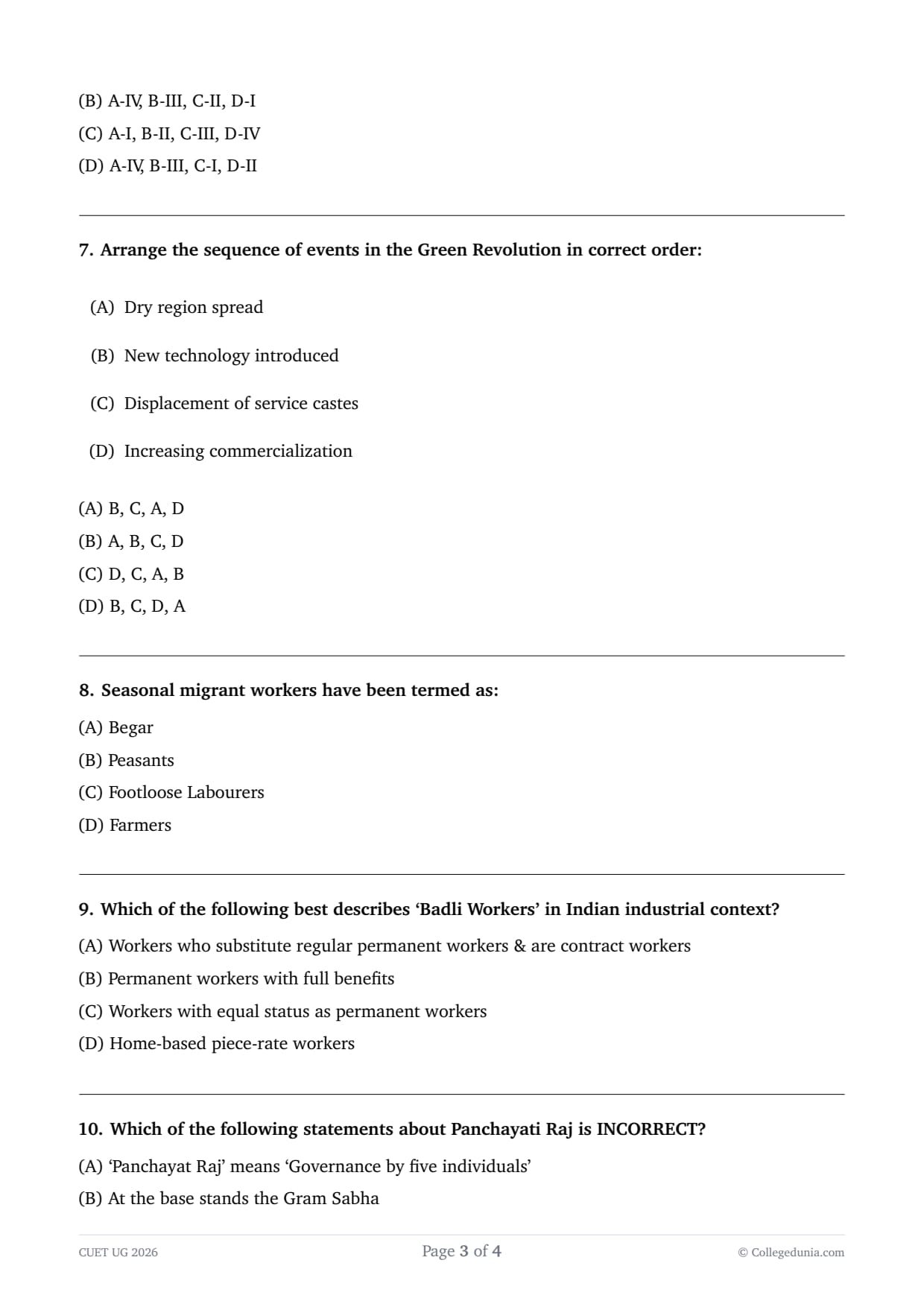
Arrange the sequence of events in the Green Revolution in correct order:
[(A)] Dry region spread
[(B)] New technology introduced
[(C)] Displacement of service castes
[(D)] Increasing commercialization
Seasonal migrant workers have been termed as:
Which of the following best describes ‘Badli Workers’ in Indian industrial context?
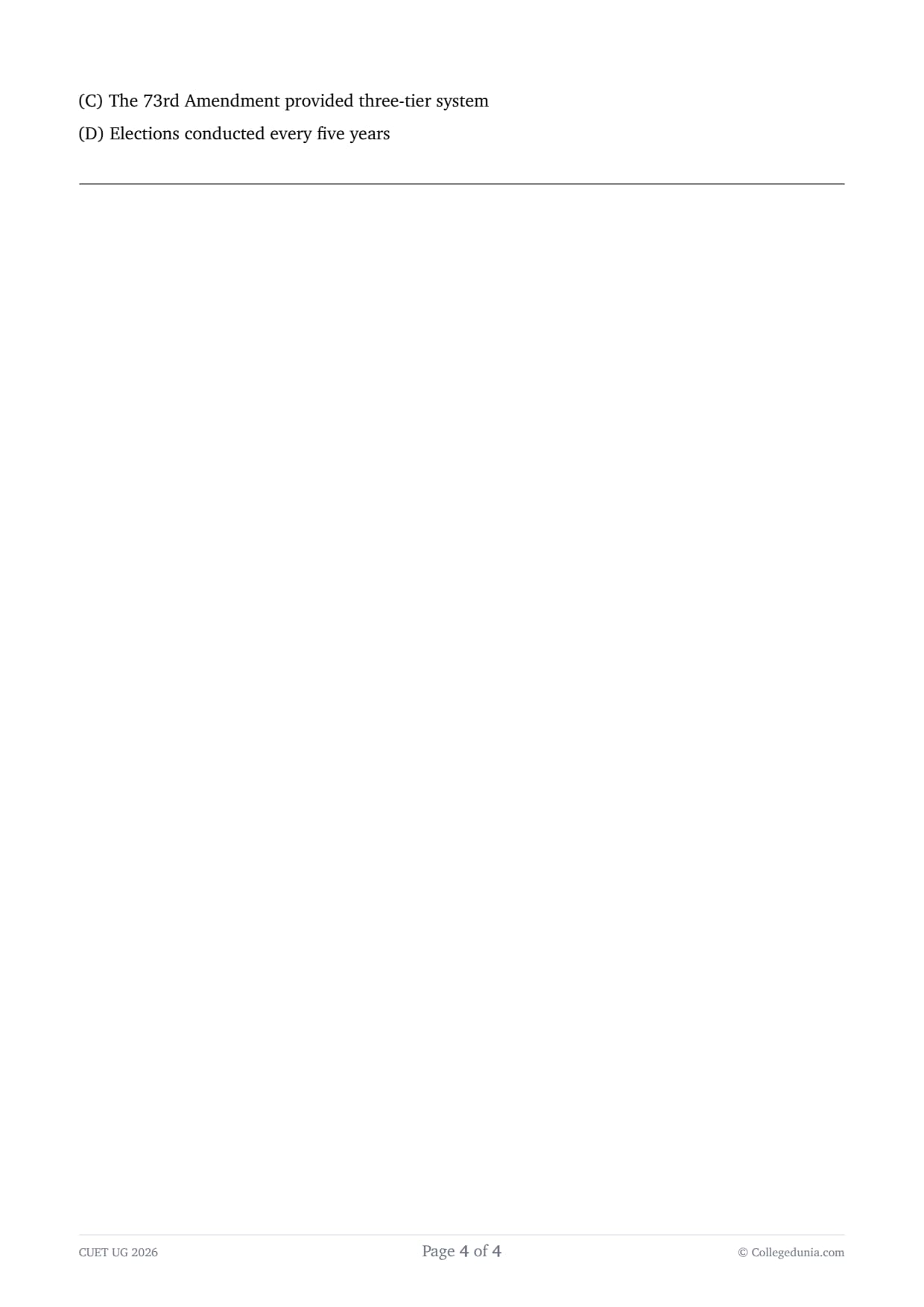
Which of the following statements about Panchayati Raj is INCORRECT?
CUET UG 2026 Exam Pattern
| Parameter | Details |
|---|---|
| Exam Name | Common University Entrance Test (CUET UG) 2026 |
| Conducting Body | National Testing Agency (NTA) |
| Exam Mode | Computer-Based Test (CBT) |
| Exam Duration | 60 minutes per test |
| Total Sections | 3 (Languages, Domain Subjects, General Test) |
| Question Type | Multiple Choice Questions (MCQs) |
| Questions per Test | 50 questions (all compulsory) |
| Marking Scheme | +5 for correct, -1 for incorrect |
| Maximum Marks | 250 marks per test |
| Maximum Subject Choices | 5 subjects in total |
| Syllabus Base | Class 12 NCERT (mainly for Domain Subjects) |



Comments