CUET 2026 May 25 Shift 2 Biology Question Paper is available for download here. NTA is conducting the CUET 2026 exam from 11th May to 31st May.

  • CUET 2026 Biology exam consists of 50 questions for 250 marks to be attempted in 60 minutes.
  • As per the marking scheme, 5 marks are awarded for each correct answer, and 1 mark is deducted for incorrect answer.

Candidates can download CUET 2026 May 25 Shift 2 Biology Question Paper with Answer Key and Solution PDF from links provided below.

Related Links:

CUET 2026 Biology May 25 Shift 2 Question Paper with Solution PDF

CUET May 25 Shift 2 Biology Question Paper 2026 Download PDF Check Solutions


Question 1:

The growth curve observed in a population growing under limited resources is:

  • (A) J-shaped curve
  • (B) S-shaped curve
  • (C) Zig-zag curve
  • (D) Bell-shaped curve
Correct Answer: (B) S-shaped curve
View Solution

Concept:
Population growth under resource limitation follows the logistic growth model.
The logistic growth equation is:
\[ \frac{dN}{dt}=rN\left(\frac{K-N}{K}\right) \]
where: \[ N = Population density \] \[ r = Intrinsic rate of increase \] \[ K = Carrying capacity \]
Step 1: Understand unlimited resource growth.
When resources are unlimited, population increases exponentially and forms a: \[ J-shaped curve \]
Step 2: Understand limited resource growth.
When resources become limited:
Population growth slows down
Competition increases
Population stabilizes near carrying capacity
This produces an: \[ S-shaped (sigmoid) curve \]
Therefore, the correct answer is: \[ \boxed{S-shaped curve} \] Quick Tip: Remember: \[ Exponential growth \rightarrow J-shape \] \[ Logistic growth \rightarrow S-shape \] Carrying capacity (\(K\)) limits population growth.


Question 2:

Assertion (A): Viroids are infectious RNA particles without a protein coat.
Reason (R): Viroids mainly infect plants and cause diseases like potato spindle tuber disease.

  • (A) Both A and R are true and R is the correct explanation of A
  • (B) Both A and R are true but R is not the correct explanation of A
  • (C) A is true but R is false
  • (D) A is false but R is true
Correct Answer: (B) Both A and R are true but R is not the correct explanation of A
View Solution

Step 1: Check Assertion (A).
Viroids are:
Small infectious RNA molecules
Lack protein coat
Simpler than viruses
Hence Assertion (A) is true.
Step 2: Check Reason (R).
Viroids infect plants and can cause diseases such as: \[ Potato\ spindle\ tuber\ disease \]
Hence Reason (R) is also true.
Step 3: Check explanation relation.
Reason (R) gives an example of disease caused by viroids, but it does not explain why viroids lack protein coat.
Hence: \[ \boxed{Both\ A\ and\ R\ are\ true\ but\ R\ is\ not\ the\ correct\ explanation} \] Quick Tip: Remember: Virus = nucleic acid + protein coat Viroid = naked RNA only Prion = infectious protein particle


Question 3:

Match the following:

List-I List-II
(A) Darwin (I) Theory of Natural Selection
(B) H.M.S. Beagle (II) Voyage related to evolution studies
(C) Mimicry (III) Protective resemblance
(D) Pathogen (IV) Disease causing organism

Choose the correct answer from the options given below:

  • (A) A-I, B-II, C-III, D-IV
  • (B) A-II, B-I, C-IV, D-III
  • (C) A-III, B-II, C-I, D-IV
  • (D) A-I, B-IV, C-II, D-III
Correct Answer: (A) A-I, B-II, C-III, D-IV
View Solution

Step 1: Match Darwin.
Darwin proposed: \[ Theory\ of\ Natural\ Selection \]
Thus: \[ A \rightarrow I \]
Step 2: Match H.M.S. Beagle.
H.M.S. Beagle was the ship used during Darwin’s voyage.
Thus: \[ B \rightarrow II \]
Step 3: Match Mimicry and Pathogen.
Mimicry: \[ Protective\ resemblance \]
Pathogen: \[ Disease\ causing\ organism \]
Thus: \[ C \rightarrow III \] \[ D \rightarrow IV \]
Therefore: \[ \boxed{A-I,\ B-II,\ C-III,\ D-IV} \] Quick Tip: Remember: \[ Darwin \rightarrow Natural\ Selection \] \[ H.M.S.\ Beagle \rightarrow Darwin’s\ voyage \] \[ Pathogen \rightarrow Disease\ causing\ agent \]


Question 4:

DNA ligase is mainly used in biotechnology because it:

  • (A) Cuts DNA at specific sites
  • (B) Joins DNA fragments together
  • (C) Synthesizes RNA molecules
  • (D) Breaks hydrogen bonds
Correct Answer: (B) Joins DNA fragments together
View Solution

Concept:
DNA ligase acts as a molecular glue in recombinant DNA technology.
Step 1: Understand function of DNA ligase.
DNA ligase:
Joins DNA fragments
Forms phosphodiester bonds
Helps produce recombinant DNA
Step 2: Eliminate incorrect options.
Restriction enzymes cut DNA
RNA polymerase synthesizes RNA
Helicase breaks hydrogen bonds
Therefore, the correct answer is: \[ \boxed{Joins\ DNA\ fragments\ together} \] Quick Tip: Remember: \[ Restriction\ enzyme \rightarrow Cuts\ DNA \] \[ DNA\ ligase \rightarrow Joins\ DNA \]


Question 5:

In gel electrophoresis, DNA fragments are separated mainly on the basis of:

  • (A) Shape
  • (B) Density
  • (C) Charge only
  • (D) Size
Correct Answer: (D) Size
View Solution

Concept:
Gel electrophoresis is a technique used to separate DNA fragments.
DNA molecules are negatively charged due to phosphate groups and move towards the positive electrode.
Step 1: Understand movement of DNA in gel.
When electric current is passed:
DNA fragments move through agarose gel
Smaller fragments move faster
Larger fragments move slower
Step 2: Identify basis of separation.
Since smaller fragments travel more distance in the same time: \[ DNA\ fragments\ are\ separated\ based\ on\ size \]
Therefore, the correct answer is: \[ \boxed{Size} \] Quick Tip: Remember: \[ Smaller\ DNA\ fragment \rightarrow Moves\ faster\ in\ gel \] \[ Larger\ DNA\ fragment \rightarrow Moves\ slower \]


Question 6:

During oogenesis, the primary oocyte remains arrested in:

  • (A) Metaphase-II
  • (B) Prophase-I
  • (C) Anaphase-I
  • (D) Telophase-II
Correct Answer: (B) Prophase-I
View Solution

Concept:
Oogenesis is the process of formation of female gametes.
Step 1: Understand primary oocyte formation.
During fetal life:
Oogonia divide mitotically
They form primary oocytes
Step 2: Identify arrest stage.
Primary oocytes begin meiosis-I but get arrested at: \[ Prophase-I \] specifically in diplotene stage.
Step 3: Understand completion.
The arrested oocyte resumes meiosis only after puberty during ovulation.
Therefore, the correct answer is: \[ \boxed{Prophase-I} \] Quick Tip: Remember: \[ Primary\ oocyte \rightarrow Prophase-I\ arrest \] \[ Secondary\ oocyte \rightarrow Metaphase-II\ arrest \]


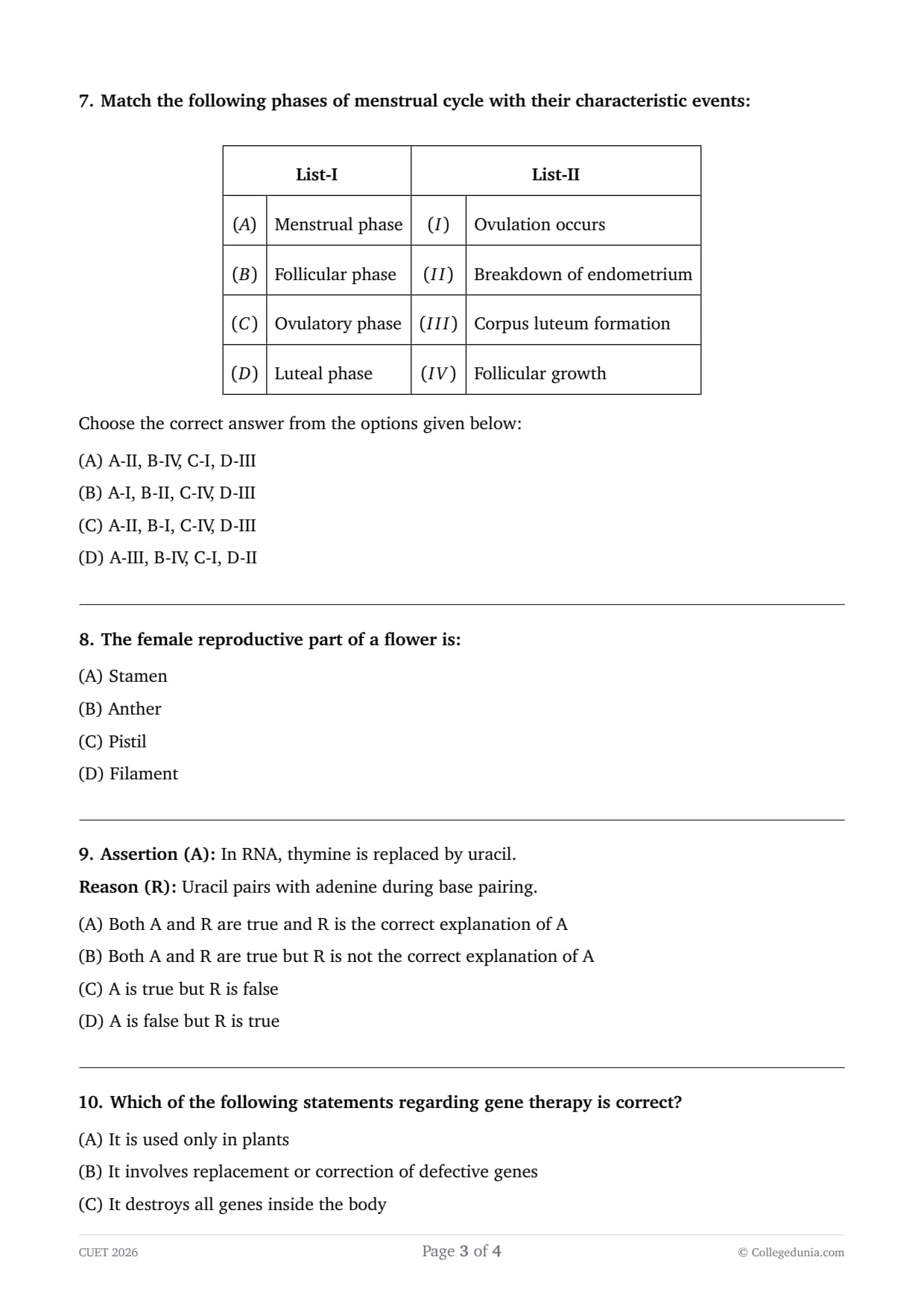
Question 7:

Match the following phases of menstrual cycle with their characteristic events:

List-I List-II
(A) Menstrual phase (I) Ovulation occurs
(B) Follicular phase (II) Breakdown of endometrium
(C) Ovulatory phase (III) Corpus luteum formation
(D) Luteal phase (IV) Follicular growth

Choose the correct answer from the options given below:

  • (A) A-II, B-IV, C-I, D-III
  • (B) A-I, B-II, C-IV, D-III
  • (C) A-II, B-I, C-IV, D-III
  • (D) A-III, B-IV, C-I, D-II
Correct Answer: (A) A-II, B-IV, C-I, D-III
View Solution

Step 1: Identify menstrual phase.
During menstrual phase: \[ Endometrium\ breaks\ down \]
Thus: \[ A \rightarrow II \]
Step 2: Identify follicular phase.
During follicular phase: \[ Ovarian\ follicles\ grow \]
Thus: \[ B \rightarrow IV \]
Step 3: Identify ovulatory and luteal phases.
Ovulatory phase: \[ Ovulation\ occurs \]
Luteal phase: \[ Corpus\ luteum\ forms \]
Thus: \[ C \rightarrow I \] \[ D \rightarrow III \]
Therefore: \[ \boxed{A-II,\ B-IV,\ C-I,\ D-III} \] Quick Tip: Remember: Menstrual phase \(\rightarrow\) Endometrial shedding Follicular phase \(\rightarrow\) Follicle growth Ovulation \(\rightarrow\) Release of ovum Luteal phase \(\rightarrow\) Corpus luteum


Question 8:

The female reproductive part of a flower is:

  • (A) Stamen
  • (B) Anther
  • (C) Pistil
  • (D) Filament
Correct Answer: (C) Pistil
View Solution

Concept:
A flower contains male and female reproductive organs.
Step 1: Identify male reproductive parts.
Male reproductive organ: \[ Stamen \]
It consists of: \[ Anther + Filament \]
Step 2: Identify female reproductive part.
Female reproductive organ: \[ Pistil (Carpel) \]
It consists of:
Stigma
Style
Ovary
Therefore, the correct answer is: \[ \boxed{Pistil} \] Quick Tip: Remember: \[ Stamen \rightarrow Male\ part \] \[ Pistil/Carpel \rightarrow Female\ part \]


Question 9:

Assertion (A): In RNA, thymine is replaced by uracil.
Reason (R): Uracil pairs with adenine during base pairing.

  • (A) Both A and R are true and R is the correct explanation of A
  • (B) Both A and R are true but R is not the correct explanation of A
  • (C) A is true but R is false
  • (D) A is false but R is true
Correct Answer: (B) Both A and R are true but R is not the correct explanation of A
View Solution

Step 1: Check Assertion (A).
RNA contains: \[ Adenine,\ Guanine,\ Cytosine\ and\ Uracil \]
Instead of thymine, RNA contains uracil.
Hence Assertion (A) is true.
Step 2: Check Reason (R).
Uracil pairs with adenine through hydrogen bonding.
Hence Reason (R) is also true.
Step 3: Check explanation relation.
The reason states the pairing property of uracil, but it does not explain why thymine is absent in RNA.
Thus: \[ \boxed{Both\ A\ and\ R\ are\ true\ but\ R\ is\ not\ the\ correct\ explanation} \] Quick Tip: Remember: \[ DNA \rightarrow Contains\ Thymine \] \[ RNA \rightarrow Contains\ Uracil \]


Question 10:

Which of the following statements regarding gene therapy is correct?

  • (A) It is used only in plants
  • (B) It involves replacement or correction of defective genes
  • (C) It destroys all genes inside the body
  • (D) It is a method of protein digestion
Correct Answer: (B) It involves replacement or correction of defective genes
View Solution

Concept:
Gene therapy is a modern biotechnological technique used to treat genetic disorders.
Step 1: Understand gene therapy.
Gene therapy aims to:
Replace defective genes
Correct abnormal genes
Introduce functional genes
Step 2: Eliminate incorrect options.
It is not limited to plants
It does not destroy all genes
It is unrelated to protein digestion
Therefore, the correct answer is: \[ \boxed{Replacement\ or\ correction\ of\ defective\ genes} \] Quick Tip: Remember: \[ Gene\ therapy \rightarrow Treats\ genetic\ disorders \] It works by introducing functional genes into cells.

CUET UG 2026 Exam Pattern

Parameter Details
Exam Name Common University Entrance Test (CUET UG) 2026
Conducting Body National Testing Agency (NTA)
Exam Mode Computer-Based Test (CBT)
Exam Duration 60 minutes per test
Total Sections 3 (Languages, Domain Subjects, General Test)
Question Type Multiple Choice Questions (MCQs)
Questions per Test 50 questions (all compulsory)
Marking Scheme +5 for correct, -1 for incorrect
Maximum Marks 250 marks per test
Maximum Subject Choices 5 subjects in total
Syllabus Base Class 12 NCERT (mainly for Domain Subjects)

CUET UG 2026 Paper Analysis