CUET 2026 May 15 Shift 1 Geography Question Paper is available for download here. NTA is conducting the CUET 2026 exam from 11th May to 31st May.

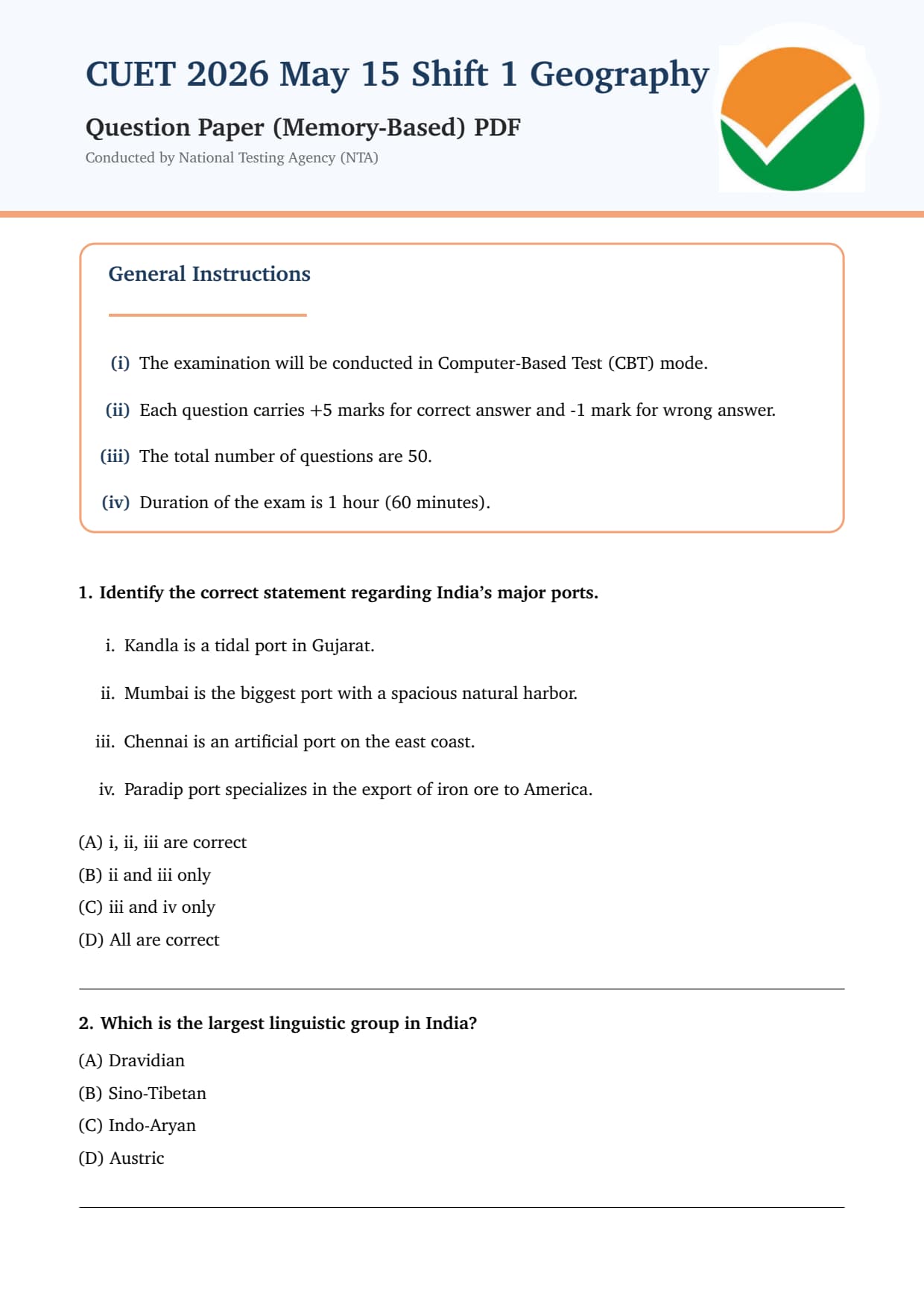
  • CUET 2026 Geography exam consists of 50 questions for 250 marks to be attempted in 60 minutes.
  • As per the marking scheme, 5 marks are awarded for each correct answer, and 1 mark is deducted for incorrect answer.

Candidates can download CUET 2026 May 15 Shift 1 Geography Question Paper with Answer Key and Solution PDF from links provided below.

Related Links:

CUET 2026 Geography May 15 Shift 1 Question Paper with Solution PDF

CUET May 15 Shift 1 Geography Question Paper 2026 Download PDF Check Solutions


Question 1:

Identify the correct statement regarding India's major ports.

i.
 Kandla is a tidal port in Gujarat.
ii.
 Mumbai is the biggest port with a spacious natural harbor.
iii.
 Chennai is an artificial port on the east coast.
iv.
 Paradip port specializes in the export of iron ore to America.

  • (A) i, ii, iii are correct
  • (B) ii and iii only
  • (C) iii and iv only
  • (D) All are correct
Correct Answer: (A) i, ii, iii are correct
View Solution


Concept:

India has a coastline of about 7,516 km and possesses several important ports that facilitate international trade, transportation, and economic development. Ports are broadly classified as natural ports, artificial ports, and tidal ports depending upon their geographical and structural characteristics. Questions related to Indian ports generally test knowledge of their location, type, and specialization.

Step 1: Analyzing Statement (i): Kandla is a tidal port in Gujarat.


Kandla Port is situated in the Gulf of Kutch in the state of Gujarat. It was developed after Independence to reduce the pressure on Mumbai Port and to compensate for the loss of Karachi Port after partition.

Kandla is classified as a tidal port because the water level in the harbor changes significantly with tides. It is one of India's major ports handling petroleum, fertilizers, food grains, and other bulk cargo.

Therefore, statement (i) is correct.

Step 2: Analyzing Statement (ii): Mumbai is the biggest port with a spacious natural harbor.


Mumbai Port is one of the largest and busiest ports in India. It is located on the western coast and possesses a deep and spacious natural harbor, which provides excellent docking facilities for ships.

The natural harbor gives Mumbai a strategic advantage because ships can anchor safely without extensive artificial construction.

Thus, statement (ii) is also correct.

Step 3: Analyzing Statement (iii): Chennai is an artificial port on the east coast.


Chennai Port lies on the Coromandel Coast along the Bay of Bengal. Unlike Mumbai Port, it does not possess a naturally protected harbor.

Hence, extensive engineering structures such as breakwaters were constructed to create a safe harbor. Therefore, Chennai is regarded as an artificial port.

Thus, statement (iii) is correct.

Step 4: Analyzing Statement (iv): Paradip specializes in export of iron ore to America.


Paradip Port is located in Odisha and is well known for exporting iron ore. However, the major destinations of iron ore exported through Paradip are mainly Japan and East Asian countries, not America.

Hence, the statement becomes factually incorrect because of the incorrect export destination mentioned.

Therefore, statement (iv) is incorrect.

Step 5: Final conclusion.


Since statements (i), (ii), and (iii) are correct while statement (iv) is incorrect, the correct option is:
\[ \boxed{(A) i, ii, iii are correct} \] Quick Tip: Important Indian Ports: Natural Ports: Mumbai, Kochi, Visakhapatnam.
Artificial Ports: Chennai, Ennore.
Tidal Ports: Kandla, Kolkata.


Question 2:

Which is the largest linguistic group in India?

  • (A) Dravidian
  • (B) Sino-Tibetan
  • (C) Indo-Aryan
  • (D) Austric
Correct Answer: (C) Indo-Aryan
View Solution


Concept:

India is one of the most linguistically diverse countries in the world. Indian languages are classified into four major linguistic families:

Indo-Aryan
Dravidian
Austric
Sino-Tibetan


Among these groups, the Indo-Aryan family has the highest number of speakers.

Step 1: Understanding the Indo-Aryan linguistic group.


The Indo-Aryan language family belongs to the larger Indo-European language group. It is spoken mainly in Northern, Central, and Western India.

Languages included in this family are:

Hindi
Bengali
Marathi
Gujarati
Punjabi
Assamese
Odia
Sanskrit


Approximately 74% of India's population speaks Indo-Aryan languages.

Therefore, it is the largest linguistic group in India.

Step 2: Analyzing the Dravidian group.


The Dravidian family is the second-largest linguistic group and is concentrated mainly in South India.

Major Dravidian languages include:

Tamil
Telugu
Kannada
Malayalam


It accounts for nearly 20% of the Indian population.

Step 3: Analyzing Austric and Sino-Tibetan groups.


The Austric group is mainly spoken by tribal populations in central and eastern India.

The Sino-Tibetan group is spoken in the Himalayan and North-Eastern regions of India.

Both of these groups represent comparatively smaller populations.

Step 4: Final conclusion.


Since the Indo-Aryan family is spoken by the majority of Indians, it is the largest linguistic group in India.
\[ \boxed{(C) Indo-Aryan} \] Quick Tip: Order of major linguistic groups in India by population: Indo-Aryan \(>\) Dravidian \(>\) Austric \(>\) Sino-Tibetan.


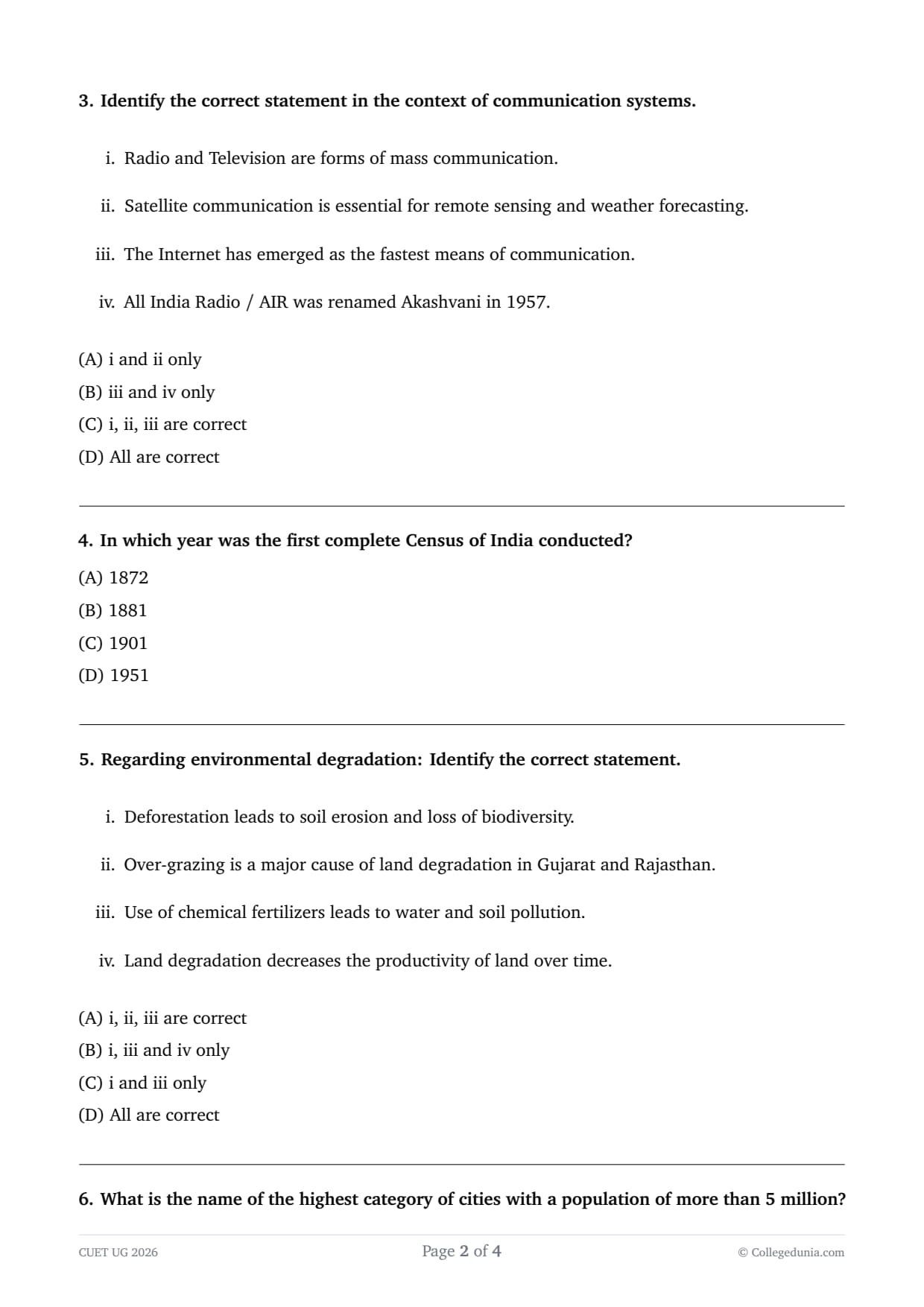
Question 3:

Identify the correct statement in the context of communication systems.

i. Radio and Television are forms of mass communication.
ii. Satellite communication is essential for remote sensing and weather forecasting.
iii. The Internet has emerged as the fastest means of communication.
iv. All India Radio / AIR was renamed Akashvani in 1957.

  • (A) i and ii only
  • (B) iii and iv only
  • (C) i, ii, iii are correct
  • (D) All are correct
Correct Answer: (D) All are correct
View Solution


Concept:

Communication systems are extremely important for connecting people, transferring information, and supporting economic and social development. Modern communication systems include radio, television, satellites, telephones, and the internet.

Step 1: Analyzing Statement (i).


Radio and Television are forms of mass communication because they transmit information to millions of people simultaneously.

They are used for:

News broadcasting
Education
Entertainment
Public awareness


Hence, statement (i) is correct.

Step 2: Analyzing Statement (ii).


Satellite communication plays a vital role in:

Weather forecasting
Disaster management
Remote sensing
Telecommunications


India uses INSAT and IRS satellite systems for these purposes.

Therefore, statement (ii) is correct.

Step 3: Analyzing Statement (iii).


The Internet enables instantaneous communication across the globe through emails, social media, video conferencing, and data transfer.

Due to its speed and accessibility, it is regarded as the fastest means of communication in the modern world.

Hence, statement (iii) is correct.

Step 4: Analyzing Statement (iv).


All India Radio (AIR) was officially renamed Akashvani in the year 1957.

Thus, statement (iv) is also correct.

Step 5: Final conclusion.


All four statements are correct.
\[ \boxed{(D) All are correct} \] Quick Tip: Important years: 1923 -- First Radio Broadcast in India
1936 -- Named All India Radio (AIR)
1957 -- Renamed Akashvani


Question 4:

In which year was the first complete Census of India conducted?

  • (A) 1872
  • (B) 1881
  • (C) 1901
  • (D) 1951
Correct Answer: (B) 1881
View Solution


Concept:

A Census is the official process of collecting, recording, and analyzing demographic, social, and economic information about the population of a country. In India, the Census is conducted every ten years under the authority of the Government of India. It provides essential information related to population size, literacy, occupation, sex ratio, urbanization, and many other socio-economic indicators.

Step 1: Understanding the early history of Census in India.


The first attempt to collect population-related information in India was made during British rule. In the year 1872, Lord Mayo initiated population enumeration in different regions of India.

However, this exercise was not conducted simultaneously across the entire country. Different provinces collected data at different times and through different methods.

Therefore, the Census of 1872 is regarded as the first non-synchronous or incomplete census.

Step 2: Identifying the first complete Census.


The first complete and synchronous Census of India was conducted in the year 1881 during the tenure of Lord Ripon.

The term ``synchronous'' means that the Census was conducted at the same time throughout the country using a uniform procedure and methodology.

This Census marked the beginning of the regular decennial Census system in India.

Hence, 1881 is considered the first complete Census of India.

Step 3: Analyzing the remaining options.


1901: This was an important Census conducted under Herbert Risley, but it was not the first Census.
1951: This was the first Census conducted after India's independence.


Thus, these options are incorrect.

Step 4: Final conclusion.


The first complete and synchronous Census of India was conducted in:
\[ \boxed{1881} \]

Therefore, the correct option is:
\[ \boxed{(B) 1881} \] Quick Tip: Important Census years: 1872 -- First Census attempt (Lord Mayo)
1881 -- First complete synchronous Census (Lord Ripon)
1951 -- First Census after Independence
2011 -- Latest completed Census of India


Question 5:

Regarding environmental degradation: Identify the correct statement.

i. Deforestation leads to soil erosion and loss of biodiversity.
ii. Over-grazing is a major cause of land degradation in Gujarat and Rajasthan.
iii. Use of chemical fertilizers leads to water and soil pollution.
iv. Land degradation decreases the productivity of land over time.

  • (A) i, ii, iii are correct
  • (B) i, iii and iv only
  • (C) i and iii only
  • (D) All are correct
Correct Answer: (D) All are correct
View Solution


Concept:

Environmental degradation refers to the deterioration of the natural environment due to excessive exploitation of natural resources and harmful human activities. Land degradation, deforestation, pollution, and overuse of chemicals negatively affect soil quality, biodiversity, water resources, and agricultural productivity.

Step 1: Analyzing Statement (i): Deforestation leads to soil erosion and loss of biodiversity.


Forests play a crucial role in maintaining ecological balance. Tree roots bind soil particles together and prevent them from being washed away by rain or blown away by wind.

When forests are cut down:

Soil becomes loose and vulnerable to erosion.
Habitats of plants and animals are destroyed.
Biodiversity decreases significantly.


Thus, deforestation directly causes both soil erosion and biodiversity loss.

Therefore, statement (i) is correct.

Step 2: Analyzing Statement (ii): Over-grazing is a major cause of land degradation in Gujarat and Rajasthan.


Over-grazing occurs when livestock graze excessively on grasslands without allowing vegetation enough time to regenerate.

This process:

Removes protective vegetation cover
Exposes soil to erosion
Reduces soil fertility
Accelerates desertification


In dry and semi-arid states such as Gujarat and Rajasthan, over-grazing is indeed a major cause of land degradation.

Hence, statement (ii) is correct.

Step 3: Analyzing Statement (iii): Use of chemical fertilizers leads to water and soil pollution.


Chemical fertilizers are widely used to increase agricultural productivity. However, excessive use creates serious environmental problems.

These chemicals:

Alter the natural composition of soil
Reduce long-term soil fertility
Leach into groundwater
Pollute nearby rivers and lakes


This causes both soil pollution and water pollution.

Therefore, statement (iii) is correct.

Step 4: Analyzing Statement (iv): Land degradation decreases productivity over time.


Land degradation reduces:

Soil fertility
Moisture retention capacity
Nutrient content
Agricultural efficiency


As a result, the productivity of land continuously decreases with time.

Thus, statement (iv) is also correct.

Step 5: Final conclusion.


Since all four statements are correct, the correct option is:
\[ \boxed{(D) All are correct} \] Quick Tip: Major causes of land degradation: Over-grazing -- Rajasthan, Gujarat
Mining -- Jharkhand, Odisha, Chhattisgarh
Over-irrigation -- Punjab, Haryana
Deforestation -- Himalayan and tribal regions


Question 6:

What is the name of the highest category of cities with a population of more than 5 million?

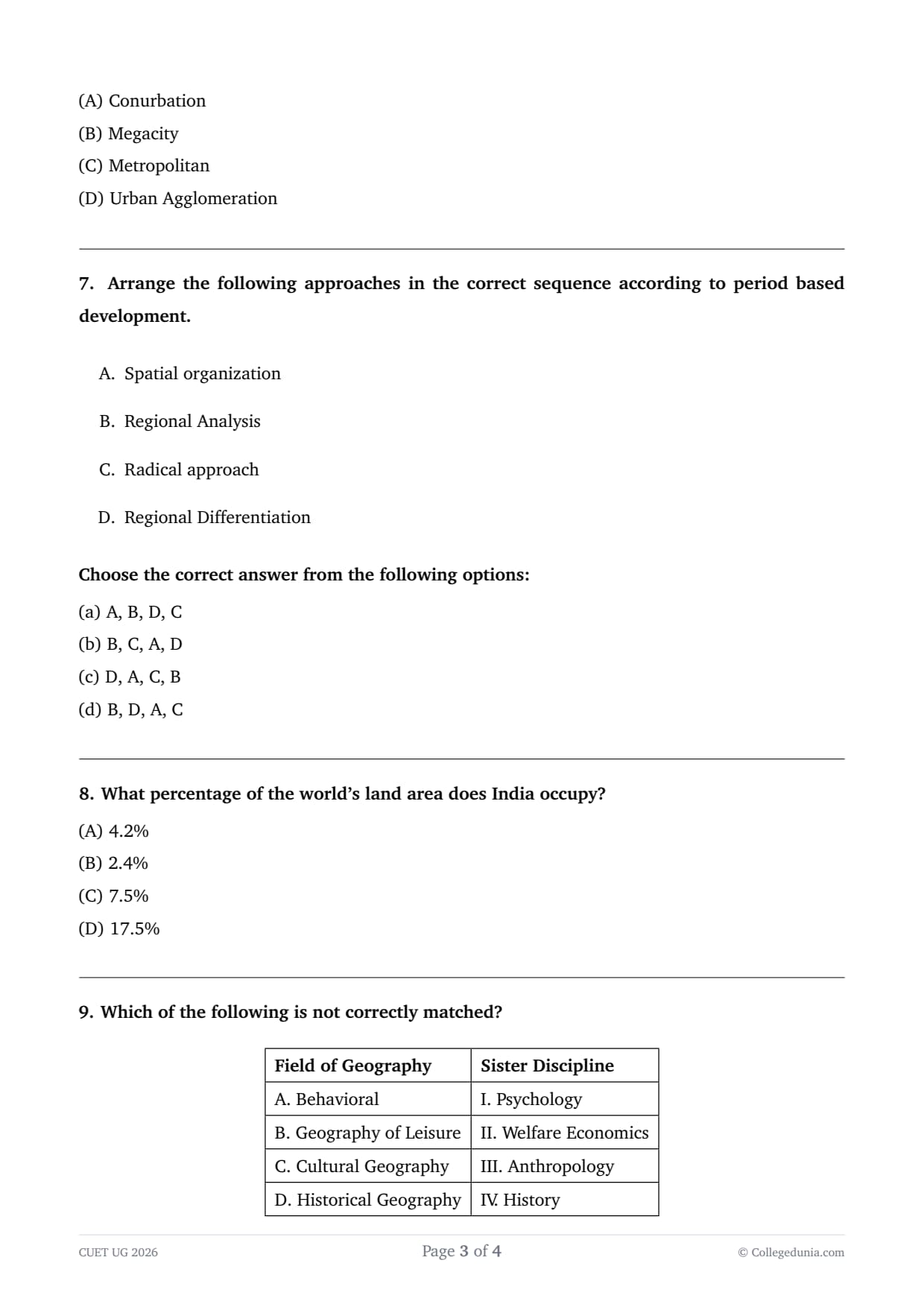
  • (A) Conurbation
  • (B) Megacity
  • (C) Metropolitan
  • (D) Urban Agglomeration
Correct Answer: (B) Megacity
View Solution


Concept:
Urban settlements are classified on the basis of population size, administrative importance, economic functions, and spatial expansion. As the size and influence of a city increase, it moves into higher categories such as city, metropolitan city, and megacity. These classifications help geographers and planners understand patterns of urbanization and population concentration.

Step 1: Understanding the classification of urban settlements.


In India, urban settlements are broadly divided into different classes according to population:


Class I City: Population greater than 1 lakh.
Metropolitan City: Population greater than 1 million (10 lakh).
Megacity: Population greater than 5 million (50 lakh).


Thus, a city having a population above 5 million falls into the category of a Megacity.

Step 2: Understanding the meaning of the other options.


Conurbation:
A conurbation refers to a continuous urban region formed when multiple towns and cities grow and merge together physically. It describes the spatial merging of urban areas rather than a population category.

Metropolitan City:
A metropolitan city generally refers to an urban area with a population exceeding 1 million. Since the question specifically asks for cities having population above 5 million, this option is not the most appropriate.

Urban Agglomeration:
An urban agglomeration is a continuous urban spread consisting of a town and adjoining urban outgrowths. It is an administrative and geographical term rather than a population category.

Step 3: Identifying the correct option.


Since cities having population more than 5 million are classified as Megacities, option (B) is correct.

Examples of megacities in India include:

Mumbai
Delhi
Kolkata
Bengaluru
Chennai


These cities are characterized by very high population density, extensive infrastructure, industrial concentration, and advanced transportation networks. Quick Tip: Important Urban Population Categories: Class I City \(\rightarrow\) Above 1 lakh Metropolitan City \(\rightarrow\) Above 1 million Megacity \(\rightarrow\) Above 5 million


Question 7:

Arrange the following approaches in the correct sequence according to period based development.

[A.] Spatial organization
[B.] Regional Analysis
[C.] Radical approach
[D.] Regional Differentiation

Choose the correct answer from the following options:

  • (a) A, B, D, C
  • (b) B, C, A, D
  • (c) D, A, C, B
  • (d) B, D, A, C
Correct Answer: (d) B, D, A, C
View Solution


Concept:
Human Geography has evolved through different intellectual phases. Each phase introduced a new method and perspective for studying regions, societies, spatial patterns, and human-environment relationships. Understanding the chronological order of these approaches is important in the study of the evolution of geographical thought.

Step 1: Regional Analysis (B).


The earliest major approach was Regional Analysis. During this phase, geographers focused on describing regions individually. The main objective was to understand the uniqueness of each region by studying its physical and human characteristics together.

This approach dominated during the late nineteenth and early twentieth centuries.

Step 2: Regional Differentiation (D).


The next stage was Regional Differentiation. This approach emphasized identifying how one region differs from another. Geographers attempted to classify regions on the basis of similarities and differences in climate, economy, culture, and settlement.

This became prominent during the inter-war period.

Step 3: Spatial Organization (A).


After regional approaches, Geography entered the phase of quantitative revolution during the 1950s and 1960s. This gave rise to the Spatial Organization approach.

In this stage:

Statistical tools were used.
Mathematical models became important.
Spatial patterns of population, industries, transport, and settlements were analyzed scientifically.


The emphasis shifted from descriptive geography to analytical geography.

Step 4: Radical Approach (C).


During the 1970s, dissatisfaction arose against excessive dependence on mathematical models. This led to the emergence of the Radical Approach.

This approach:

Focused on social inequality and poverty.
Was influenced by Marxist ideology.
Emphasized welfare and social justice.
Criticized capitalism and uneven development.


Step 5: Arranging the correct order.


Thus, the chronological order becomes:
\[ Regional Analysis \rightarrow Regional Differentiation \rightarrow Spatial Organization \rightarrow Radical Approach \]

That is:
\[ B \rightarrow D \rightarrow A \rightarrow C \]

Hence, option (d) is correct. Quick Tip: Evolution of Geographical Thought: Regional Analysis \(\rightarrow\) Regional Differentiation \(\rightarrow\) Spatial Organization \(\rightarrow\) Radical Approach


Question 8:

What percentage of the world's land area does India occupy?

  • (A) 4.2%
  • (B) 2.4%
  • (C) 7.5%
  • (D) 17.5%
Correct Answer: (B) 2.4%
View Solution


Concept:
India is one of the largest countries in the world in terms of population and geographical diversity. However, despite its huge population, India occupies only a small percentage of the total land area of the world.

Step 1: Understanding India's geographical area.


India has a total geographical area of approximately:
\[ 3.28 million square kilometers \]

The total land area of the Earth is approximately:
\[ 148.9 million square kilometers \]

Step 2: Calculating the percentage share.


The percentage share of India in the world's land area can be expressed as:
\[ Percentage Share = \left( \frac{Area of India}{Total World Land Area} \right) \times 100 \]

Substituting the values:
\[ = \left( \frac{3.28}{148.9} \right) \times 100 \]
\[ \approx 2.4% \]

Thus, India occupies approximately 2.4% of the world's land area.

Step 3: Comparing land area with population share.


An important geographical fact is that:

India occupies only 2.4% of the world's land area.
But India supports around 17.5% of the world's population.


This shows the enormous population pressure on India's natural resources, agriculture, housing, transport, and environment.

Step 4: Analyzing other options.


4.2%: Incorrect and not related to India's land area share.

7.5%: Incorrect; sometimes confused with biodiversity-related figures.

17.5%: Represents India's approximate share in world population, not land area.

Therefore, the correct answer is option (B). Quick Tip: Remember: India's share in World Area = 2.4% India's share in World Population = 17.5%


Question 9:

Which of the following is not correctly matched?


{Field of Geography} & {Sister Discipline}

A. Behavioral & I. Psychology

B. Geography of Leisure & II. Welfare Economics

C. Cultural Geography & III. Anthropology

D. Historical Geography & IV. History


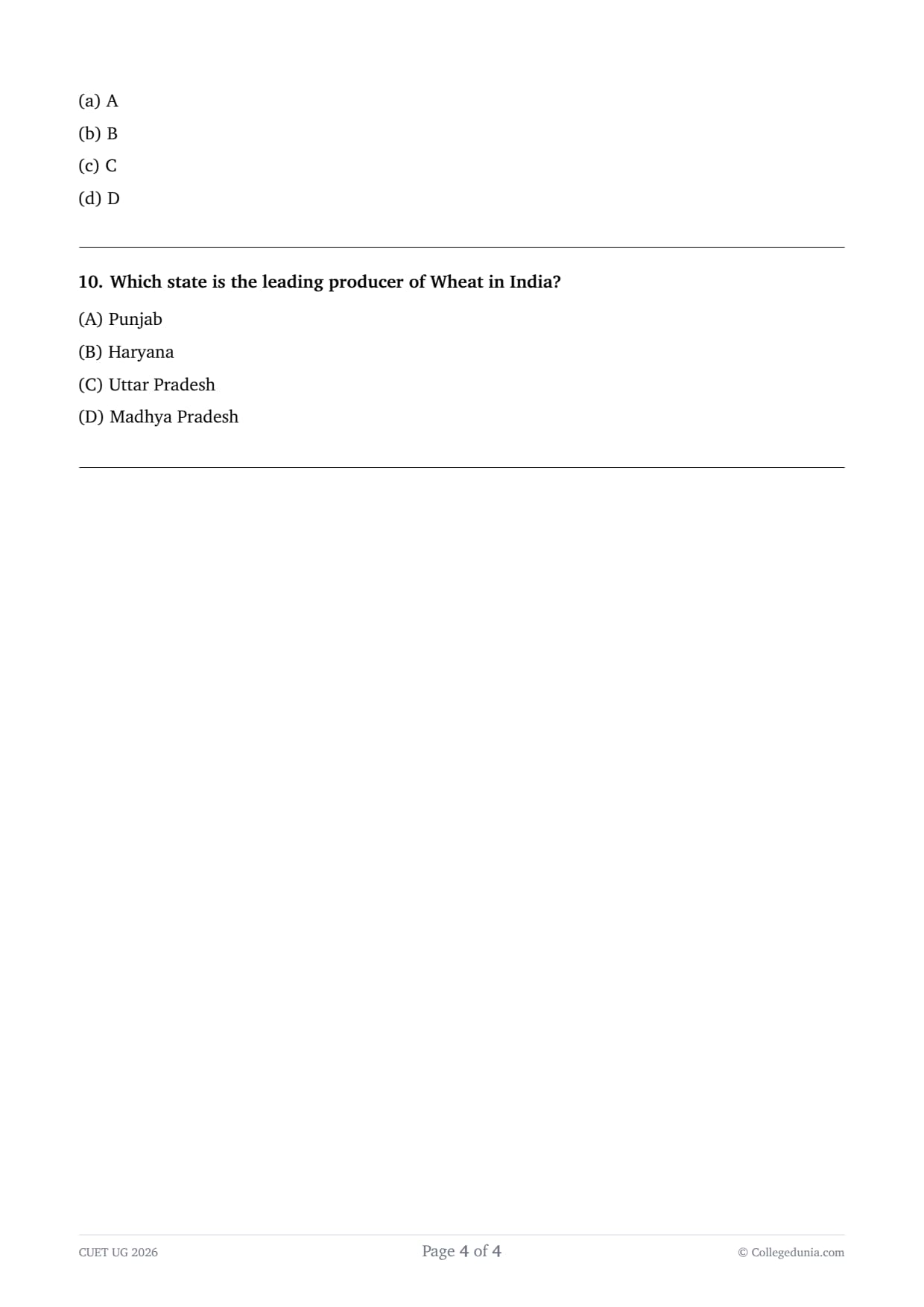
  • (a) A
  • (b) B
  • (c) C
  • (d) D
Correct Answer: (b) B
View Solution


Concept:
Human Geography is interdisciplinary in nature. Different branches of geography are closely connected with various social sciences, known as sister disciplines. These disciplines provide theories, methods, and concepts that help geographers study human activities and spatial patterns.

Step 1: Checking Match A: Behavioral Geography -- Psychology.


Behavioral Geography studies human perception, decision-making, attitudes, and spatial behavior. These ideas are deeply connected with Psychology.

Therefore, Match A is correct.

Step 2: Checking Match B: Geography of Leisure -- Welfare Economics.


Geography of Leisure studies recreation, tourism, entertainment, and the use of free time in different places.

Its related discipline is mainly:

Sociology
Sociology of Leisure
Tourism Studies


Welfare Economics is actually related to Welfare Geography, not Geography of Leisure.

Hence, Match B is incorrect.

Step 3: Checking Match C: Cultural Geography -- Anthropology.


Cultural Geography studies cultural landscapes, traditions, language, religion, and human lifestyles across regions.

Anthropology also studies human culture and societies. Therefore, Cultural Geography is closely related to Anthropology.

Hence, Match C is correct.

Step 4: Checking Match D: Historical Geography -- History.


Historical Geography examines changes in places and landscapes over time. Since it deals with past events and temporal development, it is naturally linked with the discipline of History.

Therefore, Match D is correct.

Final Conclusion:


Only option B is incorrectly matched.

Hence, the correct answer is option (b). Quick Tip: Important Sister Disciplines: Behavioral Geography \(\rightarrow\) Psychology Cultural Geography \(\rightarrow\) Anthropology Historical Geography \(\rightarrow\) History Welfare Geography \(\rightarrow\) Welfare Economics


Question 10:

Which state is the leading producer of Wheat in India?

  • (A) Punjab
  • (B) Haryana
  • (C) Uttar Pradesh
  • (D) Madhya Pradesh
Correct Answer: (C) Uttar Pradesh
View Solution


Concept:
Wheat is one of the most important food crops of India and serves as the staple diet for a large section of the population, especially in northern India. It is a rabi crop cultivated during the winter season and harvested in spring.

Step 1: Understanding wheat cultivation in India.


Wheat requires:

Cool and moist climate during growth.
Bright sunshine during ripening.
Well-drained fertile alluvial soil.
Moderate rainfall or irrigation.


These conditions are ideally found in the Indo-Gangetic Plains.

Step 2: Identifying the leading wheat-producing state.


Uttar Pradesh is the largest producer of wheat in India because:

It has extensive fertile alluvial plains.
Irrigation facilities are highly developed.
The climate is favorable for rabi cultivation.
Large agricultural land area is available.


The state contributes approximately one-third of India's total wheat production.

Step 3: Understanding the role of other states.


Punjab:
Punjab has one of the highest wheat yields per hectare due to modern farming methods and Green Revolution technologies.

Haryana:
Haryana is also a major producer with intensive irrigation and mechanized farming.

Madhya Pradesh:
Madhya Pradesh has recently increased wheat production significantly, especially due to Sharbati wheat cultivation.

However, in terms of total production, Uttar Pradesh remains the leading producer.

Step 4: Importance of Wheat Production.


Wheat is important because:

It is a staple food crop.
It contributes significantly to food security.
It supports agro-based industries.
It forms a major component of India's Public Distribution System (PDS).


Therefore, the correct answer is option (C). Quick Tip: Largest Wheat Producer in India \(\rightarrow\) Uttar Pradesh Highest Productivity States \(\rightarrow\) Punjab and Haryana

CUET UG 2026 Exam Pattern

Parameter Details
Exam Name Common University Entrance Test (CUET UG) 2026
Conducting Body National Testing Agency (NTA)
Exam Mode Computer-Based Test (CBT)
Exam Duration 60 minutes per test
Total Sections 3 (Languages, Domain Subjects, General Test)
Question Type Multiple Choice Questions (MCQs)
Questions per Test 50 questions (all compulsory)
Marking Scheme +5 for correct, -1 for incorrect
Maximum Marks 250 marks per test
Maximum Subject Choices 5 subjects in total
Syllabus Base Class 12 NCERT (mainly for Domain Subjects)

CUET UG 2026 Question Paper Analysis